They Said the Stray Wouldn’t Survive the Night—What Happened Next Will STUN You
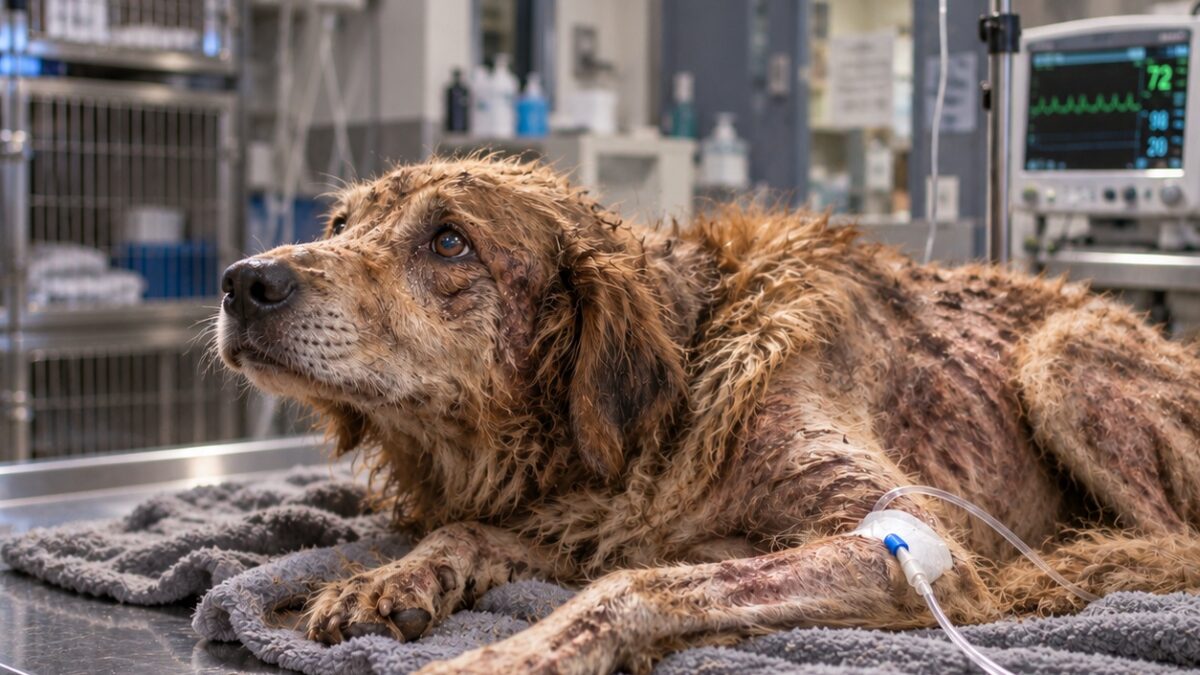
The parvo test came back negative.
That was the first good thing.
His blood work was terrible.
That was nearly everything else.
Severe anemia.
Dehydration.
High white-cell count.
Low protein.
Electrolyte imbalance.
Signs of prolonged malnutrition.
Possible systemic infection.
His body had been consuming itself for so long that there was almost nothing left to borrow from.
Dr. Harris, the shelter veterinarian supervising my rotation, stood beside the kennel reading the results.
He was fifty-eight, calm under pressure, and rarely sentimental about medicine.
That made his silence frightening.
“What do you think?” I asked.
He looked at me.
“You want the student answer or the honest answer?”
“Both.”
“The student answer is we stabilize hydration, correct electrolytes carefully, treat infection, manage nutrition slowly, control pain, monitor blood values, and reassess.”
“And the honest answer?”
“He may die anyway.”
I looked through the kennel bars.
Chance’s eyes were closed.
“Tonight?”
“Possibly.”
“Tomorrow?”
“Possibly.”
“This week?”
“Emma.”
“I know.”
“No, I don’t think you do.”
He closed the chart.
“You can do everything correctly and still lose him.”
“I know.”
“Do you?”
I looked at him.
“I want to try.”
Dr. Harris studied me.
“Then try intelligently.”
That became our rule.
Not emotionally.
Not recklessly.
Intelligently.
The first twenty-four hours were mostly waiting.
Chance received warmed fluids.
Broad-spectrum antibiotics.
Medication for nausea.
Pain control.
Small amounts of easily digestible food only when he could tolerate them.
We turned him regularly to protect the sores on his hips.
I cleaned his ears.
Mallerie trimmed mats from his coat.
A technician named Luis washed dried blood from his paws.
Nobody said much.
The shelter continued around us.
Dogs barked.
Phones rang.
Metal bowls clattered.
Adopters came and left.
Chance slept.
At six that evening, my scheduled shift ended.
I stayed.
At ten, Mallerie found me sitting against the kennel wall with a pharmacology textbook open on my knees.
“You know the couch in the break room smells like feet.”
“Good to know.”
“You going home?”
“No.”
“You don’t have to stay.”
“I know.”
She looked at Chance.
“Four-hour fluid check.”
“Already set an alarm.”
Mallerie sighed.
“I’ll bring you a blanket.”
I slept twenty-seven minutes at a time.
Every alarm sent me back down the hall.
Temperature.
Respiratory rate.
Heart rate.
Gums.
IV line.
Urine.
Breathing.
Still alive.
At two in the morning, Chance opened his eyes.
“Hey.”
His gaze moved toward me.
“You’re making me look stupid.”
One ear twitched.
“Mallerie says you’re a ghost.”
Nothing.
“Personally, I think that’s rude.”
His eyes remained on me.
I sat beside him.
“My dog Toby died when I was seventeen.”
I don’t know why I told him that.
Maybe because the room was dark.
Maybe because sick animals make honesty easier.
“He was a mutt too.”
Chance blinked.
“Toby chased squirrels into trees.”
Another blink.
“I mean literally into the trees. Nose first.”
I laughed quietly.
“He was very committed and not especially bright.”
Chance’s breathing stayed slow.
“You would’ve liked him.”
I talked for nearly an hour.
About Indiana.
My mother.
Vet school.
My first anatomy lab.
The professor who terrified all of us.
A boyfriend I had broken up with because he said he “didn’t really get the animal thing.”
Chance listened.
Or slept.
I didn’t care.
At 5:30 a.m., Mallerie walked into the ward carrying coffee.
“You’re still here.”
“So is he.”
She looked at the kennel.
Chance’s head had shifted toward me during the night.
Mallerie noticed.
“Don’t get attached.”
“Too late.”
“Emma.”
“I know.”
“You really don’t.”
That morning, Chance ate two teaspoons of recovery food.
By noon, he ate four.
The next day, six.
Every tiny amount felt ridiculous to celebrate.
We celebrated anyway.
On day three, he tried to stand.
His front legs pushed beneath him.
Rear legs trembled.
He lifted himself perhaps three inches.
Then collapsed.
I caught him.
“No.”
His eyes looked frustrated.
“You don’t have to do that yet.”
He tried again.
“Chance.”
Again.
Mallerie watched from the doorway.
“You two are equally stubborn.”
“I’m smarter.”
She laughed.
“Debatable.”
By day five, he stood.
Actually stood.
All four paws beneath him.
His legs shook so hard that his nails scraped the kennel floor.
Luis froze while carrying a laundry basket.
Mallerie stopped filling a syringe.
Dr. Harris looked over from the treatment table.
For maybe eight seconds, everyone watched.
Chance stood.
Then he sat down badly.
His tail moved.
Once.
The entire room erupted.
Luis clapped.
Mallerie covered her mouth.
I dropped to my knees.
“Did you just wag?”
Chance’s tail moved again.
Mallerie turned away quickly.
“You crying?”
“No.”
“You are.”
“I’m allergic to irresponsible optimism.”
The following morning, she brought a rotisserie chicken.
“For the ghost.”
I smiled.
“You’re attached.”
“Shut up.”
By the end of the second week, Chance had gained six pounds.
Not enough.
But visible.
His eyes were clearer.
His hydration normalized.
He started lifting his head when footsteps approached.
More importantly, he started looking for me.
I noticed the pattern during rounds.
If another student entered, Chance watched.
If I entered, his whole face changed.
Ears slightly forward.
Eyes wider.
Tail.
It scared me.
Love is terrifying when you know exactly how medically fragile it is.
I kept telling myself I was still making rational decisions.
Then the shelter director, Sandra Cole, stopped me near the pharmacy cabinet.
“You’re graduating in six months.”
“Yes.”
“You understand this arrangement can’t continue forever.”
“What arrangement?”
“You sleeping in my break room.”
“I shower.”
“Barely.”
I smiled.
She didn’t.
“And Chance.”
I looked through the window.
“What about him?”
“You can’t keep a medical hold indefinitely.”
“He’s improving.”
“I know.”
“Then?”
“Then he’ll need placement.”
My chest tightened.
“Foster.”
“Maybe.”
“Rescue.”
“Maybe.”
“Adoption.”
Sandra folded her arms.
“You’ve already decided.”
“No.”
“Yes.”
“I’m being responsible.”
“You named him Chance.”
“Someone else did.”
“You wrote it on the chart.”
“That proves nothing.”
“Emma.”
I sighed.
“I might foster him.”
Sandra smiled.
“Of course.”
I called Mom that evening.
She answered on the second ring.
“Hi, baby.”
“I have a question.”
“You sound guilty.”
“I’m not.”
“You sound exactly like you did when you were ten and broke the lamp.”
“That was Toby.”
“You blamed Toby.”
“He was nearby.”
“What’s the question?”
“Can I bring a dog home for the summer?”
Silence.
“What dog?”
“A patient.”
“Emma.”
“He’s recovering.”
“What’s wrong with him?”
“A lot.”
“How big?”
“Medium.”
“That means large.”
“Fifty pounds eventually.”
“How many pounds currently?”
“Thirty-eight.”
My mother became quiet.
“Is this the dog you’ve been talking about?”
“Maybe.”
“The one you slept at the shelter for?”
“Possibly.”
“The one Mallerie called a ghost?”
I frowned.
“How do you know that?”
“You told me.”
“Oh.”
Mom laughed.
“Bring him home.”
“You haven’t met him.”
“I know you.”
“He might have accidents.”
“So did you.”
“I was a baby.”
“My statement remains factual.”
“You’re sure?”
“Where do you think his bed will go?”
I knew immediately.
“By the kitchen heater.”
“Exactly where Toby slept.”
My throat tightened.
“Thanks, Mom.”
“Emma?”
“Yeah?”
“Don’t bring six dogs.”
“One.”
“I know you.”
Chance came home four weeks after intake.
He wore no fancy collar.
Just a soft blue nylon one because anything rough irritated his recovering skin.
His coat still looked terrible.
The pressure sores were healing.
His ribs were less sharp.
He could walk, but his muscles fatigued quickly.
I wrapped him in a towel across the passenger seat of my beat-up Corolla.
“You’re going to Indiana.”
He looked at me.
“You know what Indiana is?”
Tail.
“Exactly.”
I drove slower than necessary.
Every few minutes, I glanced over.
Chance eventually fell asleep.
Then started snoring.
That sound made me laugh so hard I had to pull off at a gas station.
For the first time since I met him, I looked at Chance and did not see a patient.
I saw my dog.
Home that summer was exactly what he needed.
My mother lived outside Bloomington in the same small house where I grew up.
White siding.
Deep front porch.
Maple tree.
Vegetable garden she took too seriously.
Record heat arrived early.
Chance loved it.
He would lie in patches of sunlight like a reptile.
Mom called him “the baked potato.”
She cooked chicken and rice every night.
I complained.
“You never cooked me chicken every night.”
“You weren’t malnourished.”
“I was in veterinary school.”
“Emotionally malnourished doesn’t count.”
Mrs. Kemp from next door brought squeaky toys.
Three.
Chance stared at the first one suspiciously.
It squeaked.
He jumped backward.
I laughed.
He gave me a deeply offended look.
Two days later, I found him asleep with it beneath his chin.
Recovery was not linear.
That matters.
People tell healing stories as though every day is better than the one before.
It isn’t.
Chance had nightmares.
Full-body trembling.
Paws jerking.
Small sounds trapped in his throat.
If I moved too quickly during those moments, he startled awake and sometimes crawled beneath the kitchen table.
He hated raised voices.
Once Mom dropped a metal pan.
Chance ran into the laundry room and shook for twenty minutes.
He hated men wearing heavy work boots.
We never learned why.
And he did not bark.
Not once.
Weeks passed.
Other dogs barked from neighboring yards.
Chance stayed silent.
I asked Dr. Harris whether neglect could explain it.
“Maybe.”
“Damage?”
“Maybe.”
“Training?”
“Maybe.”
“Very helpful.”
He laughed.
“Some questions never get answers.”
I hated that.
Vet students love answers.
Numbers.
Diagnoses.
Protocols.
Chance taught me uncertainty.
By July, he could run.
Not fast.
Not far.
But run.
His first real sprint happened in the field behind Mom’s house.
A butterfly floated past.
Chance saw it.
Something switched on.
He launched.
Three seconds of pure chaos.
Brown fur.
Long legs.
Tongue.
The butterfly obviously escaped.
Chance stopped.
Looked around like he couldn’t believe what his own body had done.
Then ran again.
Mom stood on the porch laughing.
“Look at him!”
I was already crying.
“He’s running.”
“No one said you had to cry every time he does something normal.”
“He wasn’t supposed to have normal.”
Mom’s smile softened.
Chance flopped into the grass.
Panting.
Happy.
I carried that image into every difficult case afterward.
Not as evidence that all animals recover.
They don’t.
As evidence that sometimes prognosis is not the same as destiny.
When I returned to school in August, Chance came with me.
I rented the cheapest duplex I could find with a fenced yard.
My roommate, Claire Morgan, was studying public health.
She stood in the living room watching Chance sniff the baseboards.
“He house-trained?”
“Yes.”
“Completely?”
“Mostly.”
Claire stared.
“Mostly?”
“He’s had a complicated life.”
“So have I. I still use bathrooms.”
I laughed.
“Give him a week.”
It took three days.
I came home after a late clinic shift and found Claire asleep on the floor.
Chance was beside her.
A documentary played on television.
One of her hands rested on his ribs.
I took a picture.
The next morning, I showed her.
“Delete that.”
“You love him.”
“I tolerate him.”
Chance walked into the kitchen.
Claire immediately handed him part of her scrambled egg.
“Clearly.”
Chance became famous around school.
Students knew his story.
Technicians recognized him.
Professors asked questions.
He attended a behavioral medicine lecture once because the instructor wanted to discuss trauma responses and recovery.
I sat in front of forty students with Chance lying beside my chair.
I explained his condition on arrival.
Malnutrition.
Fear triggers.
Silence.
Physical recovery.
Then Professor Hale asked,
“What do you think saved him?”
I should have answered scientifically.
Nutrition.
Fluids.
Antibiotics.
Time.
Supportive care.
Instead I said,
“Hope.”
Then I realized how sentimental it sounded.
“And chicken.”
The class laughed.
Chance lifted his head.
Professor Hale didn’t.
“What do you mean by hope?”
I thought.
“Not his.”
She waited.
“Ours.”
I looked down at him.
“Somebody has to believe another outcome is possible long enough to create the conditions where it can happen.”
Professor Hale nodded.
“That’s a better answer.”
That winter, Chance developed a severe respiratory infection.
High fever.
Cough.
Weakness.
I became irrational immediately.
All my training disappeared.
Chance stopped eating and I mentally returned to the intake ward.
Ghost.
PTS.
Won’t survive the night.
Christmas Eve found us at an emergency hospital.
Chance on fluids.
Me in a plastic chair.
Claire drove two hours to bring food.
“You look terrible.”
“He’s sick.”
“He’s at a hospital.”
“What if—”
“Stop.”
She sat beside me.
“You saved him once.”
“That doesn’t mean I can every time.”
“No.”
She leaned back.
“But it also doesn’t mean every illness is the end.”
Chance recovered.
Again.
I started keeping a journal afterward.
At first clinical.
Weight.
Medication.
Symptoms.
Then personal.
Chance tilted his head while I played guitar.
Chance rolled in leaves and came inside looking like a scarecrow.
Chance licked a toddler at the park and made her laugh so loudly everyone turned.
Chance finally barked.
That one happened after an overnight shift.
I had been gone fourteen hours.
Claire texted me.
He’s been at the door since 9.
I came home at 7:20 the next morning.
Before my key fully entered the lock, Chance stood.
The door opened.
He looked at me.
Then barked.
One sharp sound.
We both froze.
Chance looked behind himself.
I started laughing.
“You did that.”
His tail began moving.
Then his entire body shook with excitement.
He barked again.
A laundry basket went over.
Claire came down the hallway.
“What happened?”
“He barked.”
“He’s a dog.”
“He’s never barked.”
Chance barked a third time.
Claire smiled.
“Well.”
I dropped to my knees.
Chance crashed into me.
That moment changed something in me.
Trust has weight.
People talk about earning it as though it’s a reward.
It’s not.
It’s responsibility.
Chance had finally decided I would come back.
After that, I started arranging my life differently.
Fewer unnecessary overnight shifts.
Tighter budget.
More time home.
Long evening walks with Claire.
Three laps around the neighborhood.
No phones.
Chance between us.
When graduation came, I had job offers in Indiana, Missouri, and northern Colorado.
Colorado paid best.
Good mentorship.
Small private clinic.
Mountains.
I accepted.
Claire got into graduate school in Oregon.
We packed separately.
Chance watched boxes appear around the house and became restless.
That worried me.
Change triggered old fear.
I padded the back of my borrowed SUV with blankets.
We drove west.
Kansas.
Nebraska.
Wyoming.
Chance sniffed trees at rest stops.
Slept through most of Nebraska.
Colorado opened in front of us with dry air, golden grass, and mountains rising where Indiana sky should have been.
Our rental house was small.
Two bedrooms.
Creaky porch.
Fenced yard.
Ten minutes from the clinic.
Chance entered.
Walked every room.
Then jumped onto the couch as though ownership had been transferred.
“I guess that’s yours.”
He sighed.
We built a life.
Work challenged me.
Dogs with porcupine quills.
Cats with kidney disease.
Farm dogs kicked by horses.
Pampered doodles with anxiety.
Puppies.
Cancer.
Accidents.
Birth.
Death.
Chance became the filter through which I viewed difficult patients.
Not falsely.
I did not begin saying yes to hopeless treatment.
I began asking better questions.
Is the animal suffering?
Can that suffering be controlled?
Is the prognosis actually poor, or are we labeling the case difficult because it requires time?
Does the behavior reflect aggression or terror?
Is there somewhere safe for recovery?
What would happen if someone waited?
That last question followed me everywhere.
Then Molly arrived.
Five-year-old yellow Lab mix.
Twenty-seven dogs removed from a hoarding property.
Crumbling trailer.
No running water.
Feces everywhere.
Molly had scars along her hind legs.
An old limp.
Cloudy eyes.
She would not eat when humans stood nearby.
Would not bark.
Would not approach.
A technician said,
“She’s not adoptable.”
The words hit me physically.
I had heard them before in another form.
Too sick.
Too far gone.
I sat outside Molly’s kennel after my shift.
Did nothing.
Talked.
Weather.
Clients.
Chance.
The cat whose owner swore it was possessed because it knocked glasses off counters.
Day one: Molly stayed against the back wall.
Day three: same.
Day seven: she ate chicken after I left it six feet away.
Day fourteen: three feet.
Day sixteen: from my open palm.
Day twenty-eight: she licked my fingers.
I called Mom.
“I’m fostering another dog.”
Mom laughed for almost thirty seconds.
“What?”
“I told you.”
“Told me what?”
“One becomes six.”
“She’s temporary.”
“Of course.”
Chance met Molly in the living room.
I held the leash loose.
Molly froze.
Chance stood.
Walked toward her.
Touched his nose to hers once.
Then turned and went to the couch.
Halfway there, he looked back.
Molly followed.
I almost laughed.
It was so simple.
No dramatic rehabilitation moment.
He just showed her where calm lived.
That night Molly slept in the corner.
Chance at my feet.
Three months later, Molly wagged when I came home.
Five months later, neighborhood children touched her.
Six months later, I signed adoption paperwork.
Not for someone else.
For me.
Mom received the news without surprise.
“Temporary?”
“Shut up.”
Life changed faster after Molly.
People began calling.
Asking about behavior.
Fostering.
Hard cases.
The clinic owner, Dr. Evans, noticed.
“You’re doing rescue work on my time.”
“After hours.”
“In my building.”
“I clean.”
“You use my chicken.”
“I replace it.”
He stared.
Then smiled.
“What do you want to build?”
I didn’t know.
Until one spring hike.
Chance beside me.
Molly ahead.
We reached a ridge overlooking the valley.
Wind moved through grass.
A hawk circled overhead.
I sat on a rock.
Both dogs explored.
I thought about the intake ward.
The first tail wag.
Molly.
All the animals between.
“What if we start something?”
Chance sniffed a pine.
“That’s not a no.”
Molly peed on a bush.
“Constructive.”
The idea became Second Light Rescue.
The name came from a line in my journal.
Some lights go out. Others are only waiting to be seen.
I filed paperwork.
Built a website badly.
Claire connected me with an animal-behavior professor.
Dr. Evans donated medications near expiration dates that were still safe and legally transferable.
Friends volunteered.
My mother mailed a check I told her not to.
We began from my living room.
Eight dogs the first year.
Fifteen the next.
Thirty after that.
Not all survived.
That nearly destroyed me.
The first rescue dog we lost was a shepherd named Ben.
Severe heartworm.
Advanced disease.
We treated.
He crashed.
I blamed myself.
Dr. Evans found me in the supply room.
“You think Chance taught you everyone lives?”
“No.”
“You’re acting like it.”
“I should’ve—”
“Stop.”
“I missed something.”
“You didn’t.”
“I could’ve—”
“No.”
His voice sharpened.
“Second chances are not guarantees.”
I cried.
He let me.
Then said,
“You honor Ben by treating the next animal well. Not by rewriting medicine because grief needs someone to blame.”
I wrote Ben’s name in a notebook.
Lit a candle.
That became our tradition.
Every dog adopted received a note.
Every dog we lost received one too.
Chance’s face appeared on Second Light flyers.
Not a dramatic before-and-after.
A photo of him yawning on the porch.
People loved it.
He attended adoption events in a blue bandana with our logo.
Children lay against him.
Older people touched his head.
Nervous dogs watched him.
Chance did nothing.
That was his gift.
He made doing nothing feel safe.
Then came Leo.
Brindle pit mix.
Found in a crate beside the interstate.
Emaciated.
Patchy coat.
Eyes dull.
He would not eat.
Would not move.
Snow was coming.
I brought him home.
Another temporary dog.
Mom no longer commented.
Leo lay near the fireplace.
Body rigid.
Chance watched from the couch.
Then slowly stood.
His joints were already aging.
He walked across the room.
Lay beside Leo.
No touching.
No sniffing.
Just presence.
Hours passed.
Leo stayed frozen.
Chance slept.
The next day, Leo lifted his head.
Day three, he drank while Chance was nearby.
Day seven, he licked Chance’s ear.
I sat on the floor and cried.
Again.
Molly looked annoyed by my emotional instability.
By spring, Leo had doubled in weight.
His coat became glossy.
His personality exploded.
He barked at everything.
Birds.
Mail.
Shadows.
A leaf once.
He was adopted by a family with three children and a trampoline.
I cried when their SUV disappeared.
Chance sat beside me.
“You know they’re supposed to leave.”
He leaned against my knee.
“I know.”
Second Light grew.
Volunteers.
Donations.
Workshops.
High school classes.
Foster families.
My garage transformed into a care room.
Kennels.
Supplies.
Portable heaters.
Fans.
Medication cabinets.
My living room stopped looking like a living room.
There were blankets everywhere.
Toy baskets.
Bowls.
Clipboards.
Hair.
So much hair.
At the center was Chance.
Silver began spreading around his muzzle.
He slept more.
Ate slowly.
Stopped chasing butterflies.
Still waited at the window when I left.
Still stood when I returned.
Then Harper came.
Black-and-tan coonhound.
Young.
Torn ears.
Old broken leg healed crooked.
Eyes that rarely blinked.
She growled when I placed food down.
I backed away.
“Fair.”
Chance slept across the room.
Harper watched him.
Watched me scratch his shoulder.
Watched Chance relax.
First week, she stayed ten feet away.
Second week, five.
Third week, she slept near the couch.
Eventually she licked his ear.
Always the ear.
I started calling it Chance’s initiation ceremony.
Harper loved water once she learned safety.
She would jump into the kiddie pool every time the hose appeared.
Months later, the Smiths visited.
Retired couple.
Blueberry farm.
Quiet.
They sat on the grass for two hours without reaching toward her.
Harper eventually walked between them.
Licked Mr. Smith’s wrist.
Done.
When she left, she looked back once.
Chance stood on the porch.
Then lay down.
No sadness.
Peace.
I began to understand adoption differently.
The goal is not to be the final home for every animal you love.
The goal is to help them reach the place where they can belong.
Chance had reached mine.
Others would pass through.
Summer evenings became sacred.
Chance and me on the porch.
Molly near the steps.
Tea.
Mountains turning purple.
One night I told him,
“We should write a book.”
Ear twitch.
“About you.”
Nothing.
“And all the others.”
Tail.
The next morning I started.
Not a book.
Not yet.
Stories.
First tail wag.
First safe sleep.
First meal eaten without fear.
First adoption.
Ben.
Leo.
Molly.
Harper.
Chance.
Volunteers started asking to read pieces.
Claire read chapters from Oregon.
Mom corrected my grammar mercilessly.
“You went to medical school for animals.”
“Veterinary school.”
“You still cannot use commas.”
“Rude.”
The rescue reached eight regular volunteers and two full-time foster partners.
Then Rick appeared.
Quiet man.
Fifties.
Former Army mechanic.
He came every Tuesday.
Cleaned bowls.
Brushed dogs.
Checked fences.
Never talked much.
I learned months later that his son had died overseas.
Rick had barely spoken about him since.
One afternoon, Chance walked toward Rick.
Pressed his head against Rick’s leg.
Stayed.
Rick stopped brushing Molly.
His face collapsed.
He sat on the ground.
Wrapped both arms around Chance.
Cried for nearly an hour.
Chance never moved.
The next Tuesday, Rick returned.
Then the next.
Years later, he told me that was the first time he had cried since the funeral.
I used to say Chance saved dogs.
That was incomplete.
He gave people permission to soften.
Eventually I planned a celebration for him.
Not a birthday.
We never knew it.
Not exactly an anniversary.
Just gratitude.
First Sunday of September.
Backyard.
Tables.
Photos of every dog Second Light had helped.
Before-and-after pictures clipped to twine.
Families returned with adopted dogs.
Children ran through grass.
Donors brought food.
Somebody ordered a cake reading:
THE DOG WHO STARTED IT ALL.
Chance wore a new navy collar with brass stars.
He spent most of the afternoon beneath the maple tree.
People came one after another.
Some knelt.
Some sat beside him.
Some whispered thank you.
A little boy who had adopted Leo hugged Chance.
An older woman cried into his fur.
Rick sat nearby.
Molly guarded his water bowl as though assigned.
That evening, I carried Chance inside.
He was too tired to walk.
That frightened me.
I placed him on the couch.
“You overdid it.”
His eyes closed.
“You’re an old man now.”
Tail tap.
I kissed his head.
September passed gently.
I started thinking about legacy.
That word had always sounded self-important.
Then I looked around.
Dogs sleeping safely.
Families connected.
Volunteers who had built friendships.
Students choosing animal-care careers.
Rick showing up every Tuesday.
Legacy wasn’t about being remembered.
It was about what kept moving after you stopped pushing it.
I turned my journal into a manuscript.
A small nonprofit publisher became interested.
Helen Brooks arrived from Denver.
Silver hair.
Rough voice.
She met Chance first.
Rubbed his ears.
“He’s everything you wrote.”
“Less dramatic in person.”
“More.”
The book deal wasn’t huge.
I didn’t care.
Advance money went into Second Light.
The cover used a photograph of Chance walking across a field with Molly behind him.
Not his face.
Just two dogs moving toward light.
I loved it.
October brought frost.
Chance wore a gray sweater with a red stripe.
He tolerated clothing because old joints hated cold.
Seven dogs arrived from a neglect case.
Nelly was the worst.
Rail thin.
Flea-covered.
Quiet.
Eyes hollow.
The first night, Chance sat beside her.
He barely moved anymore.
Still, she moved toward him.
By day seven, she followed him.
Again.
The same pattern.
That was when I stopped thinking Chance’s effect was coincidence.
Not magic.
Dogs communicate calm.
Body language.
Scent.
Routine.
Science can explain much of it.
But explaining something doesn’t make it less beautiful.
November brought Finch.
Six-week-old puppy found behind a gas station.
Eyes sealed from infection.
Flea dirt.
Too young.
Too weak.
A woman brought him in a cardboard box and cried.
“I can’t keep him.”
“You brought him somewhere safe.”
“I’m sorry.”
“You don’t have to be.”
Finch required feedings every three hours.
Heating pad.
Eye medication.
Constant cleaning.
He cried at night.
Chance lay nearby.
Just close enough.
Finch quieted.
Eventually he began sleeping pressed against Chance’s side.
I photographed it.
Tiny puppy.
Ancient rescue dog.
One paw over Finch’s nose.
Mom saw the picture.
“He’s training his replacement.”
“No.”
“I mean role.”
“No one replaces him.”
“I know.”
Chance’s aging accelerated that winter.
Kidneys monitored.
Heart checked.
Arthritis.
No single dramatic diagnosis.
Just time.
The gradual unraveling of a body that had already survived more than expected.
I would wake at night convinced he had stopped breathing.
Then he sighed.
I breathed too.
The manuscript was finished by December.
Preorders began.
Library book event.
Chance on his favorite blanket.
Molly beside the table.
People came holding copies.
Some brought pictures of dogs they adopted because of Second Light.
A little girl handed me a drawing.
Stick figures.
Trees.
A giant dog in the center wearing a blue collar with yellow stars.
“That’s your dog.”
I smiled.
“He looks very handsome.”
“He’s magic.”
I looked at Chance.
He slept through the compliment.
“He is.”
I pinned the drawing above our intake-room sink.
First snow came early.
Chance stepped outside.
Slow.
Snowflakes caught in his silver muzzle.
He lifted his face.
Molly ran circles around him.
Nelly barked.
Finch stumbled through snow like his legs had been installed incorrectly.
Chance stood.
Watched.
I took no photograph.
Sometimes cameras make you step outside moments you should stay inside.
Christmas was simple.
Dogs got dollar-store stockings.
Finch destroyed his in five minutes.
Molly carried hers all morning.
Nelly stared until I removed the treats.
Chance wore a red bow.
The photograph was blurry.
Still my favorite.
Between Christmas and New Year, adoptions emptied the house more than usual.
Nelly remained.
Finch.
Molly.
Chance.
I cleaned.
Organized.
Painted.
Then wrote a letter.
No recipient.
Just words.
About patience.
Grace.
Broken things.
What animals had taught me about people.
I left it in a notebook.
New Year’s Eve, I sat on the porch.
Fireworks sounded far away.
Chance beside me.
Molly against him.
“We came a long way.”
His eyes opened.
“But we’re not done.”
I helped him inside.
Another year began.
Chance took longer getting up each morning.
I never rushed him.
That was another lesson.
We spend years telling old animals “come on” because our bodies still move faster than theirs.
Then one day you learn to wait.
He would stretch.
Pause.
Shift.
Stand.
Walk to the kitchen.
The other dogs moved aside.
Nobody trained them to.
They knew.
A regional foundation awarded us a grant.
Enough to build a proper recovery wing.
Heated floors.
Sound insulation.
Soft lighting.
Natural light.
Peter, the contractor, studied the property.
“That side gets morning sun.”
“That’s Chance’s spot.”
Peter looked at him sleeping beneath the maple.
“Then we keep it.”
Construction began.
Chance watched through the window.
When workers left each afternoon, I carried him outside.
He sniffed the foundation.
Lay beneath his tree.
Carrie arrived looking to adopt.
Recently lost her terrier.
Quiet grief.
Nelly chose her.
Walked over.
Put her head on Carrie’s knee.
Two hours later, paperwork began.
Nelly left Tuesday.
Chance watched from the window.
The house became quieter.
Not empty.
Never empty.
February turned bitter.
Chance’s bed moved closer to the fireplace.
Molly began taking his place with new dogs.
Not exactly.
Her own version.
She approached.
Sniffed.
Then lay nearby.
Two terrified terrier siblings arrived.
Barked constantly.
Molly ignored them.
By day three, both slept beside her.
I sat watching.
A realization moved through me.
Chance had taught Molly.
Molly would teach others.
Calm could be inherited without genetics.
The recovery wing neared completion.
I carried Chance inside before any dog used it.
Wrapped in his blanket.
Fresh floors.
Warm air.
Windows.
I sat with him.
“This is yours.”
His eyes moved around the room.
“I mean, not legally. The nonprofit would hate that.”
Tail tap.
“Dogs will come here scared.”
He rested his head against me.
“And they’ll leave different.”
I swallowed.
“Because you taught me how to wait.”
That evening, Murphy arrived.
Elderly boxer.
Family moving.
Arthritis.
Cataracts.
Heart murmur.
Needed hospice or sanctuary.
Chance met him.
They sat beside each other.
Two old dogs.
No drama.
No hierarchy.
Just shared silence.
The house felt older after that.
Wiser.
I opened boxes of photographs.
Every dog.
Every year.
Finch tried stealing prints.
Molly corrected him.
Then I found Chance’s first picture.
Shelter intake.
Blurred.
Skeleton.
Dull eyes.
Still looking directly at me.
I framed it.
Placed it on the mantel beside a recent photo.
Old Chance.
Silver face.
Navy collar.
Same eyes.
Elena came to foster.
Recently divorced.
Lost job.
Father died.
She said she wanted to help but didn’t know if she was stable enough.
I introduced Boots.
Scruffy mut.
Distrustful of men.
Growling.
Elena sat on the floor.
Boots eventually sniffed her coat.
“He doesn’t usually do that quickly.”
She smiled sadly.
“Maybe he sees something.”
Three days after fostering him, she called.
“He sleeps beside my bed.”
“Good.”
“He watches me read.”
“That sounds like him.”
“Like he’s memorizing my voice.”
I knew exactly what she meant.
Spring came.
Chance made it outside daily.
With help.
Finch circled him.
Molly guarded doorways.
Murphy snored.
I read aloud in the evenings.
All the dogs settled.
Chance listened.
Or slept.
Same difference.
The spring open house filled our yard.
String lights.
Cookies.
Families.
Past adopters.
Donations.
Chance couldn’t walk comfortably through crowds anymore.
We placed him in a padded wagon beneath the maple.
People approached as though visiting someone important.
Maybe they were.
They touched his head.
Thanked him.
Handed me photographs.
One family had adopted a dog after reading our book.
Another teenager said he began volunteering because of Chance.
A veteran told Rick that Second Light saved him from drinking himself to death.
I stood there overwhelmed.
Chance rested his chin on the wagon edge.
I whispered,
“I hope you know what you did.”
Blink.
That evening, after everyone left, I wheeled him inside.
Dogs slept across every room.
The recovery building waited clean and warm.
Everything existed because one dying stray had lifted his head two inches.
April softened.
Warm rain.
Chance’s body weakened.
He needed help standing.
I carried him outside.
He accepted it without embarrassment because dogs are wiser about dependency than humans.
We sat together each morning.
Blanket.
Porch.
Younger dogs running.
Chance watching.
I bathed him outside one Sunday.
Warm water.
Lavender shampoo.
Soft brush.
He rested his head against my arm.
I brushed his thinning fur until sunset.
Three tiny dogs arrived from a hoarding case.
Lahi.
Pippa.
Beans.
Shaking.
Wouldn’t eat.
Molly helped first.
Sat nearby.
Eventually they nibbled.
Days later, I carried Chance into the room.
Three tiny faces watched.
They moved forward one at a time.
Sniffed.
No touch.
Enough.
A high school animal-behavior class volunteered.
Twelve teenagers.
Some interested.
Some obviously there for credit.
One girl approached Chance on the porch.
“Can I pet him?”
I nodded.
Chance rested his chin in her palm.
She stayed there several minutes.
Before leaving, students wrote notes.
One remained above my sink afterward.
I didn’t know what peace felt like until I sat next to that dog.
May brought weekend foster trials.
A blind collie mix named Sophie spent two days with a retired librarian.
The woman texted hourly.
Sophie found the couch.
Sophie climbed stairs.
Sophie slept in my lap.
Sunday evening, she returned crying.
“I can’t bring her back.”
I smiled.
“That’s usually how adoption works.”
Chance’s eyes seemed brighter when I told him.
The paperback edition of the book was announced.
Publisher wanted a group photo.
We gathered dogs beneath the maple.
Molly.
Finch.
The tiny trio.
Murphy asleep under a chair.
Others.
Chance in the middle, wrapped in a blanket.
Chaos.
Nobody looked at the camera simultaneously.
Perfect.
I leaned close.
“Look what you made.”
Chance blinked.
Jason arrived later that month.
Forties.
Thin.
Nervous hands.
Drove four hours.
“I read the book.”
“Thank you.”
“I want to volunteer.”
“Do you live nearby?”
“No.”
“Then that’s a long drive.”
“I know.”
“Why?”
He looked toward Chance.
“I used to be a mess.”
I waited.
“Someone gave me a dog.”
His voice broke slightly.
“That dog saved my life.”
Jason swallowed.
“I want to pay it forward.”
He came every weekend.
Dogs trusted him.
So did I.
One evening we sat beside Chance.
Jason said,
“This place feels sacred.”
I laughed.
“It smells like bleach and dog food.”
“Still.”
Maybe sacred places don’t need to look sacred.
Maybe they’re just places where suffering stops.
Summer began.
Chance slept more.
One golden morning, I woke before everyone.
Made tea.
Chance was already awake.
Eyes met mine.
He didn’t lift his head.
“Morning.”
I tucked his blanket.
His breathing was shallow.
Steady.
He had eaten poorly the previous day.
Our veterinarian had warned me.
His body was slowing.
No crisis.
No disease we could defeat.
Just the end approaching.
I hated that almost more.
With disease, you fight.
With time, you negotiate.
“Want outside?”
One paw moved.
I carried him.
Porch.
Sunlight.
Molly lay beside him.
Finch ran.
Dogs moved through the yard.
Chance watched.
Jason arrived around midmorning.
We worked on fencing.
Filled bins.
Cleaned kennels.
Jason glanced toward the porch.
“He’s quiet.”
“Yeah.”
“Tired?”
“Yeah.”
We both understood.
Around two, I sat inside updating adoption pages.
Murphy had found a retired couple.
Lahi and Beans had an applicant.
Sophie’s adopter sent another photograph.
I heard the front door creak.
Jason appeared.
He didn’t enter.
One hand on the frame.
“Emma.”
I looked up.
His face told me.
“I think you should come outside.”
My heart didn’t race.
Something deeper simply went still.
I walked.
Chance remained beneath the maple.
Molly beside him.
His blanket under his body.
Head slightly turned toward the yard.
I knelt.
“Chance?”
Nothing.
I placed my hand on his chest.
No movement.
Still warm.
“No.”
Molly lifted her head.
Looked at me.
No panic.
No confusion.
Just presence.
I pressed two fingers where I knew the pulse should be.
Nothing.
Veterinarian.
Doctor.
Rescue founder.
None of those words mattered.
“Come on.”
I pressed my forehead against him.
“Chance.”
Nothing.
My tears didn’t come.
Not immediately.
I sat.
Hand on his side.
Jason remained several feet away.
I whispered,
“You were supposed to tell me.”
Ridiculous.
“You were supposed to wait.”
More ridiculous.
Then I laughed once.
Broken.
“You always waited.”
That did it.
I cried.
Molly moved closer.
Jason knelt on the other side.
“He was ready.”
“I know.”
“Doesn’t help.”
“No.”
I lifted Chance.
The same way I had carried him so many times during his last year.
Into the house.
Recovery wing.
Cot nearest the window.
Golden light covered his blanket.
The other dogs came.
One by one.
Finch.
Murphy was gone, but Boots happened to be visiting with Elena.
Molly.
The tiny dogs.
Arthur and May.
No one barked.
Animals understand death through scent more honestly than we do.
They sniffed.
Paused.
Lay down.
I lit a candle beside him.
Years earlier, in my notebook, I had written words for frightened fosters.
You are loved.
You are safe.
You are home.
I whispered them.
“You are loved.”
My hand rested on his head.
“You are safe.”
Molly lay beside the cot.
“You are home.”
Jason stayed until late.
We drank tea.
Mostly silence.
That night, I walked the hall.
Checked bowls unnecessarily.
Adjusted blankets.
Refilled water.
Anything to avoid the recovery room.
Eventually I entered.
Candle low.
Chance unchanged.
Of course.
I knelt.
Rested my head beside him.
“Thank you.”
That was all.
No speech.
Everything else had already been lived.
Helen helped handle arrangements.
The local artist who had painted Second Light signs made a plaque.
THE DOG WHO SAVED US ALL.
I hated the wording when I first saw it.
Too dramatic.
Then the memorial happened.
Volunteers.
Adopters.
Families.
Children.
Rick.
Claire flew from Oregon.
Mom arrived carrying Chance’s first squeaky toy.
Mallerie drove from Missouri.
I hadn’t seen her in years.
She walked toward me.
Older.
Same dry expression.
“Horrible idea.”
I stared.
“What?”
“Trying to save that ghost.”
I laughed through tears.
She hugged me.
“Best horrible idea you ever had.”
We planted a redbud tree near the maple.
Soft pink blossoms.
People shared stories.
A woman who had met Chance once said,
“He made me feel like I belonged somewhere.”
Rick couldn’t speak.
He placed Chance’s old bandana beside the tree.
Claire read part of the book.
Mom told everyone about the summer Chance learned to chase butterflies.
Then she said,
“He gave my daughter a whole life.”
That broke me.
After everyone left, candles stayed.
The house remained full.
Dogs moved.
Bowls clattered.
Finch barked.
Molly waited at the door.
New intakes came.
Life refused to stop.
At first, that felt insulting.
Then comforting.
Second Light did not collapse without Chance.
That was his final gift.
We no longer needed him physically at the center because everything he taught us had spread.
Molly greeted new dogs.
Volunteers sat quietly instead of forcing contact.
Students learned patience.
Foster families understood decompression.
Rick trained newcomers.
Jason became our volunteer coordinator.
Elena eventually joined the board.
Peter completed the recovery wing.
The book funded expansion.
The redbud grew.
Letters came from readers.
A woman in Kansas wrote about losing her dog.
A child wrote that Chance helped her ask her parents to adopt.
A shelter director said they changed their behavior-assessment protocol after one of our workshops.
That one mattered deeply.
Not every scared dog was labeled dangerous immediately.
More decompression time.
More context.
More observation.
I pinned the letter above my desk.
Chance was gone.
Still changing outcomes.
I thought grief would get smaller.
It didn’t.
My life grew around it.
That is different.
For months, I looked toward his bed each morning.
Sometimes I called his name.
Once I poured four bowls instead of three.
Then stared at the extra food.
Molly came over.
I sat on the floor.
“You miss him?”
She leaned against me.
Good answer.
A year after Chance died, we held another open house.
I almost canceled the “Dog Who Started It All” display.
Jason stopped me.
“Why?”
“He’s not here.”
“That’s why.”
So we kept it.
His first intake photograph.
The recent group portrait.
Blue collar.
Book.
The little girl’s drawing.
The note:
I didn’t know what peace felt like until I sat next to that dog.
People stood quietly.
Not mourning exactly.
Remembering.
That afternoon, a family adopted a terrified shepherd mix named Willow.
She had hidden behind a chair during the entire event.
A little boy sat ten feet away.
Didn’t touch her.
Didn’t call.
Just waited.
Eventually Willow crawled toward him.
One step.
Then another.
I watched.
Mallerie’s voice returned from years earlier.
He’s a ghost.
You touch him and he’ll fall apart.
Then Chance lifting his head.
Two inches.
Everything can begin with two inches.
Second Light grew into a real organization.
Not huge.
Never wanted huge.
Quality over volume.
Trauma-informed fostering.
Medical rehabilitation.
Behavior support.
Hospice placements.
Senior dogs.
Animals shelters struggled to place.
We built relationships across Colorado.
Then Wyoming.
Kansas.
Missouri.
Indiana.
Claire eventually became a public-health researcher and helped us design community outreach programs.
Rick led veteran foster partnerships.
Elena ran donor relations.
Jason became indispensable.
Mom visited twice a year and still cooked too much chicken.
I stayed a veterinarian.
That mattered.
I didn’t want Second Light to become my excuse to stop medicine.
Medicine grounded me.
Facts protect compassion from turning reckless.
Chance taught me hope.
Training taught me limits.
Good rescue requires both.
There were animals we euthanized.
Humanely.
Painfully.
Lovingly.
There were animals behaviorally unsafe for placement despite months of work.
Those decisions never became easy.
I stopped believing they should.
Easy would have frightened me.
Before each one, we asked:
Is suffering controllable?
Is improvement realistic?
Is safety possible?
Have we mistaken fear for aggression?
Have we given enough time?
Are we continuing because the animal benefits, or because humans cannot let go?
That final question came from Chance’s death.
Love can become selfish when we demand one more day for ourselves.
Chance had gone peacefully under his maple.
No panic.
No final crisis.
Sunlight.
Molly.
Home.
Eventually I became grateful I never had to choose the exact moment.
He chose.
Or his body did.
Years passed.
The redbud grew taller.
Molly aged.
Finch became a confident adult and was eventually adopted by a family that had volunteered with us for years.
I cried when he left.
Still terrible at goodbyes.
Molly remained.
Of course.
My yellow shadow after my brown shadow.
When Molly died years later, I was prepared.
That didn’t help.
She was cremated.
Her ashes went beneath the redbud.
I placed her beside Chance.
“Go find him.”
Maybe sentimental.
Fine.
Rick retired from regular volunteering after a stroke.
Jason and I visited him.
He had a photograph of Chance beside his son’s military portrait.
I stared.
Rick noticed.
“Two boys who taught me how to keep living.”
I couldn’t answer.
Elena officially adopted Boots.
Nobody was surprised.
Boots eventually stopped growling at men except delivery drivers, whom he considered universally suspicious.
The book stayed in print longer than anyone expected.
Not bestseller.
Not celebrity.
Steady.
Rescue groups used it for fundraisers.
Vet students emailed.
One wrote:
I wanted to euthanize a terrified shelter dog today because I thought he was aggressive. I asked for twenty-four hours of decompression instead. He slept for fourteen hours and woke up asking for affection.
I sat at my desk reading that email three times.
Then looked at Chance’s first photo.
That was legacy.
Not the plaque.
Not the book.
Not my name.
One dog receiving one extra day because another dog once received one extra night.
I eventually returned to Missouri for a veterinary conference.
I almost skipped the county shelter.
Couldn’t.
The building had been renovated.
New paint.
Different director.
Mallerie had become head technician.
Of course.
She met me near reception.
“Look who finally came back.”
We hugged.
She walked me through the ward.
Better kennels.
Isolation rooms.
Enrichment program.
Foster office.
Then we stopped near the old intake room.
Different table.
Same fluorescent hum.
“I hated you that morning,” she said.
“What?”
“Chance.”
“You were the one who agreed to test him.”
“Because you wouldn’t move.”
“You said he was a ghost.”
“He was.”
She leaned against the counter.
“We were drowning.”
“I know.”
“We still are sometimes.”
“I know.”
“There’s a danger in your story.”
I looked at her.
“What?”
“People hear Chance and think every dying dog should get everything.”
“Yes.”
“He survived.”
“Yes.”
“Plenty don’t.”
“I know.”
Mallerie nodded.
“Good.”
I smiled.
“You worried I became irrational?”
“You started a rescue organization.”
“Fair.”
We stood quietly.
Then she opened a drawer.
Pulled out a photocopy.
Chance’s original intake sheet.
PTS.
Severe neglect.
Possible parvo.
No ID.
Across the top:
CHANCE.
My handwriting.
“You kept this?”
“Copy.”
“Why?”
She shrugged.
“Reminder.”
“Of what?”
“That charts describe moments.”
I looked at her.
“Not futures.”
That sentence made it into our training manual.
Charts describe moments, not futures.
Prognosis matters.
Data matters.
But labels can harden faster than reality.
I returned to Colorado with the copy framed.
Placed it in the recovery wing.
Not as propaganda.
As humility.
Years later, a young veterinary student named Maya rotated through Second Light.
She reminded me painfully of myself.
Eager.
Exhausted.
Too emotional.
One afternoon, she sat beside a severely neglected mastiff brought from a seizure case.
He wouldn’t stand.
Maya looked at me.
“Can we save him?”
I hated the question.
“Maybe.”
“What do you think?”
“I think we gather facts.”
She frowned.
“That’s not what I meant.”
“I know.”
I sat beside her.
“When I was your age, I thought caring more was the difference.”
“And now?”
“Caring matters.”
I touched the dog’s chart.
“But caring without judgment can hurt animals too.”
“So what do we do?”
“We stabilize.”
“Then?”
“Reassess.”
“And hope?”
I smiled.
“Yes.”
“Scientifically?”
“No.”
She laughed.
The mastiff survived.
Later adopted.
But another dog that month did not.
Maya cried.
Good.
I would have worried if she didn’t.
Then she returned the next morning.
Better.
One evening, long after staff left, I sat beneath the maple and redbud.
Second Light looked different.
Larger.
Recovery wing.
Fenced yards.
Volunteer shed.
Memorial stones.
No Chance.
My hair had gray in it now.
That offended me.
I thought about twenty-six-year-old Emma.
Student.
Debt.
Uncertainty.
One dying stray.
If someone had shown her everything ahead—
Molly.
Leo.
Harper.
Nelly.
Finch.
Rick.
Jason.
The book.
The rescue.
Chance’s death—
she would have been terrified.
Good lives are often too big to understand from the beginning.
They arrive disguised as interruptions.
A dog behind a dumpster.
A request to stay late.
One impossible patient.
Chance was never supposed to become a symbol.
I’m glad he didn’t know.
He wasn’t “the dog who saved us all” to himself.
He was a dog.
He loved chicken.
Sun.
My mother.
The couch.
Slow walks.
Molly.
Porch light.
He hated thunderstorms.
He once stole an entire loaf of bread and then looked shocked when caught.
He snored.
He smelled terrible when wet.
He could become stubborn over medication.
He was ordinary.
That is what made him extraordinary to me.
His life did not matter because he became useful.
That would be a terrible lesson.
He deserved saving before he helped another dog.
Before Second Light.
Before the book.
Before anyone thanked him.
His life mattered when he was filthy, skeletal, silent, and lying on a steel table.
That was the point I almost missed when people started calling him inspirational.
Worth is not something suffering beings have to earn by inspiring us.
Chance deserved care because he was alive.
Everything after was gift.
Every year, on the anniversary of his intake, we place one candle in the recovery wing.
No big event.
Staff.
Volunteers.
Sometimes adopters.
We read names.
Animals helped that year.
Animals lost.
Then we read Chance.
One year, a little girl asked,
“Why Chance first?”
I crouched.
“Because he was the beginning.”
“Was he your best dog?”
I thought.
“Yes.”
“That’s not fair to Molly.”
I laughed.
“You’re right.”
She smiled.
“Maybe they’re all best.”
“Better answer.”
My mother died when I was in my late forties.
Peacefully.
Home.
Cancer.
Different grief.
Chance had been gone many years.
During Mom’s last week, I slept near her bed.
She woke one night.
“Remember the heater?”
“What?”
“Chance’s bed.”
I smiled.
“Kitchen.”
“Right next to it.”
“Yes.”
“He looked awful.”
“Mom.”
“He did.”
I laughed quietly.
“He smelled awful too.”
“He was recovering.”
She reached for my hand.
“You always brought broken things home.”
“Learned from you.”
“No.”
“Yes.”
“You said yes.”
She smiled.
“To one.”
“One was enough.”
Mom looked toward the dark window.
“You were different after him.”
“How?”
“Happier.”
That word hurt.
“I didn’t know I was unhappy.”
“I did.”
We sat quietly.
Then Mom said,
“Maybe I needed him too.”
I knew.
Chance had arrived during a summer when Mom lived alone after I returned to school.
He had filled her kitchen.
Given her routine.
Given us a reason to call and laugh.
Another thread.
Another life touched.
After Mom died, I brought her old knitted dog blanket back to Second Light.
Mrs. Kemp had made it for Chance.
It was faded.
I placed it inside the hospice room.
Old dogs slept beneath it.
Chance and Mom continuing their work without permission.
The organization outlived some volunteers.
Rick died.
We named our veteran foster fund after him.
Dr. Evans retired.
Mallerie finally left shelter medicine and immediately began fostering neonatal puppies, proving retirement was impossible for people like us.
Claire married.
Had twins.
Both children grew up believing every house contained at least three rescue animals.
Jason became executive director when I reduced administrative work.
That was hard.
Letting go of control always is.
But Second Light could not truly be a legacy if it required me forever.
I remained medical director.
Mentor.
Pain in everyone’s neck.
One evening, Jason found me rewriting an intake protocol.
“You’re supposed to be semi-retired.”
“I am.”
“You changed six pages.”
“They were wrong.”
“They were your pages.”
“Then past me was wrong.”
He laughed.
“Go home.”
I looked around.
“This is home.”
“That’s the problem.”
He was right.
I bought a small cabin twenty minutes away.
Took in one old dog.
Just one.
His name was Walter.
Yes, after nothing in particular.
He slept fourteen hours a day.
Had terrible breath.
Perfect.
My life became quieter.
But now quiet meant peace.
Chance had taught me the difference decades earlier.
One rainy evening, I sat by the cabin window.
Walter snored.
Rain moved through pine trees.
For some reason, the sound pulled me back to Missouri.
Fluorescent lights.
Steel table.
Mallerie.
“He’s not going to make it through the night.”
I could see every detail.
My hand touching Chance’s neck.
His head moving.
Two inches.
I wondered what would have happened if I had walked away.
That question can become dangerous.
We like believing one moment controls everything.
Usually it doesn’t.
Someone else might have intervened.
Maybe Chance would have been saved anyway.
Maybe not.
What I know is this:
I stayed.
Chance lifted his head.
Mallerie ran the test.
The staff treated him.
He survived.
No hero.
A chain.
Each person adding one thing.
That became the philosophy Second Light eventually adopted.
No one saves alone.
Animal control found him.
Mallerie listened.
Dr. Harris supervised.
Mom opened her home.
Claire accepted him.
Dr. Evans supported the rescue.
Volunteers built it.
Fosters carried it.
Adopters completed each cycle.
Chance stood at the center only because we needed a face for something larger.
Compassion works in chains too.
Good ones.
A few years after I reduced my role, the county where Second Light operated opened a publicly funded trauma-recovery shelter wing based partly on our model.
I attended the opening.
Young veterinarian gave a speech.
Mentioned Chance.
I hated being introduced as “Dr. Emma Carter, founder of Second Light and author of—”
Titles feel strange when your life started moving because you ignored instructions as a student.
After the ceremony, I slipped away.
Walked through kennels.
One dog sat at the back.
Brown.
Thin.
New intake.
Not dying.
Just scared.
I sat outside the door.
The dog watched.
I didn’t reach.
Didn’t call.
Waited.
Ten minutes.
Twenty.
A young technician passed.
“You okay?”
“Yes.”
“He doesn’t come forward.”
“That’s fine.”
“He may never.”
“That’s fine.”
The technician left.
Forty minutes later, one brown paw moved.
Then another.
The dog stopped halfway.
I smiled.
“No rush.”
He sat.
Still several feet away.
Enough.
That was the thing Chance taught best.
Enough can be very small.
One bite.
Two inches.
One wag.
One night.
One person staying.
We celebrate dramatic transformations because they photograph well.
Real healing is usually boring.
Eat.
Sleep.
Repeat.
Trust.
Retreat.
Try again.
Stand.
Collapse.
Stand again.
Chance’s life looked miraculous in summary.
Living it felt slow.
Messy.
Expensive.
Exhausting.
Beautiful.
That is true of most worthwhile things.
On what would have been some impossible age for Chance, we replaced the plaque above the fireplace.
The original had weathered.
THE DOG WHO SAVED US ALL.
I almost changed it.
Then didn’t.
Because by then I understood it differently.
Chance did not save us by performing a heroic act.
He saved us by changing how we looked at the next frightened animal.
And the next.
And the next.
That is how one life becomes many.
Not through fame.
Through repetition.
I keep his original blue collar in a drawer.
The brass stars one too.
His first intake sheet.
A photograph under the maple.
Mom’s blanket.
The little girl’s drawing.
Objects.
Memory anchors.
Sometimes veterinary students ask to see them.
I usually show the intake sheet.
PTS.
Severe neglect.
Unresponsive.
Then Chance’s later photograph.
I ask,
“Which one is true?”
They usually say the second.
I shake my head.
“Both.”
He was that dying dog.
He was also the calm old dog beneath the maple.
Recovery doesn’t make the past false.
It adds to it.
That matters with animals.
It matters with people.
Rick never stopped being a grieving father.
He also became a man who helped hundreds of dogs.
Elena never stopped having a divorce and job loss in her history.
She also built a new life.
Molly remained a hoarding survivor.
She also became a teacher for terrified dogs.
I remained the frightened student who had no authority and too much debt.
I also became someone who built something.
Chance never needed his suffering erased.
He needed it not to be the final sentence.
That became the entire mission.
Second light.
Not replacing darkness.
Something after it.
One last thing happened years after I thought Chance’s story was finished.
A package arrived.
No return address I recognized.
Inside was an old photograph.
A younger dog.
Brown.
Same markings.
Chance.
Standing beside a weathered trailer.
On the back:
His name was Buddy. He belonged to my brother. My brother went to prison and Buddy disappeared. I found your book years later. I think this was him. I’m sorry for what happened to him.
I sat at my kitchen table for a long time.
Buddy.
Chance had another name.
Another life.
I looked at the photograph.
He was healthier.
Younger.
Standing beside a man whose face had been cut from the print.
I called Jason.
“What do I do with this?”
“Do you need to do anything?”
“I don’t know.”
“Does it change anything?”
I stared.
“No.”
“Then maybe just let it be part of him.”
I wrote back to the address on the envelope.
Thank you for sending this. He was loved. He was safe. He had a long life and changed many others.
Weeks later, a reply came.
I’m glad somebody stayed.
That sentence destroyed me.
Somebody stayed.
All these years later, that was still the center.
I added the photograph to his box.
BUDDY.
CHANCE.
Names given in different chapters.
Same dog.
I will never know exactly what happened before the dumpster.
Neglect.
Abandonment.
Loss.
Maybe deliberate cruelty.
Maybe poverty.
Maybe chaos.
The missing pieces used to bother me.
Now they don’t.
Chance taught me that an unknown past does not prevent a known future.
We can care for what is in front of us without solving every mystery behind it.
I’m old now.
Old enough to say that without pretending otherwise.
My knees complain.
My hands ache in winter.
I no longer take emergency shifts.
I teach sometimes.
Write occasionally.
Visit Second Light.
Walter is gone.
Another dog sleeps near my fireplace.
A senior mutt named June.
She snores louder than Chance ever did.
Some mornings, sunlight comes through the cabin windows and hits her brown fur.
For half a second, I see him.
Not literally.
Memory.
Then June wakes.
Different eyes.
Different life.
I scratch her head.
“Morning.”
She stretches.
Outside, mountains rise.
Somewhere at Second Light, volunteers are feeding dogs.
Somewhere a foster family is realizing the “temporary” dog is not temporary.
Somewhere a veterinary student is standing beside a case with a terrible prognosis.
I hope they make the right decision.
Not always the aggressive decision.
Not always the hopeful one.
The right one for that animal.
Sometimes that means treatment.
Sometimes comfort.
Sometimes letting go.
Chance did not teach me to fight death at any cost.
He taught me to look twice before deciding a life had nothing left to give.
There is a difference.
That difference shaped everything.
The last time I visited the redbud tree, it was in bloom.
Pink flowers against blue sky.
The maple beside it had grown broader.
Second Light’s yard was busy.
Young dogs running.
Old dogs sleeping.
Volunteers moving between buildings.
No one recognized me immediately.
I liked that.
A teenager carried laundry past.
A woman sat with a terrified dog beneath a tree.
A veteran brushed a shepherd.
In the recovery wing, someone had pinned a new handwritten note near the sink.
I read it.
Thank you for not deciding who I was on my worst day.
I stood there for a long time.
Then looked toward Chance’s plaque.
The dog who saved us all.
Maybe.
But if I could change the words, I think I know what I would write now.
THE DOG WHO TAUGHT US TO WAIT.
Because that is where everything began.
Not with a miracle.
Not with a rescue organization.
Not with a book.
With waiting.
One more test.
One more hour.
One more meal.
One more chance.
The morning Chance arrived at the shelter, his chart described a dog everyone had reasonable grounds to believe was dying.
Maybe he should have died.
Statistically.
Medically.
Practically.
Instead, he lifted his head.
Two inches.
And because of those two inches, Mallerie ran a test.
Because she ran the test, we started fluids.
Because treatment worked, Chance survived the night.
Because he survived, I stayed.
Because I stayed, he trusted.
Because he trusted, Molly learned.
Because Molly learned, other dogs learned.
Because those dogs healed, families opened homes.
Because families cared, volunteers arrived.
Because volunteers stayed, Second Light grew.
Because Second Light grew, thousands of animals received time they otherwise might not have had.
That chain still amazes me.
Not because Chance was destined for greatness.
I don’t believe that.
Destiny can become another way of making suffering sound necessary.
Chance did not need to suffer so something good could happen later.
His suffering was bad.
Full stop.
The good came afterward because people chose what to do with what remained.
That is a better lesson.
You cannot always choose what arrives broken.
You can choose whether to look away.
I didn’t.
Thank God.
Chance is gone.
Has been for many years.
Still, some nights when rain taps against the windows, I remember that first treatment room.
The buzzing fluorescent lights.
The smell.
Mallerie’s tired face.
A dog who looked like bones held together by paper.
I remember reaching down.
Touching his neck.
“Come on.”
Then movement.
Small.
Impossible.
Enough.
If there is one thing I want people to understand about Chance, it isn’t that love saves everything.
It doesn’t.
It isn’t that every broken animal becomes whole.
They don’t.
It isn’t that hope defeats death.
Eventually, death wins every biological argument.
The lesson is simpler.
A life can be worth fighting for before you know what it will become.
Chance did not have to create Second Light to justify that first IV bag.
He did not have to help Molly.
Leo.
Harper.
Rick.
Nelly.
Finch.
He did not have to inspire a book or a rescue.
He only had to be alive.
That was enough.
Everything else was extra.
A gift.
And what a gift it was.
A brown dog once found behind a dumpster taught a young veterinarian how to practice medicine without losing tenderness.
He taught frightened dogs that quiet could mean safety.
He taught grieving people they could still open their hearts.
He taught volunteers to wait.
He taught me that being needed and being loved are not the same thing, but sometimes one leads you back to the other.
And when his work was finished—though he never knew it was work—he lay beneath a maple tree in the Colorado sun with Molly beside him and simply stopped breathing.
No steel table.
No fluorescent lights.
No chart.
No letters at the bottom predicting what came next.
Just home.
Years earlier, someone had looked at him and said:
He’s not going to make it through the night.
They were almost right.
Chance nearly didn’t.
But he did.
Then another night.
Another.
Another.
Until those nights became years.
And those years became a rescue.
And that rescue became thousands of second chances.
All because a dying dog lifted his head.
And somebody stayed.








