I Found a Dog Waiting on a Flooded Roof for Three Days After the Flood—Then One Neighbor Noticed Something
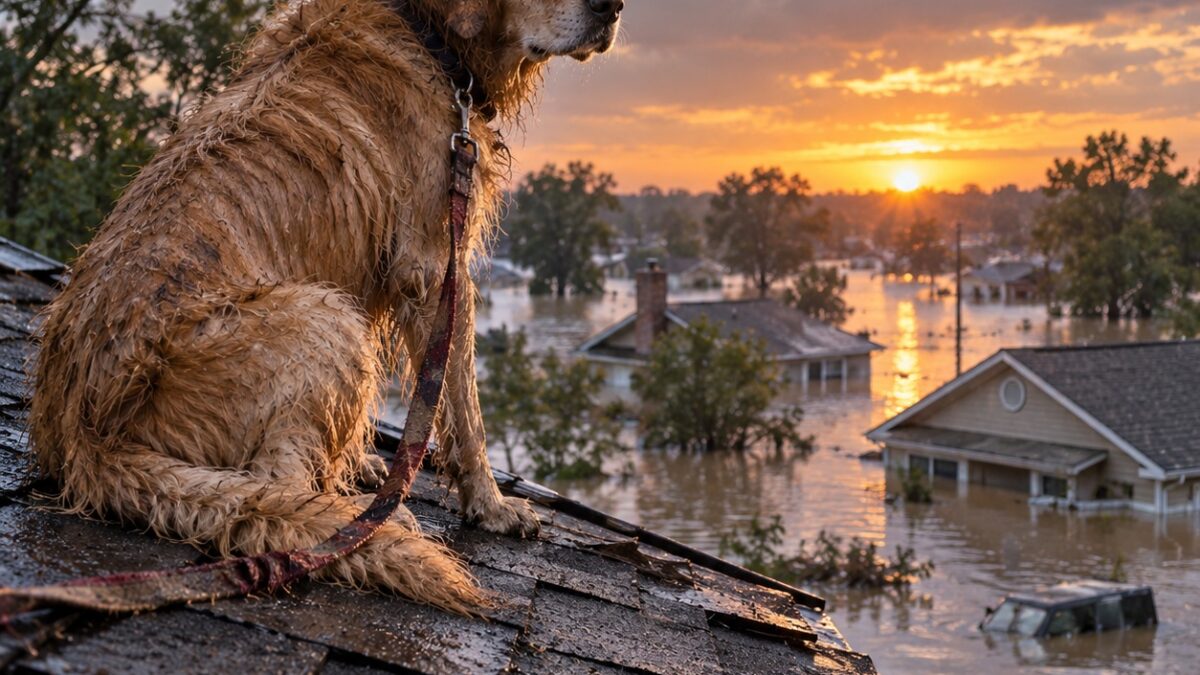
I tied the canoe to a gutter pipe and immediately regretted it.
Jack would have laughed himself sick if he could have seen me.
The Jenkins house was a single-story brick place with a steep roof and one of those decorative metal gutters that looked stronger than it actually was.
The canoe rocked beneath me.
Brown water slapped against the siding.
Trash floated past.
A plastic lawn chair.
A child’s soccer ball.
A tree limb thick enough to break my wrist if it caught me wrong.
I looked up at the dog.
“Now would be a good time to tell me you’re friendly.”
He stared down.
No bark.
No growl.
Nothing.
“All right.”
I positioned the ladder.
The bottom two rungs disappeared beneath the floodwater.
I tested my weight.
It shifted.
“Jack,” I muttered, “if I fall in and drown rescuing a dog, you better not be laughing when I get there.”
The ladder held.
I climbed.
My knees had opinions.
My back had opinions.
Every decision I had made since sunrise suddenly had an opinion.
The dog remained still.
When I reached the roof edge, I saw the leash clearly.
Red nylon.
Frayed nearly in half.
It was caught around a broken vent pipe.
I understood.
He had not climbed onto the roof voluntarily.
He had probably been pulled there by rising water, debris, panic—God knew what.
At some point the leash snagged.
The water rose.
He climbed higher.
And then he waited.
I crawled onto the shingles.
“Hey.”
The dog watched.
Up close, he looked worse.
Golden-brown coat.
Some shepherd in the face.
Maybe retriever.
A small scar cut through the fur near his left ear.
Mud coated his legs.
His paw pads were scraped and swollen.
I held out my hand.
“I’m Ruthie.”
Ridiculous thing to say to a dog.
But it felt rude not to introduce myself.
He sniffed the air.
I moved closer.
“You don’t have to like me.”
Nothing.
“You just have to not bite me.”
One ear twitched.
“That’s encouraging.”
I reached for the leash.
He flinched.
Not violently.
Just enough.
“Okay.”
I stopped.
“You’ve had enough people deciding things for you.”
His eyes met mine.
Maybe I imagined understanding.
Probably.
People like to believe dogs understand entire speeches when really they’re listening to tone.
Still, I spoke.
“I’m not taking you away from whoever you’re waiting for forever.”
The dog’s gaze shifted toward the road again.
“I’m just getting you somewhere dry.”
I unclipped the snagged leash.
That was when he moved.
He stepped toward me.
One step.
Then another.
His legs shook.
He was exhausted.
I clipped one of Jack’s old boat ropes loosely through the leash handle as a second safety line.
“Slow.”
We reached the ladder.
The dog looked down.
Then at me.
“I know.”
There was no graceful way to get a fifty-pound dog down a ladder into a moving canoe.
We did it anyway.
I climbed one rung.
He followed.
I went another.
He hesitated.
“Good boy.”
Another.
His rear paw slipped.
My heart stopped.
I caught his chest against my shoulder.
“Got you.”
He froze.
For one second, the two of us clung to that stupid ladder in the middle of a flooded Louisiana neighborhood.
“Do not make me explain this to the emergency room.”
He breathed against my neck.
Then we kept moving.
When he reached the canoe, he stepped in carefully.
No struggle.
No shaking water everywhere.
He simply curled into the bottom of the boat.
Head on his paws.
I pushed away from the Jenkins house.
He looked back once.
Not at the roof.
Toward Oakley Street.
Then he lowered his head.
I paddled home.
The trip back took longer because the current had shifted.
My arms burned.
The dog never moved.
When the canoe bumped my front steps, I climbed out and helped him onto the porch.
He stood dripping.
I opened the door.
He stopped.
“Come on.”
Nothing.
“You survived three days on a roof and now hardwood floors scare you?”
He lowered his head.
I softened my voice.
“You can come in.”
One paw crossed the threshold.
Then another.
He entered my house like someone expecting to be told he had made a mistake.
That hurt.
I found old towels.
Jack’s towels, actually.
Ugly brown ones he had refused to throw away because “they still absorb water.”
For once, the man had been right.
I dried the dog slowly.
He tolerated it.
His ribs were too easy to feel.
I opened a can of chicken.
He sniffed.
Wouldn’t eat.
“Come on.”
Nothing.
I sat on the floor.
Took a piece myself.
Ate it.
“See?”
He looked offended by my demonstration.
“I realize it’s not Julia Child.”
He finally took one bite.
Then another.
He ate half the bowl.
Drank.
Then stood in my hallway staring at the front door.
That was the first time.
It wouldn’t be the last.
I made a bed from blankets near the sofa.
He ignored it.
Instead, he lay where he could see the entrance.
I sat in Jack’s old chair.
“You waiting on someone?”
His ears lifted.
“Yeah.”
I stared at the water outside.
“So am I sometimes.”
The rain stopped that afternoon.
Not completely.
But the violent part moved east.
Emergency crews returned.
A Guard boat came by around four.
A young soldier spotted the dog through my doorway.
“Ma’am, you picked up a passenger?”
“Roof rescue.”
“You went out there?”
“I had a canoe.”
“That was not my question.”
“I’m old enough to ignore lectures from boys younger than my refrigerator.”
He laughed despite himself.
Then became serious.
“You sure you don’t want to evacuate now?”
I looked at the dog.
Then my house.
“No.”
“Water may rise another foot.”
“My foundation gives me two.”
He hesitated.
“Radio if anything changes.”
“I will.”
He pointed at me.
“No canoe.”
“No promises.”
He shook his head.
The dog watched him leave.
Then returned his gaze to the door.
I needed to call him something.
“Roof Dog” seemed disrespectful.
“Wet Mop” was accurate but rude.
Jack would have named him something ridiculous like Admiral.
I watched the dog track every sound from outside.
“You look like a Scout.”
His ear moved.
“Scout?”
He looked at me.
“All right.”
Scout.
Temporary.
Until I found his family.
That night, he slept beside the front door.
The next morning, the water began dropping.
Not fast.
But enough.
Mud replaced current along my lawn.
The lower end of the street remained submerged.
I posted Scout’s photograph everywhere I could.
Local Facebook groups.
Shelter pages.
Parish lost-and-found.
Veterinary clinics.
Emergency pet registries.
GOLDEN/SHEPHERD MIX FOUND AFTER FLOOD.
MALE.
RED LEASH.
SCAR LEFT EAR.
FOUND ON ROOF NEAR 42 OAKLEY STREET.
I called shelters as far as Baton Rouge.
Nothing.
No microchip scanners were available nearby because half the clinics were closed.
A mobile veterinary team came through two days later.
Scout had no chip.
“Probably seven or eight years old,” the veterinarian said.
“Healthy?”
“Dehydrated. Underweight. Feet need attention.”
She cleaned his pads.
Checked lungs.
Gave antibiotics for a cut.
Scout never complained.
“That dog is unbelievably quiet.”
“He’s waiting.”
The vet looked toward the door.
“For an owner?”
“I think so.”
“Could be shock.”
Maybe.
But every passing engine made his ears rise.
Every knock brought him upright.
He checked every person.
Then settled again when they weren’t who he wanted.
At night, he moved to the foot of my bed.
Not onto it.
Never asked.
Just lay there.
I became used to hearing his breathing.
The water receded enough for cleanup crews after five days.
Hollow Creek looked like a town somebody had shaken inside a muddy bucket.
Furniture lined streets.
Drywall piled at curbs.
Refrigerators stood open in yards.
Mud coated everything below the flood line.
Some houses smelled like gasoline.
Others sewage.
Others just wet rot.
The Jenkins place remained empty.
Nobody knew where the family had gone.
I walked Scout there once.
He stopped fifty feet away.
Body stiff.
Then sat.
I didn’t pull him closer.
“All right.”
We returned home.
A week passed.
Then two.
Nobody claimed him.
Scout ate better.
His coat dried and fluffed until I realized he was much larger than he had looked on the roof.
He had a broad chest.
Feathery tail.
Golden fur darkening around the back.
The shepherd showed in his ears.
He followed me everywhere.
Kitchen.
Laundry.
Porch.
Mailbox.
But every morning, he sat near the gate and looked down Oakley Street.
That was where the FEMA worker found us.
White pickup.
Mud on the tires.
Man with a clipboard.
“Mrs. Palmer?”
“That depends what you’re selling.”
He smiled.
“FEMA assessment.”
“Oh.”
He surveyed the damage.
Roof.
Water line.
Electrical panel.
Then Scout rounded the corner.
The man stopped.
“That your dog?”
“No.”
I explained.
He crouched.
Scout wagged once.
Didn’t approach.
“You done good by him.”
“I’m trying to find his people.”
The man straightened.
“A lot of pets got separated.”
“I know.”
He handed me a website.
“Regional disaster animal registry.”
“I posted on three.”
“This one combines shelter and rescue logs. Family reunification.”
I thanked him.
That evening, I uploaded everything.
Photo.
Scar.
Location.
Red leash.
Approximate age.
Then I forgot about it for three days.
The email came while I was making coffee.
Subject:
I THINK THAT’S BOOMER.
I froze.
The sender was Maggie Hart.
Her message was short.
My parents lived at 38 Oakley Street.
Their dog, Boomer, went missing during evacuation.
I have been searching.
Please tell me where you found him.
Attached are photos.
My hands shook opening them.
Photo one.
Scout beside an older man in a fishing hat.
Photo two.
Scout sleeping on a porch swing beside an elderly woman.
Photo three.
Scout younger, standing between a woman in her thirties and the same couple.
Same scar.
Same eyes.
Same dog.
“Boomer.”
Scout was lying beneath the table.
His head snapped up.
I stopped breathing.
“Boomer?”
He stood.
Tail moved.
Fast.
“Oh.”
I crouched.
“Baby, that’s you.”
His tail thumped the cabinet.
I called Maggie.
She answered immediately.
“Hello?”
“Maggie?”
“Yes.”
“This is Ruthie Palmer.”
Silence.
“Is he alive?”
Her voice broke on the last word.
“He’s alive.”
A sob.
“Oh God.”
“He’s okay.”
“Is he hurt?”
“Raw feet. Thin. But he’s getting stronger.”
“Can you—”
She couldn’t finish.
“What?”
“Can you say his name?”
I looked at Scout.
“Boomer.”
He came to me.
Maggie cried harder.
“That’s him.”
Scout pressed his head against my knee.
I sat on the kitchen floor.
“What happened?”
Maggie tried to breathe.
“My parents lived two houses down from you.”
“I knew the Harts by sight.”
“Harold and May.”
“Yes.”
“My mom had health problems. I was staying with them because of the storm.”
I waited.
Her voice became thinner.
“The water came faster than we expected.”
I closed my eyes.
“We were trying to get out.”
She continued.
“The rescue boat was coming. Dad went back for Mom’s medication.”
Her breath hitched.
“The back wall collapsed.”
“Maggie…”
“I couldn’t reach them.”
I covered my mouth.
Scout leaned harder against me.
“They died?”
“Yes.”
The word barely existed.
“I’m so sorry.”
“Boomer slipped his leash when the boat pulled up. I tried to get him. He ran toward the house.”
The torn red leash.
“He was going back for them.”
“I think so.”
Maggie cried.
“They forced me into the boat.”
Of course they did.
Flood rescue does not negotiate with shock.
“I kept screaming for him.”
Scout’s eyes were on me.
“He must have gotten onto the Jenkins roof.”
“He waited.”
Maggie became silent.
“He what?”
“He sat on that roof looking down the street.”
I swallowed.
“For three days.”
The line stayed silent so long I checked the phone.
Then she whispered:
“He was waiting for us.”
“Yes.”
I hated saying it.
But I wouldn’t lie.
Maggie asked:
“Can I come see him?”
“Anytime.”
“Today?”
“Come.”
She drove from Baton Rouge a week later.
Not that afternoon after all.
She wasn’t ready.
She called me twice first.
Then finally Saturday morning she said:
“I’m leaving now.”
Three hours later, a gray Honda turned onto Oakley Street.
Scout had been asleep on my porch.
Before I heard the car, he stood.
Ears high.
His body changed.
“Maggie?”
Scout stared.
The Honda stopped.
A woman stepped out.
Mid-thirties.
Dark hair.
Jeans.
Face thinner than her photograph.
Scout barked.
One bark.
The first I had heard.
Then another.
“Boomer!”
He ran.
I had never seen him run.
Not truly.
He flew across my yard.
Maggie dropped to her knees.
Scout hit her so hard she nearly fell backward.
She wrapped both arms around his neck.
“Oh my God.”
He buried his face against her chest.
And then the dog who never made a sound began whining.
Soft.
Broken little noises.
Maggie sobbed.
“I’m sorry.”
Scout shook.
“I’m sorry, baby.”
I stood on my porch and cried like a fool.
No dignity whatsoever.
They stayed on the grass for several minutes.
Maggie whispering.
Scout leaning into her.
When they finally came inside, Maggie looked at me.
“Thank you.”
“You don’t owe me.”
“I do.”
“No.”
She stared around my house.
Scout walked between us like a nervous host.
We sat at the kitchen table.
Maggie held his paw.
“He looks better.”
“He wouldn’t eat much at first.”
“He does that when he’s upset.”
“You know him.”
“I’ve known him three years.”
“How did your parents get him?”
“Shelter.”
Her smile appeared through tears.
“Dad said he wanted a dog who didn’t need him too much.”
“And?”
“Boomer slept against his legs every night.”
I laughed.
“Sounds right.”
Maggie told me more.
Her mother May had ovarian cancer several years earlier.
During treatment, Scout—Boomer—would sleep beside her chair.
When she entered hospice temporarily before improving, he stayed on Harold’s side of the bed.
When Harold’s arthritis worsened, Boomer walked slowly.
He adjusted to whoever needed him.
“He always waited,” Maggie said.
“What do you mean?”
“If Dad went fishing, Boomer sat by the driveway.”
She touched Scout’s ear.
“If Mom went to the hospital, he lay by the door.”
I looked toward my front entrance.
“Oh.”
“He wasn’t waiting for one person.”
“No.”
Maggie swallowed.
“He was waiting for all of us.”
That evening, she stood beside her car.
Scout at her feet.
I assumed she would take him.
Then she said:
“I can’t.”
I looked at her.
“My apartment doesn’t allow dogs.”
“We’ll figure something out.”
“I lost my job after the flood.”
“Maggie—”
“I’m sleeping on a friend’s couch half the week.”
Scout leaned into her leg.
“I want him.”
“I know.”
“But wanting him and being able to care for him are different.”
That was one of the most painful responsible sentences I had ever heard.
“What do you want to do?”
She looked at me.
“Would you keep him?”
“For now?”
Her eyes filled.
“If you can.”
I looked at Scout.
Then my empty house.
“Yes.”
Maggie crouched.
“Boomer.”
Scout licked her face.
“You stay with Ruthie.”
I almost laughed.
“He understands less English than you think.”
“He understands everything.”
Scout sat.
Maggie smiled.
“See?”
She left.
Scout stood at the gate.
Watched her car disappear.
Then came back to the porch.
He still looked at the road afterward.
But less.
That was the first shift.
Maggie came every Sunday.
At first, religiously.
Nine-thirty.
Same Honda.
Same bag of treats.
Scout knew the engine.
He waited by the gate.
They would walk.
Sit in the yard.
Sometimes she brought photographs.
One Sunday, she brought one of her parents.
Harold and May in folding chairs beside a lake.
Scout between them.
Maggie stared at it.
“I don’t know what to do with their house.”
“Nothing yet.”
“It’s gutted.”
“Then let it be gutted.”
“I feel like I’m supposed to decide everything.”
“You’re grieving.”
“That doesn’t stop bills.”
“No.”
“But it means you’re allowed to make fewer decisions.”
She looked at me.
“That sounds like nurse advice.”
“It is.”
“You miss it?”
“Nursing?”
“Yes.”
“Some days.”
“Why’d you retire?”
“My knees.”
She laughed.
“Honest.”
“And my husband died.”
Her smile faded.
“Jack.”
“You remember?”
“You mentioned him.”
We became friends because grief recognizes grief.
Not because our losses were equal.
They weren’t.
But the language was familiar.
The unfinished sentences.
The sudden silence.
The way ordinary things ambush you.
Maggie once cried because the grocery store still sold the tea her mother liked.
I once cried because Jack’s old screwdriver fell from a drawer.
Scout sat with whichever one of us was falling apart.
No judgment.
No fixing.
Presence.
One Saturday, Maggie arrived exhausted.
Wrinkled blouse.
Hair tied badly.
Crack in her windshield.
She sat on my porch.
“I got laid off.”
“When?”
“Wednesday.”
“Why didn’t you call?”
“What would you do?”
“Make soup.”
That made her laugh.
Then she cried.
Scout put his chin on her knee.
“I keep thinking I should move back.”
“To Hollow Creek?”
“There’s nothing here.”
“There are people.”
“My parents are gone.”
“Yes.”
“The house is ruined.”
“Yes.”
“You are very bad at sales.”
“I’m not selling.”
She stared toward the street.
“I still can’t take Boomer.”
“He’s fine.”
“Stop saying that like it costs you nothing.”
I looked at her.
She knew.
Of course she did.
Scout had become mine in ways I had not admitted.
Morning coffee with his back against my ankles.
Nails in the hallway.
His sighs.
The spot beside the bed.
His head appearing when the refrigerator opened.
Maggie whispered:
“You love him.”
“Yes.”
“So do I.”
“I know.”
“What happens when I can take him?”
There it was.
The question neither of us wanted.
I looked at Scout.
“We figure it out then.”
That night, after Maggie left, Scout stood beside the hallway looking where her shoes had been.
Then he lay down.
I had an idea.
Scout needed something besides waiting.
So did I.
Hollow Creek Elementary had not fully reopened.
Flood damage had forced classes into the church basement.
Kids were anxious.
Some had lost homes.
Some relatives.
Pets.
Everything familiar.
I called Principal Connie Boudreaux.
“You want to bring a flood-rescue dog?”
“Maybe.”
“Is he trained?”
“No.”
“Certified?”
“No.”
“Ruthie.”
“He’s calmer than half the adults in town.”
She sighed.
“Friday.”
Scout’s first school visit changed things.
The basement smelled like crayons, damp concrete, and graham crackers.
Children stared.
One girl screamed and hid behind a desk.
I crouched beside Scout.
“He’s not going to hurt you.”
A boy with a Batman backpack approached.
Scout sat.
The boy touched one ear.
Nothing happened.
He stroked Scout’s head.
Scout closed his eyes.
That was all it took.
Within fifteen minutes, six children sat around him.
One read a picture book.
Another leaned against Scout’s side.
The girl who had hidden eventually crawled from beneath the desk.
Her name was Lily.
She had lost her cat in the flood.
She sat several feet away.
Scout looked at her.
Didn’t approach.
Just waited.
Lily moved closer.
Scout remained still.
Finally, she touched his paw.
I watched her shoulders relax.
Connie whispered:
“Bring him back.”
We did.
Every Friday.
Scout learned the route.
His tail started wagging the moment I turned onto Church Street.
Children drew pictures.
Made paper crowns.
Read to him.
A boy named Eli said:
“I like Scout better than people.”
“So do I some days.”
“Does he understand me?”
“Yes.”
“Everything?”
“Probably not math.”
Eli considered that.
“Good.”
The kids called him Scout because that was the name I had used at school.
Maggie found it funny.
“He has two names.”
“He answers to both.”
“Boomer was Dad’s choice.”
“Scout was mine.”
She looked at the dog.
“Which one are you?”
Scout yawned.
“Diplomat,” I said.
Maggie’s visits became less regular.
Not because she cared less.
Life was beating her up.
Job interviews.
Her aunt hospitalized.
Insurance.
Parents’ estate.
She called instead.
“How is he?”
“Fat.”
“He is not fat.”
“He manipulated Marlene at the diner into giving him bacon.”
“He learned that from Dad.”
“He is a criminal.”
“He’s grieving.”
“He is grieving directly into breakfast meat.”
Maggie laughed.
Those calls helped both of us.
Then, one evening, she called with a different voice.
Excited.
Terrified.
“I got a job.”
I stood in the laundry room holding one of Jack’s old shirts.
“What?”
“Administrative work at a clinic.”
“That’s wonderful.”
“And an apartment.”
“Maggie.”
“Pet-friendly.”
I went silent.
Scout was asleep on the rug.
“I think I can bring him home.”
There it was.
The day I had promised to accept.
“How soon?”
“Two weeks.”
My throat tightened.
“That’s good.”
“Ruthie.”
“It’s good.”
“You sound like someone swallowed a nail.”
“I’m happy.”
“You’re allowed to be sad.”
“I’m not.”
“Liar.”
I sat beside Scout.
He opened one eye.
“Two weeks,” I whispered.
He closed it.
Those fourteen days became painfully specific.
I noticed everything.
White fur between his toes.
One crooked whisker.
The way he stretched front legs first and groaned like an old man.
The exact weight of his head on my foot.
I cooked chicken and rice.
Let him sleep on my bed.
Took long walks.
We visited school.
Connie had heard.
“Scout’s leaving?”
“Probably.”
“For Maggie?”
“Yes.”
“That’s good.”
Everyone kept saying that.
Good.
The children made a card.
WE LOVE YOU SCOUT.
Crayon hearts.
Paw prints.
Eli wrote:
DON’T FORGET PEOPLE.
Scout carried the card to the car.
I cried in the parking lot.
Two nights before Maggie was supposed to come, my phone rang.
Unknown number.
“Mrs. Palmer?”
“Yes?”
“This is Officer Darren Mills with Louisiana State Police.”
My body went cold.
“Is this about Maggie Hart?”
“Yes.”
Everything inside me dropped.
“There’s been an accident.”
Rain.
Highway.
A truck lost control.
Maggie’s car struck the median.
She was alive.
Unconscious.
Lafayette hospital.
Emergency contact records had my number from the disaster registration.
I hung up.
Scout approached.
Put his head on my lap.
“She’s hurt.”
His ears moved.
“She was coming for you.”
I leaned over him.
“She’s going to be okay.”
I had no right to promise that.
I did anyway.
The next morning, Marlene kept Scout at the diner.
“He’ll eat bacon until you get back.”
“That is the opposite of veterinary advice.”
“Go.”
I drove three hours.
Hospitals still smelled the same.
Bleach.
Coffee.
Fear.
I had spent decades walking those halls wearing scrubs.
Being on the other side felt wrong.
A young doctor met me.
Broken ribs.
Concussion.
Pulmonary bruising.
No spinal injury.
Seat belt saved her.
“She’ll likely wake soon.”
“Likely?”
“We expect it.”
I hated how medical people spoke when trying not to give guarantees.
Because I had been one.
I sat outside the ICU.
Finally, a nurse let me see her.
Machines.
Bruising.
Hair across the pillow.
“Maggie.”
No response.
“Scout’s okay.”
I stood beside her bed.
“He’s waiting.”
The monitor kept beeping.
“You come back when you’re ready.”
I drove home.
Scout sat beside the diner door.
The moment he saw my car, he stood.
I knelt.
“She’s alive.”
He pushed his nose into my chest.
“Going to take a while.”
He sighed.
We went home.
Scout stopped waiting at the front door as much.
Instead, he waited for me.
That mattered.
Five days later, Maggie woke.
Her first question:
“Boomer?”
The nurse called me.
I drove back.
Maggie looked terrible.
I told her so.
She smiled weakly.
“Nice to see you too.”
“He’s fine.”
“I was coming to get him.”
“I know.”
“I still want to.”
“I know.”
“Not yet.”
“Obviously.”
She closed her eyes.
“Thank you.”
“For what?”
“For never making me feel like I lost him twice.”
That nearly broke me.
Maggie spent almost a month in rehabilitation.
Scout and I kept visiting the children.
Hollow Creek rebuilt.
The Jenkins house sold to a teacher and mechanic.
They planted wildflowers where flood debris had once piled.
Scout sat beneath a tree watching.
When Maggie finally returned, she moved carefully.
Still sore.
She spent the whole afternoon with Scout.
They walked.
Sat in grass.
Shared chicken she wasn’t supposed to give him.
At dusk, she stood in my kitchen.
“I don’t think I should take him.”
I froze.
“You mean yet?”
“Maybe ever.”
“Maggie.”
She looked outside.
“He’s happy here.”
“He’d be happy with you.”
“Yes.”
“But?”
“He has you.”
I said nothing.
“He has the school.”
She smiled.
“Marlene’s bacon.”
“Unfortunately.”
“The kids.”
“He can still visit.”
“I know.”
Her eyes filled.
“When I look at him now, he doesn’t feel like something I lost.”
Scout entered.
He sat between us.
“He feels like someone who survived.”
Maggie knelt.
“I love you.”
Scout licked her hand.
She looked at me.
“Maybe loving him isn’t taking him back.”
I thought about Jack.
About every patient’s family I had watched cling to things that had already changed.
“No.”
I swallowed.
“Sometimes it isn’t.”
Scout stayed with me.
Maggie stayed too.
Not in my house immediately.
In our lives.
Every Friday, she began joining school visits.
She read stories.
Helped kids make origami.
Walked Scout around the block.
Eventually, she was there often enough that neighbors stopped asking whether she was visiting.
She was simply Maggie.
Then Scout found another job.
Sunny Pines Retirement Home.
It began because school closed for summer.
Every Friday morning, Scout stood by the gate.
Waiting.
No children came.
Maggie arrived one Friday carrying books.
“He misses his audience.”
“He likes attention.”
“Sunny Pines?”
“The retirement home?”
“They said yes.”
Scout entered Sunny Pines wearing a borrowed blue bandana.
The residents lit up.
One man said Scout looked like the dog he had during the Korean War.
A woman named Edna showed us a 1971 photograph of her golden retriever.
Another resident with dementia repeated Scout’s name six times.
Scout did not care.
He rested his head on her lap every time.
That became Friday.
School in session?
Children.
Summer?
Sunny Pines.
Eventually both.
Then library.
Then church.
Then food pantry.
Scout became the unofficial emotional support animal of Hollow Creek without anyone filing paperwork.
He was not formally trained.
We were careful.
No medical claims.
No forced interactions.
Scout simply had a gift.
He stayed still.
People came to him.
A child cried?
Scout sat.
An elderly woman talked for twenty minutes about a dead husband?
Scout listened.
Maggie once said:
“He waits for people the way he waited for us.”
That was exactly it.
He had learned waiting as survival.
Then somehow turned it into kindness.
The town potluck returned the next summer.
First since the flood.
Tables.
Casseroles.
Pies.
Music.
Children chalking sidewalks.
Someone made Scout a sign.
THANK YOU, SCOUT.
OUR HERO.
“He’s not a hero,” I said.
Maggie stood beside me.
Scout was being fed biscuit pieces by four children.
“No?”
“He sat on a roof.”
“He survived.”
“That doesn’t make him heroic.”
Maggie watched him.
“No. What came after did.”
I understood.
People stood during the potluck and told stories.
Scout sitting beside Lily when she was afraid.
Scout resting his head on Edna’s knees.
Scout lying beneath a table during a church fundraiser while a grieving widower rubbed his ears.
One older woman said:
“He looked at me like I was still somebody.”
That was Scout.
He made people feel visible.
Maggie started writing.
At first in a notebook.
Observations.
Memories.
Fragments.
The flood.
Her parents.
The roof.
My canoe.
School.
Sunny Pines.
One Sunday, she read something aloud.
Title:
The Dog That Waited.
It was only three pages.
Simple.
No tricks.
I cried.
“You should publish that.”
“No.”
“Why?”
“It’s ours.”
“Stories can be ours and still help somebody.”
She looked at Scout.
He was asleep.
Eventually she submitted it to a regional journal.
They published it.
People wrote letters.
Then a small publisher asked:
Do you have more?
Maggie laughed.
I pointed toward boxes of cards.
Photographs.
Children’s drawings.
“Yes.”
We had more.
The manuscript grew.
She interviewed residents.
Teachers.
Marlene.
Lacy from a nearby rescue who had helped after the flood.
Even the Guard soldier who later found us through social media and wrote:
PLEASE TELL RUTHIE I STILL THINK THE CANOE WAS A TERRIBLE IDEA.
I responded:
PLEASE TELL HIM I WAS RIGHT.
Maggie included neither comment.
“Coward.”
“Editor.”
The book became a map of recovery.
Not just Scout.
Hollow Creek.
The flood had torn open homes.
But also people.
Scout moved through the aftermath quietly.
Connecting things.
Maggie titled the manuscript:
The Dog Who Waited.
A publisher accepted it.
The day the contract arrived, Maggie dropped a dish towel.
Scout ran in.
“What happened?”
“They want it.”
“What?”
“The book.”
I stared.
“They want to publish it.”
Scout barked once.
I looked at him.
“You understand royalties?”
Tail wag.
“He wants chicken.”
“That’s his agent fee.”
The book launch was scheduled for winter.
Before that came local events.
Library.
School.
Sunny Pines.
Church.
Maggie hated public speaking.
Scout made it possible.
At the first reading, she stood behind a small podium.
Scout lay beside her feet.
She began:
“I want to tell you about the day he waited.”
The room went silent.
Maggie read about the roof.
Not everything.
Just enough.
Then school.
Then Edna’s quilt.
At the end, a little girl gave Scout a paper flower.
“For waiting so good.”
He took it gently.
Placed it beside his paw.
Maggie cried in the car.
“I almost left him there forever.”
“You lost him in a flood.”
“I mean afterward.”
I understood.
She had spent months believing Scout’s survival was an accusation.
It wasn’t.
It became permission.
Permission to survive too.
Maggie moved back to Hollow Creek.
At first, she rented a room.
Then she began spending enough time at my house that her coffee mug acquired a cabinet.
Neither of us discussed it.
After the accident, she felt safer nearby.
I had space.
Scout liked both of us.
One morning, I noticed her robe hanging beside mine.
“You live here now.”
She looked offended.
“I pay groceries.”
“You have toothpaste in my bathroom.”
“That’s temporary.”
“You have books in three rooms.”
“Ruthie.”
“Admit it.”
Scout walked between us.
Maggie pointed.
“He invited me.”
“Traitor.”
Living together was surprisingly easy.
I was old enough not to pretend habits didn’t annoy me.
Maggie left mugs everywhere.
I folded towels incorrectly according to her.
Scout took whichever side offered food.
We became a strange family.
A retired nurse.
A woman rebuilding after a flood.
A dog with two names.
Boomer to Maggie.
Scout to Hollow Creek.
He answered to love.
That was enough.
The book’s galley arrived in November.
Soft cover.
Scout sitting on my porch.
Title in plain letters.
THE DOG WHO WAITED.
Maggie held it like something alive.
“Read the dedication.”
She handed it to me.
For the ones who waited,
and the ones who stayed.
I couldn’t speak.
Scout sniffed the book.
Then tried to lick the cover.
“Literary critic,” I said.
The launch happened at the reopened Hollow Creek bookstore.
Snow had dusted roofs.
People arrived early.
Teachers.
Children.
Sunny Pines residents.
First responders.
Neighbors.
Even strangers who had read Maggie’s article.
Scout wore his ambassador harness.
Edna’s red-and-white scarf.
He greeted everyone like this was entirely normal.
Maggie sat on a wooden stool.
Scout curled at her feet.
“I didn’t plan to write a book,” she said.
“I didn’t plan to lose my parents.”
Her voice shook.
“I didn’t plan to lose my dog.”
Scout lifted his head.
“And Ruthie certainly didn’t plan to paddle an ancient canoe through floodwater.”
Laughter.
I called from the back:
“It was a perfectly good canoe.”
More laughter.
Maggie smiled.
“But sometimes a life changes because somebody notices something.”
She looked at me.
“A dog on a roof.”
Then Scout.
“A person waiting.”
She opened the book.
Afterward, she signed copies.
Scout slept beneath the table.
People cried.
Hugged Maggie.
Told stories.
The book spread farther than Hollow Creek.
Third printing.
Then sixth.
Letters came.
A teacher in Vermont.
A cancer patient in Idaho.
Children overseas sent paintings.
Scout did not care about publishing.
He still cared about bacon.
Routine.
Maggie.
Me.
Sunny spots.
His water bowl.
He grew older.
At first slowly.
Then suddenly.
That is how dogs age.
One year, they run.
The next, you notice them considering stairs.
Scout’s muzzle lightened.
His hips stiffened.
He slept longer.
At Sunny Pines, Edna knitted him another blanket.
Golden squares.
“There,” she said, draping it over him.
“Now you match the sun.”
Scout rested his head on her lap.
By then, everybody noticed.
He was quieter.
Not sick.
Not miserable.
Just old.
The veterinarian came.
Listened.
Checked.
“His heart is good.”
“Then why is he slowing?”
“Because bodies do.”
I hated the answer.
She smiled gently.
“Keep him comfortable.”
“He’s comfortable.”
“Keep him near you.”
“That won’t be difficult.”
Scout was always near.
Maggie began turning down events.
Publishers invited her to Baton Rouge.
Lafayette.
Regional fairs.
She went to some.
Then fewer.
“I want to finish the next book.”
That was partly true.
Mostly, she wanted time.
Time becomes visible when you realize it is limited.
Scout sat on the porch.
Watched butterflies instead of chasing them.
Walked to the gate but did not always reach it.
Children visited him.
Sunny Pines residents sent cards.
Edna came by cab one afternoon carrying the quilt.
She lowered herself beside him.
“Thank you.”
Scout sniffed her hand.
“For what?” Maggie asked.
Edna looked surprised.
“Everything.”
She kissed Scout’s head.
People often thanked him.
Scout never understood.
That made it pure.
Then came the letter.
Pale blue envelope.
No return address.
Dear Scout,
I don’t know you, but I read your story.
Last week I wanted to give up.
It had been a long year.
Then I read about you waiting on the roof.
I thought if you could wait one more day, maybe I could too.
So I did.
The next day was better.
You don’t know me.
But I needed to tell you that your story helped save me.
Thank you for waiting.
Love,
Someone who needed you.
Maggie read it three times.
I sat beside her.
Neither of us spoke.
Scout slept by the fireplace.
Finally, Maggie walked over.
Lay beside him.
Pressed her face into his fur.
“You don’t even know.”
His tail moved.
That night, he barely ate.
The next morning, he stayed in the hallway.
By afternoon, he would not stand.
Not because he seemed in pain.
Because he seemed finished.
I knew.
Nurses know.
You learn the difference between fighting and resting.
Maggie knew too.
We canceled everything.
Phones off.
Door unanswered.
We sat on the floor.
Scout on Edna’s quilt.
Maggie read from The Dog Who Waited.
I told stories.
The canoe.
The first chicken.
His disgust with rain.
Marlene’s illegal bacon.
Eli saying dogs were better than people.
The first bark.
The book launch.
Scout’s breathing remained steady.
Near sunset, he lifted his head.
Looked toward the window.
Golden light filled the room.
For a second, he looked like the dog on the roof.
Alert.
Watching.
Waiting.
Maggie whispered:
“Mom and Dad?”
I didn’t answer.
Nobody knew.
Scout looked at her.
Then me.
His head lowered.
His eyes closed.
One breath.
Another.
Another.
Then stillness.
The room changed.
That is the only way I can describe it.
Not empty.
Full.
Too full.
Maggie pressed both hands against him.
“Boomer.”
I touched his head.
“Scout.”
Two names.
One dog.
Maggie cried first.
I followed.
We stayed until dark.
We buried him beneath the sycamore tree.
The tree where children had once sat with him.
The tree near the garden.
Edna’s quilt wrapped around him.
The pale blue letter tucked beside him.
People came quietly.
No speeches.
Flowers.
Food.
Drawings.
The church bell rang once.
Eli, older now, placed a Batman keychain near the grave.
Lily brought a drawing.
Marlene brought bacon and then cried because she realized how ridiculous that was.
“It’s what he liked.”
“It is.”
She left it anyway.
After everyone left, Maggie and I sat on the porch.
The gate was open.
Scout would never walk through it again.
That hurt.
For weeks, my body expected him.
I opened the refrigerator and waited for nails.
Reached for a leash.
Looked toward the foot of the bed.
Maggie did the same.
Once, I heard her call:
“Boomer?”
Then silence.
She came into the kitchen.
“I forgot.”
I hugged her.
“Me too.”
Grief does that.
It lets you forget for half a second.
Then charges interest.
Maggie finished the second book that August.
The Dog Who Stayed.
It wasn’t really about Scout’s fame.
It was about what happened after rescue.
School.
Sunny Pines.
Hollow Creek.
Maggie.
Me.
A community rebuilding.
The final chapter did not describe his death in detail.
It described the porch.
Two women.
One empty space.
And marigolds moving in the wind.
The book sold well.
I didn’t care.
Maggie pretended she didn’t either.
What mattered were the letters.
People sent stories.
Dogs waiting outside hospital rooms.
Cats returning after storms.
Neighbors helping strangers.
People choosing one more day.
Maggie created a small foundation with part of the royalties.
Emergency pet boarding during natural disasters.
Temporary housing support.
Microchip clinics.
Evacuation planning.
She named it:
The Waiting Home Project.
I said:
“That sounds like a funeral home.”
She changed it.
Scout’s Harbor.
Better.
During hurricanes, they provided crates.
Pet transport.
Temporary foster networks.
“No one should have to choose between evacuation and their animal,” Maggie said.
I looked at her.
“That’s the point, isn’t it?”
She nodded.
“If Mom and Dad had known…”
“Don’t.”
“I know.”
“You cannot rebuild the past.”
“But we can build something because of it.”
“Yes.”
That became her answer to grief.
Not erasing.
Building.
The Jenkins roof was replaced years later.
The house had new owners.
Fresh siding.
Wildflowers.
Nothing visible remained of the spot where Scout had waited.
That felt right.
Places should heal too.
One anniversary of the flood, Hollow Creek installed a small plaque near the community park.
Not a statue.
Thank God.
Scout would have hated bronze.
Just a plaque beneath a tree.
SCOUT “BOOMER” HART-PALMER
HE WAITED.
HE STAYED.
HE HELPED US DO THE SAME.
I protested the double last name.
Maggie insisted.
“He was ours.”
“He was everybody’s.”
“Then we’d need a very large plaque.”
At the dedication, children from Hollow Creek Elementary read short messages.
Sunny Pines residents attended.
Edna was gone by then.
Her niece brought Scout’s old red scarf.
Marlene brought sweet tea.
Connie spoke.
Then Maggie.
I refused.
“I am not speaking.”
“You literally talked to sick people’s families for forty years.”
“Professionally.”
“This is professional.”
“This is emotional terrorism.”
She laughed.
Maggie stood beneath the sycamore.
The same book in her hand.
“When Scout sat on that roof, we thought he was waiting for rescue.”
She paused.
“I don’t think that was entirely true.”
People listened.
“He was waiting for his family.”
Her voice broke slightly.
“My parents never came.”
Silence.
“I came too late.”
Scout’s plaque shone in morning light.
“But somebody else came.”
She looked at me.
“Ruthie.”
My eyes burned.
“And that changed everything.”
Maggie closed the book.
“We spend a lot of time believing love belongs to whoever came first.”
She looked around.
“Scout taught me it can belong to everyone who stays.”
That line became quoted everywhere.
I teased her about it.
“You practiced that.”
“For three weeks.”
“I knew.”
“Ruined my moment.”
“Happy to help.”
Years passed.
Hollow Creek recovered.
Not completely.
Towns don’t erase disasters.
They absorb them.
New houses.
Old scars.
Flood markers.
People who moved away.
People who returned.
Rainstorms remained difficult.
Whenever thunder rolled hard, I found myself checking Oakley Street.
No dog on a roof.
Still, I checked.
Maggie eventually bought a small house nearby.
Pet-friendly, obviously.
She did not adopt immediately.
People assumed she would.
“You’re the dog woman now,” Marlene told her.
“I had one dog.”
“Famous dog.”
“Still one.”
Years after Scout died, Maggie adopted a senior shelter dog.
Twelve years old.
Gray muzzle.
Missing teeth.
Name: Walter.
“Why Walter?”
“He looked like one.”
“There is no defense against that logic.”
Walter hated everyone for four days.
Then adored Maggie.
He never replaced Scout.
That was important.
New love doesn’t replace old love.
It occupies a different room.
I fostered occasionally.
Mostly small dogs.
After Scout, I refused anything over forty pounds.
“My knees have standards.”
Maggie called me a coward.
Then she brought me a twenty-two-pound mutt named Lucy who stayed permanently.
I accused Maggie of fraud.
She denied everything.
Lucy slept in Scout’s old corner.
First night, I cried.
Then she snored so loudly I laughed.
That was grief too.
The ability to laugh in a room where you once thought laughter had ended.
Sometimes visitors came to Hollow Creek because of the books.
That was strange.
They wanted to see the roof.
The school.
The sycamore.
One woman drove from Mississippi with her teenage son.
She held Scout’s book.
“My boy read this in the hospital.”
The boy looked embarrassed.
“He had depression,” she said.
“Mom.”
“He wants to say something.”
The boy stared at the plaque.
Then said:
“I didn’t think waiting mattered.”
I waited.
“Scout made it look like doing something.”
My throat tightened.
“Sometimes staying alive is doing something.”
He nodded.
That conversation stayed with me.
Scout never knew any of it.
That might be the beautiful part.
He did not become good because he had an audience.
He did not wait for praise.
He waited because he loved.
Then, when the people he expected did not come, he accepted the people who did.
That was his miracle.
Not supernatural.
Not magic.
Adaptation without bitterness.
Animals may not think about forgiveness the way we do.
Maybe that made him better at it.
I once asked Maggie whether she believed Scout forgave her for leaving him during the flood.
She looked shocked.
“I didn’t leave him.”
“I know.”
“I lost him.”
“You know what I mean.”
She thought.
“Maybe I needed forgiveness even though I hadn’t done something wrong.”
That was true.
Survivors carry strange guilt.
Why them?
Why not me?
Why did I get out?
Why couldn’t I save more?
I had seen it in hospitals.
Maggie carried all of it.
Her parents.
Scout.
The rescue boat.
The moment she stopped fighting and let someone pull her away from the house.
For years, that moment felt like betrayal.
Scout’s return changed it.
He had survived after she left.
Not because she abandoned him.
Because life separated them.
Then life connected him to me.
That is what eventually freed Maggie.
The story was not:
She left and he waited.
It was:
They were torn apart, and he survived long enough to be loved again.
Language matters.
Especially the language we use against ourselves.
Maggie taught writing workshops later.
She told students:
“Be careful where you place blame in your own story.”
That came from Scout.
Everything did eventually.
The flood anniversary became less painful.
Five years.
Ten.
Each year, fewer television crews.
Fewer memorial events.
But Hollow Creek residents remembered.
At ten years, the town planted twenty trees.
One for every resident lost.
Harold and May each had one.
Maggie chose two oaks near the park.
Scout’s plaque sat beneath a sycamore not far away.
She stood between them.
“Whole family.”
I nodded.
“Whole family.”
She smiled.
“Almost.”
“What?”
She pointed at me.
“No.”
“Come stand here.”
“I am alive.”
“You can still be family alive.”
“That sounds threatening.”
“Ruthie.”
I joined her.
Someone took our picture.
Maggie.
Me.
Walter, her senior dog.
Lucy, mine.
Two oaks behind us.
Scout’s sycamore nearby.
The photograph later appeared in the tenth-anniversary edition of The Dog Who Waited.
I complained.
Maggie ignored me.
By then, I was seventy-seven.
Knees worse.
Opinions stronger.
I still lived in Jack’s house.
Maggie tried to convince me to move.
“No.”
“Flood zone.”
“Raised foundation.”
“You are impossible.”
“Genetic.”
“If another storm comes?”
“I evacuate.”
She stared.
“I learned.”
That surprised her.
I had stayed once because I couldn’t bear losing the house.
Scout taught me something I should have learned as a nurse.
A home matters.
Life matters more.
When another major storm threatened, I packed early.
Photographs.
Medicine.
Documents.
Lucy.
Jack’s mug.
Maggie arrived.
“You’re ready?”
“Yes.”
“No canoe?”
“Very funny.”
We drove inland.
The storm weakened.
Hollow Creek flooded only lightly.
When we returned, I stood on my porch.
Looked toward the old Jenkins house.
Empty roof.
Blue sky.
I smiled.
“You win.”
Maggie asked:
“Who?”
“Scout.”
She understood.
Scout’s greatest impact on me might have been that.
He made leaving possible.
Because he taught me home was not the building you refuse to abandon.
Home was where someone waited for you.
Jack had been home.
Scout had been home.
Maggie had become home.
Lucy too, obnoxiously.
I could leave a house and still carry all of that.
I wished I had understood sooner.
Maybe Jack had.
He used to say:
“Ruthie, you keep everything like the house is a museum.”
I called him careless.
He called me sentimental.
We were both right.
After Scout, I finally gave away some of Jack’s old things.
Not the mug.
Never the mug.
But tools.
Fishing equipment.
Coats.
I kept memories.
Released objects.
Maggie helped.
“This wrench?”
“Donate.”
“Lamp?”
“Donate.”
“This hideous ceramic fish?”
“That was a wedding gift.”
“So?”
“Destroy.”
She laughed.
Grief became lighter when it had room to move.
That was another Scout lesson.
Waiting is not the same as refusing change.
Scout waited for his family.
Then climbed into my canoe.
Both mattered.
You can honor who you were waiting for and still go somewhere new.
That idea became the heart of Maggie’s second book.
The Dog Who Stayed.
It never sold as much as the first.
Maggie loved it more.
So did I.
The last chapter said:
Waiting is hope facing backward.
Staying is love learning how to face forward.
I accused her of getting too poetic.
She told me readers liked it.
I secretly wrote it on a card.
Kept it in my Bible.
Never told her.
She will find out eventually.
Maggie grew older too.
That sounds obvious.
It wasn’t.
In my mind, she remained the woman getting out of a gray Honda and falling into Scout’s fur.
Then one day, I noticed silver in her hair.
“When did that happen?”
“What?”
“You’re gray.”
She looked offended.
“You’re eighty.”
“I earned mine.”
“So did I.”
Fair.
We sat on the porch.
No Scout.
No Walter either by then.
Lucy gone too.
Loss accumulated.
So did love.
Maggie had another dog at her feet.
A beagle named June.
I had sworn no more dogs.
I had a cat named Otis.
Life has a sense of humor.
“Do you ever think about the roof?” Maggie asked.
“Every rainstorm.”
“Me too.”
She looked down Oakley Street.
“I used to imagine him scared.”
“He probably was.”
“I hate that.”
“He wasn’t scared forever.”
She nodded.
“That’s what matters?”
“Yes.”
I believed that.
We cannot spare the people and animals we love from every frightening moment.
The goal is not a life without fear.
It is a life where fear does not become the final chapter.
Scout’s fear ended in a canoe.
Then towels.
Chicken.
A door.
A school.
A town.
A book.
A grave beneath a tree.
An enormous life after one terrifying roof.
That mattered.
When Hollow Creek Elementary renovated its library, they created a reading corner.
Blue cushions.
Low shelves.
Children’s books about animals, storms, grief, resilience.
On the wall was Scout’s photograph.
Not the famous roof image—there wasn’t one.
A picture from years later.
Scout lying on a rug.
Six children reading around him.
His eyes half closed.
Underneath:
STAY AS LONG AS YOU NEED.
I stood there opening day.
Connie had retired.
Eli was grown.
Lily had become a nurse.
She found me.
“Mrs. Palmer?”
“Lily?”
She hugged me.
I almost fell.
“Careful. Bones.”
She laughed.
“I wanted you to know Scout is why I work pediatrics.”
“Scout?”
“The flood.”
She looked at his photograph.
“I was terrified of everything after.”
“I remember.”
“He didn’t try to make me talk.”
“No.”
“He just waited.”
Her eyes filled.
“That mattered.”
I understood.
Maybe nursing and Scout had the same deepest lesson.
People do not always need fixing in the moment.
Sometimes they need someone willing to remain in the room.
Jack knew that too.
At the end, I tried to fill silence.
Medicine.
Questions.
Pill schedules.
Appointments.
One night he said:
“Ruthie, you can just sit here.”
I was angry.
“I am trying to help.”
“You are helping.”
“By doing nothing?”
“By being here.”
Years later, Scout taught me the same thing without words.
Presence is not nothing.
Waiting is not nothing.
Staying is not nothing.
Those became the three words that defined him.
He waited on the roof.
I stayed long enough to see him.
Then he stayed with us.
The story sounds simple when shortened.
An old woman rescued a dog during a flood.
The owner found him.
The dog helped a town.
He died loved.
But living it did not feel simple.
It felt messy.
Muddy.
Unfair.
Beautiful.
Full of accidents.
If the rain had stopped sooner?
If I evacuated?
If the Guard rescued him before me?
If Maggie found the post earlier?
If Scout ran another direction?
If I had not uploaded the registry?
A thousand tiny hinges.
I stopped asking why.
Life is made of hinges.
We only notice the doors after they open.
The final time I spoke publicly about Scout was at the fifteenth anniversary of the flood.
Maggie tricked me.
She said I only needed to attend.
Then a microphone appeared.
“I hate you.”
“You love me.”
“Debatable.”
The crowd laughed.
I stood under the park pavilion.
Rain threatened in the distance.
Not flood rain.
Summer rain.
Scout’s tree behind me.
I had prepared nothing.
So I told the truth.
“I thought I was rescuing a dog.”
People became quiet.
“I was sixty-seven.”
I smiled.
“And apparently believed owning a canoe made me immortal.”
Laughter.
“I climbed onto a roof and found an animal looking down the street for people who were never coming.”
Maggie looked down.
“I’ve thought about that look for fifteen years.”
Wind moved through the trees.
“People say Scout waited three days.”
I paused.
“That’s true.”
“But I think the more important thing is what he did when the person who came wasn’t the person he expected.”
Silence.
“He came with me.”
Maggie cried.
“So if you remember anything about that dog, remember that.”
I looked at Scout’s plaque.
“Sometimes life does not bring back what you lost.”
My voice shook.
“It brings you someone different.”
I looked at Maggie.
“A stranger in a canoe.”
Laughter through tears.
“A child with a book.”
“An old woman in a nursing home.”
“A town trying to rebuild.”
“Another home.”
I breathed.
“And accepting the new thing does not mean you loved the old thing less.”
That was what Scout’s life had taught me.
He never forgot Harold and May.
He never stopped loving Maggie.
But he loved me too.
He loved Hollow Creek.
He accepted joy without demanding it look like the past.
I wish humans were as wise.
When I finished, nobody clapped immediately.
Thank God.
Applause would have ruined it.
Then Maggie stood.
She hugged me.
Later she said:
“That should go in the next edition.”
“No.”
“I recorded it.”
“You did not.”
“Of course I did.”
“Delete it.”
“No.”
I called her ungrateful.
She published it anyway.
The fifteenth-anniversary edition ends with those words.
I complained.
Then bought six copies.
People ask me what happened to Scout’s original collar.
Maggie has it.
Red nylon.
The torn leash was discarded during cleanup.
I wish we had kept it.
Then again, maybe not.
Not everything deserves preservation.
The collar matters.
Name tag.
Boomer.
Phone number barely legible.
She keeps it in a wooden box with her parents’ photographs.
Beside it is Scout’s blue ambassador bandana.
Two names.
Two lives.
One story.
I have Jack’s canoe paddle hanging in my garage.
The canoe itself finally cracked beyond repair.
Maggie wanted to preserve it.
Absolutely not.
“I am not turning my garage into a Scout museum.”
“You kept the paddle.”
“Useful object.”
“You have not paddled anything in twenty years.”
“Could.”
She stared.
“Please don’t.”
Fair.
The paddle is scratched.
Water-stained.
Nothing special.
But sometimes I touch it.
Remember the weight.
The current.
Scout curled in the canoe.
I remember thinking:
I hope somebody is looking for you.
Someone was.
That may be the saddest and happiest part.
Maggie was looking.
She simply did not know where to look.
Scout was waiting.
He simply did not know she survived.
Two creatures separated by chaos, both assuming the other might be gone.
Then a website.
One photograph.
One email.
Is he okay?
He was more than okay.
Eventually.
Not immediately.
Healing rarely happens immediately.
Scout stayed thin for weeks.
Maggie grieved for years.
I missed Jack for the rest of my life.
Hollow Creek still flinches at heavy rain.
But okay does not mean unchanged.
It means able to live inside what changed.
Scout did that better than all of us.
The morning after his funeral, Maggie said:
“He’s still here.”
I told her yes.
At the time, I meant emotionally.
Memory.
Influence.
Love.
Years later, I understand more concretely.
Scout is in the emergency pet evacuation plan Hollow Creek uses every hurricane season.
He is in the blue reading corner at the elementary school.
In books on shelves.
In Sunny Pines photographs.
In the microchip clinic funded every August.
In Maggie’s work.
In the people who chose to wait one more day.
In me.
That is how the dead stay.
Not as ghosts moving toys across rooms.
Not as shadows.
As changed behavior.
As habits.
As institutions.
As kindness passed forward.
Maggie once asked whether that sounded too clinical.
“Very nurse.”
“I was a nurse.”
“Also poetic.”
“Don’t insult me.”
She laughed.
Scout would have sighed.
I can hear it now.
The heavy old-dog sigh.
The sound of someone who had survived enough drama and preferred a nap.
That is the Scout I remember most.
Not the roof.
Not the flood.
The old dog.
Safe.
Bored.
Loved.
Because rescue stories should not end at rescue.
The best ending is ordinary.
A dog getting old.
A dog becoming spoiled.
A dog napping by a fire.
A dog who once clung to a roof eventually deciding the most urgent problem in his life was whether Marlene would give him a second piece of bacon.
That is victory.
Scout got ordinary.
He earned every boring second.
If I could return to that third morning of rain and speak to myself as I dragged Jack’s canoe from beneath the porch, I would probably say:
Wear a life jacket, you idiot.
Then I would tell myself:
Go anyway.
Not because every risk is wise.
It wasn’t.
Emergency officials were right.
Floodwater kills people.
Today I would never recommend what I did.
But in the life I actually lived, that foolish little canoe trip brought Scout off a roof.
And Scout brought the rest of us somewhere too.
Out of waiting.
Into staying.
Maggie says the distinction is the reason the books still sell.
I think people just love dogs.
Maybe both.
These days, when someone in Hollow Creek asks about Scout, I rarely tell the whole story.
It is too long.
So I say:
“He was a dog who lost his family in a flood.”
Then:
“He found another.”
That is enough.
Because he did not replace one family with another.
He expanded.
Harold and May remained his.
Maggie remained his.
I became his.
The children.
The retirees.
The town.
Love did not divide.
It multiplied.
That may be the most remarkable thing about him.
The flood took so much.
Scout responded by belonging to more.
The last time Maggie and I visited his grave together, we were both old enough that getting down onto the grass was a strategic operation.
“You first.”
“You are older.”
“Exactly. Respect.”
She sat carefully beneath the sycamore.
I joined.
The plaque was warm from sunlight.
SCOUT “BOOMER” HART-PALMER
HE WAITED.
HE STAYED.
HE HELPED US DO THE SAME.
Maggie traced his name.
“You know what I still wonder?”
“What?”
“If he knew I was coming.”
“To the roof?”
“Yes.”
“No.”
“That was fast.”
“I’m old. I don’t have time for mystical suspense.”
She laughed.
Then looked toward Oakley Street.
“I think he thought I would.”
“That is different.”
“How?”
“He trusted you.”
Her face softened.
“I failed him.”
“No.”
“Ruthie.”
“The flood separated you.”
“I let them put me on the boat.”
“You were going to die.”
“I know.”
“Then stop rewriting survival as betrayal.”
She looked at me.
“Still nurse advice?”
“Yes.”
“Still bossy.”
“Yes.”
Scout would have agreed.
Maggie leaned against the tree.
“He trusted I would come.”
“I think so.”
“And then you did.”
“Yes.”
“Not me.”
“No.”
She smiled.
“He adjusted.”
“That dog had excellent standards.”
“Debatable.”
We laughed.
Wind moved the leaves.
Somewhere nearby, children shouted from the park.
Life continuing.
Always rude that way.
Always beautiful.
Before leaving, Maggie touched the plaque.
“Good boy.”
I stood with difficulty.
“Very good boy.”
We walked home slowly.
That evening, rain began.
Gentle.
No thunder.
I sat on my porch.
Maggie beside me.
June, her beagle, asleep near the door.
Water ran along the curb.
Nothing dangerous.
Just rain.
I looked two houses down.
New roof.
Lights in the windows.
No stranded dog.
For years, rain had made me see Scout waiting.
That night, something changed.
I remembered the canoe instead.
Scout curled in the bottom.
Dry house ahead.
Not waiting.
Going.
That is the image I want to leave with.
Not a dog abandoned to floodwater.
Not a dog staring down an empty street.
A dog in a canoe.
Tired.
Safe enough to close his eyes.
Moving toward a home he did not know existed yet.
Because sometimes that is what hope looks like.
Not knowing where you are going.
Not knowing who is taking you.
Not knowing whether the people you love are still out there.
Only knowing someone has reached for your leash and said:
Come with me.
Scout did.
And because he did, the dog who spent three days waiting on a roof eventually became the reason an entire town learned how to stay.








