𝗙𝗨𝗟𝗟 𝗦𝗧𝗢𝗥𝗬 Why Was an Airport Police Supervisor Watching the Clock While I Sat in Handcuffs?
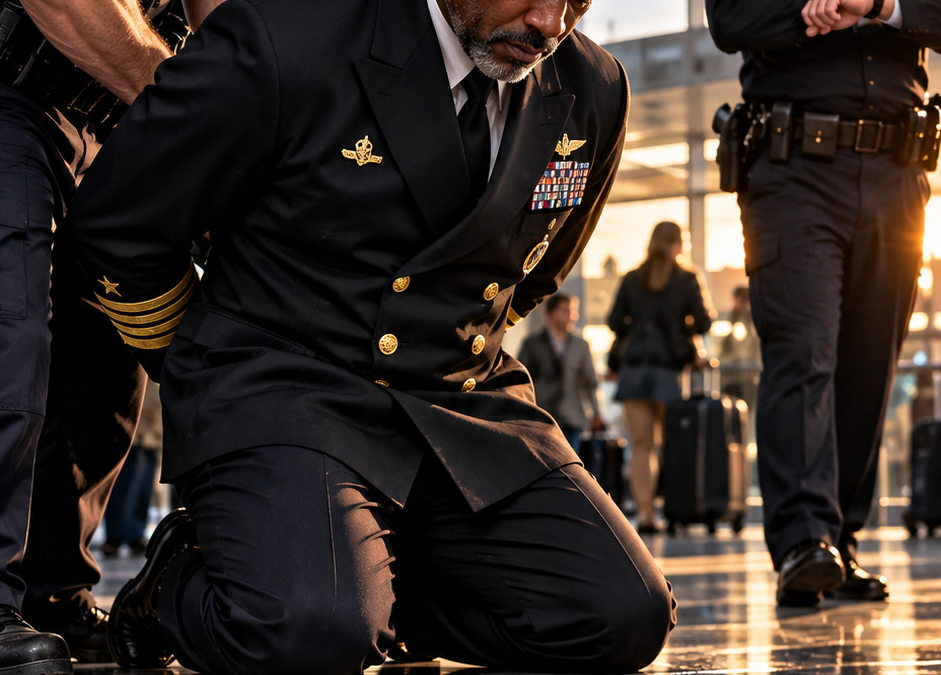
𝗙𝗨𝗟𝗟 𝗦𝗧𝗢𝗥𝗬
“Nothing. It contains official travel documents.”
“Then you shouldn’t have a problem with us checking.”
Mercer watched from several feet away.
His expression was calm.
Too calm.
And then I saw him look at his watch.
That was the moment my understanding of the situation changed.
He wasn’t watching me for signs of resistance.
He was watching the clock.
A woman standing near the departure board raised her phone and began recording.
Another passenger followed.
A Black mother pulled her teenage son closer as they watched from beside a row of seats. She looked at me with an expression I knew immediately.
She wanted her boy to understand what he was witnessing.
She also wanted him to forget it.
I kept my voice steady.
“Officer Row, you confirmed my identification and declaration. Please contact the command verification number on the paperwork.”
Row glanced at Mercer.
Mercer took the declaration from his hand.
“We’re not calling a number supplied by a suspect.”
“It’s printed on an official Department of Defense form.”
“Anybody can print a form.”
Every answer I gave seemed to create another accusation.
My uniform was suspicious.
My identification was questionable.
My calmness was argumentative.
My willingness to cooperate apparently proved that I was concealing something.
Then I noticed someone standing near a pillar at the far end of the terminal.
Aaron Vance.
I knew his face from the Norfolk review.
He was an airport operations employee whose credential activity had appeared in several irregular shipping records.
He was holding his phone at chest height.
When our eyes met, he turned away.
A moment later, he started walking toward a restricted service entrance.
The TSA manager who had arrived to oversee the scene watched him pass.
She leaned toward Mercer and whispered something I couldn’t hear.
Mercer looked at Vance.
Then at his watch again.
I understood that my missed flight might be the least important thing happening that morning.
“Officer Row.”
He looked down at me.
“Call the command number. Now.”
Mercer stepped between us.
“You’re not giving instructions to my officers.”
“Then allow me one phone call.”
Collins laughed.
“You’re detained, Commander.”
I looked directly at Mercer.
“Preventing this call would be a very serious mistake.”
The terminal grew quieter.
He studied me for several seconds.
“Who are you calling?”
“Rear Admiral Steven Caldwell.”
The change in his face was small, but unmistakable.
I had seen men react that way when they discovered that a decision they considered private had already become part of a much larger operation.
Row removed one cuff under the procedure for command verification.
I took my phone from my jacket.
My fingers were stiff, but I managed to dial from memory.
Caldwell answered on the second ring.
“Hayes?”
“Sir, they’ve done it again, and I have witnesses.”
I gave him the airport, my location, Mercer’s badge number, and Aaron Vance’s name.
Then I ended the call.
Collins smirked.
“Calling your lawyer?”
I said nothing.
Mercer immediately ordered Row to replace the handcuff.
Row looked at the declaration still lying beside my open bag.
“Supervisor, his weapon is secured. His orders match. There’s no new justification for tightening the restraint.”
Mercer’s voice dropped.
“Are you refusing an instruction?”
Row swallowed.
“I’m telling you what I verified.”
For the first time that morning, one of the men holding authority over me seemed more concerned with the evidence than with the person giving orders.
It didn’t erase what he had already done.
But it mattered.
The next four minutes felt longer than the entire detention.
Mercer ordered Collins to move the passengers back. He told the TSA manager to block the nearest checkpoint lane. He repeatedly demanded that Row secure my remaining wrist.
Meanwhile, the woman near the departure board kept filming.
“Turn that camera off,” Mercer ordered her.
“I’m standing exactly where I was standing before,” she replied.
“You’re interfering with an active security response.”
“No, I’m recording one.”
An older man wearing a Navy cap stepped beside her.
“I watched your officer check his papers. They matched.”
Collins pointed toward the concourse.
“Sir, move along.”
The older man removed his cap.
“I’ll leave when the commander does.”
I wanted to thank him.
Instead, I looked at the small American flag embroidered on his cap and felt an unexpected pressure behind my eyes.
For more than twenty years, I had asked sailors to place their trust in the institutions I represented.
Now a stranger was refusing to look away while one of those institutions failed me in public.
Mercer checked his watch again.
Four minutes after my call, two black SUVs arrived outside the terminal.
The first door opened before the vehicles had completely stopped.
Rear Admiral Steven Caldwell entered in service dress, followed by a Department of Defense investigator and the airport’s chief operating officer.
I had known Caldwell for eleven years.
He had a habit of becoming exceptionally quiet when he was angry.
That morning, he didn’t raise his voice.
His eyes moved from the contents of my bag to the cuff hanging from my left wrist.
“Commander Hayes.”
“Sir.”
“Step away from those officers.”
Collins shifted in front of him.
“Sir, this is an active airport police matter.”
Caldwell looked at him.
“Not anymore.”
The investigator beside him stepped forward.
“Agent Norah Bennett, Department of Defense.”
She displayed her credentials and turned toward Row.
“Remove the restraint.”
Row unlocked the remaining cuff.
The sudden absence of metal felt almost as strange as its weight had.
I rubbed my wrist once.
Red marks had begun forming beneath the edge of my sleeve.
Bennett surveyed the scene.
“Every body camera recording, dispatch communication, access log, and terminal video from the last hour is to be preserved. Nobody deletes a message, alters an incident report, or leaves this airport without authorization from the appropriate investigative authority.”
Mercer attempted to speak.
Bennett interrupted him.
“Who initiated the report against Commander Hayes?”
Nobody answered.
The chief operating officer requested the incident file on a tablet.
The original report had been submitted through an internal employee channel at 8:42 that morning.
It described an agitated Black male wearing a possible military uniform, repeatedly reaching into his jacket and causing nearby employees to fear for their safety.
Bennett read it once.
“Who submitted this?”
The executive scrolled.
“The employee’s identity is hidden behind an administrative code.”
“Open it.”
The TSA manager stepped closer.
“That could violate personnel privacy.”
Bennett glanced at my belongings spread across the carpet.
“Privacy seems to have become a concern rather suddenly.”
The executive entered his authorization code.
A name appeared.
Aaron Vance.
Mercer immediately said, “Vance probably acted out of caution.”
Bennett turned toward him.
“I hadn’t identified the employee aloud.”
He went completely still.
I watched Caldwell register the exchange.
“Malcolm, do you know this man?”
“I recognize him from the Norfolk review.”
“Did he recognize you?”
“He photographed me before leaving through a restricted service door.”
Bennett spoke into her radio.
“Locate Aaron Vance. Disable his badge and secure the west service exits.”
The airport executive relayed the order.
Mercer reached into his pocket.
I saw his thumb move across his phone.
“He’s sending a warning,” I said.
Row stepped in front of him.
“Supervisor, Agent Bennett ordered all communication devices preserved.”
“She doesn’t command me.”
Bennett held out her hand.
“Give me the phone.”
Mercer didn’t move.
Then the executive’s radio crackled.
“Operations, Vance is at the west vehicle gate. He’s attempting to leave airport property.”
Bennett turned toward the nearest officer.
“Stop that vehicle.”
I looked at Caldwell.
“The detention was never supposed to be the entire operation.”
He nodded.
“What was it supposed to accomplish?”
I thought of Vance disappearing through the service door while Mercer watched his clock.
“Time.”
By the time they brought Aaron Vance back into the operations building, the passenger video had already begun spreading online.
He had made it as far as the outer service road before airport police stopped his vehicle between two maintenance trucks.
According to the arresting officer, Vance attempted to drop his phone into a paper cup filled with coffee.
When that failed, he smashed it against the pavement.
The screen shattered.
The device was recovered.
Vance entered the operations office without his jacket, sweat darkening the collar of his shirt.
He saw me seated beside Caldwell.
Then he looked at Mercer.
Bennett caught the glance.
“Separate rooms,” she ordered.
I had spent enough years conducting investigations to understand why that mattered.
People involved in a conspiracy often depend on knowing what everyone else has admitted.
Alone, each participant has to wonder whether the others have already decided to save themselves.
The airport executive gave us access to the surveillance center.
Three recordings quickly established that my detention had been planned.
The first showed Vance photographing me before the police report was submitted.
The second showed Mercer leaving the airport police office before dispatch assigned the incident to Collins and Row.
The third showed the TSA manager holding my valid declaration while telling nearby passengers I had refused to produce identification.
The executive stared at the monitor.
“She was holding the proof.”
“Yes,” I said.
He looked at me.
“Commander, I’m sorry.”
I didn’t doubt his sincerity.
But sincerity was not what I needed.
“Find out what those seventeen minutes purchased.”
Bennett joined us with the preliminary records recovered from Vance’s communications.
He had sent my photograph to an unsaved number.
Beneath it were five words.
It is him. Stall him now.
The response arrived nineteen seconds later.
Use police if needed. Forty-eight hours.
Caldwell read the message twice.
“Forty-eight hours.”
I recognized the significance immediately.
Our procurement hearing was scheduled for the following morning. If it proceeded with my testimony and the records already submitted, the panel could authorize subpoenas reaching well beyond the civilian companies our team had identified.
Those subpoenas could expose the military officials approving unauthorized cargo transfers.
Someone wanted enough time to destroy the documents connecting the two sides of the operation.
Caldwell looked at my flight information.
“You’re not making your original connection. We can arrange military transport.”
Bennett shook her head.
“Not until we know whether the delay was intended to keep him here or move him onto a route they control.”
I turned toward the airport’s cargo access map.
“Before we go anywhere, we need to know what changed while I was detained.”
The executive ordered an immediate freeze on contractor access.
No vendor credential would open a controlled cargo door without additional verification.
Within three minutes, two alarms appeared.
One came from an unused baggage tunnel beneath Terminal Two.
The other came from Warehouse Fourteen, a private logistics facility connected to military freight transfers.
Both access attempts were associated with Vance’s credentials.
Bennett ordered response teams to both locations.
I leaned over the map.
“The tunnel is a diversion.”
“Why?”
“It doesn’t connect to controlled cargo. But getting a response team through it would take several minutes.”
I pointed to the warehouse.
“Fourteen has direct access to the service road where Vance was intercepted.”
Caldwell looked at the executive.
“One team to the tunnel. Everyone else to the warehouse.”
I watched the response vehicles begin moving across the airport’s security feeds.
For the first time, I understood exactly why Mercer had wanted me on my knees instead of on my flight.
The question was no longer who had lied about my identity.
It was what they had been moving while everyone was watching me.
The team sent to the baggage tunnel reported finding an empty corridor and a maintenance cart deliberately parked beneath a surveillance camera.
At the same time, Vance began talking.
Bennett had confronted him with the photographs and communication records. He initially claimed he had been protecting the airport from an unauthorized military inspection.
Then she showed him the message requesting forty-eight hours.
His explanation changed.
He admitted that he had been instructed to identify me, invent a local security concern, and prevent me from reaching my flight.
“Who gave you those instructions?” Bennett asked.
“A prepaid number. Sometimes a voice.”
“What did the voice say?”
Vance lowered his head.
“That the uniform would make the report believable.”
I felt my jaw tighten.
The investigators recovered a prepared reporting template from his phone account. It described a Black male in a possible military costume and included several accusations Vance could select depending on my behavior.
If I reached for my identification, he could report suspicious movements.
If I remained calm, he could describe controlled aggression.
If I challenged an officer’s instructions, he could claim I was resisting security procedures.
The language had been prepared before I entered the airport.
I stared at the report.
Every effort I had made to prevent a confrontation had simply given them another way to describe me as dangerous.
Bennett asked Vance how long I was supposed to remain detained.
“Forty minutes.”
“Why?”
“To clear the warehouse and open a route through Norfolk.”
“Who controls Norfolk?”
Vance looked toward the wall separating his interview room from Mercer’s.
“The man Mercer answers to.”
Before Bennett could question him further, the operations center received another alert.
Vance’s credential had just opened the interior records room of Warehouse Fourteen.
His actual badge was already secured in an evidence bag.
Someone was using a duplicate.
Vance went pale when Bennett told him.
“They’re making it look like I did everything.”
“What happens inside that room?” she asked.
“There’s a remote erase program. If your people trigger the alarm, someone in Norfolk can wipe the computers.”
“How do we stop it?”
Vance hesitated.
“There’s an emergency network switch behind the wall map.”
Bennett relayed the information to the warehouse team.
The first officers entering Warehouse Fourteen reported the smell of burning plastic.
Through a live security feed, I watched them move between enormous shelving units toward a locked office.
Two industrial bins stood beneath a portable ventilation hood. One contractor was feeding documents into a fire. Another was destroying computer drives with a drill.
Both tried to escape when the officers entered.
One reached a rear exit and found another police team already waiting.
The other disappeared between shelves, overturned a metal cart, and scattered burning papers across the floor.
The warehouse smoke detectors remained silent.
Someone had disabled the alarm.
Officers extinguished the fire and caught the second contractor near an electrical cabinet, seconds before he could cut power to the office servers.
Inside the locked records room, every computer displayed the same warning.
REMOTE ERASE IN PROGRESS.
The progress indicator had already passed forty percent.
Bennett placed Vance on speaker.
“Tell them exactly where the isolation switch is.”
“Behind the wall map. Red toggle. Plastic cover.”
An officer pulled the map aside.
The switch was there.
The remote connection was severed when the erase indicator reached fifty-three percent.
Two drives were lost.
One survived.
That surviving drive contained contractor access maps, payment references, and a folder labeled LOCAL RESPONSE.
When the investigators opened the folder, they found records showing how civilian security personnel could be used to obstruct military inspections.
My arrest had not been an improvised favor.
It had been part of their operating procedure.
The warehouse search recovered something even more significant.
A wall map marked civilian airports from Virginia to Georgia.
Colored symbols identified inspection stations, surveillance gaps, and security personnel who could be contacted when military cargo needed to pass without scrutiny.
Raleigh-Durham had been marked SAFE.
Beside it was Mercer’s name.
Norfolk carried another name.
Captain Adrien Callahan.
I stared at it for several seconds before Caldwell noticed I had stopped listening.
“Malcolm?”
I couldn’t answer immediately.
Adrien Callahan was not simply another officer I had served with.
He was the man I had trusted to notify my wife if I didn’t return from deployment.
Eight years earlier, during a machinery fire in the Persian Gulf, Adrien had refused to leave a smoke-filled passageway until the last injured sailor was carried out.
We had spent fourteen years serving together, enduring deployments, funerals, separations, and the quiet exhaustion that follows decisions nobody outside the military ever hears about.
He knew my family.
He had sat at my mother’s table for Thanksgiving when his own deployment schedule kept him from going home.
When my mother died, he had taken over my duties so I could attend her funeral. He had even driven Elena to the cemetery when her car broke down.
I had considered him a brother.
Now his name was written beside Norfolk on a map recovered from a warehouse where men had been burning evidence.
Caldwell stepped closer.
“You know him.”
“Yes, sir.”
“Could it be somebody else?”
“Not with that name and that access.”
I wanted another explanation.
More than anything, I wanted the map to be wrong.
But I had spent my career teaching younger officers that loyalty was not permission to ignore evidence.
I couldn’t abandon that principle simply because the evidence had reached someone I loved.
Bennett photographed the map.
“Nobody contacts Callahan,” she ordered. “As far as he knows, the delay worked.”
A few minutes later, officers discovered that Mercer had concealed a second phone inside his duty vest.
It contained a message he had sent shortly after Vance’s arrest.
Burn the blue binders. Move the drives. Callahan will handle Norfolk.
I looked away from the screen.
It is difficult to describe what betrayal feels like when it comes from someone who knows your entire history.
Mercer had judged me by my appearance and used that judgment to justify treating me as a criminal.
Adrien knew my character, my service record, my family, and the responsibilities I carried.
He knew exactly how difficult it would be for me to believe he had betrayed us.
And that knowledge had apparently become part of his protection.
By afternoon, Mercer was in custody. Vance had agreed to cooperate, and the warehouse contractors were being questioned.
Investigators identified payments to Mercer through a company registered to his brother-in-law.
The TSA manager had not received money from the network. She had supported Mercer’s version of events because he had previously protected her department from complaints.
Collins had no established financial connection to the conspiracy.
He had simply accepted the accusation against me and treated every contradiction as further evidence of guilt.
That distinction mattered legally.
It did not make the memory any easier to carry.
Before I left the airport, Row asked to speak with me privately.
We stood in a small employee lounge, away from the cameras and the passengers who had witnessed my detention.
Without Mercer beside him, he looked considerably younger.
“Commander, I knew something was wrong almost immediately.”
I waited.
“Your declaration matched. You were calm. The report said you were shouting, but nobody at the coffee stand heard you raise your voice.”
I looked at him.
“And you still put the cuffs on me.”
“Yes, sir.”
“Why?”
“Because my supervisor ordered it.”
He seemed to expect me to become angry.
I didn’t.
Anger would have made the conversation easier for him. He could have accepted my reaction as punishment and considered the matter closed.
Instead, I asked him what he believed he should have done.
He looked at the floor.
“I should have trusted the documents.”
“You should have read the paper in your hand before helping a lie become procedure.”
He nodded.
Then he told me he had preserved a copy of his body camera recording outside the local server.
It captured Mercer instructing dispatch to identify me as uncooperative before Collins and Row had even reached the coffee stand.
“Have you given it to Agent Bennett?”
“Yes, sir.”
“Good.”
He looked at my bruised wrist.
“I know it doesn’t make up for what happened.”
“No,” I said. “It doesn’t.”
I left without offering him forgiveness.
But I hoped the next traveler he stopped would benefit from what he had finally decided to do.
That evening, Caldwell and Bennett moved me to a secure federal facility outside Washington.
I was supposed to spend the night preparing for the procurement hearing.
Instead, Bennett received a preliminary extraction from Vance’s broken phone.
Two words appeared repeatedly in communications sent after my call to Caldwell.
Richmond pressure.
My younger sister lived in Richmond.
Elena was an eighth-grade history teacher, and she had spent most of her adult life avoiding the public attention my career occasionally attracted.
She loved her students, cared for our mother’s old furniture as if every piece were irreplaceable, and called me every Sunday whether I answered or not.
She was also the only immediate family member the conspirators could reach quickly.
Bennett arranged protection at her home.
I called from a secure phone.
Elena answered before the first ring finished.
“I saw the video.”
Of course she had.
“Are you all right?”
“I’m safe.”
“That wasn’t my question.”
I closed my eyes.
“My wrists are bruised. Nothing serious.”
“Malcolm.”
I knew that tone.
It was the same voice she had used when we were children and I claimed I wasn’t hurt after falling from my bicycle.
“I’m telling you the truth.”
“You’re telling me the part you think I can handle.”
I looked toward Caldwell.
He quietly stepped outside.
I explained that officers were positioned near her house and that investigators were examining a possible threat.
Elena listened without interrupting.
When I finished, she said, “Don’t carry this like you caused it.”
“I brought people into your life who never should have known your name.”
“You didn’t bring anyone here. They’re the ones making those decisions.”
I wanted to believe that distinction would comfort me.
It didn’t.
At ten-thirty that night, the online attack began.
Anonymous accounts claimed I had a history of aggressive behavior during security screenings. Others accused me of using my rank to intimidate civilian employees.
One post falsely identified a retired Navy officer standing beside me in an old ceremony photograph as the owner of a defense company connected to our investigation.
Within an hour, dozens of accounts were repeating identical accusations.
Unstable behavior.
Special treatment.
Staged confrontation.
Bennett’s analysts traced several accounts to profiles that had previously promoted the same logistics subcontractor during an unrelated labor dispute.
“They’re trying to contaminate your testimony,” she said.
I watched a shortened version of the airport video playing silently on her monitor.
The clip began with me already in handcuffs.
It omitted Row verifying my documents.
It omitted Mercer refusing to contact command.
It omitted the minutes during which I had remained compliant while officers searched my belongings.
“They’re trying to contaminate me,” I said.
The airport detention had failed to produce footage of me resisting.
Now they needed to invent a history that made their treatment of me appear justified.
Caldwell refused to engage in a public contest over my service record.
He instructed Navy Public Affairs to release only the verification of my orders and official travel status.
“We’re not giving them a collection of medals to argue about,” he told me. “We’re giving them timestamps.”
Shortly after midnight, the full extraction from Vance’s broken phone arrived.
One contact had been saved under the name ORE.
At 8:41 that morning, the contact had instructed Vance to hold me and make my uniform the problem.
After Caldwell arrived at the airport, another message had followed.
If Caldwell is moving, clear Fourteen and initiate Richmond pressure.
Minutes later, the security officer watching Elena’s house reported an unidentified dark SUV moving slowly along her street.
It passed once.
Then again.
On the third pass, it stopped half a block from her driveway.
Its lights went out.
Nobody exited.
No weapon appeared.
They didn’t need one.
They wanted us to know they had found her.
Elena was grading essays at the kitchen table when the protection officer told her to move into the rear hallway.
I called immediately.
“Where are you?”
“Inside. Two officers are with me.”
“Stay away from the windows.”
“Malcolm, I’m not going outside to ask them what they want.”
Her attempt at humor nearly broke me.
I could hear the strain beneath it.
“Listen to me. They’re sending additional officers. You’re going to be moved somewhere safe.”
“And you’re staying exactly where you are.”
“Elena—”
“No. Don’t start.”
She knew me too well.
She knew I was already considering every possible way to reach Richmond.
“If they want you to choose between the hearing and me, don’t insult me by pretending I don’t understand what they’re doing.”
“You’re my sister.”
“And you’re my brother. That’s why they chose me.”
Then I heard the crash.
Metal struck metal somewhere beyond her house.
An officer shouted.
A vehicle accelerated.
For several seconds, Elena’s line filled with overlapping voices.
“Elena!”
“I’m here!”
“Are you hurt?”
“No. They’re moving me.”
I gripped the phone so tightly its edge pressed into my palm.
The SUV had accelerated when police entered the street from opposite directions, struck a parked car, and escaped through an alley.
A traffic camera captured a temporary dealership tag taped inside its rear window.
Investigators traced the tag to a company used by Adrien Callahan’s wife.
I placed both palms on the conference table.
“Bring Elena here.”
Bennett immediately began arranging it.
Caldwell remained seated across from me.
“Malcolm, look at me.”
I did.
“You’re not going to Richmond.”
“I didn’t say I was.”
“You didn’t have to.”
I wanted to tell him that he didn’t understand.
But he did.
He understood that a frightened brother would be considerably easier to manipulate than a naval officer preparing to testify under oath.
“They used my uniform at the airport,” I said. “Now they’re using my family because the first attack didn’t produce the reaction they needed.”
Caldwell pushed the temporary phone toward me.
“Don’t give it to them now.”
Elena arrived at the secure facility before three in the morning.
She carried one overnight bag and a stack of essays she had apparently refused to leave behind.
When she stepped into the hallway, I went straight to her.
She looked at my wrists before she looked at my face.
I noticed a scrape across her palm.
“What happened?”
“I tripped over a flowerpot when they took me through the backyard.”
“You should have told me.”
“And you should have told me people were being paid to track you.”
We stood there looking at each other.
Neither of us could find an apology that would repair what had happened.
So I embraced her.
For a few seconds, I stopped being a commander, an investigator, or a witness.
I was simply a man holding his little sister and feeling how close he had come to losing her.
Later, Bennett explained what the investigators knew about the vehicle.
It had been recovered abandoned near Interstate Ninety-Five. Its interior had been wiped, but the driver had left behind a toll receipt and a disposable drink cup.
Elena listened carefully.
Then Bennett mentioned Callahan.
My sister went still.
“Adrien?”
I nodded.
“The name is in the evidence.”
“The same Adrien who spent Thanksgiving with us?”
“Yes.”
“The one Mom used to send leftovers home with?”
I couldn’t answer.
Elena sat down.
For the first time since arriving, she looked genuinely exhausted.
“Are you certain?”
“No. That’s why we’re investigating.”
She studied my face.
“But you believe it’s possible.”
I thought of the message ordering Richmond pressure.
“I believe somebody wants me thinking about him before I testify.”
At eight the following morning, Adrien called me.
He used my original phone, unaware that Bennett had retained it and was monitoring incoming communications.
She placed it on the conference table and began recording.
I answered.
“Adrien.”
“Malcolm, thank God. I just saw the airport footage. Are you all right?”
His voice sounded exactly as I remembered.
Steady.
Concerned.
Familiar enough to make me feel, for one dangerous moment, that the evidence must be wrong.
“I’m safe.”
“I tried Caldwell, but he wouldn’t return my call. Listen, I heard Mercer may be connected to your logistics investigation.”
I glanced at Bennett.
She wrote something on a legal pad.
“Go on,” I said.
“You need to be careful what you say today. People will use your anger about that airport incident against you.”
“What do you think I should say?”
“Only what you personally observed. Don’t repeat theories about the Norfolk chain. Some of your analysts have been overreaching.”
“Which theories?”
“The access logs. The waiver sequence. You know how young investigators get when they start seeing patterns.”
My stomach tightened.
He was naming restricted findings that had not appeared in the public account of my detention.
“Adrien, a vehicle connected to your wife’s company was outside Elena’s house last night.”
Silence.
Then a sigh.
“My wife’s company sold several vehicles this month. Temporary tags get copied. You can’t let frightened investigators turn every coincidence into betrayal.”
I watched Bennett lift her head.
“I didn’t tell you the vehicle had a temporary tag.”
Another silence.
“It’s all over the internal alerts.”
Bennett shook her head.
It wasn’t.
I looked down at the phone.
“Aaron Vance sent messages to someone named Ore.”
“You think that’s me?”
“I didn’t ask you a question.”
His breathing changed.
Then the warmth disappeared from his voice.
“You always did enjoy making a room wait for you, Malcolm.”
I felt fourteen years of friendship narrowing into one terrible moment.
“And you always started filling the silence when you were afraid, Adrien.”
He disconnected.
Neither Bennett nor I spoke immediately.
Then her tablet sounded.
My security clearance had changed from green to red.
An emergency complaint alleged that I had carried classified audit material in my personal bag at Raleigh-Durham and allowed civilian police to expose it during their search.
The complaint had been filed at 7:56 that morning.
Four minutes before Adrien called to ask whether I was safe.
Two security officers arrived to collect my access badge.
They were courteous, professional, and visibly uncomfortable.
I removed it and placed it in the envelope.
Until the allegation was resolved, I couldn’t enter the restricted hearing or testify about the Norfolk investigation.
Elena watched from across the room.
“They couldn’t make the airport search your fault,” she said. “So now they’re making the search itself a security violation.”
I looked at the envelope containing my badge.
“Procedure makes excellent camouflage.”
The complaint included a photograph of Collins holding my document pouch above the contents of my open bag.
Its caption falsely identified the pouch as containing classified cargo reports.
In reality, I had carried only my travel orders, hearing notice, and weapon declaration. The classified evidence had been transmitted directly through secure channels to the hearing panel.
But my word wasn’t enough.
The panel needed a verifiable chain of custody before I could testify.
Mercer’s official inventory described the contents of the pouch as unidentified restricted documents.
Row’s body camera showed me identifying the pouch before the search, but its audio stopped thirty seconds before Collins opened it.
Mercer had ordered the cameras muted.
Caldwell stared at the incomplete recording.
“Where do we find the missing thirty seconds?”
I remembered the woman near the departure board.
“She recorded everything.”
The airport executive located her witness statement and contacted her through the number she had provided.
She still had the original video.
She had also sent a duplicate to her daughter before leaving the terminal.
When asked why she had preserved it, she explained that the officers kept changing the reason they were holding me, and she had been afraid they would eventually change the account of what the cameras had captured.
Her uninterrupted recording showed Collins opening my document pouch and reading every page aloud.
Official travel orders.
Hearing notice.
Weapon declaration.
No classified cargo reports.
It also showed Mercer watching the entire search without once asking whether any document contained classified information.
The allegation had appeared only after Adrien needed my clearance suspended.
At 8:39, Bennett submitted the original video and document serial numbers to the security office.
Investigators traced the emergency complaint to Adrien’s authority code.
It had been submitted from his home network.
At 8:52, my clearance returned to green.
The two security officers brought my badge back in the same envelope.
“We’re sorry, Commander.”
I clipped it onto my uniform.
“Don’t apologize for examining an allegation. Preserve the identity of the man who filed it.”
Bennett was already requesting warrants for Adrien’s office, home, vehicles, and electronic devices.
I looked toward the clock.
The hearing was less than three hours away.
And somewhere in Norfolk, the man who had once promised to protect my family was still trying to make the evidence disappear.
Vance provided the missing information twenty minutes later.
The forty-eight-hour window had not been intended solely for destroying electronic records.
A secure archive near Norfolk held three blue binders containing original shipping waivers and military approval signatures. Their digital counterparts had been altered, but the paper copies identified the officers who had authorized restricted cargo transfers and the civilian contractors who had received access.
Adrien had insisted that the originals remain outside the regular Navy records system.
He had described the arrangement as an emergency measure designed to accelerate local operations.
Now I understood why he had wanted those records under his control.
“Where are the binders?” Bennett asked Vance.
“They were moved last night.”
“Where?”
“I don’t know. Three gray transfer cases. They were supposed to go to an industrial destruction facility.”
An automated highway camera located a gray transfer vehicle traveling west on Interstate Sixty-Four.
Its destination appeared to be a private airfield operated by the logistics consultant.
Bennett dispatched a team to intercept it.
Caldwell wanted me to remain at the secure facility and concentrate on the hearing.
I was studying the vehicle’s route when something occurred to me.
“Why would Adrien move his most important evidence in a truck connected to a company we already know about?”
Bennett examined the map.
“You think it’s a decoy.”
“I think he wants us following it.”
The highway team intercepted the vehicle two exits before the airfield.
Inside were three gray cases filled with outdated training manuals.
A tracking beacon beneath the floor allowed the conspirators to monitor the vehicle’s progress.
Adrien had sent investigators chasing empty boxes while keeping the real evidence somewhere else.
I closed my eyes and tried to remember how he handled sensitive material during deployments.
He disliked depending on other people when the consequences were personal.
Once, after an investigation into a maintenance failure, he had kept copies of critical notes inside an ordinary garment bag because he believed obvious hiding places attracted unnecessary attention.
“His house,” I said.
Bennett looked at me.
“What?”
“He won’t trust anyone else with his last protection. Check his house.”
She redirected the nearest federal team toward Adrien’s Norfolk residence.
The surveillance feed from a camera across the street showed smoke escaping beneath his garage door.
Agents were eight minutes away.
I stared at the image.
Eight minutes was an eternity when someone was feeding documents into a fire.
Bennett coordinated with local firefighters while her team approached from opposite ends of the street.
I studied the garage floor plan.
“If he sees them, he’ll try to make the fire a reason for everyone to withdraw.”
Caldwell turned toward me.
“Would he harm himself?”
“No. He’ll create enough danger to stop the search and later claim he panicked.”
Bennett relayed the warning.
The agents reached the property with less than thirty minutes remaining before the hearing.
Adrien was standing beside his car.
An open garment bag lay on his workbench.
Beneath it were three blue binders.
He attempted to close the garage door as the federal vehicles entered his driveway.
The agents moved before it could seal.
Adrien kicked a metal container of burning paper toward a shelf holding paint thinner.
One agent pulled the container clear while another restrained him against the car.
The garage alarm finally sounded when the federal team forced the door open.
Its cable had been cut.
The first binder was scorched along one edge.
The original signatures were still readable.
Adrien insisted the binders were duplicate training records. When investigators opened them and identified the original authorization sheets, he changed his explanation.
He claimed he had brought them home to protect them after the airport security incident.
An investigator pointed toward the burning container.
“Then why were you destroying them?”
Adrien stopped answering.
Inside his garment bag, agents recovered a second phone.
Its screen displayed the decoy vehicle’s location, the emergency complaint against me, and the exact time my security clearance had been suspended.
He had been watching both distractions while attempting to destroy the original approvals.
Bennett received photographs of the recovered documents at 10:17 that morning.
One page contained my original audit question.
Who authorized civilian access during sealed transfer?
Beneath it, in handwriting I recognized immediately, Adrien had written an instruction.
Delay Hayes. Route through Mercer. Clear after hearing.
For several seconds, I couldn’t speak.
My oldest friend had taken a question I had asked in the interest of protecting Navy personnel and turned it into instructions for removing me from the investigation.
The person who knew me well enough to understand how I would respond to a legitimate security concern had used that knowledge to trap me.
Bennett placed the photograph beside the airport records.
“We have him.”
I wanted to believe the hardest part was finished.
Three minutes later, the panel’s legal counsel called.
Adrien’s attorney had submitted an emergency memorandum claiming I had arranged the airport confrontation myself.
Attached was an airline reservation note apparently created the previous week.
It carried my initials and stated that I had personally requested the Raleigh connection in anticipation of a security review.
If authentic, the document suggested that I had knowingly traveled through the airport to provoke the officers and manufacture evidence against Mercer.
The binders could still expose the cargo conspiracy.
But my testimony might be discredited.
“I never requested Raleigh,” I said.
Bennett believed me.
The hearing panel required something stronger.
The airline’s reservation system showed that the connection had been requested by the passenger.
Our military travel office recorded the route as an automatically selected connection.
The records contradicted each other.
At 10:35, the panel warned that my testimony might have to proceed under a formal credibility challenge.
Bennett sent the airline note to the technicians examining Vance’s communications.
They discovered that its visible date had been falsified.
The underlying creation record showed it had been entered at 9:12 the previous morning, after I contacted Caldwell.
Its text matched a draft recovered from Vance’s phone.
Beside the draft was another instruction.
If Hayes reacts, preserve confrontation. If he stays calm, claim planned contact.
I read it twice.
They had prepared to turn either my anger or my restraint into evidence against me.
At 10:44, the military travel office delivered the original routing packet, complete with a digital seal created five days before the detention.
It established that I had no control over the Raleigh connection and had received my final itinerary only after the route was selected.
Bennett placed both records in front of me.
“The panel will want the entire sequence.”
“Then we’ll give it to them,” I said.
I retrieved the uniform jacket I had worn at the airport.
It was still creased where Collins had pulled it from my bag.
I had been offered a clean replacement.
I refused it.
I wasn’t wearing the jacket to make a statement about what had happened.
I was wearing it because the hearing was about evidence, and I wanted nothing about my appearance or conduct altered to make the truth easier to accept.
At eleven o’clock, I entered the hearing room.
There were no windows.
Five panel members sat behind a curved table while a Justice Department attorney arranged the evidence folders.
No reporters were present.
No phones were permitted.
The panel chair opened with Adrien’s accusation.
“Commander Hayes, you recognized Daniel Mercer and Aaron Vance before contacting Admiral Caldwell.”
“Yes, ma’am.”
“You were leading a security review that required evidence of coordination between military personnel and civilian contractors.”
“Yes, ma’am.”
“Why should this panel believe you did not deliberately choose Raleigh-Durham to provoke an encounter?”
The government attorney displayed my original travel record.
The military travel office had booked the connection five days earlier.
I had received the itinerary after the route was selected, and I had no access to Mercer’s duty schedule.
The chair studied the document.
“Once you recognized Mercer, you understood the detention might produce evidence relevant to your investigation.”
“I understood it might be connected.”
“Why did you not immediately identify yourself as the officer leading the restricted review?”
“Because I had no authorization to disclose that investigation. I identified myself as a Navy commander, presented valid orders, and requested verification through the official number.”
“Yet you remained there long enough for the confrontation to escalate.”
“I repeatedly asked them to verify my documents and end the detention.”
The attorney played Row’s preserved body camera footage.
The room became silent.
There I was again, kneeling on the terminal floor.
I watched myself offer my identification.
I heard Row confirm the paperwork.
Then Mercer ordered the search to continue.
Watching those minutes was unexpectedly difficult.
I remembered the pressure around my wrists and the humiliation of seeing my belongings scattered across the carpet.
But what struck me most was how ordinary my voice sounded.
I had been trying to go about my morning.
I had been trying to catch my flight.
The chair watched the recording without interruption.
Then she examined the page recovered from Adrien’s garage.
“Do you recognize this handwriting?”
“Yes, ma’am.”
“Whose is it?”
“Captain Adrien Callahan’s.”
“How long have you known him?”
“Fourteen years.”
“Did you consider him a friend?”
I stared at the document.
“I considered him a brother.”
“Does that relationship affect your testimony?”
For a moment, I thought of our mother’s kitchen.
Adrien laughing with Elena.
My mother insisting that he take another plate of food.
The long deployments when his friendship had made the burden of command easier to carry.
“It affects me,” I answered. “It doesn’t change what he wrote.”
The chair allowed the words to settle.
Then she asked another question.
“Why did the original airport report emphasize your race and question the authenticity of your uniform?”
I looked toward the screen displaying Vance’s prepared reporting template.
“Because they needed the officers to accept a description instead of examining the evidence.”
I explained how the accusation had been constructed.
Vance had reported an armed Black man in a possible military costume rather than a commander whose identification and paperwork had already been checked.
The language was designed to make officers suspicious of the very documents that should have resolved the encounter.
The attorney displayed the messages recovered from Vance’s phone.
The false report had been prepared before I arrived.
Mercer had repeated its allegations before dispatch formally assigned the incident.
Adrien’s recovered instruction established that I was supposed to be delayed through Mercer.
The panel then examined the falsified airline reservation note.
Its visible creation date conflicted with its actual electronic record.
The original military travel packet carried an intact digital seal.
The attorney displayed the draft that described how the conspirators intended to interpret my behavior.
If Hayes reacts, preserve confrontation. If he stays calm, claim planned contact.
The chair looked up.
“So the allegation would change depending on his response?”
“Yes,” the attorney answered. “The intended conclusion remained the same.”
I thought about the morning at Raleigh-Durham.
When I provided identification, the officers questioned its authenticity.
When I remained calm, they called me argumentative.
When the detention failed to discredit me, Adrien used the search to accuse me of mishandling classified documents.
And when that allegation failed, he claimed I had arranged the confrontation myself.
The chair turned back toward me.
“Commander, when did you first believe the detention might have been planned?”
“When Mercer denied attending the Norfolk review.”
“Why didn’t you contact Admiral Caldwell immediately?”
“Because I first requested ordinary verification. I had given the officers everything they needed to resolve the situation without disclosing the restricted investigation.”
“And when Mercer refused?”
“I requested the call.”
“Did you intentionally delay making that call to collect evidence?”
“No, ma’am.”
I met her eyes.
“I was trying to end the detention using the same procedures available to any other traveler.”
At 12:18, the chair ruled that the allegation that I had staged the airport encounter lacked factual support.
My testimony would remain part of the procurement investigation.
The panel authorized subpoenas for companies connected to the altered shipping records, suspended Adrien’s emergency cargo waivers, and froze seven financial accounts before their funds could be transferred overseas.
The recovered binders established the connection between the civilian logistics network and the military approvals that had allowed restricted cargo to move without proper oversight.
The people who had spent months hiding behind administrative procedures would now have to answer for the documents they had created.
Before releasing me, the chair asked one final question.
“Commander Hayes, what do you remember most clearly about your detention?”
I thought about the handcuffs.
The open bag.
The woman holding her phone beside the departure board.
The mother trying to protect her son from understanding what he was watching.
And Mercer, standing above me, checking his watch with absolute confidence that the officers around him would accept his version of events.
“I remember how comfortable they were,” I answered. “They believed the lie would protect them because it always had.”
The sentence entered the official transcript.
By evening, someone had leaked that portion of my testimony.
I disliked the attention it attracted.
But I understood why people responded to it.
The most disturbing part of the encounter had not been the extraordinary conspiracy concealed behind it.
It had been how little effort Mercer needed to make the first lie work.
The indictments arrived over the following six weeks.
Adrien was charged with directing the cargo scheme, obstructing the security review, destroying evidence, and authorizing pressure against my sister.
Mercer faced charges involving conspiracy, false statements, evidence destruction, and misuse of his police authority.
Vance remained in custody as a cooperating defendant.
Adrien’s attorneys asked me to support a private military resolution.
They argued that a public criminal case would damage trust in Navy contracting and compromise the reputation of officers who had never participated in the scheme.
I returned the request with four words.
Trust cannot survive concealment.
Adrien eventually pleaded guilty after the court admitted the airport communications, recovered binders, falsified reservation records, and recording of his telephone conversation with me.
At sentencing, he insisted he had only wanted additional time to correct administrative mistakes before anyone was harmed.
The judge questioned why correcting administrative mistakes would require destroying original records and threatening a witness’s family.
Adrien received a federal prison sentence, forfeited the illegal payments, and permanently lost his security access.
Mercer received a shorter prison term.
He also lost his badge and the ability to serve in law enforcement again.
Vance received a reduced sentence in recognition of his cooperation. His information had helped investigators preserve the warehouse evidence and recover the original authorization records.
The cooperation did not erase the false report he had created against me.
Collins was not charged in the procurement conspiracy.
Investigators found no evidence that he understood why Mercer wanted me detained.
An independent review nevertheless uncovered five previous incidents in which Collins had expanded searches after travelers presented valid identification.
In each case, he had characterized the traveler’s objections as aggression.
He was dismissed from the airport police department.
The TSA manager lost her supervisory position and was barred from security oversight after admitting that she had examined my valid declaration before repeating Mercer’s false description.
Row accepted a suspension for placing the first handcuff on me after verifying my paperwork.
His independent preservation of the body camera recording and subsequent testimony were significant in establishing Mercer’s actions.
When the review board asked for my opinion, I requested that both parts of Row’s conduct remain in the record.
He had followed an unjustified order.
He had also preserved evidence and eventually refused to continue enforcing it.
Leaving out either decision would distort what happened.
He returned to duty under a different supervisor after completing additional training.
Several months later, I received a letter from him.
He didn’t ask for forgiveness.
He described the moment he had looked at my valid declaration, heard Mercer order me restrained, and decided that obeying his supervisor was more important than the facts he had just verified.
He wrote that he had spent more time thinking about that decision than about anything that happened after Caldwell entered the terminal.
I kept the letter.
I never answered.
Raleigh-Durham subsequently introduced additional verification and evidence-preservation procedures.
Valid military and federal credentials had to be checked before searches were expanded unless a traveler’s actual conduct presented an immediate threat.
Internal security reports were required to preserve the identity of the person submitting them, along with dispatch records, body camera footage, and relevant terminal video.
The Navy centralized original shipping approvals so local offices could no longer alter or destroy the only authoritative copies.
I declined requests to attach my name to either reform.
I had been fortunate enough to know which admiral to call.
The next person unfairly detained at an airport might not know anyone with the authority to intervene.
The procedures needed to protect that person, too.
A year after the detention, my orders took me through Raleigh-Durham again.
The travel office offered me two connections.
One passed through Charlotte and added forty minutes to the journey.
The other brought me back to the airport where my military identification had been thrown onto the floor.
I stared at the options longer than I wanted to admit.
I had told myself that the encounter was behind me.
But the night before the trip, I checked my weapon declaration three times.
I woke before my alarm with the remembered pressure of metal around my wrists.
I considered choosing Charlotte.
Nobody would have questioned it.
Elena certainly wouldn’t have.
She had resumed teaching after investigators confirmed that the threat against her had ended, but she still called more frequently than before.
Whenever I traveled, she wanted to know where I was connecting and when I expected to land.
She never called it worrying.
I never corrected her.
Eventually, I selected Raleigh-Durham.
I didn’t choose it because I wanted to prove that I was fearless.
I wasn’t.
I chose it because I wanted to know whether the place where I had once been treated as a threat had actually changed.
The coffee stand was still there.
So was the pillar where Vance had photographed me.
Its side now carried an advertisement for beach vacations.
Travelers passed beneath the departure screens without recognizing the spot where my detention had begun.
I wore my service dress uniform and carried the same travel bag.
As I approached the security entrance, I noticed a young Black Navy lieutenant standing beside a locked weapon case at the military baggage desk.
Two airport officers were examining his paperwork.
One of them was Ethan Row.
I stopped several yards away.
Row read the declaration, entered the verification number, and waited for the confirmation.
Then he compared the lieutenant’s identification with his travel orders.
Everything matched.
“Your declaration is verified, Lieutenant,” he said. “The case can remain locked. You’re cleared to continue.”
The lieutenant thanked him.
Nobody called a supervisor.
Nobody ordered him onto his knees.
Nobody emptied his bag.
The entire exchange lasted less than two minutes.
I felt something in my chest loosen.
Row noticed me after the lieutenant walked away.
For a moment, shame crossed his face.
Then he approached.
“Commander Hayes.”
“Officer Row.”
He glanced toward the young lieutenant disappearing into the terminal.
“I read the paperwork first.”
I looked in the same direction.
“That’s where you should have started.”
He nodded.
There was nothing more either of us needed to say.
I continued toward my gate.
My bag rested against my shoulder, zipped shut and entirely ordinary.
One year earlier, strangers had watched officers scatter its contents across the floor to make an accusation appear reasonable.
Now I watched a young officer continue his journey without having to prove that his uniform belonged to him.
My flight began boarding on time.
I took my place in line, handed over my boarding pass, and walked down the jet bridge.
No cameras followed me.
No admiral had to intervene.
And for the first time since that morning a year earlier, I understood how much dignity there is in being allowed to pass through an airport without becoming anyone’s story.








