𝗙𝗨𝗟𝗟 𝗦𝗧𝗢𝗥𝗬 Why Did the Police Chief Panic When He Learned Who Was Handcuffed at Pump Six?
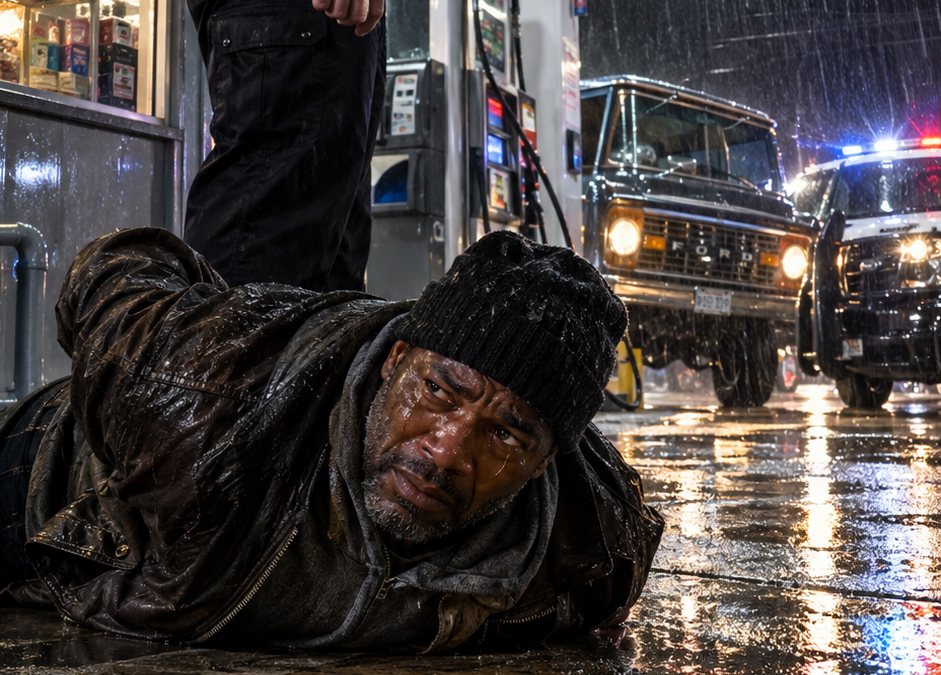
𝗙𝗨𝗟𝗟 𝗦𝗧𝗢𝗥𝗬
“I followed your instructions. My hands were raised when you sprayed me. Your dash camera and the station cameras will confirm that.”
He laughed.
“You people always think a camera’s going to save you.”
Those words hurt in a way the spray couldn’t.
I lifted my face toward his voice.
“My name is Noah Bradley. I’m the governor of this state.”
For half a second, he stopped moving.
“My identification is in my vehicle. My protection detail is nearby. Verify my identity before this goes any further.”
Then he laughed again.
“Of course you are. And I’m the president.”
He shoved me toward his cruiser.
I stumbled because my eyes were almost completely closed.
He didn’t slow down.
Instead, he pushed my head beneath the doorframe and forced me into the molded plastic back seat.
The door slammed.
The smell inside the cruiser was a mixture of disinfectant, damp upholstery, and old sweat.
My handcuffed arms were trapped painfully behind me.
I leaned forward to relieve the pressure on my shoulders.
Outside, Clearary began searching my Bronco.
I watched through swollen eyes as he opened the driver’s door and examined the center console.
He found my wallet exactly where I’d told him it would be.
Then he discovered my government credential case.
He opened it beneath the gas station lights.
Even through the rain-streaked window, I saw him go still.
The credential contained my photograph, my full name, the state executive seal, a holographic security strip, and an emergency verification number.
There was no reasonable ambiguity.
Clearary stood looking at it.
For a moment, I thought the situation might finally end.
He could contact headquarters, admit he’d detained the wrong person, and request medical assistance.
Instead, his expression changed.
Fear appeared first.
Then calculation.
He slipped my credential into his uniform pocket.
I watched him do it.
When he returned to the cruiser, he opened the rear door.
“Where’d you get this identification?”
“It was issued to me by the state whose laws you’ve just violated.”
“Looks fake.”
“Call the verification number. Run the license plate. Contact state police headquarters.”
He leaned toward me.
“You reached toward the vehicle after I ordered you not to move.”
“No.”
“You became aggressive.”
“No.”
“I thought you were reaching for a weapon.”
“My hands were above my shoulders when you sprayed me.”
He stared at me.
“That’s not what my report’s going to say.”
I blinked until his face came into focus.
“Then your report will be a confession.”
He slammed the door.
What I didn’t know was that someone had been watching the entire encounter.
His name was Arthur Penhalagon.
He was sixty-seven years old and had worked nights at that gas station for years.
He had been standing behind the store window when Clearary’s cruiser arrived.
From there, he watched me step away from the Bronco with my palms open.
He saw the officer advance.
He saw the spray.
He saw me collapse.
And he saw Clearary force his knee against my neck.
Arthur didn’t know I was the governor.
He only knew I hadn’t done anything to justify what he’d witnessed.
His hands shook as he raised his phone and began recording.
Clearary had parked his cruiser at an angle that obstructed the station’s main security camera.
Arthur’s phone had a clear view of the pumps.
After watching the officer place me inside the cruiser, Arthur called 911.
“Oak Haven Emergency Services,” a woman answered.
“There’s a police officer at the Shell station on Route Nine. He just pepper-sprayed a man who had his hands up.”
“Is the officer in danger?”
“No. The other man never touched him.”
“Is the subject restrained?”
“He’s handcuffed in the patrol car.”
“Do you know which officer is involved?”
“Thomas Clearary.”
The dispatcher fell silent.
Her name was Brenda Pike.
“Sir, remain inside the building and don’t interfere with law enforcement activity.”
“Are you sending a supervisor?”
“The situation is under control.”
Then she disconnected.
Arthur stared at his phone.
He had lived in Oak Haven for thirty-nine years.
He understood what silence meant in a small town.
Sometimes it was caution.
Sometimes it was fear.
And sometimes it meant people had learned that asking questions could make their own lives difficult.
He saved the recording and sent a copy to his daughter.
If anything happens to this phone, keep this safe.
Meanwhile, Clearary was searching my jacket.
He retrieved my encrypted state phone and turned it over in his hands.
The black rubberized case bore no commercial logo.
“What’s this?”
“A secure state communications device.”
He studied it suspiciously.
“A burner phone?”
“Press the red button. It connects directly to the executive command center.”
“Sure it does.”
“The device is transmitting my location and biometric status. My team already knows something is wrong.”
He tossed it onto the passenger seat.
Then he used his shoulder radio.
“Dispatch, Unit Four. One male detained at the Route Nine Shell. Possible burglary suspect. Combative. Presenting false government identification.”
Static filled the car.
“Copy, Unit Four,” Brenda answered. “Stand by.”
Her voice had changed.
I closed my eyes.
I could hear my own pulse beneath the rain.
For the first time that night, I thought about what might have happened if I’d actually been the person Clearary believed I was.
A Black man traveling alone.
No government credentials.
No protection detail.
No direct line to the governor’s office.
Who would have believed my account?
Would Arthur have been brave enough to preserve his recording?
Would Brenda have sent a supervisor?
Would Clearary have released me, or would I have spent the night in a jail cell while he wrote a report describing resistance that never happened?
The encrypted phone suddenly emitted a sharp two-tone alarm.
Clearary picked it up.
The screen glowed red.
EXECUTIVE COMMAND — PRIORITY OVERRIDE.
The call connected automatically through the speaker.
“Eagle One, this is Vanguard. We have a biometric distress alert and loss of vehicle telemetry. Confirm status.”
I recognized Dylan Cole’s voice.
Clearary lifted the device.
“This is Officer Thomas Clearary, Oak Haven Police Department. The owner of this phone is detained. Identify yourself.”
There was a brief silence.
“Officer Clearary, this is Commander Dylan Cole of the Executive Protection Division. You are holding Governor Noah Bradley.”
Clearary glanced into the rearview mirror.
I met his eyes through the partition.
“My team is approaching your location,” Dylan continued. “Step away from the detainee, keep your hands visible, preserve all evidence, and request a supervisor immediately.”
Clearary swallowed.
“You don’t give orders in my jurisdiction.”
Dylan didn’t raise his voice.
“Your unit number is Four. Your badge number is forty-four ninety-two. You’re at the Shell station near mile marker eighty-seven. State Police Troop C is now on your radio channel, and your dispatch center has received the governor’s identity verification.”
Clearary said nothing.
“You will not touch him again.”
Before he could respond, Brenda’s voice came through the cruiser radio.
“Unit Four, respond immediately. That plate is a protected executive registration. State command confirms the detainee is Governor Bradley.”
She sounded frightened.
“Thomas, tell me he’s safe.”
The gas station seemed to become very quiet.
Clearary looked at the pepper-spray canister on his belt.
Then he touched the credential protruding from his pocket.
He opened the rear door.
“Governor, there’s been a misunderstanding.”
He reached for his handcuff key.
I moved away.
“Don’t touch the restraints until a state police supervisor documents their position.”
“They’re too tight.”
“They were too tight when you believed I was nobody.”
His face twitched.
“I was responding to a burglary call.”
“There was no call.”
“You resisted.”
“There are cameras here, Officer. Which version of your story would you prefer they preserve first?”
The handcuff key trembled between his fingers.
Then headlights appeared through the rain.
Two black SUVs entered the forecourt, followed by three state police cruisers and an ambulance.
The vehicles positioned themselves around Clearary’s cruiser.
Doors opened.
Agents and troopers emerged with their weapons holstered and their instructions clear.
“Officer Clearary, move away from the vehicle. Keep both hands visible.”
He obeyed immediately.
I watched the same man who had interpreted my questions as aggression follow every command with desperate precision.
Dylan approached the cruiser first.
He was a tall, broad-shouldered man whose calm demeanor had reassured me through everything from bomb threats to emergency evacuations.
But when he opened the rear door and saw my swollen eyes, soaked clothing, and injured wrists, anger tightened his face.
“Governor, can you breathe?”
“Yes. My right hand’s going numb.”
He signaled the paramedics.
A state police captain named Lena Ortiz approached with an evidence photographer.
Her body camera was recording.
“Sir, we need a few seconds to document the restraints. Then they’re coming off. Your circulation takes priority.”
I nodded.
I had no intention of sacrificing my hands to preserve a photograph.
The photographer documented the restraints, the absence of a proper double lock, and the deep red grooves forming beneath the metal.
Ortiz read the handcuff serial number aloud.
A paramedic checked my fingertips and instructed them to remove the cuffs immediately.
Dylan used Clearary’s key.
The metal opened with two small clicks.
Pain surged through my arms as I brought them forward.
My fingers tingled violently.
Then they began shaking.
The paramedics guided me toward the ambulance, where they flushed my eyes with saline and examined the abrasion on my cheek.
Cold gauze was wrapped around my wrists.
Across the forecourt, Captain Ortiz separated Clearary from the other officers.
She informed him that he was being detained pending investigation of excessive force, unlawful restraint, and possible evidence tampering.
She collected his weapon, radio, body camera, spray canister, and the credential he’d taken from my Bronco.
Every transfer was documented.
Nobody threw him into the mud.
Nobody deliberately tightened his restraints.
Nobody treated his questions as an excuse to hurt him.
Accountability didn’t require us to imitate the humiliation we were investigating.
“My body camera malfunctioned,” Clearary told Ortiz.
“It appears to be powered on now.”
“It wasn’t recording during the stop.”
“Then the activation log will tell us when it was disabled.”
He looked toward the ambulance.
“Governor, I swear I didn’t know.”
I wiped saline from my face.
“That’s the problem, Officer Clearary. You believe knowing my job would’ve changed what I deserved.”
A voice called from across the forecourt.
“Captain! I recorded it!”
Arthur was standing beneath the canopy with his phone inside a plastic grocery bag.
“I got the whole thing.”
Clearary turned toward him so abruptly that two troopers stepped between them.
Ortiz approached Arthur.
“Please preserve the original file. We’ll make a forensic copy while you retain your phone. Did you see the encounter from the beginning?”
“From the moment that police car pulled in. The man had his hands up. That officer sprayed him anyway.”
I watched Clearary’s expression collapse.
Whatever confidence he still possessed had depended on controlling the official version of events.
Arthur had taken that away with a trembling hand and an ordinary phone.
Dylan lowered his voice beside the ambulance.
“We can take you directly to the mansion. Captain Ortiz has the scene.”
“First, secure every recording lawfully.”
“Already moving.”
“Station video, dispatch audio, cruiser data, the body camera, Arthur’s original file. Contact Attorney General Robert Hayes and the independent inspector general. I want preservation orders before anyone enters that department’s servers.”
Dylan nodded.
“And nobody acts out of anger. Not for me.”
“Understood.”
“If we break procedure, Clearary becomes the victim in his own story.”
Then I remembered something.
Clearary had claimed he was looking for burglary suspects near the wealthy neighborhoods along the ridge.
But the way he’d treated me hadn’t felt improvised.
He had behaved like a man following a procedure he trusted.
I turned toward Captain Ortiz.
“Verify whether there was any active burglary bulletin. Then examine every stop initiated by Oak Haven officers along Route Nine over the last two years.”
“What are you looking for, Governor?”
“Compare race, searches, arrests, citations, and property seizures.”
She studied me.
“You believe this might be departmental policy?”
“I believe he acted like a man who expected somebody to protect him.”
From the back of Ortiz’s cruiser, Clearary began speaking urgently to the trooper beside him.
“I need to call Chief Carter. He can explain the burglary detail.”
The name caught my attention.
William Carter.
Six years earlier, when I’d been attorney general, Carter had strongly opposed a statewide body-camera standard.
He claimed independent evidence review insulted honest local officers.
His department had also reported unusually high civil-asset-forfeiture revenue and surprisingly few sustained misconduct complaints.
The numbers had troubled my office.
But jurisdictional limits, incomplete records, and a lack of cooperating witnesses had prevented a broader investigation.
I hadn’t thought about Carter in years.
Now I couldn’t stop thinking about him.
“Don’t allow Clearary to contact Carter until investigators have secured the evidence,” I told Ortiz.
She was already reaching for her phone.
“The attorney general is seeking an emergency order.”
Forty miles away, Chief William Carter was sleeping in a small apartment above Oak Haven’s municipal courthouse when his private phone began ringing.
Brenda Pike was calling.
“Chief, something happened with Clearary.”
Carter answered irritably.
“Something always happens with Clearary. Put it in the morning log.”
“He detained Governor Bradley.”
The chief sat upright.
“What?”
“He pepper-sprayed him. Handcuffed him. State police are holding Clearary now.”
There was a long silence.
Then Carter asked the question that revealed what mattered most to him.
“Did his body camera upload?”
Brenda hesitated.
“I don’t know.”
“Did you log the original burglary call?”
“There wasn’t one. He initiated the contact.”
Carter’s voice sharpened.
“Listen carefully. Mark it as a response to the Ridge burglary bulletin. Incident code B-seventeen.”
“Chief, that bulletin expired last month.”
“Then reopen it.”
“State police are requesting the dispatch archive.”
“Don’t answer questions. Don’t let anyone into the records room. I’ll be there shortly.”
He ended the call and opened a secure messaging application.
The group was called Night Maintenance.
It included Carter, Clearary, two patrol sergeants, and Oak Haven’s town manager, Paul Dempsey.
Carter typed a short message.
Delete tonight’s messages. State is coming. Use B17.
A red symbol appeared beside it.
Delivery failed.
He tried again.
The same symbol appeared.
He didn’t know investigators had already placed Clearary’s phone in an isolation pouch.
Nor did he realize that the failed message attempts would remain documented on the service provider’s systems.
His panic was beginning to create the very evidence he wanted to destroy.
Attorney General Robert Hayes was sitting at his kitchen table when Dylan’s call reached him.
By 1:38 a.m., he had awakened a duty judge, notified the independent inspector general, and assigned two career prosecutors who had never participated in my campaigns.
He understood the political and legal danger.
I was the governor.
The person accused of assaulting me worked for a local police department.
If my administration appeared to direct the prosecution for personal revenge, every defendant would exploit that conflict.
The evidence had to remain independent of my office.
At 1:56 a.m., a judge signed a temporary preservation order covering Oak Haven’s dispatch logs, vehicle recordings, body-camera systems, departmental messaging accounts, and property records.
The order prohibited deletion or alteration.
It didn’t authorize a general search.
At 2:07, a second judge approved a narrowly tailored emergency warrant after examining Arthur’s video, the dispatch audio, and evidence of the attempted alteration of the incident code.
State investigators were authorized to secure specific digital systems and create forensic copies.
Chief Carter arrived at headquarters five minutes later.
The concrete building was illuminated from end to end.
Brenda stood behind the dispatch desk, pale and rigid.
Two night officers watched their chief enter without speaking.
“Server room,” Carter snapped.
The municipal attorney attempted to stop him.
“Chief, there’s a preservation order.”
“Preservation means nobody outside this department touches our files.”
“That’s not what the order says.”
Carter pushed through the security door.
Inside the server room, he entered his administrative password and opened the retention console.
Hundreds of folders filled the screen.
Traffic stops.
Arrest reports.
Dispatch recordings.
Evidence photographs.
One directory sat behind a second layer of encryption.
NW ARCHIVE.
Operation Nightwatch.
It had begun as a private promise to wealthy residents following three burglaries near Oakridge.
Carter instructed midnight officers to stop unfamiliar vehicles and make outsiders uncomfortable enough to avoid the neighborhood.
Then the department discovered how much money it could seize from drivers who lacked the resources to challenge civil forfeiture.
Cash paid for new cruisers.
New cruisers produced favorable publicity.
Favorable publicity encouraged officials to demand higher productivity.
Eventually, unwritten quotas developed.
But Carter had maintained private records.
The archive contained spreadsheets tracking stops by vehicle value, neighborhood, and the amount of property seized.
It contained messages in which officers used coded descriptions for Black and Hispanic drivers.
It contained complaint videos that never reached the county review board.
Carter selected the directory.
His cursor moved toward the delete command.
“Step away from the terminal, Chief.”
Captain Ortiz stood in the doorway with two investigators.
Her warrant was displayed on a tablet.
Carter kept his hand beside the mouse.
“This is a municipal facility. You have no authority to seize our entire system.”
“The warrant identifies specific databases and date ranges. You were served with a preservation order six minutes ago. Any deletion now would constitute a separate offense.”
“You don’t understand what you’re looking at.”
“Then step away and allow the forensic team to determine that.”
Carter looked at the monitor.
One click would move the directory into the recovery queue.
A second command could overwrite it.
He might destroy enough information to cripple the investigation before anyone stopped him.
Ortiz watched his hand.
“Chief Carter, place both hands on top of your head and take three steps backward.”
He didn’t move.
“Now.”
Slowly, he raised his hands.
An investigator took his place at the console, photographed the screen, and disconnected the keyboard before beginning the forensic imaging process.
Carter watched the screen from the doorway.
For the first time in years, the archive no longer belonged to him.
I arrived at the executive mansion at 2:34 a.m.
Both eyes were swollen.
My wrists were bandaged.
My right shoulder throbbed whenever I moved.
Sarah Jenkins was waiting beneath the portico with a physician and two members of the legal staff.
She crossed the steps before my vehicle had fully stopped.
“My God, Noah.”
“I’m all right.”
“You are very clearly not all right.”
She was usually the most controlled person in any room.
That night, her composure deserted her.
The physician examined me in a ground-floor sitting room converted into a temporary medical workspace.
The chemical irritation would fade.
The abrasion on my cheek required cleaning.
My wrists were badly bruised, but there was no fracture or evidence of permanent nerve damage.
I answered every question and allowed photographs for the medical record.
On a nearby table, Clearary’s handcuffs rested inside a sealed evidence bag.
I couldn’t stop looking at them.
Sarah noticed.
“National media already has the scanner traffic. We can confirm the detention and announce the independent investigation. Nothing more until morning.”
“Agreed.”
She blinked.
“I expected you to demand a live address at three in the morning.”
“At three in the morning, anger would be speaking. I want evidence to speak.”
Attorney General Hayes entered carrying a thick folder.
“Governor, for the record, you’re the victim and a material witness. You’re not directing charging decisions.”
“Understood.”
“I’ve appointed Deputy Attorney General Elena Ruiz as special prosecutor. She will operate independently of your office and report through the courts and inspector general.”
“Good.”
He continued.
“The department is secured under warrant. Chief Carter attempted to access a concealed archive after receiving the preservation order. We don’t know everything it contains yet.”
“I know the name of the program.”
Hayes stopped.
“Nightwatch.”
“How?”
“Clearary claimed they were looking for people like me. Carter opposed statewide camera retention six years ago, and his forfeiture numbers have never made sense.”
I looked toward Sarah.
“Retrieve the files from the old attorney general inquiry.”
She folded her arms.
“If this is bigger than one officer, tomorrow’s budget session will become a political crisis. People will accuse you of using state police to occupy a town that voted against you.”
“Then we show the warrants, the independent prosecutor, the chain of custody, and the evidence.”
I glanced at the handcuffs.
“Not until Arthur consents to the release of his recording and Elena determines it won’t compromise the case.”
Sarah studied me.
“You could dominate the news cycle in ten minutes.”
“I’m not interested in winning ten minutes.”
I looked directly at her.
“I want the truth to survive ten years.”
By four in the morning, the mansion’s west conference room had become a temporary command center.
Phones vibrated against the long table.
Printers delivered warm pages.
A map of Oak Haven County glowed beside a timeline of the night’s events.
Elena Ruiz arrived wearing a navy suit beneath an unbuttoned raincoat.
She had prosecuted public corruption for nineteen years and possessed a remarkable ability to make powerful people understand that lying to her was an exceptionally poor decision.
She greeted me formally.
“Governor, before we begin, I need you to understand our boundaries.”
“Go ahead.”
“I control the criminal investigation. You control your office and your policy response. If those responsibilities overlap improperly, I’ll document it and report it to the court.”
“That’s why Robert selected you.”
“He selected me because I once subpoenaed his campaign treasurer.”
Hayes gave a tired smile.
“She enjoyed that.”
Elena placed a recorder on the table.
For the next seventy-three minutes, she questioned me about the encounter.
Not about my political views.
Not about how the assault made me feel about policing.
About facts.
Exactly where had my hands been?
Which instructions had I received?
Had I moved toward the Bronco?
When did Clearary search the vehicle?
What words had he used?
I answered carefully.
When the spray made a particular detail uncertain, I said so.
I didn’t ask Elena to charge Clearary.
I didn’t speculate about what he secretly believed.
I described what he’d said and done.
When the interview ended, Elena switched off the recorder.
“Your account matches the station video and Arthur Penhalagon’s recording in every material respect.”
I leaned back.
“His body camera?”
“The activation log shows he manually disabled recording thirty-one seconds before leaving his cruiser.”
Sarah closed her eyes briefly.
“It reactivated automatically when the priority alert reached his radio and dash camera,” Elena continued. “He apparently didn’t realize the system retained a two-minute preactivation buffer.”
“What’s on it?”
“The approach, the vehicle obstruction, your raised hands, and the deployment of the spray. The restored audio captures much of what happened afterward.”
I stared at the table.
For hours, I had been repeating the facts inside my head, afraid that the chemical pain and confusion might have distorted my memory.
Now an independent record existed.
Arthur had also consented to public release after investigators completed the forensic copy.
Elena recommended publishing one unedited camera angle with a written timeline rather than selected clips that the defense could later accuse us of manipulating.
“Release the full encounter,” I agreed. “Protect Arthur’s private information and any uninvolved customers.”
“There were no other customers.”
The emptiness of the gas station returned to me.
The black woods.
The hard rain.
The old attendant behind the glass.
If Arthur had looked away, Clearary might have controlled the only surviving version of the night.
“Is Arthur safe?”
“A trooper is staying with him. Apparently, he’s more worried about missing the morning delivery than anything else.”
Despite everything, I smiled.
At 5:22 a.m., Elena received a call from the forensic team.
She listened without interrupting.
Then she asked for verified totals and instructed the examiner to preserve the spreadsheet formulas as well as the values.
When she ended the call, her expression had changed.
“The Nightwatch archive covers twenty-six months.”
Hayes leaned forward.
“How extensive?”
“At least six hundred and twelve vehicle stops appear to have been tracked outside the official reporting system.”
The room became quiet.
“Drivers were categorized by race, estimated income, and likelihood of contesting a seizure. There’s a column labeled resistance potential. Another is labeled yield.”
“Property taken?” Hayes asked.
“Cash, vehicles, tools, jewelry. The recorded value exceeds two million dollars.”
“How many drivers were charged?”
“Fewer than one in five.”
I looked down at my bandaged wrists.
“Complaints?”
“Forty-three in the hidden archive. Four appear in the public database.”
Sarah walked toward the window.
Dawn was beginning to brighten the horizon beyond the mansion lawn.
“By breakfast,” she said, “everyone will ask why the governor received attention that six hundred ordinary people never received.”
“And they’ll be right,” I answered.
I remembered the precise moment Clearary discovered my credential.
How quickly contempt had become fear.
How quickly he’d offered to remove the handcuffs once he understood I had powerful people looking for me.
The system had awakened because a governor had been assaulted.
That awakening would mean nothing if it returned to sleep after protecting me.
“Every person in that archive needs to be identified and contacted independently,” I said.
“Not for a speech. Not for the cameras. They need access to counsel and an opportunity for restitution.”
Elena nodded.
“I’ll coordinate with the inspector general and victim services.”
“No campaign staff. No pressure on anyone to tell their story publicly.”
“Agreed.”
At 6:15 that morning, Police Benevolent Association President Michael Donnelly appeared on a local television program.
He was a polished man accustomed to being introduced as the voice of law enforcement.
Sarah placed the broadcast on the conference room screen.
“What happened appears to have been an unfortunate case of mistaken identity,” Donnelly told the host.
He claimed Clearary had been responding to active burglary concerns during severe weather.
He described me as an unidentified driver wearing concealing clothing and operating a vehicle with protected registration.
Then he insisted that I had refused to provide ordinary identification and that Clearary had deployed defensive spray after perceiving a sudden movement.
The host asked whether race had played a role.
“There’s no evidence of that,” Donnelly replied. “We should resist judging an officer from the comfort of a television studio when he had seconds to make a decision.”
I watched without speaking.
Elena looked toward Hayes.
“He already knows about incident code B-seventeen.”
“Carter’s story,” Hayes said.
“Can we prove they communicated?”
“Not yet.”
Sarah muted the television.
“We release the evidence at seven. Full video, dispatch history, the preservation orders, medical summary, and confirmation of Elena’s independence.”
I nodded.
“At nine, I’ll address the joint session.”
Elena pointed toward me.
“No charging announcements from the podium. No unnecessary speculation.”
“Understood.”
The video went online at exactly seven in the morning.
For the first forty seconds, nothing extraordinary happened.
A man in a faded sweatshirt stood beneath a leaking gas station canopy, filling an old Ford Bronco.
Rain crossed the camera in silver lines.
Then Clearary’s cruiser entered too quickly and stopped across the Bronco’s front bumper.
The recording showed me step away with my hands raised.
It captured my questions.
His accusations.
My attempt to explain where my identification was located.
Then it showed me begin turning.
And it showed Clearary spray me directly in the face.
There was no sudden reach.
No aggressive movement.
No angle that obscured my raised hands.
Arthur’s closer recording showed the officer driving me onto the concrete, pressing his knee against my neck, and tightening the handcuffs while I coughed into oily rainwater.
The footage also documented Clearary discovering my credential and continuing to accuse me of possessing false identification.
By 7:06, major television networks were interrupting their programs.
By 7:12, Donnelly’s interview was being replayed beside the recording that contradicted him.
By 7:20, Oak Haven’s municipal website had crashed under the traffic.
The image that spread most widely wasn’t the pepper spray or the handcuffs.
It was the footage of me sitting in the patrol car after Clearary found my identification.
My eyes were swollen almost completely shut.
My voice remained level.
“Then your report will be a confession.”
People called it courage.
I knew it had been discipline born from terror.
And I saw no shame in acknowledging the difference.
At 8:05, Elena received confirmation that the burglary explanation had been constructed after my detention.
The bulletin Carter wanted associated with my arrest concerned two teenagers seen near an abandoned property thirty-two days earlier.
Both suspects were described as white males under twenty.
They had been driving a red compact car.
Neither the suspects nor their vehicle resembled me or my Bronco.
At 8:18, forensic analysts recovered the Night Maintenance group messages.
Previous instructions directed officers to manufacture probable cause, look for travelers carrying cash, and make the Route Nine corridor uncomfortable for outsiders.
Carter’s failed deletion order appeared at the end of the thread.
At 8:32, a judge approved arrest warrants for Carter and Clearary on state charges that included assault under color of authority, unlawful imprisonment, official misconduct, falsification of records, evidence tampering, and conspiracy.
Federal prosecutors announced they were reviewing possible civil rights violations.
I learned about the warrants while preparing for the legislative address.
A makeup artist was gently covering the abrasion on my cheek.
I stopped her.
“Leave it visible.”
“The lights will make it look worse, Governor.”
“It looked worse in the dark.”
I changed into a charcoal suit but kept the white medical wraps around my wrists.
Sarah suggested placing the handcuffs on the podium.
I refused.
They were criminal evidence, not a prop.
Instead, the legislature’s sergeant-at-arms arranged for a certified evidence photograph to be displayed beside the rostrum.
The House chamber was full before nine.
Legislators occupied every desk.
Judges, county officials, police chiefs, civil rights attorneys, religious leaders, and reporters crowded the galleries.
Outside, thousands had gathered behind barriers.
Some carried signs quoting my words from the patrol car.
Others held photographs of relatives whose complaints against Oak Haven had gone nowhere.
I entered through the central doors with Attorney General Hayes on one side and Inspector General Margaret Sloan on the other.
Dylan followed several paces behind.
The chamber rose.
I raised one hand before the applause could build.
“Please sit.”
I placed both bandaged hands on the edges of the rostrum.
“Last night, at twelve forty-eight in the morning, an Oak Haven police officer sprayed me in the face, forced me onto wet concrete, and handcuffed me.”
I paused.
“At the time, I was committing no crime. I had broken no traffic law. I was buying gasoline.”
The room became completely silent.
“Many people have called what happened to me shocking.”
I looked toward the public gallery.
“To hundreds of families in this state, it was familiar.”
Several legislators lowered their eyes.
“That difference should trouble every person entrusted with public power, including me.”
I described how quickly the institutions responsible for investigating my assault had responded.
My protection detail located me.
State troopers preserved the scene.
Judges answered their telephones in the middle of the night.
Prosecutors obtained warrants.
By sunrise, independent evidence had reached the public.
I was grateful.
But I couldn’t stand there and pretend that the speed of the response represented equal access to justice.
I looked toward Arthur, seated beside his daughter in the gallery.
“I am especially grateful to Arthur Penhalagon, who understood that witnessing an apparent abuse of authority creates a responsibility.”
He lowered his head.
“But gratitude isn’t enough. We have to ask why the same machinery failed people stopped on Route Nine before me.”
The screens beside the rostrum displayed six names.
Marcus Green.
Leah Watkins.
Rafael Santos.
Denise Carter.
Jamal Price.
Tanya Brooks.
“These names appear in complaints recovered from a concealed police archive. Their allegations were marked resolved without proper interviews, hearings, or notice.”
I allowed the audience a moment to read them.
“We will not display their photographs or tell their stories without their consent. Their experiences don’t belong to the state to use as political material.”
Then I explained what investigators had verified about Operation Nightwatch.
The unauthorized tracking system.
The missing complaints.
The racial classifications.
The property seizures frequently unconnected to criminal charges.
I didn’t declare Carter or Clearary guilty.
Both men were entitled to counsel, an independent investigation, and a fair trial.
“Due process is not mercy reserved for people we like,” I told the chamber.
“It is the discipline that separates justice from revenge.”
I introduced a package of proposed emergency measures for public debate.
An independent statewide office to investigate serious uses of force.
Automatic external storage of body-camera recordings.
Restrictions on civil forfeiture without a criminal conviction, with narrowly defined emergency exceptions subject to prompt judicial review.
A public database of sustained misconduct findings.
Legal protection for officers who reported unlawful orders.
And assistance for residents trying to recover improperly seized property.
“A badge carries immense authority,” I said. “Most officers understand that authority as a duty. Some mistake it for ownership.”
I raised my bandaged wrists slightly.
“These marks will fade. The record we create now must not.”
When I finished, the chamber remained quiet for a moment.
Then applause began in the gallery.
Some legislators stood.
Others remained seated, already examining the proposals.
I preferred that honest division to automatic praise.
Reform built entirely on emotion would weaken as soon as public attention moved elsewhere.
Outside the chamber, reporters shouted questions.
One asked whether I’d been afraid during the arrest.
“Yes.”
Another asked whether I wanted Clearary imprisoned.
“I want the evidence tested in court and the law applied without favor.”
Then someone asked whether I’d accept responsibility if investigators discovered that my administration had ignored earlier warnings about Oak Haven.
I stopped walking.
“If my office buried credible evidence, responsibility won’t end in Oak Haven. It’ll reach us, too.”
That answer became more important than I expected.
At noon, Elena’s investigators discovered a memorandum written eighteen months earlier by a junior analyst in the Department of Public Safety.
Her name was Priya Desai.
She’d noticed that Oak Haven reported forfeiture revenue nearly six times the statewide average while submitting unusually few related arrest reports.
She recommended an audit.
Her supervisor forwarded the memorandum to a deputy commissioner, who classified the matter as a local issue requiring no further action.
The decision followed a telephone call from an Oak Haven senator.
The deputy commissioner had been appointed by me.
Sarah brought the memorandum to my private office.
“It never reached us,” she said. “There’s no evidence anybody on your immediate staff saw it.”
“That’s a legal defense. Not a moral one.”
“No governor can personally read every memorandum circulating through state government.”
“No. But I appointed the person who made ignoring this one easier than investigating it.”
I asked Priya to come to my office.
She arrived expecting to be reprimanded for embarrassing the administration.
Instead, I asked her to explain the analysis as though I knew nothing about it.
She was twenty-nine years old, precise, and visibly angry beneath her nervousness.
She described the forfeiture ratios, missing case-disposition codes, and repeated disappearance of complaints after they were transferred to Oak Haven.
Her supervisor had warned her that pushing further would damage her career.
“Why did you stay?” I asked.
She looked at the memorandum between us.
“Because leaving would’ve made it easier for them to say nobody noticed.”
I studied her for a moment.
“Would you testify publicly?”
“If I have whistleblower protection.”
“You will.”
That afternoon, I accepted the deputy commissioner’s resignation and directed the inspector general to examine why Priya’s warning had been ignored.
Critics called the resignation an admission of administrative failure.
I agreed.
My administration couldn’t demand accountability from a small-town police chief while protecting senior officials at the capital.
The first person from the hidden complaint list to contact investigators was Marcus Green.
Marcus was twenty-two and worked as a refrigeration technician.
He drove Route Nine twice a week to service restaurant equipment.
Eight months earlier, Clearary and another officer had stopped him because they claimed his license plate light was broken.
Photographs taken shortly afterward showed the light functioning normally.
The officers searched his work van and seized forty-eight hundred dollars he’d collected from customers for equipment parts.
Marcus was never charged.
When he requested the return of his money, the department told him to hire an attorney and prove it hadn’t been connected to criminal activity.
The legal costs exceeded the amount taken.
Without the money, Marcus missed a supplier payment and eventually lost his job.
His complaint was marked withdrawn.
He’d never withdrawn it.
He agreed to meet me privately, provided no reporters or cameras were present.
We sat in a small conference room with his attorney and Elena.
Marcus wore work boots and a faded jacket.
He looked tired in a way I recognized from years of representing people whose lives had been slowly dismantled by paperwork.
“They listened to you because you’re the governor,” he said.
I didn’t interrupt.
“That’s the whole story.”
“It’s part of the story.”
“It’s the part that matters.”
He leaned forward.
“You got sprayed, and judges woke up. I lost everything, and they sent me a form letter.”
I looked directly at him.
“You’re right.”
He seemed almost irritated by the answer.
“That’s it?”
“No. But anything I say after that has to begin there.”
I folded my hands.
“The state failed you. My title opened doors that stayed closed for you. I can’t change that fact.”
Marcus stared at me.
“But I can work to return what was taken and establish a system that doesn’t require the governor to be assaulted before anyone pays attention.”
“And when the cameras leave?”
“Then you should judge us by what remains.”
Marcus never became a public symbol.
He testified under his own name during a committee hearing, recovered his money with interest, and returned to refrigeration work.
When reporters requested interviews, he usually declined.
He wanted his life restored.
He didn’t want to spend the rest of it explaining the worst thing that had happened to him.
Other cases followed.
Leah Watkins, a night-shift nurse, had been detained for forty minutes while driving home in her scrubs.
Officers searched her vehicle and opened sealed medication she was transporting for her diabetic mother.
Rafael Santos lost the landscaping truck that supported four employees after police discovered a small amount of marijuana in the possession of a cousin traveling with him.
Tanya Brooks had been handcuffed in front of her children after questioning why officers demanded proof that her leased vehicle belonged to her.
Each account matched entries in Carter’s spreadsheets.
The yield column measured the amount of money officers expected to recover.
The resistance-potential column estimated whether drivers possessed education, legal assistance, local family, or community influence.
Clearary had classified me as low resistance before approaching my Bronco.
His attorney insisted that the term referred to a motorist’s likelihood of physical aggression.
Then investigators recovered an audio recording from a departmental training session.
Carter’s voice explained the classification.
“Low resistance means no lawyer, no local family, nobody making calls. Those are clean stops.”
The recording had been made by Sergeant Elaine Foster.
Elaine had worked in Oak Haven for fourteen years.
For much of that time, she’d tried to survive inside Carter’s department while quietly preserving evidence of practices she believed were unlawful.
She had copied messages and recorded meetings onto a private drive.
But she’d never trusted an outside agency enough to surrender the material.
When she watched the recording of my arrest and learned that Elena controlled the investigation, she drove to the attorney general’s office.
The drive was hidden beneath her spare tire.
Elena interviewed her personally.
“Why didn’t you come forward sooner?”
Elaine stared at her hands.
“I watched what happened to officers who complained.”
She described undesirable shifts, retaliatory evaluations, and rumors that made other departments reluctant to hire officers who challenged their supervisors.
“I kept telling myself I was collecting enough evidence.”
Her voice weakened.
“Then every week I stayed became another week I was part of it.”
Her recordings connected Carter’s operation to town manager Paul Dempsey and two members of the municipal finance committee.
Seized money had helped pay for tactical equipment, a renovated police gym, and a public-safety banquet at a resort.
Dempsey approved altered accounting entries.
Committee members asked few questions as long as local taxes remained low.
Elaine’s evidence also showed that not every officer had participated willingly.
One had refused to conduct quota-based stops and was reassigned to school-crossing duty.
Another documented a search he believed was unlawful, only to discover that the report had been rewritten under his electronic signature.
Fear, ambition, and institutional loyalty had allowed corruption to become routine.
But the degree of responsibility varied.
I insisted that the investigation distinguish between officers who committed crimes, officers who knowingly falsified reports, and those who resisted or cooperated.
Punishing everyone identically might satisfy public anger.
It would also teach honest officers that telling the truth offered no protection.
Michael Donnelly, the police association president, showed no similar restraint.
For three days, he described the investigation as an attack on law enforcement.
He called Arthur’s video emotionally misleading and suggested I had arranged the confrontation to justify greater state control over local departments.
Then Elena obtained his messages with Carter.
One message, sent eleven months earlier, advised Carter to keep Nightwatch off official email so the association could defend the department publicly.
Another exchange concerned the expired burglary bulletin used to justify my detention.
Donnelly resigned as association president that evening.
He was later charged with obstruction for helping conceal complaints and coaching Carter about the fabricated justification.
The association elected an interim president named Grace Holloway.
She was a twenty-six-year patrol veteran.
At her first press conference, she made a statement that upset some of her own members.
“A police association exists to protect due process, not to protect proven misconduct. We failed to understand the difference.”
It wasn’t a popular statement among everyone she represented.
But it opened the door to conversations that had been impossible while Donnelly controlled the association.
The investigation lasted nine months.
During that period, my proposed Public Trust and Accountability Act moved through eleven committee hearings.
The first draft was too broad.
Several rural departments demonstrated that they couldn’t afford the required evidence technology.
Civil rights advocates argued that the proposed public misconduct database excluded too much information about unresolved complaints.
Police organizations warned that eliminating all civil forfeiture could prevent officers from securing weapons or trafficking proceeds during active investigations.
I refused to force the original language through simply because public outrage was high.
I asked critics to provide alternatives in public hearings.
The final legislation created regional independent investigation teams funded by the state.
It required automatic off-site uploads of body-camera footage and introduced penalties for deliberate deactivation.
It established narrowly defined emergency seizure authority, followed by judicial review within seventy-two hours.
A criminal conviction would ordinarily be required before seized property could be permanently transferred to law enforcement.
Sustained misconduct findings and decertifications became public.
Unproven allegations remained protected from indiscriminate publication but accessible to authorized independent investigators looking for patterns across departments.
The law also created an Office of First Notice.
It was an independent reporting system through which residents and officers could submit misconduct complaints without routing them back to the department being accused.
After Senate confirmation, Priya Desai became its first data director.
The closest vote occurred in the House.
Two legislators who had applauded my speech after the arrest opposed the final bill.
Three who had remained seated supported it after rural sheriffs helped revise the funding formula.
The legislation passed by seven votes.
I signed it at a plain wooden desk in the capital rotunda.
I invited no celebrities.
Standing behind me were Arthur, Marcus, Leah, Rafael, Tanya, Sergeant Foster, Captain Ortiz, and families whose cases were still under review.
Grace Holloway represented the officers who had supported the final legislation.
Before signing, I held up the pen.
“This law won’t make every officer fair or every citizen safe. Laws don’t perform moral work by themselves.”
I looked toward the people standing behind me.
“They create duties, records, safeguards, and consequences. People still have to choose to use them.”
Then I signed my name.
The new review process eventually returned one million six hundred thousand dollars to people whose property had been seized without criminal charges.
Another seven hundred thousand dollars remained disputed and proceeded through judicial review.
Oak Haven’s insurance carrier funded settlements for unlawful stops.
But I required the town to hold public budget hearings so residents could see the costs of Carter’s program.
Accountability wasn’t going to disappear inside an insurance premium increase.
Carter refused every plea offer.
His trial lasted six weeks.
Elena presented the spreadsheets, messages, altered complaints, financial records, and Sergeant Foster’s recordings.
The defense argued that Nightwatch had been an aggressive but lawful crime-prevention effort distorted by political opponents.
Carter’s attorneys demonstrated that some burglaries had declined during the program.
They also showed that a portion of the seized property had been connected to genuine criminal activity.
Elena didn’t dispute either point.
“A program doesn’t become lawful simply because some guilty people are caught while innocent people are being deprived of their rights,” she told the jury.
The trial exposed how systematically the program had operated.
Brenda Pike testified that Carter instructed her to change my incident code after learning my identity.
She admitted redirecting earlier complaints and had received immunity in exchange for truthful cooperation.
Arthur authenticated his video.
Priya explained the statistical warning the state had ignored.
Marcus described the financial collapse that followed the seizure of money he’d earned legitimately.
Finally, Clearary took the stand.
He had accepted a plea agreement requiring a complete account, permanent decertification, restitution, and a prison sentence partly dependent on his cooperation.
He entered the courtroom without his uniform.
I sat in the second row as Elena questioned him.
“Officer Clearary, was there an active burglary call that caused you to approach Governor Bradley?”
“No.”
“Then why did you follow his vehicle?”
He looked toward the jury.
“His plate didn’t return ordinary owner information.”
“And what did you believe that meant?”
“Chief Carter told us protected registrations often belonged to people carrying something valuable.”
“So you followed the Bronco?”
“Yes.”
“Why did you deploy pepper spray?”
Clearary swallowed.
“He questioned me.”
“Did he threaten you?”
“No.”
“Did he reach for a weapon?”
“No.”
“Were his hands visible?”
“Yes.”
“Then why did you spray him?”
For a long moment, he couldn’t speak.
Then he looked down.
“Because I thought he’d complain, and I wanted the recording to start with him already on the ground.”
The courtroom became completely silent.
I felt my stomach tighten.
I had spent months wondering whether he truly believed I was dangerous or simply wanted to punish me for questioning him.
Now I had the answer.
He had disabled the camera because he wanted the official record to begin after the violence.
Elena continued.
“Why did you hide the governor’s credential?”
“I knew the stop would be over if dispatch verified him.”
“Would you have removed the handcuffs if he hadn’t been governor?”
He hesitated.
Then he shook his head.
“No.”
I watched him from the second row.
I felt no triumph.
His admissions were too ordinary for the monstrous figure some people had constructed around him.
He hadn’t acted under the influence of some incomprehensible force.
He had made decisions.
One after another.
Because he believed his uniform, his chief, his association, and a town accustomed to silence would absorb the consequences.
That ordinary calculation frightened me more than anything he’d shouted at the gas station.
The jury convicted Carter of conspiracy, evidence tampering, official misconduct, theft, and multiple civil rights offenses under state law.
Separate federal proceedings followed.
Dempsey and Donnelly entered guilty pleas.
Clearary received seven years in state prison followed by three years of supervised release.
The judge acknowledged his cooperation but emphasized the deliberate use of force, falsification of records, and repeated targeting of vulnerable motorists.
At sentencing, Clearary asked permission to address me.
I hadn’t intended to respond.
He unfolded a prepared statement.
“Governor Bradley, I’m sorry I didn’t recognize you.”
I felt my expression change.
He saw it.
For several seconds, he stared at the paper.
Then he folded it.
“No,” he said quietly. “That’s what I’ve been saying since that night, and it’s still wrong.”
He looked toward the judge.
“I should be sorry for what I did before I knew who he was.”
Then he turned toward Marcus, Leah, and the other former complainants seated behind the prosecution table.
“I should be sorry for every person whose name I never learned because I didn’t think I needed to.”
His voice broke.
“I can’t ask you to forgive me. I only want the record to say the governor wasn’t my first victim.”
He lowered his eyes.
“He was the first victim I couldn’t erase.”
The judge allowed the statement to stand without requiring a response.
I never wrote to Clearary in prison.
Forgiveness wasn’t a public duty, and I wasn’t going to perform it to make the ending comfortable for other people.
I supported educational and restorative programs for incarcerated officers just as I did for other prisoners.
But I didn’t confuse rehabilitation with avoiding the consequences of deliberate wrongdoing.
One year after the night at pump six, I returned to the Shell station on Route Nine.
The sky was clear.
The old canopy had been repainted.
New security cameras covered every angle of the forecourt.
Arthur had retired three months earlier, but he’d agreed to meet me there.
He arrived wearing a red flannel shirt and carrying the same phone he’d used to record my arrest.
Its blue protective case was cracked along one corner.
“I keep meaning to replace this thing,” he said.
“Elena told me the original file is preserved in three separate places. You’re allowed to buy another phone.”
He grinned.
“Maybe Christmas.”
There were no television crews.
I’d asked Sarah to keep the visit private.
My protection detail remained nearby, close enough to satisfy Dylan and far enough away to allow me a few minutes of peace.
The Bronco stood beside the same pump.
Its faded paint and cracked steering wheel had survived their unexpected fame.
I inserted the nozzle and began filling the tank.
Arthur leaned against a concrete post.
“You know, people keep telling me I was brave.”
“You were.”
“I was behind glass. You were the one on the ground.”
I looked at him.
“Bravery isn’t measured by distance from danger.”
He shrugged.
“You probably would’ve done the same.”
“I hope so.”
Arthur looked across the road toward the dark line of pine trees.
“I knew Carter.”
I turned toward him.
“Played cards with him years ago. I knew things happened out here. Not the details, but enough.”
He rubbed the cracked edge of his phone case.
“I told myself it was young officers being rude. Drivers exaggerating. Outsiders not understanding how things worked in a small town.”
He paused.
“Your arrest made me think about all the times I chose the easier explanation.”
I shook my head.
“You didn’t choose it that night.”
“Almost did.”
“But you didn’t.”
Arthur looked toward pump six.
“I had to point the camera before I could stop looking away.”
I returned the nozzle to the pump.
For months, strangers had told me that my suffering had transformed the state.
I’d never accepted that description.
Pain didn’t transform anything by itself.
It could be denied.
Exploited.
Repeated.
Forgotten.
Change came from the decisions people made once the evidence was impossible to ignore.
A sedan pulled into the station.
Its driver was a young Black woman wearing hospital scrubs.
She recognized me and lowered her window.
“Governor Bradley?”
I walked toward her.
“Yes, ma’am?”
“My brother got his truck back because of the new review board.”
I smiled.
“What’s his name?”
“Devon Cole. No relation to your security commander.”
“Tell Devon the state should never have taken his truck without giving him a fair hearing. Getting it back is correction, not a favor.”
She looked surprised.
Then she smiled.
“Thank you.”
She drove to another pump.
Dylan approached from the edge of the forecourt.
“Governor, we should leave in five minutes.”
“You said ten.”
“That was before three people posted your location.”
I looked toward Arthur.
“Apparently, I remain unpopular with the protection division.”
Arthur laughed.
“They’ve got a point. Last time you came here alone, you changed state law. They probably don’t want to risk what you’ll do next.”
For the first time in a year, I laughed at that gas station.
Before leaving, I walked toward the patch of concrete where I’d fallen.
The stains were gone.
Thousands of tires had passed over it.
Rain had washed the forecourt through winter and spring.
Nothing on the ground marked what happened there.
For years, Oak Haven had depended on precisely that kind of disappearance.
A traffic stop ended.
A driver left.
A complaint entered a drawer.
Money moved into an account.
The public record described an ordinary police encounter.
Only the person forced onto the roadside remembered what had actually happened.
Now the records remained.
Every serious use of force generated an independent notification.
Camera footage uploaded beyond local control.
Seizures required prompt judicial review.
Complaints could be compared across county lines.
The system wasn’t perfect.
New failures had already revealed gaps in the law.
Some departments resisted the changes.
Some officers found subtler ways to misuse their discretion.
Reform hadn’t created a world without wrongdoing.
It had made wrongdoing harder to hide.
I touched the fading scar near my right wrist.
The pepper spray had stopped burning within hours.
The bruises disappeared within weeks.
But for longer than I expected, the smell of peppermint gum made my chest tighten.
Sometimes, rain striking a metal roof woke me before dawn.
I’d begun seeing a trauma counselor despite advisers who feared the disclosure might make me appear weak.
When a reporter eventually asked about it, I answered plainly.
“Public strength that depends on private denial isn’t strength.”
The statement brought letters from police officers, veterans, assault survivors, and teenagers who’d never heard a governor admit fear without apologizing for it.
I kept several of those letters in the bottom drawer of my desk beside a photograph of my father and a signed copy of the Public Trust and Accountability Act.
Arthur followed me back to the Bronco.
“Your father would’ve been proud,” he said, looking at the old truck.
I rested one hand on the driver’s door.
“He would’ve asked why it took me getting arrested to notice what the numbers had been telling us for years.”
Arthur smiled.
“Then he probably would’ve made you check the oil.”
I laughed softly.
“He absolutely would have.”
I opened the door.
Then I looked once more toward pump six.
That place no longer seemed like the site of my humiliation.
It was where several ordinary choices had collided.
Clearary had chosen force.
Arthur had chosen to record.
Brenda had eventually chosen to testify.
Elaine had surrendered the evidence she’d preserved for years.
Priya had refused to abandon the analysis her supervisors wanted buried.
Investigators had chosen procedure over vengeance.
Legislators had chosen difficult negotiations over an easy speech.
No single decision would have been enough.
Together, they had broken a pattern that powerful people had taught themselves not to see.
I climbed into the Bronco.
Dylan’s vehicles took their positions behind me, considerably closer than they’d been the previous year.
I turned the key.
The old engine caught with a familiar rumble.
As I pulled onto Route Nine, the station receded in my rearview mirror.
I watched until its yellow sign became a tiny point of light between the trees and finally disappeared around the bend.
The road ahead was dark.
But this time, it was no longer unrecorded.








