𝗙𝗨𝗟𝗟 𝗦𝗧𝗢𝗥𝗬 Why Did the Officer Go Silent When My Confiscated Phone Started Ringing?
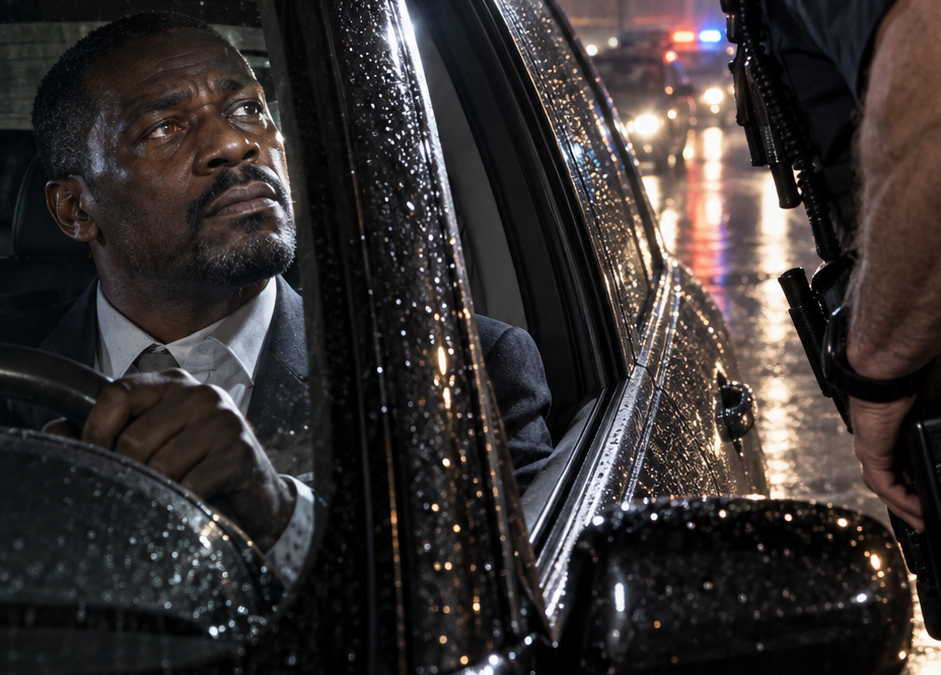
𝗙𝗨𝗟𝗟 𝗦𝗧𝗢𝗥𝗬
The silence that followed was different from the silence on the highway.
On the highway, I had been afraid of what a stranger might do.
Inside that station, I was watching people become afraid of what the truth might do to them.
“Put me on speaker,” the governor said.
Blanco complied.
“Sergeant Reed, are you there?”
“Yes, Governor.”
“Secure the patrol vehicle and every recording associated with this arrest. Contact Sheriff Callahan, the attorney general, and the state bureau of investigation. Nobody touches the evidence without an independent record.”
“Understood.”
“And move Officer Blanco away from Senator Harrison.”
Reed began issuing orders before the governor ended the call.
For the first time that night, Blanco looked genuinely frightened.
But the governor’s intervention did not save the most important recording.
Six minutes later, somebody remotely deleted it.
The evidence technician reached Blanco’s cruiser at approximately 3:03 a.m.
The dash-camera file was missing from its local storage.
A remote reset had been executed through an authorized departmental account.
Blanco’s account.
By the time Attorney General Richard Lawson arrived with Sheriff Robert Callahan and two state investigators, the investigation had expanded from a potentially unlawful arrest into possible evidence tampering.
Paramedics were already documenting my injuries.
They photographed the swollen area beneath my eye where Blanco had forced my face against the car, the cuts around my wrists, my torn trousers, the bruising on my knee, and the strain in my shoulder.
Only after they finished did Reed remove the handcuffs.
The sudden release of pressure almost hurt more than the restraints themselves.
I flexed my fingers.
Blanco stood beside a filing cabinet.
His badge and gun had been taken for safekeeping.
“Senator,” he said, “I made a mistake.”
I looked at him.
“No. You made a decision. When the evidence contradicted you, you made another one.”
One investigator requested his department phone.
Blanco reached toward the screen before handing it over.
“Don’t touch anything,” the investigator said.
The device was immediately sealed.
I would later learn that its records connected the remote reset directly to Blanco.
Unfortunately for him, my Mercedes had its own cameras and driving-data system.
The car had recorded my speed, lane position, and exterior surroundings. Its measurements showed that I had remained inside my lane and that no traffic violation had occurred.
The exterior video showed Blanco examining my registration and Senate credential before announcing that they were fraudulent.
And although someone had removed the patrol recording from the local file system, technicians discovered that portions remained in a recoverable storage buffer.
Before dawn, they restored the critical audio.
Blanco’s voice.
The impact of his boot against my knee.
His accusation about the supposedly counterfeit credential.
The sequence was no longer dependent on my memory.
But when Lawson explained the evidence, I found myself thinking about a different question.
“How many complaints does Officer Blanco have?”
He checked his notes.
“Eight.”
“How many were sustained?”
“None.”
“Who investigated them?”
“We’re determining that.”
I looked at the recovered video.
Eight complaints.
Eight occasions when somebody had tried to make the system listen.
“Find out who closed them,” I said.
At 4:18 that morning, I was sitting in the emergency department at St. Catherine’s Hospital.
The doctor confirmed that my knee was deeply bruised and my shoulder strained, but nothing was broken.
She recommended rest.
I almost laughed.
My phone had already received more than forty calls.
Before the morning news could reach him, I called my father.
Isaiah Harrison answered on the second ring.
“Nate?”
“I’m alive, Dad.”
A long silence.
“Where are you?”
“St. Catherine’s.”
“What happened?”
“I was arrested.”
I heard him draw a sharp breath.
“Are you hurt?”
“Some bruising. Nothing broken.”
“Did you make it home?”
“Not yet.”
“Then I’m coming.”
I closed my eyes.
“Please stay there for now. Reporters are going to find out. Lock the door, and I’ll call you when I know more.”
He was quiet.
Then he asked a question that hurt more than my knee.
“They found out you were a senator, didn’t they?”
I looked down at the bandages around my wrists.
“Eventually.”
He understood everything concealed inside that word.
“Nathaniel, don’t let them make this only about you.”
“I won’t.”
At eight that morning, Governor Kennedy entered the capital press room.
He had originally intended to discuss the newly signed Accountability Act.
Instead, he addressed my arrest and announced that the attorney general had opened an independent investigation.
I stood beside him in a clean navy suit.
The bandages remained visible beneath my cuffs. The swelling under my eye was impossible to conceal.
A staff member offered to have a makeup artist reduce its appearance before the cameras arrived.
I declined.
Sheriff Callahan announced Blanco’s suspension.
Then I approached the microphone.
I could feel every camera in the room finding my face.
“My title eventually changed what happened inside that police station,” I said. “But my constitutional rights did not begin when somebody recognized my name.”
I stopped there.
I had no desire to turn my injuries into a performance.
The evidence needed to speak.
By noon, it began telling a much larger story.
A retired records clerk named Lena Morris arrived at the attorney general’s satellite office carrying a cardboard box.
She had worked for the sheriff’s department for eighteen years.
Inside her box were copies of twenty-three civilian complaints that the official database either misrepresented or no longer acknowledged.
Eight concerned Blanco.
Every one of those eight had passed through Internal Affairs Captain Vincent Morrow.
Lena explained that the records had not vanished in one sweeping act of destruction.
They had been weakened piece by piece.
An excessive-force complaint became a communication problem.
A witness who failed to answer a single daytime telephone call was marked unavailable.
A camera that mysteriously failed to activate became grounds for dismissing the complainant’s account.
“Why did you keep copies?” Lawson asked.
“Because the records changed after I scanned them.”
“Changed how?”
“At first, I thought somebody was making clerical mistakes. Then I noticed the mistakes always protected the same officers.”
She opened the first file.
Marcus Grant.
Twenty-seven years old when Blanco pulled him through the window of his car four years earlier.
An electrician with an industrial security clearance, Marcus had been driving home from work when Blanco claimed he reached beneath his seat.
Marcus insisted that both hands had remained on the steering wheel.
The patrol camera had never activated.
He spent two days fighting the arrest and eventually lost his job because of the report.
His complaint was closed for insufficient independent evidence.
Lena reached for another folder.
Her telephone rang.
She glanced at the screen.
“It’s Denise from records.”
She answered on speaker.
“Lena, there’s a shredding truck backing toward the loading dock. Captain Morrow has your old archive list. They’re moving the Blanco boxes right now.”
Lawson was on his feet before Denise finished speaking.
An emergency preservation order had already been obtained.
State investigators were dispatched immediately.
I should have remained at the office.
My knee throbbed, my shoulder felt as though someone had pulled the joint apart, and I had been awake for nearly thirty hours.
But I could not stop thinking about Marcus Grant.
For four years, he had lived with the consequences of a document that nobody had bothered to question.
Now somebody was preparing to destroy his opportunity to challenge it.
I rode with Lawson.
“You should be home,” he told me.
“So should those files.”
We reached sheriff’s headquarters at 12:31 p.m.
The rear gate was chained shut.
Beyond it, a white document-destruction truck idled beside the loading dock. Two employees were pushing archive boxes toward its hydraulic platform.
Captain Morrow stood nearby with a clipboard and a department attorney.
Lawson held up the preservation order.
“Open the gate.”
Morrow did not move.
“This is scheduled destruction under county retention policy.”
Lena stepped forward.
“Those files aren’t eligible for destruction for another three years.”
Morrow stared at her.
“You removed confidential departmental records.”
“I copied records you altered.”
The shredder started.
A mechanical roar rolled across the loading dock.
I watched the first box move toward the intake.
“Turn it off!” an investigator shouted.
The truck operator looked toward Morrow.
Morrow offered no instruction.
Lawson immediately contacted the judge who had issued the preservation order.
Within ninety seconds, the judge authorized entry to prevent the destruction of subpoenaed evidence.
State agents cut the gate chain.
The truck operator shut down the blades as investigators reached the platform.
The first box had been partially destroyed.
The remaining twenty-two were intact.
Lena climbed onto the loading platform and retrieved Morrow’s clipboard.
The disposal date had been changed that morning.
His signature appeared beneath the alteration.
An investigator opened one of the surviving boxes.
Inside was Marcus Grant’s original complaint.
Unlike the electronic version, it identified a witness who had seen both of Marcus’s hands on the steering wheel.
That witness had never been interviewed.
A handwritten instruction appeared in the margin.
No video. Officer account controls.
The next folder belonged to Renee Porter, a hospice nurse arrested after questioning Blanco’s decision to scatter sealed patient medication across the highway shoulder during a search.
Her hearing notice had been mailed to an address in a county where she had never lived.
She had missed the hearing.
The resulting record had damaged her career.
I stared at the folders.
Twenty-three people had tried to describe what happened to them.
Instead of investigating the allegations, Morrow had apparently made their complaints progressively harder to prove.
There was nothing sophisticated about it.
Just small administrative choices, repeated until ordinary people exhausted their savings, their leave from work, and their willingness to fight.
Investigators seized Morrow’s phone and computer.
The recovered messages between him and Blanco stretched back three years.
Some were brief.
Camera didn’t sync.
Handle before upload.
Caller has no witnesses.
Keep this one local.
Their final exchange had taken place at approximately 3:01 that morning.
Morrow had asked whether Blanco could clear the patrol recording before the state arrived.
Blanco replied that he could use a mobile reset.
Two minutes later, the recording disappeared.
When investigators showed me the timeline, I felt an unexpected emptiness.
On the highway, Blanco had looked so confident.
I had assumed he was extraordinarily reckless.
Now I understood that his confidence had been reinforced for years by somebody who knew how to make evidence disappear.
Blanco was arrested that afternoon on charges including aggravated assault under color of authority, false imprisonment, official oppression, and evidence tampering.
Morrow was placed on leave pending a separate criminal investigation.
I did not watch either man being taken into custody.
I stayed inside the records office with Lena while investigators identified complainants who urgently needed to be contacted.
“You saved these people,” I told her.
She shook her head.
“I saved paper, Senator. Nobody saved the people when they asked.”
I had no answer.
At 4:40 p.m., the shredding truck was sealed as evidence.
Outside the headquarters, television crews gathered behind barricades.
I thought the evidence might finally be allowed to tell the truth.
Then Blanco’s defense attorney found my initials on a confidential report.
The document had been delivered to the Judiciary Committee two months earlier.
It summarized officers across the state who had repeated civilian complaints and unexplained camera failures.
Blanco appeared on page forty-seven.
Eight complaints.
Three missing recordings.
Oak Haven County.
I had reviewed that report while developing the Accountability Act.
My initials were on the cover sheet.
At 5:12 that evening, an online political publication asked whether I had known my arresting officer before the traffic stop.
Within an hour, the question had become an accusation.
According to Blanco’s attorney, I had deliberately arranged the encounter to manufacture sympathy for my legislation.
He pointed to the timing.
The law had taken effect at midnight.
Blanco stopped me less than two hours later.
I had reviewed a report containing Blanco’s name.
And when Reed offered to remove my handcuffs, I had refused until the injuries were photographed.
By morning, some commentators were presenting those facts as evidence that I had staged the entire incident.
I watched one broadcast from my apartment.
The commentator repeatedly described my refusal to remove the cuffs as a carefully calculated political decision.
The program never played the recovered sound of Blanco kicking me.
It never showed him examining my identification.
Instead, it displayed a photograph of me standing beside Governor Kennedy at the press conference.
I turned off the television.
The governor called shortly afterward.
“Don’t respond to it,” he said. “The evidence is overwhelming.”
“That’s exactly why they’re attacking everything except the evidence.”
“Then let the investigation do its work.”
I stood beside my apartment window.
Satellite trucks lined the street below.
“If I remain silent, they’ll describe silence as proof. If I defend myself publicly, they’ll accuse me of directing the prosecution.”
“What do you want to do?”
I looked toward the signed copy of the Accountability Act on my desk.
“Remove myself from implementation oversight. Appoint an independent special prosecutor who has never worked for me, you, or Oak Haven County.”
“You’re the judiciary chairman.”
“That’s why it matters.”
“They’ll call your recusal an admission.”
“Then they’ll have to make that argument without claiming I control the investigation.”
The following morning, I requested an independent prosecutor and recused myself from every committee decision directly involving Blanco, Morrow, or the Oak Haven Sheriff’s Department.
Some colleagues thought I was surrendering authority unnecessarily.
My political opponents called it evidence that I had been compromised.
I viewed it differently.
If a law designed to prevent conflicts of interest could not survive its own author stepping aside, it was not the law I had intended to write.
My father arrived before sunrise with clean clothes and the unopened bottle of bourbon we had planned to share.
He set the bottle on my kitchen counter.
Then he examined my face.
“I taught you how to survive a traffic stop,” he said quietly. “I never taught you what to do when surviving becomes evidence against you.”
I tried to smile.
My swollen cheek made it painful.
“Neither did law school.”
He watched a television commentator question why I had remained handcuffed after Reed recognized me.
“Turn that off,” my father said.
I complied.
Then he sat across from me.
“Did you know Blanco’s name?”
“I read the report.”
“Do you remember him?”
“I remember a table with complaint totals. I don’t remember his face, his patrol assignment, or his shift. I wouldn’t have recognized him if he’d introduced himself on the highway.”
“Then say that.”
“Every time I answer publicly, his lawyer gets another opportunity to claim I’m influencing the case.”
My father looked at the dark television.
“So they can repeat a lie, and you have to stay quiet until court?”
I stared at my bandaged wrists.
“Unfortunately, a lie only has to sound convincing once. The truth has to remain exact every single time somebody asks.”
Two days later, independent special prosecutor Dana Whitaker assumed control of the investigation.
She had sixteen years of experience prosecuting public corruption and no previous professional relationship with the governor, my committee, or Oak Haven County.
Her first instruction prohibited investigators from providing me with private case updates.
Her second was to question me as though she fully expected Blanco’s accusation to be true.
We met in a recorded interview room.
Two investigators sat behind her.
No political staff accompanied me.
“Did you recognize Officer Blanco when he approached your car?”
“No.”
“Did you know he patrolled Interstate 85?”
“No.”
“Why did you take that highway?”
“It’s the direct route from the capital to my home.”
She turned a page.
“Why did you leave your briefcase in the governor’s office?”
“Because I was exhausted.”
“Convenient. It caused the governor to telephone during your booking.”
I held her gaze.
“If I could arrange the timing of Governor Kennedy’s phone calls, my job would be considerably easier.”
She did not smile.
“Why refuse to have the handcuffs removed after Sergeant Reed recognized you?”
“Because I wanted the injuries documented before they disappeared from the official record.”
“Or because a photograph of an injured senator was politically valuable?”
I felt my jaw tighten.
“The law had already passed and taken effect before Officer Blanco stopped me.”
“Implementation funding hasn’t passed.”
I said nothing.
She leaned forward.
“I believe the recording. But your defense isn’t the issue here. Blanco’s attorney doesn’t have to prove you arranged the stop. He only needs to convince one juror that you prolonged the incident for political advantage.”
“Then ask what I controlled.”
“I’m asking.”
“I didn’t choose the patrol car behind me. I didn’t tell Blanco to invent a stolen-vehicle report. I didn’t make him point a gun at me, kick my knee, ignore my identification, or delete his recording.”
I paused.
“I chose to preserve the condition of my wrists after somebody finally recognized me. Not while a weapon was pointed at my chest. After I was no longer afraid of being killed.”
Whitaker made a note.
“That distinction will matter.”
But outside the interview room, it was already disappearing.
Blanco’s attorney began appearing on television.
He described me as a talented politician who had transformed an unfortunate misunderstanding into a national advertisement.
A police association released a video combining footage of the Accountability Act’s signing ceremony, my injured face, and campaign advertisements from my previous election.
The video prominently included my words at the booking desk.
Book me.
It immediately cut to my appearance at the governor’s press conference.
There was no footage of the kick.
No description of the fabricated stolen-car allegation.
No mention of the attempted deletion.
Within forty-eight hours, the video had attracted two million views.
Calls flooded Senate offices.
Some people demanded the Accountability Act be repealed.
Others demanded Blanco receive the maximum possible sentence without waiting for a trial.
Both reactions disturbed me.
A law could not become illegitimate simply because its author was unpopular.
And due process could not become optional simply because the accused officer had behaved reprehensibly on camera.
Meanwhile, the implementation funding vote was approaching.
Without the appropriation, the independent evidence archive and statewide complaint office would exist only as promises written into legislation.
Senator Paul Vickers, who had opposed the bill throughout negotiations, publicly demanded my resignation as Judiciary Committee chairman.
I listened from the rear of the Senate chamber as he described the new statute as inseparable from my personal prosecution.
I wanted to answer him with Blanco’s recovered recording.
But court restrictions limited what could be released before jury selection.
I wanted to introduce Marcus Grant and the other complainants.
Their cases remained under confidential review.
The evidence was locked in investigative files.
The accusations were everywhere.
That afternoon, Marcus came to my district office.
He was thirty-one now, with broad shoulders and small electrical burns along two fingers.
He carried the termination letter he had kept for four years.
“I watched them call you ambitious,” he said.
I offered him a chair.
“What did they call you?”
He gave a bitter smile.
“Aggressive. Uncooperative. Unstable.”
He unfolded his termination notice.
“Blanco pulled me through my window. I spent two nights in jail. My contractor fired me because the arrest report claimed I reached for a weapon.”
“Did you?”
“There wasn’t even a weapon in my car.”
“Your complaint is being reopened.”
“That’s what the investigators told me.”
He hesitated.
Then he reached into his jacket.
“I need you not to settle.”
I looked at him.
“Marcus, I can’t make decisions about your case.”
“I know. I’m talking about what happened to you.”
He placed an envelope on the desk.
Four years earlier, the county had offered him thirty thousand dollars in exchange for withdrawing his complaint and signing a confidentiality agreement.
He had almost accepted.
His daughter was about to be born.
His rent was overdue.
He had no job.
But the agreement required him to permanently abandon his allegations without any acknowledgment that the arrest report might have been false.
“They wanted me to sign something saying they hadn’t done anything wrong,” he explained. “They were willing to pay me, but only if I helped them keep lying.”
“Why didn’t you?”
“Because my daughter was going to grow up someday. I couldn’t stand the thought of telling her I sold the truth before she was even born.”
I held the envelope carefully.
It could not, by itself, prove Blanco had assaulted Marcus.
But it showed how the department had attempted to close his complaint.
I contacted Whitaker, disclosed our meeting, and arranged for Marcus to deliver the document directly to investigators.
He stood to leave.
“Senator?”
“Yes?”
“Don’t let them make it look like we only deserve the truth because somebody important finally got hurt.”
I remembered my father’s warning.
“I won’t.”
That Thursday evening, Lena Morris received a photograph on her phone.
It showed her front porch.
The picture had been taken from across the street.
Beneath it was a message.
Old paper burns fast.
She contacted state investigators, then called me.
“They know where I live,” she whispered.
“Are you alone?”
“State police are outside. They sent somebody.”
I heard a lock turning.
“I spent eighteen years afraid of losing my job,” she said. “Now I’m retired, and somehow I’m still afraid of the same building.”
“You have the right not to testify.”
“I know.”
“If you don’t want to continue, nobody should pressure you.”
She took a long breath.
“That’s why I’m continuing, Senator. Because for once, it’s actually my choice.”
Investigators traced the threatening photograph to a prepaid phone purchased by a former internal affairs investigator who had moved into private security work for the police association.
Records connected him to Morrow’s attorney.
Whitaker refused to attribute the threat to Blanco without direct evidence.
Instead, she arranged protection for Lena and transferred the original complaint files to a secure federal evidence facility.
The investigation was expanding.
But so was the effort to undermine it.
On Friday morning, I entered the Senate chamber with my right wrist still bandaged.
My injured knee had improved, although climbing the steps to my seat remained uncomfortable.
Vickers immediately proposed an amendment delaying implementation funding until every criminal case connected to my arrest had concluded.
That could take years.
During the delay, local departments would retain control over their own evidence systems.
Vickers described his proposal as protection against politically motivated enforcement.
I requested five minutes to address the chamber.
I did not show photographs of my injuries.
I did not describe Blanco’s behavior.
Instead, I displayed the timestamp from the archive-disposal order.
9:14 a.m.
Seventy-four minutes after the governor’s press conference.
“Twenty-three complaint files were moving toward a shredding truck on the first day this law was in effect,” I told my colleagues.
“Those files didn’t contain my name. They belonged to people who had already spent years waiting for somebody to investigate their allegations.”
I looked across the chamber.
“You’re not voting on whether you believe my account of the traffic stop. You’re voting on whether any department should retain the power to destroy the evidence needed to answer that question.”
The delay amendment failed by three votes.
The implementation appropriation passed.
I returned to my seat without celebrating.
The vote had secured funding for independent evidence protection, but I understood what Blanco’s attorney would do with the result.
Every public benefit created another opportunity to argue that I had engineered the arrest.
That afternoon, Whitaker summoned me back to the interview room.
“We verified the patrol assignment,” she began.
I sat down.
“Blanco was moved to Interstate 85 twenty-one minutes before he stopped you. A dispatcher made the change because another cruiser responded to a collision on his normal route.”
She pushed a document toward me.
“The reassignment wasn’t visible outside the county dispatch system.”
She placed another file beside it.
“Capital security confirms you left your briefcase accidentally. The governor’s assistant called your chief of staff before the governor attempted to reach you.”
A third report contained my vehicle’s navigation history.
“You took the same route home after thirty-seven of your previous forty late Senate sessions.”
I looked up.
“So there’s no evidence I planned the encounter.”
“The available evidence contradicts that allegation.”
“Will that end it?”
“No.”
She sounded almost sympathetic.
“The factual argument is weak. The emotional argument is effective.”
Then she opened the confidential committee report.
“You accessed this document five times.”
“For the statewide complaint totals.”
“Can you swear you didn’t remember Blanco’s name?”
I studied the page.
Eight complaints.
Three missing camera files.
Oak Haven County.
I could remember discussing those statistics with my staff.
I could not remember retaining the officer’s name.
But I also understood that memory was not something I could reconstruct simply because the truth would be convenient.
“I can swear I didn’t recognize the officer on the highway,” I said. “I cannot swear that his name had never entered my memory.”
Whitaker nodded.
“Say exactly that in court.”
Before the criminal case could reach trial, Vickers filed a formal ethics complaint against me.
He alleged that I had used the governor, attorney general, and Judiciary Committee to direct an investigation from which I had benefited politically.
He did not claim to possess evidence that I had arranged the traffic stop.
Instead, he challenged my conduct after the arrest.
An emergency ethics hearing was scheduled for the following Monday.
My attorneys urged me to request a postponement.
Every answer I gave could later be used during Blanco’s trial.
Refusing to answer, however, would create another round of accusations.
I released my office calendar, relevant travel history, call records, and committee access logs to the ethics council.
I also authorized review of communications concerning the first six hours after my arrest, subject to restrictions imposed by the criminal court.
My chief of staff protested.
“You’re giving them access to the internal operations of your office.”
“For the relevant period.”
“They’re going to argue everything is relevant.”
“Then they’ll have to explain every request in public.”
The ethics hearing filled a chamber that usually attracted very little attention.
Television cameras lined the rear wall.
Vickers sat opposite me beneath the state seal.
“Did you direct Governor Kennedy to contact the police station?”
“No. He called because I left my briefcase in his office.”
“Did you instruct the attorney general to investigate Officer Blanco?”
“The governor ordered evidence preservation. I requested documentation of my injuries and the arrest.”
“Did you demand access to Blanco’s previous complaints?”
“I asked how many existed.”
“Did you announce that those complaints would be reopened before an independent prosecutor had been appointed?”
“The attorney general had already ordered evidence preservation under the new statute.”
“So you used a law you authored to expand your own criminal case.”
“No. My arrest exposed evidence that the statute already required the state to preserve.”
Vickers changed direction.
“Why did you refuse to have the handcuffs removed?”
I looked toward the ethics council.
“That question belongs in the criminal trial.”
“Convenient.”
“Necessary. Officer Blanco is entitled to a jury that hasn’t watched me argue his defense on television.”
Vickers paused.
For the first time that morning, he had no immediate follow-up.
The panel then heard from a capital security officer.
He confirmed that I had left the capital at 1:34 a.m., twenty-six minutes before the governor’s assistant discovered my forgotten briefcase.
The patrol dispatcher testified that Blanco’s highway assignment had changed after I left the capital and that nobody outside the county dispatch system had access to the reassignment.
No witness identified any contact between my office and Oak Haven County before the stop.
After lengthy deliberations, the ethics council dismissed the complaint by a four-to-two vote.
It found no evidence that I had anticipated, caused, or improperly directed the arrest.
It did criticize some of the language used during the governor’s press conference.
But it found no abuse of office.
The accusation nevertheless continued circulating.
At a district town hall several days later, a retired teacher stood near the back of the room.
“Senator, why did you need the governor to get justice when ordinary people don’t have one?”
The question silenced the audience.
I thought carefully before answering.
“I didn’t need the governor to make my driver’s license valid. I needed that call because the people inside the station had already decided my license wasn’t enough.”
She folded her arms.
“Then what changes for people like us?”
“The next person’s evidence has to reach somebody outside that room before anyone inside it can erase the record.”
An older man stood near the aisle.
He introduced himself as Marcus Grant’s former supervisor.
Marcus was sitting three rows behind him.
“I fired Marcus because of Officer Blanco’s report,” the man said. “I told myself I was protecting the company. I never called Marcus. I never asked what actually happened.”
He turned toward his former employee.
“I’m sorry.”
Marcus remained seated.
“You believed the paper.”
“Yes.”
“Then help correct it on paper.”
The supervisor agreed to submit a formal statement acknowledging that Marcus’s termination had relied on an arrest report now under investigation for falsification.
I watched Marcus fold his arms across his chest.
He did not smile.
He had waited four years for somebody to question the report that destroyed his career.
An apology was not going to return those years.
But it was the first time I had seen somebody who benefited from the original accusation accept responsibility for believing it.
Two weeks later, a grand jury indicted Blanco.
Morrow was charged separately with obstruction, evidence tampering, and conspiracy to falsify public records.
Blanco rejected a plea offer.
His attorneys made clear that they intended to place my conduct before a jury.
Before trial, they challenged nearly every piece of technical evidence.
They argued that the Mercedes data should be excluded because investigators downloaded it after taking control of the vehicle.
They claimed the recovered patrol-camera buffer was incomplete and unreliable.
They also asked the court to exclude footage of Blanco examining my credential, insisting that the camera angle could not establish whether he understood what he was looking at.
The suppression hearing lasted two days.
A Mercedes engineer testified that the original vehicle data remained inside a sealed electronic module and matched the downloaded copy.
I had consented to its examination.
The recorded measurements established that my vehicle maintained its lane and speed before the stop.
The forensic technician explained that the remote reset had removed the patrol file’s listing but had not rearranged the surviving audio.
The recovered segments carried continuous timestamps.
The portions containing Blanco’s statements and the impact of the kick had not been damaged.
The judge admitted them.
The credential footage required a more careful ruling.
It clearly showed Blanco holding my registration and identification, but the print on the cards could not be read from the camera’s position.
Whitaker paired the footage with the original documents and the length of time Blanco examined them.
The judge admitted the video while prohibiting the prosecution from claiming it conclusively proved that Blanco had read every word.
Jurors would determine what the sequence established.
The defense obtained one significant restriction.
Only limited evidence concerning Blanco’s previous complaints could be presented during the guilt phase.
Marcus, Renee, and the other complainants would not testify about their earlier encounters with him.
Lena could explain missing records and Morrow’s attempted destruction of evidence, but the state could not ask jurors to convict Blanco simply because other people had accused him.
I understood why that mattered.
The jury had to decide whether Blanco committed the crimes charged in my case.
An independent justice system could not replace automatically believing officers with automatically believing every allegation against them.
Still, I thought about Marcus.
His earlier case had failed because no independent recording existed.
Now a courtroom was debating whether to exclude the recordings that had survived in mine.
The trial began ten weeks after the traffic stop.
By then, the swelling beneath my eye had disappeared.
My wrists had healed.
My knee still ached after long periods of standing.
Outside the courthouse, opposing groups gathered behind metal barriers.
Television crews positioned themselves along the public entrance.
Blanco arrived wearing a dark suit.
Without his uniform, he looked like a middle-aged man who had slept badly for several weeks.
I entered through the front doors beside my father.
He placed a hand on my shoulder before we passed through security.
“Whatever happens in there,” he said, “you came home from that highway.”
I nodded.
But I knew that coming home had only been the beginning.
Whitaker opened the trial by describing a sequence of decisions.
No recorded traffic violation.
Authentic identification.
Continued detention.
A false arrest report.
An attempted deletion after the recording had been ordered preserved.
She told the jury they were not being asked to approve my politics, dislike Blanco, or decide whether the Accountability Act was good legislation.
They were being asked whether a police officer had knowingly abused his authority and attempted to conceal the evidence.
Blanco’s attorney responded by conceding that the stop had gone badly.
He acknowledged that his client had been wrong about the stolen vehicle.
He acknowledged that my identification was genuine.
But he argued that serious errors did not automatically establish criminal intent.
Then he held up the confidential report bearing my initials.
He suggested that I had known Blanco’s history and recognized an opportunity to turn a confrontation into political support for my legislation.
Once Reed recognized me, he argued, I had chosen to remain handcuffed because I understood the visual power of an injured senator.
He asked the jury to examine my decisions as carefully as they examined Blanco’s.
I watched several jurors turn toward me.
For the first time, I understood how easily the trial could become an argument about my character instead of the officer’s conduct.
Whitaker called Sergeant Reed first.
He described Blanco entering the station, announcing the charges, and presenting my supposedly counterfeit identification.
“What did you do when you recognized Senator Harrison?”
“I checked the credential and ran the plate. Then I offered to remove the handcuffs.”
“Before recognizing him, did you check whether the restraints were too tight?”
“No.”
“Why not?”
“I accepted Officer Blanco’s description of him as combative.”
“Did you personally observe combative behavior?”
“No.”
“Did Senator Harrison threaten anybody?”
“No.”
“Did he attempt to escape?”
“No.”
Whitaker let the silence settle.
“What changed your response to him?”
Reed looked down.
“His title.”
During cross-examination, Blanco’s attorney focused on my refusal to be released.
“Sergeant Reed, you offered to remove Senator Harrison’s handcuffs before the governor telephoned?”
“Yes.”
“Was Officer Blanco still threatening him?”
“No.”
“Was any gun pointed at him?”
“No.”
“So he voluntarily remained restrained.”
Whitaker objected to the characterization.
The judge instructed Reed to describe what I had actually requested.
“He asked us to photograph the handcuffs and his injuries before removing them.”
“Photographs that looked extremely powerful on television five hours later, correct?”
Reed hesitated.
“They looked painful in the station.”
The next witnesses established the technical record.
A Mercedes specialist confirmed that my vehicle had maintained its lane and speed.
A forensic examiner described the recovered patrol recording and the footage showing Blanco examining my documents.
Then she connected the remote reset command to Blanco’s department phone.
The jury heard three short audio fragments.
Blanco’s voice calling me “your type.”
The impact of the kick.
His declaration that my authentic identification was fake.
When the recording ended, I found myself gripping the edge of my chair.
I had not heard those sounds together since the night of my arrest.
The force of the memory surprised me.
My knee seemed to ache in the exact place his boot had struck it.
Blanco’s attorney attacked each fragment separately.
He suggested that “your type” might refer to educated motorists who argued with police.
He questioned whether the impact could have resulted from somebody slipping on wet gravel.
He argued that a remote reset might have been a misguided attempt to troubleshoot a recording problem.
The examiner refused to speculate about Blanco’s private intentions.
She explained only what the evidence established.
That restraint was frustrating.
It was also necessary.
Lena testified next.
She described how complaints had been altered after scanning and how missing recordings had repeatedly been treated as grounds for discounting civilian statements.
She explained why the archive boxes were not eligible for destruction and how Morrow had changed the disposal schedule on the morning after my arrest.
Blanco’s attorney questioned her decision to copy confidential records without permission.
“You broke department policy.”
“Yes.”
“You decided which records to keep.”
“I copied complaints that changed after scanning.”
“You disliked Captain Morrow.”
“I feared what he was doing to the records.”
“That wasn’t my question.”
Lena looked directly at him.
“I disliked him after I understood what he was doing.”
The attorney displayed the destruction schedule.
“Officer Blanco didn’t sign this document, did he?”
“No.”
“He wasn’t at the loading dock?”
“No.”
“So the shredding truck tells us nothing about what happened during Senator Harrison’s traffic stop.”
Lena’s hands tightened.
“It tells you why Officer Blanco thought a recording could disappear.”
The defense then called Professor Malcolm Avy, an expert in political communications.
He had analyzed public reaction to the Accountability Act.
According to his measurements, approval of the legislation had increased by twenty-eight percentage points after my arrest.
Donations to my political committee had also risen.
I had received invitations to speak at several national events.
“Did Senator Harrison benefit politically?” Blanco’s attorney asked.
“Substantially.”
Whitaker’s cross-examination was brief.
“Professor, does political benefit prove Senator Harrison caused the traffic stop?”
“No.”
“Does it prove he wanted Officer Blanco to kick him?”
“No.”
“Does it prove he deleted the patrol recording?”
“No.”
“So you’ve measured what happened politically after the arrest, not who caused it.”
“Correct.”
The defense next called the committee analyst who had prepared the confidential report.
She confirmed that Blanco’s name had appeared on a screen during a briefing I attended.
I had asked why three missing camera files had not automatically triggered an independent review.
Blanco’s attorney emphasized that I had accessed the report five times.
“Could Senator Harrison have remembered my client’s name?”
“Yes.”
“Could he have known which part of Interstate 85 Officer Blanco patrolled?”
“The report identified the county, not his patrol zone.”
“But he might have remembered the name?”
“Yes.”
Blanco did not testify.
His attorneys announced that decision after the court ruled that the prosecution could question him about the message concerning the camera reset.
The judge instructed jurors not to draw any adverse inference from his choice.
I was called to the witness stand on the sixth day.
I had testified before legislative committees hundreds of times.
I had questioned department heads, confronted hostile witnesses, and defended legislation while political opponents interrupted me.
None of those experiences prepared me to describe the night I thought I might die.
Whitaker began at 2:03 a.m.
“How fast were you driving?”
“Sixty-five miles per hour.”
“Did you know who was operating the cruiser behind you?”
“No.”
“Did you recognize Officer Blanco when he reached your window?”
“No.”
“What did you ask him?”
“I asked why I’d been stopped and which documents he wanted me to retrieve first.”
She led me through the encounter in chronological order.
The flashlight.
The gun.
The handcuffs.
The kick.
The identification.
The false accusation.
I kept my answers short.
I resisted the urge to explain every emotion.
The facts were difficult enough.
Then she asked the question everyone was waiting for.
“Senator Harrison, did you arrange to encounter Officer Grayson Blanco?”
“No.”
“Did you intentionally leave your briefcase so Governor Kennedy would telephone during your arrest?”
“No.”
“Did you remain in handcuffs to promote the Accountability Act?”
“No.”
“Then why did you refuse Sergeant Reed’s offer to remove them?”
I looked down at my wrists.
“Because I knew what would happen if nobody documented them while the cuffs were still in place.”
I paused.
“The report would say the restraints were properly fitted. My bruises would appear later. Officer Blanco could describe them as injuries sustained while resisting arrest. And another complaint would become one person’s word against an officer’s report.”
Whitaker returned to her seat.
Blanco’s attorney approached with the confidential committee document.
“Senator, you told investigators you didn’t remember my client’s name.”
“I told them I didn’t recognize the officer who approached my vehicle. I can’t promise that his name had never entered my memory.”
“That’s a very careful distinction.”
“It’s an honest one.”
“You opened this report five times.”
“Yes.”
“You asked a question about missing recordings listed beside Officer Blanco’s name.”
“Yes.”
“So you knew Oak Haven County had problems before driving through it.”
“I knew the data identified repeated complaints and missing evidence.”
He projected a highway map onto the courtroom screen.
“There are three routes from the capital to your home.”
“Yes.”
“You chose the one passing through Oak Haven.”
“It’s the shortest route. It’s also the route I normally use.”
“According to your navigation records, you used it thirty-seven times out of forty.”
“Correct.”
He left the map displayed.
“You’re an experienced politician.”
“I’m a state senator.”
“You understand the influence of images.”
“Yes.”
“You understood what a photograph of you in handcuffs would accomplish.”
I looked at him.
“Not while Officer Blanco was pointing a gun at my chest.”
“The gun was gone at the precinct.”
“Yes.”
“Sergeant Reed knew who you were.”
“Yes.”
“So you were safe.”
I took a moment before answering.
“After my identity was recognized, I was no longer afraid they were going to kill me.”
The room became very quiet.
The attorney lowered his voice.
“And that was when you chose to keep the handcuffs.”
“That was when I could safely preserve what had happened before anybody believed my identification.”
“Preserve or stage, Senator?”
“Preserve.”
“You appeared before television cameras five hours later.”
“At a press conference scheduled before the traffic stop.”
“Your approval increased.”
“I didn’t ask it to.”
“Your legislation received funding.”
“The Senate voted to fund it.”
“Your political position transformed this incident into a national story.”
“My position made it more difficult to bury.”
He walked toward his table.
Then he turned sharply.
“You told Officer Blanco there would be consequences. Was that a threat?”
“It was a statement that the law applied to him.”
“A law you wrote?”
“A law passed by both chambers and signed before he stopped me.”
“You wanted to make him an example?”
For the first time during my testimony, I looked directly at Blanco.
He was sitting beside his attorneys with his hands folded.
I remembered the flashlight striking the roof of my car.
The cold rain.
My father’s voice inside my head.
And the moment Blanco had examined my identification and decided to accuse me of a new crime.
“No,” I answered.
“I wanted him to verify a driver’s license.”
Blanco looked away.
The cross-examination lasted ninety minutes.
I left the witness stand without knowing whether I had helped or damaged the prosecution.
That evening, I went to my father’s house instead of returning to my apartment.
He made coffee at the kitchen table where I had completed homework as a child.
“How bad was it?” he asked.
“I told the truth.”
“That wasn’t my question.”
I stared into my cup.
“Good enough to be twisted. Exact enough to survive if they want to believe it.”
He sat opposite me.
“Do you know what frightened me when you called from the hospital?”
“That I was hurt?”
“That you said they believed you eventually.”
I looked up.
“I kept wondering what would have happened if nobody important had called that station.”
I thought about Marcus losing his job.
Renee missing her hearing.
Lena preserving records in secret for years because she no longer trusted the department employing her.
“That’s the whole case, Dad.”
He reached across the table.
“Then stop trying to win every other argument.”
Closing statements began the next morning.
Blanco’s attorney asked the jury to distinguish poor policing from criminal intent.
He acknowledged mistakes, offensive language, and a panicked officer who had learned he detained a prominent state official.
But he insisted that the prosecution had failed to establish that Blanco knowingly intended to violate my rights.
He returned repeatedly to the confidential committee report.
He suggested that doubt existed in what I remembered and why I had remained handcuffed after being recognized.
Whitaker approached the center of the courtroom carrying three objects.
A printed copy of the Mercedes driving data.
My authentic Senate credential.
Blanco’s department phone.
She placed them on the evidence table.
“The defense wants you to begin with what Senator Harrison might have remembered from page forty-seven of a report,” she said.
She touched the vehicle data.
“Begin earlier.”
She described the absence of a traffic violation.
Then she indicated my identification.
She reminded the jury that Blanco had access to verification before announcing an additional felony.
Finally, she pointed toward the phone.
The device used to execute the reset after the governor had ordered the recording preserved.
“Even if Senator Harrison remembered Officer Blanco’s name,” Whitaker said, “he didn’t control the officer’s gun, his boot, his arrest report, or his telephone.”
She paused.
“A citizen’s knowledge of an officer’s history is not permission for that officer to repeat it.”
I watched Blanco from the corner of my eye.
He was staring at the evidence table.
“A mistake seeks correction,” Whitaker concluded. “Intent seeks concealment.”
The jury began deliberating at 11:42 a.m.
One hour passed.
Then three.
By late afternoon, I could no longer sit comfortably.
Every time a courthouse employee entered the waiting area, my stomach tightened.
At five, the judge sent the jury home without a verdict.
Reporters described the delay as evidence of division.
I spent that night in my Senate office, attempting to read constituent correspondence.
I could not concentrate.
I had built my career on the belief that institutions should be compelled to examine evidence instead of protecting themselves.
Now twelve ordinary citizens were examining evidence concerning the worst night of my life.
And I had absolutely no control over what they would decide.
The following morning, the jury requested the confidential report, Reed’s testimony, and the three recovered audio fragments.
At 2:16 p.m., we were informed that a verdict had been reached.
My father accompanied me into the courtroom.
Blanco was already seated.
His attorney whispered something to him as the jurors entered.
I watched their faces.
Nobody looked toward me.
The judge asked whether they had reached a unanimous decision.
The foreperson stood.
“We have, Your Honor.”
I felt my father’s hand settle over mine.
“On the charge of aggravated assault under color of authority, guilty.”
I exhaled.
“On the charge of false imprisonment, guilty.”
The room remained silent.
“On official oppression, guilty.”
Blanco’s shoulders stiffened.
“On falsifying an arrest report, guilty.”
The foreperson looked down at the final count.
“On attempted destruction of protected evidence, guilty.”
For several seconds, I could not move.
I had imagined that moment during sleepless nights, during legislative hearings, and every time somebody suggested I had arranged my own assault.
I expected relief to arrive with the verdict.
Instead, I felt an enormous exhaustion.
Blanco turned toward me.
For the first time since the highway, he looked neither angry nor arrogant.
He looked confused.
As though consequences were something that had suddenly happened to him, rather than the result of his own decisions.
Outside the courthouse, I could hear people cheering and crying.
I remained inside.
Whitaker closed her file.
“The state proved its case,” she said.
I looked toward the empty jury box.
“That’s the only answer that doesn’t turn this into what his defense claimed it was.”
Six weeks later, the sentencing hearing brought us back into the same courtroom.
Marcus Grant spoke first.
He carried the termination letter he had shown me in my office.
“Officer Blanco took twenty minutes of my life,” he told the judge. “Everybody who believed his report took four years.”
Renee Porter submitted a written statement describing the patients who had been left without her care while she sat in jail.
Lena declined to speak publicly.
Her records had already told the story she wanted the court to hear.
When my turn came, I stood slowly.
My knee had almost healed.
The memory of the kick had not.
“I had education, political influence, and direct access to the governor,” I told the judge.
“On that highway, none of those things prevented an assumption from becoming a gun, a boot, and a pair of handcuffs.”
I did not look at Blanco.
“The frightening part isn’t that this happened to a state senator. It’s how quickly the system prepared to treat it as ordinary until somebody learned that I was one.”
The judge sentenced Blanco to twelve years in prison.
She cited the violence, the decision to disregard verified identification, the falsified arrest report, and the attempted destruction of evidence after an explicit preservation order.
Under the Accountability Act, the county could not assume his personal liability for intentional misconduct.
He forfeited his pension under the applicable public-trust provisions.
His children did not lose their home.
His family was not punished for his offenses.
But the badge he had used to threaten other people no longer protected him from accountability.
Captain Vincent Morrow pleaded guilty before his own trial.
The altered complaint records, destruction order, messages concerning the camera reset, and evidence connected to the threat against Lena left him facing substantial criminal exposure.
He received five years for obstruction, evidence tampering, and conspiracy to falsify public records.
Blanco and Morrow had protected one another for years.
They entered prison through separate doors.
But the convictions were only the beginning of repairing what had happened.
An independent team reviewed every Oak Haven complaint Morrow had handled.
Marcus’s record was corrected to state that he had not resisted arrest and that Blanco’s report was false.
His former employer restored his eligibility for contract work and compensated him for wages lost after the company relied on the fabricated arrest report.
Renee’s disorderly conduct case was expunged.
The county issued a written finding acknowledging that her account had been credible from the beginning.
The remaining complainants received independent hearings.
Not every allegation was sustained.
I considered that important.
Accountability did not mean automatically believing whichever person held less authority.
It meant ensuring that nobody could control or destroy the evidence needed to determine what actually happened.
Sheriff Callahan resigned after an audit established that he had repeatedly ignored warnings about Morrow’s unusually high complaint-closure rate.
Sergeant Reed received a formal reprimand for accepting Blanco’s description of me as combative without independently evaluating my behavior or examining the handcuffs.
He testified during subsequent reform hearings.
At one, he made an admission I never forgot.
“I did the right thing when I recognized a senator. My failure was that I hadn’t done it thirty seconds earlier for a man I thought had no title.”
Across the state, traffic-stop recordings involving searches, restraints, or force began uploading automatically to an independent archive.
Local supervisors could review the recordings, but they could no longer erase the only copy.
Missing footage triggered external alerts.
Complaints involving an officer’s command chain were routed outside that chain.
The system was deliberately designed to make the preservation of evidence routine rather than exceptional.
One year after my arrest, I presented the Accountability Act’s first annual review to the Senate.
Reported camera failures had declined.
Complaint decisions were being issued more quickly.
Officers cleared by independent evidence no longer carried unresolved allegations for years.
People whose rights had been violated had access to records that could not quietly disappear inside the very departments they were challenging.
I knew the law had not eliminated misconduct or prejudice.
No legislation could guarantee that every officer would act properly.
But it had changed what happened when somebody failed.
Evidence was harder to bury.
Investigations were harder to control from within.
And people without powerful friends no longer had to depend entirely on the goodwill of the institution they were accusing.
After presenting the statistics, I left the chamber without making the anniversary about myself.
That evening, I drove home on Interstate 85.
The sky darkened as I approached Oak Haven.
A light rain began falling.
Then I saw red and blue lights ahead.
My injured knee tightened instinctively.
For an instant, I was back on the roadside with my cheek pressed against cold metal.
I slowed.
A state trooper stood beside an older sedan.
Inside, a young Black driver held both hands on the steering wheel.
I could not hear their conversation, but I could see the trooper remaining several feet from the open window.
He explained something to the driver and waited while the young man retrieved his wallet.
Then the trooper returned to his cruiser to verify the license.
Several minutes later, he handed back the documents and issued a warning about a broken taillight.
The young man pulled safely onto the highway.
No weapon had been drawn.
Nobody had been dragged from the vehicle.
Nobody important had needed to telephone a police station.
Nothing extraordinary had happened.
I watched the sedan disappear into traffic.
For the first time in a year, I felt something resembling peace.
I continued to my father’s house.
He was waiting on the porch beside the bottle of bourbon we had planned to open the night the governor signed my bill.
It had remained sealed throughout the investigation, the ethics hearing, and the trial.
“Long day?” he asked.
“Not as long as the last one.”
He poured a small measure into each glass.
We sat beneath the porch light while rain touched the yard.
“Law working?” he asked.
I thought about the recovered complaint files.
Marcus returning to his profession.
Renee receiving the acknowledgment she had waited years to read.
Lena finally living without the fear of somebody destroying the records she had spent so long protecting.
And the young driver on Interstate 85, who had been able to retrieve his wallet without first proving that somebody important knew his name.
“It’s starting to,” I said.
My father raised his glass.
“You came home.”
I looked toward the quiet road.
“This time, Dad.”
Then I raised mine.
“I want everyone to.”








