𝗙𝗨𝗟𝗟 𝗦𝗧𝗢𝗥𝗬 Why Did the Airport Officer Refuse to Verify the FBI Badge He Took From My Pocket?
𝗙𝗨𝗟𝗟 𝗦𝗧𝗢𝗥𝗬
He continued examining my wallet.
“You’re avoiding that call because it would end your control of this room.”
For a second, I thought he might strike me.
Instead, he reached inside my briefcase and lifted the encrypted laptop.
“Do not touch that computer,” I said. “It’s federal property. I do not consent to a search.”
“Something illegal on it?”
“My identification is on the table. My baggage receipt matches the suitcase you accused me of stealing. You’ve ignored both.”
He set the laptop beside him and began typing.
I could see his fingers moving, but not the computer screen.
“What was the name of the passenger whose luggage I supposedly stole?” I asked.
Pike kept typing.
“What color was the missing suitcase?”
He didn’t answer.
“What flight did its owner arrive on?”
His fingers moved faster.
“When did dispatch receive the complaint?”
“I ask the questions.”
“You’re creating the answers because there was no complaint before you put me in handcuffs.”
Mercer stood near the door.
His expression had become increasingly strained.
I wanted to ask him how many years he’d been a police officer and when he’d decided that standing silently beside misconduct was safer than stopping it.
But my shoulder was throbbing, my wrists were going numb, and I had begun to understand that whatever happened next would depend on somebody outside that room.
Then an electronic tone sounded in the corridor.
Three short pulses.
The magnetic locks in the secured wing engaged.
Pike stopped typing.
His radio crackled.
“All units hold position. Federal protective detail entering the east corridor. Supervisor to interview three immediately.”
For the first time, Pike looked directly at me without contempt.
I didn’t smile.
“Put the laptop down.”
He obeyed.
Footsteps approached with disciplined speed.
The door opened, and Naomi Chen entered with two federal agents and the airport’s duty commander.
Naomi had worked with me for eleven years.
She was one of the most composed investigators I had ever known.
Her gaze moved from my restrained wrist to the credentials on the table and then to the dark cameras on both officers’ uniforms.
“Release Deputy Director Hayes.”
Pike began speaking immediately.
“We have a possible theft, fraudulent federal credentials, and a subject who refused lawful commands.”
“Who reported the theft?” Naomi asked.
“An anonymous traveler.”
“What’s the incident number?”
Pike said nothing.
Naomi turned toward Mercer.
“Were either of you dispatched to a stolen-luggage complaint?”
Mercer swallowed.
“No, ma’am.”
“Then why did you initiate contact?”
“Officer Pike believed the bag might not belong to him.”
“Did you compare the tag with his identification?”
Mercer looked at my suitcase.
“No.”
“Did you examine the airline receipt?”
“No.”
Naomi faced the duty commander.
“Preserve every recording between gate twenty-four and this room. That includes terminal surveillance, dispatch audio, report histories, access logs, both body-camera audit records, and the footage from that ceiling camera.”
The commander shifted.
“Our department can handle its own preliminary inquiry.”
“Your department can preserve evidence,” Naomi replied. “It will not investigate itself tonight.”
She instructed the federal agents to secure the relevant systems before any internal review began.
Pike’s face reddened.
“Are you arresting me?”
“Not tonight,” Naomi said.
She looked toward his computer.
“Tonight, I’m making sure you cannot rewrite what happened before morning.”
Mercer unlocked the cuff attached to the table.
Then he removed the restraints from my wrists.
Deep red marks circled both arms.
I stood slowly, fighting the sharp pain in my shoulder.
Someone offered me a chair.
I declined.
Pike gave a bitter laugh.
“He says he wants equal treatment, but one name brings federal agents through the door.”
I picked up my credentials and wedding ring.
“My name brought them through the door,” I said. “That’s the problem.”
He stared at me.
“If I’d been a teacher, a mechanic, or a college student, you’d already be writing a report that turned your suspicion into my guilt.”
Then I turned toward Naomi.
“I won’t participate in this investigation in any official capacity. I’m the complainant. Request an outside prosecutor, document the chain of custody, and handle my statement like anyone else’s.”
“Understood.”
“Inventory everything removed from me before anybody leaves.”
Pike looked almost offended by my restraint.
I didn’t care.
I had spent thirty years learning that authority meant very little if it existed only to protect the person exercising it.
Outside the interview room, the terminal was still crowded.
The clearest video of my arrest had already appeared online.
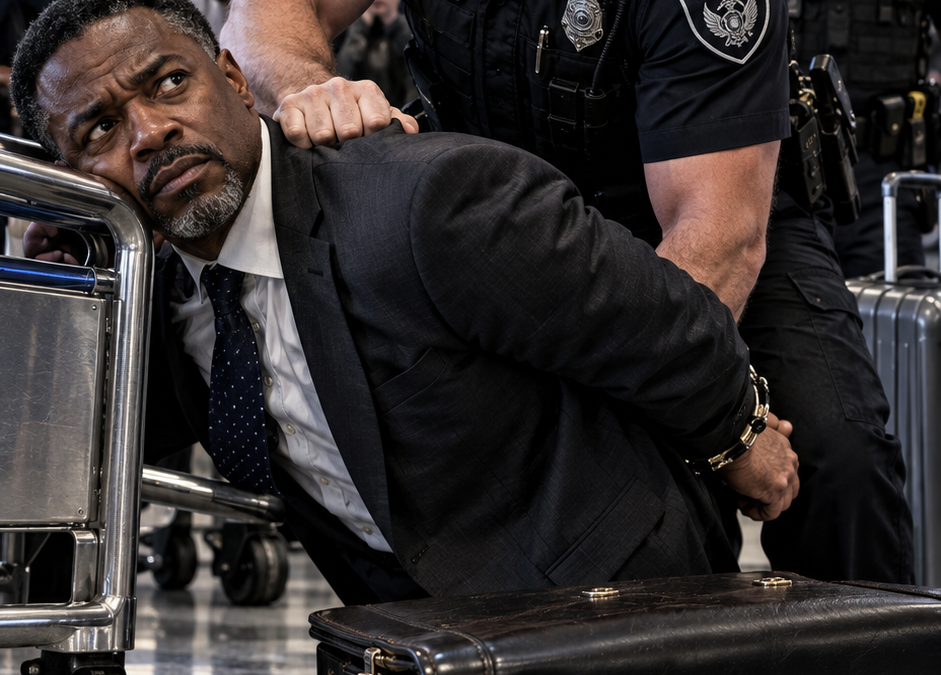
It showed Pike knocking away my briefcase, forcing me into the luggage cart, and handcuffing me while I attempted to identify myself.
It captured his false radio call.
And it showed two dark body cameras.
Near the corridor, the flight attendant who had rescued my mother’s gift was waiting.
She held out the wooden box.
“This fell from your case.”
I opened it.
The bracelet was undamaged.
“Thank you.”
“My name is Clare Donnelly,” she said. “I recorded everything.”
I looked at the phone in her hand.
“Please preserve the original video. Keep a separate copy somewhere the airport cannot access. And write down exactly what you remember before anybody tells you what they think happened.”
“I will.”
She hesitated.
“I heard you tell him who you were. I thought that would make him stop.”
“So did I.”
Her eyes filled slightly.
“I’m sorry.”
I closed the jewelry box.
“Thank you for not looking away.”
At the airport clinic, a doctor documented abrasions around both wrists, swelling in my right shoulder, and bruising along my ribs.
While she photographed the injuries, Naomi showed me a statement the airport authority had just released.
It claimed officers had responded to suspicious activity reported near baggage claim.
There had been no such report.
But the first official version was already reaching the public.
“They moved quickly,” Naomi said.
“Faster than they checked my luggage receipt.”
She told me an independent special counsel had been requested.
Then she mentioned that my protective detail had been delayed after my flight landed and that the bureau would review the security gap.
I looked at the bruises forming beneath the clinic lights.
“Don’t let anybody turn this into a story about a missing bodyguard.”
“Malcolm—”
“Pike violated the rights of a traveler he believed was ordinary. My security gap didn’t cause his decision. It only allowed people to see what he was willing to do.”
At 11:15 that night, I finally reached my home in Annapolis.
Renee was waiting in the kitchen.
She was still wearing the clothes she’d worn to the hospital, where she worked as a trauma nurse.
She had seen the video.
I knew the moment I looked at her.
She didn’t ask me to explain what the news had already shown.
She helped me remove my coat and examined my shoulder beneath the warm kitchen light.
Her fingers paused over the swelling.
“They did this after you told them who you were?”
“Yes.”
“And the second officer just watched?”
“Yes.”
Her expression remained controlled, but her hands grew gentler.
“Sit down.”
I obeyed her far more quickly than I had obeyed Pike.
On the counter sat my mother’s birthday cake beneath a glass dome.
Beside it was a blue gift bag.
I placed the bracelet inside.
Renee wrapped ice in a towel and pressed it against my shoulder.
“The airport says somebody reported suspicious activity.”
“Nobody did.”
“Then why are they saying it?”
“Because the first official account often determines which facts people are willing to believe afterward.”
She looked toward the kitchen window.
“Will it work?”
I didn’t answer immediately.
“It has before.”
She removed the ice pack.
“I watched him force you against that cart,” she said. “For three seconds, I didn’t know whether I was about to watch my husband die on somebody else’s phone.”
I reached for her hand.
“Renee—”
“Don’t explain procedure to me tonight. Don’t tell me what the investigators are doing.”
Her voice broke.
“Just tell me the truth. Were you afraid?”
I had spent decades learning to describe dangerous situations without allowing emotion to interfere with operational decisions.
That night, I couldn’t hide behind professional language.
“Yes.”
She held my face between her hands.
“Then that belongs in the record, too.”
The following morning, we visited my mother before she turned on the television.
She was sitting at her breakfast table in a blue dress when I gave her the bracelet.
She turned the silver band slowly until the engraving faced upward.
Courage.
Then she listened while I explained what had happened.
I told her about the suitcase, the handcuffs, the fabricated theft accusation, and the interview room where Pike continued writing his report after examining my credentials.
She glanced at my injured wrists.
“Do you remember why you joined the bureau?”
I thought about the young man I had been.
“I believed carrying a federal badge might make boys who look like me have to prove themselves one fewer time.”
“And did it?”
I looked down.
“For some people. Sometimes. Not enough.”
She covered my hand with hers.
“Then stop asking the badge to do the work. Make the truth do it.”
Before we cut her birthday cake, I received a message from counsel.
The airport authority wanted a confidential meeting.
Its attorneys were prepared to offer a public apology, pay my medical expenses, and discuss an early settlement.
The proposed agreement required all parties to refrain from further public discussion while the internal review proceeded.
I read it once.
Then I set the phone aside.
“No.”
Renee studied me.
“Because the offer isn’t enough?”
“Because they’re trying to buy silence before anyone learns what silence has already cost other people.”
I called Naomi.
“Decline the meeting. Ask the special counsel to begin with the cameras and the nonexistent theft report.”
“What about public affairs?”
“Unless my position is legally necessary, they should refer to me as a traveler, not Deputy Director Hayes.”
“Understood.”
“And Naomi?”
“Yes?”
“If Pike has done this before, we’ll find the truth in the gap between what happened and what the department wrote afterward.”
By noon, veteran civil rights prosecutor Celia Monroe had been appointed to lead an independent task force.
She was sixty-one years old, with close-cropped gray hair and a reputation for distrusting explanations that became more elaborate after contradictory evidence appeared.
I had no role in selecting her.
I was formally excluded from operational decisions, as was everyone in my direct chain of command.
Pike and Mercer were placed on administrative leave.
Their badges, weapons, phones, and access cards were collected.
The airport authority amended its statement.
It no longer claimed that officers had received a theft report.
Instead, it said they had observed behavior requiring investigation and urged the public not to judge a complicated encounter from incomplete video.
At 3:16 that afternoon, Clare released her complete recording through an attorney.
It wasn’t incomplete.
The footage showed me checking the red luggage tag and offering my airline receipt.
It captured Pike refusing both.
It showed my briefcase hitting the floor and Mercer staring at my federal credentials.
Most importantly, it preserved a sentence Pike had omitted from his report.
“A man dressed like you with a case like that usually means stolen money or drugs.”
By evening, the airport authority had stopped asking the public to reserve judgment.
Celia began her investigation in the equipment office beneath the terminal.
She didn’t request an executive briefing or begin by interviewing the officers.
She went straight to the body cameras.
A digital examiner placed Pike’s device in an isolated reader and opened its audit history.
At 8:26 p.m., while my flight was still taxiing, Pike had pressed and held two buttons in a sequence that disabled recording.
Nine seconds later, Mercer performed the identical sequence.
Neither device had malfunctioned.
Both remained powered and continued logging their locations.
The cameras had been disabled fourteen minutes before Pike approached me.
Celia asked the examiner whether both officers could have accidentally executed the same command within nine seconds.
He told her the sequence required deliberate input.
She ordered forensic copies of both devices and requested the audit histories from every earlier shift.
Then she went to dispatch.
She listened to the complete audio archive from eight o’clock until Pike’s voice finally appeared after I was handcuffed.
There was no earlier report of stolen luggage.
Baggage services had received no complaint.
My airline confirmed that the suitcase tracking number matched my receipt throughout the journey from Chicago to Chesapeake.
Pike’s written report mentioned an anonymous female traveler who had supposedly reported suspicious activity before leaving the scene.
The report’s version history showed that detail had been added at 10:12 p.m., more than an hour after my detention.
The entry had been made by the duty commander using Pike’s terminal.
Celia ordered the complete revision history preserved.
The body cameras and the dispatch records established how the officers had constructed their version of events.
They still didn’t explain why I had been selected.
That answer arrived shortly before midnight.
A civilian analyst named Maya Ortiz approached investigators carrying an encrypted drive.
She was thirty-two years old and worked in the airport police division, preparing performance reports for executives and the airport board.
She had kept her employee identification attached to her blouse.
Her hands trembled when she placed the drive on the table.
“If I give you this, I’ll lose my job.”
Celia didn’t offer a promise she couldn’t guarantee.
“If it contains evidence, we can seek protection against retaliation. We also have to review how you obtained the records.”
Maya nodded.
“There’s something you need to understand about the numbers this airport publishes.”
She explained that the police division maintained two sets of performance data.
The first was presented to the airport board.
It contained contacts, arrests, searches, seizures, and contraband discoveries.
It made the airport interdiction unit appear highly productive.
The second dataset was stored in a restricted folder called Field Notes.
It contained information deliberately removed before public reports were created.
Race.
Estimated income.
Luggage type.
Travel destination.
Whether a passenger had a local address.
Whether consent to search had been recorded.
Whether a body camera was active.
And a category labeled traveler leverage.
Celia asked her to explain the phrase without using departmental terminology.
Maya drew a breath.
“It predicts how difficult somebody will be after officers take something from them.”
Travelers classified as having low leverage were usually alone, financially vulnerable, unfamiliar with local legal procedures, or under pressure to catch another flight.
Some lived in other states.
Some feared that a police encounter might affect their immigration status.
Others had no realistic way to hire an attorney or return to Maryland repeatedly for hearings.
High-leverage travelers were people who appeared to have legal knowledge, local support, established professional connections, or the financial resources to challenge a seizure.
The interdiction unit was encouraged to avoid high-leverage targets.
Complaints reduced productivity.
Maya explained that she’d analyzed the unit’s data three months earlier.
Her report showed that Black travelers were being searched at significantly higher rates following supposedly voluntary contacts.
Those searches also produced contraband at lower rates than searches involving white travelers.
The disparity was generating more police encounters and more cash seizures, not better security outcomes.
When she submitted her findings, the chief ordered her to remove the racial comparison before presenting the report to the board.
She refused.
The comparison disappeared anyway.
Her access privileges were subsequently reduced, and her performance review described her as resistant to leadership.
“Why didn’t you report this outside the airport?” Naomi asked.
Maya stared at the drive.
“Because I was afraid.”
She swallowed.
“I have a mortgage. My mother lives with me. And every person I was supposed to report the problem to was already in the email chain telling me to change the report.”
She looked toward Celia.
“I kept the original. I told myself preserving the evidence was the same as doing something.”
“What changed tonight?”
“I saw Officer Pike’s report about the alleged theft. Then I checked Field Notes.”
She unlocked the drive.
“He’d entered Mr. Hayes before the contact even began.”
Inside were the raw datasets, her suppressed analysis, and messages linked to individual encounters.
Most of those messages didn’t contain explicit racial slurs.
Instead, officers used descriptions that appeared neutral until investigators compared them with passenger photographs and encounter histories.
Premium.
Urban.
Cash-friendly.
Unanchored.
Four minutes before Pike approached me, he had sent Mercer a message.
Solo premium at seven. Locked leather case. Easy numbers before shift end.
Attached was a live surveillance image of me waiting alone beside carousel seven.
My credentials were still inside my coat.
Pike hadn’t mistaken me for a thief.
He’d selected a traveler he believed would be easy to pressure, search, and discredit afterward.
Maya’s hidden database established that my encounter had been planned before Pike asked his first question.
I learned about the discovery through a formal victim update.
For several minutes, I sat alone after reading it.
I kept returning to the photograph.
There I was, standing beside the baggage carousel, looking down at the red tag on my suitcase.
Thinking about my mother’s birthday.
Unaware that somebody watching a security monitor was calculating how much difficulty I might cause if he decided to take something from me.
It was a disturbing realization.
My education, professional experience, and federal credentials had not protected me from being selected.
Pike had chosen me because he didn’t know about any of them.
He saw a Black man traveling alone with expensive belongings and decided I was an opportunity.
Maya could document at least 116 travelers assigned similar low-leverage classifications during the previous eighteen months.
Celia ordered investigators to begin with the individual cases rather than turning the entire investigation into an argument about statistics.
One name stood out.
Jamal Price.
Jamal was a thirty-two-year-old electrician from Baltimore.
Three years earlier, he’d flown home from Atlanta carrying eight thousand dollars in cash.
The money was a deposit from a church that had hired his company to rewire its community center.
The church treasurer had paid him following a weekend meeting because demolition was scheduled to begin the following Monday.
Pike stopped him near the rideshare exit.
He claimed a narcotics dog had shown interest in Jamal’s backpack.
No dog handler had documented an alert.
No illegal substances were found.
Jamal wasn’t arrested.
But Pike seized the eight thousand dollars.
The body camera hadn’t started recording until after Jamal had been led into an interview room.
It took him eleven months and more than four thousand dollars in legal fees to recover his money.
By then, he had borrowed funds to pay his employees.
He’d also lost the church contract because he couldn’t purchase materials when the project was scheduled to begin.
Jamal filed a complaint.
The airport classified it as a disagreement over procedure and closed the matter without interviewing the church treasurer or examining the missing camera footage.
When investigators visited his electrical shop, he opened a locked drawer and removed a thick folder.
Inside were receipts, emails, bank records, certified letters, and copies of his original complaint.
“I kept everything,” he told them.
“For a while, I thought I was keeping it because I’d get another chance.”
He looked at the documents.
“Later, I kept it because I needed proof that I hadn’t imagined the whole thing.”
Then he played a voicemail Pike had left after the seizure.
“If the money’s clean, you can prove it in court.”
Jamal stopped the recording.
“That was the rule at that airport. Innocence was something you had to buy back.”
Investigators showed him his entry in Field Notes.
His traveler leverage had been classified as low.
Beside his name, Pike had written:
Remote business. Cash dependent. Likely depart.
Jamal read the words twice.
“He knew I owned a business?”
“Yes.”
“He knew I needed that money?”
“He recorded your financial circumstances after questioning you.”
Jamal looked away.
“Then he knew taking it could destroy my company.”
The investigator didn’t soften the answer.
“Yes.”
Three years of anger had taught Jamal to speak quietly.
“People kept telling me maybe the officer made a mistake.”
He closed the folder.
“A mistake is taking somebody else’s suitcase by accident. He measured how badly I could fight him and charged me accordingly.”
His case became central to the investigation.
The church contract confirmed the source of the money.
The voicemail documented Pike’s attempt to shift the burden of proof.
The hidden database showed that Jamal had been selected as a low-leverage target before the seizure.
And his closed complaint established that airport officials had received evidence contradicting Pike’s account and declined to investigate it properly.
By the third morning, the task force had enough evidence to obtain emergency preservation orders covering the airport’s servers and interdiction-unit communications.
The airport police chief responded by placing Maya on administrative leave for unauthorized removal of confidential data.
Celia’s team obtained a federal anti-retaliation order that afternoon.
The chief was subsequently suspended after investigators established that he had attempted to revoke Maya’s access because she had met with federal authorities.
But the suspension didn’t end the danger to the records.
His remote administrative credentials had not yet been revoked.
At 4:18 p.m., while forensic technicians were copying the Field Notes server, a warning appeared on their monitor.
An administrator had initiated a scheduled deletion process against the complaint archive.
The command was labeled routine retention cleanup.
It targeted four years of closed cases and every file linked to the low-leverage classifications.
The preservation demand had already been served.
Deleting those records was no longer a matter of internal policy.
It was potential obstruction of a federal investigation.
“Can you stop it?” Celia asked.
The examiner studied the monitor.
“I can interrupt the transfer, but the command could resume from another terminal unless airport access is frozen.”
“How much is gone?”
“The live directory is still here. The backup index is disappearing.”
Naomi contacted the airport duty commander and ordered the server room secured.
He initially objected, saying airport counsel hadn’t authorized federal control of operational systems.
Celia took the telephone.
“Someone is deleting records subject to a federal preservation demand. Lock that room and keep every administrator away from a keyboard.”
The commander hesitated.
“If you refuse,” she continued, “the time and substance of this conversation will be included in the warrant application.”
Forty seconds later, the server-room lock engaged.
The forensic examiner disconnected the archive from the airport network and continued copying the data inside an isolated environment.
A second technician traced the deletion command to a remote administrative session using the chief’s credentials.
A verification code had been sent to his personal phone less than a minute before the command began.
Outside the sealed server room, an airport technology manager appeared carrying written instructions to perform emergency data maintenance.
He explained that the chief had called him that morning and warned that corrupted complaint files threatened the airport’s security network.
“Did you verify the corruption?” Celia asked.
“No. I was told the police division had already verified it.”
“Were you aware of the federal preservation demand?”
“Yes.”
“Did you ask whether the maintenance should be postponed?”
He unfolded the instruction sheet.
Beneath the chief’s signature was a handwritten sentence.
Legal exposure exceeds archive value. Complete before outside imaging.
By 5:30 p.m., Celia had obtained an emergency warrant authorizing forensic control of the relevant servers.
The team recovered the deleted index from a mirrored backup the chief hadn’t known existed.
Nothing essential had been lost.
But the attempt to erase the records had become another piece of evidence.
Maya watched the forensic examiner seal the final drive.
“If I’d waited one more day, would everything be gone?”
“The public reports would probably still exist,” he answered. “Everything explaining how those reports were created would not.”
She looked toward Celia.
“That was always the point, wasn’t it?”
Celia said nothing.
“Keep the totals. Delete the method.”
“Now a jury will be able to see both,” Celia replied.
The pressure reached Clare that evening.
When she reported for her next flight, her employee badge stopped working.
A scheduling notice informed her that she’d been removed from duty pending review of unauthorized filming inside a restricted security area.
But Clare had recorded my arrest in a public concourse.
The notice cited airport safety regulations and instructed her not to speak with passengers or the media.
She contacted the attorney who had released her video.
Within an hour, Celia sent the airport authority a formal warning that punishing a federal witness could constitute retaliation and obstruction.
Clare’s suspension disappeared before her scheduled departure.
She returned to the coffee kiosk where Pike had threatened to detain her.
A gate agent asked why she looked shaken.
“Because they made the same mistake twice,” Clare said.
“They thought making somebody afraid would make the record disappear.”
She boarded her flight carrying a printed copy of the withdrawn suspension notice.
Meanwhile, the airport announced that it had only recently discovered the hidden database.
Maya produced an email proving otherwise.
Months earlier, she’d warned the chief that racial data and complaint outcomes were being removed from board reports.
His response contained six words.
Remove exposure language. Keep performance totals.
I received these developments through formal victim updates.
I didn’t call Celia for private briefings.
I didn’t ask Naomi to accelerate arrests.
Every communication from my office went through counsel so that no defendant could later claim I’d used the FBI to direct a personal prosecution.
That restraint didn’t protect my family from what followed.
Pike’s police union described the incident as a reasonable misunderstanding complicated by my refusal to open the briefcase.
Television commentators replayed slowed footage of my hand moving toward my coat.
They questioned whether that movement might reasonably have frightened an officer.
Anonymous accounts called me arrogant.
One published my home address.
Another shared a photograph of my mother leaving church.
Renee began looking up and down the street before leaving for her hospital shifts.
I arranged protection for Evelyn without immediately telling her.
She noticed the same vehicle outside her house on two consecutive mornings.
When she confronted me, I explained the situation.
“I taught school through bomb threats after integration,” she said. “I’m not moving because some coward found a photograph.”
“I wasn’t asking you to move.”
“You were about to.”
“I was going to suggest a temporary adjustment.”
She gave me a look I remembered from childhood.
“That’s government language for asking your mother to move.”
I almost smiled.
“The agents are staying.”
“They can stay if they eat what I cook. I’m not having hungry people sitting in a car all day.”
For a few moments, I felt like her little boy again.
Then night came.
At 2:17 a.m., I woke with my right hand pressed against our bedroom wall.
My heart was pounding.
In the dream, I was back against the luggage cart.
But the terminal was empty.
Nobody was filming.
Nobody was calling my name.
Pike kept pulling my cuffed arms upward while every security door remained locked.
Renee switched on the bedside lamp.
“You were saying the same thing over and over.”
I sat on the edge of the bed.
“What?”
“There’s no incident number.”
Cold sweat gathered beneath my shirt.
I stared at my hands.
“I should’ve created more distance before he touched me.”
Renee sat beside me.
“You told an armed officer what you were doing, and you followed his commands.”
“I train agents to preserve options.”
“You’re trying to find a version of that night where being better at your job would’ve made his prejudice less dangerous.”
I didn’t answer.
“There isn’t one, Malcolm.”
I lowered my head.
“I knew the moment he refused to check the tag. I knew he wasn’t interested in an answer.”
“Then why do you keep blaming yourself?”
“Because I kept thinking the right sentence would make him stop.”
She took my hand.
“That’s because you believe words backed by law should matter. He created the moment when they didn’t.”
The following morning, I called the trauma counselor Celia had recommended.
I didn’t announce the appointment.
I didn’t turn my recovery into a public statement.
I simply began the difficult private work of understanding that another person’s abuse of authority was not a failure of my professional judgment.
While I was doing that work, Evan Mercer was confronting a different kind of responsibility.
During his first interview, he’d arrived with a union attorney and claimed to remember almost nothing.
He assumed a theft report had existed.
He couldn’t recall exactly when he’d seen my credentials.
He didn’t remember why both cameras were disabled.
Then investigators obtained the audit logs.
Clare’s complete video showed him examining my badge.
Maya’s records contained Pike’s message about easy numbers, sent directly to Mercer’s phone.
Mercer requested a second interview.
This time, he brought a private attorney.
Celia placed a recorder on the table.
“Cooperation after the evidence appears isn’t the same thing as courage before it.”
“I understand,” Mercer said.
“Then why are you here?”
He stared through the conference room window.
“My son is sixteen. He watched the video.”
He swallowed.
“He pointed at the screen and said, ‘Dad, you’re the one standing there doing nothing.'”
Celia waited.
“I told him there was context he couldn’t see.”
Mercer’s voice tightened.
“He asked me what context makes a lie true.”
“Did you have an answer?”
“No.”
“Do you have one now?”
He shook his head.
Celia opened her notebook.
“Then start with the cameras.”
Mercer explained that Pike routinely disabled body cameras before supposedly voluntary contacts.
Recorded consent, he admitted, often sounded like coercion when people listened afterward.
Pike selected the travelers.
A second officer stood beside him to create the appearance that two trained people had independently observed suspicious behavior.
If officers found nothing, the contact still counted toward productivity totals.
If they discovered cash, they created suspicion around it and left the traveler to bear the financial burden of recovering the money.
“Did anybody explicitly order you to target Black travelers?” Celia asked.
“Not in those words.”
“What words did they use?”
“People outside their expected profile. Premium travelers who looked unanchored. People carrying expensive belongings who probably couldn’t afford expensive lawyers.”
“Expected by whom?”
Mercer lowered his eyes.
“By us.”
“How many incomplete or false reports did you sign?”
“More than twenty.”
“How many times did you stop Pike from using force?”
His eyes reddened.
“Never.”
The word remained between them.
Then he disclosed something investigators hadn’t yet discovered.
Pike kept a second phone.
The interdiction unit had a private group chat called Easy Numbers.
Officers posted photographs of seized cash and joked about how long travelers would fight to recover their property.
Pike kept the phone at home.
Inside a box of old uniform shirts in his garage.
Mercer signed a cooperation agreement that offered no immunity.
The next morning, federal agents executed a search warrant at Pike’s house.
Their body cameras recorded the entire process.
They showed him the warrant, allowed him to contact his lawyer, and documented every item they removed.
The second phone was exactly where Mercer said it would be.
Its messages connected the hidden database to the people using it.
Pike had posted the surveillance image of me standing beside carousel seven.
Beneath it was the message about easy numbers.
He’d also photographed Jamal’s eight thousand dollars spread across the hood of a patrol vehicle.
The caption read:
8 grand from a man with a $2 lawyer.
Another message came from the airport police chief after an officer expressed concern that a traveler might file a complaint.
No clean camera. No clean complaint. Close it and move on.
When I read the relevant findings in the formal update, I thought about Jamal’s daughter.
She had been about to enter the world when Pike seized the money her father needed to support his business.
For three years, her family had paid the price of an encounter the airport had classified as a procedural disagreement.
My own arrest had lasted far less than an evening.
Federal agents had reached me before Pike finished writing his report.
Jamal had spent eleven months paying to prove that his own money belonged to him.
That distinction stayed with me.
The case now rested on several independent forms of evidence.
The cameras and dispatch records established what happened to me.
The hidden database demonstrated how travelers were selected.
Mercer’s testimony explained the operating method.
Jamal’s records showed the human cost.
And Pike’s second phone connected the officers’ private intentions to their official reports.
Pike’s attorney presented him with the evidence during a private meeting.
She placed four items across the table.
A photograph of the dark body-camera indicators.
The dispatch record showing no original theft complaint.
Maya’s recovered message.
And the photograph of Jamal’s money.
“They don’t have one bad judgment call,” she told him. “They have preparation, an invented accusation, evidence of motive, and a prior victim.”
“Mercer’s blaming me to save himself.”
“These records existed before Mercer cooperated.”
“Maya stole them.”
“A jury will decide the evidentiary issues. But the records match your phone.”
Pike paced behind his chair.
“I never used a racial slur.”
“Bias doesn’t become lawful because you learn to describe it with other words.”
He stopped beside the window.
“Hayes ruined my life.”
His attorney closed the folder.
“Malcolm Hayes didn’t turn off your camera. He didn’t invent a theft. He didn’t write that message before the contact.”
Pike rejected the plea discussion.
For years, his reports had protected him.
Complaints had closed.
Supervisors had accepted his explanations.
Travelers had caught their flights, paid their lawyers, and eventually disappeared from his daily life.
He believed the system would protect him one more time.
Thirty-one days after my arrest, a federal grand jury returned indictments against Pike, Mercer, and the airport police chief.
Pike faced charges including willful deprivation of civil rights, obstruction, falsifying an official record, and conspiracy.
The chief faced obstruction and conspiracy charges connected to the hidden system and concealed complaints.
Mercer faced false-statement and civil rights charges, with his cooperation to be considered later.
Federal agents arrested Pike at 6:12 the following morning.
They didn’t throw him against a vehicle.
They didn’t disable their cameras.
They presented the warrant, secured his hands according to procedure, and recorded every step.
At the courthouse, reporters asked Celia whether the arrests proved that powerful people received a different kind of justice.
“An indictment establishes that charges have been filed,” she answered. “Mr. Pike will receive the legal process he denied others.”
She paused.
“The evidence existed before Malcolm Hayes entered that airport. The question is why a prominent title was necessary before the institutions responsible for examining it finally looked.”
I watched her statement at home with the television volume turned low.
Renee stood behind my chair.
“Are you relieved?”
“I’m relieved the records can’t be quietly closed.”
“That wasn’t my question.”
I looked at the screen.
Pike was being escorted into the courthouse.
His wrists were restrained in front of him.
His attorney walked beside him.
Every officer accompanying him had an active camera.
“Part of me wanted to see him afraid,” I admitted.
Renee rested her hand on my shoulder.
“And now?”
“I watched the agents show him the warrant. I saw the cameras recording.”
I turned toward her.
“The point isn’t for him to experience what I experienced. The point is that nobody gets to change the rules depending on who’s wearing the handcuffs.”
She smiled faintly.
“Your mother was right.”
“She usually is.”
“Should I tell her you said that?”
“Absolutely not.”
For the first time since the airport, I laughed without forcing it.
But the criminal case was far from over.
Pike’s defense challenged the evidence obtained from Maya’s drive.
His attorney argued that she’d copied confidential records after her access had been restricted and had effectively acted as an agent of the government without a warrant.
If the judge accepted that argument, the hidden database and Pike’s message might be excluded.
The defense could then challenge the second-phone search as the product of improperly obtained evidence.
The public had already seen the words easy numbers.
But a jury might never be allowed to consider them.
At the suppression hearing, Maya entered through a courthouse side door.
Protesters outside called her a hero.
Former colleagues had been calling her a thief online.
She seemed comfortable with neither description.
Celia began by asking when federal investigators had instructed her to copy the records.
“Nobody did.”
“When did you preserve your original disparity report?”
“Three months before Mr. Hayes was stopped.”
“Why did you retain the Field Notes?”
“Because the chief removed my access after I refused to alter the analysis.”
“Had you contacted federal investigators at that point?”
“No.”
“Then why preserve the records?”
Maya looked toward the judge.
“Because every public report removed the columns explaining who was being selected. And every complaint review depended on those same reports.”
Pike’s attorney questioned her aggressively.
He accused her of being angry about her poor performance review.
She acknowledged that she had been angry.
He accused her of believing she knew better than her supervisors.
Maya answered without raising her voice.
“I believed the public report shouldn’t say race was unknown when the private database recorded it in every row.”
She admitted waiting too long to report the problem.
She acknowledged taking the drive home and hiding it while deciding what to do.
She didn’t pretend to have been fearless.
Her testimony was imperfect because she hadn’t lived through the situation perfectly.
But the forensic evidence supported her account.
A digital examiner testified that server copies obtained under warrant matched her files exactly, including deleted cells and creation timestamps.
Even without Maya’s drive, Clare’s video, the body-camera audit logs, the dispatch archive, and Mercer’s message records independently supported the warrant for Pike’s second phone.
The judge denied the suppression motion.
Maya had acted independently before approaching federal authorities.
And the challenged warrant rested on evidence separate from her copy.
The jury would be allowed to hear the records and determine their significance.
Pike showed little reaction until the judge left the courtroom.
Then he leaned toward his attorney and whispered angrily enough that the deputy standing behind him moved closer.
The trial began five months after the night at carousel seven.
I entered the courthouse with Renee.
Opposing crowds stood behind barriers outside, shouting at each other across the entrance.
I kept my eyes on the doors.
The decision had to come from twelve people inside that building.
Celia’s opening statement was direct.
Police officers could make mistakes without committing crimes.
This case, she argued, involved an officer who prepared to hide his conduct, selected a traveler for vulnerability, disregarded evidence that contradicted him, and invented a theft accusation after placing the traveler in handcuffs.
The defense presented the encounter as a rapidly developing airport investigation transformed into a federal prosecution because the detained passenger happened to hold a powerful position.
Then the jury watched Clare’s video.
They saw me examining the red luggage tag.
They heard me offer the airline receipt and explain how I intended to retrieve my identification.
They watched Pike strike my briefcase away.
They saw Mercer examine my credential.
And they saw that both body cameras were dark.
Clare testified about why she continued filming after Pike threatened to detain her.
“I realized that whatever happened next might exist only if strangers refused to look away.”
A digital examiner displayed the timeline.
The cameras were deliberately disabled fourteen minutes before the encounter.
Pike entered me as a voluntary productivity contact before approaching me.
No theft complaint appeared in dispatch until after I was restrained.
The anonymous witness wasn’t added to the report until more than an hour later.
Maya took the stand next.
She explained the difference between the public performance database and the hidden Field Notes system.
One measured apparent productivity.
The other measured vulnerability.
Then she identified the message attached to my entry.
Solo premium at seven. Locked leather case. Easy numbers before shift end.
The defense suggested the phrase was ordinary productivity slang.
The prosecution paired it with the surveillance image of me waiting alone beside the baggage carousel.
The message had been sent before the encounter.
Pike’s attorney questioned whether whistleblower protections had personally benefited Maya.
She looked directly at him.
“Protection didn’t give me better data. It kept me from being fired for showing the data we already had.”
Jamal testified with the church contract and Pike’s voicemail.
The jury heard Pike instruct him to prove that his own money was legitimate.
Then prosecutors displayed the photograph from the second phone.
Eight thousand dollars spread across the hood of a patrol car.
A mocking caption about a man with a cheap lawyer.
Jamal spoke quietly.
“He didn’t think I was dangerous. He thought I was affordable.”
Mercer admitted disabling his camera, signing false reports, and lying during his first interview.
The defense asked why anyone should believe him after he’d changed his account.
“They shouldn’t believe me just because I’m saying it now,” he answered.
“They should believe the records we created when we thought nobody would ever see them.”
Celia asked him one final question.
“What prevented you from intervening when you saw Mr. Hayes’s FBI credentials?”
Mercer looked down.
“Nothing.”
“And why didn’t you?”
“Because I chose not to.”
I was the final fact witness.
I had testified many times as a federal investigator.
I’d described surveillance operations, documentary evidence, and the decisions that led to arrests.
But I had never testified in a case where the evidence included the sound of my own body striking metal.
Renee sat in the first row.
I focused on her for a moment before Celia began.
“What did you feel when Officer Pike laughed at your identification?”
“Afraid.”
“Why?”
“Because I had offered him the fastest way to resolve any legitimate doubt. Instead of verifying my identity, he treated the evidence itself as another offense.”
I explained why I couldn’t open an encrypted federal briefcase in a public concourse.
I described my efforts to follow Pike’s instructions and the moment I realized that no answer would satisfy him.
Celia asked whether federal agents would have arrived so quickly if I’d been an ordinary traveler.
“No.”
“Why not?”
“My title shortened the detention. It didn’t create the violation.”
I looked toward the jury.
“If Malcolm Hayes, the electrician, had been taken through that security door, Pike’s report might have become the only version anyone preserved.”
During cross-examination, Pike’s attorney displayed a slowed frame showing my hand near my coat.
“Could that movement reasonably appear sudden to an officer under pressure?”
“Not when the recording includes me explaining that my identification was inside my coat and that I intended to retrieve it slowly.”
“An officer may focus on movement rather than words.”
“Officer Pike created the pressure by refusing the documents I’d already offered.”
The attorney walked toward the jury.
“Isn’t it possible this investigation was pursued more aggressively because you’re the FBI deputy director?”
“Yes.”
That answer seemed to surprise him.
“Your position gave you extraordinary influence.”
“My position brought federal agents through the door.”
“And that’s a problem?”
“That’s the problem.”
I paused.
“But my influence didn’t disable those cameras. It didn’t invent an anonymous witness. It didn’t classify Jamal Price as low leverage or send the message about easy numbers.”
I turned toward the jury.
“The evidence already existed. My title only made it harder to bury.”
Pike didn’t testify.
In closing, Celia asked the jurors not to convict because of my position, a percentage in Maya’s report, or the public controversy surrounding the airport.
She placed Pike’s message beside his radio call.
“He didn’t mistake Malcolm Hayes for a thief. He selected a traveler he believed he could describe as a thief.”
She looked toward the defense table.
“The accusation wasn’t an error made under pressure. The accusation was part of the plan.”
The jury deliberated for nine hours.
I waited in a small room with Renee, Maya, and Jamal.
We spoke about almost everything except the verdict.
Jamal described how his company had eventually completed the community-center project after the church hired him again.
Maya stared at a paper cup of coffee she hadn’t touched.
Renee held a novel open on her lap.
I don’t think she turned a single page.
After six hours, a television in the corner showed a reporter standing outside the courthouse.
The caption described me as the man whose arrest exposed the airport scheme.
Jamal watched it in silence.
“That’s not exactly true.”
I looked toward the screen.
“No. It isn’t.”
“My complaint exposed it three years ago,” he said.
Maya lowered her paper cup.
“My report exposed it three months ago.”
I nodded.
“My arrest made ignoring it expensive.”
Jamal turned toward me.
“I don’t want you thinking what happened to you was smaller.”
“I don’t.”
I leaned forward.
“You gave them the truth when your business, your payroll, and your reputation were at risk. I had agents through the door before Pike finished writing his report.”
Jamal looked at the floor.
“Do you know what bothered me most?”
I waited.
“It wasn’t losing the money.”
He rubbed his hands together.
“It was walking into that complaint office afterward. The supervisor sat there reading Pike’s report while I tried to explain what happened.”
His voice tightened.
“I watched her decide which one of us sounded official.”
Maya looked toward him.
“Your complaint became a row in the public database. Procedure disagreement. No verified financial loss.”
“I verified every dollar.”
“I know. The Field Notes linked your church contract.”
He looked up.
“Then why wasn’t it in my complaint file?”
“Somebody removed the link before the case was closed.”
Jamal sat back.
“Then whatever the jury decides about Pike, make sure the record says the institution had the answer and chose the easier story.”
I looked toward the closed waiting-room door.
“That’s the part no verdict can finish for us.”
The television continued playing without sound.
Outside, people argued about whether the prosecution concerned one corrupt officer or a larger system.
Inside that room, the distinction seemed increasingly inadequate.
Pike had made individual decisions.
Other people had recorded, edited, classified, approved, rewarded, or ignored those decisions.
Responsibility came in different forms.
But silence had never been empty.
When the clerk finally opened the door, nobody asked what the expressions on the faces outside might mean.
We walked into the courtroom.
Pike stood beside his attorneys.
The foreperson rose.
On the charge of willfully depriving me of my civil rights, guilty.
On obstruction, guilty.
On falsifying an official record, guilty.
On conspiracy connected to the Easy Numbers scheme, guilty.
Pike’s shoulders dropped with each count.
By the final verdict, he was staring at the table.
Renee closed her hand around mine.
Maya covered her mouth.
Jamal lowered his head.
I felt relief, but not triumph.
Across the aisle, Pike’s sister began crying.
A family was breaking under the consequences of choices he had made.
Recognizing her pain didn’t excuse him.
It reminded me that justice wasn’t supposed to become entertainment.
In the courthouse corridor, I called my mother.
“They found him guilty.”
“I heard.”
“You watched?”
“I told you I was staying home. I didn’t tell you I was turning off the television.”
I leaned against the wall and closed my eyes.
“How do you feel?” she asked.
“Like I’ve been holding my breath for five months.”
“Then breathe, son.”
I listened to her steady voice.
“The truth did its work. Now people have to do theirs.”
At sentencing, Pike apologized for allowing an encounter to get out of control.
He talked about long shifts, operational pressure, and a culture that rewarded high productivity numbers.
He didn’t acknowledge selecting me as a target.
He didn’t explain why he refused to verify my identification.
He didn’t address the decisions that preceded the encounter.
His sentences made everything sound as though it had happened without anybody choosing to do it.
The judge noticed.
“An encounter doesn’t lose control by itself,” she told him.
“You created the conditions, concealed the record, and relied on your uniform to make your account more credible than the people you targeted.”
Pike received a federal prison sentence and a permanent ban from law enforcement.
The airport police chief later pleaded guilty to obstruction and conspiracy.
Mercer received a reduced sentence because of his cooperation, but his law enforcement certification was permanently revoked.
The judge made clear that his cooperation did not erase his participation.
The airport reforms were less dramatic than the public speeches.
They were also more useful.
Body cameras at Chesapeake International began recording automatically whenever officers left their assigned posts.
Disabling a camera triggered an immediate alert outside the police chain of command.
Every voluntary search required a recorded explanation that the traveler was free to refuse and free to leave.
Seized funds could no longer flow directly into the airport police budget.
Raw complaint data was delivered to an independent civilian office before administrators could remove identifying columns.
Most importantly to Jamal, the airport reopened the closed seizure cases.
His legal expenses were repaid with interest.
The church received written confirmation that its money had never been linked to criminal activity.
Other travelers recovered funds through the same review.
The final public report didn’t reduce their experiences to one impressive restitution total.
It documented what had been taken, how long it had been held, and why the original justification failed.
Maya accepted a position in the independent analytics office only after the airport board agreed that disparity reports would be published without executive editing.
Her first report placed a sentence in plain language above every table.
Numbers are not performance if the conduct producing them is unlawful.
Sixteen months after my arrest, I returned to Chesapeake International with Renee.
I could have used a private entrance.
I chose the main terminal.
The steel luggage cart was gone.
Self-service kiosks now occupied the space beside carousel seven.
Travelers hurried beneath the same fluorescent lights, carrying suitcases, coffee cups, crying children, and worries nobody else could see.
Near the carousel, a small screen explained travelers’ rights during voluntary searches and provided instructions for preserving complaints.
I didn’t want a plaque bearing my name.
Institutions were sometimes eager to turn the harm they had resisted acknowledging into monuments celebrating their eventual decency.
The screen was different.
It was a tool.
And that made it worth keeping.
As Renee and I approached the exit, I noticed a young Black man lifting a suitcase whose paper identification tag had torn loose.
A uniformed airport officer approached him.
I slowed instinctively.
Her body camera activated with a clear electronic tone.
She introduced herself and explained that two passengers had reported having similar luggage.
Then she asked whether the young man had his airline receipt.
He showed it on his phone.
She compared the tracking number, returned the suitcase handle to him, and stepped back.
“Thank you for your time, sir. You’re free to go.”
The entire exchange lasted less than a minute.
Renee stopped beside me.
“Is that what justice looks like?”
I watched the young man continue toward the exit.
“Part of it.”
“It looks ordinary.”
“It should.”
The officer hadn’t asked what the traveler did for a living.
No supervisor had rushed through a locked corridor.
Nobody had needed to film an assault.
The airline receipt had been treated as useful information rather than evidence of defiance.
And the uniform hadn’t required humiliation to establish authority.
My phone rang as we reached the glass doors.
It was Evelyn.
“Did you remember my cinnamon tea?”
I smiled.
“I’m buying it now.”
“Then you may come home.”
I ended the call and took Renee’s hand.
For months, people had asked me when justice had finally been achieved.
Was it the moment Naomi entered interview room three?
The morning federal agents arrested Pike?
Or the afternoon a jury found him guilty?
Every one of those moments mattered.
But none was sufficient by itself.
Justice was also Jamal opening a letter confirming that he would be reimbursed for the cost of proving his own innocence.
It was Maya publishing data nobody could quietly edit.
It was Mercer admitting that standing beside abuse and refusing to intervene had made him part of it.
It was a working camera, a verified airline receipt, an honest question, and a traveler allowed to continue his journey without first proving that he knew somebody powerful.
I didn’t mistake reform for completion.
Policies could weaken.
Evidence could disappear if people stopped protecting it.
New leaders could rediscover old habits.
The work would require officers willing to intervene, analysts willing to preserve uncomfortable findings, independent investigators willing to follow records wherever they led, and ordinary witnesses who refused to look away.
At the parking garage, I stopped and looked back toward carousel seven.
Sixteen months earlier, an officer had stood there and tried to turn an assumption into an official fact.
He’d counted on his uniform being more credible than the stranger standing in front of him.
I touched the credentials case inside my coat.
For most of my career, I had believed that carrying a federal badge meant I possessed the authority to make institutions listen.
But my mother had understood something I was still learning.
The badge wasn’t the reason the truth deserved to be heard.
Neither was my title.
Neither was the speed with which federal agents could reach a locked interview room.
The truth had been present in Jamal’s receipts three years before my arrest.
It had existed in Maya’s reports long before my face appeared on national television.
It had been preserved by a flight attendant who refused to stop recording when a police officer threatened her.
And on the night I was handcuffed, it had existed in the airline receipt Pike refused to examine.
I turned away from the carousel.
Renee squeezed my hand as we walked toward our car.
Nobody called my name.
Nobody announced my title.
The airport continued its ordinary rhythm around us.
And for the first time since that night, I was content to leave without anybody knowing who I was.
The badge remained in my pocket.
The record remained beyond anyone’s power to quietly rewrite.








