“Who do you think you are?” Five minutes later, five black SUVs tore into the driveway. Because… I was a general.
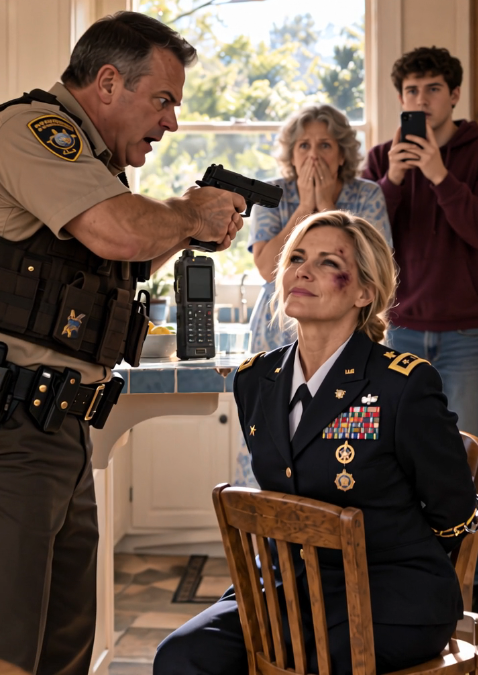
“Who do you think you are?” Five minutes later, five black SUVs tore into the driveway. Because… I was a general.
The kitchen in my mother’s house always smelled the same: stale coffee grounds, lemon dish soap, and the faint, permanent aroma of old wood and burnt toast.
Through the front window, the small American flag on the porch snapped hard against its metal pole in the afternoon wind. It was a rhythmic, impatient sound, like a clock ticking down to something unavoidable.
I stood beside the old breakfast table with its chipped blue tiles—tiles my mother had promised she would replace every Christmas for the last decade.
I wore black uniform trousers, a plain white blouse, and the silver watch I had been given after an operation in Kabul.
In my ear, pressed tightly against the side of my head, was a secure satellite phone.
From the other end of the encrypted line, a calm, precise Pentagon voice said, “General Mitchell, repeat the last figure, please.”
I never got the chance.
The back door banged open against the pantry wall.
Heavy boots slammed onto the linoleum, and before I could turn my head, Michael Harris was standing three feet away from me with his department-issued service weapon already drawn and leveled at my chest.
“Put that phone down or I swear I’ll drop you, you fraud.”
That was the first thing Michael said.
Not welcome home.
Not is everything all right?
Just a threat delivered with the casual venom of a man who believed his badge gave him jurisdiction over the laws of physics and common decency.
Michael had been the police chief in that suffocating little Texas town long enough to convince himself that every room in the county became his precinct the second he crossed the threshold.
For ten long years, ever since my mother married him after my father passed away, he had treated her house like a private fiefdom where his word carried more weight than federal statute, local ordinance, or basic human respect.
He despised me.
He despised the fact that I had left home, gone to West Point, risen through the ranks, and returned with medals he couldn’t explain, a level of authority he couldn’t comprehend, and a rank he flat-out refused to believe.
“What are you doing in my house?” he snarled, the vein in his temple beginning to throb.
“My mother invited me,” I said, my voice entirely level.
My mother, Emma, stood frozen behind him, her hands twisted so hard into the fabric of her faded yellow apron that her knuckles were entirely white.
My stepbrother, Tyler, leaned lazily against the refrigerator door with his smartphone already raised, recording the scene with that vacant, ugly smile people wear when they think public humiliation is high-definition entertainment.
“Look at her,” Tyler muttered, shaking his head. “Still playing soldier in Mom’s kitchen.”
Michael’s eyes dropped from my face to the secure device clutched in my hand.
The heavy, matte-black satellite handset looked completely out of place next to a half-empty coffee mug and a grocery receipt from 3:17 p.m.
“Who are you talking to?” Michael demanded, taking another aggressive step forward.
“It’s a secure line, Chief Harris,” I replied, keeping my tone clipped and formal—the kind of tone that usually forces subordinates to snap to attention.
It was the worst possible answer I could have given a man who confused obedience with respect.
His jaw tightened so hard I could hear the cartilage pop.
His eyes narrowed into malicious slits, and that small muscle in his cheek started jumping—the violent twitch it always exhibited whenever someone in his presence refused to shrink, cower, or agree with his version of reality.
“A secure line?” he mocked, his lips curling into a sneer. “So now you’re an international spy, too? What is this, a walkie-talkie you bought at an army surplus store?”
From the earpiece pressed against my ear, the Pentagon voice cut through the background noise, sharper and colder this time.
“General Mitchell, is there a problem at your location? We have an open, unverified transmission.”
Michael went dead still.
For a fraction of a second, the sheer foreignness of the terminology seemed to register, but his ego—brittle and bloated—refused to process the data correctly.
Instead, he laughed.
A short, barking sound of utter derision.
“General? You? Don’t make me laugh. I’ve seen privates with more backbone than you.”
I lowered the phone a few inches, keeping the line live so the operations center could log every decibel of what was happening.
“Chief Harris, do not touch this device. Step back.”
“You don’t give orders in my house,” he roared, spitting the words out.
“It isn’t your house. It’s my mother’s.”
That sentence—simple, factual, and utterly devastating to his ego—was the spark that detonated the powder keg.
Some men can tolerate your success, your education, or your independence, but only as long as it never threatens their dominance or alters the seating arrangement at their dinner table.
Michael Harris was pathological about control.
The idea that a woman—and worse, his stepdaughter—could stand in a kitchen he claimed to own and issue a correction was an insult his psyche couldn’t endure.
Michael crossed the remaining distance between us in three hard steps.
Before I could pivot, square my stance, or execute a defensive sweep, his thick, calloused hand clamped around my right wrist.
I could have folded his fingers backward, snapped his wrist joint, and had him pinned to the chipped blue tiles before Tyler’s camera even adjusted its autofocus.
I had done harder things in much darker rooms across three continents with far less warning and infinitely higher stakes.
I didn’t move.
I didn’t strike back.
I simply breathed in slowly through my nose, locked my gaze onto his bloodshot eyes, and said, “Let go of me.”
He smiled.
A wide, sadistic grin of a man who thought he had finally cornered his prey.
“Oh, no. You’ve spent years acting like you’re above everyone else because you wear a fancy uniform. Now you’re going to learn some respect.”
With a vicious yank, he spun me around, slammed my hand down onto the breakfast table, and snapped a heavy steel handcuff around my right wrist.
The cold metal bit instantly into my skin, tight and sharp.
“Michael, no! Stop it!” my mother cried out, finally finding her voice, rushing forward with her hands outstretched.
“Stay out of this, Emma!” he barked without looking at her, his voice like a whip crack.
Then he grabbed my left arm, dragged it backward with brutal force, and cuffed it to the heavy wrought-iron leg of the kitchen chair.
Tyler kept recording, stepping closer to get a better angle.
“This is getting good,” he muttered under his breath, zooming in on my pinned wrists.
The secure satellite phone had slipped from my fingers during the scuffle, sliding across the table to rest beside my mother’s grocery receipt, the half-empty coffee mug, and the crisp, folded copy of my temporary duty orders I had brought along because the emergency recall had interrupted our lunch.
Michael reached down, picked up the military-grade satellite handset, and pressed it directly to his ear.
“Listen here, whoever the hell you are,” Michael barked into the receiver, puffing out his chest for Tyler’s camera. “This woman is impersonating federal authority and interfering with local law enforcement. Consider yourself off the hook, whoever’s paying her to play dress-up.”
There was complete, profound silence on the other end of the line.
Then the voice answered.
It was no longer just calm.
It was arctic.
Absolute zero.
“Identify yourself.”
Michael smirked, loving the sound of his own authority.
“Chief Michael Harris. Chief of Police, Precinct Four. And you are trespassing on an active local investigation by speaking to a suspect.”
“Chief Harris,” the voice said, the cadence dropping an octave into pure menace, “you have just interfered with a secure, classified Department of Defense priority communication.”
Michael’s smug smile flickered for precisely one second.
One second was all it took for me to assess the tactical landscape, calculate the operational exposure, and realize he had crossed a line that no badge in the state of Texas could protect him from.
I looked up from the chair, my wrists locked to the iron leg, blood beginning to pool where the metal cut into my skin.
“Hang up the phone, Michael,” I said quietly. “Now.”
Instead of complying, the alcohol-fueled adrenaline and wounded pride driving him made him double down.
His face flushed a dark, mottled purple.
With a violent jerk, he drew his service weapon—a standard-issue Glock 22—from its holster, the black steel catching the afternoon glare from the window.
My mother made a sound I had never heard come from her before—a horrific, jagged hybrid of a gasp and a breaking rib.
Tyler’s phone dipped, the camera view suddenly tilting toward the floor.
The refrigerator hummed mindlessly in the background.
The small American flag outside snapped against its pole with rhythmic precision, as if the entire house were counting down the final seconds of a countdown timer.
For one ugly, instinctual heartbeat, my combat training surged through me, overriding conscious thought.
Weapon hand.
Distance.
Witnesses.
Open line.
Protocol.
Incident report.
Response window.
Fear screams.
Assessment counts.
Before I could shift my weight to minimize the impact, Michael shoved the chair hard.
The heavy wood legs caught on the kitchen tiles.
I went down hard, hitting the floor shoulder-first, then cheek-first.
Pain exploded across my face—bright, blinding, and hot.
The metallic taste of copper flooded my mouth as my teeth split my inner lip.
The handcuffs twisted savagely against my wrist and the iron chair leg, sending shooting nerve pain up my forearm.
Through the blur of the impact, I saw the room not with panic, but through the cold, dispassionate math of after-action logs, extraction drills, and every survival lesson that had ever beaten into me the absolute necessity of keeping a clear head when violence enters the room.
Michael stood directly over me, his boots planted wide, his pistol aimed straight at my forehead.
“Who do you think you are?!” he shouted, spittle flying from his lips, his chest heaving. “Who do you think you are coming into my house and giving me orders?!”
I pushed my tongue against my split lip, tasted my own blood, spat a red glob onto my mother’s immaculate kitchen floor, and looked up at him with calm, terrifying steadiness.
“They already told you,” I whispered.
On the breakfast table just a few feet away, the secure satellite phone—still live, un-hung-up, and transmitting every audio byte directly to a command post—went dead silent for half a beat.
Then a different voice came through the speaker.
It wasn’t the calm desk officer from before.
It was deeper, heavier, carrying the unmistakable weight of flag rank and operational command.
It was close enough, projected through the high-gain tactical speaker mode, that everyone in the kitchen heard every single syllable.
“General Mitchell, stay down. Response team is inbound. ETA four minutes.”
Michael’s eyes snapped away from my face, cutting sharply toward the phone on the table.
And for the first time since he entered that kitchen, I saw uncertainty.
Not fear yet.
Michael Harris did not frighten easily because men like Michael spent most of their lives arranging the world so that fear always belonged to someone else.
But uncertainty was there.
A crack.
His pistol lowered less than an inch.
Tyler stopped recording me and turned his camera toward the satellite phone.
“What response team?” he asked.
Michael glanced at him.
“Shut up.”
“Mike,” my mother whispered.
He spun toward her.
“What?”
Her face had gone pale.
“Put the gun down.”
Michael laughed again, but the sound was thinner now.
“Everyone relax.”
He said that while standing over a bleeding woman handcuffed to furniture with a loaded pistol in his hand.
That was Michael’s gift.
He could create chaos and then accuse everyone else of overreacting to it.
He holstered the Glock.
Not because my mother asked.
Because somewhere outside the house, faint but growing louder, came the low thudding beat of rotor blades.
Michael heard it.
So did Tyler.
The grin disappeared from my stepbrother’s face.
Michael moved to the window.
At first there was nothing but the oak trees, the porch flag, and the long road cutting toward town.
Then a pair of dark SUVs turned hard onto the street.
No lights.
No sirens.
They moved too fast and too cleanly to be local patrol.
Behind them came a county sheriff’s vehicle.
Then another.
Michael’s mouth tightened.
“What the hell?”
He looked at me.
I said nothing.
That was when his training should have taken over.
He should have secured his weapon.
He should have uncuffed me.
He should have identified himself to the approaching officers and preserved whatever remained of his position.
Instead, pride took control again.
He reached for the satellite phone.
I spoke sharply.
“Don’t.”
He froze.
The word came out in the command voice I had spent half my adult life learning not to use at home.
Even Michael heard the difference.
“Do not touch that equipment again.”
For a strange second, nobody moved.
Then engines stopped outside.
Doors opened.
Not slammed.
Opened.
Controlled movement.
Boots crossed the porch.
Michael backed away from the table and reached instinctively toward his holster.
The front door burst inward.
“Hands!”
The kitchen filled with bodies.
Two sheriff’s deputies entered first because the house was civilian property and Michael was a local law-enforcement officer.
Behind them came three members of the military protective liaison team assigned to my emergency recall.
They had been staged less than four miles away at the municipal airport, waiting to drive me to Naval Air Station Joint Reserve Base Fort Worth after my secure call concluded.
That was why the response time had been four minutes.
Michael never knew.
He had assumed I had simply come home for lunch.
He had assumed the black sedan parked half a block away belonged to a neighbor.
He had assumed the two men inside were insurance salesmen or utility workers.
They were Army Criminal Investigation Division protective-security personnel supporting a classified strategic logistics consultation.
And now they were standing in my mother’s kitchen.
“Chief,” the sheriff’s senior deputy said, “step away from the weapon.”
Michael’s eyes moved from one uniform to another.
“This is my jurisdiction.”
“No,” the deputy answered.
That single word landed harder than any shouting could have.
“This is a domestic assault scene. You are involved.”
“She’s impersonating military authority!”
One of the protective agents looked at me on the floor.
Then at Michael.
Then at the blood around my mouth.
“Sir,” he said, “the woman you have handcuffed to a kitchen chair is Major General Evelyn Mitchell, United States Army.”
Nobody spoke.
Tyler’s phone was still recording.
His hand began to shake.
Michael stared at the agent.
Then at me.
“No.”
It was almost quiet.
“No, she isn’t.”
The agent stepped closer.
“I personally reviewed her protective movement order this morning.”
Michael shook his head.
“She’s lying.”
The second agent moved toward the satellite phone without touching it.
“Secure communications device has been compromised. Chain-of-custody starts now.”
The sheriff’s deputy addressed Michael again.
“Unbuckle your duty belt.”
Michael laughed.
Nobody joined him.
“This is insane.”
“Chief.”
The deputy’s tone changed.
“Unbuckle the belt.”
For years, I had watched Michael use that exact voice on other people.
The calm threat beneath it.
The promise that things would get worse if compliance did not happen immediately.
For once, he was the person hearing it.
His face turned red.
“You answer to me.”
The sheriff’s deputy looked almost tired.
“I answer to the county sheriff, Michael. Not you.”
That sentence changed everything.
Michael looked toward the front door as if only then realizing the men entering his house—or rather, my mother’s house—were not his officers.
He had no chain of command to manipulate.
No junior patrolman to intimidate.
No dispatcher to bully.
No one there owed him loyalty.
He slowly removed his service belt.
The Glock.
Radio.
Cuffs.
Taser.
Everything came away from him one item at a time.
The deputy stepped behind him.
The click of handcuffs closing around Michael’s wrists was softer than I expected.
My mother covered her mouth.
Tyler whispered, “Dad?”
Michael twisted around.
“You keep filming.”
The deputy pulled him toward the door.
Michael looked at me.
And something ugly settled into his face.
Not remorse.
Not shame.
Betrayal.
As if I had done this to him.
“You set me up.”
I was still cuffed to the chair.
Blood ran down my wrist.
“You came through the door with a gun.”
“That phone was a setup!”
“You picked it up.”
“You were baiting me!”
“You handcuffed me.”
His breathing quickened.
“I was doing my job.”
My mother made a broken sound behind him.
“No, Michael.”
He turned.
Her eyes were wet, but her voice had steadied.
“You were doing what you always do.”
He stared at her.
Something passed between them that had nothing to do with me.
Ten years compressed into a single look.
Then she said the sentence that ended their marriage.
“You were just finally doing it where somebody else could see.”
The deputy led him out.
I will remember that line longer than I remember the pain.
The protective agent cut the handcuffs from the chair because Michael’s key ring had already been secured as evidence.
My wrists were swollen.
The right one had gone partially numb.
An Army medic checked my pupils, cleaned the cut on my lip, and examined my shoulder.
My mother sat beside me.
Tyler stood near the refrigerator looking at his phone as though it had transformed into a weapon.
One of the agents approached him.
“Do not delete that recording.”
Tyler swallowed.
“I wasn’t going to.”
“Back it up.”
His face lost color.
“Why?”
“Because it may be evidence.”
That was the exact second my stepbrother realized he had not filmed a joke.
He had filmed a felony investigation.
By sunset, the house had become a controlled scene.
The secure satellite device was sealed in an evidence case and replaced within hours.
My temporary orders were photographed where they had fallen.
Michael’s body camera was recovered from the belt he had removed.
It had not been activated.
That mattered.
But his patrol vehicle’s location history mattered more.
So did Tyler’s video.
So did the secure communications log.
So did the recording automatically retained by the operations center after the call registered what the system classified as a possible hostile interruption.
Every word.
Every threat.
Every command.
Every second.
Michael had built his own case more carefully than any investigator could have.
I was taken to the hospital in Fort Worth.
Nothing was broken.
Bruised shoulder.
Split lip.
Deep abrasions around both wrists.
A mild concussion.
The physician who examined me looked at the bruising and asked the standard question.
“Do you feel safe going home?”
I almost laughed.
Home.
That word had become complicated.
My mother’s house had never been mine after my father died.
Not legally.
Not emotionally.
Michael filled every room too aggressively.
He changed the locks.
Changed the furniture.
Changed the routines.
He replaced my father’s workshop shelves with gun cabinets.
He removed family photographs he didn’t like.
He controlled who visited.
He criticized what my mother wore.
He criticized what she cooked.
He criticized how long she stayed at church.
And every time I confronted him, she asked me not to make things worse.
For years, I mistook that request for weakness.
Sitting under fluorescent lights with dried blood under my fingernails, I finally understood it was fear.
Abuse rarely begins with a pistol pointed at someone’s forehead.
It begins with permission.
A sentence nobody challenges.
A door slammed hard enough to make someone jump.
Money controlled.
Phone calls monitored.
Friends discouraged.
Family visits turned into arguments until relatives stop coming.
By the time violence becomes visible, control has usually been living in the house for years.
The next morning, my mother called.
“I changed the locks.”
Four words.
Her voice shook when she said them.
I closed my eyes.
“Good.”
“He called from county intake.”
“What did he say?”
“That I was ruining his life.”
Of course he did.
Abusive people often experience consequences as persecution.
“What did you say?”
She was quiet.
Then:
“I hung up.”
I smiled for the first time since the kitchen.
“Good.”
The investigation moved quickly at first.
Then slowly.
That is how real cases work.
Drama happens in minutes.
Accountability takes paperwork.
The county sheriff suspended Michael’s law-enforcement authority pending investigation.
The town council placed him on administrative leave the same evening.
By Friday, the state licensing board had opened a review.
Federal investigators became involved because of the classified communication device, although the exact charges took longer to sort through than television would have people believe.
His physical assault on me was a local matter.
His interference with protected Department of Defense communications raised separate issues.
His threat with a firearm while acting under color of law raised more.
Then investigators discovered the problem was larger.
Much larger.
The first clue came from Tyler’s recording.
Near the beginning, before Michael entered the kitchen, Tyler could be heard saying, “Dad said he’d finally prove she’s fake.”
That sentence did not fit Michael’s later claim that he had responded spontaneously because he believed a crime was occurring.
Investigators pulled department communications.
Then text messages.
Then dispatch records.
Michael had not stumbled onto the situation.
Tyler had texted him that I was at the house speaking on “some military phone.”
Michael had left the police station without opening an incident.
Without requesting backup.
Without contacting military authorities.
Without running my name.
Without checking my identification.
He drove directly to the house in his department vehicle.
He entered through the back door.
Weapon drawn.
No warrant.
No complaint.
No probable cause.
That turned his “mistake” into something much harder to explain.
Then came another discovery.
Michael had run my name through local databases nine times over six years.
Nine.
No investigative purpose was listed.
Twice, he searched my vehicle plates when I came home for Christmas.
Once, he requested a criminal-history check.
There was nothing to find.
But the pattern mattered.
He had been trying to prove something about me long before that afternoon.
Not because evidence existed.
Because he needed me to be lying.
My existence offended his hierarchy.
I was his wife’s Black daughter from a previous marriage.
I had outranked him before we even met.
I had served in Afghanistan.
I had commanded logistics operations involving more people and resources than his entire town government.
I had built a career he could not diminish with a joke at dinner.
So he created a story in which none of it was real.
Every medal was exaggerated.
Every assignment was administrative nonsense.
Every promotion was diversity politics.
Every secure call was theater.
Reality had to be counterfeit because accepting it would mean accepting that I had authority he could never control.
Three weeks after the arrest, I testified before a state grand jury.
I wore full service dress.
Not for intimidation.
Not for theater.
Because I had flown in directly from Washington after briefing senior leadership on the same Pacific logistics issue Michael had interrupted.
The prosecutor asked me to identify myself for the record.
“Major General Evelyn Rae Mitchell, United States Army.”
Even after everything, saying it in that room felt strange.
Not because of the rank.
Because I remembered Michael laughing at it.
The prosecutor walked through the incident slowly.
When I arrived.
Why I was in Texas.
Why the satellite phone was authorized.
Why the call was classified.
Why the nearby protective team had been assigned.
“Did you ever tell Chief Harris he was under military authority?”
“No.”
“Did you ever threaten to use your position against him?”
“No.”
“Did you resist his attempt to restrain you?”
“No.”
“Could you have?”
I paused.
“Yes.”
The jurors looked up.
“Why didn’t you?”
“Because he was armed, my mother was behind him, my stepbrother was nearby, and escalating physical force inside a confined kitchen would have increased the risk to everyone.”
The prosecutor nodded.
“So you complied.”
“I chose not to fight.”
There is a difference.
I wanted the record to show it.
Michael was indicted two days later on multiple state charges tied to unlawful restraint, aggravated assault, official misconduct, and related offenses.
Federal review continued separately.
His attorney immediately began describing the entire event as a misunderstanding.
Michael had been confused.
Michael had been under stress.
Michael believed I was impersonating an officer.
Michael had legitimate concerns.
The language was fascinating.
It transformed every choice into weather.
As though actions had simply happened around him.
The body-camera issue hurt him.
The database searches hurt him more.
The secure recording destroyed what remained.
But the hardest evidence to dismiss came from the person Michael least expected.
My mother.
Emma Mitchell Harris walked into the county attorney’s office carrying a grocery bag full of notebooks.
For ten years, she had kept records.
Dates.
Arguments.
Threats.
Broken objects.
Times Michael took her bank card.
Times he prevented her from leaving the house.
Times he had discharged a firearm into the backyard while drunk.
Times she had called me and then hung up before speaking.
I never knew.
I asked her why she wrote it down.
She looked embarrassed.
“I think some part of me knew I might need to prove I wasn’t imagining it.”
That sentence broke something inside me.
I had seen combat.
I had signed condolence letters.
I had stood on airfields while flag-draped transfer cases moved under floodlights.
Yet nothing had prepared me for my mother apologizing because she had needed written evidence to believe her own fear.
“You never had to prove it to me,” I said.
“I know that now.”
She filed for divorce that week.
Michael fought everything.
The house.
The bank accounts.
The truck.
Furniture he claimed he bought.
Appliances my mother had receipts for.
He contested restraining orders.
He accused her of manipulation.
He accused me of using military resources for personal revenge.
He accused the sheriff.
The prosecutor.
The mayor.
His own former officers.
Everyone except himself.
Meanwhile, Tyler disappeared from town.
Not literally.
He stayed with a friend forty miles away and stopped answering calls.
Two months after the incident, he finally sent me a message.
I stared at it for five minutes before opening it.
I’m sorry.
That was all.
I didn’t respond.
An hour later, another message came.
I didn’t think he was going to hurt you.
Still I said nothing.
Then:
I thought you were lying too.
That one mattered.
I typed back.
Why?
The three dots appeared.
Disappeared.
Returned.
Because Dad always said you were.
There it was.
The inheritance of contempt.
Michael had taught him what to see before Tyler was old enough to question it.
I wrote:
And now?
Tyler answered after nearly ten minutes.
Now I know he lied about a lot.
That was not redemption.
It was not forgiveness.
But it was the first honest sentence I had ever received from him.
He eventually turned over the original video file voluntarily and gave investigators access to messages between himself and Michael.
He admitted Michael regularly mocked my service.
He admitted they had planned to confront me.
He admitted he began recording because they believed the video would embarrass me publicly.
The humiliation they had planned became evidence against them instead.
The court proceedings lasted months.
Michael accepted a plea arrangement before trial.
Not because he suddenly became reasonable.
Because discovery became impossible to survive.
The protected phone log.
The video.
The database searches.
My mother’s documentation.
Departmental records showing unauthorized use of police resources.
His own statements.
Even the words he had screamed into the satellite handset.
For once, Michael Harris had no room left to redefine reality.
He lost his badge.
His state peace-officer license was revoked.
He received a custodial sentence on the most serious state charge, followed by supervision and a permanent prohibition on possessing firearms during the period required by law.
Additional federal consequences related to the secure device and protected communications were resolved through a separate agreement whose classified details I could not discuss publicly.
People asked whether I was satisfied.
I hated that question.
Satisfied is what you feel after fixing a problem.
Nothing about the case fixed the years before it.
It did not give my mother back the decade she spent measuring her voice before speaking.
It did not erase my split lip or the image of a Glock pointed at my forehead.
It did not undo what Tyler had learned.
It did not make Michael understand.
Consequences are not healing.
They are only consequences.
Healing came somewhere quieter.
It began with my mother choosing paint.
She called one Saturday morning.
“Blue or green?”
“For what?”
“The kitchen.”
I smiled.
“You’re finally replacing those tiles?”
“Don’t push your luck.”
She painted the walls.
Then she replaced the old breakfast table.
I protested.
My father had eaten at that table.
So had I.
But Mom said something I could not argue with.
“I don’t want to keep furniture just because suffering happened near it.”
She bought an oak table with rounded edges and a wide center leaf.
She replaced the back door Michael had damaged.
She gave his gun cabinet to the sheriff to dispose of legally.
She moved my father’s old photographs back into the hallway.
One showed him at twenty-nine beside a battered pickup.
Another showed all three of us at Galveston when I was eight.
My mother standing barefoot in the sand.
My father squinting into the sun.
Me between them holding a red plastic shovel.
When I visited, she gave me that photograph.
“You should have it.”
I held it carefully.
For years, I thought strength meant endurance.
West Point teaches endurance.
The Army rewards it.
Carry the load.
Complete the mission.
Remain functional.
Do not collapse because conditions are unfair.
But I learned something from my mother that year.
Sometimes endurance becomes another cage.
Sometimes strength is leaving.
Sometimes victory is changing the locks.
In Washington, the incident became part of a command-level review.
Not because anyone questioned my actions.
Because a two-star general had been assaulted during a secure classified call inside the continental United States, and systems are supposed to study failures even when the failure begins with one unstable police chief in a Texas kitchen.
The review tightened off-site classified communication procedures.
Protective coordination changed.
Emergency authentication protocols changed.
A discreet device-alert function was expanded.
My staff tried to apologize for the fact that the response team had taken nearly four minutes.
I told them four minutes had felt miraculous from the kitchen floor.
By spring, the bruises were gone.
The nerve pain in my wrist lingered.
The doctor said it might always flare when the weather changed.
He was right.
Some mornings, before rain, two fingers still tingled.
I learned to accept it as a reminder.
Not of Michael.
Of restraint.
I could have hurt him that day.
Part of me had wanted to.
When his hand closed around my wrist, I knew seventeen different ways to put him on the floor.
When the weapon came out, my body prepared to move before my mind finished calculating.
But command is not proving what you can do.
It is knowing when not to do it.
That lesson had taken thirty years of service to understand.
Michael thought restraint meant weakness.
That mistake cost him everything.
In May, I testified before a congressional oversight subcommittee in a closed session about secure communications resilience.
The chairwoman asked whether the Texas incident had affected my willingness to work from civilian locations.
“Yes,” I said.
“How?”
“I verify exits now.”
There was a brief silence.
Then she asked, “Anything else?”
I thought about my mother.
Tyler.
The kitchen.
Michael’s pistol.
The voice saying stay down.
“Yes.”
“What?”
“I no longer assume familiarity makes a place safe.”
That answer stayed with me.
Six months after the rainy Thursday in the Pentagon, the autumn chill had returned to North Texas, painting the trees along my mother’s street in brilliant shades of amber, copper, and gold.
I pulled my government sedan up the long gravel driveway, parking right beside the front porch.
The American flag snapped crisp and clean in the afternoon breeze.
The house looked immaculate—freshly painted, brilliantly maintained, and entirely free of the toxic cloud that had once hung over it for a decade.
When I stepped out of the car, the front door swung open before I even reached the steps.
My mother walked out onto the porch, wrapped in a comfortable blue scarf, her face beaming with a pride that reached all the way to her eyes.
Behind her, through the open doorway, the new oak breakfast counter gleamed under the warm interior lights.
“General Mitchell,” my mother teased gently, stepping down to pull me into a tight embrace. “Or can I just call you my daughter?”
“You can call me whatever you want, Mom,” I laughed, hugging her back tightly.
We walked inside together.
The familiar scent of fresh coffee and lemon dish soap filled the air.
There were no shouting voices.
No heavy boots stomping down the hallway.
No fragile egos rattling the teacups on the counter.
My phone buzzed in my pocket.
I pulled it out to see a secure priority notification from Pentagon command:
Pacific theater logistics conference confirmed for Monday.
I locked the screen, turned my phone face-down on the kitchen counter, and sat down at the table across from my mother.
For once, nobody needed anything from me.
No operations center.
No commander.
No staff officer waiting for a decision.
No emergency moving across a digital map.
My mother pushed a cup of coffee toward me.
“Still take it black?”
“Always.”
She smiled.
Outside, the flag struck the pole again.
Once.
Twice.
Three times.
Six months earlier, that same sound had felt like a countdown.
Now it was only wind.
I wrapped both hands around the warm cup.
My wrist ached faintly where Michael’s handcuffs had once cut into it.
The scar was small.
Barely visible.
My mother noticed me touching it.
Her smile disappeared.
“I’m sorry.”
I shook my head.
“No.”
She looked at me.
“You don’t have to apologize for what he did.”
Her eyes filled anyway.
For ten years, Michael Harris had taught everyone inside that house to carry responsibility for his anger.
My mother had carried the most.
I reached across the table and took her hand.
“He doesn’t live here anymore.”
She breathed in slowly.
“No.”
“He doesn’t get a room in your head either.”
She laughed softly through the tears.
“Spoken like a general.”
“Spoken like your daughter.”
That made her smile again.
We sat quietly after that.
Two women in a small Texas kitchen.
No medals.
No uniforms.
No ranks.
Just coffee.
Evening light.
And a house learning what peace sounded like.
For most of my life, I had believed victory announced itself loudly.
Aircraft touching down.
Orders executed.
Objectives secured.
Flags raised.
Michael had believed the same thing in his own twisted way.
He thought power had to be visible.
A badge.
A pistol.
A raised voice.
A frightened room.
But sitting there with my mother, I finally understood that some victories arrive so quietly you almost miss them.
A door that no longer slams.
A woman who no longer flinches.
A phone placed face-down because the people you love matter more than whatever waits on the other end.
And a kitchen that once held a gun, a pair of handcuffs, and a terrified family becoming nothing more than a kitchen again.
Have you finished reading the story and want to read it again?
The kitchen in my mother’s house always smelled the same: stale coffee grounds, lemon dish soap, and the faint, permanent aroma of old wood and burnt toast.
Through the front window, the small American flag on the porch snapped hard against its metal pole in the afternoon wind. It was a rhythmic, impatient sound, like a clock ticking down to something unavoidable.
I stood beside the old breakfast table with its chipped blue tiles—tiles my mother had promised she would replace every Christmas for the last decade.
I wore black uniform trousers, a plain white blouse, and the silver watch I had been given after an operation in Kabul.
In my ear, pressed tightly against the side of my head, was a secure satellite phone.
From the other end of the encrypted line, a calm, precise Pentagon voice said, “General Mitchell, repeat the last figure, please.”
I never got the chance.
The back door banged open against the pantry wall.
Heavy boots slammed onto the linoleum, and before I could turn my head, Michael Harris was standing three feet away from me with his department-issued service weapon already drawn and leveled at my chest.
“Put that phone down or I swear I’ll drop you, you fraud.”
That was the first thing Michael said.
Not welcome home.
Not is everything all right?
Just a threat delivered with the casual venom of a man who believed his badge gave him jurisdiction over the laws of physics and common decency.
Michael had been the police chief in that suffocating little Texas town long enough to convince himself that every room in the county became his precinct the second he crossed the threshold.
For ten long years, ever since my mother married him after my father passed away, he had treated her house like a private fiefdom where his word carried more weight than federal statute, local ordinance, or basic human respect.
He despised me.
He despised the fact that I had left home, gone to West Point, risen through the ranks, and returned with medals he couldn’t explain, a level of authority he couldn’t comprehend, and a rank he flat-out refused to believe.
“What are you doing in my house?” he snarled, the vein in his temple beginning to throb.
“My mother invited me,” I said, my voice entirely level.
My mother, Emma, stood frozen behind him, her hands twisted so hard into the fabric of her faded yellow apron that her knuckles were entirely white.
My stepbrother, Tyler, leaned lazily against the refrigerator door with his smartphone already raised, recording the scene with that vacant, ugly smile people wear when they think public humiliation is high-definition entertainment.
“Look at her,” Tyler muttered, shaking his head. “Still playing soldier in Mom’s kitchen.”
Michael’s eyes dropped from my face to the secure device clutched in my hand.
The heavy, matte-black satellite handset looked completely out of place next to a half-empty coffee mug and a grocery receipt from 3:17 p.m.
“Who are you talking to?” Michael demanded, taking another aggressive step forward.
“It’s a secure line, Chief Harris,” I replied, keeping my tone clipped and formal—the kind of tone that usually forces subordinates to snap to attention.
It was the worst possible answer I could have given a man who confused obedience with respect.
His jaw tightened so hard I could hear the cartilage pop.
His eyes narrowed into malicious slits, and that small muscle in his cheek started jumping—the violent twitch it always exhibited whenever someone in his presence refused to shrink, cower, or agree with his version of reality.
“A secure line?” he mocked, his lips curling into a sneer. “So now you’re an international spy, too? What is this, a walkie-talkie you bought at an army surplus store?”
From the earpiece pressed against my ear, the Pentagon voice cut through the background noise, sharper and colder this time.
“General Mitchell, is there a problem at your location? We have an open, unverified transmission.”
Michael went dead still.
For a fraction of a second, the sheer foreignness of the terminology seemed to register, but his ego—brittle and bloated—refused to process the data correctly.
Instead, he laughed.
A short, barking sound of utter derision.
“General? You? Don’t make me laugh. I’ve seen privates with more backbone than you.”
I lowered the phone a few inches, keeping the line live so the operations center could log every decibel of what was happening.
“Chief Harris, do not touch this device. Step back.”
“You don’t give orders in my house,” he roared, spitting the words out.
“It isn’t your house. It’s my mother’s.”
That sentence—simple, factual, and utterly devastating to his ego—was the spark that detonated the powder keg.
Some men can tolerate your success, your education, or your independence, but only as long as it never threatens their dominance or alters the seating arrangement at their dinner table.
Michael Harris was pathological about control.
The idea that a woman—and worse, his stepdaughter—could stand in a kitchen he claimed to own and issue a correction was an insult his psyche couldn’t endure.
Michael crossed the remaining distance between us in three hard steps.
Before I could pivot, square my stance, or execute a defensive sweep, his thick, calloused hand clamped around my right wrist.
I could have folded his fingers backward, snapped his wrist joint, and had him pinned to the chipped blue tiles before Tyler’s camera even adjusted its autofocus.
I had done harder things in much darker rooms across three continents with far less warning and infinitely higher stakes.
I didn’t move.
I didn’t strike back.
I simply breathed in slowly through my nose, locked my gaze onto his bloodshot eyes, and said, “Let go of me.”
He smiled.
A wide, sadistic grin of a man who thought he had finally cornered his prey.
“Oh, no. You’ve spent years acting like you’re above everyone else because you wear a fancy uniform. Now you’re going to learn some respect.”
With a vicious yank, he spun me around, slammed my hand down onto the breakfast table, and snapped a heavy steel handcuff around my right wrist.
The cold metal bit instantly into my skin, tight and sharp.
“Michael, no! Stop it!” my mother cried out, finally finding her voice, rushing forward with her hands outstretched.
“Stay out of this, Emma!” he barked without looking at her, his voice like a whip crack.
Then he grabbed my left arm, dragged it backward with brutal force, and cuffed it to the heavy wrought-iron leg of the kitchen chair.
Tyler kept recording, stepping closer to get a better angle.
“This is getting good,” he muttered under his breath, zooming in on my pinned wrists.
The secure satellite phone had slipped from my fingers during the scuffle, sliding across the table to rest beside my mother’s grocery receipt, the half-empty coffee mug, and the crisp, folded copy of my temporary duty orders I had brought along because the emergency recall had interrupted our lunch.
Michael reached down, picked up the military-grade satellite handset, and pressed it directly to his ear.
“Listen here, whoever the hell you are,” Michael barked into the receiver, puffing out his chest for Tyler’s camera. “This woman is impersonating federal authority and interfering with local law enforcement. Consider yourself off the hook, whoever’s paying her to play dress-up.”
There was complete, profound silence on the other end of the line.
Then the voice answered.
It was no longer just calm.
It was arctic.
Absolute zero.
“Identify yourself.”
Michael smirked, loving the sound of his own authority.
“Chief Michael Harris. Chief of Police, Precinct Four. And you are trespassing on an active local investigation by speaking to a suspect.”
“Chief Harris,” the voice said, the cadence dropping an octave into pure menace, “you have just interfered with a secure, classified Department of Defense priority communication.”
Michael’s smug smile flickered for precisely one second.
One second was all it took for me to assess the tactical landscape, calculate the operational exposure, and realize he had crossed a line that no badge in the state of Texas could protect him from.
I looked up from the chair, my wrists locked to the iron leg, blood beginning to pool where the metal cut into my skin.
“Hang up the phone, Michael,” I said quietly. “Now.”
Instead of complying, the alcohol-fueled adrenaline and wounded pride driving him made him double down.
His face flushed a dark, mottled purple.
With a violent jerk, he drew his service weapon—a standard-issue Glock 22—from its holster, the black steel catching the afternoon glare from the window.
My mother made a sound I had never heard come from her before—a horrific, jagged hybrid of a gasp and a breaking rib.
Tyler’s phone dipped, the camera view suddenly tilting toward the floor.
The refrigerator hummed mindlessly in the background.
The small American flag outside snapped against its pole with rhythmic precision, as if the entire house were counting down the final seconds of a countdown timer.
For one ugly, instinctual heartbeat, my combat training surged through me, overriding conscious thought.
Weapon hand.
Distance.
Witnesses.
Open line.
Protocol.
Incident report.
Response window.
Fear screams.
Assessment counts.
Before I could shift my weight to minimize the impact, Michael shoved the chair hard.
The heavy wood legs caught on the kitchen tiles.
I went down hard, hitting the floor shoulder-first, then cheek-first.
Pain exploded across my face—bright, blinding, and hot.
The metallic taste of copper flooded my mouth as my teeth split my inner lip.
The handcuffs twisted savagely against my wrist and the iron chair leg, sending shooting nerve pain up my forearm.
Through the blur of the impact, I saw the room not with panic, but through the cold, dispassionate math of after-action logs, extraction drills, and every survival lesson that had ever beaten into me the absolute necessity of keeping a clear head when violence enters the room.
Michael stood directly over me, his boots planted wide, his pistol aimed straight at my forehead.
“Who do you think you are?!” he shouted, spittle flying from his lips, his chest heaving. “Who do you think you are coming into my house and giving me orders?!”
I pushed my tongue against my split lip, tasted my own blood, spat a red glob onto my mother’s immaculate kitchen floor, and looked up at him with calm, terrifying steadiness.
“They already told you,” I whispered.
On the breakfast table just a few feet away, the secure satellite phone—still live, un-hung-up, and transmitting every audio byte directly to a command post—went dead silent for half a beat.
Then a different voice came through the speaker.
It wasn’t the calm desk officer from before.
It was deeper, heavier, carrying the unmistakable weight of flag rank and operational command.
It was close enough, projected through the high-gain tactical speaker mode, that everyone in the kitchen heard every single syllable.
“General Mitchell, stay down. Response team is inbound. ETA four minutes.”
Michael’s eyes snapped away from my face, cutting sharply toward the phone on the table.
And for the first time since he entered that kitchen, I saw uncertainty.
Not fear yet.
Michael Harris did not frighten easily because men like Michael spent most of their lives arranging the world so that fear always belonged to someone else.
But uncertainty was there.
A crack.
His pistol lowered less than an inch.
Tyler stopped recording me and turned his camera toward the satellite phone.
“What response team?” he asked.
Michael glanced at him.
“Shut up.”
“Mike,” my mother whispered.
He spun toward her.
“What?”
Her face had gone pale.
“Put the gun down.”
Michael laughed again, but the sound was thinner now.
“Everyone relax.”
He said that while standing over a bleeding woman handcuffed to furniture with a loaded pistol in his hand.
That was Michael’s gift.
He could create chaos and then accuse everyone else of overreacting to it.
He holstered the Glock.
Not because my mother asked.
Because somewhere outside the house, faint but growing louder, came the low thudding beat of rotor blades.
Michael heard it.
So did Tyler.
The grin disappeared from my stepbrother’s face.
Michael moved to the window.
At first there was nothing but the oak trees, the porch flag, and the long road cutting toward town.
Then a pair of dark SUVs turned hard onto the street.
No lights.
No sirens.
They moved too fast and too cleanly to be local patrol.
Behind them came a county sheriff’s vehicle.
Then another.
Michael’s mouth tightened.
“What the hell?”
He looked at me.
I said nothing.
That was when his training should have taken over.
He should have secured his weapon.
He should have uncuffed me.
He should have identified himself to the approaching officers and preserved whatever remained of his position.
Instead, pride took control again.
He reached for the satellite phone.
I spoke sharply.
“Don’t.”
He froze.
The word came out in the command voice I had spent half my adult life learning not to use at home.
Even Michael heard the difference.
“Do not touch that equipment again.”
For a strange second, nobody moved.
Then engines stopped outside.
Doors opened.
Not slammed.
Opened.
Controlled movement.
Boots crossed the porch.
Michael backed away from the table and reached instinctively toward his holster.
The front door burst inward.
“Hands!”
The kitchen filled with bodies.
Two sheriff’s deputies entered first because the house was civilian property and Michael was a local law-enforcement officer.
Behind them came three members of the military protective liaison team assigned to my emergency recall.
They had been staged less than four miles away at the municipal airport, waiting to drive me to Naval Air Station Joint Reserve Base Fort Worth after my secure call concluded.
That was why the response time had been four minutes.
Michael never knew.
He had assumed I had simply come home for lunch.
He had assumed the black sedan parked half a block away belonged to a neighbor.
He had assumed the two men inside were insurance salesmen or utility workers.
They were Army Criminal Investigation Division protective-security personnel supporting a classified strategic logistics consultation.
And now they were standing in my mother’s kitchen.
“Chief,” the sheriff’s senior deputy said, “step away from the weapon.”
Michael’s eyes moved from one uniform to another.
“This is my jurisdiction.”
“No,” the deputy answered.
That single word landed harder than any shouting could have.
“This is a domestic assault scene. You are involved.”
“She’s impersonating military authority!”
One of the protective agents looked at me on the floor.
Then at Michael.
Then at the blood around my mouth.
“Sir,” he said, “the woman you have handcuffed to a kitchen chair is Major General Evelyn Mitchell, United States Army.”
Nobody spoke.
Tyler’s phone was still recording.
His hand began to shake.
Michael stared at the agent.
Then at me.
“No.”
It was almost quiet.
“No, she isn’t.”
The agent stepped closer.
“I personally reviewed her protective movement order this morning.”
Michael shook his head.
“She’s lying.”
The second agent moved toward the satellite phone without touching it.
“Secure communications device has been compromised. Chain-of-custody starts now.”
The sheriff’s deputy addressed Michael again.
“Unbuckle your duty belt.”
Michael laughed.
Nobody joined him.
“This is insane.”
“Chief.”
The deputy’s tone changed.
“Unbuckle the belt.”
For years, I had watched Michael use that exact voice on other people.
The calm threat beneath it.
The promise that things would get worse if compliance did not happen immediately.
For once, he was the person hearing it.
His face turned red.
“You answer to me.”
The sheriff’s deputy looked almost tired.
“I answer to the county sheriff, Michael. Not you.”
That sentence changed everything.
Michael looked toward the front door as if only then realizing the men entering his house—or rather, my mother’s house—were not his officers.
He had no chain of command to manipulate.
No junior patrolman to intimidate.
No dispatcher to bully.
No one there owed him loyalty.
He slowly removed his service belt.
The Glock.
Radio.
Cuffs.
Taser.
Everything came away from him one item at a time.
The deputy stepped behind him.
The click of handcuffs closing around Michael’s wrists was softer than I expected.
My mother covered her mouth.
Tyler whispered, “Dad?”
Michael twisted around.
“You keep filming.”
The deputy pulled him toward the door.
Michael looked at me.
And something ugly settled into his face.
Not remorse.
Not shame.
Betrayal.
As if I had done this to him.
“You set me up.”
I was still cuffed to the chair.
Blood ran down my wrist.
“You came through the door with a gun.”
“That phone was a setup!”
“You picked it up.”
“You were baiting me!”
“You handcuffed me.”
His breathing quickened.
“I was doing my job.”
My mother made a broken sound behind him.
“No, Michael.”
He turned.
Her eyes were wet, but her voice had steadied.
“You were doing what you always do.”
He stared at her.
Something passed between them that had nothing to do with me.
Ten years compressed into a single look.
Then she said the sentence that ended their marriage.
“You were just finally doing it where somebody else could see.”
The deputy led him out.
I will remember that line longer than I remember the pain.
The protective agent cut the handcuffs from the chair because Michael’s key ring had already been secured as evidence.
My wrists were swollen.
The right one had gone partially numb.
An Army medic checked my pupils, cleaned the cut on my lip, and examined my shoulder.
My mother sat beside me.
Tyler stood near the refrigerator looking at his phone as though it had transformed into a weapon.
One of the agents approached him.
“Do not delete that recording.”
Tyler swallowed.
“I wasn’t going to.”
“Back it up.”
His face lost color.
“Why?”
“Because it may be evidence.”
That was the exact second my stepbrother realized he had not filmed a joke.
He had filmed a felony investigation.
By sunset, the house had become a controlled scene.
The secure satellite device was sealed in an evidence case and replaced within hours.
My temporary orders were photographed where they had fallen.
Michael’s body camera was recovered from the belt he had removed.
It had not been activated.
That mattered.
But his patrol vehicle’s location history mattered more.
So did Tyler’s video.
So did the secure communications log.
So did the recording automatically retained by the operations center after the call registered what the system classified as a possible hostile interruption.
Every word.
Every threat.
Every command.
Every second.
Michael had built his own case more carefully than any investigator could have.
I was taken to the hospital in Fort Worth.
Nothing was broken.
Bruised shoulder.
Split lip.
Deep abrasions around both wrists.
A mild concussion.
The physician who examined me looked at the bruising and asked the standard question.
“Do you feel safe going home?”
I almost laughed.
Home.
That word had become complicated.
My mother’s house had never been mine after my father died.
Not legally.
Not emotionally.
Michael filled every room too aggressively.
He changed the locks.
Changed the furniture.
Changed the routines.
He replaced my father’s workshop shelves with gun cabinets.
He removed family photographs he didn’t like.
He controlled who visited.
He criticized what my mother wore.
He criticized what she cooked.
He criticized how long she stayed at church.
And every time I confronted him, she asked me not to make things worse.
For years, I mistook that request for weakness.
Sitting under fluorescent lights with dried blood under my fingernails, I finally understood it was fear.
Abuse rarely begins with a pistol pointed at someone’s forehead.
It begins with permission.
A sentence nobody challenges.
A door slammed hard enough to make someone jump.
Money controlled.
Phone calls monitored.
Friends discouraged.
Family visits turned into arguments until relatives stop coming.
By the time violence becomes visible, control has usually been living in the house for years.
The next morning, my mother called.
“I changed the locks.”
Four words.
Her voice shook when she said them.
I closed my eyes.
“Good.”
“He called from county intake.”
“What did he say?”
“That I was ruining his life.”
Of course he did.
Abusive people often experience consequences as persecution.
“What did you say?”
She was quiet.
Then:
“I hung up.”
I smiled for the first time since the kitchen.
“Good.”
The investigation moved quickly at first.
Then slowly.
That is how real cases work.
Drama happens in minutes.
Accountability takes paperwork.
The county sheriff suspended Michael’s law-enforcement authority pending investigation.
The town council placed him on administrative leave the same evening.
By Friday, the state licensing board had opened a review.
Federal investigators became involved because of the classified communication device, although the exact charges took longer to sort through than television would have people believe.
His physical assault on me was a local matter.
His interference with protected Department of Defense communications raised separate issues.
His threat with a firearm while acting under color of law raised more.
Then investigators discovered the problem was larger.
Much larger.
The first clue came from Tyler’s recording.
Near the beginning, before Michael entered the kitchen, Tyler could be heard saying, “Dad said he’d finally prove she’s fake.”
That sentence did not fit Michael’s later claim that he had responded spontaneously because he believed a crime was occurring.
Investigators pulled department communications.
Then text messages.
Then dispatch records.
Michael had not stumbled onto the situation.
Tyler had texted him that I was at the house speaking on “some military phone.”
Michael had left the police station without opening an incident.
Without requesting backup.
Without contacting military authorities.
Without running my name.
Without checking my identification.
He drove directly to the house in his department vehicle.
He entered through the back door.
Weapon drawn.
No warrant.
No complaint.
No probable cause.
That turned his “mistake” into something much harder to explain.
Then came another discovery.
Michael had run my name through local databases nine times over six years.
Nine.
No investigative purpose was listed.
Twice, he searched my vehicle plates when I came home for Christmas.
Once, he requested a criminal-history check.
There was nothing to find.
But the pattern mattered.
He had been trying to prove something about me long before that afternoon.
Not because evidence existed.
Because he needed me to be lying.
My existence offended his hierarchy.
I was his wife’s Black daughter from a previous marriage.
I had outranked him before we even met.
I had served in Afghanistan.
I had commanded logistics operations involving more people and resources than his entire town government.
I had built a career he could not diminish with a joke at dinner.
So he created a story in which none of it was real.
Every medal was exaggerated.
Every assignment was administrative nonsense.
Every promotion was diversity politics.
Every secure call was theater.
Reality had to be counterfeit because accepting it would mean accepting that I had authority he could never control.
Three weeks after the arrest, I testified before a state grand jury.
I wore full service dress.
Not for intimidation.
Not for theater.
Because I had flown in directly from Washington after briefing senior leadership on the same Pacific logistics issue Michael had interrupted.
The prosecutor asked me to identify myself for the record.
“Major General Evelyn Rae Mitchell, United States Army.”
Even after everything, saying it in that room felt strange.
Not because of the rank.
Because I remembered Michael laughing at it.
The prosecutor walked through the incident slowly.
When I arrived.
Why I was in Texas.
Why the satellite phone was authorized.
Why the call was classified.
Why the nearby protective team had been assigned.
“Did you ever tell Chief Harris he was under military authority?”
“No.”
“Did you ever threaten to use your position against him?”
“No.”
“Did you resist his attempt to restrain you?”
“No.”
“Could you have?”
I paused.
“Yes.”
The jurors looked up.
“Why didn’t you?”
“Because he was armed, my mother was behind him, my stepbrother was nearby, and escalating physical force inside a confined kitchen would have increased the risk to everyone.”
The prosecutor nodded.
“So you complied.”
“I chose not to fight.”
There is a difference.
I wanted the record to show it.
Michael was indicted two days later on multiple state charges tied to unlawful restraint, aggravated assault, official misconduct, and related offenses.
Federal review continued separately.
His attorney immediately began describing the entire event as a misunderstanding.
Michael had been confused.
Michael had been under stress.
Michael believed I was impersonating an officer.
Michael had legitimate concerns.
The language was fascinating.
It transformed every choice into weather.
As though actions had simply happened around him.
The body-camera issue hurt him.
The database searches hurt him more.
The secure recording destroyed what remained.
But the hardest evidence to dismiss came from the person Michael least expected.
My mother.
Emma Mitchell Harris walked into the county attorney’s office carrying a grocery bag full of notebooks.
For ten years, she had kept records.
Dates.
Arguments.
Threats.
Broken objects.
Times Michael took her bank card.
Times he prevented her from leaving the house.
Times he had discharged a firearm into the backyard while drunk.
Times she had called me and then hung up before speaking.
I never knew.
I asked her why she wrote it down.
She looked embarrassed.
“I think some part of me knew I might need to prove I wasn’t imagining it.”
That sentence broke something inside me.
I had seen combat.
I had signed condolence letters.
I had stood on airfields while flag-draped transfer cases moved under floodlights.
Yet nothing had prepared me for my mother apologizing because she had needed written evidence to believe her own fear.
“You never had to prove it to me,” I said.
“I know that now.”
She filed for divorce that week.
Michael fought everything.
The house.
The bank accounts.
The truck.
Furniture he claimed he bought.
Appliances my mother had receipts for.
He contested restraining orders.
He accused her of manipulation.
He accused me of using military resources for personal revenge.
He accused the sheriff.
The prosecutor.
The mayor.
His own former officers.
Everyone except himself.
Meanwhile, Tyler disappeared from town.
Not literally.
He stayed with a friend forty miles away and stopped answering calls.
Two months after the incident, he finally sent me a message.
I stared at it for five minutes before opening it.
I’m sorry.
That was all.
I didn’t respond.
An hour later, another message came.
I didn’t think he was going to hurt you.
Still I said nothing.
Then:
I thought you were lying too.
That one mattered.
I typed back.
Why?
The three dots appeared.
Disappeared.
Returned.
Because Dad always said you were.
There it was.
The inheritance of contempt.
Michael had taught him what to see before Tyler was old enough to question it.
I wrote:
And now?
Tyler answered after nearly ten minutes.
Now I know he lied about a lot.
That was not redemption.
It was not forgiveness.
But it was the first honest sentence I had ever received from him.
He eventually turned over the original video file voluntarily and gave investigators access to messages between himself and Michael.
He admitted Michael regularly mocked my service.
He admitted they had planned to confront me.
He admitted he began recording because they believed the video would embarrass me publicly.
The humiliation they had planned became evidence against them instead.
The court proceedings lasted months.
Michael accepted a plea arrangement before trial.
Not because he suddenly became reasonable.
Because discovery became impossible to survive.
The protected phone log.
The video.
The database searches.
My mother’s documentation.
Departmental records showing unauthorized use of police resources.
His own statements.
Even the words he had screamed into the satellite handset.
For once, Michael Harris had no room left to redefine reality.
He lost his badge.
His state peace-officer license was revoked.
He received a custodial sentence on the most serious state charge, followed by supervision and a permanent prohibition on possessing firearms during the period required by law.
Additional federal consequences related to the secure device and protected communications were resolved through a separate agreement whose classified details I could not discuss publicly.
People asked whether I was satisfied.
I hated that question.
Satisfied is what you feel after fixing a problem.
Nothing about the case fixed the years before it.
It did not give my mother back the decade she spent measuring her voice before speaking.
It did not erase my split lip or the image of a Glock pointed at my forehead.
It did not undo what Tyler had learned.
It did not make Michael understand.
Consequences are not healing.
They are only consequences.
Healing came somewhere quieter.
It began with my mother choosing paint.
She called one Saturday morning.
“Blue or green?”
“For what?”
“The kitchen.”
I smiled.
“You’re finally replacing those tiles?”
“Don’t push your luck.”
She painted the walls.
Then she replaced the old breakfast table.
I protested.
My father had eaten at that table.
So had I.
But Mom said something I could not argue with.
“I don’t want to keep furniture just because suffering happened near it.”
She bought an oak table with rounded edges and a wide center leaf.
She replaced the back door Michael had damaged.
She gave his gun cabinet to the sheriff to dispose of legally.
She moved my father’s old photographs back into the hallway.
One showed him at twenty-nine beside a battered pickup.
Another showed all three of us at Galveston when I was eight.
My mother standing barefoot in the sand.
My father squinting into the sun.
Me between them holding a red plastic shovel.
When I visited, she gave me that photograph.
“You should have it.”
I held it carefully.
For years, I thought strength meant endurance.
West Point teaches endurance.
The Army rewards it.
Carry the load.
Complete the mission.
Remain functional.
Do not collapse because conditions are unfair.
But I learned something from my mother that year.
Sometimes endurance becomes another cage.
Sometimes strength is leaving.
Sometimes victory is changing the locks.
In Washington, the incident became part of a command-level review.
Not because anyone questioned my actions.
Because a two-star general had been assaulted during a secure classified call inside the continental United States, and systems are supposed to study failures even when the failure begins with one unstable police chief in a Texas kitchen.
The review tightened off-site classified communication procedures.
Protective coordination changed.
Emergency authentication protocols changed.
A discreet device-alert function was expanded.
My staff tried to apologize for the fact that the response team had taken nearly four minutes.
I told them four minutes had felt miraculous from the kitchen floor.
By spring, the bruises were gone.
The nerve pain in my wrist lingered.
The doctor said it might always flare when the weather changed.
He was right.
Some mornings, before rain, two fingers still tingled.
I learned to accept it as a reminder.
Not of Michael.
Of restraint.
I could have hurt him that day.
Part of me had wanted to.
When his hand closed around my wrist, I knew seventeen different ways to put him on the floor.
When the weapon came out, my body prepared to move before my mind finished calculating.
But command is not proving what you can do.
It is knowing when not to do it.
That lesson had taken thirty years of service to understand.
Michael thought restraint meant weakness.
That mistake cost him everything.
In May, I testified before a congressional oversight subcommittee in a closed session about secure communications resilience.
The chairwoman asked whether the Texas incident had affected my willingness to work from civilian locations.
“Yes,” I said.
“How?”
“I verify exits now.”
There was a brief silence.
Then she asked, “Anything else?”
I thought about my mother.
Tyler.
The kitchen.
Michael’s pistol.
The voice saying stay down.
“Yes.”
“What?”
“I no longer assume familiarity makes a place safe.”
That answer stayed with me.
Six months after the rainy Thursday in the Pentagon, the autumn chill had returned to North Texas, painting the trees along my mother’s street in brilliant shades of amber, copper, and gold.
I pulled my government sedan up the long gravel driveway, parking right beside the front porch.
The American flag snapped crisp and clean in the afternoon breeze.
The house looked immaculate—freshly painted, brilliantly maintained, and entirely free of the toxic cloud that had once hung over it for a decade.
When I stepped out of the car, the front door swung open before I even reached the steps.
My mother walked out onto the porch, wrapped in a comfortable blue scarf, her face beaming with a pride that reached all the way to her eyes.
Behind her, through the open doorway, the new oak breakfast counter gleamed under the warm interior lights.
“General Mitchell,” my mother teased gently, stepping down to pull me into a tight embrace. “Or can I just call you my daughter?”
“You can call me whatever you want, Mom,” I laughed, hugging her back tightly.
We walked inside together.
The familiar scent of fresh coffee and lemon dish soap filled the air.
There were no shouting voices.
No heavy boots stomping down the hallway.
No fragile egos rattling the teacups on the counter.
My phone buzzed in my pocket.
I pulled it out to see a secure priority notification from Pentagon command:
Pacific theater logistics conference confirmed for Monday.
I locked the screen, turned my phone face-down on the kitchen counter, and sat down at the table across from my mother.
For once, nobody needed anything from me.
No operations center.
No commander.
No staff officer waiting for a decision.
No emergency moving across a digital map.
My mother pushed a cup of coffee toward me.
“Still take it black?”
“Always.”
She smiled.
Outside, the flag struck the pole again.
Once.
Twice.
Three times.
Six months earlier, that same sound had felt like a countdown.
Now it was only wind.
I wrapped both hands around the warm cup.
My wrist ached faintly where Michael’s handcuffs had once cut into it.
The scar was small.
Barely visible.
My mother noticed me touching it.
Her smile disappeared.
“I’m sorry.”
I shook my head.
“No.”
She looked at me.
“You don’t have to apologize for what he did.”
Her eyes filled anyway.
For ten years, Michael Harris had taught everyone inside that house to carry responsibility for his anger.
My mother had carried the most.
I reached across the table and took her hand.
“He doesn’t live here anymore.”
She breathed in slowly.
“No.”
“He doesn’t get a room in your head either.”
She laughed softly through the tears.
“Spoken like a general.”
“Spoken like your daughter.”
That made her smile again.
We sat quietly after that.
Two women in a small Texas kitchen.
No medals.
No uniforms.
No ranks.
Just coffee.
Evening light.
And a house learning what peace sounded like.
For most of my life, I had believed victory announced itself loudly.
Aircraft touching down.
Orders executed.
Objectives secured.
Flags raised.
Michael had believed the same thing in his own twisted way.
He thought power had to be visible.
A badge.
A pistol.
A raised voice.
A frightened room.
But sitting there with my mother, I finally understood that some victories arrive so quietly you almost miss them.
A door that no longer slams.
A woman who no longer flinches.
A phone placed face-down because the people you love matter more than whatever waits on the other end.
And a kitchen that once held a gun, a pair of handcuffs, and a terrified family becoming nothing more than a kitchen again.








