𝗣𝗔𝗥𝗧 𝟮 Viven Built Her Million-Dollar Entrance Over the One Structure She Was Warned Never to Bury
𝗣𝗔𝗥𝗧 𝟮
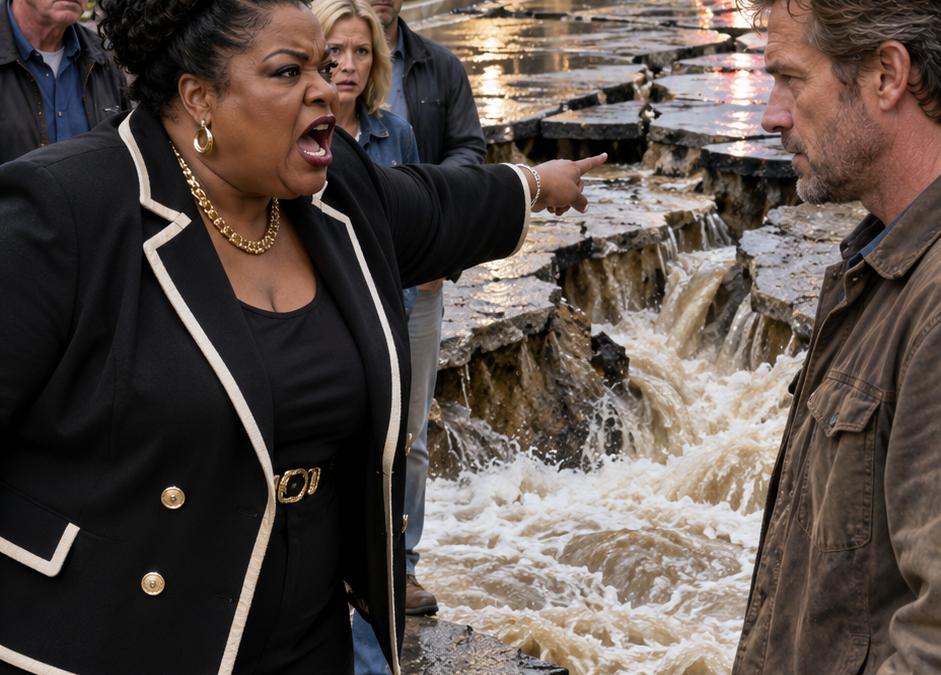
Viven finally looked down.
Not at the map.
At my boots.
I had come straight from clearing a drainage ditch.
There was mud on them.
“This is the old farm tunnel?”
“It’s an active flood-control structure.”
She smiled.
“We’re building a two-million-dollar entrance, Mr. Whitaker. We are not reopening your family’s ditch.”
A few people laughed.
I kept my finger on the survey.
“It’s not a ditch.”
“We have engineers.”
“So did the county when they built this.”
She turned slightly toward the room.
“Stonegate has its own modern drainage system and retention lake.”
“That lake does not replace this tunnel.”
“We appreciate the history lesson.”
“It isn’t history.”
Then I explained the risk.
Deep foundations.
Heavy fill.
Buried conduit.
Loss of hatch access.
Settlement over the tunnel arch.
No ability to clear debris during a flood.
The room had gone quieter.
Viven signaled toward security.
“Mr. Whitaker, this meeting is for Stonegate residents.”
“The tunnel protects Stonegate residents.”
A security guard came closer.
I rolled the map slowly.
Viven said,
“We have heard your concerns.”
She had not.
I left.
The next morning, I started writing.
I sent formal notice to the HOA.
Architect.
General contractor.
County planning office.
I attached the recorded access rights.
Original tunnel survey.
Photographs of the hatch.
Historical drainage reports.
Flood records.
I requested a clear twenty-foot maintenance corridor above the tunnel.
Nothing complicated.
Leave the hatch accessible.
Do not place structural loads directly over it.
If the design needed adjustment, make it before concrete.
Viven answered five days later.
She claimed the tunnel had no meaningful modern function.
She said my rights did not allow me to interfere with improvements on private HOA property.
She called my concerns speculative.
Then came the first insult.
At a site meeting, in front of workers, she said,
“Grant repairs irrigation pumps. That doesn’t make him Stonegate’s chief engineer.”
Several men looked down.
I said,
“You don’t need to believe me. Pull the county drainage file.”
“Our engineers have already done the work.”
“Have they walked the tunnel?”
No answer.
“Have they opened the hatch?”
Nothing.
“Have they inspected the western chamber?”
Viven smiled.
“You think walking around underground with a flashlight makes you more qualified than licensed engineers?”
“No.”
“Good.”
“It makes me the person who knows whether they ever looked.”
Her smile disappeared.
That was when things became personal for her.
Soon afterward, I learned that the tunnel had vanished from the final construction drawings.
On an early preliminary survey, it was there.
A dashed line.
Utility note.
Access hatch.
On the final permit set?
Nothing.
I went to county planning.
A clerk pulled the submission.
Attached was a certification from the association stating no active subsurface flood-control infrastructure existed within the entrance footprint.
I stared at the sentence.
Then filed a written objection before leaving the building.
Viven found out almost immediately.
Her next letter accused me of:
Trespassing.
Harassing contractors.
Interfering with lawful construction.
Spreading alarmist claims.
She threatened legal action if I entered the construction area.
The strange part was that some of the protected access corridor crossed ground my family still had rights to enter.
That did not seem to matter to her.
I stopped communicating by phone.
Everything moved to writing.
I installed a camera facing the property boundary.
Then I hired Marlo Keen.
Marlo was a land-use attorney who had represented farmers, utilities, road districts, and people who learned too late that an easement can matter more than a fence.
She pulled the records.
Spent a week reading.
Then called me into her office.
“Your rights are valid.”
“I know.”
“No.”
She tapped the file.
“I mean there’s no ambiguity here.”
She laid two drawings on the table.
Original survey.
Final construction plan.
The early plan showed the tunnel.
The final plan did not.
Marlo stared at them.
“This wasn’t accidentally missed.”
“What are you saying?”
“I’m saying somebody removed it.”
Construction continued anyway.
Fast.
Too fast.
Viven wanted the entrance finished before Stonegate’s next phase of luxury-home marketing.
I could see the schedule pressure from my property.
Saturday work.
Sunday work.
Lights after dark.
One morning I watched an excavator working exactly where the hatch should have been.
I called the site manager.
Nolan Price.
He sounded confused.
“Hatch?”
“Flood tunnel inspection hatch.”
“There’s nothing on our plan.”
“I know.”
I sent him photographs.
Survey coordinates.
Recorded documents.
An hour later he called back.
“I’m going to raise it.”
“Stop digging until you do.”
“I don’t have authority to stop the whole job.”
“You have authority not to bury something you know exists.”
Silence.
“I’ll talk to the association.”
The next day, Viven arrived at my property with the HOA attorney.
She accused me of causing delays.
Then offered money.
Not much.
A one-time payment if I signed away the tunnel access rights affecting Stonegate land.
I read the proposal.
Then handed it back.
“No.”
Viven leaned against her car.
“You should think carefully.”
“I did.”
“This is more money than that little workshop behind you is worth.”
“You aren’t buying my workshop.”
“I’m buying an obsolete easement.”
“No.”
“Then what do you think it is?”
“A flood-control access right.”
She sighed.
“Grant.”
“You want permission to make the tunnel inaccessible.”
“Our engineers consider the risk negligible.”
“Your engineers still haven’t walked it.”
“That doesn’t make you an engineer.”
“No.”
I looked toward the ridge.
“It makes me the man who will have to open it when your numbers are wrong.”
She laughed.
Not loudly.
Enough.
Then she told me construction would proceed.
By Monday, the hatch was gone.
Compacted fill.
Electrical conduit.
Guard-building foundation.
Reinforced plaza slab.
Everything directly above the location I had marked.
I reported it.
County planning said the matter remained under review.
Without a clear emergency or completed engineering finding, they were not prepared to shut down the entire project.
Marlo sent a preservation letter immediately.
If the entrance interfered with the tunnel, Stonegate had been warned.
The contractor had been warned.
The architect had been warned.
The county had been notified.
Every date preserved.
Viven called my warnings “speculation from a man without engineering credentials.”
So I stopped arguing with her.
I documented.
Rain totals.
Photographs.
Construction dates.
Emails.
Concrete pours.
Foundation placement.
Any visible settling.
Then I checked the tunnel from my side.
The airflow felt wrong.
Weaker.
That mattered.
A long tunnel breathes.
Air moves with water and temperature.
A change in airflow can mean narrowing.
Debris.
Obstruction.
Something had changed near the western side.
I wrote it down.
The entrance opened on schedule.
Stonegate threw a celebration.
Reporters.
Real-estate people.
Investors.
Catered food.
Music.
Viven gave a speech beneath the stone towers.
The entrance was impressive.
Three steel gates moved smoothly across rails buried in the plaza.
A bronze STONEGATE RIDGE emblem sat between the towers.
The fountain glowed.
The guard building had tinted glass.
Access readers.
Cameras.
A central gate-control cabinet.
Backup generator.
Residents applauded.
I had been invited.
I suspect Viven wanted the optics.
Proof that the old dispute was over.
During her speech she mentioned “uninformed resistance from individuals unwilling to embrace progress.”
She did not say my name.
Several people looked at me anyway.
Afterward, I approached her.
“You buried the hatch.”
She smiled for nearby guests.
“We completed an approved project.”
“The rainy season isn’t over.”
Her smile remained.
“Do you ever get tired of predicting disaster?”
“No.”
“Maybe you should.”
“Do you know what happens if the plaza settles unevenly?”
She laughed.
“Our entrance has backup power.”
“That wasn’t my question.”
She turned toward a real-estate agent.
I walked away.
Power was never the biggest risk.
The gates all depended on one central control cabinet.
That cabinet sat lower than the historic flood elevation.
The electrical conduit crossed close to the tunnel arch.
All three steel gates ran on rails embedded in one continuous plaza structure.
The manual override access was hidden behind decorative panels.
And the fill beneath portions of the entrance had been placed fast.
Within weeks, cracks appeared near the guard building.
Small.
Hairline.
But new.
Marlo photographed them.
Then Nolan Price called me.
Quietly.
“I need to tell you something.”
I waited.
“We found a void during construction.”
“Where?”
“Under the plaza area.”
“How big?”
“Enough that I asked for a geotechnical review.”
“And?”
“I was told to fill it.”
“By whom?”
Silence.
“Nolan?”
“Viven.”
I closed my eyes.
“Did you put the tunnel in writing?”
“Yes.”
“Keep the email.”
“I already did.”
He told me he had specifically asked whether the void could relate to the old flood structure.
Viven replied that the “Whitaker tunnel issue” was closed and should not return to the drawing package.
That phrasing mattered.
It proved she knew.
A few weeks later, the weather service issued a flood advisory.
Slow-moving storm.
Heavy tropical moisture.
Forecast models showed the system stalling directly over our watershed.
Potential rainfall exceeded anything we had seen in more than twenty years.
The first rain started gently.
By afternoon, my field was soaked.
I checked the eastern hatch.
Water was already higher than normal for that stage of a storm.
I called Stonegate security.
Viven answered.
“Why are you answering the guard phone?”
“I’m at the entrance.”
“I need emergency access to the western hatch.”
“No.”
“The tunnel is rising.”
“Our drainage system is functioning.”
“I need access before it stops functioning.”
“You are not entering association property because it’s raining.”
“My emergency access rights are recorded.”
“You will not use this storm as an excuse to trespass.”
“Viven—”
“No.”
Then she hung up.
Rain kept falling.
Stonegate’s artificial lake rose.
Its pumps ran.
From the houses above, everything probably looked controlled.
I went back into my tunnel.
That was when I heard the sound.
Thump.
Pause.
Thump.
Pause.
Heavy.
Dull.
Far away.
Debris striking something.
I put one hand against the tunnel wall.
The vibration traveled through wet limestone.
Something had lodged near the buried western access.
The water could not move freely.
I checked the level gauge.
Higher.
Ten minutes later.
Higher again.
The tunnel was backing up.
My father’s voice came back to me.
Water talks differently when something’s wrong.
This was wrong.
I called Reed Callahan.
County flood-control engineer.
He had known my family for years and had inspected the tunnel records before.
He arrived within an hour.
By then the rain was hard enough that we had to shout near the hatch.
He checked pressure.
Flow.
Upstream data.
Then looked at me.
“It’s choking.”
“That’s what I’m hearing.”
“Where?”
“Western side.”
He knew exactly what that meant.
Reed called Stonegate.
This time Viven let one county vehicle through.
One.
When Reed reached the plaza, he asked security to open the western inspection hatch.
Nobody knew where it was.
The current site plan showed nothing.
The guard searched utility drawings.
Nothing.
Reed finally pointed at the guard building.
“It should be approximately there.”
A guard stared at him.
“Under the building?”
“Under or beside it.”
Viven stepped in.
“That hatch was obsolete.”
Reed looked at her.
“Who determined that?”
“Our project team.”
“Who?”
No answer.
Rainwater began pushing through seams between plaza pavers.
Viven called it surface runoff.
She told residents not to post photographs.
I went back to my eastern hatch.
Prepared the emergency diversion.
The water level kept climbing.
Near midnight, the ground made a sound I felt before I heard.
A deep roll.
Then every light at the Stonegate entrance died.
Darkness.
The fountain stopped.
Guardhouse black.
Gate lights gone.
Three steel gates motionless.
A few seconds later, the backup generator started.
Lights returned.
The gates did not move.
That was the detail everyone inside Stonegate misunderstood at first.
They thought power failure had locked them in.
It had not.
Water reached the low control cabinet and damaged electronics.
But even after backup power came online, the steel itself was trapped.
Saturated fill beneath the plaza had settled unevenly.
The pavement moved.
Gate rails twisted out of alignment.
Three sliding gates.
One structural field.
All bound.
Inside the neighborhood, cars began stacking.
Outside, county vehicles waited.
Then a fire engine arrived.
It needed access for a medical call inside Stonegate.
The main gates would not open.
The service gate had distorted too.
Security tried the manual override.
The access panel was behind stone trim.
Nobody could find the correct tool.
Nobody could find the mechanical schematic.
Rain hammered everything.
Viven found me near the edge of my property.
“Cut them open.”
“What?”
“You have torches. Saw equipment. Cut the gates.”
“No.”
Her face changed.
“There’s a fire truck out there.”
“I can see it.”
“Then do something.”
“Those rails are under stress.”
“Cut them!”
“If I release the wrong section, the gate could fall. The plaza is moving.”
“People are trapped.”
“This needs engineers and emergency crews.”
Her voice broke into anger.
“You wanted this.”
I stared at her.
“You think I wanted houses trapped behind steel gates during a flood?”
“You spent months trying to stop this entrance.”
“I spent months trying to keep you from building it over a flood tunnel.”
“You’re enjoying this.”
“No.”
Rain ran off my jacket.
“I wanted you to listen before this happened.”
Reed established an emergency pedestrian opening through a stable section of perimeter fencing.
Fire personnel reached the medical call on foot while county crews worked another route.
Residents who needed to leave were escorted out in groups.
Then I went to the one control point Viven had never been able to take away from me.
The eastern diversion gate.
I unlocked the mechanism.
Checked the downstream basin.
Then opened it.
Slowly.
Water changed direction.
The tunnel roared.
Pressure began bleeding toward the low ground east of my property.
It did not fix the plaza.
Did not open the gates.
Did not restore the guard building.
But it reduced the load pushing back toward Stonegate’s lowest homes.
About twenty minutes later, the plaza failed visibly.
A crack opened in front of the guard building.
Not a hairline crack.
Wide.
Running across the pavers.
Then another.
A section of concrete dropped.
Water surged through.
The broken surface exposed the tunnel arch beneath.
The structure Viven had insisted was obsolete was suddenly visible under her two-million-dollar entrance.
Reed stood in the rain looking into the opening.
Then he turned toward Viven.
His voice was calm.
“Who authorized building the guard station over the access point of an active flood-control tunnel?”
Viven opened her mouth.
Nothing came out.
Reed waited.
She looked toward the fractured pavement.
Then at the guard building.
Then at me.
No answer.
That silence lasted only a few seconds.
It changed everything.
County records staff worked through the night.
They pulled the original tunnel survey.
Maintenance rights.
Early entrance plans.
Final entrance plans.
By dawn, they had confirmed the final permit drawings did not match the archived survey information.
The storm weakened after sunrise.
Stonegate looked completely different.
Fountain dead.
One stone tower visibly out of plumb.
Pavers buckled.
Guard building without normal power.
Water seeping through cracks.
Steel gates jammed.
Emergency fencing cut for pedestrian access.
The bronze Stonegate emblem had been removed because crews were worried the surrounding structure might shift.
Viven’s first public explanation was predictable.
Historic storm.
Unprecedented rainfall.
Unforeseeable event.
Nature overwhelmed modern infrastructure.
Then I handed Reed the folder.
Every warning.
Every letter.
Every delivery receipt.
Tunnel map.
Photographs.
Requested clearance.
Flood history.
Airflow notes.
Settlement photographs.
Viven’s written responses.
Nothing written after the storm.
All before.
The first emergency community meeting happened that afternoon.
Residents were angry.
Confused.
Some frightened.
Everett Sloan, who had lived in Stonegate almost from the beginning, held up a copy of the tunnel map.
“Why were we never told this entrance sat over a flood-control tunnel?”
No one answered immediately.
Laurel Ames, the association treasurer, looked pale.
She had spent the morning pulling financial records.
Something else was wrong.
Large sums had been categorized as ground stabilization.
But instead of one project item requiring broader approval, expenses had been split across multiple smaller authorizations.
Hundreds of thousands in total.
Below normal thresholds for a community-wide vote.
Viven blamed the contractor.
Then Nolan Price walked in with his attorney.
He brought emails.
The room changed again.
In one, Nolan had written:
We encountered a hollow condition in the plaza footprint near the location Mr. Whitaker identifies as a flood-tunnel access. Recommend halt and survey before fill placement.
Viven’s reply:
Do not bring Whitaker’s tunnel back into the drawings. That issue has been dealt with. Proceed according to schedule.
Another email was worse.
Nolan had asked whether the hatch should remain temporarily exposed while the dispute was pending.
Viven replied:
Seal the access before Whitaker obtains an order delaying the project.
The room went silent.
Until then, residents could believe the tunnel had been overlooked.
Those emails killed that possibility.
She knew.
Not every technical consequence.
But she knew the hatch existed.
She knew I disputed covering it.
She knew the contractor had found a void.
And she ordered work to continue.
Reed announced that the county inquiry now included the permit process itself.
If the “no active infrastructure” certification had been knowingly false, the problem was larger than construction negligence.
Viven responded by hiring outside counsel.
Then she changed strategies.
The tunnel was my responsibility.
I had failed to maintain it.
I had let debris accumulate.
I had opened the diversion gate without permission.
My actions had destabilized the entrance.
I had exaggerated the danger to extort the HOA.
Marlo Keen handled that argument.
She did not get angry.
She brought documents.
The recorded agreement stated:
My family owned the eastern hatch and diversion mechanism.
We retained inspection and maintenance rights.
Development above the tunnel could not obstruct access.
The western maintenance corridor had to remain usable.
Emergency diversion could be opened during flood conditions.
Stonegate’s land ownership did not extinguish any of those rights.
Marlo also produced my inspection records.
Annual photographs.
Maintenance logs.
Debris clearing.
Gate tests.
Everything current until the western hatch became inaccessible beneath construction.
Then came the independent engineering report.
That report did not blame one single cause.
It blamed a chain.
That mattered.
The storm was severe.
But the storm alone did not lock Stonegate behind its own gates.
The failures compounded.
The inspection hatch had been buried.
Maintenance access had been eliminated.
A known subsurface void was filled without full investigation.
Backfill was placed under schedule pressure.
Drainage around the plaza had been altered.
The control cabinet sat below documented flood elevation.
Three gates shared a central control system.
Manual overrides were poorly accessible.
Gate rails crossed a plaza susceptible to differential settlement.
When the tunnel became partially obstructed during extreme rainfall, water backed up.
Surrounding soil saturated.
Fill moved.
Concrete shifted.
Rails warped.
Electronics flooded.
Every gate failed.
Not because the electricity went out.
Because the ground underneath them moved.
The report also concluded that opening the eastern diversion reduced hydraulic pressure enough to lower the risk of more severe flooding in Stonegate’s lowest section.
Viven had spent months calling me a pump repairman pretending to be an engineer.
Reed corrected that publicly.
At a press briefing, a reporter asked about my involvement.
Reed said,
“Mr. Whitaker previously worked in county flood-control maintenance and has maintained this structure for years. His operation of the emergency diversion gate was consistent with the recorded procedure and materially reduced risk during the event.”
I did not need him to defend me personally.
But I admit I appreciated the accuracy.
The insurance problem came next.
Stonegate’s carrier issued a reservation-of-rights notice.
If the association knowingly concealed active infrastructure during permitting, portions of the claim might not be covered.
That terrified the board.
The special meeting had to be held at a hotel because Stonegate’s entrance area was still partly closed.
Viven arrived with attorneys.
I arrived with Marlo.
Reed represented the county.
Laurel had binders.
Nolan came with his records.
The room was full.
Viven spoke first.
She described me as a neighboring landowner exploiting “antiquated property language” to interfere with modern development.
She claimed no reasonable person could have anticipated the storm.
Then Marlo stood.
She did not respond to the insults.
She started with the oldest document.
Recorded flood-control agreement.
Then survey.
Then maintenance corridor.
Then the early Stonegate drawing showing the tunnel.
Then the final drawing without it.
Warning letters.
Delivery receipts.
Photographs.
Nolan’s emails.
Post-storm engineering findings.
Diversion flow data.
One after another.
No drama.
Just sequence.
Then Laurel spoke.
Her subject was money.
The association had spent large amounts accelerating the entrance.
Additional fill work.
Weekend labor.
Legal fees intended to keep me away from the project site.
Drawing revisions.
Ground-stabilization work.
Post-storm public-relations expenses.
Some expenditures had been divided into smaller authorizations, preventing them from automatically triggering broader homeowner approval.
Viven tried interrupting.
Laurel kept reading.
Then Everett Sloan stood.
He looked directly at Viven.
“Why didn’t you tell us?”
She stiffened.
“Tell you what?”
“That our entrance was sitting over a flood tunnel.”
“It was not relevant to residents.”
“You built our only main entrance over it.”
“It was a technical matter.”
Everett stared at her.
“A technical matter?”
Viven sighed.
“Homeowners do not need to be burdened with every minor infrastructure detail involved in a complex construction project.”
That sentence ended her.
You could feel it.
Not because it was the worst thing she had said.
Because residents finally understood how she saw them.
Not partners.
Not people entitled to information.
An audience to be managed.
The room turned.
Questions came from everywhere.
Who signed the permit certification?
Why was the tunnel removed from the plan?
Who authorized filling the void?
Why was the project accelerated?
Why were expenditures divided?
Why were residents told I was lying?
Why had the emergency gate system been designed with one control point?
Why was there no accessible manual override?
Viven stopped answering.
Reed eventually raised one hand.
The room quieted.
He gave the county’s preliminary requirements.
The damaged gate system could not return to service.
The guard building was unsafe.
The plaza section above the tunnel had to be demolished.
Tunnel maintenance access had to be restored immediately.
A temporary emergency entrance needed to be constructed.
The tunnel itself required full inspection and clearing.
Any replacement gate complex would need flood-control review.
Stonegate would bear responsibility according to the final determination of fault and coverage.
I sat there listening.
Two million dollars.
Months of work.
Reduced to demolition because a twenty-foot access corridor had been treated like an inconvenience.
Then the board moved to suspend Viven.
She was still sitting at the head table when the motion was made.
The vote passed overwhelmingly.
No applause.
I was grateful.
This was not entertainment anymore.
Hundreds of people had a damaged entrance and a major financial problem.
An independent committee took over negotiations with the county and with me.
I had leverage.
More than I wanted.
Stonegate needed access rights clarified.
The county needed tunnel work.
The HOA wanted to avoid years of litigation.
I could have demanded money that had nothing to do with my actual losses.
I did not.
The residents had not buried the hatch.
Most of them had never known it existed.
My conditions were practical.
Restore every inspection hatch.
Protect the maintenance corridor permanently.
Mark it clearly on site.
Reimburse my legal and inspection costs.
Require independent flood-control engineering review before any future construction near the tunnel.
Give any new gate system separate power and control redundancy.
Install accessible manual overrides.
Create a dedicated emergency vehicle route independent of the main sliding gates.
Correct every official Stonegate map.
Acknowledge in writing that I had warned the association before construction.
And record my family’s access rights so no future board could pretend they were unclear.
Laurel met me afterward.
“I expected you to ask for more.”
“More what?”
“Money.”
“I want the tunnel accessible.”
“After what they did?”
“The people paying dues didn’t all do it.”
She looked at me.
“You’re a better man than I would be.”
“No.”
I shook my head.
“I’m just trying not to create a second stupid problem while fixing the first.”
The board accepted every condition.
Demolition began.
The entrance came apart far faster than it had gone up.
Decorative stone removed.
Gate rails cut free.
Guard building lifted.
Plaza slab sawed into sections.
Then finally, after months underground, the western inspection hatch reappeared.
The crew opened it.
Branches.
Silt.
Construction debris.
Enough material jammed downstream to restrict flow badly.
Nolan stood nearby.
Reed looked inside.
Then at me.
“How long to clear this under normal access?”
“Couple guys?”
“Yes.”
“Less than an hour.”
That was the part that hurt.
Not because I wanted to be right.
Because it had been so unnecessary.
A one-hour maintenance job had turned into a multimillion-dollar failure because somebody considered access ugly and delay unacceptable.
Viven resigned before the financial review concluded.
A few months later, the Blackwell family sold their Stonegate house.
The day the moving truck left, her car came down the road bordering my property.
Slowly.
I happened to be near the fence.
She saw me.
I saw her.
She did not roll down the window.
For once, neither of us needed to say anything.
Stonegate built a new entrance the following year.
Farther uphill.
Away from the tunnel.
Less theatrical.
Better.
Separate entry and exit gate systems.
Independent controls.
Controls above flood elevation.
Accessible manual release.
Dedicated emergency bypass.
No structural foundation over the tunnel.
The maintenance corridor remains open.
The restored hatch sits behind a low protective fence.
Beside it is a sign.
FLOOD CONTROL CORRIDOR
NO STRUCTURES OR OBSTRUCTIONS
MAINTENANCE ACCESS REQUIRED
Simple.
Ugly, maybe.
Useful.
Laurel Ames became HOA president.
The first time she came to my property in that role, she brought a corrected map.
She also brought a formal letter from the board.
It acknowledged my warnings.
The tunnel rights.
The association’s previous errors.
And the role the diversion gate played during the storm.
I read it.
Then put it in my file.
Laurel asked,
“Anything else we need to do?”
“Keep the hatch clear.”
“That’s it?”
“That was always it.”
The next major storm arrived about a year later.
Not as large.
Still heavy.
I went out before dark.
Checked the eastern hatch.
Then the western corridor.
Clear.
No concrete.
No buried conduit.
No guard station.
Just the low fence and warning sign.
Water rose.
Entered the tunnel.
Moved east.
Steady.
No thumping.
No backing pressure.
Stonegate’s lake rose some.
Its pumps ran.
The entrance gates continued opening and closing normally.
Cars came through.
Emergency route remained empty.
Nothing dramatic happened.
That is what good flood control looks like.
Nothing.
No one notices.
Nobody stands outside in the rain.
Nobody calls a lawyer.
Nobody watches pavement crack.
Water simply goes where the system was designed to send it.
The next morning, I walked the tunnel.
Cool limestone.
Wet air.
Steady flow.
Same sound my father taught me to recognize.
Healthy.
At the western hatch, sunlight came through above me.
For the first time in more than a year, I could climb out there without asking anyone to move a truck, unlock a gate, or grant permission.
I stood on the surface.
The new Stonegate entrance was visible uphill.
Simpler stone.
Less decoration.
The gates were open.
A resident drove through and waved.
I waved back.
Most people in Stonegate still do not know me.
That is fine.
I never wanted to become part of their neighborhood story.
I wanted the tunnel to remain part of their safety system.
There is a difference.
People sometimes ask whether I felt vindicated when the original entrance failed.
No.
Vindication is too pleasant a word.
That night was dangerous.
A fire truck could not enter normally.
Residents were trapped behind gates.
People were frightened.
A structural failure happened exactly where I had warned it could.
You do not enjoy being right about something like that.
What I felt was anger at how avoidable it had been.
Then relief that nobody died.
Later, when everything was safe, I understood the irony.
Viven built that entrance to make a statement.
Stonegate was exclusive.
Controlled.
Protected.
You entered through the place she designed.
Three steel gates.
Two stone towers.
Security.
Technology.
All of it separating inside from outside.
She spent months treating me like somebody who belonged outside.
An old-land owner.
Pump repairman.
Ditch digger.
Obstacle to progress.
She thought the important structure was the one everybody could see.
The gate.
I knew the important structure was underneath it.
The tunnel nobody noticed.
That difference mattered.
A decorative tower can impress people.
A flood tunnel does not need to.
A gate can cost two million dollars and still fail because the ground beneath it was misunderstood.
An old piece of county infrastructure can look obsolete for thirty quiet years and become essential in one hour.
The same is true of records.
Viven treated old easements like stories dead people had written.
Then the storm arrived and those old documents described reality better than her new drawings did.
That is what she never understood.
Paper does not become obsolete just because it is old.
Infrastructure does not become inactive because it is invisible.
And experience does not become ignorance because it arrives wearing muddy boots.
My father never had an engineering degree.
Neither did my grandfather.
They understood that.
They respected the county engineer.
They respected surveys.
They respected water.
Most importantly, they respected the possibility that the land knew something they did not.
Viven never did.
She believed enough money could force the land to behave.
More fill.
More concrete.
More steel.
More engineering language.
More legal letters.
More authority.
But floodwater does not care about the Blackwell name.
It does not care how much the entrance cost.
It does not care whether a report calls a tunnel active or obsolete.
Water follows pressure.
Gravity.
Openings.
Blockages.
That night it found every mistake they had buried.
There was another lesson in the three gates.
People originally blamed the electronics.
That was easy.
Control cabinet floods.
Power fails.
Replace equipment.
But the generator came on.
The electricity returned.
The gates remained shut.
Because the real failure was structural.
The rails had moved.
That became a metaphor for the whole dispute in my mind.
Viven kept treating everything like an authority problem.
If she had more authority, she could make the issue go away.
Threaten me.
Exclude me.
Erase the tunnel from drawings.
Seal the hatch.
Call the objection settled.
But authority was just the electricity.
It could tell the gate to move.
It could not make steel slide across a rail that had physically shifted underneath it.
Reality had moved.
Her commands became useless.
After the investigation closed, Marlo gave me the final binder.
It was almost four inches thick.
She set it on my kitchen table.
“Keep this.”
“I already have copies.”
“Keep this one too.”
I flipped through it.
Survey.
Letters.
Emails.
Reports.
Photographs.
Settlement documents.
“You lawyers really love paper.”
“We love evidence.”
I smiled.
“My father would’ve liked you.”
“Was he difficult?”
“Very.”
“Then probably.”
I put the binder in the same cabinet where my family’s tunnel records had lived for years.
The old documents now sit beside the new ones.
Different paper.
Same lesson.
Every spring, I still inspect the tunnel.
I no longer do it because I distrust Stonegate.
The new board has been careful.
They notify me before any work near the corridor.
They keep the fencing clear.
They send plans if anything changes.
I do it because maintenance is maintenance.
People like to think catastrophe is prevented by heroic action.
Usually it is prevented by ordinary things done on schedule.
Clear a grate.
Grease a hinge.
Check a seal.
Read a gauge.
Do not pour a building over an access hatch.
Simple things.
One morning this past spring, I took my grandson into the tunnel for the first time.
He is ten.
Old enough to listen.
Young enough to think walking underground with a flashlight is an adventure.
We stopped halfway.
I switched off my light.
He immediately complained.
“Grandpa.”
“Listen.”
“To what?”
“The water.”
We stood in the dark.
Steady flow against limestone.
After a moment, he said,
“It sounds normal.”
I smiled.
“How do you know?”
“You told me.”
“No.”
I turned the flashlight back on.
“You listened.”
He thought about that.
Then we kept walking.
Maybe one day he will be the person checking the hatch.
Maybe not.
I do not need him to inherit the job.
I only need him to understand the principle.
Before you build, listen.
Before you decide something is useless, understand what it does.
Before you dismiss an old warning, ask why somebody bothered recording it.
And when a man tells you there is a flood tunnel beneath the place where you want to pour two million dollars of concrete, at least look at the map.
Viven never did.
That was the whole tragedy.
Not that she lacked information.
She had it.
Not that I failed to warn her.
I warned her repeatedly.
Not that the storm was impossible to imagine.
The flood history was attached.
The tunnel location was surveyed.
The access rights were recorded.
The risk of saturation was written down.
The construction crew even found a void beneath the plaza.
Every chance to stop existed before the first crack appeared.
But each chance required Viven to accept that somebody she had already decided was beneath her might know something she did not.
She could not do that.
So she buried the hatch.
Then the drawing.
Then the objection.
Then the problem.
Until the storm dug all of it back up.
Today the old tunnel still carries water beneath the ridge.
You cannot see most of it.
You could live in Stonegate for years and never think about it.
That is probably the best compliment infrastructure can receive.
The new entrance stands clear of it.
The gates are simpler.
Safer.
The emergency road is visible.
The maintenance corridor stays empty.
Sometimes when I drive past, I notice the warning sign beside the hatch.
No decorative stone.
No bronze emblem.
Just plain letters.
FLOOD CONTROL CORRIDOR.
KEEP CLEAR.
Viven once believed a place looked important when you built something expensive on top of it.
My grandfather believed some places were important precisely because you left them alone.
In the end, he was right.
The night Stonegate Ridge learned that lesson, three beautiful steel gates stood powerless in the rain while an old tunnel beneath them kept trying to do the job it had been built to do.
And once the concrete finally broke open, everybody could see the thing Viven had spent six months trying to bury.
The tunnel had never been obsolete.
Only ignored.
Have you finished reading the story and want to read it again?
Viven Built Her Million-Dollar Entrance Over the One Structure She Was Warned Never to Bury
The night Stonegate Ridge lost all three of its gates, the power came back before the steel moved an inch.
A fire truck sat stranded outside, black water pushed uphill through the new boulevard, and the pavement in front of the guardhouse began splitting open under Viven Blackwell’s feet.
Six months earlier, I had shown her exactly what was buried beneath that concrete, and she had laughed before I finished unfolding the map.
My family’s land sits on the low side of a ridge north of town, in a part of Missouri where water still remembers what the land looked like before anybody built neighborhoods on it.
The fields flood.
The ravines fill.
The creek jumps its banks.
New houses do not change that.
Stone walls do not change that.
Property values certainly do not change that.
Rain falls where it falls, and gravity does the rest.
My name is Grant Whitaker.
I grew up on that land.
My grandfather worked with the county decades ago to build the flood diversion tunnel that eventually became the center of everything I am about to tell you.
The tunnel runs nearly half a mile through limestone beneath our pasture.
It begins near the western ravine, passes under what later became part of Stonegate Ridge, and empties into a natural catch basin east of my property.
Most of the year, there is not much drama inside it.
A steady trickle.
Cool air.
Wet stone.
The smell of limestone and standing water.
But when a major storm hits, that tunnel carries overflow out of the ravine before it can spread across the lower valley.
My grandfather did not build it alone.
The county designed and funded most of the work.
My family donated land and paid part of the construction cost.
In return, the legal rights were recorded clearly.
We owned the eastern access hatch and the emergency diversion mechanism on our side.
We had the right to inspect and maintain the tunnel.
We had the right to walk its full length when necessary.
Any future development above the tunnel had to preserve a maintenance corridor.
Nothing could permanently block the access points.
And when flood conditions required it, my family had the right to open the emergency diversion gate without waiting for anybody’s permission.
Those provisions were not family folklore.
They were recorded.
Book.
Page.
Survey.
Easement description.
Everything.
My father taught me the tunnel before he taught me to drive.
Once a year, before spring rains, we walked it.
He carried a lantern first, then later a heavy flashlight.
He showed me where mineral deposits formed.
Where roots sometimes reached through joints.
Where silt liked to gather after a wet winter.
He taught me to listen.
“Water talks differently when something’s wrong.”
I was probably twelve the first time he said that.
I laughed.
He stopped walking.
“Listen.”
So I did.
The normal flow made a steady rushing sound against the stone.
No sharp changes.
No pulsing.
No hollow knocking.
“When debris catches,” he said, “you hear the rhythm change before you see the problem.”
I never forgot it.
Long after he died, I still checked the tunnel the same way.
Walk.
Listen.
Clear grates.
Test the diversion gate.
Inspect the hatches.
Write down what I found.
I spent years repairing pumps, irrigation systems, and flood-control equipment around the county, so people often reduced what I did to “fixing water pumps.”
That was fine with me.
Machines do not care what title you use.
Neither does water.
Eight years before the storm, the ravine land west of us was sold.
Stonegate Ridge went up within eighteen months.
Large houses.
Artificial lake.
Stone monuments.
Private roads.
Guarded entrance.
Everything designed to look permanent.
I never objected.
The developer had bought the land legally.
My tunnel rights were already recorded.
As long as they respected those rights, there was no reason we could not coexist.
For several years, we did.
I repaired the guard station generator once.
Helped pump water out of a utility vault after a thunderstorm.
A couple of residents bought firewood from me.
No conflict.
Then Viven Blackwell became HOA president.
Viven came from one of the families involved in the early Stonegate development.
She had money, connections, confidence, and an instinct for making every room feel like it had been waiting for her to enter it.
Within weeks of taking office, she announced the entrance project.
Stonegate already had a functional gate.
That was not enough.
Viven wanted what she called a signature arrival experience.
Three vehicle lanes.
Sliding steel gates.
Two stone towers.
Bronze community emblem.
Decorative fountain.
Guard building.
Smart access controls.
Heated pavement at the gate approach.
Landscape lighting.
Wide stone plaza.
The budget eventually climbed near two million dollars.
There was one problem.
She chose the exact wrong place to build it.
The proposed entrance sat over the western maintenance corridor of the flood tunnel.
More specifically, one of the tunnel’s inspection hatches lay beneath the footprint of the plaza and close to the planned guard building.
I went to the first public design meeting carrying the old survey rolled under my arm.
Viven was at the front of the room beside architectural renderings of the new entrance.
The drawings were beautiful.
I will give them that.
Golden evening lighting.
Clean stone.
Cars gliding through.
Trees that had apparently been trained never to drop leaves.
When public comment opened, I stood.
“My name is Grant Whitaker. My family owns the lower parcel east of Stonegate.”
Viven knew who I was.
She still gave me the look people use when they want you to hurry.
I unfolded the survey.
“There’s a county flood diversion tunnel beneath the proposed entrance.”
A few residents turned toward me.
Viven did not.
“The maintenance hatch is here.”
I pointed.
“The plaza and part of the guard building are directly over it.”
Viven finally looked down.
Not at the map.
At my boots.
I had come straight from clearing a drainage ditch.
There was mud on them.
“This is the old farm tunnel?”
“It’s an active flood-control structure.”
She smiled.
“We’re building a two-million-dollar entrance, Mr. Whitaker. We are not reopening your family’s ditch.”
A few people laughed.
I kept my finger on the survey.
“It’s not a ditch.”
“We have engineers.”
“So did the county when they built this.”
She turned slightly toward the room.
“Stonegate has its own modern drainage system and retention lake.”
“That lake does not replace this tunnel.”
“We appreciate the history lesson.”
“It isn’t history.”
Then I explained the risk.
Deep foundations.
Heavy fill.
Buried conduit.
Loss of hatch access.
Settlement over the tunnel arch.
No ability to clear debris during a flood.
The room had gone quieter.
Viven signaled toward security.
“Mr. Whitaker, this meeting is for Stonegate residents.”
“The tunnel protects Stonegate residents.”
A security guard came closer.
I rolled the map slowly.
Viven said,
“We have heard your concerns.”
She had not.
I left.
The next morning, I started writing.
I sent formal notice to the HOA.
Architect.
General contractor.
County planning office.
I attached the recorded access rights.
Original tunnel survey.
Photographs of the hatch.
Historical drainage reports.
Flood records.
I requested a clear twenty-foot maintenance corridor above the tunnel.
Nothing complicated.
Leave the hatch accessible.
Do not place structural loads directly over it.
If the design needed adjustment, make it before concrete.
Viven answered five days later.
She claimed the tunnel had no meaningful modern function.
She said my rights did not allow me to interfere with improvements on private HOA property.
She called my concerns speculative.
Then came the first insult.
At a site meeting, in front of workers, she said,
“Grant repairs irrigation pumps. That doesn’t make him Stonegate’s chief engineer.”
Several men looked down.
I said,
“You don’t need to believe me. Pull the county drainage file.”
“Our engineers have already done the work.”
“Have they walked the tunnel?”
No answer.
“Have they opened the hatch?”
Nothing.
“Have they inspected the western chamber?”
Viven smiled.
“You think walking around underground with a flashlight makes you more qualified than licensed engineers?”
“No.”
“Good.”
“It makes me the person who knows whether they ever looked.”
Her smile disappeared.
That was when things became personal for her.
Soon afterward, I learned that the tunnel had vanished from the final construction drawings.
On an early preliminary survey, it was there.
A dashed line.
Utility note.
Access hatch.
On the final permit set?
Nothing.
I went to county planning.
A clerk pulled the submission.
Attached was a certification from the association stating no active subsurface flood-control infrastructure existed within the entrance footprint.
I stared at the sentence.
Then filed a written objection before leaving the building.
Viven found out almost immediately.
Her next letter accused me of:
Trespassing.
Harassing contractors.
Interfering with lawful construction.
Spreading alarmist claims.
She threatened legal action if I entered the construction area.
The strange part was that some of the protected access corridor crossed ground my family still had rights to enter.
That did not seem to matter to her.
I stopped communicating by phone.
Everything moved to writing.
I installed a camera facing the property boundary.
Then I hired Marlo Keen.
Marlo was a land-use attorney who had represented farmers, utilities, road districts, and people who learned too late that an easement can matter more than a fence.
She pulled the records.
Spent a week reading.
Then called me into her office.
“Your rights are valid.”
“I know.”
“No.”
She tapped the file.
“I mean there’s no ambiguity here.”
She laid two drawings on the table.
Original survey.
Final construction plan.
The early plan showed the tunnel.
The final plan did not.
Marlo stared at them.
“This wasn’t accidentally missed.”
“What are you saying?”
“I’m saying somebody removed it.”
Construction continued anyway.
Fast.
Too fast.
Viven wanted the entrance finished before Stonegate’s next phase of luxury-home marketing.
I could see the schedule pressure from my property.
Saturday work.
Sunday work.
Lights after dark.
One morning I watched an excavator working exactly where the hatch should have been.
I called the site manager.
Nolan Price.
He sounded confused.
“Hatch?”
“Flood tunnel inspection hatch.”
“There’s nothing on our plan.”
“I know.”
I sent him photographs.
Survey coordinates.
Recorded documents.
An hour later he called back.
“I’m going to raise it.”
“Stop digging until you do.”
“I don’t have authority to stop the whole job.”
“You have authority not to bury something you know exists.”
Silence.
“I’ll talk to the association.”
The next day, Viven arrived at my property with the HOA attorney.
She accused me of causing delays.
Then offered money.
Not much.
A one-time payment if I signed away the tunnel access rights affecting Stonegate land.
I read the proposal.
Then handed it back.
“No.”
Viven leaned against her car.
“You should think carefully.”
“I did.”
“This is more money than that little workshop behind you is worth.”
“You aren’t buying my workshop.”
“I’m buying an obsolete easement.”
“No.”
“Then what do you think it is?”
“A flood-control access right.”
She sighed.
“Grant.”
“You want permission to make the tunnel inaccessible.”
“Our engineers consider the risk negligible.”
“Your engineers still haven’t walked it.”
“That doesn’t make you an engineer.”
“No.”
I looked toward the ridge.
“It makes me the man who will have to open it when your numbers are wrong.”
She laughed.
Not loudly.
Enough.
Then she told me construction would proceed.
By Monday, the hatch was gone.
Compacted fill.
Electrical conduit.
Guard-building foundation.
Reinforced plaza slab.
Everything directly above the location I had marked.
I reported it.
County planning said the matter remained under review.
Without a clear emergency or completed engineering finding, they were not prepared to shut down the entire project.
Marlo sent a preservation letter immediately.
If the entrance interfered with the tunnel, Stonegate had been warned.
The contractor had been warned.
The architect had been warned.
The county had been notified.
Every date preserved.
Viven called my warnings “speculation from a man without engineering credentials.”
So I stopped arguing with her.
I documented.
Rain totals.
Photographs.
Construction dates.
Emails.
Concrete pours.
Foundation placement.
Any visible settling.
Then I checked the tunnel from my side.
The airflow felt wrong.
Weaker.
That mattered.
A long tunnel breathes.
Air moves with water and temperature.
A change in airflow can mean narrowing.
Debris.
Obstruction.
Something had changed near the western side.
I wrote it down.
The entrance opened on schedule.
Stonegate threw a celebration.
Reporters.
Real-estate people.
Investors.
Catered food.
Music.
Viven gave a speech beneath the stone towers.
The entrance was impressive.
Three steel gates moved smoothly across rails buried in the plaza.
A bronze STONEGATE RIDGE emblem sat between the towers.
The fountain glowed.
The guard building had tinted glass.
Access readers.
Cameras.
A central gate-control cabinet.
Backup generator.
Residents applauded.
I had been invited.
I suspect Viven wanted the optics.
Proof that the old dispute was over.
During her speech she mentioned “uninformed resistance from individuals unwilling to embrace progress.”
She did not say my name.
Several people looked at me anyway.
Afterward, I approached her.
“You buried the hatch.”
She smiled for nearby guests.
“We completed an approved project.”
“The rainy season isn’t over.”
Her smile remained.
“Do you ever get tired of predicting disaster?”
“No.”
“Maybe you should.”
“Do you know what happens if the plaza settles unevenly?”
She laughed.
“Our entrance has backup power.”
“That wasn’t my question.”
She turned toward a real-estate agent.
I walked away.
Power was never the biggest risk.
The gates all depended on one central control cabinet.
That cabinet sat lower than the historic flood elevation.
The electrical conduit crossed close to the tunnel arch.
All three steel gates ran on rails embedded in one continuous plaza structure.
The manual override access was hidden behind decorative panels.
And the fill beneath portions of the entrance had been placed fast.
Within weeks, cracks appeared near the guard building.
Small.
Hairline.
But new.
Marlo photographed them.
Then Nolan Price called me.
Quietly.
“I need to tell you something.”
I waited.
“We found a void during construction.”
“Where?”
“Under the plaza area.”
“How big?”
“Enough that I asked for a geotechnical review.”
“And?”
“I was told to fill it.”
“By whom?”
Silence.
“Nolan?”
“Viven.”
I closed my eyes.
“Did you put the tunnel in writing?”
“Yes.”
“Keep the email.”
“I already did.”
He told me he had specifically asked whether the void could relate to the old flood structure.
Viven replied that the “Whitaker tunnel issue” was closed and should not return to the drawing package.
That phrasing mattered.
It proved she knew.
A few weeks later, the weather service issued a flood advisory.
Slow-moving storm.
Heavy tropical moisture.
Forecast models showed the system stalling directly over our watershed.
Potential rainfall exceeded anything we had seen in more than twenty years.
The first rain started gently.
By afternoon, my field was soaked.
I checked the eastern hatch.
Water was already higher than normal for that stage of a storm.
I called Stonegate security.
Viven answered.
“Why are you answering the guard phone?”
“I’m at the entrance.”
“I need emergency access to the western hatch.”
“No.”
“The tunnel is rising.”
“Our drainage system is functioning.”
“I need access before it stops functioning.”
“You are not entering association property because it’s raining.”
“My emergency access rights are recorded.”
“You will not use this storm as an excuse to trespass.”
“Viven—”
“No.”
Then she hung up.
Rain kept falling.
Stonegate’s artificial lake rose.
Its pumps ran.
From the houses above, everything probably looked controlled.
I went back into my tunnel.
That was when I heard the sound.
Thump.
Pause.
Thump.
Pause.
Heavy.
Dull.
Far away.
Debris striking something.
I put one hand against the tunnel wall.
The vibration traveled through wet limestone.
Something had lodged near the buried western access.
The water could not move freely.
I checked the level gauge.
Higher.
Ten minutes later.
Higher again.
The tunnel was backing up.
My father’s voice came back to me.
Water talks differently when something’s wrong.
This was wrong.
I called Reed Callahan.
County flood-control engineer.
He had known my family for years and had inspected the tunnel records before.
He arrived within an hour.
By then the rain was hard enough that we had to shout near the hatch.
He checked pressure.
Flow.
Upstream data.
Then looked at me.
“It’s choking.”
“That’s what I’m hearing.”
“Where?”
“Western side.”
He knew exactly what that meant.
Reed called Stonegate.
This time Viven let one county vehicle through.
One.
When Reed reached the plaza, he asked security to open the western inspection hatch.
Nobody knew where it was.
The current site plan showed nothing.
The guard searched utility drawings.
Nothing.
Reed finally pointed at the guard building.
“It should be approximately there.”
A guard stared at him.
“Under the building?”
“Under or beside it.”
Viven stepped in.
“That hatch was obsolete.”
Reed looked at her.
“Who determined that?”
“Our project team.”
“Who?”
No answer.
Rainwater began pushing through seams between plaza pavers.
Viven called it surface runoff.
She told residents not to post photographs.
I went back to my eastern hatch.
Prepared the emergency diversion.
The water level kept climbing.
Near midnight, the ground made a sound I felt before I heard.
A deep roll.
Then every light at the Stonegate entrance died.
Darkness.
The fountain stopped.
Guardhouse black.
Gate lights gone.
Three steel gates motionless.
A few seconds later, the backup generator started.
Lights returned.
The gates did not move.
That was the detail everyone inside Stonegate misunderstood at first.
They thought power failure had locked them in.
It had not.
Water reached the low control cabinet and damaged electronics.
But even after backup power came online, the steel itself was trapped.
Saturated fill beneath the plaza had settled unevenly.
The pavement moved.
Gate rails twisted out of alignment.
Three sliding gates.
One structural field.
All bound.
Inside the neighborhood, cars began stacking.
Outside, county vehicles waited.
Then a fire engine arrived.
It needed access for a medical call inside Stonegate.
The main gates would not open.
The service gate had distorted too.
Security tried the manual override.
The access panel was behind stone trim.
Nobody could find the correct tool.
Nobody could find the mechanical schematic.
Rain hammered everything.
Viven found me near the edge of my property.
“Cut them open.”
“What?”
“You have torches. Saw equipment. Cut the gates.”
“No.”
Her face changed.
“There’s a fire truck out there.”
“I can see it.”
“Then do something.”
“Those rails are under stress.”
“Cut them!”
“If I release the wrong section, the gate could fall. The plaza is moving.”
“People are trapped.”
“This needs engineers and emergency crews.”
Her voice broke into anger.
“You wanted this.”
I stared at her.
“You think I wanted houses trapped behind steel gates during a flood?”
“You spent months trying to stop this entrance.”
“I spent months trying to keep you from building it over a flood tunnel.”
“You’re enjoying this.”
“No.”
Rain ran off my jacket.
“I wanted you to listen before this happened.”
Reed established an emergency pedestrian opening through a stable section of perimeter fencing.
Fire personnel reached the medical call on foot while county crews worked another route.
Residents who needed to leave were escorted out in groups.
Then I went to the one control point Viven had never been able to take away from me.
The eastern diversion gate.
I unlocked the mechanism.
Checked the downstream basin.
Then opened it.
Slowly.
Water changed direction.
The tunnel roared.
Pressure began bleeding toward the low ground east of my property.
It did not fix the plaza.
Did not open the gates.
Did not restore the guard building.
But it reduced the load pushing back toward Stonegate’s lowest homes.
About twenty minutes later, the plaza failed visibly.
A crack opened in front of the guard building.
Not a hairline crack.
Wide.
Running across the pavers.
Then another.
A section of concrete dropped.
Water surged through.
The broken surface exposed the tunnel arch beneath.
The structure Viven had insisted was obsolete was suddenly visible under her two-million-dollar entrance.
Reed stood in the rain looking into the opening.
Then he turned toward Viven.
His voice was calm.
“Who authorized building the guard station over the access point of an active flood-control tunnel?”
Viven opened her mouth.
Nothing came out.
Reed waited.
She looked toward the fractured pavement.
Then at the guard building.
Then at me.
No answer.
That silence lasted only a few seconds.
It changed everything.
County records staff worked through the night.
They pulled the original tunnel survey.
Maintenance rights.
Early entrance plans.
Final entrance plans.
By dawn, they had confirmed the final permit drawings did not match the archived survey information.
The storm weakened after sunrise.
Stonegate looked completely different.
Fountain dead.
One stone tower visibly out of plumb.
Pavers buckled.
Guard building without normal power.
Water seeping through cracks.
Steel gates jammed.
Emergency fencing cut for pedestrian access.
The bronze Stonegate emblem had been removed because crews were worried the surrounding structure might shift.
Viven’s first public explanation was predictable.
Historic storm.
Unprecedented rainfall.
Unforeseeable event.
Nature overwhelmed modern infrastructure.
Then I handed Reed the folder.
Every warning.
Every letter.
Every delivery receipt.
Tunnel map.
Photographs.
Requested clearance.
Flood history.
Airflow notes.
Settlement photographs.
Viven’s written responses.
Nothing written after the storm.
All before.
The first emergency community meeting happened that afternoon.
Residents were angry.
Confused.
Some frightened.
Everett Sloan, who had lived in Stonegate almost from the beginning, held up a copy of the tunnel map.
“Why were we never told this entrance sat over a flood-control tunnel?”
No one answered immediately.
Laurel Ames, the association treasurer, looked pale.
She had spent the morning pulling financial records.
Something else was wrong.
Large sums had been categorized as ground stabilization.
But instead of one project item requiring broader approval, expenses had been split across multiple smaller authorizations.
Hundreds of thousands in total.
Below normal thresholds for a community-wide vote.
Viven blamed the contractor.
Then Nolan Price walked in with his attorney.
He brought emails.
The room changed again.
In one, Nolan had written:
We encountered a hollow condition in the plaza footprint near the location Mr. Whitaker identifies as a flood-tunnel access. Recommend halt and survey before fill placement.
Viven’s reply:
Do not bring Whitaker’s tunnel back into the drawings. That issue has been dealt with. Proceed according to schedule.
Another email was worse.
Nolan had asked whether the hatch should remain temporarily exposed while the dispute was pending.
Viven replied:
Seal the access before Whitaker obtains an order delaying the project.
The room went silent.
Until then, residents could believe the tunnel had been overlooked.
Those emails killed that possibility.
She knew.
Not every technical consequence.
But she knew the hatch existed.
She knew I disputed covering it.
She knew the contractor had found a void.
And she ordered work to continue.
Reed announced that the county inquiry now included the permit process itself.
If the “no active infrastructure” certification had been knowingly false, the problem was larger than construction negligence.
Viven responded by hiring outside counsel.
Then she changed strategies.
The tunnel was my responsibility.
I had failed to maintain it.
I had let debris accumulate.
I had opened the diversion gate without permission.
My actions had destabilized the entrance.
I had exaggerated the danger to extort the HOA.
Marlo Keen handled that argument.
She did not get angry.
She brought documents.
The recorded agreement stated:
My family owned the eastern hatch and diversion mechanism.
We retained inspection and maintenance rights.
Development above the tunnel could not obstruct access.
The western maintenance corridor had to remain usable.
Emergency diversion could be opened during flood conditions.
Stonegate’s land ownership did not extinguish any of those rights.
Marlo also produced my inspection records.
Annual photographs.
Maintenance logs.
Debris clearing.
Gate tests.
Everything current until the western hatch became inaccessible beneath construction.
Then came the independent engineering report.
That report did not blame one single cause.
It blamed a chain.
That mattered.
The storm was severe.
But the storm alone did not lock Stonegate behind its own gates.
The failures compounded.
The inspection hatch had been buried.
Maintenance access had been eliminated.
A known subsurface void was filled without full investigation.
Backfill was placed under schedule pressure.
Drainage around the plaza had been altered.
The control cabinet sat below documented flood elevation.
Three gates shared a central control system.
Manual overrides were poorly accessible.
Gate rails crossed a plaza susceptible to differential settlement.
When the tunnel became partially obstructed during extreme rainfall, water backed up.
Surrounding soil saturated.
Fill moved.
Concrete shifted.
Rails warped.
Electronics flooded.
Every gate failed.
Not because the electricity went out.
Because the ground underneath them moved.
The report also concluded that opening the eastern diversion reduced hydraulic pressure enough to lower the risk of more severe flooding in Stonegate’s lowest section.
Viven had spent months calling me a pump repairman pretending to be an engineer.
Reed corrected that publicly.
At a press briefing, a reporter asked about my involvement.
Reed said,
“Mr. Whitaker previously worked in county flood-control maintenance and has maintained this structure for years. His operation of the emergency diversion gate was consistent with the recorded procedure and materially reduced risk during the event.”
I did not need him to defend me personally.
But I admit I appreciated the accuracy.
The insurance problem came next.
Stonegate’s carrier issued a reservation-of-rights notice.
If the association knowingly concealed active infrastructure during permitting, portions of the claim might not be covered.
That terrified the board.
The special meeting had to be held at a hotel because Stonegate’s entrance area was still partly closed.
Viven arrived with attorneys.
I arrived with Marlo.
Reed represented the county.
Laurel had binders.
Nolan came with his records.
The room was full.
Viven spoke first.
She described me as a neighboring landowner exploiting “antiquated property language” to interfere with modern development.
She claimed no reasonable person could have anticipated the storm.
Then Marlo stood.
She did not respond to the insults.
She started with the oldest document.
Recorded flood-control agreement.
Then survey.
Then maintenance corridor.
Then the early Stonegate drawing showing the tunnel.
Then the final drawing without it.
Warning letters.
Delivery receipts.
Photographs.
Nolan’s emails.
Post-storm engineering findings.
Diversion flow data.
One after another.
No drama.
Just sequence.
Then Laurel spoke.
Her subject was money.
The association had spent large amounts accelerating the entrance.
Additional fill work.
Weekend labor.
Legal fees intended to keep me away from the project site.
Drawing revisions.
Ground-stabilization work.
Post-storm public-relations expenses.
Some expenditures had been divided into smaller authorizations, preventing them from automatically triggering broader homeowner approval.
Viven tried interrupting.
Laurel kept reading.
Then Everett Sloan stood.
He looked directly at Viven.
“Why didn’t you tell us?”
She stiffened.
“Tell you what?”
“That our entrance was sitting over a flood tunnel.”
“It was not relevant to residents.”
“You built our only main entrance over it.”
“It was a technical matter.”
Everett stared at her.
“A technical matter?”
Viven sighed.
“Homeowners do not need to be burdened with every minor infrastructure detail involved in a complex construction project.”
That sentence ended her.
You could feel it.
Not because it was the worst thing she had said.
Because residents finally understood how she saw them.
Not partners.
Not people entitled to information.
An audience to be managed.
The room turned.
Questions came from everywhere.
Who signed the permit certification?
Why was the tunnel removed from the plan?
Who authorized filling the void?
Why was the project accelerated?
Why were expenditures divided?
Why were residents told I was lying?
Why had the emergency gate system been designed with one control point?
Why was there no accessible manual override?
Viven stopped answering.
Reed eventually raised one hand.
The room quieted.
He gave the county’s preliminary requirements.
The damaged gate system could not return to service.
The guard building was unsafe.
The plaza section above the tunnel had to be demolished.
Tunnel maintenance access had to be restored immediately.
A temporary emergency entrance needed to be constructed.
The tunnel itself required full inspection and clearing.
Any replacement gate complex would need flood-control review.
Stonegate would bear responsibility according to the final determination of fault and coverage.
I sat there listening.
Two million dollars.
Months of work.
Reduced to demolition because a twenty-foot access corridor had been treated like an inconvenience.
Then the board moved to suspend Viven.
She was still sitting at the head table when the motion was made.
The vote passed overwhelmingly.
No applause.
I was grateful.
This was not entertainment anymore.
Hundreds of people had a damaged entrance and a major financial problem.
An independent committee took over negotiations with the county and with me.
I had leverage.
More than I wanted.
Stonegate needed access rights clarified.
The county needed tunnel work.
The HOA wanted to avoid years of litigation.
I could have demanded money that had nothing to do with my actual losses.
I did not.
The residents had not buried the hatch.
Most of them had never known it existed.
My conditions were practical.
Restore every inspection hatch.
Protect the maintenance corridor permanently.
Mark it clearly on site.
Reimburse my legal and inspection costs.
Require independent flood-control engineering review before any future construction near the tunnel.
Give any new gate system separate power and control redundancy.
Install accessible manual overrides.
Create a dedicated emergency vehicle route independent of the main sliding gates.
Correct every official Stonegate map.
Acknowledge in writing that I had warned the association before construction.
And record my family’s access rights so no future board could pretend they were unclear.
Laurel met me afterward.
“I expected you to ask for more.”
“More what?”
“Money.”
“I want the tunnel accessible.”
“After what they did?”
“The people paying dues didn’t all do it.”
She looked at me.
“You’re a better man than I would be.”
“No.”
I shook my head.
“I’m just trying not to create a second stupid problem while fixing the first.”
The board accepted every condition.
Demolition began.
The entrance came apart far faster than it had gone up.
Decorative stone removed.
Gate rails cut free.
Guard building lifted.
Plaza slab sawed into sections.
Then finally, after months underground, the western inspection hatch reappeared.
The crew opened it.
Branches.
Silt.
Construction debris.
Enough material jammed downstream to restrict flow badly.
Nolan stood nearby.
Reed looked inside.
Then at me.
“How long to clear this under normal access?”
“Couple guys?”
“Yes.”
“Less than an hour.”
That was the part that hurt.
Not because I wanted to be right.
Because it had been so unnecessary.
A one-hour maintenance job had turned into a multimillion-dollar failure because somebody considered access ugly and delay unacceptable.
Viven resigned before the financial review concluded.
A few months later, the Blackwell family sold their Stonegate house.
The day the moving truck left, her car came down the road bordering my property.
Slowly.
I happened to be near the fence.
She saw me.
I saw her.
She did not roll down the window.
For once, neither of us needed to say anything.
Stonegate built a new entrance the following year.
Farther uphill.
Away from the tunnel.
Less theatrical.
Better.
Separate entry and exit gate systems.
Independent controls.
Controls above flood elevation.
Accessible manual release.
Dedicated emergency bypass.
No structural foundation over the tunnel.
The maintenance corridor remains open.
The restored hatch sits behind a low protective fence.
Beside it is a sign.
FLOOD CONTROL CORRIDOR
NO STRUCTURES OR OBSTRUCTIONS
MAINTENANCE ACCESS REQUIRED
Simple.
Ugly, maybe.
Useful.
Laurel Ames became HOA president.
The first time she came to my property in that role, she brought a corrected map.
She also brought a formal letter from the board.
It acknowledged my warnings.
The tunnel rights.
The association’s previous errors.
And the role the diversion gate played during the storm.
I read it.
Then put it in my file.
Laurel asked,
“Anything else we need to do?”
“Keep the hatch clear.”
“That’s it?”
“That was always it.”
The next major storm arrived about a year later.
Not as large.
Still heavy.
I went out before dark.
Checked the eastern hatch.
Then the western corridor.
Clear.
No concrete.
No buried conduit.
No guard station.
Just the low fence and warning sign.
Water rose.
Entered the tunnel.
Moved east.
Steady.
No thumping.
No backing pressure.
Stonegate’s lake rose some.
Its pumps ran.
The entrance gates continued opening and closing normally.
Cars came through.
Emergency route remained empty.
Nothing dramatic happened.
That is what good flood control looks like.
Nothing.
No one notices.
Nobody stands outside in the rain.
Nobody calls a lawyer.
Nobody watches pavement crack.
Water simply goes where the system was designed to send it.
The next morning, I walked the tunnel.
Cool limestone.
Wet air.
Steady flow.
Same sound my father taught me to recognize.
Healthy.
At the western hatch, sunlight came through above me.
For the first time in more than a year, I could climb out there without asking anyone to move a truck, unlock a gate, or grant permission.
I stood on the surface.
The new Stonegate entrance was visible uphill.
Simpler stone.
Less decoration.
The gates were open.
A resident drove through and waved.
I waved back.
Most people in Stonegate still do not know me.
That is fine.
I never wanted to become part of their neighborhood story.
I wanted the tunnel to remain part of their safety system.
There is a difference.
People sometimes ask whether I felt vindicated when the original entrance failed.
No.
Vindication is too pleasant a word.
That night was dangerous.
A fire truck could not enter normally.
Residents were trapped behind gates.
People were frightened.
A structural failure happened exactly where I had warned it could.
You do not enjoy being right about something like that.
What I felt was anger at how avoidable it had been.
Then relief that nobody died.
Later, when everything was safe, I understood the irony.
Viven built that entrance to make a statement.
Stonegate was exclusive.
Controlled.
Protected.
You entered through the place she designed.
Three steel gates.
Two stone towers.
Security.
Technology.
All of it separating inside from outside.
She spent months treating me like somebody who belonged outside.
An old-land owner.
Pump repairman.
Ditch digger.
Obstacle to progress.
She thought the important structure was the one everybody could see.
The gate.
I knew the important structure was underneath it.
The tunnel nobody noticed.
That difference mattered.
A decorative tower can impress people.
A flood tunnel does not need to.
A gate can cost two million dollars and still fail because the ground beneath it was misunderstood.
An old piece of county infrastructure can look obsolete for thirty quiet years and become essential in one hour.
The same is true of records.
Viven treated old easements like stories dead people had written.
Then the storm arrived and those old documents described reality better than her new drawings did.
That is what she never understood.
Paper does not become obsolete just because it is old.
Infrastructure does not become inactive because it is invisible.
And experience does not become ignorance because it arrives wearing muddy boots.
My father never had an engineering degree.
Neither did my grandfather.
They understood that.
They respected the county engineer.
They respected surveys.
They respected water.
Most importantly, they respected the possibility that the land knew something they did not.
Viven never did.
She believed enough money could force the land to behave.
More fill.
More concrete.
More steel.
More engineering language.
More legal letters.
More authority.
But floodwater does not care about the Blackwell name.
It does not care how much the entrance cost.
It does not care whether a report calls a tunnel active or obsolete.
Water follows pressure.
Gravity.
Openings.
Blockages.
That night it found every mistake they had buried.
There was another lesson in the three gates.
People originally blamed the electronics.
That was easy.
Control cabinet floods.
Power fails.
Replace equipment.
But the generator came on.
The electricity returned.
The gates remained shut.
Because the real failure was structural.
The rails had moved.
That became a metaphor for the whole dispute in my mind.
Viven kept treating everything like an authority problem.
If she had more authority, she could make the issue go away.
Threaten me.
Exclude me.
Erase the tunnel from drawings.
Seal the hatch.
Call the objection settled.
But authority was just the electricity.
It could tell the gate to move.
It could not make steel slide across a rail that had physically shifted underneath it.
Reality had moved.
Her commands became useless.
After the investigation closed, Marlo gave me the final binder.
It was almost four inches thick.
She set it on my kitchen table.
“Keep this.”
“I already have copies.”
“Keep this one too.”
I flipped through it.
Survey.
Letters.
Emails.
Reports.
Photographs.
Settlement documents.
“You lawyers really love paper.”
“We love evidence.”
I smiled.
“My father would’ve liked you.”
“Was he difficult?”
“Very.”
“Then probably.”
I put the binder in the same cabinet where my family’s tunnel records had lived for years.
The old documents now sit beside the new ones.
Different paper.
Same lesson.
Every spring, I still inspect the tunnel.
I no longer do it because I distrust Stonegate.
The new board has been careful.
They notify me before any work near the corridor.
They keep the fencing clear.
They send plans if anything changes.
I do it because maintenance is maintenance.
People like to think catastrophe is prevented by heroic action.
Usually it is prevented by ordinary things done on schedule.
Clear a grate.
Grease a hinge.
Check a seal.
Read a gauge.
Do not pour a building over an access hatch.
Simple things.
One morning this past spring, I took my grandson into the tunnel for the first time.
He is ten.
Old enough to listen.
Young enough to think walking underground with a flashlight is an adventure.
We stopped halfway.
I switched off my light.
He immediately complained.
“Grandpa.”
“Listen.”
“To what?”
“The water.”
We stood in the dark.
Steady flow against limestone.
After a moment, he said,
“It sounds normal.”
I smiled.
“How do you know?”
“You told me.”
“No.”
I turned the flashlight back on.
“You listened.”
He thought about that.
Then we kept walking.
Maybe one day he will be the person checking the hatch.
Maybe not.
I do not need him to inherit the job.
I only need him to understand the principle.
Before you build, listen.
Before you decide something is useless, understand what it does.
Before you dismiss an old warning, ask why somebody bothered recording it.
And when a man tells you there is a flood tunnel beneath the place where you want to pour two million dollars of concrete, at least look at the map.
Viven never did.
That was the whole tragedy.
Not that she lacked information.
She had it.
Not that I failed to warn her.
I warned her repeatedly.
Not that the storm was impossible to imagine.
The flood history was attached.
The tunnel location was surveyed.
The access rights were recorded.
The risk of saturation was written down.
The construction crew even found a void beneath the plaza.
Every chance to stop existed before the first crack appeared.
But each chance required Viven to accept that somebody she had already decided was beneath her might know something she did not.
She could not do that.
So she buried the hatch.
Then the drawing.
Then the objection.
Then the problem.
Until the storm dug all of it back up.
Today the old tunnel still carries water beneath the ridge.
You cannot see most of it.
You could live in Stonegate for years and never think about it.
That is probably the best compliment infrastructure can receive.
The new entrance stands clear of it.
The gates are simpler.
Safer.
The emergency road is visible.
The maintenance corridor stays empty.
Sometimes when I drive past, I notice the warning sign beside the hatch.
No decorative stone.
No bronze emblem.
Just plain letters.
FLOOD CONTROL CORRIDOR.
KEEP CLEAR.
Viven once believed a place looked important when you built something expensive on top of it.
My grandfather believed some places were important precisely because you left them alone.
In the end, he was right.
The night Stonegate Ridge learned that lesson, three beautiful steel gates stood powerless in the rain while an old tunnel beneath them kept trying to do the job it had been built to do.
And once the concrete finally broke open, everybody could see the thing Viven had spent six months trying to bury.
The tunnel had never been obsolete.
Only ignored.








