𝗙𝗨𝗟𝗟 𝗦𝗧𝗢𝗥𝗬 Victoria Called the Sheriff on My Barn Like Thirty Years of Deeds Could Be Erased by One HOA Folder
𝗙𝗨𝗟𝗟 𝗦𝗧𝗢𝗥𝗬
“That still doesn’t make it yours.”
“The association considers it part of the common-use history of the community.”
“Then the association is wrong.”
There was a brief silence after that, the kind that happens when someone unaccustomed to resistance decides whether to escalate or retreat.
Victoria escalated.
She pulled out her phone, looked me straight in the eye, and said, “Then I’ll let the sheriff explain it to you.”
“You should verify the records first,” I told her.
She smiled.
“You’ll see.”
There are smiles people give when they know something you don’t. Then there are smiles people give when they want you to think they do. Victoria’s was the second kind, though she wore it with enough certainty that I understood how often it must have worked on other people.
She made the call right there near my barn, speaking loudly enough to ensure I heard every loaded phrase.
“Private property dispute… unauthorized occupation… HOA-owned structure… refusing to vacate… yes, we need assistance immediately.”
I said nothing while she performed.
I had learned years earlier that arguing with someone in that state only feeds the drama they’re trying to create. If the truth is on your side, sometimes the best thing you can do is let a lie grow large enough to expose itself.
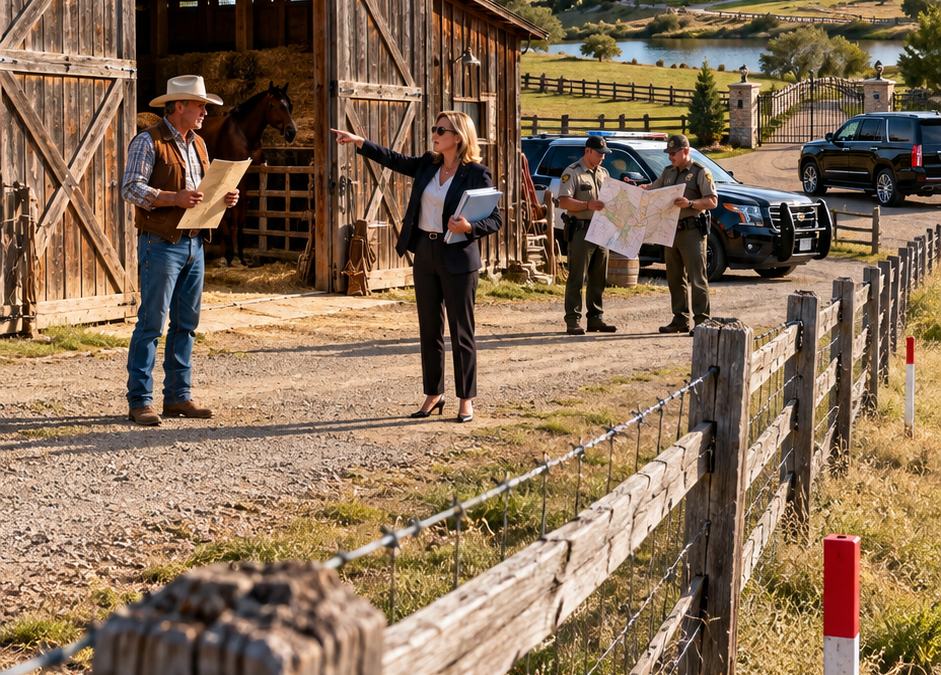
About twenty minutes later, sheriff vehicles came up the drive.
Three deputies got out.
Victoria straightened her posture and stepped behind them with the expression of a woman who believed she had already won. She didn’t look anxious. She looked triumphant. She expected the deputies to walk over, hear a sentence or two, and order me off my own land.
The lead deputy, a broad-shouldered man in his forties with a patient face and sun-lined skin, approached first.
“Sir,” he said, “we got a call about a property ownership dispute. Can you explain what’s going on?”
I handed him the deed and the survey copy without a word.
He took both documents and started reading.
Behind him, Victoria folded her arms.
“This structure belongs to the HOA,” she said. “He’s refusing to surrender it.”
The deputy didn’t answer immediately. He kept reading.
Then he asked me, “This survey current?”
“Yes. I also have a more recent copy inside if you need it.”
He nodded once, then turned to Victoria.
“Ma’am, do you have your ownership documents?”
She opened her folder immediately, too quickly, as though she had rehearsed that motion in her mind on the drive over. She flipped past several tabbed sections and began pulling out papers one by one.
Meeting minutes.
HOA maintenance notes.
An internal map.
A sheet listing prior community projects.
None of it was a deed.
None of it was a title transfer.
None of it was an official survey vesting ownership in the association.
The second deputy stepped closer and looked over the lead deputy’s shoulder. The third remained back near the vehicle, watching quietly.
Victoria continued flipping.
“I have the association records here somewhere,” she said, her voice tightening slightly.
The lead deputy waited another moment, then asked, “Do you have a deed showing the HOA owns this barn?”
She did not.
What she had was a stack of documents proving only that the HOA believed many things about itself.
The deputy handed my deed back to me and spoke in a calm, measured tone.
“Ma’am, the sheriff’s office cannot remove someone from private property based on HOA minutes or maintenance notes. Ownership disputes have to be supported by actual recorded title documentation or handled through proper legal procedures.”
Victoria’s face reddened.
“So you’re refusing to act?” she demanded.
“We’re refusing to seize private property without proof that it’s not private.”
She took a step forward.
“This man is occupying HOA property.”
The deputy stayed exactly where he was. “Your records do not establish that.”
That was the first crack.
You could see it in her eyes. Up until that moment, she had believed authority would flow in the direction of her confidence. She genuinely thought showing up with police would be enough to force the result she wanted. Instead, she had run straight into something stronger than confidence.
Documentation.
She pivoted quickly.
“He’s interfering with community rights,” she said. “This structure has historical use by residents.”
I said, “Historical use isn’t ownership.”
Her head whipped toward me. “You don’t speak while I’m addressing law enforcement.”
One of the deputies actually glanced at the other in a way that told me they had already formed an opinion about how this visit was going to go.
The lead deputy returned his attention to me.
“Sir, do you have the full survey?”
“I do,” I said. “And my attorney is on the way with certified county copies.”
That got Victoria’s attention.
“You called an attorney?” she asked, incredulous.
“You called the sheriff.”
I stepped back into the barn office, placed a call to my property attorney, and told him exactly what was happening. He had represented my family on boundary and easement issues before and knew the property well. His name was Warren Albright, and he had the rare gift of sounding calm even when other people were trying to manufacture a crisis.
“I’m leaving now,” he said. “Pull out the old survey packet if you have it. I’ll bring the county records copies.”
While we waited, the deputies stayed. They were professional enough not to leave an unresolved scene, but it was obvious the urgency had drained out of the situation. No one was going to haul me away. No one was putting my hands behind my back over Victoria’s fantasy map.
Still, Victoria refused to let go.
She paced in front of the barn, making phone calls, lowering her voice whenever she mentioned the deputies, then raising it again when she wanted me to hear phrases like unlawful occupation and unauthorized control. Every few minutes she would return to one of the deputies and ask if they were prepared to act yet.
Every time, the answer was some version of the same sentence.
“We need documentation.”
When Warren arrived, he didn’t rush. That was one of the reasons I trusted him. Panic makes fools louder. Calm makes them look ridiculous.
He got out of his car carrying a slim legal case and a long survey tube.
“Afternoon,” he said to the deputies. Then he looked at Victoria. “And you must be the HOA president.”
Victoria lifted her chin. “I am. And this property dispute—”
Warren held up one hand gently.
“Let’s start with your proof of ownership.”
She bristled immediately.
“We have association records.”
“No,” he said, in the patient tone one uses with a child who has answered the wrong question in math class. “You have association paperwork. I asked for proof of ownership.”
She began producing the same stack of materials again, but this time the performance had lost some of its force. Warren let her finish without interruption. Then he laid out the documents he had brought.
Certified copies of the county property records.
The original recorded survey.
A more recent survey update.
The parcel map showing the HOA boundary.
He unrolled the survey across the hood of my truck, weighed the corners with two flashlights, and pointed with a pen.
“This,” he said, “is Mr. Mercer’s boundary.”
Then he moved the pen several inches outward.
“This is the HOA boundary.”
Then he tapped the barn.
“And this structure sits several hundred feet outside the HOA line.”
The lead deputy leaned in.
Warren handed him the certified record copy.
“There is no shared ownership interest here,” he continued. “No transfer, no conveyance, no easement granting possession, no recorded agreement transferring this barn to the association.”
Victoria stepped closer, peering at the lines as though the map might change if she stared hard enough.
“That can’t be right,” she said.
“It is right,” Warren answered.
She quickly pulled out her own HOA map with renewed hope.
“Here,” she said. “This shows the structure within the association area.”
Warren took the map and studied it.
He didn’t speak for several seconds. Then a very slight smile appeared.
“Actually,” he said, “this map proves the opposite.”
Victoria frowned. “No, it doesn’t.”
He turned the map so the deputies could see it.
“The structure marker is here,” he said, pointing. “And the HOA boundary legend places the line here. Your own map leaves the barn outside the association area.”
One of the deputies gave a low exhale through his nose.
The second deputy stepped in to compare it against the county survey.
They matched.
Not roughly.
Not ambiguously.
Exactly where it mattered.
The lead deputy looked at Victoria and said, with admirable restraint, “Ma’am, at this point, the official survey and even your own map show the barn outside the HOA boundary.”
She blinked rapidly.
“There has to be another document,” she said.
Warren folded his hands. “If there is, produce it.”
That was the second crack.
The first crack had been the deputies refusing to remove me. The second was her realizing that every piece of paper in front of her was now an enemy.
She asked the deputies for time to check additional records at the HOA office.
They gave it to her.
Not because they believed it would help, I suspect, but because it was the cleanest path toward ending the circus.
Victoria rushed back to her SUV and drove off.
The deputies remained with me and Warren while we waited. One of them asked how long my family had owned the property. Another asked whether the HOA had challenged other boundary features before. Warren answered most of those questions while I stood there staring at the barn, feeling a mixture of anger and something else I’m still not sure how to name.
Violation feels too weak.
The barn was more than a structure to me, and that is difficult to explain to people who think ownership begins and ends with paperwork. Yes, the documents mattered. Without them, Victoria might have created more trouble. But standing there while strangers in uniform discussed whether I should be allowed to remain near a building my father had worked on with his own hands felt like something intimate had been dragged into public and treated like a bargaining chip.
That stayed with me.
About forty minutes later, Victoria returned.
This time, she was not alone.
Two HOA board members were with her, along with a woman I recognized as the association’s office manager. They were all carrying files.
None of them looked confident.
What followed would have been almost funny if it had not started with such brazen disrespect. They opened folders on the back of the SUV and began sorting through old records, correspondence, meeting minutes, budget approvals, maintenance requests, archived newsletters, and some kind of inventory log.
Still no deed.
Still no transfer record.
Still no title documentation.
The board members began to realize, in real time, how serious the situation was. I could see it in the way they stopped talking over one another. The office manager looked pale. At one point, one of the board members quietly asked Victoria, “Are we sure about this?”
She snapped at him immediately.
“Of course we’re sure.”
But she didn’t sound sure anymore.
She sounded desperate.
Warren remained beside me, hands in his pockets, patient as ever.
Then, after nearly another half hour of searching, the truth settled over the whole scene with the heavy stillness it usually brings.
There was nothing.
No deed.
No conveyance.
No recorded transfer.
No legal basis for her claim.
The lead deputy closed his notebook and addressed the group.
“At this time,” he said, “we have no evidence whatsoever that the HOA owns this barn. The county survey confirms it lies on Mr. Mercer’s property. If the association believes otherwise, that is a civil matter that must be pursued through proper legal channels. But no enforcement action will be taken today.”
Victoria stared at him.
“So he just gets to keep using it?”
The deputy answered, “Ma’am, based on the records in front of us, it’s his to use.”
That should have ended it.
For any sensible person, it would have.
Not for Victoria.
Instead of backing off, she escalated again.
She filed a formal complaint with the county claiming the barn violated HOA agreements. She alleged that there had once been some understanding, some arrangement, some community-use expectation that made my continued possession improper. It was nonsense dressed up in bureaucratic language, but it forced a response.
Warren prepared it.
Our answer was exact, unemotional, and devastating.
He attached the official title records.
The complete ownership history.
The recorded surveys.
The parcel map.
The county records office then independently confirmed what we already knew: the barn had always been part of my property. No transfer to the HOA had ever been recorded. No shared ownership interest existed. No agreement granting the association control over the structure could be found in the chain of title.
That single fact changed everything.
Until then, Victoria had been operating on noise. Threats. Volume. Assumptions. The vague idea that if she acted certain enough, other people would grow too tired to resist. But once the county records office confirmed the ownership history in writing, her claim stopped being merely weak.
It became reckless.
And the HOA board knew it.
The first shift came quietly.
One of the board members, the same one who had looked uneasy near the SUV, called me privately a few days later. He sounded embarrassed.
“I want to be clear,” he said, “I did not support involving law enforcement without legal confirmation.”
I let him talk.
He explained that Victoria had insisted there was historical documentation proving the HOA’s rights. She had told the board the barn was “effectively community property.” She had spoken with such certainty that some of them assumed the lawyers had already reviewed the issue.
“They hadn’t?” I asked.
“No.”
That told me everything I needed to know.
She had not just made a mistake. She had dragged the sheriff’s office into a property dispute without even securing legal confirmation from her own side.
The second shift came when the board’s attorney requested copies of everything.
Not from Victoria.
From Warren.
That was the moment the board stopped treating her claim as an initiative and started treating it as a liability.
Warren sent the file packet over in clean chronological order. Deed. Survey. title history. County confirmation. Incident summary. Record of Victoria requesting sheriff intervention. Notes on the failed ownership claim. The package was the legal equivalent of a locked door.
A week later, the county rejected Victoria’s complaint.
Not vaguely.
Not softly.
Rejected.
The response made clear that the barn was not subject to HOA control because it was outside HOA boundaries and not part of any recorded association property. It also reminded the association that property claims unsupported by title documentation cannot be enforced through county action simply because an organization asserts them.
Warren framed that letter in his office as a joke. I considered doing the same.
The board, however, was in no mood for jokes.
What had started as Victoria’s attempted property seizure had turned into a full internal problem for Brook Hollow Estates. Residents started hearing versions of the story. Some heard that the HOA had tried to take a private barn. Some heard that Victoria had called the sheriff on a landowner without proof. Others heard that the county had embarrassed the association over a false claim.
All of it was bad.
And the worst part, for Victoria, was that the story was true in every way that mattered.
The board convened an emergency meeting. I wasn’t invited, but I didn’t need to be. Information travels fast when people are scared of financial exposure.
One of the residents I knew casually—a decent man named Harold who lived at the edge of the subdivision—called me afterward.
“She got hammered,” he said.
“By who?”
“By half the room.”
Apparently, once the board saw the risk clearly, courage blossomed where silence had lived before. Directors wanted to know why Victoria had bypassed legal review. They wanted to know why police had been summoned. They wanted to know why the HOA had taken a formal position over property it didn’t own. They wanted to know whether any other “historical use” claims were floating around in association files like unexploded devices.
And perhaps most importantly, they wanted to know whether I planned to sue.
That question had real power in the room.
Because by then, Warren had already walked me through the possibilities.
Wrongful interference with property rights.
Potential defamation.
Misrepresentation.
Abuse of process.
Maybe not all of them would stick cleanly, but the sheer fact that the discussion existed changed the tone entirely. Victoria had started this thinking she could pressure me off a building. Now the HOA was worried about the cost of defending itself from the consequences of her pressure campaign.
For several days, I said nothing publicly.
That bothered people more than if I had shouted.
Silence, when backed by good documents and competent counsel, has a way of making careless people imagine all the things that might be coming.
Eventually, the board asked for a meeting.
This time, they came to my property respectfully. Three directors. The association attorney. No Victoria.
That omission spoke louder than anything else.
We met at a table just outside the barn. I chose that location deliberately. If they wanted to discuss its status, they could do it in the shadow of the very building they had tried to take.
The attorney spoke first.
“Mr. Mercer, the association recognizes that the prior ownership claim was not supported by the official record.”
“That’s one way to say it,” I replied.
He accepted that without protest.
The directors apologized in the careful, guarded language of people who know sincerity may be required but liability still exists. They said the board had relied on incorrect information. They said they regretted the law enforcement involvement. They said the association intended to correct internal procedures.
Then one of them, a woman named Linda Cates, did something the others had not.
She looked me in the eye and said, “What happened to you was wrong.”
That was the first apology that sounded like a human being had spoken it.
Warren asked the practical questions.
Would the HOA provide written acknowledgment that the barn was not association property? Yes.
Would the complaint be formally withdrawn from every internal file with corrective notation attached? Yes.
Would the board issue instructions that no future enforcement or ownership claim involving my property be initiated without legal review and title verification? Yes.
Would they provide that in writing? Yes.
Then came the more difficult question.
“What about Victoria?” Warren asked.
The silence after that was almost satisfying.
Finally, the board attorney answered. “The association is addressing governance matters internally.”
Which, translated into plain English, meant Victoria was in trouble and they didn’t want to discuss it in front of me.
Fair enough.
A week later, I learned she had been removed as HOA president pending a full internal review.
By the end of the month, she resigned from the board entirely.
Officially, it was for “personal reasons.”
Unofficially, she had overplayed power so badly that even the people who used to benefit from her forceful style no longer wanted to be associated with it.
The county matter closed.
The barn remained mine, exactly as it had always been.
But the aftermath lingered longer than the paperwork.
For a while after that, I found myself standing inside the barn at odd hours, looking up at the beams, the roofline, the repaired braces, the workbench, the tool pegs on the wall, and feeling something like gratitude mixed with fatigue. People who have never had to defend what is plainly theirs sometimes underestimate the exhaustion that comes with it. Even when you win, even when the truth is obvious, being forced into a fight against nonsense leaves a mark.
I thought about my father a lot during those weeks.
About the way he’d set the property records back into their envelope after any tax or survey matter was handled.
About the way he used to say, “Most trouble starts when one person decides another man’s fence means less than his own ambition.”
At the time, I thought he was speaking abstractly.
He wasn’t.
What saved me in the end was not outrage, though I had plenty of it. It wasn’t volume. It wasn’t connections. It wasn’t some dramatic courtroom reveal or clever trick.
It was the ordinary strength of documents maintained properly over time.
The deed.
The survey.
The title history.
The county records.
The truth had been sitting in file drawers and plat books long before Victoria ever strutted up my drive with her folder and her threats. All I had to do was refuse to surrender until the right people looked at the right papers.
That is often how these fights are won.
Not by louder people.
By better records.
A month after Victoria resigned, Harold from the subdivision came by again, this time carrying a pie his wife had made.
“That’s either a thank-you gift or a bribe,” I said.
He laughed. “Maybe both.”
We sat for a while outside the barn and talked.
He told me residents were still angry about the whole incident. Some were embarrassed. Some were furious the association had spent money chasing a fake claim. Some were discovering, for the first time, how loosely Victoria had treated the difference between HOA preference and legal authority.
“She always acted like the boundary only mattered when it protected the HOA,” he said.
“That’s common,” I replied.
“What is?”
“People who love authority usually hate limits.”
He was quiet for a moment after that.
Then he looked at the barn and said, “You know, she really thought she could take this from you.”
“I know.”
“What did that feel like?”
I looked at the doors, the repaired hinges, the long weathered boards along the western wall.
“Like someone walking into your family cemetery and saying the stones look more decorative under their name.”
He didn’t answer.
He didn’t need to.
That was the closest I could come to explaining it.
The barn was never just lumber and roofing tin. It was labor handed down. It was continuity. It was proof that not everything old had to be surrendered to whatever new group arrived with more money and louder assumptions.
That winter, I repainted the trim, replaced a warped side panel, and rehung an interior lantern my father used to keep near the rear stall door. None of that was necessary because of Victoria. I did it because there was something healing in ordinary maintenance after a season of absurd conflict. Repair, unlike conflict, has dignity.
The following spring, Warren mailed me a copy of the HOA’s formal recorded acknowledgment.
I still have it in my file cabinet.
Not because I need the reassurance.
But because paper matters.
And because if there is one thing I learned from Victoria Hayes, it is that some people can look directly at a deed, a survey, a boundary line, and thirty years of history and still convince themselves that wanting something badly enough creates a right to it.
It doesn’t.
The barn remained exactly where it had always been—outside the HOA line, on my land, under my roof, behind my doors.
And in the end, that was the part Victoria could never change.
She could arrive in an SUV with a folder full of noise.
She could call the sheriff.
She could threaten my name, my reputation, and my standing with the county.
She could send staff scrambling through every property file in the HOA office.
She could file complaints, repeat claims, and refuse to back down long after common sense should have forced her to.
But she could not rewrite the record.
She could not turn use into ownership.
She could not turn bluff into title.
And she could not take a barn my family had held for more than thirty years simply by saying, loudly and in public, that it belonged to someone else.
In the end, the deputies left my property without touching a single door.
The county closed the complaint in my favor.
The board withdrew its claim.
Victoria lost her position.
And my barn stood exactly where it belonged, unchanged by her ambition and protected by the one thing she never bothered to verify before declaring war on it—
the truth.
𝗧𝗛𝗘 𝗘𝗡𝗗
**Victoria Called the Sheriff on My Barn Like Thirty Years of Deeds Could Be Erased by One HOA Folder**
When Victoria Hayes pointed at my barn and said it belonged to the HOA, I thought I had misunderstood her. When she called the sheriff and tried to have me removed from my own land, I realized she was either dangerously confused or dangerously arrogant. By the time the deputies started reading the county survey out loud in front of her, the entire performance began collapsing under the weight of the truth.
The barn had belonged to my family for more than thirty years, but in my mind, it felt older than paper.
Technically, the structure came into our hands when my father bought the adjoining acreage from a retiring cattleman who had let the place fall into neglect. The land transfer was formal, recorded, and clean. The deed included the barn, the surrounding pasture, the access lane, and every marked fence line running back toward the creek. The county records reflected it. The tax maps reflected it. The original survey reflected it. Everything about the property said the same thing in the plain, boring language the truth usually prefers.
It was ours.
But land ownership, at least in a family like mine, is never only about paper.
I learned to swing a hammer inside that barn. I learned to sort feed sacks there, repair latches, patch old wood, and listen to my father explain the difference between maintaining property and merely occupying it. When storms came through, he would walk out there with a flashlight and a ladder before dawn, checking the roof line, the hinges, and the south wall where the wind hit hardest. When I got older, that responsibility became mine. After he passed, keeping that barn in shape felt less like a chore and more like a promise.
The roof had been repaired twice on my dime. The doors had been reinforced. The supports had been strengthened. I had replaced warped boards, treated the wood, cleaned the drainage line around the slab, and made sure the whole structure stayed solid. I didn’t leave it to rot. I didn’t neglect it. I kept it in better condition than some people keep their houses.
That was part of why Victoria’s accusation hit me so hard.
Not because I doubted the truth, but because I could hear, in the way she said it, that she had already decided my truth did not matter.
The nearby HOA had arrived years after my family’s property was already established. A developer bought land west of us, carved it into lots, added a gated entrance, planted ornamental trees, built a clubhouse, and sold people on the idea that they were moving into a polished, private community with scenic character and country charm. What the brochures called country charm was, in reality, land that had belonged to families like mine long before anyone installed brick monument signs and “luxury lifestyle” banners.
I had nothing against the residents as a group. Most of them stayed on their side of the boundary and I stayed on mine. A few waved when they drove by. One retired couple used to ask me about wildflowers in the pasture beyond the fence. Another neighbor bought eggs from a farmer two parcels over and would sometimes stop to chat if she saw me repairing something outside.
But HOAs, at least the aggressive kind, have a habit of expanding in their own imagination long before they expand legally.
And that habit had a face.
Victoria Hayes.
She was the president of the Brook Hollow Estates HOA, and she carried that title like it entitled her to more than volunteer authority over subdivision bylaws. She was sharp-dressed, polished, loud when she needed to be, and very skilled at speaking with the confidence of someone who believed confidence itself could substitute for evidence.
I had dealt with her before, though never over anything this serious.
A year earlier, she sent me a letter claiming that brush near my outer fence line was “visually inconsistent with the neighborhood perimeter standard.” I ignored it because the fence line she referenced was on my property and outside HOA jurisdiction. Then she sent another letter about “maintenance concerns” related to a tractor I had parked near the barn for two weeks while waiting on a replacement hydraulic hose. My attorney drafted a response that politely reminded the HOA where its authority ended. That should have settled it.
It did not.
Victoria’s type rarely sees boundaries as boundaries. She sees them as obstacles that might dissolve if she pushes hard enough.
Still, even with all that history, I never expected her to come after the barn itself.
That afternoon was warm, bright, and ordinary in a way that now feels almost offensive. I had spent the first half of the day replacing a worn latch on the side door and sorting hardware on a workbench just inside the main entrance. By noon, I was wiping sweat from my neck and thinking about getting lunch when I heard tires crunching over the gravel drive.
I looked up and saw a black SUV stop near the fence.
Victoria stepped out holding a thick folder.
That alone told me she hadn’t come for a casual conversation. People who come to talk bring a question. People who come to perform authority bring paperwork.
She strode toward me without waiting for an invitation.
“This barn is ours,” she shouted before she was even fully within conversational distance.
For a second, I just stared at her.
I actually thought I had missed part of the conversation we had not yet had.
“I’m sorry?” I said.
She stopped several yards from the entrance and lifted the folder like a prosecutor about to begin.
“The HOA has rights to this structure,” she said. “Residents have used it for years. It falls under association control.”
I set the rag in my hand down on the workbench and stepped fully outside.
“No,” I said. “It does not.”
She looked past me toward the barn interior as if inspecting a property she believed she had every right to reclaim.
“This building has been treated as community-access storage in the past,” she continued. “You cannot simply occupy HOA property and declare it private.”
I almost laughed, but the tone in her voice stopped me.
She wasn’t confused in the mild, fixable way people sometimes are when they misunderstand a fence line. She was committed. She had built an entire conclusion first and was now looking for reality to catch up with it.
I went inside, grabbed the deed copy I kept in the metal file cabinet, and brought it back out.
“The barn is on my parcel,” I said. “Always has been. Here’s the deed.”
I handed it to her.
Victoria barely glanced at the paper.
That was the moment I knew she didn’t actually want proof. She wanted surrender.
“This doesn’t settle the matter,” she said.
“It settles it completely.”
“No, it doesn’t. The HOA has maintenance records related to this structure.”
“Maintenance records don’t equal ownership.”
She tightened her jaw.
“Residents used this barn years ago.”
“That still doesn’t make it yours.”
“The association considers it part of the common-use history of the community.”
“Then the association is wrong.”
There was a brief silence after that, the kind that happens when someone unaccustomed to resistance decides whether to escalate or retreat.
Victoria escalated.
She pulled out her phone, looked me straight in the eye, and said, “Then I’ll let the sheriff explain it to you.”
“You should verify the records first,” I told her.
She smiled.
“You’ll see.”
There are smiles people give when they know something you don’t. Then there are smiles people give when they want you to think they do. Victoria’s was the second kind, though she wore it with enough certainty that I understood how often it must have worked on other people.
She made the call right there near my barn, speaking loudly enough to ensure I heard every loaded phrase.
“Private property dispute… unauthorized occupation… HOA-owned structure… refusing to vacate… yes, we need assistance immediately.”
I said nothing while she performed.
I had learned years earlier that arguing with someone in that state only feeds the drama they’re trying to create. If the truth is on your side, sometimes the best thing you can do is let a lie grow large enough to expose itself.
About twenty minutes later, sheriff vehicles came up the drive.
Three deputies got out.
Victoria straightened her posture and stepped behind them with the expression of a woman who believed she had already won. She didn’t look anxious. She looked triumphant. She expected the deputies to walk over, hear a sentence or two, and order me off my own land.
The lead deputy, a broad-shouldered man in his forties with a patient face and sun-lined skin, approached first.
“Sir,” he said, “we got a call about a property ownership dispute. Can you explain what’s going on?”
I handed him the deed and the survey copy without a word.
He took both documents and started reading.
Behind him, Victoria folded her arms.
“This structure belongs to the HOA,” she said. “He’s refusing to surrender it.”
The deputy didn’t answer immediately. He kept reading.
Then he asked me, “This survey current?”
“Yes. I also have a more recent copy inside if you need it.”
He nodded once, then turned to Victoria.
“Ma’am, do you have your ownership documents?”
She opened her folder immediately, too quickly, as though she had rehearsed that motion in her mind on the drive over. She flipped past several tabbed sections and began pulling out papers one by one.
Meeting minutes.
HOA maintenance notes.
An internal map.
A sheet listing prior community projects.
None of it was a deed.
None of it was a title transfer.
None of it was an official survey vesting ownership in the association.
The second deputy stepped closer and looked over the lead deputy’s shoulder. The third remained back near the vehicle, watching quietly.
Victoria continued flipping.
“I have the association records here somewhere,” she said, her voice tightening slightly.
The lead deputy waited another moment, then asked, “Do you have a deed showing the HOA owns this barn?”
She did not.
What she had was a stack of documents proving only that the HOA believed many things about itself.
The deputy handed my deed back to me and spoke in a calm, measured tone.
“Ma’am, the sheriff’s office cannot remove someone from private property based on HOA minutes or maintenance notes. Ownership disputes have to be supported by actual recorded title documentation or handled through proper legal procedures.”
Victoria’s face reddened.
“So you’re refusing to act?” she demanded.
“We’re refusing to seize private property without proof that it’s not private.”
She took a step forward.
“This man is occupying HOA property.”
The deputy stayed exactly where he was. “Your records do not establish that.”
That was the first crack.
You could see it in her eyes. Up until that moment, she had believed authority would flow in the direction of her confidence. She genuinely thought showing up with police would be enough to force the result she wanted. Instead, she had run straight into something stronger than confidence.
Documentation.
She pivoted quickly.
“He’s interfering with community rights,” she said. “This structure has historical use by residents.”
I said, “Historical use isn’t ownership.”
Her head whipped toward me. “You don’t speak while I’m addressing law enforcement.”
One of the deputies actually glanced at the other in a way that told me they had already formed an opinion about how this visit was going to go.
The lead deputy returned his attention to me.
“Sir, do you have the full survey?”
“I do,” I said. “And my attorney is on the way with certified county copies.”
That got Victoria’s attention.
“You called an attorney?” she asked, incredulous.
“You called the sheriff.”
I stepped back into the barn office, placed a call to my property attorney, and told him exactly what was happening. He had represented my family on boundary and easement issues before and knew the property well. His name was Warren Albright, and he had the rare gift of sounding calm even when other people were trying to manufacture a crisis.
“I’m leaving now,” he said. “Pull out the old survey packet if you have it. I’ll bring the county records copies.”
While we waited, the deputies stayed. They were professional enough not to leave an unresolved scene, but it was obvious the urgency had drained out of the situation. No one was going to haul me away. No one was putting my hands behind my back over Victoria’s fantasy map.
Still, Victoria refused to let go.
She paced in front of the barn, making phone calls, lowering her voice whenever she mentioned the deputies, then raising it again when she wanted me to hear phrases like unlawful occupation and unauthorized control. Every few minutes she would return to one of the deputies and ask if they were prepared to act yet.
Every time, the answer was some version of the same sentence.
“We need documentation.”
When Warren arrived, he didn’t rush. That was one of the reasons I trusted him. Panic makes fools louder. Calm makes them look ridiculous.
He got out of his car carrying a slim legal case and a long survey tube.
“Afternoon,” he said to the deputies. Then he looked at Victoria. “And you must be the HOA president.”
Victoria lifted her chin. “I am. And this property dispute—”
Warren held up one hand gently.
“Let’s start with your proof of ownership.”
She bristled immediately.
“We have association records.”
“No,” he said, in the patient tone one uses with a child who has answered the wrong question in math class. “You have association paperwork. I asked for proof of ownership.”
She began producing the same stack of materials again, but this time the performance had lost some of its force. Warren let her finish without interruption. Then he laid out the documents he had brought.
Certified copies of the county property records.
The original recorded survey.
A more recent survey update.
The parcel map showing the HOA boundary.
He unrolled the survey across the hood of my truck, weighed the corners with two flashlights, and pointed with a pen.
“This,” he said, “is Mr. Mercer’s boundary.”
Then he moved the pen several inches outward.
“This is the HOA boundary.”
Then he tapped the barn.
“And this structure sits several hundred feet outside the HOA line.”
The lead deputy leaned in.
Warren handed him the certified record copy.
“There is no shared ownership interest here,” he continued. “No transfer, no conveyance, no easement granting possession, no recorded agreement transferring this barn to the association.”
Victoria stepped closer, peering at the lines as though the map might change if she stared hard enough.
“That can’t be right,” she said.
“It is right,” Warren answered.
She quickly pulled out her own HOA map with renewed hope.
“Here,” she said. “This shows the structure within the association area.”
Warren took the map and studied it.
He didn’t speak for several seconds. Then a very slight smile appeared.
“Actually,” he said, “this map proves the opposite.”
Victoria frowned. “No, it doesn’t.”
He turned the map so the deputies could see it.
“The structure marker is here,” he said, pointing. “And the HOA boundary legend places the line here. Your own map leaves the barn outside the association area.”
One of the deputies gave a low exhale through his nose.
The second deputy stepped in to compare it against the county survey.
They matched.
Not roughly.
Not ambiguously.
Exactly where it mattered.
The lead deputy looked at Victoria and said, with admirable restraint, “Ma’am, at this point, the official survey and even your own map show the barn outside the HOA boundary.”
She blinked rapidly.
“There has to be another document,” she said.
Warren folded his hands. “If there is, produce it.”
That was the second crack.
The first crack had been the deputies refusing to remove me. The second was her realizing that every piece of paper in front of her was now an enemy.
She asked the deputies for time to check additional records at the HOA office.
They gave it to her.
Not because they believed it would help, I suspect, but because it was the cleanest path toward ending the circus.
Victoria rushed back to her SUV and drove off.
The deputies remained with me and Warren while we waited. One of them asked how long my family had owned the property. Another asked whether the HOA had challenged other boundary features before. Warren answered most of those questions while I stood there staring at the barn, feeling a mixture of anger and something else I’m still not sure how to name.
Violation feels too weak.
The barn was more than a structure to me, and that is difficult to explain to people who think ownership begins and ends with paperwork. Yes, the documents mattered. Without them, Victoria might have created more trouble. But standing there while strangers in uniform discussed whether I should be allowed to remain near a building my father had worked on with his own hands felt like something intimate had been dragged into public and treated like a bargaining chip.
That stayed with me.
About forty minutes later, Victoria returned.
This time, she was not alone.
Two HOA board members were with her, along with a woman I recognized as the association’s office manager. They were all carrying files.
None of them looked confident.
What followed would have been almost funny if it had not started with such brazen disrespect. They opened folders on the back of the SUV and began sorting through old records, correspondence, meeting minutes, budget approvals, maintenance requests, archived newsletters, and some kind of inventory log.
Still no deed.
Still no transfer record.
Still no title documentation.
The board members began to realize, in real time, how serious the situation was. I could see it in the way they stopped talking over one another. The office manager looked pale. At one point, one of the board members quietly asked Victoria, “Are we sure about this?”
She snapped at him immediately.
“Of course we’re sure.”
But she didn’t sound sure anymore.
She sounded desperate.
Warren remained beside me, hands in his pockets, patient as ever.
Then, after nearly another half hour of searching, the truth settled over the whole scene with the heavy stillness it usually brings.
There was nothing.
No deed.
No conveyance.
No recorded transfer.
No legal basis for her claim.
The lead deputy closed his notebook and addressed the group.
“At this time,” he said, “we have no evidence whatsoever that the HOA owns this barn. The county survey confirms it lies on Mr. Mercer’s property. If the association believes otherwise, that is a civil matter that must be pursued through proper legal channels. But no enforcement action will be taken today.”
Victoria stared at him.
“So he just gets to keep using it?”
The deputy answered, “Ma’am, based on the records in front of us, it’s his to use.”
That should have ended it.
For any sensible person, it would have.
Not for Victoria.
Instead of backing off, she escalated again.
She filed a formal complaint with the county claiming the barn violated HOA agreements. She alleged that there had once been some understanding, some arrangement, some community-use expectation that made my continued possession improper. It was nonsense dressed up in bureaucratic language, but it forced a response.
Warren prepared it.
Our answer was exact, unemotional, and devastating.
He attached the official title records.
The complete ownership history.
The recorded surveys.
The parcel map.
The county records office then independently confirmed what we already knew: the barn had always been part of my property. No transfer to the HOA had ever been recorded. No shared ownership interest existed. No agreement granting the association control over the structure could be found in the chain of title.
That single fact changed everything.
Until then, Victoria had been operating on noise. Threats. Volume. Assumptions. The vague idea that if she acted certain enough, other people would grow too tired to resist. But once the county records office confirmed the ownership history in writing, her claim stopped being merely weak.
It became reckless.
And the HOA board knew it.
The first shift came quietly.
One of the board members, the same one who had looked uneasy near the SUV, called me privately a few days later. He sounded embarrassed.
“I want to be clear,” he said, “I did not support involving law enforcement without legal confirmation.”
I let him talk.
He explained that Victoria had insisted there was historical documentation proving the HOA’s rights. She had told the board the barn was “effectively community property.” She had spoken with such certainty that some of them assumed the lawyers had already reviewed the issue.
“They hadn’t?” I asked.
“No.”
That told me everything I needed to know.
She had not just made a mistake. She had dragged the sheriff’s office into a property dispute without even securing legal confirmation from her own side.
The second shift came when the board’s attorney requested copies of everything.
Not from Victoria.
From Warren.
That was the moment the board stopped treating her claim as an initiative and started treating it as a liability.
Warren sent the file packet over in clean chronological order. Deed. Survey. title history. County confirmation. Incident summary. Record of Victoria requesting sheriff intervention. Notes on the failed ownership claim. The package was the legal equivalent of a locked door.
A week later, the county rejected Victoria’s complaint.
Not vaguely.
Not softly.
Rejected.
The response made clear that the barn was not subject to HOA control because it was outside HOA boundaries and not part of any recorded association property. It also reminded the association that property claims unsupported by title documentation cannot be enforced through county action simply because an organization asserts them.
Warren framed that letter in his office as a joke. I considered doing the same.
The board, however, was in no mood for jokes.
What had started as Victoria’s attempted property seizure had turned into a full internal problem for Brook Hollow Estates. Residents started hearing versions of the story. Some heard that the HOA had tried to take a private barn. Some heard that Victoria had called the sheriff on a landowner without proof. Others heard that the county had embarrassed the association over a false claim.
All of it was bad.
And the worst part, for Victoria, was that the story was true in every way that mattered.
The board convened an emergency meeting. I wasn’t invited, but I didn’t need to be. Information travels fast when people are scared of financial exposure.
One of the residents I knew casually—a decent man named Harold who lived at the edge of the subdivision—called me afterward.
“She got hammered,” he said.
“By who?”
“By half the room.”
Apparently, once the board saw the risk clearly, courage blossomed where silence had lived before. Directors wanted to know why Victoria had bypassed legal review. They wanted to know why police had been summoned. They wanted to know why the HOA had taken a formal position over property it didn’t own. They wanted to know whether any other “historical use” claims were floating around in association files like unexploded devices.
And perhaps most importantly, they wanted to know whether I planned to sue.
That question had real power in the room.
Because by then, Warren had already walked me through the possibilities.
Wrongful interference with property rights.
Potential defamation.
Misrepresentation.
Abuse of process.
Maybe not all of them would stick cleanly, but the sheer fact that the discussion existed changed the tone entirely. Victoria had started this thinking she could pressure me off a building. Now the HOA was worried about the cost of defending itself from the consequences of her pressure campaign.
For several days, I said nothing publicly.
That bothered people more than if I had shouted.
Silence, when backed by good documents and competent counsel, has a way of making careless people imagine all the things that might be coming.
Eventually, the board asked for a meeting.
This time, they came to my property respectfully. Three directors. The association attorney. No Victoria.
That omission spoke louder than anything else.
We met at a table just outside the barn. I chose that location deliberately. If they wanted to discuss its status, they could do it in the shadow of the very building they had tried to take.
The attorney spoke first.
“Mr. Mercer, the association recognizes that the prior ownership claim was not supported by the official record.”
“That’s one way to say it,” I replied.
He accepted that without protest.
The directors apologized in the careful, guarded language of people who know sincerity may be required but liability still exists. They said the board had relied on incorrect information. They said they regretted the law enforcement involvement. They said the association intended to correct internal procedures.
Then one of them, a woman named Linda Cates, did something the others had not.
She looked me in the eye and said, “What happened to you was wrong.”
That was the first apology that sounded like a human being had spoken it.
Warren asked the practical questions.
Would the HOA provide written acknowledgment that the barn was not association property? Yes.
Would the complaint be formally withdrawn from every internal file with corrective notation attached? Yes.
Would the board issue instructions that no future enforcement or ownership claim involving my property be initiated without legal review and title verification? Yes.
Would they provide that in writing? Yes.
Then came the more difficult question.
“What about Victoria?” Warren asked.
The silence after that was almost satisfying.
Finally, the board attorney answered. “The association is addressing governance matters internally.”
Which, translated into plain English, meant Victoria was in trouble and they didn’t want to discuss it in front of me.
Fair enough.
A week later, I learned she had been removed as HOA president pending a full internal review.
By the end of the month, she resigned from the board entirely.
Officially, it was for “personal reasons.”
Unofficially, she had overplayed power so badly that even the people who used to benefit from her forceful style no longer wanted to be associated with it.
The county matter closed.
The barn remained mine, exactly as it had always been.
But the aftermath lingered longer than the paperwork.
For a while after that, I found myself standing inside the barn at odd hours, looking up at the beams, the roofline, the repaired braces, the workbench, the tool pegs on the wall, and feeling something like gratitude mixed with fatigue. People who have never had to defend what is plainly theirs sometimes underestimate the exhaustion that comes with it. Even when you win, even when the truth is obvious, being forced into a fight against nonsense leaves a mark.
I thought about my father a lot during those weeks.
About the way he’d set the property records back into their envelope after any tax or survey matter was handled.
About the way he used to say, “Most trouble starts when one person decides another man’s fence means less than his own ambition.”
At the time, I thought he was speaking abstractly.
He wasn’t.
What saved me in the end was not outrage, though I had plenty of it. It wasn’t volume. It wasn’t connections. It wasn’t some dramatic courtroom reveal or clever trick.
It was the ordinary strength of documents maintained properly over time.
The deed.
The survey.
The title history.
The county records.
The truth had been sitting in file drawers and plat books long before Victoria ever strutted up my drive with her folder and her threats. All I had to do was refuse to surrender until the right people looked at the right papers.
That is often how these fights are won.
Not by louder people.
By better records.
A month after Victoria resigned, Harold from the subdivision came by again, this time carrying a pie his wife had made.
“That’s either a thank-you gift or a bribe,” I said.
He laughed. “Maybe both.”
We sat for a while outside the barn and talked.
He told me residents were still angry about the whole incident. Some were embarrassed. Some were furious the association had spent money chasing a fake claim. Some were discovering, for the first time, how loosely Victoria had treated the difference between HOA preference and legal authority.
“She always acted like the boundary only mattered when it protected the HOA,” he said.
“That’s common,” I replied.
“What is?”
“People who love authority usually hate limits.”
He was quiet for a moment after that.
Then he looked at the barn and said, “You know, she really thought she could take this from you.”
“I know.”
“What did that feel like?”
I looked at the doors, the repaired hinges, the long weathered boards along the western wall.
“Like someone walking into your family cemetery and saying the stones look more decorative under their name.”
He didn’t answer.
He didn’t need to.
That was the closest I could come to explaining it.
The barn was never just lumber and roofing tin. It was labor handed down. It was continuity. It was proof that not everything old had to be surrendered to whatever new group arrived with more money and louder assumptions.
That winter, I repainted the trim, replaced a warped side panel, and rehung an interior lantern my father used to keep near the rear stall door. None of that was necessary because of Victoria. I did it because there was something healing in ordinary maintenance after a season of absurd conflict. Repair, unlike conflict, has dignity.
The following spring, Warren mailed me a copy of the HOA’s formal recorded acknowledgment.
I still have it in my file cabinet.
Not because I need the reassurance.
But because paper matters.
And because if there is one thing I learned from Victoria Hayes, it is that some people can look directly at a deed, a survey, a boundary line, and thirty years of history and still convince themselves that wanting something badly enough creates a right to it.
It doesn’t.
The barn remained exactly where it had always been—outside the HOA line, on my land, under my roof, behind my doors.
And in the end, that was the part Victoria could never change.
She could arrive in an SUV with a folder full of noise.
She could call the sheriff.
She could threaten my name, my reputation, and my standing with the county.
She could send staff scrambling through every property file in the HOA office.
She could file complaints, repeat claims, and refuse to back down long after common sense should have forced her to.
But she could not rewrite the record.
She could not turn use into ownership.
She could not turn bluff into title.
And she could not take a barn my family had held for more than thirty years simply by saying, loudly and in public, that it belonged to someone else.
In the end, the deputies left my property without touching a single door.
The county closed the complaint in my favor.
The board withdrew its claim.
Victoria lost her position.
And my barn stood exactly where it belonged, unchanged by her ambition and protected by the one thing she never bothered to verify before declaring war on it—
the truth.








