𝗙𝗨𝗟𝗟 𝗦𝗧𝗢𝗥𝗬 Victoria Called the Sheriff on My Barn Like Thirty Years of Deeds Could Be Erased by One HOA Folder
𝗙𝗨𝗟𝗟 𝗦𝗧𝗢𝗥𝗬
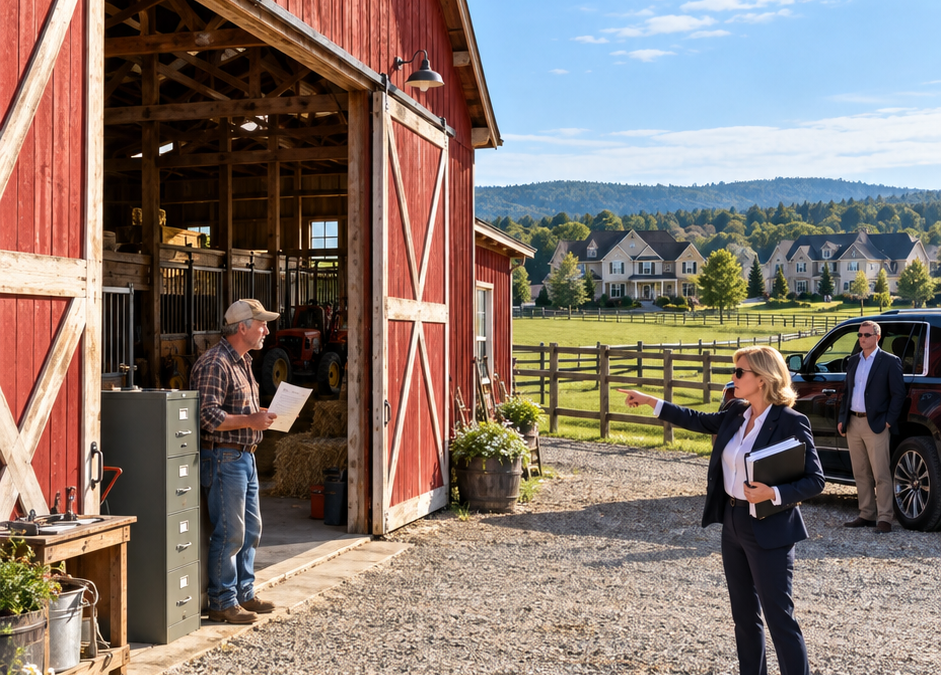
She made the call standing ten feet from the barn my father had helped me repair with his own hands. Her voice changed when the dispatcher answered. Suddenly she sounded calmer, wounded, official.
“Yes, this is Victoria Hayes, president of Brook Hollow Estates HOA. We have a property matter involving unauthorized occupation of an HOA-owned structure. The individual is refusing to vacate.”
I stared at her.
Unauthorized occupation.
That was what she called a man standing in his own barn.
She continued. “Yes, we need a deputy here. He has been shown association documentation and is refusing to comply.”
Martin looked down at the gravel.
I remember that detail clearly.
While Victoria built her lie into a police call, the board member she brought with her stared at the ground like a man who already knew he should have stopped this sooner.
After she hung up, she folded her arms and stood there like the matter was settled.
“You made a mistake,” I said.
“No,” she replied. “You did.”
The next twenty minutes were quiet in a way that felt staged. Victoria paced near her SUV. Martin made a phone call with his back turned. I leaned against the barn doorway and forced myself not to argue. I knew the documents. I knew the survey. I knew the chain of title. But I also knew how quickly a loud person can make a simple truth feel complicated if they drag enough uniforms into it.
When the sheriff’s vehicles arrived, Victoria straightened like she had just been handed a crown.
Two patrol vehicles pulled up near the lower gate. Three deputies stepped out. The lead deputy was a broad-shouldered man in his forties with a calm face and eyes that moved carefully before his mouth did. His name tag read Delgado.
He approached us without rushing.
“Who made the call?”
Victoria stepped forward immediately. “I did. I’m Victoria Hayes, president of the Brook Hollow Estates HOA. This man is refusing to leave HOA property.”
Deputy Delgado looked at me.
“Sir, your name?”
“Samuel Carter.”
“Can you explain what’s going on?”
Before I could answer, Victoria said, “I already explained it. The barn belongs to the association.”
Deputy Delgado raised one hand slightly. “Ma’am, I’ll speak with everyone.”
That small interruption irritated her. I saw it in her jaw.
I handed him the deed and survey.
“This is my property,” I said. “The barn sits inside my boundary, several hundred feet outside the HOA line. My family has owned it for more than thirty years.”
Deputy Delgado took the documents and read them carefully.
Not quickly. Carefully.
That mattered to me.
People like Victoria rely on speed. They want confusion, pressure, urgency, authority arriving before facts can breathe. Deputy Delgado gave the paperwork time to speak.
One of the other deputies stepped beside him and looked over the survey.
Victoria waited for a moment, then opened her folder and began pulling out papers.
“I have association records,” she said. “Meeting minutes, maintenance references, historical use notes, and neighborhood documents.”
Deputy Delgado looked up. “Do you have a deed?”
Victoria paused.
“I have HOA records.”
“I’m asking whether you have a deed showing the HOA owns this barn.”
She flipped through the folder. “Ownership is established through the association’s historical treatment of the structure.”
“That is not what I asked.”
The air shifted.
I watched Victoria’s confidence flicker for the first time.
She pulled out a printed map with the Brook Hollow Estates logo in the corner. “This map shows the barn’s relationship to the community.”
Deputy Delgado took it and compared it to my survey.
“Relationship isn’t ownership,” he said.
Victoria’s face reddened. “Deputy, this is association property. I need him removed so the board can secure the structure.”
Deputy Delgado handed the HOA map to the second deputy.
“We are not removing anyone from property based on meeting minutes and an internal HOA map,” he said. “If there’s an ownership dispute, it needs proper legal documentation or a court order.”
Victoria stared at him like he had betrayed her personally.
“So you’re refusing to help?”
“No, ma’am. I’m refusing to seize private property without proof.”
The sentence landed hard.
Martin shifted near the SUV, his discomfort now impossible to hide.
Victoria turned toward me. “This isn’t over. I’ll destroy your reputation with the county before I let you steal from this community.”
Something cold moved through me then.
Not fear. Anger, but controlled.
“You came onto my land, called the sheriff, and accused me of stealing my own barn,” I said. “Be careful what you say next.”
Her eyes narrowed. “The HOA has powerful connections.”
“Then use them properly.”
I stepped away, pulled out my phone, and called my property attorney.
His name was Warren Albright, and he had handled every serious land matter my family had faced for nearly two decades. He knew the parcel. He knew the survey history. More importantly, he knew how to remove emotion from a room full of people trying to weaponize it.
He answered on the third ring.
“Warren, it’s Sam Carter. I’m at the barn. The HOA president is here with deputies claiming the barn belongs to the association.”
There was a short silence.
Then he said, “I’ll be there shortly. Do not argue. Do not sign anything. Keep the deputies there if possible.”
“I already gave them the deed and survey.”
“Good. I’m bringing county copies.”
When I hung up, Victoria was speaking to one of the deputies again, repeating the phrase community-use rights as if saying it enough times might turn it into law.
Deputy Delgado remained patient.
Patient, but not persuaded.
Warren arrived twenty-five minutes later in a gray sedan, wearing a charcoal suit that looked entirely too formal for a gravel drive. He stepped out carrying a leather case and a long survey tube. He nodded to me, then to the deputies, then to Victoria.
“Warren Albright,” he said. “Counsel for Mr. Carter.”
Victoria stiffened.
That was the second time I saw real uncertainty on her face.
Warren set his case on the hood of my truck and opened it.
“Mrs. Hayes,” he said, “I understand you are claiming ownership of this barn on behalf of the HOA.”
Victoria regained some of her composure. “The association has a longstanding interest in the structure.”
“Ownership,” Warren said. “Not interest. Not familiarity. Not past access. Ownership. Do you have a recorded deed, transfer, easement, or court order?”
She opened her folder again.
Warren watched her without expression.
She produced the same papers she had already shown the deputies.
He reviewed them one by one.
HOA rules.
Meeting minutes.
A maintenance note from years earlier mentioning “old barn storage.”
A printed internal map.
A newsletter referencing a community cleanup day near the western pasture.
When he finished, he stacked them neatly and slid them back toward her.
“These do not establish ownership.”
“They establish historical use.”
“Historical use is not title.”
“The residents used it.”
“With permission from whom?”
Victoria hesitated.
That hesitation did more damage than any argument I could have made.
Warren unrolled the original property survey across the hood of my truck and held down the corners with a tape measure, a wrench, and two rocks from the drive. He pointed to the thick boundary line.
“This is Mr. Carter’s parcel. This is the Brook Hollow Estates boundary. Here is the barn.”
Deputy Delgado leaned in.
Warren continued. “The barn is several hundred feet outside the HOA boundary. There is no shared ownership indicated. No recorded transfer to the HOA exists. No easement grants possession or control of the structure to the association.”
Victoria stepped closer with her own map.
“This map shows the barn in relation to Brook Hollow.”
Warren looked at it.
For several seconds, he said nothing.
Then he lifted his eyebrows slightly.
“Mrs. Hayes, your own map shows the barn outside the HOA boundary.”
“No, it doesn’t.”
“It does.”
He turned the map toward Deputy Delgado and tapped the legend.
“This line marks association property. The barn marker is here. Outside the line.”
The deputy examined it.
Then he looked at Victoria.
“Ma’am, he’s right.”
There are moments when a room—or a gravel drive, in this case—becomes so silent you can hear pride breaking.
Victoria looked from her map to Warren’s survey to the deputy’s face.
“There has to be another document,” she said.
Warren folded his hands. “Then produce it.”
She called the HOA office from the driveway and ordered the staff to search every property file. Her voice was sharp enough that even the deputies looked uncomfortable. She demanded old records, developer correspondence, transfer files, legal notes, anything connected to the barn.
Then she left.
She actually drove back to the HOA office, leaving Martin behind with us and taking her folder with her like a soldier retreating to find heavier weapons.
While we waited, Martin approached me.
“I didn’t know she was calling the sheriff,” he said quietly.
I looked at him. “You came with her.”
“I thought she had documents.”
“You saw mine.”
He swallowed. “I know.”
That was all he said.
But it told me something about how Victoria operated. She did not need everyone to believe her completely. She only needed them uncertain enough to follow until turning back became embarrassing.
Almost an hour passed before she returned.
This time, two more board members came with her, along with a pale office manager carrying a cardboard file box. They set documents on the hood of Victoria’s SUV and started digging through them.
Old meeting minutes.
Budget reports.
Insurance summaries.
Copies of newsletters.
Maintenance schedules.
A decades-old note about residents storing folding tables “near the old barn” after a picnic.
Still no deed.
Still no transfer.
Still nothing that gave them ownership.
I watched the board members begin to understand what she had done.
Their faces changed first. Then their posture. Then their voices.
One of them, a woman named Linda Cates, whispered, “Victoria, did counsel review this before you called law enforcement?”
Victoria ignored her.
Linda asked again, louder this time. “Did counsel review this?”
Victoria snapped, “We had enough documentation to proceed.”
Warren said, “No, you didn’t.”
Nobody contradicted him.
Deputy Delgado closed his notebook.
“At this point,” he said, “the official survey and the documents provided indicate the barn is on Mr. Carter’s property. The HOA has not produced ownership documentation. We will not be removing Mr. Carter, and we will not be securing the barn for the association.”
Victoria’s face was tight with fury.
“So he just gets away with this?”
Deputy Delgado looked at her for a long moment.
“With owning his property?” he asked.
Linda looked down.
Martin turned away.
One of the other deputies coughed into his hand, but I could tell he was hiding a reaction.
Victoria was not amused.
“This matter will be escalated,” she said.
Warren nodded. “Please do. Send everything through my office.”
That should have ended the entire thing.
It did not.
Victoria filed a formal complaint with the county three days later.
She claimed the barn violated HOA agreements. She alleged that it had been part of a long-standing association arrangement. She demanded county intervention and requested review of my “unauthorized retention” of the structure.
Unauthorized retention.
That phrase almost impressed me.
It takes real nerve to accuse a man of retaining something his family never gave away.
Warren’s response was immediate and surgical.
He submitted the recorded deed, complete ownership history, survey records, parcel maps, tax documentation, and a sworn statement outlining Victoria’s attempt to use law enforcement without evidence of title. He also requested that the county confirm whether any transfer of the barn or underlying land to Brook Hollow Estates had ever been recorded.
The answer came back clearly.
No.
The barn had always been part of my property. No HOA transfer had ever been recorded. No deed granted ownership to Brook Hollow Estates. No easement gave the association possession or control.
That single fact changed everything.
Until then, Victoria’s behavior could be dressed up as a dispute. A misunderstanding. A disagreement over history. But once the county confirmed the chain of title, her claim became something much harder for the HOA to defend.
She had sent sheriff’s deputies to seize property the HOA did not own.
That realization hit the board like a hammer.
Within a week, Brook Hollow Estates called an emergency meeting.
I did not attend. I didn’t need to. By then, several residents had reached out to me quietly, either to apologize or to find out whether the rumors were true. One man told me Victoria had been telling people for months that the HOA was “reclaiming neglected assets.” Another said she had described my barn as “community property being withheld by an uncooperative landowner.”
Neglected.
Withheld.
Community property.
Every word was designed to make theft sound responsible.
At the emergency meeting, according to people who later told me what happened, the board asked Victoria one question again and again: why did she involve law enforcement before confirming title?
She never gave a clean answer.
She said residents had used the barn.
She said old records referenced it.
She said the association had relied on historical understanding.
She said my refusal to cooperate had forced her hand.
But she could not say she had a deed.
She could not say the barn was inside HOA boundaries.
She could not say the county was wrong.
And she could not explain why her own map showed the barn outside the association line.
That was when the board’s fear changed direction.
Before, they had feared losing control. Now they feared liability.
That is when people who once stood behind a bully suddenly discover the value of procedure.
The HOA attorney contacted Warren and requested a meeting.
This time, Victoria was not invited.
That told me more than any apology could have.
The meeting took place at a long table inside Warren’s office. Three board members sat across from us, along with the HOA attorney. Linda Cates was there. So was Martin Bell. The third was a quiet older man named Peter Ash, who looked like he had aged five years in one week.
The HOA attorney began carefully.
“Mr. Carter, the association recognizes that its prior position regarding the barn was not supported by the recorded property documents.”
I leaned back. “That is a very polished way to say your president tried to take my property.”
He did not argue.
Linda looked at me directly. “What happened was wrong.”
That mattered because she said it without hiding behind legal phrasing.
Martin added, “I should have stopped it before she called the sheriff.”
“Yes,” I said. “You should have.”
He nodded once, accepting it.
Warren handled the terms.
The HOA had to issue a written acknowledgment that the barn and surrounding land belonged solely to me. The complaint had to be withdrawn. Any internal record suggesting HOA ownership had to be corrected. The association had to agree not to make future claims against my property without title verification and legal review. They also had to reimburse my attorney’s fees for the response Victoria forced me to prepare.
The HOA attorney tried to soften that last part.
Warren did not let him.
“Your association created a false ownership dispute, involved law enforcement, filed a county complaint, and forced my client to defend clear title,” he said. “Fees are not optional in this discussion.”
The room went quiet.
Then the attorney said, “We’ll recommend approval.”
They approved it two days later.
Victoria fought it, of course.
People like her rarely stop because they discover they are wrong. They stop only when the cost of continuing becomes unbearable.
But by then, she had lost the board.
Residents were angry. Not just because she had embarrassed the HOA, but because they began wondering how many other things she had handled the same way. How many letters had gone out without legal authority? How many threats had been made because people assumed she had checked the facts? How many homeowners had given in because fighting seemed harder than surrender?
That was the real damage.
Not just what she did to me.
What she taught people to accept.
Two weeks later, Victoria was removed as HOA president pending an internal review.
By the end of the month, she resigned from the board entirely.
The official notice said she was stepping down for personal reasons.
Everyone knew better.
I received the HOA’s written acknowledgment in the mail on a Friday afternoon. It was printed on association letterhead, signed by the acting board president, and copied to their attorney.
The language was formal.
The meaning was simple.
The barn was mine.
It had always been mine.
The HOA had no ownership interest, no right of possession, and no authority to control it.
I stood in my kitchen reading that letter twice, then carried it out to the barn.
I don’t know why.
Maybe I wanted the building to have the last word, even if buildings don’t speak.
The late afternoon sun came through the open doors, laying long gold strips across the floorboards. Dust floated in the light. The repaired doors stood solid on their hinges. The roof held. The walls held. Everything my father and I had worked on was still there, unchanged by Victoria’s folder, her phone call, her threats, or her ridiculous belief that wanting something loudly could make it hers.
I placed the letter on the workbench.
For a while, I just stood there.
People talk about property disputes like they are only about lines and documents. Sometimes they are. But sometimes they are about memory. Labor. Inheritance. The right to keep what your family built without having to explain its value to someone who only sees usefulness when it serves them.
Victoria looked at my barn and saw opportunity.
I looked at it and saw my father.
That was the difference between us.
A month later, I repaired the old lantern near the rear stall door. It had not worked in years. The wiring was simple, but I took my time with it anyway. When I finally flipped the switch and warm light filled the back corner, I felt something in me settle.
Not victory exactly.
Something quieter.
A sense that the barn had survived one more storm.
Not wind this time. Not rain. Not rot.
Ambition.
That is what Victoria brought onto my land that day. Not confusion. Not honest error. Ambition wearing the costume of authority.
She arrived believing a folder full of HOA papers could outweigh thirty years of deeded ownership. She believed sheriff vehicles would frighten me into surrender. She believed county officials would defer to her title. She believed the board would protect her because she had always been the loudest person in the room.
But the truth has a way of waiting calmly for loud people to run out of breath.
The deputies left without touching a single door.
The county rejected her complaint.
The board withdrew its claim.
The HOA corrected its records.
Victoria lost the position she had tried to use against me.
And the barn remained exactly where it had always been—outside the HOA boundary, inside my property line, under my care, and beyond the reach of anyone who thought paper only mattered when it belonged to them.
I still keep the old deed in the metal cabinet.
I still keep the survey beside it.
And now I keep the HOA acknowledgment there too, not because I need it to know what is mine, but because my father was right.
A fence keeps honest people out.
Paper stops dishonest people from pretending the fence was never there.
Victoria learned that too late.
She came to my land convinced she could turn my family’s barn into HOA property by saying it with enough confidence.
She left with deputies, attorneys, county records, and her own board proving the opposite.
And every time I open those reinforced barn doors, I remember the one thing she never understood.
A building does not become yours because you used it, wanted it, or wrote about it in a meeting.
It becomes yours when the record says it is yours.
And in every record that mattered, that barn had my family’s name on it long before Victoria Hayes ever learned how to threaten someone with a folder in her hand.
𝗧𝗛𝗘 𝗘𝗡𝗗
Victoria Called the Sheriff on My Barn Like Thirty Years of Deeds Could Be Erased by One HOA Folder
The morning Victoria Hayes pointed at my barn and called it HOA property, I thought the mistake would die the moment I showed her the deed. Then she called the sheriff and stood behind the deputies like the ending had already been written. She had no idea the county records she never bothered to read were about to turn her own accusation into evidence against her.
The barn had belonged to my family for more than thirty years.
That was the first fact.
Not the loudest fact. Not the most dramatic fact. Not the fact Victoria Hayes wanted anyone to hear. But it was the one fact that mattered more than every folder she carried, every threat she made, and every polished sentence she used to make theft sound like administration.
The barn sat on land I legally owned outside the Brook Hollow Estates HOA boundary. It was not community property. It was not shared-use storage. It was not some forgotten structure sitting in a gray area between my land and theirs. It was mine, listed plainly in county records, reflected on the survey, included in the parcel history, and maintained by my family long before the HOA existed.
My father bought that acreage when I was still young enough to believe old buildings could remember people.
Maybe I still believe that.
Because every time I walked into that barn, I felt him there. I could see him standing under the center beam with a pencil behind his ear, squinting up at the rafters after a storm. I could hear him telling me to hold the ladder steady, to measure twice, to never trust a hinge that groaned louder in winter than it did in summer. I learned how to patch roof seams in that barn. I learned how to set a post, sharpen a blade, repair a door latch, and stack feed in a way that kept mice from turning the place into a kingdom.
After my father died, the barn became more than a building to me.
It became a promise.
I repaired the roof twice. I reinforced the main doors after a windstorm nearly tore one of them loose. I replaced rotten boards along the west wall, fixed the drainage trench behind the foundation, and repainted the trim the same faded red my father had always liked. Every repair receipt went into a file. Every tax record was saved. Every property survey was kept in a metal cabinet inside my home office.
That was how my father raised me.
“Keep your records clean,” he used to say. “A fence keeps honest people out. Paper keeps dishonest people from pretending the fence was never there.”
I never forgot that.
For years, no one questioned the barn.
Why would they? It was clearly inside my property line, several hundred feet beyond the HOA boundary. The old fence separated my land from the subdivision long before Brook Hollow Estates built its gate, clubhouse, pool, and rows of expensive houses with matching stone mailboxes. The developer knew where the line was. The county knew where the line was. I knew where the line was.
Everyone knew.
Or at least everyone should have.
Brook Hollow came later, built on land that had once been open pasture and scrub brush. At first, I didn’t pay much attention to it. I had no interest in their meetings, landscaping disputes, pool rules, architectural committees, or arguments over mailbox paint. They were on their side. I was on mine. That arrangement worked fine for a while.
Then Victoria Hayes became HOA president.
Victoria was the kind of woman who could make a clipboard look dangerous. She was always dressed like she had just stepped out of a real estate magazine—expensive sunglasses, crisp blouses, perfect hair, polished shoes that somehow never seemed to collect dust. She spoke with a smooth, sharp confidence, the kind that made uncertain people nod before they understood what they were agreeing to.
I had dealt with her twice before.
The first time, she sent me a letter claiming the brush along my outer fence created a “negative visual transition” for the neighborhood perimeter. I ignored it because the brush was on my land and outside HOA control. The second time, she complained about an old tractor parked near the barn while I waited on a replacement part. My attorney sent one polite letter explaining that the HOA had no authority over my property.
After that, I thought she understood.
I was wrong.
Victoria did not misunderstand boundaries. She resented them.
That morning, I was inside the barn replacing a worn bolt on the side door when I heard tires crunching up the gravel drive. It wasn’t unusual for delivery trucks or neighbors to turn around near the lower gate, so I didn’t look up right away. Then the engine stopped too close to the barn.
I stepped outside and saw Victoria Hayes climbing out of a black SUV.
She wasn’t alone. A man I recognized from the HOA board sat in the passenger seat, but he didn’t get out at first. Victoria came forward carrying a folder so thick it looked like she had spent all night trying to build a case before anyone had accused her of needing one.
She didn’t say good morning.
She didn’t introduce the reason for her visit.
She pointed at my barn and shouted, “This barn is ours.”
For a moment, I simply stared at her.
I thought I must have misheard.
“What did you just say?”
She marched closer, stopping just beyond the open doors. “The HOA has rights to this structure. It has been used by residents in the past, and the board has determined it falls under association control.”
There are certain sentences so wrong that your mind has to walk around them twice before it can respond.
I wiped my hands on a shop rag. “No, it doesn’t.”
“Yes,” she said, lifting the folder. “It does.”
“No,” I repeated. “This barn is on my property.”
Victoria smiled, but it was not friendly. It was the sort of smile people use when they think they are about to enjoy watching you learn your place.
“That is your interpretation.”
“It’s not an interpretation. It’s a recorded boundary.”
She looked past me into the barn like she was already deciding where the HOA would put its equipment once I was removed.
“This structure has community-use history,” she said. “Residents have stored event materials here before. There are meeting notes referencing the barn. There are maintenance records.”
“Meeting notes don’t transfer ownership.”
“They establish association interest.”
“No, they establish that someone wrote something down.”
Her smile disappeared.
I walked into the small office corner inside the barn and opened the metal filing cabinet. I kept copies of relevant records there because land disputes in rural areas have a way of appearing when people build too close to old boundaries and start believing new money outranks old deeds.
I pulled out a copy of the deed and the most recent property survey.
Then I walked back outside and handed them to Victoria.
“The barn is inside my property boundary,” I said. “My family has owned this land for more than thirty years. The structure is listed in the property records. There has never been a transfer to the HOA.”
Victoria barely looked at the documents.
She held them for maybe five seconds before pushing them back toward me.
“This doesn’t resolve anything.”
“It resolves everything.”
She tilted her head. “You don’t get to decide that.”
“Neither do you.”
That was when the man from her SUV finally opened his door. He stepped out slowly, looking uncomfortable before he said a single word. His name was Martin Bell, and I knew him only as one of the quieter HOA board members. He stood beside the SUV and glanced between us.
“Victoria,” he said, “maybe we should let the attorney review the records before—”
She cut him off without turning around.
“The board already discussed this.”
Martin’s face tightened, but he said nothing else.
That told me something important.
Victoria had not come to ask questions. She had come to create a scene large enough that everyone else would assume the answer had already been decided.
She turned back to me.
“You have been occupying HOA property without authorization,” she said.
I almost laughed. “Occupying? Victoria, this is my barn.”
“The sheriff can sort that out.”
“You should verify the county records before you embarrass yourself.”
She pulled out her phone.
Then she smiled again.
“You’ll see.”
She made the call standing ten feet from the barn my father had helped me repair with his own hands. Her voice changed when the dispatcher answered. Suddenly she sounded calmer, wounded, official.
“Yes, this is Victoria Hayes, president of Brook Hollow Estates HOA. We have a property matter involving unauthorized occupation of an HOA-owned structure. The individual is refusing to vacate.”
I stared at her.
Unauthorized occupation.
That was what she called a man standing in his own barn.
She continued. “Yes, we need a deputy here. He has been shown association documentation and is refusing to comply.”
Martin looked down at the gravel.
I remember that detail clearly.
While Victoria built her lie into a police call, the board member she brought with her stared at the ground like a man who already knew he should have stopped this sooner.
After she hung up, she folded her arms and stood there like the matter was settled.
“You made a mistake,” I said.
“No,” she replied. “You did.”
The next twenty minutes were quiet in a way that felt staged. Victoria paced near her SUV. Martin made a phone call with his back turned. I leaned against the barn doorway and forced myself not to argue. I knew the documents. I knew the survey. I knew the chain of title. But I also knew how quickly a loud person can make a simple truth feel complicated if they drag enough uniforms into it.
When the sheriff’s vehicles arrived, Victoria straightened like she had just been handed a crown.
Two patrol vehicles pulled up near the lower gate. Three deputies stepped out. The lead deputy was a broad-shouldered man in his forties with a calm face and eyes that moved carefully before his mouth did. His name tag read Delgado.
He approached us without rushing.
“Who made the call?”
Victoria stepped forward immediately. “I did. I’m Victoria Hayes, president of the Brook Hollow Estates HOA. This man is refusing to leave HOA property.”
Deputy Delgado looked at me.
“Sir, your name?”
“Samuel Carter.”
“Can you explain what’s going on?”
Before I could answer, Victoria said, “I already explained it. The barn belongs to the association.”
Deputy Delgado raised one hand slightly. “Ma’am, I’ll speak with everyone.”
That small interruption irritated her. I saw it in her jaw.
I handed him the deed and survey.
“This is my property,” I said. “The barn sits inside my boundary, several hundred feet outside the HOA line. My family has owned it for more than thirty years.”
Deputy Delgado took the documents and read them carefully.
Not quickly. Carefully.
That mattered to me.
People like Victoria rely on speed. They want confusion, pressure, urgency, authority arriving before facts can breathe. Deputy Delgado gave the paperwork time to speak.
One of the other deputies stepped beside him and looked over the survey.
Victoria waited for a moment, then opened her folder and began pulling out papers.
“I have association records,” she said. “Meeting minutes, maintenance references, historical use notes, and neighborhood documents.”
Deputy Delgado looked up. “Do you have a deed?”
Victoria paused.
“I have HOA records.”
“I’m asking whether you have a deed showing the HOA owns this barn.”
She flipped through the folder. “Ownership is established through the association’s historical treatment of the structure.”
“That is not what I asked.”
The air shifted.
I watched Victoria’s confidence flicker for the first time.
She pulled out a printed map with the Brook Hollow Estates logo in the corner. “This map shows the barn’s relationship to the community.”
Deputy Delgado took it and compared it to my survey.
“Relationship isn’t ownership,” he said.
Victoria’s face reddened. “Deputy, this is association property. I need him removed so the board can secure the structure.”
Deputy Delgado handed the HOA map to the second deputy.
“We are not removing anyone from property based on meeting minutes and an internal HOA map,” he said. “If there’s an ownership dispute, it needs proper legal documentation or a court order.”
Victoria stared at him like he had betrayed her personally.
“So you’re refusing to help?”
“No, ma’am. I’m refusing to seize private property without proof.”
The sentence landed hard.
Martin shifted near the SUV, his discomfort now impossible to hide.
Victoria turned toward me. “This isn’t over. I’ll destroy your reputation with the county before I let you steal from this community.”
Something cold moved through me then.
Not fear. Anger, but controlled.
“You came onto my land, called the sheriff, and accused me of stealing my own barn,” I said. “Be careful what you say next.”
Her eyes narrowed. “The HOA has powerful connections.”
“Then use them properly.”
I stepped away, pulled out my phone, and called my property attorney.
His name was Warren Albright, and he had handled every serious land matter my family had faced for nearly two decades. He knew the parcel. He knew the survey history. More importantly, he knew how to remove emotion from a room full of people trying to weaponize it.
He answered on the third ring.
“Warren, it’s Sam Carter. I’m at the barn. The HOA president is here with deputies claiming the barn belongs to the association.”
There was a short silence.
Then he said, “I’ll be there shortly. Do not argue. Do not sign anything. Keep the deputies there if possible.”
“I already gave them the deed and survey.”
“Good. I’m bringing county copies.”
When I hung up, Victoria was speaking to one of the deputies again, repeating the phrase community-use rights as if saying it enough times might turn it into law.
Deputy Delgado remained patient.
Patient, but not persuaded.
Warren arrived twenty-five minutes later in a gray sedan, wearing a charcoal suit that looked entirely too formal for a gravel drive. He stepped out carrying a leather case and a long survey tube. He nodded to me, then to the deputies, then to Victoria.
“Warren Albright,” he said. “Counsel for Mr. Carter.”
Victoria stiffened.
That was the second time I saw real uncertainty on her face.
Warren set his case on the hood of my truck and opened it.
“Mrs. Hayes,” he said, “I understand you are claiming ownership of this barn on behalf of the HOA.”
Victoria regained some of her composure. “The association has a longstanding interest in the structure.”
“Ownership,” Warren said. “Not interest. Not familiarity. Not past access. Ownership. Do you have a recorded deed, transfer, easement, or court order?”
She opened her folder again.
Warren watched her without expression.
She produced the same papers she had already shown the deputies.
He reviewed them one by one.
HOA rules.
Meeting minutes.
A maintenance note from years earlier mentioning “old barn storage.”
A printed internal map.
A newsletter referencing a community cleanup day near the western pasture.
When he finished, he stacked them neatly and slid them back toward her.
“These do not establish ownership.”
“They establish historical use.”
“Historical use is not title.”
“The residents used it.”
“With permission from whom?”
Victoria hesitated.
That hesitation did more damage than any argument I could have made.
Warren unrolled the original property survey across the hood of my truck and held down the corners with a tape measure, a wrench, and two rocks from the drive. He pointed to the thick boundary line.
“This is Mr. Carter’s parcel. This is the Brook Hollow Estates boundary. Here is the barn.”
Deputy Delgado leaned in.
Warren continued. “The barn is several hundred feet outside the HOA boundary. There is no shared ownership indicated. No recorded transfer to the HOA exists. No easement grants possession or control of the structure to the association.”
Victoria stepped closer with her own map.
“This map shows the barn in relation to Brook Hollow.”
Warren looked at it.
For several seconds, he said nothing.
Then he lifted his eyebrows slightly.
“Mrs. Hayes, your own map shows the barn outside the HOA boundary.”
“No, it doesn’t.”
“It does.”
He turned the map toward Deputy Delgado and tapped the legend.
“This line marks association property. The barn marker is here. Outside the line.”
The deputy examined it.
Then he looked at Victoria.
“Ma’am, he’s right.”
There are moments when a room—or a gravel drive, in this case—becomes so silent you can hear pride breaking.
Victoria looked from her map to Warren’s survey to the deputy’s face.
“There has to be another document,” she said.
Warren folded his hands. “Then produce it.”
She called the HOA office from the driveway and ordered the staff to search every property file. Her voice was sharp enough that even the deputies looked uncomfortable. She demanded old records, developer correspondence, transfer files, legal notes, anything connected to the barn.
Then she left.
She actually drove back to the HOA office, leaving Martin behind with us and taking her folder with her like a soldier retreating to find heavier weapons.
While we waited, Martin approached me.
“I didn’t know she was calling the sheriff,” he said quietly.
I looked at him. “You came with her.”
“I thought she had documents.”
“You saw mine.”
He swallowed. “I know.”
That was all he said.
But it told me something about how Victoria operated. She did not need everyone to believe her completely. She only needed them uncertain enough to follow until turning back became embarrassing.
Almost an hour passed before she returned.
This time, two more board members came with her, along with a pale office manager carrying a cardboard file box. They set documents on the hood of Victoria’s SUV and started digging through them.
Old meeting minutes.
Budget reports.
Insurance summaries.
Copies of newsletters.
Maintenance schedules.
A decades-old note about residents storing folding tables “near the old barn” after a picnic.
Still no deed.
Still no transfer.
Still nothing that gave them ownership.
I watched the board members begin to understand what she had done.
Their faces changed first. Then their posture. Then their voices.
One of them, a woman named Linda Cates, whispered, “Victoria, did counsel review this before you called law enforcement?”
Victoria ignored her.
Linda asked again, louder this time. “Did counsel review this?”
Victoria snapped, “We had enough documentation to proceed.”
Warren said, “No, you didn’t.”
Nobody contradicted him.
Deputy Delgado closed his notebook.
“At this point,” he said, “the official survey and the documents provided indicate the barn is on Mr. Carter’s property. The HOA has not produced ownership documentation. We will not be removing Mr. Carter, and we will not be securing the barn for the association.”
Victoria’s face was tight with fury.
“So he just gets away with this?”
Deputy Delgado looked at her for a long moment.
“With owning his property?” he asked.
Linda looked down.
Martin turned away.
One of the other deputies coughed into his hand, but I could tell he was hiding a reaction.
Victoria was not amused.
“This matter will be escalated,” she said.
Warren nodded. “Please do. Send everything through my office.”
That should have ended the entire thing.
It did not.
Victoria filed a formal complaint with the county three days later.
She claimed the barn violated HOA agreements. She alleged that it had been part of a long-standing association arrangement. She demanded county intervention and requested review of my “unauthorized retention” of the structure.
Unauthorized retention.
That phrase almost impressed me.
It takes real nerve to accuse a man of retaining something his family never gave away.
Warren’s response was immediate and surgical.
He submitted the recorded deed, complete ownership history, survey records, parcel maps, tax documentation, and a sworn statement outlining Victoria’s attempt to use law enforcement without evidence of title. He also requested that the county confirm whether any transfer of the barn or underlying land to Brook Hollow Estates had ever been recorded.
The answer came back clearly.
No.
The barn had always been part of my property. No HOA transfer had ever been recorded. No deed granted ownership to Brook Hollow Estates. No easement gave the association possession or control.
That single fact changed everything.
Until then, Victoria’s behavior could be dressed up as a dispute. A misunderstanding. A disagreement over history. But once the county confirmed the chain of title, her claim became something much harder for the HOA to defend.
She had sent sheriff’s deputies to seize property the HOA did not own.
That realization hit the board like a hammer.
Within a week, Brook Hollow Estates called an emergency meeting.
I did not attend. I didn’t need to. By then, several residents had reached out to me quietly, either to apologize or to find out whether the rumors were true. One man told me Victoria had been telling people for months that the HOA was “reclaiming neglected assets.” Another said she had described my barn as “community property being withheld by an uncooperative landowner.”
Neglected.
Withheld.
Community property.
Every word was designed to make theft sound responsible.
At the emergency meeting, according to people who later told me what happened, the board asked Victoria one question again and again: why did she involve law enforcement before confirming title?
She never gave a clean answer.
She said residents had used the barn.
She said old records referenced it.
She said the association had relied on historical understanding.
She said my refusal to cooperate had forced her hand.
But she could not say she had a deed.
She could not say the barn was inside HOA boundaries.
She could not say the county was wrong.
And she could not explain why her own map showed the barn outside the association line.
That was when the board’s fear changed direction.
Before, they had feared losing control. Now they feared liability.
That is when people who once stood behind a bully suddenly discover the value of procedure.
The HOA attorney contacted Warren and requested a meeting.
This time, Victoria was not invited.
That told me more than any apology could have.
The meeting took place at a long table inside Warren’s office. Three board members sat across from us, along with the HOA attorney. Linda Cates was there. So was Martin Bell. The third was a quiet older man named Peter Ash, who looked like he had aged five years in one week.
The HOA attorney began carefully.
“Mr. Carter, the association recognizes that its prior position regarding the barn was not supported by the recorded property documents.”
I leaned back. “That is a very polished way to say your president tried to take my property.”
He did not argue.
Linda looked at me directly. “What happened was wrong.”
That mattered because she said it without hiding behind legal phrasing.
Martin added, “I should have stopped it before she called the sheriff.”
“Yes,” I said. “You should have.”
He nodded once, accepting it.
Warren handled the terms.
The HOA had to issue a written acknowledgment that the barn and surrounding land belonged solely to me. The complaint had to be withdrawn. Any internal record suggesting HOA ownership had to be corrected. The association had to agree not to make future claims against my property without title verification and legal review. They also had to reimburse my attorney’s fees for the response Victoria forced me to prepare.
The HOA attorney tried to soften that last part.
Warren did not let him.
“Your association created a false ownership dispute, involved law enforcement, filed a county complaint, and forced my client to defend clear title,” he said. “Fees are not optional in this discussion.”
The room went quiet.
Then the attorney said, “We’ll recommend approval.”
They approved it two days later.
Victoria fought it, of course.
People like her rarely stop because they discover they are wrong. They stop only when the cost of continuing becomes unbearable.
But by then, she had lost the board.
Residents were angry. Not just because she had embarrassed the HOA, but because they began wondering how many other things she had handled the same way. How many letters had gone out without legal authority? How many threats had been made because people assumed she had checked the facts? How many homeowners had given in because fighting seemed harder than surrender?
That was the real damage.
Not just what she did to me.
What she taught people to accept.
Two weeks later, Victoria was removed as HOA president pending an internal review.
By the end of the month, she resigned from the board entirely.
The official notice said she was stepping down for personal reasons.
Everyone knew better.
I received the HOA’s written acknowledgment in the mail on a Friday afternoon. It was printed on association letterhead, signed by the acting board president, and copied to their attorney.
The language was formal.
The meaning was simple.
The barn was mine.
It had always been mine.
The HOA had no ownership interest, no right of possession, and no authority to control it.
I stood in my kitchen reading that letter twice, then carried it out to the barn.
I don’t know why.
Maybe I wanted the building to have the last word, even if buildings don’t speak.
The late afternoon sun came through the open doors, laying long gold strips across the floorboards. Dust floated in the light. The repaired doors stood solid on their hinges. The roof held. The walls held. Everything my father and I had worked on was still there, unchanged by Victoria’s folder, her phone call, her threats, or her ridiculous belief that wanting something loudly could make it hers.
I placed the letter on the workbench.
For a while, I just stood there.
People talk about property disputes like they are only about lines and documents. Sometimes they are. But sometimes they are about memory. Labor. Inheritance. The right to keep what your family built without having to explain its value to someone who only sees usefulness when it serves them.
Victoria looked at my barn and saw opportunity.
I looked at it and saw my father.
That was the difference between us.
A month later, I repaired the old lantern near the rear stall door. It had not worked in years. The wiring was simple, but I took my time with it anyway. When I finally flipped the switch and warm light filled the back corner, I felt something in me settle.
Not victory exactly.
Something quieter.
A sense that the barn had survived one more storm.
Not wind this time. Not rain. Not rot.
Ambition.
That is what Victoria brought onto my land that day. Not confusion. Not honest error. Ambition wearing the costume of authority.
She arrived believing a folder full of HOA papers could outweigh thirty years of deeded ownership. She believed sheriff vehicles would frighten me into surrender. She believed county officials would defer to her title. She believed the board would protect her because she had always been the loudest person in the room.
But the truth has a way of waiting calmly for loud people to run out of breath.
The deputies left without touching a single door.
The county rejected her complaint.
The board withdrew its claim.
The HOA corrected its records.
Victoria lost the position she had tried to use against me.
And the barn remained exactly where it had always been—outside the HOA boundary, inside my property line, under my care, and beyond the reach of anyone who thought paper only mattered when it belonged to them.
I still keep the old deed in the metal cabinet.
I still keep the survey beside it.
And now I keep the HOA acknowledgment there too, not because I need it to know what is mine, but because my father was right.
A fence keeps honest people out.
Paper stops dishonest people from pretending the fence was never there.
Victoria learned that too late.
She came to my land convinced she could turn my family’s barn into HOA property by saying it with enough confidence.
She left with deputies, attorneys, county records, and her own board proving the opposite.
And every time I open those reinforced barn doors, I remember the one thing she never understood.
A building does not become yours because you used it, wanted it, or wrote about it in a meeting.
It becomes yours when the record says it is yours.
And in every record that mattered, that barn had my family’s name on it long before Victoria Hayes ever learned how to threaten someone with a folder in her hand.








