𝗙𝗨𝗟𝗟 𝗦𝗧𝗢𝗥𝗬 Vanessa Thought White Paint Could Erase the One Thing on My Garage She Never Bothered to Understand
𝗙𝗨𝗟𝗟 𝗦𝗧𝗢𝗥𝗬
At the time, I accepted that.
I had a mortgage to sign and a workshop to move.
The mural was interesting, but it was not why I bought the house.
Three days after I closed, Vanessa Whitcomb knocked on my front door.
I had not even finished unpacking my tools.
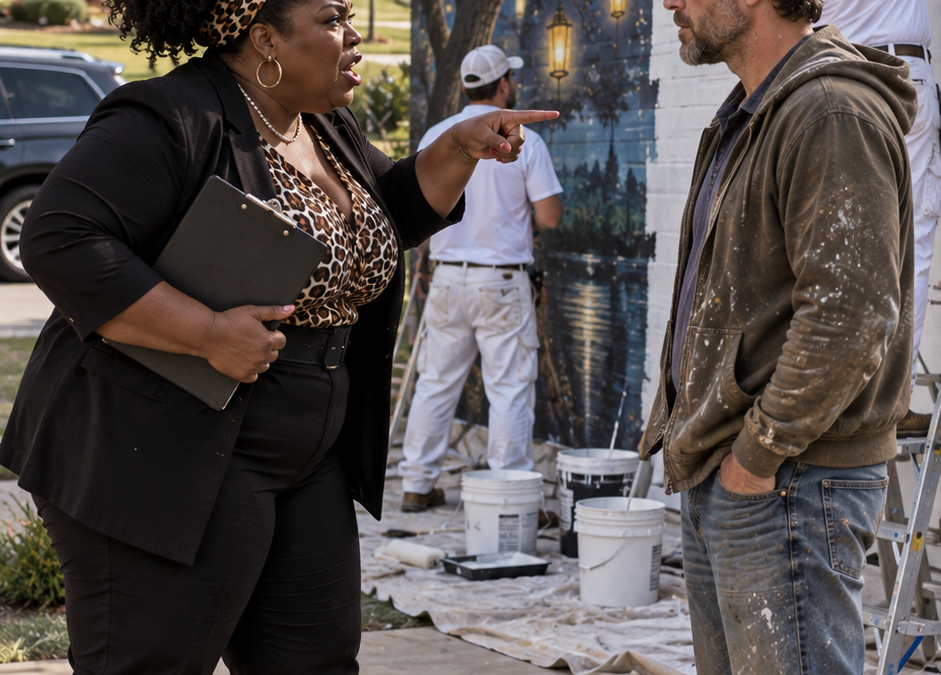
She stood there in a pale green jacket with eleven pages stapled together and the expression of someone delivering instructions rather than introducing herself.
“Elias Wren?”
“Yes.”
“Vanessa Whitcomb. Briar Glen Homeowners Association president.”
She handed me the packet.
“Welcome to the neighborhood. These are the exterior issues we need corrected.”
I looked down.
Eleven items.
Paint color on the garage trim.
A hedge that extended four inches beyond the recommended line.
Trash bins visible from one angle near the road.
A workbench briefly visible when my garage door was open.
And item number one, underlined twice in blue ink:
REMOVE UNAPPROVED GARAGE MURAL.
I looked at her.
“The mural was here before I bought the property.”
“I know.”
“How long has it been there?”
“Too long.”
She smiled.
“It doesn’t comply with current standards.”
“Do you have the original approval file?”
“The original what?”
“For the mural.”
Her face changed slightly.
“It was never approved.”
“How do you know?”
“Because no current approval exists.”
“That isn’t the same thing.”
Her smile thinned.
She glanced past me toward the garage.
“It’s faded. It’s amateur. It looks commercial. It doesn’t fit the neighborhood.”
“I’m going to check its history before I alter anything permanently attached to the property.”
Vanessa laughed.
Short.
Dismissive.
“Mr. Wren, that garage is not one of your antique end tables. You don’t need weeks of research.”
She tapped the violation sheet with one finger.
“Just paint over it.”
That sentence told me more about her than the eleven violations did.
I did not argue.
I thanked her.
Closed the door.
And put the packet in a folder.
A few days later, I was cleaning one lower section of the mural with distilled water and a soft cotton pad.
Not restoring it.
Just checking whether a dark patch near the foundation was mildew or surface dirt.
The light was low that afternoon.
As I stood, I noticed something in the branches of one painted tree.
Letters.
Faint.
Almost hidden in the black pigment.
A. REDDICK.
Below that was a year.
I took photographs.
Close.
Then closer.
That evening I searched the name.
August Reddick.
I knew nothing about him.
The more I read, the stranger the mural became.
Reddick had been an American muralist and painter who worked mostly across the Southwest and Mountain West during the seventies, eighties, and early nineties.
Train stations.
Libraries.
Historic hotels.
Municipal buildings.
His public works were not flashy.
They tended to be atmospheric landscapes, lonely figures, industrial edges, orchards, abandoned towns.
He had a reputation among collectors for embedding private symbols inside commissioned work.
He died in the late 1990s.
A retrospective of his work had recently reopened interest in him.
Auction prices had climbed.
Museums had begun researching missing or undocumented pieces.
But I found no mention of Briar Glen.
No private garage mural.
No Midnight Orchard.
I could have told Vanessa.
I did not.
Not because I wanted to hide anything.
Because I had spent enough years restoring furniture to know what happens when you announce a conclusion before you have evidence.
Someone hears, “Maybe valuable,” and starts sanding.
Or selling.
Or interfering.
I wanted facts first.
I photographed the signature under several light angles and sent the images to the contact address listed for the August Reddick Estate.
I included photographs of the entire mural.
Dimensions.
Location.
What little history I knew.
Then I forgot about it.
Three days later, my phone rang.
“Mr. Wren?”
“Yes.”
“My name is Miriam Bellamy. I’m calling on behalf of the August Reddick Estate.”
My hand stopped over the cabinet hinge I was repairing.
“All right.”
“Before I explain why I’m calling, I need you to check something.”
“What?”
“On the left side of the mural, near the outermost tree. Is there a small silver bird?”
I said nothing.
“Mr. Wren?”
“I’m walking outside.”
I crossed my yard.
Stood in front of the garage.
At first I saw nothing.
Then I found it.
Small.
Maybe three inches long.
Painted on a dark branch in such a muted silver-gray that I had mistaken it for weathering.
“Wings half folded?”
“Yes.”
Miriam exhaled.
“That matters.”
“Why?”
“August used that bird in personal works.”
“Personal meaning?”
“Pieces not made under formal commission. Things for friends. Family. Places that mattered to him.”
I looked across the mural.
“What exactly do you think this is?”
Her answer came slowly.
“For years, the family has had references to a work called Midnight Orchard. We have sketches, diary entries, correspondence. But nobody knew where the finished mural was.”
I felt the back of my neck tighten.
“You think this is it?”
“I think you should not touch it until we know.”
“I wasn’t planning to.”
“No cleaning chemicals.”
“Understood.”
“No scraping.”
“Understood.”
“No pressure washing.”
“Definitely not.”
“And please do not paint over it.”
I looked toward my house.
At the HOA violation packet on the dining table inside.
“That last part may be a problem.”
I told her about Vanessa.
Miriam became very quiet.
“Send me the notice.”
I did.
That afternoon, I emailed the HOA.
I kept the language simple.
I explained that the mural’s origin was under active review by the estate of a recognized artist and asked for enforcement to be paused while authentication was completed.
Vanessa responded the next morning.
Not with a question.
With a $500 fine.
FAILURE TO CORRECT EXTERIOR ART VIOLATION.
Two days later, the running total became $1,250.
A note at the bottom said communication with outside parties did not suspend HOA enforcement.
I requested a board hearing.
The meeting was held the following Wednesday.
Maybe twenty-five residents attended.
Vanessa sat at the center of the board table.
Behind her, she had projected a photograph of my garage wall.
“There it is,” she said.
A few people looked toward me.
“Mr. Wren believes a faded signature may transform an ordinary garage into an art museum.”
A few people laughed.
Not many.
I stood.
“I have correspondence from the August Reddick Estate.”
Vanessa raised one hand.
“You’ve already submitted that.”
“I’d like it entered into the meeting record.”
“You can leave a copy.”
“I’d like to read the relevant portion.”
“That won’t be necessary.”
“It says—”
“Mr. Wren.”
Her voice sharpened.
“The dead do not override community standards.”
Silence.
“Neither,” she continued, “do homeowners who collect old furniture and suddenly imagine themselves qualified to evaluate fine art.”
I felt something warm move through my chest.
I let it pass.
“I don’t collect furniture.”
She smiled.
“I repair it.”
“That’s what I said.”
“No.”
A board member on her right shifted uncomfortably.
I held up Miriam’s letter.
“I am not claiming expertise. I’m asking the board to wait for someone who has it.”
Vanessa leaned back.
“Briar Glen has maintained aesthetic standards for years. We are not freezing enforcement because somebody discovered initials on a wall.”
“Can the board vote on a temporary suspension?”
“No.”
“Why not?”
“Because this is routine enforcement.”
“You can decide that alone?”
“As president, I can make decisions necessary to protect community appearance.”
“Are you trained in conservation?”
A few heads turned.
Vanessa stared at me.
“Excuse me?”
“Art conservation. Appraisal. Historic preservation. Any of those?”
Her expression hardened.
“My position gives me sufficient authority to decide whether this mural belongs in Briar Glen.”
That was the end of the discussion.
Afterward, in the parking lot, an older man approached me.
Thin.
Silver hair.
Brown jacket.
“You’re Elias?”
“Yes.”
“Franklin Dorsey.”
He glanced back toward the clubhouse.
“I remember that mural being painted.”
I stared at him.
“You do?”
“I was a young idiot with too much hair.”
He smiled faintly.
“August stayed around here for a while.”
“At that house?”
“No. Couple streets over. Friend of one of the original owners.”
“Do you know why he painted it?”
“Not exactly.”
Franklin rubbed his chin.
“But I remember a ceremony.”
“What kind?”
“Little ribbon. Folding chairs. Cheap wine.”
He looked amused by the memory.
“The neighborhood association approved the piece. We were proud of it.”
“Do you have anything from then?”
“Maybe.”
He thought.
“I used to take pictures of everything. My wife hated it.”
Two days later, Franklin arrived at my door carrying a grocery bag containing a shoebox.
Inside were photographs.
Faded snapshots.
Early Briar Glen.
Half-finished sidewalks.
Young trees.
Cars with square headlights.
Then I found it.
August Reddick standing in front of my garage.
The mural behind him was fresh.
The blues deeper.
The glowing windows brighter.
The solitary figure unmistakable.
Two association officers stood beside Reddick holding a small certificate.
Another photograph showed a wooden sign leaning against the garage:
MIDNIGHT ORCHARD.
A ribbon ran across the driveway.
Franklin appeared in one corner with much more hair.
On the back of one image, in blue ink, someone had written:
Briar Glen permanent neighborhood art dedication, June 1992.
I sat at my kitchen table staring at the photograph.
Franklin watched me.
“You understand what this means?”
“I think so.”
“It means Vanessa is wrong.”
“That part was already becoming obvious.”
“No.”
He tapped the photograph.
“I mean historically wrong.”
That night, I went through my closing documents.
Every page.
Not just the recent title package.
The older property records transferred from Walter.
Near the bottom of a thin envelope was an addendum dated 1992.
I had barely noticed it before.
The language was formal.
The owner retained title to the physical wall and work.
A designated representative of the artist retained rights to inspect, photograph, document, and assist in preservation.
No material alteration, covering, or destruction could occur without written consent from that representative.
Most importantly for Briar Glen, the mural was expressly exempted from later architectural or aesthetic restrictions.
The original association president had signed it.
The document had been recorded with the property records.
I read it three times.
Then called Miriam.
She arrived five days later.
With her was Jonah Creel, a conservator who had worked on painted masonry, historic murals, and public artworks for more than thirty years.
Jonah did not seem impressed by anybody.
Including me.
He walked straight to the wall.
Put on magnification glasses.
Used raking light.
Took pigment samples from already-flaking microscopic areas.
Photographed the signature.
Measured brick courses.
Studied brush patterns.
Miriam opened a leather portfolio and removed preparatory sketches from Reddick’s private papers.
One showed twisted orchard branches.
Another the walking figure.
Another the arrangement of lighted windows.
Jonah placed a transparent overlay on one photograph.
Every major element aligned.
Even the strange bend of one branch near the center.
Finally, Jonah stepped back.
“This is it.”
Miriam did not smile.
She looked almost relieved.
“Midnight Orchard.”
I stared at the mural I had been walking past every morning for six months.
“What does something like this mean financially?”
Jonah shrugged.
“Depends what you mean by mean.”
“Value.”
“That comes later.”
Miriam answered more directly.
“Potentially significant.”
“How significant?”
“A final appraisal takes time.”
She paused.
“But seven figures is not unrealistic.”
I laughed once.
Not because it was funny.
Because my brain had no useful response.
“This wall?”
“This work,” Miriam said.
That distinction stayed with me.
Not wall.
Work.
The estate moved quickly after that.
Formal authentication.
Conservation planning.
Provenance research.
Catalog registration.
A regional museum expressed interest in a future unveiling once the mural was stabilized.
A publisher wanted reproduction rights for a Reddick monograph.
Jonah recommended a protective system to slow future weathering.
Then attorney Tessa Rowland entered the picture.
Tessa represented the estate in intellectual-property and preservation matters.
She sent Briar Glen a formal notice.
It attached the 1992 addendum.
Authentication findings.
Historic photographs.
A statement that appraisal was underway.
And a direct instruction that nobody alter the mural while the rights questions were being resolved.
Vanessa signed the delivery receipt herself.
Her reply was one sentence.
“The association does not recognize an artist estate’s veto over Briar Glen community standards.”
Tessa called me after reading it.
“Has she always been like this?”
“I’ve known her six months.”
“That wasn’t really an answer.”
“Yes.”
The situation should have stopped there.
Any reasonable board would have paused.
Not because the estate automatically controlled everything.
Not because every legal question had been settled.
But because destroying the mural before those questions were resolved created risk nobody could undo afterward.
Vanessa did not see risk.
She saw interference.
Around that same time, I learned about her Briar Glen Heritage Wall project.
It was supposed to be unveiled in late summer.
Uniform pale facades along the private road.
Donor plaques.
Association achievement boards.
Historic photographs.
A large central plaque crediting Vanessa as founder of the heritage initiative.
My garage stood directly along the visual route planned for the ceremony.
Midnight Orchard did not fit her palette.
It also threatened to become the only thing reporters cared about.
If the mural became recognized as a newly rediscovered Reddick, Vanessa’s carefully designed heritage project risked becoming background.
I cannot prove that was her only motive.
But I know what happened next.
She came to my workshop.
I was repairing an early twentieth-century writing desk.
She stood in the doorway watching me fit a drawer runner.
“I can make the fines disappear.”
I looked up.
“What?”
“All of them.”
“In exchange for?”
“You cover the mural yourself.”
I stared at her.
“The estate hasn’t finished the appraisal.”
“Exactly.”
“You want it gone before they do?”
“I want this community finished with the issue.”
“No.”
“Elias.”
“No.”
She walked inside.
Ran one finger over the edge of the desk.
“You’re letting wealthy people use you.”
“I’m letting qualified people examine a painting.”
“They’ll take their photographs. They’ll get publicity. They’ll make money.”
“That isn’t my concern.”
“Then what is?”
I set down the chisel.
“That I don’t destroy something before I understand what it is.”
She smiled.
“That’s the difference between you and me.”
“What is?”
“I make decisions.”
She glanced around the workshop.
“You repair what other people leave behind.”
I remember that line.
Not because it hurt.
Because she thought it was an insult.
A week later, Jonah’s preliminary valuation arrived.
Insurance value estimate:
$1.65 million.
Initial conservation and stabilization needs:
approximately $110,000.
The work was stable enough to survive if properly protected.
But original pigment was vulnerable.
The regional museum followed with a written expression of interest.
The publisher began discussing licensing.
All of those records existed before the mural was damaged.
That became crucial.
Vanessa next produced what she called an emergency condition report.
A contractor she knew claimed the garage wall had mold, unstable coatings, and possible hazardous material concerns.
The report included close-up photographs.
I stared at them for several minutes.
Something bothered me.
Then I realized the brick bond was wrong.
My garage used common bond with specific header courses.
The photographs showed running bond.
Different brick.
Different mortar.
Different building.
The inspector had not sampled my wall.
Had not entered my property.
Had apparently photographed another structure and used those images to justify action on mine.
I sent a written denial of entry to the HOA.
Tessa Rowland sent another preservation demand.
No painting.
No scraping.
No washing.
No contractor access.
No emergency work absent a genuine documented safety condition.
Vanessa received both.
That same night, she emailed the board requesting an emergency vote.
Only three members responded.
Two supported hiring an independent inspector.
One asked for more time.
Vanessa later treated that as authorization to proceed.
I did not know that yet.
The morning she had the mural painted, I was away delivering a restored dining table.
My front-door camera captured most of what happened.
At 8:11, Vanessa entered my driveway with the contractor.
At 8:13, she stood in front of the mural.
She pointed directly toward the hidden signature.
“Start there.”
One worker asked why.
Her answer was clear.
“Because without the signature, nobody can prove anything.”
The man hesitated.
Vanessa pointed again.
“Cover it.”
They hung tarps.
A neighbor walked over.
Vanessa told her the work involved hazardous-material remediation.
No city inspector was present.
No environmental official.
No conservator.
No emergency.
The contractor opened industrial bonding primer.
One worker suggested they apply a lighter temporary coating until the dispute was resolved.
Vanessa refused.
“I don’t want art people coming back here and finding a way to bring it through.”
After the first coat, she inspected the signature area.
You could still faintly see dark shapes.
She ordered a second coat.
“Make sure nothing bleeds through.”
Before leaving, she had them remove a small bronze marker mounted low near the foundation.
I had barely noticed the marker before.
It disappeared into the contractor’s truck.
At 11:04, Tessa Rowland’s final warning email landed.
DO NOT LET ANYONE TOUCH MIDNIGHT ORCHARD.
The message went to me.
Vanessa.
The management company.
Every board member.
Attached were the appraisal summary, authenticated provenance documents, and another copy of the recorded exemption.
Vanessa opened the message.
We know that from server records.
The crew kept painting.
I returned after lunch.
Turned onto the street.
And saw white.
Not bright white.
A dull institutional beige-gray.
The color of a hallway nobody remembers.
For a second, my mind refused to understand the shape.
I kept driving.
Then stopped.
The orchard was gone.
The black trees.
Golden windows.
The walking figure.
The silver bird.
All buried.
Vanessa stood in my driveway.
Two workers were cleaning rollers.
She smiled.
“Now it looks appropriate.”
I got out.
I do not remember shutting the truck door.
I walked toward the wall.
Fresh paint dripped along the lower bricks.
One drop had reached the concrete.
Another hung thickly from a mortar joint.
The surface looked dead.
Flat.
Vanessa held out a sheet of paper.
“Your invoice.”
I took it.
$6,800.
Surface preparation.
Industrial primer.
Two finish coats.
Emergency remediation.
Association oversight.
“You’re billing me?”
“The association corrected the violation.”
“Who authorized you to enter my property?”
She sighed.
“Elias, please.”
“I asked who authorized entry.”
“We were addressing a compliance and safety issue.”
“Who gave permission?”
“You’ve been warned repeatedly.”
“That isn’t permission.”
Her eyes narrowed.
“You really need to stop pretending that repairing old chairs makes you a property lawyer.”
One of the painters looked at the ground.
I turned to him.
“What primer did you use?”
He pointed toward the cans.
I photographed the label.
The license plate.
The wall.
The invoice.
The wet paint.
Everything.
The worker spoke quietly.
“She wanted the high-adhesion stuff.”
Vanessa turned.
“That’s enough.”
He stopped.
My phone vibrated.
Tessa’s email.
I opened it.
Read the subject.
Checked the timestamp.
Then the recipient list.
Vanessa had been copied.
Three hours before the first roller.
I looked at her.
“Did you read Tessa Rowland’s email this morning?”
“I don’t need instruction from some art lawyer about how Briar Glen operates.”
That answer ended any doubt I still had.
Several neighbors had gathered.
Vanessa turned slightly toward them.
“A grown man should know how to accept it gracefully when women in charge have to clean up his mess.”
I heard someone inhale sharply.
I did not respond.
Not because I was calm inside.
I wasn’t.
I wanted to tear the invoice in half.
I wanted to shout.
I wanted the paint crew back with solvents immediately.
But restoration work had taught me one thing more useful than anger.
When damage happens, stop touching it.
Preserve the scene.
Document first.
So I did.
I called Miriam.
Then Jonah.
Then Tessa.
They arrived that afternoon.
Jonah walked to the wall and stopped.
His face did not change much.
That frightened me more than anger would have.
He put on gloves.
Took microscopic edge samples.
Examined adhesion.
Tested the fresh coating.
Studied where paint had entered old brick pores.
After almost an hour, he said,
“This can be treated.”
Miriam’s shoulders lowered slightly.
“Recovered?”
“I didn’t say recovered.”
She looked at him.
“Jonah.”
“The primer has chemically bonded to unstable historic layers. Some original pigment came away during application. Some will come away during removal. We can separate portions, stabilize others.”
“How bad?”
“Expensive.”
He looked at the wall.
“And the original integrity has been materially damaged.”
Miriam stood there a long time.
Then she placed two fingers against the painted brick.
I remember that image more than anything else from that afternoon.
Not her crying.
She did not.
Not shouting.
None.
Just two fingers on the blank wall where a painting her family had searched for had existed that morning.
Finally, she turned toward me.
“Did Vanessa know the appraisal figure?”
“Yes.”
“How do you know?”
I showed her the delivery confirmation.
The email open record.
The attachments.
Tessa Rowland closed her folder.
“This is no longer an architectural dispute.”
Three days later, formal claim packets arrived by courier.
Vanessa.
The board.
Management company.
Contractor.
The demand was $2.4 million.
$1.65 million tied to lost or diminished value.
$480,000 estimated for stabilization, restoration, treatment, and monitoring.
$270,000 tied to interrupted exhibition, publication, and licensing opportunities.
The demand also required preservation of every email.
Every text.
Board records.
Contractor instructions.
Invoices.
Voting records.
Insurance communications.
And return of the missing bronze marker.
Vanessa called an emergency meeting.
The room was packed.
She began by accusing me of orchestrating a financial scheme with the estate.
“This is extortion dressed up as preservation.”
I sat in the back.
Exactly where she had assigned me.
She displayed my $6,800 invoice on the projector.
“Mr. Wren refuses to reimburse Briar Glen for correcting his own violation.”
Some residents nodded.
Most still did not know what had happened.
Vanessa continued.
“He repairs furniture for a living. That does not make him an art expert.”
I waited.
“He claims he accidentally purchased a million-dollar masterpiece attached to his garage.”
A few people murmured.
“He expects all of you to believe that.”
She moved to the next slide.
Photographs of the mural before destruction.
Underneath:
UNAPPROVED GRAFFITI.
Then:
POTENTIAL HAZARD.
Then:
PROPERTY VALUE CONCERNS.
She argued that the signature could have been added.
Franklin’s photographs could have been staged.
The estate could have inflated the value after the fact.
The 1992 addendum, she claimed, had no binding relevance to the present association.
Then she suggested my objections had less to do with the mural than with my inability to accept being told what to do by a woman.
I let her finish.
When she finally asked whether I had anything to say, I stood.
“Three questions.”
She crossed her arms.
“Go ahead.”
“Did you read the estate’s preservation notice before the painting was authorized?”
“Yes.”
“Did you personally supervise the contractor?”
“Yes.”
“Did you believe you had the authority to cover the mural regardless of the estate’s objection?”
“Yes.”
No hesitation.
She thought certainty was helping her.
The board secretary wrote every answer down.
I sat.
Vanessa smiled slightly, as though she had just proven something.
Then Tessa Rowland stood from the middle row.
“Vanessa Whitcomb?”
Vanessa’s smile vanished.
Tessa introduced herself.
“Counsel for the August Reddick Estate.”
Miriam walked forward carrying a portfolio.
Jonah followed.
Franklin stood too.
One by one, they placed documents on the board table.
Reddick’s original sketches.
Private notebook pages.
Historic photographs.
The 1992 dedication ceremony.
The recorded exemption.
Authentication report.
Jonah’s preliminary condition report.
Appraisal completed before destruction.
Museum letter.
Publishing correspondence.
Then Franklin identified himself.
“I took that photograph.”
Vanessa looked at him.
“You expect us to accept a thirty-year-old snapshot as proof?”
A document specialist had already examined it.
Paper.
Ink.
Processing.
Age.
Everything consistent.
Tessa explained that.
Then she displayed the appraisal date.
Three days before the painting.
“So the $1.65 million figure existed before any damage occurred.”
Vanessa said nothing.
Next came the contractor’s hazard report.
Tessa projected one of the photographs.
Then a photograph of my actual garage.
Different brick.
Different mortar.
Different building.
“There was no verified mold emergency.”
A resident near the front said,
“You used pictures from another house?”
Vanessa leaned toward her microphone.
“The contractor provided those materials.”
Tessa continued.
“Now the email.”
She projected Vanessa’s message to the contractor.
Cover the signature first.
The room went quiet.
Vanessa shifted.
“That wording is being taken out of context.”
Tessa looked at her.
“Please explain the context in which ordering a contractor to cover identifying evidence first means something else.”
Vanessa opened her mouth.
Nothing came.
Tessa nodded toward me.
I stood.
Connected my phone to the room display.
Then played the camera footage.
Timestamp.
Vanessa entering my driveway.
Pointing at the signature.
“Start there.”
The worker asking why.
“Because without the signature, nobody can prove anything.”
Someone in the room whispered,
“Oh my God.”
The video continued.
The first coat.
Worker suggesting they pause.
Vanessa refusing.
“I don’t want art people coming back here and finding a way to bring it through.”
Then the second coat.
“Make sure nothing bleeds through.”
Nobody spoke.
When the clip ended, Vanessa looked smaller.
Not physically.
In relation to the room.
Marlene Shaw, the board vice president, stood next.
“I have something too.”
She carried a printed email chain.
Vanessa turned toward her.
“Marlene, this should be discussed privately.”
“No.”
Marlene looked exhausted.
“The emergency vote never passed.”
A murmur spread.
“What do you mean?” someone asked.
“Vanessa sent an email requesting emergency authority. Three people responded.”
She held up the thread.
“Two of us approved hiring an inspector.”
She looked directly at Vanessa.
“Neither approved painting.”
Another resident asked,
“But the minutes say it was unanimous.”
Marlene’s face tightened.
“The minutes were altered afterward.”
The room changed.
She displayed the original thread.
Then the final minutes.
A board member who had been out of state was listed as voting yes.
He stood from the back.
“I never voted.”
Vanessa started talking quickly.
“This is being distorted. The president has emergency authority—”
“Not to falsify my vote,” he said.
The insurance representative was present too.
He had been silent until then.
Now he stood.
“The carrier has reviewed the preliminary record.”
Everybody turned.
“We have not made a final coverage determination.”
Vanessa looked relieved for half a second.
Then he continued.
“However, intentional acts undertaken after explicit warning and outside valid board authorization may fall outside applicable coverage.”
Vanessa’s face changed.
That was the first time I saw genuine fear.
Not anger.
Fear.
“You’re saying you won’t defend me?”
“I’m saying coverage is under review.”
“You represent the association.”
“We insure the association under specified terms.”
He paused.
“And those terms matter.”
Tessa walked forward.
She placed the claim packet in front of Vanessa.
$2,400,000 was printed on the first page.
The same woman who had handed me a $6,800 invoice now stared at a number more than three hundred times larger.
Marlene moved to suspend her authority immediately.
Another board member seconded.
The vote passed.
Association access credentials revoked.
Contract authority frozen.
Credit-card access frozen.
Records preserved.
Independent counsel retained.
Residents started talking at once.
Vanessa remained standing.
Finally, she looked toward me.
“You destroyed my reputation.”
I stood.
“No.”
She stared.
“I kept the footage.”
That was all I said.
The recall petition began that night.
Within two months, Vanessa was removed from the board.
The management company terminated her authority as any representative of Briar Glen.
The contractor cooperated.
He turned over text messages.
Work orders.
Invoices.
And admitted Vanessa had personally insisted on the high-bond primer and second coat.
His insurance contributed to the eventual settlement.
Further review found that Vanessa had used “emergency remediation” procedures before.
Not for million-dollar murals.
For fences.
Landscaping.
Exterior alterations.
Situations where waiting for a full vote would have slowed her down.
The mural case finally forced the board to examine a pattern it had tolerated because most earlier consequences had been smaller.
The $6,800 invoice disappeared.
So did every mural-related fine.
The association later filed its own claim against Vanessa for costs resulting from actions taken outside her authority.
Settlement negotiations took months.
I was not involved in every part.
The estate handled its claim.
The HOA handled its own exposure.
The contractor had counsel.
The management company had counsel.
Vanessa had eventually hired personal counsel once the insurance question became serious.
The final agreement was confidential in many respects.
Public filings confirmed the total estate resolution exceeded seven figures.
Part came from the contractor’s insurer.
Part from association funds and available coverage.
Part from Vanessa personally under a separate agreement.
I later heard she sold a vacation property.
I never checked.
I did not need to know whether she suffered enough.
I cared about the wall.
Restoration began that winter.
Jonah’s team worked slowly.
Painfully slowly.
If you have never watched a conservator remove modern paint from historic pigment, it looks less like painting and more like surgery.
Small sections.
Solvent testing.
Gels.
Microscopic lifting.
Stabilization.
Stop.
Document.
Repeat.
Some sections came back beautifully.
Others did not.
There were places where the industrial primer had bonded so deeply that removing it without taking original paint was impossible.
The estate made a decision I respected.
They would not fake completeness.
Where something had been permanently lost, they stabilized the surrounding image rather than inventing a replacement that pretended nothing had happened.
Midnight Orchard would survive.
But it would carry evidence of its damage.
The official conservation record would say why.
Nearly a year passed.
Then one afternoon Jonah called me outside.
He pointed toward the branches on the left.
There.
The silver bird.
Faint.
Not untouched.
But visible again.
Later came the signature.
A. REDDICK.
The letters emerged gradually beneath the layers Vanessa had specifically ordered covered first.
I stood there longer than I expected.
Jonah looked at me.
“You all right?”
“Yeah.”
“You look like you’re about to cry.”
“I restore furniture.”
“So?”
“We’re not supposed to cry.”
He laughed.
“Bull.”
Briar Glen changed too.
The new board adopted rules requiring actual documented emergencies before any officer could authorize entry onto private property without consent.
Permanent exterior work required a recorded vote.
No single officer could sign a contractor agreement for irreversible work.
Historic exemptions had to be checked before enforcement against older properties.
Original records were digitized.
I was asked to join the board.
I declined.
Instead, I built them an archive cabinet.
Quarter-sawn oak.
Deep drawers.
Acid-free document boxes.
Proper labels.
That felt more useful.
A year after restoration began, Midnight Orchard was formally entered into the August Reddick catalog.
The estate funded a small bronze plaque beside the garage.
Not large.
Not theatrical.
It listed:
MIDNIGHT ORCHARD
AUGUST REDDICK
1992
Then a short note about conservation.
Vanessa’s name was nowhere on it.
That seemed right.
The unveiling was smaller than the museum originally imagined.
A few reporters.
Residents.
Art historians.
Franklin.
Miriam.
Jonah.
Tessa Rowland.
I stood toward the side.
I had already spent enough time in front of rooms because of that wall.
After most people left, Miriam stayed behind.
She looked at the mural.
Then at me.
“Do you ever regret buying the house?”
I laughed.
“Ask me after the next HOA letter.”
“I’m serious.”
I thought about it.
“When I moved in, I thought the mural just made the garage interesting.”
“And now?”
I looked at the solitary figure at the end of the painted path.
“Now I think it revealed more about the people standing in front of it than the man who painted it.”
Miriam nodded slowly.
I had spent my whole career looking at damaged things.
The damage is rarely the whole story.
A scratched table tells you someone used it.
A split joint tells you where stress traveled.
Bad refinishing tells you what somebody valued at the time.
Paint can hide craftsmanship.
It can also reveal arrogance.
Vanessa believed authority lived in visible things.
A clipboard.
A president’s title.
An association letterhead.
A contractor willing to follow instructions.
A key that opened a gate.
A room full of people accustomed to letting her speak first.
She believed if she could physically cover something, she could make its claim disappear.
That assumption guided almost every decision she made.
Cover the mural.
Cover the signature.
Cover the vote.
Cover the warning.
Cover the old exemption.
Cover the lack of authority.
Cover the hazard report with enough official language that nobody would look closely at the photographs.
But covering something is not the same as erasing it.
The original association records still existed.
Franklin’s photographs still existed.
The addendum still existed.
Reddick’s sketches still existed.
The estate’s email still existed.
The appraisal timestamp still existed.
The camera footage still existed.
The board’s original email thread still existed.
Even the contractor’s invoice existed.
Especially the invoice.
The $6,800 bill Vanessa handed me like proof she had won became proof that the job had been ordered, performed, and paid for under her direction.
She created evidence everywhere she went.
That is the part people misunderstand about power.
Real authority does not fear records.
It creates them correctly.
Vanessa wanted obedience without verification.
And because everybody around her had spent years giving her the first, she stopped respecting the second.
I also thought often about the comment she made the day she painted the garage.
That men who owned garages mistook hobbies for art.
I was never offended by the part about my work.
Furniture restoration is honest labor.
I like using my hands.
I like sawdust.
I like glue.
I like seeing a chair stand solidly again after someone thought it was finished.
What bothered me was the assumption underneath her words.
She believed practical work and serious knowledge could not occupy the same person.
She looked at my apron.
My old pickup.
My workshop.
And decided I was a man who would not understand provenance.
Or contracts.
Or records.
Or value.
She made the same mistake with the mural.
Old garage.
Faded paint.
No museum label.
Therefore worthless.
Vanessa kept judging things by the surface.
That was her weakness from the beginning.
And it was an especially dangerous weakness for someone who believed she should decide what deserved to survive.
The mural looks different now.
If you saw photographs from 1992 beside the restored wall, you would notice the losses.
Some midnight blue is gone.
One section of branches has weaker contrast.
A few golden windows have been reconstructed only enough to make the design readable.
Under certain light, you can still see a faint pale veil where the primer permanently altered the brick.
Jonah once asked whether those marks bothered me.
“No.”
“Why?”
“They’re part of it now.”
He nodded.
“That’s what Miriam said.”
I would not have chosen the damage.
Nobody should romanticize destruction just because restoration followed.
But pretending the damage never happened would have been another kind of lie.
Midnight Orchard survived Vanessa.
Not unchanged.
Survival rarely means unchanged.
Sometimes I stand outside in the evening after finishing work.
The mural catches the low light.
The black trees become almost real.
The golden windows seem warmer.
The walking figure at the end of the path still faces away.
I have wondered who he was supposed to be.
August?
Somebody he lost?
Nobody specific?
Miriam said Reddick never explained it in the notes they found.
I like that.
Not everything needs an answer.
But the silver bird is there.
Small.
Easy to miss.
Exactly where Miriam said it would be the first time she called.
That little bird changed the course of everything.
Had it not been there, maybe the estate would have taken longer.
Had the signature been completely gone, authentication might have been harder.
Had Franklin thrown away his photographs, provenance would have been weaker.
Had I ignored the old addendum, Vanessa might have believed even longer that her standards controlled the wall.
None of those things alone saved Midnight Orchard.
Together, they formed a chain.
I sometimes think Vanessa lost because she did not understand chains of evidence.
She understood single acts.
Issue a violation.
Send a fine.
Call a contractor.
Hold a meeting.
Paint a wall.
She believed every act replaced the thing before it.
The newest order defeated the old one.
The newest coat of paint defeated the old image.
The newest board policy defeated the old agreement.
But records do not work that way.
History accumulates.
Rights accumulate.
Evidence accumulates.
You cannot simply place a fresh layer over what came before and assume the earlier layer stopped existing.
That is true of furniture.
It is true of art.
And apparently it is true of homeowners associations.
The new Briar Glen board is quieter.
That might be the greatest improvement.
They send questions instead of declarations.
Once, a board member emailed me because the plaque beside Midnight Orchard was technically outside the preferred metal-finish palette.
He wrote:
“I assume the recorded exemption covers this, but I wanted to verify before we update our files.”
I laughed for five minutes.
Then I replied:
“Yes. Thank you for checking.”
That was the entire dispute.
No emergency meeting.
No contractor.
No lawyers.
No seven-figure claim.
Just someone asking before deciding.
Franklin still lives three streets over.
Every few months, he walks down to look at the mural.
The first time after restoration was complete, he stood with his hands in his pockets.
“Looks older.”
“It is older.”
“No, I mean compared to what I remember.”
“Thirty years will do that.”
He smiled.
“August would’ve hated the plaque.”
“Why?”
“He hated explaining his paintings.”
We both looked at it.
Then Franklin pointed at the pale scars left by the primer.
“He would’ve hated that too.”
“Probably.”
“You ever wish it looked exactly like it did?”
“Sometimes.”
He nodded.
“Me too.”
Then he said something I have remembered.
“But if it did, nobody would know what it survived.”
I am not sure August Reddick would have agreed.
But I understood what Franklin meant.
Vanessa moved out of Briar Glen eventually.
Not immediately.
For months, I still saw her.
At the grocery store once.
Driving through the neighborhood.
Walking to her mailbox.
People expected some dramatic confrontation between us.
There never was one.
The last time we spoke happened by accident.
I was loading a restored dresser into a client’s truck.
She stopped on the sidewalk.
For a moment, neither of us said anything.
Then she looked toward the mural.
“They made you a hero out of this.”
“No.”
She gave me that old thin smile.
“Of course they did.”
“I didn’t save it.”
“Right.”
“The conservators did.”
She looked at me.
“The estate did.”
I tightened a strap around the dresser.
“Franklin saved photographs. The original board saved the exemption. My camera saved the footage. The secretary saved the emails.”
Her smile disappeared.
“A lot of people saved pieces.”
I closed the truck tailgate.
“You were the only person trying to erase them.”
She walked away.
That was the last conversation we had.
The estate’s settlement fund later helped preserve other Reddick works.
Miriam sent me photographs occasionally.
A fading hotel mural stabilized in New Mexico.
A railway-panel series cleaned and documented.
A small private canvas authenticated for a family that had owned it for decades without knowing exactly what it was.
I liked that part of the outcome.
The money did not simply become a number attached to Vanessa’s loss.
It went back into keeping things from disappearing.
That felt appropriate.
My own life returned to normal.
Which is another way of saying I went back to repairing furniture.
A normal week still contains chairs with loose joints.
Tables with water rings.
Cabinets somebody tried to fix with drywall screws.
People sometimes assume after the publicity that I became an art dealer.
I did not.
I remain much better with dovetails than auction catalogs.
But I look at old surfaces differently now.
Not because I believe every faded object hides a million-dollar secret.
Most do not.
The lesson was never that old things are secretly valuable in money.
The lesson was that value deserves investigation before destruction.
Sometimes the answer will be:
It is ordinary.
Sometimes:
It can be replaced.
Sometimes:
There is no reason to save it.
But you ask first.
You look.
You read.
You verify.
Vanessa did the opposite.
She decided first.
Everything afterward existed only to support the decision she had already made.
That was why the warning letters did not matter to her.
The photographs did not matter.
The addendum did not matter.
The estate did not matter.
Jonah’s credentials did not matter.
The appraisal did not matter.
Even the board’s lack of approval did not matter.
Once Vanessa decided the wall should be pale and uniform, every contradictory fact became an inconvenience.
And when enough facts become inconvenient to one person, destruction starts to feel efficient.
That is what frightened me most in hindsight.
Not the money.
Not the lawsuit.
Not even the paint.
The ease with which she convinced herself she had the right to make something disappear simply because she considered it ugly.
That is why I stayed calm.
People later praised me for that.
They should not.
Staying calm was not noble.
It was practical.
I knew if I screamed, Vanessa would remember my anger.
If I threatened, the contractor would remember the threat.
If I tore down signs or grabbed rollers, there would be a second story competing with the first.
So I photographed.
Saved emails.
Asked questions.
Kept receipts.
Let people speak on the record.
That is what restoration taught me.
Do not create new damage while trying to understand old damage.
The most valuable evidence Vanessa provided was usually given freely because she never imagined anyone would question her authority.
She admitted reading the warning.
Admitted supervising the crew.
Admitted believing outside objections did not matter.
Admitted it in front of the board secretary.
On video.
In writing.
With invoices.
She was not tricked.
She was documented.
There is a difference.
The Heritage Wall Vanessa planned was eventually completed too.
The new board changed the concept.
No giant founder plaque.
No uniform pale facades.
Instead, they used photographs of Briar Glen across several decades.
Old homes.
New homes.
The first pool.
Storm damage.
Tree planting.
Neighborhood events.
And one picture Franklin donated.
August Reddick standing in front of Midnight Orchard in 1992.
I saw it during the installation.
Underneath was a small caption.
Neighborhood art dedication.
No mention of Vanessa.
No mention of me.
Perfect.
Briar Glen had wanted heritage.
It turned out heritage was not the same thing as making everything match.
Sometimes heritage is the one thing that refuses to.
On warm evenings now, people occasionally stop near my garage.
Not crowds.
A couple walking a dog.
A resident showing visiting relatives.
An art student once sat on the curb sketching for nearly an hour.
At first I found it strange.
Then I got used to it.
The estate installed a small weatherproof information plate with a QR code for people who wanted more history.
That was enough.
No ropes.
No museum guards.
It remained what Reddick had apparently intended from the beginning.
A painting on a wall people lived beside.
One autumn evening, I came outside and found a little girl standing with her father in front of the mural.
She pointed toward the silver bird.
“Why is that there?”
Her father said he did not know.
She saw me.
“Do you?”
“I know why it matters.”
“Why?”
I thought about Miriam’s first phone call.
The estate.
The lawsuit.
The primer.
The restoration.
All of it because of a bird hardly bigger than my palm.
“It tells you who made the painting.”
She frowned.
“But there’s a name too.”
“Yes.”
“Then why have the bird?”
I smiled.
“Maybe the artist wanted one thing in the painting that only certain people would know to look for.”
She considered that.
Then went back to staring at it.
Kids accept mystery more easily than adults.
Maybe Vanessa’s problem was that she could not.
Anything she did not immediately understand had to be classified.
Approved.
Unapproved.
Attractive.
Ugly.
Compliant.
Violation.
Useful.
Mess.
She had no category for something that required patience.
My whole life had been built around patience.
Glue needs time.
Wood moves with seasons.
Finishes cure.
Repairs reveal themselves slowly.
An old piece tells you what it needs if you stop trying to impose an answer too quickly.
Midnight Orchard was the same.
It survived three decades because most people before Vanessa had simply let it exist.
She needed six months to nearly destroy it.
And even then, she failed.
The wall still stands.
The mural still lives on it.
The scars remain.
The silver bird remains.
The signature remains.
And the walking figure is still heading down that dark painted path with his back to all of us.
Sometimes I wonder what Vanessa saw when she looked at him.
Probably nothing.
She saw faded paint.
An inconvenience.
A surface that refused to match.
I saw something I wanted to understand.
That small difference became very expensive.
Not for me.
For her.
Vanessa once stood in my driveway beside a freshly painted wall and handed me a $6,800 bill because she believed covering something gave her the last word.
What she never understood was that white paint only covered the surface.
Underneath it were thirty years of history, a recorded exemption, old photographs, an artist’s private mark, a million-dollar appraisal, a lawyer’s warning, an unedited camera file, and her own voice ordering the evidence erased.
She thought two coats would make Midnight Orchard disappear.
Instead, they made sure nobody would ever forget who tried.








