𝗙𝗨𝗟𝗟 𝗦𝗧𝗢𝗥𝗬 Vanessa Never Asked Why That Wind Gauge Had Been Turning Above My Field for Eleven Years
𝗣𝗔𝗥𝗧 𝟮
Her mouth tightened slightly.
She changed the subject.
She once asked me to park my pickup behind the barn because it was visible from the eastern homes.
My truck was nineteen years old at the time, dark blue, with a dented tailgate.
It ran perfectly.
Vanessa seemed personally offended by the dent.
On another visit, she handed me a printed page titled something like Elevating Landscape Standards to Protect Property Values in the Surrounding Area.
She kept saying “surrounding area” as if those two words had somehow annexed my land.
I listened because I was raised to let people finish sentences.
Then I told her no.
That usually ended the conversation.
The important fact was simple.
I did not belong to Silver Crest.
My parcel predated the subdivision by decades.
It was not part of their plat.
It was not subject to their covenants.
No deed restriction tied my property to their homeowners association.
No agreement gave Vanessa authority over my fences, my barn, my truck, my grass, or my runway.
I knew that.
The county knew that.
My attorney knew that.
Vanessa either never bothered to learn it or believed authority was something that became real if you exercised it confidently enough.
For years, the cost of that belief was mostly my patience.
Then she noticed the wind gauge.
The Silver Crest clubhouse patio looked directly toward it.
Sometime in early spring, Vanessa decided the instrument was a problem.
She called it “industrial.”
Then “visually incompatible.”
Then an “eyesore.”
At one point she told me it made the view from the clubhouse “read as utility rather than estate.”
I still don’t know exactly what that means.
What I did understand was that she wanted it gone.
She also told me prospective buyers had begun asking about aircraft.
She pronounced the word aircraft the way some people say termites.
I explained the gauge once.
Only once.
We were standing by the fence.
I told her it supported the airfield.
I explained that it logged wind data.
I told her the information became part of my operating records.
And I told her the instrument was not decoration.
Therefore, it was not being removed.
Vanessa tilted her head.
Then she smiled.
“Calvin, that is a field with a strip of grass on it. Please don’t call it an airport like you’re running Kennedy out there.”
Two board members were standing with her.
One of them immediately looked down.
That detail stayed with me.
He understood she had crossed a line even if she didn’t.
I did not explain anything else.
I did not defend the size of the field.
I did not list registration numbers.
I did not tell her how many flights I made.
I did not argue about terminology.
Because once somebody tells you what your property is after you have already told them what it is, more explanation usually does not improve the situation.
I looked at her and said four words.
“Don’t touch the equipment.”
She smiled again.
“I’ll be in touch through the proper channels.”
Nine days later, I received a letter on Silver Crest stationery.
Embossed pine trees along the border.
Official-looking font.
The title read:
COURTESY NOTICE.
It informed me that an “unapproved structure exceeding permitted height” was visible within the community’s “designated view corridor.”
I was requested to remove it within fourteen days to avoid further escalation.
There were references to neighborhood aesthetics.
Architectural standards.
Property values.
There was no recorded covenant attached.
No legal description of my parcel.
No county ordinance.
No survey.
No statute.
Nothing explaining how Silver Crest acquired authority over forty-two acres it did not own.
Vanessa had signed the letter herself.
I replied in one sentence.
“Your covenants do not apply to my parcel.”
I signed it.
Sent it certified.
And kept the receipt.
That was all.
I could have sent the deed.
I could have sent the survey.
I could have spent three pages explaining metes and bounds descriptions.
But I believed Vanessa deserved one opportunity to discover that she might be wrong.
She took the letter as proof that I was defying her.
The crew arrived the following Tuesday at 7:12 in the morning.
I remember the exact time because the engine woke me.
It was a diesel laboring up the service road on the north side of my property.
That road existed for me to move equipment to the far end of the runway.
A mower.
Fuel.
Maintenance tools.
It was entirely on my land.
There was a gate at the county road.
That morning, the gate was open.
I put on my boots and went outside.
By the time I reached the north end of the strip, a white flatbed truck was parked near the gauge.
A landscaping company logo was painted on the door.
The bucket lift was still extended.
Two workers in green shirts stood beside the truck.
Their foreman, Travis Boone, was near the rear wheel.
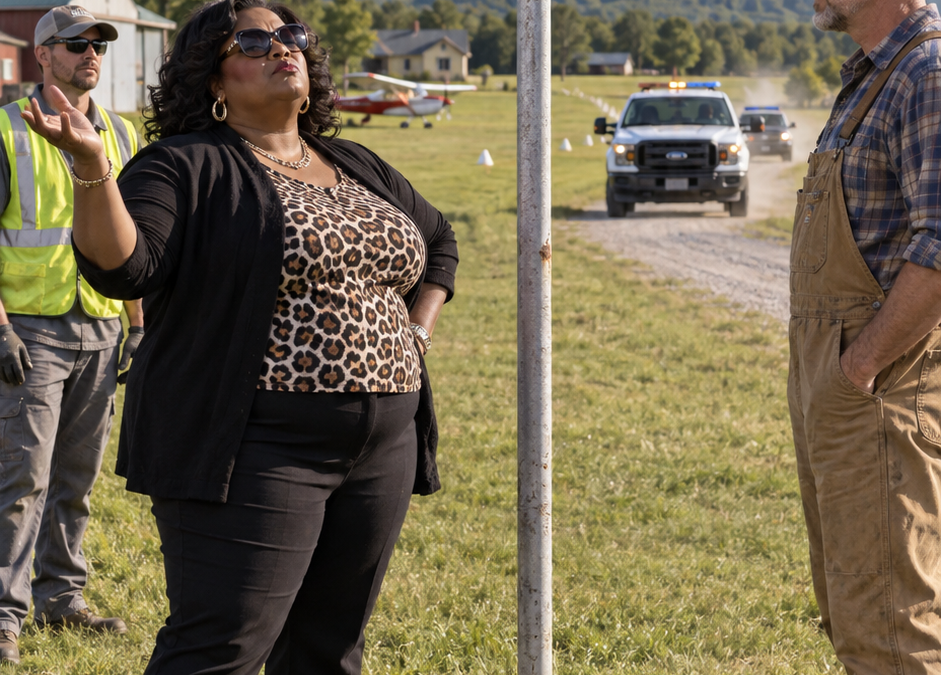
And Vanessa Halbrook stood about fifteen feet away with her arms folded.
My wind gauge was already down.
It lay on the flatbed.
The vane was bent.
A section of conduit dangled from the mounting collar.
The logger housing had been disconnected.
I had spent an entire weekend installing and calibrating that equipment.
They had destroyed the integrity of the system in less than ten minutes.
Vanessa saw me coming.
I did not run.
I did not shout.
I did not threaten anybody.
People sometimes confuse restraint with fear.
It usually has more to do with arithmetic.
There were four of them and one of me.
They were already on my property.
They had already decided they belonged there.
If I shoved somebody, grabbed the equipment, blocked the truck, or lost my temper loudly enough for someone to call law enforcement, the story could be rewritten before I had even finished telling it.
Suddenly I would not be the property owner whose equipment had been removed.
I would be the angry man who confronted a work crew.
I understood how easily that transformation could happen.
So I pulled out my phone.
And I recorded.
Vanessa saw it.
She saw the red recording symbol.
She kept talking anyway.
“The association is removing an unapproved structure within the Silver Crest landscape maintenance zone.”
Her delivery sounded rehearsed.
I asked one question.
“Do you have a boundary survey?”
She held up an iPad.
“I have the community plan.”
She turned the screen toward me.
It was a colored map.
Green areas.
Tan areas.
Lot numbers.
A decorative legend.
And a dashed line that extended east of the last row of houses, beyond my fence.
It looked convincing if you had never seen an actual survey.
But I had.
There was no surveyor’s seal.
No bearings.
No measured distances.
No monument references.
No recording number.
No field date.
No legal description.
It was a marketing site plan.
The kind developers put in sales materials.
The dashed line represented a conceptual landscape buffer.
Not ownership.
“Who gave you permission to enter my property?” I asked.
Vanessa’s expression changed.
Not much.
Just enough.
“I don’t need a lecture about property from you.”
The phone caught every word.
Then she turned toward Travis.
“Load everything.”
Travis hesitated.
His eyes moved from the post to the fence roughly ninety feet west.
Then back to Vanessa.
He said something quietly.
I only caught the final word.
“Survey.”
Vanessa answered louder.
“The association has it handled. Finish the job.”
Travis finished the job.
I watched the truck leave.
Then I went inside.
I made coffee.
And I opened the file cabinet.
My father bought that cabinet at a government auction sometime before I started high school.
Four drawers.
Steel.
Ugly.
Nearly impossible to move.
It held the institutional memory of our airfield.
The first drawer contained title documents and surveys.
The second contained registration paperwork, inspection history, and correspondence with the state aviation office.
The third held operations documents.
Approach information.
Maintenance logs.
Grading records.
Wind summaries.
Obstruction notes.
The fourth drawer was what I privately called the neighbor drawer.
Anything built within roughly a mile of the property eventually ended up there.
My father started that habit.
If someone planned a tower, road, subdivision, utility pole, or anything else near the airfield, he requested public records.
He used to say that obstacles were easiest to deal with before concrete hardened around them.
Inside that drawer was a folder labeled COLEMAN PASTURE in his handwriting.
That became Silver Crest.
I had read portions of the file years earlier.
That morning, I read all of it.
Preliminary plats.
Planning commission minutes.
Drainage reports.
Traffic studies.
County conditions of approval.
The language I needed was buried on page four.
It said, in substance, that because the proposed subdivision bordered an existing registered public-use airfield, final approval required an airport compatibility agreement between the developer and the airfield owner.
The obligations would run with the land.
They would bind successors.
And they would expressly bind any homeowners association later formed.
I stopped.
Read it again.
Then I searched deeper in the folder.
The agreement was there.
Six pages.
Signed in 2013.
Recorded.
I remembered signing it.
County conference room.
A developer representative who spent most of the meeting looking at his phone.
A notary fanning herself with another file because the air conditioning was struggling.
At the time, the agreement had seemed routine.
Now I read every line.
It included a navigation easement over designated portions of the neighboring property.
There were height restrictions tied to defined approach and transitional surfaces.
There was a requirement that the airfield owner receive written notice before any structure, landscaping, or vegetation was installed within the designated compatibility zone.
Then I reached paragraph nine.
No party bound by the agreement could interfere with, alter, damage, or remove navigational, meteorological, or operational equipment associated with the airfield.
I read it once.
Then again.
Then a third time.
Vanessa had not simply sent a landscaping crew onto land her association did not own.
She had ordered the removal of documented operational equipment from a registered airfield.
And she had done it on behalf of an association specifically bound by a recorded agreement prohibiting exactly that conduct.
Better still, from an evidentiary standpoint, she had identified herself on camera while doing it.
I spread the documents across my kitchen table.
Survey.
Registration certificate.
Compatibility agreement.
Operating logs.
Photographs.
Video.
Then I called the state aviation office.
I did not call Vanessa.
I did not call the sheriff.
I did not begin with my attorney.
I called the people responsible for airfield compliance.
A woman answered in the compliance section.
I kept the explanation simple.
“Operational meteorological equipment belonging to my registered airfield was removed this morning by a third party without authorization. I have documentation.”
She asked for my registration number.
I gave it to her.
There was a pause.
I could hear a keyboard.
Then her voice became more deliberate.
“What exactly was removed?”
I told her.
“Who removed it?”
I told her that too.
After the call, I expected things to go quiet.
The rational response from Silver Crest would have been to recognize that they had overstepped, preserve the equipment, hire counsel, and stop touching anything.
Vanessa did the opposite.
Three days later, Karen Doyle drove down to my house.
Karen lived in Silver Crest.
She had bought eggs from me for six years.
She was one of those people who could disagree with you without needing to prove you were a bad person.
That afternoon she looked uncomfortable.
“I thought you should see this.”
She handed me a printed email sent to the entire association.
It announced that the board had “successfully removed a hazardous, unpermitted structure from the community’s eastern perimeter.”
It thanked the landscape committee.
Then it expanded the accusation.
The email claimed that the neighboring landowner was operating an incompatible airstrip adjacent to a residential community.
The board, it said, was reviewing options regarding continuing safety and nuisance concerns.
Residents were instructed to direct questions to the association office rather than contact the landowner.
My name was not included.
It didn’t need to be.
There was only one landowner fitting the description.
I thanked Karen.
She hesitated.
“Is any of that true?”
“The field is registered.”
Her eyes widened.
“All this time?”
“Long before Silver Crest existed.”
She stared at the paper in her hand.
“Does Vanessa know?”
“I’ve told her what the field is.”
“That’s not what I asked.”
I looked toward the runway.
“I don’t know what Vanessa knows.”
That was becoming the central problem.
On Friday she came to my gate.
A younger board member was with her.
Quarter-zip sweater.
Leather portfolio.
He barely looked at me.
Vanessa held out a two-page document and a pen.
“We’ve prepared a path to resolve this without further conflict.”
I read it.
Silver Crest wanted me to voluntarily cease flight operations.
Remove aviation markings.
Remove the segmented circle.
Remove threshold indicators.
And agree not to install meteorological equipment visible from the subdivision.
In return, the association would consider the “compliance matter” closed and agree not to pursue it further.
I read the entire document.
Then I laughed.
I didn’t mean to.
It just happened.
Vanessa’s expression hardened.
“Do you understand what you’re being asked to sign?”
“Yes.”
“Then I’m not sure what’s funny.”
“I was looking for the page where the association became the owner of my property.”
The young man finally raised his eyes.
“There isn’t one,” I said. “So I thought maybe I missed it.”
Vanessa took the document from me.
Her voice became calm in that particular way people sometimes become calm when anger would expose too much.
“Calvin, a man with a field and an old airplane should think very carefully before setting himself against a community with forty million dollars in assessed value behind it.”
She wanted the number to frighten me.
I think she believed wealth itself created jurisdiction.
I handed her the pen.
“Have a good afternoon, Vanessa.”
She left.
Elliot Vance arrived the following Monday.
Gray state SUV.
Small seal on the door.
Long antenna.
He was around sixty, thin, practical, with reading glasses resting on his forehead and a canvas document case that looked older than some of the people working for his agency.
He introduced himself in about seven words.
Then he asked to see the field.
That told me I was dealing with somebody serious.
Inspectors worth anything observe first.
Conversation comes later.
We walked the runway from end to end.
Elliot checked the threshold.
Measured markers.
Photographed the segmented circle.
Inspected the windsock.
Then we reached the empty wind-gauge post.
He stayed there for eleven minutes.
I know because I checked.
He photographed the sheared bolts.
Measured the remaining mounting height.
Knelt near the pier.
Ran his thumb along a crack in the collar where the bucket equipment had put lateral load into the concrete.
He photographed tire tracks.
Then he looked at me.
“Cameras?”
“One on the barn covers the service road.”
“You kept the footage?”
“I exported it the morning it happened.”
He nodded once.
At his vehicle, he spread documents across the hood.
My airfield registration.
The diagram of the runway.
Approach surfaces.
A copy of the compatibility agreement.
He had already pulled it from county records.
That mattered.
He was not depending on my interpretation.
He had done his own work.
“When was the instrument installed?”
I gave him the date.
“Model?”
I told him.
“Was the data used operationally?”
“Yes.”
“How?”
I explained the logger, annual summaries, wind history, and decision-making.
He took notes.
Then he asked, “Have you received any required notices from Silver Crest concerning construction or planting within the compatibility area?”
That question stopped me.
“No.”
“You’re certain?”
“I’ll check my files again, but I don’t remember any.”
He wrote something.
“Where is the equipment now?”
“Silver Crest has it.”
He nodded.
Then he looked west toward the subdivision.
At that exact moment, Vanessa’s white SUV came down the service road.
Fast.
Too fast for the ruts.
She stopped around forty feet away.
Got out.
And walked toward us like a person arriving just in time to prevent a mistake.
I understood what she thought she was seeing.
A man in a work jacket.
Tools and documents on a vehicle.
Me beside the empty post.
She assumed I had hired someone to reinstall the gauge.
She did not read the state seal.
She did not ask who Elliot was.
She opened with an order.
“If you’re here to put that thing back up, you’re going to need approval from the association first.”
Elliot looked at her over his glasses.
“Association approval.”
He did not exactly ask a question.
He repeated the phrase.
Vanessa heard invitation where there was only verification.
She began explaining Silver Crest architectural standards.
The landscape committee.
The designated view corridor.
Eastern perimeter regulations.
When she finished, she introduced herself.
“Vanessa Halbrook, president of the Silver Crest Homeowners Association.”
Elliot wrote it down.
Then he asked, “Are you the person who directed the removal of the equipment from this location?”
“Yes.”
Immediate.
Confident.
No hesitation.
That was the moment I knew she still had no idea who she was talking to.
Elliot reached into his case.
He removed a large airfield chart.
Unfolded it across the hood.
Approach surfaces crossed the page in shaded polygons.
The property boundary was a heavy dark line.
A small marked point showed the primary wind reference.
He placed his finger on it.
“This is the primary wind reference for the facility. It is a documented component of the operating record.”
Vanessa’s eyes moved from the chart to Elliot.
He looked directly at her.
Then he asked the question that changed everything.
“Who authorized you to remove equipment from an active registered airfield?”
Vanessa did not answer.
Not immediately.
For three years, she had never been short of an answer around me.
Now I watched her search for one.
Her eyes dropped to the chart.
Then came back to me.
Then returned to Elliot.
“Registered airfield?”
Her voice sounded smaller.
Elliot did not rescue her.
“That was the question.”
Silence.
Wind moved through the grass.
Vanessa turned toward me.
“You never told me this was registered.”
For the first time, I heard something in her voice that sounded almost like betrayal.
As if I had hidden the truth instead of repeating it for years.
“You never asked.”
Her face tightened.
“I told you it was an airfield. You told me not to call it one.”
“That’s not the same thing.”
“You called it a field with a strip of grass.”
She said nothing.
“For three years,” I continued, “you have told me what this place is. You have never once asked me.”
She recovered quickly.
Vanessa always did.
She said the location of the post did not matter because it stood inside the association’s maintenance zone.
Elliot asked for the survey.
She took out her phone.
Opened the same site map.
Handed it to him.
He looked at it for less than five seconds.
Then he returned the phone.
“This is not a boundary survey.”
“It’s the official community plan.”
“It may be a community plan. It does not establish a property boundary.”
She looked offended.
“It clearly shows the maintenance buffer.”
“It has no surveyor’s seal. No bearings. No measured distances. No monument references. No recording information.”
He paused.
“I’ll need the recorded survey.”
Two days later, Renee Whitaker from county land records came out.
Renee was in her mid-fifties, wore a cardigan that looked appropriate for every government building ever constructed, and carried a tote bag packed with plat books.
She also remembered parcel numbers with a precision that made most computers seem lazy.
She brought the recorded survey of my land.
The Silver Crest plat.
The compatibility agreement.
And the association transfer file from 2017.
We located the old iron property pins.
My father had poured small concrete collars around them years earlier.
He did not trust the future.
As usual, he had been right not to.
The measurement was not close.
The wind gauge had stood one hundred eleven feet inside my property.
Not eleven inches.
Not a few disputed feet.
One hundred eleven feet.
The dashed line Vanessa kept calling the association’s boundary sat roughly one hundred thirty feet west of the true property line.
Her crew had crossed the actual boundary, continued more than a hundred feet onto my land, and removed equipment from there.
When Elliot saw the results, he asked another question.
“What improvements has the association installed along this side recently?”
I looked west.
And that was when the story grew much larger than my wind gauge.
During the previous year, Silver Crest had installed a new ornamental fence behind the eastern row of houses.
Brick columns.
Metal sections.
Much taller than the old split rail.
They had also planted mature trees.
Not small nursery saplings.
Fifteen- and eighteen-foot trees hauled in on trucks.
Near the secondary entrance they had built a stone monument sign with raised metal letters.
Beneath it was a landscaped berm designed to give the sign more presence from the road.
I had noticed the work.
I had not paid much attention.
Elliot did.
All of it sat within the compatibility zone.
He overlaid the recorded agreement on the airfield chart.
The berm had raised ground level roughly four feet in an area where the agreement imposed height limitations.
The trees were already approaching a protected surface.
And unlike masonry, trees kept growing.
Elliot asked Vanessa who approved the construction.
“The board.”
“Which reviewing agency?”
“The board approved it.”
“I understand. Which agency reviewed the work for compliance with the airport compatibility agreement?”
She frowned.
“I’m not sure that was required.”
He opened the agreement.
“Paragraph six requires written notice to the airfield owner before construction, planting, or installation inside the designated zone.”
Vanessa looked at me.
“Did you receive notice?”
Elliot asked.
“No.”
Vanessa’s first response was to blame whoever had served before her.
“These agreements were made by the developer years ago. I wasn’t involved.”
I had remained silent through nearly the entire exchange.
That time I spoke.
“You’ve been president for three years.”
Her eyes flashed toward me.
I said nothing else.
That evening I checked all four drawers of the cabinet.
No construction notice.
No planting notice.
No fence notice.
No monument notice.
Nothing.
Then Graham Bellamy called me.
Graham had been the civil engineer involved in Silver Crest’s original planning work.
He had since left the firm and worked independently two counties away.
His voice was cautious.
“Calvin, has the airport compatibility agreement come up?”
“Yes.”
“Good.”
He went quiet.
Then he said, “There’s something you need to know.”
Seven months earlier, Vanessa had contacted him privately about an expansion proposal.
Silver Crest controlled approximately thirteen undeveloped acres on its northeast side.
The association wanted twenty-eight premium home sites.
A smaller clubhouse.
Four pickleball courts.
Additional parking.
It was the kind of project an HOA president could point to for years.
New homes.
Higher assessments.
Expansion.
Prestige.
But there was a problem.
The tract sat beneath the northeast approach to my runway.
Graham had told Vanessa that the site could potentially be developed, but not exactly as she envisioned.
The compatibility agreement had to be considered.
Height restrictions mattered.
The layout would require redesign.
The northern portion would likely need a lower profile.
State aviation review would be part of the process.
It could be done.
But it would take longer.
Vanessa did not like that answer.
Then Graham told me what she had asked next.
“Is there a process for having an airfield classified as inactive?”
I did not speak.
Graham continued.
“She asked whether a facility that was barely used could be treated as dormant for planning purposes.”
“What did you tell her?”
“That it wasn’t the association’s decision. I told her registration status is determined through the aviation authority and that abandonment or inactivity involves actual operational history, maintenance status, records, things like that.”
My hand tightened around the phone.
Graham hesitated.
“She said something else.”
“What?”
“She said, ‘He barely flies. That field is basically abandoned.’”
After the call, I went outside.
I stood beside the empty post.
Until then, I had thought the wind gauge was simply the object Vanessa hated most.
Something ugly in her view.
A piece of metal she believed she had the power to remove.
Now I looked at the concrete pier differently.
For eleven years, that instrument had been producing continuous, timestamped data.
Every day.
Every night.
Every season.
Wind speed.
Direction.
Operational records tied to a maintained airfield.
It was not the only evidence that the field remained active.
But it was extremely clean evidence.
Machine-generated.
Dated.
Continuous.
The exact opposite of abandoned.
I did not decide that Vanessa had removed the gauge to manufacture an inactivity argument.
I could not know what was in her mind.
And I refused to make an accusation I could not prove.
Maybe she simply hated how it looked.
Maybe the expansion plan had nothing to do with the removal.
Maybe both things existed in her head separately.
That was not my conclusion to draw.
So I did what I had been trained to do.
I documented.
I gathered the association letters.
The certified-mail receipt.
The site-plan image.
The video.
Photographs of the damaged instrument.
My registration records.
The wind summaries.
The compatibility agreement.
The expansion materials circulated to Silver Crest residents.
And Graham’s written statement describing his meeting with Vanessa.
I gave the documents to the agencies and attorneys whose job it was to decide what mattered.
Vanessa responded by calling an emergency HOA meeting.
The agenda read:
COMMUNITY PERIMETER AND ADJACENT LAND USE CONCERNS.
The meeting began at seven on the second Tuesday of the month.
By then I had learned that Vanessa intended to frame the problem as an aggressive neighboring landowner using state bureaucracy against homeowners.
She had slides.
Handouts.
Talking points about safety.
A first page titled PROTECTING SILVER CREST FAMILIES.
I was allowed to attend because the property-boundary issue directly involved my parcel.
I did not bring a lawyer.
I did not prepare a speech.
I brought one white cardboard document box.
I placed it beside my chair in the second row.
Vanessa looked at it twice before the meeting formally began.
That almost made me smile.
She opened confidently.
I will give her credit for that.
Vanessa knew how to command a room when the room belonged to her.
She spoke about stewardship.
Property values.
Protecting homeowners.
Responsible board action.
And she repeatedly referred to me without using my name.
“The neighboring landowner.”
“The hobby pilot.”
“The gentleman with the private field.”
Each phrase reduced me a little.
That was intentional.
But something unexpected happened.
People noticed.
I could feel it.
Many of those residents knew me.
Some had bought eggs from me.
Some waved when they drove past.
Some had watched aircraft operate from my property for years without ever thinking much about it.
The more Vanessa avoided my name, the more artificial the performance became.
Then the back door opened.
Graham Bellamy walked in.
He sat near the rear.
A minute later, Renee Whitaker entered carrying her tote bag.
Then Elliot Vance appeared.
Same work jacket.
Same document case.
He took a seat at the end of the last row.
Vanessa stopped halfway through changing slides.
“Have we invited additional guests?”
Renee raised one hand slightly.
“The county asked me to provide the recorded property documents relevant to the boundary question. May I use the display?”
There were nearly ninety residents in the room.
Vanessa could not reasonably say no.
The first image on the screen was the recorded survey.
Not a marketing plan.
Not a landscape rendering.
A legal survey.
My parcel was outlined.
The monuments were marked.
And the location of the wind-gauge post was plotted.
One hundred eleven feet inside my property.
Renee stood beside the screen.
“The removed equipment was located entirely on the Rhodes parcel.”
A man several rows back said, “Oh, come on.”
Not at Renee.
At the absurdity of the distance.
The next document appeared.
Silver Crest’s original development approval.
Condition seven.
The airport compatibility requirement.
Then the six-page recorded agreement.
The successor clause.
The notice requirements.
Paragraph nine.
No interference with meteorological or operational equipment.
Then came an aerial image.
The compatibility zone was drawn across the northeastern side of Silver Crest.
Three photographs appeared beside it.
The ornamental fence.
The mature trees.
The stone entrance monument.
The landscaped berm.
Renee did not accuse anyone.
She did not need to.
She simply showed the documents in chronological order.
Sometimes the most devastating argument is a sequence of facts delivered without emotion.
Vanessa stood near the front table.
Her face had lost color.
“Nobody ever told me these documents existed.”
Renee looked down at the transfer packet.
“The association acknowledged receipt of the complete development file when control transferred from the developer in 2017.”
One of the board members asked, “Who signed the acknowledgment?”
Renee checked the page.
“Vanessa Halbrook.”
The room changed.
I cannot describe it any better than that.
Ninety people absorbed one fact at nearly the same time.
Nobody shouted.
Nobody needed to.
Vanessa stood straighter.
“Even accepting all of this paperwork, the real issue is whether a residential community has the ability to protect itself from safety concerns created by an airstrip it never asked to be beside.”
Elliot spoke from the back.
He did not stand.
“The airfield predates the subdivision by approximately four decades.”
Every head turned.
He continued.
“The facility is registered and current. The owner is not required to obtain homeowners association approval to maintain aviation systems that existed before the association.”
He paused.
“The obligations in the recorded compatibility agreement run in the opposite direction.”
Vanessa’s eyes narrowed.
Elliot opened his folder.
“The removal of the wind instrument prompted our office to review the broader compatibility file.”
Nobody moved.
“That review identified multiple improvements constructed or planted within the protected zone without the written notice required under the agreement. We also identified a berm and mature vegetation that may penetrate or eventually penetrate protected surfaces.”
He looked toward the board table.
“As a result, the state review associated with the proposed twenty-eight-lot northeast expansion has been suspended pending resolution.”
The room erupted into murmurs.
Vanessa stared at him.
“Suspended?”
“Yes.”
“For how long?”
“Until the property boundary is certified, the removed operational equipment is restored or replaced, the affected approach surfaces are evaluated, and the existing improvements are reviewed for compliance.”
Her voice cracked slightly.
“Are you telling me twenty-eight homes are being delayed over a wind gauge?”
Elliot looked at her.
“No, ma’am.”
The room went quiet again.
“They are being delayed because you treated a recorded agreement like it didn’t exist.”
He did not sound triumphant.
That made it worse.
He put his pen into his jacket pocket.
For all practical purposes, the meeting ended right there.
People continued asking questions for another twenty minutes.
Who approved the fence?
Who approved the trees?
Why had the board not reviewed the development file?
How much would corrections cost?
Had the association’s attorney been consulted before the wind gauge was removed?
Why had residents been told the structure was hazardous?
Why had the board claimed the land was inside a maintenance zone without a survey?
Vanessa answered some questions.
Avoided others.
The certainty was gone from her voice.
I never spoke.
I did not need to.
Nine days later, Travis Boone called me.
Eight in the morning.
“Mr. Rhodes?”
“Yes.”
“This is Travis from the landscaping company.”
“I remember.”
“We have your equipment.”
I waited.
“And the association authorized us to return it. Would it be all right if we came down this morning?”
The first time he had entered my property, he had driven through the gate behind Vanessa.
This time he asked.
“That’s fine.”
“Where do you want us to park?”
I told him.
The truck arrived around nine.
It stopped outside the gate.
Travis waited until I came down before driving through.
The old gauge assembly was in a plastic bin.
The bent vane had been wrapped carefully in a moving blanket.
The conduit was there.
The mounting collar.
Even the sheared bolts.
Somebody had collected every one of them.
The gesture was pointless mechanically, but I understood what it meant.
By then, attorneys were involved.
Nobody wanted one missing piece.
Travis looked embarrassed.
“I should’ve stopped that morning.”
I looked at the damaged housing.
“You asked about the survey.”
He nodded.
“She told me they had it handled.”
“I remember.”
He exhaled.
“I should’ve made her show it to me.”
The instrument could not simply be reinstalled.
The vane was bent.
The bearing housing had cracked.
Calibration could no longer be trusted.
And the concrete collar around the original pier had been damaged by the bucket-lift outriggers.
Silver Crest paid for all of it.
New instrument.
New logger.
Pier repair.
Installation.
Calibration.
No argument.
Their attorney had read paragraph nine.
The HOA board met privately the following week.
Karen brought me the published summary afterward.
This time she was smiling.
The board suspended Vanessa’s authority to independently direct work on behalf of the association.
Any future activity within two hundred feet of my property line would require a certified boundary survey.
The association hired independent legal counsel to audit its obligations under the airport compatibility agreement.
The fence, trees, berm, and monument would all be reviewed.
Three months later, Silver Crest held its annual election.
Vanessa did not run again.
I never asked whether that was her decision or whether somebody had persuaded her.
It did not matter to me.
By then, I had spent enough of my life thinking about Vanessa Halbrook.
I installed the replacement gauge on a Saturday.
Same general location.
New pier beside the damaged one.
The new model was slightly better.
Heated sensor for winter weather.
Cleaner digital output.
More reliable data connection.
And the installation manual required additional clearance above surrounding obstructions.
That placed it about three feet higher than the old gauge.
I will admit something.
For maybe thirty seconds, I looked at it and wondered how the extra height would appear from the Silver Crest clubhouse.
I wondered whether someone would interpret it as a final insult.
Then I opened the manual again.
Checked the specification.
Closed it.
The height had nothing to do with Vanessa.
It was there because the equipment worked better at that height.
I had spent too much time being pulled into somebody else’s obsession with appearances.
My father never maintained that field for appearances.
Neither had I.
We maintained it because aircraft are indifferent to pride.
Wind does not care about property values.
Concrete does not care about an HOA election.
A recorded agreement does not become less binding because somebody never bothered to read it.
And a property line does not move because a prettier map places it somewhere else.
Over the following months, I thought often about what had really gone wrong.
It would be easy to say Vanessa underestimated a wind gauge.
That would not be quite right.
She underestimated me first.
Everything else followed from that.
She looked at what she could see from her SUV.
A Black man living outside the gates of an expensive neighborhood.
A twenty-year-old pickup with a dented tailgate.
A modest house with a metal roof.
An old barn.
A grass runway instead of polished pavement.
A gray piece of equipment turning above a field.
She took inventory.
Then she made a calculation.
She concluded that I had less money.
Less influence.
Less knowledge.
Less documentation.
Less standing.
And once she liked the answer she had calculated, she stopped checking the numbers.
She never asked who owned the land.
She never asked whether her map was a survey.
She never asked whether my parcel belonged to the HOA.
She never asked when the runway had been established.
She never asked whether it was registered.
She never asked why an eighteen-foot meteorological instrument had been operating in the same location for eleven years.
She never asked why I kept records.
She never asked why I did not seem frightened by her letters.
She never asked what her own association had agreed to before she became president.
She never asked what she had signed when control of Silver Crest transferred from the developer.
Most importantly, she never asked a question before issuing an instruction.
That was the mistake.
Not arrogance by itself.
Arrogance combined with incuriosity.
My father understood the opposite instinct.
That man questioned everything.
Where was the boundary?
Where did the water drain?
How high would that tree grow?
Who maintained that road?
What did the county document say?
Where was the recorded copy?
What happened if somebody forgot this twenty years from now?
As a child, I sometimes thought he worried too much.
As an adult, I understood that he was not worrying.
He was preserving options for people he would never meet.
That concrete collar around the property pin looked unnecessary when he poured it.
The neighbor file looked obsessive when he started it.
The agreement looked routine when I signed it.
The wind logs looked repetitive when I archived them every year.
Then one morning a landscaping truck drove onto my land, and every supposedly unnecessary thing became necessary at once.
That experience changed the way I think about power.
Vanessa believed power sounded like an order.
Remove that.
Repaint this.
Move the truck.
Shorten the grass.
Sign the agreement.
She believed power was arriving in a white SUV with a title and a clipboard and expecting other people to rearrange themselves around you.
My father taught me something quieter.
Real power can be an iron pin buried in the earth.
A survey filed thirty years earlier.
A signature on page six.
A certified-mail receipt.
A timestamp.
A maintenance record.
A video taken without shouting.
A man who knows exactly where he is standing.
Or an inspector who unfolds a map on the hood of a state vehicle and asks one question nobody thought to prepare for.
The spring after the new gauge went up, I took my father’s old taildragger out just after sunrise.
The grass was still wet enough to darken the tires.
I opened the hangar.
Rolled the airplane out.
Completed the walk-around slowly.
Fuel.
Oil.
Control surfaces.
Tires.
Connections.
Nothing complicated.
Just the ritual of making sure assumptions had not replaced facts.
I climbed in.
The engine turned.
Caught on the second blade.
Then settled into the low uneven rumble I have known since childhood.
For a moment, I was eight years old again.
My father’s hand on the wing strut.
His voice telling me not to stand behind the propeller.
The smell of cut grass and warm oil.
I taxied toward the departure end.
The new wind gauge turned above the pier.
I checked the windsock.
Then the digital reading.
Both agreed.
A light crosswind.
Manageable.
Silver Crest sat west of the runway in the early morning light.
Stone houses.
Clean roofs.
Perfect lawns.
The clubhouse patio was empty, chairs stacked neatly beneath the overhang.
It really was a nice neighborhood.
I never hated the people living there.
Most of them had done nothing to me.
They bought homes.
Raised children.
Planted flowers.
Went to work.
Argued about dues.
Lived their lives.
My problem had never been with Silver Crest existing.
My problem had been with one person deciding that because she could see my land from her neighborhood, she had acquired authority over it.
I lined up on the runway my father had first measured on foot.
Advanced the throttle.
The engine climbed.
The tail lifted.
The grass blurred beneath me.
And then the wheels were no longer touching the ground.
I climbed over the northeast end exactly where I had climbed hundreds of times before.
The gauge disappeared beneath the wing.
The subdivision slid away to my left.
For the first time in months, nothing about that view felt contested.
It was simply land.
Mine.
Theirs.
Lines established by deeds and surveys instead of opinions.
When I came back forty minutes later, I taxied toward the barn and shut the engine down.
The propeller slowed one revolution at a time until it stopped.
The morning became quiet again.
I sat there for another minute with my hands resting on my knees.
Then I looked toward the gate.
Since the spring Vanessa removed that gauge, no Silver Crest contractor has crossed it without calling first.
No board member has arrived with a courtesy notice.
No one has asked me to repaint the fence.
No one has mentioned my pickup.
And nobody has told me what I am allowed to call my own runway.
The new wind gauge still turns above the field.
Most days I barely notice it.
It does exactly what it was installed to do.
Measures wind.
Records data.
Keeps an honest history of what passes through that piece of sky.
Sometimes, though, when the light catches the galvanized post just right, I think about Vanessa standing beneath the empty bracket with that satisfied smile.
She believed she had finally removed the thing that did not belong.
What she had actually removed was the last excuse anyone had to ignore a stack of documents her own association had spent years pretending did not matter.
And in the end, the most damaging thing Vanessa Halbrook ever did was not taking down my wind gauge.
It was spending three years telling me what my property was without once stopping long enough to ask.








