𝗣𝗔𝗥𝗧 𝟮 Two Giant Shepherds Guarded a Freezing Puppy in the Snow—What I Saw That Night Changed Everything
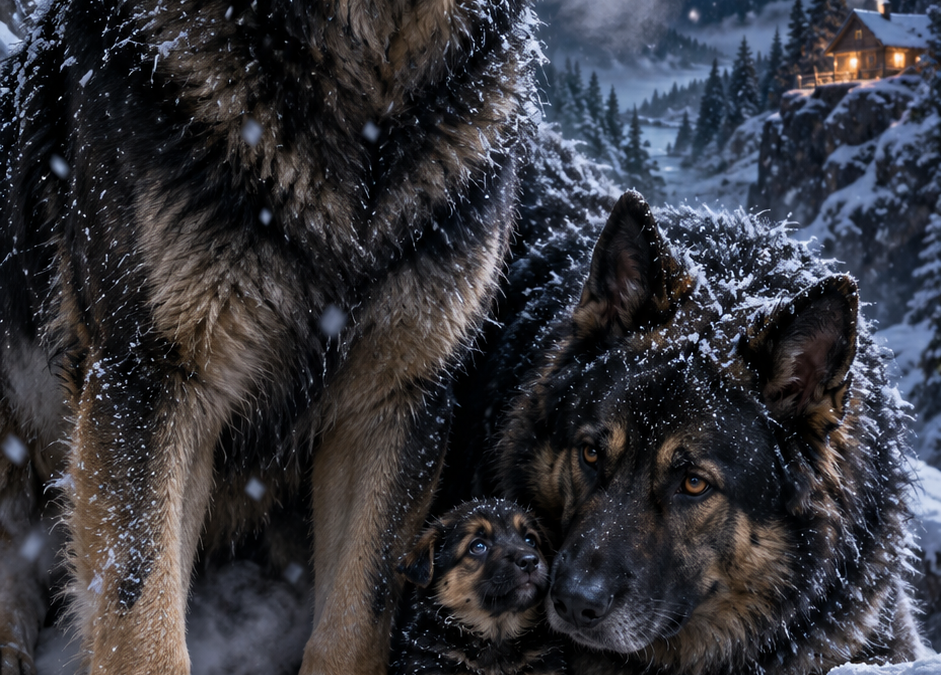
𝗣𝗔𝗥𝗧 𝟮
I didn’t walk directly toward them.
Anyone who works around frightened animals learns quickly that good intentions don’t make you less threatening.
A stranger is a stranger.
A uniform is still a uniform.
A hand reaching too fast is still a hand reaching too fast.
So I stopped twenty-five yards away.
The male’s ears angled forward.
The female’s body stayed tight.
The puppy tried to stand again.
He made it three seconds.
Then collapsed onto his belly.
“Easy,” I said.
My voice vanished into the wind.
The male lowered his head slightly.
Not submission.
Assessment.
I backed away.
That seemed to surprise him.
Good.
Let him think about it.
I returned to the truck, pulled out an emergency ration pack, a bottle of water, and one of the wool blankets we kept for stranded hikers.
When I looked back, all three dogs were still there.
Watching.
I opened the food.
The smell carried.
The puppy’s nose lifted.
The female immediately looked at him.
That tiny response almost made me smile.
Hunger was useful.
Hunger meant he was still interested in tomorrow.
I placed several pieces of meat on the snow, then backed toward the truck.
“That’s yours.”
The male did not move.
Neither did the female.
The puppy tried.
He got one paw forward.
The female blocked him gently.
I understood.
Not yet.
I climbed into the truck.
Closed the door.
Waited.
Five minutes.
Ten.
The puppy whimpered once.
The female licked his ear.
The male finally stepped forward.
Every movement deliberate.
He stopped at the food.
Sniffed.
Looked at me.
I stayed still.
He ate one piece.
Waited.
Then took another and carried it back.
He dropped it in front of the puppy.
I stared.
“You’re kidding.”
The puppy attacked the piece with all the violence his little body could manage.
The female ate next.
Then the male.
They finished everything.
Nobody bolted.
That mattered.
I drove away twenty minutes later.
Not because I wanted to.
Because forcing contact that first morning might have destroyed whatever chance I had of helping them.
That is the frustrating part about rescue.
Sometimes the correct action looks exactly like walking away.
I returned the next morning.
They were gone.
For ten seconds, disappointment hit so hard I felt stupid.
Then I saw the tracks.
Three sets.
Two massive.
One tiny.
The small tracks were uneven.
Sometimes they vanished entirely where the puppy had been carried or walked beneath one of the adults.
I followed them from a distance.
The trail curved through lodgepole pine and crossed a shallow drainage buried under snow.
Eventually I found the dogs near an abandoned summer campsite.
The male was digging beside an old fire ring.
The female lay beneath a cluster of pines.
The puppy was curled against her belly.
I stayed behind a tree.
Binoculars up.
The male uncovered something.
Probably food waste preserved by the cold.
He sniffed.
Then returned to the female and puppy.
I began calling him Luthar in my head.
I don’t know why.
He looked like a Luthar.
Heavy.
Serious.
The female became Freya.
The puppy took longer.
He was small enough to need something sharper.
Something that sounded like it could survive.
Kai.
Luthar.
Freya.
Kai.
Names make observation dangerous.
The moment you name something, objectivity starts packing its bags.
By the third day, I was worried.
Kai was limping.
His paws looked worse.
The weather forecast showed another cold front pushing down from Montana.
Nothing catastrophic yet.
But temperatures would drop.
Wind would strengthen.
He did not have enough body mass for another prolonged exposure.
Luthar and Freya might.
Kai wouldn’t.
I spent that afternoon watching them through binoculars.
Freya groomed him constantly.
Kai tried to climb over her front leg.
Fell.
Tried again.
Luthar lay facing outward.
Guarding.
When Kai wandered more than six feet away, one of them redirected him.
Not aggressively.
Like parents.
That bothered me.
Not because it was strange.
Because it was familiar.
I had spent years convincing myself I was done with that kind of attachment.
I hadn’t always been a ranger.
Before Wyoming, before the uniform, before the cabin and the controlled loneliness, I had served overseas.
My closest friend there was a man named Reed Dawson.
Reed had the irritating quality of being cheerful during circumstances that did not deserve cheerfulness.
Blistering heat?
“At least laundry dries fast.”
Food terrible?
“Less temptation to overeat.”
Mortars nearby?
“Property values are dropping.”
I hated him appropriately.
Everyone did.
Which meant everyone loved him.
One afternoon, a stray tan dog appeared outside our position.
Skinny.
Half one ear missing.
No interest in becoming anyone’s pet.
Reed fed him.
Naturally.
“Don’t.”
That was my contribution.
Reed looked at me.
“Don’t what?”
“Start.”
“I’m giving him food.”
“You’re naming him in your head.”
“I am not.”
“What is it?”
He hesitated.
“Murphy.”
I stared.
“You’re an idiot.”
Murphy followed Reed from then on.
Slept near his bunk.
Waited outside the command tent.
Learned which soldiers carried food.
Completely ignored military hierarchy.
Smart dog.
Weeks later, an explosion hit a structure Reed had entered.
Murphy started barking seconds before the roof came down.
Reed later swore the dog grabbed his trouser leg and pulled him toward the doorway.
I wasn’t there for that exact moment.
I was there afterward.
Reed lived.
Murphy didn’t.
A section of debris hit him.
Reed carried that dog farther than he needed to.
Wouldn’t let anybody else do it.
Some losses become part of your biography whether you include them or not.
Years later, Reed died in a highway accident back home.
Completely ordinary.
No war.
No heroic ending.
A patch of black ice and a pickup traveling too fast.
After the funeral, I changed.
Not dramatically.
No breakdown.
No dramatic drinking problem.
I simply got quieter.
Moved west.
Took work where silence was considered an asset.
Mountains don’t ask whether you’re lonely.
They assume everyone has good reasons.
Then Kai appeared.
A tiny dog between two giants.
And every time he stumbled and got up again, I saw Murphy.
Every time Luthar stepped between him and danger, I saw Reed.
It irritated me.
Grief has terrible manners.
It shows up without invitation and sits wherever it wants.
On the fourth morning, I approached again.
Closer this time.
Food in one hand.
Water in the other.
Luthar saw me first.
He stood.
Freya lifted her head.
Kai crawled out between her front legs.
“Morning.”
Luthar’s tail remained low.
“I realize we’ve skipped introductions.”
I crouched.
“That’s Luthar.”
He stared.
“You’re welcome.”
I pointed toward Freya.
“Freya.”
Her expression suggested I had exceeded my authority.
“And the little criminal is Kai.”
Kai’s ears moved.
“See? He approves.”
I placed the food down.
Backed away.
Luthar watched me for thirty seconds.
Then walked forward.
This time, Kai followed.
Freya stood instantly.
One low bark.
Kai stopped.
She came beside him.
Luthar reached the food.
Sniffed.
Then looked back.
Kai waited.
Luthar ate.
Freya approached next.
Kai came between them.
They allowed it.
He grabbed a small piece.
Chewed.
Then, astonishingly, looked toward me.
His tail flicked.
Once.
“Don’t overdo it.”
He ate again.
I returned the following day.
And the next.
The distance shortened.
Fifty feet.
Thirty.
Twenty.
No touching.
No sudden movements.
No miracle.
Trust does not usually arrive as a cinematic event.
It arrives as the absence of retreat.
Luthar stopped baring his teeth.
Freya stopped moving Kai behind her every time I appeared.
Kai began coming forward first.
He was the problem.
Puppies have survival instincts and absolutely no respect for strategic planning.
On the sixth day, Kai walked almost all the way to me.
Freya called him back with one sharp bark.
Kai looked over his shoulder.
Then at me.
Then at her.
I could practically see the toddler argument happening in his head.
“But the strange man has meat.”
Freya won.
Good mother.
Even if she wasn’t his mother.
That question stayed with me.
Kai looked nothing like either adult beyond broad breed family.
His proportions were different.
His coat markings were classic German Shepherd.
Luthar and Freya appeared more like shepherd crosses—possibly livestock guardian somewhere in the bloodline, maybe oversized working-line shepherds.
Whatever they were, Kai almost certainly wasn’t theirs.
Yet they had adopted him.
That choice fascinated me.
People like to talk about nature as if it is only competition.
Teeth.
Territory.
Survival of the strongest.
Convenient philosophy if you want selfishness to sound scientific.
But cooperation is natural too.
Protection.
Adoption.
Social bonds.
Animals routinely ruin our tidy theories by caring for things they aren’t required to care about.
Luthar and Freya had no obvious biological obligation to Kai.
They were still risking themselves for him.
The weather report worsened that evening.
High winds.
Heavy snow.
Temperatures falling toward twenty below overnight.
I sat at the ranger station staring at the forecast.
Kai’s red paws filled my head.
I called my supervisor, Mark Ellis.
“You still tracking those dogs?”
“Yeah.”
“Animal control contacted?”
“Yes.”
“They can’t get a team up until weather clears.”
“I know.”
“Then don’t do anything stupid.”
There is a recurring problem in my life where people say that sentence shortly before I do something they consider stupid.
“I’m building shelter.”
Silence.
“Ethan.”
“Temporary.”
“For the dogs?”
“Yes.”
“In a storm.”
“Before the storm.”
“Those animals are unpredictable.”
“They’re not aggressive.”
“You have known them through binoculars for six days.”
“That’s basically engagement by Wyoming standards.”
“Ethan.”
“Kai won’t survive another night fully exposed.”
“Who?”
“The puppy.”
Another silence.
“You named them?”
Mistake.
“No.”
“You just said Kai.”
“Administrative designation.”
Mark sighed.
“You’re impossible.”
“Known issue.”
“Do not corner the adults.”
“I won’t.”
“Do not attempt capture alone.”
“I won’t.”
“Do not get bitten.”
“I’ll put that on the list.”
“And call me.”
“Yeah.”
I hung up.
Built the shelter before sunset.
Nothing complicated.
Three-sided windbreak near the pine cluster.
Raised pallet base.
Insulated tarp.
Wool blankets.
Food.
Water.
My old flannel shirt.
I rubbed it deliberately across the doorway.
Scent matters.
If they entered, I wanted the place to smell familiar.
Not like a trap.
At dusk, I withdrew fifty yards.
The wind started rising.
Snow moved sideways.
For an hour, nothing.
Then Freya appeared.
Alone.
My heart jumped.
Where were the others?
She sniffed the shelter.
Backed away.
Circled.
Entered halfway.
Retreated.
Then vanished into the snow.
Twenty minutes later, she came back.
Kai hung from her mouth by the scruff.
Limp.
Not unconscious.
But exhausted.
Luthar followed.
Freya stopped outside the shelter.
She looked toward me.
Then at the opening.
Then toward me again.
“Use it.”
Wind tore the words apart.
She lowered Kai onto the blanket.
The puppy stirred.
Luthar entered next.
He sniffed my shirt.
A strange moment.
A massive dog smelling evidence of me while deciding whether my idea was safer than the mountain.
He turned.
Looked directly toward where I stood.
Then lay beside Kai.
Freya entered.
She curled around the puppy.
I exhaled.
“Good.”
The storm intensified.
I returned to the ranger station.
Did not sleep.
At two in the morning, I drove out as far as the road allowed.
Visibility terrible.
No way to reach them safely.
I parked.
Waited.
Stared into white.
I felt helpless in a way I hadn’t since overseas.
Different situation.
Same poison.
Knowing somebody is in danger while distance turns concern into uselessness.
At dawn, the storm weakened.
I went out immediately.
Tracks led to the shelter.
Three sets.
I approached slowly.
Luthar came out first.
Covered in frost.
Freya behind him.
Kai remained inside.
My stomach tightened.
I crouched.
“Where is he?”
Freya looked back.
Kai moved.
Barely.
He lifted his head.
Tail tapped once against the blanket.
Relief hit so hard I laughed.
“You little bastard.”
Luthar’s ears moved.
“Term of affection.”
I brought warm water.
Not hot.
Food.
Kai tried to stand.
His legs buckled.
This time Freya didn’t block me when I moved closer.
Ten feet.
Eight.
Six.
Luthar stepped forward.
I stopped.
“Okay.”
His eyes held mine.
I set the water down.
Kai crawled toward it.
Freya moved beside him.
He drank.
Slow.
Then faster.
I watched his nose.
Paws.
Breathing.
Too weak.
His condition had crossed from difficult to dangerous.
“You kept him alive.”
Freya looked at me.
“But this isn’t enough.”
I don’t know why I expected a dog to understand the sentence.
Maybe tone carries more truth than words.
Kai finished drinking.
Then did something reckless.
He walked toward me.
Three steps.
Stumble.
Two more.
Luthar watched.
Freya watched.
I didn’t move.
Kai reached my boots.
Sniffed.
Lifted one paw.
Placed it on my glove.
My breath caught.
The contact lasted maybe two seconds.
Then Kai leaned against my knee.
Freya whined.
Soft.
I looked at her.
“I know.”
Luthar came closer.
Every primitive part of my brain reminded me that this animal had teeth capable of changing my appearance.
He stopped within arm’s reach.
Head level with mine.
I stayed still.
He smelled my shoulder.
Then my hand.
His golden eyes held me.
I remembered Reed saying once that dogs don’t care whether your story sounds good.
They care whether your body tells the truth.
Luthar’s nose touched my glove.
Then he stepped back.
Permission.
Not ownership.
Not surrender.
A temporary agreement.
I touched Kai.
One hand along his back.
His fur was cold.
Too cold.
His ribs sharp.
I swore under my breath.
“You need help now.”
Freya moved forward.
I expected her to block me.
Instead, she nudged Kai toward my leg.
I stared at her.
“No.”
I almost laughed because the moment felt too impossible.
“You cannot possibly know what I’m saying.”
She nudged him again.
Kai fell against me.
That settled it.
I wrapped him in the wool blanket.
Luthar barked.
Low.
One sound.
My body froze.
He didn’t advance.
Freya stood close.
Watching.
I lifted Kai.
His head rested against my chest.
No resistance.
His breath felt weak.
“I’m taking him.”
Freya whined.
“I’ll bring him back.”
Ridiculous promise.
I didn’t know whether I could.
But I said it.
I backed away.
One step.
Two.
Luthar followed.
Freya followed.
Not attacking.
Escorting.
Snow began again.
Kai shivered beneath the blanket.
I walked faster.
My truck waited nearly half a mile away.
By the time I reached it, my face was numb.
I opened the passenger door.
Placed Kai inside.
He made one weak sound.
I looked back.
Luthar and Freya stood thirty yards away.
Two silhouettes.
“Come on.”
They didn’t.
“Fine.”
I climbed in.
Started the engine.
Pulled away.
In the mirror, they followed.
At first slowly.
Then trotting.
Two enormous shapes pacing the road behind the truck.
I drove no faster than necessary.
They followed until the ranger station appeared.
Then stopped near the tree line.
I carried Kai inside.
He was colder now.
Or maybe my hands were warmer.
Either way, fear sharpened.
I laid him beside the wood stove.
Wrapped him.
Called Dr. Bennett at the Jackson shelter clinic.
“Frostbite?”
“Possibly.”
“Temperature?”
I checked.
Told her.
“Warm gradually. No direct high heat. Warm fluids if he can swallow. Bring him as soon as roads are safe.”
I followed instructions.
Kai’s breathing steadied slightly.
I fed diluted warm broth in tiny amounts.
He swallowed.
Good.
Outside the window, movement.
Luthar.
Freya.
They had come closer.
Standing beyond the porch light.
Watching.
I opened the door.
Cold rushed in.
Freya took two steps forward.
Kai heard something.
His ears twitched.
Freya whined.
His head lifted.
For the first time since I picked him up, his tail moved.
Once.
“They’re here.”
Kai tried to stand.
“No.”
I held him gently.
“You need to stay warm.”
Outside, Luthar lay down.
Freya remained standing.
They were waiting.
I don’t know whether that made me feel better or worse.
At first light, the road opened enough to drive.
I carried Kai to the truck.
Luthar and Freya stood near the tree line.
I opened the rear door.
“Come with us.”
No movement.
Freya sniffed.
Luthar watched.
I tried again.
Nothing.
I couldn’t force them.
Kai was getting weaker.
“I’m coming back.”
I drove toward town.
The shelter clinic took Kai immediately.
Dr. Bennett was a compact woman with silver hair and the energy of someone who had spent thirty years becoming unimpressed by emergencies while still caring deeply about them.
She examined Kai.
“Severely underweight.”
“I know.”
“Dehydrated.”
“I know.”
“Early frostbite on paw pads.”
My stomach dropped.
“Permanent?”
“Too soon.”
“Anything else?”
“Temperature low. Possible respiratory infection. We’ll do bloodwork.”
“Fine.”
“Where did you find him?”
“With two dogs.”
“Owner?”
“No idea.”
“His parents?”
“Not likely.”
I explained.
She stopped writing halfway through.
“Two adult dogs kept him alive in the storm?”
“For days.”
She looked toward the treatment room.
“That’s unusual.”
“Very.”
“We need to notify animal control about the adults.”
“Already did.”
“Can they capture them?”
“Maybe.”
I hated the word capture.
Necessary sometimes.
Still hated it.
Kai received warm IV fluids.
Antibiotics.
Pain medication.
Treatment for his paws.
He lay under warming blankets.
I stayed.
At some point, a staff member brought coffee.
I forgot to drink it.
Late that afternoon, I walked outside behind the shelter.
Needed air.
Needed space.
Needed to stop looking at the monitor.
Snow covered the field beyond the fence.
I heard the howl before I saw them.
Low.
Deep.
Not wolf.
Dog.
Luthar.
I moved toward the back gate.
There he was.
Standing near the tree line.
Freya beside him.
My entire body went cold for a reason unrelated to temperature.
“They followed.”
A shelter technician stepped outside.
“Those are the dogs?”
“Yeah.”
“My God.”
Luthar stared toward the building.
Freya paced.
Then howled.
Higher.
Questioning.
Inside, faint through the glass, Kai moved.
I turned.
His head lifted from the blanket.
Ears toward the sound.
Freya called again.
Kai tried to bark.
Nothing came.
Only air.
But Luthar stepped forward.
He heard.
“They came for him.”
The technician whispered.
“Looks like it.”
Word spread through the shelter.
Staff gathered near the windows.
Someone suggested calling animal control immediately.
Someone else mentioned tranquilizers.
I raised a hand.
“Nobody rushes them.”
Dr. Bennett came beside me.
“We can’t leave them outside indefinitely.”
“I know.”
“They’re vulnerable too.”
“I know.”
“We need a plan.”
“Give me tonight.”
She looked at me.
“Ethan.”
“They trust me more than anybody here.”
“Do they?”
“Enough.”
She looked at Luthar’s size.
“That’s an optimistic definition of trust.”
“Welcome to wildlife work.”
We placed food and water outside.
Neither dog touched it for an hour.
Then Freya ate.
Luthar remained watching the building.
Kai worsened that night.
His temperature fluctuated.
Breathing faster.
Dr. Bennett listened to his lungs.
“Possible infection.”
“What kind?”
“Could be pneumonia developing after exposure.”
The word hit hard.
“What do we do?”
“What we’re doing.”
“That’s not enough.”
“It’s what medicine looks like, Ethan.”
“I know.”
I didn’t sound like I knew.
Kai lay still.
I sat beside him.
His paw rested in my hand.
Outside, Luthar and Freya waited.
At ten, Freya howled.
Kai’s ear moved.
At midnight, Luthar barked once.
Kai lifted his head a fraction.
At two, his breathing became shallow.
I leaned closer.
“No.”
Dr. Bennett adjusted fluids.
“Come on.”
Kai didn’t respond.
I touched his chest.
Faint heartbeat.
Fast.
“We’ve come too far.”
My voice cracked.
“Don’t.”
The monitor alarm changed.
Dr. Bennett moved.
A technician came in.
For several minutes, I was pushed aside.
Which was correct.
I hated it.
They worked.
Oxygen.
Medication.
Warmth.
I stood against the wall feeling useless.
The exact old helplessness.
Different room.
Different decade.
Same feeling.
Reed’s funeral.
Murphy beneath rubble.
All the things you cannot fix by wanting harder.
I stepped outside.
Snow fell lightly.
Luthar stood.
Freya beside him.
They looked at me.
I don’t know what expression I wore.
Freya whined.
“I’m trying.”
My voice broke.
“I’m trying.”
Luthar took one step closer to the fence.
“You kept him alive.”
Another step.
“I don’t know if I can.”
Freya howled.
Long.
Soft.
I closed my eyes.
For the first time in years, I prayed.
Not elegantly.
Not religiously.
Just desperate words thrown at whatever might listen.
Let him have morning.
That’s all.
One more morning.
I returned inside.
At four-thirty, Kai’s breathing stabilized.
At six, his temperature rose slightly.
At seven-fifteen, he opened his eyes.
I stared.
“Hey.”
One ear moved.
Dr. Bennett looked up from the chart.
“That’s good.”
Kai blinked.
His paw shifted.
Touched my fingers.
I laughed.
Then cried.
No dignity whatsoever.
“You’re a terrible patient.”
His tail moved beneath the blanket.
One weak wag.
Dr. Bennett smiled.
“He’s responding.”
I bent forward.
“You’re coming back.”
Kai’s eyes closed again.
This time sleep.
Not collapse.
Sleep.
Outside, the howling had stopped.
I looked through the window.
Luthar and Freya were lying together in the snow.
As if somehow they knew.
Kai improved slowly.
Painfully slowly.
Two steps forward.
One back.
The paws worried us.
Frostbite had damaged tissue, but not as severely as first feared.
No amputation.
That felt like winning.
His appetite returned.
First broth.
Then softened food.
Then anything that could theoretically be eaten.
Once he began trying to steal the technician’s sandwich, Dr. Bennett declared his personality medically encouraging.
Luthar and Freya remained outside.
They started eating regularly from the bowls we placed near the fence.
I approached them twice daily.
By the third day, Freya allowed me within ten feet.
Luthar within eight.
No touch.
Didn’t need it.
We brought one of Kai’s blankets outside.
Freya sniffed it for a long time.
Then lay beside it.
On the fifth day, Kai was strong enough to stand briefly.
I carried him outside.
Wrapped in a blanket.
The moment Freya saw him, she rushed the fence.
Not aggressively.
Desperately.
Kai whined.
Luthar appeared behind her.
I lowered Kai carefully onto packed snow inside the fenced yard.
He stood.
Wobbled.
Freya pressed her nose through the fence.
Kai stumbled forward.
Nose to nose.
He squealed.
That sound broke every person watching.
Luthar lowered his head.
Kai moved toward him too.
The giant male exhaled against the puppy’s face.
Kai licked his nose.
Luthar’s tail moved.
Once.
It was the first time I had seen it.
“Well.”
Dr. Bennett stood beside me.
“You were right.”
“I’d like that in writing.”
“Don’t ruin it.”
Fair.
We needed to decide what came next.
Kai could not simply be released back into the wilderness.
Neither, probably, should Luthar and Freya remain there.
They were domestic dogs.
Possibly abandoned.
Possibly escaped.
Possibly lost for months.
We checked missing animal reports across counties.
Nothing matched.
No chips in the adults—we didn’t know yet, because we hadn’t physically handled them.
No collars.
No obvious identification.
Animal control wanted to trap them safely.
I argued for patience.
“Sedation if necessary,” an officer said.
“Only if necessary.”
“They’re large animals.”
“They haven’t shown aggression.”
“Not the same as safe.”
“I know.”
“You’ve bonded.”
There was accusation in the word.
I hated that because it was true.
“I’m aware.”
“Then let us do our job.”
I stepped back.
They used large humane live traps first.
Luthar laughed at the concept.
Not literally.
But he examined the first trap from every angle, ate the bait he could reach without entering, then urinated beside it.
I respected him.
Freya nearly went inside.
Then followed Luthar away.
Plan B was a temporary fenced feeding corridor.
No closing gate initially.
Food placed deeper each day.
My scent.
Kai’s blanket.
Routine.
It took a week.
Freya entered fully first.
Then Luthar.
Two more days before they tolerated the gate moving behind them.
No panic.
No lunging.
Just immediate alertness.
I sat outside the enclosure.
“It’s okay.”
Freya stared.
Luthar paced once.
Then stopped.
Kai barked from inside the shelter.
Both adults froze.
Freya whined.
Luthar sat.
That changed everything.
They weren’t trying to escape.
They were waiting for him.
Dr. Bennett performed examinations under careful handling and mild sedation.
No microchips.
Both underweight.
Freya had an old healed leg injury.
Luthar carried scars around his shoulders.
Neither had been recently groomed.
Both had survived outdoors for a long time.
Maybe months.
Maybe longer.
Their ages were estimated at four and five years.
No evidence connecting them biologically to Kai.
Which meant what I had suspected from the beginning was true.
They had chosen him.
Somewhere, somehow, these two adult dogs had found an orphaned—or abandoned or lost—German Shepherd puppy and adopted him.
No instinct required them to.
They simply did.
Kai recovered enough for supervised contact two days later.
We used a secure yard.
Freya entered first.
Kai saw her.
Everything inside him exploded.
He ran.
Not gracefully.
His bandaged paws made him clumsy.
But he ran.
Freya met him halfway.
She lowered herself.
Kai crashed against her chest.
She licked him so aggressively he almost disappeared.
Luthar entered.
Kai left Freya and ran toward him.
The giant male stood still until the puppy reached him.
Then lowered his body completely onto the snow.
Kai climbed onto his front legs.
Bit his ear.
Luthar tolerated it.
Parenting confirmed.
Everyone watching laughed.
I didn’t.
I couldn’t.
I cried again.
Apparently that winter had destroyed whatever remained of my emotional reputation.
Kai eventually noticed me.
He ran over.
Tail wild.
Pressed against my knee.
Freya followed.
Stopped three feet away.
I froze.
She stepped closer.
Sniffed my glove.
Then pushed her head beneath my hand.
My breath caught.
I scratched her neck.
Slowly.
Luthar watched.
Then approached.
His head came beside my other arm.
I touched him too.
Three dogs.
One man.
A shelter yard covered in snow.
I had spent years building a life that required no one.
They dismantled it in under a month.
Kai stayed at the shelter another two weeks.
Freya and Luthar stayed too.
No owners appeared.
No reports.
No proof that anyone was looking.
Eventually the shelter moved toward adoption eligibility.
That created another problem.
Separating them.
Dr. Bennett asked me one afternoon, “What are you thinking?”
“About what?”
She gave me the look doctors reserve for men pretending not to understand obvious questions.
“The dogs.”
“They need homes.”
“Yes.”
“Preferably together.”
“All three?”
“Yes.”
She folded her arms.
“That’s going to be difficult.”
“I know.”
“Two very large adult shepherd mixes and a German Shepherd puppy.”
“I know.”
“One adopter taking all three is unlikely.”
“I hated that word.
“What about pairs?”
“Kai with Freya?”
“Possible.”
“And Luthar?”
She didn’t answer.
That was unacceptable.
Luthar had protected the puppy through storms.
Hunted.
Guarded.
Followed a truck through snow.
Waited outside the shelter.
Now the reward was separation because family structure looked inconvenient on adoption paperwork?
No.
I understood practical reality.
I also resented it.
“Give me time.”
“Ethan.”
“How much are adoption fees?”
Dr. Bennett stared.
“No.”
“What?”
“No.”
“I asked a number.”
“You are not casually asking.”
“I need information.”
She smiled.
“You live in a ranger cabin.”
“Two-bedroom.”
“You work long shifts.”
“Variable.”
“You have never owned three dogs.”
“Technically accurate.”
“One is going to be over eighty pounds. One already is. The other may hit a hundred.”
“I own a vacuum.”
She laughed.
“That is your preparation?”
“Industrial model.”
“Ethan.”
I looked through the glass.
Kai was sleeping against Freya.
Luthar lay across the doorway.
Same positions as the mountain.
Guarding.
“They stay together.”
Dr. Bennett’s expression changed.
“You mean that.”
“Yes.”
“All three?”
“Yes.”
“You’re insane.”
“I’ve had professional opinions.”
“Think about it.”
“I have.”
“For more than thirty seconds.”
“I’ve thought about them every night for a month.”
She went quiet.
That was the truth.
The problem wasn’t whether I could keep them.
The problem was admitting what they had already become.
I drove home without answering the adoption question officially.
My cabin felt different.
Too clean.
Too quiet.
I stood in the kitchen.
Listened.
Nothing.
No paws.
No breathing.
No Kai attacking furniture.
No Freya checking the doorway.
No Luthar standing like security at the porch.
I’d lived in that cabin six years.
That night it felt empty for the first time.
I sat at the table.
Reed’s photograph stood on a shelf.
Old uniform.
Dust on the frame.
He was smiling.
Of course.
I looked at it.
“This is your fault.”
Reed remained uselessly deceased.
“You’d do it.”
I already knew.
He would have taken all three without thinking.
Then complained about the food bill.
I laughed.
First time I’d laughed talking to his photograph.
That decided it.
The next morning, I called Dr. Bennett.
“All three.”
She exhaled.
“I knew it.”
“You could pretend surprise.”
“I’m not an actress.”
“Paperwork?”
“Come in.”
“Today?”
“If you’re serious.”
“I’m serious.”
“Ethan.”
“What?”
“Kai chewed through a leash.”
I smiled.
“I’ll bring two.”
The adoption process was less romantic than the rescue.
Forms.
Home inspection.
Fencing.
Veterinary planning.
Food costs.
Training.
Emergency contingencies.
The shelter insisted, correctly.
Love is not logistics.
You need both.
I modified the property around the ranger cabin.
Reinforced fencing.
Built insulated outdoor runs that I suspected nobody would use because all three dogs clearly intended to occupy my living room.
Bought beds.
Bowls.
Crates.
Food.
Toys.
Training equipment.
My supervisor walked through during the inspection.
“You’re actually doing this.”
“Apparently.”
“Three?”
“Correct.”
“Why?”
I pointed toward Kai, who was trying to climb into Freya’s food bowl.
“Strong judgment.”
Mark stared.
Luthar stared back.
“That dog is enormous.”
“He’s sensitive about it.”
Luthar sneezed.
Mark stepped back.
I laughed.
“Relax.”
“Easy for you to say.”
“He likes you.”
“How can you tell?”
“He hasn’t eaten you.”
“Excellent standard.”
Kai came home first because he required continued monitoring.
Freya and Luthar arrived together two days later.
The moment the vehicle stopped, Kai lost his mind.
Barking.
Spinning.
Scratching at the door.
“Calm down.”
Impossible request.
When Freya entered the cabin, Kai launched himself at her.
She immediately began grooming him.
Luthar walked through the doorway, looked at me, looked around the room, then chose the rug beside the front door.
Of course.
Guard position.
“Home inspector already?”
He lay down.
Freya followed Kai into the kitchen.
Kai discovered his toy basket.
Pulled out everything.
Ignored all expensive toys.
Stole my glove.
Naturally.
That first night, I had prepared three separate beds.
Kai slept between Freya and Luthar.
On the floor.
Three feet away from the beds.
I stood over them.
“Excellent use of resources.”
Kai’s tail thumped.
“That entire bed cost more than my first car payment.”
Luthar closed his eyes.
Freya sighed.
“Fine.”
I turned off the light.
Then stopped.
The room wasn’t quiet.
Breathing.
Three rhythms.
Kai’s fast puppy breathing.
Freya’s slower one.
Luthar’s deep chest.
For years, silence had protected me.
That night, sound did.
Life changed fast.
Kai recovered fully.
His paw pads healed.
His weight increased.
He grew at a criminal rate.
One week he fit under the coffee table.
The next he got stuck.
I heard crashing from the living room and found Kai beneath it, body too large, head out one side, back legs the other.
He looked offended.
“What exactly was the plan?”
Tail wag.
“There was no plan.”
Luthar watched from the rug.
Freya seemed embarrassed on his behalf.
Kai barked.
“Don’t blame furniture.”
I lifted the table.
He scrambled free.
Immediately tried to go under it again.
“No.”
This was the animal two giants had nearly died protecting.
I began questioning their judgment.
Training started once Kai was physically ready.
He learned quickly.
Sit.
Down.
Come.
Stay.
Leave it.
Luthar knew several commands already.
That told me he’d had training somewhere.
Freya too.
Sit.
Stay.
Heel.
Both responded to hand signals.
Someone had worked with them once.
Someone had owned them.
That mystery never resolved.
No chip.
No reports.
No one came.
I wondered sometimes what had happened.
Had they been abandoned?
Run away?
Lost during another storm?
Whatever the past was, they had built something new before I met them.
I decided not knowing didn’t reduce what existed now.
Kai idolized Luthar.
Every behavior copied.
Luthar sat.
Kai sat.
Luthar watched the window.
Kai watched the window.
Luthar lifted one leg outside.
Kai tried immediately despite having no idea what he was doing and nearly fell sideways.
I laughed for ten minutes.
Kai looked betrayed.
Freya was the disciplinarian.
If Kai got too rough, one look corrected him.
No drama.
No cruelty.
Just maternal authority.
If he wandered too far on walks, Freya brought him back.
If he barked unnecessarily at wildlife, Luthar ignored him until embarrassment achieved what training couldn’t.
They raised him.
I merely paid expenses.
Winter turned toward spring.
Snow softened.
Streams reopened.
Kai discovered mud.
This became a tragedy for my floors.
He ran through the cabin leaving black paw prints.
I stood in the hallway.
“Kai.”
He froze.
Freya froze.
Luthar quietly moved to another room.
Coward.
“Who did this?”
Kai sat.
Tail wagging.
“Oh, excellent.”
I pointed toward the floor.
“This.”
Tail.
“Do you understand?”
More wagging.
Freya came beside him.
Kai leaned into her.
“Do not use your mother as legal representation.”
Luthar watched from the doorway.
I pointed.
“And you.”
He left.
“Unbelievable.”
I cleaned.
They slept.
This was family.
The harder changes happened inside me.
Before them, nightmares visited occasionally.
War.
Reed.
Explosions.
Murphy.
Moments stitched together incorrectly by sleep.
I usually woke alone.
Sat in darkness.
Waited for morning.
The first nightmare after the dogs moved in ended differently.
I woke breathing hard.
Room dark.
Something heavy against my bed.
Luthar.
He stood beside me.
Freya behind him.
Kai on the floor.
All three awake.
Watching.
“I’m fine.”
Luthar did not move.
“Seriously.”
Freya approached.
Rested her head on the mattress.
Kai put his front paws up.
I rubbed my face.
“This is humiliating.”
Kai licked my hand.
I sat on the floor.
Within seconds, they surrounded me.
Warm bodies.
Breathing.
Presence.
I had spent years treating grief as a wound that needed privacy.
These dogs disagreed.
They treated pain like cold.
Something survived better shared.
That realization took longer to accept than rescuing them had.
One morning in April, I took them toward the ridge where I had first seen them.
Snow remained in pockets.
The rest had melted into wet grass and dark soil.
Kai ran ahead.
Bigger now.
Healthy.
His legs still puppy-long.
Freya followed.
Luthar moved beside me.
Same calm pace.
We reached the pine cluster.
Kai stopped.
Sniffed.
Freya did too.
The old shelter was still there, damaged by snow.
Blanket gone.
My flannel shirt shredded by weather.
Luthar sniffed the doorway.
Then looked at me.
I touched his shoulder.
“You remember.”
Kai ran through the remains.
Found a stick.
Completely unimpressed by the emotional significance.
Good.
The place that had nearly become his grave was just a place.
That’s healing.
We continued toward the ridge.
At the top, the Tetons rose against a blue sky.
Kai stood facing the wind.
Freya beside him.
Luthar on the other side.
The same arrangement.
Two giants.
One smaller dog.
Only now Kai wasn’t shaking.
He barked into the valley.
Freya answered.
Luthar gave one deep bark.
I laughed.
Sound rolled across the snowfields.
For the first time in years, I felt something I had stopped expecting.
Peace.
Not happiness exactly.
Peace.
Different thing.
Happiness is a moment.
Peace is the absence of needing to escape the moment.
I stood there with them.
Didn’t want to be anywhere else.
Kai became a powerful young shepherd.
Not as large as Luthar.
Large enough.
His black-and-tan coat filled out.
Chest broadened.
His limp disappeared completely.
The only evidence of frostbite was sensitivity during extreme cold, which meant he wore protective boots during winter.
He hated them.
Walked like all four feet had simultaneously resigned.
I laughed every time.
“Necessary.”
Kai lifted one paw dramatically.
“You are not injured.”
He lifted another.
Freya sniffed a boot.
Luthar walked away, clearly unwilling to associate himself with the situation.
“Your son is dramatic.”
Freya looked at me.
Kai flopped onto the floor.
“Fine.”
I gave him a treat.
Manipulated again.
People around the park began knowing them.
Visitors asked questions.
Some assumed Luthar and Freya were wolves.
“Are they hybrids?”
“No.”
“They’re huge.”
“Correct.”
“Are they dangerous?”
I usually looked at Kai, who was upside down in snow chewing his own tail.
“Terrifying.”
Once a tourist asked if she could take a selfie with Luthar.
I said no.
She looked offended.
Apparently access to wildlife—or large dogs near wildlife—had become a constitutional right sometime while I wasn’t paying attention.
Freya tolerated strangers selectively.
Luthar more selectively.
Kai loved everyone who passed his approval test, which mostly involved possessing hands.
At the ranger station, the dogs became unofficial celebrities.
Kids especially loved Kai.
He would sit while they touched his ears.
Then look at me afterward as though requesting overtime pay.
One winter afternoon, a family reported their golden retriever missing near a trail.
Storm approaching.
Bad visibility.
We searched.
Kai came.
Luthar and Freya stayed at the station because of conditions.
Kai tracked scent along the trail.
Not formally trained search-and-rescue.
Just good nose and obsession.
Two hours in, he stopped near a snowbank.
Barked.
I dug.
The golden retriever was wedged beneath fallen branches, alive.
Cold.
Terrified.
We got him out.
The family cried.
The dog survived.
Back at the station, Kai walked straight to Freya.
She inspected him thoroughly.
Then Luthar.
He sniffed Kai’s face.
Kai lay between them.
I watched.
The puppy they had once guarded had started guarding others.
Reed would have loved that.
I said it aloud.
“Reed would like you.”
Kai’s ears moved.
“You would’ve liked him too.”
I sat beside the dogs.
For years, saying Reed’s name hurt.
Now it still hurt.
But pain had stopped being the only thing attached to it.
That’s another form of healing nobody advertises.
You don’t stop missing somebody.
You regain access to the parts of them that make you smile.
The dogs gave me that.
Years moved.
Not quickly.
Not slowly.
The way years do once life becomes full.
Kai matured.
Freya’s muzzle grayed.
Luthar slowed slightly.
The three remained inseparable.
When Kai wandered, Luthar watched.
When Kai rested, Freya often slept nearby.
When either adult seemed stiff after a long walk, Kai adjusted his pace.
Family changes roles.
The protected becomes protector.
The strong accept help.
Nobody announces it.
One January evening, Luthar struggled getting up.
My stomach tightened.
He tried again.
Succeeded.
But slower.
Vet examination showed arthritis.
Nothing catastrophic.
Age.
I hated age.
It was too ordinary an enemy.
We started medication.
Joint supplements.
Shorter walks.
Kai adapted immediately.
No racing ahead.
He walked beside Luthar.
Freya on the other side.
I watched them through winter.
Three tracks again.
But now Kai’s prints were nearly as large.
Sometimes he walked ahead.
Then came back.
Checking.
The image undid me every time.
One morning, we returned to the original ridge.
Luthar moved slowly.
Freya too.
Kai in front.
Snow had fallen overnight.
Fresh.
Clean.
The valley looked almost exactly as it had the first day.
I stopped at the spot where my truck had been.
For a moment, memory overlaid reality.
Luthar young and massive.
Freya covered in frost.
Kai tiny between them.
I could almost see it.
The puppy trying to stand.
The giants blocking the wind.
I looked at Kai now.
Full-grown.
Strong.
Healthy.
He turned.
Ran back.
Pressed against me.
Luthar approached.
Freya.
I put my hands on them.
“Look what you did.”
Freya looked toward Kai.
Luthar leaned against my leg.
“You kept him alive.”
Kai licked my glove.
“And then you kept me alive.”
That sounded sentimental.
I didn’t care anymore.
Age weakens several things.
One of the first is embarrassment.
We continued uphill.
At the ridge, Kai stood between them.
Exactly where he had always belonged.
Family isn’t always blood.
That phrase gets overused until it sounds decorative.
With those dogs, it wasn’t decoration.
It was observable fact.
Luthar and Freya had found a puppy they did not produce.
They fed him.
Warmed him.
Guarded him.
Carried him.
Followed him.
Waited outside a shelter for him.
They made him theirs through behavior.
No paperwork.
No genetics.
No argument.
Later, they made me theirs the same way.
Presence.
Trust.
Staying.
It took me longer to recognize it because humans are less intelligent about obvious things.
One night, years after I found them, snow began falling heavily.
Not the same storm.
But close enough that memory tightened in my chest.
Kai went to the window.
Freya behind him.
Luthar slower.
All three watched.
I remembered the first night.
Them outside.
Me inside a heated truck.
A puppy barely alive.
I opened the door.
Cold air rushed in.
Kai stepped onto the porch.
Looked back.
Freya followed.
Luthar.
I put on my coat.
“Fine.”
We walked.
Not far.
Just around the property.
Snow gathered on their backs.
Kai ran through drifts.
Freya corrected him when he got stupid.
Luthar stayed near me.
Same family.
Different winter.
When we returned, they lay by the fire.
Kai between the adults.
Always.
I sat in the chair.
Watched them.
That image became my definition of home.
Not the cabin.
Not Wyoming.
Not my uniform hanging by the door.
Three dogs breathing beside a fire.
A man finally willing to admit he needed them.
People later asked why I kept all three.
The practical answer was that separating them would have been cruel.
The deeper answer was less flattering.
I couldn’t bear the idea of returning to silence.
They had reminded me of something I thought war and grief had permanently removed.
Attachment is not weakness.
Loss makes attachment expensive.
That’s different.
For years, I had avoided paying.
Then Kai looked at me from the snow.
Luthar allowed me closer.
Freya pushed the puppy toward my hands.
And suddenly I was invested again.
Vulnerable again.
Alive again.
That’s the price.
Worth it.
Every time.
On the anniversary of the rescue, I developed a ritual.
Extra-long walk.
Ridge.
Food afterward.
Kai learned the pattern before I did.
The second year, he waited by the door before sunrise.
“You’re early.”
Tail.
“It’s dark.”
Tail.
“Anniversary means nothing to you.”
Kai barked.
Freya stood.
Luthar stretched.
“Traitors.”
We went.
At the ridge, the sun rose across the Tetons.
Kai chased light across the snow.
Freya followed.
Luthar stood beside me.
His shoulder against my leg.
I remembered Reed.
Murphy.
All the unfinished grief.
Then Kai ran back.
Luthar moved forward.
Freya joined.
Three sets of tracks.
I looked behind us.
Mine made four.
That was new.
I smiled.
For years, I had thought the story was about two giant dogs raising a puppy.
Then I thought it was about rescuing Kai.
Later, about keeping the family together.
I was wrong each time.
The story was about what happens when creatures who have every reason to protect only themselves choose otherwise.
Luthar could have left Kai.
Freya could have.
They didn’t.
Kai could have remained afraid of me.
He didn’t.
I could have stayed in the truck.
I didn’t.
Every important part began with somebody choosing not to walk away.
That’s all.
No miracle.
Choice.
Stay.
Protect.
Trust.
Return.
The last thing Reed ever told me before the accident was ordinary.
A voicemail.
I had saved it for years.
“Call me when you stop pretending Wyoming has no phones.”
Typical Reed.
I listened to it hundreds of times after he died.
Then stopped.
Couldn’t bear it.
One night, years after the dogs came home, I played it again.
Kai lay beside me.
Freya near the fire.
Luthar at the door.
Reed’s voice filled the cabin.
Joking.
Alive.
When it ended, I expected the old collapse.
Instead, I laughed.
Then cried.
Kai put his head on my knee.
Luthar lifted his eyes.
Freya came closer.
I played the message again.
This time I heard my friend.
Not his death.
That’s what they gave me.
Not escape from grief.
A way through it.
The winter Kai turned six, Luthar stopped climbing the ridge.
His joints couldn’t manage.
We found lower trails.
Kai adapted.
Never complained.
Freya stayed beside Luthar.
The giants who had once towered over Kai now moved slower than him.
He guarded them.
If Luthar fell behind, Kai went back.
If Freya stopped, Kai waited.
At night, he slept across the doorway while they rested near the fire.
The role had changed completely.
One evening, I watched Kai help Luthar stand by pressing his shoulder against him.
The old dog rose.
Kai stayed beside him until he stabilized.
I sat down because my knees suddenly felt weak.
“There you are.”
Kai looked at me.
“You learned.”
Of course he had.
Family teaches through repetition.
Luthar had spent Kai’s infancy using his body as a wall against weather.
Now Kai used his body as support against age.
Balance restored.
Not fair.
But beautiful.
Freya eventually developed arthritis too.
Medication helped.
We slowed.
Our walks became shorter.
No one cared.
Tourists rushed past us on trails.
Young people with expensive gear, checking watches and mileage.
I used to move like that.
Distance mattered.
Speed.
Achievement.
Now we walked half a mile and spent twenty minutes watching snow fall.
Better.
Kai still ran occasionally.
Then returned.
Always returned.
The day Luthar died came years later.
Old age.
His body simply reached the point where strength could no longer solve the problem.
We were at home.
Not shelter.
Not snowfield.
Home.
Freya beside him.
Kai lying across his front paws.
Me on the floor.
Luthar’s breathing slowed.
I kept one hand on his shoulder.
“Good boy.”
His eyes opened.
Gold still there.
Older.
Softer.
“Best damn dog I ever met.”
Kai lifted his head.
Freya pressed closer.
Luthar exhaled.
Did not inhale again.
Silence.
Real silence.
The kind you cannot negotiate with.
Kai nudged him.
Waited.
Nudged again.
Freya sniffed his face.
Then lay beside him.
I stayed there.
No rush.
They needed time.
So did I.
For years, Luthar had guarded every doorway.
That night, the doorway looked enormous.
Kai eventually moved into his place.
Not immediately.
Hours later.
He lay across the threshold.
Head up.
Watching.
I understood.
Someone had to guard.
Freya lived another year and a half.
Kai never left her alone.
When she struggled, he slowed.
When she slept, he stayed nearby.
Her last winter was gentle.
We avoided deep snow.
Kept the fire warmer.
She still loved the porch.
One morning, light snow fell.
Freya walked outside.
Kai followed.
She stood facing the mountains.
I came beside her.
“Pretty good view.”
Her tail moved.
Kai pressed against her.
She leaned into him.
For one second I saw the young mother from years before.
Frost on her fur.
Puppy beneath her body.
Defying weather.
I touched her neck.
“You did good.”
She looked at me.
“You know that?”
Tail.
“Best mother a dog could steal.”
Kai licked her muzzle.
Freya closed her eyes.
She died months later.
Peacefully.
Kai was with her.
So was I.
Afterward, the cabin felt wrong.
Kai wandered room to room.
Looking.
Luthar’s rug.
Freya’s place by the fire.
Doorway.
Porch.
He waited.
Grief isn’t uniquely human.
Anyone claiming otherwise hasn’t watched a bonded animal search a room that no longer contains who he’s looking for.
I let Kai grieve.
No forced distraction.
Routine.
Walks.
Food.
Presence.
He slept beside my bed now.
Not the doorway.
For the first time in his life, both giants were gone.
It was just us.
The puppy and the ranger.
Except Kai wasn’t a puppy.
And I wasn’t the man from the truck anymore.
One snowy morning, months after Freya died, Kai stood by the door.
I grabbed my coat.
“Ridge?”
Tail wag.
We went.
Slow.
Kai older.
Me too.
The climb took longer.
At the top, wind moved through his coat.
He stood where he had once stood between Luthar and Freya.
Empty space on both sides.
My chest hurt.
Kai looked back.
Then walked to me.
Stood against my leg.
I put one hand on his back.
“Yeah.”
We faced the valley.
Snow covered everything.
Pure.
Silent.
I imagined two giant silhouettes beside him.
Maybe memory is enough.
Maybe love teaches the mind to keep shapes after bodies leave.
Kai barked.
One strong sound.
Echo rolled across the ridge.
I laughed.
“Think they heard you?”
He barked again.
“I’ll take that as yes.”
We stayed until sunset.
On the way down, Kai walked ahead.
His tracks appeared in fresh snow.
One set.
Mine behind.
I looked at them.
Years earlier, there had been three canine tracks.
Two giants.
One tiny.
Now one large shepherd.
One old ranger.
For a moment sadness almost swallowed the beauty.
Then Kai turned.
Waited.
Same thing he had always done.
Checking.
I caught up.
“Let’s go home.”
He walked beside me.
That word had changed completely.
Home.
Once it meant a building I slept in.
Then three dogs around a fire.
Now it meant memory, routine, and the living creature still walking at my side.
Kai lived well into old age.
Long enough for his muzzle to gray.
Long enough for children who met him as a young ranger dog to bring their own children back years later.
Long enough for the story of “the puppy raised by giants” to become local legend.
I corrected people when they romanticized it too much.
“They nearly froze.”
“That doesn’t sound legendary.”
“Reality usually doesn’t.”
But then I’d look at Kai.
Strong.
Calm.
Still gentle.
And admit there was something extraordinary about him.
Not because he survived.
Because of what survival became.
He didn’t turn fearful.
Didn’t become hard.
He became protective.
Patient.
The traits Luthar and Freya had given him.
He carried them forward.
That was their victory.
Nature had tried to reduce their world to hunger and cold.
They answered with family.
The storm tried to isolate them.
They answered by closing ranks.
Age took the giants eventually.
It did not take what they taught.
Kai carried it.
I carried it.
Every frightened animal I approached slowly after that benefited from them.
Every young ranger I trained heard the same lesson.
“Don’t mistake wild-looking for wild.”
“Don’t rush trust.”
“Don’t assume animals care only for themselves.”
“And don’t sit in a heated truck pretending observation is always enough.”
That last one usually got a laugh.
I never explained all of it.
Some stories don’t need complete translation.
The final winter of Kai’s life was mild.
He moved slowly.
Arthritis.
Medication.
Still interested in food.
Very interested.
He had inherited no restraint from Luthar.
One evening, we sat by the fire.
Kai asleep beside me.
I opened an old box.
Inside was the wool blanket from the first shelter.
I had kept a piece after the rest fell apart.
Kai sniffed.
His eyes opened wider.
Maybe he remembered.
Maybe not.
I laid it beside him.
He rested his head on it.
My throat tightened.
“You were about this big.”
I held my hands apart.
Kai looked insulted.
“You were pathetic.”
Tail thump.
“Terrible survival plan.”
Another thump.
“Fortunately, you hired excellent security.”
His eyes closed.
I stroked his gray muzzle.
“Luthar.”
Ear moved.
“Freya.”
Kai’s head lifted.
Even after all those years, the names did something.
I smiled.
“You remember.”
Of course he did.
I don’t know what dogs remember as narrative.
Maybe scent.
Images.
Emotion.
But Kai knew those names.
He laid his head down again.
I sat beside him.
The fire cracked.
Snow fell outside.
Years collapsed.
Two giants in a valley.
Tiny puppy between them.
A ranger behind binoculars.
All of us unknowingly heading toward each other.
Kai died the following spring.
At home.
My hand on his chest.
The ridge visible through the window.
I told him what I had told Luthar.
What I told Freya.
“You did good.”
His tail moved once.
Barely.
“You made it.”
I swallowed.
“All the way.”
He exhaled.
Then he was gone.
The cabin became silent.
I hated silence again.
But this time I didn’t run from it.
I knew what grief required.
Stay.
Let it hurt.
Remember.
Eventually move.
Exactly what the dogs had taught me.
Weeks later, I climbed the ridge alone.
First time truly alone since the winter I found them.
Snow remained on the peaks.
Valley green below.
At the spot where I first saw the three shapes, I stopped.
I carried their collars.
Luthar’s.
Freya’s.
Kai’s.
I didn’t leave them.
Couldn’t.
I simply held them.
Wind crossed the ridge.
Closed my eyes.
And saw it all.
Luthar stepping into the storm.
Freya curling around Kai.
The puppy falling into snow.
Trying again.
The first piece of food.
The paw on my glove.
Freya pushing him toward me.
Two giants following my truck.
Howling outside the shelter.
The reunion.
The cabin.
Mud.
Firelight.
Old age.
Everything.
For years people had called me brave for walking into the storm.
They were wrong.
I had equipment.
A truck.
Training.
A heated station.
I knew help existed.
Kai didn’t.
Luthar didn’t.
Freya didn’t.
They faced the cold with nothing except each other.
That was courage.
Not fearlessness.
Loyalty under pressure.
Love when love had a cost.
I opened my eyes.
Wind moved through the grass.
No tracks.
No dogs.
Still, I didn’t feel alone.
That’s the ending people often misunderstand.
They think a happy ending means nobody dies.
That’s impossible.
A happy ending is when love becomes larger than the loss that eventually follows it.
Luthar died loved.
Freya died safe.
Kai lived a life the freezing puppy in the snow had no reasonable chance of reaching.
And me?
I stopped mistaking isolation for strength.
That might have been the biggest rescue of all.
I had entered that winter believing survival meant becoming hard enough that nothing could reach you.
Three dogs taught me the opposite.
Survival is letting the right things reach you.
Kai survived because two giants let him into their world.
Luthar and Freya survived because eventually they let me into theirs.
And I came back to life because all three refused to let me remain outside.
I stayed on the ridge until sunset.
Then turned toward home.
Halfway down, snow began falling.
Light.
Soft.
Nothing dangerous.
I stopped and watched flakes collect on my sleeve.
For one impossible second, I thought I heard a bark behind me.
Deep.
Luthar.
Then a softer one.
Freya.
Then the sharp, bright bark of a young shepherd.
Kai.
I turned.
Nothing.
Just mountains.
Wind.
Snow.
I smiled anyway.
“Yeah.”
My voice carried into the valley.
“I’m coming.”
Then I walked down the trail.
And behind me, where the snow had begun covering my footprints, I could almost picture three more sets beside them.
Two giant tracks.
And one tiny set in between.








