𝗣𝗔𝗥𝗧 𝟮 Two Frozen Puppies and a Baby Goat Scratched at Our Door at –40°—By Morning, Everything Had Changed
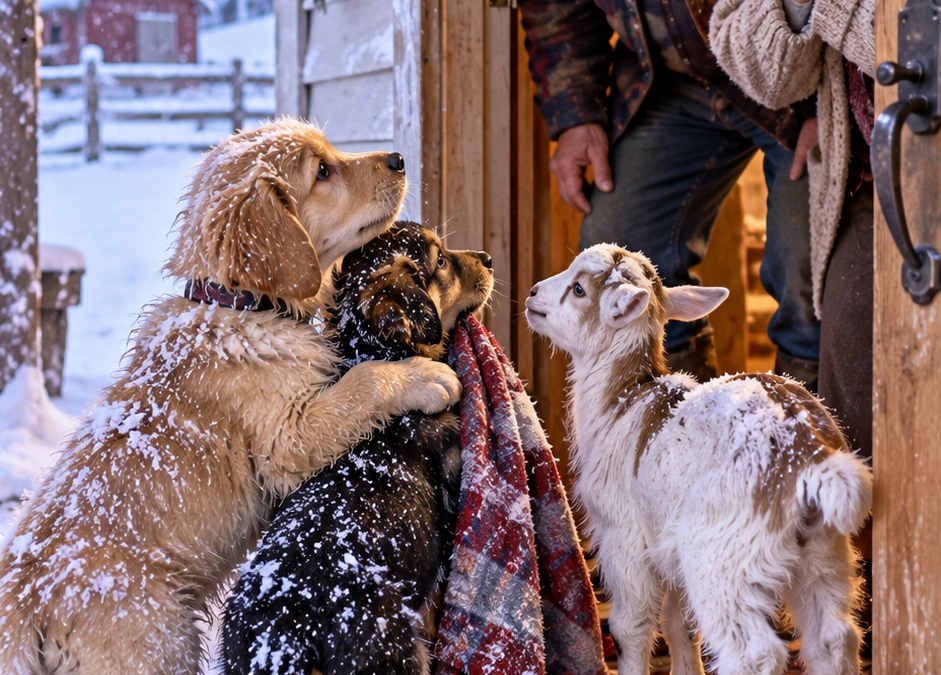
𝗣𝗔𝗥𝗧 𝟮
The first half hour was measured in breaths.
Not minutes.
Breaths.
I spread dry towels near the stove while Margaret filled glass bottles with warm water and wrapped each one in old T-shirts.
“No direct contact,” I reminded her.
“I married you in 1981, Harold. I’ve heard you explain basic thermodynamics before.”
“Then imagine how educational the next forty years will be.”
Under different circumstances, she might have smiled.
She didn’t.
The goat’s chest moved so faintly that every few seconds Margaret touched two fingers to her side just to reassure herself.
The puppies were trembling violently now.
Oddly enough, that gave me hope.
Shivering meant their bodies were still fighting.
The stronger pup had taken the worst exposure across his back and hindquarters.
His paw pads were cracked.
One back leg didn’t want to straighten.
The quieter pup worried me more.
His breathing rattled.
A wet, soft sound in his chest.
I leaned closer.
“No.”
Margaret looked at me.
“What?”
“His lungs.”
She heard it then.
“Oh, Harold.”
“One problem at a time.”
I said that because there were approximately twenty problems and I didn’t want either of us counting.
We began with warm water.
Tiny amounts.
Drops.
Nothing forced.
Margaret dipped her finger in diluted honey and touched it carefully against the puppies’ gums.
The stronger one licked once.
Then stopped.
“Good,” she whispered.
“Again.”
Another tiny lick.
The quieter pup didn’t respond at first.
Margaret touched his mouth again.
“Come on.”
Nothing.
I rubbed his side.
His eye opened.
Barely.
“That’s right,” I murmured. “Be difficult.”
His tongue moved.
Margaret exhaled.
“Good boy.”
We worked on the goat next.
She was terrifyingly cold.
I had raised livestock when I was younger, though never goats.
I knew enough to know she was in real trouble.
Margaret wrapped her ears loosely in soft flannel.
I tucked a warm bottle against the blanket near her body.
Not directly against skin.
Slow.
Everything slow.
The stronger puppy kept trying to crawl toward her.
“Stay.”
He ignored me.
Naturally.
German Shepherds seem to arrive on earth already convinced that human instructions are merely opening arguments.
He dragged himself another inch.
Then another.
Finally, his muzzle rested against the goat’s shoulder.
The second pup shifted closer too.
They formed a rough half-circle around her.
Margaret looked at me.
“Leave them.”
“I wasn’t going to move them.”
“They know something.”
“They know she’s warm.”
“No.”
She watched them.
“They know she’s theirs.”
I almost told her not to anthropomorphize.
Then I looked at those two pups.
Neither had enough strength to save himself.
Yet both were still orienting toward the goat.
Maybe Margaret was right.
That happened often enough in our marriage to be statistically irritating.
The clock above the stove ticked.
The wind hammered the house.
Every few minutes I checked gums.
Breathing.
Paws.
Ears.
Responsiveness.
The puppy closest to me clenched his jaw while I massaged one cracked pad.
“Yeah, I know.”
He pulled weakly.
“You can file a complaint tomorrow.”
Margaret warmed a towel.
“What are we calling them?”
“We’re not.”
She stopped.
“Why not?”
“Because naming things is how you accidentally own them.”
“We currently have two German Shepherd puppies and a goat warming beside our stove.”
“Temporary.”
She looked at me.
“Of course.”
I knew that look too.
Temporary was already dead.
We just hadn’t buried it yet.
The smaller pup made a tiny sound.
Not a bark.
Almost like a bird chirping.
The stronger one raised his head.
Immediately.
He checked his brother.
Then the goat.
Then me.
That sequence would become familiar.
Brother.
Goat.
Human.
Always in that order.
“You’ve got priorities,” I said.
The pup lowered his head.
An hour passed.
Then another.
The goat’s temperature began coming up.
Her breathing deepened slightly.
The stronger puppy’s shivering eased.
The second pup continued rattling.
At one point, Margaret took his face gently between her hands.
“Don’t you dare.”
I looked at her.
She was crying.
Quietly.
“Don’t you dare quit now.”
The puppy blinked.
Margaret sniffed.
“You came all this way.”
She wiped her cheek with the back of her wrist.
“You can stay.”
Something in those words went through me.
Stay.
For years, that had been the word we couldn’t use.
Not in this house.
Not after Daniel.
Our only son had been thirty-two when a drunk driver crossed the center line outside Great Falls.
One phone call.
One hospital corridor.
One terrible sentence.
Then suddenly everything he owned fit into boxes.
The house had never recovered.
People say grief fades.
That’s generous.
Grief changes jobs.
At first, it screams.
Later, it maintains the property.
It sits in unused rooms.
It lives inside recipes nobody cooks anymore and birthdays nobody mentions until the day has passed.
Margaret stopped playing the piano.
I stopped inviting neighbors over.
We became very efficient at being alive.
Nothing more.
Just alive.
Then three half-dead animals scratched at our door.
And my wife was kneeling on the kitchen floor telling one of them to stay.
The irony wasn’t lost on me.
The goat stirred.
Her head lifted half an inch.
Both puppies reacted.
The stronger one pushed up on his elbows.
The second pup opened both eyes.
The goat made another sound.
A little squeak.
Thin.
Bright.
Alive.
Margaret folded in half.
Her hand covered her face.
I sat beside her.
“Hey.”
“I’m fine.”
“You haven’t been fine since Reagan.”
That actually made her laugh.
Once.
Wet and broken.
The puppies watched us.
“Now you’re frightening the animals,” I said.
Margaret wiped her eyes.
“I don’t care.”
The goat squeaked again.
And something in that kitchen shifted.
Not healed.
I don’t use that word carelessly.
Some things never return to what they were.
But the room changed.
For years, our house had held silence like a second roof.
That night, the silence cracked.
And three animals barely capable of breathing crawled through it.
By dawn, the stronger puppy had earned a name.
Bo.
Margaret said it first.
“Why Bo?”
She shrugged.
“He looks like a Bo.”
“That’s not reasoning.”
“Neither was marrying you.”
“Fair.”
The quieter puppy became Zeke.
Then Margaret shortened it to Z within twenty minutes because apparently syllables were now wasteful.
The goat took longer.
Margaret stood at the kitchen window and looked toward the juniper shrubs along the fence.
“Juniper.”
I glanced down.
The goat blinked.
“Juniper.”
“Too fancy.”
“Harold.”
“Juniper it is.”
Names.
That was how it happened.
Three names.
Three commitments disguised as vocabulary.
Margaret smiled.
“If we name them—”
“I know.”
“They stay.”
I looked at Bo.
He had his chin resting across Juniper’s back.
Z slept with one paw touching her side.
“Seems they’ve already decided.”
The first attempt at standing happened around seven in the morning.
Z surprised us.
He pushed himself upright.
His front legs shook.
Then his back legs followed.
For one triumphant second, he stood.
Then the melted snow on the floor betrayed him.
All four paws slid outward.
He landed on his side.
Bo startled.
Juniper lifted her head.
Margaret gasped.
I started toward him.
Then Z barked.
One tiny, ridiculous bark.
Bo responded.
Not with concern.
With what sounded suspiciously like excitement.
He tried to stand too.
His back leg folded.
He slid.
Juniper made a soft bleat.
And for reasons I still can’t explain, I laughed.
Not chuckled.
Laughed.
A full, ugly, rusty sound.
It came out of me like I’d coughed up an old engine part.
Margaret stared.
Then she started laughing too.
Z barked again.
Bo tried standing.
Failed.
Juniper attempted to crawl over both of them.
Our kitchen looked like the least competent livestock exhibition in Montana.
And we laughed.
I hadn’t heard that sound in our house for years.
Real laughter.
Not polite.
Not social.
Not the little noise people make when someone tells a mediocre joke at church.
This was reckless laughter.
It hurt.
That frightened me more than the storm.
Because joy, once you’ve lost enough, begins to feel irresponsible.
You start distrusting it.
Expecting payment.
That morning, I realized grief had taught us a terrible habit.
Whenever anything good appeared, we immediately searched for the exit.
Bo solved that by falling over again.
Margaret laughed so hard she sat down.
“Stop encouraging him.”
“I’m not.”
“You laughed.”
“He fell.”
“You’re horrible.”
“He agrees.”
Bo glared at me from the floor.
At least I chose to interpret it as a glare.
His hind leg worried me.
When he tried bearing weight, it buckled.
Z’s lungs worried me more.
His breathing had improved slightly, but the rattle remained.
Juniper needed proper veterinary assessment too.
“We need Olsen.”
Margaret nodded.
Dr. Peter Olsen ran the nearest veterinary clinic.
Twenty miles.
Under normal circumstances, thirty minutes.
During that storm?
Could have been three days.
I called.
The phone rang six times.
“Clinic.”
“Peter.”
“Harold?”
“Yeah.”
“You know sane people are inside right now.”
“So I’ve heard.”
“What happened?”
“I have two frozen German Shepherd pups and a baby goat in my kitchen.”
Silence.
Then, “Margaret finally replaced you?”
“Funny.”
“I’m serious. Repeat that.”
I did.
His voice changed.
“Breathing?”
“All three.”
“Core warmth?”
“Improving.”
“Any black tissue?”
“Not yet.”
“Chest sounds?”
“One pup is rattling.”
He exhaled.
“Bring them.”
“You open?”
“For you, apparently.”
“Road?”
“Bad.”
“Useful assessment.”
“You’re welcome.”
I hung up.
Margaret had already started preparing blankets.
“You’re not coming.”
She kept folding.
“Margaret.”
“Harold.”
“Road’s ugly.”
“So is your driving.”
“Exactly why you should stay.”
She looked at me.
I sighed.
“Fine.”
Marriage.
Forty-three years of negotiated surrender.
We loaded the animals into the pickup.
Margaret sat passenger side with Juniper under her coat.
Bo and Z were wrapped together in a thick blanket across her lap.
I had started the truck twenty minutes earlier.
It still felt like a refrigerated tractor.
The heater wheezed warm air with all the urgency of a government office.
“Come on,” I muttered.
The truck didn’t care.
We pulled onto the road.
Snow screamed beneath the tires.
Visibility came and went.
Fields had disappeared.
Fence lines rose from drifts like black stitches.
At minus thirty-something, even the steering wheel hurt through gloves.
Bo shifted.
I reached across and touched his paw.
Cold, but better.
“Still with me?”
His eyes opened.
“Good.”
Z coughed.
The sound tightened every muscle in my back.
Margaret pulled him closer.
“It’s okay.”
Another cough.
“Peter’s waiting.”
I kept driving.
Ten miles.
Twelve.
Fifteen.
Every mile felt stolen.
The storm had tried to claim those animals overnight.
Now it seemed offended we’d objected.
At one drift, the truck fishtailed.
Margaret grabbed the dash.
“Harold.”
“I know.”
“You always say that right before making it worse.”
“Very supportive.”
“Stay on the road.”
“That’s my current hobby.”
Juniper bleated from inside her coat.
Bo’s head rose.
Z turned too.
Both pups checked her.
Even sick, cold, exhausted—they checked.
I looked at Margaret.
She had noticed.
“They really won’t leave her.”
“No.”
“How did they end up together?”
I didn’t know.
That question haunted us for weeks.
Had they belonged to the same farm?
Had the puppies escaped and found her?
Had she been abandoned with them?
Had someone dumped all three?
Had a storm broken fencing and scattered livestock?
We never learned.
Maybe that’s appropriate.
Some families know exactly how they began.
Others simply look up one day and realize they’ve already chosen each other.
The clinic sign finally appeared through blowing snow.
SHELBY VETERINARY CARE.
EST. 1964.
I had never seen anything more beautiful.
Olsen was waiting at the door in boots and scrubs.
His assistant, Renee, stood behind him holding towels.
They moved immediately.
No speeches.
No sentimental nonsense.
That was why I trusted Peter.
Compassionate men who work with animals for decades usually become very practical.
Bo first.
Temperature.
Pads.
Ears.
Circulation.
Leg movement.
Then Z.
The stethoscope remained on his chest longer.
Too long.
“Peter.”
He held up one finger.
I waited.
Z looked at me.
Then Olsen removed the stethoscope.
“Fluid sounds. Early pneumonia possible.”
Margaret closed her eyes.
“Treatable?”
“Yes.”
The word didn’t come fast enough.
“But?”
“He’s weak.”
I hated buts.
Every bad day in life has a but attached somewhere.
Olsen examined Bo’s hind leg.
“Cold injury. Maybe nerve involvement. I don’t feel a break.”
“So he’ll walk?”
“Maybe.”
Another terrible word.
“Peter.”
“I’m not lying to you.”
“I didn’t ask you to.”
“You looked like you wanted me to.”
Fair.
He checked Juniper.
Temperature.
Hydration.
Ears.
Hooves.
Gums.
“She’s tough.”
Margaret smiled weakly.
“She had bodyguards.”
Olsen glanced at the puppies.
“I noticed.”
They started treatment.
Warm fluids.
Antibiotics for Z.
Pain control.
Skin ointment.
Protective wrapping.
Heat support.
Juniper received warmed goat milk and careful monitoring.
Bo’s pads were cleaned and dressed.
When Renee tried moving Z to another table, Bo struggled upright.
His back leg failed.
He tried again.
“Bo.”
He ignored me.
He kept watching his brother.
Olsen looked over.
“Keep them where they can see each other.”
“Thank you.”
“Not sentiment. Stress management.”
“Still thank you.”
He worked for nearly two hours.
Finally, Peter leaned against the counter.
“They’ve got a chance.”
Margaret breathed out.
“But you need to be realistic.”
There was that word.
Realistic.
People love using realism when they mean preparing you for pain.
“You have two compromised puppies and a young goat. That’s a lot of care.”
“We’ll handle it.”
“Harold.”
“What?”
“Every two hours initially. Medication. Monitoring. Physical therapy if Bo’s leg improves. Z needs respiratory checks. Juniper needs feeding support.”
“We’ll handle it.”
“You’re sixty-eight.”
“Thank you for the update.”
“Margaret’s seventy.”
She looked offended.
“Peter, I’ve known your mother since before you could walk. Continue and I’ll tell stories.”
He shut up.
Smart veterinarian.
Olsen handed me medication.
“Call if Z’s breathing worsens. If Bo loses color or sensation in any paw, call. If Juniper stops feeding—”
“Call.”
“Exactly.”
He paused.
“One more thing.”
“What?”
“They may not all make it.”
Margaret held Juniper closer.
I looked at Bo and Z.
The two pups were pressed together again.
I had heard versions of that sentence before.
From doctors.
From paramedics.
From people trained to prepare families for endings.
I didn’t resent Peter for saying it.
He was doing his job.
But something inside me refused to entertain it yet.
“We already did the hardest part,” I said.
Peter frowned.
“What was that?”
“We opened the door.”
He studied me.
Then nodded.
“Drive carefully.”
Back home, the barn became a hospital.
The old lambing stall had been empty for years.
I cleaned it out.
Hung an infrared lamp high enough to provide warmth without overheating.
Margaret carried down towels, quilts, old wool blankets, bowls, syringes, thermometers, and enough supplies to make the place look like we’d robbed a very rural pharmacy.
We laid down rubber mats for traction.
Straw around them.
A low enclosed area for Juniper.
Bo and Z refused every arrangement that separated them from her.
Eventually I stopped arguing.
“Fine.”
Margaret smiled.
“You sound surprised.”
“I remain hopeful one day an animal will obey me.”
“You could get a goldfish.”
“It would probably unionize.”
That evening, Z coughed until his whole body shook.
Bo crawled closer and pressed against him.
Juniper wedged herself under Z’s chin.
I sat in the straw.
“Come on, kid.”
The cough slowed.
I listened to his chest.
Still wet.
Still wrong.
But he was breathing.
Every two hours became our schedule.
Alarm.
Barn.
Temperature.
Medication.
Food.
Water.
Pads.
Legs.
Breathing.
Repeat.
The storm eased after three days.
Our exhaustion did not.
Bo’s hind leg showed slight improvement.
I began basic range-of-motion work under Peter’s instructions.
Flex.
Release.
Massage.
Rest.
At first Bo hated it.
He’d turn and mouth my sleeve.
Not bite.
Just register disagreement.
“You submitted your complaint yesterday.”
Mouth.
“Denied.”
Mouth.
“Appeal process is closed.”
Margaret watched from the doorway.
“You’re arguing with a puppy.”
“He started it.”
Z needed steam sessions to help loosen his breathing.
We’d create a warm humid environment, sit quietly, and let him breathe.
“Breathe, Z.”
His ribs expanded.
“That’s your whole job.”
Bo watched nearby.
Juniper watched Bo.
The entire barn became a committee.
The smallest improvement mattered.
A full bowl eaten.
A stronger swallow.
One cough fewer.
A paw placed correctly.
A tail thump.
You learn to redefine victory when life gets fragile.
People want miracles because miracles are tidy.
Recovery isn’t.
Recovery is boring.
Repetitive.
Unphotogenic.
It smells like medication, wet straw, antiseptic, broth, and exhaustion.
Recovery is doing the same gentle thing at three in the morning without knowing whether it will matter.
That’s what Margaret and I did.
And somewhere in the middle of caring for them, we began caring about things again.
I noticed it gradually.
Margaret started humming.
The first time I heard it, I thought the radio was on.
It wasn’t.
She stood at the barn sink washing feeding syringes.
Soft melody.
An old song Daniel had hated because she’d sung it while making breakfast.
I froze.
She kept humming.
Didn’t acknowledge me.
I didn’t mention it.
Some moments break if you name them too early.
Later, I found her baking bread.
Real bread.
Not supermarket.
Not frozen.
She hadn’t done that in years.
“What’s this?”
“Food.”
“I recognize the category.”
“Then why ask?”
“You’re baking.”
“Apparently.”
I looked at her.
“Everything okay?”
She set down the dough.
“Harold.”
“What?”
“Let me bake the bread.”
I raised my hands.
“Proceed.”
Bo took his first proper steps on day eight.
I was half asleep when I heard claws clicking against the barn boards.
Not dragging.
Click.
Click.
Click.
I looked up.
Bo stood three feet from his bed.
His back leg trembled.
But it held.
“Margaret!”
She came running from the house wearing one boot and one slipper.
“What?”
I pointed.
Bo took another step.
Then another.
Five total.
He sat.
Not collapsed.
Sat.
As if he had deliberately decided five was enough for one morning.
Margaret put both hands over her mouth.
“Bo.”
His tail moved.
Once.
“Do it again.”
He looked at her.
No.
Absolutely not.
He had already performed.
I laughed.
Margaret knelt.
“You stubborn little thing.”
Bo leaned against her hands.
Behind him, Z stood too.
Still weak.
Still thin.
But upright.
And then Juniper did something completely ridiculous.
She jumped.
A tiny goat hop.
Four feet left the ground.
Approximately three inches of altitude.
No grace whatsoever.
She landed crooked.
Z barked.
His first real bark.
Bo answered.
Juniper hopped again.
Z’s tail wagged.
Bo tried getting up.
And suddenly the barn was chaos.
Beautiful chaos.
Margaret started crying.
“Not again.”
“I’m allowed.”
“You’re dehydrating.”
She laughed.
Juniper bounced toward her.
For the first time since they’d arrived, none of the three looked like patients.
They looked young.
That’s different.
Young creatures are supposed to be inconvenient.
Noisy.
Clumsy.
Hungry.
Annoying.
Watching them become annoying might have been the happiest thing I’d ever seen.
Their bond became stronger as their bodies did.
We tried feeding Bo and Z separately once.
Neither ate.
Juniper was across the stall.
They stared at her.
I moved her closer.
Still nothing.
Margaret put her between their bowls.
Bo began eating.
Z followed.
“You’ve got to be kidding.”
Margaret smiled.
“Told you.”
Every meal became a ceremony.
Juniper first.
Then the boys.
If she wandered away, they stopped.
If she returned, they continued.
At night, they slept tangled together.
Bo on one side.
Z on the other.
Juniper in the middle.
Two dogs and a goat.
No biology textbook would have recommended it.
Biology had apparently not been consulted.
“They think she’s their mother,” Margaret said.
I watched Juniper head-butt Bo directly in the jaw.
“No.”
“What then?”
I thought about it.
“She’s their reason.”
Margaret went quiet.
That was closer.
Bo had survived the storm protecting her.
Z had survived the same way.
They checked her before food.
Before sleep.
Before moving.
Whatever had happened before our porch, Juniper had become the center of their little world.
The important thing wasn’t who belonged to whom.
The important thing was that none of them believed survival was an individual activity.
That’s not a bad philosophy.
By the second week, the weather broke.
Not warm.
Montana in winter doesn’t suddenly become reasonable.
But the temperature climbed above zero.
Then into the teens.
After thirty below, fifteen degrees feels like Miami.
Margaret cut two faded yellow ribbons from an old Easter box.
“What are those?”
“For the boys.”
“They’re dogs.”
“I’m aware.”
“They don’t need ribbons.”
“Neither do Christmas trees.”
She tied one loosely around Bo’s collar.
Then Z’s.
I stared.
“They look ridiculous.”
“They look handsome.”
“They look like they’re running for office.”
“Go open the barn.”
I obeyed.
Sunlight flooded inside.
Bo froze.
His whole body stiffened.
The outdoors had last meant death.
Wind.
Ice.
Pain.
Darkness.
He looked at me.
I didn’t pull.
“Your choice.”
Z stood behind him.
Juniper squeezed between them.
Of course she did.
The goat walked outside first.
Bo watched.
Then stepped forward.
One paw onto snow.
He flinched.
His leg trembled.
But the snow wasn’t trying to kill him now.
Sun shone across it.
Blue sky.
No screaming wind.
No darkness.
Just cold air and light.
Bo took another step.
Z followed.
Juniper trotted three feet ahead and turned around.
Bleated.
Impatient.
Margaret laughed.
“She’s yelling at them.”
“Managerial personality.”
Bo walked.
Slowly.
Five steps.
Seven.
Ten.
Z came alongside him.
At one point Bo’s hind leg weakened.
He paused.
Z stopped too.
Then pressed his shoulder against Bo’s side.
Neither moved for several seconds.
Juniper came back.
Head-butted both.
Bo stepped again.
A pickup slowed along the road.
Our neighbors, Tom and Elsie Carter.
Tom rolled down the window.
“Those the pups?”
I nodded.
He shut off the truck.
They stood at the fence.
Elsie watched silently.
Tom shoved his hands into his coat pockets.
“No way.”
“What?”
“Didn’t think they’d make it.”
“No offense taken.”
“I mean after that night.”
“I know.”
Bo stood with his chest toward the breeze.
Yellow ribbon fluttering.
Z leaned against him.
Juniper bounced through the snow.
Elsie wiped her eye.
Tom looked at her.
“Cold wind.”
“Shut up, Tom.”
He shut up.
More neighbors heard.
Not because we called anyone.
Rural communities possess communication systems faster than modern telecommunications.
Within days, people began arriving.
A bag of feed appeared on the porch.
Then goat milk replacer.
Then dog food.
Someone left straw.
Someone brought a casserole, which remains the official Midwestern and Plains States response to all known human suffering.
Margaret started enjoying visitors again.
At first, she pretended not to.
“People are nosy.”
“They’ve always been nosy.”
“Tom stayed forty minutes.”
“You gave him coffee.”
“He looked cold.”
“You gave Elsie pie.”
“She brought feed.”
“Margaret.”
“What?”
“You’re socializing.”
She looked at me like I’d insulted her.
Then smiled.
Just a little.
Our house changed faster than we did.
There were towels everywhere.
Booties near the door.
Medication charts on the refrigerator.
A goat bottle beside the dish rack.
Chew marks on one table leg.
Margaret blamed Bo.
I blamed Z.
Juniper was actually responsible.
Our once-silent kitchen had become an ongoing argument about what shouldn’t be in anybody’s mouth.
“Bo!”
He froze with a sock.
“Drop it.”
He considered.
“Bo.”
He dropped it.
“Good.”
Z immediately picked it up.
“Traitor.”
Juniper tried eating the corner.
I closed my eyes.
“Wonderful.”
Margaret laughed from the stove.
“We wanted life back.”
“This is excessive life.”
“You seem happy.”
“I am surrounded by criminals.”
Bo leaned against my leg.
I scratched behind his ear.
“Especially you.”
His tail hit the cabinet.
The question of where they’d come from remained.
I called neighboring ranches.
Animal control.
Sheriff’s office.
Local shelters.
Nobody had reported two missing German Shepherd pups with a goat.
No microchips.
No collar.
No identification.
One deputy thought they might have wandered miles during the storm.
Peter disagreed.
“Not in that condition.”
“Then someone dropped them?”
“I don’t know.”
That possibility made me angry.
I tried not to dwell on it.
Anger wants a target.
Sometimes there isn’t one.
Maybe a fence broke.
Maybe someone panicked.
Maybe circumstances were more complicated than abandonment.
All I knew was what appeared on our porch.
And eventually I realized knowing the beginning wasn’t necessary to decide the ending.
“They’re ours,” Margaret said one afternoon.
We were standing in the barn.
Bo slept beside Juniper.
Z’s head rested across Bo’s back.
I pretended to misunderstand.
“The blankets?”
“The animals.”
“Temporary.”
She stared.
“Harold.”
“Very temporary.”
“Bo has eaten two of your socks.”
“That’s evidence against adoption.”
“You built them a ramp.”
“Safety.”
“You installed a second heat lamp.”
“Redundancy.”
“You ordered orthopedic mats.”
“Medical.”
“You made a sign.”
I turned.
She pointed toward the paddock.
I’d painted it two days earlier.
BO, Z & JUNIPER FIELD.
I cleared my throat.
“Administrative labeling.”
Margaret folded her arms.
“Temporary.”
“Fine.”
“What?”
“They stay.”
She smiled.
“Say it properly.”
“No.”
“Harold.”
“They’re home.”
Her eyes filled.
“Yeah.”
I looked toward the animals.
“They’re home.”
The words hurt.
Then helped.
Home.
Such a simple word.
We had been living in one for decades without feeling it.
Now the place was full again.
Not the way it had been.
That mattered.
Nothing replaced Daniel.
Bo didn’t replace him.
Z didn’t.
Juniper certainly didn’t, though Daniel would have found her deeply amusing.
Love doesn’t work by vacancy.
You don’t lose someone and assign their square footage to the next creature who arrives.
The new love builds elsewhere.
Another room.
Another shelf.
The heart expands badly, painfully, but it expands.
I found myself thinking about Daniel more often.
Strangely, it hurt less.
Not because I missed him less.
Because the memories weren’t entering an empty room anymore.
One evening, Margaret brought out an old photograph.
Daniel at twelve.
Snow up to his knees.
A German Shepherd beside him.
Our old dog, Sam.
I hadn’t seen that photo in years.
“You remember?”
“Of course.”
“He begged for that dog.”
“He promised to clean the kennel.”
“He lied.”
“Children are politicians.”
Margaret laughed.
Bo wandered over.
Sniffed the photograph.
“That’s Daniel,” she told him.
I looked at her.
She kept talking.
“He would have liked you.”
Bo licked the frame.
“Not that much.”
She laughed again.
I sat beside her.
For once, neither of us put the photo away quickly.
That night, we left it on the mantle.
Spring was still far away, but recovery accelerated.
Bo’s leg strengthened.
He went from five steps to twenty.
Twenty to full trips across the barn.
Then the yard.
His gait remained slightly uneven for a while.
Peter warned us he might always carry a hint of the injury.
Bo couldn’t care less.
The first time he ran, he terrified me.
“Bo!”
He launched across the paddock after Juniper.
His back legs worked.
Not perfectly.
But enough.
Z chased after him.
Juniper zigzagged.
All three disappeared behind the barn.
“Margaret!”
“What?”
“They’re running.”
“Good.”
“They’re not supposed to.”
“Did you tell them?”
“I am currently attempting.”
Three seconds later, they reappeared from the other side.
Bo leading.
Z behind.
Juniper somehow in the middle.
I stood with both hands on my hips.
“Stop!”
Nobody stopped.
Margaret nearly fell over laughing.
“I don’t see the humor.”
“Look at your face.”
“They’re recovering.”
“They’re recovered enough to ignore you.”
“That’s not medical evidence.”
Peter confirmed it several days later.
Bo’s nerve function was nearly normal.
Pads healed.
Frostbite limited mostly to superficial damage.
Z’s lungs sounded clear.
Weight improving.
Juniper thriving.
Peter finished his examination.
“I suppose I owe you something.”
“Money?”
“No.”
“Then I’m uninterested.”
He shook his head.
“I didn’t think all three would make it.”
“Neither did I.”
He looked surprised.
“You acted like you did.”
“I was busy.”
“That’s your explanation?”
“Pretty much.”
He scratched Bo’s neck.
“Sometimes you’re lucky.”
“Sometimes.”
“And sometimes you’re stubborn.”
“That’s why Margaret married me.”
From the waiting room she shouted, “No, it isn’t.”
Peter grinned.
I sighed.
“No professional confidentiality in this place.”
By late winter, the three moved as a unit.
Where Juniper went, the dogs followed.
Where the dogs slept, Juniper settled.
People joked that the boys thought they were goats.
I thought Juniper believed she was a German Shepherd.
Neither theory fully covered the situation.
They simply belonged together.
One afternoon, a loose dog came near the paddock fence.
Nothing serious.
Neighbor’s mutt.
Friendly.
But the moment he approached Juniper, Bo stepped between them.
No barking.
No aggression.
Just position.
Z came alongside.
Shoulder to shoulder.
Juniper stood behind both.
The exact formation they must have used during the storm.
I watched from the porch.
The memory hit hard.
Two frozen puppies.
One goat.
Doorstep.
Bo’s body shielding her.
Z pressed close.
They hadn’t outgrown it.
Protection wasn’t trauma anymore.
It was identity.
I called the neighbor dog away.
Bo watched until he left.
Then immediately turned and licked Juniper’s face.
She head-butted him.
“Beautiful relationship,” I muttered.
Spring arrived.
Snow retreated from the field.
Mud replaced it.
I learned that three healthy young animals can redistribute approximately half an acre of mud throughout a house in under ninety seconds.
Margaret instituted rules.
Rule one: no animals in the kitchen covered in mud.
Ignored.
Rule two: towels by the door.
Eaten.
Rule three: wipe paws.
Negotiated.
Rule four: Juniper absolutely forbidden from standing on furniture.
Juniper slept on the couch.
“Your discipline system is failing.”
Margaret scratched Juniper’s head.
“She’s cold.”
“It’s sixty-three degrees.”
“Emotionally cold.”
I walked away.
There are times when a husband protects his peace by refusing to participate.
Neighbors started calling the place “the little zoo.”
Tom Carter painted us a proper sign.
MILLER’S THREE.
Margaret hung it above the barn door.
I pretended not to like it.
That fooled nobody.
The yellow ribbons remained on a hook near the door.
We stopped putting them on the dogs.
They had become too frayed.
But Margaret refused to throw them away.
“Why keep them?”
“Because.”
“Strong argument.”
“They remind me.”
“Of what?”
She looked out toward the field.
Bo was chasing Z.
Juniper stood on a stump, observing them like a disappointed supervisor.
“That things can come back.”
I knew what she meant.
Not people.
Not time.
Not exactly.
But parts of yourself.
Laughter.
Purpose.
Routine.
Annoyance.
Hope.
The willingness to wake tomorrow because something needs breakfast.
Those things can come back.
Sometimes they scratch at the door.
Summer transformed them.
Bo grew into a handsome German Shepherd with broad shoulders and one ear that leaned slightly when he was tired.
Z remained a little narrower.
Quieter.
Observant.
He listened before moving.
Bo met the world chest-first.
Z studied it.
Juniper became a menace.
There is no graceful way to say that.
The tiny dying goat transformed into an athletic criminal with horns.
She learned to open latches.
She climbed things.
She ate one corner of Margaret’s gardening hat.
She escaped the paddock twice and once appeared on the hood of Tom Carter’s pickup.
“Harold!”
I came outside.
Tom stood beside his truck.
Juniper stood on the hood.
“Your goat.”
“I can see.”
“Get her off.”
“She appears comfortable.”
“Harold.”
I grabbed grain.
Juniper hopped down.
Bo and Z watched from behind the fence.
I swear they looked proud.
“You two are terrible influences.”
Z wagged.
In August, Margaret played the piano.
I was outside repairing a gate.
At first, I thought the sound came from a radio.
Then I realized.
Piano.
One slow chord.
Then another.
I put down the wrench.
Walked toward the house.
Through the screen door, I saw her.
Margaret sat at the old upright piano.
Dust had been wiped from the keys.
Her shoulders were stiff.
Her hands trembled.
She played the first bars of an old hymn.
Stopped.
Started again.
Bo lay behind her bench.
Z beside him.
Juniper had somehow entered the house and was chewing nothing, which was suspicious.
I stood outside.
Didn’t interrupt.
Margaret played.
The song filled the room.
The same room where silence had lived for nearly a decade.
I cried then.
Quietly.
I’m not embarrassed to say it.
At sixty-eight, you become less concerned about maintaining a reputation for emotional invulnerability.
Mostly because everybody who might have believed it already knows better.
The animals had not cured our grief.
That isn’t what happened.
They had interrupted it.
Forced it to share space.
Grief had occupied every room.
Then Bo needed medication.
Z needed steam.
Juniper needed feeding.
Margaret needed help carrying towels.
I needed to repair a stall.
Life came back disguised as chores.
That was the trick.
Nobody announced it.
Nobody said, Today you begin living again.
We were too busy to notice.
One year after the storm, the temperature dropped hard again.
Not quite as bad.
Minus twenty-seven by dusk.
Wind howled along the eaves.
The house tightened.
I stood at the same door.
The memory returned immediately.
Scratch.
Scratch.
Scratch.
Except this time, the sound came from inside.
Bo sat beside the door.
His paw against it.
“Want out?”
He stared.
“No.”
Stare.
“It’s twenty-seven below.”
Tail thump.
Z appeared behind him.
Juniper pushed between both dogs.
I stared at the three of them.
“Absolutely not.”
Margaret came in.
“What?”
“They want outside.”
“Just for a minute.”
“Did everyone in this house lose basic survival instincts?”
She opened the inner door.
Cold air leaked through the storm door.
Bo pressed his nose against the glass.
He looked outside.
Not desperate.
Not afraid.
Just watching snow.
Z stood beside him.
Juniper between them.
Same formation.
I stepped closer.
For one second, I saw them as they had been.
Ice on lashes.
Blue ears.
Shallow breath.
Three small lives waiting for us to decide whether to open the door.
Margaret touched my hand.
“You okay?”
“Yeah.”
Bo turned.
His eyes found mine.
Then he walked away from the door.
Z followed.
Juniper stayed two seconds longer, mostly because goats enjoy making exits difficult.
I locked the door.
That night, they slept beside the stove.
Not because they were freezing.
Because they liked it.
There is an enormous difference.
I sat in my chair watching them.
Bo stretched out.
Z curled beside him.
Juniper tucked herself into the gap.
Margaret read on the couch.
Wind slammed against the house.
Nobody cared.
The storm had returned to the same place.
But it had lost all authority.
That pleased me more than I can explain.
Winter had nearly killed those three.
Now they treated its noise like background music.
A few weeks later, we celebrated what Margaret called “doorstep day.”
“I refuse to celebrate an attempted freezing.”
“We’re celebrating them surviving.”
“That’s acceptable.”
She baked a cake for us.
Dog-safe treats for the boys.
Something goat-appropriate for Juniper.
Tom and Elsie came.
Peter Olsen came.
Renee from the clinic.
Half the road came.
People stood around the barn sharing the version of the story they’d heard.
Each version had grown slightly more ridiculous.
According to Tom, Bo had dragged Juniper six miles through a blizzard while fighting wolves.
“That didn’t happen.”
“You weren’t there.”
“I was there when they arrived.”
“Exactly. You don’t know what happened before.”
“No wolves.”
“You can’t prove that.”
Elsie smacked his arm.
“Stop improving the story.”
“I’m not.”
“Next year there’ll be bears.”
Tom considered.
“Could be.”
I walked away.
Bo followed.
I rested my hand on his neck.
Fully grown now.
Warm.
Strong.
Nothing about him felt fragile.
Z came beside us.
Juniper pushed between.
Predictable.
Always together.
Someone asked Margaret whether we would ever consider rehoming them.
She stared at the woman so long that the woman began apologizing before Margaret said anything.
“No.”
That ended negotiations.
At dusk, everyone left.
Snow began falling lightly.
Not a storm.
Just flakes drifting through still air.
Margaret and I stood at the fence.
Bo and Z walked through the field.
Juniper between them.
Their breath rose in pale clouds.
I thought about probability.
Three young animals surviving long enough to reach us.
Finding our porch.
Scratching.
Us hearing.
Opening.
Knowing enough to warm them carefully.
A veterinary clinic being reachable.
Medicine working.
Bo’s leg recovering.
Z’s lungs clearing.
Juniper surviving frost exposure.
One unlikely event after another.
People call that a miracle.
Maybe.
I’ve never been good with the word.
Miracles suggest something happens without labor.
This involved plenty.
The animals fought.
We worked.
Peter worked.
Margaret worked harder than all of us.
Neighbors helped.
There were medicines, towels, alarms, sleepless nights, cracked hands, spilled broth, muddy floors, vet bills, chewed socks, and enough laundry to defeat a commercial hotel.
If that’s a miracle, miracles have terrible administrative overhead.
Margaret leaned against me.
“You know what I think?”
“Usually.”
“I think they saved us.”
I looked at her.
“That’s sentimental.”
“You’re sentimental.”
“Defamation.”
She smiled.
“I’m serious.”
I looked back toward the field.
Bo stopped.
Z stopped beside him.
Juniper continued several feet, realized nobody followed, and came back.
“I know.”
Margaret slipped her hand into mine.
For years, we’d avoided saying things like that.
Saved.
Healed.
Hope.
Home.
They had seemed too dramatic.
Too vulnerable.
Now I understood that vulnerable words aren’t necessarily dishonest.
Sometimes they’re the only accurate ones left.
That winter I started leaving the porch light on.
Not the door open.
I had not become insane.
The light.
Every night.
Margaret noticed.
“You expecting company?”
“No.”
“Then why?”
I shrugged.
“Somebody might need to find the house.”
She didn’t tease me.
She simply nodded.
Years passed.
Bo and Z matured.
Their bond never weakened.
Juniper grew into a sturdy little goat who remained convinced the dogs existed as her personal security detail.
When she grazed, one usually lay nearby.
When strangers approached, both watched.
When she slept in the field, Bo often positioned himself toward the road.
Z toward the trees.
Nobody taught them.
Some habits begin as survival and eventually become love.
Margaret and I aged.
That part refused negotiation.
My knees began predicting weather more accurately than radio.
Her hands stiffened.
We moved more slowly.
The animals adjusted.
Bo stopped charging down stairs when he realized I couldn’t.
Z waited at gates.
Juniper continued respecting nobody.
Fair enough.
One afternoon, I slipped on ice near the barn.
Not dramatic.
No injury.
Just one humiliating moment where gravity reminded me it maintained jurisdiction.
Before I even sat up, Bo was there.
Then Z.
Bo stood over me.
Z ran toward the house.
Margaret opened the door.
“What happened?”
“I’m fine.”
Z barked.
“Traitor.”
Margaret walked over.
“You fell.”
“I sat unexpectedly.”
“In snow.”
“Very soft.”
She helped me up.
Bo stayed pressed against my leg until I reached the porch.
I looked at him.
“Role reversal?”
His tail wagged.
Apparently.
Years earlier, I’d picked him up because he couldn’t stand.
Now he walked slowly because I couldn’t move fast.
That is the bargain with animals.
You save them when they’re young.
If you’re lucky, one day they begin saving you in smaller ways.
Not from storms.
From loneliness.
From falls.
From sleeping too late.
From the temptation to stop going outside.
From becoming entirely enclosed inside your own memories.
Bo and Z never let the house go quiet again.
Neither did Juniper.
On Daniel’s birthday, Margaret and I developed a new ritual.
We used to avoid the day.
Not consciously.
We simply became busy.
Now we carried coffee to the paddock.
Sat on a bench.
Talked about him.
Not his death.
His life.
The ridiculous haircut at sixteen.
The fishing trip where he dropped my tackle box in the river.
The time he tried teaching our old dog Sam to ride in a canoe.
The Christmas he proposed to cook dinner and nearly burned the kitchen.
Margaret laughed.
Then cried.
Then laughed again.
Bo rested at her feet.
Z leaned against me.
Juniper attempted to eat the bench.
Perfect.
Grief was still there.
But now grief had company.
That’s what changed.
I had spent years thinking healing meant the pain should eventually leave.
It doesn’t.
Healing means the pain stops being the only thing in the room.
The day Bo, Z, and Juniper arrived, cold had stripped everything down to essentials.
Breath.
Warmth.
Touch.
Stay.
Those remained the essentials long after the frostbite healed.
By the third winter, we didn’t talk about them as rescues anymore.
They were simply ours.
Bo.
Z.
Juniper.
Family.
The old enamel bowl from their first night remained by the mudroom.
Dented.
Chipped.
Too small now for either dog.
Margaret wanted to throw it out once.
I stopped her.
She smiled.
“Sentimental.”
“Historical artifact.”
“Of course.”
The yellow ribbons remained on the hook.
Faded almost white.
We never moved them.
Above the doorway, Margaret wrote three words in chalk one spring.
STAY.
YOU’RE HOME.
Technically four words.
I mentioned this.
She told me to find something useful to do.
I complied.
The chalk faded over time.
She rewrote it.
Again.
Again.
Eventually the words became part of the house.
Visitors asked.
We told them.
Or tried.
The story always sounded impossible when spoken aloud.
Two puppies.
A goat.
Forty below.
Scratch at the door.
But impossible things happen regularly.
They just rarely announce themselves politely.
One January night, years after the original storm, another blizzard rolled across the plains.
Hard wind.
Whiteout.
Temperature falling.
Bo was older now.
Gray beginning along his muzzle.
Z too.
Juniper had become rounder and bossier.
All three lay near the stove.
Margaret slept in her chair.
I checked the door.
Locked.
Porch light on.
I stood there longer than necessary.
Listening.
Nothing.
No scratching.
Good.
I hoped no animal was out there.
No person either.
The storm hit the siding.
Bo lifted his head.
I looked back.
“Remember?”
He blinked.
Maybe.
Maybe not.
Dogs don’t tell us what they remember.
Z raised his head too.
Juniper stayed asleep.
Naturally.
I sat on the floor beside them.
Bo put his head in my lap.
Z rested against my side.
I ran my hand along Bo’s back.
Warm.
Thick coat.
Solid body.
No ice.
No trembling.
“You won.”
His ear twitched.
“The cold had you.”
I scratched his neck.
“It thought it had you.”
Z shifted closer.
“Both of you.”
Juniper woke and immediately stepped on my boot.
“And you.”
Margaret opened one eye.
“Talking to animals again?”
“They listen.”
“Poor things.”
She went back to sleep.
I smiled.
Outside, the temperature dropped.
Inside, the stove burned.
Bo slept.
Z slept.
Juniper slept.
And I understood something that had taken me almost seventy years to learn.
Warmth isn’t a temperature.
We had heat before they came.
Wood stove.
Furnace.
Blankets.
Hot water.
The house had never actually been cold.
Not physically.
But there are colder things than weather.
A table set for two when it used to be three.
A piano nobody touches.
A bedroom door kept shut.
Birthdays allowed to pass without names.
Photographs turned facedown because looking hurts.
That was cold.
Then three dying animals arrived during the worst night of winter.
They needed warmth.
So we gave them ours.
What we hadn’t realized was that we still had any.
They proved it.
Every feeding.
Every sleepless hour.
Every bandage.
Every ridiculous goat hop.
Every bark.
Every muddy paw.
Every chewed sock.
Every morning obligation.
Each one was another match struck inside a house we’d allowed to go dark.
The storm had meant to finish them.
Instead, it delivered them to us.
I still don’t call it fate.
At sixty-eight I had become suspicious of explanations that make life sound organized.
Some things are simply accidents.
Terrible ones.
Beautiful ones.
A door.
A sound.
A decision.
Open or don’t.
That night, we opened it.
That’s all.
Everything after came from that.
Bo survived.
Z survived.
Juniper survived.
Margaret laughed again.
She baked again.
She played the piano again.
I started inviting people inside.
We said Daniel’s name without lowering our voices.
The barn filled.
The kitchen filled.
Our days filled.
Even our grief changed shape.
I don’t know who rescued whom.
People like clear roles.
Rescuer.
Rescued.
Owner.
Animal.
Strong.
Weak.
Life has less respect for categories.
That first night, I carried Bo because he couldn’t walk.
Years later, he stood over me when I fell.
Margaret warmed Z’s chest until he could breathe.
Later, Z slept beside her chair through nights when arthritis kept her awake.
We fed Juniper milk one drop at a time.
Later, her ridiculous behavior made Margaret laugh on days when nothing else could.
Everybody gave.
Everybody received.
That feels closer to the truth.
One morning after the big storm passed, sunlight came through the windows.
Snow covered the field.
Perfect.
Untouched.
Bo stood at the door.
Z beside him.
Juniper in the middle.
Same arrangement as always.
I opened it.
Cold air came in.
Not deadly.
Just clean.
The animals stepped onto the porch.
Bo paused at the exact place where I’d found him years earlier.
I wondered if scent memories could last that long.
Probably not.
Maybe mine was doing the work.
He looked back.
Gray muzzle.
Steady eyes.
Then walked down the steps.
Z followed.
Juniper trotted between them.
The three crossed the yard.
Sunlight touched their backs.
Their breath rose into the air.
Warm clouds.
Not desperate.
Not fading.
Just breath.
I stood at the doorway.
Margaret came behind me.
“We should close it.”
“In a minute.”
“You’re letting the heat out.”
“In a minute.”
She slipped her arm through mine.
We watched.
Bo reached the field.
Z beside him.
Juniper stopped between the two dogs.
They stood facing the bright morning.
For a second, I saw both versions at once.
Three babies frozen at the doorstep.
Three survivors standing in the sun.
The distance between those two images contained nearly everything worth knowing.
They had arrived with nothing.
No names.
No home.
No guarantee of morning.
They ended with a field carrying their footprints, a barn built around their habits, neighbors who knew them, two old people who loved them, and a porch light that would never be turned off again during a storm.
The cold had lost.
Completely.
Not because winter stopped coming.
It didn’t.
Not because hardship disappeared.
It didn’t.
The cold lost because it no longer got to decide what happened next.
That belonged to us.
To Bo.
To Z.
To Juniper.
To Margaret.
To me.
The storm could knock them down.
It could freeze their paws.
It could fill Z’s lungs.
It could make Bo’s leg fail.
It could leave Juniper barely breathing.
But it couldn’t make us close the door.
That was the part winter never understood.
It could control the temperature.
It could control the road.
It could control the wind.
It could bury the fields beneath four feet of snow.
But it couldn’t control the hand on the doorknob.
Years later, when people heard the story, they’d often say the same thing.
“Those animals were lucky they found your house.”
I always shook my head.
No.
Luck was only part of it.
They were stubborn.
They stayed together.
Bo shielded Juniper.
Z shielded her from the other side.
They moved as one little family before anybody told them that’s what they were.
They found a porch.
They scratched.
Then they waited.
The rest was our decision.
And I suppose that’s what the story finally became for me.
Not a story about puppies.
Not really.
Not even a story about the cold.
It’s a story about a door.
On one side was a warm house occupied by two people who had almost forgotten how much life they still had left to give.
On the other side were three dying creatures who had almost run out of time.
A few inches of wood separated them.
That’s all.
Then somebody opened it.
Sometimes a life changes with something enormous.
A birth.
A death.
A wedding.
A diagnosis.
A terrible phone call.
And sometimes everything changes because you hear scratching at two in the morning and decide to get out of bed.
I still hear it sometimes.
Not for real.
Memory.
Scratch.
Pause.
Scratch.
Then I see Bo looking up.
Z curled around Juniper.
Frost along their lashes.
Three breaths in the darkness.
And I remember what Margaret said behind me.
“They’re just babies.”
She was right.
But that wasn’t the whole truth.
They were also survivors.
They were family before they knew what family meant.
And eventually they became ours.
The final winter Bo spent with us, he was slower.
Old age had caught him.
German Shepherds don’t get enough years.
None of them do.
Z had gone gray too.
Juniper remained offensively energetic.
Bo still slept beside the door.
Habit.
Guardian.
One evening, snow began falling.
He watched it through the glass.
I sat beside him.
“Cold out there.”
He rested his head on my knee.
“Not going back, are you?”
Tail tap.
“Smart.”
Z came over.
Lay on my other side.
Juniper squeezed between them.
Of course.
Margaret looked over from her chair.
“Some things don’t change.”
“No.”
I rubbed Bo’s ears.
“Thank God.”
The storm continued.
The porch light glowed.
No scratching came that night.
But if it had—
I would have opened the door.
Immediately.
Because that was the lesson they left me.
The world is full of cold things.
Weather.
Loss.
Fear.
Loneliness.
All of them convincing you to make yourself smaller.
Close the curtains.
Lock the door.
Stop expecting anything good.
Then something fragile appears.
Something breathing.
Something that needs you.
And suddenly you have a choice.
Stay closed.
Or open.
We opened.
Bo survived long enough to become old.
Z survived long enough to sleep with his gray muzzle across my boot.
Juniper survived long enough to become the most irritating goat in northern Montana.
Margaret found her music again.
I found laughter I thought had rusted shut.
The house found its heartbeat.
And every winter after that, when snow blew across our porch and the thermometer dropped, I remembered the night the cold arrived certain it had won.
It hadn’t.
It brought three nearly frozen babies to our doorstep.
We gave them warmth.
They gave it back.
And in the end, the cold lost everything it had tried to take.








