𝗣𝗔𝗥𝗧 𝟮 Three Months After Our Son Died, a Shelter Called About a Dog Registered in His Name—Then It Walked Straight to His Bedroom
𝗣𝗔𝗥𝗧 𝟮
She didn’t answer immediately.
“Hélène?”
She looked at me.
“It’s an animal shelter.”
I frowned.
“What?”
“They found a dog.”
“Okay.”
“A golden retriever.”
I still didn’t understand.
Then she said, “His microchip is registered to Dan.”
For several seconds, I honestly thought I had misheard.
“Say that again.”
“They found a stray golden retriever.”
Her fingers tightened around the phone.
“The chip lists Daniel as the owner.”
I stared at her.
“That’s impossible.”
“I know.”
“He didn’t have a dog.”
“I know.”
“We cleaned his apartment.”
“I know, Henri.”
“There was no dog.”
“I know.”
She nearly shouted the last word.
We both stopped.
The person from the shelter was still on the line.
Hélène put the call on speaker.
A woman introduced herself as Claire Morgan.
She explained that animal control had picked up a male golden retriever wandering near an industrial road on the edge of Daniel’s city.
The dog was thin.
Dirty.
No collar.
They scanned him.
The microchip information listed Daniel Moreau.
It included Daniel’s old address.
His phone number.
Everything.
“Could it be another Daniel Moreau?” I asked.
Claire paused.
“Sir, I understand why you’re asking.”
She read the registered phone number.
I knew it immediately.
Daniel’s.
Then the address.
His.
Hélène sat down.
I remained standing because sitting suddenly seemed impossible.
“When was the chip registered?”
“We’re checking.”
“Could someone have used his information?”
“It’s possible.”
“Could the dog have belonged to somebody else?”
“Also possible.”
“Then why call us?”
Claire’s voice softened.
“Because your number was added as an alternate contact.”
That silenced me.
“My number?”
“Yes.”
She read it.
My cell.
I had no explanation.
Neither did Hélène.
Claire said the dog was stable but underweight.
Based on his condition, he had likely been loose for some time.
She asked whether we wanted to come identify him.
Four hundred miles.
Hélène looked at me.
I knew what she wanted before she spoke.
“We’ll come.”
Claire said, “You don’t have to decide anything today.”
“We’ll come.”
After the call, we sat at the kitchen table.
My garden gloves were still on.
Soil fell from them onto the floor.
Neither of us noticed.
“Dan had a dog,” Hélène whispered.
“We don’t know that.”
“His name is on the chip.”
“That doesn’t prove—”
“Henri.”
I stopped.
Her eyes filled.
“Why would our number be there?”
I had nothing.
She looked toward the ceiling.
Toward Daniel’s old bedroom.
“Why didn’t he tell us?”
That question hurt in an unexpected way.
Not because I felt betrayed.
Because I realized there had been something alive our son had loved and we had known nothing about it.
I began searching memory.
Sunday calls.
Had he ever mentioned walks?
A dog park?
Veterinary appointments?
A neighbor’s dog?
Anything.
I remembered one conversation months before his death.
He had sounded distracted.
I asked where he was.
“Outside.”
“What are you doing?”
“Just walking.”
“Since when do you walk recreationally?”
“Trying to get healthier, Dad.”
I had laughed.
Maybe he had been walking the dog.
There was another Sunday when I heard something in the background.
A thump.
Then Daniel said, “Stop that.”
I asked who he was talking to.
“No one.”
I assumed the television.
Now every forgotten detail became suspicious.
Hélène did the same.
“That picture.”
“What picture?”
“The one he sent from the park.”
“What about it?”
“There was a leash.”
“You sure?”
“I don’t know.”
She covered her face.
“Why can’t I remember?”
I sat beside her.
“Because we didn’t know we needed to.”
That night, neither of us slept.
Around two, I found Hélène sitting in Daniel’s room.
She had been doing that every day since his death.
Morning.
Evening.
She opened the door.
Sat on the edge of the bed.
Sometimes five minutes.
Sometimes an hour.
She never moved anything.
The pillow still had a slight indentation from the last time he slept there during Christmas.
His old high-school sweatshirt hung behind the door.
A photograph from graduation sat on the dresser.
I stood in the hallway.
“You okay?”
She looked at me.
“Do you think he brought the dog here?”
“When?”
“Christmas.”
“I don’t remember a dog.”
“No.”
She looked around.
“But maybe something in here smells like him.”
I understood what she meant.
If the dog had known Daniel, would it know this room?
I didn’t answer.
The next morning we called Claire.
Driving four hundred miles immediately was possible, but difficult.
She surprised us by offering another option.
A partner rescue organization had a transport run scheduled toward our region.
Given the unusual circumstances, they could bring the dog the following morning.
“We can meet him here?”
“Yes.”
Hélène looked relieved.
I wasn’t sure whether I was.
There was something frightening about bringing whatever this mystery was directly into our home.
But I agreed.
The shelter van arrived shortly after ten.
I remember every detail.
Cloudless sky.
Warm air.
The smell of soil from the garden.
A bee moving around the lavender near the porch.
Hélène stood beside me.
Her hand held my forearm.
The van stopped on the gravel.
Two shelter workers stepped out.
Claire was one of them.
Blonde hair tied behind her head.
Green shirt.
Kind face.
She greeted us quietly.
“We’re sorry for your loss.”
“Thank you.”
Her coworker opened the rear door.
I heard a leash clip.
Then claws against metal.
The dog appeared.
Golden retriever.
Large male.
Maybe five years old.
Hard to tell.
His fur was tangled.
Dust darkened his legs.
His ribs were faintly visible.
Not starving.
But neglected.
Tired.
Claire helped him down.
The dog touched the gravel.
Then lifted his head.
He saw me.
Stopped.
Completely.
Claire gave the leash a small encouraging movement.
He didn’t respond.
I almost stepped backward.
He stared directly into my face.
Hélène’s grip tightened.
“What?” I whispered.
The dog’s nostrils moved.
He took one step.
Then another.
Claire loosened the leash.
The dog approached slowly.
Not fearful.
Not excited.
Intentional.
Five feet.
Three.
One.
He stopped directly in front of me.
Sniffed my pants.
My hands.
Then suddenly moved around my legs.
Not jumping.
He pressed himself against me.
His body curved around my knees.
His head pushed into my thigh.
I froze.
His heart beat rapidly.
I could feel the vibration through my pants.
“What is he doing?”
Claire’s voice was quiet.
“I think he knows something.”
Hélène began crying.
The dog pressed harder.
My hand moved automatically to his head.
His fur was rough.
Warm.
I touched behind one ear.
His eyes closed.
That was when I broke.
For three months, I had cried mostly alone.
In the garden.
In the garage.
Once in the grocery store after seeing Daniel’s favorite cereal.
I hated crying where Hélène could see because I thought one of us needed to remain functional.
That morning, I stopped trying.
I bent over the dog.
Tears fell onto his coat.
Hélène put her arms around both of us.
The three of us stayed there.
No one spoke.
Eventually the dog lifted his head and looked at me.
Amber eyes.
Deep.
Alert.
Something about them felt unbearably familiar.
Not because Daniel had amber eyes.
He didn’t.
Because of the expression.
That slight tilt.
The patient attention.
I had seen Daniel look at me that way countless times when I was talking too much and he was waiting politely for me to finish.
It was ridiculous.
I knew it was ridiculous.
Still, the association landed in my chest.
Claire’s coworker stepped away.
I heard him whisper, “Wow.”
Claire said nothing.
Eventually I stood.
“Come inside.”
The dog followed immediately.
That surprised everyone.
No hesitation at the threshold.
He entered the living room.
Stopped.
His nose lifted.
He sniffed.
Once.
Twice.
Then looked toward the staircase.
Hélène and I looked at each other.
My pulse accelerated.
The dog walked toward the stairs.
“Should we stop him?” I asked.
Hélène whispered, “No.”
Claire unclipped the leash.
The dog placed one paw on the first stair.
He looked back.
Permission.
That was exactly what it felt like.
“Go,” Hélène said.
He climbed.
Slowly.
Confidently.
We followed.
At the top, he turned left.
Daniel’s room was the second door.
Slightly open.
The dog passed the bathroom.
Passed the guest room.
Went directly to Daniel’s door.
My knees weakened.
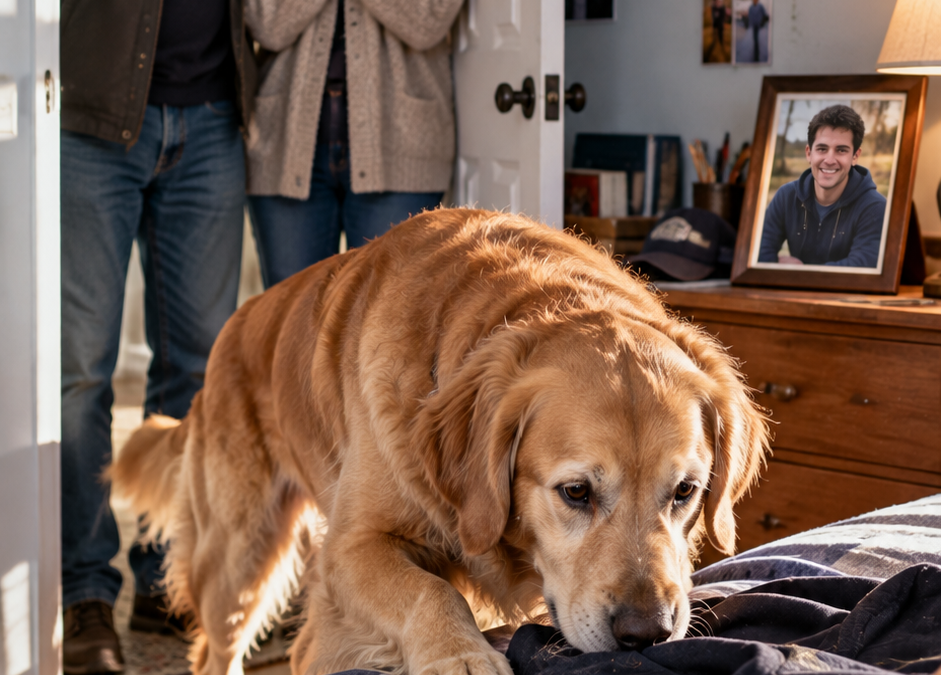
He pushed it with his nose.
The door opened.
He entered.
Jumped onto the bed.
Circled once.
Then lowered himself onto Daniel’s pillow.
A long breath left him.
Not a whine.
A sigh.
The sound of someone who had finally reached somewhere familiar.
Hélène grabbed my hand.
“He knows.”
I could not speak.
The dog closed his eyes.
Sunlight came through the window and covered his back.
Claire remained in the hallway.
She looked stunned.
“Has he been here before?”
“We don’t know.”
I shook my head.
“We never knew he existed.”
Hélène knelt beside the bed.
She placed one hand on the dog’s head.
His eyes opened.
He looked at her.
Then closed them again.
“He knows Dan,” she whispered.
The sentence filled the room.
I sat on the bed.
The mattress shifted.
The dog did not move away.
For the first time since Daniel’s death, his bedroom did not feel like a museum.
Something alive was breathing there.
That alone changed the air.
Claire left us with food, instructions, paperwork, and a temporary foster arrangement.
“You don’t have to adopt him.”
Hélène looked at the dog.
“Yes, we do.”
I turned.
“Hélène.”
She looked at me.
“We do.”
Claire smiled faintly.
“Take time.”
We did not need much.
But first, we needed answers.
The shelter had started researching the chip history.
Within several days, pieces emerged.
Daniel had registered the dog approximately eighteen months before his death.
The dog’s shelter intake name had originally been Samson.
Daniel had adopted him from a small rescue organization after he had been surrendered by another family.
For reasons we never fully understood, Daniel never mentioned him to us.
We found veterinary receipts later in one of the boxes from his apartment.
They had been inside a folder labeled “House Stuff.”
Daniel had a gift for terrible organization.
There were photographs too.
Hundreds.
Stored digitally.
Once we knew what to search for, we found them on an old laptop.
Daniel and the dog.
At a lake.
On a hiking trail.
In his apartment.
The dog asleep with his head across Daniel’s feet.
Daniel wearing the ridiculous winter hat Hélène gave him, kneeling beside the golden retriever.
One photo stopped us.
Daniel was sitting on the floor.
The dog rested against him.
On the back, Daniel had typed a caption into the file metadata:
“Best decision I made this year.”
Hélène cried for an hour.
I stared at the screen.
“How did we not know?”
She wiped her face.
“Maybe he was going to tell us.”
“Eighteen months?”
“You know Dan.”
I did.
He sometimes kept things private until he was certain.
Jobs.
Relationships.
Plans.
Maybe the dog had started as temporary.
Maybe Daniel knew Hélène would worry about his travel schedule.
Maybe there was no dramatic reason at all.
Adults are allowed parts of life their parents do not know.
That truth hurt less once I stopped treating it as exclusion.
There was another question.
Where had the dog been for three months?
We learned that too, partially.
After Daniel’s accident, a friend had apparently taken the dog temporarily.
The friend then experienced housing problems and transferred him informally to someone else.
Somewhere in that chain, the dog got loose.
No one contacted us because no one seemed to know we existed in relation to him.
The microchip did.
Eventually, that tiny device brought him to our door.
We stopped calling him Samson after Claire told us his original name.
Not because Samson was wrong.
Because Daniel had apparently called him “Danny Boy” jokingly, according to messages we later found.
That created another problem.
My son was Dan.
The dog became Dan in the shelter records because staff had initially seen Daniel’s name attached to the chip and used it as a temporary reference before learning more.
Hélène began calling him Danny.
I called him Dog for several days because my emotions couldn’t handle saying my son’s name toward an animal.
Eventually, “Danny” stayed.
Sometimes grief creates awkward names.
Nobody cared.
Danny adapted quickly to our house.
Too quickly, almost.
That was further proof he knew something about us.
He slept in Daniel’s room every night.
Not in the hallway.
Not downstairs.
On the bed.
Always near the pillow.
During the day, he followed me into the garden.
I would dig.
He would sit beside the tomato plants.
The first week, I barely spoke.
Then I started talking.
“Your owner planted tomatoes badly.”
Danny looked at me.
“Very badly.”
His ears lifted.
“He thought throwing seeds at dirt was agriculture.”
The dog’s tail moved.
I laughed despite myself.
It startled me.
I had not heard my own laugh in three months.
I stopped.
Danny tilted his head.
Something inside me cracked.
Then I laughed again.
Longer.
Harder.
It became almost painful.
Hélène came to the back door.
“What happened?”
I pointed at Danny.
“He thinks Daniel could garden.”
“I doubt the dog has an opinion.”
“He does.”
She smiled.
A real smile.
Small.
But real.
Danny went inside with us.
That evening, Hélène baked cookies.
For the first time since Daniel died.
Chocolate chip.
Danny sat in the kitchen watching every movement.
Hélène dropped a small piece of plain dough accidentally.
Danny lunged.
“Absolutely not.”
He ate it.
I laughed.
Hélène stared.
Then she laughed too.
The sound filled the kitchen.
We both stopped afterward.
Guilt arrived immediately.
How could we laugh?
Our child was dead.
Grief has cruel rules that no one actually writes.
You begin believing pain is proof of love.
That smiling means betrayal.
Danny ignored those rules.
He wanted another piece of food.
Life continued in his body whether we approved or not.
That became one of his gifts.
He dragged us into the present.
Morning meant walk.
Food meant bowl.
Door meant outside.
Ball meant throw.
No philosophical debate.
No permission from grief.
One afternoon, Danny brought me an old tennis ball.
I had never seen it.
He must have arrived with it in his transport bag.
The felt was nearly gone from one side.
He dropped it near my shoe.
I picked it up.
“You expect me to throw this?”
His tail moved.
“I’m sixty-five.”
Tail.
“My shoulder hurts.”
Tail.
“You have no sympathy.”
He crouched.
I threw.
Danny ran.
Fast.
Golden fur in sunlight.
He grabbed the ball.
Returned.
Dropped it.
Again.
I threw.
He ran.
Again.
After ten minutes, I was laughing.
Really laughing.
I leaned against the garden fence.
Danny sat in front of me.
His tongue hanging sideways.
“You’re an idiot.”
Tail.
I knelt.
Put my arms around him.
Then I cried.
That became common.
Laughter and tears lived next door to each other now.
Sometimes in the same minute.
Danny accepted both.
He did not flinch when I cried.
Did not offer solutions.
He remained.
That is something dogs understand better than people.
Humans become uncomfortable around grief.
We want to fix.
Explain.
Offer sentences.
“He’s in a better place.”
“Everything happens for a reason.”
“Time heals.”
I hated all of them.
Danny offered nothing.
Just weight.
Warmth.
Breathing.
Presence.
That was better.
Hélène changed too.
She still entered Daniel’s room every morning.
But now she found Danny there.
At first, she sat beside him in silence.
Then she started talking.
I once stood outside the door without her knowing.
She was telling Danny about Daniel as a baby.
“He wouldn’t sleep.”
Danny’s tail thumped against the mattress.
“Everyone said babies sleep eighteen hours.”
Thump.
“Not ours.”
I leaned against the hallway wall.
“He screamed every night for four months.”
Danny sighed.
“I know. Terrible.”
I smiled through tears.
Later, she told me she had started telling him stories because it felt easier than telling me.
“Why?”
“You hurt the same way I do.”
I understood.
“Danny doesn’t.”
“No.”
She stroked his fur.
“He carries Dan differently.”
That was true.
For us, Daniel had become absence.
For Danny, Daniel seemed to remain memory without abstraction.
Scent.
Voice.
Hands.
Walks.
Routine.
Maybe that was why the dog’s grief seemed purer.
He missed.
He searched.
He waited.
But he did not ask why.
Humans torture ourselves with why.
What if Daniel had left five minutes later?
What if he took another road?
What if the weather had been different?
What if we had called that evening?
What if?
Danny never asked.
He simply loved what had been.
Then adapted to what was.
I began trying to learn from him.
The first breakthrough between Hélène and me came during an evening walk.
Danny had become healthier.
His coat shone.
His ribs disappeared beneath muscle.
We walked along a country lane near our house.
Sunset painted the fields gold.
For months, Hélène and I had spoken mostly in practical sentences.
Coffee?
Mail came.
Did you call the bank?
Dinner?
Grief had reduced language.
That evening, Danny walked ahead.
Hélène reached for my hand.
I almost startled.
We had held hands thousands of times.
But not since Daniel died.
Her fingers fit into mine.
She said, “I thought losing him would take you too.”
I stopped.
She looked at the road.
“What?”
“You disappeared.”
“I was here.”
“Your body was.”
That hurt because it was true.
“I didn’t know how to talk.”
“Neither did I.”
Danny looked back.
Waiting.
Hélène continued.
“I thought if I started, I wouldn’t stop.”
“Crying?”
“Everything.”
I squeezed her hand.
“I thought I had to be strong for you.”
She laughed sadly.
“I hated that.”
“You never said.”
“You never asked.”
We stood there.
Thirty-nine years of marriage.
And still capable of failing each other through love.
I pulled her toward me.
She cried against my chest.
Danny came back.
Pressed against our legs.
We stood together in the road until the sun nearly disappeared.
After that, we began talking more.
Not constantly about Daniel.
That would have been another prison.
We talked about him when we wanted.
We talked about other things too.
Bills.
Neighbors.
The tomatoes.
Danny’s obsession with stealing socks.
Whether we should repaint the kitchen.
The future.
That last subject had been impossible before.
Future meant time Daniel would never experience.
Now future gradually became ours again.
Not a betrayal.
A responsibility.
We had years left.
Maybe many.
Maybe few.
Danny needed them.
So did we.
The mystery of how he recognized me was never fully solved.
We had theories.
Daniel probably had photographs of us.
Maybe he had worn clothes from our house.
Maybe Danny had visited secretly with Daniel when we weren’t home—unlikely, but possible.
Dogs can recognize familial scents in ways humans do not fully understand.
Perhaps my smell resembled Daniel’s enough.
Perhaps Hélène’s did.
Perhaps the dog simply sensed our emotional state and responded.
Eventually I stopped caring.
Hélène was right.
He was here.
That mattered.
One Saturday, I opened one of the boxes from Daniel’s apartment we had avoided.
Inside were clothes.
Books.
A jacket.
Danny immediately came running.
He buried his nose in the jacket.
Then stopped.
His body went completely still.
He sniffed again.
Then lay down with his head on it.
I sat on the garage floor.
Hélène joined me.
Neither of us spoke.
That jacket carried Daniel more clearly for Danny than any photograph could.
We left it with him.
For weeks, Danny slept on it.
Eventually, the scent must have faded.
But the habit remained.
The jacket became his blanket.
I found that comforting.
Daniel had owned it.
Then Danny.
Objects change meaning after loss.
We also found letters.
Not dramatic letters.
Notes.
Receipts.
Lists.
One notebook contained random thoughts Daniel apparently wrote while working.
Near the back, we found a paragraph about Danny.
“Adopting Samson was probably irresponsible, but he forces me out of the apartment and gives me something to take care of that isn’t a spreadsheet. Mom would love him. Dad would pretend not to, then feed him from the table.”
I read that line three times.
Hélène laughed and cried.
“He knew you.”
“I do not feed dogs from the table.”
Danny sat beside me.
I was holding a piece of cheese.
Hélène raised one eyebrow.
“That is unrelated.”
I gave Danny the cheese.
She laughed harder.
The notebook answered something else.
Daniel had planned to bring Danny home for Christmas.
The accident happened first.
That knowledge devastated us.
But it also explained the strange feeling that the dog had arrived unfinished.
Daniel had intended this meeting.
He never got to make it happen.
The microchip, chance, a shelter worker, and an exhausted stray had completed the plan for him.
That was when Hélène began calling Danny “Daniel’s last gift.”
At first, I disliked the phrase.
A dog is not a gift left intentionally through death.
I did not want to romanticize the accident.
Nothing beautiful caused our son to die.
But eventually, I understood what she meant.
Danny did not justify the loss.
He arrived from Daniel’s life carrying evidence that our son had loved, cared, laughed, walked, and built routines we had never seen.
He expanded Daniel beyond death.
That was the gift.
We had been trapped in the final phone call.
The accident.
The hospital.
The funeral.
Danny returned us to the life before those events.
Daniel throwing a ball.
Daniel filling a food bowl.
Daniel lying on the floor beside a golden retriever.
Daniel laughing when the dog stole something.
Our son became living again in our memories.
Not physically.
Never that.
But memory moved away from the grave.
That was healing.
Slow.
Painful.
Real.
Sunday evenings changed.
At first, seven o’clock remained dangerous.
Hélène still watched the clock.
Then one Sunday, Danny brought his tennis ball at 6:58.
He dropped it in front of us.
I looked at the clock.
Hélène did too.
Neither spoke.
Danny barked once.
I picked up the ball.
We went outside.
At seven, I threw it.
Danny ran.
Hélène stood beside me.
Tears on her face.
But smiling.
The phone did not ring.
The world continued anyway.
Later that evening, she baked cookies.
We left one on a small plate in Daniel’s room.
Not because we believed he would eat it.
Because rituals can change without disappearing.
We ate the rest.
Danny received none despite intense lobbying.
Months passed.
Then a year approached.
The anniversary of Daniel’s death frightened us more than anything.
I expected collapse.
Instead, we planned.
We drove to the city where he had lived.
Danny came with us.
We visited the park from the photographs.
For the first time, Danny seemed excited before we even reached the path.
He pulled lightly.
Sniffed.
Turned toward a trail.
“Let him lead,” Hélène said.
We did.
Danny followed the path.
At one point, he stopped near a bench overlooking a pond.
He sat.
I opened Daniel’s photo archive on my phone.
There it was.
A photograph of Danny beside that same bench.
Daniel’s shoe visible in the corner.
Hélène covered her mouth.
“He remembers.”
Maybe.
Probably.
We sat there for an hour.
I told Daniel stories aloud.
At first it felt foolish.
Then I stopped caring.
“Your mother still overbakes cookies.”
Hélène shoved my shoulder.
“Your father still complains.”
Danny lay between us.
We cried.
Then laughed.
Then cried again.
The anniversary passed.
We survived.
That was all we needed.
People talk about closure.
I stopped believing in it.
There is no closing a child.
No finishing.
No clean final chapter.
There is integration.
You make room.
Daniel became part of the way we lived rather than the event that stopped us from living.
Danny helped us learn that.
The dog grew inseparable from both of us.
Morning routine belonged to Hélène.
She woke first.
Danny followed her to the kitchen.
She made coffee.
He watched.
I came downstairs later.
He greeted me as if we had been separated for years.
Then garden.
Every day.
Danny would sit between tomato rows.
Sometimes dig where he shouldn’t.
Once he uprooted an entire young plant chasing a beetle.
I shouted.
He froze.
Then I saw his face.
I laughed.
“Daniel would’ve done the same thing.”
Hélène shouted from the kitchen, “Exactly why neither of them should be allowed near tomatoes.”
Danny became part of neighborhood life.
Children loved him.
He was gentle.
Patient.
He carried tennis balls to anyone capable of throwing.
A widow down the road began walking with us because she liked his company.
A retired teacher brought treats.
Our world widened.
Grief had shrunk it to two people and one empty bedroom.
Danny reopened doors.
Not metaphorically only.
Literally.
We left the house.
We spoke to people.
We walked.
We visited.
We accepted invitations.
The first dinner we attended after Daniel died felt impossible.
I wanted to cancel.
Hélène insisted.
We went.
We talked about ordinary things.
Nobody asked us to explain grief.
When we returned, Danny met us at the door.
Hélène hugged him.
“We did it.”
He wagged.
I understood exactly what she meant.
Healing became a collection of firsts.
First laugh.
First restaurant.
First birthday.
First Christmas.
First week without crying every day.
None meant we were forgetting.
They meant we were learning to carry.
On Daniel’s birthday, we planted a new tomato variety.
Hélène called it “Dan’s row.”
I objected to the sentimentality.
Then built a wooden marker for it.
She laughed at me.
Danny lay nearby.
That evening, we looked through photographs.
Not accident documents.
Not funeral pictures.
Childhood.
Daniel at five covered in mud.
Daniel missing two front teeth.
Daniel graduating.
Daniel holding Danny.
We finally saw his entire life rather than only its ending.
That may have been the greatest transformation.
Death is greedy.
It tries to rewrite the person backward.
Everything becomes “before he died.”
His last vacation.
His last birthday.
His last phone call.
Danny resisted that.
To him, Daniel was not “the man who died.”
He was the man who threw the ball.
Fed breakfast.
Opened the door.
Shared the couch.
That version of our son returned to us.
I will always be grateful.
Two years after Danny arrived, Hélène asked something unexpected.
“Do you think Dan knew he saved us?”
I looked up from the newspaper.
“Our son?”
“Yes.”
“How could he?”
“I don’t know.”
She was brushing Danny.
“I wish he did.”
I put the newspaper down.
“Hélène.”
She looked at me.
“He knew we loved him.”
Tears formed.
“That’s not the same.”
“No.”
I moved beside her.
“But it’s what matters.”
Danny rested his chin on her knee.
I added, “And he loved this dog.”
She stroked his head.
“So he knew how to give love.”
“Yes.”
“That has to be enough.”
It had to be.
Parents torture themselves after a child dies.
Did I say enough?
Did I listen enough?
Did he know?
Was our last conversation good?
I replayed mine.
Sunday.
Five days before the crash.
Daniel complained about work.
I told him to stop whining.
He laughed.
“Love you, Dad.”
“Yeah, you too.”
For months, I hated myself for saying “Yeah, you too” instead of something better.
Eventually, Danny taught me something without knowing.
Love is not measured by the eloquence of the final sentence.
It is measured by the thousands before.
Daniel knew.
I knew.
That had to be enough.
Years passed.
Danny aged.
Golden fur gradually lightened around his face.
He still slept in Daniel’s room most nights.
We never changed the room significantly.
But it stopped being frozen.
We washed the sheets.
Opened the curtains.
Moved boxes.
Eventually, Hélène stored some clothes.
The room remained Daniel’s, but it became part of the house again.
Sometimes guests stayed there.
Danny tolerated them reluctantly.
One young nephew tried to move him from the bed.
Danny simply looked at him.
The nephew slept elsewhere.
“His room,” I said.
Hélène rolled her eyes.
“You encouraged that.”
“Absolutely.”
By then, saying Daniel’s name no longer always hurt.
Sometimes it did.
Unexpectedly.
A song.
A smell.
A young man at the store with the same walk.
Grief has ambushes.
But we recovered faster.
Danny often sensed them.
He would come close.
Sit.
No miracle.
No magical cure.
Just presence.
When I turned seventy, Hélène organized a small gathering.
I did not want one.
She ignored me.
Neighbors came.
Family.
Old coworkers.
Someone put seventy candles on a cake as a joke and nearly started a fire.
Danny stole frosting.
Everyone laughed.
Later, after people left, I found myself outside with him.
The garden was dark.
I sat on the porch.
“You know, Dan would’ve made fun of me today.”
Danny rested near my feet.
“He’d say seventy is prehistoric.”
Tail.
“I’d tell him he was still an idiot.”
Tail.
“I miss him.”
Danny lifted his head.
“I know you do too.”
I placed my hand on his back.
We stayed there.
I no longer needed the dog to be a supernatural messenger.
That mattered.
Early on, Hélène and I sometimes spoke as if Daniel had sent him.
Maybe emotionally we needed that.
Later, the truth became enough.
Daniel loved this dog.
The dog survived.
The chip connected him to us.
We chose to keep loving what our son had loved.
That was beautiful without needing anything mystical.
And yet, I admit there were moments I could not explain.
The first look.
The bedroom.
The way Danny reacted to my voice.
Maybe scent.
Memory.
Chance.
Maybe something beyond my understanding.
I stopped needing to choose.
Not every meaningful event requires an explanation.
Sometimes meaning is what remains after explanation ends.
Danny remained.
We remained.
Our marriage survived.
That was not guaranteed.
Child loss destroys some couples.
Not because love disappears.
Because grief isolates.
Hélène moved toward memory.
I moved toward work.
She wanted to talk.
I wanted to dig.
She wanted to preserve.
I wanted to avoid.
For months, we lived ten feet apart emotionally.
Danny became the neutral ground.
Walks.
Feeding.
Vet appointments.
Stories.
Touch.
Through him, we learned how to speak again.
Eventually, we learned how to grieve differently without accusing the other of grieving incorrectly.
That saved us.
On our forty-second anniversary, we returned to the restaurant where I proposed.
Danny stayed home with a neighbor.
At dinner, Hélène lifted her glass.
“To thirty-nine years before everything changed.”
I corrected her.
“Forty-two.”
“You know what I mean.”
I did.
Then she said, “And to everything after.”
We drank.
The phrase mattered.
Everything after.
We had once believed there could be nothing after Daniel.
There was.
Not a replacement life.
A continuation.
Different.
Scarred.
Still worthy.
When we returned home, Danny met us at the door.
Hélène knelt.
“There he is.”
I watched her bury her face in his fur.
The woman who once sat every morning in an empty bedroom now laughed because a dog had stolen her slipper.
Life is strange.
Merciful sometimes.
Years after the original shelter call, Claire contacted us again.
She was still working in rescue.
She asked whether she could use Danny’s story at an adoption fundraiser.
I hesitated.
Hélène said yes immediately.
We attended.
Claire told the audience about microchips.
About updating contact information.
About how a single registered alternate number can reconnect a lost animal.
Then she told our story without dramatizing it.
Afterward, a man approached me.
He had recently lost his daughter.
He said nothing for several seconds.
Then asked, “Did the dog fix it?”
The question was so honest I respected him for asking.
“No.”
His face fell slightly.
“He didn’t fix anything.”
I looked toward Danny, who was accepting affection from strangers.
“He gave us something to care about while we learned how to live with what couldn’t be fixed.”
The man nodded.
I put a hand on his shoulder.
“That mattered.”
I hope it helped.
I never saw him again.
Danny never replaced Daniel.
That sentence is important.
No dog could.
No new child could.
No hobby.
No spiritual idea.
Nothing replaces a person.
But love does not require replacement.
It requires movement.
Danny gave ours somewhere to move.
That was why the house came alive again.
Not because Daniel returned.
Because the love we had for him stopped having nowhere to go.
We fed.
Walked.
Brushed.
Played.
Remembered.
Talked.
That energy became life instead of only pain.
There is a difference.
When Danny grew older, I became afraid of losing him too.
The first gray hairs around his muzzle triggered a reaction I was embarrassed by.
I saw them one morning and went into the garage.
Hélène found me sitting there.
“What happened?”
“He’s getting old.”
She understood immediately.
She sat beside me.
“So are we.”
“Not funny.”
“I wasn’t joking.”
I looked at her.
“I can’t do this again.”
She took my hand.
“Yes, you can.”
“I don’t want to.”
“Neither do I.”
We sat quietly.
Then she said, “Would you rather we never met him?”
The answer came instantly.
“No.”
“Then there it is.”
She was right.
Grief is the receipt love eventually hands you.
You cannot keep the love and refuse the cost.
I hated that truth.
I accepted it anyway.
We gave Danny the best care we could.
Annual exams became twice yearly.
Joint supplements.
Softer bed.
Shorter walks.
He still visited the tomatoes.
Still slept in Daniel’s room.
Still placed his muzzle on Hélène’s lap during Sunday cookie baking.
One evening, years after the call, I found him lying on Daniel’s bed.
Sunlight came through the same window as that first day.
I sat beside him.
He raised his head.
“You remember?”
His tail moved.
“This place?”
I touched the pillow.
“You came straight here.”
Danny sighed.
“I wish you could tell me everything.”
He placed his head against my leg.
I smiled.
“Probably better you can’t.”
Maybe some mysteries deserve to remain gentle.
I told him about Daniel again.
Not because Danny needed the stories.
I did.
“When he was nine, he tried to build a raft.”
Danny’s ear moved.
“It sank immediately.”
Tail.
“He blamed the wood.”
I laughed.
“He was terrible at admitting mistakes.”
Danny looked at me.
“Like me.”
I continued.
Hours sometimes passed like that.
By then, grief no longer felt like drowning.
More like weather.
Some days clear.
Some storms.
Always part of the landscape.
I could live inside it.
That was something I never believed possible three months after the accident.
Back then, I thought peace meant forgetting.
Now I understand peace means remembering without being destroyed every time.
Danny helped build that.
One ordinary Thursday years ago, a phone call interrupted our silence.
A shelter employee told us a stray dog carried our son’s name inside a microchip.
We nearly dismissed it as a mistake.
Instead, we opened the door.
A golden retriever stepped onto our gravel.
He saw me.
Approached.
Pressed himself against my legs.
Then entered our house and climbed directly toward the room where our son had once slept.
That moment did not resurrect Daniel.
Nothing could.
But it resurrected part of us.
I can say that now without shame.
Danny made Hélène laugh again.
Made me throw a ball.
Made us leave the house.
Made us hold hands on evening walks.
Made Sunday seven o’clock survivable.
Made Daniel’s bedroom a place of memory instead of only absence.
Made us discover photographs of a part of our son’s life we never knew.
Made us understand that Daniel had continued becoming someone after leaving our home.
That realization mattered more than I can explain.
Parents want to believe they know their children completely.
We don’t.
They belong to themselves too.
Danny was proof our son had built love beyond us.
That should not have hurt.
Eventually, it didn’t.
It made me proud.
Daniel had rescued a dog once.
Then, after Daniel was gone, that dog rescued us in a different way.
Not intentionally.
Not magically.
Simply by needing a home and carrying love from one life into another.
That was enough.
Today, Danny is sleeping downstairs as I tell this.
He is older now.
His breathing is deeper.
He dreams more.
Sometimes his legs move as if he is running somewhere.
Hélène says he’s chasing Daniel.
I tell her not to make me cry.
She does anyway.
The tomatoes outside are nearly ripe.
There are fewer plants now.
My knees complain about eighteen.
I grow six again.
One row is still Daniel’s.
Danny likes sleeping between them in the afternoon.
Hélène still bakes cookies on Sundays.
We eat some.
Give neighbors some.
Freeze some.
Danny receives small dog-safe treats instead and considers this a human rights violation.
At seven in the evening, we sometimes still pause.
Not always consciously.
But the body remembers rituals.
The phone no longer rings with Daniel’s voice.
That absence remains.
Then Danny usually shifts nearby.
His collar makes a small sound.
Life answers in another voice.
That does not make the loss fair.
I want to be clear about that.
Nothing about losing a child becomes fair because something beautiful follows.
I would trade every lesson, every insight, every moment of spiritual growth to have Daniel walk through our door.
Any parent would.
Healing is not deciding tragedy was worthwhile.
It wasn’t.
Healing is refusing to let tragedy erase everything worthwhile that remains.
Hélène remains.
I remain.
Danny remains.
Daniel remains in us.
Not as fantasy.
As influence.
Memory.
Habit.
Love.
He remains when I plant tomatoes.
When Hélène measures chocolate chips.
When Danny rests on that old jacket.
When we tell stories.
When we laugh at something Daniel would have found funny.
When we help the shelter now because we know what one phone call can change.
His life still causes things to happen.
That is one form of continuation.
Last year, Hélène and I began volunteering occasionally at the same rescue network that found Danny.
Nothing demanding.
We are not young.
We help with fundraising.
Laundry.
Sometimes older dogs.
I like senior dogs now.
Animals people overlook.
One afternoon, I sat beside an old golden mix who had been surrendered after his owner died.
He refused to eat.
Would not approach.
I sat.
No pressure.
Eventually, he rested his chin near my shoe.
A volunteer said, “You’re good with grieving dogs.”
I almost laughed.
“I have experience.”
That old dog was adopted two weeks later.
When I told Hélène, she smiled.
“Dan would like that.”
Which Dan?
For a second, I didn’t know whether she meant our son or the dog.
Then I realized it did not matter.
Both had led us there.
A photograph hangs in our hallway now.
Not the funeral photograph.
Not Daniel’s formal graduation portrait.
It is one of the pictures we discovered on his computer.
Daniel is sitting on a park bench.
Danny is beside him.
Daniel’s arm is around the dog.
Neither is looking at the camera properly.
Danny’s tongue is out.
Daniel is laughing.
Below it, another photograph.
Hélène and me in the garden years later.
Danny between us.
Two chapters.
One dog.
One line of love connecting them.
When visitors ask about it, I tell them the story.
Sometimes I shorten it.
Sometimes I don’t.
The full version is never really finished.
Because grief continues.
So does love.
One changes shape with the other.
If I could speak to myself on the night the police called, I don’t know what I would say.
Nothing could make that moment survivable in advance.
Maybe I would simply tell myself:
You will get up tomorrow.
Then the next day.
You will plant too many tomatoes.
Your wife will bake dough nobody wants to eat.
You will sit in silence.
You will think your marriage is disappearing.
You will believe joy is over.
Then a telephone will ring.
Someone will say there is a dog.
You will think it makes no sense.
Go open the door anyway.
You will not get your son back.
Do not expect that.
You will get something else.
A living piece of the love he gave while he was here.
You will learn more about who he became.
You will laugh again and feel guilty.
Then learn not to.
You will walk with Hélène at sunset.
You will hold hands.
You will say Daniel’s name without collapsing.
You will still miss him.
Always.
But missing will stop being the only thing you know how to do.
That is what I would say.
Maybe I would believe it.
Probably not.
Some truths can only be lived.
Danny is awake now.
I can hear his paws moving slowly across the hallway.
He appears at the doorway.
Golden face mostly white around the muzzle.
He looks at me.
I pat my knee.
“Come here.”
He walks over.
Places his head against my leg.
Exactly as he did the first morning.
I run my hand over his fur.
“Good boy.”
His eyes close.
Hélène calls from the kitchen.
“Henri?”
“Yes?”
“Cookies are ready.”
I smile.
Some rituals survive everything.
I stand.
Danny follows.
Before leaving the room, I glance toward the stairs.
At the top is Daniel’s bedroom.
The door is open now.
It has been open for years.
That detail matters.
For months after our son died, Hélène opened it each morning and closed it every night.
As if grief had office hours.
As if memory needed containment.
After Danny arrived, the door gradually stayed open.
At first because he went in and out.
Later because we no longer needed to protect ourselves from the room.
Sunlight reaches the hallway through that doorway now.
Sometimes Danny sleeps there.
Sometimes no one does.
It is still Daniel’s room.
It is also just a room.
Both can be true.
That may be the simplest definition of healing I know.
Something can remain sacred without remaining untouchable.
Someone can remain loved without preventing life from continuing.
Loss can live in the house without owning every room.
Danny taught us that.
Or perhaps Daniel did, through him.
I don’t know.
I no longer need to know.
My name is Henri.
I am older now than I was when this story began.
My wife Hélène and I have spent more than four decades together.
We have known the kind of joy that makes you believe life is generous.
We have known the kind of loss that makes you believe generosity was an illusion.
Then we learned something harder and truer.
Life can contain both.
Love does not prevent grief.
Grief does not invalidate love.
And death does not automatically end the influence of a life.
Our son Daniel lived thirty-four years.
Too few.
Unfairly few.
But during those years, he loved people.
He loved us.
He loved a golden retriever he never got the chance to introduce properly.
He registered our phone number on that dog’s microchip.
A small administrative decision.
Probably made in a few seconds.
Maybe he typed my number while standing at a veterinary counter.
Maybe he never thought about it again.
Months later, after Daniel was gone, that number rang.
That tiny decision became a road home.
For Danny.
For Hélène.
For me.
I sometimes imagine Daniel filling out the registration.
Emergency contact.
Dad.
Number.
Save.
Done.
No dramatic music.
No sense of destiny.
Just ordinary responsibility.
That is how many of the most important things in life happen.
Quietly.
Without knowing who they will save later.
Danny was found because of that number.
We found a piece of our son because of Danny.
And somewhere in the process, Hélène and I found each other again.
Our son still does not call on Sunday nights.
I will never pretend that doesn’t hurt.
His chair at Christmas remains empty.
There are birthdays that still destroy me for an hour.
There are mornings when Hélène wakes after dreaming he is alive and has to lose him again.
Nothing cures that.
But downstairs, there are footsteps.
There is a water bowl.
A tennis ball beneath the table.
A golden dog who once belonged to our son and now belongs to this house.
There are tomato plants outside.
Cookies in the kitchen.
My wife’s hand still finding mine on evening walks.
There is life.
Not the life we planned.
The life that remained.
And I have learned not to insult what remains by calling it less.
Tonight, Danny will climb the stairs.
He will enter Daniel’s room.
He will circle once on the bed because age has made him careful.
Then he will lower himself onto the same place he chose the first morning.
Maybe the pillow still carries nothing of Daniel now.
Too many years have passed.
Maybe what Danny remembers is no longer scent.
Maybe it is simply safety.
Routine.
Home.
I will stand at the doorway sometimes.
Hélène beside me.
We will watch him sleep.
And I will remember the shelter call.
The disbelief.
The van.
The gravel.
The moment he saw me.
The moment he climbed those stairs.
I will remember thinking that something impossible was happening.
Now I see it differently.
Nothing impossible happened.
Something profoundly ordinary happened.
A dog lost the person he loved.
Two parents lost the child they loved.
Then, through a number stored on a tiny chip beneath the dog’s skin, three grieving lives found one another.
No miracle was required.
Only connection.
And sometimes connection is enough to keep people alive until they remember how to live.
Daniel gave Danny a home once.
Danny gave us one back.
That is why, when people ask me what the dog meant to us, I never say he replaced our son.
He didn’t.
I say he carried something forward.
A routine.
A kindness.
A piece of Daniel’s unseen life.
An invitation to care again.
That is more truthful.
It is also more beautiful.
Our son is gone.
Our love for him is not.
Danny will one day be gone too.
Our love for him will not be.
That used to frighten me.
Now I understand.
Love was never powerful because it could make anyone stay forever.
Nothing can.
Love is powerful because even after someone leaves, it keeps changing what the living do next.
Daniel changed what we did next.
Danny changed what we did next.
And because of them, when the phone rings unexpectedly now, I no longer assume it can only bring loss.
Sometimes it brings a dog.
Sometimes that dog looks into your eyes like he has spent months trying to find something familiar.
Sometimes he walks through your door, climbs your stairs, and lies down in the room where grief has been sitting alone.
And sometimes, without taking anything away from the person you lost, he reminds you that your heart is still capable of becoming a home.








