𝗣𝗔𝗥𝗧 𝟮 They Tied a Tiny Shepherd to a Shopping Cart and Walked Away—They Thought That Was the End of Her Story
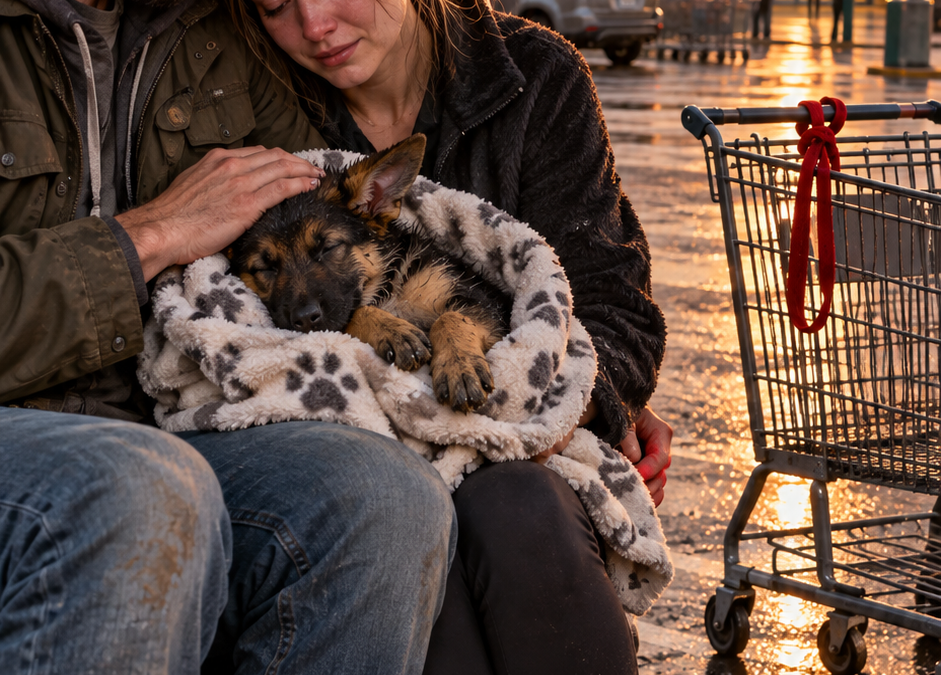
PART2
The puppy didn’t make a sound during the drive home.
Not one.
Lauren sat in the passenger seat with the little dog wrapped in her coat, one hand resting lightly against her back.
Every few minutes, Lauren looked at me.
Neither of us said what we were thinking.
We had both noticed the same thing.
The puppy never relaxed.
Not when the doors closed.
Not when the engine started.
Not when Lauren scratched gently behind one ear.
She remained rigid, eyes wide, bracing for something.
I drove slower than usual.
At a red light, Lauren whispered, “What do you think happened to her?”
“I don’t know.”
That was a lie.
Maybe I didn’t know the details, but I knew enough.
Happy puppies didn’t react to raised hands by shrinking.
Healthy puppies didn’t have ribs showing through their fur.
Loved puppies generally didn’t end up tied to grocery carts with insulting reviews attached to them like defective merchandise.
Lauren looked down at her.
“She’s so little.”
The puppy’s nose twitched.
“She should still be with her mother,” I said.
Lauren’s jaw tightened.
We drove the rest of the way in silence.
Our house felt strange when we walked in.
It had felt strange for two weeks.
There were flowers on the dining-room table from people who didn’t know what else to send.
Half the cards remained unopened.
At the end of the hallway was a door neither Lauren nor I had entered since the funeral.
Behind it waited a crib.
A mobile.
Stuffed animals.
A dresser filled with clothes that would never be worn again.
I avoided looking that direction.
Lauren carried the puppy into the living room.
The moment her paws touched the hardwood floor, she scrambled into the corner.
She pressed herself between the couch and the wall and began trembling again.
Lauren crouched several feet away.
“You’re okay.”
The puppy stared.
“You’re safe.”
Nothing.
I filled a bowl with water and placed it near her.
Then food.
She didn’t touch either.
When I shifted my weight, she flinched so hard her back struck the wall.
I froze.
Lauren’s eyes met mine.
That tiny reaction told us more than any note ever could.
I sat on the floor.
No reaching.
No talking.
Just sitting.
For nearly twenty minutes, none of us moved.
Eventually, the puppy looked toward the water.
Her tongue passed over her nose.
“Go ahead,” Lauren whispered.
The dog took one hesitant step.
Then another.
A delivery truck passed outside.
Its brakes hissed.
The puppy shot backward.
Lauren closed her eyes.
“Jesus.”
“We need a vet.”
She nodded.
We called the first clinic that could take her immediately.
Forty minutes later, we were sitting in a small examination room while a veterinarian named Dr. Patel studied the puppy’s gums.
He was careful with her.
Very careful.
Even so, she whimpered when he touched her front paw.
Lauren turned her face away.
Dr. Patel looked at me.
“She’s dehydrated.”
“How bad?”
“Moderate. She’s also significantly underweight.”
He gently ran his hand along her back.
“No obvious fractures. That’s good.”
“Her paws?”
“Likely abrasions from climbing against something.”
I thought about her claws scraping helplessly against the shopping cart.
My jaw tightened.
Dr. Patel examined her ears.
“There’s irritation here. Fleas. Her coat’s in poor condition.”
Then he looked at us.
“Do you know where she came from?”
“We found her tied inside a shopping cart.”
He stopped moving.
“What?”
I pulled the folded paper from my pocket and handed it to him.
He read it.
His expression changed.
Not dramatically.
Just enough.
“Did you contact animal control?”
“Not yet.”
“You should.”
Lauren immediately stiffened.
“They’re not going to take her away, are they?”
“Not necessarily. But she was abandoned. That needs to be documented.”
Lauren placed both hands around the puppy.
The puppy surprised all three of us by leaning slightly toward her.
Dr. Patel noticed.
“So she’s choosing you.”
Lauren swallowed.
“I think so.”
He smiled faintly.
“Well, for a wild dog, she seems remarkably committed to hiding in your sweater.”
It was the first joke anyone had made in our presence for two weeks that didn’t feel cruel.
A sound escaped Lauren.
Half laugh.
Half sob.
Dr. Patel gave us instructions.
Small meals.
Plenty of water.
Quiet environment.
No forced contact.
No punishment.
Routine.
Patience.
“Trauma changes behavior,” he said. “Fear can look like aggression. Panic can look like defiance. You may see things over the next several days that feel unpredictable.”
“How long before she’s normal?” I asked.
The moment the question left my mouth, I hated it.
Dr. Patel didn’t judge me.
He simply said, “There may not be a timeline.”
Then he added, “Safe first. Normal later.”
I thought about that all the way home.
Safe first.
Normal later.
It applied to more than the puppy.
That evening, Lauren replaced the dirty blanket from the cart with a clean one.
I was making coffee when she opened the hallway closet.
Then my hand stopped.
She pulled out a pink blanket.
Not the same blanket.
But close enough.
The one from our daughter’s nursery.
“Lauren.”
She looked down.
For several seconds, neither of us spoke.
Then she knelt and placed it beside the puppy.
The dog sniffed it.
Once.
Twice.
Then slowly curled on top of it.
Lauren sat beside her.
I turned toward the kitchen because suddenly I couldn’t breathe.
Behind me, Lauren began humming.
It was a song she used to sing in the nursery.
My hands gripped the counter.
Grief is strange.
It doesn’t always arrive like an explosion.
Sometimes it walks in quietly, wearing a familiar color.
Sometimes it smells like baby detergent.
Sometimes it curls into a ten-pound ball and falls asleep where your future used to be.
I went outside.
The air was cold.
Rainwater dripped from the gutter.
I stood on the porch until my hands stopped shaking.
When I came back inside, Lauren was still on the floor.
The puppy had pressed herself against the inside of Lauren’s elbow.
Her eyes were closed.
Lauren looked at me.
“She stopped shaking.”
I sat beside them.
Neither of us touched the dog.
We simply watched her breathe.
That night she woke every forty minutes.
Sometimes with a whimper.
Sometimes with a sharp yelp.
Twice she scrambled upright and stared toward the door as though expecting someone to come through it.
We stayed in the living room.
I slept sitting against the couch.
Lauren slept curled beside the puppy.
Or tried to.
Around four in the morning, I woke to complete silence.
For one panicked second, silence meant only one thing to me.
I reached out.
The puppy’s chest rose.
Fell.
Rose again.
I exhaled.
Lauren opened her eyes.
“What?”
“Nothing.”
She watched me.
Then she understood.
Her hand found mine.
Neither of us said anything.
There are some fears married people learn to recognize without language.
The puppy ate for the first time the next morning.
Three pieces of softened kibble from Lauren’s hand.
She chewed each one slowly.
Then looked away.
Another.
Another.
By lunchtime, she drank without watching us.
That felt like a victory.
A ridiculous one, maybe.
But grief changes your definition of achievement.
Sometimes getting out of bed is a victory.
Sometimes a frightened animal drinking water feels like winning the lottery.
We called animal control that afternoon.
An officer named Carla Mendoza came to the house.
She had kind eyes and the exhausted patience of someone who had already met several disappointing human beings that week.
She photographed the leash.
The note.
The puppy’s paws.
Her ribs.
She copied Dr. Patel’s records.
“Did anyone see who left her?” she asked.
“Not that we know of.”
“Store cameras?”
I hadn’t thought of that.
Carla nodded.
“I’ll contact management.”
Lauren looked worried.
“What happens if you find them?”
“That depends on what happened.”
“She stays here?”
Carla studied her.
The puppy was hiding partly behind Lauren’s leg.
“If nobody can establish lawful ownership, and assuming you’re willing to foster while we investigate, she can stay here for now.”
“We’re willing,” Lauren said immediately.
Carla smiled.
“I suspected that.”
Before leaving, she crouched several feet from the puppy.
“Poor little thing.”
I handed her the note.
She read it.
SHE’S TOO WILD.
Carla looked at the puppy, who was currently frightened by her own reflection in a glass cabinet.
“Terrifying,” she said dryly.
I liked Carla.
The puppy’s first three days were a series of tiny negotiations.
Would she eat if I sat six feet away?
Yes.
Five feet?
Eventually.
Would she walk past the refrigerator?
Only if the compressor wasn’t running.
Would she let Lauren touch her head?
Sometimes.
Would she let me?
Not yet.
At night, she cried.
Not constantly.
That would almost have been easier.
Instead, she made these soft, broken sounds at random moments.
Sometimes while sleeping.
Sometimes while staring into nothing.
On the third night, she climbed onto my lap.
I hadn’t called her.
I hadn’t touched her.
I was sitting against the couch reading an article I had already read four times without absorbing a single sentence.
She approached me slowly.
One paw.
Stop.
Another.
Stop.
She sniffed my jeans.
I remained still.
Then she placed both front paws on my thigh.
I looked toward Lauren.
Lauren covered her mouth.
The puppy climbed the rest of the way.
She turned twice.
Curled against my stomach.
And sighed.
Something broke open inside my chest.
Not painfully.
Not entirely.
I rested one hand several inches above her back.
“Can I?” I whispered.
Lauren nodded even though the question wasn’t for her.
I lowered my palm.
The puppy flinched.
Then relaxed.
I felt each breath beneath my fingers.
Lauren moved beside us.
Her hand rested against the puppy too.
For nearly an hour, we sat there.
Three bodies.
One couch.
No television.
No conversation.
Just breathing.
For the first time since the funeral, our house didn’t feel empty.
Then, three mornings later, everything went backward.
A metal pan slipped from my hand in the kitchen.
It hit the tile with a violent crash.
The puppy exploded.
There is no gentler word for it.
One second she was drinking water.
The next she spun around, barking wildly.
Her bowl flipped.
Water splashed across the floor.
She snapped at empty air.
Lauren entered from the hallway.
“Hey, hey, sweetheart—”
The puppy backed into the cabinet.
Teeth exposed.
Eyes huge.
“Don’t,” I said.
Lauren stopped.
The puppy’s breathing became frantic.
I took one careful step.
She lunged.
Not at me.
Not exactly.
More like through me.
At something only she could see.
Then she ran.
Straight beneath the couch.
Silence.
My heart hammered.
Lauren crouched.
“It’s okay.”
No response.
“Come here, baby.”
Nothing.
I stared at the overturned bowl.
The mess.
The scratch her claw had left across the cabinet.
And suddenly every sleepless night, every buried memory, every ounce of helplessness I had refused to acknowledge came rushing upward.
“She’s too much.”
Lauren looked at me.
I heard my own voice and still couldn’t stop.
“We can’t keep doing this.”
Her face changed.
“Joe.”
“I’m serious.”
“She got scared.”
“What happens next time? What happens when she’s seventy pounds?”
“She’s a baby.”
“A baby that just tried to bite.”
“She panicked.”
“So what?”
Lauren stood.
“So what?”
“I mean what are we supposed to do?”
“Help her.”
“I’m trying.”
“Are you?”
That hit exactly where she meant it to.
I stepped backward.
“What the hell is that supposed to mean?”
“It means she’s scared, Joe.”
“So am I!”
My voice cracked through the room.
The puppy whimpered beneath the couch.
Lauren’s anger vanished instantly.
She lowered her voice.
“So am I.”
Those three words stopped me.
I sank into a chair.
The note was sitting on the counter.
I don’t know why I had left it there.
SHE’S TOO WILD.
I picked it up.
For one terrible second, I understood how easy it was to label fear instead of dealing with it.
Wild.
Difficult.
Broken.
Too much.
Convenient words.
Words people use when another living thing’s pain becomes inconvenient.
Lauren stood across from me.
“She doesn’t know safe yet.”
I stared at the note.
Lauren continued.
“And neither do we.”
I looked toward the couch.
Two brown eyes watched us from the darkness underneath it.
Not angry.
Terrified.
I hated myself.
I lowered myself onto the floor.
“I’m sorry.”
The puppy didn’t move.
I wasn’t sure whether I was apologizing to her or Lauren.
Probably both.
She stayed beneath that couch for five hours.
We didn’t drag her out.
We didn’t tempt her endlessly.
We simply waited.
Around three in the morning, I woke to another cry.
Lauren was asleep beside me.
I slipped out of bed.
The puppy was sitting beside the crate we had bought for her.
Somehow, she had pushed the door open.
But she hadn’t gone anywhere.
She was waiting.
I sat on the floor.
She watched me.
“You scared me today,” I whispered.
Her ears lowered.
“I scared you too.”
Nothing.
“I’m sorry.”
Slowly, she approached.
Her nose touched my fingers.
Cold.
Wet.
Alive.
“You’re not wild.”
I swallowed.
“You’re hurt.”
The puppy leaned against my wrist.
Those words stayed between us.
You’re not wild.
You’re hurt.
Maybe I needed to hear them too.
I had spent two weeks behaving like grief was some embarrassing weakness I could discipline myself out of.
I had answered concerned friends with, “I’m fine.”
I had ignored calls.
I had gone grocery shopping because groceries were normal and normal people bought groceries.
Meanwhile, I could barely walk past a closed bedroom door in my own house.
The puppy curled beside me.
I lay down on the hardwood.
She tucked herself against the bend of my arm.
And for the first time, she slept through until morning.
Lauren found us shortly after sunrise.
She stood in the hallway wearing one of my old sweatshirts.
Her hair was tangled.
Her eyes were red.
Still, she smiled.
“She finally slept.”
I looked down at the puppy.
“So did I.”
That morning, Lauren gave her a name.
“Tina.”
The word stopped me cold.
I looked at my wife.
She was crying.
Tina had been our daughter’s name.
For weeks, we had barely spoken it.
Names can become dangerous after death.
They can turn ordinary sentences into traps.
I stared at Lauren.
“Are you sure?”
She nodded.
The puppy was lying across her lap.
Lauren ran one finger along the black stripe above her nose.
“I don’t want the name to only mean the worst day of our lives.”
My throat tightened.
“Lauren…”
“She doesn’t replace her.”
“I know.”
“Nothing could.”
“I know.”
Lauren looked down.
“But maybe the name can hold more than one thing.”
The puppy licked her wrist.
Lauren laughed through tears.
“See?”
I knelt.
“Tina.”
The puppy’s ears twitched.
“Tina.”
Her tail tapped the floor once.
Lauren smiled.
“There.”
And just like that, the name belonged to hope too.
Not instead of grief.
Beside it.
That distinction mattered.
The next week became a collection of firsts.
First full bowl of food.
First toy.
First time she slept through the night.
First time she followed me into the kitchen without flattening herself when I opened a cabinet.
First time she barked at her own reflection.
That one startled everyone.
Tina barked once at the patio door.
The reflected puppy barked simultaneously.
Tina leaped backward.
I laughed.
She looked at me.
Then barked again.
Same result.
By the fourth attempt, her tail had started wagging.
Lauren laughed harder than I had heard her laugh since before the hospital.
Tina looked delighted with herself.
I remember thinking how absurd life was.
A few days earlier, I had wondered whether joy would ever enter our house again.
Apparently, it arrived by barking at patio glass.
Her progress wasn’t smooth.
Thunderstorms sent her under the table.
Garbage trucks made her panic.
If I raised a broom too quickly, she crouched.
That one made me feel sick.
We stopped using loud voices around her.
We warned each other before vacuuming.
We kept doors from slamming.
Not because we wanted to build the world around her fear forever.
Because she needed enough safe experiences to understand that the world she lived in now was different from the one she remembered.
Dr. Patel put it simply at her follow-up appointment.
“You’re replacing old expectations.”
“With what?”
“New ones.”
He scratched behind Tina’s ear.
She tolerated him this time.
“Door closes. Nothing bad happens. Hand reaches. Nothing bad happens. Person walks toward food bowl. Nothing bad happens.”
Lauren nodded.
“Eventually she stops expecting the bad thing?”
“That’s the goal.”
I looked at Tina.
She was sniffing the edge of the examination table.
“How long?”
Dr. Patel smiled.
“You really like timelines.”
“I like measurable progress.”
“You chose the wrong species.”
Lauren laughed.
I gave him a look.
He continued.
“Dogs heal on dog schedules.”
That afternoon, Carla called.
“We got the grocery-store footage.”
I straightened.
Lauren looked at me from across the kitchen.
“And?”
“There’s a clear vehicle.”
My stomach tightened.
“Can you identify them?”
“We’re working on it.”
“What did the footage show?”
Silence.
Not long.
But enough.
Carla’s voice changed.
“A man and woman arrived around six twenty that morning. Puppy was in the back seat.”
I sat down.
Lauren moved closer.
Carla continued.
“The woman put her in the cart. The man tied the leash.”
I looked at Tina.
She was sleeping beside Lauren’s feet.
“They both just left?”
“Yes.”
“How long was she there?”
“Forty-seven minutes before you found her.”
Forty-seven minutes.
It sounded like nothing.
It sounded endless.
“Did they look back?”
Carla paused.
“The woman did.”
“And?”
“She kept walking.”
That detail stayed with me.
She looked back.
Not ignorance.
Not confusion.
A choice.
I told myself it shouldn’t matter.
Tina was safe now.
The past was the past.
But there was something unbearable about imagining that tiny dog watching the people she knew cross a parking lot and disappear.
“What happens if you identify them?” I asked.
“We make contact. Establish ownership history. Determine whether there are other animals.”
That last sentence changed the temperature in the room.
“Other animals?”
“It’s something we always check.”
Lauren whispered, “Good.”
Carla continued.
“There’s one more thing.”
“What?”
“Store staff found part of a pet-food receipt in the cart.”
I almost laughed.
“Seriously?”
“Seriously.”
Apparently, abandoning an animal didn’t automatically come with criminal genius.
Who knew?
“Receipt was linked to a loyalty account.”
I looked at Lauren.
She raised her eyebrows.
“There’s a customer name.”
Carla wouldn’t tell me yet.
The investigation was active.
That was fine.
For the next few days, Tina remained our priority.
She gained weight.
Her coat improved.
Her paws healed.
She started bringing me toys.
Not gracefully.
Usually she picked one up, walked halfway across the room, dropped it, became distracted by a sock, and forgot her original objective.
Her favorite object was a stuffed yellow duck.
She carried it everywhere.
The duck lost one eye within twenty-four hours.
Lauren repaired it.
Tina removed the same eye again by dinner.
“This is personal now,” Lauren told her.
Tina wagged.
I watched my wife sitting cross-legged on the floor, sewing a toy duck for a puppy we hadn’t known two weeks earlier.
Something warm moved through me.
This was not recovery in the way people describe it in sympathy cards.
There was no straight road out.
No inspirational staircase.
We still cried.
We still avoided the nursery some days.
Lauren still woke from dreams about the hospital.
I still found myself staring at the empty car seat base we hadn’t managed to remove.
But Tina inserted life into the spaces grief had occupied completely.
She needed breakfast.
She needed walks.
She needed medication.
She needed someone to prevent her from eating couch stuffing.
Grief could tell you there was no reason to get up.
A German Shepherd puppy needing to pee was remarkably effective at challenging that philosophy.
Three weeks after we found her, Tina ran across the backyard for the first time.
Not cautiously.
Not examining every sound.
She ran.
Full speed.
Legs too long for her body.
Ears bouncing.
She chased a leaf for twenty feet before the leaf changed direction and apparently betrayed her.
Tina stopped.
Barked indignantly.
Lauren laughed.
I laughed too.
We looked at each other.
That surprised us more than the dog.
Tina ran back.
She collided with my legs.
I lifted her.
She licked my chin.
“You’re disgusting.”
She licked me again.
Lauren said, “She knows.”
My phone rang.
Carla.
Her timing could have been better.
I carried Tina inside.
“We identified them.”
My smile disappeared.
Lauren saw my expression.
“Who?”
Carla gave me two names.
Travis Keller.
Megan Price.
They lived less than six miles from the grocery store.
“They admitted she was theirs?”
“Eventually.”
“What does eventually mean?”
“It means Mr. Keller initially claimed he had never seen the dog.”
I looked down at Tina.
She was chewing my shoelace.
“Then?”
“We showed him the security video.”
“And he suddenly developed a memory?”
Carla almost laughed.
“Something like that.”
“What did they say?”
“They claimed the puppy was destructive and aggressive.”
I stared toward the yard.
“Aggressive.”
“They said she bit furniture, urinated indoors, barked at night, and wouldn’t obey.”
“Tina was eight weeks old.”
“I’m aware.”
“She was a puppy.”
“I’m aware of that too.”
I rubbed my forehead.
“What happened to her before they dumped her?”
“That’s still being investigated.”
“Are there other animals?”
Another pause.
“Yes.”
My stomach dropped.
“How many?”
“Two adult dogs.”
Lauren had moved close enough to hear.
Her face changed.
Carla continued.
“Animal welfare officers inspected the property this morning.”
“And?”
“The dogs were removed pending evaluation.”
Lauren covered her mouth.
“Why?”
“Conditions.”
Carla didn’t elaborate.
She didn’t need to.
Something inside me went cold.
“Can they get Tina back?”
“No.”
That answer came quickly.
I breathed.
“They signed surrender paperwork.”
“Why?”
“Because once they realized an abandonment case had been documented, ownership became inconvenient.”
There was that word again.
Inconvenient.
Apparently responsibility was a hobby you could cancel.
Carla continued.
“They’ve also been informed of the potential citations.”
“What kind?”
“Animal abandonment. Neglect allegations are being reviewed separately based on the condition of the other dogs.”
I looked toward Tina.
She had fallen asleep with her head on Lauren’s foot.
Good.
Let the adults deal with the ugly parts.
“Thank you.”
“We’re not done yet.”
Neither were we.
For the first month, everything continued improving.
Then Travis Keller showed up at our house.
I knew who he was before he spoke.
Maybe because I had watched the grocery-store footage Carla eventually allowed us to view as part of the case file.
Maybe because some people carry entitlement like cologne.
It arrives before they do.
I opened the front door but kept the storm door closed.
He stood on the porch wearing a black baseball cap and work jacket.
Tall.
Mid-thirties.
His hands were in his pockets.
“What do you want?”
He looked past me.
“Dog.”
My entire body stiffened.
“What dog?”
“Don’t play stupid.”
That was charming.
A strong opening.
Very persuasive.
He nodded toward the house.
“Our shepherd.”
“She isn’t yours.”
“You know what I mean.”
“No, actually, I don’t.”
“We made a mistake.”
I stared at him.
“You tied an eight-week-old puppy inside a shopping cart.”
His jaw flexed.
“She was impossible.”
I laughed.
I genuinely couldn’t help it.
He looked offended.
Good.
“What’s funny?”
“Nothing. I’m just trying to imagine being defeated by a puppy who weighed ten pounds.”
His eyes hardened.
“You don’t know what she was like.”
“I know exactly what she was like.”
“You’ve had her after training.”
“No.”
“Then you don’t—”
“We trained her.”
He stopped.
I continued.
“We fed her. Took her to the vet. Sat beside her during panic attacks. Slept on the floor because she was too scared to close her eyes.”
His face shifted.
“Megan wants her back.”
“There is no scenario where that happens.”
“You don’t own her.”
“Actually, according to the surrender document you signed, neither do you.”
His jaw tightened.
“That was because that officer threatened us.”
“Carla?”
“Yes.”
I almost smiled.
Carla was approximately five foot four and had once apologized to our ficus after accidentally bumping it with her clipboard.
Terrifying woman.
“She explained the law to you.”
“She pressured us.”
“You abandoned a dog.”
“We were overwhelmed.”
“So you tied her to a shopping cart?”
“We were going to call the shelter.”
“But your phone stopped working sometime between tying the leash and driving away?”
He stepped closer.
I remained behind the door.
“Look, man. She’s ours.”
“No.”
“We paid for her.”
“And then legally surrendered any claim.”
“Megan’s upset.”
I stared at him.
Behind me, I heard Tina’s collar.
She had come into the hallway.
Travis saw her.
His expression changed.
“Tasha.”
Tina froze.
Not Tina.
Tasha.
Her old name.
Her body lowered.
Ears back.
Tail beneath her stomach.
Everything we had spent weeks helping her unlearn returned in half a second.
Travis smiled.
“See? She knows me.”
Rage is interesting.
People imagine it loud.
Mine became very quiet.
“Leave.”
He frowned.
“She knows her name.”
“Leave my property.”
“She’s ours.”
“No.”
“I can call the cops.”
“Please do.”
He stared at me.
I smiled.
“Seriously. Save me the trouble.”
Lauren appeared behind Tina.
The moment Tina saw her, the puppy moved backward.
Straight into Lauren’s legs.
Lauren lifted her.
Travis’s expression hardened.
“Megan paid eighteen hundred dollars for that dog.”
I looked at him.
“There it is.”
“What?”
“The actual problem.”
“It’s our property.”
“No. Your property was worth money. Tina became disposable the second caring for her required effort.”
“That’s not fair.”
“Fair?”
I opened the storm door.
Not enough to invite him in.
Enough to make my point.
“You tied a dehydrated puppy inside a metal cart in a parking lot and drove away. I’m really fascinated by your sudden interest in fairness.”
“She was destroying our apartment!”
“She was eight weeks old!”
He flinched at my voice.
Tina whimpered.
I immediately lowered it.
That mattered more.
“Leave.”
Travis looked past me again.
“Megan saw pictures.”
I frowned.
“What pictures?”
“A vet employee posted one.”
I remembered.
Dr. Patel’s clinic had asked permission to share a photo of Tina’s recovery without identifying our address.
Lauren had agreed because she wanted people to understand abandoned dogs could heal.
The post had spread farther than expected.
Thousands of reactions.
Hundreds of comments.
Apparently Megan had seen her.
Healthy now.
Glossy coat.
Bright eyes.
Adorable.
Worth wanting again.
“We want her back,” Travis said.
“No.”
“We can go to court.”
“Then go.”
“I mean it.”
“So do I.”
He stood there another second.
Then pointed at me.
“You stole our dog.”
That almost impressed me.
The mental gymnastics required to abandon an animal in public, sign ownership away, then accuse the rescuers of theft should qualify for an Olympic event.
I closed the door.
Then I called Carla.
She was not amused.
At all.
“You did what?” she asked after I explained.
“I told him to leave.”
“No, before that.”
“I opened the storm door.”
“Joe.”
“It remained mostly closed.”
“Mostly?”
“Carla.”
She sighed.
“Did he threaten you?”
“Not directly.”
“Did he say he was coming back?”
“No.”
“Okay. I’m documenting it.”
Lauren sat on the couch holding Tina.
The puppy was shaking again.
Seeing Travis had undone weeks of progress in seconds.
That angered me more than his ridiculous ownership claim.
“How did he get our address?”
“I don’t know.”
“Can you tell him not to return?”
“Yes.”
“And if he does?”
“Call police.”
I hung up.
Lauren looked at me.
“She remembered him.”
“I know.”
Tina’s eyes were fixed on the door.
“She was terrified.”
“I know.”
Lauren stroked her.
“What if they actually try to get her back?”
“They won’t.”
“How do you know?”
“Because I won’t let them.”
Lauren gave me a look.
“That’s emotionally reassuring and legally meaningless.”
I almost smiled.
“There’s the woman I married.”
“I’m serious.”
“So am I.”
The next morning, we contacted an attorney.
Not because we believed Travis had a legitimate claim.
Because grief had already taught us what happens when you assume the worst can’t happen.
Her name was Rachel Nguyen.
She reviewed the surrender form.
Animal-control report.
Veterinary records.
Security footage.
The receipt.
The photographs.
She looked at us over the top of her glasses.
“This isn’t particularly complicated.”
Lauren leaned forward.
“So they can’t take her?”
“Based on what I’m seeing? Their case would be extraordinarily weak.”
My shoulders dropped slightly.
Rachel continued.
“They abandoned the dog. The abandonment was recorded. They later signed an ownership surrender. You’ve documented veterinary care and possession since then.”
“What if they say they signed under pressure?”
“They’re free to say many things.”
I smiled.
I liked Rachel too.
“Does saying them help?”
“Not necessarily.”
A week passed.
No lawsuit.
No visit.
Tina gradually settled again.
Then we received a letter.
Not from a lawyer.
From Megan herself.
Four handwritten pages.
She claimed Tina had been uncontrollable.
That the puppy destroyed rugs.
Bit shoes.
Cried all night.
Had accidents.
Scratched a door.
Chewed chair legs.
I read it twice.
Then I handed it to Lauren.
She finished and stared at me.
“She described a puppy.”
“Exactly.”
Apparently Tina’s most serious criminal offenses included peeing indoors and chewing furniture.
Call the governor.
The letter insisted they had only left her somewhere public because they believed “someone would find her quickly.”
That sentence nearly made me tear the pages in half.
Instead, I gave them to Rachel.
Evidence.
Useful.
Megan had just admitted the abandonment in writing.
Rachel called fifteen minutes after receiving it.
“She has been extremely helpful.”
“That’s one word for it.”
“She admitted intentional abandonment.”
“Yep.”
“And confirmed the puppy was theirs.”
“Yep.”
“And explained the behavior that supposedly justified it.”
“Chair legs.”
“I saw.”
“Dangerous stuff.”
Rachel laughed.
Then her tone changed.
“Do not respond.”
“Wasn’t planning to.”
“Good.”
Carla later told us the other two dogs removed from Travis and Megan’s property had been badly underweight.
One had an untreated skin infection.
The other had a collar wound.
Both survived.
Both were eventually placed with rescue organizations.
That mattered to Lauren.
It mattered to me too.
Tina had not been the only one.
She was simply the one they had become tired of first.
The cruelty case took time.
Most cases do.
Nothing moved with television speed.
There were reports.
Hearings.
Veterinary statements.
Photographs.
Administrative delays.
At times, the process felt painfully ordinary compared to what the animals had endured.
But while adults argued on paper, Tina kept becoming a dog.
A real dog.
Not a trauma case.
Not evidence.
Not the shepherd from the shopping cart.
Tina.
She learned “sit” in approximately six minutes.
“Stay” took longer because Tina believed distance from us violated basic constitutional principles.
She mastered “down.”
“Leave it” remained theoretical.
Especially around socks.
Lauren enrolled us in a positive-reinforcement training class.
The first session was difficult.
Six dogs.
New room.
Strangers.
Metal chairs scraping.
Tina shook beside us.
The trainer, Marisol, noticed.
“You don’t have to stay.”
Lauren looked at me.
I looked at Tina.
“Maybe five minutes?”
Marisol nodded.
“Five successful minutes beat fifty minutes of flooding.”
We stayed seven.
The next week, twelve.
By the sixth class, Tina walked through the door with her tail level.
She never became the bravest dog in the room.
She didn’t need to.
Bravery isn’t a competition.
Sometimes bravery is entering the room.
Sometimes it’s staying when a chair moves.
Sometimes it’s taking a treat from a stranger.
Months earlier, someone had called those fear responses wild.
We started calling them progress.
One afternoon, the wind slammed our back door.
The crack shook the hallway.
Tina froze.
I froze too.
This was one of her worst triggers.
Normally, she would have run beneath the dining table.
Instead, she stood still.
Her ears pulled back.
One paw lifted.
I said nothing.
She looked at the door.
Then at me.
Then she walked forward.
One step.
Another.
Her nails clicked softly across the hardwood.
She reached my chair.
And placed her head on my knee.
That was it.
No dramatic music.
No speech.
Just a dog choosing a person instead of a hiding place.
My vision blurred.
Lauren had seen everything from the kitchen.
She covered her mouth.
I put both hands around Tina’s face.
“You did it.”
Her tail thumped.
“You stayed.”
Another thump.
Lauren knelt beside us.
I pressed my forehead against Tina’s.
“You’re okay.”
This time, she believed me.
That night, she slept between us.
She had started climbing into our bed weeks earlier.
Initially, we pretended we were going to discourage it.
That policy survived roughly forty-eight hours.
Tina would wait until we were asleep, jump onto the mattress, crawl between us, turn three times, and collapse with a sigh dramatic enough to suggest she had personally completed twelve hours of manual labor.
“She snores,” Lauren whispered one night.
“So do you.”
“I do not.”
Tina snorted loudly.
Lauren laughed.
“Even she disagrees with you.”
For the first time in months, the laughter didn’t end in tears.
That was progress too.
Then came the hearing.
We weren’t required to attend the first administrative proceeding, but we chose to.
Rachel sat beside us.
Carla sat several rows away.
Travis and Megan were across the room with an attorney.
I barely recognized Megan from the security footage.
She was younger than I expected.
Maybe thirty.
She kept looking toward us.
Tina wasn’t there.
We had left her with Dr. Patel’s technician.
There was no reason to bring her into a room containing people who had already frightened her enough.
The allegations involved abandonment and neglect-related violations.
I won’t pretend the process was cinematic.
Nobody slammed a fist onto a desk.
Nobody delivered a dramatic confession.
Reality is usually less polished.
But facts have a stubborn way of surviving boredom.
The grocery-store video played.
There they were.
Travis lifted Tina from the back seat.
Megan placed the blanket in the cart.
The puppy tried to climb out.
Travis tied the leash shorter.
Megan attached the note.
Then they walked away.
The video had no sound.
That made it worse.
At one point, Megan turned around.
Tina stood with both front paws against the cart.
Watching.
Megan faced forward again.
Lauren gripped my hand.
I wanted to look away.
I didn’t.
Neither did Megan.
The investigator presented veterinary photographs.
Tina’s ribs.
Raw paws.
Dehydration.
Fleas.
Then photographs of the other dogs.
That was harder.
Travis’s attorney argued they had become overwhelmed.
That they intended for someone to find Tina.
That their actions reflected poor judgment rather than cruelty.
The hearing officer asked a simple question.
“Why not take the animal to a shelter?”
Travis said shelters were full.
“Did you call one?”
Silence.
His attorney leaned toward him.
Eventually Travis answered.
“No.”
“Did you contact a rescue?”
“No.”
“Veterinarian?”
“No.”
“Breed organization?”
“No.”
“Animal control?”
“No.”
“Did you post that you needed to rehome the animal?”
“No.”
“Did you contact the breeder?”
Travis shifted.
“No.”
The officer looked down at the file.
“So when you say alternatives were unavailable, what you mean is you did not attempt them.”
Nobody answered.
That sentence did more than any angry speech could have.
Megan eventually spoke.
“She was ruining everything.”
The hearing officer looked at her.
“The puppy?”
“Yes.”
“What was she doing?”
“Chewing. Barking. Peeing everywhere.”
“How old was she?”
Megan hesitated.
“About nine weeks.”
Even Travis closed his eyes.
Nine weeks.
The absurdity landed on its own.
The hearing officer didn’t need sarcasm.
I almost envied that level of restraint.
Then Megan said the sentence that destroyed whatever sympathy remained.
“We paid a lot for her. We expected better.”
Lauren’s fingers tightened around mine.
A living creature had failed a customer-service review.
The hearing officer looked at her for a long time.
“A nine-week-old dog failed to meet your expectations.”
Megan seemed to realize too late how the sentence sounded.
“That’s not what I meant.”
But it was exactly what she meant.
The ruling wasn’t delivered immediately.
We left.
Outside, rain was falling.
Rachel opened her umbrella.
Lauren didn’t.
She stood on the courthouse steps and let the rain touch her face.
“You okay?”
She nodded.
Then shook her head.
Then laughed softly.
“I don’t know.”
“Same.”
She looked at me.
“That video…”
“I know.”
“She looked back.”
“I know.”
Lauren wiped rain from her cheek.
“I’m glad Tina never has to see them again.”
Three weeks later, the decision arrived.
The abandonment violation was sustained.
The neglect findings involving the other dogs were also sustained in part based on veterinary evidence.
Travis and Megan were ordered to pay fines and costs associated with the animals’ care.
Restrictions were placed on their ability to own animals for a period determined under the local proceeding.
Most importantly to us, every remaining ownership claim regarding Tina was formally extinguished.
Not that there had been much legal doubt.
But seeing it in writing mattered.
Tina was ours.
Completely.
Permanently.
Legally.
Lauren read the final order twice.
Then handed it to me.
“That’s it?”
“That’s it.”
“They can’t come back?”
“No.”
“They can’t demand her?”
“No.”
Lauren cried.
Not from sadness.
Maybe not even happiness exactly.
Relief has its own tears.
I called Carla.
She answered, “You got it?”
“Yes.”
“Good.”
“Thank you.”
“You two did the hard part.”
“No.”
I looked across the room.
Tina was lying on her back, all four paws in the air, asleep beneath the window.
“She did.”
Carla was quiet for a moment.
Then she said, “Give her a scratch for me.”
“I will.”
By six months, Tina looked nothing like the puppy from the cart.
Her coat had become thick and glossy.
Her ears finally decided to stand up, although one still leaned sideways when she was tired.
She had gained weight.
Too much enthusiasm.
And several opinions.
She considered squirrels enemies of the state.
Vacuum cleaners remained suspicious.
Delivery drivers required formal announcement.
Bath time was an act of betrayal.
She followed Lauren from room to room.
She followed me into the garage.
She waited outside the bathroom as though convinced toilets were portals through which family members might vanish.
When either of us returned home, even after ten minutes, Tina greeted us as though we had survived an ocean crossing.
One evening I found Lauren sitting outside the nursery.
The door was open.
That stopped me.
For months, it had remained closed.
Tina sat beside her.
I approached quietly.
“You okay?”
Lauren nodded.
Inside, dust lay across the dresser.
The crib remained exactly where it had been.
The mobile hung motionless.
Lauren looked at me.
“I think I want to pack some things.”
I sat beside her.
“Today?”
“Maybe.”
“We don’t have to.”
“I know.”
Tina rested her head across Lauren’s thigh.
Lauren smiled.
“I know.”
We entered together.
Not because we were finished grieving.
We never would be.
The idea that grief has an expiration date is something people invent because permanent pain makes them uncomfortable.
We entered because grief had stopped being the only thing in the house.
We packed slowly.
Some clothes we donated.
Some we kept.
Lauren folded the pink blanket.
The one Tina had slept on her first night.
She held it for a long time.
Then she placed it in a cedar box.
Tina sniffed the box.
Lauren smiled.
“That one’s not yours.”
Tina sneezed.
I laughed.
The nursery eventually became a quiet reading room.
Not erased.
Changed.
There was still a framed photograph of our daughter on the shelf.
We never hid her.
We never needed Tina to replace her.
That was never what rescue meant.
Love is not a chair with one seat.
Loving another living thing doesn’t evict the ones who came before.
It makes the room bigger.
Nearly a year after the shopping-cart morning, we returned to the same grocery store.
Not intentionally.
We needed milk.
Apparently major life milestones are often scheduled around dairy products.
Lauren parked.
Tina was in the back seat.
We took her everywhere we reasonably could.
As soon as I stepped out, I saw the cart return.
My body stopped before my mind did.
Lauren noticed.
“You okay?”
I looked at the metal carts.
Same place.
Different day.
“Yeah.”
She followed my gaze.
“Oh.”
For a moment, neither of us moved.
Then Tina pushed her nose between the front seats.
Lauren laughed.
“Someone’s impatient.”
We clipped on her leash.
She jumped down.
The difference was almost impossible to comprehend.
The puppy who once couldn’t stand safely inside a cart was now a strong adolescent shepherd with bright eyes and a tail that moved constantly.
We walked past the cart return.
Tina stopped.
My throat tightened.
She sniffed one wheel.
Then another.
I wondered if she remembered.
Probably not the way people remember.
Dogs live differently.
Smell.
Association.
Body memory.
Maybe something about that place remained.
Tina looked at me.
Then at Lauren.
Her tail wagged.
And she kept walking.
That was it.
The parking lot no longer owned the story.
Neither did Travis.
Neither did Megan.
Neither did the red note.
We did our shopping.
On the way out, a little boy asked if he could pet Tina.
His mother looked embarrassed.
“Ethan, ask first.”
“He did,” Lauren said, smiling.
She crouched beside Tina.
“Gentle.”
The boy touched Tina’s shoulder.
For half a second, I remembered the terrified puppy who used to collapse beneath approaching hands.
Tina leaned toward him.
His face lit up.
“She’s soft!”
“She is,” I said.
“What’s her name?”
“Tina.”
He scratched beneath her chin.
“I like her.”
“So do we.”
That night, I opened my desk drawer.
The note was still inside.
Wrinkled.
Creased.
One corner missing where I had crushed it in my fist that first morning.
SHE’S TOO WILD.
I carried it into the bedroom.
Lauren was reading.
Tina was already between us, occupying approximately seventy percent of a king-sized bed despite representing less than twenty percent of its combined body mass.
“What’s that?” Lauren asked.
I showed her.
“Oh.”
“I’ve been thinking about throwing it away.”
“Why haven’t you?”
I sat on the edge of the bed.
“I used to keep it because I was angry.”
“And now?”
I looked at Tina.
She was asleep on her back.
One paw rested against Lauren’s leg.
I smiled.
“Now it’s funny.”
Lauren raised an eyebrow.
“Funny?”
“Kind of.”
I held up the note.
“They were so sure.”
Lauren studied the words.
Then Tina.
“Too wild.”
Tina snored.
Lauren laughed.
“Terrifying.”
I folded the paper.
“I think I’ll keep it.”
“Why?”
“Proof.”
“Of what?”
I reached down and rubbed Tina’s chest.
“That people can be completely wrong about what they throw away.”
Lauren’s expression softened.
She closed her book.
Tina opened one eye.
Then closed it again.
I turned off the lamp.
In the darkness, I could hear three different rhythms of breathing.
Mine.
Lauren’s.
Tina’s.
There had once been another.
We both knew that.
We always would.
Nothing about our new life erased the old one.
That was the truth I finally understood.
Healing isn’t replacing what was lost.
It isn’t pretending pain never happened.
It isn’t some dramatic moment when every scar disappears and inspirational music starts playing.
Healing is smaller.
Messier.
More stubborn.
It is waking up.
Feeding the dog.
Opening a door you used to keep closed.
Laughing and not feeling guilty afterward.
It is a frightened animal hearing a slam and choosing your lap instead of a hiding place.
It is saying a name you once could not say.
It is discovering that grief and love can exist in the same room without destroying each other.
Months later, Tina still sleeps between us.
Every night.
Lauren complains about the snoring.
I complain about the paws in my back.
Neither of us does anything to stop her.
Sometimes Tina dreams.
Her legs twitch.
Her ears move.
Her tail taps the blanket.
I wonder what she sees.
Maybe fields.
Maybe squirrels she finally catches.
Maybe nothing at all.
But she doesn’t whimper anymore.
Not like she did during those first nights.
That sound is gone.
One Saturday morning, almost exactly a year after we found her, I woke before sunrise.
Lauren was asleep.
Tina was sprawled across both of us.
I carefully climbed out of bed.
Tina opened one eye.
“Stay.”
Her eye closed.
Miracle.
I made coffee and went onto the porch.
Rain had fallen overnight.
The air smelled wet and cold.
Portland was beginning to wake.
A bus sighed somewhere in the distance.
A car door closed.
Normal sounds.
The same kind of sounds that filled the parking lot the morning we found her.
A few minutes later, the back door opened.
Lauren stepped outside.
Tina squeezed past her.
“Traitor,” Lauren muttered.
Tina ran across the yard.
Fast.
Confident.
Wild.
Yes.
Wild.
But not the way they meant it.
Wild like wind.
Wild like morning.
Wild like something alive enough to refuse the ending other people chose for it.
She chased a bird.
Lost badly.
Barked at the sky.
Ran back.
Then launched herself at me.
I barely saved the coffee.
“Easy!”
Lauren laughed.
“She’s too wild.”
I looked at her.
For half a second, neither of us spoke.
Then we both started laughing.
Tina wagged harder because she assumed she had caused it.
Maybe she had.
I scratched behind her ears.
“Way too wild.”
She licked my face.
“You hear that? Completely unmanageable.”
Another lick.
“Terrible dog.”
Her tail hammered against my leg.
Lauren leaned against the porch railing.
The sunrise caught the side of her face.
For one second, I saw the woman she had been before the hospital.
Then I realized that wasn’t true.
She wasn’t that woman anymore.
Neither was I.
People talk about getting your old life back after tragedy.
We never did.
We built another one.
Different.
Scarred.
Still good.
Tina dropped onto the porch between us.
Her head rested on my boot.
I looked down at her.
I could still see the shopping cart if I tried.
The red leash.
The dirty blanket.
Raw paws against metal.
A terrified puppy staring at strangers and waiting to learn whether strangers meant pain.
I could still see the video too.
Travis tying the knot.
Megan walking away.
Megan looking back.
For a long time, that image had made me furious.
Now it made me think of something else.
She had looked back because some part of her understood she was leaving a living thing behind.
And she left anyway.
That was the choice that defined her role in Tina’s life.
But it didn’t define Tina’s life.
That belonged to Tina.
The people who abandoned her lost more than ownership.
They lost every morning that followed.
They never saw her discover snow.
They never saw her bark at her reflection.
They never saw her learn to sit.
They never felt her crawl into bed during a thunderstorm.
They never heard Lauren laugh when Tina stole a sock and paraded through the house like she had captured enemy intelligence.
They never watched a terrified puppy turn into a confident dog.
They never experienced the extraordinary reward of being trusted by something that once had every reason not to trust anyone.
They had called her too wild.
Then they walked away before finding out who she could become.
That was their punishment long before any official ruling arrived.
The fines were paperwork.
The restrictions mattered.
The legal defeat mattered.
The other dogs being removed from their care mattered most of all.
But the deepest consequence was simpler.
They gave her up.
And they were never getting her back.
Not the frightened puppy.
Not the beautiful dog.
Not one minute of the life they decided wasn’t worth the inconvenience.
Tina stood and stretched.
Then she pushed between Lauren and me.
Lauren scratched her neck.
“Breakfast?”
Tina’s ears shot up.
Apparently English comprehension improves dramatically around food.
I opened the door.
She charged inside.
Lauren followed.
I stayed on the porch one second longer.
The sky was turning pale gold above the houses.
For years, I had assumed second chances arrived dramatically.
Maybe with some grand revelation.
Maybe with certainty.
I was wrong.
Ours arrived trembling in a shopping cart.
She weighed ten pounds.
She smelled like rain and neglect.
She had raw paws, frightened eyes, and a red leash tied too tightly around a metal handle.
She came with no guarantees.
No promise that loving her would be easy.
No assurance that helping her heal would help us heal too.
We only knew we couldn’t walk away.
That turned out to be enough.
Inside, Lauren called my name.
Tina barked.
Once.
Then again.
Impatient.
Alive.
I smiled and went inside.
The red note stayed in my desk drawer.
I never threw it away.
Not because the people who wrote it deserved space in our home.
They didn’t.
I kept it because sometimes you need evidence of how wrong cruelty can be.
SHE’S TOO WILD.
Maybe they had one word right.
Tina was wild.
Wild enough to survive abandonment.
Wild enough to trust again.
Wild enough to love two broken people until they remembered how to love life again.
And every night, that supposedly impossible little shepherd climbs into our bed, wedges herself between us, sighs like she pays the mortgage, and falls asleep with absolute certainty that morning will find us all together.
The people who tied her to that cart thought they were throwing away a problem.
They were wrong.
They threw away a miracle.
And we were the ones lucky enough to bring her home.








