𝗙𝗨𝗟𝗟 𝗦𝗧𝗢𝗥𝗬 They Thought the Ocean Between Us Made Me Helpless
𝗙𝗨𝗟𝗟 𝗦𝗧𝗢𝗥𝗬
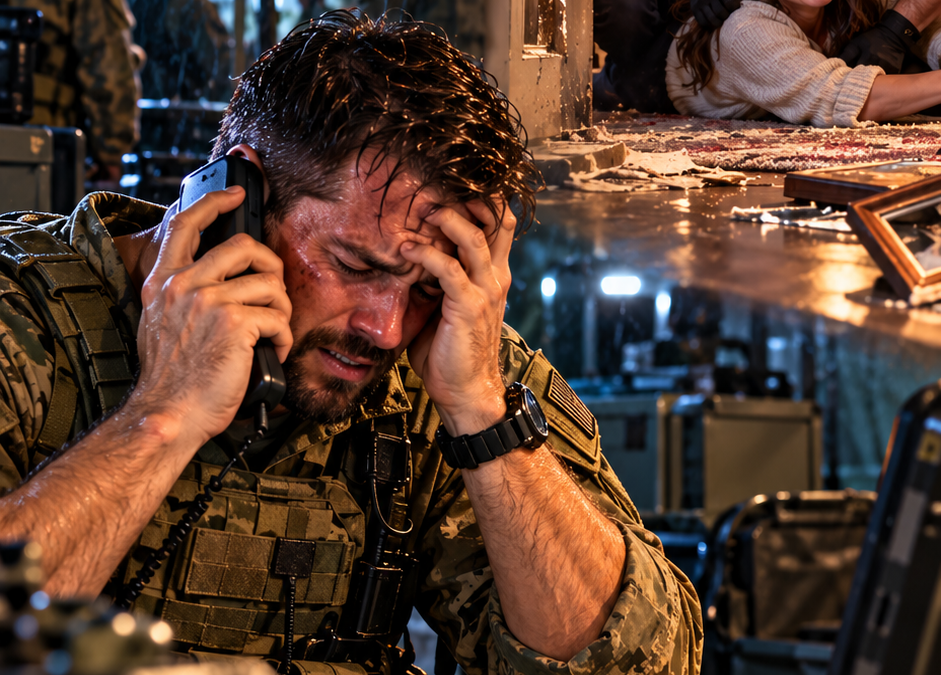
Then more laughter.
After that, the call went dead.
For three seconds, I did not move.
Then training took over because if it had not, I would have shattered.
I called Emily back.
No answer.
Again.
No answer.
I called 911 in Virginia from an overseas military line and gave my address, my name, my wife’s name, the note, the sedan, the cruiser, the break-in, everything.
The dispatcher transferred me.
The sheriff’s department answered.
“There is no active incident at that address.”
“You are wrong.”
“Sir, I need you to calm down.”
“My wife just called me while men broke into our house.”
“We don’t have a call logged.”
“She called 911.”
“I’m not showing that.”
“Then your system is compromised.”
The woman’s voice changed.
“Sir, if you continue tying up emergency lines—”
I hung up before I said something that would become evidence against me.
For two hours, I called everyone I could.
Neighbors.
Hospitals.
County dispatch.
The sheriff’s office again.
Again.
Again.
No one admitted anything.
No one knew where my wife was.
No one cared that I was half a world away listening to the echo of her scream in my skull.
Finally, St. Jude’s Medical Center answered.
A nurse put me on hold for eleven seconds.
Those eleven seconds lasted longer than firefights.
When she returned, her voice was different.
“Mr. Dean?”
“Yes.”
“Your wife is alive.”
My knees almost failed.
I gripped the edge of the table.
“Let me talk to her.”
“She’s in surgery.”
“What happened?”
The nurse began to cry.
I had heard people cry in hospitals before. I had heard parents, wives, brothers, medics who had held themselves together until the door closed.
But there was something in her voice that made the air leave my lungs.
“Both legs have multiple fractures,” she said. “I’m so sorry.”
The tent tilted around me.
“Who brought her in?”
Before she could answer, I heard a voice near her.
“You can’t be back here, sir.”
Then a man laughed.
Not loudly.
Not nervously.
A small, pleased sound.
Someone took the phone.
“You Blake?”
My hand tightened until pain flashed through my fingers.
“Who are you?”
“Doesn’t matter.”
He chuckled.
“Your wife was tougher than I expected.”
Every person in that tent went still.
I said nothing.
Not because I had nothing to say.
Because a part of me so old and dangerous had opened its eyes, and I knew better than to feed it words.
The man lowered his voice.
“Your wife walks funny now, soldier. Come do something about it.”
Someone ordered him to leave.
He laughed again.
“My dad owns the police.”
The line went dead.
Twenty minutes later, I stood inside Brigadier General Marcus Hale’s tent.
Hale was a hard man to impress and a harder man to frighten. He had built his reputation on restraint, which made the people who mistook his calm for softness very stupid and sometimes unemployed.
I placed my phone on his desk.
Then I laid out everything Emily had sent me.
Photographs of the black sedan.
The sheriff’s cruiser.
Badge numbers she had managed to record.
License plates.
The threatening note.
Dates.
Times.
Call logs.
And one name.
Cameron Voss.
Twenty-eight years old. Son of billionaire Richard Voss, a man whose company owned warehouses, transport contracts, commercial property, and half the goodwill in Richmond County. The Voss name appeared on hospital wings, school gyms, police charity fundraisers, campaign banners, and glossy foundation brochures full of smiling children and careful lies.
Cameron was not a public figure in any meaningful sense.
He was worse.
A rich man’s son with access to power he had never earned and consequences he had never been required to meet.
Three weeks earlier, Emily had witnessed him assault a young woman in a parking garage outside a downtown pharmacy. The woman was crying. Cameron had her cornered between two parked cars. Emily heard her say, “Leave me alone.”
Emily called police.
The woman later withdrew her complaint.
That was when the surveillance began.
Hale studied the evidence in silence.
I had served long enough under men like him to know what silence meant.
He was not deciding whether he believed me.
He was deciding how to move without letting my rage contaminate the case.
At last, he opened a locked drawer and placed a black access card on the desk.
“Emergency transit authorization.”
I stared at it.
“You’re sending me home?”
“I’m ordering you home.”
My throat tightened.
He leaned forward.
“But not for revenge.”
I said nothing.
“Look at me, Blake.”
I looked at him.
“This is not an operation. This is not a target package. This is not a war zone where anger can be pointed at the right building and called a mission.”
“My wife—”
“I know.”
His voice softened for one second.
Then hardened again.
“And because I know, I’m saying this clearly. If you go home looking for revenge, you help the men who hurt her. If you go home with discipline, evidence, and witnesses, you help Emily.”
The name did what rank could not.
Emily.
I forced air into my lungs.
“Yes, sir.”
“Federal investigators are already being contacted,” Hale said. “Richmond Field Office. Public corruption. Civil rights. Violent crime if the facts support it.”
He slid the access card closer.
“Three men from your old unit are rotating home tomorrow.”
I looked up.
“Ghost Squad?”
Hale’s expression did not change, but his eyes did.
“They volunteered.”
Jonah Reyes. Malik Turner. Owen Shaw.
Men who knew where the line was because they had lived too long beside it.
Men who would stop me if I forgot.
Fourteen hours later, our transport touched down on American soil under a sky the color of wet steel.
My phone connected while the plane was still rolling.
One message said Emily was stable after surgery.
Another came from an unknown number.
It was a photograph of Emily’s hospital room.
Taken from outside her door.
A second message arrived.
WELCOME HOME, SOLDIER.
Jonah leaned across the aisle and studied the rain-streaked window.
Two sheriff’s cruisers sat near the military terminal.
Waiting.
The transport had not even reached the gate.
Somehow, Cameron already knew I was home.
Jonah looked at the cruisers.
“Could be coincidence.”
Malik Turner, sitting behind him, gave a quiet snort.
“Two cruisers beside a military terminal at five in the morning after somebody texts Blake a picture from his wife’s hospital?”
Jonah did not look away from the window.
“I said could be.”
Owen Shaw, the youngest of us and still old enough to have seen too much, glanced at my phone again.
WELCOME HOME, SOLDIER.
The words glowed beneath Emily’s hospital-room photograph.
I wanted to walk down the aircraft stairs, cross the tarmac, and demand answers from the first person wearing a badge.
Twelve years of training told me not to.
My wife needed a husband more than she needed a man proving he could be dangerous.
Hale’s last words echoed in my head.
Not for revenge.
Jonah seemed to read the thought in my face.
“We go home the smart way,” he said.
“Hospital,” I answered.
“Hospital,” he agreed.
The aircraft stopped.
Before anyone opened the rear door, my phone rang.
Unknown number.
Malik’s eyebrows rose.
I answered.
“Blake Dean?”
A woman’s voice.
Calm. Professional.
“Yes.”
“My name is Dana Price. Special Agent, FBI Richmond Field Office. General Hale gave you my number through command channels, but I thought it would be better if I called first.”
I looked toward the cruisers.
“You know where I am?”
“I do.”
“Then you know I have company.”
A pause.
“I’m looking at the same company.”
I turned toward the far side of the aircraft.
Across the terminal service road sat an ordinary gray SUV. A woman stood beside it beneath an umbrella, dark suit under a raincoat, posture too still to be airport staff.
“That you?”
“Yes.”
“What are the deputies doing here?”
“That,” Dana said, “is something I would prefer they explain before you speak to them.”
She hung up.
Jonah nodded once.
“Better.”
The rear door opened. Cold rain carried the smell of jet fuel inside.
We descended together.
The two deputies stepped out of their vehicles almost immediately. One was older and heavyset, rain gathering on the brim of his campaign hat. The second looked barely thirty.
Neither reached for anything.
Neither raised his voice.
The older deputy walked toward us carrying a folder.
“Blake Dean?”
Dana reached us first, identification already in hand.
“Special Agent Dana Price,” she said. “Mr. Dean is currently cooperating with a federal inquiry. What do you need?”
The deputy looked uncomfortable.
“We were asked to speak with him.”
“About?”
“A complaint.”
“What complaint?”
His eyes shifted toward me.
“Threatening communications.”
For one second, I thought I had misunderstood him.
“Against who?”
The deputy opened the folder.
“Mr. Cameron Voss.”
Malik looked away as if he had suddenly become fascinated by the wet pavement.
Dana did not react.
“Do you have a warrant?”
“No.”
“Is Mr. Dean being detained?”
“No.”
“Then he has somewhere else to be.”
The younger deputy looked relieved.
The older one looked frustrated, though whether with Dana or with the situation, I could not tell. He handed her a card.
“Sheriff Cole would appreciate cooperation.”
Dana took it.
“Then Sheriff Cole can call me.”
We walked away.
I did not look back.
That may have been the hardest thing I did all morning.
Not because I was afraid.
Because every instinct I possessed demanded certainty, and certainty was exactly what no one could give me.
St. Jude’s Medical Center stood beneath the pale Virginia dawn, its glass front reflecting clouds the color of steel.
I had seen hospitals in half a dozen countries.
I hated all of them.
There was always the same artificial warmth in the hallways. The same quiet shoes. The same machines beeping as if human suffering could be reduced to polite electronic reminders.
Dana stopped me before we entered.
“Your friends can come inside,” she said, “but I want something clear.”
Jonah folded his arms.
“We’re listening.”
“You are not here as a unit.”
“We know.”
“You are not investigators.”
“We know.”
“You are not security.”
Malik raised one hand.
“We are three people who care about our friend and have an unusually strong preference for drinking terrible hospital coffee.”
Dana almost smiled.
“Good.”
Then she looked at me.
“And you are a husband today.”
I held her gaze.
“That was the plan.”
“Keep it that way.”
Inside, a nurse led me to the orthopedic floor.
Every step down that corridor seemed longer than the flight across the Atlantic.
I had prepared myself for machines.
For casts.
For bruises.
For fear.
I had not prepared myself for Emily sitting upright in bed, arguing with another nurse about whether hospital oatmeal qualified as food.
“You cannot call this oatmeal,” she said. “It has the structural integrity of wallpaper paste.”
The nurse laughed.
Then Emily saw me.
Everything in her face changed.
Her smile disappeared first.
Then her eyes filled.
Mine did too.
Nobody said anything for several seconds.
I walked to the bed.
She reached for me.
I took her hand carefully.
“Hi,” she whispered.
“Hi.”
“You look terrible.”
“So do you.”
Her mouth opened in exaggerated offense.
“That is not what husbands are supposed to say after international travel.”
“I’m out of practice.”
That broke something inside both of us.
She laughed once and began crying.
I leaned over her carefully.
Emily wrapped her arms around my shoulders.
For the first time since the phone call, the world stopped moving.
I could smell her shampoo beneath the hospital antiseptic.
I could feel her breathing.
Alive.
That was enough.
For a while, it had to be enough.
“I’m sorry,” I whispered.
She pulled back.
“For what?”
“For not being here.”
“Blake.”
“I should have—”
“No.”
Her fingers tightened around mine.
“You were where you were supposed to be.”
I looked toward the blanket covering her legs.
She noticed.
“The doctors say recovery is going to take time.”
“I know.”
“They also say I’m not allowed to win any marathons this month.”
“That seems unnecessarily restrictive.”
“I’m filing a complaint.”
There she was.
My Emily.
The woman who once spent six hours arguing with an airline because they had lost her mother’s suitcase and then apologized to the customer-service agent for keeping him late.
The woman who labeled leftovers with increasingly threatening notes because I repeatedly forgot them in the refrigerator.
LASAGNA. TUESDAY.
PLEASE EAT ME.
BLAKE, THIS MEANS YOU.
She saw the fear in my face anyway.
“Come here,” she said.
I sat beside her.
“You don’t have to fix everything this morning.”
“I know.”
“No,” she said gently. “You don’t.”
I looked at her.
“You’re doing the thing.”
“What thing?”
“The thing where you stop blinking and decide the entire world is now a logistics problem.”
Despite myself, I smiled.
She touched my cheek.
“I need you here. Not five moves ahead.”
That sentence stayed with me.
Because she was right.
I had spent years believing love meant anticipating danger before it arrived.
Emily believed love meant being present after it did.
Neither of us had ever explained that difference.
Dana waited nearly an hour before asking Emily anything. She came into the room without a recorder and pulled a chair beside the window.
“You can tell me to leave at any time,” Dana said.
Emily nodded.
“I want to help.”
Dana glanced at me.
“Blake stays?”
Emily looked surprised.
“Of course.”
Then she hesitated.
It was small.
Barely visible.
But I saw it.
So did Dana.
“Actually,” Emily said, “there are a few things I need to tell you that Blake doesn’t know.”
I stared at her.
She looked down.
“Not bad things.”
“Emily.”
“Please don’t use that tone.”
“What tone?”
“The one where my first name becomes an interrogation technique.”
Dana stood.
“I can give you two a minute.”
“No,” Emily said. “Stay.”
Her fingers twisted the edge of the blanket.
“I didn’t tell Blake everything because he was deployed.”
I felt a familiar pressure behind my ribs.
“What didn’t you tell me?”
“The woman from the parking garage contacted me afterward.”
I said nothing.
Emily continued.
“Her name is Hannah Lee. She worked for the Voss Foundation.”
Dana’s attention sharpened.
“What kind of work?”
“Accounting. Grants, mostly.”
I remembered the original version. Emily had been leaving a downtown pharmacy when she saw Cameron Voss and a young woman arguing beside a parking structure. Hannah looked frightened. Emily called police.
That was the beginning.
Or so I had believed.
“Hannah found me four days later,” Emily said. “She came to the library while I was working.”
Emily was a research librarian at a university outside Richmond. She loved obscure historical records and considered poorly labeled archives a personal insult.
“She thanked me for calling,” Emily said. “Then she told me what I saw wasn’t the entire reason she was afraid.”
Dana leaned forward slightly.
“What was?”
“She had discovered irregular payments.”
“What kind?”
“Payments from one of the foundation’s community-outreach accounts. Small amounts at first. Consulting fees. Vehicle expenses. Security services. Hannah said they were being approved using authorization codes that belonged to executives who hadn’t approved them.”
“Cameron?”
“She thought so.”
I stood and walked toward the window.
“Why didn’t you tell me?”
Emily closed her eyes.
“Because you were thousands of miles away.”
“You told me about the sedan.”
“Eventually.”
“And the cruiser.”
“Yes.”
“But not this.”
“No.”
I turned.
“Why?”
Her eyes flashed.
“Because I knew exactly what would happen.”
“What would happen?”
“You would do this.”
I almost laughed from disbelief.
“Do what?”
“Take everything onto yourself.”
Her voice was not angry.
That made it harder.
“You would stop sleeping. You’d call people. You’d try to solve something you physically could not solve from where you were. And every time I called you, I’d hear that silence.”
“What silence?”
“The one where you decide how much truth I can handle.”
The room went very still.
Dana looked toward the door.
“I can—”
“No,” Emily said softly. “This needs to be said.”
I sat down again.
Emily wiped beneath one eye.
“For twelve years, Blake, you’ve protected me from your work.”
“I never wanted you carrying it.”
“I know.”
“I wanted home to stay home.”
“I know that too.”
“Then what’s wrong with that?”
She thought before answering.
“Nothing. Until protection becomes deciding for someone else.”
I looked away.
She continued quietly.
“You don’t tell me when you’re scared. You don’t tell me when something stays with you. You come home and fix the sink and take out the trash and ask about my day. And I love that man. I love him so much.”
Her voice trembled.
“But sometimes I feel like I’m married to the front porch of a house I’m not allowed inside.”
I had no answer.
There were things I had not told Emily because they were classified.
There were things I had not told her because I loved her.
And there were still others I had not told her because I did not know how.
I had bundled all three categories together and called the silence protection.
Now I wondered how much of it had simply been fear.
Emily gave me a sad little smile.
“So yes. Hannah talked to me. And I kept part of it from you.”
I nodded.
“That wasn’t fair either.”
“No.”
She reached toward me.
I took her hand.
“We’re apparently both terrible at this,” she said.
“Marriage?”
“Secrets.”
That almost made her laugh.
Dana waited a few seconds.
“Did Hannah give you anything?”
Emily nodded.
“A list of transaction numbers.”
“Where is it?”
“I memorized them.”
I stared.
“Of course you did.”
“I’m a librarian.”
“That does not explain it.”
“It explains more than you think.”
She recited six transaction codes from memory.
Dana wrote them down.
“And the originals?” Dana asked.
“Hannah kept those.”
“Do you know where she is?”
“No. She stopped answering me four days ago.”
By afternoon, Emily needed rest.
I walked downstairs with Dana while Jonah stayed nearby. The hospital cafeteria coffee was exactly as bad as Malik had predicted.
Dana sat across from me.
“You’re angry with her.”
“I’m worried about her.”
“That wasn’t what I said.”
I stared into the paper cup.
“Both.”
“That’s allowed.”
“She should have told me.”
“Probably.”
I looked up, surprised.
Dana shrugged.
“You don’t need me to turn your marriage into a federal case. People make imperfect decisions when they’re scared.”
I leaned back.
“What do you know about Voss?”
“Which one?”
“Both.”
“Richard Voss built a logistics company into a regional conglomerate. Warehouses, commercial property, private transport, municipal contracts. Major donor to hospitals, schools, police charities, political campaigns.”
“And Cameron?”
“His son has spent most of his adult life moving between executive titles without holding any of them for very long.”
“That’s diplomatic.”
“I’m a federal employee.”
“Meaning?”
“Meaning paperwork has trained me to remove adjectives.”
I almost smiled.
She slid a folder across the table.
“We’ve confirmed something unusual.”
Inside was a photograph Emily had taken of the sheriff’s cruiser parked near our home.
“Plate looks right,” I said.
“It is right.”
“Then what’s unusual?”
“That vehicle hasn’t belonged to the county for seven months.”
I looked at her.
Dana tapped the page.
“It was retired from service and sold at auction.”
“To who?”
“A fleet reseller.”
“And after that?”
“Voss Protective Services bought it.”
I read the sentence twice.
“They drove an old sheriff’s vehicle?”
“Not exactly. The official markings were supposed to have been removed before sale.”
“They weren’t.”
“According to county records, they were.”
I thought about Emily looking through the curtain at a cruiser parked outside.
A symbol designed to make her believe there was nowhere safe to call.
“So it wasn’t a deputy.”
“We don’t know yet,” Dana said.
“You just said—”
“I said the vehicle wasn’t owned by the sheriff’s department. Anyone can wear a uniform. Anyone can duplicate markings. That does not mean there are no deputies involved.”
I remembered dispatch denying any incident.
“And the call logs?”
“Being reviewed.”
“Sheriff Cole?”
“Also being reviewed.”
I leaned forward.
“Cameron said his father owns the police.”
Dana’s expression remained neutral.
“People say many things when they want someone to feel powerless.”
“You think he was bluffing?”
“I think our job is to distinguish a boast from a system.”
That sentence changed something in me.
For days, I had imagined an entire county turned against Emily.
Maybe that was what whoever did this wanted.
Isolation worked best when people believed there was nowhere legitimate left to turn.
Jonah found us a rental house twenty minutes from the hospital. Malik bought groceries. Owen quietly replaced my phone charger after discovering I had left mine overseas.
Nobody called themselves Ghost Squad.
Nobody discussed our old work.
We were four aging men standing in a suburban kitchen at midnight trying to understand why Malik had purchased six pounds of potatoes.
“They were on sale,” he said.
“For whom?” Owen asked. “A restaurant?”
“Food security matters.”
Jonah opened a cabinet.
“There are twelve cans of beans.”
“Also on sale.”
I sat at the kitchen table, listening to them argue.
For the first time in two days, I felt something close to normal.
Jonah eventually sat across from me.
“How is she?”
“Trying to take care of everybody else.”
“So, Emily.”
“Pretty much.”
He nodded.
“And you?”
“I’m fine.”
All three men stopped moving.
Malik slowly set down the bag he was unpacking.
Owen leaned against the counter.
Jonah looked almost offended.
“What?” I asked.
“You’ve known us too long to lie that badly,” Jonah said.
I rubbed my face.
“She told me I keep parts of myself from her.”
Malik resumed putting away groceries.
“You do.”
I looked at him.
“Thank you, counselor.”
“You’re welcome.”
Owen opened a box of cereal.
“You did it with us too.”
“Did what?”
“Decided what everybody needed.”
“That was literally my job.”
“No,” Jonah said. “Sometimes it was. Sometimes you just liked believing it was.”
I looked around the room.
“Did you three cross an ocean to criticize my personality?”
Malik nodded.
“That and the potatoes.”
The joke faded.
Jonah’s voice softened.
“You kept people alive by controlling variables. That works in places where uncertainty gets people hurt.”
He nodded toward the window, toward the sleeping Virginia neighborhood.
“But home isn’t a mission.”
I thought about Emily’s sentence.
The front porch of a house I wasn’t allowed inside.
“I don’t know how to give someone the things I spent years learning to carry alone.”
Jonah shrugged.
“You don’t give her everything.”
“Then what?”
“You let her know you’re carrying something.”
Simple.
Uncomfortable.
Probably true.
The next morning, Emily asked for her laptop.
“No,” I said automatically.
She stared at me.
I corrected myself.
“What would you like your laptop for?”
“Better.”
She smiled faintly.
“Hannah.”
Dana had been unable to reach Hannah Lee. Emily wanted to check a university research database.
“Hannah once asked me about public nonprofit filings,” she explained. “She wanted to know whether donor-restricted funds could legally pay for security.”
“Could they?”
“Depends how they’re designated.”
I brought the laptop.
Emily searched old filings from the Voss Foundation for forty minutes. Nothing happened.
Then she stopped.
“What?”
She rotated the screen.
A foundation annual report listed a program called Safe Streets Partnership.
It had received $1.8 million over three years.
Recipients included community groups, youth programs, security initiatives, and a county law-enforcement foundation.
“That’s the sheriff’s charity,” I said.
“Partly.”
She scrolled.
One vendor appeared repeatedly.
Blue Ridge Civic Solutions.
The name meant nothing to me.
Emily opened Virginia corporate records. The registered address belonged to a small office park. The company officers were hidden behind a commercial registration service.
But a historical filing showed a former manager.
Caleb Wade.
Dana, arriving minutes later, recognized the name immediately.
“Captain Caleb Wade,” she said.
“Sheriff’s department?” I asked.
“Operations commander.”
Emily looked at me.
That was the first direct connection between questionable foundation payments and a senior member of Sheriff Cole’s department.
But Dana was not satisfied.
“A corporate filing isn’t proof of a crime,” she said.
“So what is it?”
“A reason to keep looking.”
That afternoon, Sheriff Nathan Cole came to the hospital.
Alone.
Dana met him in a private consultation room before I was allowed inside.
Cole was in his late fifties, broad-shouldered, silver-haired, and exhausted. He did not look like a man who owned the county.
He looked like a man who had not slept.
When I entered, he stood.
“Mr. Dean.”
I did not take the offered hand.
He lowered it.
“Fair enough.”
“Why did your department tell me nothing happened at my house?”
His face tightened.
“I’m trying to answer that.”
“Try faster.”
Dana glanced at me.
I sat down.
Cole removed his hat and turned it in his hands.
“My office received an internal request three weeks ago to route calls from your address through a supervisory desk.”
“Whose request?”
“That’s under review.”
“Captain Wade?”
Cole looked at Dana.
Then back at me.
“I didn’t say that.”
“You didn’t need to.”
He exhaled.
“I’ve known Richard Voss thirty-six years.”
There it was.
“My dad owns the police,” I said.
Cole’s face changed.
Not anger.
Humiliation.
“Richard does not own me.”
“His foundation gave your department money.”
“It gave a nonprofit law-enforcement support foundation money. Training grants. Equipment. Community programs.”
“And his former business manager works for your operations captain.”
Cole frowned.
I corrected myself.
“Worked. Blue Ridge Civic Solutions.”
He looked genuinely surprised.
Dana noticed.
“You weren’t aware?”
“No.”
Silence.
Cole set his hat on the table.
“When I ran for sheriff, Richard donated to my first campaign. He donated to the next one too. So did half the county business association.”
I said nothing.
“That doesn’t excuse anything,” he continued. “But it also doesn’t mean every deputy works for him.”
“Somebody erased my wife.”
His jaw tightened.
“Yes.”
“That happened inside your department.”
“Yes.”
“And you’re sheriff.”
“Yes.”
No excuses.
That surprised me more than excuses would have.
Cole looked toward the door.
“My younger deputies think I know everything that happens under my roof.”
He gave a humorless smile.
“My voters probably think the same.”
Then he looked at me.
“I did not know about your wife’s calls.”
“Do you expect me to believe that?”
“No.”
The answer came immediately.
“I expect you to wait for evidence.”
I almost laughed.
“That sounds familiar.”
Dana leaned forward.
“Sheriff, why were deputies sent to the airport?”
Cole stared at her.
“What deputies?”
Dana became very still.
“The two units that met Mr. Dean’s aircraft.”
“I didn’t send anyone.”
I felt the room shift.
Dana opened her phone and showed him a photograph she had taken on the tarmac.
Cole studied it.
His face slowly drained of color.
“That’s Unit 214.”
“You recognize it?”
“I recognize the number.”
“Whose unit?”
“Nobody’s.”
He enlarged the image.
“Unit 214 was totaled last winter.”
I looked at Dana.
She was already typing.
Cole pointed at the photograph.
“Those markings are old. Look at the stripe under SHERIFF. We changed the graphics in March.”
Dana stood.
“I need the airport security footage.”
Cole stood too.
“I’ll get you our fleet registry.”
I blocked the doorway without thinking.
He stopped.
I forced myself to step aside.
One choice.
Small.
But mine.
“Sheriff.”
Cole turned.
“If you find out people inside your department helped do this…”
His expression hardened.
“I’ll give the evidence to people who can prosecute them.”
“Even if it ends your career?”
He looked tired again.
“Mr. Dean, if I protected them, I wouldn’t have a career worth saving.”
Two hours later, Dana called from the field office.
The airport cruisers were not county vehicles. One was registered to a shell leasing company. The other VIN belonged to a retired municipal sedan sold two years earlier.
Both had been made to look official from a distance.
Someone had built an illusion around us.
An illusion powerful enough that Emily had believed police were watching her.
Powerful enough that I had landed expecting an entire sheriff’s department to be waiting.
Powerful enough that dispatch records had somehow supported the lie.
That last part still mattered.
Someone on the inside had helped.
But perhaps fewer people than we had imagined.
I returned to Emily’s room after sunset.
She was awake, staring through the window.
“How much do you know?” I asked.
“Dana told me about the fake cruisers.”
I sat beside her.
“Does that make you feel better?”
“No.”
“Me neither.”
She reached for my hand.
“But it makes the world smaller.”
I understood what she meant.
An entire institution was terrifying.
A network of specific people could be investigated.
Names could be found.
Decisions traced.
Responsibility assigned.
After a while, Emily said, “There’s one more thing.”
I closed my eyes.
She squeezed my fingers.
“You’re allowed to groan.”
“Thank you.”
“Hannah gave me a key.”
My eyes opened.
“What kind of key?”
“Small. Brass. Number stamped on it.”
“Where is it?”
“I hid it.”
“Emily.”
“I know.”
“Where?”
She smiled weakly.
“Remember the cookbook you hate?”
“We own thirty cookbooks.”
“The vegetarian one.”
“I hate several vegetarian cookbooks.”
“The green one your mother gave us.”
“That narrows it.”
“In the spine.”
I stared.
“You cut open a book?”
“It was already falling apart.”
“You’re a librarian.”
“I contain multitudes.”
Despite everything, I laughed.
She laughed too. It hurt her, so she stopped and glared at me as if the discomfort were my fault.
“What does the key open?” I asked.
“I don’t know.”
The next morning, Dana obtained permission for an evidence team to enter our house.
I did not go.
That was Emily’s request.
“I don’t want your first memory of home to be searching for evidence,” she said.
So Owen accompanied the federal agents instead, not as an investigator, but because he knew which absurd green cookbook Emily meant.
Three hours later, Dana returned to the hospital carrying a clear evidence pouch.
Inside was a small brass key.
Stamped into it were three numbers.
No company name.
No address.
Nothing else.
Except a tiny blue plastic tag.
Emily stared at it.
“I never noticed that mark.”
Dana held it toward the light.
A faded logo appeared beneath scratches.
Three curved lines above the letters JRS.
Emily frowned.
“What is JRS?”
Dana’s phone rang.
She answered, listened, and walked toward the window.
Her expression changed.
When she turned back, all humor had disappeared.
“Hannah Lee has been located.”
Emily sat straighter.
“Is she okay?”
“She’s safe.”
I exhaled.
“Where?”
“Charlottesville.”
“Why hasn’t she answered?”
“Because she checked herself into a hotel under her mother’s maiden name and turned off her phone.”
Emily looked relieved and hurt at the same time.
“Why?”
Dana lowered the phone.
“Because according to Hannah, someone inside Voss Foundation warned her that Cameron had discovered she copied records.”
I looked at the brass key.
“What does that have to do with 317?”
Dana met my eyes.
“She says she gave Emily the only key to a private document locker at James River Storage.”
JRS.
Emily whispered, “What’s inside?”
Dana looked from her to me.
“Hannah says she doesn’t know.”
“That makes no sense.”
“She never put anything in it.”
I frowned.
“Then who did?”
Dana took a breath.
“According to Hannah, the locker was rented by Richard Voss himself.”
The room went silent.
“Cameron’s father?” Emily asked.
“Yes.”
“Why would Richard Voss give Hannah access to a locker?”
“He didn’t.”
Dana looked down at her notes.
“The key appeared on Hannah’s desk the morning after she told Richard Voss that she had found irregular payments.”
I felt the pieces shift again.
Richard Voss had been presented to us as the center of everything.
The billionaire father.
The donor.
The man whose name supposedly opened every locked door in the county.
But if the key had truly come from him, or from someone near him, then the story was no longer simply about a powerful father protecting his son.
Someone had been leaving a trail.
Someone had wanted the records found.
The question was whether that person was trying to expose Cameron, or whether we were being guided toward exactly what they wanted us to see.
Dana did not open locker 317 that day.
That would have been easy.
Too easy.
Instead, she got a warrant.
Real authority.
Real paper.
Real chain of custody.
That mattered more than my impatience wanted it to.
The next morning, James River Storage looked like every storage facility I had ever seen in America. Metal doors. Security cameras. A sleepy office with a coffee machine older than Owen. Chain-link fencing beaded with rain.
I did not go inside the locker.
Dana allowed me to stand outside the fenced area with Jonah, Malik, and Owen, far enough away to be useless and close enough to feel every second.
Emily watched through a video call from her hospital bed.
“I hate this,” she said.
“You should be resting.”
“You should be less predictable.”
Jonah stood beside me with his hands in his jacket pockets.
“Breathe.”
“I am breathing.”
“Barely.”
The facility manager led Dana and the evidence technicians down a row of lockers.
317 stood near the end.
Small.
Ordinary.
The kind of place people stored tax records, old furniture, divorce boxes, childhood ornaments.
Dana put on gloves.
An evidence technician filmed the lock, the key, the door, the seal.
Then the brass key turned.
The door rolled up.
No one moved for several seconds.
I could see almost nothing from where I stood.
Then Dana stepped inside.
One box came out.
Then another.
Then a hard case.
Then a fireproof document safe.
Dana looked toward me.
Not with triumph.
With the grim expression of someone who had found proof that human beings had been exactly as bad as feared.
Hours passed.
By evening, we knew enough to understand why Cameron had been afraid.
Locker 317 contained records.
Foundation records.
Bank transfers.
Copies of internal emails.
Photographs of fake law-enforcement vehicles.
A list of retired police equipment purchased through shell companies.
Payments from Blue Ridge Civic Solutions to two deputies, one dispatcher, and Captain Caleb Wade.
And a flash drive labeled C.V.
Dana would not describe everything on it in front of Emily.
That was its own answer.
But what she did say was enough.
The drive contained video from the parking garage.
The argument Emily had seen.
The assault.
Cameron’s face clear.
Hannah’s face terrified.
And after that, another video recorded from inside an office.
Cameron screaming at Hannah because she had “stuck her nose into money that kept people loyal.”
His words.
His voice.
His arrogance captured by a device someone had placed where he never thought to look.
But the most important item was not the video.
It was a letter.
Typed.
Signed.
Dated two days before Hannah gave Emily the key.
Richard Voss had written it to his private attorney.
Dana read it once.
Then again.
Then she looked at me.
“This changes the shape of the case.”
“How?”
She hesitated.
“Richard Voss knew something was wrong.”
Emily’s voice came from the phone.
“He knew Cameron was doing it?”
“He suspected Cameron was using foundation accounts and private-security resources to intimidate witnesses and move money through shell vendors. He also suspected someone in Sheriff Cole’s department was helping.”
I felt anger burn behind my eyes.
“Then why didn’t he go to the FBI?”
Dana did not soften the answer.
“Because he wanted to protect the family name first.”
Emily closed her eyes.
Of course.
Richard Voss had not been innocent.
He had not ordered Emily’s attack, not according to the records in the locker, but he had created the climate in which Cameron believed consequences were optional. He had built influence around the sheriff’s office. He had funded charities and campaigns and equipment grants until his name became a shadow inside every official room. He had seen evidence of corruption and tried to manage it privately.
Then Cameron found out Hannah had records.
That was when things accelerated.
Richard had panicked.
Or developed a conscience too late.
Or both.
He placed the locker key on Hannah’s desk without explanation, hoping she would understand that the records existed somewhere safe. But Hannah, terrified, passed the key to Emily after realizing Emily was the only outsider who had already risked calling police.
Then men came to our house.
Fake deputies.
A fake cruiser.
A dispatcher routing calls into darkness.
A private-security crew wearing authority like a costume.
And Cameron Voss laughing on a hospital phone because he believed his father owned the police.
By midnight, federal warrants were moving.
Dana did not tell me locations.
She did not have to.
At 5:12 the next morning, Cameron Voss was arrested at a private airfield before boarding a chartered jet.
Captain Caleb Wade was arrested at his home forty minutes later.
Two deputies and a dispatcher were taken into custody before breakfast.
Blue Ridge Civic Solutions ceased to exist by lunchtime, not legally, but practically. Agents entered its office and came out carrying boxes, drives, and the kind of paper people only keep when they believe everyone important is already compromised.
Richard Voss was not arrested that day.
That angered me until Dana explained why.
“He’s cooperating.”
“He covered it up.”
“He delayed reporting. He used private counsel instead of law enforcement. He may face charges. He may face civil exposure. He may lose his foundation and his company leadership.”
“That doesn’t sound like enough.”
Dana looked at me.
“It may not be. But enough is not a legal standard. Evidence is.”
I hated that answer.
I respected it anyway.
Two days later, Richard Voss came to St. Jude’s.
Dana did not want him near Emily without permission.
Emily gave it.
I hated that too.
But this time, I remembered to ask instead of decide.
“Are you sure?”
She looked at me from her hospital bed, both legs immobilized, face pale but eyes clear.
“No,” she said. “But I want to see whether he can say it to my face.”
Richard Voss entered the room alone.
He was not what I expected.
I had imagined a giant because money makes men look larger from a distance. In person, he was seventy-one, thin, carefully dressed, and carrying himself like a man whose bones had become too tired for his reputation.
His eyes went to Emily’s legs.
Then to her face.
“Mrs. Dean.”
Emily said nothing.
Richard swallowed.
“I am sorry.”
The words lay there.
Insufficient.
Emily waited.
He seemed to understand that three words would not purchase absolution.
“My son did this,” Richard said. “Not with his own hands, perhaps, but by his orders, his money, his arrogance, and the protection I allowed him to believe he had.”
His voice shook.
“I did not order it. I did not want it. But I spent years cleaning up smaller versions of the same cruelty, and I called it protecting my family.”
Emily watched him without blinking.
Richard continued.
“When Hannah came to me, I should have gone to federal authorities. Instead, I tried to confirm quietly. I tried to contain it quietly. I thought if I moved carefully enough, I could stop Cameron without destroying everything attached to my name.”
I almost laughed.
Men like Richard Voss always thought destruction was something that happened to reputations.
Emily knew better.
Destruction was a woman learning to walk again because a rich man’s son could not tolerate a witness.
Richard looked at me.
“Mr. Dean.”
I did not answer.
“I deserved your anger before I walked into this room.”
“You still do.”
“Yes.”
Good.
At least he knew that.
Emily finally spoke.
“Did you put the key on Hannah’s desk?”
“Yes.”
“Why not tell her what it opened?”
“Because my office was watched. Because I did not know who I could trust. Because I was afraid.”
Emily’s expression did not change.
“You understand that your fear broke my legs.”
Richard closed his eyes.
The sentence struck harder than any shouting could have.
“Yes,” he whispered.
“No,” Emily said. “You don’t. But you might someday.”
He opened his eyes.
“I will pay for your medical care. Rehabilitation. Anything you need.”
I felt my jaw tighten.
Emily noticed before I spoke.
“Blake,” she said quietly.
I looked at her.
Her hand was extended.
I took it.
Then she turned back to Richard.
“You will not buy my forgiveness.”
“I know.”
“You will not turn me into a foundation story.”
His face flushed.
“No.”
“You will not put my name in a statement.”
“I won’t.”
“And when federal investigators ask you questions, you will answer them even if the answer destroys your son.”
Richard Voss looked, in that moment, very old.
Then he nodded.
“Yes.”
Emily leaned back.
“Then leave.”
He left.
I stood there shaking with the effort it took not to follow him.
Emily squeezed my hand.
“You stayed.”
“I wanted to do something else.”
“I know.”
“You shouldn’t have had to stop me.”
“I didn’t,” she said. “You stopped yourself.”
That mattered.
More than I wanted to admit.
The case unfolded over months.
Not days.
Stories like this should end with a dramatic arrest, a courtroom confession, a rich man dragged in handcuffs across marble floors while cameras flash and everyone finally understands.
Real accountability is slower.
Less cinematic.
More exhausting.
Emily moved from surgery to recovery to rehabilitation. The first time she stood between parallel bars, her face went white and she cursed so creatively that the physical therapist had to turn away to hide a smile.
The second time, she cried.
The third time, she made it three steps.
I learned to hold her without hovering.
That was harder than any training I had ever done.
Some mornings she hated everyone.
Some nights I woke to find her staring at the ceiling, silent tears running into her hair.
Some days she joked about titanium hardware and demanded I refer to her as “structurally upgraded.”
Other days she could not look at the wheelchair without shaking.
I stopped saying, “It’ll be okay.”
Instead, I learned to say, “I’m here.”
At first, the words felt too small.
Then I realized they were the only ones large enough to be true.
Jonah, Malik, and Owen stayed longer than they admitted they would. They fixed the rental-house porch railing. Bought too many potatoes. Installed better exterior lights after Dana approved them. Sat with me in hospital waiting rooms without asking whether I wanted to talk.
One night, Malik handed me a beer on the back steps.
“You told her yet?”
“Told who what?”
He gave me the look men give each other when both know evasion is embarrassing.
“Emily. About Kandahar.”
I looked away.
Kandahar was one of the things I had filed under classified, then under love, then under never.
“No.”
“You should.”
“She has enough.”
“She has enough secrets,” Malik said. “That’s different.”
Two weeks later, I told Emily one piece.
Not all of it.
Not details that belonged to other families.
But enough.
I told her about a convoy. About smoke. About a kid named Alvarez who had made bad coffee and sung old R&B songs off-key. About how I still smelled burning rubber sometimes when it rained.
Emily listened without interrupting.
When I finished, she said, “Thank you for letting me inside.”
I understood then that honesty did not mean handing someone every horror.
Sometimes it meant opening one locked room and trusting them not to run from what they saw.
Sheriff Nathan Cole resigned three months after the arrests.
Not because federal agents proved he had ordered the cover-up.
They did not.
But because the investigation showed he had accepted too much influence, delegated too much oversight, trusted men who sold pieces of his department’s authority to private power, and failed to notice when a citizen calling for help was routed into danger.
At his press conference, he did not blame politics.
He did not blame the media.
He said, “The badge failed Mrs. Emily Dean before the night she was attacked. It failed her the moment she believed calling us might make her less safe.”
I watched the statement beside Emily.
She said nothing.
But her hand found mine.
Captain Caleb Wade pleaded not guilty at first.
Then the records from locker 317 met the call logs from dispatch, the airport security footage, the shell-company payments, and Hannah Lee’s testimony.
His plea changed.
So did the dispatcher’s.
So did one deputy’s.
Cameron Voss held out the longest.
Men like him often do.
He hired attorneys whose shoes cost more than my first car. His team tried to paint Emily as unstable, Hannah as disgruntled, me as a dangerous soldier hungry for revenge, Dana as overreaching, and every record in that locker as misunderstood corporate security work.
Then the hospital call recording surfaced.
The nurse had not meant to record it.
But St. Jude’s recorded calls to certain internal lines for security after prior threats against medical staff.
Cameron’s voice filled the courtroom months later.
Your wife walks funny now, soldier.
Come do something about it.
My dad owns the police.
The room went silent.
Cameron looked smaller after that.
Not sorry.
Just smaller.
Emily testified from the witness stand with a cane beside her chair.
I sat behind the prosecutor, hands folded, eyes on my wife.
The defense tried to rattle her.
Emily waited until the attorney finished a long question about whether she might have misunderstood the parking-garage incident.
Then she said, “I am a research librarian. Misunderstanding records is against my religion.”
The jury laughed.
The judge told them not to.
Even Dana smiled.
When Emily described the night of the attack, she did not cry.
I did.
Quietly.
Jonah handed me a tissue without looking at me.
Cameron Voss was convicted on charges tied to witness intimidation, conspiracy, assault, obstruction, and public-corruption offenses connected to the fake law-enforcement operation.
Caleb Wade and the others were sentenced separately.
Richard Voss avoided prison through cooperation and plea terms related to obstruction and financial reporting violations, a result I hated until Emily said, “I don’t need every ruined man in a cell. I need every hidden thing in the light.”
The Voss Foundation dissolved the following year.
Part of its remaining assets, after litigation, went into a victim-witness protection fund administered by people who did not share a last name with Voss.
Emily refused to let them name anything after her.
“I am not becoming a plaque,” she said.
No one argued.
A year after the attack, Emily walked across our kitchen without a cane.
Only twelve steps.
From the table to the sink.
She did not know I was watching at first.
Her movements were slow, deliberate, angry in the way healing often is.
When she reached the counter, she gripped it with both hands and bowed her head.
I wanted to rush to her.
I did not.
She turned.
Saw me.
And smiled through tears.
“Don’t make a face,” she said.
“What face?”
“The one where you look like someone handed you the moon and you’re trying to be normal about it.”
I laughed.
Then I crossed the room and held her because this time she reached for me first.
That night, we sat on the porch of the rental house that had slowly become ours. The real house, the one where they broke the door, had been sold. Emily made that decision. I supported it.
The new porch faced a quiet street with bad parking and good neighbors.
Jonah had repaired the railing so well it would probably outlive all of us.
Emily leaned against my shoulder.
“Do you ever wish you’d gotten to him first?” she asked.
I knew who she meant.
Cameron.
I looked out at the street.
“Yes.”
She nodded.
“Do you still?”
I thought about the airport.
The fake cruisers.
Dana stepping between me and the trap.
General Hale saying, not for revenge.
Emily in a hospital bed telling me she needed me here, not five moves ahead.
I thought about Cameron hearing his own voice in court, watching strangers decide what his father’s money could no longer erase.
“No,” I said. “Not anymore.”
Emily was quiet for a moment.
“Why?”
“Because if I had gone to him first, the story would have become about what I did.”
She took my hand.
“And instead?”
“Instead, it stayed about what he did to you.”
She nodded.
“That matters.”
“Yes,” I said. “It does.”
The war had come to my wife because a man believed distance made me helpless and money made him untouchable.
He was wrong about both.
But the part that saved us was not violence.
It was not Ghost Squad.
It was not the old version of me that wanted to turn grief into action before it became pain.
What saved us was evidence.
Discipline.
A nurse who cared enough to cry.
A federal agent who knew the difference between a boast and a system.
A sheriff willing, too late but not never, to let the truth damage him.
A terrified accountant who passed a key to the right woman.
A wife who survived what was done to her and still demanded to be treated as more than something broken.
And, finally, a husband who learned that coming home did not mean arriving with clenched fists.
It meant sitting beside her bed.
Listening.
Waiting.
Telling the truth.
Letting her tell hers.
Months later, when Emily took her first walk outside without the cane, rain had just stopped falling. The sidewalk shone silver under the porch light. She moved slowly, one careful step at a time, her hand wrapped around mine.
Halfway down the block, she stopped.
“You’re crying,” she said.
“No, I’m not.”
“Blake.”
I wiped my face.
“Fine.”
She smiled.
“Still a terrible liar.”
“Only with you.”
“That’s how I prefer it.”
She took another step.
Then another.
Not because everything was fixed.
Not because pain had vanished.
Not because justice had returned the months she lost, the fear she carried, or the sound of breaking wood from her dreams.
But because she could.
Because the men who tried to make her powerless had failed.
Because the house of lies they built had not survived one brass key, one stubborn librarian, and the truth.
At the corner, Emily looked up at me.
“Ready to go home?”
For years, I thought home was a place I protected by keeping darkness outside.
Now I knew better.
Home was not untouched.
Home was where the truth could enter and still be met with love.
I squeezed her hand.
“Yeah,” I said. “Let’s go home.”
And this time, when we turned back together, I did not walk ahead to check the way.
I walked beside her.








