𝗙𝗨𝗟𝗟 𝗦𝗧𝗢𝗥𝗬 They Said the White Shepherd Was “Too Broken”—Then I Found Him Hiding Beneath a Yellow Porsche
PART2
The next morning, I brought rotisserie chicken.
If medicine teaches you anything, it is that biology becomes surprisingly persuasive when it smells like roasted poultry.
I also brought water, two towels, and no plan beyond showing up.
Holtz was drinking coffee when I arrived.
He lifted the cup toward me.
“Your patient’s still there.”
“Don’t call him my patient.”
“You brought supplies.”
“Observation.”
“Chicken?”
“Clinical tool.”
“Sure, Doc.”
The Porsche hadn’t moved.
Neither had the puppy.
Same position.
Same tucked body.
Same eyes.
I crouched outside the car’s shadow.
“Morning.”
One ear moved.
That was new.
I placed the chicken container six feet away.
Opened it.
Smell traveled quickly through the garage.
The puppy’s nose twitched.
Small.
Almost invisible.
I tore off a piece and rolled it closer.
No movement.
Another piece.
Closer.
Nothing.
I sat.
Holtz pulled over a folding chair.
“You always this patient?”
“No.”
“People think surgeons are impatient.”
“We are.”
“So why this?”
I looked beneath the Porsche.
“I don’t know.”
That was a lie.
I knew enough.
Six months earlier, I had lost my baby at eighteen weeks.
Complications.
A clot.
A sequence of events I replayed so often that the details had stopped feeling like medicine and started feeling like punishment.
I was a trauma surgeon.
I spent my life catching things before they killed people.
Bleeding.
Airways.
Shock.
Minutes mattered.
Recognition mattered.
And yet when it was my own body, my own pregnancy, my own child, I had failed to understand what was happening until there was nothing left to fix.
That was how I saw it.
My doctors disagreed.
My therapist disagreed.
Facts disagreed.
Grief didn’t care.
I took leave.
Returned to work.
Told almost nobody.
Walked back into the operating room as if nothing had happened.
My hands remained steady during surgery.
That was almost worse.
The world had broken apart and somehow muscle memory continued.
Scalpel.
Suction.
Clamp.
Suture.
Go home.
Don’t think.
Repeat.
Then this puppy appeared beneath a Porsche.
Another living thing refusing to move because surviving had taken everything.
Holtz watched me.
“You’re not here because this is easy.”
I looked at him.
“When did parking attendants become psychiatrists?”
“Night shift.”
Fair.
An hour passed.
I stood.
The puppy’s nose extended.
One inch.
Then another.
He reached the nearest piece of chicken.
Touched it.
Picked it up.
Held it between his teeth.
My heart jumped.
He dropped it.
No eating.
But contact.
Choice.
“Good.”
His eyes lifted.
I backed away.
“Tomorrow.”
That night I thought about him instead of the hospital.
That should have annoyed me.
It didn’t.
At three in the morning, sleep still wouldn’t come.
I stared at the ceiling for an hour.
Then got dressed and drove back.
Level B3 was almost empty.
The yellow Porsche remained.
So did the puppy.
I sat in the same place.
No Holtz.
No conversation.
No phones.
Just the hum of fluorescent lights and a white dog hiding beneath several hundred thousand dollars of machinery.
I rolled a piece of chicken.
He sniffed.
Ate.
I froze.
Another.
He ate that too.
Then his tail moved.
Barely.
A single twitch against the concrete.
I laughed under my breath.
“There you are.”
His head lifted slightly.
I didn’t approach.
Trust has terrible timing when you’re desperate for it.
Push one second too early and you can lose three days of progress.
So I sat until he stopped eating.
Then left.
By the fourth night, he recognized my footsteps.
I knew because his head lifted before I turned the final column.
He stayed beneath the Porsche, but now he faced outward.
Watching for me.
That did something dangerous to my heart.
“Evening.”
Nose twitch.
“Rotisserie chicken has officially purchased your loyalty.”
No tail.
“Fair. Too soon.”
I added a shallow bowl of water.
His lips were dry.
He had eaten more, but drinking remained limited.
I slid the bowl forward.
He crawled several inches.
Chest nearly flat.
Front legs moving.
Back end stiff.
He drank.
Not much.
Enough.
I nearly smiled.
Then Holtz appeared with a flashlight.
“Doc, you want me to—”
The beam crossed the puppy’s face.
Everything exploded.
The shepherd shot from beneath the Porsche.
Full speed.
I stood.
“No!”
His paws slipped on concrete.
He crashed against the far wall with a yelp.
Scrambled.
Disappeared behind maintenance carts and into a utility corridor.
Silence.
I turned.
“What the hell, Holtz?”
His face collapsed.
“I didn’t mean to scare him.”
“You came straight at him with a light.”
“I thought maybe if we blocked—”
“No trapping.”
“I was trying to help.”
“I know.”
My anger burned for another second.
Then faded into guilt.
Holtz already had enough.
“I know.”
We searched twenty minutes.
Nothing.
The utility area contained pipes, storage closets, janitorial equipment, narrow spaces behind mechanical systems.
If he wanted to vanish, he could.
I finally left because security locked part of the level overnight.
Holtz stood beside the booth.
“He’ll come back.”
He said it for both of us.
I didn’t sleep.
At dawn I returned with fresh chicken, more towels, and a soft harness I had bought from a twenty-four-hour pharmacy that happened to carry pet supplies.
I left the food beneath the Porsche.
Waited in my car.
One hour.
Two.
Nothing.
Then movement.
The puppy crawled from the utility corridor.
He was limping badly.
One front paw barely touched the floor.
Blood marked the pad.
He ignored the Porsche.
Instead, he moved into a dark corner near a janitor’s sink and curled up.
Tighter than before.
I waited.
Then sat five feet away.
No talking.
No eye contact.
Chicken rolled halfway between us.
His eyes closed.
Not sleep.
Exhaustion.
That was when I saw the bruise.
Along his shoulder.
Fur had separated enough to expose skin beneath.
Purple-yellow discoloration.
Roughly hand-shaped.
My breath stopped.
Old enough to be fading.
Clear enough to understand.
Someone had grabbed him hard.
Maybe trying to restrain him.
Maybe worse.
The exact story didn’t matter.
His body had learned the lesson.
Hands hurt.
I sat there longer.
Every medical instinct told me we were past gentle waiting.
The paw could infect.
He was underfed.
The bruised eye needed examination.
Dehydration remained a concern.
But the moment I trapped him, I risked confirming everything he believed about people.
We needed a compromise.
Day six, I got closer.
Day seven, he let me touch him.
Not because some cinematic breakthrough happened.
Because he was tired.
Because I had become predictable.
Because hunger and injury narrowed his choices.
I sat near the janitor’s sink.
Same distance.
Same chicken.
Same quiet.
His damaged paw looked swollen.
I soaked a piece of clean towel with bottled water.
Slid it toward him.
No reaction.
I moved my hand slowly.
His eyes locked onto it.
“I’m touching the paw.”
His body tightened.
“Not you.”
My fingers reached fur.
Warm.
Dirty.
Sticky near the wound.
He flinched.
Didn’t bite.
I cleaned the pad.
He trembled throughout.
I wrapped it lightly.
When I tied the bandage, he stared at me with his mismatched eyes.
“Done.”
I started to pull away.
His head lowered.
Onto my forearm.
I stopped breathing.
Weight.
Warmth.
Trust?
Maybe.
Or exhaustion.
I didn’t care.
I stayed until he moved first.
Holtz saw the bloody smear on my sleeve when I walked back.
He nodded.
No jokes.
The next evening I brought an open carrier.
Blankets inside.
One of my old shirts.
I placed it near his corner.
No coaxing.
He sniffed.
Didn’t enter.
Progress.
The night after that, I finally lifted him.
I warned him first.
“I need to get you out of here.”
His ears flattened.
“You’re getting sick.”
Jaw tight.
“I know you hate this.”
I slid one hand under his chest.
Another supporting his hindquarters.
He froze.
Every muscle rigid.
No struggle.
Somehow that frightened me more.
Then I lifted.
His body weighed far less than it should have.
He pressed against my chest.
Breathing fast.
Eyes scanning.
I carried him past Holtz.
The old man opened the passenger door.
“Good luck, kid.”
The puppy looked at him.
Holtz smiled.
“You gave Doc more trouble than any patient in the building.”
We went directly to an emergency veterinarian.
The examination confirmed what I feared and what I didn’t.
Underweight.
Dehydrated.
Paw abrasion with early infection.
Bruised eye but intact globe.
Soft-tissue injury in the rear leg.
Multiple older bruises.
No fractures.
No internal bleeding.
No microchip.
No collar.
No identification.
The veterinarian looked at me.
“You found him where?”
“Parking garage.”
“How long?”
“At least a week.”
“Animal control report?”
“Building security had apparently made informal calls. I’ll file properly.”
“You planning to foster?”
“No.”
The answer came too fast.
She raised an eyebrow.
“I’m taking him home temporarily.”
“Right.”
“Medical foster.”
“You’re a trauma surgeon.”
“Same number of syllables.”
She smiled.
“Different species.”
“Details.”
I followed the legal stray process.
Reported him.
Photographs submitted.
Found-animal listing.
No matching microchip.
No immediate owner claim.
Temporary foster placement approved while his medical needs were treated.
That mattered.
I wasn’t stealing someone’s dog simply because I hated what I imagined had happened.
Facts first.
Always.
At home, I put him in the bathroom.
Small.
Quiet.
Tile floor.
No furniture he could hide beneath indefinitely.
Warm towel.
Water.
Soft food.
Open carrier.
My shirt.
Then I sat outside the door.
Two hours.
He didn’t bark.
Didn’t scratch.
I heard water.
Slow laps.
Eventually I opened the door slightly.
He was curled in the corner.
Head resting on my shirt.
“Okay.”
One ear moved.
“You’re not staying.”
He watched me.
Even then, I think he knew I was lying.
My cat Milo met him that night.
Milo had lived with me nine years and considered every square inch of the apartment his sovereign territory.
I expected hissing.
At minimum, judgment.
Milo sniffed beneath the bathroom door.
The puppy sniffed back.
Milo sat.
That was it.
At three in the morning, I woke on the hallway floor.
I had apparently fallen asleep outside the bathroom.
The door stood open.
I didn’t remember opening it.
Then I felt warmth near my back.
The puppy lay several inches away.
Not touching.
Close enough to share air.
Milo slept on the other side of me.
I whispered, “What exactly is happening here?”
Milo ignored me.
The puppy’s eyes remained open.
Guarded.
Still learning.
In the morning, I found him inside the laundry basket.
He had dragged my T-shirt into it.
Ignored the expensive dog bed.
Of course.
I crouched.
“Good taste.”
He sniffed my hand.
No retreat.
That was the day I named him Axel.
I don’t know why.
The name appeared.
“Axel.”
His ear moved.
“Too dramatic?”
Nothing.
“Fine.”
Milo jumped onto the counter.
“You don’t get a vote.”
Axel’s paw improved.
He let me clean it daily.
The first few times, his breathing accelerated the moment I reached down.
Eventually, less.
One afternoon, we sat on the balcony.
Los Angeles haze softened the horizon.
Axel lay beside my chair.
Milo balanced along the railing despite years of me explaining gravity.
A helicopter passed.
Axel’s entire body trembled.
I placed my hand near his shoulder.
Not on him.
He moved closer until contact happened by his choice.
Then I rested my palm against him.
“Not here.”
His muscles shook.
“That part is over.”
Even while saying it, I knew the sentence wasn’t entirely true.
Trauma does not obey geography.
You can leave the place.
Sometimes the place follows inside you.
I knew that.
My hospital was full of people who survived injuries long after the bleeding stopped.
I had simply failed to apply the same principle to myself.
Axel ate cautiously at first.
I fed small meals.
Chicken.
Rice.
Veterinary diet.
He approached every bowl like there might be consequences.
One bite.
Look up.
Nothing.
Second bite.
Look up.
Still nothing.
Eventually he finished.
The first time, he sat across from me afterward.
Watching.
As if asking:
What happens now?
“Nothing.”
His head tilted.
“You ate.”
I pointed toward the bowl.
“Nobody’s taking it back.”
Milo licked his own empty dish.
“Except him. Watch your food around the criminal.”
Days passed.
Axel began leaving the bathroom voluntarily.
Hallway first.
Then living room.
Milo followed him everywhere.
Not affectionately.
Supervisorially.
One night, Axel stood in the bathroom doorway while I brushed my teeth.
I saw him in the mirror.
White fur.
Uneven ears.
One golden eye.
One blue-gray.
He waited.
I turned.
“Come in.”
He stepped forward.
Lay on the tile.
That simple act made my throat tighten.
He wanted witness.
That was how I thought of it.
Not touch necessarily.
Not praise.
Just somebody present.
The first bark happened because a delivery driver dropped a package outside.
Bang.
Axel launched upright.
One bark exploded from him.
Deep.
Sharp.
Then silence.
He looked horrified.
At himself.
Milo’s back arched.
I dropped my pen.
Axel stared at me.
Tail low.
“I know.”
He remained rigid.
“That was your voice.”
One ear moved.
“You’re allowed one.”
His tail twitched.
“Even two.”
Milo approached cautiously.
Sniffed Axel’s leg.
Axel exhaled.
I scratched behind his ear.
“You didn’t break anything.”
The next milestone was the front door.
For three days, Axel stood near it whenever I reached for my keys.
Watching.
Curious.
Maybe worried I was leaving.
I bought a gray collar with silver stitching.
Soft harness.
Leash.
The first time I fastened the collar, Axel froze.
I immediately stopped.
“Okay.”
Loosen.
Treat.
Touch.
Pause.
Again later.
By afternoon he accepted it.
The next day, leash.
Then doorway.
I opened it.
Axel stared into the hall.
One paw forward.
Back.
Again.
Two paws.
Pause.
Then he crossed.
The elevator was too much.
So we used stairs.
One flight.
Outside, the city attacked him.
Cars.
Voices.
Siren.
Scooter.
Footsteps.
Air brakes.
Axel flinched constantly.
But he moved.
One block.
That was all.
On the way home, a child shot past on a scooter.
Axel stopped.
Braced.
Did not run.
I crouched.
“You stayed.”
His eyes met mine.
Then he licked my hand.
First time.
Slow.
Careful.
I sat there on the sidewalk longer than necessary.
That evening, I opened the shelter volunteer portal and looked at therapy-dog requirements.
Absurd.
He had been out of a parking garage barely two weeks.
Still startled by cardboard boxes.
Still slept with one eye open.
Still suspicious of men wearing baseball caps.
Why was I researching therapy work?
Hope, probably.
Humans are terrible at tolerating uncertain futures.
We like labels.
Goals.
Plans.
I told myself a therapy-dog program would give Axel structure.
Truth?
I needed to imagine he could become something beyond what happened to him.
Maybe I needed the same possibility for myself.
A week later, I brought Axel into the medical tower during an off day.
Not as a therapy dog.
Exposure only.
Front desk approved five minutes in the lobby.
Axel stayed close to my leg.
Hospital floors clicked beneath his nails.
The smell of antiseptic made his nose work overtime.
A woman with a cane smiled.
A teenager ignored him.
Dr. Singh came out.
He was one of our senior surgeons.
Brilliant.
Demanding.
Emotionally built like reinforced concrete.
He saw Axel.
Stopped.
“New resident?”
“Poor operative skills.”
Dr. Singh crouched.
Axel watched.
Singh held out one hand.
No reaching.
Axel approached.
Sniffed.
Sat.
Dr. Singh’s expression softened.
“Interesting.”
“What?”
“He has stillness.”
“What does that mean?”
“Still water.”
“That’s not medicine.”
“Neither is everything worth noticing.”
I stared.
“Who are you?”
He smiled.
“Get out of my lobby.”
As we left, a little girl held the door.
“Pretty dog.”
Axel’s ears lifted.
He didn’t approach.
Didn’t retreat.
Just watched.
That night, Milo slept directly across Axel’s ribs like a cat-sized landlord collecting rent.
I sat nearby with patient charts.
For the first time in months, I completed them without realizing how late it had become.
My apartment felt different.
Not happier exactly.
Alive.
Then Holtz called.
“Doc.”
His voice sounded wrong.
“What?”
“Woman down here says she recognizes your dog.”
My stomach dropped.
“Stay there.”
When I reached B3, she stood beside the booth.
Mid-thirties.
Designer sunglasses despite being indoors.
Large tote bag.
Nervous expression.
Holtz had taped one of Axel’s found-dog flyers to the glass.
She pointed.
“That’s him.”
“You know the dog?”
“My boyfriend had a white shepherd.”
“Name?”
Pause.
“I don’t remember what he called him.”
My anger arrived instantly.
I kept my voice level.
“When did he disappear?”
“During a move.”
“Where?”
She named a neighborhood several miles away.
“What happened?”
“He got spooked.”
“Ran?”
“I guess.”
“You reported him?”
“No.”
“Microchip?”
“Don’t know.”
“Veterinarian?”
She shrugged.
“My boyfriend handled that stuff.”
“Food?”
“What?”
“What brand did he eat?”
“I don’t know.”
“Medical history?”
“No.”
“Which eye was injured?”
Her face tightened.
“Look, dogs are dogs. I just thought maybe—”
“Maybe what?”
“He looks expensive.”
That answer clarified everything.
I took down her contact information.
“I’ll pass this to animal control.”
She frowned.
“So I can’t take him?”
“No.”
“If ownership can be established, the proper authorities will determine what happens.”
Her jaw tightened.
“My boyfriend paid for him.”
“Then he can provide records.”
She left.
Holtz looked at me.
“That go well?”
“Beautifully.”
Back home, Axel rested his head in my lap.
“I almost lost you.”
His tail moved.
“Legally speaking, that sentence is premature.”
Milo jumped onto the couch.
“But emotionally?”
Axel leaned harder.
“Yeah.”
The official investigation went nowhere.
No proof of ownership.
No veterinary records matching Axel.
No microchip registration.
No purchase documentation produced.
The required stray period expired.
His foster status could convert to adoption.
I signed.
No hesitation.
AXEL.
Mine.
Or rather, legally my responsibility.
Emotionally, he had been family long before the paperwork caught up.
Therapy training moved slowly.
Basic obedience first.
Sit.
Down.
Stay.
Come.
Handling tolerance.
People approaching.
Wheelchairs.
Dropped objects.
Medical equipment.
Axel surprised everyone.
He wasn’t fearless.
That distinction mattered.
He startled.
Often.
But recovery improved.
Noise.
Pause.
Look at me.
Breathe.
Continue.
A slammed door used to send him searching for escape.
Later, it made him turn his head.
A flashlight once triggered panic.
Months later, he could tolerate directed light after gradual desensitization.
We never forced.
Choice became central.
That was why our first attempted hospital walkthrough failed.
Sunday.
Quiet wing.
Minimal traffic.
The volunteer coordinator met us.
Axel stepped from the elevator.
Stopped.
His body changed.
Nose high.
Eyes hard.
Muscles tight.
I felt it through the leash.
“Okay.”
He stared down the hallway.
Fluorescent lights.
Echoing tile.
Metal carts.
The smell of disinfectant.
Something there resembled something he remembered.
Maybe the garage.
Maybe a vehicle.
Maybe veterinary rooms.
We would never know.
I crouched.
“Axel.”
No response.
He took two steps backward.
Then turned toward the elevator.
The coordinator started to speak.
I raised my hand.
“We’re done.”
Outside, we sat near the ambulance bay.
Axel climbed onto the stone bench.
Put his head in my lap.
“I wanted that too much.”
His ears moved.
“That wasn’t fair.”
I ran my fingers through his coat.
“You choose.”
I meant it.
If Axel never became a therapy dog, fine.
He didn’t owe anybody inspiration.
He didn’t owe strangers a beautiful ending because his beginning was ugly.
That lesson took me longer than it should have.
Maybe healing did not need a job description.
That same week, a neighbor knocked on my door.
I barely knew her.
She was holding an old leather collar.
Her face was wet.
“I’m sorry.”
“What happened?”
“My dog died this morning.”
Twelve-year-old Labrador.
Cancer.
She looked embarrassed.
“I heard you had a rescue. I don’t know why I came here.”
I opened the door wider.
“You don’t need a reason.”
Axel was lying near the entryway.
He stood.
Walked toward her.
No command.
The woman knelt.
Axel pressed his chest against her.
She broke.
Arms around him.
Crying into white fur.
Axel stayed.
That was all.
When she left, she touched his head.
“He’s not just a good dog.”
She looked at me.
“He’s a soul.”
I closed the door.
Axel sat beside me.
No certificate.
No vest.
No program.
Still a healer.
That night, a storm rolled across Los Angeles.
Rare hard rain.
Thunder.
Axel crawled beneath the kitchen table.
Every rumble made his body smaller.
Milo eventually climbed onto his back.
Purring.
I sat on the floor.
Didn’t touch him.
Didn’t coax.
Just stayed.
Hours later, thunder moved farther away.
Axel stood.
Walked toward me.
Then toward the door.
“What?”
He looked back.
I put on a hoodie.
Leashed him.
We went outside.
Rainwater glittered under streetlights.
Axel walked with surprising purpose.
Left.
Right.
Two blocks.
Then toward the medical tower.
My heart tightened.
“You sure?”
He kept moving.
Holtz had given me overnight access months earlier after I helped him arrange care for a shoulder injury.
We entered.
Down the ramp.
Level B3.
Axel slowed.
I stopped.
No pressure.
He walked toward the place where the yellow Porsche used to park.
Empty now.
He stood there.
Exactly where I had first seen him.
No shaking.
No tucked tail.
Just stillness.
He sniffed the concrete.
Moved toward the column.
Then the janitor’s sink.
Old map.
Old smells.
His history.
I crouched.
“You came here.”
Axel looked at me.
Then walked back.
Leaned against my hip.
We stood together.
Nothing dramatic happened.
That was why it mattered.
He returned.
And left.
On his own feet.
That night, Axel slept on the couch.
Milo on top of him.
The next therapy evaluation happened weeks later.
We approached differently.
No expectations.
If Axel wanted out, we left.
He passed handling.
Wheelchair.
Dropped clipboard.
Rolling cart.
Quick approach.
Then final exercise.
A volunteer actor portraying acute distress.
Crying.
Unpredictable movements.
Axel watched.
One paw forward.
Pause.
Then approached from the side.
Slowly.
Lay beside the woman’s leg.
Not licking.
Not pawing.
Just contact.
The evaluator looked at me.
“We don’t teach that.”
My throat tightened.
“What?”
“That choice.”
Axel remained still while the woman rested one hand across his shoulders.
The evaluator smiled.
“He passed.”
I laughed.
“Of course he did.”
The certificate mattered less than I expected.
I framed it anyway.
Not because paper transformed Axel.
Because it documented distance traveled.
From beneath a Porsche to choosing closeness with a stranger in pain.
The next morning, I found a note taped to my apartment door.
Five words.
THE WHITE DOG IS MINE.
My body went cold.
Axel lay in the hallway.
Milo against his side.
I read it twice.
No signature.
I filed a police report.
Not dramatic.
Documentation.
Building security preserved camera footage.
I updated Axel’s microchip information.
Confirmed adoption paperwork.
Sent records to my veterinarian.
Added a door camera.
Changed the lock.
Holtz received a photograph of the person who had previously appeared asking about Axel.
“Call security if anyone matching that description returns.”
“Absolutely.”
That evening, Axel sensed my tension.
Every passing car made me look toward the window.
He lifted his head whenever I moved.
I lay on the couch.
He climbed beside me.
For the first time since losing my baby, I felt something I had tried hard not to feel.
Fear of loss.
Real loss requires attachment first.
I had spent months believing numbness was safer.
Axel made that impossible.
I kissed the top of his head.
“You’re not going back.”
His eyes closed.
Months passed.
No more notes.
No verified claimant.
No confrontation.
Nothing.
The threat became another chapter instead of the ending.
Axel started working limited therapy visits.
Never overbooked.
Never forced.
Short sessions.
Plenty of decompression.
If he showed stress, we stopped.
His specialty, if dogs can have one, was stillness.
He didn’t perform.
No tricks.
No dramatic commands.
He sat.
A grieving parent would touch him.
He stayed.
A patient waiting for surgery would place one hand on his neck.
He stayed.
A nurse after a bad shift would kneel beside him.
He stayed.
Dr. Singh saw us in the hallway one afternoon.
“Still water.”
I smiled.
“You’re going to keep saying that forever.”
“Yes.”
Axel leaned against his leg.
Singh scratched his ear.
“Good dog.”
I watched them.
Sometimes I wondered how something that had hidden from human hands could choose to become safe beneath them.
Then I stopped framing it as contradiction.
Healing is not forgetting danger.
It is learning danger is not everywhere.
Axel knew some people had hurt him.
Eventually he learned others would not.
I learned the same thing about grief.
Losing my baby had not meant love itself was dangerous.
It meant love had mattered enough to devastate me.
For months, I treated the devastation as evidence I should never risk that kind of attachment again.
Axel didn’t let me maintain the theory.
He followed me from room to room.
Slept near my bed.
Waited at the door when I worked.
Pressed his head into my hand when I came home after difficult surgeries.
Milo slept across him as if the seventy-pound shepherd had been purchased specifically as cat furniture.
Life became ridiculous.
Messy.
Tender.
Worth showing up for.
One evening, I had a terrible case.
Young patient.
Complications.
We saved him, but barely.
Afterward, I sat in the physician lounge unable to move.
Old fear.
Old guilt.
If you miss one thing.
One clot.
One bleed.
One sign.
Everything changes.
I went home late.
Axel met me at the door.
No jumping.
He had learned my moods.
He followed me into the kitchen.
I sat on the floor.
Still in scrubs.
He leaned against me.
I buried my face in his coat.
“I’m tired.”
He stayed.
“You’re supposed to be the patient.”
Tail.
“Fine.”
Milo jumped onto the counter.
“Both of you have terrible boundaries.”
For the first time in a long time, I cried without immediately trying to stop.
Axel had learned crying wasn’t dangerous.
So had I.
Months became a year.
His white coat grew thick.
The bruises disappeared.
The damaged eye retained its blue-gray color, giving him a permanent mismatched gaze people remembered.
His rear leg recovered.
Only fatigue brought a slight stiffness.
The puppy who once flattened himself beneath a sports car now walked through hospital corridors wearing a therapy vest.
Patients knew him.
Nurses kept treats hidden at stations despite repeated lectures about diet.
Holtz still worked B3.
Sometimes I brought Axel down.
The first time, Holtz crouched.
“Well, look at you.”
Axel approached.
Sniffed his USC cap.
Then licked his chin.
Holtz laughed.
“You remember the flashlight?”
Axel wagged.
“I’m forgiven.”
“Don’t push it.”
We walked toward the old parking space.
A different car sat there now.
Silver sedan.
Ordinary.
Holtz watched Axel.
“Never thought he’d come out.”
“Neither did I.”
“That’s not true.”
I looked at him.
“You kept coming back.”
Axel sat beside me.
Maybe Holtz was right.
Hope doesn’t always feel like optimism.
Sometimes hope is just repetition.
Show up.
Again.
Again.
Again.
Even when nothing changes yet.
I eventually told Dr. Singh about the miscarriage.
Not everything.
Enough.
We were between cases.
He listened.
No platitudes.
Then said, “You know physicians are allowed to be patients.”
“I hate that sentence.”
“Yes.”
“And I know.”
“Knowing and accepting are different specialties.”
I laughed.
Axel lay under the table.
Singh looked at him.
“Dog figured it out first.”
“Everybody’s a critic.”
Therapy helped too.
I returned consistently.
Not because Axel fixed me.
He didn’t.
That would insult both of us.
Recovery came from many places.
Professional treatment.
Time.
Friends.
Work boundaries.
Grief spoken aloud instead of hidden.
Axel gave me something else.
A daily reason to practice trust.
He needed routines.
So I built routines.
He needed calm.
So I learned calm.
He needed me to stop blaming him for fear responses.
Eventually I wondered why I offered myself less mercy.
He had panic.
I called it trauma.
I had panic.
I called it weakness.
He had setbacks.
I called them normal recovery.
I had setbacks.
I called them failure.
Dogs are sometimes mirrors we cannot argue with.
One afternoon, a woman sat beside Axel in the hospital family waiting area.
Her husband was in surgery.
She kept twisting her wedding ring.
Axel walked over.
Rested his chin on her knee.
She whispered, “I’m scared.”
He stayed.
She looked at me.
“Does he always know?”
“No.”
That surprised her.
“He doesn’t know what’s happening.”
I smiled.
“He just knows you need company.”
She looked down.
“Maybe that’s enough.”
Exactly.
I thought about the parking garage.
The first protein-bar piece untouched on concrete.
The first chicken held and dropped.
The first touch.
His head on my arm.
None of those moments fixed everything.
They accumulated.
That was healing.
Not one miracle.
A thousand tolerable experiences until fear stopped owning every decision.
Years later, the note claiming Axel became almost funny.
Almost.
I kept the incident report.
Not from fear.
Evidence.
His legal history was clear.
Stray intake.
Medical foster.
Ownership investigation.
No substantiated claim.
Adoption.
Microchip.
Veterinary record.
Therapy certification.
A life documented properly after beginning in total uncertainty.
Sometimes new staff asked about the blue-gray eye.
“Born that way?”
“Probably trauma.”
“What happened?”
“I don’t know.”
That answer became easier.
We didn’t need to know every cruelty in order to respect every scar.
Axel became older.
Not old.
Mature.
His behavior softened.
He still disliked flashlights pointed directly at him.
Fine.
He tolerated storms better but preferred being beneath a table.
Fine.
He still needed warning before unfamiliar men touched his head.
Fine.
Healing had never required becoming a dog who liked everything.
It meant having choices.
That was enough.
My apartment changed too.
I eventually moved Claire’s things.
Not erased.
Moved.
Her mug became a mug again instead of a shrine.
I donated clothes.
Kept a few things.
Put one photograph in the living room.
The house stopped being frozen at the moment before loss.
Axel slept beneath that photograph often.
Milo eventually accepted that Axel owned part of the couch.
Or perhaps Milo simply allowed him access.
Hard to tell.
One night, I sat with both of them while rain hit the windows.
Thunder rolled.
Axel lifted his head.
Body tense.
Then looked at me.
Not under the table.
Me.
I patted the rug.
He came over.
Lay down.
Milo climbed onto his side.
Thunder again.
Axel breathed.
No shaking.
I felt something in my chest loosen.
“You’re getting boring.”
Tail.
“I miss the drama.”
Milo glared.
“Not you. You remain exhausting.”
The storm moved on.
Axel slept.
I thought about that first night on B3.
Stillness had been his survival strategy.
Become invisible.
Don’t move.
Don’t invite pain.
Years later, stillness became his gift.
The same dog who froze beneath a sports car now chose to lie quietly beside people in pain.
Same behavior from the outside.
Completely different meaning.
That fascinated me.
Trauma can make a behavior necessary.
Healing can transform it into choice.
Axel no longer stayed still because he believed movement would get him hurt.
He stayed still because sometimes another person needed a calm body beside them.
That distinction was everything.
One morning, a resident asked whether Axel had always been gentle.
I laughed.
“He tried to disappear into a concrete wall the first week I knew him.”
The resident looked shocked.
“Seriously?”
“He trusted nobody.”
“What changed him?”
I thought.
“Consistency.”
“Training?”
“That too.”
“Medication?”
“For a while.”
“Time?”
“Yes.”
I looked at Axel.
“But mostly he kept having experiences that ended differently than he expected.”
The resident nodded.
“That sounds familiar.”
Maybe it should.
I still visit B3 sometimes.
Less now.
Holtz retired eventually.
On his last shift, I brought Axel.
We gave him a framed photograph.
Not of the rescue.
Of Axel in his therapy vest sitting beside Holtz’s security booth.
Holtz cried.
Then denied it.
“Dust.”
“Underground garage.”
“Lots of dust.”
“Sure.”
He hugged me.
Then crouched beside Axel.
“You take care of Doc.”
Axel wagged.
Holtz looked up.
“He already did, huh?”
I didn’t answer.
Didn’t need to.
After he left, Axel and I walked to the old corner.
The janitor’s sink had been replaced.
Maintenance carts rearranged.
The parking spot repainted.
Nothing preserved the scene.
Good.
Places should be allowed to change.
We stood for a moment.
Then Axel turned toward the elevator.
Ready.
I followed.
That is the part of his story I think about most now.
Not the bruise.
Not the Porsche.
Not the note.
Not even the therapy certificate.
The turning.
A frightened puppy once spent days believing the safest possible life was one where nobody noticed him.
Then slowly, he chose something else.
Food.
Touch.
Doorways.
Sidewalks.
Home.
People.
Work.
Connection.
He kept turning toward life.
So did I.
I returned to therapy.
Told friends what had happened instead of saying my leave had been “medical.”
Stopped pretending my loss was a private failure I could surgically remove through discipline.
I allowed grief to be grief.
Not diagnosis.
Not incompetence.
Not punishment.
Axel never saw the ultrasound image I kept in a drawer.
Never understood why certain dates made me quiet.
Never knew why the first anniversary nearly broke me.
He didn’t need the story.
When I sat on the floor, he sat too.
When I couldn’t sleep, he stayed near the bed.
When I finally packed away the things I had bought for a baby who never came home, Axel lay in the hallway.
Witness.
That word again.
Sometimes love does not fix.
It witnesses.
And sometimes being witnessed is what makes survival feel less lonely.
Years after the garage, Axel became one of the hospital’s most requested therapy dogs.
I made sure that sentence never became a burden.
He had days off.
Weeks off.
Retirement would come whenever he needed it.
He owed nobody his trauma transformed into service.
But he loved the work.
You could tell.
Vest appeared.
Tail.
Hospital entrance.
Ears forward.
Elevator.
Calm.
He chose it.
That mattered.
One afternoon, he sat beside a father whose child was undergoing emergency surgery.
The man’s hands shook.
Axel leaned against his shin.
The father whispered, “I can’t lose him.”
My throat closed.
Different story.
Same terror.
I crouched nearby.
“You don’t have to be okay right now.”
The man looked at me.
Axel stayed.
Hours later, the surgeon came out.
Good news.
The child would recover.
The father bent down and hugged Axel.
I stood farther back.
Watching.
For one second, I thought about the baby I couldn’t save.
Then I thought about all the people I had saved since.
Both truths.
Neither cancels the other.
I finally understood that.
Axel helped.
Not alone.
Never alone.
But he helped.
At home that evening, I removed his vest.
Milo, older now, inspected him.
Axel flopped onto the rug.
I sat beside him.
“You know they used to say you were too broken.”
His tail moved.
“Ridiculous.”
He rolled onto his side.
I scratched his chest.
“They weren’t completely wrong.”
One eye opened.
“You were broken.”
I swallowed.
“So was I.”
His paw landed on my wrist.
“But broken isn’t finished.”
Tail.
“Apparently.”
I leaned back against the couch.
Axel rested his head on my leg.
Milo curled against his stomach.
The apartment was quiet.
Not the sterile silence I had once built around myself.
Living quiet.
Breathing.
Rainwater in the gutter.
A refrigerator hum.
Cat purring.
Dog dreaming.
Home.
I sometimes wonder about the person who left Axel.
Whoever drove into that garage.
Whoever frightened him enough that a yellow Porsche seemed safer than a human voice.
Whoever wrote the note later, if it was the same person.
I used to want answers.
Now I don’t.
Knowing why someone caused pain would not improve the life we built afterward.
They are part of Axel’s history.
They do not own his future.
That belongs to him.
And if I learned anything from him, it is that survival begins when someone offers safety—but healing begins when the survivor realizes they are allowed to choose what comes next.
Axel chose.
He chose chicken.
Then my arm.
Then the carrier.
Then my apartment.
Then the hallway.
Then the sidewalk.
Then the hospital.
Then strangers who needed him.
Again and again, he made choices the puppy beneath that sports car could not have imagined.
People tell me I rescued him.
Technically, yes.
I fed him.
Got him medical care.
Filed the reports.
Adopted him.
Trained him.
Protected him.
But rescue is too simple a word for what happened between us.
Axel gave me somewhere to put tenderness when grief had convinced me tenderness was dangerous.
He taught me that fear can live inside a body without being allowed to run the entire life around it.
He showed me recovery could be slow without being failure.
And every day he stayed beside me, he contradicted the belief I had never said aloud.
That after losing one life I loved, loving anything deeply again would only guarantee another wound.
Of course it guaranteed another wound.
Someday Axel would grow old.
Someday Milo would be gone.
Someday everyone we love leaves, or we leave first.
That is not an argument against love.
It is the cost of having something worth grieving.
I know that now.
One night, long after B3 stopped feeling haunted, I took Axel outside after rain.
The pavement shone beneath streetlights.
We walked past the medical tower.
Axel paused.
Looked toward the garage entrance.
Then looked at me.
I loosened the leash.
“Your call.”
He sniffed the air.
For a second I wondered if he would lead me down again.
Instead, he turned away.
Toward home.
I smiled.
“Yeah.”
We kept walking.
His therapy vest hung inside the apartment.
Milo would be waiting on the couch.
Breakfast would come in the morning.
There would be patients.
Bad days.
Good days.
Storms.
Appointments.
Ordinary things.
Life.
Axel walked beside me with his head level and his tail loose.
No hiding.
No disappearing.
And for the first time, I realized the most important thing about the puppy I had found beneath that yellow Porsche wasn’t that he had survived being broken.
It was that eventually, after enough patience, enough safety, enough chances to choose for himself—
he stopped believing he had to disappear.
Have you finished reading the story and want to read it again?
They Said the White Shepherd Was “Too Broken”—Then I Found Him Hiding Beneath a Yellow Porsche
He wasn’t hiding from the rain.
He was hiding from people.
And when I finally saw the hand-shaped bruise beneath his white fur, I understood why.
I found him on level B3 of a medical tower parking garage off Wilshire after a sixteen-hour trauma shift that had left my hands aching and my brain moving half a second behind the rest of me.
I almost missed him.
That still bothers me.
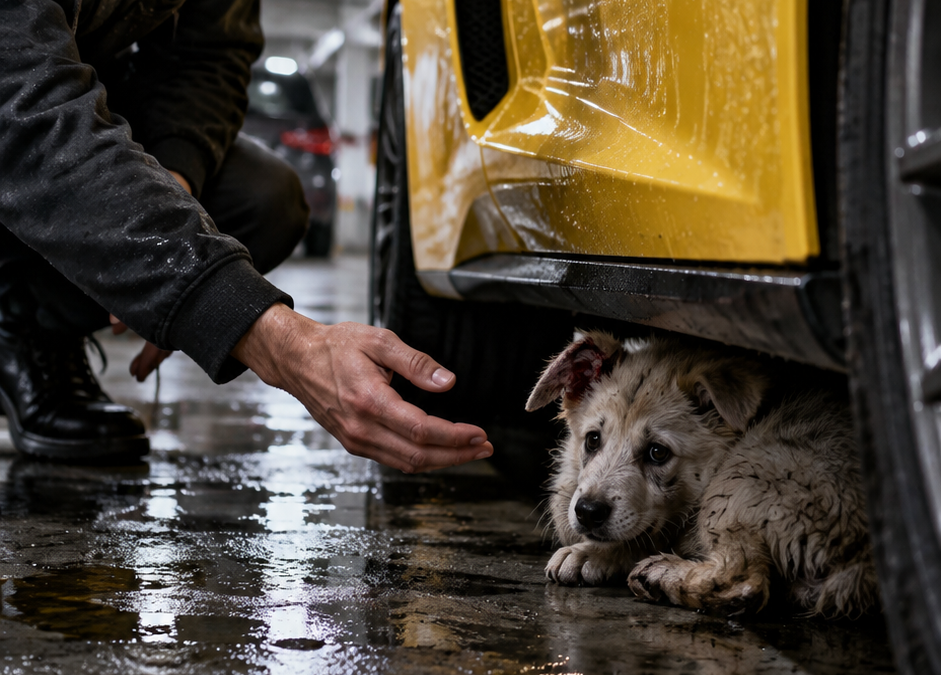
The yellow Porsche was impossible to miss—low, polished, expensive enough that I instinctively gave it a wider berth while walking toward my own car—but beneath it was a shadow darker than the others.
Something moved.
Barely.
I stopped.
At first I thought exhaustion was playing tricks on me.
Then two eyes opened.
One was golden brown.
The other looked blue-gray beneath swelling and bruising.
A white German Shepherd puppy was curled under the sports car so tightly that his body almost disappeared behind the tires.
Four months old, maybe five.
His coat should have been bright white.
Instead it was gray with brake dust, soot, and garage grime.
Dried blood crusted beneath one ear.
His ribs showed.
His right rear leg trembled without actually moving.
He wasn’t growling.
Wasn’t barking.
Wasn’t trying to escape.
He was doing something much more unsettling.
Nothing.
Perfect stillness.
Like he had learned that disappearing was safer than being noticed.
I crouched several feet away.
His eyes locked onto mine.
His jaw tightened.
That was the only warning.
One step closer and he might bite.
Not because he wanted to hurt me.
Because whatever had happened before had convinced him that hands approaching meant pain.
“You see him too?”
I turned.
Mr. Holtz, the evening parking attendant, stood beside his booth wearing the faded USC cap I had seen every night for years.
“How long?”
He looked toward the puppy.
“Three days that I know of.”
“Three days?”
“I left turkey. Water too.”
“Did he eat?”
Holtz shook his head.
“Nothing.”
I looked back at the puppy.
“You called anyone?”
“Building security knows.”
“And?”
Holtz gave me the sort of expression that answered before words did.
“This building gets nervous about strays.”
Of course.
A bleeding dog beneath somebody’s luxury car was apparently less urgent than preserving the atmosphere of a private medical tower.
“What happened to him?”
“I heard tires squeal the first night.”
Holtz lowered his voice.
“Came down here and found him between those columns. Looked like he’d been tossed out.”
My stomach tightened.
“You saw a vehicle?”
“Too late.”
I sat cross-legged on the concrete.
Not closer.
Just lower.
The puppy tracked every movement.
I removed half a protein bar from my pocket, broke off a piece, and rolled it gently toward him.
It stopped two feet from his nose.
He didn’t sniff.
Didn’t blink.
Nothing.
So I leaned against the concrete column and waited.
Ten minutes.
Fifteen.
Twenty.
The ventilation system hummed overhead.
Cars entered and left.
Elevator doors opened.
Closed.
I said nothing.
Finally, the puppy exhaled.
A long, soft breath.
Then he lowered his head to the concrete.
His eyes remained open.
Still watching.
Still afraid.
But the tension around his mouth loosened.
It wasn’t trust.
Not even close.
It was permission to exist near him.
For that first night, it was enough.
I stood slowly.
“I’ll come back tomorrow.”
Holtz shook his head.
“Doc, don’t get attached.”
I looked beneath the Porsche.
The puppy’s eyes followed me.
“Too late.”
PART2
The next morning, I brought rotisserie chicken.
If medicine teaches you anything, it is that biology becomes surprisingly persuasive when it smells like roasted poultry.
I also brought water, two towels, and no plan beyond showing up.
Holtz was drinking coffee when I arrived.
He lifted the cup toward me.
“Your patient’s still there.”
“Don’t call him my patient.”
“You brought supplies.”
“Observation.”
“Chicken?”
“Clinical tool.”
“Sure, Doc.”
The Porsche hadn’t moved.
Neither had the puppy.
Same position.
Same tucked body.
Same eyes.
I crouched outside the car’s shadow.
“Morning.”
One ear moved.
That was new.
I placed the chicken container six feet away.
Opened it.
Smell traveled quickly through the garage.
The puppy’s nose twitched.
Small.
Almost invisible.
I tore off a piece and rolled it closer.
No movement.
Another piece.
Closer.
Nothing.
I sat.
Holtz pulled over a folding chair.
“You always this patient?”
“No.”
“People think surgeons are impatient.”
“We are.”
“So why this?”
I looked beneath the Porsche.
“I don’t know.”
That was a lie.
I knew enough.
Six months earlier, I had lost my baby at eighteen weeks.
Complications.
A clot.
A sequence of events I replayed so often that the details had stopped feeling like medicine and started feeling like punishment.
I was a trauma surgeon.
I spent my life catching things before they killed people.
Bleeding.
Airways.
Shock.
Minutes mattered.
Recognition mattered.
And yet when it was my own body, my own pregnancy, my own child, I had failed to understand what was happening until there was nothing left to fix.
That was how I saw it.
My doctors disagreed.
My therapist disagreed.
Facts disagreed.
Grief didn’t care.
I took leave.
Returned to work.
Told almost nobody.
Walked back into the operating room as if nothing had happened.
My hands remained steady during surgery.
That was almost worse.
The world had broken apart and somehow muscle memory continued.
Scalpel.
Suction.
Clamp.
Suture.
Go home.
Don’t think.
Repeat.
Then this puppy appeared beneath a Porsche.
Another living thing refusing to move because surviving had taken everything.
Holtz watched me.
“You’re not here because this is easy.”
I looked at him.
“When did parking attendants become psychiatrists?”
“Night shift.”
Fair.
An hour passed.
I stood.
The puppy’s nose extended.
One inch.
Then another.
He reached the nearest piece of chicken.
Touched it.
Picked it up.
Held it between his teeth.
My heart jumped.
He dropped it.
No eating.
But contact.
Choice.
“Good.”
His eyes lifted.
I backed away.
“Tomorrow.”
That night I thought about him instead of the hospital.
That should have annoyed me.
It didn’t.
At three in the morning, sleep still wouldn’t come.
I stared at the ceiling for an hour.
Then got dressed and drove back.
Level B3 was almost empty.
The yellow Porsche remained.
So did the puppy.
I sat in the same place.
No Holtz.
No conversation.
No phones.
Just the hum of fluorescent lights and a white dog hiding beneath several hundred thousand dollars of machinery.
I rolled a piece of chicken.
He sniffed.
Ate.
I froze.
Another.
He ate that too.
Then his tail moved.
Barely.
A single twitch against the concrete.
I laughed under my breath.
“There you are.”
His head lifted slightly.
I didn’t approach.
Trust has terrible timing when you’re desperate for it.
Push one second too early and you can lose three days of progress.
So I sat until he stopped eating.
Then left.
By the fourth night, he recognized my footsteps.
I knew because his head lifted before I turned the final column.
He stayed beneath the Porsche, but now he faced outward.
Watching for me.
That did something dangerous to my heart.
“Evening.”
Nose twitch.
“Rotisserie chicken has officially purchased your loyalty.”
No tail.
“Fair. Too soon.”
I added a shallow bowl of water.
His lips were dry.
He had eaten more, but drinking remained limited.
I slid the bowl forward.
He crawled several inches.
Chest nearly flat.
Front legs moving.
Back end stiff.
He drank.
Not much.
Enough.
I nearly smiled.
Then Holtz appeared with a flashlight.
“Doc, you want me to—”
The beam crossed the puppy’s face.
Everything exploded.
The shepherd shot from beneath the Porsche.
Full speed.
I stood.
“No!”
His paws slipped on concrete.
He crashed against the far wall with a yelp.
Scrambled.
Disappeared behind maintenance carts and into a utility corridor.
Silence.
I turned.
“What the hell, Holtz?”
His face collapsed.
“I didn’t mean to scare him.”
“You came straight at him with a light.”
“I thought maybe if we blocked—”
“No trapping.”
“I was trying to help.”
“I know.”
My anger burned for another second.
Then faded into guilt.
Holtz already had enough.
“I know.”
We searched twenty minutes.
Nothing.
The utility area contained pipes, storage closets, janitorial equipment, narrow spaces behind mechanical systems.
If he wanted to vanish, he could.
I finally left because security locked part of the level overnight.
Holtz stood beside the booth.
“He’ll come back.”
He said it for both of us.
I didn’t sleep.
At dawn I returned with fresh chicken, more towels, and a soft harness I had bought from a twenty-four-hour pharmacy that happened to carry pet supplies.
I left the food beneath the Porsche.
Waited in my car.
One hour.
Two.
Nothing.
Then movement.
The puppy crawled from the utility corridor.
He was limping badly.
One front paw barely touched the floor.
Blood marked the pad.
He ignored the Porsche.
Instead, he moved into a dark corner near a janitor’s sink and curled up.
Tighter than before.
I waited.
Then sat five feet away.
No talking.
No eye contact.
Chicken rolled halfway between us.
His eyes closed.
Not sleep.
Exhaustion.
That was when I saw the bruise.
Along his shoulder.
Fur had separated enough to expose skin beneath.
Purple-yellow discoloration.
Roughly hand-shaped.
My breath stopped.
Old enough to be fading.
Clear enough to understand.
Someone had grabbed him hard.
Maybe trying to restrain him.
Maybe worse.
The exact story didn’t matter.
His body had learned the lesson.
Hands hurt.
I sat there longer.
Every medical instinct told me we were past gentle waiting.
The paw could infect.
He was underfed.
The bruised eye needed examination.
Dehydration remained a concern.
But the moment I trapped him, I risked confirming everything he believed about people.
We needed a compromise.
Day six, I got closer.
Day seven, he let me touch him.
Not because some cinematic breakthrough happened.
Because he was tired.
Because I had become predictable.
Because hunger and injury narrowed his choices.
I sat near the janitor’s sink.
Same distance.
Same chicken.
Same quiet.
His damaged paw looked swollen.
I soaked a piece of clean towel with bottled water.
Slid it toward him.
No reaction.
I moved my hand slowly.
His eyes locked onto it.
“I’m touching the paw.”
His body tightened.
“Not you.”
My fingers reached fur.
Warm.
Dirty.
Sticky near the wound.
He flinched.
Didn’t bite.
I cleaned the pad.
He trembled throughout.
I wrapped it lightly.
When I tied the bandage, he stared at me with his mismatched eyes.
“Done.”
I started to pull away.
His head lowered.
Onto my forearm.
I stopped breathing.
Weight.
Warmth.
Trust?
Maybe.
Or exhaustion.
I didn’t care.
I stayed until he moved first.
Holtz saw the bloody smear on my sleeve when I walked back.
He nodded.
No jokes.
The next evening I brought an open carrier.
Blankets inside.
One of my old shirts.
I placed it near his corner.
No coaxing.
He sniffed.
Didn’t enter.
Progress.
The night after that, I finally lifted him.
I warned him first.
“I need to get you out of here.”
His ears flattened.
“You’re getting sick.”
Jaw tight.
“I know you hate this.”
I slid one hand under his chest.
Another supporting his hindquarters.
He froze.
Every muscle rigid.
No struggle.
Somehow that frightened me more.
Then I lifted.
His body weighed far less than it should have.
He pressed against my chest.
Breathing fast.
Eyes scanning.
I carried him past Holtz.
The old man opened the passenger door.
“Good luck, kid.”
The puppy looked at him.
Holtz smiled.
“You gave Doc more trouble than any patient in the building.”
We went directly to an emergency veterinarian.
The examination confirmed what I feared and what I didn’t.
Underweight.
Dehydrated.
Paw abrasion with early infection.
Bruised eye but intact globe.
Soft-tissue injury in the rear leg.
Multiple older bruises.
No fractures.
No internal bleeding.
No microchip.
No collar.
No identification.
The veterinarian looked at me.
“You found him where?”
“Parking garage.”
“How long?”
“At least a week.”
“Animal control report?”
“Building security had apparently made informal calls. I’ll file properly.”
“You planning to foster?”
“No.”
The answer came too fast.
She raised an eyebrow.
“I’m taking him home temporarily.”
“Right.”
“Medical foster.”
“You’re a trauma surgeon.”
“Same number of syllables.”
She smiled.
“Different species.”
“Details.”
I followed the legal stray process.
Reported him.
Photographs submitted.
Found-animal listing.
No matching microchip.
No immediate owner claim.
Temporary foster placement approved while his medical needs were treated.
That mattered.
I wasn’t stealing someone’s dog simply because I hated what I imagined had happened.
Facts first.
Always.
At home, I put him in the bathroom.
Small.
Quiet.
Tile floor.
No furniture he could hide beneath indefinitely.
Warm towel.
Water.
Soft food.
Open carrier.
My shirt.
Then I sat outside the door.
Two hours.
He didn’t bark.
Didn’t scratch.
I heard water.
Slow laps.
Eventually I opened the door slightly.
He was curled in the corner.
Head resting on my shirt.
“Okay.”
One ear moved.
“You’re not staying.”
He watched me.
Even then, I think he knew I was lying.
My cat Milo met him that night.
Milo had lived with me nine years and considered every square inch of the apartment his sovereign territory.
I expected hissing.
At minimum, judgment.
Milo sniffed beneath the bathroom door.
The puppy sniffed back.
Milo sat.
That was it.
At three in the morning, I woke on the hallway floor.
I had apparently fallen asleep outside the bathroom.
The door stood open.
I didn’t remember opening it.
Then I felt warmth near my back.
The puppy lay several inches away.
Not touching.
Close enough to share air.
Milo slept on the other side of me.
I whispered, “What exactly is happening here?”
Milo ignored me.
The puppy’s eyes remained open.
Guarded.
Still learning.
In the morning, I found him inside the laundry basket.
He had dragged my T-shirt into it.
Ignored the expensive dog bed.
Of course.
I crouched.
“Good taste.”
He sniffed my hand.
No retreat.
That was the day I named him Axel.
I don’t know why.
The name appeared.
“Axel.”
His ear moved.
“Too dramatic?”
Nothing.
“Fine.”
Milo jumped onto the counter.
“You don’t get a vote.”
Axel’s paw improved.
He let me clean it daily.
The first few times, his breathing accelerated the moment I reached down.
Eventually, less.
One afternoon, we sat on the balcony.
Los Angeles haze softened the horizon.
Axel lay beside my chair.
Milo balanced along the railing despite years of me explaining gravity.
A helicopter passed.
Axel’s entire body trembled.
I placed my hand near his shoulder.
Not on him.
He moved closer until contact happened by his choice.
Then I rested my palm against him.
“Not here.”
His muscles shook.
“That part is over.”
Even while saying it, I knew the sentence wasn’t entirely true.
Trauma does not obey geography.
You can leave the place.
Sometimes the place follows inside you.
I knew that.
My hospital was full of people who survived injuries long after the bleeding stopped.
I had simply failed to apply the same principle to myself.
Axel ate cautiously at first.
I fed small meals.
Chicken.
Rice.
Veterinary diet.
He approached every bowl like there might be consequences.
One bite.
Look up.
Nothing.
Second bite.
Look up.
Still nothing.
Eventually he finished.
The first time, he sat across from me afterward.
Watching.
As if asking:
What happens now?
“Nothing.”
His head tilted.
“You ate.”
I pointed toward the bowl.
“Nobody’s taking it back.”
Milo licked his own empty dish.
“Except him. Watch your food around the criminal.”
Days passed.
Axel began leaving the bathroom voluntarily.
Hallway first.
Then living room.
Milo followed him everywhere.
Not affectionately.
Supervisorially.
One night, Axel stood in the bathroom doorway while I brushed my teeth.
I saw him in the mirror.
White fur.
Uneven ears.
One golden eye.
One blue-gray.
He waited.
I turned.
“Come in.”
He stepped forward.
Lay on the tile.
That simple act made my throat tighten.
He wanted witness.
That was how I thought of it.
Not touch necessarily.
Not praise.
Just somebody present.
The first bark happened because a delivery driver dropped a package outside.
Bang.
Axel launched upright.
One bark exploded from him.
Deep.
Sharp.
Then silence.
He looked horrified.
At himself.
Milo’s back arched.
I dropped my pen.
Axel stared at me.
Tail low.
“I know.”
He remained rigid.
“That was your voice.”
One ear moved.
“You’re allowed one.”
His tail twitched.
“Even two.”
Milo approached cautiously.
Sniffed Axel’s leg.
Axel exhaled.
I scratched behind his ear.
“You didn’t break anything.”
The next milestone was the front door.
For three days, Axel stood near it whenever I reached for my keys.
Watching.
Curious.
Maybe worried I was leaving.
I bought a gray collar with silver stitching.
Soft harness.
Leash.
The first time I fastened the collar, Axel froze.
I immediately stopped.
“Okay.”
Loosen.
Treat.
Touch.
Pause.
Again later.
By afternoon he accepted it.
The next day, leash.
Then doorway.
I opened it.
Axel stared into the hall.
One paw forward.
Back.
Again.
Two paws.
Pause.
Then he crossed.
The elevator was too much.
So we used stairs.
One flight.
Outside, the city attacked him.
Cars.
Voices.
Siren.
Scooter.
Footsteps.
Air brakes.
Axel flinched constantly.
But he moved.
One block.
That was all.
On the way home, a child shot past on a scooter.
Axel stopped.
Braced.
Did not run.
I crouched.
“You stayed.”
His eyes met mine.
Then he licked my hand.
First time.
Slow.
Careful.
I sat there on the sidewalk longer than necessary.
That evening, I opened the shelter volunteer portal and looked at therapy-dog requirements.
Absurd.
He had been out of a parking garage barely two weeks.
Still startled by cardboard boxes.
Still slept with one eye open.
Still suspicious of men wearing baseball caps.
Why was I researching therapy work?
Hope, probably.
Humans are terrible at tolerating uncertain futures.
We like labels.
Goals.
Plans.
I told myself a therapy-dog program would give Axel structure.
Truth?
I needed to imagine he could become something beyond what happened to him.
Maybe I needed the same possibility for myself.
A week later, I brought Axel into the medical tower during an off day.
Not as a therapy dog.
Exposure only.
Front desk approved five minutes in the lobby.
Axel stayed close to my leg.
Hospital floors clicked beneath his nails.
The smell of antiseptic made his nose work overtime.
A woman with a cane smiled.
A teenager ignored him.
Dr. Singh came out.
He was one of our senior surgeons.
Brilliant.
Demanding.
Emotionally built like reinforced concrete.
He saw Axel.
Stopped.
“New resident?”
“Poor operative skills.”
Dr. Singh crouched.
Axel watched.
Singh held out one hand.
No reaching.
Axel approached.
Sniffed.
Sat.
Dr. Singh’s expression softened.
“Interesting.”
“What?”
“He has stillness.”
“What does that mean?”
“Still water.”
“That’s not medicine.”
“Neither is everything worth noticing.”
I stared.
“Who are you?”
He smiled.
“Get out of my lobby.”
As we left, a little girl held the door.
“Pretty dog.”
Axel’s ears lifted.
He didn’t approach.
Didn’t retreat.
Just watched.
That night, Milo slept directly across Axel’s ribs like a cat-sized landlord collecting rent.
I sat nearby with patient charts.
For the first time in months, I completed them without realizing how late it had become.
My apartment felt different.
Not happier exactly.
Alive.
Then Holtz called.
“Doc.”
His voice sounded wrong.
“What?”
“Woman down here says she recognizes your dog.”
My stomach dropped.
“Stay there.”
When I reached B3, she stood beside the booth.
Mid-thirties.
Designer sunglasses despite being indoors.
Large tote bag.
Nervous expression.
Holtz had taped one of Axel’s found-dog flyers to the glass.
She pointed.
“That’s him.”
“You know the dog?”
“My boyfriend had a white shepherd.”
“Name?”
Pause.
“I don’t remember what he called him.”
My anger arrived instantly.
I kept my voice level.
“When did he disappear?”
“During a move.”
“Where?”
She named a neighborhood several miles away.
“What happened?”
“He got spooked.”
“Ran?”
“I guess.”
“You reported him?”
“No.”
“Microchip?”
“Don’t know.”
“Veterinarian?”
She shrugged.
“My boyfriend handled that stuff.”
“Food?”
“What?”
“What brand did he eat?”
“I don’t know.”
“Medical history?”
“No.”
“Which eye was injured?”
Her face tightened.
“Look, dogs are dogs. I just thought maybe—”
“Maybe what?”
“He looks expensive.”
That answer clarified everything.
I took down her contact information.
“I’ll pass this to animal control.”
She frowned.
“So I can’t take him?”
“No.”
“If ownership can be established, the proper authorities will determine what happens.”
Her jaw tightened.
“My boyfriend paid for him.”
“Then he can provide records.”
She left.
Holtz looked at me.
“That go well?”
“Beautifully.”
Back home, Axel rested his head in my lap.
“I almost lost you.”
His tail moved.
“Legally speaking, that sentence is premature.”
Milo jumped onto the couch.
“But emotionally?”
Axel leaned harder.
“Yeah.”
The official investigation went nowhere.
No proof of ownership.
No veterinary records matching Axel.
No microchip registration.
No purchase documentation produced.
The required stray period expired.
His foster status could convert to adoption.
I signed.
No hesitation.
AXEL.
Mine.
Or rather, legally my responsibility.
Emotionally, he had been family long before the paperwork caught up.
Therapy training moved slowly.
Basic obedience first.
Sit.
Down.
Stay.
Come.
Handling tolerance.
People approaching.
Wheelchairs.
Dropped objects.
Medical equipment.
Axel surprised everyone.
He wasn’t fearless.
That distinction mattered.
He startled.
Often.
But recovery improved.
Noise.
Pause.
Look at me.
Breathe.
Continue.
A slammed door used to send him searching for escape.
Later, it made him turn his head.
A flashlight once triggered panic.
Months later, he could tolerate directed light after gradual desensitization.
We never forced.
Choice became central.
That was why our first attempted hospital walkthrough failed.
Sunday.
Quiet wing.
Minimal traffic.
The volunteer coordinator met us.
Axel stepped from the elevator.
Stopped.
His body changed.
Nose high.
Eyes hard.
Muscles tight.
I felt it through the leash.
“Okay.”
He stared down the hallway.
Fluorescent lights.
Echoing tile.
Metal carts.
The smell of disinfectant.
Something there resembled something he remembered.
Maybe the garage.
Maybe a vehicle.
Maybe veterinary rooms.
We would never know.
I crouched.
“Axel.”
No response.
He took two steps backward.
Then turned toward the elevator.
The coordinator started to speak.
I raised my hand.
“We’re done.”
Outside, we sat near the ambulance bay.
Axel climbed onto the stone bench.
Put his head in my lap.
“I wanted that too much.”
His ears moved.
“That wasn’t fair.”
I ran my fingers through his coat.
“You choose.”
I meant it.
If Axel never became a therapy dog, fine.
He didn’t owe anybody inspiration.
He didn’t owe strangers a beautiful ending because his beginning was ugly.
That lesson took me longer than it should have.
Maybe healing did not need a job description.
That same week, a neighbor knocked on my door.
I barely knew her.
She was holding an old leather collar.
Her face was wet.
“I’m sorry.”
“What happened?”
“My dog died this morning.”
Twelve-year-old Labrador.
Cancer.
She looked embarrassed.
“I heard you had a rescue. I don’t know why I came here.”
I opened the door wider.
“You don’t need a reason.”
Axel was lying near the entryway.
He stood.
Walked toward her.
No command.
The woman knelt.
Axel pressed his chest against her.
She broke.
Arms around him.
Crying into white fur.
Axel stayed.
That was all.
When she left, she touched his head.
“He’s not just a good dog.”
She looked at me.
“He’s a soul.”
I closed the door.
Axel sat beside me.
No certificate.
No vest.
No program.
Still a healer.
That night, a storm rolled across Los Angeles.
Rare hard rain.
Thunder.
Axel crawled beneath the kitchen table.
Every rumble made his body smaller.
Milo eventually climbed onto his back.
Purring.
I sat on the floor.
Didn’t touch him.
Didn’t coax.
Just stayed.
Hours later, thunder moved farther away.
Axel stood.
Walked toward me.
Then toward the door.
“What?”
He looked back.
I put on a hoodie.
Leashed him.
We went outside.
Rainwater glittered under streetlights.
Axel walked with surprising purpose.
Left.
Right.
Two blocks.
Then toward the medical tower.
My heart tightened.
“You sure?”
He kept moving.
Holtz had given me overnight access months earlier after I helped him arrange care for a shoulder injury.
We entered.
Down the ramp.
Level B3.
Axel slowed.
I stopped.
No pressure.
He walked toward the place where the yellow Porsche used to park.
Empty now.
He stood there.
Exactly where I had first seen him.
No shaking.
No tucked tail.
Just stillness.
He sniffed the concrete.
Moved toward the column.
Then the janitor’s sink.
Old map.
Old smells.
His history.
I crouched.
“You came here.”
Axel looked at me.
Then walked back.
Leaned against my hip.
We stood together.
Nothing dramatic happened.
That was why it mattered.
He returned.
And left.
On his own feet.
That night, Axel slept on the couch.
Milo on top of him.
The next therapy evaluation happened weeks later.
We approached differently.
No expectations.
If Axel wanted out, we left.
He passed handling.
Wheelchair.
Dropped clipboard.
Rolling cart.
Quick approach.
Then final exercise.
A volunteer actor portraying acute distress.
Crying.
Unpredictable movements.
Axel watched.
One paw forward.
Pause.
Then approached from the side.
Slowly.
Lay beside the woman’s leg.
Not licking.
Not pawing.
Just contact.
The evaluator looked at me.
“We don’t teach that.”
My throat tightened.
“What?”
“That choice.”
Axel remained still while the woman rested one hand across his shoulders.
The evaluator smiled.
“He passed.”
I laughed.
“Of course he did.”
The certificate mattered less than I expected.
I framed it anyway.
Not because paper transformed Axel.
Because it documented distance traveled.
From beneath a Porsche to choosing closeness with a stranger in pain.
The next morning, I found a note taped to my apartment door.
Five words.
THE WHITE DOG IS MINE.
My body went cold.
Axel lay in the hallway.
Milo against his side.
I read it twice.
No signature.
I filed a police report.
Not dramatic.
Documentation.
Building security preserved camera footage.
I updated Axel’s microchip information.
Confirmed adoption paperwork.
Sent records to my veterinarian.
Added a door camera.
Changed the lock.
Holtz received a photograph of the person who had previously appeared asking about Axel.
“Call security if anyone matching that description returns.”
“Absolutely.”
That evening, Axel sensed my tension.
Every passing car made me look toward the window.
He lifted his head whenever I moved.
I lay on the couch.
He climbed beside me.
For the first time since losing my baby, I felt something I had tried hard not to feel.
Fear of loss.
Real loss requires attachment first.
I had spent months believing numbness was safer.
Axel made that impossible.
I kissed the top of his head.
“You’re not going back.”
His eyes closed.
Months passed.
No more notes.
No verified claimant.
No confrontation.
Nothing.
The threat became another chapter instead of the ending.
Axel started working limited therapy visits.
Never overbooked.
Never forced.
Short sessions.
Plenty of decompression.
If he showed stress, we stopped.
His specialty, if dogs can have one, was stillness.
He didn’t perform.
No tricks.
No dramatic commands.
He sat.
A grieving parent would touch him.
He stayed.
A patient waiting for surgery would place one hand on his neck.
He stayed.
A nurse after a bad shift would kneel beside him.
He stayed.
Dr. Singh saw us in the hallway one afternoon.
“Still water.”
I smiled.
“You’re going to keep saying that forever.”
“Yes.”
Axel leaned against his leg.
Singh scratched his ear.
“Good dog.”
I watched them.
Sometimes I wondered how something that had hidden from human hands could choose to become safe beneath them.
Then I stopped framing it as contradiction.
Healing is not forgetting danger.
It is learning danger is not everywhere.
Axel knew some people had hurt him.
Eventually he learned others would not.
I learned the same thing about grief.
Losing my baby had not meant love itself was dangerous.
It meant love had mattered enough to devastate me.
For months, I treated the devastation as evidence I should never risk that kind of attachment again.
Axel didn’t let me maintain the theory.
He followed me from room to room.
Slept near my bed.
Waited at the door when I worked.
Pressed his head into my hand when I came home after difficult surgeries.
Milo slept across him as if the seventy-pound shepherd had been purchased specifically as cat furniture.
Life became ridiculous.
Messy.
Tender.
Worth showing up for.
One evening, I had a terrible case.
Young patient.
Complications.
We saved him, but barely.
Afterward, I sat in the physician lounge unable to move.
Old fear.
Old guilt.
If you miss one thing.
One clot.
One bleed.
One sign.
Everything changes.
I went home late.
Axel met me at the door.
No jumping.
He had learned my moods.
He followed me into the kitchen.
I sat on the floor.
Still in scrubs.
He leaned against me.
I buried my face in his coat.
“I’m tired.”
He stayed.
“You’re supposed to be the patient.”
Tail.
“Fine.”
Milo jumped onto the counter.
“Both of you have terrible boundaries.”
For the first time in a long time, I cried without immediately trying to stop.
Axel had learned crying wasn’t dangerous.
So had I.
Months became a year.
His white coat grew thick.
The bruises disappeared.
The damaged eye retained its blue-gray color, giving him a permanent mismatched gaze people remembered.
His rear leg recovered.
Only fatigue brought a slight stiffness.
The puppy who once flattened himself beneath a sports car now walked through hospital corridors wearing a therapy vest.
Patients knew him.
Nurses kept treats hidden at stations despite repeated lectures about diet.
Holtz still worked B3.
Sometimes I brought Axel down.
The first time, Holtz crouched.
“Well, look at you.”
Axel approached.
Sniffed his USC cap.
Then licked his chin.
Holtz laughed.
“You remember the flashlight?”
Axel wagged.
“I’m forgiven.”
“Don’t push it.”
We walked toward the old parking space.
A different car sat there now.
Silver sedan.
Ordinary.
Holtz watched Axel.
“Never thought he’d come out.”
“Neither did I.”
“That’s not true.”
I looked at him.
“You kept coming back.”
Axel sat beside me.
Maybe Holtz was right.
Hope doesn’t always feel like optimism.
Sometimes hope is just repetition.
Show up.
Again.
Again.
Again.
Even when nothing changes yet.
I eventually told Dr. Singh about the miscarriage.
Not everything.
Enough.
We were between cases.
He listened.
No platitudes.
Then said, “You know physicians are allowed to be patients.”
“I hate that sentence.”
“Yes.”
“And I know.”
“Knowing and accepting are different specialties.”
I laughed.
Axel lay under the table.
Singh looked at him.
“Dog figured it out first.”
“Everybody’s a critic.”
Therapy helped too.
I returned consistently.
Not because Axel fixed me.
He didn’t.
That would insult both of us.
Recovery came from many places.
Professional treatment.
Time.
Friends.
Work boundaries.
Grief spoken aloud instead of hidden.
Axel gave me something else.
A daily reason to practice trust.
He needed routines.
So I built routines.
He needed calm.
So I learned calm.
He needed me to stop blaming him for fear responses.
Eventually I wondered why I offered myself less mercy.
He had panic.
I called it trauma.
I had panic.
I called it weakness.
He had setbacks.
I called them normal recovery.
I had setbacks.
I called them failure.
Dogs are sometimes mirrors we cannot argue with.
One afternoon, a woman sat beside Axel in the hospital family waiting area.
Her husband was in surgery.
She kept twisting her wedding ring.
Axel walked over.
Rested his chin on her knee.
She whispered, “I’m scared.”
He stayed.
She looked at me.
“Does he always know?”
“No.”
That surprised her.
“He doesn’t know what’s happening.”
I smiled.
“He just knows you need company.”
She looked down.
“Maybe that’s enough.”
Exactly.
I thought about the parking garage.
The first protein-bar piece untouched on concrete.
The first chicken held and dropped.
The first touch.
His head on my arm.
None of those moments fixed everything.
They accumulated.
That was healing.
Not one miracle.
A thousand tolerable experiences until fear stopped owning every decision.
Years later, the note claiming Axel became almost funny.
Almost.
I kept the incident report.
Not from fear.
Evidence.
His legal history was clear.
Stray intake.
Medical foster.
Ownership investigation.
No substantiated claim.
Adoption.
Microchip.
Veterinary record.
Therapy certification.
A life documented properly after beginning in total uncertainty.
Sometimes new staff asked about the blue-gray eye.
“Born that way?”
“Probably trauma.”
“What happened?”
“I don’t know.”
That answer became easier.
We didn’t need to know every cruelty in order to respect every scar.
Axel became older.
Not old.
Mature.
His behavior softened.
He still disliked flashlights pointed directly at him.
Fine.
He tolerated storms better but preferred being beneath a table.
Fine.
He still needed warning before unfamiliar men touched his head.
Fine.
Healing had never required becoming a dog who liked everything.
It meant having choices.
That was enough.
My apartment changed too.
I eventually moved Claire’s things.
Not erased.
Moved.
Her mug became a mug again instead of a shrine.
I donated clothes.
Kept a few things.
Put one photograph in the living room.
The house stopped being frozen at the moment before loss.
Axel slept beneath that photograph often.
Milo eventually accepted that Axel owned part of the couch.
Or perhaps Milo simply allowed him access.
Hard to tell.
One night, I sat with both of them while rain hit the windows.
Thunder rolled.
Axel lifted his head.
Body tense.
Then looked at me.
Not under the table.
Me.
I patted the rug.
He came over.
Lay down.
Milo climbed onto his side.
Thunder again.
Axel breathed.
No shaking.
I felt something in my chest loosen.
“You’re getting boring.”
Tail.
“I miss the drama.”
Milo glared.
“Not you. You remain exhausting.”
The storm moved on.
Axel slept.
I thought about that first night on B3.
Stillness had been his survival strategy.
Become invisible.
Don’t move.
Don’t invite pain.
Years later, stillness became his gift.
The same dog who froze beneath a sports car now chose to lie quietly beside people in pain.
Same behavior from the outside.
Completely different meaning.
That fascinated me.
Trauma can make a behavior necessary.
Healing can transform it into choice.
Axel no longer stayed still because he believed movement would get him hurt.
He stayed still because sometimes another person needed a calm body beside them.
That distinction was everything.
One morning, a resident asked whether Axel had always been gentle.
I laughed.
“He tried to disappear into a concrete wall the first week I knew him.”
The resident looked shocked.
“Seriously?”
“He trusted nobody.”
“What changed him?”
I thought.
“Consistency.”
“Training?”
“That too.”
“Medication?”
“For a while.”
“Time?”
“Yes.”
I looked at Axel.
“But mostly he kept having experiences that ended differently than he expected.”
The resident nodded.
“That sounds familiar.”
Maybe it should.
I still visit B3 sometimes.
Less now.
Holtz retired eventually.
On his last shift, I brought Axel.
We gave him a framed photograph.
Not of the rescue.
Of Axel in his therapy vest sitting beside Holtz’s security booth.
Holtz cried.
Then denied it.
“Dust.”
“Underground garage.”
“Lots of dust.”
“Sure.”
He hugged me.
Then crouched beside Axel.
“You take care of Doc.”
Axel wagged.
Holtz looked up.
“He already did, huh?”
I didn’t answer.
Didn’t need to.
After he left, Axel and I walked to the old corner.
The janitor’s sink had been replaced.
Maintenance carts rearranged.
The parking spot repainted.
Nothing preserved the scene.
Good.
Places should be allowed to change.
We stood for a moment.
Then Axel turned toward the elevator.
Ready.
I followed.
That is the part of his story I think about most now.
Not the bruise.
Not the Porsche.
Not the note.
Not even the therapy certificate.
The turning.
A frightened puppy once spent days believing the safest possible life was one where nobody noticed him.
Then slowly, he chose something else.
Food.
Touch.
Doorways.
Sidewalks.
Home.
People.
Work.
Connection.
He kept turning toward life.
So did I.
I returned to therapy.
Told friends what had happened instead of saying my leave had been “medical.”
Stopped pretending my loss was a private failure I could surgically remove through discipline.
I allowed grief to be grief.
Not diagnosis.
Not incompetence.
Not punishment.
Axel never saw the ultrasound image I kept in a drawer.
Never understood why certain dates made me quiet.
Never knew why the first anniversary nearly broke me.
He didn’t need the story.
When I sat on the floor, he sat too.
When I couldn’t sleep, he stayed near the bed.
When I finally packed away the things I had bought for a baby who never came home, Axel lay in the hallway.
Witness.
That word again.
Sometimes love does not fix.
It witnesses.
And sometimes being witnessed is what makes survival feel less lonely.
Years after the garage, Axel became one of the hospital’s most requested therapy dogs.
I made sure that sentence never became a burden.
He had days off.
Weeks off.
Retirement would come whenever he needed it.
He owed nobody his trauma transformed into service.
But he loved the work.
You could tell.
Vest appeared.
Tail.
Hospital entrance.
Ears forward.
Elevator.
Calm.
He chose it.
That mattered.
One afternoon, he sat beside a father whose child was undergoing emergency surgery.
The man’s hands shook.
Axel leaned against his shin.
The father whispered, “I can’t lose him.”
My throat closed.
Different story.
Same terror.
I crouched nearby.
“You don’t have to be okay right now.”
The man looked at me.
Axel stayed.
Hours later, the surgeon came out.
Good news.
The child would recover.
The father bent down and hugged Axel.
I stood farther back.
Watching.
For one second, I thought about the baby I couldn’t save.
Then I thought about all the people I had saved since.
Both truths.
Neither cancels the other.
I finally understood that.
Axel helped.
Not alone.
Never alone.
But he helped.
At home that evening, I removed his vest.
Milo, older now, inspected him.
Axel flopped onto the rug.
I sat beside him.
“You know they used to say you were too broken.”
His tail moved.
“Ridiculous.”
He rolled onto his side.
I scratched his chest.
“They weren’t completely wrong.”
One eye opened.
“You were broken.”
I swallowed.
“So was I.”
His paw landed on my wrist.
“But broken isn’t finished.”
Tail.
“Apparently.”
I leaned back against the couch.
Axel rested his head on my leg.
Milo curled against his stomach.
The apartment was quiet.
Not the sterile silence I had once built around myself.
Living quiet.
Breathing.
Rainwater in the gutter.
A refrigerator hum.
Cat purring.
Dog dreaming.
Home.
I sometimes wonder about the person who left Axel.
Whoever drove into that garage.
Whoever frightened him enough that a yellow Porsche seemed safer than a human voice.
Whoever wrote the note later, if it was the same person.
I used to want answers.
Now I don’t.
Knowing why someone caused pain would not improve the life we built afterward.
They are part of Axel’s history.
They do not own his future.
That belongs to him.
And if I learned anything from him, it is that survival begins when someone offers safety—but healing begins when the survivor realizes they are allowed to choose what comes next.
Axel chose.
He chose chicken.
Then my arm.
Then the carrier.
Then my apartment.
Then the hallway.
Then the sidewalk.
Then the hospital.
Then strangers who needed him.
Again and again, he made choices the puppy beneath that sports car could not have imagined.
People tell me I rescued him.
Technically, yes.
I fed him.
Got him medical care.
Filed the reports.
Adopted him.
Trained him.
Protected him.
But rescue is too simple a word for what happened between us.
Axel gave me somewhere to put tenderness when grief had convinced me tenderness was dangerous.
He taught me that fear can live inside a body without being allowed to run the entire life around it.
He showed me recovery could be slow without being failure.
And every day he stayed beside me, he contradicted the belief I had never said aloud.
That after losing one life I loved, loving anything deeply again would only guarantee another wound.
Of course it guaranteed another wound.
Someday Axel would grow old.
Someday Milo would be gone.
Someday everyone we love leaves, or we leave first.
That is not an argument against love.
It is the cost of having something worth grieving.
I know that now.
One night, long after B3 stopped feeling haunted, I took Axel outside after rain.
The pavement shone beneath streetlights.
We walked past the medical tower.
Axel paused.
Looked toward the garage entrance.
Then looked at me.
I loosened the leash.
“Your call.”
He sniffed the air.
For a second I wondered if he would lead me down again.
Instead, he turned away.
Toward home.
I smiled.
“Yeah.”
We kept walking.
His therapy vest hung inside the apartment.
Milo would be waiting on the couch.
Breakfast would come in the morning.
There would be patients.
Bad days.
Good days.
Storms.
Appointments.
Ordinary things.
Life.
Axel walked beside me with his head level and his tail loose.
No hiding.
No disappearing.
And for the first time, I realized the most important thing about the puppy I had found beneath that yellow Porsche wasn’t that he had survived being broken.
It was that eventually, after enough patience, enough safety, enough chances to choose for himself—
he stopped believing he had to disappear.








