𝗙𝗨𝗟𝗟 𝗦𝗧𝗢𝗥𝗬 They Said a Waitress and Her K9 Had No Place in First Class—But One Name on His Collar Changed the Entire Cabin
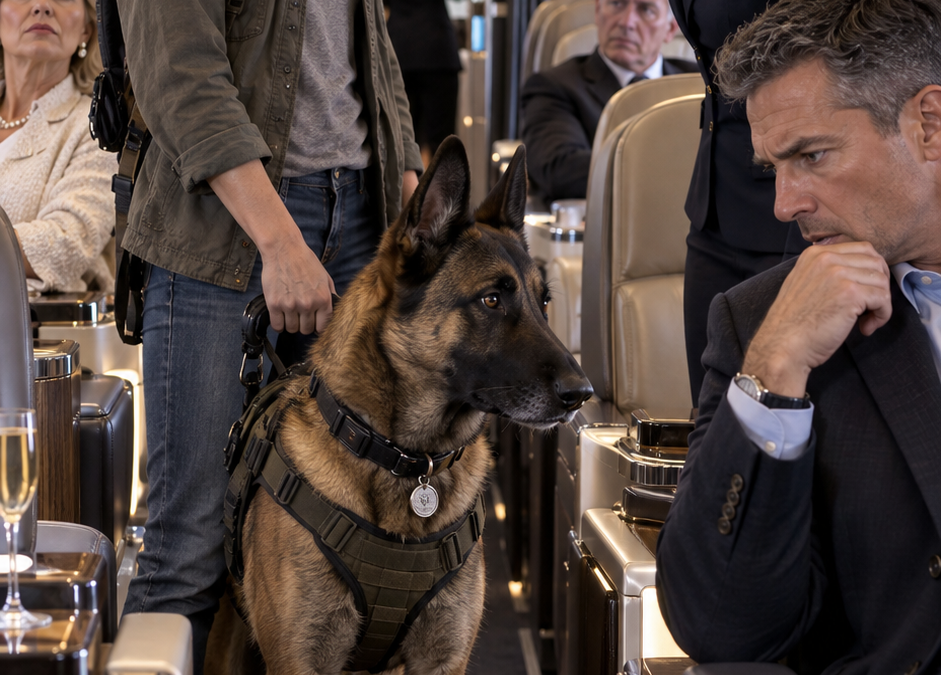
𝗣𝗔𝗥𝗧 𝟮
The man from the booth stood slowly.
The Malinois stopped at the bar.
Then he sat beside my leg.
Pressed his shoulder against me.
And went completely still.
My hand froze above the register.
I knew that weight.
I knew that posture.
But recognition can be a violent thing when you have spent years convincing yourself that recognition is impossible.
The man called from the booth.
“Titan.”
The name hit me harder than any gunshot I had heard in years.
My fingers went cold.
The dog looked up at me.
Same eyes.
Older now.
Silver beginning along the muzzle.
But the same eyes.
“Titan,” the man repeated.
A recall command followed.
Titan did not move.
The man walked over.
He was in his sixties, maybe early seventies.
Straight-backed.
Controlled.
The kind of bearing military men never fully lose.
He stopped several feet from us.
“Titan.”
Nothing.
The dog remained against my leg.
The man crouched.
For a moment, he looked at the animal.
Then at me.
His expression changed.
Not confusion.
Recognition of something he had hoped for but had not expected to find.
“What?” I asked.
He did not answer immediately.
Instead, he studied Titan.
Then me.
“Do you know this dog?”
The safest answer would have been no.
I almost gave it.
But Titan shifted slightly against my knee.
My hand lowered before I could stop it.
Two fingers touched the top of his head.
He closed his eyes.
Six years vanished.
Smoke.
Blood.
A man yelling his dog’s name.
My hands buried in fur dark with blood.
“Titan.”
My voice barely worked.
The older man exhaled.
That was how Admiral Harlan Reyes entered my life.
I did not know his rank at first.
He introduced himself simply as Harlan.
He did not explain why he had Titan.
He did not ask me questions in front of customers.
Instead, he said, “I’d like to speak with you privately.”
“I’m working.”
“I understand.”
“I close at eleven.”
“I can wait.”
Most people who said that expected waiting to become a favor you owed them.
Reyes did not.
He returned to his booth.
His coffee went cold.
Titan stayed beside me.
For forty minutes, I served drinks with a retired military working dog pressed against my leg while pretending my heart had not turned itself inside out.
At eleven, I locked the door.
My manager left through the back.
I turned around.
Reyes was still there.
So was Titan.
I sat across from him.
“Who are you?”
“Harlan Reyes.”
“That doesn’t answer the question.”
A faint smile.
“No. It doesn’t.”
He reached into his coat and placed identification on the table.
Admiral.
United States Navy.
I looked from the card to his face.
“Why do you have Titan?”
Reyes took a long breath.
“Because nobody else could keep him.”
I frowned.
He explained that Titan had been placed three times after retirement.
Three homes.
Three experienced handlers.
Three failed transitions.
He would follow commands.
He would eat.
He would perform routines.
But he never settled.
He paced doors.
Refused affection.
Slept facing exits.
Sometimes he stopped eating for days.
“He was not dangerous,” Reyes said. “Just… absent.”
I understood that description better than I wanted to.
“He hasn’t done what he did tonight in six years.”
“What?”
“Chosen someone.”
I looked at Titan.
He lay beneath the table, head against my boot.
Reyes continued.
“He has never ignored my recall.”
My throat tightened.
“Why bring him here?”
“I didn’t.”
I looked up.
“Excuse me?”
“I was meeting someone nearby. This bar was convenient.”
“So this was chance?”
“I don’t believe chance deserves credit for everything it does.”
I did not like answers that sounded philosophical.
“What do you want?”
Reyes leaned back.
“I want you to have coffee with me tomorrow.”
“No.”
He nodded as if expecting that.
“There are things you deserve to know.”
“That sentence usually means there are things I’ve worked very hard not to know.”
His eyes softened.
“I thought that might be true.”
I looked down at Titan.
The dog breathed against my shoe.
My chest hurt.
“Tomorrow. Noon,” I finally said. “Coffee shop at the corner.”
Reyes nodded.
“That’s more than enough.”
I went home and did not sleep.
Not because of Reyes.
Because of Titan.
Six years earlier, I had knelt beside that dog while Petty Officer Ray Whitfield held his head in both hands.
Titan had been hit by shrapnel along the lower ribs.
Ray had been injured too.
Worse than I understood at first.
He kept refusing treatment.
“Dog first.”
“Ray, you’re bleeding.”
“Dog first.”
“You’re not helping me by passing out.”
He had laughed.
Actually laughed.
Then coughed and turned pale.
“Patch him, Doc.”
I remembered Titan trying to crawl toward him.
Remembered Ray holding his face.
“Stay with her, boy.”
I removed two fragments.
A third sat too deep.
Too dangerous to chase in the field.
I stabilized Titan.
Then turned to Ray.
By then, we were losing him.
I had worked on Ray until evacuation.
He died before definitive surgery.
Titan lived.
That was all I knew.
After the mission, classification swallowed everything.
Different units separated.
Reports sealed.
Names reduced to initials.
I never knew where Titan went.
I never met Ray’s family.
Then my own injuries came.
Then separation.
Then I became a waitress.
Until Titan walked across Miller’s floor and sat against my leg.
At noon the next day, Admiral Reyes told me my upcoming flight had been upgraded to first class.
I stared at the itinerary.
“No.”
“It’s already done.”
“I bought economy.”
“I know.”
“I don’t want anyone paying for me.”
“It isn’t charity.”
“Then what is it?”
He looked at Titan, who sat beside my chair.
“A formality.”
I almost laughed.
“Admiral, you’re terrible at making things sound less suspicious.”
“That has been said before.”
“Why is Titan flying with me?”
“Transfer paperwork.”
“Transfer to whom?”
He looked at me.
“You.”
I stopped breathing.
“No.”
Reyes did not react.
“I don’t have the right home.”
“You have a home.”
“I work nights.”
“You’re home more than most military handlers.”
“I’m not a handler anymore.”
“Titan disagrees.”
I looked down.
The dog’s eyes were fixed on me.
“He doesn’t get to make legal decisions.”
“That is why paperwork exists.”
I pushed the itinerary back.
Reyes left it between us.
“Olivia, three placements failed.”
My head snapped up.
He had used my first name.
“I haven’t told you what happened after Ray died because some of it still requires formal release. There are also people in Denver who deserve to meet you.”
“My sister is in Denver.”
“I know.”
“How?”
“You gave the airline your destination.”
“That does not explain anything.”
“No. Not yet.”
I hated him a little in that moment.
Mostly because part of me trusted him.
And trust was dangerous.
Three days later, Titan slept beside my front door.
He had been with me under temporary authorization for forty-eight hours.
He followed me room to room.
Not nervously.
Quietly.
As if returning to a station he had once known.
That morning, Reyes called.
“The paperwork is moving.”
“Meaning?”
“Signatures in Denver.”
I looked at Titan.
“Is something wrong?”
A pause.
“No.”
“That pause means something.”
“Not wrong,” Reyes said. “Overdue.”
I should have pushed harder.
Instead, I drank my coffee.
“I’ll be at the airport by ten.”
I dressed simply.
Jeans.
Gray shirt.
Comfortable shoes.
One canvas purse.
One small bag.
Years of moving with gear had taught me that everything you pack becomes something you eventually have to carry.
Titan walked beside me through the terminal.
People stared.
Some smiled.
Some moved away.
Some saw the working-dog harness and understood enough to leave him alone.
The gate agent scanned my boarding pass.
Then looked at me.
Then Titan.
Then back at the pass.
“First class?”
“That’s what it says.”
A hesitation.
One second.
Maybe less.
I saw it.
Titan saw it too.
His body angled closer to my knee.
I touched two fingers against his harness.
“Easy.”
The word came automatically.
His shoulders relaxed.
That bothered me more than the gate agent’s expression.
Six years.
And he still remembered my hands.
Seat 2A.
First class.
The cabin smelled like coffee, leather and expensive cologne.
Everything was soft.
Quiet.
Controlled.
A woman across the aisle wore a cream blazer and gold bracelets.
Her husband had the kind of watch I could have lived on for a year after leaving the Navy.
They noticed me immediately.
More specifically, they noticed that I did not match the room they believed they had purchased.
I put my canvas purse beneath the seat.
Titan settled at my feet.
The woman pressed the call button before boarding was finished.
A flight attendant arrived.
“Yes, ma’am?”
The woman nodded toward Titan.
“Are animals actually allowed up here?”
The attendant glanced at me.
“He’s authorized.”
“With her?”
I looked out the window.
Choosing not to hear someone was different from being unable to hear.
Her husband leaned toward the aisle.
“I’m just surprised.”
The flight attendant forced a smile.
“Everything is in order.”
The man studied my jeans.
My bag.
My tired face.
“First class used to have standards.”
His wife gave a thin laugh.
“Clearly.”
Titan’s ear moved.
My hand rested lightly on his harness.
The man added, “She doesn’t exactly look like first class material.”
Then looked at the dog.
“Neither does that.”
I could have answered.
I had been insulted by men carrying rifles.
I had been underestimated by officers who later learned to ask for me by name.
A wealthy stranger’s opinion was not dangerous enough to deserve my energy.
So I said nothing.
That should have ended it.
Instead, my silence made it easier.
A second attendant appeared.
Then whispered discussion near the galley.
Then the senior attendant came over.
She touched my shoulder.
I turned.
Her smile was apologetic in the way people smile when they have already decided the apology is cheaper than doing the right thing.
“Ms. Hart, we’ve located another seat for you farther back.”
I looked at her.
“Why?”
She lowered her voice.
“We’re just trying to keep everyone comfortable.”
I looked across the aisle.
The woman in cream avoided my eyes.
Her husband did not.
He looked satisfied.
I asked, “Is Titan violating any regulation?”
“No.”
“Am I?”
“No, ma’am.”
“Then why am I moving?”
The attendant swallowed.
“We think this will be the easiest solution.”
There it was.
Not fair.
Easy.
In dangerous places, you learned quickly that people often chose the easiest problem to remove instead of confronting the actual problem.
I could have fought.
Maybe I should have.
But I had spent too much of my life fighting things that mattered more.
I stood.
Picked up my purse.
Took Titan’s leash.
“All right.”
The attendant looked almost disappointed by my lack of resistance.
Titan walked beside me.
As we moved down the aisle, passengers pretended not to watch.
Three rows behind first class sat a man in Navy uniform.
He had been reading a newspaper.
When I passed, the paper lowered.
His eyes went first to me.
Then Titan.
Then the metal identification tag near Titan’s collar.
I heard the tiny jingle as Titan moved.
The man’s face changed.
Completely.
He stared at the engraving.
Whitfield.
Ray Whitfield.
I did not know his name yet.
Commander Grant Ashford.
But he knew Ray.
And he knew Titan.
I kept walking.
Economy received us with less space and more knees.
A man stood so I could reach the aisle seat.
Titan squeezed beneath my legs.
The flight attendant thanked me for being “understanding.”
I almost smiled.
People often call you understanding when what they mean is compliant.
The aircraft took off twenty minutes later.
I watched the ground disappear.
For forty minutes, nothing happened.
Then Titan’s breathing changed.
It was subtle.
One extra pause.
A shorter intake.
Then another.
Nobody else noticed.
I did.
My body reacted before thought caught up.
I looked down.
Titan’s ribs were moving unevenly.
“Titan.”
His eyes lifted.
Alert.
But strained.
I slid from my seat to the floor.
The passenger beside me jerked backward.
“Is he okay?”
I put my palm along Titan’s ribs.
There.
Swelling.
Exactly where the old fragment remained.
My blood ran cold.
Altitude.
Pressure.
Movement.
Something had shifted.
Six years earlier, I had made a decision in the field to leave that fragment because chasing it would have caused more damage than leaving it.
It had stayed quiet for six years.
Until now.
Titan took another shallow breath.
I looked up.
“I need the aircraft medical kit.”
The flight attendant stared.
“What?”
“Medical kit. Now.”
“Ma’am, if the dog is having—”
“Get the kit.”
My voice had changed.
I heard it.
So did everyone else.
The waitress was gone.
The medic had come back.
Behind us, a newspaper folded.
Commander Ashford stood.
The attendant still hesitated.
He said one word.
“Move.”
Not loud.
Not angry.
Command rarely needs volume when it is real.
She moved.
The kit arrived.
White case.
Neat compartments.
Too clean.
I opened it.
Gauze.
Wrap.
Saline.
Shears.
Oxygen equipment.
Not enough.
Still more than I had once had.
I shifted Titan carefully.
He made a low sound.
Pain.
My chest tightened.
“Easy, boy.”
His eyes found mine.
“Stay with me.”
Six years collapsed.
I was kneeling in dust again.
Ray’s hands around Titan’s face.
“Stay with her, boy.”
Blood beneath my knees.
A radio screaming.
Someone calling for evacuation.
I pressed gently along the swelling.
The fragment had migrated.
Not much.
Enough.
I needed to reduce movement.
Support the area.
Keep respiration as efficient as possible.
Monitor color.
Keep him calm.
A passenger behind me said, “Shouldn’t you be calling a veterinarian?”
I ignored him.
At thirty thousand feet, opinions were easy.
Useful hands were harder to find.
“Towel.”
No response.
I looked up.
“Clean towel. Water. Oxygen.”
The younger attendant moved this time.
Quickly.
Ashford came closer but stopped several feet away.
He did not ask what he could do.
He watched.
That told me something.
People who had never seen emergencies often tried to prove their usefulness by filling the air with questions.
People who had lived through them learned that sometimes the most useful thing you could do was shut up and let the person working work.
I folded the towel.
Supported Titan’s side.
Wrapped the ribs carefully.
Not tight.
Never tight enough to restrict expansion.
Just enough stabilization to reduce painful movement.
Titan’s breathing caught.
His front paw searched.
Then pressed against my wrist.
I covered it.
“I know.”
His eyes stayed on me.
“I know it hurts.”
My voice dropped.
“You already did this once.”
My throat tightened.
“Don’t make me ask you to do it twice.”
Behind me, Ashford inhaled sharply.
I did not notice then.
I was watching Titan.
Eleven minutes.
That was how long it took before the rhythm began to improve.
Small breaths.
Then slightly deeper.
The swelling remained.
But his distress eased.
I checked his gums.
Pulse.
Responsiveness.
The cabin had become completely silent.
Funny.
They had not been capable of respectful silence when I was sitting quietly in first class.
Now that they were frightened, they found it easily.
I sat back slightly.
Ashford crouched opposite me.
“Stable?”
“For now.”
“Can he land?”
“If nothing shifts again.”
“And if it does?”
I looked at the tiny medical kit.
“Then everybody here will learn why medics hate small kits and clean rooms.”
The corner of his mouth almost moved.
Then he became serious.
“How did you know?”
“Know what?”
“What to do.”
I looked at him.
He was perhaps mid-forties.
Commander insignia.
Steady eyes.
Something familiar in the way he studied Titan.
“Because I was there the first time.”
Ashford froze.
The passengers around us leaned closer.
I kept one hand on Titan.
“Six years ago. Field engagement. Belgian Malinois. Shrapnel low on the ribs.”
Ashford’s face drained.
I continued.
“Handler held him still while I removed what I could. One fragment stayed because attempting removal in the field would’ve done more damage.”
Ashford’s eyes dropped to Titan’s collar.
“Who was the handler?”
The question came too quickly.
Too personally.
I stared at him.
“Why?”
“Please.”
I looked down at Titan.
“Petty Officer Ray Whitfield.”
Ashford closed his eyes.
For one second.
When he opened them, whatever rank had been standing in front of me disappeared.
There was only a man remembering his friend.
“I knew Ray.”
My fingers tightened in Titan’s fur.
Ashford sat back on his heels.
“Four years.”
His voice roughened.
“Same team rotation twice.”
I said nothing.
“I was at his memorial.”
That hit somewhere I was not prepared to defend.
I looked down.
Ashford continued quietly.
“We knew Titan survived.”
I swallowed.
“We knew someone stabilized him.”
His eyes met mine.
“The report never named the medic.”
“Joint operations.”
“I know.”
“Names get buried.”
“Yours did.”
I looked at Titan.
“Maybe that was easier.”
“For who?”
I did not answer.
Ashford’s eyes settled on my hands.
“You’re the medic.”
“Yes.”
“The one Ray’s mother asked about.”
My head snapped up.
“What?”
Before he could answer, a voice came from first class.
The woman in cream.
“What’s happening back there?”
Another voice.
Her husband.
“This is exactly why animals shouldn’t be allowed in premium cabins.”
Ashford stood.
Slowly.
His face changed.
No theatrics.
No explosion of anger.
Just decision.
He looked toward the curtain separating first class.
Then at the senior flight attendant.
“Bring them back here.”
She blinked.
“Commander?”
“The couple who had her moved.”
Her eyes widened.
“Sir, I’m not sure—”
“Bring them.”
I looked up.
“Ashford.”
He turned.
I had read the name on his uniform.
“I don’t need this.”
His expression softened slightly.
“No.”
“Then leave them alone.”
“This is not about revenge.”
“Then what?”
He looked toward first class.
“Accountability.”
I almost told him I did not care.
But the truth was more complicated.
I did care.
I just did not want to.
The senior attendant disappeared through the curtain.
A minute later, the couple arrived.
Annoyed.
The woman had her arms crossed.
Her husband’s expression suggested someone had interrupted a meeting more important than human life.
“What is this about?” the woman asked.
Then she saw Titan on the floor.
The bandage.
The oxygen.
Me kneeling beside him.
Her irritation weakened slightly.
Her husband looked at Ashford.
Rank did what compassion had failed to do.
He straightened.
Ashford spoke calmly.
“That dog you objected to is Titan.”
Neither responded.
“He is a retired military working dog.”
The husband shifted.
Ashford continued.
“Six years ago, Titan was wounded during an operation you will never read about in the newspaper.”
The woman’s arms slowly lowered.
“His handler was Petty Officer Ray Whitfield.”
I stared at Titan.
Ashford’s voice remained controlled.
“Ray was wounded in the same engagement.”
He looked at me.
“A combat medic stayed under hostile conditions and treated Titan with limited field supplies.”
The cabin did not move.
“Titan survived.”
Ashford paused.
“Ray did not.”
The woman’s face changed.
Her husband glanced at me.
Then back at Ashford.
Ashford continued.
“The medic’s identity remained classified in the reports available to Ray’s family.”
He looked directly at the couple.
“The woman you decided did not belong in first class is that medic.”
Nothing dramatic happened.
No gasp from every passenger.
No music.
Just silence.
Real silence.
The woman opened her mouth.
Closed it.
Her husband looked at my jeans.
My canvas purse.
My waitress shirt folded inside the bag beside me.
Everything he had used to measure me.
Suddenly none of it could tell him what he wanted it to tell him.
He whispered, “We didn’t know.”
That finally made me look at him.
“No.”
He swallowed.
“We didn’t.”
I held his gaze.
“That was the problem.”
The woman’s eyes filled.
“I’m sorry.”
Maybe she meant it.
Maybe she was sorry because everyone was watching.
Maybe both could be true.
I looked back at Titan.
“I’m not the person you need to impress right now.”
The woman stared at the floor.
Nobody had anything else to say.
Ashford signaled the flight attendant.
She led the couple away.
I did not watch them go.
Because Titan moved.
A slight shift.
I immediately leaned over him.
“Easy.”
His breathing remained stable.
The captain appeared ten minutes later.
He crouched beside me.
Did not stand over me.
I respected him for that.
“Ms. Hart?”
“Yes.”
“I understand you have medical experience.”
“For people.”
He glanced at Titan.
“And apparently for military dogs.”
“Only when necessary.”
“What does he need?”
Not what procedure says.
Not what keeps the schedule.
What does he need?
That was the correct question.
“Keep the aircraft steady. Minimize movement. Avoid unnecessary repositioning. We’re closer to destination than diversion airports that can handle what he’ll need after landing.”
“You’re comfortable continuing?”
“I’m not comfortable with any of this.”
He almost smiled.
“But yes.”
He nodded.
“Then we continue.”
He hesitated.
Then looked directly at me.
“I also need to apologize.”
I said nothing.
“What happened before takeoff should not have happened.”
“No.”
“You were moved because the crew chose convenience.”
“Yes.”
His jaw tightened.
“That was wrong.”
I appreciated the lack of excuse.
He did not tell me people were stressed.
He did not tell me procedures were unclear.
He did not tell me the staff had meant well.
“I’m sorry,” he said.
“Thank you.”
That was all I had.
The crew moved me back to seat 2A.
This time, nobody questioned it.
The couple did not return to the row.
I never asked where they sat.
Titan lay carefully at my feet.
His head rested on my shoe.
Commander Ashford sat across the aisle.
For the next hour, he said almost nothing.
That mattered too.
Praise can become another demand when you are exhausted.
Sometimes people think gratitude gives them permission to open every locked door inside you.
Ashford did not.
He watched Titan breathe.
Once, he asked whether I needed water.
I said yes.
That was enough.
Twenty minutes before landing, he finally spoke.
“Ray talked about Titan constantly.”
I looked out the window.
“That sounds right.”
“He talked about the dog more than he talked about his family.”
“His family know that?”
“They knew.”
A faint smile.
“His mother used to say Titan was her favorite child.”
I smiled despite myself.
Ashford studied me.
“She asked about you.”
The smile disappeared.
“You said that earlier.”
“Yes.”
“What did she ask?”
“Who saved Titan.”
My throat tightened.
“She knew Ray died.”
“Yes.”
“Why would she care about the dog?”
Ashford looked shocked by the question.
“Because Titan came home.”
I looked down.
His old scar rose beneath the wrap.
Ashford continued.
“Ray’s mother said Titan was the last living thing her son had touched every day.”
I had no answer.
“She wanted to thank whoever kept him alive.”
I turned toward the window again.
“I didn’t save Ray.”
“No.”
The word came gently.
I looked back.
Ashford did not soften it.
Did not pretend.
“You didn’t.”
The honesty hurt.
But it also respected me.
He continued.
“You saved Titan.”
My jaw tightened.
“That didn’t feel like enough.”
“I know.”
“How?”
“Because Ray was my friend.”
He stared ahead.
“And I spent a long time thinking bringing his gear home should have felt like enough.”
That silenced me.
Grief recognizes grief without needing explanation.
We landed just after three in the afternoon.
The moment the wheels touched down, my body released tension I had not realized I was holding.
Titan lifted his head.
“Good boy.”
His tail moved once.
Barely.
I almost cried.
At the gate, two uniformed personnel waited near the jet bridge.
Behind them stood Admiral Reyes.
He saw Titan.
Then the wrap around his ribs.
His face tightened.
I spoke before he could ask.
“He’s stable.”
Relief moved through him.
Small.
Controlled.
But I saw it.
“Good.”
Then his eyes moved to me.
“I’m sorry.”
“For what?”
“That it happened this way.”
I looked at Ashford behind me.
Then back to Reyes.
“You knew he’d be on the plane.”
Reyes did not lie.
“Yes.”
“You planned this?”
“No.”
“Be careful.”
“I knew Commander Ashford was traveling on that flight.”
“Why?”
“Because he served with Ray.”
My anger rose.
“And you thought what? We would casually recognize each other at thirty thousand feet?”
“I hoped the right people might finally be in the same place.”
“You could have told me.”
“Yes.”
“Why didn’t you?”
Reyes held my gaze.
“Because I was afraid you wouldn’t board.”
That answer landed because it was true.
I would not have.
I looked at Titan.
“You used him.”
“No.”
“You used me.”
His face changed.
“That was never my intention.”
“Intentions don’t erase methods.”
“No.”
He accepted that without defending himself.
That cooled some of the anger.
Not all.
He stepped closer.
“There’s something else.”
“Of course there is.”
“The transfer paperwork is real.”
“Good.”
“But that is not why I needed you in Denver.”
I waited.
“For two years, I’ve been trying to identify the medic who treated Titan.”
My throat tightened.
“Why?”
“Ray’s family.”
I looked at Ashford.
He nodded.
Reyes continued.
“They have asked for six years.”
“Classification—”
“Blocked direct disclosure.”
“I know.”
“Then your separation made locating you harder.”
“That was the point.”
“I know.”
Reyes looked at Titan.
“Then he found you.”
I looked down.
The dog leaned into my leg.
Reyes’s voice softened.
“I spent two years trying to solve a problem Titan solved in forty minutes.”
That almost made me laugh.
Almost.
Ashford stepped forward.
He held a small envelope.
No insignia.
No official markings.
Just my name.
Olivia Hart.
Written by hand.
“This is from Ray’s mother.”
I stared at it.
My fingers would not move.
Ashford waited.
I finally took it.
The paper felt impossibly heavy.
“Did she know I was coming?”
“She knows now.”
Reyes glanced toward a nearby room off the terminal.
My stomach dropped.
“She’s here?”
“No.”
Relief and disappointment arrived together.
“She didn’t want to overwhelm you.”
I understood that instantly.
“She sent the letter.”
“Yes.”
I slid it into my purse.
Not ready.
Not there.
The transfer officials handled Titan’s paperwork in a small administrative office.
Veterinary support examined him first.
Imaging showed the fragment had shifted but had not penetrated deeper structures.
He would need follow-up care.
Possibly surgery after assessment.
But he was stable.
Alive.
Still mine.
That word frightened me more than I expected.
Mine.
Not equipment.
Not assignment.
Not military property.
Mine.
When the final signature was placed in front of me, I hesitated.
Reyes noticed.
“You don’t have to.”
I looked at him.
“You told me three failed placements.”
“Yes.”
“What happens if I don’t sign?”
“We find a fourth.”
Titan rested his head against my knee.
I stared at the paper.
Six years earlier, I had promised Ray nothing.
There had been no time.
But I remembered the way he held Titan’s face.
“Stay with her, boy.”
At the time, he meant for thirty seconds.
Maybe a minute.
Until I could stabilize the dog.
He could not have known the command would take six years to finish.
I signed.
That night, I stayed at my sister’s house.
She opened the door, saw Titan, saw my face, and asked no questions for nearly five minutes.
That was why I loved her.
Eventually she said, “You came for four days.”
“I know.”
“You brought a dog.”
“I noticed.”
“A very large dog.”
“Yes.”
“Is there a story?”
“There’s always a story.”
She hugged me.
I stood stiffly for one second.
Then hugged her back.
Titan slept beside my bed.
At two in the morning, I woke from a dream I could not remember.
My heart was racing.
For years, waking like that meant staring at the ceiling until sunrise.
That night, Titan lifted his head.
Walked to the bed.
Pressed his muzzle against my hand.
I rested my fingers between his ears.
My breathing slowed.
Maybe retirement could happen in both directions.
Maybe I was not the only one being given another placement.
The letter remained inside my purse until the next afternoon.
My sister had gone grocery shopping.
Sunlight came through the windows.
Titan slept on the rug.
I sat at the kitchen table.
Opened the envelope.
Inside was one sheet.
The handwriting belonged to an older woman.
Careful.
Steady.
Dear Olivia,
I stopped.
My name already hurt.
I continued.
She wrote that she had wondered about me for six years.
That she had received official reports.
Condolences.
Medals.
Explanations shaped by classification.
But one detail had stayed with her.
Her son’s dog had survived.
Ray had not.
Yet Titan had returned.
And somewhere in the world was a medic who had placed her hands on both of them during the worst hour of their lives.
She wrote that she had once asked an officer whether Ray had been alone when he died.
The officer had told her no.
A medic had been with him.
That was me.
My vision blurred.
I had never thought about what that answer might mean to a mother.
To me, it meant failure.
I had been there.
I had tried.
He died anyway.
To her, it meant her son had not died alone.
The distinction broke something open inside me.
I kept reading.
She thanked me for Titan.
Not because the dog replaced Ray.
Nothing could.
But because Titan carried habits home.
He slept beside Ray’s boots for weeks.
He refused to let anyone move Ray’s old training jacket.
He would perk up whenever a truck that sounded like Ray’s pulled into the street.
For a long time, Ray’s mother sat beside Titan in the evenings because they were both waiting for someone who was not coming home.
Then Titan retired.
Placement became complicated.
Time passed.
She worried she would lose the last living connection she could still touch.
And then Reyes called.
They had found me.
Titan had found me first.
Near the end of the letter, one sentence stopped me completely.
Thank you for bringing part of him home.
I read it again.
Then again.
My hands shook.
For six years, I had remembered that mission through Ray’s death.
The moment his pulse disappeared.
The evacuation.
The blood.
The report.
The failure.
His mother remembered the same event through what survived.
Titan.
And the fact that her son had not been alone.
Same mission.
Different truth.
I put the letter down.
Titan woke.
Looked at me.
I slid from the chair to the floor.
He came over.
For the first time since Miller’s, I wrapped both arms around his neck.
Not like a medic.
Not like a handler.
Like somebody who finally understood she had been carrying grief in only one direction.
He leaned against me.
Solid.
Warm.
Alive.
I cried into his fur.
No one told me to stop.
No one told me I had done my best.
No one tried to make the tears mean healing.
They were just tears.
And for once, that was enough.
I stayed in Denver almost two weeks.
Titan’s follow-up imaging showed the fragment could be removed safely with a scheduled procedure.
The surgery went well.
When he woke, I was beside him.
His eyes opened slowly.
Found mine.
His tail struck the blanket once.
The veterinarian smiled.
“He seems pretty certain about you.”
I looked at Titan.
“Unfortunately, he has terrible judgment.”
The vet laughed.
Titan did not.
He simply watched me.
On the flight home, I bought economy.
Reyes offered an upgrade.
I declined.
Not because I believed I did not belong in first class.
That lesson had changed.
I declined because Titan needed space after surgery, and we chose the seating arrangement that worked best.
There is a difference between choosing where you sit and being told where people like you belong.
I understood that now.
The airline contacted me twice.
Once with a formal apology.
Once with compensation.
I accepted the apology.
I declined to speak publicly about the crew.
People expected me to want someone fired.
I didn’t.
I wanted them trained.
There was a difference.
The senior attendant sent me a personal letter weeks later.
She admitted she had known moving me was wrong.
She had done it because confronting the complaining passengers seemed harder.
That confession mattered more to me than polished corporate language.
Most cruelty does not require monsters.
Sometimes it only requires ordinary people deciding that fairness is less convenient than silence.
I wrote back.
One sentence.
Next time, move the problem, not the person enduring it.
She replied that she would.
Commander Ashford stayed in touch.
Not constantly.
Neither of us was built that way.
Every few weeks, he sent a message.
Sometimes a photograph of Ray.
Sometimes a story.
Ray asleep in a chair with Titan stretched across both legs.
Ray arguing that military working dogs deserved retirement pensions.
Ray stealing instant coffee from Ashford’s gear.
The stories gave me pieces of a man I had known only during pain.
That mattered.
For years, I had remembered Ray as a casualty.
Ashford returned him to me as a person.
Annoying.
Funny.
Loyal.
Terrible singer.
Good friend.
Son.
Dog handler.
The dead deserve more than the manner of their dying.
I had forgotten that.
Titan helped me remember.
I returned to Miller’s after three weeks.
Evan saw Titan first.
His eyes widened.
“You got a dog?”
“Apparently.”
“That’s a military dog.”
“Retired.”
“How do you know military dogs?”
I stopped.
Two years earlier, I would have deflected.
Changed the subject.
Made a joke.
Instead, I said, “I was a Navy medic.”
His mouth fell open.
“You?”
I raised an eyebrow.
“What exactly is that supposed to mean?”
“No—I mean—”
I let him suffer for three seconds.
Then smiled.
He laughed nervously.
“Okay. Fair.”
Titan lay behind the bar during my shift.
Not every customer understood him.
That was fine.
Not everyone needed to.
Reyes visited a month later.
He sat in the same corner booth where Titan had first left him.
I brought coffee.
“You still angry with me?” he asked.
“Yes.”
“How long do you think that will last?”
“I’m considering making it permanent.”
He nodded.
“Reasonable.”
I sat across from him.
“Thank you.”
He looked confused.
I hated that he made me say it.
“For finding a way to give Titan a choice.”
Reyes looked toward the dog.
“I didn’t.”
“What?”
“He chose.”
I followed his gaze.
Titan was sleeping near the end of the bar.
Completely relaxed.
Back exposed.
No door in sight.
Reyes smiled faintly.
“I just handled the paperwork.”
Six months later, I reduced my shifts.
Not because I disliked Miller’s.
Miller’s had saved me when I needed small days.
But small days were no longer the only days I could survive.
I began volunteering with a veteran support program twice a week.
Not as a clinician.
Not as a medic.
As someone who understood what it was like to build an ordinary life around extraordinary memories.
Titan came with me.
He had a way of knowing who needed him.
Some veterans touched him immediately.
Some avoided him for weeks.
One man sat across the room for three sessions before finally holding out his hand.
Titan walked over.
Sat against his leg.
The man cried for twenty minutes.
I said nothing.
I had learned that not every wound needed words.
Sometimes it needed company.
A year after the flight, Admiral Reyes invited me to a small private memorial gathering.
Ray’s mother would be there.
For three days, I considered not going.
I imagined all the possible versions.
She would blame me.
Thank me too much.
Ask questions I could not answer.
Look at me and see the woman who failed to save her son.
I nearly canceled.
Titan made the decision for me again.
When I pulled my suitcase from the closet, he sat beside it.
Ready.
“Traitor.”
His ears lifted.
We went.
Ray’s mother was smaller than I expected.
Silver hair.
Blue sweater.
Hands that trembled slightly.
She saw Titan first.
He saw her.
For one second, nobody moved.
Then Titan walked across the room.
Not quickly.
Slowly.
Carefully.
He pressed his head against her stomach.
She folded around him.
No sound came out at first.
Then she cried his name.
Not Titan.
“Ray.”
My chest broke.
Ashford looked away.
Reyes stared at the floor.
I stayed near the door.
Eventually, Ray’s mother lifted her face.
Saw me.
She did not ask who I was.
She knew.
“Olivia?”
I nodded.
She came toward me.
I expected a handshake.
She hugged me.
Hard.
I froze.
Then my arms moved around her.
She whispered into my shoulder.
“He wasn’t alone.”
My eyes closed.
“No.”
“You were with him.”
“Yes.”
“Thank you.”
My voice failed.
She pulled back.
I forced myself to say the thing I had never said aloud to anyone in Ray’s family.
“I couldn’t save him.”
Her expression did not change.
“I know.”
The words hit with terrible softness.
“I’m sorry.”
She took both my hands.
“So am I.”
No forgiveness.
Because there was nothing to forgive.
No false reassurance.
No rewriting history.
Just two women acknowledging the same loss from opposite sides.
Then she squeezed my fingers.
“But you saved what you could.”
I looked at Titan.
He was lying beside Ray’s photograph.
The scar beneath his ribs barely visible now.
Ray’s mother followed my gaze.
“That mattered.”
For years, I had believed survival only counted if I could save everyone.
Medicine had taught me better.
Grief had made me forget.
Ray’s mother reminded me.
We spent the afternoon talking.
She showed me photographs.
Ray at sixteen.
Ray graduating.
Ray with Titan as a young working dog.
Ray asleep with Titan’s head on his chest.
One photograph showed both of them covered in mud, grinning like criminals.
“That one is my favorite,” she said.
“Why?”
“Because he was happy.”
That answer stayed with me.
Not brave.
Not decorated.
Not heroic.
Happy.
Maybe that was how people should be remembered whenever possible.
When I returned home, I put two photographs on my mantel.
One of me in uniform.
Young.
Tired.
Trying very hard to look certain.
Beside it, Ray with Titan.
Mud on his face.
Dog pressed against his knee.
Laughing.
Behind the frame, I placed his mother’s letter.
Thank you for bringing part of him home.
Some nights, I still woke suddenly.
Titan usually noticed.
Sometimes he came to the bed.
Sometimes he simply lifted his head from the doorway.
He no longer slept facing the exit every night.
Neither did I.
That felt important.
People occasionally asked about the flight.
News traveled.
Stories grow when strangers repeat them.
In some versions, I became a decorated hero who humiliated a wealthy couple.
That was not what happened.
I did not humiliate anyone.
They did that themselves.
In other versions, Commander Ashford stood up and delivered some dramatic speech that made everyone applaud.
Nobody applauded.
Real shame is usually quiet.
So is dignity.
What happened was simpler.
Two people looked at my clothes, my job, my bag, and the dog beside me and decided those things gave them enough information to measure my worth.
The crew made the easier decision.
They moved me.
Then Titan needed help.
My past became useful again.
A commander recognized the name of his dead friend.
And suddenly everyone knew more about me than they had ten minutes earlier.
But I was not more worthy after they learned I had been a combat medic.
I was not more deserving of the seat because Titan had served.
I had belonged there before anyone knew.
That took me a long time to understand.
Maybe because part of me had been doing the same thing to myself.
I had spent years deciding I no longer belonged among people who served because I left.
Deciding I no longer deserved pride because some of my patients died.
Deciding my quiet civilian life was evidence that the person I used to be had failed.
The people on that airplane measured me by clothing.
I measured myself by ghosts.
Both measurements were wrong.
Titan taught me that.
He did not care that I was a waitress.
Did not care that I no longer wore rank.
Did not care that my hands shook sometimes.
He remembered what my hands had done when he needed them most.
Then he chose them again.
There are moments in life when the thing that returns to you is not what you lost.
Ray did not come back.
My military career did not come back.
The younger woman who believed training could protect her from grief did not come back.
But Titan did.
And with him came pieces I had assumed were gone forever.
Purpose.
Connection.
The ability to say Ray’s name without immediately seeing blood.
The ability to look at my uniform photograph without feeling like I was staring at someone who had died.
One evening, almost two years after the flight, I closed Miller’s at eleven.
Same chairs.
Same register.
Same old floorboard creaking near the kitchen.
Titan waited by the door.
Gray around the muzzle now.
Slower.
Still watchful.
I turned off the final neon sign.
The room went dim.
For years, I had loved the predictability of that moment because it meant nothing unexpected could reach me.
Now I understood that quiet did not have to mean hiding.
I locked the door.
Titan stood.
“Ready?”
He walked to my side.
Outside, the parking lot was cool.
Empty.
Ordinary.
Exactly the kind of place I once believed I needed in order to survive.
I opened the car door.
Titan paused before climbing inside.
He looked at me.
That same steady look from the night he crossed the bar.
I rested my hand against his head.
Six years earlier, Ray Whitfield had told him to stay with me.
Neither of us knew how long that command would take.
Maybe Titan had simply remembered.
Maybe dogs understand promises differently than people do.
Or maybe both of us had spent six years looking for something familiar enough to call home.
I scratched beneath his collar.
The metal tag moved softly.
Whitfield.
The name was still there.
It always would be.
Not as a wound.
As a history.
As proof that love did not disappear simply because the person who gave it first could no longer carry it.
Titan climbed into the car.
I got behind the wheel.
Before starting the engine, I looked at him resting beside me.
I thought about the plane.
Seat 2A.
The cream blazer.
The flight attendant’s hand on my shoulder.
The long walk toward the back while strangers watched.
For a few minutes that day, other people decided where I belonged.
Then Titan’s breathing changed.
A commander read a name.
And everything hidden became visible.
But the part that mattered most happened later.
Not when people learned who I had been.
When I finally stopped believing I had to prove it.
I started the car.
Titan settled against the seat.
And for the first time in years, home was not simply the quietest place I could find.
It was the place where the past no longer had to stay outside the door.
Have you finished reading the story and want to read it again?
They Said a Waitress and Her K9 Had No Place in First Class—But One Name on His Collar Changed the Entire Cabin
They decided I did not belong in first class before they knew my name.
When they sent me toward the back of the plane with Titan walking beside me, I thought humiliation would be the worst thing that happened that day.
Then a Navy commander read the name engraved on Titan’s collar, and the past I had buried for six years began to rise.
My name is Olivia Hart.
For the last two years, most people had known me as the woman who closed Miller’s Bar on weeknights.
Nothing more.
Nothing interesting.
Nothing worth asking about.
That was deliberate.
Every night at eleven, I locked the front door, wiped down the last section of the counter, checked the register twice, stacked the chairs, and turned off the neon beer signs one by one.
By eleven-twenty, I was usually outside.
By eleven-thirty, I was home.
My life had become a sequence of ordinary things performed in the same order.
Coffee.
Work.
Home.
Sleep.
Repeat.
Some people would have called that boring.
To me, boring was peace.
Before Miller’s, I had spent nine years as a Navy combat medic attached to forward special operations teams.
Not in a clinic behind reinforced walls.
Not in a hospital where every instrument had a place and every emergency came through a door.
I worked where the emergency happened.
Dust.
Darkness.
Rotors.
Gunfire.
Blood soaking through gloves while somebody shouted coordinates fifty feet away.
I had learned how to stop bleeding with limited supplies, how to keep an airway open while moving, how to recognize shock by touch before a monitor ever confirmed it.
I knew how to speak calmly to someone who was dying.
I knew how to tell a man I was staying with him even when I did not know whether either of us would survive the next ten minutes.
For eight years, I carried that work without allowing myself to think too deeply about what it was carrying away from me.
Then came one mission I still could not discuss openly.
A handler died.
His dog nearly did too.
Eight months later, during another engagement, I suffered injuries that ended my deployability.
The Navy gave me options.
Rehabilitation.
Appeal.
Administrative assignments.
Training positions.
I could have fought to stay.
I did not.
I sat inside an office under fluorescent lights and listened while a medical officer explained what “non-deployable” meant.
Then I signed the separation paperwork.
People later assumed I left because my body could no longer do the job.
That was only partly true.
The part of me that wanted to keep doing it had already gone missing.
I did not tell anyone at Miller’s.
Not my manager.
Not the regulars.
Not Evan, the nineteen-year-old server who once asked whether I had ever done anything exciting before waiting tables.
I told him the tips were better at Miller’s than my last job.
He laughed.
I changed the subject.
That was the arrangement I preferred.
People saw a waitress.
I let them.
Because being underestimated was easier than being remembered.
Then, three nights before my flight, a man I had never seen walked into Miller’s with a Belgian Malinois.
It was a Tuesday.
Nine-fifteen.
Slow crowd.
The man took the corner booth and ordered coffee.
The dog lay beside him.
I noticed the animal once.
That was my rule.
Once was observation.
Twice was memory.
And memory was expensive.
Still, the sight of the Malinois made something old shift inside my ribs.
Strong shoulders.
Dark mask.
Alert ears.
A familiar stillness.
I looked away.
Twenty minutes later, I was counting the register when the entire room changed.
I did not hear anything.
I felt it.
People who spend enough time in dangerous places develop strange senses.
You notice when a room’s attention shifts.
You notice when movement changes where movement should not.
I looked up.
The dog was crossing the bar.
Not running.
Not wandering.
Coming directly toward me.
His leash dragged behind him.
The man from the booth stood slowly.
The Malinois stopped at the bar.
Then he sat beside my leg.
Pressed his shoulder against me.
And went completely still.
My hand froze above the register.
I knew that weight.
I knew that posture.
But recognition can be a violent thing when you have spent years convincing yourself that recognition is impossible.
The man called from the booth.
“Titan.”
The name hit me harder than any gunshot I had heard in years.
My fingers went cold.
The dog looked up at me.
Same eyes.
Older now.
Silver beginning along the muzzle.
But the same eyes.
“Titan,” the man repeated.
A recall command followed.
Titan did not move.
The man walked over.
He was in his sixties, maybe early seventies.
Straight-backed.
Controlled.
The kind of bearing military men never fully lose.
He stopped several feet from us.
“Titan.”
Nothing.
The dog remained against my leg.
The man crouched.
For a moment, he looked at the animal.
Then at me.
His expression changed.
Not confusion.
Recognition of something he had hoped for but had not expected to find.
“What?” I asked.
He did not answer immediately.
Instead, he studied Titan.
Then me.
“Do you know this dog?”
The safest answer would have been no.
I almost gave it.
But Titan shifted slightly against my knee.
My hand lowered before I could stop it.
Two fingers touched the top of his head.
He closed his eyes.
Six years vanished.
Smoke.
Blood.
A man yelling his dog’s name.
My hands buried in fur dark with blood.
“Titan.”
My voice barely worked.
The older man exhaled.
That was how Admiral Harlan Reyes entered my life.
I did not know his rank at first.
He introduced himself simply as Harlan.
He did not explain why he had Titan.
He did not ask me questions in front of customers.
Instead, he said, “I’d like to speak with you privately.”
“I’m working.”
“I understand.”
“I close at eleven.”
“I can wait.”
Most people who said that expected waiting to become a favor you owed them.
Reyes did not.
He returned to his booth.
His coffee went cold.
Titan stayed beside me.
For forty minutes, I served drinks with a retired military working dog pressed against my leg while pretending my heart had not turned itself inside out.
At eleven, I locked the door.
My manager left through the back.
I turned around.
Reyes was still there.
So was Titan.
I sat across from him.
“Who are you?”
“Harlan Reyes.”
“That doesn’t answer the question.”
A faint smile.
“No. It doesn’t.”
He reached into his coat and placed identification on the table.
Admiral.
United States Navy.
I looked from the card to his face.
“Why do you have Titan?”
Reyes took a long breath.
“Because nobody else could keep him.”
I frowned.
He explained that Titan had been placed three times after retirement.
Three homes.
Three experienced handlers.
Three failed transitions.
He would follow commands.
He would eat.
He would perform routines.
But he never settled.
He paced doors.
Refused affection.
Slept facing exits.
Sometimes he stopped eating for days.
“He was not dangerous,” Reyes said. “Just… absent.”
I understood that description better than I wanted to.
“He hasn’t done what he did tonight in six years.”
“What?”
“Chosen someone.”
I looked at Titan.
He lay beneath the table, head against my boot.
Reyes continued.
“He has never ignored my recall.”
My throat tightened.
“Why bring him here?”
“I didn’t.”
I looked up.
“Excuse me?”
“I was meeting someone nearby. This bar was convenient.”
“So this was chance?”
“I don’t believe chance deserves credit for everything it does.”
I did not like answers that sounded philosophical.
“What do you want?”
Reyes leaned back.
“I want you to have coffee with me tomorrow.”
“No.”
He nodded as if expecting that.
“There are things you deserve to know.”
“That sentence usually means there are things I’ve worked very hard not to know.”
His eyes softened.
“I thought that might be true.”
I looked down at Titan.
The dog breathed against my shoe.
My chest hurt.
“Tomorrow. Noon,” I finally said. “Coffee shop at the corner.”
Reyes nodded.
“That’s more than enough.”
I went home and did not sleep.
Not because of Reyes.
Because of Titan.
Six years earlier, I had knelt beside that dog while Petty Officer Ray Whitfield held his head in both hands.
Titan had been hit by shrapnel along the lower ribs.
Ray had been injured too.
Worse than I understood at first.
He kept refusing treatment.
“Dog first.”
“Ray, you’re bleeding.”
“Dog first.”
“You’re not helping me by passing out.”
He had laughed.
Actually laughed.
Then coughed and turned pale.
“Patch him, Doc.”
I remembered Titan trying to crawl toward him.
Remembered Ray holding his face.
“Stay with her, boy.”
I removed two fragments.
A third sat too deep.
Too dangerous to chase in the field.
I stabilized Titan.
Then turned to Ray.
By then, we were losing him.
I had worked on Ray until evacuation.
He died before definitive surgery.
Titan lived.
That was all I knew.
After the mission, classification swallowed everything.
Different units separated.
Reports sealed.
Names reduced to initials.
I never knew where Titan went.
I never met Ray’s family.
Then my own injuries came.
Then separation.
Then I became a waitress.
Until Titan walked across Miller’s floor and sat against my leg.
At noon the next day, Admiral Reyes told me my upcoming flight had been upgraded to first class.
I stared at the itinerary.
“No.”
“It’s already done.”
“I bought economy.”
“I know.”
“I don’t want anyone paying for me.”
“It isn’t charity.”
“Then what is it?”
He looked at Titan, who sat beside my chair.
“A formality.”
I almost laughed.
“Admiral, you’re terrible at making things sound less suspicious.”
“That has been said before.”
“Why is Titan flying with me?”
“Transfer paperwork.”
“Transfer to whom?”
He looked at me.
“You.”
I stopped breathing.
“No.”
Reyes did not react.
“I don’t have the right home.”
“You have a home.”
“I work nights.”
“You’re home more than most military handlers.”
“I’m not a handler anymore.”
“Titan disagrees.”
I looked down.
The dog’s eyes were fixed on me.
“He doesn’t get to make legal decisions.”
“That is why paperwork exists.”
I pushed the itinerary back.
Reyes left it between us.
“Olivia, three placements failed.”
My head snapped up.
He had used my first name.
“I haven’t told you what happened after Ray died because some of it still requires formal release. There are also people in Denver who deserve to meet you.”
“My sister is in Denver.”
“I know.”
“How?”
“You gave the airline your destination.”
“That does not explain anything.”
“No. Not yet.”
I hated him a little in that moment.
Mostly because part of me trusted him.
And trust was dangerous.
Three days later, Titan slept beside my front door.
He had been with me under temporary authorization for forty-eight hours.
He followed me room to room.
Not nervously.
Quietly.
As if returning to a station he had once known.
That morning, Reyes called.
“The paperwork is moving.”
“Meaning?”
“Signatures in Denver.”
I looked at Titan.
“Is something wrong?”
A pause.
“No.”
“That pause means something.”
“Not wrong,” Reyes said. “Overdue.”
I should have pushed harder.
Instead, I drank my coffee.
“I’ll be at the airport by ten.”
I dressed simply.
Jeans.
Gray shirt.
Comfortable shoes.
One canvas purse.
One small bag.
Years of moving with gear had taught me that everything you pack becomes something you eventually have to carry.
Titan walked beside me through the terminal.
People stared.
Some smiled.
Some moved away.
Some saw the working-dog harness and understood enough to leave him alone.
The gate agent scanned my boarding pass.
Then looked at me.
Then Titan.
Then back at the pass.
“First class?”
“That’s what it says.”
A hesitation.
One second.
Maybe less.
I saw it.
Titan saw it too.
His body angled closer to my knee.
I touched two fingers against his harness.
“Easy.”
The word came automatically.
His shoulders relaxed.
That bothered me more than the gate agent’s expression.
Six years.
And he still remembered my hands.
Seat 2A.
First class.
The cabin smelled like coffee, leather and expensive cologne.
Everything was soft.
Quiet.
Controlled.
A woman across the aisle wore a cream blazer and gold bracelets.
Her husband had the kind of watch I could have lived on for a year after leaving the Navy.
They noticed me immediately.
More specifically, they noticed that I did not match the room they believed they had purchased.
I put my canvas purse beneath the seat.
Titan settled at my feet.
The woman pressed the call button before boarding was finished.
A flight attendant arrived.
“Yes, ma’am?”
The woman nodded toward Titan.
“Are animals actually allowed up here?”
The attendant glanced at me.
“He’s authorized.”
“With her?”
I looked out the window.
Choosing not to hear someone was different from being unable to hear.
Her husband leaned toward the aisle.
“I’m just surprised.”
The flight attendant forced a smile.
“Everything is in order.”
The man studied my jeans.
My bag.
My tired face.
“First class used to have standards.”
His wife gave a thin laugh.
“Clearly.”
Titan’s ear moved.
My hand rested lightly on his harness.
The man added, “She doesn’t exactly look like first class material.”
Then looked at the dog.
“Neither does that.”
I could have answered.
I had been insulted by men carrying rifles.
I had been underestimated by officers who later learned to ask for me by name.
A wealthy stranger’s opinion was not dangerous enough to deserve my energy.
So I said nothing.
That should have ended it.
Instead, my silence made it easier.
A second attendant appeared.
Then whispered discussion near the galley.
Then the senior attendant came over.
She touched my shoulder.
I turned.
Her smile was apologetic in the way people smile when they have already decided the apology is cheaper than doing the right thing.
“Ms. Hart, we’ve located another seat for you farther back.”
I looked at her.
“Why?”
She lowered her voice.
“We’re just trying to keep everyone comfortable.”
I looked across the aisle.
The woman in cream avoided my eyes.
Her husband did not.
He looked satisfied.
I asked, “Is Titan violating any regulation?”
“No.”
“Am I?”
“No, ma’am.”
“Then why am I moving?”
The attendant swallowed.
“We think this will be the easiest solution.”
There it was.
Not fair.
Easy.
In dangerous places, you learned quickly that people often chose the easiest problem to remove instead of confronting the actual problem.
I could have fought.
Maybe I should have.
But I had spent too much of my life fighting things that mattered more.
I stood.
Picked up my purse.
Took Titan’s leash.
“All right.”
The attendant looked almost disappointed by my lack of resistance.
Titan walked beside me.
As we moved down the aisle, passengers pretended not to watch.
Three rows behind first class sat a man in Navy uniform.
He had been reading a newspaper.
When I passed, the paper lowered.
His eyes went first to me.
Then Titan.
Then the metal identification tag near Titan’s collar.
I heard the tiny jingle as Titan moved.
The man’s face changed.
Completely.
He stared at the engraving.
Whitfield.
Ray Whitfield.
I did not know his name yet.
Commander Grant Ashford.
But he knew Ray.
And he knew Titan.
I kept walking.
Economy received us with less space and more knees.
A man stood so I could reach the aisle seat.
Titan squeezed beneath my legs.
The flight attendant thanked me for being “understanding.”
I almost smiled.
People often call you understanding when what they mean is compliant.
The aircraft took off twenty minutes later.
I watched the ground disappear.
For forty minutes, nothing happened.
Then Titan’s breathing changed.
It was subtle.
One extra pause.
A shorter intake.
Then another.
Nobody else noticed.
I did.
My body reacted before thought caught up.
I looked down.
Titan’s ribs were moving unevenly.
“Titan.”
His eyes lifted.
Alert.
But strained.
I slid from my seat to the floor.
The passenger beside me jerked backward.
“Is he okay?”
I put my palm along Titan’s ribs.
There.
Swelling.
Exactly where the old fragment remained.
My blood ran cold.
Altitude.
Pressure.
Movement.
Something had shifted.
Six years earlier, I had made a decision in the field to leave that fragment because chasing it would have caused more damage than leaving it.
It had stayed quiet for six years.
Until now.
Titan took another shallow breath.
I looked up.
“I need the aircraft medical kit.”
The flight attendant stared.
“What?”
“Medical kit. Now.”
“Ma’am, if the dog is having—”
“Get the kit.”
My voice had changed.
I heard it.
So did everyone else.
The waitress was gone.
The medic had come back.
Behind us, a newspaper folded.
Commander Ashford stood.
The attendant still hesitated.
He said one word.
“Move.”
Not loud.
Not angry.
Command rarely needs volume when it is real.
She moved.
The kit arrived.
White case.
Neat compartments.
Too clean.
I opened it.
Gauze.
Wrap.
Saline.
Shears.
Oxygen equipment.
Not enough.
Still more than I had once had.
I shifted Titan carefully.
He made a low sound.
Pain.
My chest tightened.
“Easy, boy.”
His eyes found mine.
“Stay with me.”
Six years collapsed.
I was kneeling in dust again.
Ray’s hands around Titan’s face.
“Stay with her, boy.”
Blood beneath my knees.
A radio screaming.
Someone calling for evacuation.
I pressed gently along the swelling.
The fragment had migrated.
Not much.
Enough.
I needed to reduce movement.
Support the area.
Keep respiration as efficient as possible.
Monitor color.
Keep him calm.
A passenger behind me said, “Shouldn’t you be calling a veterinarian?”
I ignored him.
At thirty thousand feet, opinions were easy.
Useful hands were harder to find.
“Towel.”
No response.
I looked up.
“Clean towel. Water. Oxygen.”
The younger attendant moved this time.
Quickly.
Ashford came closer but stopped several feet away.
He did not ask what he could do.
He watched.
That told me something.
People who had never seen emergencies often tried to prove their usefulness by filling the air with questions.
People who had lived through them learned that sometimes the most useful thing you could do was shut up and let the person working work.
I folded the towel.
Supported Titan’s side.
Wrapped the ribs carefully.
Not tight.
Never tight enough to restrict expansion.
Just enough stabilization to reduce painful movement.
Titan’s breathing caught.
His front paw searched.
Then pressed against my wrist.
I covered it.
“I know.”
His eyes stayed on me.
“I know it hurts.”
My voice dropped.
“You already did this once.”
My throat tightened.
“Don’t make me ask you to do it twice.”
Behind me, Ashford inhaled sharply.
I did not notice then.
I was watching Titan.
Eleven minutes.
That was how long it took before the rhythm began to improve.
Small breaths.
Then slightly deeper.
The swelling remained.
But his distress eased.
I checked his gums.
Pulse.
Responsiveness.
The cabin had become completely silent.
Funny.
They had not been capable of respectful silence when I was sitting quietly in first class.
Now that they were frightened, they found it easily.
I sat back slightly.
Ashford crouched opposite me.
“Stable?”
“For now.”
“Can he land?”
“If nothing shifts again.”
“And if it does?”
I looked at the tiny medical kit.
“Then everybody here will learn why medics hate small kits and clean rooms.”
The corner of his mouth almost moved.
Then he became serious.
“How did you know?”
“Know what?”
“What to do.”
I looked at him.
He was perhaps mid-forties.
Commander insignia.
Steady eyes.
Something familiar in the way he studied Titan.
“Because I was there the first time.”
Ashford froze.
The passengers around us leaned closer.
I kept one hand on Titan.
“Six years ago. Field engagement. Belgian Malinois. Shrapnel low on the ribs.”
Ashford’s face drained.
I continued.
“Handler held him still while I removed what I could. One fragment stayed because attempting removal in the field would’ve done more damage.”
Ashford’s eyes dropped to Titan’s collar.
“Who was the handler?”
The question came too quickly.
Too personally.
I stared at him.
“Why?”
“Please.”
I looked down at Titan.
“Petty Officer Ray Whitfield.”
Ashford closed his eyes.
For one second.
When he opened them, whatever rank had been standing in front of me disappeared.
There was only a man remembering his friend.
“I knew Ray.”
My fingers tightened in Titan’s fur.
Ashford sat back on his heels.
“Four years.”
His voice roughened.
“Same team rotation twice.”
I said nothing.
“I was at his memorial.”
That hit somewhere I was not prepared to defend.
I looked down.
Ashford continued quietly.
“We knew Titan survived.”
I swallowed.
“We knew someone stabilized him.”
His eyes met mine.
“The report never named the medic.”
“Joint operations.”
“I know.”
“Names get buried.”
“Yours did.”
I looked at Titan.
“Maybe that was easier.”
“For who?”
I did not answer.
Ashford’s eyes settled on my hands.
“You’re the medic.”
“Yes.”
“The one Ray’s mother asked about.”
My head snapped up.
“What?”
Before he could answer, a voice came from first class.
The woman in cream.
“What’s happening back there?”
Another voice.
Her husband.
“This is exactly why animals shouldn’t be allowed in premium cabins.”
Ashford stood.
Slowly.
His face changed.
No theatrics.
No explosion of anger.
Just decision.
He looked toward the curtain separating first class.
Then at the senior flight attendant.
“Bring them back here.”
She blinked.
“Commander?”
“The couple who had her moved.”
Her eyes widened.
“Sir, I’m not sure—”
“Bring them.”
I looked up.
“Ashford.”
He turned.
I had read the name on his uniform.
“I don’t need this.”
His expression softened slightly.
“No.”
“Then leave them alone.”
“This is not about revenge.”
“Then what?”
He looked toward first class.
“Accountability.”
I almost told him I did not care.
But the truth was more complicated.
I did care.
I just did not want to.
The senior attendant disappeared through the curtain.
A minute later, the couple arrived.
Annoyed.
The woman had her arms crossed.
Her husband’s expression suggested someone had interrupted a meeting more important than human life.
“What is this about?” the woman asked.
Then she saw Titan on the floor.
The bandage.
The oxygen.
Me kneeling beside him.
Her irritation weakened slightly.
Her husband looked at Ashford.
Rank did what compassion had failed to do.
He straightened.
Ashford spoke calmly.
“That dog you objected to is Titan.”
Neither responded.
“He is a retired military working dog.”
The husband shifted.
Ashford continued.
“Six years ago, Titan was wounded during an operation you will never read about in the newspaper.”
The woman’s arms slowly lowered.
“His handler was Petty Officer Ray Whitfield.”
I stared at Titan.
Ashford’s voice remained controlled.
“Ray was wounded in the same engagement.”
He looked at me.
“A combat medic stayed under hostile conditions and treated Titan with limited field supplies.”
The cabin did not move.
“Titan survived.”
Ashford paused.
“Ray did not.”
The woman’s face changed.
Her husband glanced at me.
Then back at Ashford.
Ashford continued.
“The medic’s identity remained classified in the reports available to Ray’s family.”
He looked directly at the couple.
“The woman you decided did not belong in first class is that medic.”
Nothing dramatic happened.
No gasp from every passenger.
No music.
Just silence.
Real silence.
The woman opened her mouth.
Closed it.
Her husband looked at my jeans.
My canvas purse.
My waitress shirt folded inside the bag beside me.
Everything he had used to measure me.
Suddenly none of it could tell him what he wanted it to tell him.
He whispered, “We didn’t know.”
That finally made me look at him.
“No.”
He swallowed.
“We didn’t.”
I held his gaze.
“That was the problem.”
The woman’s eyes filled.
“I’m sorry.”
Maybe she meant it.
Maybe she was sorry because everyone was watching.
Maybe both could be true.
I looked back at Titan.
“I’m not the person you need to impress right now.”
The woman stared at the floor.
Nobody had anything else to say.
Ashford signaled the flight attendant.
She led the couple away.
I did not watch them go.
Because Titan moved.
A slight shift.
I immediately leaned over him.
“Easy.”
His breathing remained stable.
The captain appeared ten minutes later.
He crouched beside me.
Did not stand over me.
I respected him for that.
“Ms. Hart?”
“Yes.”
“I understand you have medical experience.”
“For people.”
He glanced at Titan.
“And apparently for military dogs.”
“Only when necessary.”
“What does he need?”
Not what procedure says.
Not what keeps the schedule.
What does he need?
That was the correct question.
“Keep the aircraft steady. Minimize movement. Avoid unnecessary repositioning. We’re closer to destination than diversion airports that can handle what he’ll need after landing.”
“You’re comfortable continuing?”
“I’m not comfortable with any of this.”
He almost smiled.
“But yes.”
He nodded.
“Then we continue.”
He hesitated.
Then looked directly at me.
“I also need to apologize.”
I said nothing.
“What happened before takeoff should not have happened.”
“No.”
“You were moved because the crew chose convenience.”
“Yes.”
His jaw tightened.
“That was wrong.”
I appreciated the lack of excuse.
He did not tell me people were stressed.
He did not tell me procedures were unclear.
He did not tell me the staff had meant well.
“I’m sorry,” he said.
“Thank you.”
That was all I had.
The crew moved me back to seat 2A.
This time, nobody questioned it.
The couple did not return to the row.
I never asked where they sat.
Titan lay carefully at my feet.
His head rested on my shoe.
Commander Ashford sat across the aisle.
For the next hour, he said almost nothing.
That mattered too.
Praise can become another demand when you are exhausted.
Sometimes people think gratitude gives them permission to open every locked door inside you.
Ashford did not.
He watched Titan breathe.
Once, he asked whether I needed water.
I said yes.
That was enough.
Twenty minutes before landing, he finally spoke.
“Ray talked about Titan constantly.”
I looked out the window.
“That sounds right.”
“He talked about the dog more than he talked about his family.”
“His family know that?”
“They knew.”
A faint smile.
“His mother used to say Titan was her favorite child.”
I smiled despite myself.
Ashford studied me.
“She asked about you.”
The smile disappeared.
“You said that earlier.”
“Yes.”
“What did she ask?”
“Who saved Titan.”
My throat tightened.
“She knew Ray died.”
“Yes.”
“Why would she care about the dog?”
Ashford looked shocked by the question.
“Because Titan came home.”
I looked down.
His old scar rose beneath the wrap.
Ashford continued.
“Ray’s mother said Titan was the last living thing her son had touched every day.”
I had no answer.
“She wanted to thank whoever kept him alive.”
I turned toward the window again.
“I didn’t save Ray.”
“No.”
The word came gently.
I looked back.
Ashford did not soften it.
Did not pretend.
“You didn’t.”
The honesty hurt.
But it also respected me.
He continued.
“You saved Titan.”
My jaw tightened.
“That didn’t feel like enough.”
“I know.”
“How?”
“Because Ray was my friend.”
He stared ahead.
“And I spent a long time thinking bringing his gear home should have felt like enough.”
That silenced me.
Grief recognizes grief without needing explanation.
We landed just after three in the afternoon.
The moment the wheels touched down, my body released tension I had not realized I was holding.
Titan lifted his head.
“Good boy.”
His tail moved once.
Barely.
I almost cried.
At the gate, two uniformed personnel waited near the jet bridge.
Behind them stood Admiral Reyes.
He saw Titan.
Then the wrap around his ribs.
His face tightened.
I spoke before he could ask.
“He’s stable.”
Relief moved through him.
Small.
Controlled.
But I saw it.
“Good.”
Then his eyes moved to me.
“I’m sorry.”
“For what?”
“That it happened this way.”
I looked at Ashford behind me.
Then back to Reyes.
“You knew he’d be on the plane.”
Reyes did not lie.
“Yes.”
“You planned this?”
“No.”
“Be careful.”
“I knew Commander Ashford was traveling on that flight.”
“Why?”
“Because he served with Ray.”
My anger rose.
“And you thought what? We would casually recognize each other at thirty thousand feet?”
“I hoped the right people might finally be in the same place.”
“You could have told me.”
“Yes.”
“Why didn’t you?”
Reyes held my gaze.
“Because I was afraid you wouldn’t board.”
That answer landed because it was true.
I would not have.
I looked at Titan.
“You used him.”
“No.”
“You used me.”
His face changed.
“That was never my intention.”
“Intentions don’t erase methods.”
“No.”
He accepted that without defending himself.
That cooled some of the anger.
Not all.
He stepped closer.
“There’s something else.”
“Of course there is.”
“The transfer paperwork is real.”
“Good.”
“But that is not why I needed you in Denver.”
I waited.
“For two years, I’ve been trying to identify the medic who treated Titan.”
My throat tightened.
“Why?”
“Ray’s family.”
I looked at Ashford.
He nodded.
Reyes continued.
“They have asked for six years.”
“Classification—”
“Blocked direct disclosure.”
“I know.”
“Then your separation made locating you harder.”
“That was the point.”
“I know.”
Reyes looked at Titan.
“Then he found you.”
I looked down.
The dog leaned into my leg.
Reyes’s voice softened.
“I spent two years trying to solve a problem Titan solved in forty minutes.”
That almost made me laugh.
Almost.
Ashford stepped forward.
He held a small envelope.
No insignia.
No official markings.
Just my name.
Olivia Hart.
Written by hand.
“This is from Ray’s mother.”
I stared at it.
My fingers would not move.
Ashford waited.
I finally took it.
The paper felt impossibly heavy.
“Did she know I was coming?”
“She knows now.”
Reyes glanced toward a nearby room off the terminal.
My stomach dropped.
“She’s here?”
“No.”
Relief and disappointment arrived together.
“She didn’t want to overwhelm you.”
I understood that instantly.
“She sent the letter.”
“Yes.”
I slid it into my purse.
Not ready.
Not there.
The transfer officials handled Titan’s paperwork in a small administrative office.
Veterinary support examined him first.
Imaging showed the fragment had shifted but had not penetrated deeper structures.
He would need follow-up care.
Possibly surgery after assessment.
But he was stable.
Alive.
Still mine.
That word frightened me more than I expected.
Mine.
Not equipment.
Not assignment.
Not military property.
Mine.
When the final signature was placed in front of me, I hesitated.
Reyes noticed.
“You don’t have to.”
I looked at him.
“You told me three failed placements.”
“Yes.”
“What happens if I don’t sign?”
“We find a fourth.”
Titan rested his head against my knee.
I stared at the paper.
Six years earlier, I had promised Ray nothing.
There had been no time.
But I remembered the way he held Titan’s face.
“Stay with her, boy.”
At the time, he meant for thirty seconds.
Maybe a minute.
Until I could stabilize the dog.
He could not have known the command would take six years to finish.
I signed.
That night, I stayed at my sister’s house.
She opened the door, saw Titan, saw my face, and asked no questions for nearly five minutes.
That was why I loved her.
Eventually she said, “You came for four days.”
“I know.”
“You brought a dog.”
“I noticed.”
“A very large dog.”
“Yes.”
“Is there a story?”
“There’s always a story.”
She hugged me.
I stood stiffly for one second.
Then hugged her back.
Titan slept beside my bed.
At two in the morning, I woke from a dream I could not remember.
My heart was racing.
For years, waking like that meant staring at the ceiling until sunrise.
That night, Titan lifted his head.
Walked to the bed.
Pressed his muzzle against my hand.
I rested my fingers between his ears.
My breathing slowed.
Maybe retirement could happen in both directions.
Maybe I was not the only one being given another placement.
The letter remained inside my purse until the next afternoon.
My sister had gone grocery shopping.
Sunlight came through the windows.
Titan slept on the rug.
I sat at the kitchen table.
Opened the envelope.
Inside was one sheet.
The handwriting belonged to an older woman.
Careful.
Steady.
Dear Olivia,
I stopped.
My name already hurt.
I continued.
She wrote that she had wondered about me for six years.
That she had received official reports.
Condolences.
Medals.
Explanations shaped by classification.
But one detail had stayed with her.
Her son’s dog had survived.
Ray had not.
Yet Titan had returned.
And somewhere in the world was a medic who had placed her hands on both of them during the worst hour of their lives.
She wrote that she had once asked an officer whether Ray had been alone when he died.
The officer had told her no.
A medic had been with him.
That was me.
My vision blurred.
I had never thought about what that answer might mean to a mother.
To me, it meant failure.
I had been there.
I had tried.
He died anyway.
To her, it meant her son had not died alone.
The distinction broke something open inside me.
I kept reading.
She thanked me for Titan.
Not because the dog replaced Ray.
Nothing could.
But because Titan carried habits home.
He slept beside Ray’s boots for weeks.
He refused to let anyone move Ray’s old training jacket.
He would perk up whenever a truck that sounded like Ray’s pulled into the street.
For a long time, Ray’s mother sat beside Titan in the evenings because they were both waiting for someone who was not coming home.
Then Titan retired.
Placement became complicated.
Time passed.
She worried she would lose the last living connection she could still touch.
And then Reyes called.
They had found me.
Titan had found me first.
Near the end of the letter, one sentence stopped me completely.
Thank you for bringing part of him home.
I read it again.
Then again.
My hands shook.
For six years, I had remembered that mission through Ray’s death.
The moment his pulse disappeared.
The evacuation.
The blood.
The report.
The failure.
His mother remembered the same event through what survived.
Titan.
And the fact that her son had not been alone.
Same mission.
Different truth.
I put the letter down.
Titan woke.
Looked at me.
I slid from the chair to the floor.
He came over.
For the first time since Miller’s, I wrapped both arms around his neck.
Not like a medic.
Not like a handler.
Like somebody who finally understood she had been carrying grief in only one direction.
He leaned against me.
Solid.
Warm.
Alive.
I cried into his fur.
No one told me to stop.
No one told me I had done my best.
No one tried to make the tears mean healing.
They were just tears.
And for once, that was enough.
I stayed in Denver almost two weeks.
Titan’s follow-up imaging showed the fragment could be removed safely with a scheduled procedure.
The surgery went well.
When he woke, I was beside him.
His eyes opened slowly.
Found mine.
His tail struck the blanket once.
The veterinarian smiled.
“He seems pretty certain about you.”
I looked at Titan.
“Unfortunately, he has terrible judgment.”
The vet laughed.
Titan did not.
He simply watched me.
On the flight home, I bought economy.
Reyes offered an upgrade.
I declined.
Not because I believed I did not belong in first class.
That lesson had changed.
I declined because Titan needed space after surgery, and we chose the seating arrangement that worked best.
There is a difference between choosing where you sit and being told where people like you belong.
I understood that now.
The airline contacted me twice.
Once with a formal apology.
Once with compensation.
I accepted the apology.
I declined to speak publicly about the crew.
People expected me to want someone fired.
I didn’t.
I wanted them trained.
There was a difference.
The senior attendant sent me a personal letter weeks later.
She admitted she had known moving me was wrong.
She had done it because confronting the complaining passengers seemed harder.
That confession mattered more to me than polished corporate language.
Most cruelty does not require monsters.
Sometimes it only requires ordinary people deciding that fairness is less convenient than silence.
I wrote back.
One sentence.
Next time, move the problem, not the person enduring it.
She replied that she would.
Commander Ashford stayed in touch.
Not constantly.
Neither of us was built that way.
Every few weeks, he sent a message.
Sometimes a photograph of Ray.
Sometimes a story.
Ray asleep in a chair with Titan stretched across both legs.
Ray arguing that military working dogs deserved retirement pensions.
Ray stealing instant coffee from Ashford’s gear.
The stories gave me pieces of a man I had known only during pain.
That mattered.
For years, I had remembered Ray as a casualty.
Ashford returned him to me as a person.
Annoying.
Funny.
Loyal.
Terrible singer.
Good friend.
Son.
Dog handler.
The dead deserve more than the manner of their dying.
I had forgotten that.
Titan helped me remember.
I returned to Miller’s after three weeks.
Evan saw Titan first.
His eyes widened.
“You got a dog?”
“Apparently.”
“That’s a military dog.”
“Retired.”
“How do you know military dogs?”
I stopped.
Two years earlier, I would have deflected.
Changed the subject.
Made a joke.
Instead, I said, “I was a Navy medic.”
His mouth fell open.
“You?”
I raised an eyebrow.
“What exactly is that supposed to mean?”
“No—I mean—”
I let him suffer for three seconds.
Then smiled.
He laughed nervously.
“Okay. Fair.”
Titan lay behind the bar during my shift.
Not every customer understood him.
That was fine.
Not everyone needed to.
Reyes visited a month later.
He sat in the same corner booth where Titan had first left him.
I brought coffee.
“You still angry with me?” he asked.
“Yes.”
“How long do you think that will last?”
“I’m considering making it permanent.”
He nodded.
“Reasonable.”
I sat across from him.
“Thank you.”
He looked confused.
I hated that he made me say it.
“For finding a way to give Titan a choice.”
Reyes looked toward the dog.
“I didn’t.”
“What?”
“He chose.”
I followed his gaze.
Titan was sleeping near the end of the bar.
Completely relaxed.
Back exposed.
No door in sight.
Reyes smiled faintly.
“I just handled the paperwork.”
Six months later, I reduced my shifts.
Not because I disliked Miller’s.
Miller’s had saved me when I needed small days.
But small days were no longer the only days I could survive.
I began volunteering with a veteran support program twice a week.
Not as a clinician.
Not as a medic.
As someone who understood what it was like to build an ordinary life around extraordinary memories.
Titan came with me.
He had a way of knowing who needed him.
Some veterans touched him immediately.
Some avoided him for weeks.
One man sat across the room for three sessions before finally holding out his hand.
Titan walked over.
Sat against his leg.
The man cried for twenty minutes.
I said nothing.
I had learned that not every wound needed words.
Sometimes it needed company.
A year after the flight, Admiral Reyes invited me to a small private memorial gathering.
Ray’s mother would be there.
For three days, I considered not going.
I imagined all the possible versions.
She would blame me.
Thank me too much.
Ask questions I could not answer.
Look at me and see the woman who failed to save her son.
I nearly canceled.
Titan made the decision for me again.
When I pulled my suitcase from the closet, he sat beside it.
Ready.
“Traitor.”
His ears lifted.
We went.
Ray’s mother was smaller than I expected.
Silver hair.
Blue sweater.
Hands that trembled slightly.
She saw Titan first.
He saw her.
For one second, nobody moved.
Then Titan walked across the room.
Not quickly.
Slowly.
Carefully.
He pressed his head against her stomach.
She folded around him.
No sound came out at first.
Then she cried his name.
Not Titan.
“Ray.”
My chest broke.
Ashford looked away.
Reyes stared at the floor.
I stayed near the door.
Eventually, Ray’s mother lifted her face.
Saw me.
She did not ask who I was.
She knew.
“Olivia?”
I nodded.
She came toward me.
I expected a handshake.
She hugged me.
Hard.
I froze.
Then my arms moved around her.
She whispered into my shoulder.
“He wasn’t alone.”
My eyes closed.
“No.”
“You were with him.”
“Yes.”
“Thank you.”
My voice failed.
She pulled back.
I forced myself to say the thing I had never said aloud to anyone in Ray’s family.
“I couldn’t save him.”
Her expression did not change.
“I know.”
The words hit with terrible softness.
“I’m sorry.”
She took both my hands.
“So am I.”
No forgiveness.
Because there was nothing to forgive.
No false reassurance.
No rewriting history.
Just two women acknowledging the same loss from opposite sides.
Then she squeezed my fingers.
“But you saved what you could.”
I looked at Titan.
He was lying beside Ray’s photograph.
The scar beneath his ribs barely visible now.
Ray’s mother followed my gaze.
“That mattered.”
For years, I had believed survival only counted if I could save everyone.
Medicine had taught me better.
Grief had made me forget.
Ray’s mother reminded me.
We spent the afternoon talking.
She showed me photographs.
Ray at sixteen.
Ray graduating.
Ray with Titan as a young working dog.
Ray asleep with Titan’s head on his chest.
One photograph showed both of them covered in mud, grinning like criminals.
“That one is my favorite,” she said.
“Why?”
“Because he was happy.”
That answer stayed with me.
Not brave.
Not decorated.
Not heroic.
Happy.
Maybe that was how people should be remembered whenever possible.
When I returned home, I put two photographs on my mantel.
One of me in uniform.
Young.
Tired.
Trying very hard to look certain.
Beside it, Ray with Titan.
Mud on his face.
Dog pressed against his knee.
Laughing.
Behind the frame, I placed his mother’s letter.
Thank you for bringing part of him home.
Some nights, I still woke suddenly.
Titan usually noticed.
Sometimes he came to the bed.
Sometimes he simply lifted his head from the doorway.
He no longer slept facing the exit every night.
Neither did I.
That felt important.
People occasionally asked about the flight.
News traveled.
Stories grow when strangers repeat them.
In some versions, I became a decorated hero who humiliated a wealthy couple.
That was not what happened.
I did not humiliate anyone.
They did that themselves.
In other versions, Commander Ashford stood up and delivered some dramatic speech that made everyone applaud.
Nobody applauded.
Real shame is usually quiet.
So is dignity.
What happened was simpler.
Two people looked at my clothes, my job, my bag, and the dog beside me and decided those things gave them enough information to measure my worth.
The crew made the easier decision.
They moved me.
Then Titan needed help.
My past became useful again.
A commander recognized the name of his dead friend.
And suddenly everyone knew more about me than they had ten minutes earlier.
But I was not more worthy after they learned I had been a combat medic.
I was not more deserving of the seat because Titan had served.
I had belonged there before anyone knew.
That took me a long time to understand.
Maybe because part of me had been doing the same thing to myself.
I had spent years deciding I no longer belonged among people who served because I left.
Deciding I no longer deserved pride because some of my patients died.
Deciding my quiet civilian life was evidence that the person I used to be had failed.
The people on that airplane measured me by clothing.
I measured myself by ghosts.
Both measurements were wrong.
Titan taught me that.
He did not care that I was a waitress.
Did not care that I no longer wore rank.
Did not care that my hands shook sometimes.
He remembered what my hands had done when he needed them most.
Then he chose them again.
There are moments in life when the thing that returns to you is not what you lost.
Ray did not come back.
My military career did not come back.
The younger woman who believed training could protect her from grief did not come back.
But Titan did.
And with him came pieces I had assumed were gone forever.
Purpose.
Connection.
The ability to say Ray’s name without immediately seeing blood.
The ability to look at my uniform photograph without feeling like I was staring at someone who had died.
One evening, almost two years after the flight, I closed Miller’s at eleven.
Same chairs.
Same register.
Same old floorboard creaking near the kitchen.
Titan waited by the door.
Gray around the muzzle now.
Slower.
Still watchful.
I turned off the final neon sign.
The room went dim.
For years, I had loved the predictability of that moment because it meant nothing unexpected could reach me.
Now I understood that quiet did not have to mean hiding.
I locked the door.
Titan stood.
“Ready?”
He walked to my side.
Outside, the parking lot was cool.
Empty.
Ordinary.
Exactly the kind of place I once believed I needed in order to survive.
I opened the car door.
Titan paused before climbing inside.
He looked at me.
That same steady look from the night he crossed the bar.
I rested my hand against his head.
Six years earlier, Ray Whitfield had told him to stay with me.
Neither of us knew how long that command would take.
Maybe Titan had simply remembered.
Maybe dogs understand promises differently than people do.
Or maybe both of us had spent six years looking for something familiar enough to call home.
I scratched beneath his collar.
The metal tag moved softly.
Whitfield.
The name was still there.
It always would be.
Not as a wound.
As a history.
As proof that love did not disappear simply because the person who gave it first could no longer carry it.
Titan climbed into the car.
I got behind the wheel.
Before starting the engine, I looked at him resting beside me.
I thought about the plane.
Seat 2A.
The cream blazer.
The flight attendant’s hand on my shoulder.
The long walk toward the back while strangers watched.
For a few minutes that day, other people decided where I belonged.
Then Titan’s breathing changed.
A commander read a name.
And everything hidden became visible.
But the part that mattered most happened later.
Not when people learned who I had been.
When I finally stopped believing I had to prove it.
I started the car.
Titan settled against the seat.
And for the first time in years, home was not simply the quietest place I could find.
It was the place where the past no longer had to stay outside the door.








