𝗣𝗔𝗥𝗧 𝟮 They Moved Away Before Sunrise and Left Their Labrador Behind—Seven Days Later, I Heard Him Crying Through the Wall
𝗣𝗔𝗥𝗧 𝟮
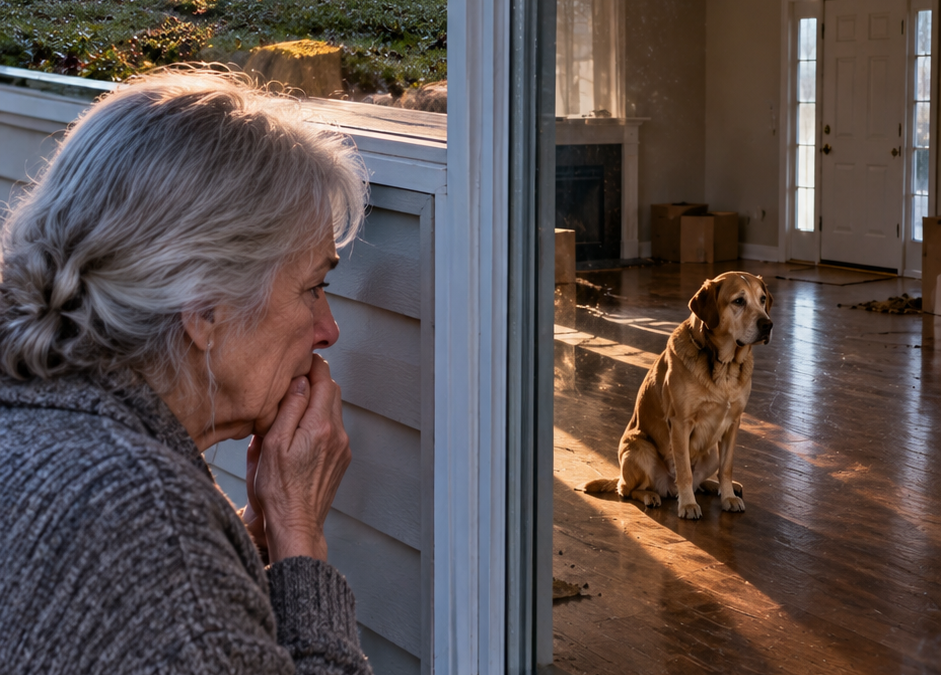
I went to the window overlooking the neighboring property.
The house looked exactly as it had all week.
Dark.
Still.
Empty.
Then the sound came again.
This time I knew.
A dog.
I felt something cold move through me.
“No.”
I grabbed my coat.
The October air bit immediately when I stepped outside.
Leaves had collected along the curb.
The wind smelled like damp earth and wood smoke.
I crossed my yard, walked through the gap between the properties, and approached the neighboring house.
“Hello?”
Nothing.
I knew no one was there.
Still, I called.
“Anybody home?”
Silence.
Then the sound came from inside.
Close.
I walked to the living room window.
The curtains were partly drawn.
I cupped my hands around my eyes and leaned toward the glass.
At first, I saw only emptiness.
The sofa had been removed.
The rug was gone.
There were pale rectangles on the walls where photographs had once hung.
Then something moved in the center of the room.
I stopped breathing.
The dog was sitting there.
The Labrador.
His body looked smaller than I remembered.
His fur was dirty.
His sides appeared hollow.
He sat facing the front door.
Not the window.
Not me.
The door.
A plastic water bowl was near the wall.
From where I stood, I could see only a shallow amount of cloudy water in the bottom.
Beside it was another bowl.
Empty.
Completely empty.
My hand went to my mouth.
“Oh my God.”
The dog did not look at me.
He stared at the door.
I tapped lightly on the glass.
Nothing.
“Hey.”
His ear moved.
“Sweetheart.”
He finally turned his head.
Our eyes met.
I have spent years trying to describe that look.
Fear was there.
Hunger.
Exhaustion.
But those were not what struck me most.
It was expectation.
He looked at me as if I were irrelevant because I was not the person he was waiting for.
Then he turned back toward the door.
That broke something inside me.
I hurried around to the front entrance.
The door was shut.
I tried the handle.
It did not move.
I knocked.
The dog made no sound.
I called the local animal control number first.
No immediate answer.
Then I called police dispatch because I did not know whether entering was legal.
I explained everything too quickly.
“The family moved. Their dog is inside. I think he’s been there a week. There’s no food. I don’t know how much water he has.”
The dispatcher became serious.
“You can see the animal?”
“Yes.”
“Is he responsive?”
“Yes, but barely.”
“Do not force entry. We’ll send someone.”
I hung up.
Then I called a local rescue organization I knew from a fundraiser at our church.
Then the county shelter.
Then another neighbor.
I don’t know why I called so many people.
Panic creates motion.
I felt useless standing there knowing he was ten feet away.
I returned to the window.
The dog was still facing the door.
“Someone is coming,” I said through the glass.
Of course he could not understand.
But I needed to say it.
“I know you don’t know me.”
His ears moved.
“I’m next door.”
Nothing.
“I should have noticed.”
That was the truth.
“I’m sorry.”
The first responder arrived about twenty minutes later.
A police officer.
Then an animal control vehicle.
Then a rescue volunteer in a green uniform.
Her name was Emily Carter.
I remember her because she became important to Orion’s recovery.
Emily was probably in her late twenties.
Short dark hair.
Calm voice.
She listened as I explained.
“A week?”
“I think so.”
“No one has entered?”
“Not that I’ve seen.”
“Any chance someone was feeding him?”
“I don’t think so.”
We checked the side gate.
Closed.
Back door.
Locked.
The police officer examined the front door.
He tried it once.
Then pushed harder.
The door moved half an inch.
“Not locked,” he said.
“Stuck.”
The frame had swollen from moisture.
He pressed his shoulder against it.
The door opened.
We all stepped back.
I expected the dog to run.
That is what dogs do when doors open.
Freedom.
Fresh air.
People.
Food.
Surely he would explode out of that house.
He didn’t move.
He remained in the center of the room.
Facing us.
Emily entered first.
Slowly.
She crouched.
“Hey, buddy.”
The dog watched.
“You’re okay.”
Nothing.
She extended one hand.
He glanced at it.
Then looked behind her.
Toward the street.
He was looking for them.
That realization hit everyone at once.
Emily lowered her hand.
She sat on the bare floor.
“No one’s going to rush you.”
The police officer walked through the house to make sure nobody was inside.
I stood on the porch.
The place smelled stale.
Cold.
Empty.
Rooms echoed.
The refrigerator was gone.
The bedrooms had been cleared.
Everything that mattered to the family had been taken.
Except the dog.
Emily placed a bowl of water several feet from him.
He stared.
She moved away.
Slowly, he approached.
He drank.
Too quickly.
Emily gently moved the bowl before he could consume too much at once.
“Easy.”
He looked at her.
Then at the door.
He took another drink.
The rescue veterinarian later told us that the small amount of water left behind had probably kept him alive.
Food had been another matter.
He had lost significant weight.
There was no sign anyone had returned.
No sign they had planned for his care.
He had simply been left.
When Emily finally clipped a leash to his collar, he froze.
“Come on.”
He would not walk.
She did not pull.
She waited.
I stood nearby.
The dog looked toward the hallway.
Then the stairs.
Then the front door.
I imagined him replaying the morning they left.
People moving boxes.
Doors opening.
Strange men carrying furniture.
Children disappearing.
Suitcases.
The truck.
Maybe he had followed them.
Maybe they had told him to stay.
Maybe the door had closed in front of him.
Maybe he spent hours expecting them to return.
Then one night.
Then another.
Then seven.
Dogs do not measure betrayal in calendars.
They understand absence.
Repeated absence.
The kind that teaches hope to become painful.
Eventually, he followed Emily.
One step.
Then another.
At the front threshold, he stopped.
His paws reached the line between inside and outside.
He looked back.
He stayed there for almost a full minute.
“What is he doing?” I whispered.
Emily answered quietly.
“He doesn’t want to leave.”
“But there’s nothing there.”
“For us.”
That sentence stayed with me.
For us, the house was empty.
For him, it was the last place his family existed.
Emily waited.
The dog looked back again.
Then stepped outside.
The cold wind moved across his coat.
His nose lifted.
He scanned the street.
My heart broke all over again.
He searched every direction.
No familiar car.
No familiar voices.
No one running toward him.
He took another step.
Then another.
He walked to the rescue vehicle.
But before climbing in, he turned and stared at the house.
Only after Emily placed a blanket inside did he enter.
I should have gone home.
That would have been the reasonable thing.
The dog was safe.
Professionals had him.
My involvement could have ended there.
Instead, when the rescue vehicle pulled away, I got into my car.
I followed.
I told myself I only wanted to know where they were taking him.
That was partly true.
The larger truth was that I could not bear the idea of him arriving somewhere strange without a single person connected to the place he had known.
Even though he barely knew me.
Even though I was only the woman next door.
I followed the rescue vehicle for about twenty minutes.
The facility was larger than I expected.
Clean.
Bright.
Rows of kennels.
Exercise yards.
Medical rooms.
It was not a bad place.
But to a frightened animal, good places can still feel terrifying.
When Emily opened the vehicle door, the Labrador refused to move.
She attached the leash.
Still nothing.
She sat on the concrete beside the open door.
Minutes passed.
I stood several yards away.
Five minutes.
Ten.
Fifteen.
Emily never pulled.
“Take your time,” she said.
The dog stared at the parking lot.
Then at the vehicle interior.
Then toward me.
For the first time, his gaze lingered.
I crouched.
“I’m here.”
His ears moved.
He looked at Emily again.
Then slowly climbed down.
He still would not enter the building.
Emily sat near the door.
He stood.
Then sat.
Twenty minutes passed.
Finally, he moved toward her.
Not into the shelter.
Toward Emily.
He lowered his head onto her knee.
Emily looked away quickly.
I saw tears in her eyes.
Mine were already falling.
“That’s something,” she said.
“What?”
“He chose contact.”
“Is that good?”
“Very.”
She stroked his neck once.
“He’s scared. But he still wants connection.”
I wiped my face.
“What happens now?”
“Medical exam first.”
“Then?”
“Then time.”
That was when someone asked whether he had a name.
I realized I didn’t know.
I had lived beside him for six years.
I had watched him in the yard.
I had waved to the children.
And I did not know what they called their dog.
The old collar had no tag.
Emily looked at him.
“We need something for his file.”
A shelter worker suggested names.
Sunny.
Goldie.
Cooper.
None felt right.
Emily studied his eyes.
Then she said, “Orion.”
I looked at her.
“Why?”
She shrugged slightly.
“Because he still looks like there’s a star in there.”
Orion.
The name stayed.
The medical exam confirmed severe dehydration, malnutrition, digestive distress, and stress-related symptoms.
No major injury.
No broken bones.
Nothing physically dramatic enough to explain the emptiness in his face.
Emily said psychological recovery might be slower.
I asked whether I could visit.
“You knew him before?”
“Not really.”
She looked curious.
“I lived next door.”
“That might help.”
“Why?”
“Familiar smell. Familiar voice.”
I almost laughed.
“He barely knows my voice.”
“Maybe.”
She looked toward the kennel.
“But you’re the only familiar thing he has left.”
That was how I started going every day.
At first, I told myself I was visiting because I felt responsible.
Then I told myself it was temporary.
Then I stopped trying to explain it.
Orion became part of my day.
Every morning after breakfast, I drove to the shelter.
I usually stayed an hour.
Sometimes longer.
He hated the kennel.
Not because it was uncomfortable.
Because people kept leaving.
That was what I eventually understood.
Whenever someone entered, Orion stood.
Whenever someone walked toward the exit, he watched.
When the door closed, his body sank again.
Visitors thought he was interested in them.
He wasn’t.
He was monitoring departures.
Every person leaving reopened the wound.
He never barked after them.
Never scratched the door.
He just watched.
The first time I sat inside his room, he moved as far from me as possible.
His back touched the wall.
I brought a book.
I don’t remember exactly what it was.
A mystery novel, I think.
Something ordinary.
I opened it.
Then I began reading aloud.
It felt ridiculous.
“Chapter One.”
Orion watched.
I read for an hour.
He did not move.
At the end, I closed the book.
“All right.”
His ears lifted.
“That’s enough terrible literature for one day.”
I stood.
Orion’s head came up.
I stopped.
He looked at the door.
Then at me.
For one second, our eyes met.
I left.
The next day, I returned.
Same chair.
Same book.
Same voice.
I did not ask him to come closer.
That became our rule.
I would show up.
I would sit.
I would read.
He would choose everything else.
For the first week, nothing changed.
Then, one afternoon, he lay down while I read.
That mattered.
Until then, he had remained sitting whenever anyone was in the room, prepared for departure.
Lying down meant something inside him had loosened.
The next week, he moved three feet closer.
Then another few feet.
Tiny progress.
People often want recovery to look dramatic.
A frightened dog suddenly running into someone’s arms.
A perfect adoption photo.
Tail wagging.
Happy ending.
Real healing is less cinematic.
It looks like a dog eating while a person remains in the room.
It looks like sleeping deeply enough to dream.
It looks like turning your back on someone because, for the first time, you believe they will not hurt you.
One day, Orion fell asleep while I read.
He snored.
I smiled so hard my face hurt.
Emily came past the doorway.
I put a finger to my lips.
She looked in.
Then whispered, “That’s huge.”
“I know.”
I stayed an extra hour because I did not want to wake him.
I began learning details about him.
He liked chicken better than beef.
He disliked metal bowls sliding on concrete.
He became nervous when he heard trucks.
That one was understandable.
He preferred women at first.
Men with deep voices made him move backward.
Children interested him.
He watched them.
Especially boys around eight or nine.
Perhaps they reminded him of the children he had lost.
I never knew.
The family could not be located immediately.
Their forwarding information was limited.
Authorities pursued what could be pursued regarding abandonment.
I stopped asking for details.
I discovered something uncomfortable in myself.
I wanted an explanation.
Desperately.
I wanted someone to tell me there had been an emergency.
A mistake.
A misunderstanding.
Something that would make leaving him seem less deliberate.
But no explanation came that changed the facts.
They had moved.
He remained.
Eventually, I realized I did not need to understand their reasoning to help Orion survive the result.
A month passed.
By then, I could sit three feet from him.
I still did not touch him unless he initiated contact.
One afternoon, I finished reading.
I closed the book.
“That’s the end.”
Orion looked at me.
“You hated it, didn’t you?”
His ears moved.
“I agree. The murderer was obvious.”
I stood.
He stood too.
Normally, he remained in the room while I left.
That day, he followed.
I reached the doorway.
Orion stopped.
His body became tense.
I stepped through.
He remained behind the threshold.
I did not pull the leash.
I wasn’t even holding one.
I sat outside.
“Okay.”
He looked toward the hallway.
“Door’s open.”
Nothing.
“You decide.”
Five minutes passed.
Then Orion stepped forward.
One paw crossed the threshold.
Then the other.
He came into the hallway.
I nearly cried.
Instead, I smiled.
“Good morning.”
He stood beside me.
That became the beginning of our outdoor time.
At first, Orion did not walk.
We went to a fenced grass area behind the shelter.
He sat.
That was all.
He stared at the sky.
At birds.
At cars passing far beyond the fence.
At trees moving in the wind.
I sat beside him.
Sometimes for an hour.
He was relearning the world.
The world had become dangerous because the people at its center disappeared.
Everything had to be reconsidered.
Was grass safe?
Was an open gate safe?
Was a woman sitting nearby safe?
Was happiness safe?
One afternoon, a little boy approached the outside fence with his mother.
He was maybe five.
“Pretty dog,” he said.
Orion watched.
The boy waved.
“Hi, doggy.”
I started to warn him not to come closer.
Then Orion tilted his head.
The boy smiled.
Orion’s tail moved.
Once.
I froze.
Then again.
A slow sweep across the grass.
“Oh my God.”
Emily was nearby.
She saw it too.
The boy laughed.
“He likes me.”
“Yes,” I said.
My voice broke.
“I think he does.”
Orion’s tail moved a third time.
It had been weeks since rescue.
Weeks of food.
Warmth.
Medicine.
Voices.
Routine.
But that tiny tail wag was the first moment I knew joy had survived abandonment.
Something inside him was not dead.
Buried.
Not gone.
That night, I returned home and stood in my own living room.
Lucy sat on the armchair.
The clock ticked.
Everything seemed too quiet.
My husband had died six years earlier.
I had lived alone since.
I managed well.
At least that was what I told people.
I had friends.
Church.
Neighbors.
Books.
A garden.
A cat with very strong opinions.
I did not think of myself as lonely.
But as I stood there that evening, I realized I understood Orion’s waiting more deeply than I had admitted.
After my husband died, I spent months listening for sounds that would never return.
His key in the lock.
His footsteps in the hallway.
His cough from another room.
I knew rationally he was gone.
But the body learns absence slower than the mind.
Orion had spent seven days staring at a door.
I had spent much longer doing the human version of the same thing.
Maybe that was why I kept visiting.
We were both experts at waiting.
I started considering adoption before I admitted it to anyone.
Immediately, I found reasons not to.
I was sixty-one.
Orion was large.
Lucy might hate him.
What if he never relaxed?
What if he destroyed things?
What if I was too old to manage him?
What if he needed more than I could give?
I made lists.
Practical objections.
Responsible objections.
Then I would visit.
Orion would look up when I entered.
Not wag yet.
But look.
That look became my answer.
I spoke with Emily.
“What would it take?”
She smiled before I finished.
“You want to adopt him.”
“I’m asking theoretically.”
“Of course.”
“I have a cat.”
“We’d test compatibility.”
“I don’t have a huge yard.”
“You have a fenced yard?”
“Yes.”
“That’s enough.”
“I’m not young.”
“Neither is half our adopter base.”
“He’s traumatized.”
“Yes.”
“What if I mess it up?”
Emily’s expression softened.
“You already show up every day.”
“That isn’t the same as living together.”
“No.”
She nodded.
“But it’s the reason he trusts you.”
The word trust still felt too generous.
“He barely lets me touch him.”
“He follows you.”
“That’s not trust?”
“It’s the beginning.”
I completed the application.
The shelter did a home visit.
We introduced Orion to Lucy carefully.
Lucy hissed from a bookshelf.
Orion backed away immediately.
Emily laughed.
“Your cat will run the house.”
“She already does.”
Over several controlled introductions, Orion showed no aggression.
Mostly confusion.
Lucy showed enough judgment for both of them.
I bought a dog bed.
Then another because I worried the first was too small.
Bowls.
A leash.
Toys.
Treats.
A brush.
I rearranged furniture.
Then I worried all of it was foolish.
What if Orion refused to leave the shelter?
What if he came home and spent the rest of his life near my front door waiting for someone else?
The morning adoption was approved, I sat beside him.
He had begun lying near me while I read.
I placed the book down.
“Orion.”
He looked at me.
“I need to tell you something.”
He blinked.
“I don’t know how to be what you need.”
His ears moved.
“I don’t know if you’ll ever completely trust that I’m coming back.”
I swallowed.
“And I can’t erase what happened.”
Orion continued watching.
“But I can promise you this.”
I placed my hand on the floor between us.
“I will not disappear.”
He looked at my hand.
“I will tell you when I’m leaving.”
His nose moved.
“I will come home.”
Slowly, Orion stood.
He came forward.
Sniffed my fingers.
Then walked toward the door.
I laughed through tears.
“Is that a yes?”
He looked back.
I stood.
We walked to my car.
When I opened the passenger door, he hesitated.
Cars had become complicated for him.
Vehicles took people away.
Vehicles had removed him from his old house.
I waited.
Orion sniffed the seat.
Then climbed in.
He sat.
Looked through the windshield.
Then turned toward me.
I closed the door.
“All right.”
I got behind the wheel.
“Let’s go home.”
Home.
I said the word carefully.
The first time Orion entered my house, Lucy watched from the stairs.
He stopped in the hallway.
Every muscle tightened.
New smells.
New rooms.
New uncertainty.
I kept the leash loose.
“You can look.”
He walked slowly.
Kitchen.
Living room.
Bedroom doorway.
Then he returned to the front entrance.
He lay down directly beside the door.
My heart sank.
Of course.
The door.
Always the door.
I set his bed nearby.
He ignored it.
I placed water and food where he could see them.
He ate a little.
That night, I went upstairs.
Orion stayed by the door.
I stood halfway up.
“Come on.”
He did not move.
I could have led him.
Instead, I went back down.
I brought a pillow.
A blanket.
And I lay on the floor beside him.
Lucy watched from the armchair with the expression of a cat reconsidering every life choice that had led her here.
“Don’t judge me.”
She did.
Orion looked at me.
I turned off the lamp.
The hallway became dark.
For a long time, I could hear him breathing.
Around two in the morning, I woke.
Orion was watching me.
His eyes reflected faint light from the window.
“Hi.”
He stayed still.
I extended my hand.
He sniffed.
Then moved closer.
One step.
Then another.
He lowered his head onto my chest.
I froze.
His body was warm.
His heartbeat fast.
I placed one hand against his neck.
He did not retreat.
I lay there on the floor, an old woman with a stiff back, a confused cat staring from furniture, and a Labrador resting against my heart.
I had never felt more certain of anything.
The next morning, Orion was still beside me.
Lucy had moved to the sofa.
I opened my eyes.
“Good morning.”
His tail moved.
Once.
Home began there.
Not with the adoption papers.
Not when I opened the car.
Not when we crossed the threshold.
Home began when Orion slept deeply enough beside me to stop watching the door.
The first weeks were difficult.
I expected that.
What I did not expect was how emotional ordinary tasks became.
The first time I left for twenty minutes to buy groceries, Orion panicked.
I prepared carefully.
I spoke to him.
“I’m going out.”
He followed me to the door.
“I’m coming back.”
The moment I stepped outside, he began whining.
I heard him from the porch.
My hand stayed on the doorknob.
Every instinct told me to go back.
But Emily had warned me.
“You need to create a pattern. Leave. Return.”
So I left.
I drove to the store.
I bought only milk because I could barely think.
I returned eleven minutes later.
When my key entered the lock, Orion barked.
I opened the door.
He stood in the hallway trembling.
Then rushed toward me.
Not jumping.
Not wild.
He pressed himself against my legs.
“I came back.”
I knelt.
“I told you.”
He shook.
“I came back.”
The next time, I left fifteen minutes.
Then thirty.
Then an hour.
Slowly, he learned.
Departure did not always mean disappearance.
Doors could close and reopen.
People could leave and return.
That may sound simple.
For Orion, it was revolutionary.
His relationship with Lucy improved too.
At first, he treated her as an unpredictable supernatural authority.
Probably accurate.
Lucy hissed if he came too close.
Orion respected boundaries instantly.
After a month, they could sleep in the same room.
After three months, I found Lucy sleeping on Orion’s bed while Orion lay beside it on the floor.
“You are ridiculous.”
Neither moved.
Orion discovered the backyard cautiously.
The first day, he walked only the perimeter.
He sniffed every corner.
Then returned to the back door.
I left it open.
“You can go in whenever you want.”
He repeated the circuit.
Day after day.
Then one afternoon, he ran.
Not far.
Maybe ten yards.
Suddenly.
A burst of movement.
He stopped.
Looked surprised.
Then ran again.
I laughed.
“Go!”
His tail lifted.
He made a wide loop across the grass.
Lucy watched from the window in disgust.
Orion ran for no reason.
No one called him.
No one chased him.
He ran because the yard was his and he could.
That became one of my favorite days.
He started greeting me at the door.
First with a cautious tail movement.
Then with full-body excitement.
He learned the sound of my car.
He learned where treats were kept.
He developed a strange fascination with one blue stuffed elephant and carried it from room to room.
He slept beside my bed.
Eventually, on my bed.
He snored.
Loudly.
I complained.
Then panicked the first night he did not snore because he had changed positions.
Trauma did not disappear.
Trucks still bothered him.
Moving boxes terrified him.
Once, I ordered a bookshelf, and the delivery men carried several large boxes into the house.
Orion froze.
His breathing changed.
He backed toward the wall.
I understood immediately.
“Stop.”
The delivery men looked confused.
“Can you leave the boxes outside?”
“Ma’am, they’re heavy.”
“Outside.”
They did.
After they left, I sat with Orion.
His body trembled.
I hated the people who had taught him cardboard boxes meant loss.
I hated strangers whose names I barely remembered.
But anger did nothing for him.
So I sat.
“We’re not moving.”
He watched me.
“No truck.”
I touched the floor.
“This stays.”
His breathing slowed.
The boxes remained outside until a neighbor helped me unpack them piece by piece.
Recovery is not proving fear irrational.
Fear had been rational once.
Recovery is giving enough new evidence that the old conclusion becomes less necessary.
Orion needed evidence.
Hundreds of small pieces.
Breakfast came every morning.
I returned after errands.
His bed stayed.
His bowl stayed.
The furniture stayed.
I stayed.
Months later, I decided to walk him down Birchwood Lane toward his old house.
I did not know whether it was wise.
Emily said, “Watch him. If he becomes overwhelmed, leave.”
So one quiet afternoon, Orion and I walked.
He loved neighborhood walks now.
He sniffed hedges.
Paused at mailboxes.
Sometimes greeted children.
We turned the corner.
His old house appeared.
Orion stopped.
I felt the leash tighten.
His body went still.
There it was.
Same porch.
Same fence.
Different curtains now absent entirely.
The property had not sold yet.
Grass had grown longer.
Leaves collected near the steps.
Orion stared.
I did nothing.
“Do you want to go?”
He remained still.
Then began walking.
Toward it.
My heart pounded.
We reached the sidewalk in front of the fence.
Orion looked at the yard.
The place where he used to sit every morning.
Then the front window.
Then the door.
I wondered what existed inside his memory.
A child’s hand.
Food.
Voices.
Car rides.
Seven days alone.
Dogs cannot tell us which memories survive strongest.
I waited.
Minutes passed.
Then Orion turned.
He looked at me.
Directly.
His tail moved.
Slowly.
Once.
Twice.
He stepped toward me.
I knelt.
“That’s not home anymore.”
Orion pressed his head against my shoulder.
I cried.
We walked away.
He did not look back.
That moment changed my understanding of rescue.
For months, I had thought rescue meant opening the stuck front door.
Giving water.
Removing him from starvation.
Then I thought rescue meant the shelter.
Medical care.
Routine.
Then I thought it meant adoption.
A bed.
A yard.
Love.
But standing outside the old house, I understood rescue differently.
Rescue is not only leaving danger.
Rescue is the moment your heart stops calling the dangerous place home.
Orion had spent months physically free while part of him remained in that empty living room.
That afternoon, something shifted.
He chose the direction we were walking.
He chose me.
I do not mean he forgot.
Forgetting is not healing.
He remembered.
Then moved anyway.
That distinction matters.
Life with Orion became ordinary.
Gloriously ordinary.
He gained weight.
His coat became thick and bright again.
People who met him months later could not believe he was the same dog.
He loved children.
That surprised me.
Whenever neighborhood kids approached, he became gentle and still.
A little boy named Tyler often stopped near my fence after school.
“Can Orion come out?”
Sometimes.
Orion would sit while Tyler scratched behind his ears.
One day, Tyler asked, “Was he always your dog?”
“No.”
“Whose was he?”
I looked at Orion.
“People who didn’t understand what they had.”
Tyler frowned.
“What does that mean?”
“It means sometimes people lose good things because they don’t know how to take care of them.”
He considered that.
Then hugged Orion.
“I would never leave him.”
Orion licked his cheek.
I hoped he understood none of the words.
Only the feeling.
I continued visiting the rescue after adopting him.
At first, because Emily had become my friend.
Then because I wanted to help.
I began reading to frightened dogs.
The same way I had read to Orion.
Some people laughed gently.
“Do they understand?”
“No.”
“Then why?”
“Because they understand someone staying.”
That became my unofficial job.
I would sit near a kennel and read.
Some dogs ignored me.
Some barked.
Some approached.
Occasionally one fell asleep.
Whenever that happened, I thought of Orion’s first snore.
I learned that rescue work changes people too.
Before Orion, I thought abandoned animals needed kindness.
After Orion, I understood they often need predictability more.
Kindness once is wonderful.
Kindness repeated becomes trust.
That is what saved him.
Not one dramatic event.
A thousand boring promises kept.
I said I would come tomorrow.
I came.
I said I would return after groceries.
I returned.
I said the house was his.
Nothing disappeared.
Love became credible because it became repetitive.
Humans are not so different.
I had spent years after my husband’s death telling everyone I was fine.
I had routines.
Responsibilities.
Friends.
Yet Orion exposed a part of my life I had carefully ignored.
I had stopped expecting new attachment.
I believed the important love had already happened.
My marriage.
Our years.
Our home.
Then death.
Afterward, I lived.
I did not build much new.
Orion disrupted that.
Suddenly someone needed me.
Not in a polite social way.
Completely.
Breakfast depended on me.
Walks.
Safety.
Return.
He gave shape to mornings.
He forced me outside in rain.
He made strangers speak to me.
People knew his name.
Through him, they began knowing mine.
I became “Orion’s Margaret” to neighborhood children.
I didn’t mind.
On the anniversary of his rescue, Emily came over.
I made dinner.
Orion slept under the table.
“He looks terrible,” Emily joked.
He had gained enough weight to look almost round.
“He’s emotionally recovering.”
“Apparently through cheese.”
“He deserves cheese.”
“Not that much.”
Orion opened one eye.
Emily pointed at him.
“Don’t manipulate her.”
His tail moved.
She laughed.
Then became quiet.
“Do you ever think about that first day?”
“Every day.”
“Me too.”
I looked at Orion.
“I thought he wouldn’t recover.”
Emily nodded.
“So did I.”
“Really?”
“Physically, yes.”
She paused.
“Emotionally? I didn’t know.”
I watched him sleeping.
“What changed?”
“You.”
I shook my head.
“No.”
“Yes.”
“The rescue saved him.”
“We opened a door.”
Emily leaned back.
“You gave him the reason not to keep waiting behind it.”
I did not answer.
That night after she left, Orion followed me upstairs.
He jumped onto the bed.
Circled twice.
Collapsed beside my legs.
I thought about seven days.
Seven days in an empty house.
How long they must have felt.
How many times headlights passed the front window.
How many times he must have stood when a car slowed.
How many sounds made him think, They’re back.
Then silence.
No animal should learn abandonment that way.
No person should either.
I placed my hand on his back.
He sighed.
Safe.
That became enough.
Years passed.
Orion grew older.
Gold faded around his muzzle.
His running slowed.
The frightened dog from the empty house became the calm older dog children loved.
People who had moved to the street after his rescue knew only the second version of him.
Sometimes new neighbors commented.
“He’s so trusting.”
I would smile.
They had no idea.
Trust was not his natural innocence.
It was an achievement.
One summer evening, I sat on the porch with Orion beside me.
The family’s old house had finally been sold years earlier.
A new couple lived there.
They had a baby.
A small garden.
And, ironically, a dog.
A black spaniel who barked at everything.
Orion watched from my porch.
No reaction.
The place had become simply another house.
I knew then the past had lost its power.
Not disappeared.
Lost authority.
That is another definition of healing.
Memories remain.
They just stop issuing orders.
One day, I received a letter.
No return address I recognized.
Inside was a short message from someone claiming to know Orion’s former family.
They wrote that the family had moved under difficult circumstances.
That there had been financial pressure.
That “things got complicated.”
There was no real explanation for the dog.
No apology directed to him.
I read the letter twice.
Then I put it away.
Years earlier, I would have obsessed over it.
Why?
How?
Did they regret it?
Did the children ask about him?
Did someone intend to return?
Now I did not need answers.
Circumstances can explain stress.
They cannot make a helpless animal feed itself inside a locked house.
Explanations might add context.
They did not change responsibility.
I looked at Orion.
He was asleep in sunlight.
I threw the letter away.
His life no longer required their explanation.
That felt like freedom too.
When Orion was around ten, arthritis appeared.
We adjusted.
Shorter walks.
Soft bed.
Medication.
A ramp near the back steps.
He accepted aging better than I did.
I hated each change.
The first day he hesitated before jumping into the car, I cried after he looked away.
It reminded me that love always comes with another goodbye hidden somewhere in the future.
But Orion had taught me something important.
Fear of goodbye is a terrible reason to refuse the days before it.
So we continued.
Walks.
Books.
Children.
Naps.
Trips to the rescue center where he became an unofficial ambassador for frightened dogs.
Sometimes newly rescued animals calmed faster when Orion sat nearby.
Maybe they read something in him.
A dog who had survived.
A dog who was not afraid anymore.
I liked to imagine he was telling them:
Wait.
This part is confusing.
But sometimes the next door opens somewhere better.
One afternoon, Emily brought in a young Labrador mix who had been abandoned near a gas station.
The dog would not leave the transport crate.
Orion was with me.
He sat several feet away.
The young dog watched him.
Orion lay down.
Minutes passed.
Then the young dog stepped out.
Emily looked at me.
“Look at that.”
I smiled.
“He’s doing my job now.”
Maybe rescue creates rescuers.
I believe that.
Pain transformed can become shelter for something else.
Orion’s history made him patient.
My loneliness made me recognize his.
Emily’s work gave both of us a bridge.
None of us erased what happened.
We used it.
That became the unexpected beauty in the story.
Years earlier, I had been the neighbor who failed to notice for seven days.
For a long time, guilt followed me.
How could I not see?
How could I drink coffee beside that house?
How could I sleep while he waited?
Emily eventually challenged me.
“You didn’t know.”
“I should have.”
“Why?”
“Because I lived next door.”
“So?”
“I saw him every day.”
“And you reasonably believed his family took him.”
I knew she was right.
Guilt does strange things.
It tries to turn hindsight into responsibility.
I could not change the first seven days.
But I could determine what happened after the seventh.
That was enough.
Orion never needed me to punish myself.
He needed breakfast.
Walks.
Return.
The present is where rescue lives.
That became another lesson.
At night, Orion still occasionally dreamed.
His paws moved.
Sometimes a low sound escaped him.
Whenever that happened, I put my hand on his shoulder.
“It’s okay.”
His breathing slowed.
“You’re here.”
Maybe he dreamed of running.
Maybe of the old house.
Maybe of nothing we could understand.
But when he woke, he found the same room.
The same bed.
The same woman.
That consistency was the answer.
One autumn morning, almost exactly eight years after I first heard him, I sat at the kitchen table.
Coffee in hand.
The windows fogged from the cold.
Orion lay beside my feet.
Lucy had died two years earlier.
I still missed her.
Orion had searched the house for several days afterward.
Then, like me, he learned to carry absence.
A sound came from outside.
A moving truck.
Orion’s head snapped up.
Old reflex.
He stood.
I watched carefully.
The truck stopped across the street.
A new family was moving in.
Boxes came out.
People.
Furniture.
Orion stared through the window.
For one second, I saw the old fear.
Then he looked at me.
I was still sitting at the table.
I smiled.
“Not us.”
His tail moved.
He lay back down.
That moment nearly meant more to me than his first tail wag.
A moving truck had once meant the end of his world.
Now it was just a truck.
He knew where he belonged.
He knew I was staying.
You cannot ask for stronger proof of healing than that.
As Orion aged, people sometimes asked why I had chosen a dog with “baggage.”
I hated that word.
Baggage.
As if trauma were luggage an animal inconveniently carried into someone else’s clean life.
Orion was not his trauma.
Fear was something that happened to his nervous system because people had failed him.
His gentleness was still his.
His patience.
His curiosity.
His ridiculous love of cheese.
His habit of sighing dramatically when dinner was late.
His obsession with one blue elephant.
His kindness toward children.
His ability to forgive.
Those were also him.
When people reduce wounded animals to their wounds, they repeat a smaller version of abandonment.
They fail to see the whole creature.
Orion taught me to look longer.
Sometimes the best parts are simply waiting beneath survival.
I began speaking at rescue fundraising events.
I hated public speaking.
Emily convinced me.
“Tell Orion’s story.”
“I’ll cry.”
“Probably.”
“That isn’t helpful.”
“It might be.”
So I stood in front of strangers and told them about the sound.
The empty house.
The door.
The weeks of reading.
The tail wag.
The adoption.
But I always emphasized the middle.
People love dramatic rescue beginnings and happy endings.
The middle is where the work lives.
The middle is showing up.
Medication.
Training.
Setbacks.
Patience.
Returning after your shoes are chewed.
Sitting beside a dog who still does not trust you after three months.
Being happy about a tail moving one inch.
That is rescue.
The door opening is only permission to begin.
One evening after a fundraiser, a woman approached me.
She was crying.
“I was going to return my dog.”
I looked at her.
“Why?”
“She’s terrified of everything.”
I listened.
“Three months. Still hides.”
She wiped her face.
“I thought she hated us.”
“She might just be scared.”
“What do I do?”
“I’m not a trainer.”
“I know.”
I thought about Orion.
“Be predictable.”
She waited.
“Don’t make her prove gratitude.”
The woman frowned.
“Gratitude?”
“Sometimes we expect rescued animals to know they’ve been rescued.”
I shook my head.
“They don’t know your intentions. They know patterns.”
She nodded slowly.
“Give her good patterns.”
Months later, she sent a photograph.
Her dog asleep beside her child.
That was Orion’s influence reaching a life he never met.
Kindness travels farther than we can measure.
So does cruelty.
The choice is which one we extend.
Orion became very old.
His face whitened.
His eyes clouded slightly.
His hearing weakened.
But every morning, he still followed me to the kitchen.
Every evening, he waited while I read.
I had stopped reading because he needed it years earlier.
I continued because we both did.
The ritual never disappeared.
Book.
Chair.
Orion nearby.
Sometimes I would finish a chapter and look down.
He would be asleep.
I would think of the frightened Labrador sitting with his back against a shelter wall.
Then I would look at this old dog stretched across my rug, vulnerable, deeply asleep.
There is no greater compliment from a formerly frightened animal than sleep.
Sleep says:
I believe someone else is watching.
I do not have to.
One spring morning, Orion struggled to stand.
My heart stopped.
He managed after a minute.
We visited the veterinarian.
Age.
Arthritis.
Nothing immediately catastrophic.
Still, the conversation changed.
Quality of life.
Pain management.
Mobility.
Words I had heard other pet owners discuss.
Now they belonged to us.
Driving home, Orion sat in the passenger seat.
That had become his favorite place.
He looked through the window.
I rested one hand on his back.
For some reason, I thought about the family who drove away without him.
Perhaps he had once sat beside one of them like this.
The thought no longer made me angry.
Not because what they did became acceptable.
Because anger had stopped being necessary.
Orion’s life had grown much larger than his abandonment.
That was the best revenge.
Not punishment.
Expansion.
Give cruelty less and less of the story.
Fill the rest with love.
One afternoon, I took Orion to his old street one final time.
Not because he needed closure.
I think I did.
We stopped near the house.
New paint.
Children’s toys in the yard.
A different dog sleeping near the porch.
Orion looked.
Then sniffed a tree.
That was all.
I laughed.
“You don’t care anymore.”
He looked at me.
His tail moved.
We continued walking.
I had spent years imagining the old house as a powerful symbol in his mind.
Perhaps I was the one still giving it power.
For Orion, home had moved long ago.
Home was where his bed smelled like him.
Where the blue elephant remained under the table.
Where my voice came from the kitchen.
Where dinner arrived.
Where I returned.
That day, I finally understood the lesson completely.
A house is architecture.
Home is repetition.
Home is who stays.
Orion slowed in his final years.
So did I.
That suited us.
Our walks became shorter.
We spent more time sitting in the yard.
Watching birds.
Watching children.
Watching seasons move across the same trees.
I often thought about the morning I heard him.
That sound had been terrible.
But it became the beginning of everything.
Sometimes rescue enters your life disguised as interruption.
I wanted coffee.
Instead, I heard a dog.
I could have ignored it.
Assumed someone else knew.
Told myself it was none of my business.
I didn’t.
I am not proud because I did something heroic.
I did the minimum decent thing.
I looked.
Then I called.
The rest grew from that.
People sometimes underestimate noticing.
We think action must be dramatic to matter.
But many tragedies survive because everyone notices a little and no one looks closer.
A sound.
A bruise.
A frightened animal.
A silent neighbor.
Something wrong.
We cannot investigate everything.
We should not endanger ourselves.
But we can pay attention.
That is how Orion survived.
Not because I was special.
Because for one morning, I refused to explain away a sound.
He was there.
I heard him.
I looked.
Years later, I would sometimes hold my coffee beside the same kitchen window and see Orion sleeping in my yard.
The contrast never stopped moving me.
Once, he sat trapped inside another house waiting for people who had chosen not to return.
Now he slept outside because he knew a door behind him would always open.
That difference is everything.
One evening, during his final winter, Orion rested his head on my lap.
Snow fell outside.
I ran my fingers through the white fur around his muzzle.
“You know something?”
His eyes remained closed.
“You saved me too.”
His ear moved.
“I know that sounds sentimental.”
Nothing.
“I was fine before you.”
I smiled.
“At least I thought I was.”
He sighed.
“But I had stopped waiting for anything good.”
Orion opened his eyes.
I looked at him.
“You were waiting too long for people who weren’t coming back.”
I touched his face.
“So was I.”
He shifted closer.
“We got tired of that, didn’t we?”
His tail touched the floor.
Once.
That was enough.
I do not know how much longer Orion will be with me as I tell this story.
He is old now.
Very old.
Some mornings are slower.
Some nights, I watch his chest to make sure it rises.
Love makes us ridiculous that way.
But I am no longer afraid of the ending the way I once was.
Orion taught me not to judge a life by whether it ends.
Everything living ends.
The question is what filled the space between fear and goodbye.
For Orion, that space became enormous.
Grass.
Books.
Children.
Chicken.
A cat who tolerated him.
Car rides.
My bed.
The rescue center.
A blue stuffed elephant.
Thousands of doors closing and reopening exactly as promised.
Thousands of moments proving the first people were not everyone.
That is a life.
A good one.
The family who left him gave him seven days of terror.
They do not get the rest.
The rest belongs to Orion.
And to me.
Today, he is asleep at my feet.
His breathing is deep.
One paw moves slightly.
Dreaming.
Maybe he is running.
Maybe through my yard.
Maybe somewhere larger.
I reach down and place my hand on his head.
His body relaxes even further.
He knows the touch.
He knows the room.
He knows me.
If I stand and walk toward the kitchen, he may open one eye.
He no longer watches the front door every time I move.
He does not need to.
He has learned one of the simplest promises in the world can become the hardest lesson after betrayal:
I will come back.
And I do.
Every time I leave.
I come back.
I once thought I rescued Orion because I heard him crying inside an empty house.
Now I know that was only the beginning.
Opening the door saved his body.
Routine saved his trust.
Time saved his joy.
And loving him saved a part of me I had stopped acknowledging.
Two hearts can become abandoned in different ways.
One can be left physically inside a house.
Another can continue moving through life long after someone it loved is gone.
Sometimes those two forms of waiting recognize each other.
That is what happened to us.
I had been waiting for a past that could not return.
Orion had been waiting for people who chose not to.
Neither of us needed what we were waiting for.
We needed somewhere new to belong.
We found it together.
If I could return to that cold October morning and speak to the woman standing outside the window with her hand over her mouth, I would tell her not to be afraid.
I would tell her the dog staring at the door is not finished.
He will eat again.
He will sleep again.
He will run.
He will wag his tail at a little boy.
He will learn the sound of your car.
He will steal part of your dinner when you are not looking.
He will take over your bed.
He will become gentle with frightened animals because he knows what fear feels like.
He will one day stand in front of this same house and choose to walk away.
And you will walk with him.
I would also tell her something she does not yet know.
You think you are looking through that window because the dog needs someone.
You are right.
But years from now, you will realize you needed someone too.
Not to replace the person you lost.
Nothing replaces love.
But to teach you that the heart does not become useless after loss.
It can attach again.
It can build new routines.
It can become home to another living thing.
That is what Orion did.
He entered my life as a sound through a wall.
A hoarse, desperate reminder that someone was still there.
Now, when the house is quiet, I hear his breathing.
That is enough.
I no longer fear silence the way I once did.
Silence can mean abandonment.
But it can also mean safety.
A dog asleep.
A woman reading.
Two creatures who no longer need to watch the door.
My name is Margaret Hale.
For nineteen years, I thought being a good neighbor meant waving, collecting mail, and keeping an eye on things while people traveled.
Then one morning, I learned that sometimes being a neighbor means listening closely enough to realize something is wrong.
A family left.
A Labrador remained.
For seven days, he waited in an empty room facing a door that never opened.
Then another door opened.
Not immediately into happiness.
Not immediately into trust.
First into rescue.
Then a shelter.
Then a hallway.
Then a yard.
Then my car.
Then my house.
Then, eventually, home.
Orion taught me that rescue is not one moment.
It is a sequence of doors.
The first gets you out.
The next gives you safety.
Another gives you choice.
Another gives you trust.
And if you are very lucky, one day you realize you no longer remember which door you once spent your life watching.
Because home is no longer behind you.
It is where you are.
Tonight, before I go to bed, I will check the front lock.
I will turn off the lights.
I will call Orion.
He will stand slowly because his legs are old.
He will follow me upstairs.
He will circle once beside the bed.
Maybe twice.
Then he will settle.
I will place my hand on his back.
And sometime during the night, one of us may wake and make sure the other is still there.
That is all right.
We know what waiting feels like.
But we also know something better now.
We know what it feels like when someone stays.








