𝗙𝗨𝗟𝗟 𝗦𝗧𝗢𝗥𝗬 They Locked Me Out of the Reunion Without Realizing They Were Standing Inside the Life I Built
𝗙𝗨𝗟𝗟 𝗦𝗧𝗢𝗥𝗬
He smiled.
“You know what I mean.”
I did.
At the time, I thought he had come because he was tired.
Later, I wondered if he had known he was running out of time.
Now, looking at the keypad logs and Rebecca’s stolen reunion address, I wondered what else Dad had left behind without telling me.
That Saturday, I rented a silver sedan and drove to Tybee.
I did not use my government vehicle.
I did not wear my uniform.
I wore a white blouse, dark slacks, and a navy blazer. On my lapel was a small pin I should probably have removed but did not. Habit, mostly. It had become part of how I moved through certain rooms.
The house sat three stories high in the late morning sun, bright and immaculate, the Atlantic rolling behind it with infuriating calm.
I parked across the road and waited.
The first vehicle arrived at 10:12.
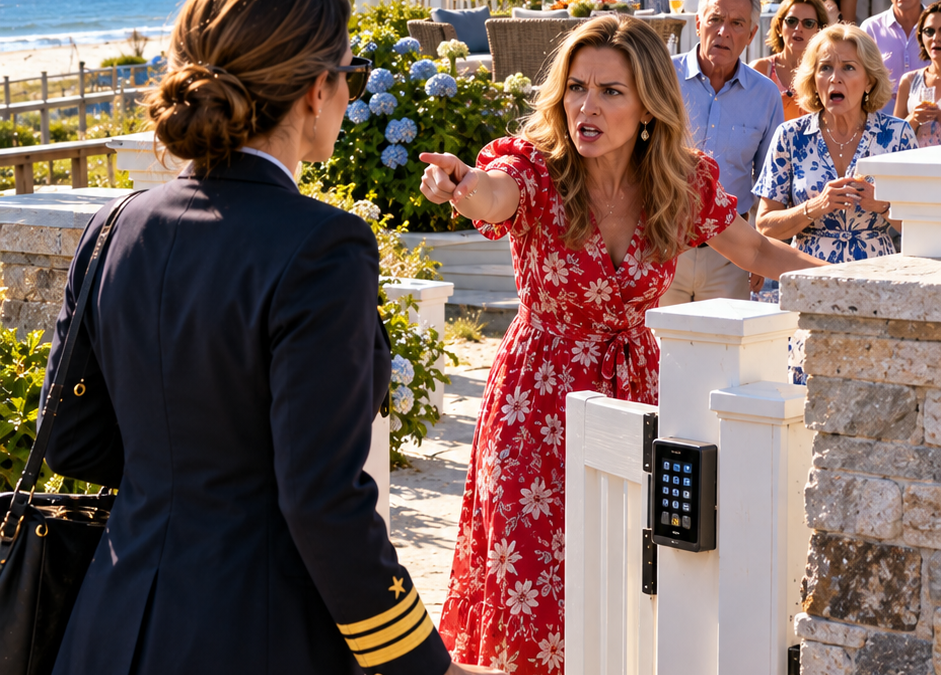
My mother stepped from the passenger side wearing a white sundress and an enormous straw hat, looking like she had dressed for a magazine spread about coastal grandmother elegance. Rebecca climbed out next, already filming.
She panned the camera across the hydrangeas, the porch, the dunes, the water.
“My God,” she said, loud enough for me to hear through my cracked window. “This is perfect.”
I watched my sister point her phone at the house I had bought, the porch I had repaired, the landscaping I had paid to install the previous spring.
Jason, her husband, carried coolers up the stone walkway.
Fourteen relatives arrived.
Aunt Lorraine in linen pants.
Uncle Pete with a folding chair nobody needed.
Cousin Mark with a Bluetooth speaker.
Emily, who glanced nervously around as if she expected me to materialize from the ocean itself.
Then Mom walked to my front door.
My heart tightened.
She entered a six-digit keypad code.
My birthday.
The lock flashed green.
Everyone cheered.
I sat across the road laughing silently while my family rushed into the home of the woman they had specifically banned from attending.
Twenty minutes later, Rebecca posted a photo from my deck.
Bennett Family Reunion! Finally surrounded by the people who actually make an effort.
I saved the screenshot.
Then I called the Chatham County Sheriff’s Office.
Not because I wanted an arrest.
Because there are moments when family needs a neutral adult with a badge to explain reality.
I had already provided proof of ownership, LLC documentation, insurance records, and screenshots from the security system. I explained that relatives had entered without permission and that I was present across the street.
The deputy arrived quietly.
No sirens.
No drama.
He parked near the curb and walked toward the house with the calm gait of a man who had learned that most property disputes begin with someone insisting everything is a misunderstanding.
On the porch, Rebecca was holding court.
She saw the deputy and smiled automatically, because Rebecca had always believed charm was legal tender.
He asked for the rental agreement.
Her confidence collapsed almost immediately.
She began scrolling through her phone.
“Oh, it’s not exactly a rental,” she said.
The deputy waited.
“A friend of Mom’s arranged it.”
Mom frowned from the porch swing.
“What friend?”
Rebecca shot her a look.
The deputy asked for written authorization.
There was none.
He asked who owned the property.
Rebecca did not know.
He asked who had given her the access code.
She said, “It’s complicated.”
That was when Jason rubbed his forehead like a man realizing his wife had built an entire weekend on vibes and trespass.
Finally, Rebecca snapped, “If there’s some owner we need to call, then call them.”
That was my cue.
I stepped out of the silver sedan.
Emily saw me first.
Her eyes widened.
Then Rebecca turned.
For a moment, she did not understand what she was seeing.
“What is she doing here?”
Jason groaned.
“You’ve got to be kidding me.”
Rebecca marched down the steps toward me.
“Claire, you were specifically told not to come.”
“I remember.”
“Then why are you here?”
I stopped beside the deputy.
“Because you asked for the owner.”
Rebecca laughed in my face.
It was sharp.
Reflexive.
Meaner than she probably intended, though that had always been one of Rebecca’s gifts—hurting people quickly and deciding afterward whether she meant it.
“You?” she said. “You’re the owner?”
I handed the deputy the folder.
Inside were the LLC records, property tax documents, insurance paperwork, and authorization showing I controlled the company that owned the house.
He reviewed everything with professional patience.
The porch had gone silent.
Aunt Lorraine stopped folding a beach towel.
Jason stared at me.
My mother’s mouth parted slightly beneath the brim of her hat.
Finally, the deputy closed the folder and turned toward my family.
“Ms. Bennett is the authorized representative of the entity that owns this property.”
No one spoke.
The Atlantic rolled behind the house with its usual steady rhythm, waves folding toward shore as if nothing unusual had happened. A gull cried somewhere above the dunes. The hydrangeas beside the steps shifted in the breeze.
It was strange how ordinary everything around us seemed.
My family, on the other hand, looked as if the ground had moved beneath them.
Mom stared at me.
“You bought this house?”
“Four years ago.”
“With what money?”
That question almost made me laugh again.
Not because it was funny.
Because it was perfect.
Before I could answer, a black government SUV pulled up behind my rental.
Captain Daniel Mercer stepped out in full uniform, followed by Lieutenant Commander Elena Ruiz.
They were supposed to collect me for an official engagement in Savannah. I had planned to meet them after resolving the situation quietly.
Nothing about that morning had remained quiet.
Mercer spotted me, walked straight toward me, came to attention, and raised his hand in a crisp salute.
“Good afternoon, Admiral Bennett.”
Jason’s beer bottle slipped from his hand and rolled across the porch.
Rebecca’s face went completely white.
Mom whispered, “What did he call you?”
I slowly turned toward them.
The deputy still had to decide what happened next.
And suddenly, every relative who had treated me like an embarrassment was staring at me like they had never known me at all.
The deputy looked from my paperwork to the people crowded across my porch.
For a moment, nobody moved.
Then he looked at me.
“Admiral Bennett,” he said, “since you are the authorized representative of the property owner, how would you like to proceed?”
That question changed the mood more than the salute had.
Because rank could be misunderstood.
Ownership could be resented.
But choice?
Choice made the room stop breathing.
I could have made the moment painful.
Some small, bruised part of me knew exactly how.
I could have repeated Rebecca’s message banning me from the reunion. I could have read her caption aloud. I could have told the deputy to remove everyone immediately and let my family carry coolers and humiliation back down the stone walkway while I stood there like judgment in a navy blazer.
For half a second, I imagined it.
Then I looked at my mother.
Not Rebecca.
Mom.
She was not angry anymore.
She looked confused.
And older than she had that morning.
I turned back to the deputy.
“I don’t want charges filed.”
Rebecca blinked.
The deputy nodded once.
“I just need everyone to leave the property for now. They can collect their belongings. No rush, as long as everything is orderly.”
“You’re letting us pack?” Jason asked, as if he had expected something more dramatic.
“It’s your luggage,” I said.
Nobody laughed.
Captain Mercer remained near the curb with Elena a few steps behind him.
I gave him a look that meant, Give me a minute.
He understood immediately.
“Admiral,” he said, “we can adjust departure.”
“Thank you, Captain.”
Mom stared at him, then at me.
There were dozens of questions on her face.
She chose the smallest one.
“People call you Admiral?”
“Some people.”
“How long?”
“Three years.”
“Three years?”
“Yes.”
Her voice dropped.
“You never told us.”
I almost answered too quickly.
Then I stopped.
Because the truth was more complicated than that.
“I didn’t hide it,” I said. “Nobody asked.”
Rebecca made a sound of disbelief.
“Oh, come on.”
I looked at her.
“What?”
“You expect us to believe you became a rear admiral and somehow it just never came up?”
“When was the last time you asked me what I do?”
She opened her mouth.
Nothing came out.
I did not enjoy that silence as much as I thought I would.
That surprised me.
For years, I had imagined certain conversations with my family. In my imagination, I always had the perfect response. Calm. Precise. Devastating.
Reality felt different.
There was no satisfaction in watching people realize they had misunderstood you if those people were still your family.
The deputy cleared his throat gently.
“I’ll remain outside while everyone gathers their things.”
Mom looked toward the open front door.
“Claire?”
“Yes?”
“What exactly happened here?”
“I was hoping you could tell me.”
Her brow furrowed.
“I thought this was a rental.”
“It isn’t.”
“Rebecca said—”
“I know what Rebecca said.”
Mom turned.
Rebecca was staring down at her phone.
“Rebecca?”
My sister looked up.
“It’s complicated.”
“No,” Mom said. “It suddenly seems very simple. Did we rent this house or not?”
Rebecca’s jaw tightened.
“I was told we could use it.”
“By whom?”
She hesitated.
That hesitation changed everything.
Jason frowned.
“Becca?”
“Can we not do this on the porch?”
“That,” I said quietly, “is probably the first good idea anyone has had in ten minutes.”
I looked toward the deputy.
“Would you mind if I went inside while they pack?”
“That’s your decision.”
I nodded.
Then I walked up the steps and entered my own house.
The living room looked exactly as I expected and somehow completely wrong.
Beach bags covered the sofa.
A bowl of potato salad sat on the coffee table.
Someone had placed a family-sized bag of tortilla chips on top of a book about maritime history.
My mother’s cardigan had been draped over the chair near the window.
There were framed photographs on the shelves—mostly landscapes because I rarely printed pictures of people—but one photograph sat beside the fireplace.
It showed my father and me on the beach.
I stopped.
I had forgotten it was there.
Dad was wearing khaki shorts and an old navy-blue polo shirt. The wind had flattened his gray hair on one side. He had one arm around my shoulder.
The picture had been taken three summers earlier.
Nine months before he died.
Mom came through the doorway behind me.
She saw where I was looking.
Her footsteps stopped.
For several seconds, neither of us spoke.
Then she whispered, “Your father was here?”
I nodded.
“When?”
“Three years ago.”
“He came here?”
“Yes.”
“Alone?”
“Yes.”
She stared at the picture.
Rebecca entered behind her carrying a duffel bag.
She froze too.
Dad’s presence changed the room.
Not literally.
But it felt that way.
Mom walked toward the photograph.
“He never told me.”
“He asked me not to tell anyone he came.”
“Why?”
“He needed somewhere quiet.”
Mom looked at me.
“What happened?”
“That’s something you would have to ask him.”
Her expression shifted.
It was the first time all afternoon that I saw hurt replace shock.
“He told you things he didn’t tell me?”
“Mom.”
“I’m not accusing you.”
“It sounds like you are.”
She took a breath.
“You’re right.”
Rebecca set her bag down.
“Dad knew this was your house?”
“Yes.”
The room became very still.
Rebecca looked toward the front door.
Then back at me.
“That doesn’t make sense.”
“What doesn’t?”
She did not answer.
Instead, she pulled out her phone and began scrolling.
My patience, already stretched thin, tightened another inch.
“Rebecca.”
“Give me a second.”
She opened a photograph.
Then another.
Her face slowly changed.
“Mom,” she said.
“What?”
“Where’s Dad’s brown notebook?”
Mom stared at her.
“What brown notebook?”
“The one from his desk.”
“What does Dad’s notebook have to do with this house?”
Rebecca swallowed.
“A lot, apparently.”
Jason appeared in the doorway carrying a cooler.
“Should I keep loading?”
“Yes,” I said.
Rebecca said, “Wait.”
Jason looked between us.
“Those are two different instructions.”
“Keep loading,” Mom said.
He disappeared again.
Rebecca walked to the dining table and placed her phone down.
“I found the address in Dad’s notebook.”
Mom’s head turned sharply.
“When?”
“A month ago.”
“And you didn’t tell me?”
“I did tell you.”
“You said Evelyn helped arrange the house.”
Evelyn Parker was one of Mom’s oldest friends.
Rebecca looked embarrassed.
“I said Evelyn knew someone who knew about the place.”
“That is not the same thing.”
“No.”
“Did Evelyn know anything about this?”
“No.”
Mom stared at her.
So did I.
Rebecca rubbed her forehead.
“I didn’t think it mattered.”
I almost laughed, but there was nothing funny left.
“You used an address from Dad’s private notebook, entered a code you found there, and told everyone we had a rental. At what point did you think it might matter?”
“When you say it like that—”
“How else would you say it?”
“I didn’t know it was yours.”
That stopped me.
I studied her face.
Rebecca could exaggerate. She could be stubborn, territorial, sarcastic, and maddeningly certain that her interpretation of any family disagreement was the correct one.
But she was a terrible liar when cornered.
Her left eyebrow always moved before the rest of her face.
It had not moved.
“You really didn’t know?”
“No.”
“Then what did you think this place was?”
She pulled up a photo and turned it toward me.
It showed a page from one of Dad’s notebooks.
His handwriting was unmistakable.
TYBEE.
Below it was my street address.
Then:
Door: 061472.
Call first.
That was it.
Mom leaned closer.
“What is that number?”
“My birthday,” I said.
Everyone looked at me.
June 14, 1972.
I had created the code when Dad visited because I knew he would forget anything random.
I remembered teasing him about it.
“You spent thirty-seven years telling me never to use my birthday as a password,” I had said.
“This isn’t a password,” he had replied. “It’s a door.”
“That is somehow worse.”
He had laughed.
I had not heard that laugh in three years.
Rebecca enlarged the photograph.
“See? There’s nothing here that says Claire.”
I took the phone.
Dad had used dozens of notebooks. He wrote down everything—oil changes, grocery prices, doctors’ appointments, television recommendations, ideas for Christmas presents.
This particular entry must have been from his trip to see me.
“Where is the notebook?” I asked.
“At Mom’s house.”
“And you thought ‘call first’ meant what?”
Rebecca looked ashamed.
“I thought it meant call whoever managed the property.”
“So who did you call?”
“No one.”
Mom’s eyes widened.
“Rebecca.”
“I looked up the address. There weren’t any active rental listings. I thought Dad had some arrangement with a friend.”
“And therefore you decided we could just use it?”
“I thought the code wouldn’t work anymore.”
“But it did.”
“Yes.”
“And then?”
Rebecca exhaled.
“Then I thought Dad must have been given permanent access.”
My mother lowered herself into one of my dining chairs.
“You told me Evelyn arranged it.”
“I know.”
“You let me thank her.”
“I know.”
“Rebecca, she looked confused for an entire week.”
“I know.”
Despite myself, I nearly smiled.
Mom noticed.
“Don’t encourage her.”
“I didn’t say anything.”
“You made the face.”
“What face?”
“The same face your father used to make when he knew something was ridiculous.”
That sentence hit harder than it should have.
Mom seemed to realize it too.
For a moment, the tension softened.
Then she looked back at Rebecca.
“Why lie?”
Rebecca sat opposite her.
“Because I wanted one thing to work.”
Nobody spoke.
She continued.
“I know that sounds stupid.”
“It sounds incomplete,” Mom said.
Rebecca nodded.
“Okay.”
Her voice became quieter.
“I wanted the reunion to be somewhere special. Not another picnic shelter beside the interstate. Not another hotel meeting room where half the family leaves after ninety minutes.”
I knew exactly which reunions she meant.
There had been years of them.
Aunt Lorraine complaining about folding chairs.
Uncle Pete disappearing before dessert.
Cousins arriving late because they had gone to the wrong Holiday Inn.
Rebecca had organized almost all of them.
“I wanted Mom to have everyone together somewhere beautiful,” Rebecca said.
Mom’s expression softened, though only slightly.
“So you broke into a house?”
“I didn’t think I was breaking in.”
“You entered a house you did not rent.”
“There was a code.”
“That is not better.”
“I know that now.”
I leaned against the wall.
“And banning me?”
Rebecca looked at me.
That was the real conversation.
The others were logistics.
This was the wound.
Her eyes moved away first.
“I assumed you wouldn’t come anyway.”
“So you made sure I couldn’t.”
“Yes.”
“Why?”
She crossed her arms, then uncrossed them.
“Because I was tired.”
“Of what?”
“Being disappointed.”
I stared at her.
Rebecca looked down.
“For years, every time we planned something, Mom would say, ‘Maybe Claire can make it this time.’ Every Christmas. Every birthday. Every reunion. Every cookout.”
“I was deployed for some of those.”
“I know.”
“Do you?”
“Yes, Claire. I do.”
Her voice was sharper now, but not angry.
More tired than angry.
“I know you had a career. I know your schedule wasn’t normal. But you also never explained anything. You would say, ‘I can’t come,’ and that was it.”
“There were things I couldn’t explain.”
“You could have said that.”
“I thought I did.”
“You didn’t.”
That landed.
I searched my memory.
Messages sent from airports.
Calls from unfamiliar numbers.
Voicemails recorded at impossible hours.
Sorry, can’t make it.
Duty came up.
Out of town.
Maybe next year.
Had I really believed those fragments were enough?
Perhaps I had.
Rebecca rubbed her hands together.
“Eventually I stopped putting your name on things.”
“I noticed.”
“I told myself I was helping Mom stop expecting you.”
“By telling everyone I didn’t care?”
She looked at me then.
“No.”
“You’ve called me selfish.”
“Yes.”
“You’ve called my career a ‘little government job.’”
Her cheeks reddened.
“That was childish.”
“It was also repeated for fifteen years.”
“I know.”
Mom looked between us.
“Fifteen?”
Neither of us answered.
Mom’s face changed.
Slowly.
Painfully.
“What have the two of you been saying to each other when I’m not around?”
Rebecca gave a humorless laugh.
“That question is about twenty years late.”
“Probably,” Mom said.
The simplicity of the admission silenced us.
Jason returned.
“The cars are almost loaded.”
He looked at my mother.
“Everybody’s asking whether we should go back to the hotel.”
“There is no hotel,” Rebecca said.
Jason closed his eyes.
“Of course there isn’t.”
“I was going to figure it out.”
“When?”
“Later.”
“That phrase has been carrying this family for decades.”
This time, even Mom laughed.
It was brief.
But it was real.
I looked through the glass doors toward the deck.
People carried bags toward their cars. Nobody argued. Nobody made a scene. Aunt Lorraine was carefully folding one of my beach towels. Cousin Mark removed paper decorations from the railing.
Emily stood beside the walkway holding two grocery bags.
Our eyes met.
She gave me an apologetic little wave.
I nodded.
Rebecca followed my gaze.
“Emily sent you the address?”
“Yes.”
“I figured.”
“Don’t be angry with her.”
“I’m not.”
I raised an eyebrow.
“I’m trying not to be.”
“Good start.”
Rebecca almost smiled.
Then her expression became serious again.
“I’m sorry about the post.”
I knew which one she meant.
Finally surrounded by the people who actually make an effort.
“It was unnecessary,” she said.
“Yes.”
“And unfair.”
“Yes.”
She looked at me.
“You could make this easier.”
“How?”
“By saying something other than yes.”
I considered that.
Then I said, “I appreciate the apology.”
Her shoulders lowered.
“Thank you.”
It was not forgiveness.
Not yet.
But it was a door.
Outside, the deputy finished speaking with one of my uncles and returned to the porch.
“Looks like everyone is heading out.”
I nodded.
“Thank you.”
He lowered his voice.
“For what it’s worth, ma’am, this seems more confused than criminal.”
“I agree.”
“If you discover property damage, you can contact the department.”
“I will.”
He handed my folder back.
Then he left.
Mercer checked his watch from across the street.
I walked outside.
“Captain?”
“We can still make the reception,” he said.
“I’m sorry.”
“You don’t need to apologize.”
Elena glanced toward the departing cars.
“Family surprise?”
“You could call it that.”
She smiled sympathetically.
“Mine once arrived at my apartment two days early for Thanksgiving.”
“That sounds manageable.”
“They brought a turkey.”
“Still manageable.”
“It was alive.”
I looked at her.
She nodded solemnly.
“Long story.”
For the first time that afternoon, I laughed without bitterness.
Mom heard me.
She was standing at the bottom of the porch steps.
“Claire?”
I turned.
“We’re going to go.”
“Okay.”
She looked toward the house.
Then back at me.
“May I call you tonight?”
The formality of the question made my chest ache.
My mother had never asked permission to call me.
“Of course.”
She nodded.
Rebecca stood behind her. Jason had already reached their car.
Mom hesitated.
“Your father came here.”
“Yes.”
“I want to know why.”
“I know.”
“Will you tell me?”
“Some of it.”
She looked disappointed.
I continued before she could speak.
“Some things he told me were private. Even from you.”
She flinched.
I hated causing that.
But Dad had trusted me.
Death did not cancel trust.
Mom seemed to understand.
Eventually, she nodded.
“All right.”
Then she walked away.
I watched their SUV turn at the end of the street.
One by one, the others followed.
Emily was last.
She rolled down her window.
“Are you mad at me?”
“For what?”
“Sending the address.”
“No.”
“I thought you should know.”
“You were right.”
She looked relieved.
“And for what it’s worth,” she said, “I didn’t know it was your house either.”
“Nobody did.”
“Kind of impressive.”
“Don’t start.”
She laughed.
Then she drove away.
Twenty minutes later, I was in the back of the government SUV heading toward Savannah.
Mercer sat across from me reviewing a briefing.
Elena worked beside him.
Neither asked questions.
That was one of the things I loved about the Navy.
People learned that silence could be respectful rather than empty.
Still, after several miles, Mercer looked up.
“Admiral?”
“Yes?”
“Do you want the professional response or the personal one?”
“That sounds dangerous.”
“It might be.”
“Personal.”
He closed the folder.
“My mother still believes I repair boats.”
Elena looked over.
“You command an amphibious transport dock.”
“Correct.”
“And she thinks you repair boats?”
“She tells people I’m good with engines.”
I laughed.
Mercer nodded.
“Families simplify whatever they don’t understand.”
That sentence stayed with me.
Families simplify whatever they don’t understand.
Maybe that was what we had all done.
They simplified my absence into indifference.
I simplified Rebecca’s resentment into jealousy.
Mom simplified silence into proof that everything was fine.
And Dad—
Dad had apparently carried pieces of everyone without forcing any of us to see the whole picture.
The reception in Savannah lasted a little over two hours.
I shook hands.
I spoke about leadership.
I congratulated officers I had watched grow from uncertain junior sailors into confident commanders.
I smiled for photographs.
But part of my mind stayed on Tybee.
At 9:17 that evening, Mom called.
I answered from the beach house deck.
“Hi.”
“Hi.”
The conversation immediately felt strange.
Too careful.
Then Mom said, “I found the notebook.”
I sat straighter.
“You did?”
“Yes. Rebecca brought me home, and I went directly into your father’s office.”
She paused.
“There’s more.”
My fingers tightened around the phone.
“What do you mean?”
“The page Rebecca photographed wasn’t the only page.”
I looked toward the dark ocean.
“What else is there?”
“Your father wrote about coming here.”
My throat tightened.
Mom continued.
“He wrote your name.”
I closed my eyes.
“Okay.”
“He wrote, ‘Claire finally bought herself a place by the water.’”
That sounded like Dad.
Practical even when he was proud.
Mom’s voice became quieter.
“He underlined finally.”
I did not respond.
“There are several entries,” she said. “Not just one.”
“How many?”
“Seven.”
That surprised me.
Dad had visited only once.
“What do they say?”
“I don’t think I should read them over the phone.”
“Why?”
“Because I think you need to see them.”
I stood.
“Mom.”
“One of them mentions me.”
I waited.
“And Rebecca.”
Another pause.
“And something your father apparently wanted us to do before he got sick.”
The waves sounded louder.
“What?”
“I don’t understand all of it.”
“What does it say?”
Mom took a breath.
“He wrote, ‘If I can get the girls in the same room long enough to stop defending themselves, they may finally realize they are grieving the same thing.’”
I did not move.
There are sentences that feel as if they were written yesterday, regardless of how long the person who wrote them has been gone.
Mom continued softly.
“Claire, what was he talking about?”
“I don’t know.”
But even as I said it, I remembered something.
Dad sitting at my kitchen island.
A mug of coffee between his hands.
His eyes fixed on the ocean.
He had asked me an odd question that afternoon.
“If your sister ever came here, would you let her stay?”
I had laughed.
“Rebecca would rather sleep in her car.”
“That wasn’t the question.”
I had looked at him.
“Yes,” I said. “If she asked.”
He nodded.
Then he wrote something in his notebook.
At the time, I had not cared what.
Now I did.
“Bring it tomorrow,” I said.
Mom was silent.
“Mom?”
“There’s something else.”
“What?”
“The notebook has an envelope tucked into the back cover.”
I stared through the glass doors toward the framed photograph beside the fireplace.
“Whose name is on it?”
“Yours.”
My breath caught.
“What does it say?”
“Just your name.”
“Did you open it?”
“No.”
I believed her immediately.
That mattered more than either of us said.
“When did he write it?”
“I don’t know.”
“Bring it tomorrow.”
“I will.”
She hesitated.
“Rebecca wants to come.”
My first instinct was no.
Then I thought of Dad’s sentence.
If I can get the girls in the same room long enough to stop defending themselves…
“Okay.”
“Are you sure?”
“No.”
Mom laughed softly.
“That sounds more like you.”
“What does that mean?”
“It means you always used to say exactly what you meant.”
Used to.
The words stayed between us.
“Ten o’clock,” I said.
“We’ll be there.”
After we hung up, I remained on the deck.
The moon was pale over the water.
I had bought the house because I wanted somewhere that belonged entirely to me.
Not the Navy.
Not my family.
Not anybody’s expectations.
Mine.
But Dad had been the first person I invited.
And now, somehow, the house felt less like a refuge and more like a message I had not finished reading.
At ten the next morning, Mom and Rebecca arrived carrying the brown notebook.
No luggage.
No reunion decorations.
No phones held up for photographs.
Just the notebook.
Mom placed it on my kitchen table.
Dad’s initials were written in the lower-right corner.
R.B.
Robert Bennett.
For several seconds, I could not touch it.
Rebecca sat across from me.
“I’m sorry I used the address.”
“I know.”
“I should have asked.”
“Yes.”
“I also shouldn’t have lied about Evelyn.”
“Definitely not.”
“She called Mom this morning.”
Mom sighed.
“She wanted to know why I kept thanking her.”
That almost made me smile.
Rebecca looked at the notebook.
“I read Dad’s entries.”
I looked at her sharply.
“Mom said the envelope was mine.”
“I didn’t open the envelope.”
“Good.”
“But the notebook wasn’t sealed.”
I could not argue with that.
Mom pushed it toward me.
I opened to the marked page.
Dad’s handwriting ran across three pages.
Not dramatic.
Not mysterious.
Just Dad.
June 12.
Claire picked me up in Savannah. House is beautiful, though she has too many empty rooms. She says she likes quiet. I think she has had enough noise for several lifetimes.
I swallowed.
Rebecca watched me but said nothing.
I continued.
June 13.
Talked about family. Claire thinks Rebecca resents her career. Rebecca thinks Claire resents the family. Both may be wrong. Both may be a little right.
I looked up.
Rebecca’s eyes had filled with tears.
She blinked them away.
“He really wrote that?”
“You said you read it.”
“I wanted to hear you say it.”
I continued.
June 14.
Claire’s birthday. She pretended not to care that nobody called before noon. She cared.
I stopped.
Mom’s hand moved to her mouth.
“I called you.”
“At seven that night.”
“I thought you were working.”
“I was.”
“Then—”
“Keep reading,” Rebecca whispered.
I turned the page.
June 15.
I asked Claire why she stays away. She said, “Because every time I come home, I spend three days proving I’m not the person everyone has already decided I am.”
The kitchen disappeared for a moment.
I remembered saying those exact words.
I had not remembered Dad writing them down.
Below that was another entry.
I asked whether she had told them this.
She said no.
I told her people cannot answer questions they have never been asked.
She told me that was annoying.
Accurate.
But annoying.
I laughed.
Mom did too, though she was crying now.
Then we reached the final entry.
June 16.
Leaving tomorrow.
I wish I had done better when the girls were young. I praised Claire for leaving and Rebecca for staying. Then I acted surprised when each believed the other had chosen the easier life.
Rebecca closed her eyes.
Dad continued.
Rebecca became the keeper of the family. Claire became the one we assumed did not need keeping.
Neither was fair.
If I can get the girls in the same room long enough to stop defending themselves, they may finally realize they are grieving the same thing.
I turned the page.
One last line.
They both think the other was loved more.
Neither one knows how wrong she is.
Nobody spoke.
The refrigerator hummed.
Outside, wind moved through the sea oats.
Finally, Mom whispered, “Oh, Robert.”
Rebecca stared at the table.
I looked at my sister.
For the first time in years, I did not see the woman who had removed me from a group chat.
I saw the girl who used to wait by the front window when I came home from college.
The sister who mailed me homemade cookies during my first deployment, even though half of them arrived crushed.
The woman who had stayed close to our parents while I moved from command to command.
The family organizer.
The dependable one.
The one who had probably spent years hearing how brave I was for leaving while nobody told her there was courage in staying.
Rebecca looked up.
“Do you think that’s true?”
“What?”
“That we both thought the other was loved more?”
I could have lied.
Instead, I said, “Yes.”
Her chin trembled once.
“So did I.”
Mom whispered, “Girls—”
Rebecca shook her head.
“No. I need to say something.”
She looked at me.
“When Dad talked about you, he sounded proud in a way he never sounded about me.”
I opened my mouth.
She lifted a hand.
“Let me finish.”
I nodded.
“He would say, ‘Claire is overseas,’ or ‘Claire has another command,’ or ‘Claire’s doing important work.’ Then he would turn to me and ask whether I had remembered to schedule his dentist appointment.”
A sad smile touched her mouth.
“I hated you for that sometimes.”
I let the words settle.
Not because they were cruel.
Because they were honest.
Then I said, “Whenever I called, Dad talked about you.”
Rebecca frowned.
“What?”
“He told me how you handled Mom’s surgery schedule. How you fixed the insurance problem. How you got him to stop climbing ladders after seventy.”
Mom muttered, “That last one took all of us.”
“He said you were the person everyone could rely on.”
Rebecca stared at me.
“He said that?”
“Constantly.”
She looked down.
“And I hated you for that.”
Her eyes lifted.
“What?”
“He talked about you like home belonged to you.”
Neither of us spoke.
The truth was embarrassingly simple.
We had both been standing outside a door that had never actually been locked.
Mom covered our hands with hers.
Dad’s notebook remained open between us.
Then I remembered the envelope.
It was still tucked inside the back cover.
My name was written across the front.
CLAIRE.
I carefully slid one finger beneath the flap.
Inside was a single folded sheet.
Dad’s handwriting filled both sides.
At the top, he had written:
For Claire, if I don’t get around to saying it properly.
I read silently at first.
Then stopped.
Rebecca watched me.
“What?”
I looked at Mom.
Then at my sister.
Dad’s final paragraph changed what I thought I knew about his visit.
He had not come to Tybee simply because he wanted somewhere quiet.
He had come because he had already made a decision.
A decision involving all three of us.
According to the letter, he had left something behind that none of us had known existed.
Something he believed might one day give us a reason to come back to this house together.
I lowered the page.
Rebecca leaned forward.
“What did Dad leave here?”
I looked toward the hallway leading to the small office downstairs.
For the first time in four years, I remembered the locked cedar box he had insisted on placing in the back of my desk cabinet.
The box I had promised not to open until “the family needed it.”
At the time, I thought he was being sentimental.
Now I was not so sure.
“I think,” I said slowly, “we’re about to find out.”
The office was the smallest room in the house.
Dad had loved it immediately.
Not because it was grand. It was not. It had one window facing the side garden, a built-in desk, and shelves I used mostly for old briefing books, spare chargers, and the collection of Navy challenge coins I never knew what to do with.
When Dad visited, he spent half an afternoon in that room while I took a call from Norfolk.
When I found him afterward, he was sitting at the desk with the cedar box beside him.
“What’s that?” I had asked.
“Insurance,” he said.
“For what?”
“For people who wait too long to say things.”
I thought he meant himself.
Maybe he did.
I unlocked the lower cabinet and pulled the box out.
It was heavier than I remembered.
The cedar had darkened slightly with age. A brass latch held it closed. There was no lock.
Of course there was no lock.
Dad never trusted locks when a good hiding place would do.
We carried it to the kitchen table.
Mom sat very still.
Rebecca’s hands were clasped so tightly her knuckles had gone pale.
I opened the lid.
Inside were three envelopes, a small flash drive, and a stack of photographs tied with blue ribbon.
The envelopes were labeled in Dad’s handwriting.
ELAINE.
REBECCA.
CLAIRE.
The flash drive had a sticky note attached.
For the house.
I picked up my envelope.
Mom touched hers but did not open it.
Rebecca stared at hers as if it might accuse her.
I broke the seal.
Claire,
If you are reading this, then either I have failed to gather everyone at Tybee while I’m alive, or you have decided the family finally needs what I left there.
Knowing us, both may be true.
I laughed once, sharply.
Dad.
I continued.
I wanted this house to be yours. I know you bought it, and I know you earned every inch of it. But I also know you did not buy it only as an investment.
You bought a place where nobody could arrive without being invited.
That is fair.
You have spent most of your life feeling summoned, judged, or forgotten.
I am sorry for my part in that.
I was proud of your strength and too often used it as an excuse not to ask where it hurt.
I swallowed hard.
Mom looked at me, but I kept reading silently.
When I came to Tybee, I saw peace on your face for the first time in years.
Then I saw the empty rooms.
I am not asking you to fill them with people who have not earned the right to be there.
I am asking you not to let pain become the only gatekeeper.
There is a difference.
I stopped.
That one hurt.
Because he was right.
And because I hated that he had known.
I read the last paragraph aloud.
“I left something on the flash drive. Not money. Not legal instructions. Nothing that requires obedience. Just an idea. If it feels wrong, ignore it. If it feels possible, use it. Either way, the house is yours, Claire. The choice should be too.”
Rebecca whispered, “What idea?”
I handed her father’s envelope.
“Read yours first.”
She looked surprised.
“You sure?”
“No.”
That made her laugh through tears.
She opened it carefully.
Her face changed as she read.
Then she began reading aloud, her voice unsteady.
Rebecca,
You stayed.
That word may not sound as glamorous as deployed, commanded, traveled, or led, but staying is not small.
You stayed when your mother needed rides to appointments. You stayed when I refused help and needed it anyway. You stayed through birthdays, roof leaks, insurance calls, family arguments, church luncheons, and every reunion that people enjoyed after complaining about your planning.
I did not praise you enough for it.
I let your reliability become background noise.
That was wrong.
Rebecca pressed the page to her mouth.
Mom began crying silently.
Rebecca kept going.
I also watched that reliability harden into resentment.
Do not make your sister pay forever for leaving when we were the ones who taught each of you that love had to be earned in different ways.
Claire was not free because she left.
You were not trapped because you stayed.
You both paid.
You just paid in different currencies.
Rebecca stopped.
Her shoulders shook.
I reached across the table and touched her wrist.
She looked at my hand like she did not know what to do with gentleness from me.
Neither did I.
Mom finally opened her letter.
She read silently for a long time.
Then she folded it, set it on the table, and looked at both of us.
“Your father told me I confused peace with silence.”
Rebecca let out a wet laugh.
“He was right.”
Mom nodded.
“Yes.”
Then she said, “He also told me that if I wanted my daughters at the same table, I had to stop inviting one as a guest and treating the other as staff.”
The sentence landed heavily.
Rebecca looked down.
I looked toward the window.
Mom’s voice trembled.
“I’m sorry.”
Neither of us spoke.
She looked first at Rebecca.
“I leaned on you too much.”
Then at me.
“And I let your absence become an explanation instead of a question.”
My throat tightened.
“I should have explained more.”
“Yes,” Mom said softly. “You should have.”
That surprised me.
Not because she was wrong.
Because she did not immediately excuse me.
Then she added, “But we should have asked.”
That was fair.
Painfully fair.
We inserted the flash drive into my laptop.
The file contained a simple document titled TYBEE PLAN.
Rebecca wiped her face.
“Dad named a family reconciliation document like a municipal zoning proposal.”
“That is exactly what Dad would do,” I said.
The plan was practical.
Of course it was.
Dad proposed that once a year, if I agreed, the immediate family gather at the Tybee house for one weekend.
No extended relatives.
No public posts without permission.
No assumptions.
Everyone contributed.
Everyone cooked or cleaned.
Phones away during dinner.
One evening reserved for telling the truth about the past year.
One morning reserved for silence.
At the bottom, Dad had added a note.
If Claire says no, respect it.
If Rebecca tries to overmanage it, stop her.
If Elaine says “whatever you girls want” more than twice, remind her that not choosing is still choosing.
I laughed.
Rebecca laughed too.
Mom covered her face.
“He knew us too well.”
“Yes,” I said.
The photographs tied with blue ribbon were the final piece.
Some were old family pictures.
Rebecca and me as children in matching blue swimsuits.
Mom holding both of us on the front steps of our childhood home.
Dad asleep in a lawn chair with baby Rebecca on his chest and me beside him reading a picture book upside down.
Others were newer.
Printed screenshots from messages I had sent.
A picture of Rebecca decorating Mom’s living room for Christmas.
A photo of me in uniform that I did not remember sending.
On the back of each, Dad had written something.
Claire came home three days and fixed the garage door without mentioning it.
Rebecca organized Elaine’s medication chart and pretended it was no trouble.
Claire called from Bahrain. Sounded tired. Said she was fine. Probably lying.
Rebecca stayed late after the reunion cleaning while everyone else left.
Both girls stubborn.
Both better than we taught them to believe.
By the time we finished, none of us were pretending not to cry.
The old reunion food still sat in coolers by the door.
The house was quiet.
The ocean moved beyond the glass.
Finally, Rebecca said, “I don’t know how to fix what I said about you.”
“You start by not saying it again.”
She nodded.
“I can do that.”
“And by telling the family the truth about the house.”
She winced.
“I can do that too.”
“And about the fact that you lied.”
Her wince deepened.
“That one sounds less fun.”
“I imagine so.”
Mom wiped her eyes.
“And I need to call Evelyn.”
“Yes,” Rebecca and I said together.
For the first time all weekend, we sounded like sisters.
Rebecca looked at me.
“Are you going to kick us out?”
I looked around my kitchen.
At Dad’s notebook.
At the cedar box.
At my mother’s tear-streaked face.
At Rebecca, who looked less like my enemy and more like someone who had been carrying the family from one side while believing I had abandoned the other.
“No,” I said. “But the rules are changing.”
Rebecca nodded quickly.
“Okay.”
“No more using me as the family excuse.”
“Okay.”
“No more planning things around assumptions.”
“Okay.”
“No more posts about who makes an effort.”
Her face reddened.
“Definitely okay.”
“And if this house ever hosts a family gathering again, I decide when and how.”
Rebecca glanced toward the ocean.
“Does that mean it might?”
I looked at Dad’s plan.
Then out at the deck where he had once stood.
“I don’t know.”
It was the most honest answer I had.
That afternoon, we cleaned the house together.
Not because it needed much.
Because doing something with our hands was easier than staring at one another across a table full of history.
Rebecca washed serving bowls.
Mom folded towels.
I carried beach chairs back to the storage closet.
At one point, Jason returned alone with a sheepish expression and a box of groceries.
“Rebecca said I should apologize.”
“Did she write it down for you?”
“No, but there was a tone.”
I almost smiled.
“I know the tone.”
He cleared his throat.
“I’m sorry we barged into your house. I honestly thought Becca had handled it.”
“That is a dangerous assumption.”
“I’m learning.”
He left the groceries and escaped quickly.
That evening, after Mom and Rebecca drove back to Savannah, I stood on the deck alone.
The house was mine again.
But not exactly as it had been.
Nothing had been taken from me.
That was what surprised me.
I had thought letting them into the truth of this place would make it feel less mine.
Instead, it felt more real.
A locked house can protect you.
But a chosen door can heal something else.
Two weeks later, Rebecca sent a message to the family group chat.
This time, she added me first.
I need to correct something. The Tybee house was not a rental, and I did not have permission to use it. Claire owns the property through her company. I was wrong to enter it, wrong to misrepresent how it was arranged, and wrong to exclude her from the reunion. I also owe everyone an apology for the confusion and for putting Mom in an embarrassing position.
Three dots appeared and disappeared for nearly twenty minutes.
Aunt Lorraine finally wrote, Well. That explains the towels.
I laughed so hard I had to sit down.
Then Rebecca sent me a private message.
Was that okay?
I replied, It was honest.
She wrote back, I am trying not to overmanage my honesty.
Good start, I said.
A month later, Mom came to Tybee alone.
She asked first.
That mattered.
We spent the weekend going through Dad’s photographs. She told me stories I had never heard because I had stopped asking. I told her some things about my career—not everything, but more than fragments.
When I showed her a photo from my promotion ceremony, she touched the edge of the frame.
“I wish I had understood what this meant.”
“So do I.”
“I’m proud of you.”
I looked at her.
“I know.”
She frowned.
“You do?”
“Yes.”
“That’s something.”
“It is.”
She nodded, then said, “I’m sorry I made Rebecca responsible for holding the family together.”
“So am I.”
“And I’m sorry I let you believe coming home meant proving yourself.”
I looked out at the water.
“That one may take longer.”
“I know.”
But she did not look away.
That mattered too.
The next summer, we held the first real Tybee weekend.
Immediate family only.
Rebecca tried to make a schedule.
I took it from her hand and tore it in half.
She looked offended for three seconds.
Then laughed.
Mom cooked breakfast.
Jason grilled badly.
Emily came because I invited her personally.
We left one chair empty for Dad at dinner, not in a theatrical way, but because Mom asked if we could.
After the meal, Rebecca stood with her glass of sweet tea.
“I would like to make a toast.”
Everyone groaned.
She glared.
“It’s short.”
“Define short,” Jason said.
She ignored him and looked at me.
“To Claire,” she said. “Who built a place by the water and had every right to keep it for herself.”
Her voice softened.
“And who let us come back anyway.”
I did not know what to say.
So I lifted my glass.
“To Rebecca,” I said. “Who stayed.”
Her eyes filled.
Mom cried immediately.
Jason whispered, “I knew this family couldn’t make it through one dinner.”
He was right.
But it was the kind of breaking that lets air into a room.
Later that night, Rebecca and I stood on the deck after everyone else had gone inside.
The moonlight touched the water.
She leaned against the railing.
“Do you ever regret leaving?”
I considered lying.
Then decided we had done enough of that.
“Sometimes.”
She looked surprised.
“Really?”
“Yes.”
“I thought you loved being away.”
“I loved becoming myself.”
“That’s different.”
“Yes.”
She stared at the waves.
“I used to think you got freedom and I got responsibility.”
“I used to think you got belonging and I got distance.”
She nodded.
“Dad was right.”
“About what?”
“We were grieving the same thing.”
I looked toward the dark horizon.
“We just gave it different names.”
Rebecca wiped her cheek quickly.
“I’m still sorry.”
“I know.”
“I may say it again.”
“I assumed.”
“That was rude.”
“It was honest.”
She laughed.
For the first time in years, the sound did not make me brace for impact.
The following morning, I changed the door code.
Not because I did not trust them.
Because the old code had done its work.
Dad had used my birthday as a door.
It had let him in.
Then, years later, it let the truth in after him.
But some doors need new numbers when a family decides to begin again.
I chose no birthday this time.
No anniversary.
No date tied to old disappointment.
I chose four digits from the coordinates of the beach and two from the year Dad first visited.
Then I wrote the code on a card and handed it to Mom and Rebecca.
Rebecca stared at it.
“You’re giving this to us?”
“Yes.”
“After last time?”
“This time, you’re being invited.”
Mom held the card carefully, as though it were fragile.
“What are the rules?”
I smiled.
“Call first.”
Rebecca groaned.
“Dad would love that.”
“Yes,” I said. “He would.”
That afternoon, after everyone left, I stood alone on the deck again.
The house was quiet.
Mine.
Still mine.
But no longer sealed against every misunderstanding that had shaped us.
I thought about the day Rebecca banned me from a reunion inside my own beach house. I thought about the deputy asking how I wanted to proceed. I thought about Captain Mercer’s salute, my mother’s shocked face, Jason’s beer bottle rolling across the porch, and Rebecca trying to explain an illegal family gathering with the words It’s complicated.
It had been complicated.
But not in the way she meant.
The house had never been the real problem.
Neither had the reunion.
The real problem was that we had spent years translating one another through hurt.
They saw absence and called it indifference.
I saw resentment and called it jealousy.
Rebecca saw my career and called it escape.
I saw her staying and called it surrender.
Dad saw all of us more clearly than we knew, and still he waited too long to say what mattered.
Maybe all families carry unfinished sentences.
Maybe healing begins when someone finally reads them aloud.
I walked inside and placed Dad’s notebook back in the cedar box.
Not hidden this time.
I set it on the shelf beside the photograph of him and me on the beach.
Then I looked around the living room.
The sofa was clean.
The towels were folded.
The hydrangeas moved outside in the wind.
Nothing about the house looked different.
Everything felt different.
For years, I thought peace meant having a place where no one could reach me.
Now I understood peace could also mean opening the door on purpose, knowing exactly who held the code, and trusting myself enough to change it if I needed to.
Rebecca had banned me from the reunion.
My family had entered my house without knowing it was mine.
And somehow, because of that absurd, painful, ridiculous mistake, we finally found the room Dad had been trying to build for us all along.
Not perfect.
Not painless.
But honest.
And for the first time in years, when I looked out at the water, the house did not feel empty.
It felt ready.








