𝗣𝗔𝗥𝗧 𝟮 They Left a Puppy Under a Shopping Cart With a Note—Months Later, Grace Proved Every Word Wrong
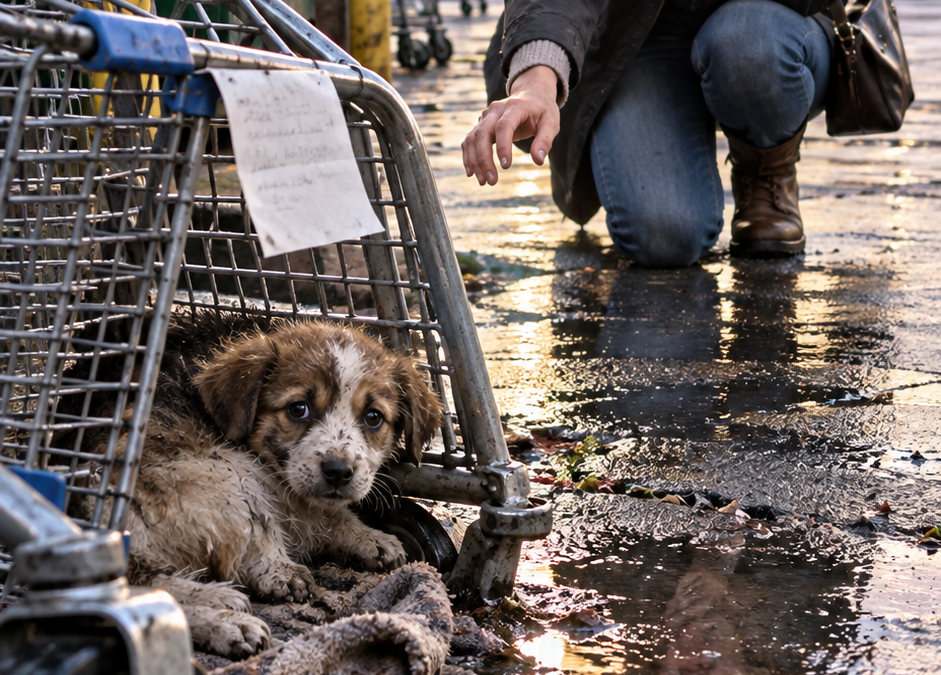
𝗣𝗔𝗥𝗧 𝟮
I had a clean clinic towel in the back seat of my truck.
I wrapped her in it and lifted.
She weighed almost nothing.
Too thin.
Under the towel, her body was rigid.
She didn’t struggle.
Dogs who trust you relax in your arms.
Dogs who hate you fight.
Grace did neither.
She simply endured being held.
That frightened me more.
“You’re coming with me.”
Her nose rested against the towel.
“And for the record?”
I glanced back at the shopping cart.
The note fluttered on the handle.
“You’re already less trouble than most people I’ve met this week.”
I carried her to the truck.
Then went back for the note.
I don’t know why.
Maybe evidence.
Maybe anger.
Maybe some part of me wanted to keep the accusation long enough to watch her destroy it.
I pulled the tape loose.
Folded the paper once.
Put it in my pocket.
Then drove to the clinic.
The ride took less than fifteen minutes.
It felt longer.
Grace lay on the passenger seat wrapped in the towel.
Every time I stopped at a red light, I checked her.
Chest moving.
Good.
Eyes open.
Not good.
She wouldn’t sleep.
Hypervigilance.
She watched the mirrors.
The windshield.
My hands.
The doors.
Anything that might change.
At one intersection, a city bus passed close.
Grace pressed herself deeper into the towel.
“You’re okay.”
Her eyes flicked toward me.
I kept my voice neutral.
No baby talk.
No desperate reassurance.
Dogs know when you’re lying with emotion.
“Nothing’s happening.”
The light turned green.
We moved.
I had spent two decades telling owners that animals live in the present more than we do.
Grace reminded me that trauma can make the past feel present very efficiently.
When I pulled into Cole Veterinary Clinic, Rachel was unlocking the front desk.
She had worked with me for eleven years and possessed two useful skills:
She could calm almost any frightened animal.
And she could tell when I was about to make our schedule significantly worse.
She saw the towel.
Closed her eyes briefly.
“What did you find?”
“Good morning to you too.”
“Nathan.”
I carried Grace inside.
Rachel followed.
“What happened?”
I set the bundle carefully on an exam table.
The towel moved.
Rachel’s face changed.
“Oh.”
Grace’s nose appeared.
Then one eye.
“Where?”
“Supermarket lot.”
“Hit by a car?”
“No.”
I pulled the note from my pocket.
Rachel unfolded it.
Read.
Her jaw tightened.
“Who would do that?”
“I don’t know.”
She read it again.
“Too much trouble?”
“Apparently.”
Rachel looked at Grace.
The puppy shrank from her gaze.
Rachel lowered the paper.
“People are unbelievable.”
“That is not a medically recognized diagnosis, but yes.”
We began the exam.
Estimated age: eleven to thirteen weeks.
Female.
German Shepherd or mostly German Shepherd.
Dehydrated.
Underweight.
Superficial abrasions around the nose and paws.
Mild dermatitis.
No obvious fractures.
No major internal trauma.
Temperature slightly low from the rain exposure, but stable.
Heart rate elevated.
Stress.
A lot of stress.
I checked her gums.
Pale, but not dangerously so.
Rachel supported her gently.
Grace stood frozen.
When I lifted one paw, she let me.
When I palpated her abdomen, she let me.
When Rachel cleaned the scrape on her nose, she let her.
That should have made the exam easy.
It didn’t.
A puppy that age should object to at least one indignity.
Squirm.
Mouth the stethoscope.
Try to eat gauze.
Grace had already learned compliance as self-defense.
Every time I touched her, her body seemed to say:
I’ll behave.
Please don’t hurt me.
I hated whoever had taught her that.
Not because I wanted revenge.
Because I knew how much work it would take to teach her something better.
Physically, she would probably recover quickly.
Psychologically?
No test result could tell me.
“Let’s get her warm,” I said.
Rachel nodded.
“Bath?”
“Slow.”
The sink water ran lukewarm.
I held Grace against my chest before lowering her in.
She stiffened.
“It’s just water.”
Her paws touched the bottom.
No scrambling.
No attempt to climb out.
Again, too compliant.
Dirty water ran from her fur.
Mud.
Parking-lot grime.
A little blood from the scrape.
I worked slowly.
Around the ears.
Under the chest.
Between the toes.
Grace stared at the wall.
“Grace.”
No response.
“Look at me.”
Nothing.
Rachel leaned against the counter.
“She may not know how.”
I knew what she meant.
Not literally.
The puppy’s eyes worked.
Trust didn’t.
My father had been a country veterinarian before me.
When I was a teenager, he’d once said, “Watch a scared dog’s eyes. They’ll tell you where the heart is hiding.”
At sixteen, I’d thought that sounded like something old men said because nobody stopped them.
At forty-three, kneeling beside Grace, I finally understood him.
Her heart was hiding somewhere far behind those eyes.
I dried her.
Wrapped her in another towel.
Set up a crate beside my office desk.
Soft blanket.
Water.
Chicken and rice.
Door open at first.
Grace didn’t enter.
She stood outside the crate staring at it.
I immediately understood the problem.
Containment.
Bars.
Trap.
“Right.”
I removed the crate.
Rachel looked in.
“Plan B?”
“Blanket.”
I made a bed beneath my desk instead.
No walls.
Grace watched.
I sat in my chair.
Waited.
Eventually she crawled beneath the desk and curled against the back panel.
Not the blanket.
The corner.
Of course.
I left her.
The clinic opened.
Appointments began.
Life resumed with rude efficiency.
A Labrador vomited in reception.
A cat tried to amputate my thumb.
A poodle needed vaccines.
A retriever had eaten half a child’s plastic action figure.
By eleven, I was thirty minutes behind.
Normal morning.
Except every chance I got, I looked under my desk.
Grace was still there.
Food untouched.
Water untouched.
Eyes open.
At noon, Rachel wheeled a stainless-steel cart down the hallway.
The wheels rattled across the tile.
Grace exploded from under my desk.
She slammed into the wall.
Scrambled behind a chair.
Flattened.
Rachel stopped immediately.
“Oh, no.”
I stepped into the room.
Grace was shaking.
Not ordinary fear.
Recognition.
The sound.
Metal wheels.
Shopping cart.
I crouched.
“Rachel, back it up.”
She slowly rolled the cart away.
The rattling faded.
Grace remained pressed into the corner.
I sat on the floor.
Didn’t reach.
Didn’t speak.
After several minutes, her breathing slowed.
Rachel appeared in the doorway.
“I’m sorry.”
“You didn’t know.”
She looked toward Grace.
“They did that to her more than once.”
I glanced at her.
“What makes you say that?”
“That reaction.”
I knew she was probably right.
One traumatic event can create associations.
Repeated fear deepens them.
Either way, the cart wasn’t an object to Grace.
It was history with wheels.
Rachel entered quietly and sat across from me.
“I keep thinking maybe the people couldn’t handle a puppy.”
“Then surrender her.”
“Maybe they didn’t know where.”
“Call a shelter.”
“Maybe—”
“Rachel.”
She stopped.
I wasn’t angry at her.
I was angry at the invisible people our conversation kept trying to excuse.
“There were options.”
Rachel nodded.
“You’re right.”
“They wrote a note.”
I pointed toward my desk.
“That’s the part I can’t get past. They wrote it down. Too much trouble.”
Grace’s ears flicked at my voice.
I softened it.
“Sorry.”
Rachel looked at the puppy.
“You’re going to keep that note, aren’t you?”
“For now.”
“Why?”
“I don’t know.”
But I did.
Because those words had been used as a verdict.
And something in me wanted an appeal.
By late afternoon, Grace drank water.
Three laps.
Stopped.
Looked around.
Two more.
I pretended not to notice.
Later she ate one piece of chicken.
Then another.
That night, after everyone left, I stayed.
I told myself I was finishing medical records.
That was technically true.
I completed six charts while watching Grace every thirty seconds.
Around ten, she came out from beneath the desk.
Slowly.
She sniffed the blanket.
Circled.
Lay down.
Progress.
At midnight, I heard a sound.
So faint I almost missed it.
“Huff.”
I stopped typing.
Another.
“Huff.”
Grace was sitting up.
She looked toward the hallway.
Then at me.
Her ears were uneven.
One almost standing.
The other bent sideways.
She opened her mouth.
A tiny bark came out.
Not even a full bark.
More like the idea of one.
I froze.
Grace stared at me.
“Bark again.”
Nothing.
I smiled.
“Of course not.”
She blinked.
“You found your voice.”
Her tail moved.
Maybe an inch.
I felt ridiculous for how much that movement affected me.
People imagine veterinary medicine toughens you.
It does.
It has to.
You cannot collapse every time an animal suffers.
If you did, you’d become useless.
But toughness isn’t immunity.
You simply get better at storing reactions for later.
A tiny tail movement at midnight can open every drawer you’ve kept locked.
I lowered myself beside the blanket.
Grace watched.
I placed my hand palm-up several inches away.
She leaned forward.
Sniffed.
Didn’t touch.
“Fair.”
I left it there.
A minute passed.
Then her nose contacted one finger.
Barely.
I didn’t move.
Grace sniffed again.
Then rested her chin against my palm.
That was our first real agreement.
Not surrender.
Choice.
I sat there until my legs went numb.
The next few days were an exercise in refusing to rush.
Grace ate more.
Slept more.
Watched people.
Avoided the hallway when carts moved.
I replaced metal equipment transport with quieter plastic trays whenever possible.
Rachel accused me of redesigning the clinic around one puppy.
“Temporary accommodation.”
“Sure.”
“You mock trauma-informed medicine?”
“I’m mocking you.”
“Different issue.”
We built positive associations slowly.
Cart visible across the hall.
Food.
No movement.
Next day, cart closer.
Food.
No movement.
Then one wheel rolling gently.
Food.
Stop before panic.
Again.
Again.
Again.
Trust isn’t built dramatically.
It’s repetitive and boring.
That’s why people fail at it.
Everybody loves breakthrough moments.
Almost nobody appreciates the thousand uneventful minutes that create them.
Grace learned that doors could open without someone leaving her.
She learned hands could approach and then stop when she moved away.
She learned bowls returned after being removed.
She learned sleeping deeply didn’t result in punishment.
The first time I saw her sleep on her side instead of curled tightly, I stood in the doorway for five minutes.
Rachel caught me.
“You know that’s creepy.”
“Observation.”
“Staring at a sleeping puppy.”
“Clinical observation.”
“From ten feet away.”
“Go answer the phone.”
She smiled and left.
The clinic staff fell in love with Grace in predictable sequence.
Rachel first.
Then Ana, our receptionist.
Then Marcus, one of the techs who claimed he wasn’t a “dog person” before spending twenty minutes cutting boiled chicken into tiny pieces because Grace preferred them that way.
By the end of the week, she had three blankets, two plush toys, a soft harness, and an unofficial employee identification card Ana printed with the title:
ASSISTANT TO THE MEDICAL DIRECTOR.
“I am the medical director,” I said.
Ana nodded.
“Exactly.”
“She doesn’t assist me.”
Grace was asleep beneath my desk.
Ana lowered her voice.
“She improves morale.”
“Apparently management never did.”
“Correct.”
I walked away.
Day six brought the first real setback.
Grace woke lethargic.
No breakfast.
No water.
Head low.
I touched her ears.
Warm.
Too warm.
Thermometer.
Fever.
My stomach dropped.
Veterinarians aren’t supposed to react emotionally before data.
So I gathered data.
Temperature.
Respiratory rate.
Heart rate.
Hydration.
Bloodwork.
White blood cell count elevated.
Stress and exposure had likely allowed an infection to take advantage of her already weakened system.
Treatable.
Probably.
That word probably bothered me more than it should have.
I had treated hundreds of sick puppies.
Grace wasn’t medically exceptional.
Emotionally, she had become dangerously so.
Rachel stood beside the treatment table.
“Nathan.”
“I’m fine.”
“You haven’t said anything for five minutes.”
“I’m thinking.”
“You’re panicking.”
“I’m a veterinarian.”
“Veterinarians panic.”
“Not professionally.”
She gave me a look.
Grace lay in a towel while I started fluids.
Her paw moved weakly.
Touched my wrist.
I stopped.
“Hey.”
Her eyes opened halfway.
“None of that.”
They closed.
I worked.
Antibiotics.
Fluids.
Temperature management.
Monitoring.
Nothing heroic.
Standard medicine.
The problem was that standard medicine feels different when you care too much about the patient.
Hours passed.
Grace’s breathing became rapid.
I sat beside her treatment area and counted.
One.
Two.
Three.
Rachel brought coffee.
I forgot to drink it.
Around five, Grace shifted.
I put my hand against her ribs.
“Come on.”
She opened one eye.
“You’re not too much trouble.”
The sentence surprised me.
I said it again.
“You’re not too much trouble.”
Grace breathed.
“You’re allowed to be sick.”
Another breath.
“You’re allowed to need things.”
Her paw pressed weakly against my palm.
“You’re allowed to be difficult.”
I smiled despite myself.
“Although let’s not abuse that one.”
Her nose moved against my wrist.
I swallowed hard.
Maybe I was talking to a dog.
Maybe I was talking to half the people I’d met in my life.
Maybe myself.
Veterinary medicine attracts people who believe usefulness is the safest way to earn belonging.
You fix things.
Keep moving.
Don’t inconvenience anybody.
Grace had been discarded because someone decided need was unacceptable.
Watching her fight fever, I realized how deeply I hated that idea.
Need is not a moral failure.
Being difficult to care for doesn’t make a living thing disposable.
That should be obvious.
Humans have built entire cultures proving it isn’t.
Grace’s fever broke during the night.
Not dramatically.
No sudden miracle.
Temperature simply began moving down.
Her breathing slowed.
At three in the morning, she opened both eyes.
Then licked my thumb.
One pass.
Weak.
I laughed.
“There you are.”
Tail movement.
Tiny.
“Very manipulative.”
She slept again.
I leaned against the wall and finally drank the coffee.
Cold.
Apparently cold coffee was going to define our relationship.
Recovery took seven days.
Those days changed her.
Or maybe they changed me enough to see her differently.
The puppy who came out of that fever wasn’t cured of fear.
But she began participating in life.
She chewed the corner of her blanket.
Excellent.
She stole Rachel’s pen.
Wonderful.
She barked at the vacuum.
Normal.
She attempted to eat a paper towel.
Outstanding.
I had never been so pleased by bad behavior.
“She’s becoming a menace,” Rachel said.
“Good.”
Grace had half a paper towel hanging from her mouth.
Rachel pointed.
“You’re encouraging delinquency.”
“I’m encouraging development.”
“She just stole medical waste.”
“Clean medical waste.”
“Important distinction.”
Grace ran under my desk.
Tail wagging.
Actually wagging.
Not twitching.
Wagging.
“See?”
Rachel laughed.
“You’re doomed.”
I pretended not to understand.
The first time Grace crossed the clinic floor willingly happened exactly one week after the fever.
She had been watching other dogs.
A young spaniel bouncing at the end of its leash.
An elderly beagle asleep in reception.
A terrier trying to convince its owner that nail trimming constituted a constitutional violation.
Grace stood near my office door.
I sat across the room.
Didn’t call.
She looked at me.
Then the open floor.
One paw forward.
Pause.
Another.
Her back legs trembled.
Not weakness.
Uncertainty.
Click.
Click.
Click.
Her nails against tile sounded louder than surgery equipment.
Rachel noticed from reception.
Stopped talking.
Ana turned.
Marcus froze beside a cabinet.
Nobody wanted to ruin it.
Grace reached the middle of the room.
Paused.
Looked around.
No cart.
No cage.
No angry voice.
No punishment.
Just people waiting.
Her tail lifted slightly.
She took another step.
Then another.
A woman waiting with her beagle whispered, “Is that her?”
I nodded.
“The parking lot puppy?”
“Yeah.”
Grace reached me.
Placed one paw on my shoe.
Exactly as she had the first morning.
But the meaning had changed.
Back then, she’d pressed against my boot because she had nowhere else to go.
Now she touched it because she knew where she wanted to be.
“Hi.”
Her ears tilted.
“You did it.”
She licked my hand.
The whole room exhaled.
Ana wiped her cheek.
Marcus suddenly found the supply cabinet fascinating.
Rachel crossed her arms.
“I’m not crying.”
“Nobody accused you.”
“Good.”
Grace turned toward them.
For the first time, she walked up to Rachel voluntarily.
Sniffed.
Rachel crouched.
Grace leaned against her knee.
That was the day the clinic stopped thinking of her as fragile.
She was still cautious.
Still triggered by certain sounds.
Still afraid of carts.
But she wasn’t surrendering anymore.
She was learning to choose.
That distinction became everything.
Over the next month, Grace grew.
German Shepherd puppies do that offensively fast.
One week they fit under a desk.
The next, you’re wondering who replaced the puppy with a set of legs.
Her ears developed an ongoing disagreement about whether they should stand.
One would rise confidently.
The other would fold.
Then they’d switch.
I told her it damaged the dignity of the breed.
She bit my shoelace.
Fair response.
She discovered tennis balls.
Then forgot how returning them worked.
She learned sit in approximately thirty seconds.
Down in a minute.
Stay in theory.
Recall when she felt philosophical.
At the clinic, she began greeting frightened dogs.
Not because I trained her.
She simply noticed them.
A trembling Chihuahua came in for bloodwork.
Grace lay several feet away.
The Chihuahua stopped shaking.
A nervous shepherd mix refused to enter an exam room.
Grace walked inside first.
He followed.
A puppy recovering from a fracture cried in its kennel.
Grace slept outside the door.
Clients noticed.
“Is she a therapy dog?”
“No.”
“Service dog?”
“No.”
“Clinic dog?”
I looked at Grace.
She was upside down beneath my desk.
“Administrative liability.”
Her tail hit the wall.
But she was changing the clinic.
And me.
I’ve practiced medicine long enough to accumulate ghosts.
Every veterinarian does.
Patients you saved.
Patients you couldn’t.
Owners who blamed you.
Owners who hugged you.
Animals who arrived too late.
Animals you euthanized because love sometimes means ending suffering instead of extending it.
You carry pieces.
You tell yourself professionalism keeps them organized.
It doesn’t.
It just teaches you which drawer to put them in.
Before Grace, I had started coming home exhausted even on easy days.
I lived alone.
My marriage had ended years earlier without drama.
No betrayal.
No screaming.
Two people discovering they’d become better coworkers than spouses.
We remained friendly.
That was somehow sadder.
The house was quiet.
I told myself I liked quiet.
Grace exposed that lie quickly.
At first, I planned to foster her.
Of course I did.
Veterinary professionals tell ourselves “foster” the way children say “I’m just looking” inside a candy store.
Rachel asked daily.
“Any applications?”
“Not ready.”
“Any interest?”
“Not medically cleared.”
“She’s cleared.”
“Behaviorally.”
“She sleeps on your foot.”
“Complex case.”
“Sure.”
One family inquired.
Good people.
Two kids.
Fenced yard.
Previous shepherd experience.
Objectively excellent.
I read the application three times.
Then put it down.
Rachel walked into my office.
“You called them?”
“No.”
“Why?”
“Busy.”
“You’ve had that form for four days.”
“I perform surgery.”
“You also avoid emotions.”
“Not covered by your job description.”
She leaned against the desk.
“Nathan.”
I looked at Grace.
She was sleeping with her nose across my shoe.
“What?”
“Just admit it.”
“No.”
“You already adopted her emotionally.”
“That’s not a legal category.”
“Neither is denial.”
I sighed.
Grace woke.
Looked at me.
Tail wag.
Traitor.
I called the family.
Told them Grace was no longer available.
Then I filled out the adoption paperwork myself.
When I signed my name, I laughed.
Not because it was funny.
Because the whole process had been over long before I admitted it.
Grace had chosen me in a parking lot.
I’d simply spent a month catching up.
The first night I brought her home as my dog, she sat in the passenger seat of my truck.
No towel.
No trembling.
Harness on.
Head turned toward the window.
Dallas lights passed across her face.
At a red light, she looked at me.
“What?”
Tail thump.
“This was your idea.”
Another thump.
“I had a peaceful house.”
She yawned.
“Very selfish.”
When we arrived, she hesitated at the front door.
New threshold.
New place.
I opened it.
Waited.
She sniffed.
One paw across.
Then another.
Within thirty seconds, she was inspecting the living room.
Kitchen.
Hallway.
Bedroom.
Back to living room.
I followed.
“Anything else?”
She sniffed the couch.
“No.”
She put her front paws up.
“Absolutely not.”
She climbed onto the couch.
“Excellent first boundary.”
Grace circled twice.
Curled against one cushion.
Looked at me.
I spread an old blanket on the floor beside the couch.
“Your bed.”
She stared.
“That’s where dogs sleep.”
She remained on the couch.
“Strong opening negotiation.”
I sat down.
Grace walked over.
Turned twice.
Curled against my leg.
Head on my thigh.
I stopped arguing.
She sighed.
Long.
Deep.
No tension.
I rested my hand on her back.
Warm.
Solid.
Alive.
The house didn’t feel quiet anymore.
It felt occupied.
There is a difference.
Around midnight, thunder rolled outside.
Grace’s head lifted.
Her body tensed.
I waited.
Another rumble.
She looked toward the window.
Then at me.
“Just weather.”
She remained alert.
I kept my hand on her shoulder.
“Nothing’s coming.”
The storm continued.
Grace gradually lowered her head.
By one in the morning, she was asleep.
I wasn’t.
I watched her.
And thought about the note.
Too much trouble.
It was still folded inside my desk drawer at the clinic.
Those words had been meant to define her.
Instead, they had started defining the person who wrote them.
That was the irony.
Grace wasn’t too much trouble.
She was a puppy.
She needed food.
Training.
Patience.
Medical care.
Consistency.
Exactly the things every puppy needs.
Whoever abandoned her hadn’t described Grace.
They had confessed something about themselves.
Their capacity had failed.
Their patience had failed.
Their responsibility had failed.
Then they assigned the failure to the dog.
People do that often.
Blame the dependent thing for depending.
Call a child difficult.
Call an elderly relative burdensome.
Call a sick animal expensive.
Call need a flaw.
Grace had carried that accusation in her posture when I found her.
Don’t worry.
I won’t ask.
I’ll stay quiet.
I won’t be trouble.
Watching her sleep across my lap, I decided we were going to correct that.
Not with revenge.
Not with a confrontation.
I never found the people who left her.
Honestly, I’m glad.
The ending didn’t need them.
Their role had been completed the moment they walked away.
What mattered was what Grace did after.
She became gloriously inconvenient.
She woke me at 5:42 every morning.
Not 5:40.
Not 5:45.
5:42.
I have no idea why.
She discovered toilet paper.
She murdered two houseplants.
She stole one sock from every pair but never both.
She barked at a garden statue for three weeks.
She learned how to open the laundry-room door by hitting the handle with her paws.
She once dragged an entire bag of dog food through the kitchen and chewed a hole in the bottom.
I came home to kibble covering the floor.
Grace sat in the middle of it.
“Too much trouble.”
She wagged.
I started laughing.
“You’re making their case.”
She sneezed.
Then tried eating the evidence.
Training helped.
So did age.
She became confident without becoming reckless.
Curious without panicking.
The biggest obstacle remained metal carts.
We worked slowly.
At the clinic, Grace could tolerate a stationary cart.
Then one moving at distance.
Then closer.
Eventually, the sound no longer sent her hiding.
She still watched.
But watching is not fear.
Awareness is not surrender.
Months after I found her, I decided it was time to return to the supermarket.
Not because I believed in cinematic closure.
I don’t.
Trauma isn’t a movie scene where you confront the object and music swells while everything heals.
I wanted information.
Could Grace be in that environment without shutting down?
If not, we’d leave.
Simple.
The morning was bright.
Almost offensively similar to the day I’d found her.
Grace jumped from the truck wearing a red harness.
She had grown.
Long legs.
Shiny black coat.
Tan markings rich now that she was healthy.
Her ribs no longer showed.
The scrape on her nose had healed.
Only a pale line on one paw remained.
She walked beside me.
Loose leash.
The parking lot smelled like hot asphalt and exhaust.
Shopping carts rattled.
Grace stopped.
I felt tension travel through the leash.
Didn’t pull.
“Take your time.”
Her ears moved.
One cart rolled across the pavement.
Clatter.
Grace’s body stiffened.
I crouched beside her.
“You don’t have to go closer.”
She looked at me.
Then the cart.
Then moved forward.
Her choice.
Ten feet.
Pause.
Five feet.
Pause.
A woman pushed a cart past us.
Grace watched.
No flattening.
No trembling.
We reached the area near the dumpster.
The exact place was impossible to identify precisely.
The carts had changed.
The puddles were gone.
Life had rearranged the evidence.
A loose cart bumped against a curb.
Grace flinched.
Once.
Then exhaled.
She walked toward it.
Sniffed the wheel.
Sniffed the frame.
Stepped back.
Looked at me.
I rolled the cart two feet.
Metal rattled.
Grace watched.
Tail neutral.
I stopped.
She stepped forward.
Sniffed again.
Then turned away.
Just like that.
No miracle.
No dramatic collapse.
She was done.
The cart had become metal again.
Not a cage.
Not a verdict.
Just an object with bad steering.
“Okay.”
Grace walked toward the truck.
I followed.
A man passing with groceries smiled.
“Beautiful Shepherd.”
“Thank you.”
“How old?”
“About eight months.”
Grace looked up.
The man waved.
She wagged.
He moved on.
I stood there for a second.
Beautiful dog.
That was all he saw.
He didn’t see a discarded puppy.
Didn’t see the note.
Didn’t see the mud.
Didn’t see the cage.
Good.
That meant Grace’s history was no longer the first thing visible about her.
I wanted that for her.
Back at the clinic, I opened my desk drawer.
Took out the note.
Too much trouble.
The ink had bled slightly from the rain.
I considered throwing it away.
Didn’t.
Not yet.
Instead, I taped it inside the drawer.
Where nobody could see it unless they knew.
Rachel caught me.
“Still keeping that?”
“Yes.”
“Why?”
I looked through the office door.
Grace was lying beside a terrified rescue dog awaiting surgery.
The other dog had pressed against her side.
Grace didn’t move.
“Evidence.”
“Of what?”
“Bad judgment.”
Rachel smiled.
“Whose?”
“Exactly.”
Grace became part of the clinic.
Not officially.
Officially she was my dog.
Unofficially she considered herself quality-control management.
She greeted employees.
Inspected deliveries.
Slept through staff meetings.
Visited nervous patients.
Ignored accounting.
Excellent executive instincts.
One afternoon, a woman arrived carrying a trembling young dog rescued from a backyard breeding situation.
The dog refused to leave the carrier.
We tried food.
Nothing.
Soft voice.
Nothing.
Time.
Nothing.
Grace walked into the room.
Stopped ten feet away.
Lay down.
The other dog stared.
Grace looked away.
No pressure.
After several minutes, the dog stepped out.
One paw.
Then another.
Walked toward Grace.
Sniffed.
Grace remained still.
The dog lay beside her.
The owner started crying.
“How did she know?”
I looked at Grace.
“I think someone taught her.”
The woman wiped her face.
“Was she a rescue?”
“Yes.”
“What happened?”
For a moment, I almost told the whole story.
Instead I said, “Someone underestimated her.”
That became my preferred version.
Grace was not the puppy under the cart.
She was not the note.
She was not abandonment.
Those were things that happened to her.
Not who she was.
She became a young dog who loved children.
A dog who learned to carry a toy to nervous patients.
A dog who slept upside down with all four legs in the air.
A dog who discovered sprinklers and declared war.
A dog who hated bananas for reasons known only to her.
A dog who adored Rachel.
A dog who pretended not to adore Marcus because he made her sit before giving treats.
A dog who waited beside the clinic door at closing time until I grabbed my keys.
A dog who had opinions.
Preferences.
Bad habits.
Joy.
Normalcy.
That was the victory.
Trauma makes a compelling story.
Normal life is the better ending.
A year after I found her, Grace was nearly full-grown.
Seventy pounds.
Strong.
Confident.
Both ears finally standing, though one tilted sideways when she was tired.
Her favorite place at home remained the couch.
I had officially surrendered that argument.
One evening, I came home after a difficult euthanasia.
Old Labrador.
Cancer.
Good family.
Right decision.
Still horrible.
Those are the hardest cases sometimes.
Nobody did anything wrong.
The dog was loved.
The owners were kind.
Medicine had reached the end.
There’s nobody to blame.
Grief without blame has nowhere to go.
I sat on the couch without turning on lights.
Grace came from the hallway.
She stopped.
Looked at me.
Normally she would bring a toy.
Not that night.
She climbed up.
Lay beside me.
Head on my leg.
No licking.
No pawing.
No demand.
Just presence.
I put my hand on her neck.
“You know?”
She sighed.
“Of course you do.”
We sat in darkness.
I remembered the first night at the clinic.
Me beside her blanket.
No words.
No pressure.
Just presence.
Grace had learned the lesson.
Then returned it.
That’s when I understood the phrase people use too casually.
Who rescued whom?
I still don’t like it.
It turns rescue into a sentimental trade.
I helped Grace because she needed help.
She didn’t owe me healing.
She didn’t owe me purpose.
She didn’t owe me love.
But she gave those things anyway.
Freely.
That’s what made them matter.
Another year passed.
The supermarket was renovated.
The old cart enclosure disappeared.
Dumpster moved.
Fresh paint.
New lights.
If I hadn’t known what happened there, nothing about the place would have suggested it.
That bothered me at first.
Then it didn’t.
Cruel places don’t deserve monuments.
Grace’s life was the monument.
She began participating informally in socialization sessions for frightened rescue dogs.
Carefully supervised.
Not because she had some magical ability.
Because she communicated calm well.
She understood distance.
She knew how to exist nearby without forcing interaction.
I watched her with one puppy who had been removed from an abusive home.
The pup hid behind a chair.
Grace lay across the room.
Waited.
Five minutes.
Ten.
The puppy eventually moved closer.
Grace turned her head away.
The puppy sniffed her shoulder.
Grace remained still.
Then the puppy curled against her.
Rachel whispered, “She remembers.”
“Maybe.”
“You don’t think so?”
“I don’t know what dogs remember as stories.”
Grace looked at us.
“I think she remembers feelings.”
That was enough.
The note remained in my drawer.
The longer Grace thrived, the more ridiculous it looked.
Too much trouble.
The dog described by those words helped frightened animals enter exam rooms.
She comforted children crying over sick pets.
She learned commands faster than most dogs I’d trained.
She adapted to a clinic.
A house.
Strangers.
Storms.
Carts.
Loss.
She forgave a species that had given her very little reason to.
Trouble?
No.
Grace was work.
Those aren’t the same thing.
Love is work.
Medicine is work.
Friendship is work.
Dogs are work.
Anything worth keeping eventually asks something from you.
Time.
Patience.
Money.
Attention.
Sacrifice.
The person who left Grace had confused responsibility with burden.
That was their failure.
Not hers.
On the second anniversary of finding her, Rachel left something on my desk.
A small frame.
Inside was a photograph of Grace sitting outside the clinic.
Chest high.
Ears up.
Tongue out.
Happy.
Underneath, Rachel had placed a copy of the original words.
TOO MUCH TROUBLE.
Then below them:
WORTH EVERY BIT OF IT.
I stared.
Rachel stood in the doorway.
“Too much?”
I laughed.
“Sentimental.”
“You’re sentimental.”
“Defamation.”
Grace walked in.
Put her head on my knee.
Rachel smiled.
“Case closed.”
I looked at the photograph.
Then at Grace.
“Yeah.”
Case closed.
I took the original note out of the drawer that afternoon.
Walked outside behind the clinic.
For years, I’d imagined keeping it forever.
Proof.
Evidence.
A reminder.
But suddenly it felt unnecessary.
Grace was almost three years old.
Healthy.
Confident.
Loved.
The note didn’t need to survive longer than the lie written on it.
I tore it once.
Then again.
Dropped the pieces into the trash.
Grace watched.
“That’s it.”
She sniffed the bin.
“No.”
She looked at me.
“Absolutely not.”
Tail wag.
“You’ve beaten the argument. Don’t eat it.”
She turned toward the grass.
I laughed.
The note was gone.
Grace didn’t notice.
That’s the thing about dogs.
They don’t need us to preserve insults on their behalf.
They would rather go for a walk.
So we did.
Years later, people still asked about the scar on her paw.
Most never noticed it.
When they did, I’d give the short answer.
“Bad start.”
Then Grace would lean into someone’s hand.
Tail wagging.
And the story would move on.
She became known around the clinic simply as Grace.
Not Grace the rescue.
Not Grace from the shopping cart.
Not abandoned Grace.
Just Grace.
That mattered.
The most satisfying ending to cruelty is not endless remembrance.
It’s irrelevance.
Whoever wrote that note probably never knew what happened.
Maybe they assumed she died.
Maybe they forgot her by dinner.
Maybe they saw a photograph online someday and recognized her.
I don’t know.
I stopped caring.
Because the person who abandoned Grace had already lost.
Not in court.
Not through public humiliation.
Not because I confronted them.
They lost the moment Grace discovered a life larger than the label they gave her.
They said she was trouble.
She became comfort.
They treated her like garbage.
She became family.
They trapped her under metal.
She spent the rest of her life walking willingly through open doors.
They taught her to fear hands.
She learned to seek them.
They taught her silence.
She found her bark.
They made her afraid of shopping carts.
One day she sniffed one and walked away.
They left her because she needed too much.
Grace grew into a dog who gave more than anyone had ever asked from her.
That was the defeat.
Complete.
Quiet.
Permanent.
One Saturday morning, I brought Grace to a community adoption event the clinic supported.
Not for adoption.
She was there as our unofficial ambassador.
Dozens of shelter dogs waited in pens.
Families moved between tables.
Volunteers answered questions.
Grace walked beside me.
A little girl, maybe seven, approached with her father.
“Can I pet her?”
“Ask her.”
The girl looked confused.
“How?”
“Hold your hand down. Let her decide.”
She did.
Grace sniffed.
Then leaned her shoulder against the girl’s knees.
The child smiled.
“She likes me.”
“Looks that way.”
“Was she always yours?”
I paused.
“No.”
“Where’d you get her?”
I looked down.
Grace sat beside the girl.
Strong.
Calm.
Bright eyes.
“She found me.”
The girl seemed satisfied.
Children often understand the important parts faster than adults.
She hugged Grace carefully.
Grace licked her cheek.
The girl laughed.
Then ran back to her father.
I watched them walk away.
Rachel came beside me.
“You still think you rescued her?”
“I never said that.”
“You definitely did.”
“I said I found her.”
Grace leaned against my leg.
Rachel smiled.
“Difference?”
“A big one.”
Finding is an event.
Rescue is what comes after.
It’s the bath.
The fever.
The sleepless nights.
The training.
The setbacks.
The patience.
The decision not to rush fear.
The first bark.
The first tail wag.
The first stolen sock.
The first night on the couch.
The thousand ordinary mornings that teach an animal the bad thing is truly over.
People like the dramatic moment.
The cart.
The note.
The parking lot.
But Grace’s real rescue happened afterward.
One uneventful day at a time.
By the time Grace turned five, gray hadn’t touched her muzzle yet, but maturity had.
She walked through the clinic like she owned stock in it.
Technically, judging by my veterinary bills, she probably did.
New employees were warned that Grace had seniority.
Patients still responded to her.
One afternoon, a frightened German Shepherd puppy came in.
Black and tan.
Twelve weeks old.
Almost the same age Grace had been.
The puppy had been surrendered responsibly by an overwhelmed family.
No abuse.
No cruelty.
They recognized they couldn’t manage her and asked for help before things became dangerous.
The rescue organization brought her to us for examination.
She barked.
Pulled.
Chewed the leash.
Knocked over a water bowl.
Tried biting the stethoscope.
A spectacular nuisance.
Rachel laughed.
“Too much trouble.”
The words stopped both of us.
Not because she’d meant anything cruel.
It was a joke.
Still.
The room changed.
Grace entered.
The puppy launched toward her.
Grace stepped aside.
The puppy bounced.
Grace corrected her gently.
The pup stopped.
Sat.
Grace sniffed.
Then walked away.
Rachel looked at me.
“Sorry.”
“Don’t be.”
I watched the puppy begin playing with a toy.
“That’s what a puppy who’s too much looks like.”
Rachel smiled.
“Healthy.”
“Exactly.”
The family had done the right thing.
They had admitted their limit.
Asked for help.
Made sure the dog went somewhere safe.
That distinction mattered.
Being unable to keep an animal doesn’t make someone cruel.
How they handle that responsibility matters.
Grace’s former owner had had options.
They chose a cage beneath a shopping cart.
The family who surrendered this pup chose a rescue.
One decision preserved trust.
The other nearly destroyed it.
The young shepherd was adopted two weeks later.
Grace attended the handoff.
The new owner was a retired teacher with a large yard and shepherd experience.
The puppy jumped into her lap.
Perfect match.
I watched from the doorway.
Sometimes humane endings are boring.
Paperwork.
Vaccination records.
Leash.
Car.
Home.
Good.
May more stories be that boring.
Grace came beside me.
“See?”
She looked up.
“That’s how it’s supposed to happen.”
Tail wag.
We went back to work.
Eventually, I stopped thinking about the parking lot every time I looked at her.
That might be the clearest sign of healing.
At first, every happy thing Grace did was measured against what had happened.
She’s playing despite the cart.
She’s sleeping despite the cart.
She’s trusting despite the cart.
Then one day she was simply playing.
Simply sleeping.
Simply trusting.
The past stopped demanding to be included in every sentence.
Grace outgrew the story people had assigned her.
I think people can do that too.
One evening, after closing, rain began pounding the clinic roof.
The same heavy Texas rain we had heard during her first weeks.
Wind pushed carts across the supermarket lot in the distance.
Metal rattled.
Grace lay in reception.
Her ears lifted.
I waited.
She listened.
Then went back to sleep.
I smiled.
Rachel looked up from her computer.
“What?”
“Nothing.”
She followed my eyes to Grace.
“Oh.”
The cart sound came again.
Grace snored.
Rachel smiled.
“Definitely not impressed anymore.”
“No.”
Rain hammered the windows.
Thunder rolled.
Grace slept.
That was the ending I’d wanted.
Not bravery.
Not confrontation.
Indifference.
Fear had become irrelevant.
When we got home, Grace ran to the kitchen.
Sat beside her food container.
“You ate.”
She stared.
“At five.”
Stare.
“It is seven-thirty.”
Tail wag.
“Medical science strongly suggests you cannot be starving.”
She barked.
Full-volume now.
I laughed.
“There it is.”
Another bark.
The puppy who once believed silence kept her safe had become very comfortable expressing dissatisfaction.
“Too much trouble.”
Grace barked again.
“Yeah.”
I filled her bowl.
“Worth it.”
Years earlier, beneath that shopping cart, Grace had looked at me as if asking permission to keep existing.
Now she had no such uncertainty.
She occupied space.
Demanded dinner.
Stole my side of the couch.
Blocked doorways.
Barked when necessary.
Slept without listening for danger.
Trusted hands.
Loved people.
Helped frightened dogs.
And, most importantly, she no longer behaved like she owed anybody gratitude for being alive.
She simply lived.
That’s what I wanted for her.
Not endless thankfulness.
Freedom.
Real freedom.
The kind that doesn’t require remembering the cage every day.
One Sunday morning, I took her to a park near White Rock Lake.
Children ran along the trail.
Cyclists passed.
Grace walked beside me.
An elderly man stopped.
“Beautiful dog.”
“Thank you.”
“She looks happy.”
I looked at her.
Tongue out.
Tail loose.
Eyes following a squirrel with criminal intent.
“She is.”
The man scratched her chest.
Grace leaned into him.
“Good girl.”
After he walked away, I sat on a bench.
Grace settled at my feet.
Sunlight moved across her coat.
I thought about how different her body language was from that first morning.
Then I deliberately stopped.
No comparison.
Not today.
Grace didn’t need the parking lot brought into a beautiful morning.
I scratched behind her ears.
She closed her eyes.
The breeze moved through the trees.
Somewhere nearby, a shopping cart from a park vendor rattled over pavement.
Grace didn’t open her eyes.
I smiled.
That was enough.
If you asked me what Grace taught me, I wouldn’t give you some grand statement about animals being better than humans.
Animals can be difficult.
Humans can be extraordinarily kind.
The world is more complicated than slogans.
What she taught me was simpler.
A label is not a diagnosis.
Someone can call you difficult.
Broken.
Burden.
Problem.
Trouble.
That doesn’t make it true.
Sometimes the label only reveals the limitations of the person holding the marker.
Grace was never too much trouble.
She was too much responsibility for someone unwilling to carry it.
Those are not the same thing.
The difference became an entire life.
A warm house.
A clinic full of people who loved her.
A couch permanently covered in black fur.
A collection of tennis balls under furniture.
A thousand frightened animals calmer because she happened to lie nearby.
One veterinarian who became a little less numb.
And Grace herself.
Whole.
Not unscarred.
Whole.
There’s a difference there too.
Her scar remained.
Small pale line near her paw.
I used to look at it and think about cruelty.
Eventually I looked at it and thought about tissue.
Skin heals by laying down something new.
Not identical to what existed before.
Stronger in some places.
Less flexible in others.
Visible if you know where to look.
That’s what healing is.
Not restoration.
Reconstruction.
Grace had rebuilt herself around the damage.
So had I.
One night, she climbed onto the couch beside me.
Older now.
Calmer.
She rested her head in my lap.
I ran my fingers along the edge of one ear.
“You know something?”
She sighed.
“I don’t even remember exactly what that note looked like anymore.”
Her eyes stayed closed.
“Good.”
Tail thump.
“That’s right.”
I leaned back.
Outside, Dallas traffic moved beyond the windows.
Cars.
People.
Metal carts somewhere.
Noise.
Life.
Grace slept.
I thought about the person who wrote those two words.
Too much trouble.
For years, part of me had wanted them to see her.
See the dog she became.
See what they’d thrown away.
I wanted them embarrassed.
Ashamed.
Defeated.
Then, eventually, I realized they didn’t deserve that much space in our story.
Grace’s victory didn’t require their witness.
That was the final lesson.
You don’t need the person who hurt you to understand what they lost.
You don’t need them to apologize before your life can become good.
You don’t need them standing in the audience when you survive.
Grace didn’t.
She didn’t spend her life waiting for an apology.
She didn’t demand justice from a shopping cart.
She simply learned that the next hand could be gentle.
Then another.
Then another.
Eventually kindness became normal.
That was enough.
The person who abandoned her disappeared from the story.
Grace stayed.
And sometimes that is the cleanest form of justice.
The cruelty becomes a footnote.
The survivor becomes the whole book.
Grace grew old with me.
Slowly.
Her muzzle silvered.
Her steps shortened.
She stopped jumping onto the couch and started waiting for me to lift her back end.
Naturally, she still refused the expensive orthopedic dog bed I bought.
Apparently my rug had superior medical properties.
At the clinic, younger dogs still calmed around her.
She no longer followed me into every exam room.
She chose one sunny spot near reception.
Patients came to her.
Children sat beside her.
Old dogs sniffed her.
Puppies crawled over her paws until she’d give them one exhausted look that seemed to say:
Control yourself.
I understood.
Rachel once stood beside me watching Grace sleep.
“Remember the cart?”
“Yeah.”
“Feels like another dog.”
“It was.”
She looked at me.
“Same dog.”
“Same body.”
“What changed?”
I thought about it.
“Expectation.”
Rachel waited.
“Back then, she expected pain.”
Grace snored.
“Now she expects lunch.”
Rachel laughed.
“That’s recovery?”
“Pretty much.”
Grace opened one eye at the word lunch.
We both laughed harder.
Yes.
That was recovery.
On her last years’ birthdays, I stopped counting how long it had been since the parking lot.
The date still mattered.
But not as an anniversary of abandonment.
It became the day we met.
I liked that better.
Grace certainly did.
The celebration involved steak.
She considered history meaningful when edible.
I would hold the plate while she stared.
“Seven years since you ruined my schedule.”
Tail wag.
“Eight years since you stole my couch.”
Wag.
“Nine years of trouble.”
Bark.
“Fine.”
I’d put down the steak.
“Worth every second.”
She never disagreed.
And every now and then, when I drove past that supermarket, I’d glance toward the place where the cart had been.
Nothing remained.
No plaque.
No sign.
No evidence.
Good.
Grace’s life did not belong to that parking lot.
It belonged to everything after.
The warm sink.
The midnight bark.
The fever she survived.
The first walk across the clinic floor.
The red harness.
The couch.
The terrified dogs she calmed.
The children she trusted.
The storms she eventually slept through.
The house she filled.
The veterinarian she softened.
The ordinary mornings.
Especially those.
That is where she defeated the people who abandoned her.
Not through spectacle.
Through ordinary happiness repeated so many times that cruelty became statistically insignificant.
Thousands of good days against one terrible morning.
The math eventually became overwhelming.
Too much trouble?
No.
Too much life.
Too much heart.
Too much resilience.
Too much personality.
Too much love for one cowardly sentence to contain.
Her name was Grace.
Not because life had treated her gently.
It hadn’t.
Her name was Grace because gentleness found her anyway.
And once it did, she learned to give it back.
The note was wrong.
The cage failed.
The fear faded.
Grace stayed.
And in the end, kindness got the last word.








