𝗙𝗨𝗟𝗟 𝗦𝗧𝗢𝗥𝗬 They Left a German Shepherd Puppy Tied to a Fire Tower—Then He Started Saving Lives
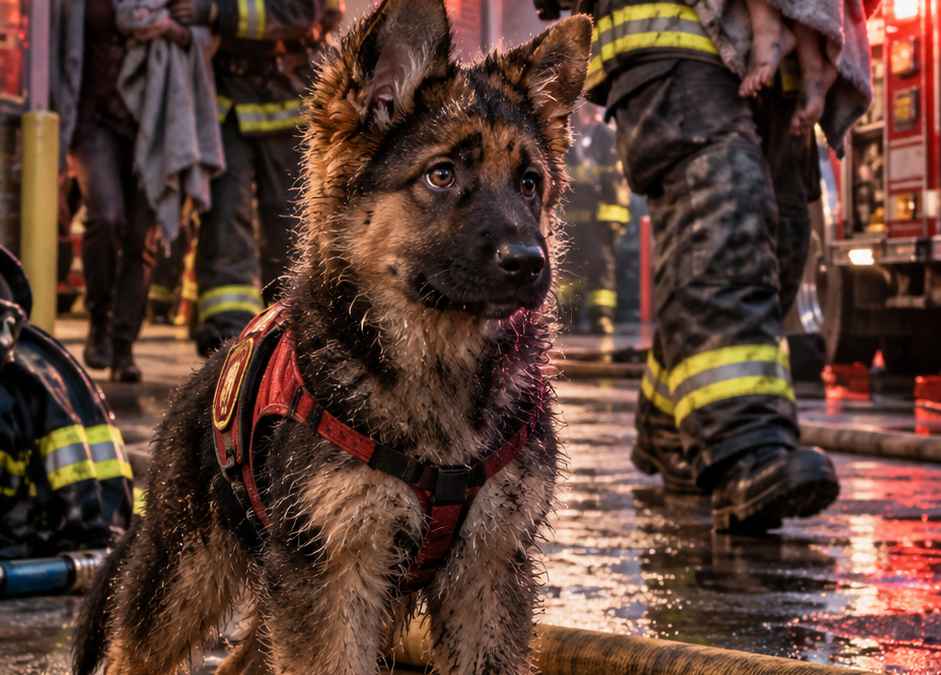
𝗣𝗔𝗥𝗧 𝟮
I didn’t take Baxter to a shelter that night.
I told myself it was because the hour was late.
Because he was wet.
Because he was tired.
Because a municipal intake facility at midnight would be unnecessarily stressful.
All technically reasonable.
Also incomplete.
The truth was simpler.
I didn’t want to hand him over.
Not yet.
I lived alone in a second-floor apartment that had never been designed with a young German Shepherd in mind.
No dog bed.
No bowls.
No crate.
No toys.
No food appropriate for a puppy.
What I had was an old wool blanket, some plain cooked chicken in the refrigerator, and a heating system that occasionally made sounds like it was preparing for death.
Good enough for one night.
I carried Baxter upstairs.
The elevator groaned.
He didn’t react.
My keys rattled.
No reaction.
I opened the apartment door.
He remained in my arms.
“You’re allowed down.”
He looked at the floor.
I lowered him carefully.
For several seconds he didn’t move.
Then he walked three steps.
Stopped.
Looked back.
“Yeah. Still here.”
Another three steps.
He inspected the living room.
The couch.
Coffee table.
Kitchen doorway.
Then curled up on the blanket I placed near the radiator.
I made him a small meal.
Chicken.
Rice.
Water.
Baxter ate slowly.
That told me something.
He wasn’t feral.
Someone had fed him from bowls.
Someone had taught him patience.
Someone had once cared enough to give him a name.
That made the tower harder to understand.
I sat on the floor several feet away.
He watched every movement I made.
When I stood, his head came up.
When I walked to the kitchen, he tracked me.
When I returned, he relaxed.
Around two in the morning, I woke on the couch.
I’d fallen asleep sitting upright.
Baxter wasn’t on the blanket.
For half a second, panic.
Then I felt pressure against my ribs.
He had climbed onto the couch and curled beside me, nose tucked beneath my arm.
I looked down.
“That’s not your spot.”
Baxter breathed.
I didn’t move him.
The next morning, I called my captain.
“I’m coming in late.”
There was a pause.
“You sick?”
“No.”
“Injured?”
“No.”
“Then why are you—”
“I found a dog.”
Longer pause.
Then:
“Of course you did.”
I took Baxter to a veterinary clinic on Southeast 42nd.
The exam was better than I feared.
Mild dehydration.
Underweight.
Small paw injury.
Fleas.
No broken bones.
No evidence of severe abuse.
No microchip.
No collar except the red leash he’d been tied with.
The veterinarian, Dr. Priya Shah, ran one hand down his back while Baxter stood quietly.
“Sweet dog.”
“Too quiet.”
She looked at me.
“You noticed.”
“He doesn’t act like a puppy.”
“Stress does that.”
“Can you tell how long he was tied there?”
“No.”
“Hours?”
“Possibly.”
“Days?”
“Could be, but he isn’t severely dehydrated enough for me to think he was without access to water for very long.”
That helped.
Slightly.
“Somebody raised him?”
“Almost certainly. He’s comfortable with people, accepts handling, knows basic inhibition.”
“Then why leave him?”
Dr. Shah gave me the answer professionals learn to use when people want certainty that doesn’t exist.
“I don’t know.”
I hated it.
She cleaned his paw.
Vaccinated him.
Treated the fleas.
Gave me food recommendations.
Then looked over the top of Baxter’s chart.
“You taking him to animal services?”
“I’ll file the found-dog report.”
“That’s not what I asked.”
Baxter sat beside my leg.
I looked down.
“Temporary.”
Dr. Shah smiled in a way I didn’t appreciate.
“Of course.”
I stopped at Engine 9 that afternoon to drop off gear.
Baxter sat in the passenger seat.
Bandage around one paw.
Head turned toward the open window.
Reyes spotted him first.
Miguel Reyes had worked beside me for eleven years and believed every situation could be improved by making it somebody else’s problem.
He leaned toward the truck.
“What’s that?”
“A dog.”
“I can see that.”
“Then why ask?”
“New recruit?”
“No.”
Baxter looked at him.
Reyes grinned.
“He’s already smarter than Nate.”
Nate, our newest firefighter, shouted from inside the bay.
“I heard that.”
“Good.”
Dennis came out carrying coffee.
Then the captain.
Then half the shift.
Within thirty seconds, Baxter had more people staring at him than he had probably ever wanted.
He didn’t retreat.
Just watched.
Reyes held out a hand.
Baxter sniffed.
Allowed one chest scratch.
“What’s his name?”
“Baxter.”
“Yours?”
“Temporary.”
Everyone laughed.
I hated that word by the end of the week.
Baxter stayed with me because no matching missing-dog reports surfaced.
I filed every form I was supposed to.
Called local shelters.
Posted photographs.
Asked the county dispatcher if anyone had reported a dog missing near the tower.
Nothing.
I kept the child’s note inside a plastic evidence sleeve in my kitchen drawer.
I read it more often than I admitted.
Dad said firefighters save everyone.
Who was Dad?
A firefighter?
A parent telling a child stories?
Why couldn’t the family keep Baxter?
Why tie him at the tower instead of surrendering him properly?
I could invent ten explanations.
None would become true just because one sounded compassionate.
So I waited.
Baxter settled into my apartment.
Not like a puppy.
Like a guest afraid to overstay.
He never jumped on counters.
Never stole food.
Didn’t chew furniture.
Didn’t bark when people passed the hallway.
He followed me from room to room, but always at a distance.
If I made coffee, he sat near the kitchen door.
If I showered, I opened the curtain afterward and found him lying on the bathroom mat.
When I sat to read, he curled near my chair.
He didn’t ask for much.
That bothered me.
Young dogs should be inconvenient.
They should test boundaries.
Steal socks.
Demand attention.
Baxter seemed to have learned that being unobtrusive was safer.
So I gave him permission to be annoying.
I bought toys.
He ignored them.
I rolled a tennis ball.
He watched it.
I squeaked a stuffed duck.
He looked offended.
Three days later, I brought him to the firehouse.
Just for an hour.
The garage doors were open.
Engines polished.
Tools being checked.
Reyes immediately produced treats he’d apparently been carrying for no legitimate reason.
“Thought you weren’t a dog guy,” I said.
“I’m not.”
He fed Baxter another piece.
“Professional courtesy.”
Baxter explored cautiously.
He sniffed the tires.
The hose racks.
A turnout coat hanging from a hook.
Then Nate dropped a Halligan bar.
Metal slammed against concrete.
The sound cracked through the bay.
Baxter flinched.
His entire body tightened.
But instead of bolting, he moved.
Directly in front of me.
He planted himself between me and the sound.
No barking.
No growling.
Just there.
Reyes looked at me.
I looked at Baxter.
“Buddy.”
Baxter glanced back.
“You’ve got the relationship backward.”
He stayed there another ten seconds before relaxing.
After that, nobody called him “the dog.”
He was Baxter.
Dennis brought an old sleeping pad.
Reyes kept treats in his locker.
Nate started sitting beside him during paperwork.
Even Captain Wallace, a man who considered visible affection a structural weakness, scratched Baxter behind one ear when he thought nobody was watching.
Baxter learned the station quickly.
He knew the apparatus floor.
The kitchen.
The bunk room doorway.
He never entered restricted areas unless invited.
He figured out shift change by watching gear bags appear.
He knew the difference between routine radio chatter and a call tone.
When the alert sounded, his head lifted.
The crews moved.
Baxter watched.
Always watched.
He was not allowed on active calls.
That rule mattered.
A fireground is dangerous enough without adding an untrained dog.
But around the station, he became useful in ways nobody had predicted.
After difficult calls, firefighters often become quiet.
People outside the job imagine adrenaline and action.
They don’t see the hour afterward.
Gear stacked.
Coffee untouched.
Everybody replaying one detail they wish had gone differently.
Baxter would wander the room during those moments.
Not anxiously.
He’d choose someone.
Sit beside them.
Sometimes lean.
Sometimes just stay.
One night after a fatal collision response, Nate sat alone on the back steps.
First death on his shift.
I was about to go outside.
Baxter beat me there.
He sat beside Nate.
Nate put one hand on his back.
Neither moved for twenty minutes.
That was the first time I realized Baxter wasn’t only helping me.
My father’s death had happened fourteen months before I found him.
Lung cancer.
Aggressive.
By the time we understood how sick Dad was, the timeline had already narrowed.
He spent forty years in the fire service.
Retired ten years.
Still introduced himself as a firefighter.
At the end, I sat beside his hospital bed trying to make conversation because silence frightened me.
He looked at me once and said:
“Sam, you know you don’t have to fill every room.”
I didn’t understand.
Not then.
After he died, my apartment became unbearable.
So I worked overtime.
Stayed late.
Volunteered for inspections.
Anything that delayed going home.
I called it dedication.
It was grief with a badge on.
Baxter ruined the arrangement.
Because now when I went home, someone was waiting.
Not dramatically.
He didn’t leap at the door.
He sat.
Tail moving twice.
Then followed me inside.
One night, after a twelve-hour shift became sixteen, I came home smelling like smoke.
Dropped my gear bag.
Sat on the floor because the couch felt too far away.
Baxter walked over.
Put his head in my lap.
I stayed there for nearly an hour.
No phone.
No television.
No noise.
The low hum I’d been carrying inside my chest since Dad died quieted.
Not disappeared.
Quieted.
A week later, I took Baxter back to the tower.
Daylight.
Dry ground.
No storm.
The tower looked smaller than it had in my memory.
Most places from childhood do.
Baxter jumped out of the truck.
Stopped.
Nose high.
He knew the place.
No question.
He followed the same path toward the base.
The red leash had been removed after I filed the initial report, but marks remained in the mud where the post stood.
Baxter sniffed.
Then sat.
I lowered myself onto the bottom step.
Dad and I had eaten lunch right there when I was twelve.
Peanut butter sandwiches.
He’d let me wear his helmet.
I had thought firefighters were invincible.
Then I became one and learned the uniform mostly teaches you how mortal everybody is.
Baxter sat against my boot.
I looked at the tower.
“He’s not temporary.”
Saying it out loud surprised me.
Baxter looked up.
“I’m talking to Dad.”
Tail tap.
“Don’t make it weird.”
Wind moved through the trees.
No ghost.
No sign.
Just air.
Still, something in me settled.
Back at the station, Baxter’s role expanded slowly.
We took him to a community open house.
Then a school safety event.
Then a hospital requested a visit after one of the pediatric nurses saw a photo of him at the station.
That first hospital visit changed everything.
The patient was a seven-year-old boy named Mason recovering from burn injuries to both lower legs.
He was medically stable.
Emotionally shut down.
Wouldn’t speak to staff except his mother.
Barely tolerated physical therapy.
We did not simply walk Baxter into his room.
The hospital’s child-life specialist evaluated the situation first.
Baxter remained on leash.
I watched his body language closely.
If he showed stress, we left.
He didn’t.
We entered quietly.
Mason turned his face toward the wall.
I introduced myself.
No response.
Then Baxter moved.
Slowly.
He stopped beside the bed.
Did not jump.
Did not reach.
Rested his chin on the mattress edge.
Mason looked.
One finger emerged from beneath the blanket.
Touched Baxter’s ear.
Then another.
His whole hand.
Baxter stayed.
Mason whispered:
“Hi.”
His mother covered her mouth.
That one word hit harder than most applause I’ve ever heard.
I looked away.
Baxter leaned slightly closer.
Mason wrapped both arms around his neck.
Afterward, his mother gave me a drawing.
Crayon fire truck.
Baxter underneath.
Mason beside him.
I put it in my locker.
It’s still there.
That was the moment Captain Wallace stopped pretending Baxter was a novelty.
We contacted a certified therapy-dog organization.
Baxter went through proper evaluation.
Temperament.
Handling tolerance.
Crowds.
Medical environments.
Unexpected sounds.
Children.
Mobility equipment.
He didn’t pass everything immediately.
One rolling IV stand startled him badly.
We worked on it.
A month later, retest.
Pass.
Good.
I didn’t want his story to become:
Abandoned dog magically heals everyone.
That’s not how dogs work.
That’s not how people work.
Baxter had an aptitude.
Then training.
Then supervision.
That made him useful.
Three weeks after I found him, I called the shelter again to finalize his legal status.
The woman checking old files paused.
“Wait.”
“What?”
“You said his name is Baxter?”
“Yeah.”
“We had a Baxter several months ago.”
My pulse jumped.
“German Shepherd?”
“Young male shepherd, yes.”
“What happened?”
She read.
A family had adopted him.
Father and daughter.
Returned him after several weeks because the dog was “too demanding.”
Then apparently changed their minds.
Before they returned, Baxter escaped from a foster holding yard during a storm.
Never recovered.
I stared at the phone.
“Can you give me their address?”
“No.”
“Phone?”
“No.”
“Anything?”
“I can forward a message.”
So I wrote one.
Baxter is safe.
He is healthy.
He was found near an abandoned fire tower.
If your family believes this is the same dog, contact me through the shelter.
Three days later, someone knocked on my apartment door.
Rain again.
Of course.
I opened it.
A girl stood there.
Ten, maybe eleven.
Dark wet hair.
Mud on her sneakers.
Her mother waited behind her.
The girl held an envelope with both hands.
Baxter appeared beside me.
The moment he saw the girl, everything changed.
Tail.
Fast.
Then he sat.
She started crying.
“Baxter.”
He moved forward.
Stopped inches away.
The girl crouched.
He pressed his head into both her hands.
No uncertainty.
They knew each other.
I invited them in.
Her name was Emma.
Her mother’s name was Claire.
Emma explained in fragments.
Her father had been through what she called “a bad time.”
Lost work.
Drinking.
Arguments.
Housing problems.
Baxter had been too energetic in their apartment.
Her father returned him.
Emma begged.
They went back.
Baxter had escaped before they could bring him home again.
Months later, after the family situation worsened, they had to move temporarily.
Eventually, Emma’s father entered treatment.
Claire and Emma lived with relatives.
Somewhere in that chaos, Emma found Baxter again.
How exactly he ended up back with them before the tower was still unclear.
Emma looked at her mother.
Claire’s face tightened.
Then she said:
“We got him back through someone who’d found him wandering. But our housing wouldn’t allow him.”
Emma whispered:
“Dad said we couldn’t keep him.”
I looked at the girl.
“You wrote the note?”
She nodded.
“Why the tower?”
“My dad told me firefighters used to be there.”
“It’s abandoned.”
“I didn’t know.”
Her face collapsed.
“I thought somebody would come.”
That nearly destroyed me.
“Why not the station?”
“We didn’t have a car. Mom was working. Dad was… sick.”
Claire closed her eyes.
Emma continued:
“He used to say firefighters save everybody.”
There it was.
Not manipulation.
Belief.
A child with no good option trying to construct one from something her father had once told her.
I did not tell her leaving a dog tied outside was safe.
It wasn’t.
But I also wasn’t going to turn a frightened ten-year-old into a villain because the adults around her had failed first.
She handed me the envelope.
Inside was a drawing.
Baxter beneath a tree.
Red leash.
And the words:
Thank you for finding him. I hoped somebody good would.
I sat on the floor.
Emma sat across from me.
Baxter between us.
“Do you want him back?”
The question came out before I was ready.
Emma looked at her mother.
Claire looked at me.
Then Emma shook her head.
“We still can’t have him where we live.”
She rubbed Baxter’s ears.
“And he looks happy.”
I didn’t trust myself to speak.
Emma whispered to him:
“You found a firefighter.”
Baxter licked her hand.
She laughed through tears.
That sound stayed with me.
Before leaving, Claire asked:
“Are you keeping him?”
I looked at Baxter.
“Yes.”
The answer was easy now.
Emma nodded.
“Good.”
That night, I filled out the adoption paperwork.
Officially.
Samuel Mercer.
Baxter Mercer.
I stared at the form.
Then signed.
At the station the next morning, Reyes saw the copy.
He pointed.
“Temporary?”
“Shut up.”
The first time Baxter barked at the station happened two months later.
Nate jammed his finger in a locker mechanism and yelped.
Baxter shot upright.
One deep bark.
Everyone froze because we’d almost never heard him vocalize.
Then he walked over, sniffed Nate’s hand, sat.
Reyes said:
“Medical officer Baxter.”
Nate held up his bandaged finger.
“He’s got better bedside manner than you.”
True.
The station started referring to Baxter as “Inspector Nine.”
He had a habit of walking through the bay while we checked equipment.
Most of what people later credited to him was coincidence.
If he sniffed a helmet we had already identified as needing a strap replacement, suddenly:
“Baxter found it.”
No.
Baxter smelled sweat.
Still, he did have one useful behavior.
He paid attention when something changed.
A loose oxygen bottle rolled slightly once.
Baxter barked.
The crew secured it.
Another day, a smoke detector battery in the dorm area began chirping.
Baxter found the room before we did.
Useful dog.
Not supernatural.
We kept perspective.
Then came the small residential fire.
Kitchen exhaust fan.
Contained quickly.
An older retriever inside the home had panicked and hidden behind a washer.
The homeowner couldn’t reach him.
Fire was out.
Structure ventilated.
Scene safe enough.
Baxter was on-site because we’d been returning from an outreach visit when the call came, but he remained outside the hazard zone.
The retriever refused everyone.
Growled.
Terrified.
I asked the owner:
“Dog-friendly?”
“Usually.”
I brought Baxter near, with permission.
Not into danger.
To the doorway.
The retriever saw him.
Baxter lay down.
Nothing more.
Two minutes later, the old dog crawled forward.
Then farther.
Enough for us to leash him.
The homeowner cried.
“How did he do that?”
“He didn’t.”
She looked confused.
“Your dog decided another dog was less scary than us.”
That was the truth.
Still mattered.
Then Baxter found the puppy at the garage fire.
That one became news.
We arrived to a detached-garage blaze behind a small home.
Residents accounted for.
No one reported animals in danger.
The main fire was being knocked down.
Baxter was secured near the apparatus with an off-duty station volunteer because we’d been doing community work earlier.
As I checked the rear perimeter after conditions improved, Baxter became intensely focused toward a side yard.
Pulling.
Not normal for him.
The volunteer called:
“Sam!”
I followed Baxter’s line of attention.
Behind a shed stood a chain-link enclosure.
Inside, partly obscured by smoke, two dog crates.
One open.
One closed.
“Animal!”
We notified command.
Once the area was deemed accessible, I entered with proper respiratory protection.
The crate contained a three-month-old puppy.
Alive.
Overheated.
Terrified.
I got him out.
Baxter didn’t go into the hazard.
He didn’t need to.
His nose and attention had pointed us to a place we had overlooked.
The puppy survived.
Someone filmed part of the scene from across the street.
By dinner, the video was everywhere.
FIREHOUSE DOG ALERTS CREW TO TRAPPED PUPPY
For once, the headline was mostly accurate.
City Hall wanted to recognize him.
Captain Wallace thought it was funny.
Reyes wanted Baxter to have a tiny helmet.
I vetoed that.
The mayor’s office gave him a ceremonial medal during a community event.
Baxter tolerated approximately forty seconds before looking at me like democracy had failed.
I whispered:
“Almost done.”
The medal clicked against his collar.
He yawned.
Perfect.
Then came the call that changed Baxter from a station dog into something else.
Warehouse fire.
Again.
Different building.
Different year.
Same kind of black smoke that turns noon into midnight.
By then Baxter had lived with me almost seven months.
He was never routinely allowed on active fire scenes.
That day, however, we’d been returning from a scheduled hospital visit when dispatch sent Engine 9 directly to the warehouse.
Baxter remained inside the command vehicle with a department aide.
Windows up enough for safety.
Climate controlled.
Harness attached.
I told him:
“Stay.”
He knew that command.
Then I entered the building.
The fire was deeper than expected.
Paint.
Electronics.
Old furniture.
A maze of storage.
Reyes and I advanced a line toward the rear.
Heat climbed.
Visibility dropped.
We worked methodically.
Then the ceiling gave a warning.
A crack.
Long.
Ugly.
I shouted.
“Move!”
Reyes turned.
A section dropped.
Not the full roof.
Enough.
Something struck my shoulder.
I went down.
My mask shifted.
Airflow became unreliable.
Reyes tried to reach me.
Debris separated us.
I keyed my radio.
Or thought I did.
Static.
Then silence.
Outside, nobody knew exactly where I’d fallen.
That mattered.
Inside a structure with near-zero visibility, ten feet can become another planet.
I crawled.
My shoulder screamed.
My mask seal kept slipping.
I remember thinking one stupid thing.
Baxter is waiting.
Not Dad.
Not some profound reflection on mortality.
My dog.
I had told him I’d come back.
Outside, Baxter began going frantic.
The aide later told me it started when crews initiated the emergency traffic for a missing firefighter.
Maybe the tones.
Maybe the voices.
Maybe he sensed the shift in everyone around the command vehicle.
Baxter barked.
Pulled.
The aide tried to calm him.
Then someone opened the vehicle to grab medical gear.
Baxter slipped the restraint.
He did not run into the burning warehouse.
Despite what one newspaper later claimed.
He ran to the side entrance our team had used.
Stopped.
Barked continuously.
Then moved along the exterior wall toward a broken loading opening.
Firefighters followed.
At that same time, Reyes managed to transmit my approximate location.
The second team entered from the loading side.
They found me faster than the original access route would have allowed.
Did Baxter “save” me?
Not alone.
Not magically.
Reyes’s radio call mattered.
The rapid intervention team mattered.
Training mattered.
Baxter’s behavior helped direct attention toward an alternate access point.
That mattered too.
I remember almost none of the removal.
Oxygen.
Hands.
Noise.
Then daylight.
I woke later in the hospital.
Smoke inhalation.
Shoulder injury.
Minor burns.
No permanent lung damage.
Lucky.
First question:
“Baxter?”
The nurse smiled.
“Your dog?”
“Yeah.”
“He’s downstairs with one of your firefighters.”
“Is he hurt?”
“Not badly.”
He’d inhaled a small amount of smoke near the loading area before responders pulled him farther back.
His paws had superficial abrasions from debris outside.
Nothing serious.
I demanded to see him.
The nurse refused.
Apparently hospitals maintain rules even when firefighters are emotionally persuasive.
An hour later, Reyes brought Baxter to the doorway after clearance from staff.
Bandage on one paw.
Baxter saw me.
Stopped.
Then moved so fast Reyes almost lost the leash.
He reached the bed.
Put his head against my hand.
I lost whatever argument I’d spent twenty-four years constructing about not being “that kind of man.”
I cried.
Quietly.
Didn’t care who saw.
“You weren’t supposed to leave the truck.”
Baxter pressed closer.
“You hear me?”
Tail.
“You follow instructions terribly.”
Reyes stood in the corner smiling.
“Want me to leave?”
“Yes.”
“No.”
“Then stop smiling.”
Baxter rested his head against my side.
Captain Wallace visited later.
“The city wants to do another press thing.”
“No.”
“Figured.”
“They’re going to make him sound like he ran into the inferno and carried me out.”
“Probably.”
“He didn’t.”
“I know.”
“Then correct them.”
Wallace nodded.
“We will.”
That mattered to me.
Hero stories become dangerous when they erase procedure.
Baxter was brave.
He was observant.
He helped.
But no dog should be encouraged to enter an active fire scene because a viral story made recklessness look noble.
We changed our policy afterward.
If Baxter arrived from outreach during an emergency call, he would transfer to a designated handler away from operations.
No exceptions.
I loved him enough to stop romanticizing risk.
Two days after I returned home, a package appeared outside my apartment.
No return address.
Inside:
A heavy leather collar.
Brass tag.
BAXTER
ENGINE 9
PARTNER • FAMILY
And another note.
Same handwriting.
Emma.
I knew he’d help somebody. I didn’t know it would be you.
I sat on the porch.
Baxter rested his chin on my knee.
I read it again.
Then called Claire.
Emma answered.
“Is he okay?”
“He’s okay.”
“Are you?”
“Yeah.”
Pause.
“Did you get the collar?”
“I did.”
“I saved money.”
My throat tightened.
“You didn’t have to.”
“I wanted to.”
I looked at Baxter.
“Thank you.”
She whispered:
“Thank you for coming back.”
That sentence landed hard.
Because I knew she wasn’t talking only about me.
Baxter returned to the station after my medical leave ended.
Reyes had hung a banner.
WELCOME HOME, BAXTER.
My name wasn’t on it.
“Nice.”
Reyes shrugged.
“You’re less popular.”
True.
Kids sent letters.
Drawings.
School invitations.
Hospital requests.
We developed something more formal rather than letting popularity control us.
Baxter became part of a community outreach program with certified handlers, scheduled rest, behavioral oversight, and clear limits.
Schools.
Pediatric units.
Burn recovery programs.
Veterans groups.
Firefighter mental-health events.
No pretending he was a medical treatment.
He was what he was.
A well-socialized dog whose calm presence helped people feel safe enough to engage.
Sometimes that’s a lot.
A seven-year-old girl at one hospital hadn’t spoken since a traumatic accident.
We entered.
Baxter lay several feet away.
No forcing contact.
Five minutes.
Ten.
Her hand reached.
Touched his back.
Then she whispered:
“Hi.”
One word.
The nurse cried.
I didn’t call it a miracle.
I called it a beginning.
Kids started recognizing Baxter around Portland.
At school visits, they asked:
“Did he really save a firefighter?”
I answered:
“He helped.”
“Is he a hero?”
“He’s a dog who pays attention.”
“Can he drive the truck?”
“No.”
Reyes once whispered:
“Yet.”
I kicked his boot.
The department created a small fund connected to Baxter’s outreach—not a viral free-for-all, but a properly managed program to help shelters prepare suitable rescue dogs for therapy and community-support work.
People donated.
Enough to cover training scholarships.
Veterinary care.
Equipment.
That meant more to me than any medal.
Not because Baxter proved every rescue dog should have a job.
Most shouldn’t.
Some need nothing more than a stable home.
But the right dog, with the right temperament and proper training, can do meaningful work.
Baxter happened to be one.
About a year after the tower, another letter came.
Same handwriting.
Older now.
More confident.
Hi Sam.
Dad is doing better. We have an apartment now. He has a job again. I see Baxter online sometimes. I hope he still likes trees. Thank you for not giving up on him.
No last name.
No address.
Claire later confirmed Emma had asked to send it through the shelter.
I took Baxter to the tower that evening.
The path was overgrown.
The tower leaned slightly more.
Rust everywhere.
I sat on the bottom step.
Read the letter aloud.
Baxter sniffed grass.
“You do still like trees.”
He looked at me.
Then wandered toward the same post.
No fear.
No hesitation.
Just scent.
Memory, maybe.
I pulled out the original note.
I’d kept it folded in my wallet until it nearly disintegrated.
Please help Baxter. Dad said firefighters save everyone.
I laughed quietly.
“Kid put a lot of pressure on us.”
Baxter sat.
I thought of Dad.
His old station coat.
His hands.
The tower.
The things he taught me intentionally.
The things I only understood after he was gone.
He used to say firefighting wasn’t mostly about bravery.
“It’s showing up, Sammy.”
I hated being called Sammy.
“Anybody can be brave for thirty seconds. The work is showing up every day.”
Baxter leaned against my boot.
That was his real gift too.
Not dramatic rescues.
Presence.
He showed up.
The department later named the outreach program Baxter’s Shift.
Schools.
Recovery centers.
Hospitals.
Veterans organizations.
We partnered with certified animal-assisted support groups rather than improvising.
Baxter worked limited hours.
Rest days mandatory.
No endless crowds because people wanted photos.
His welfare came first.
He was a dog before he was a symbol.
At home, there were no medals.
No cameras.
No turnout coat.
He slept on my bed.
Stole one entire roast chicken from the counter at age two.
Destroyed Reyes’s favorite cap.
Developed an irrational hatred for the vacuum cleaner.
Snored.
A lot.
The same city that called him a hero would have been less impressed watching him panic because a grocery bag stuck to his tail.
Good.
I loved that version most.
Then came the training-lot incident.
Controlled burn.
Planned exercise.
Wind shifted faster than forecast.
Embers reached dry brush near the perimeter.
Crews contained most of it quickly.
But smoke rolled toward a neighboring public trail.
Baxter was at the command area after participating in an earlier demonstration.
Secured.
Handled.
Then someone screamed.
Child.
A girl, around eleven, had slipped under a temporary barrier from a nearby trail and become disoriented between smoke and fencing.
Nobody knew she was there until that scream.
I moved toward the sound.
So did two other firefighters.
Baxter reacted.
His handler held him.
He pulled hard.
Not toward the fire.
Toward the child’s voice.
We did not simply release him into flames.
We moved as a team through the safe edge of the smoke zone.
Baxter on line.
Then we saw her.
Frozen.
Crying.
Couldn’t decide which direction was safe.
I called:
“Don’t move!”
She looked at us.
Baxter reached her first because his line extended ahead of me.
He pressed sideways against her legs.
She grabbed his harness.
That contact broke the panic.
I reached them seconds later.
Picked her up.
We withdrew.
The fire never reached us.
Her parents arrived later.
She was uninjured except for minor smoke exposure.
Someone had filmed part of the rescue from a distance.
The clip spread.
Again.
Baxter standing against the girl’s knees became the image everyone shared.
Headlines called it:
FIREHOUSE DOG LEADS CHILD FROM FLAMES
Not exactly.
I spent half the next morning correcting reporters.
He didn’t “lead her through fire.”
He stabilized a panicked child long enough for me to reach her.
Still brave.
Still useful.
Still enough.
At the station, Reyes slid a clipboard across the table.
Honorary Member, Engine 9
Every name signed.
Mine last.
I clipped a small ceremonial badge to Baxter’s outreach vest.
Not duty gear.
He looked at me.
Tail thump.
“Don’t get promoted past me.”
Another thump.
Life settled.
Calls.
Walks.
School visits.
Hospital visits.
Home.
Years began moving faster.
Baxter reached three.
Then five.
His black coat remained mostly dark, rust markings deepened.
The worried eyebrows never disappeared.
At six, he reduced hospital work.
Crowds tired him sooner.
At seven, formal therapy visits ended completely.
No tragedy.
Retirement.
He had done enough.
Engine 9 still belonged to him.
He would visit.
Sleep under the whiteboard.
Inspect the kitchen.
Beg from Reyes despite strict rules everybody ignored.
At eight, arthritis began.
Mild.
Managed.
At nine, he preferred shorter walks.
At ten, he stopped jumping into my truck.
I bought a ramp.
Reyes said:
“Old man.”
I wasn’t sure which of us he meant.
Probably both.
Emma visited occasionally over the years.
She grew up.
Graduated high school.
Her father stayed in recovery.
Their relationship remained complicated but improving.
When she was sixteen, she visited the station.
Baxter saw her.
Slow tail wag.
Walked straight to her.
She knelt.
He pressed his head against her chest.
She cried.
“So you remember me.”
I don’t know whether he remembered the way humans do.
Her scent.
Her voice.
Some association.
Enough.
She sat with him for an hour.
Before leaving, she told me:
“I used to feel guilty.”
“For what?”
“The tower.”
“You were a kid.”
“I still left him.”
“Because every adult option around you had collapsed.”
She looked down.
“I could’ve done something different.”
“Maybe.”
I didn’t lie.
“But you also left a note where you believed somebody would help.”
Her eyes filled.
“I thought firefighters saved everyone.”
I smiled.
“We try.”
She touched Baxter’s ear.
“You did.”
“No.”
I looked at the old dog.
“We all did pieces.”
That became my understanding of rescue.
Nobody saves alone.
The person who calls.
The dispatcher.
The neighbor who points.
The medic.
The firefighter.
The veterinarian.
The family.
The dog who stays calm at the right moment.
Pieces.
Baxter’s older years were quieter.
Good.
He deserved quiet.
I retired from active fire service when he was eleven.
Twenty-nine years total.
My final shift was embarrassingly emotional.
Engine 9 crew lined the bay.
Baxter wore his leather collar.
No ceremony from him.
He sniffed someone’s lunch.
Afterward, I took him to the tower.
Dad had been dead almost twelve years.
Baxter gray around the muzzle.
Me gray everywhere.
The structure had finally been fenced off for safety.
We couldn’t sit on the old steps.
So we sat on a fallen log nearby.
I brought two sandwiches.
Habit.
One turkey for me.
A dog-safe portion for him.
“You know, Dad brought me here when I was ten.”
Baxter stared at my sandwich.
“Sentimental moment.”
Still staring.
I gave him turkey.
“Better?”
Yes.
We sat.
I thought about Dad’s last years.
My years at the station.
Baxter tied to the post.
Emma writing that note.
The children.
The firefighters.
The fires.
The mistakes.
The people we saved.
The people we couldn’t.
The thing about a career built around emergency is that eventually you learn not every story ends well.
Baxter hadn’t changed that.
He changed how I carried it.
Dad once wrote something on the back of an old photograph.
I found it after retiring.
Picture of me at ten standing beside him near Engine 9.
On the back:
Save lives. Don’t forget to live yours.
I had spent years doing the first part.
Baxter forced the second.
Retirement with him was simple.
Morning walk.
Coffee.
Porch.
Occasional firehouse visit.
Kids recognized him less as years passed.
Good.
Fame is useless to a dog.
He cared about familiar hands.
Reyes.
Captain Wallace after he retired.
Emma.
Me.
At thirteen, Baxter developed kidney disease.
Medication helped.
Diet changed.
He considered the new food a personal attack.
At fourteen, his hind legs weakened.
We used rugs.
Ramps.
More rest.
He still thumped his tail twice every time I came home.
Always twice.
That remained.
His final winter came quietly.
No fire.
No emergency.
No dramatic rescue.
Cancer.
Advanced.
The veterinarian gave me options.
Some treatment might buy time.
Aggressive.
Hard.
I asked the question every dog owner eventually has to ask.
“Would it give him better days?”
The vet hesitated.
“Probably not many.”
That was enough.
Comfort.
Food.
Pain control.
Home.
Emma came to see him.
She was twenty-four by then.
Baxter lay on his bed.
She sat beside him.
Placed one hand on his chest.
“I used to think leaving you there was the worst thing I ever did.”
Baxter’s eyes opened.
She smiled through tears.
“Maybe it was.”
I started to speak.
She shook her head.
“It’s okay.”
She looked at me.
“It can be something I regret and still be the thing that led him here.”
That was wiser than anything I could have told her.
Baxter licked her fingers.
She laughed.
Before leaving, she whispered:
“Firefighters save everyone.”
Then looked at me.
“Guess Dad was almost right.”
“Almost?”
She nodded toward Baxter.
“Sometimes dogs do too.”
His last morning was clear.
Cold.
Portland sky pale blue.
I carried his bed near the window.
He watched trees move.
Dr. Shah—yes, the same vet who examined him the day after I found him—came to the apartment.
Older now.
So was I.
Baxter rested his head in my lap.
I had the original note.
Fragile.
Almost unreadable.
I placed it beside him.
“Remember this?”
No reaction.
Good.
He didn’t need the story.
I did.
I scratched behind his ear.
“You weren’t trained to be a hero.”
His eyes opened.
“Good.”
I smiled.
“Heroes are exhausting.”
Tail.
One faint thump.
“You’re just Baxter.”
Another.
Two.
Always two.
Dr. Shah gave the first medication.
His body relaxed.
I thought of the warehouse.
The hospital.
The child at the training lot.
Mason reaching from the hospital bed.
Nate on the back steps.
Reyes staring at sunsets beside him.
Emma in the rain.
Dad.
The tower.
Everything.
Then I thought about home.
Baxter asleep against my chest the first night.
That was the memory I wanted.
Not smoke.
Not medals.
A wet puppy finally warm enough to sleep.
I put my hand over his ribs.
“You’re not alone.”
The same promise from that first night.
His breathing slowed.
“I’ve got you.”
One breath.
Then another.
Then stillness.
I stayed there.
No sirens.
No radios.
No one calling for help.
Just the quiet my father had once told me not to fear.
Earned silence.
After Baxter died, Engine 9 asked if they could hang his ceremonial badge in the station.
I agreed.
Not in some dramatic memorial.
Beside the community-outreach photographs.
Where he belonged.
One picture shows Baxter with Mason.
Another with the girl from the training lot.
One with the entire Engine 9 crew.
My favorite is different.
Baxter lying beneath the kitchen table asleep while firefighters’ boots surround him.
No heroism.
No cameras.
Home.
Emma kept one copy of the original note.
I kept the other in a frame with Dad’s photograph.
Two sentences from two people who never met.
Dad:
Save lives. Don’t forget to live yours.
Emma:
Dad said firefighters save everyone.
Neither sentence is completely true.
We don’t save everyone.
That is the first brutal lesson of emergency work.
Sometimes we arrive late.
Sometimes fire moves faster.
Sometimes bodies fail.
Sometimes people make decisions we cannot undo.
But saving was never really the lesson Baxter left me.
Staying was.
Showing up.
Being present after the sirens stop.
Sitting beside a rookie who can’t talk after his first bad call.
Resting your head on a child’s bed until he finds one word.
Standing near a frightened dog until it decides to move.
Waiting beside an old firefighter who has spent years pretending he isn’t grieving.
Baxter did those things without speeches.
Without understanding the symbols people put on him.
He didn’t know what a medal was.
Didn’t know what newspapers called him.
Didn’t know a million people might watch a video.
He knew voices.
Scents.
Safe places.
His people.
That was enough.
People sometimes still call him the firehouse puppy who saved lives.
I’m okay with that now.
As long as the full truth comes with it.
He wasn’t born knowing how to rescue people.
He wasn’t fearless.
He wasn’t magical.
He startled.
He got tired.
He needed training.
He needed boundaries.
He needed protection too.
The brave things he did mattered because he was still a dog.
A dog someone once tied to a rusted post in the rain.
A dog a frightened child trusted strangers to help.
A dog who learned the firehouse was home.
A dog who gave back what the world had finally given him.
Safety.
Presence.
Belonging.
I thought the important moment in Baxter’s story was when I untied that red leash.
It wasn’t.
The important moment came afterward.
Again and again.
Every time somebody chose to stay.
Emma leaving the note.
Me opening the truck.
Dr. Shah treating him.
Engine 9 accepting him.
Baxter sitting beside people who hurt.
Me coming home.
Him waiting.
Years of ordinary return.
That is what turned abandonment into a life.
Not one dramatic rescue.
Thousands of small ones.
And if my father had been alive to meet Baxter, I know exactly what he would have done.
He would have pretended not to like dogs in the station.
Complained about hair on his coat.
Slipped Baxter half his sandwich under the table.
Then looked at me when nobody else was listening and said:
“See, Sammy?”
I would have rolled my eyes.
He would have smiled.
And somewhere nearby, Baxter’s tail would have hit the floor twice.
Always twice.
Have you finished reading the story and want to read it again?
They Left a German Shepherd Puppy Tied to a Fire Tower—Then He Started Saving Lives
He was tied to an abandoned fire tower in pouring rain.
The note beside him had been written by a child.
And somehow, that frightened puppy would end up changing an entire firehouse.
My name is Sam Mercer, and by the night I found Baxter, I had been a firefighter in Portland for twenty-four years.
Long enough to know smoke has a way of following you home.
Not literally.
You shower.
Wash the uniform.
Scrub soot from the lines around your fingernails.
But certain calls stay.
That night, we’d just cleared a warehouse fire in St. Johns.
Nobody died.
Nobody even went to the hospital.
On paper, it was a good call.
In real life, the building had come apart around us in enough ugly ways that my nerves were still vibrating hours afterward.
I couldn’t sleep.
So instead of driving straight home, I took an old wooded route I hadn’t used in years.
Rain hammered the windshield.
Branches leaned over the narrow road.
Then I heard something.
At first, I thought it was a branch dragging against the truck.
Then it came again.
A thin cry.
Not loud.
Almost swallowed by the weather.
I stopped.
My headlights landed on an old metal fire lookout structure beyond the trees.
Rust bleeding down its supports.
Concrete base cracked.
Nobody had used it in decades.
My father used to bring me there when I was a kid.
He’d been a firefighter too.
Eventually chief.
We’d sit at the bottom of the tower eating sandwiches while he told me stories that were probably inappropriate for a ten-year-old.
I hadn’t been back since his funeral.
Then something moved near one of the lower posts.
Dog.
Young.
Dark.
I grabbed a flashlight and stepped into the rain.
Mud swallowed my boots.
The dog didn’t bark.
Didn’t pull away.
He sat at the base of the tower with a short red leash knotted around a steel post.
German Shepherd.
Seven or eight months old.
Mostly black with rust-colored markings above his eyes that made him look permanently worried.
He was soaked completely through.
His ribs weren’t prominent enough to suggest prolonged starvation, but he was thin.
Cold.
One front paw had a shallow cut.
His whole body trembled.
I crouched several feet away.
“Hey.”
His head lowered.
That was all.
No tail.
No growl.
Just resignation.
I’d rather see fear than resignation in a young dog.
Fear still expects something.
Resignation has already made its decision.
I moved closer.
That’s when I saw the plastic bag tucked beneath the leash knot.
Inside was a folded piece of notebook paper.
I pulled it free.
The ink had bled from moisture, but the sentence remained readable.
Please help Baxter. Dad said firefighters save everyone.
I read it twice.
Then a third time.
My throat closed.
The handwriting wasn’t adult.
The letters were careful and uneven, pressed hard enough into the paper to leave grooves.
A child.
I looked around the dark clearing.
Nothing.
No vehicle.
No footprints the rain hadn’t erased.
No person calling his name.
Just the tower, the storm, and that puppy watching me as if he’d already learned not to expect much.
“Baxter?”
One ear lifted.
So that really was his name.
I untied the leash.
He didn’t stand.
“Come on.”
Nothing.
I reached slowly.
He allowed me to slide one arm under his chest and another beneath his hips.
He was lighter than he should have been.
As I lifted him, Baxter tucked his face against my coat.
Not affection.
Shelter.
I carried him to the truck.
Wrapped him in the dry sweatshirt I kept behind the passenger seat.
For several minutes he sat upright, staring through the rain-covered window.
Then he turned.
Looked at me.
I had spent most of my adult life entering buildings other people were running out of.
Yet sitting there with that note in my hand, I felt more responsibility than I had expected.
My father used to say one thing constantly.
You don’t leave anybody behind.
I looked at Baxter.
“You’re not staying here.”
His eyes softened.
I started the truck.
And for the first time since my father’s funeral, I drove away from that old tower with something beside me instead of something missing.
PART2
I didn’t take Baxter to a shelter that night.
I told myself it was because the hour was late.
Because he was wet.
Because he was tired.
Because a municipal intake facility at midnight would be unnecessarily stressful.
All technically reasonable.
Also incomplete.
The truth was simpler.
I didn’t want to hand him over.
Not yet.
I lived alone in a second-floor apartment that had never been designed with a young German Shepherd in mind.
No dog bed.
No bowls.
No crate.
No toys.
No food appropriate for a puppy.
What I had was an old wool blanket, some plain cooked chicken in the refrigerator, and a heating system that occasionally made sounds like it was preparing for death.
Good enough for one night.
I carried Baxter upstairs.
The elevator groaned.
He didn’t react.
My keys rattled.
No reaction.
I opened the apartment door.
He remained in my arms.
“You’re allowed down.”
He looked at the floor.
I lowered him carefully.
For several seconds he didn’t move.
Then he walked three steps.
Stopped.
Looked back.
“Yeah. Still here.”
Another three steps.
He inspected the living room.
The couch.
Coffee table.
Kitchen doorway.
Then curled up on the blanket I placed near the radiator.
I made him a small meal.
Chicken.
Rice.
Water.
Baxter ate slowly.
That told me something.
He wasn’t feral.
Someone had fed him from bowls.
Someone had taught him patience.
Someone had once cared enough to give him a name.
That made the tower harder to understand.
I sat on the floor several feet away.
He watched every movement I made.
When I stood, his head came up.
When I walked to the kitchen, he tracked me.
When I returned, he relaxed.
Around two in the morning, I woke on the couch.
I’d fallen asleep sitting upright.
Baxter wasn’t on the blanket.
For half a second, panic.
Then I felt pressure against my ribs.
He had climbed onto the couch and curled beside me, nose tucked beneath my arm.
I looked down.
“That’s not your spot.”
Baxter breathed.
I didn’t move him.
The next morning, I called my captain.
“I’m coming in late.”
There was a pause.
“You sick?”
“No.”
“Injured?”
“No.”
“Then why are you—”
“I found a dog.”
Longer pause.
Then:
“Of course you did.”
I took Baxter to a veterinary clinic on Southeast 42nd.
The exam was better than I feared.
Mild dehydration.
Underweight.
Small paw injury.
Fleas.
No broken bones.
No evidence of severe abuse.
No microchip.
No collar except the red leash he’d been tied with.
The veterinarian, Dr. Priya Shah, ran one hand down his back while Baxter stood quietly.
“Sweet dog.”
“Too quiet.”
She looked at me.
“You noticed.”
“He doesn’t act like a puppy.”
“Stress does that.”
“Can you tell how long he was tied there?”
“No.”
“Hours?”
“Possibly.”
“Days?”
“Could be, but he isn’t severely dehydrated enough for me to think he was without access to water for very long.”
That helped.
Slightly.
“Somebody raised him?”
“Almost certainly. He’s comfortable with people, accepts handling, knows basic inhibition.”
“Then why leave him?”
Dr. Shah gave me the answer professionals learn to use when people want certainty that doesn’t exist.
“I don’t know.”
I hated it.
She cleaned his paw.
Vaccinated him.
Treated the fleas.
Gave me food recommendations.
Then looked over the top of Baxter’s chart.
“You taking him to animal services?”
“I’ll file the found-dog report.”
“That’s not what I asked.”
Baxter sat beside my leg.
I looked down.
“Temporary.”
Dr. Shah smiled in a way I didn’t appreciate.
“Of course.”
I stopped at Engine 9 that afternoon to drop off gear.
Baxter sat in the passenger seat.
Bandage around one paw.
Head turned toward the open window.
Reyes spotted him first.
Miguel Reyes had worked beside me for eleven years and believed every situation could be improved by making it somebody else’s problem.
He leaned toward the truck.
“What’s that?”
“A dog.”
“I can see that.”
“Then why ask?”
“New recruit?”
“No.”
Baxter looked at him.
Reyes grinned.
“He’s already smarter than Nate.”
Nate, our newest firefighter, shouted from inside the bay.
“I heard that.”
“Good.”
Dennis came out carrying coffee.
Then the captain.
Then half the shift.
Within thirty seconds, Baxter had more people staring at him than he had probably ever wanted.
He didn’t retreat.
Just watched.
Reyes held out a hand.
Baxter sniffed.
Allowed one chest scratch.
“What’s his name?”
“Baxter.”
“Yours?”
“Temporary.”
Everyone laughed.
I hated that word by the end of the week.
Baxter stayed with me because no matching missing-dog reports surfaced.
I filed every form I was supposed to.
Called local shelters.
Posted photographs.
Asked the county dispatcher if anyone had reported a dog missing near the tower.
Nothing.
I kept the child’s note inside a plastic evidence sleeve in my kitchen drawer.
I read it more often than I admitted.
Dad said firefighters save everyone.
Who was Dad?
A firefighter?
A parent telling a child stories?
Why couldn’t the family keep Baxter?
Why tie him at the tower instead of surrendering him properly?
I could invent ten explanations.
None would become true just because one sounded compassionate.
So I waited.
Baxter settled into my apartment.
Not like a puppy.
Like a guest afraid to overstay.
He never jumped on counters.
Never stole food.
Didn’t chew furniture.
Didn’t bark when people passed the hallway.
He followed me from room to room, but always at a distance.
If I made coffee, he sat near the kitchen door.
If I showered, I opened the curtain afterward and found him lying on the bathroom mat.
When I sat to read, he curled near my chair.
He didn’t ask for much.
That bothered me.
Young dogs should be inconvenient.
They should test boundaries.
Steal socks.
Demand attention.
Baxter seemed to have learned that being unobtrusive was safer.
So I gave him permission to be annoying.
I bought toys.
He ignored them.
I rolled a tennis ball.
He watched it.
I squeaked a stuffed duck.
He looked offended.
Three days later, I brought him to the firehouse.
Just for an hour.
The garage doors were open.
Engines polished.
Tools being checked.
Reyes immediately produced treats he’d apparently been carrying for no legitimate reason.
“Thought you weren’t a dog guy,” I said.
“I’m not.”
He fed Baxter another piece.
“Professional courtesy.”
Baxter explored cautiously.
He sniffed the tires.
The hose racks.
A turnout coat hanging from a hook.
Then Nate dropped a Halligan bar.
Metal slammed against concrete.
The sound cracked through the bay.
Baxter flinched.
His entire body tightened.
But instead of bolting, he moved.
Directly in front of me.
He planted himself between me and the sound.
No barking.
No growling.
Just there.
Reyes looked at me.
I looked at Baxter.
“Buddy.”
Baxter glanced back.
“You’ve got the relationship backward.”
He stayed there another ten seconds before relaxing.
After that, nobody called him “the dog.”
He was Baxter.
Dennis brought an old sleeping pad.
Reyes kept treats in his locker.
Nate started sitting beside him during paperwork.
Even Captain Wallace, a man who considered visible affection a structural weakness, scratched Baxter behind one ear when he thought nobody was watching.
Baxter learned the station quickly.
He knew the apparatus floor.
The kitchen.
The bunk room doorway.
He never entered restricted areas unless invited.
He figured out shift change by watching gear bags appear.
He knew the difference between routine radio chatter and a call tone.
When the alert sounded, his head lifted.
The crews moved.
Baxter watched.
Always watched.
He was not allowed on active calls.
That rule mattered.
A fireground is dangerous enough without adding an untrained dog.
But around the station, he became useful in ways nobody had predicted.
After difficult calls, firefighters often become quiet.
People outside the job imagine adrenaline and action.
They don’t see the hour afterward.
Gear stacked.
Coffee untouched.
Everybody replaying one detail they wish had gone differently.
Baxter would wander the room during those moments.
Not anxiously.
He’d choose someone.
Sit beside them.
Sometimes lean.
Sometimes just stay.
One night after a fatal collision response, Nate sat alone on the back steps.
First death on his shift.
I was about to go outside.
Baxter beat me there.
He sat beside Nate.
Nate put one hand on his back.
Neither moved for twenty minutes.
That was the first time I realized Baxter wasn’t only helping me.
My father’s death had happened fourteen months before I found him.
Lung cancer.
Aggressive.
By the time we understood how sick Dad was, the timeline had already narrowed.
He spent forty years in the fire service.
Retired ten years.
Still introduced himself as a firefighter.
At the end, I sat beside his hospital bed trying to make conversation because silence frightened me.
He looked at me once and said:
“Sam, you know you don’t have to fill every room.”
I didn’t understand.
Not then.
After he died, my apartment became unbearable.
So I worked overtime.
Stayed late.
Volunteered for inspections.
Anything that delayed going home.
I called it dedication.
It was grief with a badge on.
Baxter ruined the arrangement.
Because now when I went home, someone was waiting.
Not dramatically.
He didn’t leap at the door.
He sat.
Tail moving twice.
Then followed me inside.
One night, after a twelve-hour shift became sixteen, I came home smelling like smoke.
Dropped my gear bag.
Sat on the floor because the couch felt too far away.
Baxter walked over.
Put his head in my lap.
I stayed there for nearly an hour.
No phone.
No television.
No noise.
The low hum I’d been carrying inside my chest since Dad died quieted.
Not disappeared.
Quieted.
A week later, I took Baxter back to the tower.
Daylight.
Dry ground.
No storm.
The tower looked smaller than it had in my memory.
Most places from childhood do.
Baxter jumped out of the truck.
Stopped.
Nose high.
He knew the place.
No question.
He followed the same path toward the base.
The red leash had been removed after I filed the initial report, but marks remained in the mud where the post stood.
Baxter sniffed.
Then sat.
I lowered myself onto the bottom step.
Dad and I had eaten lunch right there when I was twelve.
Peanut butter sandwiches.
He’d let me wear his helmet.
I had thought firefighters were invincible.
Then I became one and learned the uniform mostly teaches you how mortal everybody is.
Baxter sat against my boot.
I looked at the tower.
“He’s not temporary.”
Saying it out loud surprised me.
Baxter looked up.
“I’m talking to Dad.”
Tail tap.
“Don’t make it weird.”
Wind moved through the trees.
No ghost.
No sign.
Just air.
Still, something in me settled.
Back at the station, Baxter’s role expanded slowly.
We took him to a community open house.
Then a school safety event.
Then a hospital requested a visit after one of the pediatric nurses saw a photo of him at the station.
That first hospital visit changed everything.
The patient was a seven-year-old boy named Mason recovering from burn injuries to both lower legs.
He was medically stable.
Emotionally shut down.
Wouldn’t speak to staff except his mother.
Barely tolerated physical therapy.
We did not simply walk Baxter into his room.
The hospital’s child-life specialist evaluated the situation first.
Baxter remained on leash.
I watched his body language closely.
If he showed stress, we left.
He didn’t.
We entered quietly.
Mason turned his face toward the wall.
I introduced myself.
No response.
Then Baxter moved.
Slowly.
He stopped beside the bed.
Did not jump.
Did not reach.
Rested his chin on the mattress edge.
Mason looked.
One finger emerged from beneath the blanket.
Touched Baxter’s ear.
Then another.
His whole hand.
Baxter stayed.
Mason whispered:
“Hi.”
His mother covered her mouth.
That one word hit harder than most applause I’ve ever heard.
I looked away.
Baxter leaned slightly closer.
Mason wrapped both arms around his neck.
Afterward, his mother gave me a drawing.
Crayon fire truck.
Baxter underneath.
Mason beside him.
I put it in my locker.
It’s still there.
That was the moment Captain Wallace stopped pretending Baxter was a novelty.
We contacted a certified therapy-dog organization.
Baxter went through proper evaluation.
Temperament.
Handling tolerance.
Crowds.
Medical environments.
Unexpected sounds.
Children.
Mobility equipment.
He didn’t pass everything immediately.
One rolling IV stand startled him badly.
We worked on it.
A month later, retest.
Pass.
Good.
I didn’t want his story to become:
Abandoned dog magically heals everyone.
That’s not how dogs work.
That’s not how people work.
Baxter had an aptitude.
Then training.
Then supervision.
That made him useful.
Three weeks after I found him, I called the shelter again to finalize his legal status.
The woman checking old files paused.
“Wait.”
“What?”
“You said his name is Baxter?”
“Yeah.”
“We had a Baxter several months ago.”
My pulse jumped.
“German Shepherd?”
“Young male shepherd, yes.”
“What happened?”
She read.
A family had adopted him.
Father and daughter.
Returned him after several weeks because the dog was “too demanding.”
Then apparently changed their minds.
Before they returned, Baxter escaped from a foster holding yard during a storm.
Never recovered.
I stared at the phone.
“Can you give me their address?”
“No.”
“Phone?”
“No.”
“Anything?”
“I can forward a message.”
So I wrote one.
Baxter is safe.
He is healthy.
He was found near an abandoned fire tower.
If your family believes this is the same dog, contact me through the shelter.
Three days later, someone knocked on my apartment door.
Rain again.
Of course.
I opened it.
A girl stood there.
Ten, maybe eleven.
Dark wet hair.
Mud on her sneakers.
Her mother waited behind her.
The girl held an envelope with both hands.
Baxter appeared beside me.
The moment he saw the girl, everything changed.
Tail.
Fast.
Then he sat.
She started crying.
“Baxter.”
He moved forward.
Stopped inches away.
The girl crouched.
He pressed his head into both her hands.
No uncertainty.
They knew each other.
I invited them in.
Her name was Emma.
Her mother’s name was Claire.
Emma explained in fragments.
Her father had been through what she called “a bad time.”
Lost work.
Drinking.
Arguments.
Housing problems.
Baxter had been too energetic in their apartment.
Her father returned him.
Emma begged.
They went back.
Baxter had escaped before they could bring him home again.
Months later, after the family situation worsened, they had to move temporarily.
Eventually, Emma’s father entered treatment.
Claire and Emma lived with relatives.
Somewhere in that chaos, Emma found Baxter again.
How exactly he ended up back with them before the tower was still unclear.
Emma looked at her mother.
Claire’s face tightened.
Then she said:
“We got him back through someone who’d found him wandering. But our housing wouldn’t allow him.”
Emma whispered:
“Dad said we couldn’t keep him.”
I looked at the girl.
“You wrote the note?”
She nodded.
“Why the tower?”
“My dad told me firefighters used to be there.”
“It’s abandoned.”
“I didn’t know.”
Her face collapsed.
“I thought somebody would come.”
That nearly destroyed me.
“Why not the station?”
“We didn’t have a car. Mom was working. Dad was… sick.”
Claire closed her eyes.
Emma continued:
“He used to say firefighters save everybody.”
There it was.
Not manipulation.
Belief.
A child with no good option trying to construct one from something her father had once told her.
I did not tell her leaving a dog tied outside was safe.
It wasn’t.
But I also wasn’t going to turn a frightened ten-year-old into a villain because the adults around her had failed first.
She handed me the envelope.
Inside was a drawing.
Baxter beneath a tree.
Red leash.
And the words:
Thank you for finding him. I hoped somebody good would.
I sat on the floor.
Emma sat across from me.
Baxter between us.
“Do you want him back?”
The question came out before I was ready.
Emma looked at her mother.
Claire looked at me.
Then Emma shook her head.
“We still can’t have him where we live.”
She rubbed Baxter’s ears.
“And he looks happy.”
I didn’t trust myself to speak.
Emma whispered to him:
“You found a firefighter.”
Baxter licked her hand.
She laughed through tears.
That sound stayed with me.
Before leaving, Claire asked:
“Are you keeping him?”
I looked at Baxter.
“Yes.”
The answer was easy now.
Emma nodded.
“Good.”
That night, I filled out the adoption paperwork.
Officially.
Samuel Mercer.
Baxter Mercer.
I stared at the form.
Then signed.
At the station the next morning, Reyes saw the copy.
He pointed.
“Temporary?”
“Shut up.”
The first time Baxter barked at the station happened two months later.
Nate jammed his finger in a locker mechanism and yelped.
Baxter shot upright.
One deep bark.
Everyone froze because we’d almost never heard him vocalize.
Then he walked over, sniffed Nate’s hand, sat.
Reyes said:
“Medical officer Baxter.”
Nate held up his bandaged finger.
“He’s got better bedside manner than you.”
True.
The station started referring to Baxter as “Inspector Nine.”
He had a habit of walking through the bay while we checked equipment.
Most of what people later credited to him was coincidence.
If he sniffed a helmet we had already identified as needing a strap replacement, suddenly:
“Baxter found it.”
No.
Baxter smelled sweat.
Still, he did have one useful behavior.
He paid attention when something changed.
A loose oxygen bottle rolled slightly once.
Baxter barked.
The crew secured it.
Another day, a smoke detector battery in the dorm area began chirping.
Baxter found the room before we did.
Useful dog.
Not supernatural.
We kept perspective.
Then came the small residential fire.
Kitchen exhaust fan.
Contained quickly.
An older retriever inside the home had panicked and hidden behind a washer.
The homeowner couldn’t reach him.
Fire was out.
Structure ventilated.
Scene safe enough.
Baxter was on-site because we’d been returning from an outreach visit when the call came, but he remained outside the hazard zone.
The retriever refused everyone.
Growled.
Terrified.
I asked the owner:
“Dog-friendly?”
“Usually.”
I brought Baxter near, with permission.
Not into danger.
To the doorway.
The retriever saw him.
Baxter lay down.
Nothing more.
Two minutes later, the old dog crawled forward.
Then farther.
Enough for us to leash him.
The homeowner cried.
“How did he do that?”
“He didn’t.”
She looked confused.
“Your dog decided another dog was less scary than us.”
That was the truth.
Still mattered.
Then Baxter found the puppy at the garage fire.
That one became news.
We arrived to a detached-garage blaze behind a small home.
Residents accounted for.
No one reported animals in danger.
The main fire was being knocked down.
Baxter was secured near the apparatus with an off-duty station volunteer because we’d been doing community work earlier.
As I checked the rear perimeter after conditions improved, Baxter became intensely focused toward a side yard.
Pulling.
Not normal for him.
The volunteer called:
“Sam!”
I followed Baxter’s line of attention.
Behind a shed stood a chain-link enclosure.
Inside, partly obscured by smoke, two dog crates.
One open.
One closed.
“Animal!”
We notified command.
Once the area was deemed accessible, I entered with proper respiratory protection.
The crate contained a three-month-old puppy.
Alive.
Overheated.
Terrified.
I got him out.
Baxter didn’t go into the hazard.
He didn’t need to.
His nose and attention had pointed us to a place we had overlooked.
The puppy survived.
Someone filmed part of the scene from across the street.
By dinner, the video was everywhere.
FIREHOUSE DOG ALERTS CREW TO TRAPPED PUPPY
For once, the headline was mostly accurate.
City Hall wanted to recognize him.
Captain Wallace thought it was funny.
Reyes wanted Baxter to have a tiny helmet.
I vetoed that.
The mayor’s office gave him a ceremonial medal during a community event.
Baxter tolerated approximately forty seconds before looking at me like democracy had failed.
I whispered:
“Almost done.”
The medal clicked against his collar.
He yawned.
Perfect.
Then came the call that changed Baxter from a station dog into something else.
Warehouse fire.
Again.
Different building.
Different year.
Same kind of black smoke that turns noon into midnight.
By then Baxter had lived with me almost seven months.
He was never routinely allowed on active fire scenes.
That day, however, we’d been returning from a scheduled hospital visit when dispatch sent Engine 9 directly to the warehouse.
Baxter remained inside the command vehicle with a department aide.
Windows up enough for safety.
Climate controlled.
Harness attached.
I told him:
“Stay.”
He knew that command.
Then I entered the building.
The fire was deeper than expected.
Paint.
Electronics.
Old furniture.
A maze of storage.
Reyes and I advanced a line toward the rear.
Heat climbed.
Visibility dropped.
We worked methodically.
Then the ceiling gave a warning.
A crack.
Long.
Ugly.
I shouted.
“Move!”
Reyes turned.
A section dropped.
Not the full roof.
Enough.
Something struck my shoulder.
I went down.
My mask shifted.
Airflow became unreliable.
Reyes tried to reach me.
Debris separated us.
I keyed my radio.
Or thought I did.
Static.
Then silence.
Outside, nobody knew exactly where I’d fallen.
That mattered.
Inside a structure with near-zero visibility, ten feet can become another planet.
I crawled.
My shoulder screamed.
My mask seal kept slipping.
I remember thinking one stupid thing.
Baxter is waiting.
Not Dad.
Not some profound reflection on mortality.
My dog.
I had told him I’d come back.
Outside, Baxter began going frantic.
The aide later told me it started when crews initiated the emergency traffic for a missing firefighter.
Maybe the tones.
Maybe the voices.
Maybe he sensed the shift in everyone around the command vehicle.
Baxter barked.
Pulled.
The aide tried to calm him.
Then someone opened the vehicle to grab medical gear.
Baxter slipped the restraint.
He did not run into the burning warehouse.
Despite what one newspaper later claimed.
He ran to the side entrance our team had used.
Stopped.
Barked continuously.
Then moved along the exterior wall toward a broken loading opening.
Firefighters followed.
At that same time, Reyes managed to transmit my approximate location.
The second team entered from the loading side.
They found me faster than the original access route would have allowed.
Did Baxter “save” me?
Not alone.
Not magically.
Reyes’s radio call mattered.
The rapid intervention team mattered.
Training mattered.
Baxter’s behavior helped direct attention toward an alternate access point.
That mattered too.
I remember almost none of the removal.
Oxygen.
Hands.
Noise.
Then daylight.
I woke later in the hospital.
Smoke inhalation.
Shoulder injury.
Minor burns.
No permanent lung damage.
Lucky.
First question:
“Baxter?”
The nurse smiled.
“Your dog?”
“Yeah.”
“He’s downstairs with one of your firefighters.”
“Is he hurt?”
“Not badly.”
He’d inhaled a small amount of smoke near the loading area before responders pulled him farther back.
His paws had superficial abrasions from debris outside.
Nothing serious.
I demanded to see him.
The nurse refused.
Apparently hospitals maintain rules even when firefighters are emotionally persuasive.
An hour later, Reyes brought Baxter to the doorway after clearance from staff.
Bandage on one paw.
Baxter saw me.
Stopped.
Then moved so fast Reyes almost lost the leash.
He reached the bed.
Put his head against my hand.
I lost whatever argument I’d spent twenty-four years constructing about not being “that kind of man.”
I cried.
Quietly.
Didn’t care who saw.
“You weren’t supposed to leave the truck.”
Baxter pressed closer.
“You hear me?”
Tail.
“You follow instructions terribly.”
Reyes stood in the corner smiling.
“Want me to leave?”
“Yes.”
“No.”
“Then stop smiling.”
Baxter rested his head against my side.
Captain Wallace visited later.
“The city wants to do another press thing.”
“No.”
“Figured.”
“They’re going to make him sound like he ran into the inferno and carried me out.”
“Probably.”
“He didn’t.”
“I know.”
“Then correct them.”
Wallace nodded.
“We will.”
That mattered to me.
Hero stories become dangerous when they erase procedure.
Baxter was brave.
He was observant.
He helped.
But no dog should be encouraged to enter an active fire scene because a viral story made recklessness look noble.
We changed our policy afterward.
If Baxter arrived from outreach during an emergency call, he would transfer to a designated handler away from operations.
No exceptions.
I loved him enough to stop romanticizing risk.
Two days after I returned home, a package appeared outside my apartment.
No return address.
Inside:
A heavy leather collar.
Brass tag.
BAXTER
ENGINE 9
PARTNER • FAMILY
And another note.
Same handwriting.
Emma.
I knew he’d help somebody. I didn’t know it would be you.
I sat on the porch.
Baxter rested his chin on my knee.
I read it again.
Then called Claire.
Emma answered.
“Is he okay?”
“He’s okay.”
“Are you?”
“Yeah.”
Pause.
“Did you get the collar?”
“I did.”
“I saved money.”
My throat tightened.
“You didn’t have to.”
“I wanted to.”
I looked at Baxter.
“Thank you.”
She whispered:
“Thank you for coming back.”
That sentence landed hard.
Because I knew she wasn’t talking only about me.
Baxter returned to the station after my medical leave ended.
Reyes had hung a banner.
WELCOME HOME, BAXTER.
My name wasn’t on it.
“Nice.”
Reyes shrugged.
“You’re less popular.”
True.
Kids sent letters.
Drawings.
School invitations.
Hospital requests.
We developed something more formal rather than letting popularity control us.
Baxter became part of a community outreach program with certified handlers, scheduled rest, behavioral oversight, and clear limits.
Schools.
Pediatric units.
Burn recovery programs.
Veterans groups.
Firefighter mental-health events.
No pretending he was a medical treatment.
He was what he was.
A well-socialized dog whose calm presence helped people feel safe enough to engage.
Sometimes that’s a lot.
A seven-year-old girl at one hospital hadn’t spoken since a traumatic accident.
We entered.
Baxter lay several feet away.
No forcing contact.
Five minutes.
Ten.
Her hand reached.
Touched his back.
Then she whispered:
“Hi.”
One word.
The nurse cried.
I didn’t call it a miracle.
I called it a beginning.
Kids started recognizing Baxter around Portland.
At school visits, they asked:
“Did he really save a firefighter?”
I answered:
“He helped.”
“Is he a hero?”
“He’s a dog who pays attention.”
“Can he drive the truck?”
“No.”
Reyes once whispered:
“Yet.”
I kicked his boot.
The department created a small fund connected to Baxter’s outreach—not a viral free-for-all, but a properly managed program to help shelters prepare suitable rescue dogs for therapy and community-support work.
People donated.
Enough to cover training scholarships.
Veterinary care.
Equipment.
That meant more to me than any medal.
Not because Baxter proved every rescue dog should have a job.
Most shouldn’t.
Some need nothing more than a stable home.
But the right dog, with the right temperament and proper training, can do meaningful work.
Baxter happened to be one.
About a year after the tower, another letter came.
Same handwriting.
Older now.
More confident.
Hi Sam.
Dad is doing better. We have an apartment now. He has a job again. I see Baxter online sometimes. I hope he still likes trees. Thank you for not giving up on him.
No last name.
No address.
Claire later confirmed Emma had asked to send it through the shelter.
I took Baxter to the tower that evening.
The path was overgrown.
The tower leaned slightly more.
Rust everywhere.
I sat on the bottom step.
Read the letter aloud.
Baxter sniffed grass.
“You do still like trees.”
He looked at me.
Then wandered toward the same post.
No fear.
No hesitation.
Just scent.
Memory, maybe.
I pulled out the original note.
I’d kept it folded in my wallet until it nearly disintegrated.
Please help Baxter. Dad said firefighters save everyone.
I laughed quietly.
“Kid put a lot of pressure on us.”
Baxter sat.
I thought of Dad.
His old station coat.
His hands.
The tower.
The things he taught me intentionally.
The things I only understood after he was gone.
He used to say firefighting wasn’t mostly about bravery.
“It’s showing up, Sammy.”
I hated being called Sammy.
“Anybody can be brave for thirty seconds. The work is showing up every day.”
Baxter leaned against my boot.
That was his real gift too.
Not dramatic rescues.
Presence.
He showed up.
The department later named the outreach program Baxter’s Shift.
Schools.
Recovery centers.
Hospitals.
Veterans organizations.
We partnered with certified animal-assisted support groups rather than improvising.
Baxter worked limited hours.
Rest days mandatory.
No endless crowds because people wanted photos.
His welfare came first.
He was a dog before he was a symbol.
At home, there were no medals.
No cameras.
No turnout coat.
He slept on my bed.
Stole one entire roast chicken from the counter at age two.
Destroyed Reyes’s favorite cap.
Developed an irrational hatred for the vacuum cleaner.
Snored.
A lot.
The same city that called him a hero would have been less impressed watching him panic because a grocery bag stuck to his tail.
Good.
I loved that version most.
Then came the training-lot incident.
Controlled burn.
Planned exercise.
Wind shifted faster than forecast.
Embers reached dry brush near the perimeter.
Crews contained most of it quickly.
But smoke rolled toward a neighboring public trail.
Baxter was at the command area after participating in an earlier demonstration.
Secured.
Handled.
Then someone screamed.
Child.
A girl, around eleven, had slipped under a temporary barrier from a nearby trail and become disoriented between smoke and fencing.
Nobody knew she was there until that scream.
I moved toward the sound.
So did two other firefighters.
Baxter reacted.
His handler held him.
He pulled hard.
Not toward the fire.
Toward the child’s voice.
We did not simply release him into flames.
We moved as a team through the safe edge of the smoke zone.
Baxter on line.
Then we saw her.
Frozen.
Crying.
Couldn’t decide which direction was safe.
I called:
“Don’t move!”
She looked at us.
Baxter reached her first because his line extended ahead of me.
He pressed sideways against her legs.
She grabbed his harness.
That contact broke the panic.
I reached them seconds later.
Picked her up.
We withdrew.
The fire never reached us.
Her parents arrived later.
She was uninjured except for minor smoke exposure.
Someone had filmed part of the rescue from a distance.
The clip spread.
Again.
Baxter standing against the girl’s knees became the image everyone shared.
Headlines called it:
FIREHOUSE DOG LEADS CHILD FROM FLAMES
Not exactly.
I spent half the next morning correcting reporters.
He didn’t “lead her through fire.”
He stabilized a panicked child long enough for me to reach her.
Still brave.
Still useful.
Still enough.
At the station, Reyes slid a clipboard across the table.
Honorary Member, Engine 9
Every name signed.
Mine last.
I clipped a small ceremonial badge to Baxter’s outreach vest.
Not duty gear.
He looked at me.
Tail thump.
“Don’t get promoted past me.”
Another thump.
Life settled.
Calls.
Walks.
School visits.
Hospital visits.
Home.
Years began moving faster.
Baxter reached three.
Then five.
His black coat remained mostly dark, rust markings deepened.
The worried eyebrows never disappeared.
At six, he reduced hospital work.
Crowds tired him sooner.
At seven, formal therapy visits ended completely.
No tragedy.
Retirement.
He had done enough.
Engine 9 still belonged to him.
He would visit.
Sleep under the whiteboard.
Inspect the kitchen.
Beg from Reyes despite strict rules everybody ignored.
At eight, arthritis began.
Mild.
Managed.
At nine, he preferred shorter walks.
At ten, he stopped jumping into my truck.
I bought a ramp.
Reyes said:
“Old man.”
I wasn’t sure which of us he meant.
Probably both.
Emma visited occasionally over the years.
She grew up.
Graduated high school.
Her father stayed in recovery.
Their relationship remained complicated but improving.
When she was sixteen, she visited the station.
Baxter saw her.
Slow tail wag.
Walked straight to her.
She knelt.
He pressed his head against her chest.
She cried.
“So you remember me.”
I don’t know whether he remembered the way humans do.
Her scent.
Her voice.
Some association.
Enough.
She sat with him for an hour.
Before leaving, she told me:
“I used to feel guilty.”
“For what?”
“The tower.”
“You were a kid.”
“I still left him.”
“Because every adult option around you had collapsed.”
She looked down.
“I could’ve done something different.”
“Maybe.”
I didn’t lie.
“But you also left a note where you believed somebody would help.”
Her eyes filled.
“I thought firefighters saved everyone.”
I smiled.
“We try.”
She touched Baxter’s ear.
“You did.”
“No.”
I looked at the old dog.
“We all did pieces.”
That became my understanding of rescue.
Nobody saves alone.
The person who calls.
The dispatcher.
The neighbor who points.
The medic.
The firefighter.
The veterinarian.
The family.
The dog who stays calm at the right moment.
Pieces.
Baxter’s older years were quieter.
Good.
He deserved quiet.
I retired from active fire service when he was eleven.
Twenty-nine years total.
My final shift was embarrassingly emotional.
Engine 9 crew lined the bay.
Baxter wore his leather collar.
No ceremony from him.
He sniffed someone’s lunch.
Afterward, I took him to the tower.
Dad had been dead almost twelve years.
Baxter gray around the muzzle.
Me gray everywhere.
The structure had finally been fenced off for safety.
We couldn’t sit on the old steps.
So we sat on a fallen log nearby.
I brought two sandwiches.
Habit.
One turkey for me.
A dog-safe portion for him.
“You know, Dad brought me here when I was ten.”
Baxter stared at my sandwich.
“Sentimental moment.”
Still staring.
I gave him turkey.
“Better?”
Yes.
We sat.
I thought about Dad’s last years.
My years at the station.
Baxter tied to the post.
Emma writing that note.
The children.
The firefighters.
The fires.
The mistakes.
The people we saved.
The people we couldn’t.
The thing about a career built around emergency is that eventually you learn not every story ends well.
Baxter hadn’t changed that.
He changed how I carried it.
Dad once wrote something on the back of an old photograph.
I found it after retiring.
Picture of me at ten standing beside him near Engine 9.
On the back:
Save lives. Don’t forget to live yours.
I had spent years doing the first part.
Baxter forced the second.
Retirement with him was simple.
Morning walk.
Coffee.
Porch.
Occasional firehouse visit.
Kids recognized him less as years passed.
Good.
Fame is useless to a dog.
He cared about familiar hands.
Reyes.
Captain Wallace after he retired.
Emma.
Me.
At thirteen, Baxter developed kidney disease.
Medication helped.
Diet changed.
He considered the new food a personal attack.
At fourteen, his hind legs weakened.
We used rugs.
Ramps.
More rest.
He still thumped his tail twice every time I came home.
Always twice.
That remained.
His final winter came quietly.
No fire.
No emergency.
No dramatic rescue.
Cancer.
Advanced.
The veterinarian gave me options.
Some treatment might buy time.
Aggressive.
Hard.
I asked the question every dog owner eventually has to ask.
“Would it give him better days?”
The vet hesitated.
“Probably not many.”
That was enough.
Comfort.
Food.
Pain control.
Home.
Emma came to see him.
She was twenty-four by then.
Baxter lay on his bed.
She sat beside him.
Placed one hand on his chest.
“I used to think leaving you there was the worst thing I ever did.”
Baxter’s eyes opened.
She smiled through tears.
“Maybe it was.”
I started to speak.
She shook her head.
“It’s okay.”
She looked at me.
“It can be something I regret and still be the thing that led him here.”
That was wiser than anything I could have told her.
Baxter licked her fingers.
She laughed.
Before leaving, she whispered:
“Firefighters save everyone.”
Then looked at me.
“Guess Dad was almost right.”
“Almost?”
She nodded toward Baxter.
“Sometimes dogs do too.”
His last morning was clear.
Cold.
Portland sky pale blue.
I carried his bed near the window.
He watched trees move.
Dr. Shah—yes, the same vet who examined him the day after I found him—came to the apartment.
Older now.
So was I.
Baxter rested his head in my lap.
I had the original note.
Fragile.
Almost unreadable.
I placed it beside him.
“Remember this?”
No reaction.
Good.
He didn’t need the story.
I did.
I scratched behind his ear.
“You weren’t trained to be a hero.”
His eyes opened.
“Good.”
I smiled.
“Heroes are exhausting.”
Tail.
One faint thump.
“You’re just Baxter.”
Another.
Two.
Always two.
Dr. Shah gave the first medication.
His body relaxed.
I thought of the warehouse.
The hospital.
The child at the training lot.
Mason reaching from the hospital bed.
Nate on the back steps.
Reyes staring at sunsets beside him.
Emma in the rain.
Dad.
The tower.
Everything.
Then I thought about home.
Baxter asleep against my chest the first night.
That was the memory I wanted.
Not smoke.
Not medals.
A wet puppy finally warm enough to sleep.
I put my hand over his ribs.
“You’re not alone.”
The same promise from that first night.
His breathing slowed.
“I’ve got you.”
One breath.
Then another.
Then stillness.
I stayed there.
No sirens.
No radios.
No one calling for help.
Just the quiet my father had once told me not to fear.
Earned silence.
After Baxter died, Engine 9 asked if they could hang his ceremonial badge in the station.
I agreed.
Not in some dramatic memorial.
Beside the community-outreach photographs.
Where he belonged.
One picture shows Baxter with Mason.
Another with the girl from the training lot.
One with the entire Engine 9 crew.
My favorite is different.
Baxter lying beneath the kitchen table asleep while firefighters’ boots surround him.
No heroism.
No cameras.
Home.
Emma kept one copy of the original note.
I kept the other in a frame with Dad’s photograph.
Two sentences from two people who never met.
Dad:
Save lives. Don’t forget to live yours.
Emma:
Dad said firefighters save everyone.
Neither sentence is completely true.
We don’t save everyone.
That is the first brutal lesson of emergency work.
Sometimes we arrive late.
Sometimes fire moves faster.
Sometimes bodies fail.
Sometimes people make decisions we cannot undo.
But saving was never really the lesson Baxter left me.
Staying was.
Showing up.
Being present after the sirens stop.
Sitting beside a rookie who can’t talk after his first bad call.
Resting your head on a child’s bed until he finds one word.
Standing near a frightened dog until it decides to move.
Waiting beside an old firefighter who has spent years pretending he isn’t grieving.
Baxter did those things without speeches.
Without understanding the symbols people put on him.
He didn’t know what a medal was.
Didn’t know what newspapers called him.
Didn’t know a million people might watch a video.
He knew voices.
Scents.
Safe places.
His people.
That was enough.
People sometimes still call him the firehouse puppy who saved lives.
I’m okay with that now.
As long as the full truth comes with it.
He wasn’t born knowing how to rescue people.
He wasn’t fearless.
He wasn’t magical.
He startled.
He got tired.
He needed training.
He needed boundaries.
He needed protection too.
The brave things he did mattered because he was still a dog.
A dog someone once tied to a rusted post in the rain.
A dog a frightened child trusted strangers to help.
A dog who learned the firehouse was home.
A dog who gave back what the world had finally given him.
Safety.
Presence.
Belonging.
I thought the important moment in Baxter’s story was when I untied that red leash.
It wasn’t.
The important moment came afterward.
Again and again.
Every time somebody chose to stay.
Emma leaving the note.
Me opening the truck.
Dr. Shah treating him.
Engine 9 accepting him.
Baxter sitting beside people who hurt.
Me coming home.
Him waiting.
Years of ordinary return.
That is what turned abandonment into a life.
Not one dramatic rescue.
Thousands of small ones.
And if my father had been alive to meet Baxter, I know exactly what he would have done.
He would have pretended not to like dogs in the station.
Complained about hair on his coat.
Slipped Baxter half his sandwich under the table.
Then looked at me when nobody else was listening and said:
“See, Sammy?”
I would have rolled my eyes.
He would have smiled.
And somewhere nearby, Baxter’s tail would have hit the floor twice.
Always twice.








