𝗣𝗔𝗥𝗧 𝟮 They Left a German Shepherd Puppy in a Box on Wall Street—And Hundreds of People Walked Past
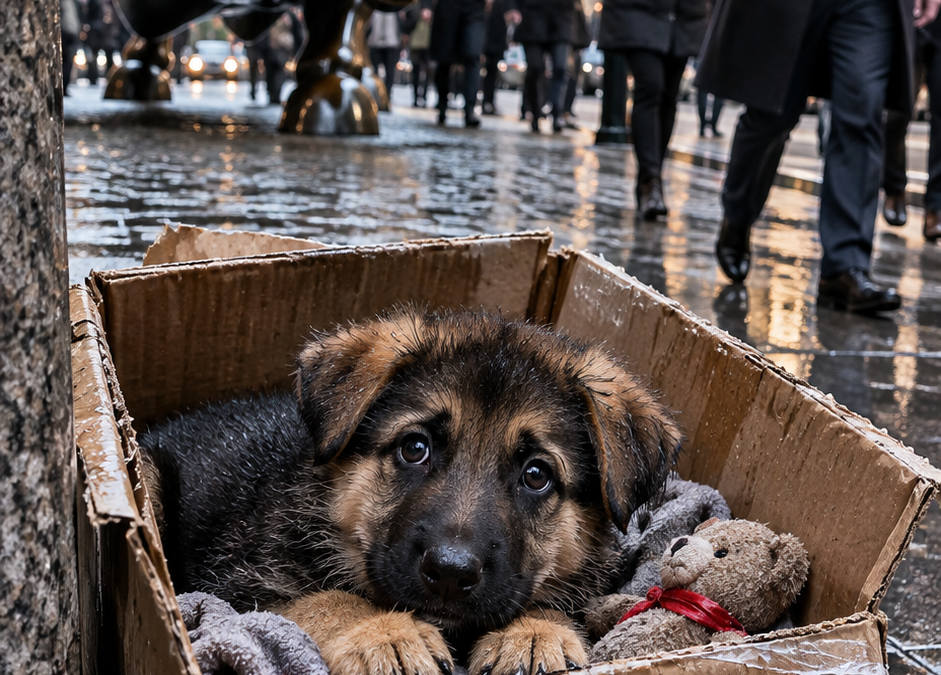
PART2
“Jesus.”
That was all I managed.
The puppy tried to move.
The rope tightened around his legs.
He cried out.
I reached in instinctively.
He panicked.
His whole body twisted.
Teeth flashed—not attacking, just terrified.
I pulled my hands back.
“Okay.”
The crowd pressed closer.
Phones rose higher.
Someone said, “Careful.”
Another person laughed.
I looked up.
“Could somebody call an emergency vet?”
Nobody answered immediately.
One man kept filming.
I stood.
“Seriously?”
He lowered the phone slightly.
“What?”
“Call someone.”
“I thought you had it.”
That sentence.
I had it.
Because I had crouched down.
Because I had touched the box.
Responsibility had transferred invisibly.
Interesting how quickly people can assign courage to someone else when courage becomes inconvenient.
I turned back to Osiris.
His breathing sounded worse.
No time to lecture strangers.
I removed my coat and laid it beside the box.
Then I took out the small folding knife I carried on my keychain.
“Listen, buddy.”
His eyes tracked the blade.
I lowered it.
“No.”
I showed him my empty hand.
“Nothing bad.”
Meaningless words.
He didn’t know me.
Why should he believe anything?
I moved slowly.
The rope around his front legs was coarse and tight.
I slipped two fingers beneath it to protect his skin.
Osiris jerked.
I stopped.
Waited.
He stared at me.
“Again.”
I tried.
This time he froze.
Not calm.
Shutdown.
Stillness born from fear.
I hated it.
The knife sawed through the first strand.
Then another.
The rope loosened.
His paws dropped apart.
One was swollen.
Both had raw abrasions.
The back legs were bound separately.
Those ropes came off faster.
Then the collar.
I slipped two fingers underneath.
Too tight.
He had either grown in it or someone had fastened it deliberately that way.
The paper with his name shook against the buckle.
Osiris.
A strange name for a starving puppy in a cardboard box.
I cut the collar rather than risk pulling it over his head.
The moment pressure disappeared from his neck, he gasped.
Actually gasped.
I felt rage rise so fast it made me dizzy.
Not useful.
Anger feels active.
It often isn’t.
The useful thing was getting him out.
I slid one hand beneath his chest.
His body went rigid.
The other hand under his hips.
“Easy.”
He struggled.
Claws caught my shirt.
I lifted.
He exploded from the box like a trapped spring.
His legs kicked.
Body twisting.
He was stronger than he looked because terror had found whatever fuel starvation had left.
I held him against my chest without squeezing.
He clawed my shoulder.
Someone in the crowd said, “Told you.”
Another laughed.
I turned my body so Osiris couldn’t see them.
“You’re okay.”
He wasn’t.
His heart slammed against me so fast I could feel it through both layers of clothing.
His fur smelled of urine, damp newspaper, and something sour.
His ribs pressed sharply through his coat.
I tucked his head beneath my chin.
“Nobody’s putting you back.”
His body kept shaking.
I don’t know whether he understood tone.
Maybe.
Maybe he was simply exhausted.
After thirty seconds, the fight softened.
Not trust.
No.
He had run out of energy.
That difference mattered.
A police officer approached from the corner.
“Everything all right?”
I almost laughed.
“No.”
He looked at the destroyed box.
Then Osiris.
“What happened?”
“Someone left him taped inside.”
The officer’s expression changed.
“You find any identification?”
I held up the cut collar.
“Just a name.”
He radioed for animal control.
I asked how long.
He didn’t know.
I looked at the puppy.
“He’s breathing badly.”
“There’s an emergency animal hospital on First Avenue.”
Too far.
I searched my phone.
Another clinic was closer.
Twenty minutes by car if traffic cooperated.
In Manhattan, that meant anywhere between fifteen minutes and the heat death of the universe.
“I’m taking him.”
The officer nodded.
“Give me your information.”
I did.
Quickly.
Then I stepped toward Broadway, one arm around Osiris, trying to hail a cab.
Three passed.
Occupied.
The fourth stopped.
I opened the rear door.
The driver saw the puppy.
“No dog.”
“He’s injured.”
“No dog.”
“Please.”
The driver shook his head.
“Seats.”
I looked at the blood on my shirt.
Fair concern in an unfair moment.
“I’ll pay cleaning.”
He hesitated.
Osiris whimpered.
The driver’s face changed.
“Get in.”
I climbed inside.
“Thank you.”
He looked at the puppy again.
“Put jacket.”
I spread my coat across the seat.
Osiris lay partly on my lap.
The cab moved.
The first pothole made him jerk.
I supported his body.
“Easy.”
The driver looked in the mirror.
“What happened?”
“Box.”
“What box?”
“Someone taped him inside one near the bull.”
The driver swore.
I agreed.
Traffic crawled north.
Osiris’s breathing rasped.
His eyes opened and closed.
I kept talking.
Not because I believed he understood the words.
Because silence felt dangerous.
“Your name’s Osiris.”
His ear moved.
“Apparently.”
I looked at the filthy scrap of paper still attached to the severed collar.
“You know that’s a ridiculous name for a puppy?”
No response.
“Very dramatic.”
His eyes opened.
I swallowed.
“It means rebirth, I think.”
Maybe that was mythology remembered poorly from school.
Didn’t matter.
“Let’s not make whoever named you a liar.”
The cab stopped at a light.
Osiris shifted.
His nose pressed against my chest.
I thought of Max.
Hadn’t thought about him in years.
My childhood German Shepherd.
Black saddle.
Tan face.
One ear that never stood completely.
Max slept beside my bed from the time I was nine until I left for college.
He waited at the kitchen door every afternoon.
He knew the sound of my father’s station wagon.
Hated thunderstorms.
Loved snow.
When he died, I was twenty.
Cancer.
Fast.
I had driven home from college for the final appointment.
I remembered kneeling on the veterinary floor, holding his collar after he was gone, and thinking something embarrassingly simple.
Never again.
People say that after losing animals.
Then many eventually love another.
I didn’t.
Not because I hated dogs.
Because loving something with a lifespan shorter than yours had suddenly seemed like signing a contract whose final clause was guaranteed pain.
So I opted out.
For twenty-five years.
No dogs.
No cats.
No fragile thing waiting at home.
Very efficient.
Wall Street would have approved.
Osiris whimpered.
I looked down.
“Don’t make this symbolic.”
His eyes closed.
The driver accelerated when traffic opened.
The clinic lights appeared twelve minutes later.
I paid far more than the fare.
The driver tried to refuse the extra.
I insisted.
“Clean your seat.”
He looked at Osiris.
“Save dog.”
“I’m trying.”
Inside the clinic, the receptionist started to speak.
Then saw him.
“Tech!”
Doors opened.
Two people rushed out.
“What happened?”
“Found taped in a box.”
“Age?”
“Maybe four months? Five?”
“Your dog?”
“No.”
A veterinary technician reached.
Osiris panicked.
His claws caught my shirt again.
“Easy.”
The tech stopped immediately.
Good.
“Can you place him on the table?”
I nodded.
I lowered him.
The second my hands left, he tried to crawl toward me.
That surprised both of us.
I kept one hand near his shoulder.
“I’m here.”
The veterinarian arrived.
Dr. Maya Chen.
She moved fast but quietly.
Temperature.
Gum color.
Heart.
Lungs.
Hydration.
Weight.
She examined the rope abrasions.
Then his throat.
“Severely dehydrated.”
I nodded.
“Malnourished.”
Obviously.
“Possible respiratory irritation from confinement. His temperature is elevated.”
“Is he going to live?”
She looked at him.
Then me.
“I think so.”
My knees nearly gave out.
“But we need to stabilize him.”
“Do it.”
“We’ll start fluids carefully, check glucose, run bloodwork, clean the wounds.”
“Anything.”
“Financial authorization—”
“I’ll cover it.”
She glanced up.
“He’s not legally yours.”
“I know.”
“You may be able to surrender him to city services and—”
“I said I’ll cover it.”
Dr. Chen held my eyes for a second.
Then nodded.
“Okay.”
They moved Osiris to treatment.
I tried to follow.
A technician stopped me.
“We’ll come get you.”
The doors closed.
My arms suddenly felt wrong.
Empty.
For the second time that day, I stood on Wall Street—or near enough to it emotionally—with nothing useful in my hands.
I sat.
The waiting room had beige walls, six chairs, one vending machine, and a television showing a home renovation program with captions.
People came and went.
A woman with a terrier.
A man carrying a cat wrapped in a towel.
An elderly couple with a beagle.
Normal emergencies.
Normal fear.
I stared at the scrap of paper.
OSIRIS.
The handwriting was jagged.
Could have been written by an adult.
Teenager.
Child.
No note.
No apology.
No explanation.
Just a name.
That bothered me.
If you were cruel enough to abandon a puppy taped inside a box, why name him?
Maybe someone else had.
Maybe the person who left him wasn’t the person who raised him.
Maybe the box had changed hands.
Maybe I was trying to construct logic where there wasn’t any.
After an hour, Dr. Chen came out.
“Daniel?”
I stood.
“He’s responding.”
“Meaning?”
“Fluids are helping. Blood sugar was low but improving. No evidence of major internal injury.”
I exhaled.
“His breathing?”
“Likely stress and poor ventilation. Lungs sound mostly clear.”
“Mostly?”
“We’ll monitor.”
“Can I see him?”
“Briefly.”
Osiris lay beneath a thin blanket with an IV taped to one leg.
His eyes were open.
When I entered, his ears moved.
Then his tail.
Barely.
One weak tap.
I stopped beside the table.
“That’s unnecessary.”
Another tap.
Dr. Chen smiled.
“He knows you.”
“He met me two hours ago.”
“Two significant hours.”
I touched one finger to his forehead.
He flinched.
Then stayed.
“Good boy.”
I hated how quickly those words felt natural.
Dr. Chen explained the plan.
Overnight observation.
Small meals.
Wound cleaning.
Parasite test.
Microchip scan.
I almost forgot.
“Chip?”
“None.”
“Any idea how long he was in the box?”
“No.”
“What would have happened if—”
I stopped.
Didn’t need the answer.
Dr. Chen gave it anyway.
“Longer confinement could have been fatal.”
I looked at Osiris.
He looked back.
Hundreds of people had passed.
Maybe thousands depending on time.
One box.
One sound.
The arithmetic made me sick.
That night, I went home alone.
Not because I wanted to.
Because the clinic wouldn’t let me sleep there and Osiris was medically safer with them.
My apartment was eight blocks from Wall Street.
Large enough for one person.
Expensive enough that I avoided calculating cost per square foot.
Quiet.
Minimal.
Controlled.
I opened the door.
Nothing greeted me.
For years, I had liked that.
That night, it felt like a criticism.
I put Osiris’s severed collar on the kitchen counter.
Then washed my hands.
Blood came off.
Dirt.
Newspaper ink.
The smell lingered.
I showered.
Changed clothes.
Sat on the couch.
At midnight, I called the clinic.
“Stable.”
At two, again.
“Sleeping.”
At five-thirty, I gave up pretending sleep would happen.
I made coffee.
At seven, Dr. Chen called.
“He ate.”
Two words.
I smiled for the first time.
“Good?”
“Very.”
“When can I see him?”
“Come at nine.”
I arrived at eight-thirty.
Of course.
Osiris was standing when I entered treatment.
Barely.
His legs trembled.
But standing.
He saw me.
Stopped.
Then took one step.
I froze.
Second step.
His front paw slipped.
A technician steadied him.
“Careful.”
Osiris looked embarrassed.
I crouched.
“You’re doing fine.”
He came closer.
Not all the way.
Enough for his nose to touch my knuckles.
Then he sat.
That tiny contact did something to me I wasn’t prepared for.
Dr. Chen appeared with paperwork.
“Animal control checked. No chip, no immediate matching lost report.”
“What happens now?”
“Technically, he needs to enter the stray-hold process.”
“At a shelter?”
“Could be through a rescue foster if one accepts him.”
“I’ll foster.”
The answer came out before the question had finished existing.
Dr. Chen smiled.
“You have dogs?”
“No.”
“Ever?”
“As a child.”
“Current supplies?”
“No.”
“Training?”
“No.”
“Experience with fearful puppies?”
“No.”
She folded her arms.
“Strong application.”
“I have a home.”
“That’s a start.”
“And money.”
“Helpful.”
“And I don’t want him going into another box.”
Her expression softened.
“A crate isn’t the same thing.”
“I know.”
I didn’t, emotionally.
But intellectually, yes.
She gave me two rescue contacts.
By noon, one agreed to sponsor his recovery if I completed emergency foster paperwork.
By three, I owned more dog supplies than I had owned in my entire adult life.
Bowls.
Bed.
Puppy food.
Harness.
Leash.
Crate.
Cleaning solution.
Puppy pads.
Toys.
The cashier looked at the cart.
“First dog?”
“Temporary.”
She smiled.
I disliked that smile.
At five, Osiris came home.
The moment the apartment door opened, he froze.
He stared inside.
Hardwood floor.
White walls.
Couch.
Kitchen.
Nothing threatening.
Didn’t matter.
Thresholds carry meaning we don’t see.
I stepped inside.
Kept the leash slack.
“Come on.”
Osiris backed away.
I stopped.
“No.”
Bad choice of word.
I crouched.
“You don’t have to.”
We stood in the hallway.
A neighbor opened her door.
Mrs. Alvarez from 14B.
She looked at me.
Then Osiris.
“Daniel.”
“Hi.”
“You have a dog.”
“Temporary.”
She laughed.
“Why does everyone keep doing that?”
“Doing what?”
She smiled.
“Nothing.”
She disappeared.
Osiris watched her door close.
Then looked at my apartment.
I sat on the floor just inside.
No pulling.
Five minutes.
Ten.
He sniffed.
One paw over the threshold.
Retreat.
Again.
Then two.
Eventually his whole body crossed.
I closed the door quietly.
Osiris spun.
Panic flashed.
I opened it again.
Immediately.
He stared.
“See?”
He looked at me.
“Door opens.”
I closed it halfway.
Opened it.
Again.
Ridiculous little exercise.
Necessary.
By the fourth repetition, he stopped backing away.
I left the door closed.
Unlocked.
My world had become a behavioral experiment.
Osiris explored only six feet into the apartment.
Then retreated beneath a console table.
I put water nearby.
Food farther away.
Bed.
Toy.
Nothing too close.
He ignored everything.
That night, he hid under my bed.
How a four-month-old puppy discovered the most psychologically significant location in my childhood within two hours remains unexplained.
I lay on the floor.
“You know Max used to do that?”
Two brown eyes watched from darkness.
“He was smarter than me too.”
No response.
I slid a bowl of water closer.
Osiris withdrew.
I stopped.
Left it.
At midnight, still untouched.
At one, I fell asleep on the floor.
At three, I woke to drinking.
Quiet lapping.
I kept my eyes closed.
He finished.
Retreated.
I smiled into the carpet.
Morning brought a second victory.
The food bowl was half empty.
Osiris remained under the bed.
Fine.
I sat six feet away with coffee.
No reaching.
Read emails.
Talked occasionally.
“Market down.”
His ear moved.
“You don’t care.”
Correct.
At noon, I placed kibble in my palm.
Extended my arm.
Waited.
Five minutes.
Ten.
My shoulder burned.
Then his nose appeared.
Slowly.
He stretched.
Body still hidden.
Neck long.
Snatched one piece.
Disappeared.
I laughed once.
He froze.
“Sorry.”
Silence.
Another piece.
He came again.
This time slower.
Took it.
Retreated only halfway.
Third.
Fourth.
By evening, his front paws were outside the bedframe.
Progress.
The next morning, Dr. Chen called.
“How’s he doing?”
“Living under furniture.”
“Excellent.”
“Excellent?”
“He’s eating and drinking?”
“Yes.”
“Eliminating?”
“Yes.”
“Then he’s decompression smart.”
I liked that phrase.
“Should I coax him out?”
“No.”
“At all?”
“Let curiosity work.”
“What about bonding?”
“Daniel.”
“Yeah?”
“You met yesterday.”
Fair.
“Give him boring safety.”
Boring safety.
I wrote it on a sticky note.
Not because I needed to.
Because I had spent fourteen years in finance believing progress should be measurable every quarter.
Dogs had no interest in my reporting standards.
So we went slowly.
Day three, Osiris came out while I read.
He sniffed the stuffed lamb I had bought.
Touched it.
Retreated.
Day four, he dragged the lamb under the bed.
Theft.
Encouraging.
Day five, he followed me into the kitchen at a distance.
Day six, he slept beside the couch instead of beneath furniture.
Day seven, he let me touch his shoulder for three seconds.
Then five.
Then ten.
No head pats.
No hugging.
Hands had to earn territory.
His legs healed faster than his mind.
The rope marks faded.
Weight improved.
His coat started looking less dull.
Parasites treated.
Vaccinations scheduled.
The collar wound closed.
But certain things broke him instantly.
Tape.
The first time I tore packing tape from a delivery box, Osiris vanished.
One second beside the couch.
Next under the dining table, trembling.
I stared at the strip of tape in my hand.
“Okay.”
I put the box outside.
Sat on the floor.
No approach.
He watched.
I touched the tape gently.
Put a treat near it.
Too much.
He wouldn’t move.
So I moved the tape farther away.
Treat.
Wait.
Eventually he ate.
Weeks later, we practiced tape sounds at low intensity.
Short tear.
Food.
Stop.
Another day.
No flooding.
No forcing him to “face it.”
People love that phrase.
Face your fears.
Sometimes courage means facing fear.
Sometimes healing means learning you have the right to back away.
Osiris learned both.
The red ribbon was another trigger.
I kept the original one in a bag with the box evidence for animal control.
Didn’t bring it home.
No reason.
Cardboard itself took longer.
A delivery box left near the hallway once caused Osiris to stop ten feet away.
I moved it.
He relaxed.
The next day, I placed an empty box across the room.
Open.
No tape.
Treats around it.
He stared.
Wouldn’t approach.
Fine.
Next day, farther.
Then closer.
One afternoon, after three weeks, he walked over.
Sniffed the corner.
Backed away.
Returned.
Touched it with his nose.
I said nothing.
My chest felt absurdly full.
By month two, he could walk past open boxes.
Closed boxes still bothered him.
We didn’t rush.
Outside presented different challenges.
New York is no place for a nervous puppy.
Sirens.
Construction.
Subway grates.
Metal carts.
People.
Hands.
Elevators.
Buses exhaling beside you.
I started at six in the morning.
Quietest hour available.
Harness.
Backup collar.
Two attachment points.
I had learned from horror stories.
Osiris stepped into the hallway.
Stopped.
Elevator dinged.
He jumped.
I waited.
Doors opened.
Empty.
Osiris leaned backward.
“Stairs?”
We took stairs.
Fourteen floors.
By floor seven, I reconsidered every life decision.
Osiris remained suspiciously energetic.
“You’re enjoying this.”
Tail flick.
First outdoor walk lasted four minutes.
Sidewalk.
Tree pit.
One truck.
One cyclist.
Then home.
He slept for three hours.
Sensory exhaustion.
Next time, six minutes.
Then eight.
At ten minutes, a delivery cart rattled behind us.
Osiris flattened.
I stepped between him and the cart.
No pulling.
He watched it pass.
Body shaking.
Then looked at me.
“You’re okay.”
Tail tucked.
“Home?”
He turned toward the building.
We went.
I didn’t make him finish the planned route.
That mattered.
Trust is partly learning that your “no” works.
Osiris discovered his did.
By the fourth month, he had changed physically.
The ribs disappeared beneath muscle.
Ears stood higher.
Coat shone.
His legs looked less like fragile sticks and more like what they were going to become.
Big.
Very big.
The vet revised his age estimate closer to five months at rescue.
German Shepherd adolescence arrived with impressive disrespect.
Shoes became negotiable objects.
Paper towels became prey.
Socks vanished.
One morning, I found Osiris standing inside my closet with one of my old Wall Street ties hanging from his mouth.
“Absolutely not.”
Tail wag.
“That cost two hundred dollars.”
He shook it.
“Do you understand capitalism?”
Shake.
I traded him a biscuit.
He dropped the tie.
I stared at it.
“You’ve just learned extortion.”
Tail.
“Perfect. You belong downtown.”
He began sleeping at the foot of my bed.
The first time, I woke at two in the morning because something heavy pressed against my ankle.
Osiris.
Curled.
Breathing deeply.
No trembling.
I didn’t move for almost an hour.
Not because I was afraid of waking him.
Because Max used to sleep exactly there.
Memory arrived so sharply it hurt.
Max waiting at the station wagon.
Max stealing toast.
Max old and gray.
Max dying.
I had spent twenty-five years avoiding that memory.
Osiris didn’t know.
He simply slept.
I put one hand against his back.
Warm.
Alive.
“You’re not him.”
One ear moved.
“Good.”
I meant it.
I did not need another Max.
I needed Osiris to become himself.
And he did.
He developed opinions.
Strong ones.
Rain?
Unacceptable.
Pigeons?
Criminal.
Squirrels?
Personal enemies.
Vacuum cleaner?
Potentially supernatural.
Mrs. Alvarez?
Best human alive because she carried cheese.
Me?
Useful.
His relationship with strangers improved slowly.
He stopped shrinking when people passed.
Still didn’t like hands reaching overhead.
So I became aggressive about boundaries.
“Can I pet him?”
“No.”
“But he looks friendly.”
“He is.”
“So—”
“No.”
People were offended sometimes.
Not my problem.
Osiris had spent enough of his life without control over what happened to his body.
He didn’t owe strangers access because he was handsome.
At five months after rescue, he chose contact with someone new for the first time.
Mrs. Alvarez sat in the lobby.
Ignored him.
Osiris approached.
Sniffed.
She kept reading.
He placed his chin on her knee.
She looked at me.
I nodded.
She scratched his chest.
His eyes closed.
“Well,” she said, “temporary?”
I sighed.
The foster-to-adopt paperwork had been sitting on my desk for a week.
Everyone knew.
Apparently except me.
That evening, I opened the form.
Name of adopter.
Daniel Whitaker.
Animal.
Osiris.
Breed.
German Shepherd.
Reason for adoption.
I stared at that one.
How do you explain?
Because he looked at me from a box.
Because he slept at my feet.
Because he had turned my apartment from a place I occupied into somewhere another living thing expected me to return.
Because fear had stopped being theoretical.
Because responsibility had become strangely comforting.
I wrote:
Bonded during foster placement. Permanent home is appropriate.
Extremely Wall Street answer.
I signed.
Adoption became official three days later.
The rescue coordinator smiled.
“Congratulations.”
Osiris sat beside me.
I looked down.
“You have no idea what happened.”
Tail wag.
“Legally, you own me now.”
The coordinator laughed.
“Pretty much.”
I bought him a new collar.
Red.
Then returned it.
Couldn’t do it.
The color reminded me too much of the ribbon.
Instead, dark green.
Silver tag.
OSIRIS.
My number.
Microchip ID registered.
When I clipped it on, Osiris shook.
Tag jingled.
He looked at me.
Then walked toward the door.
No fear.
The return to Wall Street wasn’t planned.
It happened because one morning our normal route took us farther south.
Osiris was almost a year old.
Strong now.
Seventy pounds.
Still filling out.
We turned onto Broadway.
I realized where we were two blocks too late.
Charging Bull ahead.
Crowds.
Phones.
The exact soundscape.
My hand tightened instinctively on the leash.
Osiris felt it.
Looked up.
My mistake.
If I acted afraid, he’d read fear.
I loosened my grip.
“Your choice.”
We stopped half a block away.
Osiris stared.
The bronze bull rose above tourists.
Camera shutters.
Voices.
Street vendors.
Metal barricades.
For a second, his body changed.
Tail lowered.
Ears back.
I could feel history moving through him.
Did he remember the location?
Dogs remember scent astonishingly well.
Context.
Sound.
Maybe.
I didn’t need to know exactly.
We stood.
A tourist approached.
“Beautiful shepherd.”
“Thanks.”
“Can I—”
“Not right now.”
She moved on.
Osiris looked at the bull.
Then at me.
One step.
I waited.
Second.
His nose worked rapidly.
Third.
We reached the edge of the crowd.
I could have turned away.
Maybe should have.
Then Osiris continued.
Not dragged.
Not lured.
His decision.
The crowd shifted around us.
A phone lifted.
For a moment I saw the original scene overlaid on the present.
Box.
Rope.
Laughter.
People filming.
My hands tearing tape.
Then Osiris stepped ahead of me.
Tail neutral.
Head up.
No shrinking.
No crawling.
A grown German Shepherd occupying the same pavement where a starving puppy had been treated as garbage.
My eyes burned.
“Show-off.”
He glanced back.
We reached the spot.
Or close enough.
The exact location was impossible to know after months.
I stopped.
Osiris sniffed.
One patch.
Another.
Then he did the least cinematic thing imaginable.
He peed on a traffic barrier.
I laughed so hard a tourist stared at me.
“Perfect.”
Osiris scratched the pavement once with his back paws.
“Very dignified.”
He turned toward me.
Mouth open.
Tongue visible.
Happy.
No ghosts.
Or at least none strong enough to own him.
We left.
That night, Osiris slept in the center of my living-room rug.
Not against a wall.
Not beneath furniture.
Not near the exit.
Center.
Belly exposed.
Four paws in different directions.
Completely defenseless.
I stood over him.
“That is an obscene level of trust.”
Tail thumped without his eyes opening.
I sat on the floor.
He rolled slightly until his back touched my leg.
Home.
That’s what it looked like.
Not adoption paperwork.
Not a collar.
A dog sleeping in the middle of a room because he no longer believed escape needed planning.
The cardboard training continued almost by accident.
Packages arrived.
Osiris stopped reacting.
One day, a large open box sat in the kitchen after a delivery.
I forgot to move it.
Twenty minutes later, I heard rustling.
My stomach dropped.
I walked in.
Osiris was inside.
Standing.
Tail wagging.
I froze.
He grabbed packing paper.
Ran.
I laughed.
He sprinted through the apartment with paper streaming behind him.
I didn’t correct him.
Not that day.
Let him destroy the box.
He shredded one side.
Bit the flap.
Jumped in.
Jumped out.
The thing that once imprisoned him had become a toy.
Healing has a sense of humor.
I kept one photograph.
Osiris sitting triumphantly inside the ruined cardboard.
Tongue out.
Green collar visible.
Every time I saw it, I thought the same thing.
You won.
Animal control never found the person who abandoned him.
There was footage of the box appearing near the bull, but camera coverage wasn’t clear enough to identify who left it.
The original collar had no tag.
No chip.
No matching ownership record.
The name Osiris remained the only connection to his past.
For months, I wanted answers.
Who bound his legs?
Who taped the box?
Who stabbed holes in the cardboard as though minimal air made abandonment acceptable?
Why leave him in one of the busiest places in New York?
To be found?
To die?
To become somebody else’s problem?
No answer.
Eventually, I stopped needing one.
Not because it didn’t matter.
Because Osiris’s life had become larger than the question.
That’s what recovery does when it’s allowed enough time.
It doesn’t change history.
It changes proportion.
The box became one day.
Then one hour inside one day.
Then one memory surrounded by hundreds of ordinary mornings.
Breakfast.
Walks.
Training.
Vet appointments.
Socks.
Chewed toys.
Rain refusal.
Elevator rides.
Mrs. Alvarez’s cheese.
My life adjusted.
I began leaving work earlier.
Not dramatically.
I still liked my job.
Still enjoyed financial markets.
Still watched openings.
Still cared about money.
But money stopped being the only thing I tracked.
At five-thirty, Osiris waited.
That mattered more than an email somebody could answer tomorrow.
I realized how much of my first career had trained me to reward things that shouted.
Urgent messages.
Market swings.
Breaking news.
Big clients.
Big numbers.
Osiris taught me to notice smaller signals.
A tail slightly lower than normal.
A hesitation near a box.
A paw placed on my shoe.
The difference between excitement and stress.
The quiet things.
Important things are often quiet.
He had been.
That’s why almost everyone missed him.
Years passed.
Osiris became one of those German Shepherds who made strangers cross the street just to ask about him.
Large.
Dark saddle.
Amber-brown eyes.
Calm.
One tiny scar around the neck where the collar had rubbed.
Another along his back leg from the rope.
Most people never noticed.
I did.
Every time.
Not with sadness.
Record keeping.
That’s what scars are.
Receipts from survival.
He loved Battery Park.
Hated skateboards.
Learned to tolerate them.
Loved snow, which felt unfair given my childhood memories of Max.
His first real snowfall, he lost his mind.
Jumped.
Dug.
Buried his face.
Ran circles.
I stood on the sidewalk laughing.
“You were traumatized by cardboard and apparently delighted by frozen water.”
Osiris shoved his face into a snowbank.
“Complex animal.”
He emerged white-faced.
Tail flying.
At three years old, he experienced his first serious thunderstorm with me.
Max had hated storms.
I was prepared.
Osiris surprised me.
First thunderclap.
Head up.
Second.
He came to me.
Not hiding.
Just pressed against my leg.
I sat on the floor.
No cage.
No forcing.
We stayed there.
Eventually he slept.
I thought of my childhood.
Max under the bed.
Me beside him.
The pattern had reversed.
Or repeated.
Depending how you looked at it.
When Osiris turned five, Mrs. Alvarez moved to Florida.
She cried harder saying goodbye to him than to me.
“I like him better.”
“Everyone does.”
She hugged me.
Then crouched carefully.
Osiris pressed his head against her chest.
She whispered something in Spanish.
I didn’t understand.
Didn’t need to.
After she left, Osiris checked her door for almost two weeks.
Empty apartment.
No cheese.
He adjusted.
Dogs grieve changes in routine too.
At six, he developed the habit of waiting beside the apartment elevator every weekday at exactly five-forty.
My neighbor sent photographs.
“He knows.”
I changed my schedule.
Started coming home at five-thirty.
Not every day.
Enough.
The first time I arrived early and elevator doors opened, Osiris was standing there with my neighbor.
He saw me.
His entire body transformed.
Tail.
Ears.
Feet dancing.
No dignity.
I crouched.
He collided with me.
“Okay.”
Face lick.
“Yes.”
Another.
“I was gone eight hours, not war.”
He pressed his head beneath my chin.
And I understood something.
For animals who have been abandoned, return is a language.
Every time you come back, you rewrite one line.
Gone doesn’t always mean gone forever.
Doors reopen.
People return.
Food arrives again.
Night ends.
Reliability becomes rehabilitation.
That was our real work.
Not dramatic rescue.
Return.
Again.
Again.
Again.
The Wall Street box became known to a few people because someone had posted video from the rescue.
I found out months later.
A clip of me tearing the tape had circulated locally.
Not massively viral.
Enough.
At first, I was angry.
Osiris’s terror turned into content.
Then I watched the clip.
Bad decision.
There he was.
Tiny.
Bound.
My younger self crouched beside the box.
Crowd around us.
Phones everywhere.
Then something else caught my eye.
In the far corner of the frame, a woman was calling someone.
Another man had begun moving people back.
The story in my memory had been simpler.
Everyone ignored him.
Everyone laughed.
Nobody helped.
That wasn’t entirely true.
Many ignored him.
Some filmed.
Some said ugly things.
But after I opened the box, others acted.
The officer came.
The cab driver stopped.
The clinic worked.
The rescue sponsored.
Mrs. Alvarez helped.
Compassion wasn’t absent.
It was delayed.
That distinction mattered.
I didn’t want to become the kind of person who used Osiris’s pain to prove humanity was terrible.
Humanity had harmed him.
Humanity had also saved him.
Both facts could stand.
The lesson wasn’t “people are cruel.”
Too easy.
The lesson was that crowds dilute responsibility.
Everyone sees.
Nobody believes the decision belongs to them.
Until one person behaves as though it does.
Then responsibility becomes contagious.
That was worth remembering.
At seven, Osiris started slowing after long walks.
Nothing serious.
Arthritis beginning.
Dr. Chen, still his veterinarian, recommended joint supplements and weight management.
“He’s aging.”
“He’s seven.”
“That’s aging.”
“I reject the premise.”
She laughed.
Osiris leaned against her.
Traitor.
We shortened some routes.
More park.
Less pavement.
No problem.
At eight, gray appeared beneath his muzzle.
I hated it.
He wore it beautifully.
At nine, he needed help getting into the car.
I bought a ramp.
Osiris looked at it like an insult.
“You have two choices.”
He sat.
“Ramp or lift.”
He weighed eighty-two pounds.
My back voted ramp.
Osiris eventually agreed.
At ten, his hearing softened.
Not gone.
Selective enough that I suspected fraud.
Treat bag from two rooms away?
Perfect auditory function.
“Come inside”?
Medical mystery.
I loved the old version of him differently.
Puppy Osiris had needed protection.
Adult Osiris had become a companion.
Old Osiris became history walking beside me.
Every gray hair carried years.
The box had lasted hours.
Maybe a day.
Our life lasted more than a decade.
That proportion became important.
On the tenth anniversary of his rescue, I took him back to the Charging Bull.
Early morning.
Before crowds.
Cool autumn air.
Osiris walked slowly.
Green collar replaced several times over the years but always green.
We reached the bull.
He sniffed.
Then sat.
I sat beside him on the low curb.
“Ten years.”
He looked at me.
“You have no concept.”
Tail tap.
“Probably healthier.”
A maintenance worker pushed a cardboard box on a cart nearby.
Osiris glanced.
No reaction.
I smiled.
“Look at that.”
The worker passed.
Osiris leaned against me.
I scratched his chest.
“You know, you cost me a very expensive suit.”
His eyes closed.
“And a cab cleaning fee.”
Tail.
“Multiple rugs.”
Nothing.
“Remote.”
Ear twitch.
“Two pairs of shoes.”
He yawned.
“No remorse.”
We watched the city wake.
Tourists appeared.
Workers hurried.
Phones came out.
Same street.
Different decade.
Osiris no longer cared.
That might have been his greatest victory.
Not returning bravely.
Not standing defiantly.
Indifference.
The place no longer mattered enough to hurt.
We left before the crowd thickened.
His final year arrived slowly.
Kidney disease.
Managed at first.
Diet.
Medication.
More water.
More frequent outings.
Then appetite changes.
Weight loss.
Still happy.
Still himself.
Dr. Chen monitored.
One morning, she showed me the latest numbers.
Not good.
“What do we have?”
“Could be months.”
“Could?”
“Less.”
I looked at Osiris lying beneath the exam table.
Gray muzzle on my shoe.
“What would you do?”
Dr. Chen sat.
“Protect quality.”
No aggressive treatment for the sake of my fear.
That became the rule.
Good days.
Food he liked.
Slow walks.
Sunlight.
Snow when winter came.
He made it to January.
One morning, the city woke under six inches of fresh snow.
Osiris stood at the window.
Tail moved.
I laughed.
“Absolutely not.”
He looked at me.
“You’re eleven.”
He walked toward the door.
“You’ve become unreasonable with age.”
We went.
He moved slowly at first.
Then snow touched his nose.
Something young appeared.
He pushed his face into it.
I laughed so hard I had to hold the railing.
“Still?”
Osiris sneezed.
Tail wagging.
We walked one block.
Then two.
Enough.
Back home, he slept for five hours.
Best day of that month.
The decline accelerated afterward.
Less food.
Weak legs.
Restlessness at night.
Pain controlled but fatigue increasing.
I knew.
Pretended not to for three days.
Then Osiris fell trying to stand.
He looked embarrassed.
That broke me.
I lifted him.
Eighty pounds had become sixty-five.
Too light.
I called Dr. Chen.
She came to the apartment.
No clinic.
No steel table.
No fluorescent light.
Home.
Osiris lay on his bed in the center of the living room.
The same room where he had once been too afraid to leave the walls.
Now his bed occupied the middle.
Always had.
I sat beside him.
Dr. Chen examined him.
Quietly.
Then looked at me.
“It’s time.”
I nodded.
No dramatic refusal.
Love means eventually making the decision your fear begs you not to make.
I opened a drawer.
Took out the original scrap of paper.
OSIRIS.
I had kept it.
Faded.
Wrinkled.
Ink still readable.
I placed it beside him.
“You came with instructions.”
His eyes opened.
“One word.”
I rubbed his ear.
“Pretty pretentious name.”
Tail moved faintly.
I laughed through tears.
“Yeah.”
Dr. Chen prepared the medication.
I kept my hand on Osiris’s chest.
His heartbeat slow.
Steady.
The same heart I’d first felt racing inside cardboard.
“Remember under the bed?”
Ear moved.
“Remember eating my tie?”
Nothing.
“Charging Bull?”
His eyes stayed on mine.
“Max would have liked you.”
That was the first time I’d said my childhood dog’s name aloud in years without pain dominating the memory.
Osiris had done that too.
Made old grief safe enough to revisit.
Dr. Chen gave the first injection.
Osiris relaxed.
His head settled into my lap.
No fear.
No searching for an exit.
No walls.
No box.
No rope.
I bent down.
“You’re safe.”
Those words had been a promise the first day.
Now they were fact.
“You were safe for a long time.”
His breath slowed.
“You did it.”
I pressed my forehead against his.
“And for the record…”
My voice broke.
“I would stop again.”
His tail moved once.
Barely.
Then stillness.
I stayed on the floor after Dr. Chen left.
Hours maybe.
The apartment became silent.
Not the clean silence I had liked before him.
A shaped silence.
Empty where breathing used to be.
The green collar sat on the table.
Food bowl.
Ramp.
Bed.
Toys.
A life leaves infrastructure behind.
I cried.
Hard.
No embarrassment.
Twenty-five-year-old me would have hated seeing it.
Good.
He had been wrong.
The pain wasn’t proof loving Osiris had been a mistake.
It was the final cost of something worth having.
Max had taught me that once.
I had misunderstood.
Osiris taught it again.
This time I listened.
Months later, I returned to Wall Street alone.
Not intentionally ceremonial.
I had a meeting nearby.
When I finished, I walked south.
Charging Bull.
Crowd.
Photos.
Noise.
I stopped where I thought the box had been.
Impossible to know exactly.
Ten years had moved through the space.
Millions of shoes.
Rain.
Snow.
Tourists.
Nothing marked it.
Good.
I didn’t want a monument to abandonment.
I stood for a minute.
A cardboard delivery box sat near a store entrance across the street.
For a split second, my body reacted.
Old memory.
Then nothing.
I smiled.
Osiris had reclaimed cardboard.
So had I.
A family passed with a young German Shepherd.
The puppy pulled toward me.
Owner laughed.
“Sorry.”
“No problem.”
The puppy sniffed my hand.
Big ears.
Huge feet.
Happy.
I touched his chest once.
Then stepped away.
Didn’t ache as much as I expected.
That surprised me.
A year after Osiris died, Mrs. Alvarez called from Florida.
She still checked on me.
“Dog?”
“No.”
“Why not?”
“I’m fine.”
“That wasn’t my question.”
“I know.”
Two months later, she sent me a photo.
Senior German Shepherd mix.
Gray muzzle.
Rescue in New Jersey.
Name: Cooper.
I called.
“Stop.”
“Stop what?”
“Sending dogs.”
“Did you meet him?”
“No.”
“Then stop complaining.”
I didn’t adopt Cooper.
That matters.
Life doesn’t require every grief to end with replacement.
But I did start volunteering financially with the rescue that handled Osiris’s foster paperwork.
Then occasional transport.
Then intake support.
No dramatic career change.
I remained in finance.
I liked my work.
People contain more than one vocation.
Once a month, I helped move dogs from city shelters into foster homes.
The first time somebody handed me a frightened puppy in a carrier, I remembered the box.
The puppy stared at my hands.
I turned sideways.
Kept my voice low.
Waited.
Osiris lived inside the method.
Not metaphorically.
Practically.
Patience I’d learned from him became patience another dog received.
That is one way love survives death.
Not through ghosts.
Through behavior.
Years after that afternoon, somebody asked me if I had saved Osiris.
I disliked the question.
Too clean.
I stopped once.
The clinic saved him medically.
The rescue created a legal path.
Neighbors helped socialize him.
Veterinarians kept him healthy.
Time healed him.
Routine changed his expectations.
And Osiris himself did most of the hard work.
He ate when his body hurt.
Came out from beneath the bed.
Took food from my hand.
Walked outside.
Faced boxes.
Trusted doors.
Trusted elevators.
Trusted me.
I did not manufacture that courage.
I gave it somewhere safe to appear.
That distinction matters.
He wasn’t a passive object I rescued.
He was a dog who kept making choices toward life after humans had given him excellent reasons not to.
I was simply lucky enough to be there when those choices needed somewhere to land.
The original box would have been easy to remember as the center of his story.
But it wasn’t.
The center was everything after.
His first full meal.
His first stolen sock.
His first relaxed sleep.
His first snow.
His first wag for Mrs. Alvarez.
The day he climbed into an empty cardboard box voluntarily.
His old gray face.
His last morning.
Those were the story.
Abandonment was only the opening scene.
That’s the ending I choose to keep.
Not a German Shepherd puppy suffocating beneath the Charging Bull while strangers walked around him.
An old shepherd sleeping in the middle of a Manhattan apartment, belly exposed, certain that the doors would open, food would come, and the man who once stopped beside a cardboard box would always come home.
Have you finished reading the story and want to read it again?
They Left a German Shepherd Puppy in a Box on Wall Street—And Hundreds of People Walked Past
The box was moving.
Everyone saw it.
No one stopped.
I noticed it beneath the shadow of the Charging Bull, where tourists crowded the sidewalk with phones raised and smiles fixed for photographs.
Wall Street was doing what Wall Street always did.
Moving.
Fast.
People streamed around one another in expensive shoes, delivery workers threaded carts through impossible gaps, taxis leaned on their horns, and tourists took turns touching the bronze bull as if some of its luck might transfer through their fingertips.
I knew that street better than most.
My name is Daniel Whitaker.
I was forty-five years old then, and fifteen years earlier I had been one of the men rushing across those same blocks with coffee in one hand and market data glowing on a phone in the other.
Back then, I measured days in basis points, bonuses, openings, closings, losses, recoveries.
I believed urgency meant importance.
I believed the loudest things deserved attention.
Wall Street cured me of that eventually.
Or maybe exhausted me out of it.
I left brokerage after fourteen years and moved into financial consulting, which still paid the bills but no longer required me to treat every second like somebody had lit money on fire.
That afternoon, I had been walking toward Broadway after a meeting when I heard something beneath the noise.
A scratch.
Then another.
I stopped.
Nobody else did.
At first, I thought it was a rat inside one of the trash bags stacked near the barricade.
Then the cardboard box moved.
Not much.
Half an inch.
Maybe less.
It sat several yards from the bull, battered and damp along the bottom, its lid wrapped in layers of gray packing tape.
Someone had stabbed a few uneven holes through the sides.
A red ribbon was looped through the handle.
It might have looked like a discarded gift box if not for the sound coming from inside.
A whimper.
Thin.
Breathless.
Alive.
I stared at it.
A woman brushed past my shoulder.
“Excuse me.”
I stepped aside automatically.
The box trembled again.
A young man nearby raised his phone.
For one stupid second, I thought he was calling for help.
He was filming.
“What is that?” someone asked.
“Probably trash,” a woman answered.
Another whimper came from inside.
Not trash.
I walked toward it.
The closer I got, the more wrong everything felt.
The cardboard was warm beneath my palm despite the cold air.
Something scratched frantically from inside.
Tiny claws.
I could hear breathing now.
Fast.
Ragged.
My stomach tightened.
“Hey.”
I crouched.
“Easy.”
Someone behind me laughed.
“Don’t open that, man.”
I looked over my shoulder.
Three people were watching.
None were coming closer.
A tourist said, “Could be sick.”
Another shrugged.
“Animal control will get it.”
“Did anyone call them?”
Silence.
Of course.
Everyone believed somebody else had.
I turned back.
The box jolted.
Tape strained.
I slid my fingers beneath one corner.
The cardboard was soft from dampness.
As I pulled, something brushed the underside.
Fur.
My heart started pounding.
I ripped the tape.
The sound seemed absurdly loud.
The lid opened two inches.
Darkness inside.
Newspaper.
Then two brown eyes appeared through the gap.
A tiny black-and-tan face.
German Shepherd.
Puppy.
His mouth opened, but almost no sound came out.
I tore the rest of the lid free.
He was tangled beneath crumpled newspaper, his legs cinched together with rough rope. A filthy collar cut into the fur at his neck, and taped to it was a scrap of paper with one word written in black ink.
OSIRIS.
The puppy looked at me.
Not at the crowd.
Not at the phones.
At me.
And I understood with a clarity that frightened me that whatever happened next was no longer someone else’s responsibility.
PART2
“Jesus.”
That was all I managed.
The puppy tried to move.
The rope tightened around his legs.
He cried out.
I reached in instinctively.
He panicked.
His whole body twisted.
Teeth flashed—not attacking, just terrified.
I pulled my hands back.
“Okay.”
The crowd pressed closer.
Phones rose higher.
Someone said, “Careful.”
Another person laughed.
I looked up.
“Could somebody call an emergency vet?”
Nobody answered immediately.
One man kept filming.
I stood.
“Seriously?”
He lowered the phone slightly.
“What?”
“Call someone.”
“I thought you had it.”
That sentence.
I had it.
Because I had crouched down.
Because I had touched the box.
Responsibility had transferred invisibly.
Interesting how quickly people can assign courage to someone else when courage becomes inconvenient.
I turned back to Osiris.
His breathing sounded worse.
No time to lecture strangers.
I removed my coat and laid it beside the box.
Then I took out the small folding knife I carried on my keychain.
“Listen, buddy.”
His eyes tracked the blade.
I lowered it.
“No.”
I showed him my empty hand.
“Nothing bad.”
Meaningless words.
He didn’t know me.
Why should he believe anything?
I moved slowly.
The rope around his front legs was coarse and tight.
I slipped two fingers beneath it to protect his skin.
Osiris jerked.
I stopped.
Waited.
He stared at me.
“Again.”
I tried.
This time he froze.
Not calm.
Shutdown.
Stillness born from fear.
I hated it.
The knife sawed through the first strand.
Then another.
The rope loosened.
His paws dropped apart.
One was swollen.
Both had raw abrasions.
The back legs were bound separately.
Those ropes came off faster.
Then the collar.
I slipped two fingers underneath.
Too tight.
He had either grown in it or someone had fastened it deliberately that way.
The paper with his name shook against the buckle.
Osiris.
A strange name for a starving puppy in a cardboard box.
I cut the collar rather than risk pulling it over his head.
The moment pressure disappeared from his neck, he gasped.
Actually gasped.
I felt rage rise so fast it made me dizzy.
Not useful.
Anger feels active.
It often isn’t.
The useful thing was getting him out.
I slid one hand beneath his chest.
His body went rigid.
The other hand under his hips.
“Easy.”
He struggled.
Claws caught my shirt.
I lifted.
He exploded from the box like a trapped spring.
His legs kicked.
Body twisting.
He was stronger than he looked because terror had found whatever fuel starvation had left.
I held him against my chest without squeezing.
He clawed my shoulder.
Someone in the crowd said, “Told you.”
Another laughed.
I turned my body so Osiris couldn’t see them.
“You’re okay.”
He wasn’t.
His heart slammed against me so fast I could feel it through both layers of clothing.
His fur smelled of urine, damp newspaper, and something sour.
His ribs pressed sharply through his coat.
I tucked his head beneath my chin.
“Nobody’s putting you back.”
His body kept shaking.
I don’t know whether he understood tone.
Maybe.
Maybe he was simply exhausted.
After thirty seconds, the fight softened.
Not trust.
No.
He had run out of energy.
That difference mattered.
A police officer approached from the corner.
“Everything all right?”
I almost laughed.
“No.”
He looked at the destroyed box.
Then Osiris.
“What happened?”
“Someone left him taped inside.”
The officer’s expression changed.
“You find any identification?”
I held up the cut collar.
“Just a name.”
He radioed for animal control.
I asked how long.
He didn’t know.
I looked at the puppy.
“He’s breathing badly.”
“There’s an emergency animal hospital on First Avenue.”
Too far.
I searched my phone.
Another clinic was closer.
Twenty minutes by car if traffic cooperated.
In Manhattan, that meant anywhere between fifteen minutes and the heat death of the universe.
“I’m taking him.”
The officer nodded.
“Give me your information.”
I did.
Quickly.
Then I stepped toward Broadway, one arm around Osiris, trying to hail a cab.
Three passed.
Occupied.
The fourth stopped.
I opened the rear door.
The driver saw the puppy.
“No dog.”
“He’s injured.”
“No dog.”
“Please.”
The driver shook his head.
“Seats.”
I looked at the blood on my shirt.
Fair concern in an unfair moment.
“I’ll pay cleaning.”
He hesitated.
Osiris whimpered.
The driver’s face changed.
“Get in.”
I climbed inside.
“Thank you.”
He looked at the puppy again.
“Put jacket.”
I spread my coat across the seat.
Osiris lay partly on my lap.
The cab moved.
The first pothole made him jerk.
I supported his body.
“Easy.”
The driver looked in the mirror.
“What happened?”
“Box.”
“What box?”
“Someone taped him inside one near the bull.”
The driver swore.
I agreed.
Traffic crawled north.
Osiris’s breathing rasped.
His eyes opened and closed.
I kept talking.
Not because I believed he understood the words.
Because silence felt dangerous.
“Your name’s Osiris.”
His ear moved.
“Apparently.”
I looked at the filthy scrap of paper still attached to the severed collar.
“You know that’s a ridiculous name for a puppy?”
No response.
“Very dramatic.”
His eyes opened.
I swallowed.
“It means rebirth, I think.”
Maybe that was mythology remembered poorly from school.
Didn’t matter.
“Let’s not make whoever named you a liar.”
The cab stopped at a light.
Osiris shifted.
His nose pressed against my chest.
I thought of Max.
Hadn’t thought about him in years.
My childhood German Shepherd.
Black saddle.
Tan face.
One ear that never stood completely.
Max slept beside my bed from the time I was nine until I left for college.
He waited at the kitchen door every afternoon.
He knew the sound of my father’s station wagon.
Hated thunderstorms.
Loved snow.
When he died, I was twenty.
Cancer.
Fast.
I had driven home from college for the final appointment.
I remembered kneeling on the veterinary floor, holding his collar after he was gone, and thinking something embarrassingly simple.
Never again.
People say that after losing animals.
Then many eventually love another.
I didn’t.
Not because I hated dogs.
Because loving something with a lifespan shorter than yours had suddenly seemed like signing a contract whose final clause was guaranteed pain.
So I opted out.
For twenty-five years.
No dogs.
No cats.
No fragile thing waiting at home.
Very efficient.
Wall Street would have approved.
Osiris whimpered.
I looked down.
“Don’t make this symbolic.”
His eyes closed.
The driver accelerated when traffic opened.
The clinic lights appeared twelve minutes later.
I paid far more than the fare.
The driver tried to refuse the extra.
I insisted.
“Clean your seat.”
He looked at Osiris.
“Save dog.”
“I’m trying.”
Inside the clinic, the receptionist started to speak.
Then saw him.
“Tech!”
Doors opened.
Two people rushed out.
“What happened?”
“Found taped in a box.”
“Age?”
“Maybe four months? Five?”
“Your dog?”
“No.”
A veterinary technician reached.
Osiris panicked.
His claws caught my shirt again.
“Easy.”
The tech stopped immediately.
Good.
“Can you place him on the table?”
I nodded.
I lowered him.
The second my hands left, he tried to crawl toward me.
That surprised both of us.
I kept one hand near his shoulder.
“I’m here.”
The veterinarian arrived.
Dr. Maya Chen.
She moved fast but quietly.
Temperature.
Gum color.
Heart.
Lungs.
Hydration.
Weight.
She examined the rope abrasions.
Then his throat.
“Severely dehydrated.”
I nodded.
“Malnourished.”
Obviously.
“Possible respiratory irritation from confinement. His temperature is elevated.”
“Is he going to live?”
She looked at him.
Then me.
“I think so.”
My knees nearly gave out.
“But we need to stabilize him.”
“Do it.”
“We’ll start fluids carefully, check glucose, run bloodwork, clean the wounds.”
“Anything.”
“Financial authorization—”
“I’ll cover it.”
She glanced up.
“He’s not legally yours.”
“I know.”
“You may be able to surrender him to city services and—”
“I said I’ll cover it.”
Dr. Chen held my eyes for a second.
Then nodded.
“Okay.”
They moved Osiris to treatment.
I tried to follow.
A technician stopped me.
“We’ll come get you.”
The doors closed.
My arms suddenly felt wrong.
Empty.
For the second time that day, I stood on Wall Street—or near enough to it emotionally—with nothing useful in my hands.
I sat.
The waiting room had beige walls, six chairs, one vending machine, and a television showing a home renovation program with captions.
People came and went.
A woman with a terrier.
A man carrying a cat wrapped in a towel.
An elderly couple with a beagle.
Normal emergencies.
Normal fear.
I stared at the scrap of paper.
OSIRIS.
The handwriting was jagged.
Could have been written by an adult.
Teenager.
Child.
No note.
No apology.
No explanation.
Just a name.
That bothered me.
If you were cruel enough to abandon a puppy taped inside a box, why name him?
Maybe someone else had.
Maybe the person who left him wasn’t the person who raised him.
Maybe the box had changed hands.
Maybe I was trying to construct logic where there wasn’t any.
After an hour, Dr. Chen came out.
“Daniel?”
I stood.
“He’s responding.”
“Meaning?”
“Fluids are helping. Blood sugar was low but improving. No evidence of major internal injury.”
I exhaled.
“His breathing?”
“Likely stress and poor ventilation. Lungs sound mostly clear.”
“Mostly?”
“We’ll monitor.”
“Can I see him?”
“Briefly.”
Osiris lay beneath a thin blanket with an IV taped to one leg.
His eyes were open.
When I entered, his ears moved.
Then his tail.
Barely.
One weak tap.
I stopped beside the table.
“That’s unnecessary.”
Another tap.
Dr. Chen smiled.
“He knows you.”
“He met me two hours ago.”
“Two significant hours.”
I touched one finger to his forehead.
He flinched.
Then stayed.
“Good boy.”
I hated how quickly those words felt natural.
Dr. Chen explained the plan.
Overnight observation.
Small meals.
Wound cleaning.
Parasite test.
Microchip scan.
I almost forgot.
“Chip?”
“None.”
“Any idea how long he was in the box?”
“No.”
“What would have happened if—”
I stopped.
Didn’t need the answer.
Dr. Chen gave it anyway.
“Longer confinement could have been fatal.”
I looked at Osiris.
He looked back.
Hundreds of people had passed.
Maybe thousands depending on time.
One box.
One sound.
The arithmetic made me sick.
That night, I went home alone.
Not because I wanted to.
Because the clinic wouldn’t let me sleep there and Osiris was medically safer with them.
My apartment was eight blocks from Wall Street.
Large enough for one person.
Expensive enough that I avoided calculating cost per square foot.
Quiet.
Minimal.
Controlled.
I opened the door.
Nothing greeted me.
For years, I had liked that.
That night, it felt like a criticism.
I put Osiris’s severed collar on the kitchen counter.
Then washed my hands.
Blood came off.
Dirt.
Newspaper ink.
The smell lingered.
I showered.
Changed clothes.
Sat on the couch.
At midnight, I called the clinic.
“Stable.”
At two, again.
“Sleeping.”
At five-thirty, I gave up pretending sleep would happen.
I made coffee.
At seven, Dr. Chen called.
“He ate.”
Two words.
I smiled for the first time.
“Good?”
“Very.”
“When can I see him?”
“Come at nine.”
I arrived at eight-thirty.
Of course.
Osiris was standing when I entered treatment.
Barely.
His legs trembled.
But standing.
He saw me.
Stopped.
Then took one step.
I froze.
Second step.
His front paw slipped.
A technician steadied him.
“Careful.”
Osiris looked embarrassed.
I crouched.
“You’re doing fine.”
He came closer.
Not all the way.
Enough for his nose to touch my knuckles.
Then he sat.
That tiny contact did something to me I wasn’t prepared for.
Dr. Chen appeared with paperwork.
“Animal control checked. No chip, no immediate matching lost report.”
“What happens now?”
“Technically, he needs to enter the stray-hold process.”
“At a shelter?”
“Could be through a rescue foster if one accepts him.”
“I’ll foster.”
The answer came out before the question had finished existing.
Dr. Chen smiled.
“You have dogs?”
“No.”
“Ever?”
“As a child.”
“Current supplies?”
“No.”
“Training?”
“No.”
“Experience with fearful puppies?”
“No.”
She folded her arms.
“Strong application.”
“I have a home.”
“That’s a start.”
“And money.”
“Helpful.”
“And I don’t want him going into another box.”
Her expression softened.
“A crate isn’t the same thing.”
“I know.”
I didn’t, emotionally.
But intellectually, yes.
She gave me two rescue contacts.
By noon, one agreed to sponsor his recovery if I completed emergency foster paperwork.
By three, I owned more dog supplies than I had owned in my entire adult life.
Bowls.
Bed.
Puppy food.
Harness.
Leash.
Crate.
Cleaning solution.
Puppy pads.
Toys.
The cashier looked at the cart.
“First dog?”
“Temporary.”
She smiled.
I disliked that smile.
At five, Osiris came home.
The moment the apartment door opened, he froze.
He stared inside.
Hardwood floor.
White walls.
Couch.
Kitchen.
Nothing threatening.
Didn’t matter.
Thresholds carry meaning we don’t see.
I stepped inside.
Kept the leash slack.
“Come on.”
Osiris backed away.
I stopped.
“No.”
Bad choice of word.
I crouched.
“You don’t have to.”
We stood in the hallway.
A neighbor opened her door.
Mrs. Alvarez from 14B.
She looked at me.
Then Osiris.
“Daniel.”
“Hi.”
“You have a dog.”
“Temporary.”
She laughed.
“Why does everyone keep doing that?”
“Doing what?”
She smiled.
“Nothing.”
She disappeared.
Osiris watched her door close.
Then looked at my apartment.
I sat on the floor just inside.
No pulling.
Five minutes.
Ten.
He sniffed.
One paw over the threshold.
Retreat.
Again.
Then two.
Eventually his whole body crossed.
I closed the door quietly.
Osiris spun.
Panic flashed.
I opened it again.
Immediately.
He stared.
“See?”
He looked at me.
“Door opens.”
I closed it halfway.
Opened it.
Again.
Ridiculous little exercise.
Necessary.
By the fourth repetition, he stopped backing away.
I left the door closed.
Unlocked.
My world had become a behavioral experiment.
Osiris explored only six feet into the apartment.
Then retreated beneath a console table.
I put water nearby.
Food farther away.
Bed.
Toy.
Nothing too close.
He ignored everything.
That night, he hid under my bed.
How a four-month-old puppy discovered the most psychologically significant location in my childhood within two hours remains unexplained.
I lay on the floor.
“You know Max used to do that?”
Two brown eyes watched from darkness.
“He was smarter than me too.”
No response.
I slid a bowl of water closer.
Osiris withdrew.
I stopped.
Left it.
At midnight, still untouched.
At one, I fell asleep on the floor.
At three, I woke to drinking.
Quiet lapping.
I kept my eyes closed.
He finished.
Retreated.
I smiled into the carpet.
Morning brought a second victory.
The food bowl was half empty.
Osiris remained under the bed.
Fine.
I sat six feet away with coffee.
No reaching.
Read emails.
Talked occasionally.
“Market down.”
His ear moved.
“You don’t care.”
Correct.
At noon, I placed kibble in my palm.
Extended my arm.
Waited.
Five minutes.
Ten.
My shoulder burned.
Then his nose appeared.
Slowly.
He stretched.
Body still hidden.
Neck long.
Snatched one piece.
Disappeared.
I laughed once.
He froze.
“Sorry.”
Silence.
Another piece.
He came again.
This time slower.
Took it.
Retreated only halfway.
Third.
Fourth.
By evening, his front paws were outside the bedframe.
Progress.
The next morning, Dr. Chen called.
“How’s he doing?”
“Living under furniture.”
“Excellent.”
“Excellent?”
“He’s eating and drinking?”
“Yes.”
“Eliminating?”
“Yes.”
“Then he’s decompression smart.”
I liked that phrase.
“Should I coax him out?”
“No.”
“At all?”
“Let curiosity work.”
“What about bonding?”
“Daniel.”
“Yeah?”
“You met yesterday.”
Fair.
“Give him boring safety.”
Boring safety.
I wrote it on a sticky note.
Not because I needed to.
Because I had spent fourteen years in finance believing progress should be measurable every quarter.
Dogs had no interest in my reporting standards.
So we went slowly.
Day three, Osiris came out while I read.
He sniffed the stuffed lamb I had bought.
Touched it.
Retreated.
Day four, he dragged the lamb under the bed.
Theft.
Encouraging.
Day five, he followed me into the kitchen at a distance.
Day six, he slept beside the couch instead of beneath furniture.
Day seven, he let me touch his shoulder for three seconds.
Then five.
Then ten.
No head pats.
No hugging.
Hands had to earn territory.
His legs healed faster than his mind.
The rope marks faded.
Weight improved.
His coat started looking less dull.
Parasites treated.
Vaccinations scheduled.
The collar wound closed.
But certain things broke him instantly.
Tape.
The first time I tore packing tape from a delivery box, Osiris vanished.
One second beside the couch.
Next under the dining table, trembling.
I stared at the strip of tape in my hand.
“Okay.”
I put the box outside.
Sat on the floor.
No approach.
He watched.
I touched the tape gently.
Put a treat near it.
Too much.
He wouldn’t move.
So I moved the tape farther away.
Treat.
Wait.
Eventually he ate.
Weeks later, we practiced tape sounds at low intensity.
Short tear.
Food.
Stop.
Another day.
No flooding.
No forcing him to “face it.”
People love that phrase.
Face your fears.
Sometimes courage means facing fear.
Sometimes healing means learning you have the right to back away.
Osiris learned both.
The red ribbon was another trigger.
I kept the original one in a bag with the box evidence for animal control.
Didn’t bring it home.
No reason.
Cardboard itself took longer.
A delivery box left near the hallway once caused Osiris to stop ten feet away.
I moved it.
He relaxed.
The next day, I placed an empty box across the room.
Open.
No tape.
Treats around it.
He stared.
Wouldn’t approach.
Fine.
Next day, farther.
Then closer.
One afternoon, after three weeks, he walked over.
Sniffed the corner.
Backed away.
Returned.
Touched it with his nose.
I said nothing.
My chest felt absurdly full.
By month two, he could walk past open boxes.
Closed boxes still bothered him.
We didn’t rush.
Outside presented different challenges.
New York is no place for a nervous puppy.
Sirens.
Construction.
Subway grates.
Metal carts.
People.
Hands.
Elevators.
Buses exhaling beside you.
I started at six in the morning.
Quietest hour available.
Harness.
Backup collar.
Two attachment points.
I had learned from horror stories.
Osiris stepped into the hallway.
Stopped.
Elevator dinged.
He jumped.
I waited.
Doors opened.
Empty.
Osiris leaned backward.
“Stairs?”
We took stairs.
Fourteen floors.
By floor seven, I reconsidered every life decision.
Osiris remained suspiciously energetic.
“You’re enjoying this.”
Tail flick.
First outdoor walk lasted four minutes.
Sidewalk.
Tree pit.
One truck.
One cyclist.
Then home.
He slept for three hours.
Sensory exhaustion.
Next time, six minutes.
Then eight.
At ten minutes, a delivery cart rattled behind us.
Osiris flattened.
I stepped between him and the cart.
No pulling.
He watched it pass.
Body shaking.
Then looked at me.
“You’re okay.”
Tail tucked.
“Home?”
He turned toward the building.
We went.
I didn’t make him finish the planned route.
That mattered.
Trust is partly learning that your “no” works.
Osiris discovered his did.
By the fourth month, he had changed physically.
The ribs disappeared beneath muscle.
Ears stood higher.
Coat shone.
His legs looked less like fragile sticks and more like what they were going to become.
Big.
Very big.
The vet revised his age estimate closer to five months at rescue.
German Shepherd adolescence arrived with impressive disrespect.
Shoes became negotiable objects.
Paper towels became prey.
Socks vanished.
One morning, I found Osiris standing inside my closet with one of my old Wall Street ties hanging from his mouth.
“Absolutely not.”
Tail wag.
“That cost two hundred dollars.”
He shook it.
“Do you understand capitalism?”
Shake.
I traded him a biscuit.
He dropped the tie.
I stared at it.
“You’ve just learned extortion.”
Tail.
“Perfect. You belong downtown.”
He began sleeping at the foot of my bed.
The first time, I woke at two in the morning because something heavy pressed against my ankle.
Osiris.
Curled.
Breathing deeply.
No trembling.
I didn’t move for almost an hour.
Not because I was afraid of waking him.
Because Max used to sleep exactly there.
Memory arrived so sharply it hurt.
Max waiting at the station wagon.
Max stealing toast.
Max old and gray.
Max dying.
I had spent twenty-five years avoiding that memory.
Osiris didn’t know.
He simply slept.
I put one hand against his back.
Warm.
Alive.
“You’re not him.”
One ear moved.
“Good.”
I meant it.
I did not need another Max.
I needed Osiris to become himself.
And he did.
He developed opinions.
Strong ones.
Rain?
Unacceptable.
Pigeons?
Criminal.
Squirrels?
Personal enemies.
Vacuum cleaner?
Potentially supernatural.
Mrs. Alvarez?
Best human alive because she carried cheese.
Me?
Useful.
His relationship with strangers improved slowly.
He stopped shrinking when people passed.
Still didn’t like hands reaching overhead.
So I became aggressive about boundaries.
“Can I pet him?”
“No.”
“But he looks friendly.”
“He is.”
“So—”
“No.”
People were offended sometimes.
Not my problem.
Osiris had spent enough of his life without control over what happened to his body.
He didn’t owe strangers access because he was handsome.
At five months after rescue, he chose contact with someone new for the first time.
Mrs. Alvarez sat in the lobby.
Ignored him.
Osiris approached.
Sniffed.
She kept reading.
He placed his chin on her knee.
She looked at me.
I nodded.
She scratched his chest.
His eyes closed.
“Well,” she said, “temporary?”
I sighed.
The foster-to-adopt paperwork had been sitting on my desk for a week.
Everyone knew.
Apparently except me.
That evening, I opened the form.
Name of adopter.
Daniel Whitaker.
Animal.
Osiris.
Breed.
German Shepherd.
Reason for adoption.
I stared at that one.
How do you explain?
Because he looked at me from a box.
Because he slept at my feet.
Because he had turned my apartment from a place I occupied into somewhere another living thing expected me to return.
Because fear had stopped being theoretical.
Because responsibility had become strangely comforting.
I wrote:
Bonded during foster placement. Permanent home is appropriate.
Extremely Wall Street answer.
I signed.
Adoption became official three days later.
The rescue coordinator smiled.
“Congratulations.”
Osiris sat beside me.
I looked down.
“You have no idea what happened.”
Tail wag.
“Legally, you own me now.”
The coordinator laughed.
“Pretty much.”
I bought him a new collar.
Red.
Then returned it.
Couldn’t do it.
The color reminded me too much of the ribbon.
Instead, dark green.
Silver tag.
OSIRIS.
My number.
Microchip ID registered.
When I clipped it on, Osiris shook.
Tag jingled.
He looked at me.
Then walked toward the door.
No fear.
The return to Wall Street wasn’t planned.
It happened because one morning our normal route took us farther south.
Osiris was almost a year old.
Strong now.
Seventy pounds.
Still filling out.
We turned onto Broadway.
I realized where we were two blocks too late.
Charging Bull ahead.
Crowds.
Phones.
The exact soundscape.
My hand tightened instinctively on the leash.
Osiris felt it.
Looked up.
My mistake.
If I acted afraid, he’d read fear.
I loosened my grip.
“Your choice.”
We stopped half a block away.
Osiris stared.
The bronze bull rose above tourists.
Camera shutters.
Voices.
Street vendors.
Metal barricades.
For a second, his body changed.
Tail lowered.
Ears back.
I could feel history moving through him.
Did he remember the location?
Dogs remember scent astonishingly well.
Context.
Sound.
Maybe.
I didn’t need to know exactly.
We stood.
A tourist approached.
“Beautiful shepherd.”
“Thanks.”
“Can I—”
“Not right now.”
She moved on.
Osiris looked at the bull.
Then at me.
One step.
I waited.
Second.
His nose worked rapidly.
Third.
We reached the edge of the crowd.
I could have turned away.
Maybe should have.
Then Osiris continued.
Not dragged.
Not lured.
His decision.
The crowd shifted around us.
A phone lifted.
For a moment I saw the original scene overlaid on the present.
Box.
Rope.
Laughter.
People filming.
My hands tearing tape.
Then Osiris stepped ahead of me.
Tail neutral.
Head up.
No shrinking.
No crawling.
A grown German Shepherd occupying the same pavement where a starving puppy had been treated as garbage.
My eyes burned.
“Show-off.”
He glanced back.
We reached the spot.
Or close enough.
The exact location was impossible to know after months.
I stopped.
Osiris sniffed.
One patch.
Another.
Then he did the least cinematic thing imaginable.
He peed on a traffic barrier.
I laughed so hard a tourist stared at me.
“Perfect.”
Osiris scratched the pavement once with his back paws.
“Very dignified.”
He turned toward me.
Mouth open.
Tongue visible.
Happy.
No ghosts.
Or at least none strong enough to own him.
We left.
That night, Osiris slept in the center of my living-room rug.
Not against a wall.
Not beneath furniture.
Not near the exit.
Center.
Belly exposed.
Four paws in different directions.
Completely defenseless.
I stood over him.
“That is an obscene level of trust.”
Tail thumped without his eyes opening.
I sat on the floor.
He rolled slightly until his back touched my leg.
Home.
That’s what it looked like.
Not adoption paperwork.
Not a collar.
A dog sleeping in the middle of a room because he no longer believed escape needed planning.
The cardboard training continued almost by accident.
Packages arrived.
Osiris stopped reacting.
One day, a large open box sat in the kitchen after a delivery.
I forgot to move it.
Twenty minutes later, I heard rustling.
My stomach dropped.
I walked in.
Osiris was inside.
Standing.
Tail wagging.
I froze.
He grabbed packing paper.
Ran.
I laughed.
He sprinted through the apartment with paper streaming behind him.
I didn’t correct him.
Not that day.
Let him destroy the box.
He shredded one side.
Bit the flap.
Jumped in.
Jumped out.
The thing that once imprisoned him had become a toy.
Healing has a sense of humor.
I kept one photograph.
Osiris sitting triumphantly inside the ruined cardboard.
Tongue out.
Green collar visible.
Every time I saw it, I thought the same thing.
You won.
Animal control never found the person who abandoned him.
There was footage of the box appearing near the bull, but camera coverage wasn’t clear enough to identify who left it.
The original collar had no tag.
No chip.
No matching ownership record.
The name Osiris remained the only connection to his past.
For months, I wanted answers.
Who bound his legs?
Who taped the box?
Who stabbed holes in the cardboard as though minimal air made abandonment acceptable?
Why leave him in one of the busiest places in New York?
To be found?
To die?
To become somebody else’s problem?
No answer.
Eventually, I stopped needing one.
Not because it didn’t matter.
Because Osiris’s life had become larger than the question.
That’s what recovery does when it’s allowed enough time.
It doesn’t change history.
It changes proportion.
The box became one day.
Then one hour inside one day.
Then one memory surrounded by hundreds of ordinary mornings.
Breakfast.
Walks.
Training.
Vet appointments.
Socks.
Chewed toys.
Rain refusal.
Elevator rides.
Mrs. Alvarez’s cheese.
My life adjusted.
I began leaving work earlier.
Not dramatically.
I still liked my job.
Still enjoyed financial markets.
Still watched openings.
Still cared about money.
But money stopped being the only thing I tracked.
At five-thirty, Osiris waited.
That mattered more than an email somebody could answer tomorrow.
I realized how much of my first career had trained me to reward things that shouted.
Urgent messages.
Market swings.
Breaking news.
Big clients.
Big numbers.
Osiris taught me to notice smaller signals.
A tail slightly lower than normal.
A hesitation near a box.
A paw placed on my shoe.
The difference between excitement and stress.
The quiet things.
Important things are often quiet.
He had been.
That’s why almost everyone missed him.
Years passed.
Osiris became one of those German Shepherds who made strangers cross the street just to ask about him.
Large.
Dark saddle.
Amber-brown eyes.
Calm.
One tiny scar around the neck where the collar had rubbed.
Another along his back leg from the rope.
Most people never noticed.
I did.
Every time.
Not with sadness.
Record keeping.
That’s what scars are.
Receipts from survival.
He loved Battery Park.
Hated skateboards.
Learned to tolerate them.
Loved snow, which felt unfair given my childhood memories of Max.
His first real snowfall, he lost his mind.
Jumped.
Dug.
Buried his face.
Ran circles.
I stood on the sidewalk laughing.
“You were traumatized by cardboard and apparently delighted by frozen water.”
Osiris shoved his face into a snowbank.
“Complex animal.”
He emerged white-faced.
Tail flying.
At three years old, he experienced his first serious thunderstorm with me.
Max had hated storms.
I was prepared.
Osiris surprised me.
First thunderclap.
Head up.
Second.
He came to me.
Not hiding.
Just pressed against my leg.
I sat on the floor.
No cage.
No forcing.
We stayed there.
Eventually he slept.
I thought of my childhood.
Max under the bed.
Me beside him.
The pattern had reversed.
Or repeated.
Depending how you looked at it.
When Osiris turned five, Mrs. Alvarez moved to Florida.
She cried harder saying goodbye to him than to me.
“I like him better.”
“Everyone does.”
She hugged me.
Then crouched carefully.
Osiris pressed his head against her chest.
She whispered something in Spanish.
I didn’t understand.
Didn’t need to.
After she left, Osiris checked her door for almost two weeks.
Empty apartment.
No cheese.
He adjusted.
Dogs grieve changes in routine too.
At six, he developed the habit of waiting beside the apartment elevator every weekday at exactly five-forty.
My neighbor sent photographs.
“He knows.”
I changed my schedule.
Started coming home at five-thirty.
Not every day.
Enough.
The first time I arrived early and elevator doors opened, Osiris was standing there with my neighbor.
He saw me.
His entire body transformed.
Tail.
Ears.
Feet dancing.
No dignity.
I crouched.
He collided with me.
“Okay.”
Face lick.
“Yes.”
Another.
“I was gone eight hours, not war.”
He pressed his head beneath my chin.
And I understood something.
For animals who have been abandoned, return is a language.
Every time you come back, you rewrite one line.
Gone doesn’t always mean gone forever.
Doors reopen.
People return.
Food arrives again.
Night ends.
Reliability becomes rehabilitation.
That was our real work.
Not dramatic rescue.
Return.
Again.
Again.
Again.
The Wall Street box became known to a few people because someone had posted video from the rescue.
I found out months later.
A clip of me tearing the tape had circulated locally.
Not massively viral.
Enough.
At first, I was angry.
Osiris’s terror turned into content.
Then I watched the clip.
Bad decision.
There he was.
Tiny.
Bound.
My younger self crouched beside the box.
Crowd around us.
Phones everywhere.
Then something else caught my eye.
In the far corner of the frame, a woman was calling someone.
Another man had begun moving people back.
The story in my memory had been simpler.
Everyone ignored him.
Everyone laughed.
Nobody helped.
That wasn’t entirely true.
Many ignored him.
Some filmed.
Some said ugly things.
But after I opened the box, others acted.
The officer came.
The cab driver stopped.
The clinic worked.
The rescue sponsored.
Mrs. Alvarez helped.
Compassion wasn’t absent.
It was delayed.
That distinction mattered.
I didn’t want to become the kind of person who used Osiris’s pain to prove humanity was terrible.
Humanity had harmed him.
Humanity had also saved him.
Both facts could stand.
The lesson wasn’t “people are cruel.”
Too easy.
The lesson was that crowds dilute responsibility.
Everyone sees.
Nobody believes the decision belongs to them.
Until one person behaves as though it does.
Then responsibility becomes contagious.
That was worth remembering.
At seven, Osiris started slowing after long walks.
Nothing serious.
Arthritis beginning.
Dr. Chen, still his veterinarian, recommended joint supplements and weight management.
“He’s aging.”
“He’s seven.”
“That’s aging.”
“I reject the premise.”
She laughed.
Osiris leaned against her.
Traitor.
We shortened some routes.
More park.
Less pavement.
No problem.
At eight, gray appeared beneath his muzzle.
I hated it.
He wore it beautifully.
At nine, he needed help getting into the car.
I bought a ramp.
Osiris looked at it like an insult.
“You have two choices.”
He sat.
“Ramp or lift.”
He weighed eighty-two pounds.
My back voted ramp.
Osiris eventually agreed.
At ten, his hearing softened.
Not gone.
Selective enough that I suspected fraud.
Treat bag from two rooms away?
Perfect auditory function.
“Come inside”?
Medical mystery.
I loved the old version of him differently.
Puppy Osiris had needed protection.
Adult Osiris had become a companion.
Old Osiris became history walking beside me.
Every gray hair carried years.
The box had lasted hours.
Maybe a day.
Our life lasted more than a decade.
That proportion became important.
On the tenth anniversary of his rescue, I took him back to the Charging Bull.
Early morning.
Before crowds.
Cool autumn air.
Osiris walked slowly.
Green collar replaced several times over the years but always green.
We reached the bull.
He sniffed.
Then sat.
I sat beside him on the low curb.
“Ten years.”
He looked at me.
“You have no concept.”
Tail tap.
“Probably healthier.”
A maintenance worker pushed a cardboard box on a cart nearby.
Osiris glanced.
No reaction.
I smiled.
“Look at that.”
The worker passed.
Osiris leaned against me.
I scratched his chest.
“You know, you cost me a very expensive suit.”
His eyes closed.
“And a cab cleaning fee.”
Tail.
“Multiple rugs.”
Nothing.
“Remote.”
Ear twitch.
“Two pairs of shoes.”
He yawned.
“No remorse.”
We watched the city wake.
Tourists appeared.
Workers hurried.
Phones came out.
Same street.
Different decade.
Osiris no longer cared.
That might have been his greatest victory.
Not returning bravely.
Not standing defiantly.
Indifference.
The place no longer mattered enough to hurt.
We left before the crowd thickened.
His final year arrived slowly.
Kidney disease.
Managed at first.
Diet.
Medication.
More water.
More frequent outings.
Then appetite changes.
Weight loss.
Still happy.
Still himself.
Dr. Chen monitored.
One morning, she showed me the latest numbers.
Not good.
“What do we have?”
“Could be months.”
“Could?”
“Less.”
I looked at Osiris lying beneath the exam table.
Gray muzzle on my shoe.
“What would you do?”
Dr. Chen sat.
“Protect quality.”
No aggressive treatment for the sake of my fear.
That became the rule.
Good days.
Food he liked.
Slow walks.
Sunlight.
Snow when winter came.
He made it to January.
One morning, the city woke under six inches of fresh snow.
Osiris stood at the window.
Tail moved.
I laughed.
“Absolutely not.”
He looked at me.
“You’re eleven.”
He walked toward the door.
“You’ve become unreasonable with age.”
We went.
He moved slowly at first.
Then snow touched his nose.
Something young appeared.
He pushed his face into it.
I laughed so hard I had to hold the railing.
“Still?”
Osiris sneezed.
Tail wagging.
We walked one block.
Then two.
Enough.
Back home, he slept for five hours.
Best day of that month.
The decline accelerated afterward.
Less food.
Weak legs.
Restlessness at night.
Pain controlled but fatigue increasing.
I knew.
Pretended not to for three days.
Then Osiris fell trying to stand.
He looked embarrassed.
That broke me.
I lifted him.
Eighty pounds had become sixty-five.
Too light.
I called Dr. Chen.
She came to the apartment.
No clinic.
No steel table.
No fluorescent light.
Home.
Osiris lay on his bed in the center of the living room.
The same room where he had once been too afraid to leave the walls.
Now his bed occupied the middle.
Always had.
I sat beside him.
Dr. Chen examined him.
Quietly.
Then looked at me.
“It’s time.”
I nodded.
No dramatic refusal.
Love means eventually making the decision your fear begs you not to make.
I opened a drawer.
Took out the original scrap of paper.
OSIRIS.
I had kept it.
Faded.
Wrinkled.
Ink still readable.
I placed it beside him.
“You came with instructions.”
His eyes opened.
“One word.”
I rubbed his ear.
“Pretty pretentious name.”
Tail moved faintly.
I laughed through tears.
“Yeah.”
Dr. Chen prepared the medication.
I kept my hand on Osiris’s chest.
His heartbeat slow.
Steady.
The same heart I’d first felt racing inside cardboard.
“Remember under the bed?”
Ear moved.
“Remember eating my tie?”
Nothing.
“Charging Bull?”
His eyes stayed on mine.
“Max would have liked you.”
That was the first time I’d said my childhood dog’s name aloud in years without pain dominating the memory.
Osiris had done that too.
Made old grief safe enough to revisit.
Dr. Chen gave the first injection.
Osiris relaxed.
His head settled into my lap.
No fear.
No searching for an exit.
No walls.
No box.
No rope.
I bent down.
“You’re safe.”
Those words had been a promise the first day.
Now they were fact.
“You were safe for a long time.”
His breath slowed.
“You did it.”
I pressed my forehead against his.
“And for the record…”
My voice broke.
“I would stop again.”
His tail moved once.
Barely.
Then stillness.
I stayed on the floor after Dr. Chen left.
Hours maybe.
The apartment became silent.
Not the clean silence I had liked before him.
A shaped silence.
Empty where breathing used to be.
The green collar sat on the table.
Food bowl.
Ramp.
Bed.
Toys.
A life leaves infrastructure behind.
I cried.
Hard.
No embarrassment.
Twenty-five-year-old me would have hated seeing it.
Good.
He had been wrong.
The pain wasn’t proof loving Osiris had been a mistake.
It was the final cost of something worth having.
Max had taught me that once.
I had misunderstood.
Osiris taught it again.
This time I listened.
Months later, I returned to Wall Street alone.
Not intentionally ceremonial.
I had a meeting nearby.
When I finished, I walked south.
Charging Bull.
Crowd.
Photos.
Noise.
I stopped where I thought the box had been.
Impossible to know exactly.
Ten years had moved through the space.
Millions of shoes.
Rain.
Snow.
Tourists.
Nothing marked it.
Good.
I didn’t want a monument to abandonment.
I stood for a minute.
A cardboard delivery box sat near a store entrance across the street.
For a split second, my body reacted.
Old memory.
Then nothing.
I smiled.
Osiris had reclaimed cardboard.
So had I.
A family passed with a young German Shepherd.
The puppy pulled toward me.
Owner laughed.
“Sorry.”
“No problem.”
The puppy sniffed my hand.
Big ears.
Huge feet.
Happy.
I touched his chest once.
Then stepped away.
Didn’t ache as much as I expected.
That surprised me.
A year after Osiris died, Mrs. Alvarez called from Florida.
She still checked on me.
“Dog?”
“No.”
“Why not?”
“I’m fine.”
“That wasn’t my question.”
“I know.”
Two months later, she sent me a photo.
Senior German Shepherd mix.
Gray muzzle.
Rescue in New Jersey.
Name: Cooper.
I called.
“Stop.”
“Stop what?”
“Sending dogs.”
“Did you meet him?”
“No.”
“Then stop complaining.”
I didn’t adopt Cooper.
That matters.
Life doesn’t require every grief to end with replacement.
But I did start volunteering financially with the rescue that handled Osiris’s foster paperwork.
Then occasional transport.
Then intake support.
No dramatic career change.
I remained in finance.
I liked my work.
People contain more than one vocation.
Once a month, I helped move dogs from city shelters into foster homes.
The first time somebody handed me a frightened puppy in a carrier, I remembered the box.
The puppy stared at my hands.
I turned sideways.
Kept my voice low.
Waited.
Osiris lived inside the method.
Not metaphorically.
Practically.
Patience I’d learned from him became patience another dog received.
That is one way love survives death.
Not through ghosts.
Through behavior.
Years after that afternoon, somebody asked me if I had saved Osiris.
I disliked the question.
Too clean.
I stopped once.
The clinic saved him medically.
The rescue created a legal path.
Neighbors helped socialize him.
Veterinarians kept him healthy.
Time healed him.
Routine changed his expectations.
And Osiris himself did most of the hard work.
He ate when his body hurt.
Came out from beneath the bed.
Took food from my hand.
Walked outside.
Faced boxes.
Trusted doors.
Trusted elevators.
Trusted me.
I did not manufacture that courage.
I gave it somewhere safe to appear.
That distinction matters.
He wasn’t a passive object I rescued.
He was a dog who kept making choices toward life after humans had given him excellent reasons not to.
I was simply lucky enough to be there when those choices needed somewhere to land.
The original box would have been easy to remember as the center of his story.
But it wasn’t.
The center was everything after.
His first full meal.
His first stolen sock.
His first relaxed sleep.
His first snow.
His first wag for Mrs. Alvarez.
The day he climbed into an empty cardboard box voluntarily.
His old gray face.
His last morning.
Those were the story.
Abandonment was only the opening scene.
That’s the ending I choose to keep.
Not a German Shepherd puppy suffocating beneath the Charging Bull while strangers walked around him.
An old shepherd sleeping in the middle of a Manhattan apartment, belly exposed, certain that the doors would open, food would come, and the man who once stopped beside a cardboard box would always come home.








