𝗙𝗨𝗟𝗟 𝗦𝗧𝗢𝗥𝗬 They Dumped This Wounded Puppy at Our Shelter Gate—Then He Became the One Every Broken Dog Needed
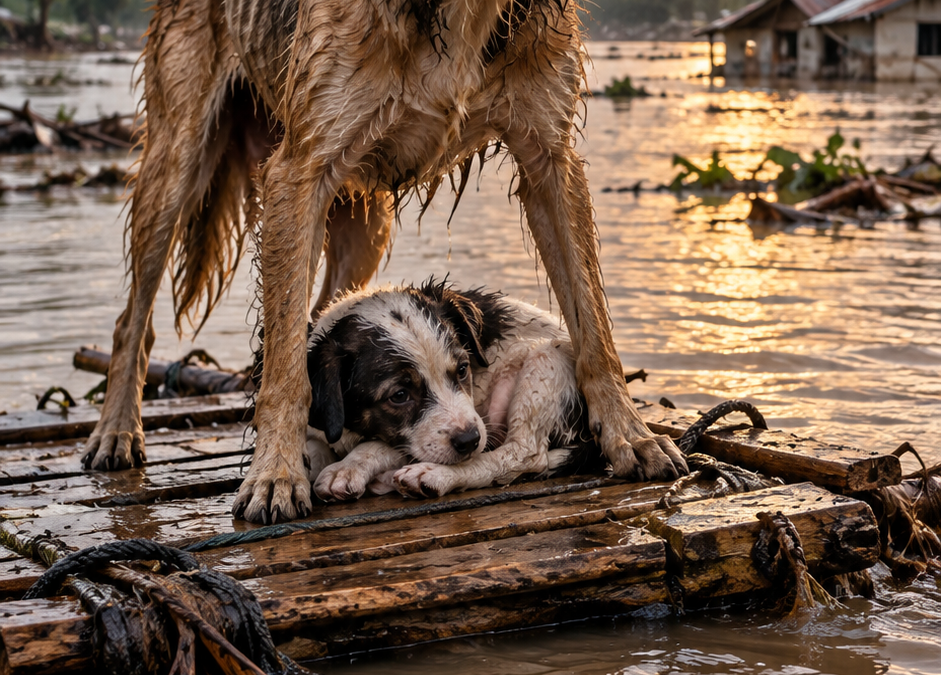
𝗙𝗨𝗟𝗟 𝗦𝗧𝗢𝗥𝗬
Harley refused food.
That worried me more than the abrasions.
A starving puppy usually has one very strong opinion about food.
Harley smelled the bowl once.
Turned his head.
I tried wet food.
Nothing.
Chicken.
Nothing.
Peanut butter on a spoon.
One glance.
Then away.
“You’re difficult.”
No response.
“Good. Difficult means alive.”
I left the food near him.
The shelter moved around us.
Dogs barking.
Kennel doors opening.
Phones ringing.
Volunteers calling names.
Harley stayed in the same corner.
He didn’t sleep.
That was the part people often misunderstood.
A shut-down dog can look calm.
Still body.
No barking.
No pacing.
Visitors sometimes say, “Oh, he’s so well behaved.”
No.
Sometimes stillness is terror with nowhere to run.
Harley’s eyes followed every movement.
Door.
Hands.
Shoes.
Leashes.
But his body remained folded against itself.
Around sunset, one of our techs, Rosa, came in.
“Any change?”
“Almost none.”
She knelt several feet away.
“Poor baby.”
Harley looked at her.
Then the door.
Rosa frowned.
“He expecting somebody?”
“Maybe.”
“Think they’ll come back?”
I thought about the car.
“No.”
Neither of us spoke after that.
We did basic medical checks.
Mild dehydration.
Underweight.
Raw paw pads.
Old bruising.
A healing laceration near the shoulder.
No broken bones.
No fever.
No obvious internal injury.
He had survived whatever happened before the gate.
Now we had to convince him surviving was worth continuing.
I stayed late.
Technically my shift ended at six.
At eight, Harley hadn’t moved.
At nine, the shelter grew quiet.
Some dogs slept.
Others barked at imaginary threats.
I sat cross-legged outside his open kennel area.
“You’re making me look incompetent.”
Nothing.
“I have a reputation.”
No reaction.
“Not a good one. But still.”
His eyes closed briefly.
Then opened.
At some point, I noticed a wet line beneath one eye.
People love saying dogs cry.
The biology is more complicated than that.
Tear production doesn’t mean human-style crying.
I knew that.
I still looked at that wet track on Harley’s dusty face and had to turn away.
Because science doesn’t always help with what something looks like.
“You don’t have to do anything tonight.”
His breathing remained shallow.
“Just stay.”
That became our second promise.
The first had been I’m staying.
The second was You stay too.
The next morning, Harley was exactly where I’d left him.
Food untouched.
Water lower, at least.
Good.
I changed both.
Brought in a soft chew toy.
He didn’t care.
I brushed my fingers gently along the side of his face.
He tensed.
But didn’t flinch away.
That was different.
Small.
Almost nothing.
In shelter work, almost nothing can be everything.
We moved him to a quieter kennel in the back wing.
Not isolation.
Just less traffic.
Door partly covered.
Blankets.
No pressure.
That was when Milo arrived.
Milo was a Labrador puppy.
Three months.
Eight pounds.
Yellow coat.
Ears too large.
Fear even larger.
Animal control brought him from an apartment complex after somebody found him alone behind a dumpster.
No litter.
No mother.
No owner.
Milo cried constantly.
Not dramatic barking.
A thin, high sound.
Over and over.
He called for something.
Someone.
Anybody.
We put him in the kennel beside Harley.
Milo cried.
Harley moved.
I was standing near the laundry room when Rosa grabbed my arm.
“James.”
“What?”
“Look.”
Harley had lifted his head.
Not toward us.
Toward Milo.
The Lab puppy pushed one paw beneath the divider.
Whimper.
Harley stared.
Milo pushed farther.
Little nails scratching against concrete.
Harley slowly moved forward.
Six inches.
Stopped.
Milo cried again.
Another six inches.
Harley reached the divider.
Then placed one paw against Milo’s.
That was it.
No licking.
No tail wagging.
No happy music.
Two paws separated by metal.
Milo became quiet.
I felt my throat tighten.
Rosa whispered, “Well.”
Harley kept his paw there.
For almost twenty minutes.
That night, I reviewed the security recording of his abandonment.
I don’t know why.
Maybe I hoped for a license plate.
Maybe I wanted to understand.
The footage showed exactly what I remembered.
Sedan slowed.
Door opened.
Harley hit concrete.
The passenger leaned just far enough to push out the towel and bowl.
Then the car drove away.
Harley tried to stand.
Fell.
Stood again.
Watched the car.
For several seconds, he remained in the road.
Then limped toward the gate.
Not because he knew what the shelter was.
Because the gate was the nearest shade.
I paused the video.
There he was.
Five months old.
Watching the only people he knew leave.
The next frame showed him lowering his head.
I closed the laptop.
There are things that become uglier when you watch them twice.
The next morning, Harley still refused most food.
But Milo ate.
And Harley watched.
When Milo finished, Harley sniffed his own bowl.
Took one bite.
Then another.
I looked at Rosa.
She looked at me.
Neither said anything.
We didn’t want to scare the miracle.
Milo became Harley’s first reason.
That became obvious quickly.
If Milo cried, Harley moved closer.
If Milo slept against the divider, Harley lay on the opposite side.
When we took Harley out to clean, Milo screamed.
When Harley returned, Milo quieted.
It wasn’t play.
Harley still didn’t play.
It wasn’t even affection in the conventional sense.
It was presence.
Steady.
Silent.
Complete.
The first family arrived three days later.
Mom.
Dad.
Two children.
They wanted a puppy.
“Friendly.”
“Young.”
“Good with kids.”
“Not too big.”
Everyone wants contradictory things.
Shelter adoption is partly matchmaking and partly diplomacy.
They met Milo.
Instant love.
Milo bounced.
Licked the little girl’s hand.
Chewed the boy’s shoelace.
Perfect puppy theater.
The mother laughed.
The father asked questions.
Vaccines.
Size.
Training.
Then the boy noticed Harley.
“What’s his name?”
“Harley.”
He stepped closer.
Harley sat near the back wall.
Watching.
“Why doesn’t he come over?”
“He’s shy.”
The father glanced.
“German Shepherd?”
“Yes.”
“He’s going to be big.”
“Probably.”
The father’s interest ended.
Not cruel.
Practical.
They chose Milo.
Good choice.
Milo needed a family.
Still, when adoption paperwork was completed, I looked at Harley.
His eyes followed the children touching Milo.
No tail movement.
No whining.
Nothing.
When they walked out with Milo, Harley remained sitting.
Then slowly turned his head toward the wall.
I hated myself for interpreting it.
Maybe he was tired.
Maybe dogs don’t narrate rejection the way humans do.
But I sat beside him that evening anyway.
“I would’ve picked you.”
Harley glanced at me.
That was a lie.
Not because I didn’t love him.
Because I worked at a shelter.
If I adopted every dog that broke my heart, I’d be living beneath a mountain of kibble with no electricity.
Still, I meant something deeper.
“You deserve picking.”
I scratched behind one ear.
Harley leaned.
Barely.
Maybe half an inch.
I froze.
He stayed.
“Okay.”
My voice broke.
“Okay, buddy.”
The next morning, Harley stood when I entered.
First time.
Front legs stiff.
Head low.
But standing.
“Well, look at you.”
No tail.
Still.
Standing.
I clipped a leash.
He flinched at the sound.
Then followed me.
The shelter yard overwhelmed him.
Gate clang.
Flinch.
Truck door.
Flinch.
Volunteer laughter.
Flinch.
But he walked.
One step.
Then another.
We passed a brindle puppy named Pepper.
Ten weeks.
New intake.
She was curled in the far corner, shaking so hard her metal tag tapped against the kennel wall.
Harley stopped.
I loosened the leash.
“She’s scared.”
He looked at Pepper.
Then walked toward the gate.
Slowly.
Pepper froze.
Harley lowered himself.
Lay in the dirt.
Nose maybe twelve inches from the bars.
Nothing else.
Pepper watched.
Five minutes.
Then moved closer.
Stopped.
Moved again.
Eventually she lay down on her side of the gate.
Her body stopped shaking.
I stared.
“Harley.”
He ignored me.
Pepper closed her eyes.
That was the moment I realized Milo had not been an accident.
Harley had learned something from pain that none of us could teach.
He knew how to stay near fear without crowding it.
No direct eye contact.
No excited movement.
No demand.
Just:
I’m here.
The next week, we tested the pattern carefully.
Not intentionally at first.
Harley kept doing it.
A terrier mix came in trembling after a hoarding seizure.
Harley lay outside the kennel.
The terrier slept.
A hound puppy refused food after transport.
Harley stayed near.
Eventually the puppy ate.
A husky mix named Nico arrived after hiding beneath a bridge in a thunderstorm.
He snapped at two volunteers.
Not biting.
Warning.
Harley approached.
Stopped several feet away.
Lay down.
Nico stared.
Half an hour later, their noses touched through the gate.
No one had told Harley what to do.
No trainer had shaped it.
He simply recognized something.
Maybe loneliness.
Maybe shutdown.
Maybe himself.
One volunteer, Abby, called him our “silent shepherd.”
The name stuck.
“He’s like a therapy dog,” someone said.
“No.”
I corrected that quickly.
Harley was not certified.
Not trained.
And more importantly, he wasn’t our employee.
He didn’t owe us emotional labor because he’d survived something terrible.
If he wanted to walk away, we let him.
If he looked tired, he rested.
But most of the time, Harley chose the frightened dogs.
Again and again.
That complicated adoption.
Visitors want connection.
Wagging.
Approach.
Performance.
Harley didn’t perform.
Families passed.
Golden retriever adopted.
Beagle adopted.
Corgi adopted in thirty-seven minutes because apparently large ears are a marketing strategy.
Harley remained.
People saw him.
Asked questions.
“Why is he so quiet?”
“Does he play?”
“Is something wrong?”
“He looks sad.”
Then moved on.
Harley watched.
Never pushed.
He seemed to have accepted a role I hated.
Comfort the ones being chosen.
Stay behind.
Week three, a woman came in shortly before closing.
Late forties.
Dark hair.
Gray streak near one temple.
No makeup.
No excited adoption voice.
That mattered.
People shopping for pets often enter shelters with energy.
She entered like she was visiting a hospital.
“Can I help you?” I asked.
“I’m looking for a dog.”
“What kind?”
“Calm.”
“Size?”
“Doesn’t matter.”
“Age?”
“Doesn’t matter.”
“Energy?”
“Low to moderate.”
“Any other pets?”
“No.”
“Children?”
Her face changed.
“No.”
I noticed.
Didn’t ask.
We showed her several dogs.
Sweet spaniel.
Young Border Collie.
Golden mix.
She was kind to all of them.
But something held back.
Then we rounded the back wing.
Harley lay beside Duke’s kennel.
Duke was a boxer puppy who had cried for almost two days.
Separation distress.
Harley lay outside.
Duke slept.
The woman stopped.
“What about him?”
“Harley.”
She watched.
Harley lifted his head.
Didn’t stand.
“How old?”
“About five months.”
“Why is he out there?”
“He helps.”
“Helps what?”
I looked at Duke.
“Scared dogs.”
She went quiet.
Then approached.
Slowly.
Harley’s ears shifted.
He watched her.
“He doesn’t greet people?”
“Not usually.”
She crouched.
No reaching.
Good.
“He’s been hurt.”
Statement.
Not question.
“Yes.”
She kept her hand near the gate.
Harley stayed still.
After a minute, she stood.
“I’ll think about it.”
There it was.
The phrase shelter workers learn not to believe.
I’ll think about it.
Sometimes people return.
Usually they don’t.
“Of course.”
She left.
Harley watched the door.
Not dramatically.
Just watched.
That night, he returned to Duke.
Duke slept with one paw through the bars.
Harley remained awake.
I sat beside him.
“You know she’s probably not coming back.”
His eyes moved toward me.
“Sorry.”
He lowered his head.
I hated the sentence after saying it.
Why teach him disappointment before it arrived?
Three days later, she came back.
No appointment.
No email.
She walked past reception.
I recognized her immediately.
“You came back.”
She nodded.
“I said I would.”
Fair.
Harley was with a ten-week-old Australian Shepherd named Bella.
Bella had arrived that morning.
Terrified of touch.
Wouldn’t eat.
Harley lay outside her kennel.
Bella had moved close enough that her nose almost touched his paw.
The woman watched.
Long time.
Then knelt.
This time Harley stood.
I stopped breathing.
He walked toward her.
No food.
No coaxing.
No leash.
He pressed his forehead into her open palm.
The woman’s face broke.
Not loudly.
Her eyes closed.
Shoulders lowered.
Harley leaned harder.
She whispered, “Oh.”
That one sound contained an entire history.
I looked away.
Give people privacy even when they are standing in a shelter corridor.
After a while, she asked, “Can I sit with him?”
“Yes.”
We moved to the quiet room.
She sat on the floor.
Harley lay beside her.
Not touching initially.
Then his shoulder met her leg.
She stroked his neck.
Slow.
Her name was Evelyn Price.
Forty-eight.
School librarian.
Widowed years earlier.
Then she told me about Matthew.
Her son.
He had died the previous year.
Seventeen.
Illness.
She didn’t give details.
Didn’t need to.
“He was quiet,” she said.
“Not shy. Quiet.”
Harley looked up at her.
“People always thought something was wrong because he wasn’t loud.”
Her hand rested on Harley’s head.
“He loved dogs.”
She laughed once.
“We had a German Shepherd named Rex.”
Harley’s ear moved.
“Rex died three months before Matthew.”
I swallowed.
“That’s a lot.”
“Yes.”
Simple.
Honest.
Evelyn looked at me.
“I haven’t touched another animal since.”
Harley moved closer.
Her mouth trembled.
“He doesn’t ask.”
“No.”
“He just stays.”
“That’s what he does.”
She looked down.
“That’s what I need.”
I said nothing.
There are moments when a shelter worker’s job is not talking.
Evelyn did not adopt him that day.
I respected that.
Instead, she asked to return.
Every day if possible.
“Of course.”
So she did.
Morning.
Sometimes afternoon.
Always quiet.
She brought a blanket.
One toy.
Treats.
But she rarely used them immediately.
Mostly she talked.
To Harley.
About Matthew.
About Rex.
About books.
About how she had stopped cooking because there was no one to cook for.
About how silence in her house had changed from peaceful to unbearable.
Harley listened.
Because Harley listened to everything.
The first week, he stayed near her feet.
Second week, his head rested on her shoe.
Third week, he walked beside her in the yard.
Leash loose.
No pulling.
No scanning the exit.
A young Golden Retriever barked frantically from a pen.
Harley stopped.
Walked toward the gate.
Lay down.
Evelyn watched.
“He can’t help himself.”
“He chooses it.”
“Why?”
“I don’t know.”
She stared at Harley.
Then said, “He’s not trying to fix them.”
That sentence stopped me.
“What?”
“He’s just letting them be scared without being scared alone.”
Exactly.
I had worked with animals for six years and Evelyn named it better in one sentence than I ever had.
Harley wasn’t fixing anyone.
He was staying.
That became his gift.
Bella ate with Harley nearby.
Nico eventually came out of his kennel.
A Dalmatian puppy named Benny followed Harley through a doorway after refusing to cross it for two days.
A Basset Hound named Rosie finally slept during daylight when Harley lay beside her.
Volunteers started learning from him.
Less reaching.
Less baby talk.
More sitting.
More patience.
We joked Harley was retraining the humans.
Probably true.
Families kept visiting.
One couple became interested in him.
Good people.
Young.
Newly married.
Looking for their first dog.
They saw Harley beside Lulu, a Sheltie puppy afraid of raised voices.
“He’s beautiful.”
“He is.”
“Why hasn’t anyone adopted him?”
I had begun hating that question.
Because it implied adoption was proof of worth.
“He’s quiet.”
The husband crouched.
Harley looked.
Didn’t approach.
The wife held out a hand.
Nothing.
“He seems kind of detached.”
“He’s cautious.”
They nodded.
Moved on.
No villain.
No cruelty.
Wrong match.
Still, I watched Harley afterward.
He did not follow them.
Did not care.
Later, Evelyn arrived.
Harley stood immediately.
His tail tapped once against the floor.
First real tail response I’d seen to a person.
Evelyn stopped.
“You saw that?”
“I saw it.”
Again.
Tap.
She covered her mouth.
Harley walked to her.
Forehead into palm.
That was his greeting now.
Not exuberant.
His.
Evelyn whispered, “You don’t have to stay quiet to be loved.”
Harley exhaled.
Long.
Deep.
Not bark.
Not whine.
A sigh.
I felt tears in my eyes.
Ridiculous workplace hazard.
The next morning, Evelyn arrived before opening.
I found her sitting on the bench in the play yard.
Paper bag beside her.
Hands folded.
The sunrise made everything gold.
“You’re early.”
“I know.”
“Everything okay?”
She nodded.
Then looked toward the kennels.
“I’m ready.”
No explanation needed.
Harley had been with us forty-two days.
Forty-two mornings.
Forty-two nights.
Dozens of frightened dogs.
Five serious inquiries.
No adoption.
Now someone had chosen him without asking him to perform.
I brought him out.
He walked beside me.
When he saw Evelyn, he stopped.
She opened her arms.
No command.
Harley walked.
Directly.
Pressed his head against her chest.
Evelyn wrapped both arms around him.
Harley leaned.
Whole body.
The dog who had barely allowed touch six weeks earlier now gave his weight to someone.
I turned away.
Rosa was standing behind me.
Crying.
“Stop.”
“You stop.”
“You’re crying.”
“So are you.”
“Allergies.”
“In July?”
“Texas.”
She laughed through tears.
Adoption paperwork took an hour.
Medical history.
Food.
Training.
Triggers.
Follow-up.
Evelyn asked detailed questions.
Noise.
Visitors.
Alone time.
Other dogs.
I explained that Harley might grieve leaving the shelter.
People think adoption is automatically joyful.
For some animals, transition is stress even when the destination is good.
“He may look for the other dogs.”
“I know.”
“He may shut down.”
“Okay.”
“He might not sleep.”
“Neither do I.”
That answer broke me again.
The bag she’d brought contained a collar.
Deep navy blue.
Simple silver tag.
HARLEY on one side.
STAY on the other.
I ran my thumb over the word.
Evelyn saw.
“It was something I used to tell Matthew.”
I said nothing.
She fastened it around Harley’s neck.
He shook once.
Tag jingled.
No more nameless puppy.
No more shelter gate.
Stay.
When they walked toward the exit, Harley paused.
Looked back.
My chest tightened.
For one irrational second, I wanted him to stay.
Then I remembered the entire point.
“Go.”
His tail moved.
Evelyn waited.
No pulling.
Harley turned.
Walked out.
The shelter felt wrong immediately.
His kennel was empty.
His blanket gone.
The hallway quieter.
That afternoon, a Bernese Mountain Dog puppy came in.
Fearful.
Wouldn’t leave the corner.
I caught myself looking toward Harley’s old area.
So did Rosa.
“Harley would’ve—”
“I know.”
But something strange happened.
Lulu, the Sheltie Harley had comforted, moved near the Bernese pup’s gate.
Lay down.
Quiet.
The puppy watched.
Eventually rested.
Rosa and I stared.
“No.”
“Yes.”
“She copied him.”
“Maybe.”
The next day, Bella did something similar with a new Doberman.
Not identical.
But close.
Less barking.
More presence.
Harley had left.
His pattern remained.
That’s when I understood he had changed more than himself.
He had changed the shelter.
Volunteers sat more often.
We started adding “quiet companionship” blocks to behavior plans.
No forcing interaction.
No expectation.
Just regulated presence.
Harley had taught us without training any of us.
A week after adoption, Evelyn texted.
A photo.
Harley on a rug.
Sunlight across his coat.
One paw hanging off the edge.
Behind him, a framed photograph of Matthew holding a young German Shepherd.
Caption:
He follows me everywhere. Doesn’t need anything. Just wants to know where I am.
I stared at the photo.
Then another message arrived.
I think he’s making sure I don’t disappear.
I replied:
Maybe you’re doing the same for him.
Three dots.
Then:
I think so.
Months passed.
Harley changed.
Not dramatically at first.
Evelyn sent updates.
First bark at the mail carrier.
First stolen sock.
First time sleeping on the couch despite rules.
First time playing with a tennis ball.
First zoomies in the backyard.
That video destroyed the entire shelter staff.
The puppy who had lain motionless beside our gate now ran circles through grass.
Ears up.
Tail high.
No silence.
Rosa shouted at my phone, “LOOK AT HIM.”
“I am.”
“He looks huge.”
“He’s growing.”
“He’s HAPPY.”
I couldn’t argue.
Six months later, Evelyn brought him back to visit.
I heard his bark before I saw him.
Deep.
Healthy.
Confident.
Harley entered wearing the navy collar.
Coat glossy.
Body strong.
He saw me.
Stopped.
I crouched.
For a second, old fear returned.
What if he didn’t remember?
Then he ran.
Not walked.
Ran.
Hit me in the chest.
Nearly knocked me over.
“Okay!”
He licked my face.
“This is extremely unprofessional.”
Tail beating everything.
Rosa came out.
Harley greeted her too.
Then something more important happened.
A new puppy cried from the back wing.
Harley stopped.
Ears up.
Looked toward the sound.
Evelyn smiled.
“Go.”
Harley walked toward the kennel.
A little terrier mix trembled inside.
Harley lay down.
Same posture.
Same distance.
No crowding.
The puppy stopped crying.
I leaned against the wall.
“Still got it.”
Evelyn nodded.
“He does that with people too.”
“What?”
“If I have a bad day, he just sits.”
“Sounds familiar.”
“He doesn’t try to distract me.”
She watched him.
“He lets me be sad.”
There it was again.
Not fixing.
Staying.
Harley became an occasional shelter visitor.
Never as a formal therapy animal.
No pressure.
If Evelyn wanted.
If Harley seemed comfortable.
He helped certain dogs.
We learned to match carefully.
Fearful dogs benefited.
Highly aroused dogs sometimes did not.
This wasn’t magic.
Behavior matters.
Temperament matters.
But when the match was right, Harley could change the atmosphere of a kennel by lying down.
Over the next year, several dogs he had sat with were adopted.
Lulu.
Bella.
Nico.
Duke.
The Bernese puppy.
Each left.
The shelter rotated.
Harley remained part of its story.
New volunteers heard about the puppy dumped at the gate who became our silent shepherd.
I always corrected one detail.
“He wasn’t born calm.”
People would look surprised.
“What do you mean?”
“He shut down.”
Different.
Important.
Harley’s calm grew from healing.
His original silence had been fear.
We had almost mistaken one for the other.
That distinction changed how we evaluated dogs.
We stopped writing “quiet” without context.
We stopped calling shutdown “easy.”
We added decompression time.
More foster outreach.
More behavior observation before labels.
Harley became policy without ever knowing it.
One afternoon, animal control called.
They had identified the sedan from our gate footage.
I had stopped expecting that.
A neighboring business had captured a partial plate from a different angle.
Owner traced.
A couple outside Dallas.
Harley had belonged to them.
Bought online.
No breeder support.
No training.
No proper vet care.
They said he was “too much.”
Chewing.
Fearful.
Wouldn’t house-train fast enough.
Then an older dog in the home attacked him.
That explained the wounds.
Instead of treating him or surrendering properly, they drove to our shelter and pushed him out.
I felt rage.
Cold rage.
Not dramatic.
The kind that makes your hands go still.
“Charges?”
Animal abandonment.
Potential cruelty citations tied to untreated injury.
Investigation.
I called Evelyn.
Not because she needed the past dragged back.
Because Harley was legally hers and she deserved to know.
She listened.
Then said, “Too much?”
“Apparently.”
Harley barked in the background.
Evelyn laughed once.
“He just carried my grocery bag from the kitchen.”
“Clearly a menace.”
“They had him five months.”
“Yeah.”
“I’ve had him almost a year.”
Pause.
“They didn’t know him.”
That was all.
The case produced consequences.
Fines.
Restrictions.
Court.
Nothing cinematic.
I testified from footage.
Medical records.
Condition at intake.
The former owners described being overwhelmed.
I believed them.
Overwhelm is real.
So are options.
Call.
Surrender.
Ask for help.
What you do not do is throw an injured puppy onto concrete and drive away.
The judge said essentially the same thing with more legal language.
Afterward, one of the former owners approached me outside the courtroom.
“Is he okay?”
I looked at them.
I wanted to say something cruel.
Instead:
“He’s loved.”
Their eyes dropped.
“Can we see a picture?”
I considered refusing.
Then showed the video of Harley running through Evelyn’s yard.
They watched.
Longer than I expected.
“He looks different.”
“He’s not.”
They looked at me.
“He was always that dog.”
I put the phone away.
“You just never gave him enough safety to show you.”
I walked away.
That was the only confrontation I needed.
The person who abandoned Harley lost in every way that mattered.
Not because a judge imposed a fine.
Because they had thrown away a dog who became extraordinary once fear stopped consuming him.
Years passed.
Harley grew into a large German Shepherd.
Ninety pounds.
Broad chest.
Deep bark.
Soft eyes.
He still preferred quiet people.
Still positioned himself near anxious dogs.
Still followed Evelyn from room to room.
Matthew’s photograph remained on the wall.
Harley often slept beneath it.
Evelyn once sent me a picture.
Caption:
My two boys.
I cried in the office.
Rosa caught me.
“Allergies?”
“Texas.”
“Indoors?”
“Very aggressive pollen.”
She rolled her eyes.
At three, Harley began accompanying Evelyn to a grief-support outdoor group with proper permission and supervision.
Not as a service dog.
Not therapy-certified initially.
Just present.
People liked him.
More importantly, Harley liked being there.
He would choose someone.
Sit.
Sometimes put one paw on their shoe.
Evelyn eventually pursued formal therapy-dog training because Harley had the temperament and now enough stability.
He passed.
That felt almost absurd.
The puppy who would not lift his head became a certified therapy dog.
But I resisted the temptation to treat that as proof of worth.
Harley had been worthy before the certificate.
Before recovery.
Before helping others.
Before anybody chose him.
The achievement showed growth.
Not value.
At four, Harley visited our shelter for an anniversary event.
We hung the old security-camera image near reception.
Him lying outside the gate.
Next to it, a photo of him wearing his therapy vest beside Evelyn.
Visitors stared.
“Same dog?”
“Same dog.”
A little boy asked, “Why did they throw him away?”
I crouched.
“They made a bad decision.”
“Because he was bad?”
“No.”
Important answer.
“He was scared and hurt.”
The boy looked at Harley.
Harley licked his hand.
“He’s not scared now.”
“Sometimes he still is.”
The boy thought.
“Me too.”
“Exactly.”
Harley sat beside him.
That’s how lessons should work.
Not through slogans.
Contact.
At five, Harley’s muzzle remained dark.
At six, first gray hairs.
Evelyn sent photos.
At seven, he slowed slightly.
At eight, arthritis appeared.
Normal.
Manageable.
He continued therapy visits less often.
More shelter visits.
Shorter.
Still effective.
He developed a habit of lying beside frightened senior dogs instead of puppies.
Maybe they matched his speed.
One old beagle named Jasper stopped pacing whenever Harley arrived.
Harley would sleep.
Jasper would sleep.
Two old men.
No conversation needed.
Evelyn called me one night when Harley was nine.
Her voice shook.
“He’s sick.”
My stomach dropped.
“How sick?”
“Mass.”
Cancer.
Hemangiosarcoma suspected.
The word hit hard.
Emergency surgery bought time.
Not cure.
I drove to Evelyn’s house.
Harley lay on a thick rug.
Gray muzzle.
Navy collar.
Silver tag.
STAY.
I sat.
He lifted his head.
Tail thump.
One.
Two.
“Hey, old man.”
He tried standing.
“Don’t.”
Too late.
He came to me.
Slow.
Put his forehead against my chest.
Same gesture he’d given Evelyn years ago.
I held him.
No shelter worker voice.
No professionalism.
Just me.
“You did good.”
Evelyn sat beside us.
“He still checks on me.”
“Of course.”
“He was bleeding internally and still followed me to the bathroom yesterday.”
I laughed through tears.
“Control issues.”
Harley sighed.
We had weeks.
Then months.
Good months.
Not perfect.
But good.
Food.
Slow walks.
Sunlight.
Occasional shelter visits.
One final visit became unforgettable.
A German Shepherd puppy had been surrendered that morning.
Five months old.
Black and tan.
Wouldn’t eat.
Wouldn’t move.
The similarity hurt.
Harley was tired.
I almost didn’t let him near.
Evelyn looked at him.
Harley looked toward the puppy.
“Your choice,” she said.
He walked.
Slowly.
Lay outside the kennel.
The puppy watched.
Harley rested his head.
Twenty minutes.
The puppy moved forward.
Thirty.
Nose to bars.
Harley didn’t move.
Forty.
The puppy ate one piece of chicken.
I stood with my arms folded tight against my chest.
History repeating.
But differently.
This puppy had not been thrown away to disappear.
She had Harley.
She had us.
She had systems Harley had helped change.
We named her Hope.
A little obvious.
Nobody objected.
Hope went to foster three days later.
Adopted two weeks after.
Harley never knew.
Maybe that was appropriate.
Kindness does not need the receipt.
His last month was quiet.
Cancer spread.
Energy faded.
Evelyn called.
“It’s time.”
I understood.
I went to the house.
The room was warm.
Afternoon sun.
Matthew’s photograph above the rug.
Harley lay beneath it.
Evelyn sat with his head in her lap.
The veterinarian prepared everything.
I knelt.
Harley’s eyes opened.
He recognized me.
I placed one hand on his chest.
“Remember the gate?”
Evelyn smiled through tears.
“He probably doesn’t.”
“Good.”
I meant that.
Harley didn’t need to carry the gate to the end.
I whispered, “You stayed.”
His ear moved.
“You stayed for Milo.”
Breath.
“Pepper.”
Breath.
“Nico.”
Breath.
“All of them.”
Evelyn stroked his face.
“And then you stayed for me.”
Harley’s tail moved weakly.
The vet gave sedation.
His body softened.
No guarding.
No watching.
No waiting for the next hurt.
Just rest.
I looked at the navy tag.
STAY.
The word had changed meaning across his life.
At the shelter, Harley stayed because fear froze him.
With other dogs, he stayed because presence helped.
With Evelyn, he stayed because he belonged.
Now love asked something harder.
Permission to stop.
I leaned close.
“You don’t have to stay this time.”
Evelyn broke.
So did I.
Harley’s breathing slowed.
One last sigh.
The same kind of deep exhale he had given years earlier when Evelyn told him he didn’t have to be quiet to be loved.
Then stillness.
The house became silent.
But not empty.
That’s different.
We buried no mythology with Harley.
He had not been an angel.
He stole food.
Hated vacuum cleaners.
Once destroyed a sofa cushion.
Barked at a Halloween decoration for three consecutive Octobers.
He had opinions about rain.
He disliked men wearing motorcycle helmets.
He was a dog.
A very good dog.
But still a dog.
That made what he accomplished more meaningful.
He didn’t “save” every frightened animal.
He didn’t magically cure trauma.
He offered regulation.
Company.
A model of calm.
Sometimes that was enough to help another dog take the next step.
Sometimes not.
Either way, Harley stayed.
After his death, Evelyn brought the navy collar to the shelter.
“I want you to have this.”
I held it.
STAY.
“No.”
She looked surprised.
“It belongs with you.”
I closed her fingers around it.
“You were the person he stayed for longest.”
She cried.
“So were you.”
“No.”
I smiled.
“I was where he started again.”
Different.
Important.
We compromised.
The original faded towel from intake—washed, folded, inexplicably still in storage—remained at the shelter inside a shadow box with his first photograph.
Not as a monument to abandonment.
Beside it we placed later photos.
Harley with Milo through the kennel bars.
Harley beside Bella.
Harley with Evelyn.
Harley wearing his therapy vest.
Harley old and gray beside Hope.
The plaque didn’t say HERO.
I hated that word for animals who never volunteered for suffering.
It said:
HARLEY
2015–2025
HE TAUGHT US THAT SOMETIMES HELPING MEANS STAYING.
That felt accurate.
The shelter changed permanently because of him.
Quiet decompression rooms.
Longer behavioral observation.
Foster protocols for shutdown dogs.
Volunteer training on consent-based interaction.
More careful language.
No “unresponsive” without context.
No “doesn’t care.”
No “not affectionate” after one bad day.
No assuming silence means stability.
Harley forced us to become better at seeing what stillness can hide.
Years later, new staff would ask about the German Shepherd in the photos.
I told the story.
Car.
Gate.
No collar.
No chip.
Silence.
Milo.
The frightened puppies.
Evelyn.
Stay.
I always ended with the part people least expected.
“He didn’t become important when he started helping other dogs.”
They would look at me.
“He was important when he hit the concrete.”
Because that’s the trap in rescue storytelling.
We love redemption so much we accidentally make it sound like wounded animals must become extraordinary to justify being saved.
They don’t.
Harley did extraordinary things.
Good.
But if he had recovered, gone home, slept on a couch, and never comforted another animal, his life would have been equally worth saving.
His gift was beautiful.
His existence was enough.
The people who dumped him had not simply failed to recognize a future therapy dog.
They had failed to recognize a puppy.
That was the real crime.
A living creature with fear.
Pain.
Needs.
Potential.
They saw inconvenience.
We eventually saw Harley.
The difference changed hundreds of lives.
Not because Harley became famous.
He didn’t.
Outside our shelter network, almost nobody knew his name.
But Milo grew up in a family.
Pepper got adopted.
Nico learned to trust.
Lulu learned how to sit beside frightened dogs.
Bella ate.
Hope went home.
Volunteers changed how they approached fear.
Evelyn started speaking aloud again.
Started cooking.
Started walking.
Started laughing.
Harley never knew the scale of any of it.
Dogs rarely know their legacy.
Maybe humans don’t either.
That’s probably healthy.
One summer afternoon, long after Harley was gone, a gray sedan slowed outside our gate.
My body reacted before my mind did.
I ran.
The car stopped.
A woman stepped out.
She was crying.
In the back seat was an elderly shepherd.
She didn’t dump him.
She walked him inside.
“My father died,” she said. “I can’t keep him where I’m moving.”
She looked ashamed.
“I’m sorry.”
I thought about Henry.
Aster.
Harley.
Every dog caught inside human catastrophe.
I said, “You brought him in.”
She nodded.
“I didn’t know what else to do.”
“You did the right thing.”
That matters too.
Surrender is not abandonment.
Asking for help is not failure.
Walking inside a shelter and giving truthful information, records, medication, history—that is difficult responsibility.
Throwing an injured puppy onto concrete is something else entirely.
The distinction had become sacred to me.
We found the older shepherd a foster.
Then a home.
Not every ending is dramatic.
Good.
I prefer boring endings now.
Paperwork.
Leash.
Car.
Home.
No security footage required.
Harley’s former owners completed their legal consequences and disappeared from our lives.
I never searched for them again.
That was another thing Harley taught me.
You can spend years making the person who caused harm central to the story.
Or you can let them shrink.
They had Harley for a few months.
Evelyn had him for nearly a decade.
Which part deserves more space?
The answer became obvious.
The people who discarded him became a paragraph.
Harley became the book.
Evelyn still visited us after he died.
Sometimes alone.
Sometimes carrying donations.
Every year on his adoption date, she brought navy collars in several sizes.
Each tag engraved with one word.
STAY.
Not every dog wore one.
Only adopters who liked the story and wanted one.
One afternoon, a little girl adopted a nervous mixed-breed puppy named June.
The girl selected a navy collar.
Read the tag.
“Why does it say stay?”
Evelyn knelt.
“Because sometimes staying is how love starts.”
The girl thought.
Then put the collar on June.
June licked her face.
Evelyn looked at me.
I looked away.
Texas pollen.
Terrible stuff.
The shelter gate is still there.
Same metal.
Different paint.
Security camera replaced twice.
Cars come and go.
Dogs arrive.
Cats.
Occasional rabbit.
Once, inexplicably, a goat.
Shelter work remains hard.
Some days worse than others.
You lose animals.
You lose patience.
You go home smelling like disinfectant and wet fur.
You wake at three wondering whether a dog ate after you left.
You watch good people cry because they cannot afford medical care.
You watch bad decisions damage innocent lives.
Then, occasionally, something small happens.
A frightened puppy eats.
A dog puts its head into someone’s hand.
A family returns after saying they would.
A volunteer sits five extra minutes.
A kennel goes empty for the right reason.
Those moments keep the building standing.
Harley became one of those moments stretched across years.
When I think of him now, I don’t see the security footage first.
I see an old German Shepherd lying in afternoon sun beside Evelyn’s chair.
White around the muzzle.
Eyes half closed.
Safe enough to sleep.
That is the image that defeated the gate.
The car.
The towel.
The cracked bowl.
All of it.
The people who threw Harley away left believing they had removed a problem from their lives.
What they actually did was surrender every good thing he later became.
They lost the dog who could quiet a crying puppy by lying nearby.
The dog who would grow into a steady companion.
The dog who helped a grieving woman reenter the world.
The dog who became a therapy animal.
The dog who taught an entire shelter to stop confusing silence with peace.
They drove away.
Harley stayed.
And staying changed everything.
He stayed beside Milo.
Beside Pepper.
Beside Nico.
Beside Bella.
Beside Duke.
Beside Lulu.
Beside Hope.
Beside Evelyn.
He stayed beside people who were hurting because somehow he had learned that presence mattered.
Then, after years of giving others that gift, he received the same thing at the end.
Nobody drove away.
Nobody dropped him at a gate.
Nobody left him frightened on concrete.
Evelyn held him.
I held him.
The veterinarian stayed.
The room stayed quiet.
His name was spoken gently.
His body was warm.
His home was his.
The puppy who had once been discarded without a goodbye left this world surrounded by people who would have given anything for one more day.
That is the part that still gets me.
Not that Harley became extraordinary.
That somebody once looked at him and decided he was nothing.
They were wrong.
Spectacularly, permanently wrong.
Harley had been wounded.
Silent.
Afraid.
But never empty.
There was an entire life inside him waiting for enough safety to begin.
A shelter gate almost became his ending.
Instead, it became the place his real story started.
And years later, when frightened dogs entered that same building and somebody sat quietly beside them instead of demanding they be brave, Harley was still there in a way.
Not as a ghost.
Not as a legend.
As a lesson.
Don’t rush.
Don’t label.
Don’t mistake quiet for okay.
Don’t assume the animal in the corner has nothing to give.
And most of all—
stay long enough to find out who they are.
Harley did.
So did we.
And in the end, the people who abandoned him became forgettable.
The dog they left behind never did.
Have you finished reading the story and want to read it again?
They Dumped This Wounded Puppy at Our Shelter Gate—Then He Became the One Every Broken Dog Needed
They threw him out and never looked back.
He survived by becoming invisible.
Then the most frightened dogs in our shelter started choosing him.
My name is James Carter, and I had worked at a rescue shelter outside Dallas for six years by the afternoon Harley landed on the concrete outside our front gate.
You learn a strange kind of emotional arithmetic in shelter work.
You count kennels.
Bowls.
Vaccines.
Blankets.
Volunteers.
Days until adoption.
Days since surrender.
You learn how many frightened animals can fit into a building before noise stops sounding like noise and becomes part of the walls.
You also learn not to ask why too often.
Why did somebody leave a twelve-year-old Labrador when he became incontinent?
Why did someone tie a pit bull mix to our fence overnight during a thunderstorm?
Why did a family surrender a dog because their new couch was white?
If you let every answer inside you, eventually there is no room left for the animals standing in front of you.
So you focus on what comes next.
Food.
Water.
Medical exam.
Chip scan.
Photographs.
Behavior notes.
Placement.
Keep moving.
That afternoon was supposed to be routine.
Texas heat.
One hundred degrees shimmering above the parking lot.
Cicadas screaming from the trees.
Kennels full.
Phones ringing.
A volunteer arguing with the washing machine because it had swallowed another sock.
Then the security monitor at reception flashed movement outside the gate.
A gray sedan slowed.
Passenger door opened.
Something fell.
The car accelerated.
That was all.
By the time I reached the gate, the sedan was gone.
The puppy wasn’t.
Black and tan German Shepherd.
Maybe five months.
He lay on one side in the narrow strip of shade cast by the metal fence.
A faded towel had landed several feet away.
A cracked plastic bowl spun once near the curb before tipping onto its side.
No collar.
No leash.
No note.
Nothing.
Just a puppy left like somebody had thrown away a bag they no longer wanted in the car.
I approached slowly.
“Hey, buddy.”
No response.
Not even an ear twitch.
That scared me.
Young shepherds are usually made almost entirely of ears, paws, opinions, and poor decisions.
This one looked hollow.
His front paws were raw.
His right shoulder had a scabbed abrasion.
His coat smelled like oil, garbage, and old rain even though Dallas hadn’t seen rain in days.
His nose was dry.
His breathing was shallow.
When I touched his ribs, his whole body tightened.
Not aggression.
Memory.
The reflex of an animal expecting touch to hurt.
“Okay.”
I pulled my hand back.
“No rush.”
His eyes followed me.
Brown.
Exhausted.
Too old for five months.
I’ve heard people describe traumatized dogs as looking sad.
Harley didn’t look sad.
Sadness still has movement in it.
Harley looked resigned.
Like he had finally understood the rule of his life:
People leave.
I slid one arm under his chest and another beneath his hips.
He didn’t struggle.
Didn’t help either.
He simply collapsed into me.
He weighed almost nothing.
Bones beneath fur.
A body that should have been fighting me instead hung against my chest like he had already spent everything he possessed trying to survive somebody else.
Inside, we put him in the intake room.
Water.
Clean towel.
Chip scanner.
Nothing.
No registration.
No tag.
No name.
I looked at him lying against the wall.
“Harley.”
One ear moved.
I don’t know why I chose it.
Strong name.
Simple name.
A name that sounded like something that belonged somewhere.
“All right, Harley.”
His eyes lifted for half a second.
“You’re here now.”
I wanted to add, You’re safe.
But after watching that car disappear from the gate, even I wasn’t sure whether a shelter full of frightened animals and no empty kennels qualified as safety.
So I said the only thing I knew I could promise.
“I’m staying.”
Then I sat on the floor beside him.
And for the next two hours, neither of us moved very much.
PART2
Harley refused food.
That worried me more than the abrasions.
A starving puppy usually has one very strong opinion about food.
Harley smelled the bowl once.
Turned his head.
I tried wet food.
Nothing.
Chicken.
Nothing.
Peanut butter on a spoon.
One glance.
Then away.
“You’re difficult.”
No response.
“Good. Difficult means alive.”
I left the food near him.
The shelter moved around us.
Dogs barking.
Kennel doors opening.
Phones ringing.
Volunteers calling names.
Harley stayed in the same corner.
He didn’t sleep.
That was the part people often misunderstood.
A shut-down dog can look calm.
Still body.
No barking.
No pacing.
Visitors sometimes say, “Oh, he’s so well behaved.”
No.
Sometimes stillness is terror with nowhere to run.
Harley’s eyes followed every movement.
Door.
Hands.
Shoes.
Leashes.
But his body remained folded against itself.
Around sunset, one of our techs, Rosa, came in.
“Any change?”
“Almost none.”
She knelt several feet away.
“Poor baby.”
Harley looked at her.
Then the door.
Rosa frowned.
“He expecting somebody?”
“Maybe.”
“Think they’ll come back?”
I thought about the car.
“No.”
Neither of us spoke after that.
We did basic medical checks.
Mild dehydration.
Underweight.
Raw paw pads.
Old bruising.
A healing laceration near the shoulder.
No broken bones.
No fever.
No obvious internal injury.
He had survived whatever happened before the gate.
Now we had to convince him surviving was worth continuing.
I stayed late.
Technically my shift ended at six.
At eight, Harley hadn’t moved.
At nine, the shelter grew quiet.
Some dogs slept.
Others barked at imaginary threats.
I sat cross-legged outside his open kennel area.
“You’re making me look incompetent.”
Nothing.
“I have a reputation.”
No reaction.
“Not a good one. But still.”
His eyes closed briefly.
Then opened.
At some point, I noticed a wet line beneath one eye.
People love saying dogs cry.
The biology is more complicated than that.
Tear production doesn’t mean human-style crying.
I knew that.
I still looked at that wet track on Harley’s dusty face and had to turn away.
Because science doesn’t always help with what something looks like.
“You don’t have to do anything tonight.”
His breathing remained shallow.
“Just stay.”
That became our second promise.
The first had been I’m staying.
The second was You stay too.
The next morning, Harley was exactly where I’d left him.
Food untouched.
Water lower, at least.
Good.
I changed both.
Brought in a soft chew toy.
He didn’t care.
I brushed my fingers gently along the side of his face.
He tensed.
But didn’t flinch away.
That was different.
Small.
Almost nothing.
In shelter work, almost nothing can be everything.
We moved him to a quieter kennel in the back wing.
Not isolation.
Just less traffic.
Door partly covered.
Blankets.
No pressure.
That was when Milo arrived.
Milo was a Labrador puppy.
Three months.
Eight pounds.
Yellow coat.
Ears too large.
Fear even larger.
Animal control brought him from an apartment complex after somebody found him alone behind a dumpster.
No litter.
No mother.
No owner.
Milo cried constantly.
Not dramatic barking.
A thin, high sound.
Over and over.
He called for something.
Someone.
Anybody.
We put him in the kennel beside Harley.
Milo cried.
Harley moved.
I was standing near the laundry room when Rosa grabbed my arm.
“James.”
“What?”
“Look.”
Harley had lifted his head.
Not toward us.
Toward Milo.
The Lab puppy pushed one paw beneath the divider.
Whimper.
Harley stared.
Milo pushed farther.
Little nails scratching against concrete.
Harley slowly moved forward.
Six inches.
Stopped.
Milo cried again.
Another six inches.
Harley reached the divider.
Then placed one paw against Milo’s.
That was it.
No licking.
No tail wagging.
No happy music.
Two paws separated by metal.
Milo became quiet.
I felt my throat tighten.
Rosa whispered, “Well.”
Harley kept his paw there.
For almost twenty minutes.
That night, I reviewed the security recording of his abandonment.
I don’t know why.
Maybe I hoped for a license plate.
Maybe I wanted to understand.
The footage showed exactly what I remembered.
Sedan slowed.
Door opened.
Harley hit concrete.
The passenger leaned just far enough to push out the towel and bowl.
Then the car drove away.
Harley tried to stand.
Fell.
Stood again.
Watched the car.
For several seconds, he remained in the road.
Then limped toward the gate.
Not because he knew what the shelter was.
Because the gate was the nearest shade.
I paused the video.
There he was.
Five months old.
Watching the only people he knew leave.
The next frame showed him lowering his head.
I closed the laptop.
There are things that become uglier when you watch them twice.
The next morning, Harley still refused most food.
But Milo ate.
And Harley watched.
When Milo finished, Harley sniffed his own bowl.
Took one bite.
Then another.
I looked at Rosa.
She looked at me.
Neither said anything.
We didn’t want to scare the miracle.
Milo became Harley’s first reason.
That became obvious quickly.
If Milo cried, Harley moved closer.
If Milo slept against the divider, Harley lay on the opposite side.
When we took Harley out to clean, Milo screamed.
When Harley returned, Milo quieted.
It wasn’t play.
Harley still didn’t play.
It wasn’t even affection in the conventional sense.
It was presence.
Steady.
Silent.
Complete.
The first family arrived three days later.
Mom.
Dad.
Two children.
They wanted a puppy.
“Friendly.”
“Young.”
“Good with kids.”
“Not too big.”
Everyone wants contradictory things.
Shelter adoption is partly matchmaking and partly diplomacy.
They met Milo.
Instant love.
Milo bounced.
Licked the little girl’s hand.
Chewed the boy’s shoelace.
Perfect puppy theater.
The mother laughed.
The father asked questions.
Vaccines.
Size.
Training.
Then the boy noticed Harley.
“What’s his name?”
“Harley.”
He stepped closer.
Harley sat near the back wall.
Watching.
“Why doesn’t he come over?”
“He’s shy.”
The father glanced.
“German Shepherd?”
“Yes.”
“He’s going to be big.”
“Probably.”
The father’s interest ended.
Not cruel.
Practical.
They chose Milo.
Good choice.
Milo needed a family.
Still, when adoption paperwork was completed, I looked at Harley.
His eyes followed the children touching Milo.
No tail movement.
No whining.
Nothing.
When they walked out with Milo, Harley remained sitting.
Then slowly turned his head toward the wall.
I hated myself for interpreting it.
Maybe he was tired.
Maybe dogs don’t narrate rejection the way humans do.
But I sat beside him that evening anyway.
“I would’ve picked you.”
Harley glanced at me.
That was a lie.
Not because I didn’t love him.
Because I worked at a shelter.
If I adopted every dog that broke my heart, I’d be living beneath a mountain of kibble with no electricity.
Still, I meant something deeper.
“You deserve picking.”
I scratched behind one ear.
Harley leaned.
Barely.
Maybe half an inch.
I froze.
He stayed.
“Okay.”
My voice broke.
“Okay, buddy.”
The next morning, Harley stood when I entered.
First time.
Front legs stiff.
Head low.
But standing.
“Well, look at you.”
No tail.
Still.
Standing.
I clipped a leash.
He flinched at the sound.
Then followed me.
The shelter yard overwhelmed him.
Gate clang.
Flinch.
Truck door.
Flinch.
Volunteer laughter.
Flinch.
But he walked.
One step.
Then another.
We passed a brindle puppy named Pepper.
Ten weeks.
New intake.
She was curled in the far corner, shaking so hard her metal tag tapped against the kennel wall.
Harley stopped.
I loosened the leash.
“She’s scared.”
He looked at Pepper.
Then walked toward the gate.
Slowly.
Pepper froze.
Harley lowered himself.
Lay in the dirt.
Nose maybe twelve inches from the bars.
Nothing else.
Pepper watched.
Five minutes.
Then moved closer.
Stopped.
Moved again.
Eventually she lay down on her side of the gate.
Her body stopped shaking.
I stared.
“Harley.”
He ignored me.
Pepper closed her eyes.
That was the moment I realized Milo had not been an accident.
Harley had learned something from pain that none of us could teach.
He knew how to stay near fear without crowding it.
No direct eye contact.
No excited movement.
No demand.
Just:
I’m here.
The next week, we tested the pattern carefully.
Not intentionally at first.
Harley kept doing it.
A terrier mix came in trembling after a hoarding seizure.
Harley lay outside the kennel.
The terrier slept.
A hound puppy refused food after transport.
Harley stayed near.
Eventually the puppy ate.
A husky mix named Nico arrived after hiding beneath a bridge in a thunderstorm.
He snapped at two volunteers.
Not biting.
Warning.
Harley approached.
Stopped several feet away.
Lay down.
Nico stared.
Half an hour later, their noses touched through the gate.
No one had told Harley what to do.
No trainer had shaped it.
He simply recognized something.
Maybe loneliness.
Maybe shutdown.
Maybe himself.
One volunteer, Abby, called him our “silent shepherd.”
The name stuck.
“He’s like a therapy dog,” someone said.
“No.”
I corrected that quickly.
Harley was not certified.
Not trained.
And more importantly, he wasn’t our employee.
He didn’t owe us emotional labor because he’d survived something terrible.
If he wanted to walk away, we let him.
If he looked tired, he rested.
But most of the time, Harley chose the frightened dogs.
Again and again.
That complicated adoption.
Visitors want connection.
Wagging.
Approach.
Performance.
Harley didn’t perform.
Families passed.
Golden retriever adopted.
Beagle adopted.
Corgi adopted in thirty-seven minutes because apparently large ears are a marketing strategy.
Harley remained.
People saw him.
Asked questions.
“Why is he so quiet?”
“Does he play?”
“Is something wrong?”
“He looks sad.”
Then moved on.
Harley watched.
Never pushed.
He seemed to have accepted a role I hated.
Comfort the ones being chosen.
Stay behind.
Week three, a woman came in shortly before closing.
Late forties.
Dark hair.
Gray streak near one temple.
No makeup.
No excited adoption voice.
That mattered.
People shopping for pets often enter shelters with energy.
She entered like she was visiting a hospital.
“Can I help you?” I asked.
“I’m looking for a dog.”
“What kind?”
“Calm.”
“Size?”
“Doesn’t matter.”
“Age?”
“Doesn’t matter.”
“Energy?”
“Low to moderate.”
“Any other pets?”
“No.”
“Children?”
Her face changed.
“No.”
I noticed.
Didn’t ask.
We showed her several dogs.
Sweet spaniel.
Young Border Collie.
Golden mix.
She was kind to all of them.
But something held back.
Then we rounded the back wing.
Harley lay beside Duke’s kennel.
Duke was a boxer puppy who had cried for almost two days.
Separation distress.
Harley lay outside.
Duke slept.
The woman stopped.
“What about him?”
“Harley.”
She watched.
Harley lifted his head.
Didn’t stand.
“How old?”
“About five months.”
“Why is he out there?”
“He helps.”
“Helps what?”
I looked at Duke.
“Scared dogs.”
She went quiet.
Then approached.
Slowly.
Harley’s ears shifted.
He watched her.
“He doesn’t greet people?”
“Not usually.”
She crouched.
No reaching.
Good.
“He’s been hurt.”
Statement.
Not question.
“Yes.”
She kept her hand near the gate.
Harley stayed still.
After a minute, she stood.
“I’ll think about it.”
There it was.
The phrase shelter workers learn not to believe.
I’ll think about it.
Sometimes people return.
Usually they don’t.
“Of course.”
She left.
Harley watched the door.
Not dramatically.
Just watched.
That night, he returned to Duke.
Duke slept with one paw through the bars.
Harley remained awake.
I sat beside him.
“You know she’s probably not coming back.”
His eyes moved toward me.
“Sorry.”
He lowered his head.
I hated the sentence after saying it.
Why teach him disappointment before it arrived?
Three days later, she came back.
No appointment.
No email.
She walked past reception.
I recognized her immediately.
“You came back.”
She nodded.
“I said I would.”
Fair.
Harley was with a ten-week-old Australian Shepherd named Bella.
Bella had arrived that morning.
Terrified of touch.
Wouldn’t eat.
Harley lay outside her kennel.
Bella had moved close enough that her nose almost touched his paw.
The woman watched.
Long time.
Then knelt.
This time Harley stood.
I stopped breathing.
He walked toward her.
No food.
No coaxing.
No leash.
He pressed his forehead into her open palm.
The woman’s face broke.
Not loudly.
Her eyes closed.
Shoulders lowered.
Harley leaned harder.
She whispered, “Oh.”
That one sound contained an entire history.
I looked away.
Give people privacy even when they are standing in a shelter corridor.
After a while, she asked, “Can I sit with him?”
“Yes.”
We moved to the quiet room.
She sat on the floor.
Harley lay beside her.
Not touching initially.
Then his shoulder met her leg.
She stroked his neck.
Slow.
Her name was Evelyn Price.
Forty-eight.
School librarian.
Widowed years earlier.
Then she told me about Matthew.
Her son.
He had died the previous year.
Seventeen.
Illness.
She didn’t give details.
Didn’t need to.
“He was quiet,” she said.
“Not shy. Quiet.”
Harley looked up at her.
“People always thought something was wrong because he wasn’t loud.”
Her hand rested on Harley’s head.
“He loved dogs.”
She laughed once.
“We had a German Shepherd named Rex.”
Harley’s ear moved.
“Rex died three months before Matthew.”
I swallowed.
“That’s a lot.”
“Yes.”
Simple.
Honest.
Evelyn looked at me.
“I haven’t touched another animal since.”
Harley moved closer.
Her mouth trembled.
“He doesn’t ask.”
“No.”
“He just stays.”
“That’s what he does.”
She looked down.
“That’s what I need.”
I said nothing.
There are moments when a shelter worker’s job is not talking.
Evelyn did not adopt him that day.
I respected that.
Instead, she asked to return.
Every day if possible.
“Of course.”
So she did.
Morning.
Sometimes afternoon.
Always quiet.
She brought a blanket.
One toy.
Treats.
But she rarely used them immediately.
Mostly she talked.
To Harley.
About Matthew.
About Rex.
About books.
About how she had stopped cooking because there was no one to cook for.
About how silence in her house had changed from peaceful to unbearable.
Harley listened.
Because Harley listened to everything.
The first week, he stayed near her feet.
Second week, his head rested on her shoe.
Third week, he walked beside her in the yard.
Leash loose.
No pulling.
No scanning the exit.
A young Golden Retriever barked frantically from a pen.
Harley stopped.
Walked toward the gate.
Lay down.
Evelyn watched.
“He can’t help himself.”
“He chooses it.”
“Why?”
“I don’t know.”
She stared at Harley.
Then said, “He’s not trying to fix them.”
That sentence stopped me.
“What?”
“He’s just letting them be scared without being scared alone.”
Exactly.
I had worked with animals for six years and Evelyn named it better in one sentence than I ever had.
Harley wasn’t fixing anyone.
He was staying.
That became his gift.
Bella ate with Harley nearby.
Nico eventually came out of his kennel.
A Dalmatian puppy named Benny followed Harley through a doorway after refusing to cross it for two days.
A Basset Hound named Rosie finally slept during daylight when Harley lay beside her.
Volunteers started learning from him.
Less reaching.
Less baby talk.
More sitting.
More patience.
We joked Harley was retraining the humans.
Probably true.
Families kept visiting.
One couple became interested in him.
Good people.
Young.
Newly married.
Looking for their first dog.
They saw Harley beside Lulu, a Sheltie puppy afraid of raised voices.
“He’s beautiful.”
“He is.”
“Why hasn’t anyone adopted him?”
I had begun hating that question.
Because it implied adoption was proof of worth.
“He’s quiet.”
The husband crouched.
Harley looked.
Didn’t approach.
The wife held out a hand.
Nothing.
“He seems kind of detached.”
“He’s cautious.”
They nodded.
Moved on.
No villain.
No cruelty.
Wrong match.
Still, I watched Harley afterward.
He did not follow them.
Did not care.
Later, Evelyn arrived.
Harley stood immediately.
His tail tapped once against the floor.
First real tail response I’d seen to a person.
Evelyn stopped.
“You saw that?”
“I saw it.”
Again.
Tap.
She covered her mouth.
Harley walked to her.
Forehead into palm.
That was his greeting now.
Not exuberant.
His.
Evelyn whispered, “You don’t have to stay quiet to be loved.”
Harley exhaled.
Long.
Deep.
Not bark.
Not whine.
A sigh.
I felt tears in my eyes.
Ridiculous workplace hazard.
The next morning, Evelyn arrived before opening.
I found her sitting on the bench in the play yard.
Paper bag beside her.
Hands folded.
The sunrise made everything gold.
“You’re early.”
“I know.”
“Everything okay?”
She nodded.
Then looked toward the kennels.
“I’m ready.”
No explanation needed.
Harley had been with us forty-two days.
Forty-two mornings.
Forty-two nights.
Dozens of frightened dogs.
Five serious inquiries.
No adoption.
Now someone had chosen him without asking him to perform.
I brought him out.
He walked beside me.
When he saw Evelyn, he stopped.
She opened her arms.
No command.
Harley walked.
Directly.
Pressed his head against her chest.
Evelyn wrapped both arms around him.
Harley leaned.
Whole body.
The dog who had barely allowed touch six weeks earlier now gave his weight to someone.
I turned away.
Rosa was standing behind me.
Crying.
“Stop.”
“You stop.”
“You’re crying.”
“So are you.”
“Allergies.”
“In July?”
“Texas.”
She laughed through tears.
Adoption paperwork took an hour.
Medical history.
Food.
Training.
Triggers.
Follow-up.
Evelyn asked detailed questions.
Noise.
Visitors.
Alone time.
Other dogs.
I explained that Harley might grieve leaving the shelter.
People think adoption is automatically joyful.
For some animals, transition is stress even when the destination is good.
“He may look for the other dogs.”
“I know.”
“He may shut down.”
“Okay.”
“He might not sleep.”
“Neither do I.”
That answer broke me again.
The bag she’d brought contained a collar.
Deep navy blue.
Simple silver tag.
HARLEY on one side.
STAY on the other.
I ran my thumb over the word.
Evelyn saw.
“It was something I used to tell Matthew.”
I said nothing.
She fastened it around Harley’s neck.
He shook once.
Tag jingled.
No more nameless puppy.
No more shelter gate.
Stay.
When they walked toward the exit, Harley paused.
Looked back.
My chest tightened.
For one irrational second, I wanted him to stay.
Then I remembered the entire point.
“Go.”
His tail moved.
Evelyn waited.
No pulling.
Harley turned.
Walked out.
The shelter felt wrong immediately.
His kennel was empty.
His blanket gone.
The hallway quieter.
That afternoon, a Bernese Mountain Dog puppy came in.
Fearful.
Wouldn’t leave the corner.
I caught myself looking toward Harley’s old area.
So did Rosa.
“Harley would’ve—”
“I know.”
But something strange happened.
Lulu, the Sheltie Harley had comforted, moved near the Bernese pup’s gate.
Lay down.
Quiet.
The puppy watched.
Eventually rested.
Rosa and I stared.
“No.”
“Yes.”
“She copied him.”
“Maybe.”
The next day, Bella did something similar with a new Doberman.
Not identical.
But close.
Less barking.
More presence.
Harley had left.
His pattern remained.
That’s when I understood he had changed more than himself.
He had changed the shelter.
Volunteers sat more often.
We started adding “quiet companionship” blocks to behavior plans.
No forcing interaction.
No expectation.
Just regulated presence.
Harley had taught us without training any of us.
A week after adoption, Evelyn texted.
A photo.
Harley on a rug.
Sunlight across his coat.
One paw hanging off the edge.
Behind him, a framed photograph of Matthew holding a young German Shepherd.
Caption:
He follows me everywhere. Doesn’t need anything. Just wants to know where I am.
I stared at the photo.
Then another message arrived.
I think he’s making sure I don’t disappear.
I replied:
Maybe you’re doing the same for him.
Three dots.
Then:
I think so.
Months passed.
Harley changed.
Not dramatically at first.
Evelyn sent updates.
First bark at the mail carrier.
First stolen sock.
First time sleeping on the couch despite rules.
First time playing with a tennis ball.
First zoomies in the backyard.
That video destroyed the entire shelter staff.
The puppy who had lain motionless beside our gate now ran circles through grass.
Ears up.
Tail high.
No silence.
Rosa shouted at my phone, “LOOK AT HIM.”
“I am.”
“He looks huge.”
“He’s growing.”
“He’s HAPPY.”
I couldn’t argue.
Six months later, Evelyn brought him back to visit.
I heard his bark before I saw him.
Deep.
Healthy.
Confident.
Harley entered wearing the navy collar.
Coat glossy.
Body strong.
He saw me.
Stopped.
I crouched.
For a second, old fear returned.
What if he didn’t remember?
Then he ran.
Not walked.
Ran.
Hit me in the chest.
Nearly knocked me over.
“Okay!”
He licked my face.
“This is extremely unprofessional.”
Tail beating everything.
Rosa came out.
Harley greeted her too.
Then something more important happened.
A new puppy cried from the back wing.
Harley stopped.
Ears up.
Looked toward the sound.
Evelyn smiled.
“Go.”
Harley walked toward the kennel.
A little terrier mix trembled inside.
Harley lay down.
Same posture.
Same distance.
No crowding.
The puppy stopped crying.
I leaned against the wall.
“Still got it.”
Evelyn nodded.
“He does that with people too.”
“What?”
“If I have a bad day, he just sits.”
“Sounds familiar.”
“He doesn’t try to distract me.”
She watched him.
“He lets me be sad.”
There it was again.
Not fixing.
Staying.
Harley became an occasional shelter visitor.
Never as a formal therapy animal.
No pressure.
If Evelyn wanted.
If Harley seemed comfortable.
He helped certain dogs.
We learned to match carefully.
Fearful dogs benefited.
Highly aroused dogs sometimes did not.
This wasn’t magic.
Behavior matters.
Temperament matters.
But when the match was right, Harley could change the atmosphere of a kennel by lying down.
Over the next year, several dogs he had sat with were adopted.
Lulu.
Bella.
Nico.
Duke.
The Bernese puppy.
Each left.
The shelter rotated.
Harley remained part of its story.
New volunteers heard about the puppy dumped at the gate who became our silent shepherd.
I always corrected one detail.
“He wasn’t born calm.”
People would look surprised.
“What do you mean?”
“He shut down.”
Different.
Important.
Harley’s calm grew from healing.
His original silence had been fear.
We had almost mistaken one for the other.
That distinction changed how we evaluated dogs.
We stopped writing “quiet” without context.
We stopped calling shutdown “easy.”
We added decompression time.
More foster outreach.
More behavior observation before labels.
Harley became policy without ever knowing it.
One afternoon, animal control called.
They had identified the sedan from our gate footage.
I had stopped expecting that.
A neighboring business had captured a partial plate from a different angle.
Owner traced.
A couple outside Dallas.
Harley had belonged to them.
Bought online.
No breeder support.
No training.
No proper vet care.
They said he was “too much.”
Chewing.
Fearful.
Wouldn’t house-train fast enough.
Then an older dog in the home attacked him.
That explained the wounds.
Instead of treating him or surrendering properly, they drove to our shelter and pushed him out.
I felt rage.
Cold rage.
Not dramatic.
The kind that makes your hands go still.
“Charges?”
Animal abandonment.
Potential cruelty citations tied to untreated injury.
Investigation.
I called Evelyn.
Not because she needed the past dragged back.
Because Harley was legally hers and she deserved to know.
She listened.
Then said, “Too much?”
“Apparently.”
Harley barked in the background.
Evelyn laughed once.
“He just carried my grocery bag from the kitchen.”
“Clearly a menace.”
“They had him five months.”
“Yeah.”
“I’ve had him almost a year.”
Pause.
“They didn’t know him.”
That was all.
The case produced consequences.
Fines.
Restrictions.
Court.
Nothing cinematic.
I testified from footage.
Medical records.
Condition at intake.
The former owners described being overwhelmed.
I believed them.
Overwhelm is real.
So are options.
Call.
Surrender.
Ask for help.
What you do not do is throw an injured puppy onto concrete and drive away.
The judge said essentially the same thing with more legal language.
Afterward, one of the former owners approached me outside the courtroom.
“Is he okay?”
I looked at them.
I wanted to say something cruel.
Instead:
“He’s loved.”
Their eyes dropped.
“Can we see a picture?”
I considered refusing.
Then showed the video of Harley running through Evelyn’s yard.
They watched.
Longer than I expected.
“He looks different.”
“He’s not.”
They looked at me.
“He was always that dog.”
I put the phone away.
“You just never gave him enough safety to show you.”
I walked away.
That was the only confrontation I needed.
The person who abandoned Harley lost in every way that mattered.
Not because a judge imposed a fine.
Because they had thrown away a dog who became extraordinary once fear stopped consuming him.
Years passed.
Harley grew into a large German Shepherd.
Ninety pounds.
Broad chest.
Deep bark.
Soft eyes.
He still preferred quiet people.
Still positioned himself near anxious dogs.
Still followed Evelyn from room to room.
Matthew’s photograph remained on the wall.
Harley often slept beneath it.
Evelyn once sent me a picture.
Caption:
My two boys.
I cried in the office.
Rosa caught me.
“Allergies?”
“Texas.”
“Indoors?”
“Very aggressive pollen.”
She rolled her eyes.
At three, Harley began accompanying Evelyn to a grief-support outdoor group with proper permission and supervision.
Not as a service dog.
Not therapy-certified initially.
Just present.
People liked him.
More importantly, Harley liked being there.
He would choose someone.
Sit.
Sometimes put one paw on their shoe.
Evelyn eventually pursued formal therapy-dog training because Harley had the temperament and now enough stability.
He passed.
That felt almost absurd.
The puppy who would not lift his head became a certified therapy dog.
But I resisted the temptation to treat that as proof of worth.
Harley had been worthy before the certificate.
Before recovery.
Before helping others.
Before anybody chose him.
The achievement showed growth.
Not value.
At four, Harley visited our shelter for an anniversary event.
We hung the old security-camera image near reception.
Him lying outside the gate.
Next to it, a photo of him wearing his therapy vest beside Evelyn.
Visitors stared.
“Same dog?”
“Same dog.”
A little boy asked, “Why did they throw him away?”
I crouched.
“They made a bad decision.”
“Because he was bad?”
“No.”
Important answer.
“He was scared and hurt.”
The boy looked at Harley.
Harley licked his hand.
“He’s not scared now.”
“Sometimes he still is.”
The boy thought.
“Me too.”
“Exactly.”
Harley sat beside him.
That’s how lessons should work.
Not through slogans.
Contact.
At five, Harley’s muzzle remained dark.
At six, first gray hairs.
Evelyn sent photos.
At seven, he slowed slightly.
At eight, arthritis appeared.
Normal.
Manageable.
He continued therapy visits less often.
More shelter visits.
Shorter.
Still effective.
He developed a habit of lying beside frightened senior dogs instead of puppies.
Maybe they matched his speed.
One old beagle named Jasper stopped pacing whenever Harley arrived.
Harley would sleep.
Jasper would sleep.
Two old men.
No conversation needed.
Evelyn called me one night when Harley was nine.
Her voice shook.
“He’s sick.”
My stomach dropped.
“How sick?”
“Mass.”
Cancer.
Hemangiosarcoma suspected.
The word hit hard.
Emergency surgery bought time.
Not cure.
I drove to Evelyn’s house.
Harley lay on a thick rug.
Gray muzzle.
Navy collar.
Silver tag.
STAY.
I sat.
He lifted his head.
Tail thump.
One.
Two.
“Hey, old man.”
He tried standing.
“Don’t.”
Too late.
He came to me.
Slow.
Put his forehead against my chest.
Same gesture he’d given Evelyn years ago.
I held him.
No shelter worker voice.
No professionalism.
Just me.
“You did good.”
Evelyn sat beside us.
“He still checks on me.”
“Of course.”
“He was bleeding internally and still followed me to the bathroom yesterday.”
I laughed through tears.
“Control issues.”
Harley sighed.
We had weeks.
Then months.
Good months.
Not perfect.
But good.
Food.
Slow walks.
Sunlight.
Occasional shelter visits.
One final visit became unforgettable.
A German Shepherd puppy had been surrendered that morning.
Five months old.
Black and tan.
Wouldn’t eat.
Wouldn’t move.
The similarity hurt.
Harley was tired.
I almost didn’t let him near.
Evelyn looked at him.
Harley looked toward the puppy.
“Your choice,” she said.
He walked.
Slowly.
Lay outside the kennel.
The puppy watched.
Harley rested his head.
Twenty minutes.
The puppy moved forward.
Thirty.
Nose to bars.
Harley didn’t move.
Forty.
The puppy ate one piece of chicken.
I stood with my arms folded tight against my chest.
History repeating.
But differently.
This puppy had not been thrown away to disappear.
She had Harley.
She had us.
She had systems Harley had helped change.
We named her Hope.
A little obvious.
Nobody objected.
Hope went to foster three days later.
Adopted two weeks after.
Harley never knew.
Maybe that was appropriate.
Kindness does not need the receipt.
His last month was quiet.
Cancer spread.
Energy faded.
Evelyn called.
“It’s time.”
I understood.
I went to the house.
The room was warm.
Afternoon sun.
Matthew’s photograph above the rug.
Harley lay beneath it.
Evelyn sat with his head in her lap.
The veterinarian prepared everything.
I knelt.
Harley’s eyes opened.
He recognized me.
I placed one hand on his chest.
“Remember the gate?”
Evelyn smiled through tears.
“He probably doesn’t.”
“Good.”
I meant that.
Harley didn’t need to carry the gate to the end.
I whispered, “You stayed.”
His ear moved.
“You stayed for Milo.”
Breath.
“Pepper.”
Breath.
“Nico.”
Breath.
“All of them.”
Evelyn stroked his face.
“And then you stayed for me.”
Harley’s tail moved weakly.
The vet gave sedation.
His body softened.
No guarding.
No watching.
No waiting for the next hurt.
Just rest.
I looked at the navy tag.
STAY.
The word had changed meaning across his life.
At the shelter, Harley stayed because fear froze him.
With other dogs, he stayed because presence helped.
With Evelyn, he stayed because he belonged.
Now love asked something harder.
Permission to stop.
I leaned close.
“You don’t have to stay this time.”
Evelyn broke.
So did I.
Harley’s breathing slowed.
One last sigh.
The same kind of deep exhale he had given years earlier when Evelyn told him he didn’t have to be quiet to be loved.
Then stillness.
The house became silent.
But not empty.
That’s different.
We buried no mythology with Harley.
He had not been an angel.
He stole food.
Hated vacuum cleaners.
Once destroyed a sofa cushion.
Barked at a Halloween decoration for three consecutive Octobers.
He had opinions about rain.
He disliked men wearing motorcycle helmets.
He was a dog.
A very good dog.
But still a dog.
That made what he accomplished more meaningful.
He didn’t “save” every frightened animal.
He didn’t magically cure trauma.
He offered regulation.
Company.
A model of calm.
Sometimes that was enough to help another dog take the next step.
Sometimes not.
Either way, Harley stayed.
After his death, Evelyn brought the navy collar to the shelter.
“I want you to have this.”
I held it.
STAY.
“No.”
She looked surprised.
“It belongs with you.”
I closed her fingers around it.
“You were the person he stayed for longest.”
She cried.
“So were you.”
“No.”
I smiled.
“I was where he started again.”
Different.
Important.
We compromised.
The original faded towel from intake—washed, folded, inexplicably still in storage—remained at the shelter inside a shadow box with his first photograph.
Not as a monument to abandonment.
Beside it we placed later photos.
Harley with Milo through the kennel bars.
Harley beside Bella.
Harley with Evelyn.
Harley wearing his therapy vest.
Harley old and gray beside Hope.
The plaque didn’t say HERO.
I hated that word for animals who never volunteered for suffering.
It said:
HARLEY
2015–2025
HE TAUGHT US THAT SOMETIMES HELPING MEANS STAYING.
That felt accurate.
The shelter changed permanently because of him.
Quiet decompression rooms.
Longer behavioral observation.
Foster protocols for shutdown dogs.
Volunteer training on consent-based interaction.
More careful language.
No “unresponsive” without context.
No “doesn’t care.”
No “not affectionate” after one bad day.
No assuming silence means stability.
Harley forced us to become better at seeing what stillness can hide.
Years later, new staff would ask about the German Shepherd in the photos.
I told the story.
Car.
Gate.
No collar.
No chip.
Silence.
Milo.
The frightened puppies.
Evelyn.
Stay.
I always ended with the part people least expected.
“He didn’t become important when he started helping other dogs.”
They would look at me.
“He was important when he hit the concrete.”
Because that’s the trap in rescue storytelling.
We love redemption so much we accidentally make it sound like wounded animals must become extraordinary to justify being saved.
They don’t.
Harley did extraordinary things.
Good.
But if he had recovered, gone home, slept on a couch, and never comforted another animal, his life would have been equally worth saving.
His gift was beautiful.
His existence was enough.
The people who dumped him had not simply failed to recognize a future therapy dog.
They had failed to recognize a puppy.
That was the real crime.
A living creature with fear.
Pain.
Needs.
Potential.
They saw inconvenience.
We eventually saw Harley.
The difference changed hundreds of lives.
Not because Harley became famous.
He didn’t.
Outside our shelter network, almost nobody knew his name.
But Milo grew up in a family.
Pepper got adopted.
Nico learned to trust.
Lulu learned how to sit beside frightened dogs.
Bella ate.
Hope went home.
Volunteers changed how they approached fear.
Evelyn started speaking aloud again.
Started cooking.
Started walking.
Started laughing.
Harley never knew the scale of any of it.
Dogs rarely know their legacy.
Maybe humans don’t either.
That’s probably healthy.
One summer afternoon, long after Harley was gone, a gray sedan slowed outside our gate.
My body reacted before my mind did.
I ran.
The car stopped.
A woman stepped out.
She was crying.
In the back seat was an elderly shepherd.
She didn’t dump him.
She walked him inside.
“My father died,” she said. “I can’t keep him where I’m moving.”
She looked ashamed.
“I’m sorry.”
I thought about Henry.
Aster.
Harley.
Every dog caught inside human catastrophe.
I said, “You brought him in.”
She nodded.
“I didn’t know what else to do.”
“You did the right thing.”
That matters too.
Surrender is not abandonment.
Asking for help is not failure.
Walking inside a shelter and giving truthful information, records, medication, history—that is difficult responsibility.
Throwing an injured puppy onto concrete is something else entirely.
The distinction had become sacred to me.
We found the older shepherd a foster.
Then a home.
Not every ending is dramatic.
Good.
I prefer boring endings now.
Paperwork.
Leash.
Car.
Home.
No security footage required.
Harley’s former owners completed their legal consequences and disappeared from our lives.
I never searched for them again.
That was another thing Harley taught me.
You can spend years making the person who caused harm central to the story.
Or you can let them shrink.
They had Harley for a few months.
Evelyn had him for nearly a decade.
Which part deserves more space?
The answer became obvious.
The people who discarded him became a paragraph.
Harley became the book.
Evelyn still visited us after he died.
Sometimes alone.
Sometimes carrying donations.
Every year on his adoption date, she brought navy collars in several sizes.
Each tag engraved with one word.
STAY.
Not every dog wore one.
Only adopters who liked the story and wanted one.
One afternoon, a little girl adopted a nervous mixed-breed puppy named June.
The girl selected a navy collar.
Read the tag.
“Why does it say stay?”
Evelyn knelt.
“Because sometimes staying is how love starts.”
The girl thought.
Then put the collar on June.
June licked her face.
Evelyn looked at me.
I looked away.
Texas pollen.
Terrible stuff.
The shelter gate is still there.
Same metal.
Different paint.
Security camera replaced twice.
Cars come and go.
Dogs arrive.
Cats.
Occasional rabbit.
Once, inexplicably, a goat.
Shelter work remains hard.
Some days worse than others.
You lose animals.
You lose patience.
You go home smelling like disinfectant and wet fur.
You wake at three wondering whether a dog ate after you left.
You watch good people cry because they cannot afford medical care.
You watch bad decisions damage innocent lives.
Then, occasionally, something small happens.
A frightened puppy eats.
A dog puts its head into someone’s hand.
A family returns after saying they would.
A volunteer sits five extra minutes.
A kennel goes empty for the right reason.
Those moments keep the building standing.
Harley became one of those moments stretched across years.
When I think of him now, I don’t see the security footage first.
I see an old German Shepherd lying in afternoon sun beside Evelyn’s chair.
White around the muzzle.
Eyes half closed.
Safe enough to sleep.
That is the image that defeated the gate.
The car.
The towel.
The cracked bowl.
All of it.
The people who threw Harley away left believing they had removed a problem from their lives.
What they actually did was surrender every good thing he later became.
They lost the dog who could quiet a crying puppy by lying nearby.
The dog who would grow into a steady companion.
The dog who helped a grieving woman reenter the world.
The dog who became a therapy animal.
The dog who taught an entire shelter to stop confusing silence with peace.
They drove away.
Harley stayed.
And staying changed everything.
He stayed beside Milo.
Beside Pepper.
Beside Nico.
Beside Bella.
Beside Duke.
Beside Lulu.
Beside Hope.
Beside Evelyn.
He stayed beside people who were hurting because somehow he had learned that presence mattered.
Then, after years of giving others that gift, he received the same thing at the end.
Nobody drove away.
Nobody dropped him at a gate.
Nobody left him frightened on concrete.
Evelyn held him.
I held him.
The veterinarian stayed.
The room stayed quiet.
His name was spoken gently.
His body was warm.
His home was his.
The puppy who had once been discarded without a goodbye left this world surrounded by people who would have given anything for one more day.
That is the part that still gets me.
Not that Harley became extraordinary.
That somebody once looked at him and decided he was nothing.
They were wrong.
Spectacularly, permanently wrong.
Harley had been wounded.
Silent.
Afraid.
But never empty.
There was an entire life inside him waiting for enough safety to begin.
A shelter gate almost became his ending.
Instead, it became the place his real story started.
And years later, when frightened dogs entered that same building and somebody sat quietly beside them instead of demanding they be brave, Harley was still there in a way.
Not as a ghost.
Not as a legend.
As a lesson.
Don’t rush.
Don’t label.
Don’t mistake quiet for okay.
Don’t assume the animal in the corner has nothing to give.
And most of all—
stay long enough to find out who they are.
Harley did.
So did we.
And in the end, the people who abandoned him became forgettable.
The dog they left behind never did.








