𝗣𝗔𝗥𝗧 𝟮 They Dumped a Paralyzed German Shepherd Puppy Outside the VA—Then He Became the Reason I Came Back
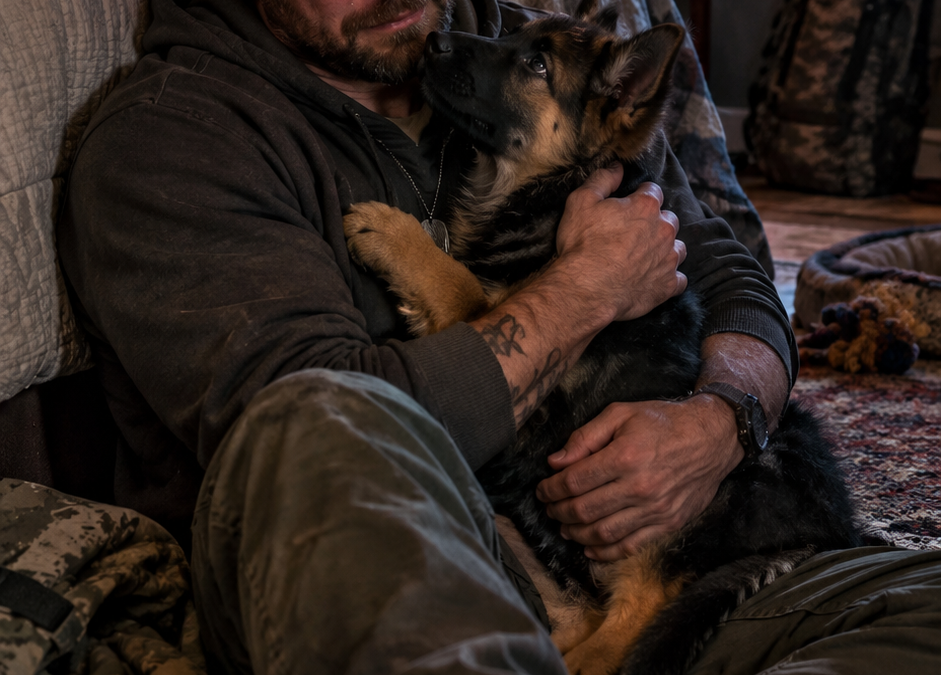
𝗣𝗔𝗥𝗧 𝟮
They put him on a towel on a treatment table in a small clinic room used by one of the veterinary-support programs attached to the campus.
Everything happened quickly.
Fluids.
Cool damp cloths.
Temperature.
Heart rate.
Gums.
Pupils.
I stood against the wall because suddenly I had nowhere useful to put my hands.
Serena moved with the calm speed of somebody who had done this before.
“How long was he outside?” she asked.
“I don’t know.”
“Did you see who left him?”
“No.”
“Collar?”
“No.”
“Tag?”
“Nothing.”
A second volunteer checked him for a microchip.
Nothing.
Serena touched one hind paw.
No reaction.
Other side.
Nothing.
My chest tightened.
“What’s wrong with his legs?”
“I don’t know yet.”
“Broken?”
“Maybe not.”
“Then why aren’t they moving?”
She looked at me.
“Tom.”
I hadn’t realized she knew my name.
“Right now, heat and dehydration come first.”
The puppy made a tiny sound.
Barely audible.
I stepped closer.
“Hey.”
His eyes opened.
“Stay here.”
Ridiculous thing to say.
Where was he going?
But that was the sentence that came.
“Stay.”
Serena started an IV.
The puppy didn’t fight.
“That bad?” I asked.
She nodded.
“He’s severely dehydrated. His temperature is dangerously high. He’s exhausted.”
“He going to make it?”
“I don’t know.”
I hated those words.
I had heard them overseas.
In field hospitals.
On radios.
From doctors talking about men whose names I knew.
I don’t know.
Three words that mean hope and disaster have agreed to stand in the same room.
I stared at the puppy.
“How old?”
“Maybe three to four months.”
“He’s just a baby.”
“Yes.”
Someone brought tweezers and removed ants from his fur.
Another cleaned his paws.
Burns.
Not severe enough to destroy tissue, but painful.
Probably hot pavement.
Serena’s expression hardened.
“He walked before ending up in that box.”
“What?”
“Those pads.”
I looked.
“So somebody didn’t just put him there?”
“Hard to know. But he’s been outside.”
I turned toward the window.
The sidewalk shimmered beyond the glass.
“Who does that?”
Serena didn’t answer.
There wasn’t an answer that would help.
After about an hour, the room became quieter.
His heart rate improved.
Temperature began dropping.
His gums looked slightly less pale.
Not safe.
Better.
Serena leaned against the counter.
“We may transfer him to an emergency animal hospital if he stabilizes enough.”
“I’ll take him.”
She looked at me.
“You don’t have to.”
“I know.”
“You have therapy today.”
I laughed once.
That seemed absurd now.
“I think therapy can wait.”
“Maybe.”
The way she said it made me look at her.
“What?”
“Nothing.”
“Serena.”
“You came here for yourself.”
“I found him dying outside.”
“I’m not telling you to leave.”
“Good.”
“I’m telling you both things can matter.”
I looked away.
That irritated me because it was reasonable.
Reasonable things are especially annoying when you’re determined to avoid them.
The puppy shifted.
His head turned toward me.
Then, inch by inch, he moved.
Not the back legs.
Those remained still.
He pulled himself with his front paws.
One weak drag.
Pause.
Another.
“What is he doing?”
Serena followed my gaze.
The puppy crossed perhaps eight inches of towel.
Then another.
Until his head reached the edge nearest my boot.
He collapsed.
His chin rested against the leather.
The room went completely quiet.
I stared down.
Serena smiled faintly.
“Well.”
“He’s trying to get off the table.”
“No.”
She looked at me.
“I think he’s trying to get to you.”
That sentence opened something.
I wish I had a more dignified description.
I don’t.
Something inside me simply cracked.
I crouched.
The puppy’s eyes remained closed.
I placed one hand beside his face.
He shifted his head.
Pressed against my fingers.
Serena asked quietly, “Does he have a name?”
I shook my head.
Then I looked at him.
“Zeke.”
No idea where it came from.
“Zeke?”
“Yeah.”
His ear twitched.
Serena wrote it on the chart.
ZEKE — FOUND OUTSIDE VA.
Seeing the name in ink changed everything.
He wasn’t the puppy anymore.
He was somebody.
That afternoon, they transferred him to an animal hospital a few minutes away.
I went with him.
I missed therapy.
My therapist called.
I ignored it.
Then Serena took my phone out of my hand.
“What are you doing?”
“Answering.”
“Give me that.”
She held it away.
“You are a grown Marine veteran and somehow less emotionally mature than this unconscious dog.”
“Strong statement.”
“Call back.”
I stared.
She stared harder.
I called.
My therapist, Dr. Reeves, answered.
“Tom?”
“Yeah.”
“Everything okay?”
“No.”
Pause.
“Want to tell me?”
“I found a dog.”
Another pause.
“Okay.”
“Puppy.”
“Okay.”
“Outside.”
“Tom.”
“He’s hurt.”
My throat tightened unexpectedly.
“Really hurt.”
Dr. Reeves’s voice softened.
“Where are you?”
“Emergency vet.”
“Are you safe?”
“Yes.”
“Is the dog being treated?”
“Yes.”
“Then stay there.”
I frowned.
“You’re not mad?”
“Why would I be mad?”
“I skipped.”
“You called.”
“After someone forced me.”
Serena waved.
Dr. Reeves said, “Serena?”
“How did you know?”
“I’ve met Serena.”
Traitors everywhere.
“We’ll reschedule.”
I looked at Zeke through the glass.
“Okay.”
“And Tom?”
“What?”
“You sound more present than you have in weeks.”
I didn’t answer.
Neither did he push.
“Call me tomorrow.”
The veterinary neurologic examination was discouraging.
No obvious spinal fracture on initial imaging.
That was good.
But his hind-limb response remained poor.
Malnutrition.
Possible nerve injury.
Possible prolonged compression.
Maybe trauma.
Maybe damage that could improve.
Maybe not.
The veterinarian said the phrase every desperate person hates.
“We need time.”
Time.
I had spent years wanting time to move faster.
Now I needed it to slow down.
Zeke stayed hospitalized.
So did I, in every way the staff would tolerate.
I left only when forced.
The next morning, I arrived before opening.
Coffee in hand.
Serena was already there.
“You slept?”
“Sure.”
“That means no.”
“I closed my eyes.”
“For how long?”
“Unclear.”
She handed me another coffee.
“What’s this?”
“Emergency medicine.”
“I already have one.”
“That one looks terrible.”
She was correct.
Zeke lay on towels in a quiet enclosure.
He watched me enter.
No tail movement.
No excitement.
But his head lifted.
One inch.
Then fell.
Serena saw.
“That’s new.”
“Yeah.”
“Good.”
The second day, nothing dramatic happened.
That mattered.
No crash.
No fever spike.
No respiratory distress.
His body stayed in the fight.
The legs still didn’t move.
On day three, I stepped outside to answer a call.
When I returned, Zeke wasn’t where I had left him.
For half a second, fear punched through me.
Then I saw him.
He had dragged himself across the towel.
Front paws.
Chest.
Dead weight behind him.
All the way to the chair where I usually sat.
He lay there panting.
I froze in the doorway.
Serena was behind me.
“He started after you left.”
My phone lowered.
“He did that whole distance?”
“Yep.”
“Why didn’t you stop him?”
“I almost did.”
“Why didn’t you?”
She looked at Zeke.
“I wanted to know where he was going.”
I walked over.
Sat.
Zeke immediately rested his chin on my thigh.
No hesitation.
That was when I cried.
Really cried.
Not the contained kind.
Not one tear wiped away before anybody notices.
I folded forward, one hand over my face, the other on Zeke’s back.
Years came out of me.
Afghanistan.
Friends.
Funerals.
Noise.
Home.
The first night I woke on my bedroom floor because a truck backfired outside.
The marriage that never happened because I stopped answering calls.
The birthday parties I skipped.
The feeling that everyone who loved me deserved somebody easier.
Everything I had turned into silence came apart beside a half-paralyzed puppy.
Serena said nothing.
Good.
I didn’t need language.
Zeke kept his head on my leg.
He had no idea what PTSD was.
He didn’t know where I had been.
He couldn’t understand survivor’s guilt.
He wasn’t trying to repair me.
He was tired.
Scared.
Broken in places.
And still, when I walked away, he had dragged himself toward where I had been.
That was enough.
I rubbed his ear.
“Okay.”
He blinked.
“Okay, Zeke.”
My voice shook.
“You’re not going back to a box.”
His tail moved.
Tiny.
Maybe reflex.
I didn’t care.
“I saw that.”
Another twitch.
“Now you’re committed.”
The next morning, Zeke urinated on himself.
He tried to shift away afterward.
Couldn’t.
Then something happened that bothered me more than the accident.
He froze.
Head low.
Eyes toward the wall.
Waiting.
“For what?”
Serena came in.
I pointed.
“He changed.”
She watched.
Zeke wouldn’t look at us.
“You think he expects punishment?”
“I don’t know.”
I did.
At least that was what it looked like.
I lowered myself beside him.
“Hey.”
Nothing.
“Zeke.”
His ear moved.
“No one is angry.”
I removed the wet towel.
Slow movements.
Cleaned him.
Fresh towel.
Warm compress.
“No one.”
His eyes flicked toward me.
“See?”
I put my palm down.
He sniffed.
“You made a mess.”
A blink.
“I’ve done worse.”
Serena laughed behind me.
“Some of us have documentation.”
“Quiet.”
Zeke pressed his nose to my hand.
I kept talking.
Because Serena told me to.
“Dogs remember tone.”
“So what do I say?”
“Anything.”
That afternoon, I told him about Duke.
The shepherd my family had when I was a kid.
Duke slept outside my bedroom door.
Stole hamburger buns.
Hated sprinklers.
Loved my mother more than any of us.
Zeke watched me.
I told him about the Marines.
Not details.
Not yet.
Just the safe parts.
Training.
Bad coffee.
Men who could insult each other for six continuous hours and then risk everything for one another without hesitation.
I told him about coming home.
About my house becoming too quiet.
About discovering that silence can become loud when your own head fills it.
Zeke didn’t understand the words.
But his breathing slowed.
Mine did too.
By the end of the week, he could sit.
Not normally.
I lifted his chest and helped place him upright.
He leaned against the wall.
Front legs trembling.
Back legs folded uselessly.
But he stayed.
Five seconds.
Ten.
Then collapsed sideways.
Serena clapped once.
I turned.
“Don’t embarrass him.”
“He sat.”
“He fell.”
“After sitting.”
Zeke looked between us.
His ears were beginning to stand more often.
Serena checked his back legs.
One reflex.
Tiny.
But present.
She looked at me.
“Did you see?”
“Yes.”
“Again.”
She tested.
A faint contraction.
My pulse jumped.
“What does that mean?”
“It means there is something.”
“He’ll walk?”
“I didn’t say that.”
“Come on.”
“Tom.”
I knew the tone.
Professional caution.
Hope with a seat belt.
“We pursue rehabilitation.”
“How much?”
“Physical therapy. Possibly hydrotherapy. Support harness. Exercises. Time.”
“I’ll do it.”
She looked at me carefully.
“That can be a lot.”
“I said I’ll do it.”
“Some people decide a disabled dog is more than they can manage.”
“Then they’re not me.”
She smiled.
“I suspected.”
Legal ownership had to be resolved.
No chip.
No report.
No one came looking.
Whoever left Zeke apparently considered the transaction complete.
Fine.
I signed foster paperwork.
Then I brought him home.
I hadn’t shared my house with another living creature in years.
That realization hit when I stood outside my front door carrying him.
My hand froze on the knob.
Dark hallway inside.
Quiet rooms.
I could already feel the familiar tightening in my chest.
Home was supposed to be safe.
My body had never received that memo.
Zeke looked at me.
Just looked.
No judgment.
No expectation.
He trusted that I knew what came next.
Which was frankly irresponsible.
“All right.”
I opened the door.
“We’ll figure it out.”
I carried him in.
Together.
The first night was rough.
He didn’t sleep.
Neither did I.
Zeke lay on a thick blanket beside my bed.
Every hour he shifted.
Front paws scraping.
Trying to reposition legs that wouldn’t cooperate.
Then came the whimper.
Small.
Apologetic.
At three in the morning, I gave up pretending sleep was possible.
I took my blanket.
Lay on the floor.
Zeke looked at me.
“This bed costs more than my first car.”
His ear moved.
“And I’m down here.”
He dragged himself closer.
Eventually his head rested against my shoulder.
I woke with his nose near my neck.
For the first time in months, I had slept several continuous hours.
Not many.
Enough.
That morning I carried him outside.
My backyard was embarrassing.
Weeds.
Bare patches.
A grill I hadn’t used in two years.
Zeke lifted his nose.
Sun.
Grass.
Birds.
Life.
I set him carefully down.
His back legs remained supported by my arm.
He smelled the ground.
Then his tail wagged.
Once.
I laughed.
“You like weeds?”
Again.
Apparently yes.
That afternoon I built our first ramp.
Calling it carpentry would insult carpenters worldwide.
Plywood.
Grip strips.
Improvised supports.
It looked like something assembled during a natural disaster.
Zeke loved it.
I made a support sling from an old towel while waiting for the proper harness.
We started exercises.
Three assisted steps.
Rest.
Three more.
On the first day, every back-leg movement came from me.
On the third, his right hind leg dragged forward slightly.
“Wait.”
I stopped.
“Do that again.”
Zeke stared.
“Excellent communication, Tom.”
I repositioned.
He pushed.
Tiny movement.
His movement.
I shouted.
“YES!”
Zeke startled.
“Sorry.”
He looked offended.
“You did that.”
Tail.
“You moved it.”
I picked up my phone.
Called Serena.
“He moved his leg.”
“Which one?”
“Right.”
“Voluntarily?”
“I think so.”
“Video it.”
“You don’t believe me?”
“I believe your emotional state has compromised your scientific reliability.”
“That’s rude.”
“Video it.”
The next session, I recorded.
Movement.
Clear.
Serena called back.
“Okay.”
“What?”
“Okay, that’s real.”
I punched the air.
Zeke barked.
His first proper bark in my house.
We both froze.
Then I laughed.
He barked again.
“Yeah, buddy.”
Something changed after that.
Not overnight.
Recovery wasn’t a movie montage despite what my memory sometimes makes it feel like.
There were bad days.
Days his legs seemed weaker.
Days diarrhea meant cleaning everything at two in the morning.
Days he became frustrated and growled at the sling.
Days I became frustrated too.
Once I dropped the harness and said, “I can’t do this today.”
Zeke looked at me.
I sat on the ground.
“I know.”
He crawled closer.
“I know you don’t get days off.”
He put his chin on my boot.
I closed my eyes.
“All right.”
We rested.
That was important.
I had spent my military career believing effort solved everything.
Push harder.
Endure.
Continue.
PTSD didn’t work that way.
Neither did nerve recovery.
Sometimes the correct action was rest.
I began attending VA appointments consistently again.
At first because Serena threatened to ask Dr. Reeves whether I was skipping.
Then because Zeke gave me something to report.
“How was the week?” Dr. Reeves would ask.
“Zeke moved his left leg.”
Next week:
“Zeke stood with support.”
Then:
“Zeke peed on my rug.”
“That sounds developmentally appropriate.”
“He looked pleased.”
“You sound pleased.”
“No.”
“You’re smiling.”
“I have facial spasms.”
The group veterans heard about him.
I showed one video.
Then another.
Men who had barely spoken during sessions asked questions.
“How’s the dog?”
“Walking?”
“Still dragging?”
“Bring him sometime.”
Zeke became a conversation I didn’t dread.
That mattered more than I realized.
The breakthrough happened on a Thursday.
I remember because garbage trucks were moving down the street and the yard smelled like somebody had cut grass nearby.
Zeke was in the support harness.
Front legs strong now.
Back legs improving.
We were halfway across the yard.
Then he stopped.
“What?”
His ears pointed forward.
I loosened the sling slightly.
“Try.”
He shifted weight.
Right hind leg lifted.
Not dragged.
Lifted.
Moved forward.
Touched grass.
A step.
I stopped breathing.
Zeke looked at me.
Then his left hind leg moved.
Messier.
But forward.
I dropped to my knees.
The sling went loose.
Zeke collapsed.
I grabbed him.
“You did that.”
His tail wagged.
“You walked.”
I laughed.
Then cried.
Apparently crying had become one of my hobbies.
I hugged him.
Zeke licked my face.
One long swipe.
“Disgusting.”
Another.
“I’m trying to have a moment.”
He didn’t care.
That evening I sat on the porch with him.
For years, sunset had been a difficult time.
That light could put me somewhere else.
A road.
Dust.
Heat.
Long shadows.
Sounds I couldn’t forget.
But that evening, Zeke lay against my boot.
And instead of scanning memories, I watched his back paw twitch in sleep.
Recovery.
Tiny muscle firing.
Something rebuilding.
I said quietly, “You’re doing better than me.”
Zeke slept.
“Show-off.”
A week later, he stood independently.
One second.
Maybe two.
His back legs shook violently.
But held.
I recorded it.
Sent Serena the video.
Her reply appeared seconds later.
I AM CRYING AT WORK AND I HATE YOU.
I wrote back:
PROFESSIONAL.
She answered:
SHUT UP.
Zeke eventually crossed the clinic floor without his sling.
People stopped.
Veterinary technicians.
Receptionist.
Serena.
One older veteran who happened to be there with his service dog.
Step.
Pause.
Step.
His gait was crooked.
Hindquarters unsteady.
He looked like a baby deer negotiating a moving ship.
But those were his steps.
Halfway across, Zeke stopped.
Everyone held their breath.
Then he sat.
On his own.
The room erupted.
Zeke looked alarmed.
I opened my arms.
“Come here.”
Three crooked steps.
Then he hit my chest.
I buried my face in his neck.
Serena crouched beside us.
“So.”
“What?”
“You’ve been researching therapy-dog work.”
I looked up.
“Who told you?”
“You left seventeen browser tabs open on the clinic computer.”
“Oh.”
“There are worse crimes.”
Zeke had become increasingly calm around people.
Especially veterans.
Something about the VA environment suited him.
Maybe because he grew up recovering around wheelchairs, walkers, hospital noises, tired voices.
Or maybe I was projecting.
But I noticed it.
A veteran would sit near him.
Zeke didn’t demand affection.
He waited.
That was unusual for a shepherd puppy.
Most young dogs want to investigate everything.
Zeke watched first.
Then approached.
“You think he could do it?” I asked.
Serena shrugged.
“Eventually.”
“What does that mean?”
“Training.”
“He trains.”
“Formal training.”
“I train.”
“Properly.”
“Hostile.”
“Tom, therapy dogs need obedience, emotional stability, predictable behavior, comfort around equipment, crowds, sudden noise, unusual movement.”
I looked at Zeke.
“He was paralyzed.”
“That is not an obedience credential.”
“He’s impressive.”
“He’s a menace around cheese.”
Zeke stared toward her pocket.
She sighed.
“Exactly.”
We started formal classes.
Basic obedience first.
Sit.
Down.
Stay.
Come.
Loose leash.
Ignore food.
Zeke objected strongly to that last principle.
His gait continued improving.
Permanent slight wobble remained.
The neurologist said it might always.
I loved it.
Not because I wanted him disabled.
Because it became part of him.
Proof without tragedy.
A scar written in motion.
Training also exposed his fear.
A metal tray dropping made him hit the floor.
A shout behind a curtain sent his tail under his body.
Rolling carts sometimes triggered him.
We never forced recovery.
We worked below threshold.
Sound.
Treat.
Calm.
Repeat.
One day during evaluation, somebody shouted unexpectedly.
Zeke dropped instantly.
Flat.
Breathing fast.
I crouched.
“Zeke.”
His eyes found mine.
“You’re here.”
Breath.
“With me.”
Another breath.
“Good.”
He scanned.
Nothing bad happened.
Then he stood.
The trainer wrote something.
I asked later.
“What?”
She turned the clipboard.
RECOVERY FROM STARTLE: EXCEPTIONAL.
“That matters?”
“More than never being startled.”
I understood immediately.
That lesson belonged to both of us.
Healing wasn’t never reacting.
It was coming back.
Zeke and I practiced together.
He learned not to collapse at every loud sound.
I learned the same thing.
At the VA, I started arriving early.
Not because I enjoyed therapy.
Let’s not exaggerate.
But I stopped dreading the building.
Zeke sometimes came for training exposure.
Veterans recognized him.
“That the box dog?”
“Yep.”
“He walking now?”
“Better than some Marines I know.”
One man in a wheelchair laughed.
“Low standard.”
Fair.
During one visit, a young veteran sat outside a group room after a panic episode.
Early twenties.
Hands clenched.
Jaw tight.
Therapist nearby.
Zeke noticed.
No command.
He looked at me.
Then the man.
I shortened the leash.
“Easy.”
Zeke approached slowly.
Stopped several feet away.
Sat.
The veteran looked at him.
No movement.
Zeke waited.
Minutes passed.
Then the man lowered one hand.
Zeke leaned forward just enough for fingertips to touch his ear.
The man’s shoulders dropped.
One breath.
Then another.
He started crying.
Zeke stayed.
No lick.
No paw.
No performance.
Stayed.
I stood nearby and felt something shift inside me.
Not magic.
Not a cure.
Presence.
That was Zeke’s gift.
He had never fixed me either.
He gave me somewhere to put my attention when my own head became dangerous.
He gave mornings structure.
Food at seven.
Exercises.
Walk.
Therapy.
Training.
He forced me outside.
Forced me to care about tomorrow because tomorrow had medication and another rehabilitation session.
Sometimes survival begins as scheduling.
Eventually Zeke passed his therapy-dog evaluations.
The certificate came in a plain folder.
Nothing cinematic.
I still cried.
ZEKE
CERTIFIED THERAPY DOG
He sat beside me.
Tail sweeping the floor.
Completely unaware that human beings had formally recognized what he had been doing since he first dragged himself across a towel toward my chair.
Serena took photographs.
“Smile.”
“I am.”
“No, that’s your hostage face.”
“I hate photos.”
“I know.”
Zeke looked up.
I smiled for real.
Click.
“There.”
I hated that she caught it.
Our first official VA visit made me more anxious than Zeke.
He wore a navy vest.
THERAPY DOG — WORKING.
His gait still had a slight sway.
His head stayed high.
I sat in the truck with both hands on the wheel.
Couldn’t open the door.
Zeke looked at me.
“You realize this is your appointment.”
Tail.
“I’m the transportation.”
He leaned against my arm.
I exhaled.
“Fine.”
We walked in.
The smell hit me.
Antiseptic.
Coffee.
Floor wax.
Hospital.
My body responded before thought.
Chest tight.
Hands damp.
Exit locations.
People.
Noise.
Then Zeke’s shoulder touched my leg.
One step.
Another.
Not the past.
Hallway.
Zeke.
Now.
A man in a wheelchair stopped.
“That him?”
I nodded.
“Zeke?”
His tail wagged.
The man smiled.
“Celebrity.”
We entered a veterans support group.
Eight people.
Some quiet.
One skeptical.
One woman smiled immediately.
“He’s beautiful.”
Zeke didn’t rush anyone.
Good training.
He sat beside me.
Waited.
Eventually one veteran called him.
Zeke approached.
Head low.
The man touched his neck.
Another reached later.
Then another.
Conversation changed.
Not dramatically.
Enough.
People asked about his legs.
I told the story.
Cardboard box.
Heat.
No movement.
Rehab.
First step.
One guy stared at Zeke.
“He couldn’t walk?”
“No.”
“And now he’s here?”
“Yes.”
The man looked down.
“I can relate.”
Nobody laughed.
Zeke put his head on the man’s knee.
The room went quiet.
Afterward, Reggie, the group facilitator, pulled me aside.
Navy veteran.
Soft voice.
Sharp eyes.
“You should speak more.”
“I just did.”
“You talked about Zeke.”
“Easier.”
“I know.”
“He’s the interesting one.”
Reggie smiled.
“That’s the trick.”
“What?”
“Sometimes we start with somebody else’s story until we’re ready to tell our own.”
I disliked him instantly for being correct.
Over the following months, Zeke became a regular visitor.
He sat with veterans who wanted touch.
Stayed several feet away from those who didn’t.
Walked beside wheelchairs.
Visited rehab units.
Waited through silences.
No miracle cures.
No movie speeches.
People still had PTSD after petting him.
So did I.
But symptoms and loneliness are different battles.
Zeke was very good against loneliness.
He gave people permission to sit without explaining.
One evening, after a group session, I walked him through a quiet neighborhood.
Sunset turned everything gold.
Zeke limped slightly because he was tired.
I slowed.
He looked up.
“You know something?”
Tail.
“I used to think I’d already done the useful part of my life.”
Zeke sniffed a mailbox.
“Very moving. Glad you’re listening.”
He finished the inspection.
We continued.
“I thought coming home was supposed to mean I was done.”
He walked beside me.
“And when I wasn’t okay, I thought maybe that meant I had failed.”
Zeke bumped my knee.
“But you…”
I swallowed.
“You got left in a box and somehow decided the next person you met was worth trusting.”
He looked up.
“That seems objectively insane.”
Tail.
“But I’m glad.”
At home, I unclipped his vest.
He collapsed onto the rug.
Within minutes, snoring.
That night, I slept without a nightmare.
Not forever.
Just that night.
Enough.
Then came Chris.
I knew Chris from group.
He rarely spoke.
Army veteran.
Early thirties.
Sat near the door.
Watched exits.
I recognized the behavior.
One afternoon, a VA social worker called.
“Tom?”
“Yes.”
“Are you with Zeke?”
My stomach tightened.
“Yeah.”
“Can you come?”
“What happened?”
“Chris is in crisis.”
That word changes everything.
“What kind?”
“He’s locked himself inside his apartment. Brother is there. Crisis team is responding.”
“Why Zeke?”
“He asked about him last week.”
I looked at the dog.
Zeke was asleep.
The social worker continued.
“We’re not asking you to intervene beyond your role. Professionals are on scene. But if he responds to you and Zeke, it may help us establish contact.”
That distinction mattered.
This was not some heroic rescue mission.
Mental-health crises require trained professionals.
Zeke was one tool.
I was support.
Nothing more.
“We’re coming.”
At the apartment complex, police were present but keeping things quiet.
No sirens.
Crisis clinicians near the building.
Chris’s brother looked wrecked.
“He won’t talk to me.”
I introduced myself.
Zeke stayed at my side.
The clinical lead explained the plan.
No forced entry unless immediate danger changed the calculation.
Try communication.
Stay calm.
Follow their direction.
I knocked.
“Chris.”
Nothing.
“It’s Tom.”
Music played inside.
Low.
Same song repeating.
“I brought Zeke.”
Silence.
I waited.
“I’m not here to fix anything.”
No response.
“Neither is he.”
Zeke sat.
I continued.
“We’re just here.”
Minute.
Another.
Then movement.
The door unlocked.
Opened two inches.
Zeke’s nose lifted.
I kept him back.
“Chris?”
No answer.
The opening widened slightly.
I could see him sitting against the far wall.
Eyes hollow.
Broken picture frame nearby.
Hands shaking.
The clinician behind me gave a tiny nod.
I knelt.
“Can Zeke come in?”
Long pause.
Chris nodded once.
I released enough leash.
Zeke walked inside.
Slow.
No rush.
No licking.
No excitement.
He stopped several feet away.
Lay down.
Chris stared.
Zeke rested his head on his paws.
Nothing happened.
That was the point.
Nobody demanded speech.
Nobody asked Chris to explain why he felt what he felt.
Minutes passed.
Then Chris reached.
One hand.
Zeke lifted his head.
Moved forward just enough.
Chris’s fingers disappeared into his fur.
His shoulders began shaking.
Then came sobbing.
Deep.
Violent.
The clinician entered quietly.
Sat nearby.
I remained across the room.
Zeke stayed with Chris.
Eventually Chris agreed to go with the crisis team for evaluation and support.
No miracle.
No dramatic cure.
A door opened.
A man accepted help.
That was enough.
Outside afterward, I knelt beside Zeke.
“You know you are not actually qualified to run this place.”
He licked my nose.
“Strong counterargument.”
The annual Veterans Mental Health Awareness event came months later.
They asked me to speak.
I said no.
Then ignored the email.
Then received another.
I said no again.
Then Reggie called.
“Stop being difficult.”
“Medical diagnosis?”
“Personal observation.”
“I don’t do speeches.”
“You talk for forty minutes every week.”
“To twelve people.”
“Fine.”
“Hundreds are different.”
“Bring Zeke.”
“That’s emotional manipulation.”
“Yes.”
I agreed.
The night before, I paced my living room until midnight.
Then one.
Then two.
Zeke followed.
Back and forth.
Back and forth.
At some point, he stopped in front of me.
I nearly walked into him.
“What?”
He leaned against my leg.
I stood there.
Hand on his neck.
“You’re not worried.”
Zeke yawned.
“Rude.”
I sat on the floor.
He lay beside me.
I practiced the speech once.
Then threw away the notes.
The next morning, backstage, my hands shook.
Rows of chairs beyond the curtain.
Doctors.
Veterans.
Families.
Advocates.
Cameras.
Too many faces.
I felt the old urge.
Exit.
Leave.
Escape before anybody sees you fail.
Warm pressure touched my calf.
Zeke.
I looked down.
He leaned harder.
“Yeah.”
I breathed.
“Present.”
They called my name.
We walked out.
The lights were brutal.
The podium looked miles away.
Zeke reached it first.
He turned once.
Lay at my feet.
The audience laughed softly.
Tension broke.
I gripped the podium.
Then I started with the cardboard box.
That was all.
I told them about a puppy left outside in Texas heat.
About useless hind legs.
About him dragging himself across a towel.
About nights on the floor.
First step.
First stand.
Training.
I told them I had believed coming home from war was supposed to make the war stop following me.
It didn’t.
I told them Zeke hadn’t cured my PTSD.
That mattered.
He hadn’t erased anything.
He hadn’t replaced treatment.
He had not made every bad night disappear.
What he gave me was a reason to participate in my own recovery.
A reason to get up.
A reason to keep appointments.
A reason to leave home.
A reason to build routines.
A reason to believe damaged and finished were not synonyms.
My voice broke near the end.
I looked down.
Zeke was watching me.
“I found him in a box outside this hospital.”
Silence.
“I thought I was carrying him inside to save his life.”
I paused.
“Turns out he spent the next few years teaching me how to come back to mine.”
That was where I cried.
Not much.
Enough.
Afterward, people lined up for Zeke.
Veterans.
Spouses.
Nurses.
One older Marine stood in front of me.
Silver hair.
Vietnam cap.
He didn’t say anything.
He simply knelt.
Pressed his forehead against Zeke’s.
Zeke stayed perfectly still.
The man whispered something.
I didn’t listen.
Some things don’t belong to witnesses.
At home that night, I removed Zeke’s vest.
Hung it beside the door.
He drank water.
Ate dinner.
Then brought me a tennis ball.
“Seriously?”
Tail.
“You spent six hours doing emotional labor.”
Ball dropped on my foot.
“Union rules require rest.”
Tail.
I threw it.
He chased.
Heroism apparently included fetch.
Zeke became older.
Stronger.
The wobble in his gait never entirely disappeared.
I was glad.
Not because I wanted him limited.
Because nobody looking at him could mistake recovery for erasure.
He carried what happened.
So did I.
The goal was never becoming people—or dogs—nothing bad had happened to.
It was learning to live fully anyway.
Years after finding him, we visited the spot outside the VA where the box had been.
No marker.
No sign.
Just sidewalk.
People moving in and out.
Zeke sniffed the concrete.
Then looked at me.
“Remember?”
Probably not in the way I did.
He wagged.
I sat on a bench.
Zeke placed his head on my knee.
The Texas sun was warm.
Not dangerous that day.
I thought about the person who left him.
I used to imagine them often.
Wanted anger.
Justice.
An explanation.
Eventually I stopped.
They were part of the beginning.
Not the story.
Zeke belonged to what happened next.
Serena joined us.
She had gray appearing at her temples now.
She sat.
“Full circle?”
“Something like that.”
Zeke moved his head to her knee because loyalty apparently had flexible boundaries.
“Traitor.”
Serena scratched his ears.
“He always liked me better.”
“Revisionist history.”
She smiled.
“Remember when you refused to go to therapy because he was in the clinic?”
“I went later.”
“After I stole your phone.”
“Details.”
We watched veterans enter the building.
Some walked quickly.
Some slowly.
One with a cane.
Another with a service dog.
A young man stood outside the doors for several seconds before entering.
I knew that pause.
I had lived in that pause.
Zeke watched too.
Then rested his head again.
“You know,” Serena said, “when you found him, I thought we’d lose him.”
“So did I.”
“I didn’t think he’d walk.”
“Neither did I.”
She looked at me.
“I wasn’t only talking about Zeke.”
I understood.
“I know.”
That evening, Zeke and I sat in the VA garden.
Jacaranda blossoms had fallen across the path.
Purple against concrete.
He moved more slowly now.
Age.
Old injuries.
A life well used.
We reached a bench.
I sat.
Zeke leaned against me.
I rubbed the scarred area near his hip.
His eyes closed.
“We did all right.”
His tail tapped.
“You more than me.”
Another tap.
“You know what I was thinking that first day?”
He opened one eye.
“I thought you needed me.”
Eye closed.
“Arrogant.”
I laughed.
The truth had become obvious years earlier.
Rescue is rarely one-directional.
I gave Zeke water.
Veterinary care.
Physical therapy.
Food.
Home.
Training.
He gave me structure.
Connection.
Responsibility.
Presence.
He pulled me toward people when I had spent years moving away from them.
The puppy who once couldn’t use his back legs eventually walked hospital corridors beside wheelchairs.
The dog abandoned outside a veterans hospital eventually became one of the reasons I could enter that same building without turning around.
He had sat beside people during panic attacks.
Beside grieving spouses.
Beside men and women who had forgotten how to speak about what hurt.
He never asked for their service record.
Never cared about medals.
Rank.
Branch.
Diagnosis.
He cared whether somebody offered a hand.
That simplicity was powerful.
One afternoon, Chris came to visit.
Years had passed since the apartment.
He looked healthier.
Not magically transformed.
Human.
Living.
Working part-time.
Still in treatment.
Still attending group.
He knelt beside Zeke.
“Old man.”
Zeke wagged.
Chris scratched his chest.
“You remember me?”
Tail.
“Probably remembers snacks.”
Chris smiled.
Then looked at me.
“I don’t remember much from that night.”
“That’s okay.”
“I remember him.”
He touched Zeke.
“I remember thinking he looked broken.”
I waited.
“And then thinking if that dog could still come sit with me…”
His voice stopped.
He shook his head.
“I don’t know.”
“You don’t need to.”
Chris nodded.
Before leaving, he whispered to Zeke.
“Thanks for staying.”
There it was.
The phrase that defined him.
Staying.
Zeke never solved war.
Never solved trauma.
Never solved grief.
Never solved depression.
He stayed.
When words failed.
When people shook.
When rooms went silent.
When I woke from nightmares.
When his own legs wouldn’t work.
He stayed.
That was the lesson.
Not that love cures everything.
Not that animals replace doctors.
Not that one inspirational rescue erases years of pain.
Something simpler.
Healing becomes possible when we stop facing everything alone.
Sometimes that support is a therapist.
A doctor.
A group.
A friend.
Family.
Sometimes it is a German Shepherd who snores loudly enough to shake the floor.
Zeke eventually retired from regular therapy work.
His body told us before either of us wanted to admit it.
Long sessions exhausted him.
The wobble worsened when tired.
Arthritis appeared around old injuries.
The veterinarian recommended shorter walks.
No slick floors.
More rest.
Zeke considered this deeply unreasonable.
The first time I left for the VA without his vest, he stood at the door.
“Not today.”
He stared.
“You’re retired.”
Stare.
“You earned it.”
Tail stopped.
“Oh, don’t manipulate me.”
He sat.
I crouched.
“You saved enough people.”
Zeke licked my chin.
“Your job now is sleeping.”
He became excellent at retirement.
Sun patches.
Slow backyard walks.
Strategic begging.
Greeting visitors.
Occasional VA events where everybody treated him like visiting royalty.
I kept going without him.
That was perhaps his final piece of training for me.
At first, entering the hospital alone felt wrong.
No shoulder against my leg.
No leash in my hand.
No dog to focus on.
The first day, I stood outside the doors.
Old anxiety returned.
Not as strong.
Present.
I breathed.
In.
Out.
I heard my own voice from years of talking to Zeke.
You’re okay.
I almost laughed.
Dogs remember tone.
Apparently humans do too.
I walked inside.
Reggie saw me.
“No Zeke?”
“Retired.”
“And you still came.”
I looked at him.
“Don’t make it weird.”
He smiled.
“Wouldn’t dream of it.”
I began helping facilitate groups.
Not as a clinician.
As a peer.
A veteran.
Someone who could say, “I know what it feels like to believe nothing will change,” without pretending our experiences were identical.
I talked less about answers.
More about showing up.
Zeke had trained me well.
On his last good summer, we returned to the VA garden.
He walked slowly.
We sat beneath the same tree where we had celebrated his certification.
Purple blossoms fell around us.
Zeke lowered himself with difficulty.
I sat beside him on the ground.
People passed.
A few recognized him.
“Zeke!”
Tail.
Always the tail.
A young veteran approached.
“Is that him?”
“Depends who him is.”
“The therapy dog.”
I smiled.
“Yeah.”
“Can I pet him?”
I looked at Zeke.
His ears lifted.
“Go ahead.”
The man sat.
Not kneeling.
Sat fully on the grass.
Zeke moved his head into the man’s lap.
The veteran closed his eyes.
We stayed that way for several minutes.
No speeches.
No miracle.
Presence.
When he left, he touched Zeke’s head.
“Good dog.”
Zeke sighed.
I looked down.
“You really milk this hero thing.”
Tail.
That evening at home, he slept beside my chair.
I found the original therapy certificate in a drawer.
Edges bent.
Photograph attached.
Me kneeling.
Zeke sitting.
Both younger.
I placed it on the table.
The cardboard box was gone.
I hadn’t kept it.
Sometimes I wished I had.
Then I realized I didn’t need evidence.
Zeke was evidence.
Every crooked step.
Every gray hair.
Every person who knew his name.
I sat on the floor.
He opened his eyes.
“You know what’s strange?”
Nothing.
“I thought the worst thing that ever happened to you was being abandoned.”
His ear moved.
“Maybe it was.”
I rubbed his shoulder.
“But it wasn’t the thing that defined you.”
Tail.
“Smart dog.”
He closed his eyes.
I thought about my own life.
For years, I had built my identity around the worst things I had seen.
Combat.
Loss.
Trauma.
As though those experiences had earned permanent ownership of everything after them.
Zeke challenged that without knowing it.
He had scars.
Weakness.
Fear.
Permanent physical changes.
But none of those stopped him from becoming other things too.
Companion.
Therapy dog.
Troublemaker.
Professional cheese thief.
Friend.
The worst thing that happened to him remained true.
It simply stopped being the only truth.
That became possible for me too.
PTSD did not vanish.
I still had bad nights.
Still hated some crowds.
Still reacted to certain sounds.
Still needed therapy.
Still had periods when the world felt too loud or too far away.
But I had other truths now.
I had friends.
Work that mattered.
A community.
People I could call.
People who called me.
And for years, I had Zeke.
Sometimes I think about the person who left that shoebox.
They probably assumed they were throwing away a problem.
A sick puppy.
A disabled animal.
An expense.
Something too difficult.
They could not have known what they were abandoning.
Not just a German Shepherd.
A future therapy dog.
A reason one veteran kept going to treatment.
A warm body beside a young soldier during a panic attack.
A silent companion beside Chris’s apartment wall.
A room full of veterans laughing after weeks of barely speaking.
A hundred ordinary moments where somebody reached down, touched fur, and remembered they were still capable of connection.
That is the thing about discarded lives.
The person doing the discarding rarely understands the future they are walking away from.
The last time I took Zeke to the hospital as an official guest, they placed his old vest beside him for photographs.
He no longer wore it for long.
Too heavy.
But I set it gently across his back.
THERAPY DOG — WORKING.
I laughed.
“You are absolutely not working.”
Zeke yawned.
A group gathered.
Veterans.
Doctors.
Nurses.
Serena.
Reggie.
Chris.
People from different years of his life.
I stood behind him.
For one second, I saw the puppy again.
Cardboard.
Heat.
Ants.
Dry tongue.
Useless back legs.
Hollow eyes.
I remembered asking:
You hanging on, little guy?
The answer had taken years.
Yes.
He had.
So had I.
Someone took the photograph.
Zeke looked away at exactly the wrong moment.
Of course.
The final picture shows everyone smiling except him.
He appears deeply interested in a sandwich outside the frame.
Perfect.
That photograph sits in my home now.
Beside his certification.
Not because Zeke cured me.
He didn’t.
I don’t tell the story that way anymore.
The truth is better.
A broken German Shepherd puppy taught me that recovery is not the same thing as returning to who you were before.
Sometimes there is no before to return to.
Sometimes your legs always wobble a little.
Sometimes certain noises always make your heart jump.
Sometimes you still need medication.
Therapy.
Support.
Rest.
Sometimes scars stay.
But you build anyway.
One trembling step.
Then another.
You fall.
You get frustrated.
You try again.
You accept help.
You learn to stay.
I thought I rescued Zeke because I picked him up out of a cardboard box.
That was one afternoon.
What happened afterward lasted years.
He gave me a reason to wake up when mornings felt useless.
He brought me back into rooms I had spent years avoiding.
He sat beside me until silence stopped feeling like punishment.
He reminded me that needing help and being helpless are not the same thing.
And eventually, he gave all of that to other people too.
Sometimes late at night, when the house was quiet, Zeke would sleep beside my chair.
His legs would twitch in dreams.
I would remember the first days when they didn’t move at all.
Then I would look at my own hands.
Remember how badly they used to shake outside the doors of the VA.
And I would understand what the two of us had done.
Not overcome everything.
Not defeated trauma.
Not become untouched.
We had learned to move with what remained.
That was enough.
More than enough.
Zeke started his life with me in a cardboard box beneath the Texas sun.
I started mine with him believing I had already survived the only part of life where I could still matter.
We were both wrong.
He learned to walk.
I learned to return.
He learned to trust people.
I learned to let people help me.
He became a therapy dog.
I became the kind of man who could finally tell another veteran, “You don’t have to do tonight alone.”
And whenever someone called Zeke a hero, I always thought about the first thing he ever did for me.
It wasn’t saving a veteran in crisis.
It wasn’t sitting through therapy groups.
It wasn’t earning a certification.
He simply dragged himself across a clinic towel with two useless back legs because I had stepped away.
Then he put his head against my boot.
Stay.
That was all.
I stayed for him.
And eventually—
I learned how to stay for myself.
Have you finished reading the story and want to read it again?
They Dumped a Paralyzed German Shepherd Puppy Outside the VA—Then He Became the Reason I Came Back
Someone left him to die in a cardboard box.
His back legs didn’t move.
I had no idea the broken puppy in my arms would become the reason I started fighting for my own life again.
My name is Tom, and the day I found Zeke, San Antonio was already above ninety degrees before lunchtime.
Texas heat is different when it rises from concrete.
It doesn’t simply surround you.
It comes from beneath your boots, reflects off buildings, crawls under your clothes, and makes the air feel too thick to breathe.
I was walking toward the veterans hospital for another therapy appointment I had considered canceling.
I had become good at canceling things.
Appointments.
Dinner invitations.
Phone calls.
Plans.
Anything that required me to leave the safe little perimeter I had built around my life.
I had served in the Marines.
I had come home years earlier carrying memories I couldn’t shut off and instincts I couldn’t shut down.
Crowded rooms made my shoulders tighten.
Fireworks could put me back somewhere I didn’t want to be before I consciously recognized the sound.
I slept badly.
Some nights I didn’t sleep at all.
The VA called it post-traumatic stress disorder.
I called it Tuesday.
That morning, I was halfway across the sidewalk when something moved beside a concrete planter.
Cardboard.
That was what I saw first.
A shoebox.
Cheap.
Crushed slightly on one side.
The bottom had sagged from moisture or weight.
I nearly kept walking.
Then it moved again.
Not the box.
Something inside.
I stopped.
A sound came from it.
Barely there.
Not a bark.
Not a whine.
Breathing.
I walked over.
And whatever complaints I had brought with me disappeared.
A German Shepherd puppy was curled inside.
Four months old, maybe less.
Black-and-tan fur matted with dirt.
Dried leaves stuck along his side.
Ants crawled across one hind leg.
His mouth hung open.
His tongue looked dry and thick.
The pads of his paws were cracked and darkened from heat.
And his back legs lay behind him at an angle that made my stomach drop.
He looked at me.
That was the worst part.
Not because he appeared frightened.
Because he didn’t.
Fear would have meant he still expected something from the world.
This puppy looked finished expecting.
People passed us.
A nurse in scrubs glanced down.
A man with a backpack slowed.
Then continued.
Cars moved through the hospital entrance.
The city went on.
I crouched.
“Hey.”
One ear moved.
“You still with me?”
His eyes blinked once.
Slow.
I slid my hands beneath him.
He didn’t resist.
His body felt hot.
Too hot.
And much too light.
When I lifted him, his hind legs simply hung.
No tension.
No reaction.
Nothing.
“Damn it.”
His head rolled against my arm.
That was when panic hit me.
Not the vague anxiety I lived with.
Real panic.
The kind with a target.
A living thing was dying in my hands.
I ran.
Through the VA entrance.
Past security.
Past the reception desk.
“Help!”
People turned.
“I need somebody!”
A woman in blue veterinary scrubs came running from the volunteer-services corridor.
Her name was Serena.
I had seen her before but never spoken to her. The hospital worked with several veteran-support and animal-welfare programs, and she volunteered through one of them.
The moment she saw the puppy, her face changed.
“Oh, no.”
“What?”
“Bring him.”
She touched his gums.
“Now.”
“What’s happening?”
“He’s crashing.”
And just like that, I followed her through a door with a dying puppy in my arms, completely unaware that I had just found the first thing in years that would make me stop thinking about whether I could be saved.
PART2
They put him on a towel on a treatment table in a small clinic room used by one of the veterinary-support programs attached to the campus.
Everything happened quickly.
Fluids.
Cool damp cloths.
Temperature.
Heart rate.
Gums.
Pupils.
I stood against the wall because suddenly I had nowhere useful to put my hands.
Serena moved with the calm speed of somebody who had done this before.
“How long was he outside?” she asked.
“I don’t know.”
“Did you see who left him?”
“No.”
“Collar?”
“No.”
“Tag?”
“Nothing.”
A second volunteer checked him for a microchip.
Nothing.
Serena touched one hind paw.
No reaction.
Other side.
Nothing.
My chest tightened.
“What’s wrong with his legs?”
“I don’t know yet.”
“Broken?”
“Maybe not.”
“Then why aren’t they moving?”
She looked at me.
“Tom.”
I hadn’t realized she knew my name.
“Right now, heat and dehydration come first.”
The puppy made a tiny sound.
Barely audible.
I stepped closer.
“Hey.”
His eyes opened.
“Stay here.”
Ridiculous thing to say.
Where was he going?
But that was the sentence that came.
“Stay.”
Serena started an IV.
The puppy didn’t fight.
“That bad?” I asked.
She nodded.
“He’s severely dehydrated. His temperature is dangerously high. He’s exhausted.”
“He going to make it?”
“I don’t know.”
I hated those words.
I had heard them overseas.
In field hospitals.
On radios.
From doctors talking about men whose names I knew.
I don’t know.
Three words that mean hope and disaster have agreed to stand in the same room.
I stared at the puppy.
“How old?”
“Maybe three to four months.”
“He’s just a baby.”
“Yes.”
Someone brought tweezers and removed ants from his fur.
Another cleaned his paws.
Burns.
Not severe enough to destroy tissue, but painful.
Probably hot pavement.
Serena’s expression hardened.
“He walked before ending up in that box.”
“What?”
“Those pads.”
I looked.
“So somebody didn’t just put him there?”
“Hard to know. But he’s been outside.”
I turned toward the window.
The sidewalk shimmered beyond the glass.
“Who does that?”
Serena didn’t answer.
There wasn’t an answer that would help.
After about an hour, the room became quieter.
His heart rate improved.
Temperature began dropping.
His gums looked slightly less pale.
Not safe.
Better.
Serena leaned against the counter.
“We may transfer him to an emergency animal hospital if he stabilizes enough.”
“I’ll take him.”
She looked at me.
“You don’t have to.”
“I know.”
“You have therapy today.”
I laughed once.
That seemed absurd now.
“I think therapy can wait.”
“Maybe.”
The way she said it made me look at her.
“What?”
“Nothing.”
“Serena.”
“You came here for yourself.”
“I found him dying outside.”
“I’m not telling you to leave.”
“Good.”
“I’m telling you both things can matter.”
I looked away.
That irritated me because it was reasonable.
Reasonable things are especially annoying when you’re determined to avoid them.
The puppy shifted.
His head turned toward me.
Then, inch by inch, he moved.
Not the back legs.
Those remained still.
He pulled himself with his front paws.
One weak drag.
Pause.
Another.
“What is he doing?”
Serena followed my gaze.
The puppy crossed perhaps eight inches of towel.
Then another.
Until his head reached the edge nearest my boot.
He collapsed.
His chin rested against the leather.
The room went completely quiet.
I stared down.
Serena smiled faintly.
“Well.”
“He’s trying to get off the table.”
“No.”
She looked at me.
“I think he’s trying to get to you.”
That sentence opened something.
I wish I had a more dignified description.
I don’t.
Something inside me simply cracked.
I crouched.
The puppy’s eyes remained closed.
I placed one hand beside his face.
He shifted his head.
Pressed against my fingers.
Serena asked quietly, “Does he have a name?”
I shook my head.
Then I looked at him.
“Zeke.”
No idea where it came from.
“Zeke?”
“Yeah.”
His ear twitched.
Serena wrote it on the chart.
ZEKE — FOUND OUTSIDE VA.
Seeing the name in ink changed everything.
He wasn’t the puppy anymore.
He was somebody.
That afternoon, they transferred him to an animal hospital a few minutes away.
I went with him.
I missed therapy.
My therapist called.
I ignored it.
Then Serena took my phone out of my hand.
“What are you doing?”
“Answering.”
“Give me that.”
She held it away.
“You are a grown Marine veteran and somehow less emotionally mature than this unconscious dog.”
“Strong statement.”
“Call back.”
I stared.
She stared harder.
I called.
My therapist, Dr. Reeves, answered.
“Tom?”
“Yeah.”
“Everything okay?”
“No.”
Pause.
“Want to tell me?”
“I found a dog.”
Another pause.
“Okay.”
“Puppy.”
“Okay.”
“Outside.”
“Tom.”
“He’s hurt.”
My throat tightened unexpectedly.
“Really hurt.”
Dr. Reeves’s voice softened.
“Where are you?”
“Emergency vet.”
“Are you safe?”
“Yes.”
“Is the dog being treated?”
“Yes.”
“Then stay there.”
I frowned.
“You’re not mad?”
“Why would I be mad?”
“I skipped.”
“You called.”
“After someone forced me.”
Serena waved.
Dr. Reeves said, “Serena?”
“How did you know?”
“I’ve met Serena.”
Traitors everywhere.
“We’ll reschedule.”
I looked at Zeke through the glass.
“Okay.”
“And Tom?”
“What?”
“You sound more present than you have in weeks.”
I didn’t answer.
Neither did he push.
“Call me tomorrow.”
The veterinary neurologic examination was discouraging.
No obvious spinal fracture on initial imaging.
That was good.
But his hind-limb response remained poor.
Malnutrition.
Possible nerve injury.
Possible prolonged compression.
Maybe trauma.
Maybe damage that could improve.
Maybe not.
The veterinarian said the phrase every desperate person hates.
“We need time.”
Time.
I had spent years wanting time to move faster.
Now I needed it to slow down.
Zeke stayed hospitalized.
So did I, in every way the staff would tolerate.
I left only when forced.
The next morning, I arrived before opening.
Coffee in hand.
Serena was already there.
“You slept?”
“Sure.”
“That means no.”
“I closed my eyes.”
“For how long?”
“Unclear.”
She handed me another coffee.
“What’s this?”
“Emergency medicine.”
“I already have one.”
“That one looks terrible.”
She was correct.
Zeke lay on towels in a quiet enclosure.
He watched me enter.
No tail movement.
No excitement.
But his head lifted.
One inch.
Then fell.
Serena saw.
“That’s new.”
“Yeah.”
“Good.”
The second day, nothing dramatic happened.
That mattered.
No crash.
No fever spike.
No respiratory distress.
His body stayed in the fight.
The legs still didn’t move.
On day three, I stepped outside to answer a call.
When I returned, Zeke wasn’t where I had left him.
For half a second, fear punched through me.
Then I saw him.
He had dragged himself across the towel.
Front paws.
Chest.
Dead weight behind him.
All the way to the chair where I usually sat.
He lay there panting.
I froze in the doorway.
Serena was behind me.
“He started after you left.”
My phone lowered.
“He did that whole distance?”
“Yep.”
“Why didn’t you stop him?”
“I almost did.”
“Why didn’t you?”
She looked at Zeke.
“I wanted to know where he was going.”
I walked over.
Sat.
Zeke immediately rested his chin on my thigh.
No hesitation.
That was when I cried.
Really cried.
Not the contained kind.
Not one tear wiped away before anybody notices.
I folded forward, one hand over my face, the other on Zeke’s back.
Years came out of me.
Afghanistan.
Friends.
Funerals.
Noise.
Home.
The first night I woke on my bedroom floor because a truck backfired outside.
The marriage that never happened because I stopped answering calls.
The birthday parties I skipped.
The feeling that everyone who loved me deserved somebody easier.
Everything I had turned into silence came apart beside a half-paralyzed puppy.
Serena said nothing.
Good.
I didn’t need language.
Zeke kept his head on my leg.
He had no idea what PTSD was.
He didn’t know where I had been.
He couldn’t understand survivor’s guilt.
He wasn’t trying to repair me.
He was tired.
Scared.
Broken in places.
And still, when I walked away, he had dragged himself toward where I had been.
That was enough.
I rubbed his ear.
“Okay.”
He blinked.
“Okay, Zeke.”
My voice shook.
“You’re not going back to a box.”
His tail moved.
Tiny.
Maybe reflex.
I didn’t care.
“I saw that.”
Another twitch.
“Now you’re committed.”
The next morning, Zeke urinated on himself.
He tried to shift away afterward.
Couldn’t.
Then something happened that bothered me more than the accident.
He froze.
Head low.
Eyes toward the wall.
Waiting.
“For what?”
Serena came in.
I pointed.
“He changed.”
She watched.
Zeke wouldn’t look at us.
“You think he expects punishment?”
“I don’t know.”
I did.
At least that was what it looked like.
I lowered myself beside him.
“Hey.”
Nothing.
“Zeke.”
His ear moved.
“No one is angry.”
I removed the wet towel.
Slow movements.
Cleaned him.
Fresh towel.
Warm compress.
“No one.”
His eyes flicked toward me.
“See?”
I put my palm down.
He sniffed.
“You made a mess.”
A blink.
“I’ve done worse.”
Serena laughed behind me.
“Some of us have documentation.”
“Quiet.”
Zeke pressed his nose to my hand.
I kept talking.
Because Serena told me to.
“Dogs remember tone.”
“So what do I say?”
“Anything.”
That afternoon, I told him about Duke.
The shepherd my family had when I was a kid.
Duke slept outside my bedroom door.
Stole hamburger buns.
Hated sprinklers.
Loved my mother more than any of us.
Zeke watched me.
I told him about the Marines.
Not details.
Not yet.
Just the safe parts.
Training.
Bad coffee.
Men who could insult each other for six continuous hours and then risk everything for one another without hesitation.
I told him about coming home.
About my house becoming too quiet.
About discovering that silence can become loud when your own head fills it.
Zeke didn’t understand the words.
But his breathing slowed.
Mine did too.
By the end of the week, he could sit.
Not normally.
I lifted his chest and helped place him upright.
He leaned against the wall.
Front legs trembling.
Back legs folded uselessly.
But he stayed.
Five seconds.
Ten.
Then collapsed sideways.
Serena clapped once.
I turned.
“Don’t embarrass him.”
“He sat.”
“He fell.”
“After sitting.”
Zeke looked between us.
His ears were beginning to stand more often.
Serena checked his back legs.
One reflex.
Tiny.
But present.
She looked at me.
“Did you see?”
“Yes.”
“Again.”
She tested.
A faint contraction.
My pulse jumped.
“What does that mean?”
“It means there is something.”
“He’ll walk?”
“I didn’t say that.”
“Come on.”
“Tom.”
I knew the tone.
Professional caution.
Hope with a seat belt.
“We pursue rehabilitation.”
“How much?”
“Physical therapy. Possibly hydrotherapy. Support harness. Exercises. Time.”
“I’ll do it.”
She looked at me carefully.
“That can be a lot.”
“I said I’ll do it.”
“Some people decide a disabled dog is more than they can manage.”
“Then they’re not me.”
She smiled.
“I suspected.”
Legal ownership had to be resolved.
No chip.
No report.
No one came looking.
Whoever left Zeke apparently considered the transaction complete.
Fine.
I signed foster paperwork.
Then I brought him home.
I hadn’t shared my house with another living creature in years.
That realization hit when I stood outside my front door carrying him.
My hand froze on the knob.
Dark hallway inside.
Quiet rooms.
I could already feel the familiar tightening in my chest.
Home was supposed to be safe.
My body had never received that memo.
Zeke looked at me.
Just looked.
No judgment.
No expectation.
He trusted that I knew what came next.
Which was frankly irresponsible.
“All right.”
I opened the door.
“We’ll figure it out.”
I carried him in.
Together.
The first night was rough.
He didn’t sleep.
Neither did I.
Zeke lay on a thick blanket beside my bed.
Every hour he shifted.
Front paws scraping.
Trying to reposition legs that wouldn’t cooperate.
Then came the whimper.
Small.
Apologetic.
At three in the morning, I gave up pretending sleep was possible.
I took my blanket.
Lay on the floor.
Zeke looked at me.
“This bed costs more than my first car.”
His ear moved.
“And I’m down here.”
He dragged himself closer.
Eventually his head rested against my shoulder.
I woke with his nose near my neck.
For the first time in months, I had slept several continuous hours.
Not many.
Enough.
That morning I carried him outside.
My backyard was embarrassing.
Weeds.
Bare patches.
A grill I hadn’t used in two years.
Zeke lifted his nose.
Sun.
Grass.
Birds.
Life.
I set him carefully down.
His back legs remained supported by my arm.
He smelled the ground.
Then his tail wagged.
Once.
I laughed.
“You like weeds?”
Again.
Apparently yes.
That afternoon I built our first ramp.
Calling it carpentry would insult carpenters worldwide.
Plywood.
Grip strips.
Improvised supports.
It looked like something assembled during a natural disaster.
Zeke loved it.
I made a support sling from an old towel while waiting for the proper harness.
We started exercises.
Three assisted steps.
Rest.
Three more.
On the first day, every back-leg movement came from me.
On the third, his right hind leg dragged forward slightly.
“Wait.”
I stopped.
“Do that again.”
Zeke stared.
“Excellent communication, Tom.”
I repositioned.
He pushed.
Tiny movement.
His movement.
I shouted.
“YES!”
Zeke startled.
“Sorry.”
He looked offended.
“You did that.”
Tail.
“You moved it.”
I picked up my phone.
Called Serena.
“He moved his leg.”
“Which one?”
“Right.”
“Voluntarily?”
“I think so.”
“Video it.”
“You don’t believe me?”
“I believe your emotional state has compromised your scientific reliability.”
“That’s rude.”
“Video it.”
The next session, I recorded.
Movement.
Clear.
Serena called back.
“Okay.”
“What?”
“Okay, that’s real.”
I punched the air.
Zeke barked.
His first proper bark in my house.
We both froze.
Then I laughed.
He barked again.
“Yeah, buddy.”
Something changed after that.
Not overnight.
Recovery wasn’t a movie montage despite what my memory sometimes makes it feel like.
There were bad days.
Days his legs seemed weaker.
Days diarrhea meant cleaning everything at two in the morning.
Days he became frustrated and growled at the sling.
Days I became frustrated too.
Once I dropped the harness and said, “I can’t do this today.”
Zeke looked at me.
I sat on the ground.
“I know.”
He crawled closer.
“I know you don’t get days off.”
He put his chin on my boot.
I closed my eyes.
“All right.”
We rested.
That was important.
I had spent my military career believing effort solved everything.
Push harder.
Endure.
Continue.
PTSD didn’t work that way.
Neither did nerve recovery.
Sometimes the correct action was rest.
I began attending VA appointments consistently again.
At first because Serena threatened to ask Dr. Reeves whether I was skipping.
Then because Zeke gave me something to report.
“How was the week?” Dr. Reeves would ask.
“Zeke moved his left leg.”
Next week:
“Zeke stood with support.”
Then:
“Zeke peed on my rug.”
“That sounds developmentally appropriate.”
“He looked pleased.”
“You sound pleased.”
“No.”
“You’re smiling.”
“I have facial spasms.”
The group veterans heard about him.
I showed one video.
Then another.
Men who had barely spoken during sessions asked questions.
“How’s the dog?”
“Walking?”
“Still dragging?”
“Bring him sometime.”
Zeke became a conversation I didn’t dread.
That mattered more than I realized.
The breakthrough happened on a Thursday.
I remember because garbage trucks were moving down the street and the yard smelled like somebody had cut grass nearby.
Zeke was in the support harness.
Front legs strong now.
Back legs improving.
We were halfway across the yard.
Then he stopped.
“What?”
His ears pointed forward.
I loosened the sling slightly.
“Try.”
He shifted weight.
Right hind leg lifted.
Not dragged.
Lifted.
Moved forward.
Touched grass.
A step.
I stopped breathing.
Zeke looked at me.
Then his left hind leg moved.
Messier.
But forward.
I dropped to my knees.
The sling went loose.
Zeke collapsed.
I grabbed him.
“You did that.”
His tail wagged.
“You walked.”
I laughed.
Then cried.
Apparently crying had become one of my hobbies.
I hugged him.
Zeke licked my face.
One long swipe.
“Disgusting.”
Another.
“I’m trying to have a moment.”
He didn’t care.
That evening I sat on the porch with him.
For years, sunset had been a difficult time.
That light could put me somewhere else.
A road.
Dust.
Heat.
Long shadows.
Sounds I couldn’t forget.
But that evening, Zeke lay against my boot.
And instead of scanning memories, I watched his back paw twitch in sleep.
Recovery.
Tiny muscle firing.
Something rebuilding.
I said quietly, “You’re doing better than me.”
Zeke slept.
“Show-off.”
A week later, he stood independently.
One second.
Maybe two.
His back legs shook violently.
But held.
I recorded it.
Sent Serena the video.
Her reply appeared seconds later.
I AM CRYING AT WORK AND I HATE YOU.
I wrote back:
PROFESSIONAL.
She answered:
SHUT UP.
Zeke eventually crossed the clinic floor without his sling.
People stopped.
Veterinary technicians.
Receptionist.
Serena.
One older veteran who happened to be there with his service dog.
Step.
Pause.
Step.
His gait was crooked.
Hindquarters unsteady.
He looked like a baby deer negotiating a moving ship.
But those were his steps.
Halfway across, Zeke stopped.
Everyone held their breath.
Then he sat.
On his own.
The room erupted.
Zeke looked alarmed.
I opened my arms.
“Come here.”
Three crooked steps.
Then he hit my chest.
I buried my face in his neck.
Serena crouched beside us.
“So.”
“What?”
“You’ve been researching therapy-dog work.”
I looked up.
“Who told you?”
“You left seventeen browser tabs open on the clinic computer.”
“Oh.”
“There are worse crimes.”
Zeke had become increasingly calm around people.
Especially veterans.
Something about the VA environment suited him.
Maybe because he grew up recovering around wheelchairs, walkers, hospital noises, tired voices.
Or maybe I was projecting.
But I noticed it.
A veteran would sit near him.
Zeke didn’t demand affection.
He waited.
That was unusual for a shepherd puppy.
Most young dogs want to investigate everything.
Zeke watched first.
Then approached.
“You think he could do it?” I asked.
Serena shrugged.
“Eventually.”
“What does that mean?”
“Training.”
“He trains.”
“Formal training.”
“I train.”
“Properly.”
“Hostile.”
“Tom, therapy dogs need obedience, emotional stability, predictable behavior, comfort around equipment, crowds, sudden noise, unusual movement.”
I looked at Zeke.
“He was paralyzed.”
“That is not an obedience credential.”
“He’s impressive.”
“He’s a menace around cheese.”
Zeke stared toward her pocket.
She sighed.
“Exactly.”
We started formal classes.
Basic obedience first.
Sit.
Down.
Stay.
Come.
Loose leash.
Ignore food.
Zeke objected strongly to that last principle.
His gait continued improving.
Permanent slight wobble remained.
The neurologist said it might always.
I loved it.
Not because I wanted him disabled.
Because it became part of him.
Proof without tragedy.
A scar written in motion.
Training also exposed his fear.
A metal tray dropping made him hit the floor.
A shout behind a curtain sent his tail under his body.
Rolling carts sometimes triggered him.
We never forced recovery.
We worked below threshold.
Sound.
Treat.
Calm.
Repeat.
One day during evaluation, somebody shouted unexpectedly.
Zeke dropped instantly.
Flat.
Breathing fast.
I crouched.
“Zeke.”
His eyes found mine.
“You’re here.”
Breath.
“With me.”
Another breath.
“Good.”
He scanned.
Nothing bad happened.
Then he stood.
The trainer wrote something.
I asked later.
“What?”
She turned the clipboard.
RECOVERY FROM STARTLE: EXCEPTIONAL.
“That matters?”
“More than never being startled.”
I understood immediately.
That lesson belonged to both of us.
Healing wasn’t never reacting.
It was coming back.
Zeke and I practiced together.
He learned not to collapse at every loud sound.
I learned the same thing.
At the VA, I started arriving early.
Not because I enjoyed therapy.
Let’s not exaggerate.
But I stopped dreading the building.
Zeke sometimes came for training exposure.
Veterans recognized him.
“That the box dog?”
“Yep.”
“He walking now?”
“Better than some Marines I know.”
One man in a wheelchair laughed.
“Low standard.”
Fair.
During one visit, a young veteran sat outside a group room after a panic episode.
Early twenties.
Hands clenched.
Jaw tight.
Therapist nearby.
Zeke noticed.
No command.
He looked at me.
Then the man.
I shortened the leash.
“Easy.”
Zeke approached slowly.
Stopped several feet away.
Sat.
The veteran looked at him.
No movement.
Zeke waited.
Minutes passed.
Then the man lowered one hand.
Zeke leaned forward just enough for fingertips to touch his ear.
The man’s shoulders dropped.
One breath.
Then another.
He started crying.
Zeke stayed.
No lick.
No paw.
No performance.
Stayed.
I stood nearby and felt something shift inside me.
Not magic.
Not a cure.
Presence.
That was Zeke’s gift.
He had never fixed me either.
He gave me somewhere to put my attention when my own head became dangerous.
He gave mornings structure.
Food at seven.
Exercises.
Walk.
Therapy.
Training.
He forced me outside.
Forced me to care about tomorrow because tomorrow had medication and another rehabilitation session.
Sometimes survival begins as scheduling.
Eventually Zeke passed his therapy-dog evaluations.
The certificate came in a plain folder.
Nothing cinematic.
I still cried.
ZEKE
CERTIFIED THERAPY DOG
He sat beside me.
Tail sweeping the floor.
Completely unaware that human beings had formally recognized what he had been doing since he first dragged himself across a towel toward my chair.
Serena took photographs.
“Smile.”
“I am.”
“No, that’s your hostage face.”
“I hate photos.”
“I know.”
Zeke looked up.
I smiled for real.
Click.
“There.”
I hated that she caught it.
Our first official VA visit made me more anxious than Zeke.
He wore a navy vest.
THERAPY DOG — WORKING.
His gait still had a slight sway.
His head stayed high.
I sat in the truck with both hands on the wheel.
Couldn’t open the door.
Zeke looked at me.
“You realize this is your appointment.”
Tail.
“I’m the transportation.”
He leaned against my arm.
I exhaled.
“Fine.”
We walked in.
The smell hit me.
Antiseptic.
Coffee.
Floor wax.
Hospital.
My body responded before thought.
Chest tight.
Hands damp.
Exit locations.
People.
Noise.
Then Zeke’s shoulder touched my leg.
One step.
Another.
Not the past.
Hallway.
Zeke.
Now.
A man in a wheelchair stopped.
“That him?”
I nodded.
“Zeke?”
His tail wagged.
The man smiled.
“Celebrity.”
We entered a veterans support group.
Eight people.
Some quiet.
One skeptical.
One woman smiled immediately.
“He’s beautiful.”
Zeke didn’t rush anyone.
Good training.
He sat beside me.
Waited.
Eventually one veteran called him.
Zeke approached.
Head low.
The man touched his neck.
Another reached later.
Then another.
Conversation changed.
Not dramatically.
Enough.
People asked about his legs.
I told the story.
Cardboard box.
Heat.
No movement.
Rehab.
First step.
One guy stared at Zeke.
“He couldn’t walk?”
“No.”
“And now he’s here?”
“Yes.”
The man looked down.
“I can relate.”
Nobody laughed.
Zeke put his head on the man’s knee.
The room went quiet.
Afterward, Reggie, the group facilitator, pulled me aside.
Navy veteran.
Soft voice.
Sharp eyes.
“You should speak more.”
“I just did.”
“You talked about Zeke.”
“Easier.”
“I know.”
“He’s the interesting one.”
Reggie smiled.
“That’s the trick.”
“What?”
“Sometimes we start with somebody else’s story until we’re ready to tell our own.”
I disliked him instantly for being correct.
Over the following months, Zeke became a regular visitor.
He sat with veterans who wanted touch.
Stayed several feet away from those who didn’t.
Walked beside wheelchairs.
Visited rehab units.
Waited through silences.
No miracle cures.
No movie speeches.
People still had PTSD after petting him.
So did I.
But symptoms and loneliness are different battles.
Zeke was very good against loneliness.
He gave people permission to sit without explaining.
One evening, after a group session, I walked him through a quiet neighborhood.
Sunset turned everything gold.
Zeke limped slightly because he was tired.
I slowed.
He looked up.
“You know something?”
Tail.
“I used to think I’d already done the useful part of my life.”
Zeke sniffed a mailbox.
“Very moving. Glad you’re listening.”
He finished the inspection.
We continued.
“I thought coming home was supposed to mean I was done.”
He walked beside me.
“And when I wasn’t okay, I thought maybe that meant I had failed.”
Zeke bumped my knee.
“But you…”
I swallowed.
“You got left in a box and somehow decided the next person you met was worth trusting.”
He looked up.
“That seems objectively insane.”
Tail.
“But I’m glad.”
At home, I unclipped his vest.
He collapsed onto the rug.
Within minutes, snoring.
That night, I slept without a nightmare.
Not forever.
Just that night.
Enough.
Then came Chris.
I knew Chris from group.
He rarely spoke.
Army veteran.
Early thirties.
Sat near the door.
Watched exits.
I recognized the behavior.
One afternoon, a VA social worker called.
“Tom?”
“Yes.”
“Are you with Zeke?”
My stomach tightened.
“Yeah.”
“Can you come?”
“What happened?”
“Chris is in crisis.”
That word changes everything.
“What kind?”
“He’s locked himself inside his apartment. Brother is there. Crisis team is responding.”
“Why Zeke?”
“He asked about him last week.”
I looked at the dog.
Zeke was asleep.
The social worker continued.
“We’re not asking you to intervene beyond your role. Professionals are on scene. But if he responds to you and Zeke, it may help us establish contact.”
That distinction mattered.
This was not some heroic rescue mission.
Mental-health crises require trained professionals.
Zeke was one tool.
I was support.
Nothing more.
“We’re coming.”
At the apartment complex, police were present but keeping things quiet.
No sirens.
Crisis clinicians near the building.
Chris’s brother looked wrecked.
“He won’t talk to me.”
I introduced myself.
Zeke stayed at my side.
The clinical lead explained the plan.
No forced entry unless immediate danger changed the calculation.
Try communication.
Stay calm.
Follow their direction.
I knocked.
“Chris.”
Nothing.
“It’s Tom.”
Music played inside.
Low.
Same song repeating.
“I brought Zeke.”
Silence.
I waited.
“I’m not here to fix anything.”
No response.
“Neither is he.”
Zeke sat.
I continued.
“We’re just here.”
Minute.
Another.
Then movement.
The door unlocked.
Opened two inches.
Zeke’s nose lifted.
I kept him back.
“Chris?”
No answer.
The opening widened slightly.
I could see him sitting against the far wall.
Eyes hollow.
Broken picture frame nearby.
Hands shaking.
The clinician behind me gave a tiny nod.
I knelt.
“Can Zeke come in?”
Long pause.
Chris nodded once.
I released enough leash.
Zeke walked inside.
Slow.
No rush.
No licking.
No excitement.
He stopped several feet away.
Lay down.
Chris stared.
Zeke rested his head on his paws.
Nothing happened.
That was the point.
Nobody demanded speech.
Nobody asked Chris to explain why he felt what he felt.
Minutes passed.
Then Chris reached.
One hand.
Zeke lifted his head.
Moved forward just enough.
Chris’s fingers disappeared into his fur.
His shoulders began shaking.
Then came sobbing.
Deep.
Violent.
The clinician entered quietly.
Sat nearby.
I remained across the room.
Zeke stayed with Chris.
Eventually Chris agreed to go with the crisis team for evaluation and support.
No miracle.
No dramatic cure.
A door opened.
A man accepted help.
That was enough.
Outside afterward, I knelt beside Zeke.
“You know you are not actually qualified to run this place.”
He licked my nose.
“Strong counterargument.”
The annual Veterans Mental Health Awareness event came months later.
They asked me to speak.
I said no.
Then ignored the email.
Then received another.
I said no again.
Then Reggie called.
“Stop being difficult.”
“Medical diagnosis?”
“Personal observation.”
“I don’t do speeches.”
“You talk for forty minutes every week.”
“To twelve people.”
“Fine.”
“Hundreds are different.”
“Bring Zeke.”
“That’s emotional manipulation.”
“Yes.”
I agreed.
The night before, I paced my living room until midnight.
Then one.
Then two.
Zeke followed.
Back and forth.
Back and forth.
At some point, he stopped in front of me.
I nearly walked into him.
“What?”
He leaned against my leg.
I stood there.
Hand on his neck.
“You’re not worried.”
Zeke yawned.
“Rude.”
I sat on the floor.
He lay beside me.
I practiced the speech once.
Then threw away the notes.
The next morning, backstage, my hands shook.
Rows of chairs beyond the curtain.
Doctors.
Veterans.
Families.
Advocates.
Cameras.
Too many faces.
I felt the old urge.
Exit.
Leave.
Escape before anybody sees you fail.
Warm pressure touched my calf.
Zeke.
I looked down.
He leaned harder.
“Yeah.”
I breathed.
“Present.”
They called my name.
We walked out.
The lights were brutal.
The podium looked miles away.
Zeke reached it first.
He turned once.
Lay at my feet.
The audience laughed softly.
Tension broke.
I gripped the podium.
Then I started with the cardboard box.
That was all.
I told them about a puppy left outside in Texas heat.
About useless hind legs.
About him dragging himself across a towel.
About nights on the floor.
First step.
First stand.
Training.
I told them I had believed coming home from war was supposed to make the war stop following me.
It didn’t.
I told them Zeke hadn’t cured my PTSD.
That mattered.
He hadn’t erased anything.
He hadn’t replaced treatment.
He had not made every bad night disappear.
What he gave me was a reason to participate in my own recovery.
A reason to get up.
A reason to keep appointments.
A reason to leave home.
A reason to build routines.
A reason to believe damaged and finished were not synonyms.
My voice broke near the end.
I looked down.
Zeke was watching me.
“I found him in a box outside this hospital.”
Silence.
“I thought I was carrying him inside to save his life.”
I paused.
“Turns out he spent the next few years teaching me how to come back to mine.”
That was where I cried.
Not much.
Enough.
Afterward, people lined up for Zeke.
Veterans.
Spouses.
Nurses.
One older Marine stood in front of me.
Silver hair.
Vietnam cap.
He didn’t say anything.
He simply knelt.
Pressed his forehead against Zeke’s.
Zeke stayed perfectly still.
The man whispered something.
I didn’t listen.
Some things don’t belong to witnesses.
At home that night, I removed Zeke’s vest.
Hung it beside the door.
He drank water.
Ate dinner.
Then brought me a tennis ball.
“Seriously?”
Tail.
“You spent six hours doing emotional labor.”
Ball dropped on my foot.
“Union rules require rest.”
Tail.
I threw it.
He chased.
Heroism apparently included fetch.
Zeke became older.
Stronger.
The wobble in his gait never entirely disappeared.
I was glad.
Not because I wanted him limited.
Because nobody looking at him could mistake recovery for erasure.
He carried what happened.
So did I.
The goal was never becoming people—or dogs—nothing bad had happened to.
It was learning to live fully anyway.
Years after finding him, we visited the spot outside the VA where the box had been.
No marker.
No sign.
Just sidewalk.
People moving in and out.
Zeke sniffed the concrete.
Then looked at me.
“Remember?”
Probably not in the way I did.
He wagged.
I sat on a bench.
Zeke placed his head on my knee.
The Texas sun was warm.
Not dangerous that day.
I thought about the person who left him.
I used to imagine them often.
Wanted anger.
Justice.
An explanation.
Eventually I stopped.
They were part of the beginning.
Not the story.
Zeke belonged to what happened next.
Serena joined us.
She had gray appearing at her temples now.
She sat.
“Full circle?”
“Something like that.”
Zeke moved his head to her knee because loyalty apparently had flexible boundaries.
“Traitor.”
Serena scratched his ears.
“He always liked me better.”
“Revisionist history.”
She smiled.
“Remember when you refused to go to therapy because he was in the clinic?”
“I went later.”
“After I stole your phone.”
“Details.”
We watched veterans enter the building.
Some walked quickly.
Some slowly.
One with a cane.
Another with a service dog.
A young man stood outside the doors for several seconds before entering.
I knew that pause.
I had lived in that pause.
Zeke watched too.
Then rested his head again.
“You know,” Serena said, “when you found him, I thought we’d lose him.”
“So did I.”
“I didn’t think he’d walk.”
“Neither did I.”
She looked at me.
“I wasn’t only talking about Zeke.”
I understood.
“I know.”
That evening, Zeke and I sat in the VA garden.
Jacaranda blossoms had fallen across the path.
Purple against concrete.
He moved more slowly now.
Age.
Old injuries.
A life well used.
We reached a bench.
I sat.
Zeke leaned against me.
I rubbed the scarred area near his hip.
His eyes closed.
“We did all right.”
His tail tapped.
“You more than me.”
Another tap.
“You know what I was thinking that first day?”
He opened one eye.
“I thought you needed me.”
Eye closed.
“Arrogant.”
I laughed.
The truth had become obvious years earlier.
Rescue is rarely one-directional.
I gave Zeke water.
Veterinary care.
Physical therapy.
Food.
Home.
Training.
He gave me structure.
Connection.
Responsibility.
Presence.
He pulled me toward people when I had spent years moving away from them.
The puppy who once couldn’t use his back legs eventually walked hospital corridors beside wheelchairs.
The dog abandoned outside a veterans hospital eventually became one of the reasons I could enter that same building without turning around.
He had sat beside people during panic attacks.
Beside grieving spouses.
Beside men and women who had forgotten how to speak about what hurt.
He never asked for their service record.
Never cared about medals.
Rank.
Branch.
Diagnosis.
He cared whether somebody offered a hand.
That simplicity was powerful.
One afternoon, Chris came to visit.
Years had passed since the apartment.
He looked healthier.
Not magically transformed.
Human.
Living.
Working part-time.
Still in treatment.
Still attending group.
He knelt beside Zeke.
“Old man.”
Zeke wagged.
Chris scratched his chest.
“You remember me?”
Tail.
“Probably remembers snacks.”
Chris smiled.
Then looked at me.
“I don’t remember much from that night.”
“That’s okay.”
“I remember him.”
He touched Zeke.
“I remember thinking he looked broken.”
I waited.
“And then thinking if that dog could still come sit with me…”
His voice stopped.
He shook his head.
“I don’t know.”
“You don’t need to.”
Chris nodded.
Before leaving, he whispered to Zeke.
“Thanks for staying.”
There it was.
The phrase that defined him.
Staying.
Zeke never solved war.
Never solved trauma.
Never solved grief.
Never solved depression.
He stayed.
When words failed.
When people shook.
When rooms went silent.
When I woke from nightmares.
When his own legs wouldn’t work.
He stayed.
That was the lesson.
Not that love cures everything.
Not that animals replace doctors.
Not that one inspirational rescue erases years of pain.
Something simpler.
Healing becomes possible when we stop facing everything alone.
Sometimes that support is a therapist.
A doctor.
A group.
A friend.
Family.
Sometimes it is a German Shepherd who snores loudly enough to shake the floor.
Zeke eventually retired from regular therapy work.
His body told us before either of us wanted to admit it.
Long sessions exhausted him.
The wobble worsened when tired.
Arthritis appeared around old injuries.
The veterinarian recommended shorter walks.
No slick floors.
More rest.
Zeke considered this deeply unreasonable.
The first time I left for the VA without his vest, he stood at the door.
“Not today.”
He stared.
“You’re retired.”
Stare.
“You earned it.”
Tail stopped.
“Oh, don’t manipulate me.”
He sat.
I crouched.
“You saved enough people.”
Zeke licked my chin.
“Your job now is sleeping.”
He became excellent at retirement.
Sun patches.
Slow backyard walks.
Strategic begging.
Greeting visitors.
Occasional VA events where everybody treated him like visiting royalty.
I kept going without him.
That was perhaps his final piece of training for me.
At first, entering the hospital alone felt wrong.
No shoulder against my leg.
No leash in my hand.
No dog to focus on.
The first day, I stood outside the doors.
Old anxiety returned.
Not as strong.
Present.
I breathed.
In.
Out.
I heard my own voice from years of talking to Zeke.
You’re okay.
I almost laughed.
Dogs remember tone.
Apparently humans do too.
I walked inside.
Reggie saw me.
“No Zeke?”
“Retired.”
“And you still came.”
I looked at him.
“Don’t make it weird.”
He smiled.
“Wouldn’t dream of it.”
I began helping facilitate groups.
Not as a clinician.
As a peer.
A veteran.
Someone who could say, “I know what it feels like to believe nothing will change,” without pretending our experiences were identical.
I talked less about answers.
More about showing up.
Zeke had trained me well.
On his last good summer, we returned to the VA garden.
He walked slowly.
We sat beneath the same tree where we had celebrated his certification.
Purple blossoms fell around us.
Zeke lowered himself with difficulty.
I sat beside him on the ground.
People passed.
A few recognized him.
“Zeke!”
Tail.
Always the tail.
A young veteran approached.
“Is that him?”
“Depends who him is.”
“The therapy dog.”
I smiled.
“Yeah.”
“Can I pet him?”
I looked at Zeke.
His ears lifted.
“Go ahead.”
The man sat.
Not kneeling.
Sat fully on the grass.
Zeke moved his head into the man’s lap.
The veteran closed his eyes.
We stayed that way for several minutes.
No speeches.
No miracle.
Presence.
When he left, he touched Zeke’s head.
“Good dog.”
Zeke sighed.
I looked down.
“You really milk this hero thing.”
Tail.
That evening at home, he slept beside my chair.
I found the original therapy certificate in a drawer.
Edges bent.
Photograph attached.
Me kneeling.
Zeke sitting.
Both younger.
I placed it on the table.
The cardboard box was gone.
I hadn’t kept it.
Sometimes I wished I had.
Then I realized I didn’t need evidence.
Zeke was evidence.
Every crooked step.
Every gray hair.
Every person who knew his name.
I sat on the floor.
He opened his eyes.
“You know what’s strange?”
Nothing.
“I thought the worst thing that ever happened to you was being abandoned.”
His ear moved.
“Maybe it was.”
I rubbed his shoulder.
“But it wasn’t the thing that defined you.”
Tail.
“Smart dog.”
He closed his eyes.
I thought about my own life.
For years, I had built my identity around the worst things I had seen.
Combat.
Loss.
Trauma.
As though those experiences had earned permanent ownership of everything after them.
Zeke challenged that without knowing it.
He had scars.
Weakness.
Fear.
Permanent physical changes.
But none of those stopped him from becoming other things too.
Companion.
Therapy dog.
Troublemaker.
Professional cheese thief.
Friend.
The worst thing that happened to him remained true.
It simply stopped being the only truth.
That became possible for me too.
PTSD did not vanish.
I still had bad nights.
Still hated some crowds.
Still reacted to certain sounds.
Still needed therapy.
Still had periods when the world felt too loud or too far away.
But I had other truths now.
I had friends.
Work that mattered.
A community.
People I could call.
People who called me.
And for years, I had Zeke.
Sometimes I think about the person who left that shoebox.
They probably assumed they were throwing away a problem.
A sick puppy.
A disabled animal.
An expense.
Something too difficult.
They could not have known what they were abandoning.
Not just a German Shepherd.
A future therapy dog.
A reason one veteran kept going to treatment.
A warm body beside a young soldier during a panic attack.
A silent companion beside Chris’s apartment wall.
A room full of veterans laughing after weeks of barely speaking.
A hundred ordinary moments where somebody reached down, touched fur, and remembered they were still capable of connection.
That is the thing about discarded lives.
The person doing the discarding rarely understands the future they are walking away from.
The last time I took Zeke to the hospital as an official guest, they placed his old vest beside him for photographs.
He no longer wore it for long.
Too heavy.
But I set it gently across his back.
THERAPY DOG — WORKING.
I laughed.
“You are absolutely not working.”
Zeke yawned.
A group gathered.
Veterans.
Doctors.
Nurses.
Serena.
Reggie.
Chris.
People from different years of his life.
I stood behind him.
For one second, I saw the puppy again.
Cardboard.
Heat.
Ants.
Dry tongue.
Useless back legs.
Hollow eyes.
I remembered asking:
You hanging on, little guy?
The answer had taken years.
Yes.
He had.
So had I.
Someone took the photograph.
Zeke looked away at exactly the wrong moment.
Of course.
The final picture shows everyone smiling except him.
He appears deeply interested in a sandwich outside the frame.
Perfect.
That photograph sits in my home now.
Beside his certification.
Not because Zeke cured me.
He didn’t.
I don’t tell the story that way anymore.
The truth is better.
A broken German Shepherd puppy taught me that recovery is not the same thing as returning to who you were before.
Sometimes there is no before to return to.
Sometimes your legs always wobble a little.
Sometimes certain noises always make your heart jump.
Sometimes you still need medication.
Therapy.
Support.
Rest.
Sometimes scars stay.
But you build anyway.
One trembling step.
Then another.
You fall.
You get frustrated.
You try again.
You accept help.
You learn to stay.
I thought I rescued Zeke because I picked him up out of a cardboard box.
That was one afternoon.
What happened afterward lasted years.
He gave me a reason to wake up when mornings felt useless.
He brought me back into rooms I had spent years avoiding.
He sat beside me until silence stopped feeling like punishment.
He reminded me that needing help and being helpless are not the same thing.
And eventually, he gave all of that to other people too.
Sometimes late at night, when the house was quiet, Zeke would sleep beside my chair.
His legs would twitch in dreams.
I would remember the first days when they didn’t move at all.
Then I would look at my own hands.
Remember how badly they used to shake outside the doors of the VA.
And I would understand what the two of us had done.
Not overcome everything.
Not defeated trauma.
Not become untouched.
We had learned to move with what remained.
That was enough.
More than enough.
Zeke started his life with me in a cardboard box beneath the Texas sun.
I started mine with him believing I had already survived the only part of life where I could still matter.
We were both wrong.
He learned to walk.
I learned to return.
He learned to trust people.
I learned to let people help me.
He became a therapy dog.
I became the kind of man who could finally tell another veteran, “You don’t have to do tonight alone.”
And whenever someone called Zeke a hero, I always thought about the first thing he ever did for me.
It wasn’t saving a veteran in crisis.
It wasn’t sitting through therapy groups.
It wasn’t earning a certification.
He simply dragged himself across a clinic towel with two useless back legs because I had stepped away.
Then he put his head against my boot.
Stay.
That was all.
I stayed for him.
And eventually—
I learned how to stay for myself.








