𝗣𝗔𝗥𝗧 𝟮 They Called This German Shepherd Puppy “Unadoptable”—Then Lumen Became Unrecognizable
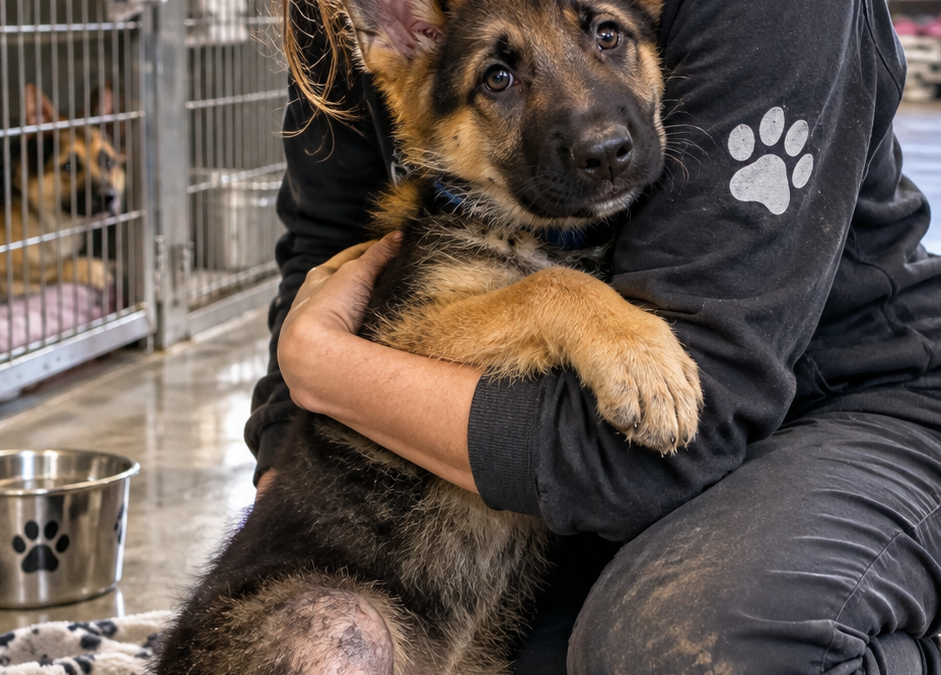
𝗣𝗔𝗥𝗧 𝟮
The adoption desk smelled like printer toner and disinfectant.
Lumen sat against the far wall.
The leash attached to her collar might as well have been steel cable.
Every time the phone rang, she flinched.
Printer.
Flinch.
Door.
Flinch.
Chair scraping.
Flinch.
The woman behind the desk slid the application toward me.
“She’s been difficult.”
“Define difficult.”
“Fearful.”
“That’s not difficult.”
“She won’t approach people.”
“She approached me.”
“Eventually.”
“Still counts.”
The woman looked at Lumen.
“She shuts down.”
“That’s different from aggression.”
“True.”
“Any bite history?”
“No.”
“Medical issues?”
“Underweight. Dermatitis. Stress-related appetite problems.”
“Training?”
“Very little.”
I nodded.
“So she’s five months old, terrified, underfed, and undertrained.”
The woman paused.
“Yes.”
“And the official conclusion was unadoptable.”
She looked uncomfortable now.
“I didn’t make the label.”
“I know.”
That mattered.
It is easy to turn institutions into villains.
Sometimes the reality is uglier and more boring.
Overcrowding.
Too few workers.
Too many animals.
Not enough foster homes.
A scared dog becomes harder to place.
Harder becomes unlikely.
Unlikely becomes unadoptable.
Words shorten difficult realities until the animal disappears beneath them.
I signed.
When I finished, the woman handed me a folder.
Vaccination record.
Temporary food supply.
Basic leash.
Care instructions.
“B27 is yours.”
I looked at her.
“No.”
She blinked.
“Her name is Lumen.”
The name had come to me while I sat outside.
Light.
Something small that still burns even after darkness convinces you it has won.
“Lumen.”
The woman wrote it on the form.
Lumen remained against the wall.
No celebration.
No miraculous tail wag.
She had no idea what had just happened.
I crouched.
“Ready?”
She wasn’t.
I moved toward the exit.
The automatic doors opened.
Traffic noise flooded inside.
Lumen froze.
All four paws planted.
Her head dropped.
I stopped.
Of course.
For me, the doorway meant parking lot.
For her, it meant unknown.
I put one treat on the threshold.
“One step.”
Nothing.
I waited.
A staff member passed us.
Then another.
Nobody rushed.
Good.
Lumen sniffed.
One paw.
Pause.
Then another.
She crossed.
Outside, the sound hit harder.
Cars.
Voices.
A bus.
Wind.
She crouched.
I kept the leash loose.
No pulling.
No dragging.
“You decide.”
She took another step.
Then another.
By the time we reached my car, I was sweating.
She looked at the back seat.
Wouldn’t move.
So I opened the door and climbed in first.
I sat sideways like an idiot.
“See?”
She stared.
“Terrible trap. Very obvious.”
No reaction.
I patted the seat.
“Come on.”
Nothing.
I waited.
Finally she jumped.
Hard.
Landed.
Then immediately dropped into the footwell.
Pressed against the floor.
“Still counts.”
I drove slowly.
Every few seconds I checked the mirror.
Her eyes tracked everything.
No blinking.
No resting.
She was monitoring escape routes.
At a red light, I looked back.
“You can sleep.”
She obviously did not trust my opinion.
I stopped at a small pet store near Main Street.
Lumen stayed in the locked car with air conditioning for a few minutes while I ran inside.
Bed.
Bowls.
Soft food.
Chew toy.
Crate.
Harness.
Long leash.
Then I saw a bright yellow bandana.
I bought it for no practical reason.
Back in the car, I tied it loosely around her neck.
Lumen froze.
Then realized nothing bad happened.
The yellow against her dull coat looked like sunlight dropped onto ash.
“That’s better.”
She looked away.
At home, the next battle began.
Driveway.
Front door.
House.
Every threshold was a question.
I opened the car.
Lumen stepped out.
Then a neighbor’s trash can tipped over in the wind.
Crash.
She jumped backward so violently I nearly lost the leash.
“Easy!”
Wrong tone.
Too sharp.
Her eyes widened.
I immediately lowered my voice.
“Sorry.”
She pulled.
I dropped to one knee.
Leash slack.
“No pressure.”
She panted.
Looked at the trash can.
Then me.
I stood slowly.
Walked to the can.
Set it upright.
Tapped it.
“See?”
Lumen did not find the demonstration persuasive.
Still, she didn’t run.
That mattered.
Inside, I put the dog bed in one corner of the kitchen.
Water nearby.
Food.
Lumen paced.
Small circles.
Always tracking me.
If I lifted one hand too quickly, her head ducked.
If I stepped toward her, she backed away.
Everything I did required negotiation.
I wanted to touch her.
Hold her.
Tell her she was safe.
But wanting to comfort an animal doesn’t give you permission to ignore what comfort means to them.
For Lumen, touch was not comfort yet.
Distance was.
So I gave it.
I sat on the kitchen floor.
Back against the cabinets.
Hands open.
No reaching.
One hour passed.
Then two.
The house hummed.
Refrigerator.
Clock.
Water pipes.
Lumen remained standing.
Midnight.
Still awake.
“You’re committed.”
Her ears moved.
“Very impressive.”
At some point after two, I drifted off.
A tiny sound woke me.
Paws.
Slow.
Lumen had moved closer.
She sniffed my shoe.
Then my knee.
I stayed still.
Her body trembled.
She stretched her neck.
Nose against my palm.
Warm.
One second.
Then she lowered herself onto the floor.
Not touching me.
Almost.
Her muzzle rested across my fingers.
That was all.
I didn’t move.
I barely breathed.
Her eyes closed.
For the first time since I met her, Lumen slept near a human because she chose to.
I should have felt triumphant.
Instead, fear hit me.
What if I wasn’t enough?
What if I made one mistake and shattered everything?
What if the shelter had been right?
What if this dog needed someone better?
More experienced.
More patient.
Someone without neighbors.
Someone who knew what they were doing.
Then Lumen sighed.
Her nose pressed deeper into my hand.
I decided to fail later.
That night, staying was enough.
Morning arrived.
My back was destroyed.
Lumen had moved to the corner.
Still there.
Not hiding.
Watching.
“Good morning.”
One ear lifted.
I tossed a piece of kibble.
She ate.
No retreat.
“Progress.”
I started with simple conditioning.
Clicker.
Treat.
Click.
Treat.
The first click made her jump.
So I muffled it with my palm.
Softer.
Click.
Food.
Again.
Again.
Eventually she learned the sound predicted something good.
Predictability became our first language.
I didn’t start with obedience.
Not really.
I started with rules about the world.
Noise can be followed by food.
Hands can appear without grabbing.
Doors can open without abandonment.
Humans can leave the room and return.
Food arrives every day.
Water doesn’t disappear.
Nothing happens when you sleep.
Those were more important than sit.
Still, Lumen learned sit quickly once she realized training was safe.
German Shepherd.
Of course.
She watched everything.
Tracked patterns.
Anticipated.
A frightened intelligent dog is difficult because the same brain that learns commands also memorizes danger.
We had to teach new equations.
Sound plus Ethan did not equal pain.
Door plus Ethan did not equal being left.
Leash did not equal restraint.
Crate did not equal punishment.
Progress came in inches.
Then Lumen found the rubber ball.
I rolled it across the kitchen.
She froze.
The ball bumped her paw.
She stepped away.
“Fair.”
I rolled it again later.
This time she sniffed.
Third time, she nudged it.
It rolled toward me.
I stared.
“No way.”
Lumen stared back.
I rolled it.
She pushed it again.
A game.
Barely.
But a game.
That evening, I sat on the couch.
Lumen approached on her own.
Stopped beside me.
Rested her chin on the cushion.
I lowered my hand.
Touched the side of her neck.
She stayed.
My fingers moved through her patchy fur.
No flinch.
Then a garbage truck crashed through the neighborhood.
Metal slammed.
Hydraulics screamed.
Lumen vanished.
Nails tore down the hallway.
I sat frozen.
“Of course.”
One sound erased the moment.
Or appeared to.
I found her inside the bathroom behind the toilet.
Curled.
Panting.
I didn’t pull her out.
I sat in the hallway.
“Bad noise.”
Her eyes watched.
“Nothing else.”
I waited.
Twenty minutes.
Lumen came out.
Walked past me.
Then turned.
Came back.
Touched my knee.
That taught me something important.
Setbacks are not resets.
Fear can return without erasing trust.
I had been measuring progress too cruelly.
One panic didn’t mean we were back at day one.
Lumen still knew me.
She still came back.
The next morning, we went to Clover Park.
Wide grass.
Open sight lines.
Enough dogs to expose her gently.
Enough distance to retreat.
Lumen froze at the entrance.
I waited.
Wind moved through the grass.
Her nose worked.
Interesting smells began competing with fear.
That was useful.
A Labrador ran past chasing a ball.
Lumen stiffened.
No bolt.
Click.
Treat.
She took it.
A husky howled.
Lumen startled.
Then looked at me.
Click.
Treat.
Good.
A stroller squeaked.
She stepped closer to my leg.
Click.
Treat.
Eventually her nose dropped.
She sniffed where another dog had rolled.
Then she made one awkward hop sideways.
Almost playful.
I laughed.
Lumen froze at the sound.
Then wagged.
Barely.
One tail movement.
I stopped laughing and almost cried instead.
“That’s it.”
She sniffed again.
Another hop.
I saw the puppy hiding beneath the fear.
That’s who I wanted to meet.
Not force out.
Invite.
We stayed forty minutes.
On the way back to the car, Lumen brushed against my leg.
Then climbed into the back seat on her own.
No coaxing.
I sat behind the wheel.
Looked in the mirror.
She wore the yellow bandana.
Head higher.
Still nervous.
Different.
I smiled.
“Unadoptable.”
Lumen tilted her head.
“Ridiculous.”
Then the neighbor complained.
Not aggressively.
That made it worse.
He knocked the next afternoon.
“Hey.”
“Hey.”
He glanced behind me.
Lumen was in the hallway.
“Everything okay with the dog?”
“Yeah.”
“She barked a lot last night.”
My stomach tightened.
“Sorry.”
“I’m not trying to be difficult.”
“I know.”
“I’ve got a baby.”
“Understood.”
“Just… if it keeps happening…”
“I’ll handle it.”
He nodded.
“She seems sweet.”
“She is.”
The door closed.
I leaned against it.
Lumen stared.
There it was.
Pressure.
Not shelter pressure.
Real life.
Neighbors.
Noise.
Schedules.
Sleep.
I had promised patience.
But patience doesn’t exist in a vacuum.
What if complaints escalated?
What if Lumen couldn’t adapt?
What if I had rescued her into another environment she couldn’t survive?
That night, I set up a crate in my bedroom.
Door open.
Blanket inside.
Yellow bandana.
Treats.
Lumen sniffed.
Entered.
Left.
Entered again.
Eventually curled inside.
I sat on the floor.
“Safe place.”
A motorcycle roared outside.
She barked.
Once.
Twice.
Then nonstop.
I stayed.
No yelling.
No crate cover immediately.
No punishment.
I waited for one break in the barking.
Click.
Treat.
Silence.
Motorcycle faded.
Lumen panted.
I put my hand near the crate.
She pressed her nose against it.
That stopped my doubt from becoming action.
She was scared.
But she was trying.
So was I.
We went back to the shelter training yard the next morning.
I hated returning.
The sight of the blue kennel doors made me angry.
Lumen froze near the entrance.
Then looked at me.
I crouched.
“Different this time.”
She leaned against my leg.
That was enough.
Training became our routine.
Name response.
Touch.
Sit.
Down.
Place.
Loose-leash walking.
Noise work.
Desensitization.
Rest.
Not everything every day.
Her nervous system needed recovery as much as her muscles needed exercise.
The shelter trainer, Maya, helped.
She had been off shift the day I adopted Lumen and was furious when she heard someone had called a five-month-old fearful puppy unadoptable as though it were a fixed diagnosis.
“Labels become lazy fast,” she told me.
“That’s what I thought.”
“She isn’t unadoptable.”
“Clearly.”
“She’s undersocialized and shut down.”
“Less dramatic.”
“More useful.”
Maya showed me how to read Lumen’s threshold.
Lip licking.
Ear position.
Weight shift.
Pupil changes.
Panting.
Avoidance.
The goal wasn’t to push until she tolerated fear.
The goal was to work below panic, where learning could still happen.
“You’re moving too fast,” Maya said one afternoon.
I frowned.
“She did well at the park.”
“That doesn’t mean Santa Monica Pier tomorrow.”
I had mentioned the pier.
“She needs exposure.”
“She needs successful exposure.”
Difference.
Important.
Annoying.
“What do you recommend?”
“Go near the pier. Not onto it. Let her hear from distance.”
We did.
Day one, fifty yards away.
Lumen heard drums.
Tensed.
Still ate treats.
Good.
Day two, closer.
Gulls.
Children.
Music.
She watched.
No panic.
Day three, edge of the boardwalk.
One paw.
Then another.
Back home.
I learned that bravery isn’t dramatic forward motion.
Sometimes bravery is stopping before you’re overwhelmed.
Weeks passed.
Lumen’s coat improved.
Nutrition.
Medication.
Baths.
Skin treatment.
She gained weight.
Her ribs disappeared.
Black fur became glossy.
Tan markings brightened.
The yellow bandana no longer looked like sunlight on ash.
Now it looked like it belonged.
Her ears began standing.
One before the other.
For a week she looked permanently confused.
I loved it.
She started sleeping on her side.
Then on her back.
First time I saw her belly-up in the living room, I took a picture.
Maya laughed.
“Congratulations.”
“What?”
“That’s a dog who feels safe.”
I stared at the photo.
Safe.
Not cured.
Not fearless.
Safe.
That mattered more.
We eventually went onto Santa Monica Pier.
Not because we had to.
Because Lumen was ready enough to try.
I parked.
Sat in the car.
“Your choice.”
I opened the door.
Lumen jumped out.
That alone would have been impossible weeks earlier.
Crowds moved ahead.
Ocean noise.
Gulls.
Music.
Wooden boards creaking.
Lumen stopped.
Her tail lowered.
I waited.
One step.
Click.
Treat.
Another.
We walked slowly.
At a distance, a street drummer played.
Lumen heard.
Body stiffened.
I moved away.
Not closer.
That was growth too.
We found space beside the railing.
Ocean below.
Salt wind.
Lumen sniffed.
A golden retriever passed.
She watched.
No panic.
A soda cup dropped.
Crash.
Lumen jumped.
Then looked at me.
That look nearly broke me.
Not at the sound.
At me.
She had developed an alternative to running.
Connection.
I crouched.
“Good.”
Treat.
She ate.
Then leaned against my knee.
The drummer moved closer.
Bad luck.
Or normal pier life.
The beat grew louder.
Lumen’s breathing changed.
Panting.
Ears back.
Weight shifted.
We should have left.
I almost did.
Then she stepped toward me.
Not away.
Her paw touched my thigh.
I froze.
“Lumen.”
Her eyes locked on mine.
I clicked.
Treat.
She took it.
Drums.
Click.
Treat.
Drums.
She trembled.
Stayed.
The drummer finished.
Crowd cheered.
Lumen flinched.
Then remained against me.
I put both hands gently around her neck.
“That’s enough.”
We left.
No conquering.
No forcing.
No dramatic victory over all fear.
We simply left after success.
That distinction matters.
Fear isn’t an enemy you beat once.
It’s something the nervous system learns to manage.
Some memories fade.
Some don’t.
The goal isn’t a dog who never reacts.
It’s a dog who recovers.
Lumen was learning recovery.
The beach came afterward.
Quiet section.
Long line first.
I did not immediately unclip her.
Despite the dramatic version of rescue stories, responsible dog ownership generally benefits from not gambling with traffic and trauma.
Lumen walked through sand.
Hated it for thirty seconds.
Then discovered digging.
Instant obsession.
She shoved her nose into a hole.
Sneezed.
Looked offended.
I laughed.
She dug again.
Then ran in a circle at the end of the long line.
Once.
Twice.
Zoomies.
Real puppy zoomies.
I stood there holding the line and laughing until my face hurt.
Lumen ran toward me.
Turned away.
Ran again.
The dog who had once tried to disappear against concrete now seemed determined to occupy as much coastline as possible.
Eventually she crashed into my legs.
I went down into the sand.
“Ow.”
Lumen licked my face.
“Very compassionate.”
Tail.
Lick.
Yellow bandana flapping.
I held her.
Not because she needed restraining.
Because now she enjoyed being held.
That difference felt enormous.
“You’re not B27.”
Her ears lifted.
“Never were.”
She licked my chin.
“Disgusting.”
More licking.
“Fine.”
I sat with her near the water.
The Pacific stretched out.
Lumen watched waves.
No fear.
Curiosity.
That became one of my favorite memories.
Not because she was “fixed.”
She wasn’t.
She still startled at garbage trucks.
Still disliked motorcycles.
Still occasionally woke at night barking.
But those things were no longer her entire identity.
She had hobbies now.
Sand.
Tennis balls.
Chewing one particular corner of my rug.
Watching squirrels with criminal intensity.
Sleeping across doorways.
Stealing socks.
Normal dog things.
That was the real transformation.
Not becoming fearless.
Becoming ordinary.
People underestimate how beautiful ordinary can be after trauma.
The shelter invited us back three months later.
Maya wanted Lumen to participate in a confidence class for newly rescued dogs.
Not as a demonstration dog exactly.
Just another dog in the room.
I agreed.
The same volunteer who had called her unadoptable was there.
He recognized her slowly.
“Wait.”
I smiled.
“Yeah.”
He stared.
Lumen’s coat was glossy now.
Weight healthy.
Ears up.
Yellow bandana.
She stood beside me calmly.
“That’s B27?”
“Lumen.”
He crouched.
“Wow.”
Lumen watched him.
No approach.
No retreat.
Neutral.
He looked embarrassed.
“I didn’t think she’d make it.”
That sentence irritated me.
“She didn’t need you to predict.”
He looked up.
“I didn’t mean—”
“I know.”
And I did.
He wasn’t the enemy.
The system was overloaded.
He’d become numb.
Still, words mattered.
“Just be careful with labels.”
He nodded.
“You’re right.”
Lumen sniffed his shoe.
Then walked away.
That was better than a confrontation.
She didn’t need his approval.
That became a pattern.
People who heard her story expected a dramatic personality transformation.
They wanted before and after.
Scared.
Then happy.
Simple.
Reality was more interesting.
Lumen remained sensitive.
She just became skilled.
A year after adoption, garbage trucks still woke her sometimes.
Difference?
She barked twice, looked at me, then settled.
At the park, sudden shouting could make her freeze.
Difference?
She recovered in seconds, not twenty minutes.
At the vet, metal equipment still made her uncomfortable.
Difference?
She chose to stand beside me instead of flattening against the wall.
Healing was measurable not by the absence of fear, but by the shortening distance back to safety.
I learned that from her.
And Lumen changed me too.
I had never considered myself impatient.
Apparently I had simply spent most of my life around people capable of understanding explanations.
Dogs expose your flaws efficiently.
If I got frustrated, Lumen got worse.
If I rushed, she retreated.
If I expected linear progress, I became disappointed.
So I changed.
Slower.
More observant.
Less interested in forcing outcomes.
Those changes followed me into the rest of my life.
Work.
Family.
People.
Turns out humans also do better when you stop treating fear like disobedience.
Lumen became my shadow.
Not because she feared abandonment forever.
At first, yes.
Later, because that was our routine.
Kitchen.
Office.
Car.
Park.
Beach.
She stopped checking whether I would leave.
She simply assumed we were going together.
That assumption became one of the greatest privileges of my life.
Then came the first real test of permanence.
Six months after I adopted her, my landlord announced the building was being sold.
New owner.
New rules.
Pet restrictions unclear.
I felt panic immediately.
Not because Lumen had done anything wrong.
Because I remembered the word.
Unadoptable.
I imagined housing problems.
Neighbors.
Complaints.
Moving.
What if I couldn’t find a place?
What if all those practical things I had dismissed at the shelter finally came due?
For two days I was tense.
Lumen noticed.
Of course.
She followed me more closely.
Stopped eating one meal until I sat nearby.
I hated that my stress became hers.
So I made a decision.
We moved before anyone could tell us we had to.
Smaller apartment.
Higher rent.
Better dog policy.
Near the park.
Terrible kitchen.
Worth it.
When we arrived, Lumen froze at the new doorway.
Old pattern.
I smiled.
“Remember this?”
She looked at me.
I walked inside.
Sat on the floor.
Same as the first night.
Hands open.
Lumen stood outside.
Then one paw crossed.
Another.
She entered.
Sniffed.
Walked into the living room.
Turned in a circle.
Then lay down.
No hours.
No panic.
Three minutes.
That was growth.
A year passed.
The yellow bandana faded.
I replaced it.
Same color.
Lumen’s birthday became the day I adopted her because nobody knew the real date.
I bought a dog-safe cake.
She stole half before the photo.
Perfect.
Maya sent a message.
UNADOPTABLE DOG COMMITS BAKERY CRIME.
I laughed.
By then, Lumen had earned her Canine Good Citizen certificate.
Not because I needed proof.
Because training gave us goals.
She passed.
Loose leash.
Greetings.
Handling.
Crowd behavior.
Recovery from distraction.
The evaluator had no idea what her starting point had been.
Afterward, I sat in the car.
Held the certificate.
Looked at Lumen.
“You understand how ridiculous this is?”
Tail wag.
“They said you couldn’t be adopted.”
Wag.
“Now you have paperwork saying you’re polite.”
She sneezed.
“Exactly.”
I framed it.
Because apparently I had become that person.
Then came a moment I didn’t expect.
A rescue asked whether Lumen could help with another fearful puppy.
Not formal therapy.
Controlled social support.
The puppy was a six-month-old shepherd mix named Nova.
Found after abandonment.
Wouldn’t approach men.
Wouldn’t leave the back of a kennel.
I said no at first.
Lumen wasn’t a tool.
She didn’t owe the rescue community anything because she’d survived.
Maya agreed.
“Only if Lumen enjoys it.”
We arranged a controlled meeting.
Large fenced yard.
Distance.
Nova stayed near one corner.
Lumen entered.
Ignored her.
Best possible thing.
She sniffed grass.
Walked.
Lay down.
Nova watched.
Five minutes.
Ten.
Then Nova moved closer.
Lumen did not stare.
Did not rush.
Nova came within six feet.
Then three.
Eventually sniffed Lumen’s tail.
Lumen turned slowly.
Sniffed back.
Done.
No miracle.
But Nova left the corner.
The rescue director cried.
I understood.
Weeks later, Nova was adopted.
Lumen had helped simply by being safe.
That became occasional work.
Not frequent.
Only when appropriate.
She had an unusual gift for fearful dogs.
Maybe because she understood pressure.
Maybe dogs recognize posture better than stories.
Either way, Lumen could sit near panic without demanding it disappear.
That was something I had learned from her too.
Two years after adoption, the shelter held a fundraising event.
Lumen was invited.
We almost didn’t go.
Then I saw the theme.
SECOND CHANCES.
Fine.
We went.
A large photo display showed former shelter dogs.
Before and after.
Lumen’s old intake photo was included.
B27.
Thin.
Head down.
Next to it, current photo.
Lumen on the beach.
Yellow bandana.
Mouth open.
Eyes bright.
People stopped.
“That’s the same dog?”
“Yes.”
“No way.”
“Way.”
One woman whispered, “She was labeled unadoptable?”
“Yes.”
She looked at Lumen.
Lumen leaned into her hand.
The woman cried.
I didn’t.
Barely.
Then the shelter director asked if I’d speak.
I declined.
Absolutely not.
She asked again.
Still no.
Eventually I agreed to say two minutes.
This is why persistence is dangerous.
I stood in front of maybe eighty people.
Lumen beside me.
I looked at the old photo.
Then at her.
“I don’t think anyone here needs a speech about rescue.”
People laughed lightly.
“I just want to say one thing about labels.”
Lumen sat.
“Unadoptable wasn’t a diagnosis.”
Silence.
“It was a description of how difficult her situation looked at that moment.”
I looked at the shelter staff.
“They were overcrowded. She was terrified. She wouldn’t engage. Everything looked bad.”
I touched Lumen’s shoulder.
“But a snapshot is not a destiny.”
Her ears lifted.
“Sometimes behavior is communication. Sometimes shutdown is fear. Sometimes the dog everyone thinks has nothing to give simply hasn’t found enough safety to show it.”
I stopped.
That was all.
Afterward, the same volunteer from the first day approached.
He had tears in his eyes.
“I’ve thought about what you said.”
“Which part?”
“Labels.”
I nodded.
“I’m sorry.”
“For what?”
“That day.”
“You didn’t abandon her.”
“No.”
“You didn’t hurt her.”
“No.”
“You were tired.”
He looked away.
“We all were.”
“I know.”
“Still.”
I shook his hand.
“Then do better with the next one.”
He nodded.
That felt right.
No villain needed.
No revenge.
The only thing worth defeating was the idea that fear equals failure.
Lumen kept doing that.
Every day.
Three years after adoption, she barely resembled the dog from the intake photo.
Strong.
Athletic.
Shiny coat.
Confident gait.
People called her beautiful constantly.
I always wanted to say:
She was beautiful then too.
You just couldn’t see it under fear.
That was the uncomfortable lesson.
Transformation stories can accidentally imply the wounded version had less worth.
She didn’t.
B27 deserved care before she became glossy.
Before the beach.
Before obedience certificates.
Before strangers admired her.
She didn’t earn rescue by improving.
She deserved rescue because she was alive.
That mattered.
Lumen taught me that too.
She wasn’t valuable because she became easy.
She became easier because someone finally treated her as valuable.
There’s a difference.
We kept going to the beach.
It became her place.
The first year, she stayed near me.
Second year, long-line confidence.
Later, after recall became rock solid and only in legal off-leash areas, she ran.
Full speed.
Wide arcs.
Sand exploding behind her.
Always back to me.
Never vanishing.
Never disappearing.
One afternoon, she ran toward the water.
Stopped at the edge.
Wave touched her paws.
She jumped backward.
Offended.
Then attacked the ocean.
Barking.
I laughed until strangers looked over.
A man said, “First time?”
“No.”
He pointed.
“She acts like it.”
“She believes repetition will improve the result.”
Lumen charged another wave.
Lost again.
Perfect.
Four years in, she became calmer.
Mature.
No longer a puppy.
Garbage trucks were mostly irrelevant.
Motorcycles still irritated her.
Thunder required closeness but not panic.
Santa Monica Pier became ordinary.
We walked it sometimes.
She remembered nothing I could prove.
Or maybe remembered everything differently.
She no longer scanned for escape.
She scanned for dropped food.
Again: ordinary.
Beautiful ordinary.
Then one day, we passed the shelter.
Lumen slowed.
I noticed.
“Want to go in?”
She looked at the building.
Then me.
I didn’t force it.
We stood outside.
Same curb.
Not exactly the same spot.
The blue tag B27 had been kept in my desk all those years.
I had almost brought it.
Didn’t.
Good.
Lumen sniffed.
A volunteer came outside with another dog.
Young shepherd.
Scared.
Lumen watched.
The dog saw her.
Paused.
The volunteer said, “She’s having a rough week.”
I smiled.
“I know the type.”
Lumen moved closer.
Not touching.
Just present.
The young dog relaxed slightly.
I looked at the shelter entrance.
Years earlier, that doorway represented uncertainty.
Now Lumen stood outside it strong enough to lend calm to another dog.
That was the moment I finally understood the title other people used when sharing her story.
Unrecognizable.
Yes, physically.
But not because Lumen had become someone else.
She had become more fully herself.
Fear had covered her.
Safety uncovered her.
That’s different.
The word unrecognizable almost felt unfair.
The puppy was always there.
The playful one.
The bright one.
The dog who wanted to run on beaches.
The dog who wanted to work.
The dog who wanted connection.
Fear had simply pushed everything behind a wall.
We didn’t create Lumen.
We waited long enough for her to emerge.
That became the ending I cared about.
Not that the shelter was wrong.
They were wrong, but institutions make mistakes.
Not that one volunteer felt guilty.
Not that people now praised her.
The real defeat belonged to fear.
Fear had ruled everything.
It decided where she stood.
Whether she ate.
Whether she slept.
Who could touch her.
Whether noise meant danger.
Whether a door meant abandonment.
Then slowly, day by day, fear lost territory.
One inch at a time.
A kibble piece.
A curb.
A car ride.
A kitchen floor.
A clicker.
A park.
A crate.
A garbage truck.
A pier.
A wave.
A new home.
Another frightened dog.
Fear didn’t disappear.
It stopped ruling.
That’s victory.
Lumen turned seven before I realized how much time had passed.
Gray appeared around her muzzle.
Very slight.
I hated it.
She remained active.
Beach walks.
Training.
Sleep.
Food.
Routine.
The years became ordinary.
Exactly what I had once hoped for.
The shelter asked for an anniversary photo.
I sent one of Lumen lying upside down on my couch, all four paws in the air, yellow bandana twisted sideways.
Caption:
B27 remains extremely unadoptable. Please advise.
Maya replied:
Return immediately.
I wrote:
Denied.
Lumen sneezed.
At eight, arthritis appeared mildly in one hip.
Nothing dramatic.
Supplements.
Weight management.
Adjusted exercise.
At nine, she still ran but shorter.
At ten, the beach became more walking than sprinting.
She continued attacking waves.
Some wars never end.
People who met her late in life could not believe the old stories.
“She was scared of everything?”
“Almost.”
“She?”
Lumen was leaning against a stranger demanding scratches.
“Yes.”
They would laugh.
I understood.
Trauma is difficult to imagine once safety becomes habitual.
That’s a good problem.
One evening, years after the curb, a garbage truck slammed a dumpster outside.
Lumen lifted her head.
Looked toward the window.
Then rested it on my foot.
No bark.
No shaking.
Nothing.
I stared.
“What?”
She closed her eyes.
I laughed.
That noise once sent her hiding behind a toilet.
Now it barely interrupted a nap.
No applause.
No certificate.
No crowd.
Just an old trigger becoming irrelevant.
One of the greatest victories of her life happened while nobody watched.
That’s usually how healing works.
By eleven, her face was mostly gray around the muzzle.
I kept the yellow bandanas going.
New one every year.
Ridiculous tradition.
Necessary tradition.
We revisited Clover Park often.
The first place she learned outdoor noise could be survivable.
One afternoon, she watched a young Labrador race after a tennis ball.
Her tail wagged.
She didn’t chase.
Too old.
Instead she looked at me.
I sat beside her.
“You remember when that would have terrified you?”
Obviously no answer.
“You were terrible.”
Tail thump.
“I was worse.”
Another thump.
Fair.
Lumen developed cancer at twelve.
I knew before the final tests.
Veterinary appointments.
Mass.
Imaging.
Biopsy.
The words arrived professionally.
Treatment options.
Prognosis.
Quality.
Time.
I listened.
Then drove home.
Lumen slept in the back seat.
No floorboard hiding.
No panic.
Head on the seat.
Trust absolute.
The contrast almost destroyed me.
I had spent her first months afraid I would fail her.
Now the only failure would be keeping her too long because I couldn’t let go.
We treated what could reasonably be treated.
Pain control.
Comfort.
Good food.
Short walks.
Beach when she wanted.
Not when I wanted.
Lumen’s world became smaller.
That was okay.
She had spent years expanding it.
She had earned small.
One final beach morning, she wore a fresh yellow bandana.
The sun was low.
Cool air.
She walked slowly.
Reached the sand.
Sniffed.
A wave came close.
She barked at it.
Weak.
Still offended.
I laughed through tears.
“Consistent.”
She looked at me.
We sat near the water.
Lumen leaned against my side.
No running.
No dramatic final sprint.
I was grateful.
Real life does not need symbolism every minute.
We watched the ocean.
That was enough.
When the time came, the veterinarian came to my home.
Lumen lay on her bed in the living room.
The same general place where she’d first chosen to rest near me all those years earlier.
I sat on the floor.
Like night one.
Back against the cabinet? No.
Different house now.
Different life.
But same level.
Her head rested in my palm.
I whispered:
“You were never unadoptable.”
Her eyes half closed.
“You were just scared.”
Tail moved.
Once.
“You made me work for it.”
Tiny movement again.
“Very inconsiderate.”
The veterinarian smiled.
I couldn’t.
I pressed my forehead to hers.
“You don’t have to be brave anymore.”
Sedation.
Lumen relaxed.
No vigilance.
No monitoring.
No waiting for noise.
Just rest.
I kept my hand beneath her muzzle.
Exactly where she had first placed it on the kitchen floor.
The final medication entered.
Her breathing slowed.
Then stopped.
The house became quiet.
I stayed on the floor.
Held the yellow bandana.
Cried.
Not because anything had gone wrong.
Because everything had gone right for twelve years and was now complete.
That difference mattered.
The shelter had once believed Lumen might have days.
She got more than a decade.
Beaches.
Parks.
Moves.
Training.
Friends.
Fearful dogs.
Garbage trucks.
Birthdays.
Couches.
Bandanas.
Ordinary mornings.
Thousands of meals.
Thousands of walks.
Thousands of nights sleeping without wondering whether anyone would leave.
That was the final answer to B27.
Not a viral video.
Not a transformation photo.
Life.
A full one.
Months after Lumen died, the shelter asked whether they could display her blue tag in a small education area they were creating about fearful dogs.
I had kept it.
B27.
I stared at it for a long time.
Then said yes.
But with one condition.
Don’t display it as a symbol of a dog nobody wanted.
Display it beside her name.
Lumen.
And explain the difference.
A number tells you where someone is stored.
A name tells you someone belongs somewhere.
The display eventually read:
B27 — later named Lumen.
Fearful does not mean hopeless.
I liked that.
No grand slogan.
No guilt.
Useful.
Years later, I still hear people use the word unadoptable.
Sometimes correctly.
There are dogs with behavioral risks that require extraordinary management.
There are cases where placement isn’t safe or realistic.
Pretending otherwise helps nobody.
But Lumen taught me to ask a better question first.
Unadoptable because of what?
Permanent behavior?
Documented danger?
Medical reality?
Or because fear makes a dog inconvenient inside a system that has no time?
Those are different things.
Lumen had been classified by a moment.
She outlived the label.
Completely.
The puppy who wouldn’t lift her eyes became a dog who leaned into strangers.
The dog who hid from noise learned to recover beside drums.
The dog who froze at doorways walked onto beaches.
The dog who wouldn’t eat became shameless about stealing chicken.
The dog who was expected to have no future grew old enough to develop gray eyebrows.
That’s the ending I remember.
Not the shelter.
Not the curb.
Not B27.
Gray eyebrows.
A yellow bandana.
A dog sleeping upside down because safety had become so ordinary she didn’t need to think about it.
That is what defeated the word unadoptable.
Not me.
Not training alone.
Not love alone.
Time.
Structure.
Patience.
Choice.
Consistency.
And one frightened dog who kept trying after the world had already written her off.
The label lost.
Fear lost.
The deadline lost.
Lumen got the years.
And in the end, that was more than enough.
Have you finished reading the story and want to read it again?
They Called This German Shepherd Puppy “Unadoptable”—Then Lumen Became Unrecognizable
They had already given up on her.
She was only five months old.
And she had just a few days left.
My name is Ethan Cole, and the first time I saw Lumen, she was trying to disappear beside a trash bin outside a shelter in Santa Monica.
Not hiding.
Disappearing.
There is a difference.
A dog that hides still believes somewhere else might be safer.
Lumen looked like she had stopped believing there was anywhere else.
She was curled against a concrete wall just beyond the shelter parking lot, thin enough that every rib showed beneath her dull black-and-tan coat. Patches of fur were missing around her hips and neck. A cheap blue collar hung loosely around her, and from it dangled a metal tag stamped with one impersonal code.
B27.
No name.
Just a number.
Cars screamed down Lincoln Boulevard behind us.
Horns.
Motorcycles.
Music pounding through open windows.
Doors slamming.
People talking.
Lumen didn’t react.
For one terrible second, I wondered if she was deaf.
Then I crouched.
“Hey, girl.”
One ear moved.
Barely.
She had heard me.
She just didn’t believe sound mattered anymore.
I stayed several feet away.
Her eyes remained fixed on the ground.
Brown, but dulled by exhaustion until they looked almost gray.
A shelter volunteer stepped outside carrying a clipboard.
He noticed me.
Then noticed her.
“That one?”
I looked up.
“Yeah.”
“Been here about three weeks.”
“What happened?”
He shrugged.
“Owner surrender, I think. Maybe transfer. Doesn’t really matter now.”
I didn’t like that answer.
“What do you mean?”
“She won’t engage. Barely eats. Won’t play. Panics when handled.”
He checked something on the clipboard.
“They’ve marked her unadoptable.”
The word landed harder than it should have.
Unadoptable.
Five months old.
Not five years.
Not a dog with a documented bite history.
Not a dangerous animal with repeated behavioral incidents.
A puppy.
The volunteer said it like he was describing a damaged refrigerator.
I looked at Lumen again.
She lifted her eyes for half a second.
That was all.
But in that glance, I saw something I couldn’t unsee.
Not aggression.
Not emptiness.
Fear.
Deep, exhausted fear.
The kind that makes every choice feel dangerous.
“Unadoptable,” I repeated.
The volunteer nodded.
“We’re full.”
He hesitated.
Then added, “If nobody takes her soon…”
He didn’t finish.
He didn’t need to.
The shelter door shut behind him.
I sat down on the curb.
Lumen stared at my shoes.
I had spent years telling myself I knew my limits.
You can’t save every dog.
You can’t fix every bad situation.
You can’t take responsibility for every animal someone else fails.
All true.
Very reasonable.
Very mature.
Also completely useless when one terrified puppy is sitting three feet away.
I reached into my pocket.
I carried training treats because my sister had asked me to pick some up for her Labrador later that day.
Funny how life arranges supplies before you know why you’ll need them.
I placed one piece of kibble in my palm.
Held it low.
“Come on.”
Nothing.
“You don’t have to like me.”
Her ear flicked.
“Honestly, most people don’t at first.”
Nothing.
A car roared past.
Hot exhaust washed over us.
Lumen didn’t move.
I waited.
My legs went numb.
People walked by.
One woman looked at me sitting on the pavement and then deliberately looked away.
A delivery driver pushed a dolly past.
A man on his phone stepped around us.
Nobody asked why I was sitting beside a frightened puppy.
Santa Monica kept moving.
Lumen didn’t.
After almost ten minutes, her nose lifted.
Just slightly.
She smelled the food.
Her eyes moved from my hand to my face.
Back to the food.
Then one paw shifted.
Scrape.
I stopped breathing.
Another inch.
Her body stayed low.
Every movement looked painful, not physically, but emotionally.
Like she expected the ground itself to punish her.
“That’s it.”
I barely whispered.
The distance closed.
Three feet became two.
Then a foot and a half.
Her nose trembled.
She was almost there.
Then—
Bang.
A car door slammed behind us.
Lumen launched backward.
Her claws scraped across the concrete.
She hit the wall.
Eyes wide.
Chest heaving.
The kibble remained in my hand.
The entire moment vanished.
I closed my eyes.
For one second, disappointment hit me harder than it should have.
Not at her.
At how fragile trust was.
One stupid noise.
One second.
Everything reset.
Then I remembered what the volunteer had said.
A few more days.
Maybe.
That clock was moving whether Lumen trusted me or not.
So I put the food down halfway between us.
“Fine.”
I leaned back.
“No hand.”
Her eyes stayed on me.
“It’s yours.”
We sat there.
One minute.
Three.
Five.
Finally she crept forward.
Lower than before.
She darted.
Grabbed the kibble.
Retreated.
I smiled.
“Okay.”
Another piece.
This time slightly closer.
She waited longer.
Then came again.
Grabbed it.
Back.
Again.
Closer.
Again.
Closer.
Her breathing became louder.
Mine probably did too.
Eventually, she stood less than a foot away.
I kept my hand still.
Food on my palm.
Lumen stretched her neck.
Her nose touched my fingers.
Warm.
Barely.
Then she took the food.
She didn’t run.
That was the first victory.
Not dramatic.
Not cinematic.
A frightened German Shepherd puppy took one piece of food from my hand.
That was enough to change everything.
The shelter door opened again.
The same volunteer stared.
“You’re still here?”
“Yeah.”
“She’s marked—”
“I heard you.”
He stopped.
I looked at Lumen.
Then at the blue tag.
B27.
A number assigned to a dog who had apparently become too inconvenient to understand.
I stood.
My knees cracked.
Lumen flinched but stayed.
“I want the paperwork.”
The volunteer blinked.
“What paperwork?”
“Adoption.”
He stared at me.
“You sure?”
“No.”
That surprised him.
I smiled.
“But I’m doing it anyway.”
PART2
The adoption desk smelled like printer toner and disinfectant.
Lumen sat against the far wall.
The leash attached to her collar might as well have been steel cable.
Every time the phone rang, she flinched.
Printer.
Flinch.
Door.
Flinch.
Chair scraping.
Flinch.
The woman behind the desk slid the application toward me.
“She’s been difficult.”
“Define difficult.”
“Fearful.”
“That’s not difficult.”
“She won’t approach people.”
“She approached me.”
“Eventually.”
“Still counts.”
The woman looked at Lumen.
“She shuts down.”
“That’s different from aggression.”
“True.”
“Any bite history?”
“No.”
“Medical issues?”
“Underweight. Dermatitis. Stress-related appetite problems.”
“Training?”
“Very little.”
I nodded.
“So she’s five months old, terrified, underfed, and undertrained.”
The woman paused.
“Yes.”
“And the official conclusion was unadoptable.”
She looked uncomfortable now.
“I didn’t make the label.”
“I know.”
That mattered.
It is easy to turn institutions into villains.
Sometimes the reality is uglier and more boring.
Overcrowding.
Too few workers.
Too many animals.
Not enough foster homes.
A scared dog becomes harder to place.
Harder becomes unlikely.
Unlikely becomes unadoptable.
Words shorten difficult realities until the animal disappears beneath them.
I signed.
When I finished, the woman handed me a folder.
Vaccination record.
Temporary food supply.
Basic leash.
Care instructions.
“B27 is yours.”
I looked at her.
“No.”
She blinked.
“Her name is Lumen.”
The name had come to me while I sat outside.
Light.
Something small that still burns even after darkness convinces you it has won.
“Lumen.”
The woman wrote it on the form.
Lumen remained against the wall.
No celebration.
No miraculous tail wag.
She had no idea what had just happened.
I crouched.
“Ready?”
She wasn’t.
I moved toward the exit.
The automatic doors opened.
Traffic noise flooded inside.
Lumen froze.
All four paws planted.
Her head dropped.
I stopped.
Of course.
For me, the doorway meant parking lot.
For her, it meant unknown.
I put one treat on the threshold.
“One step.”
Nothing.
I waited.
A staff member passed us.
Then another.
Nobody rushed.
Good.
Lumen sniffed.
One paw.
Pause.
Then another.
She crossed.
Outside, the sound hit harder.
Cars.
Voices.
A bus.
Wind.
She crouched.
I kept the leash loose.
No pulling.
No dragging.
“You decide.”
She took another step.
Then another.
By the time we reached my car, I was sweating.
She looked at the back seat.
Wouldn’t move.
So I opened the door and climbed in first.
I sat sideways like an idiot.
“See?”
She stared.
“Terrible trap. Very obvious.”
No reaction.
I patted the seat.
“Come on.”
Nothing.
I waited.
Finally she jumped.
Hard.
Landed.
Then immediately dropped into the footwell.
Pressed against the floor.
“Still counts.”
I drove slowly.
Every few seconds I checked the mirror.
Her eyes tracked everything.
No blinking.
No resting.
She was monitoring escape routes.
At a red light, I looked back.
“You can sleep.”
She obviously did not trust my opinion.
I stopped at a small pet store near Main Street.
Lumen stayed in the locked car with air conditioning for a few minutes while I ran inside.
Bed.
Bowls.
Soft food.
Chew toy.
Crate.
Harness.
Long leash.
Then I saw a bright yellow bandana.
I bought it for no practical reason.
Back in the car, I tied it loosely around her neck.
Lumen froze.
Then realized nothing bad happened.
The yellow against her dull coat looked like sunlight dropped onto ash.
“That’s better.”
She looked away.
At home, the next battle began.
Driveway.
Front door.
House.
Every threshold was a question.
I opened the car.
Lumen stepped out.
Then a neighbor’s trash can tipped over in the wind.
Crash.
She jumped backward so violently I nearly lost the leash.
“Easy!”
Wrong tone.
Too sharp.
Her eyes widened.
I immediately lowered my voice.
“Sorry.”
She pulled.
I dropped to one knee.
Leash slack.
“No pressure.”
She panted.
Looked at the trash can.
Then me.
I stood slowly.
Walked to the can.
Set it upright.
Tapped it.
“See?”
Lumen did not find the demonstration persuasive.
Still, she didn’t run.
That mattered.
Inside, I put the dog bed in one corner of the kitchen.
Water nearby.
Food.
Lumen paced.
Small circles.
Always tracking me.
If I lifted one hand too quickly, her head ducked.
If I stepped toward her, she backed away.
Everything I did required negotiation.
I wanted to touch her.
Hold her.
Tell her she was safe.
But wanting to comfort an animal doesn’t give you permission to ignore what comfort means to them.
For Lumen, touch was not comfort yet.
Distance was.
So I gave it.
I sat on the kitchen floor.
Back against the cabinets.
Hands open.
No reaching.
One hour passed.
Then two.
The house hummed.
Refrigerator.
Clock.
Water pipes.
Lumen remained standing.
Midnight.
Still awake.
“You’re committed.”
Her ears moved.
“Very impressive.”
At some point after two, I drifted off.
A tiny sound woke me.
Paws.
Slow.
Lumen had moved closer.
She sniffed my shoe.
Then my knee.
I stayed still.
Her body trembled.
She stretched her neck.
Nose against my palm.
Warm.
One second.
Then she lowered herself onto the floor.
Not touching me.
Almost.
Her muzzle rested across my fingers.
That was all.
I didn’t move.
I barely breathed.
Her eyes closed.
For the first time since I met her, Lumen slept near a human because she chose to.
I should have felt triumphant.
Instead, fear hit me.
What if I wasn’t enough?
What if I made one mistake and shattered everything?
What if the shelter had been right?
What if this dog needed someone better?
More experienced.
More patient.
Someone without neighbors.
Someone who knew what they were doing.
Then Lumen sighed.
Her nose pressed deeper into my hand.
I decided to fail later.
That night, staying was enough.
Morning arrived.
My back was destroyed.
Lumen had moved to the corner.
Still there.
Not hiding.
Watching.
“Good morning.”
One ear lifted.
I tossed a piece of kibble.
She ate.
No retreat.
“Progress.”
I started with simple conditioning.
Clicker.
Treat.
Click.
Treat.
The first click made her jump.
So I muffled it with my palm.
Softer.
Click.
Food.
Again.
Again.
Eventually she learned the sound predicted something good.
Predictability became our first language.
I didn’t start with obedience.
Not really.
I started with rules about the world.
Noise can be followed by food.
Hands can appear without grabbing.
Doors can open without abandonment.
Humans can leave the room and return.
Food arrives every day.
Water doesn’t disappear.
Nothing happens when you sleep.
Those were more important than sit.
Still, Lumen learned sit quickly once she realized training was safe.
German Shepherd.
Of course.
She watched everything.
Tracked patterns.
Anticipated.
A frightened intelligent dog is difficult because the same brain that learns commands also memorizes danger.
We had to teach new equations.
Sound plus Ethan did not equal pain.
Door plus Ethan did not equal being left.
Leash did not equal restraint.
Crate did not equal punishment.
Progress came in inches.
Then Lumen found the rubber ball.
I rolled it across the kitchen.
She froze.
The ball bumped her paw.
She stepped away.
“Fair.”
I rolled it again later.
This time she sniffed.
Third time, she nudged it.
It rolled toward me.
I stared.
“No way.”
Lumen stared back.
I rolled it.
She pushed it again.
A game.
Barely.
But a game.
That evening, I sat on the couch.
Lumen approached on her own.
Stopped beside me.
Rested her chin on the cushion.
I lowered my hand.
Touched the side of her neck.
She stayed.
My fingers moved through her patchy fur.
No flinch.
Then a garbage truck crashed through the neighborhood.
Metal slammed.
Hydraulics screamed.
Lumen vanished.
Nails tore down the hallway.
I sat frozen.
“Of course.”
One sound erased the moment.
Or appeared to.
I found her inside the bathroom behind the toilet.
Curled.
Panting.
I didn’t pull her out.
I sat in the hallway.
“Bad noise.”
Her eyes watched.
“Nothing else.”
I waited.
Twenty minutes.
Lumen came out.
Walked past me.
Then turned.
Came back.
Touched my knee.
That taught me something important.
Setbacks are not resets.
Fear can return without erasing trust.
I had been measuring progress too cruelly.
One panic didn’t mean we were back at day one.
Lumen still knew me.
She still came back.
The next morning, we went to Clover Park.
Wide grass.
Open sight lines.
Enough dogs to expose her gently.
Enough distance to retreat.
Lumen froze at the entrance.
I waited.
Wind moved through the grass.
Her nose worked.
Interesting smells began competing with fear.
That was useful.
A Labrador ran past chasing a ball.
Lumen stiffened.
No bolt.
Click.
Treat.
She took it.
A husky howled.
Lumen startled.
Then looked at me.
Click.
Treat.
Good.
A stroller squeaked.
She stepped closer to my leg.
Click.
Treat.
Eventually her nose dropped.
She sniffed where another dog had rolled.
Then she made one awkward hop sideways.
Almost playful.
I laughed.
Lumen froze at the sound.
Then wagged.
Barely.
One tail movement.
I stopped laughing and almost cried instead.
“That’s it.”
She sniffed again.
Another hop.
I saw the puppy hiding beneath the fear.
That’s who I wanted to meet.
Not force out.
Invite.
We stayed forty minutes.
On the way back to the car, Lumen brushed against my leg.
Then climbed into the back seat on her own.
No coaxing.
I sat behind the wheel.
Looked in the mirror.
She wore the yellow bandana.
Head higher.
Still nervous.
Different.
I smiled.
“Unadoptable.”
Lumen tilted her head.
“Ridiculous.”
Then the neighbor complained.
Not aggressively.
That made it worse.
He knocked the next afternoon.
“Hey.”
“Hey.”
He glanced behind me.
Lumen was in the hallway.
“Everything okay with the dog?”
“Yeah.”
“She barked a lot last night.”
My stomach tightened.
“Sorry.”
“I’m not trying to be difficult.”
“I know.”
“I’ve got a baby.”
“Understood.”
“Just… if it keeps happening…”
“I’ll handle it.”
He nodded.
“She seems sweet.”
“She is.”
The door closed.
I leaned against it.
Lumen stared.
There it was.
Pressure.
Not shelter pressure.
Real life.
Neighbors.
Noise.
Schedules.
Sleep.
I had promised patience.
But patience doesn’t exist in a vacuum.
What if complaints escalated?
What if Lumen couldn’t adapt?
What if I had rescued her into another environment she couldn’t survive?
That night, I set up a crate in my bedroom.
Door open.
Blanket inside.
Yellow bandana.
Treats.
Lumen sniffed.
Entered.
Left.
Entered again.
Eventually curled inside.
I sat on the floor.
“Safe place.”
A motorcycle roared outside.
She barked.
Once.
Twice.
Then nonstop.
I stayed.
No yelling.
No crate cover immediately.
No punishment.
I waited for one break in the barking.
Click.
Treat.
Silence.
Motorcycle faded.
Lumen panted.
I put my hand near the crate.
She pressed her nose against it.
That stopped my doubt from becoming action.
She was scared.
But she was trying.
So was I.
We went back to the shelter training yard the next morning.
I hated returning.
The sight of the blue kennel doors made me angry.
Lumen froze near the entrance.
Then looked at me.
I crouched.
“Different this time.”
She leaned against my leg.
That was enough.
Training became our routine.
Name response.
Touch.
Sit.
Down.
Place.
Loose-leash walking.
Noise work.
Desensitization.
Rest.
Not everything every day.
Her nervous system needed recovery as much as her muscles needed exercise.
The shelter trainer, Maya, helped.
She had been off shift the day I adopted Lumen and was furious when she heard someone had called a five-month-old fearful puppy unadoptable as though it were a fixed diagnosis.
“Labels become lazy fast,” she told me.
“That’s what I thought.”
“She isn’t unadoptable.”
“Clearly.”
“She’s undersocialized and shut down.”
“Less dramatic.”
“More useful.”
Maya showed me how to read Lumen’s threshold.
Lip licking.
Ear position.
Weight shift.
Pupil changes.
Panting.
Avoidance.
The goal wasn’t to push until she tolerated fear.
The goal was to work below panic, where learning could still happen.
“You’re moving too fast,” Maya said one afternoon.
I frowned.
“She did well at the park.”
“That doesn’t mean Santa Monica Pier tomorrow.”
I had mentioned the pier.
“She needs exposure.”
“She needs successful exposure.”
Difference.
Important.
Annoying.
“What do you recommend?”
“Go near the pier. Not onto it. Let her hear from distance.”
We did.
Day one, fifty yards away.
Lumen heard drums.
Tensed.
Still ate treats.
Good.
Day two, closer.
Gulls.
Children.
Music.
She watched.
No panic.
Day three, edge of the boardwalk.
One paw.
Then another.
Back home.
I learned that bravery isn’t dramatic forward motion.
Sometimes bravery is stopping before you’re overwhelmed.
Weeks passed.
Lumen’s coat improved.
Nutrition.
Medication.
Baths.
Skin treatment.
She gained weight.
Her ribs disappeared.
Black fur became glossy.
Tan markings brightened.
The yellow bandana no longer looked like sunlight on ash.
Now it looked like it belonged.
Her ears began standing.
One before the other.
For a week she looked permanently confused.
I loved it.
She started sleeping on her side.
Then on her back.
First time I saw her belly-up in the living room, I took a picture.
Maya laughed.
“Congratulations.”
“What?”
“That’s a dog who feels safe.”
I stared at the photo.
Safe.
Not cured.
Not fearless.
Safe.
That mattered more.
We eventually went onto Santa Monica Pier.
Not because we had to.
Because Lumen was ready enough to try.
I parked.
Sat in the car.
“Your choice.”
I opened the door.
Lumen jumped out.
That alone would have been impossible weeks earlier.
Crowds moved ahead.
Ocean noise.
Gulls.
Music.
Wooden boards creaking.
Lumen stopped.
Her tail lowered.
I waited.
One step.
Click.
Treat.
Another.
We walked slowly.
At a distance, a street drummer played.
Lumen heard.
Body stiffened.
I moved away.
Not closer.
That was growth too.
We found space beside the railing.
Ocean below.
Salt wind.
Lumen sniffed.
A golden retriever passed.
She watched.
No panic.
A soda cup dropped.
Crash.
Lumen jumped.
Then looked at me.
That look nearly broke me.
Not at the sound.
At me.
She had developed an alternative to running.
Connection.
I crouched.
“Good.”
Treat.
She ate.
Then leaned against my knee.
The drummer moved closer.
Bad luck.
Or normal pier life.
The beat grew louder.
Lumen’s breathing changed.
Panting.
Ears back.
Weight shifted.
We should have left.
I almost did.
Then she stepped toward me.
Not away.
Her paw touched my thigh.
I froze.
“Lumen.”
Her eyes locked on mine.
I clicked.
Treat.
She took it.
Drums.
Click.
Treat.
Drums.
She trembled.
Stayed.
The drummer finished.
Crowd cheered.
Lumen flinched.
Then remained against me.
I put both hands gently around her neck.
“That’s enough.”
We left.
No conquering.
No forcing.
No dramatic victory over all fear.
We simply left after success.
That distinction matters.
Fear isn’t an enemy you beat once.
It’s something the nervous system learns to manage.
Some memories fade.
Some don’t.
The goal isn’t a dog who never reacts.
It’s a dog who recovers.
Lumen was learning recovery.
The beach came afterward.
Quiet section.
Long line first.
I did not immediately unclip her.
Despite the dramatic version of rescue stories, responsible dog ownership generally benefits from not gambling with traffic and trauma.
Lumen walked through sand.
Hated it for thirty seconds.
Then discovered digging.
Instant obsession.
She shoved her nose into a hole.
Sneezed.
Looked offended.
I laughed.
She dug again.
Then ran in a circle at the end of the long line.
Once.
Twice.
Zoomies.
Real puppy zoomies.
I stood there holding the line and laughing until my face hurt.
Lumen ran toward me.
Turned away.
Ran again.
The dog who had once tried to disappear against concrete now seemed determined to occupy as much coastline as possible.
Eventually she crashed into my legs.
I went down into the sand.
“Ow.”
Lumen licked my face.
“Very compassionate.”
Tail.
Lick.
Yellow bandana flapping.
I held her.
Not because she needed restraining.
Because now she enjoyed being held.
That difference felt enormous.
“You’re not B27.”
Her ears lifted.
“Never were.”
She licked my chin.
“Disgusting.”
More licking.
“Fine.”
I sat with her near the water.
The Pacific stretched out.
Lumen watched waves.
No fear.
Curiosity.
That became one of my favorite memories.
Not because she was “fixed.”
She wasn’t.
She still startled at garbage trucks.
Still disliked motorcycles.
Still occasionally woke at night barking.
But those things were no longer her entire identity.
She had hobbies now.
Sand.
Tennis balls.
Chewing one particular corner of my rug.
Watching squirrels with criminal intensity.
Sleeping across doorways.
Stealing socks.
Normal dog things.
That was the real transformation.
Not becoming fearless.
Becoming ordinary.
People underestimate how beautiful ordinary can be after trauma.
The shelter invited us back three months later.
Maya wanted Lumen to participate in a confidence class for newly rescued dogs.
Not as a demonstration dog exactly.
Just another dog in the room.
I agreed.
The same volunteer who had called her unadoptable was there.
He recognized her slowly.
“Wait.”
I smiled.
“Yeah.”
He stared.
Lumen’s coat was glossy now.
Weight healthy.
Ears up.
Yellow bandana.
She stood beside me calmly.
“That’s B27?”
“Lumen.”
He crouched.
“Wow.”
Lumen watched him.
No approach.
No retreat.
Neutral.
He looked embarrassed.
“I didn’t think she’d make it.”
That sentence irritated me.
“She didn’t need you to predict.”
He looked up.
“I didn’t mean—”
“I know.”
And I did.
He wasn’t the enemy.
The system was overloaded.
He’d become numb.
Still, words mattered.
“Just be careful with labels.”
He nodded.
“You’re right.”
Lumen sniffed his shoe.
Then walked away.
That was better than a confrontation.
She didn’t need his approval.
That became a pattern.
People who heard her story expected a dramatic personality transformation.
They wanted before and after.
Scared.
Then happy.
Simple.
Reality was more interesting.
Lumen remained sensitive.
She just became skilled.
A year after adoption, garbage trucks still woke her sometimes.
Difference?
She barked twice, looked at me, then settled.
At the park, sudden shouting could make her freeze.
Difference?
She recovered in seconds, not twenty minutes.
At the vet, metal equipment still made her uncomfortable.
Difference?
She chose to stand beside me instead of flattening against the wall.
Healing was measurable not by the absence of fear, but by the shortening distance back to safety.
I learned that from her.
And Lumen changed me too.
I had never considered myself impatient.
Apparently I had simply spent most of my life around people capable of understanding explanations.
Dogs expose your flaws efficiently.
If I got frustrated, Lumen got worse.
If I rushed, she retreated.
If I expected linear progress, I became disappointed.
So I changed.
Slower.
More observant.
Less interested in forcing outcomes.
Those changes followed me into the rest of my life.
Work.
Family.
People.
Turns out humans also do better when you stop treating fear like disobedience.
Lumen became my shadow.
Not because she feared abandonment forever.
At first, yes.
Later, because that was our routine.
Kitchen.
Office.
Car.
Park.
Beach.
She stopped checking whether I would leave.
She simply assumed we were going together.
That assumption became one of the greatest privileges of my life.
Then came the first real test of permanence.
Six months after I adopted her, my landlord announced the building was being sold.
New owner.
New rules.
Pet restrictions unclear.
I felt panic immediately.
Not because Lumen had done anything wrong.
Because I remembered the word.
Unadoptable.
I imagined housing problems.
Neighbors.
Complaints.
Moving.
What if I couldn’t find a place?
What if all those practical things I had dismissed at the shelter finally came due?
For two days I was tense.
Lumen noticed.
Of course.
She followed me more closely.
Stopped eating one meal until I sat nearby.
I hated that my stress became hers.
So I made a decision.
We moved before anyone could tell us we had to.
Smaller apartment.
Higher rent.
Better dog policy.
Near the park.
Terrible kitchen.
Worth it.
When we arrived, Lumen froze at the new doorway.
Old pattern.
I smiled.
“Remember this?”
She looked at me.
I walked inside.
Sat on the floor.
Same as the first night.
Hands open.
Lumen stood outside.
Then one paw crossed.
Another.
She entered.
Sniffed.
Walked into the living room.
Turned in a circle.
Then lay down.
No hours.
No panic.
Three minutes.
That was growth.
A year passed.
The yellow bandana faded.
I replaced it.
Same color.
Lumen’s birthday became the day I adopted her because nobody knew the real date.
I bought a dog-safe cake.
She stole half before the photo.
Perfect.
Maya sent a message.
UNADOPTABLE DOG COMMITS BAKERY CRIME.
I laughed.
By then, Lumen had earned her Canine Good Citizen certificate.
Not because I needed proof.
Because training gave us goals.
She passed.
Loose leash.
Greetings.
Handling.
Crowd behavior.
Recovery from distraction.
The evaluator had no idea what her starting point had been.
Afterward, I sat in the car.
Held the certificate.
Looked at Lumen.
“You understand how ridiculous this is?”
Tail wag.
“They said you couldn’t be adopted.”
Wag.
“Now you have paperwork saying you’re polite.”
She sneezed.
“Exactly.”
I framed it.
Because apparently I had become that person.
Then came a moment I didn’t expect.
A rescue asked whether Lumen could help with another fearful puppy.
Not formal therapy.
Controlled social support.
The puppy was a six-month-old shepherd mix named Nova.
Found after abandonment.
Wouldn’t approach men.
Wouldn’t leave the back of a kennel.
I said no at first.
Lumen wasn’t a tool.
She didn’t owe the rescue community anything because she’d survived.
Maya agreed.
“Only if Lumen enjoys it.”
We arranged a controlled meeting.
Large fenced yard.
Distance.
Nova stayed near one corner.
Lumen entered.
Ignored her.
Best possible thing.
She sniffed grass.
Walked.
Lay down.
Nova watched.
Five minutes.
Ten.
Then Nova moved closer.
Lumen did not stare.
Did not rush.
Nova came within six feet.
Then three.
Eventually sniffed Lumen’s tail.
Lumen turned slowly.
Sniffed back.
Done.
No miracle.
But Nova left the corner.
The rescue director cried.
I understood.
Weeks later, Nova was adopted.
Lumen had helped simply by being safe.
That became occasional work.
Not frequent.
Only when appropriate.
She had an unusual gift for fearful dogs.
Maybe because she understood pressure.
Maybe dogs recognize posture better than stories.
Either way, Lumen could sit near panic without demanding it disappear.
That was something I had learned from her too.
Two years after adoption, the shelter held a fundraising event.
Lumen was invited.
We almost didn’t go.
Then I saw the theme.
SECOND CHANCES.
Fine.
We went.
A large photo display showed former shelter dogs.
Before and after.
Lumen’s old intake photo was included.
B27.
Thin.
Head down.
Next to it, current photo.
Lumen on the beach.
Yellow bandana.
Mouth open.
Eyes bright.
People stopped.
“That’s the same dog?”
“Yes.”
“No way.”
“Way.”
One woman whispered, “She was labeled unadoptable?”
“Yes.”
She looked at Lumen.
Lumen leaned into her hand.
The woman cried.
I didn’t.
Barely.
Then the shelter director asked if I’d speak.
I declined.
Absolutely not.
She asked again.
Still no.
Eventually I agreed to say two minutes.
This is why persistence is dangerous.
I stood in front of maybe eighty people.
Lumen beside me.
I looked at the old photo.
Then at her.
“I don’t think anyone here needs a speech about rescue.”
People laughed lightly.
“I just want to say one thing about labels.”
Lumen sat.
“Unadoptable wasn’t a diagnosis.”
Silence.
“It was a description of how difficult her situation looked at that moment.”
I looked at the shelter staff.
“They were overcrowded. She was terrified. She wouldn’t engage. Everything looked bad.”
I touched Lumen’s shoulder.
“But a snapshot is not a destiny.”
Her ears lifted.
“Sometimes behavior is communication. Sometimes shutdown is fear. Sometimes the dog everyone thinks has nothing to give simply hasn’t found enough safety to show it.”
I stopped.
That was all.
Afterward, the same volunteer from the first day approached.
He had tears in his eyes.
“I’ve thought about what you said.”
“Which part?”
“Labels.”
I nodded.
“I’m sorry.”
“For what?”
“That day.”
“You didn’t abandon her.”
“No.”
“You didn’t hurt her.”
“No.”
“You were tired.”
He looked away.
“We all were.”
“I know.”
“Still.”
I shook his hand.
“Then do better with the next one.”
He nodded.
That felt right.
No villain needed.
No revenge.
The only thing worth defeating was the idea that fear equals failure.
Lumen kept doing that.
Every day.
Three years after adoption, she barely resembled the dog from the intake photo.
Strong.
Athletic.
Shiny coat.
Confident gait.
People called her beautiful constantly.
I always wanted to say:
She was beautiful then too.
You just couldn’t see it under fear.
That was the uncomfortable lesson.
Transformation stories can accidentally imply the wounded version had less worth.
She didn’t.
B27 deserved care before she became glossy.
Before the beach.
Before obedience certificates.
Before strangers admired her.
She didn’t earn rescue by improving.
She deserved rescue because she was alive.
That mattered.
Lumen taught me that too.
She wasn’t valuable because she became easy.
She became easier because someone finally treated her as valuable.
There’s a difference.
We kept going to the beach.
It became her place.
The first year, she stayed near me.
Second year, long-line confidence.
Later, after recall became rock solid and only in legal off-leash areas, she ran.
Full speed.
Wide arcs.
Sand exploding behind her.
Always back to me.
Never vanishing.
Never disappearing.
One afternoon, she ran toward the water.
Stopped at the edge.
Wave touched her paws.
She jumped backward.
Offended.
Then attacked the ocean.
Barking.
I laughed until strangers looked over.
A man said, “First time?”
“No.”
He pointed.
“She acts like it.”
“She believes repetition will improve the result.”
Lumen charged another wave.
Lost again.
Perfect.
Four years in, she became calmer.
Mature.
No longer a puppy.
Garbage trucks were mostly irrelevant.
Motorcycles still irritated her.
Thunder required closeness but not panic.
Santa Monica Pier became ordinary.
We walked it sometimes.
She remembered nothing I could prove.
Or maybe remembered everything differently.
She no longer scanned for escape.
She scanned for dropped food.
Again: ordinary.
Beautiful ordinary.
Then one day, we passed the shelter.
Lumen slowed.
I noticed.
“Want to go in?”
She looked at the building.
Then me.
I didn’t force it.
We stood outside.
Same curb.
Not exactly the same spot.
The blue tag B27 had been kept in my desk all those years.
I had almost brought it.
Didn’t.
Good.
Lumen sniffed.
A volunteer came outside with another dog.
Young shepherd.
Scared.
Lumen watched.
The dog saw her.
Paused.
The volunteer said, “She’s having a rough week.”
I smiled.
“I know the type.”
Lumen moved closer.
Not touching.
Just present.
The young dog relaxed slightly.
I looked at the shelter entrance.
Years earlier, that doorway represented uncertainty.
Now Lumen stood outside it strong enough to lend calm to another dog.
That was the moment I finally understood the title other people used when sharing her story.
Unrecognizable.
Yes, physically.
But not because Lumen had become someone else.
She had become more fully herself.
Fear had covered her.
Safety uncovered her.
That’s different.
The word unrecognizable almost felt unfair.
The puppy was always there.
The playful one.
The bright one.
The dog who wanted to run on beaches.
The dog who wanted to work.
The dog who wanted connection.
Fear had simply pushed everything behind a wall.
We didn’t create Lumen.
We waited long enough for her to emerge.
That became the ending I cared about.
Not that the shelter was wrong.
They were wrong, but institutions make mistakes.
Not that one volunteer felt guilty.
Not that people now praised her.
The real defeat belonged to fear.
Fear had ruled everything.
It decided where she stood.
Whether she ate.
Whether she slept.
Who could touch her.
Whether noise meant danger.
Whether a door meant abandonment.
Then slowly, day by day, fear lost territory.
One inch at a time.
A kibble piece.
A curb.
A car ride.
A kitchen floor.
A clicker.
A park.
A crate.
A garbage truck.
A pier.
A wave.
A new home.
Another frightened dog.
Fear didn’t disappear.
It stopped ruling.
That’s victory.
Lumen turned seven before I realized how much time had passed.
Gray appeared around her muzzle.
Very slight.
I hated it.
She remained active.
Beach walks.
Training.
Sleep.
Food.
Routine.
The years became ordinary.
Exactly what I had once hoped for.
The shelter asked for an anniversary photo.
I sent one of Lumen lying upside down on my couch, all four paws in the air, yellow bandana twisted sideways.
Caption:
B27 remains extremely unadoptable. Please advise.
Maya replied:
Return immediately.
I wrote:
Denied.
Lumen sneezed.
At eight, arthritis appeared mildly in one hip.
Nothing dramatic.
Supplements.
Weight management.
Adjusted exercise.
At nine, she still ran but shorter.
At ten, the beach became more walking than sprinting.
She continued attacking waves.
Some wars never end.
People who met her late in life could not believe the old stories.
“She was scared of everything?”
“Almost.”
“She?”
Lumen was leaning against a stranger demanding scratches.
“Yes.”
They would laugh.
I understood.
Trauma is difficult to imagine once safety becomes habitual.
That’s a good problem.
One evening, years after the curb, a garbage truck slammed a dumpster outside.
Lumen lifted her head.
Looked toward the window.
Then rested it on my foot.
No bark.
No shaking.
Nothing.
I stared.
“What?”
She closed her eyes.
I laughed.
That noise once sent her hiding behind a toilet.
Now it barely interrupted a nap.
No applause.
No certificate.
No crowd.
Just an old trigger becoming irrelevant.
One of the greatest victories of her life happened while nobody watched.
That’s usually how healing works.
By eleven, her face was mostly gray around the muzzle.
I kept the yellow bandanas going.
New one every year.
Ridiculous tradition.
Necessary tradition.
We revisited Clover Park often.
The first place she learned outdoor noise could be survivable.
One afternoon, she watched a young Labrador race after a tennis ball.
Her tail wagged.
She didn’t chase.
Too old.
Instead she looked at me.
I sat beside her.
“You remember when that would have terrified you?”
Obviously no answer.
“You were terrible.”
Tail thump.
“I was worse.”
Another thump.
Fair.
Lumen developed cancer at twelve.
I knew before the final tests.
Veterinary appointments.
Mass.
Imaging.
Biopsy.
The words arrived professionally.
Treatment options.
Prognosis.
Quality.
Time.
I listened.
Then drove home.
Lumen slept in the back seat.
No floorboard hiding.
No panic.
Head on the seat.
Trust absolute.
The contrast almost destroyed me.
I had spent her first months afraid I would fail her.
Now the only failure would be keeping her too long because I couldn’t let go.
We treated what could reasonably be treated.
Pain control.
Comfort.
Good food.
Short walks.
Beach when she wanted.
Not when I wanted.
Lumen’s world became smaller.
That was okay.
She had spent years expanding it.
She had earned small.
One final beach morning, she wore a fresh yellow bandana.
The sun was low.
Cool air.
She walked slowly.
Reached the sand.
Sniffed.
A wave came close.
She barked at it.
Weak.
Still offended.
I laughed through tears.
“Consistent.”
She looked at me.
We sat near the water.
Lumen leaned against my side.
No running.
No dramatic final sprint.
I was grateful.
Real life does not need symbolism every minute.
We watched the ocean.
That was enough.
When the time came, the veterinarian came to my home.
Lumen lay on her bed in the living room.
The same general place where she’d first chosen to rest near me all those years earlier.
I sat on the floor.
Like night one.
Back against the cabinet? No.
Different house now.
Different life.
But same level.
Her head rested in my palm.
I whispered:
“You were never unadoptable.”
Her eyes half closed.
“You were just scared.”
Tail moved.
Once.
“You made me work for it.”
Tiny movement again.
“Very inconsiderate.”
The veterinarian smiled.
I couldn’t.
I pressed my forehead to hers.
“You don’t have to be brave anymore.”
Sedation.
Lumen relaxed.
No vigilance.
No monitoring.
No waiting for noise.
Just rest.
I kept my hand beneath her muzzle.
Exactly where she had first placed it on the kitchen floor.
The final medication entered.
Her breathing slowed.
Then stopped.
The house became quiet.
I stayed on the floor.
Held the yellow bandana.
Cried.
Not because anything had gone wrong.
Because everything had gone right for twelve years and was now complete.
That difference mattered.
The shelter had once believed Lumen might have days.
She got more than a decade.
Beaches.
Parks.
Moves.
Training.
Friends.
Fearful dogs.
Garbage trucks.
Birthdays.
Couches.
Bandanas.
Ordinary mornings.
Thousands of meals.
Thousands of walks.
Thousands of nights sleeping without wondering whether anyone would leave.
That was the final answer to B27.
Not a viral video.
Not a transformation photo.
Life.
A full one.
Months after Lumen died, the shelter asked whether they could display her blue tag in a small education area they were creating about fearful dogs.
I had kept it.
B27.
I stared at it for a long time.
Then said yes.
But with one condition.
Don’t display it as a symbol of a dog nobody wanted.
Display it beside her name.
Lumen.
And explain the difference.
A number tells you where someone is stored.
A name tells you someone belongs somewhere.
The display eventually read:
B27 — later named Lumen.
Fearful does not mean hopeless.
I liked that.
No grand slogan.
No guilt.
Useful.
Years later, I still hear people use the word unadoptable.
Sometimes correctly.
There are dogs with behavioral risks that require extraordinary management.
There are cases where placement isn’t safe or realistic.
Pretending otherwise helps nobody.
But Lumen taught me to ask a better question first.
Unadoptable because of what?
Permanent behavior?
Documented danger?
Medical reality?
Or because fear makes a dog inconvenient inside a system that has no time?
Those are different things.
Lumen had been classified by a moment.
She outlived the label.
Completely.
The puppy who wouldn’t lift her eyes became a dog who leaned into strangers.
The dog who hid from noise learned to recover beside drums.
The dog who froze at doorways walked onto beaches.
The dog who wouldn’t eat became shameless about stealing chicken.
The dog who was expected to have no future grew old enough to develop gray eyebrows.
That’s the ending I remember.
Not the shelter.
Not the curb.
Not B27.
Gray eyebrows.
A yellow bandana.
A dog sleeping upside down because safety had become so ordinary she didn’t need to think about it.
That is what defeated the word unadoptable.
Not me.
Not training alone.
Not love alone.
Time.
Structure.
Patience.
Choice.
Consistency.
And one frightened dog who kept trying after the world had already written her off.
The label lost.
Fear lost.
The deadline lost.
Lumen got the years.
And in the end, that was more than enough.








