𝗙𝗨𝗟𝗟 𝗦𝗧𝗢𝗥𝗬 They Called My Windmill an Eyesore, but Nobody Asked Why I Had Kept It Running for Eighty Years
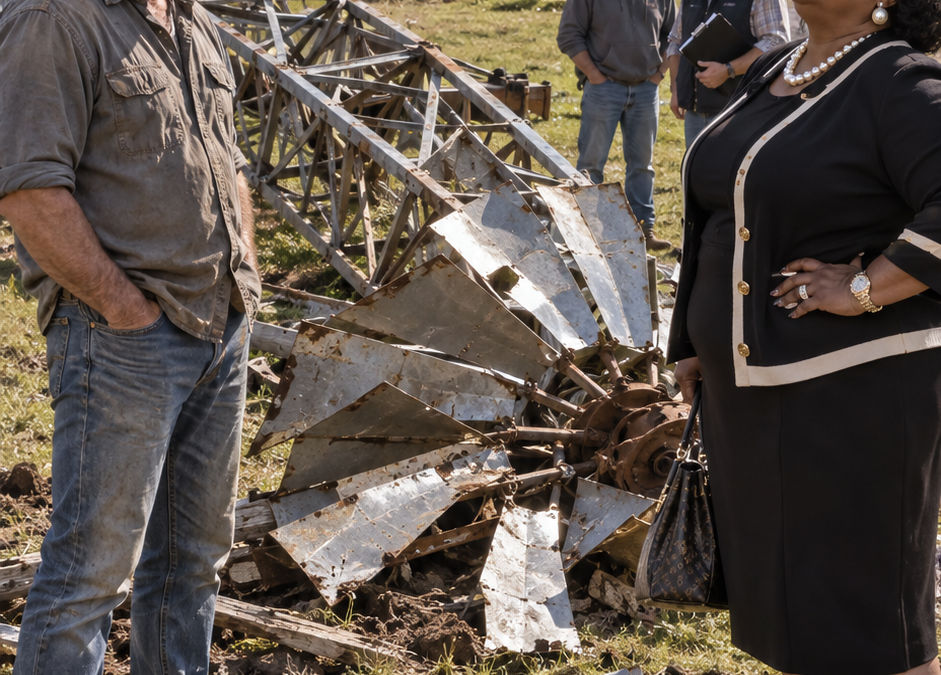
𝗙𝗨𝗟𝗟 𝗦𝗧𝗢𝗥𝗬
I waited.
She smiled.
“You can live like a farmer if that’s what you want, Mr. Boone. Obviously, that’s your right. But there are six hundred other families who shouldn’t have to look at it.”
She said it gently.
That was what stayed with me.
Not anger.
Not open contempt.
Gentleness.
Like she was explaining that my shirt was untucked.
I looked past her at the roofs of Red Willow Estates.
“The land is mine,” I said. “The tower is mine. The tower stays.”
She asked what I even used it for.
“It runs equipment.”
“Oh.”
The word came out without curiosity.
No follow-up question.
No request to see the equipment.
She had already categorized my answer as irrelevant.
She went on to explain that old properties were expensive to maintain and that the association had discretionary money for improvements to adjacent parcels when those improvements benefited community appearance.
It took me a second to understand.
She thought she was being generous.
She believed the reason the windmill remained standing was that I could not afford to take it down.
“No, thank you,” I said.
I turned back toward the hill.
Behind me, she said, “I suppose we’ll see what the board thinks.”
I remember climbing toward the windmill afterward.
The wheel turned slowly in a light eastern wind.
The drivetrain caught, settled, and began carrying its normal load.
Vanessa had been standing less than ten feet from a warning sign attached to my fence.
She had never read it.
She never asked why a man with an old pickup and a roof that still needed repairs spent money maintaining a machine built when Harry Truman was president.
She never asked why I inspected it twice a month.
I could have explained.
I did not.
For a long time afterward, I wondered whether I should have.
Eventually I decided it would not have mattered.
A person has to be curious before an explanation can reach them.
The following month, Vanessa presented the matter at a board meeting.
I was not invited.
A woman named Denise who lived on the cul-de-sac nearest my property told me what happened.
Denise thought the entire dispute was ridiculous and had begun calling me whenever my name appeared on the agenda.
Vanessa presented photographs of the windmill taken with a long lens from the walking path. The angles made the tower appear to lean over houses that were actually hundreds of feet away.
She called it a potential hazard.
Then a foreseeable hazard.
Then, twice, a “catastrophic failure event.”
A retired attorney named Paul Ostrander interrupted.
According to Denise, Paul reminded the board that Boone Acre was outside the subdivision plat and that the HOA had no legal jurisdiction over my property.
“If we authorize work on land we don’t own,” he reportedly said, “every homeowner sitting in this room may end up paying for it.”
The room went quiet.
Vanessa did not change expression.
Instead, she changed the argument.
She said she was not proposing that the association exercise authority over my land.
She was requesting an inspection related to the community’s infrastructure corridor.
A maintenance easement ran near the northern property line.
The windmill stood within the broader vicinity.
Therefore, she argued, the HOA had an obligation to assess whether it posed a risk to community infrastructure.
That was the opening she needed.
She could not legally reach the windmill directly, so she went around the property line with vocabulary.
The board approved an inspection.
That was how I met Caleb Finch.
Caleb managed maintenance for the association. He was in his thirties, drove a company pickup, carried a clipboard, and wore the permanent expression of a man whose job required him to carry out instructions he did not always respect.
I liked him almost immediately because when he reached my property, he stopped at the fence.
He did not assume an easement meant everything belonged to him.
He called out.
I waved him through.
He told me exactly why he was there.
Vanessa wanted photographs, a condition assessment, and an estimate of what removing the tower might require.
“I’m telling you because I don’t like being used as somebody’s crowbar,” he said.
That earned more respect from me than any letter the board had sent.
“If you want to inspect it,” I said, “inspect it properly.”
We climbed the hill.
I showed him the tower legs.
The anchor bolts I had replaced eleven years earlier.
The guy wires.
The gearbox.
The grease points.
He tested one of the supports with his hand.
“This isn’t about to fall down,” he said.
“No.”
“There’s surface corrosion.”
“It’s been outside since the nineteen-forties.”
He gave me the smallest smile.
Then I walked him down the other side of the rise to the pump house.
There were two signs on the door.
One was old enamel, rusted around the corners.
PRIVATE UTILITY EQUIPMENT. AUTHORIZED ACCESS ONLY.
The newer sign beneath it repeated the warning and listed the number for the Hawthorne County Utility Cooperative.
Caleb read both.
Then he looked up toward the windmill.
Then down at the pump house.
“You’re connected?”
“Yes.”
“To what?”
“A transfer well and booster system.”
His face changed.
“Red Willow?”
“Part of it.”
He took out his pen.
I explained the basics.
The windmill powered a mechanical pump and a small auxiliary generator. That system maintained steady conditions in the transfer works tied to the northern service run.
Caleb wrote it all down.
Then he tore a page from one of his forms.
“Would you write that yourself?”
I did.
ACTIVE UTILITY INFRASTRUCTURE. WINDMILL MECHANICALLY CONNECTED TO TRANSFER WELL AND AUXILIARY CONTROL SYSTEM.
I signed it.
Dated it.
Handed it back.
Caleb promised to attach it to his report.
He did.
I know because eleven days later Vanessa quoted another part of that exact report to me.
She chose Caleb’s note about visible corrosion on the lower tower.
She ignored the paragraph explaining that the windmill was active utility equipment.
The ultimatum came certified.
Seventy-two hours.
Disable and remove the wheel assembly, or the HOA would take whatever action it considered necessary to protect residents, infrastructure, and property values.
I opened it beside the mailbox while rain ran down the paper.
They had included association letterhead for my response.
I wrote one word.
No.
I mailed it certified.
Two days later Vanessa came to my house.
This time she drove onto my property and parked behind my truck.
She climbed onto the porch without being invited.
“I’m trying to understand something,” she said. “Do you really want to pick a fight with an entire homeowners association over a pile of scrap metal?”
“No.”
That seemed to surprise her.
“I don’t want a fight at all. I want your people to leave my property alone.”
She folded her arms.
I continued.
“The equipment on that hill is operating equipment. It is live. If your people interfere with it, the consequences will not stop at my fence.”
Her expression told me she was already waiting for her turn to speak.
People do that when they are not listening.
When I finished, she stepped down from the porch.
At the bottom, she turned.
“Well,” she said, “don’t blame me when the board handles it itself.”
She backed down my driveway too fast.
A tire threw gravel into the ditch.
I watched her leave with the same feeling I get when the pressure drops and the western sky turns green before a storm.
Something was coming.
Thursday morning, I left at 5:40.
I needed a replacement seal and a length of shafting from a supply yard two counties away.
Before leaving, I fed my dog.
I checked the pump-house gauge with a flashlight.
Sixty-two pounds.
Normal.
The wind was steady.
The wheel turned smoothly in the dark.
I locked the gate.
Chain.
Padlock.
Warning sign.
Then I drove away.
I returned a little after eleven.
I saw the trucks first.
A flatbed.
A crane.
A contractor’s box truck.
Two pickups.
They were parked in my pasture.
For several seconds my mind refused to assemble the picture.
Then I saw the gate.
The chain lay on the ground.
One link had been cut clean through.
Fresh steel shone where the bolt cutters had bitten.
My dog had been shut inside the barn.
I have always been grateful somebody on that crew had enough sense or decency to do that.
Then I looked toward the hill.
The windmill was gone.
Even now, saying those words feels wrong.
The tower had been cut through near the second brace and folded into the pasture.
The sixteen-foot wheel lay on its side.
Several sails had buckled beneath its weight.
The tail vane my grandfather had painted, my father had repaired, and I had repainted was snapped from its mount and half buried in mud.
The gear head had been cut loose.
The drive shaft was severed in two places.
One coupling sat in a bucket with scrap metal.
For almost eighty years that machine had stood on that rise.
My grandfather had touched it.
My father had touched it.
I had climbed it as a boy when I was not supposed to.
I had helped my father rebuild the gearbox.
I had painted it under a July sun until my arms shook.
Now men were standing around its body drinking coffee.
Vanessa stood near the crane with the contractor.
She saw my pickup and walked toward me.
She was not embarrassed.
She was not nervous.
She looked satisfied.
“The board acted under the emergency safety provision,” she said before I could speak. “The structure was documented as deteriorated, and the contractor remained within the authorized infrastructure setback.”
There was no authorized setback on my land that gave them the right to do what they had done.
A copy of the board resolution, she told me, would be delivered formally.
I said nothing.
There are moments in life when anger arrives so pure that it almost becomes calm.
For ten seconds, everything in me wanted to shout.
I wanted to ask what kind of person cuts a lock and enters another man’s land after being warned in writing not to.
I wanted to tell every worker to get off my property.
I wanted Vanessa to understand what was lying in that grass.
But I have lived in this country forty-eight years.
I know how quickly a story changes when a Black man raises his voice around people prepared to describe him as unreasonable.
So I took out my phone.
I photographed the vehicles.
Every license plate.
The crane.
The flatbed.
The contractor’s truck.
The severed chain.
The damaged fence.
The ruts.
The tower cuts.
The drive shaft.
The bucket of removed parts.
The workers.
The contractor.
Vanessa.
Then I photographed the pump-house door.
Both warning signs.
The time stamp.
Nobody stopped me.
One worker eventually asked the contractor, “We good?”
The contractor looked at Vanessa.
“We’re finished,” she said.
Then she looked toward the open sky where the tower had stood.
“This is finally starting to look civilized.”
I looked at her.
There are things people say that tell you more than they intended.
I still did not answer.
I unlocked the pump house.
The pressure gauge had fallen to forty-one.
My stomach tightened.
I looked at the old controller.
Normally, the auxiliary indicator was amber when the windmill was providing input. When the electric system was carrying load without the mechanical side, it turned green.
It was red.
I had seen that light red once during the 2009 ice storm.
This was the second time.
Red meant the controller had lost reference and had dropped onto a short-term fallback.
The system was already failing.
I stepped back outside.
Vanessa was walking toward her car.
“Vanessa.”
She turned.
“Do you have any idea what you disconnected?”
She laughed.
Not viciously.
That was almost worse.
It was the tired little laugh of someone who believed she had finally solved a ridiculous problem.
“A windmill, Darius?”
She shook her head.
“I disconnected a windmill.”
I studied her for another second.
“All right.”
That was all I said.
I went back inside and called the cooperative at 11:51 a.m.
I gave dispatch the site number from the control cabinet.
The woman on the line sounded routine until I explained what had been cut.
Then her voice changed.
“Hold please.”
I heard muffled conversation.
She returned.
“We have a crew leaving now.”
The first visible failure happened in the common-area irrigation.
Red Willow maintained roughly eleven acres of landscaped common property: entrance gardens, trail beds, greens, and three artificial ponds described in the sales brochures as water features.
All depended on the northern pressurized loop.
A little after one, sprinklers on the southern green activated.
They ran weakly for about ninety seconds.
Then they stopped.
By two o’clock, the landscaping contractor was calling the HOA office.
The ponds took longer.
They were lined basins, not natural ponds. Every day they lost water to evaporation and seepage, and automatic top-off valves replaced it from the transfer system.
Without makeup water, the change was gradual.
Until it was not.
By late afternoon, a pale stripe appeared around the north pond liner.
The aerator in the middle pond began sucking air and made a horrible choking noise.
Then Booster Station B7 faulted.
A booster station does not care why supply pressure is dropping.
Its controls simply tell it to compensate.
So it worked harder.
Then hotter.
Then its protection system shut it down.
It restarted.
Faulted again.
Then locked out.
Twenty minutes later another pump group farther north went into protection mode.
Then another.
One by one.
By three, the Red Willow office was being buried in calls.
Denise told me later that the office manager eventually stopped answering the phone.
Residents complained about irrigation pressure.
Dead lawn zones.
Dropping ponds.
Weak outdoor faucets.
The landscaping crew wanted to know what had happened.
For the first several hours, Vanessa insisted it had nothing to do with the windmill.
Coincidence.
Mechanical issues.
The cooperative needed to fix its equipment.
Immediately.
What she did not understand was that the system had existed before Red Willow Estates.
Long before it.
When developers began planning the subdivision in the early 2000s, they discovered they did not possess the water rights they needed for one portion of the project.
The old transfer well serving that area had been permitted decades earlier.
The permit ran with Boone land.
My grandfather had developed it.
My father had rebuilt parts of it.
The developer could have spent years fighting through applications and hearings.
Instead, they approached my father.
In 2003, they signed an agreement.
Red Willow would receive an allotment of flow through existing infrastructure.
The association would contribute to maintenance expenses.
A limited utility easement would permit authorized personnel to access defined portions of Boone Acre for routine maintenance.
The windmill did not directly pump drinking water into anyone’s kitchen.
That misunderstanding would matter later.
Its role was subtler.
It maintained the transfer system.
The mill drove a mechanical pump that stabilized conditions in the transfer well. It also turned a small auxiliary generator that provided steady reference power to an older controller and maintained pilot-valve positions.
Low input.
Continuous input.
The kind of background mechanical work nobody notices because when it functions correctly nothing dramatic happens.
Without it, the well column began drifting.
Storage drew down.
The controller lost its reference.
Electric pumps received bad operating conditions and tried to compensate.
They ran too hard against inadequate supply.
Thermal protection engaged.
Dry-run protection followed.
The whole system began protecting itself from damage.
The windmill was not the only thing keeping Red Willow’s northern infrastructure running.
It was the thing keeping everything else balanced.
My father understood that.
I understood it.
The cooperative understood it.
Vanessa had never bothered to learn it.
Two cooperative trucks came up my driveway around two-twenty.
The man stepping from the lead truck was Graham Keane, an operations engineer I had spoken with maybe a dozen times over the years.
We had never met face-to-face.
He was broad-shouldered, deliberate, with reading glasses pushed on top of his head.
He walked six steps toward me.
Then he saw the hill.
He stopped.
His eyes moved over the collapsed tower.
The bent wheel.
The severed drive shaft.
The raw steel cuts.
Vanessa was still there.
The contractor was loading equipment.
She walked toward us carrying a folder.
Graham did not greet me first.
He looked at her.
“Who authorized this?”
Vanessa answered without hesitation.
“The Red Willow Estates board.”
She explained the deterioration.
The safety concern.
The licensed contractor.
Then she said that if the utility cooperative had issues with the work schedule, it should have communicated more effectively.
Schedule.
Graham slowly removed his glasses from his head.
“Are you aware Booster B7 has lost auxiliary input?”
Vanessa stared at him.
I do not criticize her for not knowing what B7 meant.
Most homeowners would not.
But most homeowners had also not spent three years ordering the removal of equipment they refused to understand.
Graham did not wait for an answer.
He asked me for the pump-house key.
I handed it over.
He stayed inside eleven minutes.
I heard him reading numbers over the radio.
Then talking to the operations center.
His voice became quieter the longer the conversation continued.
People imagine emergencies sound like shouting.
Usually, the people who actually understand an emergency get quieter.
When Graham came out, his expression had changed.
“Two more groups have gone to protection,” he told me. “Transfer well is almost four feet down.”
He looked toward Red Willow.
“We need temporary supply established before evening demand.”
Then he turned to me.
“Tell me exactly what happened.”
I did.
I left at 5:40.
Returned shortly after eleven.
Found the gate cut.
Found the crew.
Found the windmill destroyed.
I pointed toward Vanessa.
“She authorized them.”
Vanessa stepped forward.
“Mr. Boone never adequately disclosed the importance of this equipment.”
I looked at her.
“If he had communicated properly,” she continued, “none of this would have happened. The association made repeated good-faith efforts.”
It was remarkable how quickly her position had shifted.
Minutes earlier, she had confidently defended the removal.
Now the problem was that nobody had warned her.
I walked to the pump-house door.
I placed my palm beneath the old enamel sign.
PRIVATE UTILITY EQUIPMENT. AUTHORIZED ACCESS ONLY.
Nobody spoke.
Then I went to my pickup.
Behind the seat was an accordion folder.
I brought it back and pulled out a certified letter from two years and four months earlier.
I read one sentence.
“‘The windmill and pump assembly are active utility infrastructure. Do not enter or alter the equipment.’”
I showed Graham the certified receipt.
Signed for by the association office.
Then I produced my response to the seventy-two-hour ultimatum.
Same warning.
Another receipt.
Another signature.
Vanessa looked at the papers.
Her voice was quieter when she said, “I believed you were exaggerating to delay removal.”
Graham stared at her for a few seconds.
He did not argue.
He turned around and made another phone call.
That silence did more damage than anything I could have said.
By Friday morning Vanessa had developed another argument.
If equipment on Boone Acre served Red Willow, then Red Willow had an interest in that equipment.
And if it had an interest, she argued, the association had a stewardship obligation that justified its intervention.
She actually used the word stewardship.
That was when I called Lydia Shaw.
Lydia had handled my father’s estate.
She was a real estate attorney with twenty-two years of experience and a filing system that could probably survive a nuclear strike.
Saturday morning, she arrived carrying a document box.
We spread the history of Red Willow’s water arrangement across my kitchen table.
Plats.
Recorded easements.
Permit records.
The 2003 infrastructure agreement.
Maintenance schedules.
Correspondence.
Lydia moved through the documents page by page.
The story was simple once you removed the HOA’s language.
The developer needed water access.
My father controlled infrastructure they needed.
They negotiated.
The developer received the right to receive a defined amount of water through the system.
Authorized utility crews received limited routine maintenance access.
Boone Acre retained ownership of the well station.
The pump house.
The controller.
The valves.
The transfer equipment.
The windmill.
The tower.
The drivetrain.
The maintenance corridor.
Everything.
Named individually.
Recorded.
Public.
Red Willow did not own one bolt.
The association had no independent right to inspect the machinery.
No right to alter it.
No right to modernize it.
No right to remove it.
Then Lydia found the clause that mattered most.
She slid the agreement toward me.
“Read that.”
I already knew the language.
My father had insisted on it.
Any construction, reconstruction, replacement, or structural modification affecting equipment on Boone Acre required prior written consent of the landowner.
Lydia tapped the paragraph.
“In twenty-two years,” she said, “I’ve rarely seen somebody this completely outside their authority.”
I leaned back.
For three years Vanessa had told people a story about me.
I was the stubborn farmer.
The eyesore.
The outsider whose property Red Willow generously tolerated.
I had heard that property values on the western edge were supposedly affected by land like mine.
I had heard Vanessa was doing me a favor by offering to help clean the place up.
But the recorded documents showed the reverse.
Her neighborhood had been benefiting for two decades from equipment sitting on my land.
The manicured entrance gardens.
The artificial ponds.
The grass Vanessa considered evidence of civilization.
Part of the infrastructure supporting all of it passed through Boone Acre.
And the machine she considered an embarrassment had been maintaining that arrangement quietly every day.
The truth had been available at the county recorder’s office the entire time.
She simply never looked.
Vanessa came to my property once more before the county became formally involved.
This time I stopped her at the fence.
I had never done that before.
“You can call me an outsider all you want,” I said.
She started to respond.
I held up my hand.
“But you never once bothered to understand what your neighborhood was standing next to.”
For the first time since I had met her, she had nothing ready.
The county inspector arrived the following Tuesday.
Nolan Pierce was in his sixties, thin as a fence post, with a metal clipboard and almost no interest in conversation.
Within two minutes, he made something clear.
He did not care whether anybody thought the windmill was attractive.
He cared that unauthorized people had entered private property, severed permitted operating infrastructure, and forced a county service area into emergency operating conditions.
He spent an hour and a half inspecting the site.
Measured cuts.
Photographed the shaft.
Photographed the gate.
Photographed the crushed fence.
Photographed both pump-house signs.
Then he took my maintenance log off its nail.
He read the entire thing while standing.
Every page.
When he reached my entry from twelve days before the demolition, he made a notation on his clipboard.
Afterward, he requested my documents.
I handed over the accordion folder.
He gave me a receipt.
Then he went to Red Willow.
What he requested from the association was much more extensive.
Board minutes.
The removal resolution.
The demolition contract.
The contractor work order.
Vanessa’s emails.
The inspection report.
Insurance notices.
Every communication they had received from me.
Caleb Finch called the next afternoon.
I could tell from his voice that he had already been interviewed.
“I told him everything,” he said.
“I figured.”
“I told him I saw the signs. I told him you showed me the equipment. I told him it was in my report.”
“Good.”
There was a pause.
“I also told him I warned Vanessa.”
That mattered.
Caleb had spoken to her after submitting the inspection.
He told her directly that the windmill appeared structurally serviceable and that utility signage indicated it was part of an active system.
He recommended that nobody touch it until the cooperative confirmed what it did.
Vanessa told him the board had already made its determination.
His job, she said, was execution.
Not analysis.
Caleb was quiet.
“You going to come after me?”
“No.”
“You sure?”
“You documented it. You warned her.”
The man had a mortgage.
A job.
Orders coming from the person controlling his contract.
I was not going to pretend I did not understand that pressure.
More importantly, Caleb had created the internal record that made everything else undeniable.
Vanessa knew.
Not vaguely.
Not hypothetically.
She had been told by me.
She had been told by the signs.
She had been told through certified letters.
She had been told by her own maintenance supervisor.
She acted anyway.
Meanwhile, the cooperative was spending money by the hour.
Graham installed portable pumping equipment.
Temporary generators were brought in.
A short-term tie-in was created.
Crews worked twelve-hour shifts monitoring pressure through peak demand.
The homes never lost water.
I was grateful for that.
Six hundred households lived in Red Willow.
Children.
Elderly people.
Families who had never written me a letter or crossed my fence.
I did not want them punished because one board president had decided she knew more than everybody else.
But keeping the system alive cost more than four thousand dollars per day before labor.
And Graham was clear.
Temporary meant temporary.
Rented pumps could not stabilize the transfer system through a dry August.
The only permanent solution was restoration.
Rebuild the tower.
Recreate the drivetrain.
Restore the windmill-driven mechanical input.
Recommission the controller.
Bring the system back to its approved operating configuration.
The question Nolan eventually asked was obvious.
“Who pays?”
Everybody present already knew.
The entity responsible for knowingly destroying permitted operating infrastructure.
Red Willow called an emergency community meeting.
The clubhouse filled beyond its seating capacity.
People stood along the walls.
Others crowded into the hallway.
Lydia glanced around when we entered.
“Fire capacity is one-forty,” she murmured.
It was the first time I had ever been inside that clubhouse.
For years, I had heard enough comments about “residents only” and “community facilities” to understand that men from Boone Acre were not the intended guests.
This time I had a written invitation from the board.
Vanessa sat at the front.
She was composed.
Prepared.
For the first four minutes, she almost held the room.
She described the demolition as a good-faith safety action.
She said the board had relied on professional information.
She described the utility emergency as a separate technical problem the cooperative was addressing.
If you knew nothing else, it sounded plausible.
Then Graham Keane stood in the aisle.
He did not make a speech.
Engineers rarely need one.
“No one from the cooperative requested removal of that equipment,” he said.
The room became quiet.
“No one from our office approved removal. No one was consulted before removal. No one was notified that removal was scheduled.”
Vanessa shifted slightly.
Graham continued.
“The windmill and connected assembly were active operating components of the transfer system serving the northern portion of Red Willow Estates.”
People began looking at one another.
“When that assembly was severed, the transfer well lost stabilization and auxiliary reference. That caused the chain of pump protection events residents have experienced over the past nine days.”
No drama.
No accusation.
Just mechanics.
That made it worse.
Lydia stood next.
She did not argue either.
She read dates.
My first written notification identifying the assembly as active infrastructure.
Date sent.
Date received.
Signature.
My second warning.
Date sent.
Date received.
Signature.
Caleb’s inspection.
The report.
The seventy-two-hour demand.
My reply.
The board resolution.
The contractor work order.
The demolition.
Date after date.
Document after document.
The room grew quieter with each one.
There is normal silence.
Then there is the silence of a hundred people doing the same calculation at once.
Arthur Reyes, one of the board members, finally leaned toward his microphone.
“Vanessa.”
She looked at him.
“Did you know Mr. Boone claimed the windmill was operating utility equipment before you authorized removal?”
For the first time that night, her composure cracked.
She could have avoided the question.
She could have blamed counsel.
The contractor.
A misunderstanding.
Instead, perhaps because she still believed her judgment justified everything, she answered.
“I believed he was exaggerating.”
A noise moved through the room.
She continued.
“People in property disputes make exaggerated claims to delay compliance. In my judgment, that was what was happening here.”
Someone in the back muttered something.
A woman near the front covered her face with both hands.
I had not planned to speak.
Then I stood.
Every face turned toward me.
I looked at Vanessa.
“That was the whole problem.”
She did not move.
“You didn’t think I was worth believing.”
Nobody interrupted.
“Not the signs. Not the certified letters. Not the maintenance records. Not the man who had been running that equipment for eleven years. Not the father who ran it twenty-six years before him.”
My voice stayed level.
“You decided what I was before you knew what the machine was. Everything after that came from the same decision.”
Vanessa looked down at the table.
I sat.
Arthur Reyes immediately moved that the board enter closed session to review the president’s authority and the association’s exposure.
The meeting stopped being about my windmill.
Outside afterward, Lydia caught my arm.
“There’s something else.”
“What?”
“The reconstruction.”
I knew from her expression where she was going.
The existing easement allowed routine maintenance crews onto Boone Acre with notice.
Routine maintenance.
It did not grant permission for structural reconstruction.
To restore the windmill, the cooperative needed cranes, concrete trucks, fabrication crews, drilling equipment, and weeks of work.
My father’s consent clause controlled all of it.
Lydia smiled.
“Guess who has to authorize that?”
I looked back toward the clubhouse.
People were still coming out.
For three years, Vanessa had tried to force me to remove the tower.
Now the association could not fully restore its own infrastructure until I signed permission allowing someone to put it back.
Vanessa eventually had to ask.
She did it by email.
It took four days to arrive and read like at least two lawyers had inspected every sentence.
I never considered refusing.
Not seriously.
I had leverage.
I knew it.
Lydia knew it.
The board knew it.
But six hundred families depended on that system.
Most had never done anything to me.
I was not going to hold their water infrastructure hostage just so I could enjoy watching Vanessa sweat.
I told Graham that night to prepare his crews.
Then Lydia sent the board my conditions.
There were four.
None were revenge.
First, Red Willow Estates would pay the entire restoration cost.
Not part.
All.
The windmill.
The drivetrain.
The controller work.
Temporary pumping.
Emergency equipment.
Fence repairs.
Pasture restoration.
Every dollar caused by the removal.
Second, the association would pay for a professional survey of the property boundary and permanent monuments along the relevant section so no future board could pretend it was uncertain where Red Willow ended and Boone Acre began.
Third, no HOA officer, employee, agent, contractor, or volunteer would enter Boone Acre or approach the utility equipment independently.
Access would occur only through authorized utility procedures.
Fourth, any future work altering the assembly required written consent from the Boone Acre owner and written approval from the cooperative.
No HOA emergency resolution would override it.
The board accepted all four conditions in one meeting.
Their insurer had already explained what rejecting them would mean.
Vanessa was asked to step aside as president while the board investigated her conduct and potential liability.
It was not dramatic.
No one shouted.
There was a motion.
A second.
A vote.
A sentence entered into the minutes.
And a woman who had spent three years telling everyone what belonged in Red Willow walked out of the clubhouse while nobody rose with her.
People expected me to enjoy that.
I did not.
The next morning, I went outside before sunrise.
The broken wheel was still lying in my pasture.
Winning a dispute does not repair what was broken.
Accountability does not put steel back together.
I stood there looking at the tail vane in the grass and felt mostly tired.
Graham arrived later with restoration paperwork.
We spread it across the hood of his truck.
I signed every required authorization.
Before leaving, he asked, “Anything specific you want from the crew?”
I looked up the hill.
“Put it where it was.”
The rebuild was supposed to take three weeks.
It took five.
Anything involving concrete, fabrication, permits, and machinery older than most of the people working on it will take longer than planned.
They saved everything they reasonably could.
The gear head was rebuilt.
The tail vane went to a fabrication shop in the next county.
The man there straightened the steel, welded the broken mount, and called me before painting it.
“Want us to finish it?”
“No.”
“You sure?”
“I’ll do that.”
So one Saturday I laid the tail vane on sawhorses beside the barn and painted it white myself.
The same way my grandfather had.
The same way my father had.
I could remember watching my father paint that piece when I was small enough to sit in the shade beneath the sawhorses.
He had handed me the brush once.
I dripped paint all over the grass.
He pretended not to notice.
The new tower sections arrived the following week.
The old ones were too badly cut to save.
The drivetrain had to be remanufactured.
Watching new steel go into a machine that had survived since my grandfather’s time bothered me more than I expected.
Then I remembered something my father used to say when people became too sentimental about equipment.
“If you replace every piece one at a time and keep doing the work, it’s still the same machine.”
He believed function was its own kind of continuity.
The wheel went up on a Thursday morning in September.
I stayed on the porch.
Coffee in my hand.
The crane lifted the assembly slowly above the pasture.
For a few seconds, it hung against the blue sky.
Then the crew lowered it onto the tower.
Bolts were tightened.
Connections checked.
The drivetrain aligned.
Graham came out himself for commissioning.
By afternoon, everything was ready.
One of the technicians released the brake.
Nothing happened immediately.
Then a breeze moved across the hill.
One sail shifted.
Then another.
The wheel turned a quarter rotation.
Half.
A full revolution.
Slowly at first.
Then steadily.
The shaft began carrying load.
I could hear it.
That old mechanical rhythm.
Steel.
Gears.
Wind.
Work.
It sounded exactly the way I remembered.
I stood there longer than I intended.
Nobody spoke to me.
I appreciated that.
Two days later Graham called.
“Transfer well is back at normal depth.”
“Good.”
“Controller reference is stable. All northern pump groups are operating within range.”
“Good.”
He paused.
“Darius?”
“Yeah?”
“Thank you.”
He did not need to thank me.
But I understood what he meant.
Red Willow elected a new board that fall.
Vanessa left it entirely.
After that, she stopped using the road along my western fence.
There was another route to the subdivision entrance that took longer.
She began taking that one.
I have never spoken to her again.
I do not need to.
The new board changed other things quietly.
Someone discovered that two years earlier the association had prepared a landscaping proposal for a double row of evergreens along the western edge.
The purpose was stated clearly in the project notes.
Screening of adjacent agricultural structures.
Meaning my windmill.
The board shelved the plan.
By then, residents had started stopping along the walking trail in the evenings to watch the wheel.
Somebody called it the oldest working machine in the county.
I do not know whether that is true.
Probably not.
One board member contacted me and asked whether I would consider allowing a small historical plaque near the trail.
Maybe a short description.
Maybe a designated viewing area.
I told them no.
Politely.
But no.
I did not want the windmill turned into a monument.
I did not want Red Willow adopting it as some charming piece of neighborhood history.
And I certainly did not want a story written beside the trail that made everyone feel good about what had happened.
The windmill is not there for inspiration.
It is not public art.
It is not a landmark.
It is a machine my grandfather bolted together.
My father kept it running.
I grease it every fourteen days.
I check the gearbox.
I inspect the drive shaft.
I write the numbers in the same maintenance book hanging from the same nail by the pump-house door.
The handwriting on the newest pages is still the worst.
Sometimes in the evening, I walk up the hill after everything else is done.
The sun drops behind Red Willow.
Porch lights come on.
Sprinklers hiss across lawns.
Water moves through pipes nobody thinks about.
The ornamental ponds stay full.
Booster pumps farther north hold pressure.
And above all of it, that old wheel keeps turning.
Vanessa once told me six hundred families should not have to look at the way I chose to live.
She thought my land was something Red Willow had outgrown.
She thought my windmill was a rusty reminder of what had been there before the stone columns, walking trails, landscaped ponds, and expensive houses arrived.
What she never understood was that old things are not always obsolete.
Quiet things are not always unimportant.
And a man maintaining something you do not understand is not necessarily too stubborn to let go.
Sometimes he knows exactly what will happen if he does.
So the windmill stays where my grandfather put it.
Not because the neighborhood finally decided it was beautiful.
Not because a board voted to tolerate it.
Not because anybody learned to appreciate its history.
It stays because it is mine.
It works.
And now, when people on the other side of that fence hear the slow turn of those steel sails in the evening wind, they finally understand that the sound they once wanted gone is the sound of something still doing its job.
Have you finished reading the story and want to read it again?
They Called My Windmill an Eyesore, but Nobody Asked Why I Had Kept It Running for Eighty Years
The morning I found my grandfather’s windmill broken across the pasture, I did not raise my voice.
The woman responsible stood beside the wreckage smiling like she had improved my property.
I only asked her one question: “Do you know what that windmill runs?”
My name is Darius Boone. I was forty-eight years old when the Red Willow Estates Homeowners Association decided that a machine my family had maintained for nearly eighty years was too ugly to be allowed to remain standing.
By then, Boone Acre was only nine acres.
It had once been almost two hundred.
My grandfather bought the original farm in the 1940s, back when the county still described that stretch of land as scrub and nobody with money wanted much to do with it. He cleared fields by hand, dug drainage where the spring floods came through, planted black walnut along the northern line, and built a life out of ground other men had dismissed as worthless.
My father inherited the place.
Then life reduced it piece by piece.
A hospital bill took some acreage.
College tuition took some more.
A roof that refused to stop leaking took another portion.
By the time Boone Acre came to me, all that remained were nine acres on a low rise above the creek, a weathered house, a barn, a tin-roofed pump building, and the old windmill on the hill.
That was enough for me.
From my front porch, I could see three hundred feet of split-rail fence and the black walnuts bending toward the creek. Behind the house, the pasture climbed gently to the rise where the windmill stood.
Beyond my western fence was Red Willow Estates.
Six hundred homes.
Stone entrance columns.
Decorative ponds.
Walking trails.
Landscaped medians.
A gatehouse nobody actually staffed.
The development had been built about twenty years earlier on the old Howeran tract after the developer bought everything around me that my family no longer owned.
Construction kept expanding until the subdivision ran out of room.
The place where it ran out was my fence.
Most of the people who lived there never bothered me.
That matters.
There was a man behind my property with a four-car garage and a fountain in his front yard worth more than my pickup. Every morning when I drove past, he waved.
I waved back.
That was our whole relationship, and it worked perfectly.
People had children to raise, jobs to work, mortgages to pay. Most did not spend their evenings worrying about what an older man had sitting on nine acres beyond their walking trail.
The windmill was visible, certainly.
You could see it above the trees from several streets.
It stood twenty-six feet to the platform, with a sixteen-foot wheel and a long steel tail vane.
My grandfather painted it white every few years until arthritis made climbing dangerous.
Then my father painted it.
The summer I turned thirty, I did it myself for the first time.
The tower had been rebuilt twice.
The gearbox had been rebuilt three times.
A hailstorm in the late eighties had torn the original wheel sails apart so badly my father said they looked like lace afterward. He replaced them and wrote the repair date in the maintenance log.
That log still hung on a nail inside the pump house.
Three generations of handwriting filled it.
My grandfather’s handwriting was square and careful.
My father’s leaned slightly to the right.
Mine was the worst.
The thing Vanessa Wickham never understood was that the windmill was not a decoration.
It was not nostalgia.
It was not some antique I kept standing because I wanted the property to look like an old calendar photograph.
It was a machine.
And it worked.
Under the center of the tower, a vertical rod traveled down into a gear head. From there, a shaft assembly transferred mechanical motion toward a concrete pump house set partly into the hillside.
Inside were pressure gauges, valves, an old control cabinet, a small auxiliary generator, and the equipment connecting my transfer well to infrastructure farther north.
My father had maintained that system for twenty-six years.
I had been maintaining it for eleven.
Every fourteen days, whether the weather was good or miserable, I inspected it.
I greased the fittings.
Checked the gauges.
Tested the controller.
Walked the line.
Logged the readings.
I knew the machine by sound.
I could stand halfway down the hill with my back turned and tell from the rhythm whether the drive shaft was carrying load properly.
That was why the first letter from Red Willow made me laugh.
It arrived four years before the windmill came down.
The language was pleasant in that particular institutional way where politeness is being used to carry a threat.
The association had, it said, “received concerns regarding a structure visible from several neighboring properties.”
Would I contact the board at my earliest convenience?
I called.
I got voicemail.
I left a message explaining that Boone Acre was not part of Red Willow Estates, never had been, and therefore was not subject to its covenants.
Nobody called back.
Six months later, another letter arrived.
That one referred to the windmill as “aesthetically inconsistent with community standards.”
I read that sentence twice.
Then I walked outside and looked at the machine turning against the sky.
Community standards.
For a water system that was older than the community.
The letters became serious after Vanessa Wickham became association president.
She was forty-four then, a former high-end real estate agent who had moved into Red Willow from out of state. Her house was over three thousand square feet. Landscapers changed parts of her garden seasonally.
I did not know much more about her, and I did not care to.
I have never believed every person who causes harm has to be some grand villain.
Sometimes the problem is simpler.
Vanessa had formed a picture in her mind of what Red Willow Estates was supposed to be, and she could not tolerate anything visible from that neighborhood that did not fit the picture.
Once she became president, the HOA letters changed.
They got shorter.
Colder.
They started coming certified.
The wording stopped asking.
It began informing.
We met in person for the first time on a Tuesday in April.
I was clearing debris from an intake screen when I noticed a woman standing at my fence.
She had parked along the shoulder.
The shoes she wore had never seen mud and were clearly not intended to start.
She called to me.
I walked down carrying a rag, wiping grease from my fingers.
As I approached, she looked at my boots.
Then the rag.
Then my old truck.
Then the pasture behind me.
I watched her reach conclusions before I had even introduced myself.
When you have spent forty-eight years as a Black man in places where people sometimes decide who you are before you speak, you learn to recognize that process.
You see the instant it happens.
Vanessa was friendly for about forty seconds.
She told me she believed neighbors should resolve disagreements face-to-face.
She said she wanted to avoid anything unpleasant.
Then she looked toward the windmill.
“We really need to find a solution to the tower.”
“There isn’t a problem with the tower,” I said.
“There is from our side.”
I waited.
She smiled.
“You can live like a farmer if that’s what you want, Mr. Boone. Obviously, that’s your right. But there are six hundred other families who shouldn’t have to look at it.”
She said it gently.
That was what stayed with me.
Not anger.
Not open contempt.
Gentleness.
Like she was explaining that my shirt was untucked.
I looked past her at the roofs of Red Willow Estates.
“The land is mine,” I said. “The tower is mine. The tower stays.”
She asked what I even used it for.
“It runs equipment.”
“Oh.”
The word came out without curiosity.
No follow-up question.
No request to see the equipment.
She had already categorized my answer as irrelevant.
She went on to explain that old properties were expensive to maintain and that the association had discretionary money for improvements to adjacent parcels when those improvements benefited community appearance.
It took me a second to understand.
She thought she was being generous.
She believed the reason the windmill remained standing was that I could not afford to take it down.
“No, thank you,” I said.
I turned back toward the hill.
Behind me, she said, “I suppose we’ll see what the board thinks.”
I remember climbing toward the windmill afterward.
The wheel turned slowly in a light eastern wind.
The drivetrain caught, settled, and began carrying its normal load.
Vanessa had been standing less than ten feet from a warning sign attached to my fence.
She had never read it.
She never asked why a man with an old pickup and a roof that still needed repairs spent money maintaining a machine built when Harry Truman was president.
She never asked why I inspected it twice a month.
I could have explained.
I did not.
For a long time afterward, I wondered whether I should have.
Eventually I decided it would not have mattered.
A person has to be curious before an explanation can reach them.
The following month, Vanessa presented the matter at a board meeting.
I was not invited.
A woman named Denise who lived on the cul-de-sac nearest my property told me what happened.
Denise thought the entire dispute was ridiculous and had begun calling me whenever my name appeared on the agenda.
Vanessa presented photographs of the windmill taken with a long lens from the walking path. The angles made the tower appear to lean over houses that were actually hundreds of feet away.
She called it a potential hazard.
Then a foreseeable hazard.
Then, twice, a “catastrophic failure event.”
A retired attorney named Paul Ostrander interrupted.
According to Denise, Paul reminded the board that Boone Acre was outside the subdivision plat and that the HOA had no legal jurisdiction over my property.
“If we authorize work on land we don’t own,” he reportedly said, “every homeowner sitting in this room may end up paying for it.”
The room went quiet.
Vanessa did not change expression.
Instead, she changed the argument.
She said she was not proposing that the association exercise authority over my land.
She was requesting an inspection related to the community’s infrastructure corridor.
A maintenance easement ran near the northern property line.
The windmill stood within the broader vicinity.
Therefore, she argued, the HOA had an obligation to assess whether it posed a risk to community infrastructure.
That was the opening she needed.
She could not legally reach the windmill directly, so she went around the property line with vocabulary.
The board approved an inspection.
That was how I met Caleb Finch.
Caleb managed maintenance for the association. He was in his thirties, drove a company pickup, carried a clipboard, and wore the permanent expression of a man whose job required him to carry out instructions he did not always respect.
I liked him almost immediately because when he reached my property, he stopped at the fence.
He did not assume an easement meant everything belonged to him.
He called out.
I waved him through.
He told me exactly why he was there.
Vanessa wanted photographs, a condition assessment, and an estimate of what removing the tower might require.
“I’m telling you because I don’t like being used as somebody’s crowbar,” he said.
That earned more respect from me than any letter the board had sent.
“If you want to inspect it,” I said, “inspect it properly.”
We climbed the hill.
I showed him the tower legs.
The anchor bolts I had replaced eleven years earlier.
The guy wires.
The gearbox.
The grease points.
He tested one of the supports with his hand.
“This isn’t about to fall down,” he said.
“No.”
“There’s surface corrosion.”
“It’s been outside since the nineteen-forties.”
He gave me the smallest smile.
Then I walked him down the other side of the rise to the pump house.
There were two signs on the door.
One was old enamel, rusted around the corners.
PRIVATE UTILITY EQUIPMENT. AUTHORIZED ACCESS ONLY.
The newer sign beneath it repeated the warning and listed the number for the Hawthorne County Utility Cooperative.
Caleb read both.
Then he looked up toward the windmill.
Then down at the pump house.
“You’re connected?”
“Yes.”
“To what?”
“A transfer well and booster system.”
His face changed.
“Red Willow?”
“Part of it.”
He took out his pen.
I explained the basics.
The windmill powered a mechanical pump and a small auxiliary generator. That system maintained steady conditions in the transfer works tied to the northern service run.
Caleb wrote it all down.
Then he tore a page from one of his forms.
“Would you write that yourself?”
I did.
ACTIVE UTILITY INFRASTRUCTURE. WINDMILL MECHANICALLY CONNECTED TO TRANSFER WELL AND AUXILIARY CONTROL SYSTEM.
I signed it.
Dated it.
Handed it back.
Caleb promised to attach it to his report.
He did.
I know because eleven days later Vanessa quoted another part of that exact report to me.
She chose Caleb’s note about visible corrosion on the lower tower.
She ignored the paragraph explaining that the windmill was active utility equipment.
The ultimatum came certified.
Seventy-two hours.
Disable and remove the wheel assembly, or the HOA would take whatever action it considered necessary to protect residents, infrastructure, and property values.
I opened it beside the mailbox while rain ran down the paper.
They had included association letterhead for my response.
I wrote one word.
No.
I mailed it certified.
Two days later Vanessa came to my house.
This time she drove onto my property and parked behind my truck.
She climbed onto the porch without being invited.
“I’m trying to understand something,” she said. “Do you really want to pick a fight with an entire homeowners association over a pile of scrap metal?”
“No.”
That seemed to surprise her.
“I don’t want a fight at all. I want your people to leave my property alone.”
She folded her arms.
I continued.
“The equipment on that hill is operating equipment. It is live. If your people interfere with it, the consequences will not stop at my fence.”
Her expression told me she was already waiting for her turn to speak.
People do that when they are not listening.
When I finished, she stepped down from the porch.
At the bottom, she turned.
“Well,” she said, “don’t blame me when the board handles it itself.”
She backed down my driveway too fast.
A tire threw gravel into the ditch.
I watched her leave with the same feeling I get when the pressure drops and the western sky turns green before a storm.
Something was coming.
Thursday morning, I left at 5:40.
I needed a replacement seal and a length of shafting from a supply yard two counties away.
Before leaving, I fed my dog.
I checked the pump-house gauge with a flashlight.
Sixty-two pounds.
Normal.
The wind was steady.
The wheel turned smoothly in the dark.
I locked the gate.
Chain.
Padlock.
Warning sign.
Then I drove away.
I returned a little after eleven.
I saw the trucks first.
A flatbed.
A crane.
A contractor’s box truck.
Two pickups.
They were parked in my pasture.
For several seconds my mind refused to assemble the picture.
Then I saw the gate.
The chain lay on the ground.
One link had been cut clean through.
Fresh steel shone where the bolt cutters had bitten.
My dog had been shut inside the barn.
I have always been grateful somebody on that crew had enough sense or decency to do that.
Then I looked toward the hill.
The windmill was gone.
Even now, saying those words feels wrong.
The tower had been cut through near the second brace and folded into the pasture.
The sixteen-foot wheel lay on its side.
Several sails had buckled beneath its weight.
The tail vane my grandfather had painted, my father had repaired, and I had repainted was snapped from its mount and half buried in mud.
The gear head had been cut loose.
The drive shaft was severed in two places.
One coupling sat in a bucket with scrap metal.
For almost eighty years that machine had stood on that rise.
My grandfather had touched it.
My father had touched it.
I had climbed it as a boy when I was not supposed to.
I had helped my father rebuild the gearbox.
I had painted it under a July sun until my arms shook.
Now men were standing around its body drinking coffee.
Vanessa stood near the crane with the contractor.
She saw my pickup and walked toward me.
She was not embarrassed.
She was not nervous.
She looked satisfied.
“The board acted under the emergency safety provision,” she said before I could speak. “The structure was documented as deteriorated, and the contractor remained within the authorized infrastructure setback.”
There was no authorized setback on my land that gave them the right to do what they had done.
A copy of the board resolution, she told me, would be delivered formally.
I said nothing.
There are moments in life when anger arrives so pure that it almost becomes calm.
For ten seconds, everything in me wanted to shout.
I wanted to ask what kind of person cuts a lock and enters another man’s land after being warned in writing not to.
I wanted to tell every worker to get off my property.
I wanted Vanessa to understand what was lying in that grass.
But I have lived in this country forty-eight years.
I know how quickly a story changes when a Black man raises his voice around people prepared to describe him as unreasonable.
So I took out my phone.
I photographed the vehicles.
Every license plate.
The crane.
The flatbed.
The contractor’s truck.
The severed chain.
The damaged fence.
The ruts.
The tower cuts.
The drive shaft.
The bucket of removed parts.
The workers.
The contractor.
Vanessa.
Then I photographed the pump-house door.
Both warning signs.
The time stamp.
Nobody stopped me.
One worker eventually asked the contractor, “We good?”
The contractor looked at Vanessa.
“We’re finished,” she said.
Then she looked toward the open sky where the tower had stood.
“This is finally starting to look civilized.”
I looked at her.
There are things people say that tell you more than they intended.
I still did not answer.
I unlocked the pump house.
The pressure gauge had fallen to forty-one.
My stomach tightened.
I looked at the old controller.
Normally, the auxiliary indicator was amber when the windmill was providing input. When the electric system was carrying load without the mechanical side, it turned green.
It was red.
I had seen that light red once during the 2009 ice storm.
This was the second time.
Red meant the controller had lost reference and had dropped onto a short-term fallback.
The system was already failing.
I stepped back outside.
Vanessa was walking toward her car.
“Vanessa.”
She turned.
“Do you have any idea what you disconnected?”
She laughed.
Not viciously.
That was almost worse.
It was the tired little laugh of someone who believed she had finally solved a ridiculous problem.
“A windmill, Darius?”
She shook her head.
“I disconnected a windmill.”
I studied her for another second.
“All right.”
That was all I said.
I went back inside and called the cooperative at 11:51 a.m.
I gave dispatch the site number from the control cabinet.
The woman on the line sounded routine until I explained what had been cut.
Then her voice changed.
“Hold please.”
I heard muffled conversation.
She returned.
“We have a crew leaving now.”
The first visible failure happened in the common-area irrigation.
Red Willow maintained roughly eleven acres of landscaped common property: entrance gardens, trail beds, greens, and three artificial ponds described in the sales brochures as water features.
All depended on the northern pressurized loop.
A little after one, sprinklers on the southern green activated.
They ran weakly for about ninety seconds.
Then they stopped.
By two o’clock, the landscaping contractor was calling the HOA office.
The ponds took longer.
They were lined basins, not natural ponds. Every day they lost water to evaporation and seepage, and automatic top-off valves replaced it from the transfer system.
Without makeup water, the change was gradual.
Until it was not.
By late afternoon, a pale stripe appeared around the north pond liner.
The aerator in the middle pond began sucking air and made a horrible choking noise.
Then Booster Station B7 faulted.
A booster station does not care why supply pressure is dropping.
Its controls simply tell it to compensate.
So it worked harder.
Then hotter.
Then its protection system shut it down.
It restarted.
Faulted again.
Then locked out.
Twenty minutes later another pump group farther north went into protection mode.
Then another.
One by one.
By three, the Red Willow office was being buried in calls.
Denise told me later that the office manager eventually stopped answering the phone.
Residents complained about irrigation pressure.
Dead lawn zones.
Dropping ponds.
Weak outdoor faucets.
The landscaping crew wanted to know what had happened.
For the first several hours, Vanessa insisted it had nothing to do with the windmill.
Coincidence.
Mechanical issues.
The cooperative needed to fix its equipment.
Immediately.
What she did not understand was that the system had existed before Red Willow Estates.
Long before it.
When developers began planning the subdivision in the early 2000s, they discovered they did not possess the water rights they needed for one portion of the project.
The old transfer well serving that area had been permitted decades earlier.
The permit ran with Boone land.
My grandfather had developed it.
My father had rebuilt parts of it.
The developer could have spent years fighting through applications and hearings.
Instead, they approached my father.
In 2003, they signed an agreement.
Red Willow would receive an allotment of flow through existing infrastructure.
The association would contribute to maintenance expenses.
A limited utility easement would permit authorized personnel to access defined portions of Boone Acre for routine maintenance.
The windmill did not directly pump drinking water into anyone’s kitchen.
That misunderstanding would matter later.
Its role was subtler.
It maintained the transfer system.
The mill drove a mechanical pump that stabilized conditions in the transfer well. It also turned a small auxiliary generator that provided steady reference power to an older controller and maintained pilot-valve positions.
Low input.
Continuous input.
The kind of background mechanical work nobody notices because when it functions correctly nothing dramatic happens.
Without it, the well column began drifting.
Storage drew down.
The controller lost its reference.
Electric pumps received bad operating conditions and tried to compensate.
They ran too hard against inadequate supply.
Thermal protection engaged.
Dry-run protection followed.
The whole system began protecting itself from damage.
The windmill was not the only thing keeping Red Willow’s northern infrastructure running.
It was the thing keeping everything else balanced.
My father understood that.
I understood it.
The cooperative understood it.
Vanessa had never bothered to learn it.
Two cooperative trucks came up my driveway around two-twenty.
The man stepping from the lead truck was Graham Keane, an operations engineer I had spoken with maybe a dozen times over the years.
We had never met face-to-face.
He was broad-shouldered, deliberate, with reading glasses pushed on top of his head.
He walked six steps toward me.
Then he saw the hill.
He stopped.
His eyes moved over the collapsed tower.
The bent wheel.
The severed drive shaft.
The raw steel cuts.
Vanessa was still there.
The contractor was loading equipment.
She walked toward us carrying a folder.
Graham did not greet me first.
He looked at her.
“Who authorized this?”
Vanessa answered without hesitation.
“The Red Willow Estates board.”
She explained the deterioration.
The safety concern.
The licensed contractor.
Then she said that if the utility cooperative had issues with the work schedule, it should have communicated more effectively.
Schedule.
Graham slowly removed his glasses from his head.
“Are you aware Booster B7 has lost auxiliary input?”
Vanessa stared at him.
I do not criticize her for not knowing what B7 meant.
Most homeowners would not.
But most homeowners had also not spent three years ordering the removal of equipment they refused to understand.
Graham did not wait for an answer.
He asked me for the pump-house key.
I handed it over.
He stayed inside eleven minutes.
I heard him reading numbers over the radio.
Then talking to the operations center.
His voice became quieter the longer the conversation continued.
People imagine emergencies sound like shouting.
Usually, the people who actually understand an emergency get quieter.
When Graham came out, his expression had changed.
“Two more groups have gone to protection,” he told me. “Transfer well is almost four feet down.”
He looked toward Red Willow.
“We need temporary supply established before evening demand.”
Then he turned to me.
“Tell me exactly what happened.”
I did.
I left at 5:40.
Returned shortly after eleven.
Found the gate cut.
Found the crew.
Found the windmill destroyed.
I pointed toward Vanessa.
“She authorized them.”
Vanessa stepped forward.
“Mr. Boone never adequately disclosed the importance of this equipment.”
I looked at her.
“If he had communicated properly,” she continued, “none of this would have happened. The association made repeated good-faith efforts.”
It was remarkable how quickly her position had shifted.
Minutes earlier, she had confidently defended the removal.
Now the problem was that nobody had warned her.
I walked to the pump-house door.
I placed my palm beneath the old enamel sign.
PRIVATE UTILITY EQUIPMENT. AUTHORIZED ACCESS ONLY.
Nobody spoke.
Then I went to my pickup.
Behind the seat was an accordion folder.
I brought it back and pulled out a certified letter from two years and four months earlier.
I read one sentence.
“‘The windmill and pump assembly are active utility infrastructure. Do not enter or alter the equipment.’”
I showed Graham the certified receipt.
Signed for by the association office.
Then I produced my response to the seventy-two-hour ultimatum.
Same warning.
Another receipt.
Another signature.
Vanessa looked at the papers.
Her voice was quieter when she said, “I believed you were exaggerating to delay removal.”
Graham stared at her for a few seconds.
He did not argue.
He turned around and made another phone call.
That silence did more damage than anything I could have said.
By Friday morning Vanessa had developed another argument.
If equipment on Boone Acre served Red Willow, then Red Willow had an interest in that equipment.
And if it had an interest, she argued, the association had a stewardship obligation that justified its intervention.
She actually used the word stewardship.
That was when I called Lydia Shaw.
Lydia had handled my father’s estate.
She was a real estate attorney with twenty-two years of experience and a filing system that could probably survive a nuclear strike.
Saturday morning, she arrived carrying a document box.
We spread the history of Red Willow’s water arrangement across my kitchen table.
Plats.
Recorded easements.
Permit records.
The 2003 infrastructure agreement.
Maintenance schedules.
Correspondence.
Lydia moved through the documents page by page.
The story was simple once you removed the HOA’s language.
The developer needed water access.
My father controlled infrastructure they needed.
They negotiated.
The developer received the right to receive a defined amount of water through the system.
Authorized utility crews received limited routine maintenance access.
Boone Acre retained ownership of the well station.
The pump house.
The controller.
The valves.
The transfer equipment.
The windmill.
The tower.
The drivetrain.
The maintenance corridor.
Everything.
Named individually.
Recorded.
Public.
Red Willow did not own one bolt.
The association had no independent right to inspect the machinery.
No right to alter it.
No right to modernize it.
No right to remove it.
Then Lydia found the clause that mattered most.
She slid the agreement toward me.
“Read that.”
I already knew the language.
My father had insisted on it.
Any construction, reconstruction, replacement, or structural modification affecting equipment on Boone Acre required prior written consent of the landowner.
Lydia tapped the paragraph.
“In twenty-two years,” she said, “I’ve rarely seen somebody this completely outside their authority.”
I leaned back.
For three years Vanessa had told people a story about me.
I was the stubborn farmer.
The eyesore.
The outsider whose property Red Willow generously tolerated.
I had heard that property values on the western edge were supposedly affected by land like mine.
I had heard Vanessa was doing me a favor by offering to help clean the place up.
But the recorded documents showed the reverse.
Her neighborhood had been benefiting for two decades from equipment sitting on my land.
The manicured entrance gardens.
The artificial ponds.
The grass Vanessa considered evidence of civilization.
Part of the infrastructure supporting all of it passed through Boone Acre.
And the machine she considered an embarrassment had been maintaining that arrangement quietly every day.
The truth had been available at the county recorder’s office the entire time.
She simply never looked.
Vanessa came to my property once more before the county became formally involved.
This time I stopped her at the fence.
I had never done that before.
“You can call me an outsider all you want,” I said.
She started to respond.
I held up my hand.
“But you never once bothered to understand what your neighborhood was standing next to.”
For the first time since I had met her, she had nothing ready.
The county inspector arrived the following Tuesday.
Nolan Pierce was in his sixties, thin as a fence post, with a metal clipboard and almost no interest in conversation.
Within two minutes, he made something clear.
He did not care whether anybody thought the windmill was attractive.
He cared that unauthorized people had entered private property, severed permitted operating infrastructure, and forced a county service area into emergency operating conditions.
He spent an hour and a half inspecting the site.
Measured cuts.
Photographed the shaft.
Photographed the gate.
Photographed the crushed fence.
Photographed both pump-house signs.
Then he took my maintenance log off its nail.
He read the entire thing while standing.
Every page.
When he reached my entry from twelve days before the demolition, he made a notation on his clipboard.
Afterward, he requested my documents.
I handed over the accordion folder.
He gave me a receipt.
Then he went to Red Willow.
What he requested from the association was much more extensive.
Board minutes.
The removal resolution.
The demolition contract.
The contractor work order.
Vanessa’s emails.
The inspection report.
Insurance notices.
Every communication they had received from me.
Caleb Finch called the next afternoon.
I could tell from his voice that he had already been interviewed.
“I told him everything,” he said.
“I figured.”
“I told him I saw the signs. I told him you showed me the equipment. I told him it was in my report.”
“Good.”
There was a pause.
“I also told him I warned Vanessa.”
That mattered.
Caleb had spoken to her after submitting the inspection.
He told her directly that the windmill appeared structurally serviceable and that utility signage indicated it was part of an active system.
He recommended that nobody touch it until the cooperative confirmed what it did.
Vanessa told him the board had already made its determination.
His job, she said, was execution.
Not analysis.
Caleb was quiet.
“You going to come after me?”
“No.”
“You sure?”
“You documented it. You warned her.”
The man had a mortgage.
A job.
Orders coming from the person controlling his contract.
I was not going to pretend I did not understand that pressure.
More importantly, Caleb had created the internal record that made everything else undeniable.
Vanessa knew.
Not vaguely.
Not hypothetically.
She had been told by me.
She had been told by the signs.
She had been told through certified letters.
She had been told by her own maintenance supervisor.
She acted anyway.
Meanwhile, the cooperative was spending money by the hour.
Graham installed portable pumping equipment.
Temporary generators were brought in.
A short-term tie-in was created.
Crews worked twelve-hour shifts monitoring pressure through peak demand.
The homes never lost water.
I was grateful for that.
Six hundred households lived in Red Willow.
Children.
Elderly people.
Families who had never written me a letter or crossed my fence.
I did not want them punished because one board president had decided she knew more than everybody else.
But keeping the system alive cost more than four thousand dollars per day before labor.
And Graham was clear.
Temporary meant temporary.
Rented pumps could not stabilize the transfer system through a dry August.
The only permanent solution was restoration.
Rebuild the tower.
Recreate the drivetrain.
Restore the windmill-driven mechanical input.
Recommission the controller.
Bring the system back to its approved operating configuration.
The question Nolan eventually asked was obvious.
“Who pays?”
Everybody present already knew.
The entity responsible for knowingly destroying permitted operating infrastructure.
Red Willow called an emergency community meeting.
The clubhouse filled beyond its seating capacity.
People stood along the walls.
Others crowded into the hallway.
Lydia glanced around when we entered.
“Fire capacity is one-forty,” she murmured.
It was the first time I had ever been inside that clubhouse.
For years, I had heard enough comments about “residents only” and “community facilities” to understand that men from Boone Acre were not the intended guests.
This time I had a written invitation from the board.
Vanessa sat at the front.
She was composed.
Prepared.
For the first four minutes, she almost held the room.
She described the demolition as a good-faith safety action.
She said the board had relied on professional information.
She described the utility emergency as a separate technical problem the cooperative was addressing.
If you knew nothing else, it sounded plausible.
Then Graham Keane stood in the aisle.
He did not make a speech.
Engineers rarely need one.
“No one from the cooperative requested removal of that equipment,” he said.
The room became quiet.
“No one from our office approved removal. No one was consulted before removal. No one was notified that removal was scheduled.”
Vanessa shifted slightly.
Graham continued.
“The windmill and connected assembly were active operating components of the transfer system serving the northern portion of Red Willow Estates.”
People began looking at one another.
“When that assembly was severed, the transfer well lost stabilization and auxiliary reference. That caused the chain of pump protection events residents have experienced over the past nine days.”
No drama.
No accusation.
Just mechanics.
That made it worse.
Lydia stood next.
She did not argue either.
She read dates.
My first written notification identifying the assembly as active infrastructure.
Date sent.
Date received.
Signature.
My second warning.
Date sent.
Date received.
Signature.
Caleb’s inspection.
The report.
The seventy-two-hour demand.
My reply.
The board resolution.
The contractor work order.
The demolition.
Date after date.
Document after document.
The room grew quieter with each one.
There is normal silence.
Then there is the silence of a hundred people doing the same calculation at once.
Arthur Reyes, one of the board members, finally leaned toward his microphone.
“Vanessa.”
She looked at him.
“Did you know Mr. Boone claimed the windmill was operating utility equipment before you authorized removal?”
For the first time that night, her composure cracked.
She could have avoided the question.
She could have blamed counsel.
The contractor.
A misunderstanding.
Instead, perhaps because she still believed her judgment justified everything, she answered.
“I believed he was exaggerating.”
A noise moved through the room.
She continued.
“People in property disputes make exaggerated claims to delay compliance. In my judgment, that was what was happening here.”
Someone in the back muttered something.
A woman near the front covered her face with both hands.
I had not planned to speak.
Then I stood.
Every face turned toward me.
I looked at Vanessa.
“That was the whole problem.”
She did not move.
“You didn’t think I was worth believing.”
Nobody interrupted.
“Not the signs. Not the certified letters. Not the maintenance records. Not the man who had been running that equipment for eleven years. Not the father who ran it twenty-six years before him.”
My voice stayed level.
“You decided what I was before you knew what the machine was. Everything after that came from the same decision.”
Vanessa looked down at the table.
I sat.
Arthur Reyes immediately moved that the board enter closed session to review the president’s authority and the association’s exposure.
The meeting stopped being about my windmill.
Outside afterward, Lydia caught my arm.
“There’s something else.”
“What?”
“The reconstruction.”
I knew from her expression where she was going.
The existing easement allowed routine maintenance crews onto Boone Acre with notice.
Routine maintenance.
It did not grant permission for structural reconstruction.
To restore the windmill, the cooperative needed cranes, concrete trucks, fabrication crews, drilling equipment, and weeks of work.
My father’s consent clause controlled all of it.
Lydia smiled.
“Guess who has to authorize that?”
I looked back toward the clubhouse.
People were still coming out.
For three years, Vanessa had tried to force me to remove the tower.
Now the association could not fully restore its own infrastructure until I signed permission allowing someone to put it back.
Vanessa eventually had to ask.
She did it by email.
It took four days to arrive and read like at least two lawyers had inspected every sentence.
I never considered refusing.
Not seriously.
I had leverage.
I knew it.
Lydia knew it.
The board knew it.
But six hundred families depended on that system.
Most had never done anything to me.
I was not going to hold their water infrastructure hostage just so I could enjoy watching Vanessa sweat.
I told Graham that night to prepare his crews.
Then Lydia sent the board my conditions.
There were four.
None were revenge.
First, Red Willow Estates would pay the entire restoration cost.
Not part.
All.
The windmill.
The drivetrain.
The controller work.
Temporary pumping.
Emergency equipment.
Fence repairs.
Pasture restoration.
Every dollar caused by the removal.
Second, the association would pay for a professional survey of the property boundary and permanent monuments along the relevant section so no future board could pretend it was uncertain where Red Willow ended and Boone Acre began.
Third, no HOA officer, employee, agent, contractor, or volunteer would enter Boone Acre or approach the utility equipment independently.
Access would occur only through authorized utility procedures.
Fourth, any future work altering the assembly required written consent from the Boone Acre owner and written approval from the cooperative.
No HOA emergency resolution would override it.
The board accepted all four conditions in one meeting.
Their insurer had already explained what rejecting them would mean.
Vanessa was asked to step aside as president while the board investigated her conduct and potential liability.
It was not dramatic.
No one shouted.
There was a motion.
A second.
A vote.
A sentence entered into the minutes.
And a woman who had spent three years telling everyone what belonged in Red Willow walked out of the clubhouse while nobody rose with her.
People expected me to enjoy that.
I did not.
The next morning, I went outside before sunrise.
The broken wheel was still lying in my pasture.
Winning a dispute does not repair what was broken.
Accountability does not put steel back together.
I stood there looking at the tail vane in the grass and felt mostly tired.
Graham arrived later with restoration paperwork.
We spread it across the hood of his truck.
I signed every required authorization.
Before leaving, he asked, “Anything specific you want from the crew?”
I looked up the hill.
“Put it where it was.”
The rebuild was supposed to take three weeks.
It took five.
Anything involving concrete, fabrication, permits, and machinery older than most of the people working on it will take longer than planned.
They saved everything they reasonably could.
The gear head was rebuilt.
The tail vane went to a fabrication shop in the next county.
The man there straightened the steel, welded the broken mount, and called me before painting it.
“Want us to finish it?”
“No.”
“You sure?”
“I’ll do that.”
So one Saturday I laid the tail vane on sawhorses beside the barn and painted it white myself.
The same way my grandfather had.
The same way my father had.
I could remember watching my father paint that piece when I was small enough to sit in the shade beneath the sawhorses.
He had handed me the brush once.
I dripped paint all over the grass.
He pretended not to notice.
The new tower sections arrived the following week.
The old ones were too badly cut to save.
The drivetrain had to be remanufactured.
Watching new steel go into a machine that had survived since my grandfather’s time bothered me more than I expected.
Then I remembered something my father used to say when people became too sentimental about equipment.
“If you replace every piece one at a time and keep doing the work, it’s still the same machine.”
He believed function was its own kind of continuity.
The wheel went up on a Thursday morning in September.
I stayed on the porch.
Coffee in my hand.
The crane lifted the assembly slowly above the pasture.
For a few seconds, it hung against the blue sky.
Then the crew lowered it onto the tower.
Bolts were tightened.
Connections checked.
The drivetrain aligned.
Graham came out himself for commissioning.
By afternoon, everything was ready.
One of the technicians released the brake.
Nothing happened immediately.
Then a breeze moved across the hill.
One sail shifted.
Then another.
The wheel turned a quarter rotation.
Half.
A full revolution.
Slowly at first.
Then steadily.
The shaft began carrying load.
I could hear it.
That old mechanical rhythm.
Steel.
Gears.
Wind.
Work.
It sounded exactly the way I remembered.
I stood there longer than I intended.
Nobody spoke to me.
I appreciated that.
Two days later Graham called.
“Transfer well is back at normal depth.”
“Good.”
“Controller reference is stable. All northern pump groups are operating within range.”
“Good.”
He paused.
“Darius?”
“Yeah?”
“Thank you.”
He did not need to thank me.
But I understood what he meant.
Red Willow elected a new board that fall.
Vanessa left it entirely.
After that, she stopped using the road along my western fence.
There was another route to the subdivision entrance that took longer.
She began taking that one.
I have never spoken to her again.
I do not need to.
The new board changed other things quietly.
Someone discovered that two years earlier the association had prepared a landscaping proposal for a double row of evergreens along the western edge.
The purpose was stated clearly in the project notes.
Screening of adjacent agricultural structures.
Meaning my windmill.
The board shelved the plan.
By then, residents had started stopping along the walking trail in the evenings to watch the wheel.
Somebody called it the oldest working machine in the county.
I do not know whether that is true.
Probably not.
One board member contacted me and asked whether I would consider allowing a small historical plaque near the trail.
Maybe a short description.
Maybe a designated viewing area.
I told them no.
Politely.
But no.
I did not want the windmill turned into a monument.
I did not want Red Willow adopting it as some charming piece of neighborhood history.
And I certainly did not want a story written beside the trail that made everyone feel good about what had happened.
The windmill is not there for inspiration.
It is not public art.
It is not a landmark.
It is a machine my grandfather bolted together.
My father kept it running.
I grease it every fourteen days.
I check the gearbox.
I inspect the drive shaft.
I write the numbers in the same maintenance book hanging from the same nail by the pump-house door.
The handwriting on the newest pages is still the worst.
Sometimes in the evening, I walk up the hill after everything else is done.
The sun drops behind Red Willow.
Porch lights come on.
Sprinklers hiss across lawns.
Water moves through pipes nobody thinks about.
The ornamental ponds stay full.
Booster pumps farther north hold pressure.
And above all of it, that old wheel keeps turning.
Vanessa once told me six hundred families should not have to look at the way I chose to live.
She thought my land was something Red Willow had outgrown.
She thought my windmill was a rusty reminder of what had been there before the stone columns, walking trails, landscaped ponds, and expensive houses arrived.
What she never understood was that old things are not always obsolete.
Quiet things are not always unimportant.
And a man maintaining something you do not understand is not necessarily too stubborn to let go.
Sometimes he knows exactly what will happen if he does.
So the windmill stays where my grandfather put it.
Not because the neighborhood finally decided it was beautiful.
Not because a board voted to tolerate it.
Not because anybody learned to appreciate its history.
It stays because it is mine.
It works.
And now, when people on the other side of that fence hear the slow turn of those steel sails in the evening wind, they finally understand that the sound they once wanted gone is the sound of something still doing its job.








