𝗙𝗨𝗟𝗟 𝗦𝗧𝗢𝗥𝗬 They Built a Road Through My Ranch Before They Realized I No Longer Needed It
𝗙𝗨𝗟𝗟 𝗦𝗧𝗢𝗥𝗬
The contractor answered this time.
“Finished travel surface is twenty-four feet. Shoulders and drainage take us wider in sections.”
He kept his eyes on the plan Brooke had given him.
As far as his crew was concerned, Cedar Ridge had cleared the corridor they were working inside.
I nodded toward my flattened fence.
“And you started before talking to me.”
Brooke folded her arms.
“The legal access has already been identified.”
“Identified by who?”
“Counsel.”
“Your counsel?”
“The association’s counsel.”
“That explains the confidence.”
Her jaw tightened.
“Our position is that permission is not required.”
She tapped an old recorded access provision clipped behind the site plan.
I had seen it before.
It gave Cedar Ridge enough of a corridor to make the dispute real. That was the dangerous part. If they had no paperwork at all, this would have been simpler. But they had something old, vague, and convenient. Enough to send letters. Enough to make lawyers argue. Enough to make Brooke believe she could begin first and settle the rest later.
But the road they wanted was not just a line across paper.
The subdivision connection depended on crossings, gates, drainage work, shoulders, and access points that the old document never granted. Brooke was betting I would sign those later.
She was betting the pressure would make me cooperate.
Behind her, the bulldozer operator waited with both hands resting on the controls.
Everyone was watching me.
Brooke.
The contractor.
The surveyors.
The operator.
They were waiting for the shouting part.
I did not give it to them.
I picked up my coffee.
Dust had settled across the surface.
“Brooke.”
She stopped turning away.
I pointed from the stakes to the cattle, then toward the old gate at the south end.
“You can cut a road across this ranch.”
For the first time that morning, she looked pleased.
She thought she had heard surrender.
I let the silence sit there for a second.
“But you can’t make this ranch cooperate with it.”
The contractor looked at me.
Brooke laughed once through her nose.
“Is that supposed to be a threat?”
“No.”
I stepped away from her SUV.
“It’s a warning.”
She held my eyes for another second.
Then she raised two fingers toward the operator.
The bulldozer engine roared back to life. Black exhaust rolled into the bright Texas air. The blade dropped.
Steel bit into my pasture, peeling away the route my cattle had walked for years.
Brooke did not look at me again.
She watched the machine instead.
She thought the noise meant she had won the first round.
Standing there with grit hitting my boots, I was not sure she was wrong.
By noon the next day, I had convinced myself I could keep the ranch running around them.
That was my first mistake.
I stretched temporary electric fence along the construction corridor. I drove steel posts into hard ground until my shoulders burned. I moved the cattle crossing sixty yards north. The sun sat white over the pasture. Dust stuck to the sweat under my collar, and every few minutes another dump truck groaned through the gate Brooke’s crew had opened.
I tried to work around them.
When the dozer moved east, I pushed cattle west.
When the grader stopped for lunch, I drove my tractor across the scraped strip with a round bale hanging off the loader.
For three days, it almost worked.
On the fourth, Brooke accelerated the job.
I came out before sunrise and found two excavators instead of one dozer. By seven, they had pulled another section of fence. By nine, a trench for drainage cut across the tractor path.
Nobody asked where my equipment needed to go.
Nobody asked where eighty head of cattle went for water.
They had a line on a plan, and everything touching that line became my problem.
I started waking at 4:30 just to move animals before the crews arrived. I burned extra diesel taking the tractor around the north pasture. I carried feed through gates that had never been meant for daily traffic.
Every adjustment created another one.
Friday evening, clouds rolled over the hills and the temperature dropped twenty degrees. Rain hit the bare construction dirt and turned it into red-brown paste. I was in the barn when I heard cattle bawling hard from the north side.
I grabbed my hat and ran.
One section of temporary fence had sagged where runoff softened the posts. Six cows were already through. The rest were crowding behind them.
My boots sank almost to the ankles as I worked them back with the pickup, headlights cutting through rain and steam rising off their backs.
One young heifer came up favoring her left rear leg after slipping near the churned edge of the roadbed.
Nothing catastrophic.
But enough.
I stood there in the rain with my hand against her flank while she trembled and shifted her weight away from the sore leg.
The next morning, the vet bill sat on my kitchen table beside receipts for fencing, fuel, and gravel.
Outside, engines started again at seven sharp.
I drove down to the corridor and found Brooke beside the contractor’s truck. She wore boots this time, but the red pantsuit was back.
“This can’t continue like this,” I told her.
She glanced toward my muddy pickup.
“I agree.”
For half a second, I thought she had finally seen what the construction was doing.
Then she handed me a printed sheet.
“We can add a controlled crossing here. It should reduce your inconvenience.”
“My inconvenience?”
I looked at the trench, the missing fence, the mud tracked halfway across my pasture.
“You’re cutting the working center out of my ranch.”
Brooke tucked the paper under one arm.
“We’re building one road, Caleb. You’re choosing to make it harder than it needs to be.”
That landed harder than I wanted it to because I was tired enough to wonder whether she had a point.
Not about the road.
About me.
I had spent a week trying to force cattle, tractors, feed, water, and fencing through the same patterns they had followed before the first survey stake went into the ground. I kept treating the construction like something temporary I could work around until somebody came to their senses.
Nobody was coming to their senses.
Brooke turned toward the crew.
“We’ll proceed with the drainage cut.”
The excavator bucket dropped into the soil.
I walked back to my tractor and tried to take the north route to the hay shed. Halfway there, the rear tires sank into a patch of soft ground I had been forced to cross because the old lane was blocked.
I rocked it once.
Twice.
The tires dug deeper.
I shut the engine off.
For a long moment, there was only rainwater ticking from the cab roof and the distant grind of machinery.
Through the windshield, I could see the orange stakes marching across my land.
I had been so busy fighting every stake that I had not noticed what the fight was doing to me.
I climbed down into the mud and looked west toward a neglected stock pond, an old fence line, and forty acres of ground I had barely used since Dad died.
The ranch I knew was being cut apart.
Standing beside that buried tractor, I finally understood that trying to keep it exactly the way it had been might finish the job for them.
The tractor stayed buried until nearly dark.
I chained it to the old Ford and eased it free six inches at a time, tires sucking out of the mud with a wet tearing sound. By the time I parked both machines undercover, my jeans were brown to the knees and my hands smelled like diesel and wet steel.
The next morning, Cedar Ridge started laying road base.
Belly dumps rolled through one after another, releasing crushed limestone in long pale piles. A grader spread it flat. A roller followed, shaking the ground hard enough that I could feel it through my boots from the barn.
Their road was becoming permanent.
My workday was becoming a maze.
The blocked tractor lane added almost a mile every time I hauled hay to the south pasture. A gate built to be opened twice a week was now swinging twenty times a day. Fuel disappeared faster. Hinges loosened. Cattle crowded places they had never crowded before.
I started keeping receipts in an old coffee can because I was too tired to sort them at night.
Diesel.
Wire.
Posts.
Gravel.
Veterinary care.
Another fuel receipt.
Then Brooke came by on a Tuesday afternoon carrying an offer.
She parked beside the barn while I was replacing a bent hinge. The air smelled of hot metal and dry grass.
“We can solve this,” she said.
I kept turning the wrench.
“You can stop building.”
“That’s not realistic.”
She held out a folder.
“Cedar Ridge will install a new driveway crossing the finished road. Professionally built. We’ll also provide fifteen thousand dollars for the inconvenience you’ve experienced.”
I stopped.
Fifteen thousand dollars was not nothing.
Not with the bills stacked on my kitchen table.
“For what?”
“A supplemental access agreement. A few connection points. Nothing that changes what we’re already doing.”
That last sentence made me look up.
Brooke had sunglasses on, so I could not see her eyes, but I could see the confidence in the way she held the folder already extended toward me.
“If it changes nothing,” I said, “why do you need my signature?”
Her hand lowered an inch.
“It’s housekeeping.”
“Then you don’t need it.”
I went back to the hinge.
The wrench clicked against the nut.
Brooke stood there another few seconds.
“This road is happening, Caleb.”
“At some point, you need to decide whether you want to benefit from it or keep paying to fight it.”
She put the folder on my workbench and left.
I did not touch it until after dinner.
The house was quiet except for the refrigerator humming and an old ceiling fan ticking above me. I spread my expenses across the kitchen table. The numbers were worse when they were all in one place.
Then I opened Brooke’s folder.
I read it twice.
Not because I was looking for a hidden legal trick.
I was looking at what Cedar Ridge assumed I would keep needing.
Crossings.
Gate access.
Connections between the same barn, pastures, water, and equipment routes I had been trying desperately to preserve.
Their entire approach assumed my ranch would still work tomorrow exactly the way it worked before they arrived.
I pushed back from the table.
Outside, moonlight caught the pale strip of new road base running across the pasture.
For the first time, I stopped looking at what the road had taken away and started looking at everything around it.
The western stock pond sat dark beyond the mesquite. Dad had stopped using it years ago after the old supply line failed. Farther south was a fence line buried under cedar growth. Beyond that, an old service track curved toward the county road without crossing Cedar Ridge’s construction at all.
None of it was ready.
Some of it had not been useful in twenty years.
But it was mine.
Before sunrise, I walked the west side with a flashlight and a tape measure. I checked the pond bank. I paced the old fence. I scraped dirt away from a rusted water fitting with my boot.
When the sun came up, Cedar Ridge crews found me nearly half a mile from their road, standing beside a gate nobody had used in years.
Brooke’s SUV stopped on the new limestone.
She watched me from across the pasture.
I lifted one hand.
She did not wave back.
Behind her, the roller kept moving, compacting another expensive layer into the ground.
Let them, I thought.
I was done trying to save the ranch they thought they understood.
At daylight, I walked the west side again, this time with a yellow legal pad folded into my back pocket. The old stock pond held more water than I expected. Cottonwood leaves floated against the bank, and when I kicked through the weeds near the inlet, I found the remains of the galvanized line Dad had abandoned years ago.
Rusted through in places.
Useless as it sat.
But the route was still there.
I spent that morning measuring instead of arguing.
By lunch, I knew what the change would cost.
By dinner, I knew I could not afford it.
The next afternoon, I washed Dad’s old restored Ford pickup until the blue paint shone.
He had bought that truck used when I was sixteen. Years later, after the transmission went, we rebuilt it together in the barn. It was not my daily driver anymore. It was just the one thing in that building I still wiped dust off instead of letting dust collect.
I stood beside it with my phone in my hand for a long time before taking the pictures.
Three days later, a man from Fredericksburg drove it away.
I watched the taillights disappear past the cattle guard.
Then I folded the cashier’s check into my shirt pocket and went back to work.
I bought pipe, fencing, two new water troughs, and enough crushed base to reopen the south service track. I rented a compact excavator for six days. Every evening after the Cedar Ridge crews shut down, I climbed into that machine and worked until the headlights turned the dust white.
I cleared cedar from the old fence line.
I cut a shallow trench for water pipe.
I rebuilt the south loop wide enough for the tractor and stock trailer.
My hands cracked around the knuckles. Red dust worked into the seams of my boots. Some nights dinner was a sandwich eaten standing over the kitchen sink because sitting down meant I might not get back up.
The hardest change was the north pasture.
It was good grass close to the barn, and Dad had built the original cattle lane through it. I stopped trying to preserve that route. I shifted the herd west and fenced off ground I had always treated as secondary.
For the first week, the cattle stood at the old gate every morning out of habit.
So did I.
Then I opened the new gate instead.
They hesitated, noses low, before the first cow stepped through.
The rest followed.
Brooke noticed the work.
One afternoon, her white SUV slowed on the limestone road while I was setting a corner post.
She lowered her window.
“Expanding?” she called.
“Changing.”
She looked past me at the fresh fence.
“That’s a lot of expense just to avoid a road we’re building for you.”
I drove the post another inch with the hydraulic driver.
“You’re not building it for me.”
“Whatever helps you sleep.”
She rolled up the window and continued toward the construction crew.
Two more dump trucks followed her in before sunset.
That told me everything I needed to know.
She saw me spending money, selling things, moving cattle, tearing apart old routines. She thought pressure was working, so Cedar Ridge committed harder.
Culvert pipe arrived the next morning.
Then another load of base.
Then concrete forms near the entrance.
While they built their road wider, I made my dependence on it smaller.
By the end of the second week, water ran through the new line for the first time.
I opened the valve slowly. The pipe knocked once beneath the dirt. Then clear water spilled into the western trough with a hollow metallic rush.
The cattle came over almost immediately.
I leaned against the fence and watched them drink while the late sun threw long shadows behind them.
Half a mile away, a roller crawled back and forth across Cedar Ridge’s road, its engine humming through the ground.
For the first time since Brooke’s bulldozer entered my property, that sound did not make me change what I was doing.
The next morning, I drove the tractor down the reopened south loop, hauled feed to the herd, checked the western trough, and returned to the barn without crossing their construction once.
It took longer than the old route.
The turns were tighter.
The ranch looked wrong to me in places, like furniture moved around in a house I had known all my life.
But it worked.
Brooke had expected me to keep fighting for every piece of the ranch I remembered.
Instead, I had started building one she had not planned for.
By the third week, Cedar Ridge’s road looked better than some county roads I had worked on. The limestone had been compacted smooth and hard. New culverts sat under clean shoulders. Concrete forms marked the future entrance, and stacks of stone waited beside them for the monument Brooke wanted facing the county road.
Every morning another truck arrived carrying something expensive.
I watched from farther away each day.
That was the part Brooke did not understand.
The first week, every machine they brought onto the ranch forced me to react.
By the third, most of them had stopped mattering.
The western trough handled the herd.
The south loop handled the tractor.
I rebuilt the old gate with new hinges and widened the turn enough to pull my stock trailer through without backing twice. The cattle stopped gathering at their old crossing.
Even they had learned the new ranch faster than I had.
Habit took longer to reroute than cattle.
I still caught myself driving toward the old lane some mornings. I would reach the fork, see Cedar Ridge’s pale road cutting across the pasture, then turn south.
Money was worse.
The cashier’s check from Dad’s Ford disappeared into pipe, gravel, fencing, equipment rental, and fuel. I sold twelve head earlier than I planned because the pasture rotation needed breathing room while the west side recovered.
Watching that trailer leave hurt in a different way than watching the truck go.
Those cattle were income I had expected months later.
Now they were paying for a fight I had not started.
One evening, I sat on the tailgate of my work pickup with my checkbook open beside me. The air smelled like cedar dust and hot rubber.
I ran the numbers twice, closed the book, and rubbed both hands over my face.
I could keep going.
Barely.
Across the field, Cedar Ridge’s crew was working late under portable lights.
Brooke had reasons to keep going too.
I learned that without investigating anything.
She told me herself.
She drove over the next afternoon while I was fastening wire to a new brace post.
“We’re pouring the entrance apron Monday,” she said.
“Good for you.”
“The new Cedar Ridge section opens for homeowner access next month.”
She paused, waiting for that to impress me.
“We’ve already scheduled contractors around this route.”
I pulled the wire tight.
“Sounds committed.”
“We are.”
Her eyes moved toward the western pasture.
“You clearly are too.”
There was something different in her voice.
Not concern.
Calculation.
“That offer is still available, Caleb. The fifteen. We can improve it.”
I looked at her then.
“Why?”
“Because your new layout is costing you money.”
She nodded toward the fresh fencing.
“Eventually, economics wins.”
I almost smiled.
Brooke believed every change she saw was evidence that her pressure was working.
The sold cattle.
The old truck gone from the barn.
The excavator.
The pipe.
She saw a man spending himself toward surrender.
What she could not see was that every dollar I spent removed something she could use against me.
Two days later, I finished relocating equipment storage to the south side. The following morning, I drove the tractor from the shed to the hay lot, then to the west pasture, then back home.
I never touched their road.
That afternoon, I took down the old cattle gate near the construction corridor.
The bolts were rusted, and one fought me until I heated it and worked it loose with a breaker bar. When the gate finally dropped into my hands, it felt heavier than I remembered.
Dad had hung it.
I had opened it thousands of times.
I loaded it onto the pickup instead of throwing it away.
Brooke arrived while I was filling the post holes. She stopped beside the new road and stared at the empty opening.
“You’re removing the crossing.”
“Don’t need it.”
Her expression changed for half a second.
Then it settled.
“You’ll want access once the road is paved.”
I tamped another shovel of dirt into the hole.
“Maybe.”
That answer relaxed her.
I let it.
Behind her, workers were setting stone around the Cedar Ridge entrance.
Ahead of me, the old crossing was disappearing under packed soil.
That night, for the first time, I drew the ranch from memory on a clean sheet of paper.
Barn.
South loop.
Western water.
New fencing.
Equipment shed.
Gates.
Then I drew Cedar Ridge’s road through the middle.
It looked important until I traced everything I actually needed.
None of my lines touched theirs.
I sat back and listened to the ceiling fan tick.
Brooke was right about one thing.
Economics eventually wins.
She just had not figured out whose economics she was watching.
The road got asphalt on a Thursday.
I smelled it before I reached the pasture, that thick petroleum bite rolling across the grass in the morning heat. A paving machine crawled toward the county road while rollers followed behind it, leaving a black ribbon where my cattle lane used to be.
Brooke stood near the new stone entrance with two contractors, pointing at curbs and talking over the machinery.
She looked at home there.
I stayed on my side of the fence and finished replacing a float valve in the western trough.
Around noon, the last roller stopped.
The silence felt strange.
For weeks, that road had announced itself every hour of every day.
Now it just sat there.
Smooth.
Dark.
Almost finished.
Two mornings later, Brooke’s SUV came down it alone.
She parked beside the barn and stepped out carrying a leather folder.
No contractor.
No survey crew.
Her heels clicked against the concrete apron they had poured near my driveway.
“We’re at the final coordination stage,” she said.
“Congratulations.”
“I think you’ll like what we’ve done.”
I looked past her.
Fresh white edge lines had appeared overnight. The Cedar Ridge monument at the entrance was nearly finished.
“I didn’t ask you to do it.”
Brooke gave me a thin smile.
“Still holding on to that?”
She opened the folder across my workbench. The pages were clean, tabbed, ready for signatures.
“This formalizes the remaining connections. Your crossing access, the southern interface, maintenance, coordination, emergency use. Standard items.”
I wiped grease from my fingers with a shop rag.
“Remaining administrative details.”
“You called them housekeeping last time.”
Her mouth tightened.
“Because that’s what they are.”
I turned one page.
Then another.
The road itself was sitting there in plain sight behind her, but these pages reached beyond the strip they had built. They connected it to places Cedar Ridge needed to use if that strip was going to function the way Brooke had promised.
The south connection.
Controlled access points.
The pieces she had always assumed I would sign because my own ranch would eventually need them too.
“Where do I sign?” I asked.
Brooke relaxed.
She slid a pen across the bench and tapped the bottom of the page.
I picked it up.
Then I walked outside.
“Caleb?”
“Come here.”
She followed me into the sun.
Heat shimmered above the new asphalt.
I pointed toward the old north crossing.
“What do you see?”
“Your former gate.”
“Exactly.”
The gate was gone.
New fence ran straight through where it had stood.
I pointed west.
Cattle were gathered around the new trough, water flashing silver beneath their noses.
“They don’t cross your road anymore.”
Brooke folded her arms.
“Fine.”
I pointed south.
My tractor came into view along the reopened service loop, driven by a ranch hand I had hired for the morning. It curved behind the mesquite, reached the equipment shed, and never came within a hundred yards of Cedar Ridge’s pavement.
“Neither does my equipment.”
Her eyes followed it.
I could see her doing the math now.
Slowly.
“You still have access issues.”
“Had.”
I handed the pen back.
She did not take it.
“You’re refusing to sign?”
“Yes.”
“After everything you’ve spent?”
“Especially after everything I’ve spent.”
Brooke looked toward the road.
For the first time since she had arrived on my property, she was not looking at it like something she owned.
She was looking at where it stopped.
Where it connected.
What it still required.
“We built around the understanding that these points would be available.”
“Your understanding.”
“You can’t just redesign your operations to obstruct an association improvement.”
“I redesigned my ranch because your improvement obstructed my operations.”
That shut the space between us quiet.
A cicada buzzed from the oak beside the barn.
Somewhere behind the house, a trough valve clicked off.
Brooke finally took the pen from my hand.
“You’ll reconsider.”
“Maybe.”
She looked relieved at the word.
I let her have that relief too.
Then I nodded toward the folder.
“But you should understand something before you spend another dollar.”
She waited.
“You built your leverage out of things I no longer need.”
Her face did not move, but her fingers tightened around the pen.
She closed the folder.
When her SUV pulled away, she drove slowly down the fresh asphalt.
I watched until she reached the far end.
Cedar Ridge had spent weeks building a road across my sixty acres.
That afternoon, Brooke finally realized the road needed something from me.
I did not need anything from it.
Brooke came back three days later with a different folder and a different number.
The afternoon was hot enough to make the new asphalt shimmer. I was replacing a cracked hose on the tractor when her SUV stopped beside the barn.
She stepped out with her red jacket folded over one arm and walked straight to my workbench.
“Fifty thousand.”
I set the wrench down.
“For housekeeping?”
She did not smile.
“For cooperation.”
She opened the folder. The agreement was thicker than the last one. I did not need to read every page to understand what had changed.
Cedar Ridge was no longer treating my signature like a formality.
They were buying something they had finally realized they did not possess.
“Fifty thousand,” Brooke repeated. “You sign the remaining access provisions, we finish coordination, and everybody moves forward.”
The number sat between us.
Six weeks earlier, I would have laughed.
That afternoon, I did not.
Fifty thousand would put back most of what I had burned through. It would replace the Ford, cover the early cattle sale, and give me room to repair the west pasture properly instead of doing everything one paycheck at a time.
Brooke saw me looking at the check clipped inside the folder.
“You’ve made your point, Caleb.”
Her voice softened.
“There’s no reason to keep hurting yourself.”
I closed the folder.
“I’ll give you an answer tomorrow.”
For once, she left without arguing.
Near sunset, I walked out to the old north crossing. The fresh asphalt was still dark against the pasture. Cedar Ridge had painted center lines now. Reflective markers caught the orange light.
It looked finished enough that a stranger would assume it belonged there.
I stepped across it and stopped where the cattle lane used to run.
The old gate was gone, but two worn post holes were still visible beneath the grass. I remembered Dad leaning against that gate with his work gloves tucked into his belt.
A ranch isn’t sixty acres.
It’s sixty acres working together.
I had spent weeks thinking keeping his ranch meant preserving every route he had built.
Then I had spent more weeks learning that was not possible.
The western trough was mine now.
The south loop was mine.
The new fence pattern was mine.
None of it was how Dad had arranged the place.
All of it worked.
My phone buzzed.
A text from Brooke.
She wanted my answer by nine.
I looked down Cedar Ridge’s road toward the stone entrance.
The problem was not the fifty thousand dollars.
The problem was what came with it.
Once I signed, their road stopped being something crossing my property and became something my property had to accommodate.
Gates.
Connections.
Access.
Future maintenance.
Their traffic would become part of the ranch’s operating reality because I had agreed to make it so.
I had already paid too much to become independent from that road just to sell the independence back.
At eight the next morning, I drove to the Cedar Ridge entrance.
Brooke was waiting beside the stone monument. Two men in polos stood with her, along with the contractor I had seen on the first day. A roll of plans rested on the hood of her SUV.
She held the folder out.
“I assume we’re done fighting.”
“I am.”
I handed it back unopened.
Brooke stared at it.
“What does that mean?”
“It means no.”
One of the men shifted his weight.
Brooke stepped closer.
“Caleb, this offer is more than reasonable.”
“Then spend it fixing another route.”
“There isn’t another route that works with the project schedule.”
The contractor looked at her.
It was quick, but I caught it.
So did she.
The wind moved dust across the asphalt between us.
I looked toward the southern end of the road, then back at Brooke.
“That’s why you need me.”
She did not answer.
“You built first because you thought I’d have to cross it. You thought my cattle would need it. My equipment would need it. You thought if you made my ranch inconvenient enough, eventually I’d sign whatever finished your connection.”
“We have substantial rights here.”
“Then use what you have.”
I tapped the folder with one finger.
“Not what you’re trying to buy from me.”
Brooke’s face went still.
Behind her stood thousands of feet of graded, drained, paved road. Stonework. Concrete. Culverts. Weeks of labor. A project built farther every day on the assumption that pressure would finish what permission had not.
She looked past me toward my pasture.
Cattle were moving west toward water.
My tractor was coming up the south loop.
Nothing crossed her asphalt.
Nothing waited at her gates.
For the first time, she saw the whole ranch I had built around her road.
And for the first time, I saw exactly what she had built around my signature.
Brooke lowered the folder.
“You understand what you’re doing now?”
“I do.”
The road between us was finished.
That was the problem.
Cedar Ridge had spent all that money building its way to a decision only I could make.
Brooke called me at 6:30 the next morning.
“We need to resolve this today.”
I was standing beside the western trough with one hand on the float valve. Water hissed into galvanized steel while cattle pushed around me, warm hides brushing my sleeves.
“I’m at the ranch.”
“I know.”
Forty minutes later, her white SUV came down the black road with two pickups behind it. The contractor was back. So were the two Cedar Ridge men from the day before.
Brooke stepped out holding rolled plans instead of a folder. Her red pantsuit was sharp as ever, but she was not smiling.
We met near the south end where the pavement approached the connection Cedar Ridge needed.
The asphalt stopped cleanly short of it.
Beyond that point was my ground, my fencing, and the access they had never secured.
Brooke spread the plans across a pickup hood. Wind snapped one corner until the contractor pinned it with his hand.
“We keep the road as constructed,” she said. “You grant the remaining access. Cedar Ridge pays you seventy-five thousand dollars and assumes routine maintenance.”
I looked at her.
“Yesterday was fifty.”
“I’m trying to be practical.”
“So am I.”
I pointed at the road.
“Take it back.”
Nobody spoke for a second.
The contractor looked down at the plans.
Brooke stared at me.
“Excuse me?”
“You wanted a free road across my sixty acres. I warned you before the first blade went into the dirt. You built it anyway because you thought I’d eventually need it more than you did.”
I nodded toward the south loop visible through the mesquite.
“I don’t.”
Her voice hardened.
“We are not removing a completed road.”
“Then use only what you are entitled to use without another inch from me.”
She glanced at one of the men beside her.
He said quietly, “That doesn’t give us the connection we designed for.”
Brooke shot him a look.
I did not say anything.
I did not need to.
The asphalt beneath our boots was doing enough talking.
Weeks of grading, drainage, base, paving, stonework, and labor had stopped short of becoming the access Cedar Ridge had promised itself.
Brooke turned back to me.
“Name your price.”
“I did.”
“Seventy-five is not enough?”
“I’m not selling.”
The wind carried the dry smell of limestone from the unfinished shoulder.
Brooke folded the plans with quick, hard movements.
“Then what exactly do you want?”
I pointed back across the pasture.
“Anything you installed solely to make this subdivision route work and can’t use without expanding onto rights I never gave you, remove it. Restore the fence lines you tore out. Regrade the disturbed areas so they drain the way they did before. Put topsoil back where you stripped it. Seed it.”
Her eyebrows lifted.
“You expect Cedar Ridge to pay to undo construction?”
“I expect Cedar Ridge to own its decision.”
“You could walk away from this with seventy-five thousand dollars.”
“I already walked away from something.”
For a moment, I saw Dad’s blue Ford leaving through the cattle guard. I felt the empty place in the barn where it had sat.
“That’s enough.”
Brooke stepped away from the truck and looked down the road.
When she spoke again, the anger had gone quiet.
“You changed your entire ranch over this.”
“I had to.”
“Just so you could say no.”
I shook my head.
“So your yes wasn’t the only way I could survive.”
That landed.
She stood still, eyes moving from the western cattle to the south equipment loop, then back to the asphalt.
When she arrived six weeks earlier, she had pointed across my property and told people where to build.
Now every option in front of her required my consent except one.
Leave.
The contractor cleared his throat.
“If the connection isn’t available, keeping the full build doesn’t serve the phase as designed.”
Brooke closed her eyes for half a second.
Then she looked at him.
“Price the removal and restoration.”
He nodded.
She turned toward me.
“You’ll get your ranch back.”
“Not the old one.”
I looked toward the west pasture.
“That one’s gone.”
Her jaw tightened, but she had nothing left to point at.
She climbed into the SUV.
The others followed.
Their tires whispered over the smooth pavement as they drove toward Cedar Ridge.
I stayed where I was.
A week later, diesel woke me before sunrise.
I stepped outside expecting another fight.
Instead, an excavator was sitting beside the road with its bucket curled inward.
The same contractor who had helped build it walked over carrying a thermos.
“Morning, Caleb.”
I looked at the machine, then at him.
“Morning.”
He nodded toward the asphalt.
“We’re starting from the south end.”
Behind him, the excavator engine climbed from an idle to a deep mechanical growl. The bucket swung over the pavement and settled its teeth against the black edge of the road.
For six weeks, every machine that moved on my land had been building something Cedar Ridge expected me to accept.
This time, when the machine moved, the bucket drove down into the asphalt.
The first section came up in broken slabs.
The excavator lifted them one at a time, and a loader carried them to waiting trucks.
For six weeks, I had heard machines building Cedar Ridge’s road across my ranch.
Now I heard the same diesel engines taking it away.
There was no celebration.
Mostly there was work.
The contractor walked the disturbed ground with me every few days. We checked drainage slopes, fence locations, and the places where roadway base had been packed deep into the soil.
Where Cedar Ridge had stripped topsoil, trucks brought it back.
Where culverts had redirected runoff, crews pulled them and reshaped the shallow natural swales.
New posts went into the holes where my old fence had been torn down.
Then came seed and straw over the raw earth.
It did not look healed.
It looked prepared.
There was a difference.
Fresh soil ran in a long brown scar through the pasture, and crushed limestone still showed white in places after rain. I did not ask them to hide that.
By then, I did not need the ranch to pretend nothing had happened.
One cool morning near the end of restoration, I found the old cattle gate lying behind the barn where I had unloaded it weeks earlier. Rust stained the bottom rail. One hinge still carried the fresh scrape from when I had fought the bolt loose.
I ran my thumb across it.
Then I left it there.
Putting it back would have been easy.
It also would have been pointless.
The cattle did not use that route anymore.
Neither did I.
The western system had become normal.
They moved through the new gate at sunrise without hesitation, following the fence toward the trough while steam rose faintly from their backs. The south loop had packed down under tractor tires. The relocated equipment shed smelled of hay, grease, and fresh-cut lumber instead of the old barn’s dust.
Everything was different enough that sometimes I still reached for a gate that was not there.
The empty space where Dad’s Ford had sat bothered me most.
Seventy-five thousand dollars could have filled it with another restored truck by the weekend.
I knew that.
I also knew it would not have been his.
Some prices do not reverse just because somebody finally offers money.
Brooke came out once during the final week.
No folder this time.
No plans.
She parked near the county road and walked maybe thirty yards onto the restored ground. Her red jacket stood out against the winter grass. She looked toward the western pasture, then at the stretch where Cedar Ridge’s pavement had been.
“They’ll finish seeding tomorrow,” she said.
“I know.”
She pressed her lips together and nodded.
“The association is redesigning the phase access.”
“Probably should have done that first.”
She looked at me.
I expected an argument.
It never came.
“Probably,” she said.
Then she walked back to her SUV.
That was the last conversation we had about the road.
A few weeks later, rain came through overnight.
Not much.
Just enough to darken the soil and settle the seed.
I drove the work pickup down the south loop before sunrise. My tires crunched over gravel, then softened against packed dirt. At the western gate, I stopped and watched the cattle move toward water.
The trough valve clicked.
A meadowlark called from a fence post.
No backup alarms.
No rollers.
No engines shaking the kitchen windows.
On my way back, I pulled over where the road had crossed the center of the ranch. New grass was beginning to show through the straw. I stepped out and found a piece of crushed limestone near my boot, bright white against the damp soil.
I picked it up.
Six weeks earlier, thousands of tons of that stone had looked like proof that Brooke could make a decision on my land and force me to live around it.
Now one piece fit inside my palm.
Dad had been right.
A ranch was not sixty acres on a survey.
It was sixty acres working together.
I just had not understood that working together did not mean working the same way forever.
I had lost money.
Sold cattle early.
Sold his truck.
Changed routes he had built with his own hands.
I had not preserved the ranch he left me exactly as it was.
I had preserved the part that mattered.
The choice.
I tossed the limestone into the bed of my pickup and closed the gate behind me.
Cedar Ridge still had its houses.
Brooke still had her HOA.
They just did not have a free road through my sixty acres.
They thought my warning was a bluff.
It was not a threat.
It was the last free thing I ever gave them.
𝗧𝗛𝗘 𝗘𝗡𝗗
They Built a Road Through My Ranch Before They Realized I No Longer Needed It
The first thing I heard that morning was diesel, not traffic.
By the time I reached the pasture, Cedar Ridge had already sent a bulldozer forty yards inside my land.
Brooke Kingsley thought she was cutting a road through my ranch, but what she really did was teach me how to survive without the one thing she believed would force me to surrender.
My name is Caleb Briggs, and those sixty acres in the Texas Hill Country had been in my family since before I was tall enough to reach the latch on the cattle gate.
I was forty-six years old when Cedar Ridge Estates decided my ranch was the shortest route to their expansion.
That was how they saw it.
A route.
A corridor.
A connection.
A strip of land between their existing neighborhood and the new section of homes they wanted to sell before the next season’s buyers lost interest.
To me, it was not a strip.
It was a working ranch.
It was the cattle lane my father had cut when I was fourteen. It was the lower water lot. It was the tractor path from the barn to the hay shed. It was the old windbreak where the calves gathered when storms rolled in from the west. It was the south gate my father had installed thirty years earlier with one boot on the bottom rail while I complained about chores.
He had said something that day I did not understand until much later.
“A ranch isn’t sixty acres, Caleb. It’s sixty acres working together.”
At fourteen, I thought he meant cattle needed grass.
At forty-six, standing in front of a bulldozer on my land, I understood he meant something bigger.
Water had to reach cattle.
Cattle had to reach pasture.
Tractors had to reach hay.
Gates had to connect to lanes.
Lanes had to connect to barns.
One wrong cut through the middle could turn a ranch from a working system into a daily fight.
Brooke Kingsley did not see that.
She saw acreage.
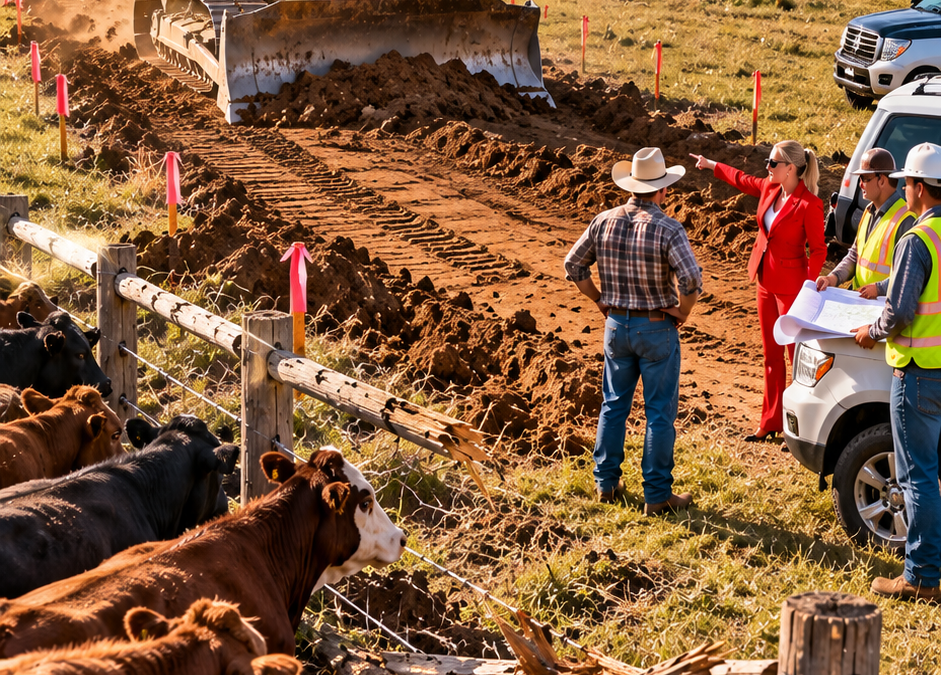
That morning, I stepped out of my barn with a coffee mug in one hand and found a yellow bulldozer sitting inside my property. Heavy diesel rolled across the pasture, low and steady, the kind that makes window glass tremble before you see the machine causing it.
Behind it, orange survey stakes cut across my grass in a dead straight line.
Fresh dirt lay curled beside the blade.
My cattle had packed themselves against the north fence, heads raised, ears twitching at the backup alarm.
Beep.
Beep.
Beep.
Then I saw the woman in red.
Brooke Kingsley stood beside a white SUV at my cattle gate wearing a bright red pantsuit that looked almost violent against all that brown grass and limestone. Two surveyors stood near her. So did a contractor holding rolled plans under one arm.
Brooke pointed across my land like she was showing somebody where to put a swimming pool.
I started walking.
“Stop that machine.”
I did not yell.
I did not need to.
The operator saw me coming and throttled down. The sudden silence made the cicadas sound deafening.
Brooke turned toward me.
Her ponytail barely moved in the hot morning wind.
“Mr. Briggs,” she said. “Good. We were hoping to catch you.”
“You caught me.”
I looked past her at the scraped earth.
One section of my fence was already lying flat.
“Now get them off my ranch.”
Her smile tightened.
“Cedar Ridge is exercising its access rights.”
She said it casually.
Like sixty acres of my property were an empty strip on a subdivision map.
I stared at the bulldozer.
Then at the orange stakes.
Then at Brooke.
“Access rights.”
“Yes.”
“You sent a machine through my fence before talking to me.”
“Notices were sent.”
“You sent me a letter saying you believed you had access.”
“That is correct.”
“That is not permission to start cutting my ranch apart.”
Brooke unrolled the site plan across the hood of her SUV. Her nails were painted pale pink. Her folder tabs were color-coded. Everything about her looked prepared, expensive, and certain.
“The association has been advised that an old access provision allows passage across this tract.”
Her finger followed a thick black line through the center of my ranch.
“The improvement is being constructed at association expense, so there will be no cost to you.”
I stared at her finger.
Then at her.
“No cost to me.”
A gust carried the smell of torn grass and hydraulic oil between us.
Twenty yards away, my cattle were still pressed against the fence because the route they used every morning to reach the lower water lot now had a bulldozer parked across it.
Brooke gave me the patient expression people use when they think the other person is slow.
“You’re receiving a professionally constructed road at no charge.”
I set my coffee on the hood hard enough to make the contractor glance at it.
“I don’t want your road.”
“That’s not really the issue.”
There it was.
Four words.
Clean.
Polite.
Cold.
She turned the plan toward the contractor again, already finished with me.
I walked past them and crouched beside one of the stakes. Pink ribbon snapped against my knuckles in the wind. From there, I could trace their route with my eyes.
Across the cattle lane.
Across the tractor path.
Past the old windbreak.
Straight toward the narrow southern connection where my father had installed that steel gate three decades earlier.
I stood slowly.
“How wide?”
The contractor answered this time.
“Finished travel surface is twenty-four feet. Shoulders and drainage take us wider in sections.”
He kept his eyes on the plan Brooke had given him.
As far as his crew was concerned, Cedar Ridge had cleared the corridor they were working inside.
I nodded toward my flattened fence.
“And you started before talking to me.”
Brooke folded her arms.
“The legal access has already been identified.”
“Identified by who?”
“Counsel.”
“Your counsel?”
“The association’s counsel.”
“That explains the confidence.”
Her jaw tightened.
“Our position is that permission is not required.”
She tapped an old recorded access provision clipped behind the site plan.
I had seen it before.
It gave Cedar Ridge enough of a corridor to make the dispute real. That was the dangerous part. If they had no paperwork at all, this would have been simpler. But they had something old, vague, and convenient. Enough to send letters. Enough to make lawyers argue. Enough to make Brooke believe she could begin first and settle the rest later.
But the road they wanted was not just a line across paper.
The subdivision connection depended on crossings, gates, drainage work, shoulders, and access points that the old document never granted. Brooke was betting I would sign those later.
She was betting the pressure would make me cooperate.
Behind her, the bulldozer operator waited with both hands resting on the controls.
Everyone was watching me.
Brooke.
The contractor.
The surveyors.
The operator.
They were waiting for the shouting part.
I did not give it to them.
I picked up my coffee.
Dust had settled across the surface.
“Brooke.”
She stopped turning away.
I pointed from the stakes to the cattle, then toward the old gate at the south end.
“You can cut a road across this ranch.”
For the first time that morning, she looked pleased.
She thought she had heard surrender.
I let the silence sit there for a second.
“But you can’t make this ranch cooperate with it.”
The contractor looked at me.
Brooke laughed once through her nose.
“Is that supposed to be a threat?”
“No.”
I stepped away from her SUV.
“It’s a warning.”
She held my eyes for another second.
Then she raised two fingers toward the operator.
The bulldozer engine roared back to life. Black exhaust rolled into the bright Texas air. The blade dropped.
Steel bit into my pasture, peeling away the route my cattle had walked for years.
Brooke did not look at me again.
She watched the machine instead.
She thought the noise meant she had won the first round.
Standing there with grit hitting my boots, I was not sure she was wrong.
By noon the next day, I had convinced myself I could keep the ranch running around them.
That was my first mistake.
I stretched temporary electric fence along the construction corridor. I drove steel posts into hard ground until my shoulders burned. I moved the cattle crossing sixty yards north. The sun sat white over the pasture. Dust stuck to the sweat under my collar, and every few minutes another dump truck groaned through the gate Brooke’s crew had opened.
I tried to work around them.
When the dozer moved east, I pushed cattle west.
When the grader stopped for lunch, I drove my tractor across the scraped strip with a round bale hanging off the loader.
For three days, it almost worked.
On the fourth, Brooke accelerated the job.
I came out before sunrise and found two excavators instead of one dozer. By seven, they had pulled another section of fence. By nine, a trench for drainage cut across the tractor path.
Nobody asked where my equipment needed to go.
Nobody asked where eighty head of cattle went for water.
They had a line on a plan, and everything touching that line became my problem.
I started waking at 4:30 just to move animals before the crews arrived. I burned extra diesel taking the tractor around the north pasture. I carried feed through gates that had never been meant for daily traffic.
Every adjustment created another one.
Friday evening, clouds rolled over the hills and the temperature dropped twenty degrees. Rain hit the bare construction dirt and turned it into red-brown paste. I was in the barn when I heard cattle bawling hard from the north side.
I grabbed my hat and ran.
One section of temporary fence had sagged where runoff softened the posts. Six cows were already through. The rest were crowding behind them.
My boots sank almost to the ankles as I worked them back with the pickup, headlights cutting through rain and steam rising off their backs.
One young heifer came up favoring her left rear leg after slipping near the churned edge of the roadbed.
Nothing catastrophic.
But enough.
I stood there in the rain with my hand against her flank while she trembled and shifted her weight away from the sore leg.
The next morning, the vet bill sat on my kitchen table beside receipts for fencing, fuel, and gravel.
Outside, engines started again at seven sharp.
I drove down to the corridor and found Brooke beside the contractor’s truck. She wore boots this time, but the red pantsuit was back.
“This can’t continue like this,” I told her.
She glanced toward my muddy pickup.
“I agree.”
For half a second, I thought she had finally seen what the construction was doing.
Then she handed me a printed sheet.
“We can add a controlled crossing here. It should reduce your inconvenience.”
“My inconvenience?”
I looked at the trench, the missing fence, the mud tracked halfway across my pasture.
“You’re cutting the working center out of my ranch.”
Brooke tucked the paper under one arm.
“We’re building one road, Caleb. You’re choosing to make it harder than it needs to be.”
That landed harder than I wanted it to because I was tired enough to wonder whether she had a point.
Not about the road.
About me.
I had spent a week trying to force cattle, tractors, feed, water, and fencing through the same patterns they had followed before the first survey stake went into the ground. I kept treating the construction like something temporary I could work around until somebody came to their senses.
Nobody was coming to their senses.
Brooke turned toward the crew.
“We’ll proceed with the drainage cut.”
The excavator bucket dropped into the soil.
I walked back to my tractor and tried to take the north route to the hay shed. Halfway there, the rear tires sank into a patch of soft ground I had been forced to cross because the old lane was blocked.
I rocked it once.
Twice.
The tires dug deeper.
I shut the engine off.
For a long moment, there was only rainwater ticking from the cab roof and the distant grind of machinery.
Through the windshield, I could see the orange stakes marching across my land.
I had been so busy fighting every stake that I had not noticed what the fight was doing to me.
I climbed down into the mud and looked west toward a neglected stock pond, an old fence line, and forty acres of ground I had barely used since Dad died.
The ranch I knew was being cut apart.
Standing beside that buried tractor, I finally understood that trying to keep it exactly the way it had been might finish the job for them.
The tractor stayed buried until nearly dark.
I chained it to the old Ford and eased it free six inches at a time, tires sucking out of the mud with a wet tearing sound. By the time I parked both machines undercover, my jeans were brown to the knees and my hands smelled like diesel and wet steel.
The next morning, Cedar Ridge started laying road base.
Belly dumps rolled through one after another, releasing crushed limestone in long pale piles. A grader spread it flat. A roller followed, shaking the ground hard enough that I could feel it through my boots from the barn.
Their road was becoming permanent.
My workday was becoming a maze.
The blocked tractor lane added almost a mile every time I hauled hay to the south pasture. A gate built to be opened twice a week was now swinging twenty times a day. Fuel disappeared faster. Hinges loosened. Cattle crowded places they had never crowded before.
I started keeping receipts in an old coffee can because I was too tired to sort them at night.
Diesel.
Wire.
Posts.
Gravel.
Veterinary care.
Another fuel receipt.
Then Brooke came by on a Tuesday afternoon carrying an offer.
She parked beside the barn while I was replacing a bent hinge. The air smelled of hot metal and dry grass.
“We can solve this,” she said.
I kept turning the wrench.
“You can stop building.”
“That’s not realistic.”
She held out a folder.
“Cedar Ridge will install a new driveway crossing the finished road. Professionally built. We’ll also provide fifteen thousand dollars for the inconvenience you’ve experienced.”
I stopped.
Fifteen thousand dollars was not nothing.
Not with the bills stacked on my kitchen table.
“For what?”
“A supplemental access agreement. A few connection points. Nothing that changes what we’re already doing.”
That last sentence made me look up.
Brooke had sunglasses on, so I could not see her eyes, but I could see the confidence in the way she held the folder already extended toward me.
“If it changes nothing,” I said, “why do you need my signature?”
Her hand lowered an inch.
“It’s housekeeping.”
“Then you don’t need it.”
I went back to the hinge.
The wrench clicked against the nut.
Brooke stood there another few seconds.
“This road is happening, Caleb.”
“At some point, you need to decide whether you want to benefit from it or keep paying to fight it.”
She put the folder on my workbench and left.
I did not touch it until after dinner.
The house was quiet except for the refrigerator humming and an old ceiling fan ticking above me. I spread my expenses across the kitchen table. The numbers were worse when they were all in one place.
Then I opened Brooke’s folder.
I read it twice.
Not because I was looking for a hidden legal trick.
I was looking at what Cedar Ridge assumed I would keep needing.
Crossings.
Gate access.
Connections between the same barn, pastures, water, and equipment routes I had been trying desperately to preserve.
Their entire approach assumed my ranch would still work tomorrow exactly the way it worked before they arrived.
I pushed back from the table.
Outside, moonlight caught the pale strip of new road base running across the pasture.
For the first time, I stopped looking at what the road had taken away and started looking at everything around it.
The western stock pond sat dark beyond the mesquite. Dad had stopped using it years ago after the old supply line failed. Farther south was a fence line buried under cedar growth. Beyond that, an old service track curved toward the county road without crossing Cedar Ridge’s construction at all.
None of it was ready.
Some of it had not been useful in twenty years.
But it was mine.
Before sunrise, I walked the west side with a flashlight and a tape measure. I checked the pond bank. I paced the old fence. I scraped dirt away from a rusted water fitting with my boot.
When the sun came up, Cedar Ridge crews found me nearly half a mile from their road, standing beside a gate nobody had used in years.
Brooke’s SUV stopped on the new limestone.
She watched me from across the pasture.
I lifted one hand.
She did not wave back.
Behind her, the roller kept moving, compacting another expensive layer into the ground.
Let them, I thought.
I was done trying to save the ranch they thought they understood.
At daylight, I walked the west side again, this time with a yellow legal pad folded into my back pocket. The old stock pond held more water than I expected. Cottonwood leaves floated against the bank, and when I kicked through the weeds near the inlet, I found the remains of the galvanized line Dad had abandoned years ago.
Rusted through in places.
Useless as it sat.
But the route was still there.
I spent that morning measuring instead of arguing.
By lunch, I knew what the change would cost.
By dinner, I knew I could not afford it.
The next afternoon, I washed Dad’s old restored Ford pickup until the blue paint shone.
He had bought that truck used when I was sixteen. Years later, after the transmission went, we rebuilt it together in the barn. It was not my daily driver anymore. It was just the one thing in that building I still wiped dust off instead of letting dust collect.
I stood beside it with my phone in my hand for a long time before taking the pictures.
Three days later, a man from Fredericksburg drove it away.
I watched the taillights disappear past the cattle guard.
Then I folded the cashier’s check into my shirt pocket and went back to work.
I bought pipe, fencing, two new water troughs, and enough crushed base to reopen the south service track. I rented a compact excavator for six days. Every evening after the Cedar Ridge crews shut down, I climbed into that machine and worked until the headlights turned the dust white.
I cleared cedar from the old fence line.
I cut a shallow trench for water pipe.
I rebuilt the south loop wide enough for the tractor and stock trailer.
My hands cracked around the knuckles. Red dust worked into the seams of my boots. Some nights dinner was a sandwich eaten standing over the kitchen sink because sitting down meant I might not get back up.
The hardest change was the north pasture.
It was good grass close to the barn, and Dad had built the original cattle lane through it. I stopped trying to preserve that route. I shifted the herd west and fenced off ground I had always treated as secondary.
For the first week, the cattle stood at the old gate every morning out of habit.
So did I.
Then I opened the new gate instead.
They hesitated, noses low, before the first cow stepped through.
The rest followed.
Brooke noticed the work.
One afternoon, her white SUV slowed on the limestone road while I was setting a corner post.
She lowered her window.
“Expanding?” she called.
“Changing.”
She looked past me at the fresh fence.
“That’s a lot of expense just to avoid a road we’re building for you.”
I drove the post another inch with the hydraulic driver.
“You’re not building it for me.”
“Whatever helps you sleep.”
She rolled up the window and continued toward the construction crew.
Two more dump trucks followed her in before sunset.
That told me everything I needed to know.
She saw me spending money, selling things, moving cattle, tearing apart old routines. She thought pressure was working, so Cedar Ridge committed harder.
Culvert pipe arrived the next morning.
Then another load of base.
Then concrete forms near the entrance.
While they built their road wider, I made my dependence on it smaller.
By the end of the second week, water ran through the new line for the first time.
I opened the valve slowly. The pipe knocked once beneath the dirt. Then clear water spilled into the western trough with a hollow metallic rush.
The cattle came over almost immediately.
I leaned against the fence and watched them drink while the late sun threw long shadows behind them.
Half a mile away, a roller crawled back and forth across Cedar Ridge’s road, its engine humming through the ground.
For the first time since Brooke’s bulldozer entered my property, that sound did not make me change what I was doing.
The next morning, I drove the tractor down the reopened south loop, hauled feed to the herd, checked the western trough, and returned to the barn without crossing their construction once.
It took longer than the old route.
The turns were tighter.
The ranch looked wrong to me in places, like furniture moved around in a house I had known all my life.
But it worked.
Brooke had expected me to keep fighting for every piece of the ranch I remembered.
Instead, I had started building one she had not planned for.
By the third week, Cedar Ridge’s road looked better than some county roads I had worked on. The limestone had been compacted smooth and hard. New culverts sat under clean shoulders. Concrete forms marked the future entrance, and stacks of stone waited beside them for the monument Brooke wanted facing the county road.
Every morning another truck arrived carrying something expensive.
I watched from farther away each day.
That was the part Brooke did not understand.
The first week, every machine they brought onto the ranch forced me to react.
By the third, most of them had stopped mattering.
The western trough handled the herd.
The south loop handled the tractor.
I rebuilt the old gate with new hinges and widened the turn enough to pull my stock trailer through without backing twice. The cattle stopped gathering at their old crossing.
Even they had learned the new ranch faster than I had.
Habit took longer to reroute than cattle.
I still caught myself driving toward the old lane some mornings. I would reach the fork, see Cedar Ridge’s pale road cutting across the pasture, then turn south.
Money was worse.
The cashier’s check from Dad’s Ford disappeared into pipe, gravel, fencing, equipment rental, and fuel. I sold twelve head earlier than I planned because the pasture rotation needed breathing room while the west side recovered.
Watching that trailer leave hurt in a different way than watching the truck go.
Those cattle were income I had expected months later.
Now they were paying for a fight I had not started.
One evening, I sat on the tailgate of my work pickup with my checkbook open beside me. The air smelled like cedar dust and hot rubber.
I ran the numbers twice, closed the book, and rubbed both hands over my face.
I could keep going.
Barely.
Across the field, Cedar Ridge’s crew was working late under portable lights.
Brooke had reasons to keep going too.
I learned that without investigating anything.
She told me herself.
She drove over the next afternoon while I was fastening wire to a new brace post.
“We’re pouring the entrance apron Monday,” she said.
“Good for you.”
“The new Cedar Ridge section opens for homeowner access next month.”
She paused, waiting for that to impress me.
“We’ve already scheduled contractors around this route.”
I pulled the wire tight.
“Sounds committed.”
“We are.”
Her eyes moved toward the western pasture.
“You clearly are too.”
There was something different in her voice.
Not concern.
Calculation.
“That offer is still available, Caleb. The fifteen. We can improve it.”
I looked at her then.
“Why?”
“Because your new layout is costing you money.”
She nodded toward the fresh fencing.
“Eventually, economics wins.”
I almost smiled.
Brooke believed every change she saw was evidence that her pressure was working.
The sold cattle.
The old truck gone from the barn.
The excavator.
The pipe.
She saw a man spending himself toward surrender.
What she could not see was that every dollar I spent removed something she could use against me.
Two days later, I finished relocating equipment storage to the south side. The following morning, I drove the tractor from the shed to the hay lot, then to the west pasture, then back home.
I never touched their road.
That afternoon, I took down the old cattle gate near the construction corridor.
The bolts were rusted, and one fought me until I heated it and worked it loose with a breaker bar. When the gate finally dropped into my hands, it felt heavier than I remembered.
Dad had hung it.
I had opened it thousands of times.
I loaded it onto the pickup instead of throwing it away.
Brooke arrived while I was filling the post holes. She stopped beside the new road and stared at the empty opening.
“You’re removing the crossing.”
“Don’t need it.”
Her expression changed for half a second.
Then it settled.
“You’ll want access once the road is paved.”
I tamped another shovel of dirt into the hole.
“Maybe.”
That answer relaxed her.
I let it.
Behind her, workers were setting stone around the Cedar Ridge entrance.
Ahead of me, the old crossing was disappearing under packed soil.
That night, for the first time, I drew the ranch from memory on a clean sheet of paper.
Barn.
South loop.
Western water.
New fencing.
Equipment shed.
Gates.
Then I drew Cedar Ridge’s road through the middle.
It looked important until I traced everything I actually needed.
None of my lines touched theirs.
I sat back and listened to the ceiling fan tick.
Brooke was right about one thing.
Economics eventually wins.
She just had not figured out whose economics she was watching.
The road got asphalt on a Thursday.
I smelled it before I reached the pasture, that thick petroleum bite rolling across the grass in the morning heat. A paving machine crawled toward the county road while rollers followed behind it, leaving a black ribbon where my cattle lane used to be.
Brooke stood near the new stone entrance with two contractors, pointing at curbs and talking over the machinery.
She looked at home there.
I stayed on my side of the fence and finished replacing a float valve in the western trough.
Around noon, the last roller stopped.
The silence felt strange.
For weeks, that road had announced itself every hour of every day.
Now it just sat there.
Smooth.
Dark.
Almost finished.
Two mornings later, Brooke’s SUV came down it alone.
She parked beside the barn and stepped out carrying a leather folder.
No contractor.
No survey crew.
Her heels clicked against the concrete apron they had poured near my driveway.
“We’re at the final coordination stage,” she said.
“Congratulations.”
“I think you’ll like what we’ve done.”
I looked past her.
Fresh white edge lines had appeared overnight. The Cedar Ridge monument at the entrance was nearly finished.
“I didn’t ask you to do it.”
Brooke gave me a thin smile.
“Still holding on to that?”
She opened the folder across my workbench. The pages were clean, tabbed, ready for signatures.
“This formalizes the remaining connections. Your crossing access, the southern interface, maintenance, coordination, emergency use. Standard items.”
I wiped grease from my fingers with a shop rag.
“Remaining administrative details.”
“You called them housekeeping last time.”
Her mouth tightened.
“Because that’s what they are.”
I turned one page.
Then another.
The road itself was sitting there in plain sight behind her, but these pages reached beyond the strip they had built. They connected it to places Cedar Ridge needed to use if that strip was going to function the way Brooke had promised.
The south connection.
Controlled access points.
The pieces she had always assumed I would sign because my own ranch would eventually need them too.
“Where do I sign?” I asked.
Brooke relaxed.
She slid a pen across the bench and tapped the bottom of the page.
I picked it up.
Then I walked outside.
“Caleb?”
“Come here.”
She followed me into the sun.
Heat shimmered above the new asphalt.
I pointed toward the old north crossing.
“What do you see?”
“Your former gate.”
“Exactly.”
The gate was gone.
New fence ran straight through where it had stood.
I pointed west.
Cattle were gathered around the new trough, water flashing silver beneath their noses.
“They don’t cross your road anymore.”
Brooke folded her arms.
“Fine.”
I pointed south.
My tractor came into view along the reopened service loop, driven by a ranch hand I had hired for the morning. It curved behind the mesquite, reached the equipment shed, and never came within a hundred yards of Cedar Ridge’s pavement.
“Neither does my equipment.”
Her eyes followed it.
I could see her doing the math now.
Slowly.
“You still have access issues.”
“Had.”
I handed the pen back.
She did not take it.
“You’re refusing to sign?”
“Yes.”
“After everything you’ve spent?”
“Especially after everything I’ve spent.”
Brooke looked toward the road.
For the first time since she had arrived on my property, she was not looking at it like something she owned.
She was looking at where it stopped.
Where it connected.
What it still required.
“We built around the understanding that these points would be available.”
“Your understanding.”
“You can’t just redesign your operations to obstruct an association improvement.”
“I redesigned my ranch because your improvement obstructed my operations.”
That shut the space between us quiet.
A cicada buzzed from the oak beside the barn.
Somewhere behind the house, a trough valve clicked off.
Brooke finally took the pen from my hand.
“You’ll reconsider.”
“Maybe.”
She looked relieved at the word.
I let her have that relief too.
Then I nodded toward the folder.
“But you should understand something before you spend another dollar.”
She waited.
“You built your leverage out of things I no longer need.”
Her face did not move, but her fingers tightened around the pen.
She closed the folder.
When her SUV pulled away, she drove slowly down the fresh asphalt.
I watched until she reached the far end.
Cedar Ridge had spent weeks building a road across my sixty acres.
That afternoon, Brooke finally realized the road needed something from me.
I did not need anything from it.
Brooke came back three days later with a different folder and a different number.
The afternoon was hot enough to make the new asphalt shimmer. I was replacing a cracked hose on the tractor when her SUV stopped beside the barn.
She stepped out with her red jacket folded over one arm and walked straight to my workbench.
“Fifty thousand.”
I set the wrench down.
“For housekeeping?”
She did not smile.
“For cooperation.”
She opened the folder. The agreement was thicker than the last one. I did not need to read every page to understand what had changed.
Cedar Ridge was no longer treating my signature like a formality.
They were buying something they had finally realized they did not possess.
“Fifty thousand,” Brooke repeated. “You sign the remaining access provisions, we finish coordination, and everybody moves forward.”
The number sat between us.
Six weeks earlier, I would have laughed.
That afternoon, I did not.
Fifty thousand would put back most of what I had burned through. It would replace the Ford, cover the early cattle sale, and give me room to repair the west pasture properly instead of doing everything one paycheck at a time.
Brooke saw me looking at the check clipped inside the folder.
“You’ve made your point, Caleb.”
Her voice softened.
“There’s no reason to keep hurting yourself.”
I closed the folder.
“I’ll give you an answer tomorrow.”
For once, she left without arguing.
Near sunset, I walked out to the old north crossing. The fresh asphalt was still dark against the pasture. Cedar Ridge had painted center lines now. Reflective markers caught the orange light.
It looked finished enough that a stranger would assume it belonged there.
I stepped across it and stopped where the cattle lane used to run.
The old gate was gone, but two worn post holes were still visible beneath the grass. I remembered Dad leaning against that gate with his work gloves tucked into his belt.
A ranch isn’t sixty acres.
It’s sixty acres working together.
I had spent weeks thinking keeping his ranch meant preserving every route he had built.
Then I had spent more weeks learning that was not possible.
The western trough was mine now.
The south loop was mine.
The new fence pattern was mine.
None of it was how Dad had arranged the place.
All of it worked.
My phone buzzed.
A text from Brooke.
She wanted my answer by nine.
I looked down Cedar Ridge’s road toward the stone entrance.
The problem was not the fifty thousand dollars.
The problem was what came with it.
Once I signed, their road stopped being something crossing my property and became something my property had to accommodate.
Gates.
Connections.
Access.
Future maintenance.
Their traffic would become part of the ranch’s operating reality because I had agreed to make it so.
I had already paid too much to become independent from that road just to sell the independence back.
At eight the next morning, I drove to the Cedar Ridge entrance.
Brooke was waiting beside the stone monument. Two men in polos stood with her, along with the contractor I had seen on the first day. A roll of plans rested on the hood of her SUV.
She held the folder out.
“I assume we’re done fighting.”
“I am.”
I handed it back unopened.
Brooke stared at it.
“What does that mean?”
“It means no.”
One of the men shifted his weight.
Brooke stepped closer.
“Caleb, this offer is more than reasonable.”
“Then spend it fixing another route.”
“There isn’t another route that works with the project schedule.”
The contractor looked at her.
It was quick, but I caught it.
So did she.
The wind moved dust across the asphalt between us.
I looked toward the southern end of the road, then back at Brooke.
“That’s why you need me.”
She did not answer.
“You built first because you thought I’d have to cross it. You thought my cattle would need it. My equipment would need it. You thought if you made my ranch inconvenient enough, eventually I’d sign whatever finished your connection.”
“We have substantial rights here.”
“Then use what you have.”
I tapped the folder with one finger.
“Not what you’re trying to buy from me.”
Brooke’s face went still.
Behind her stood thousands of feet of graded, drained, paved road. Stonework. Concrete. Culverts. Weeks of labor. A project built farther every day on the assumption that pressure would finish what permission had not.
She looked past me toward my pasture.
Cattle were moving west toward water.
My tractor was coming up the south loop.
Nothing crossed her asphalt.
Nothing waited at her gates.
For the first time, she saw the whole ranch I had built around her road.
And for the first time, I saw exactly what she had built around my signature.
Brooke lowered the folder.
“You understand what you’re doing now?”
“I do.”
The road between us was finished.
That was the problem.
Cedar Ridge had spent all that money building its way to a decision only I could make.
Brooke called me at 6:30 the next morning.
“We need to resolve this today.”
I was standing beside the western trough with one hand on the float valve. Water hissed into galvanized steel while cattle pushed around me, warm hides brushing my sleeves.
“I’m at the ranch.”
“I know.”
Forty minutes later, her white SUV came down the black road with two pickups behind it. The contractor was back. So were the two Cedar Ridge men from the day before.
Brooke stepped out holding rolled plans instead of a folder. Her red pantsuit was sharp as ever, but she was not smiling.
We met near the south end where the pavement approached the connection Cedar Ridge needed.
The asphalt stopped cleanly short of it.
Beyond that point was my ground, my fencing, and the access they had never secured.
Brooke spread the plans across a pickup hood. Wind snapped one corner until the contractor pinned it with his hand.
“We keep the road as constructed,” she said. “You grant the remaining access. Cedar Ridge pays you seventy-five thousand dollars and assumes routine maintenance.”
I looked at her.
“Yesterday was fifty.”
“I’m trying to be practical.”
“So am I.”
I pointed at the road.
“Take it back.”
Nobody spoke for a second.
The contractor looked down at the plans.
Brooke stared at me.
“Excuse me?”
“You wanted a free road across my sixty acres. I warned you before the first blade went into the dirt. You built it anyway because you thought I’d eventually need it more than you did.”
I nodded toward the south loop visible through the mesquite.
“I don’t.”
Her voice hardened.
“We are not removing a completed road.”
“Then use only what you are entitled to use without another inch from me.”
She glanced at one of the men beside her.
He said quietly, “That doesn’t give us the connection we designed for.”
Brooke shot him a look.
I did not say anything.
I did not need to.
The asphalt beneath our boots was doing enough talking.
Weeks of grading, drainage, base, paving, stonework, and labor had stopped short of becoming the access Cedar Ridge had promised itself.
Brooke turned back to me.
“Name your price.”
“I did.”
“Seventy-five is not enough?”
“I’m not selling.”
The wind carried the dry smell of limestone from the unfinished shoulder.
Brooke folded the plans with quick, hard movements.
“Then what exactly do you want?”
I pointed back across the pasture.
“Anything you installed solely to make this subdivision route work and can’t use without expanding onto rights I never gave you, remove it. Restore the fence lines you tore out. Regrade the disturbed areas so they drain the way they did before. Put topsoil back where you stripped it. Seed it.”
Her eyebrows lifted.
“You expect Cedar Ridge to pay to undo construction?”
“I expect Cedar Ridge to own its decision.”
“You could walk away from this with seventy-five thousand dollars.”
“I already walked away from something.”
For a moment, I saw Dad’s blue Ford leaving through the cattle guard. I felt the empty place in the barn where it had sat.
“That’s enough.”
Brooke stepped away from the truck and looked down the road.
When she spoke again, the anger had gone quiet.
“You changed your entire ranch over this.”
“I had to.”
“Just so you could say no.”
I shook my head.
“So your yes wasn’t the only way I could survive.”
That landed.
She stood still, eyes moving from the western cattle to the south equipment loop, then back to the asphalt.
When she arrived six weeks earlier, she had pointed across my property and told people where to build.
Now every option in front of her required my consent except one.
Leave.
The contractor cleared his throat.
“If the connection isn’t available, keeping the full build doesn’t serve the phase as designed.”
Brooke closed her eyes for half a second.
Then she looked at him.
“Price the removal and restoration.”
He nodded.
She turned toward me.
“You’ll get your ranch back.”
“Not the old one.”
I looked toward the west pasture.
“That one’s gone.”
Her jaw tightened, but she had nothing left to point at.
She climbed into the SUV.
The others followed.
Their tires whispered over the smooth pavement as they drove toward Cedar Ridge.
I stayed where I was.
A week later, diesel woke me before sunrise.
I stepped outside expecting another fight.
Instead, an excavator was sitting beside the road with its bucket curled inward.
The same contractor who had helped build it walked over carrying a thermos.
“Morning, Caleb.”
I looked at the machine, then at him.
“Morning.”
He nodded toward the asphalt.
“We’re starting from the south end.”
Behind him, the excavator engine climbed from an idle to a deep mechanical growl. The bucket swung over the pavement and settled its teeth against the black edge of the road.
For six weeks, every machine that moved on my land had been building something Cedar Ridge expected me to accept.
This time, when the machine moved, the bucket drove down into the asphalt.
The first section came up in broken slabs.
The excavator lifted them one at a time, and a loader carried them to waiting trucks.
For six weeks, I had heard machines building Cedar Ridge’s road across my ranch.
Now I heard the same diesel engines taking it away.
There was no celebration.
Mostly there was work.
The contractor walked the disturbed ground with me every few days. We checked drainage slopes, fence locations, and the places where roadway base had been packed deep into the soil.
Where Cedar Ridge had stripped topsoil, trucks brought it back.
Where culverts had redirected runoff, crews pulled them and reshaped the shallow natural swales.
New posts went into the holes where my old fence had been torn down.
Then came seed and straw over the raw earth.
It did not look healed.
It looked prepared.
There was a difference.
Fresh soil ran in a long brown scar through the pasture, and crushed limestone still showed white in places after rain. I did not ask them to hide that.
By then, I did not need the ranch to pretend nothing had happened.
One cool morning near the end of restoration, I found the old cattle gate lying behind the barn where I had unloaded it weeks earlier. Rust stained the bottom rail. One hinge still carried the fresh scrape from when I had fought the bolt loose.
I ran my thumb across it.
Then I left it there.
Putting it back would have been easy.
It also would have been pointless.
The cattle did not use that route anymore.
Neither did I.
The western system had become normal.
They moved through the new gate at sunrise without hesitation, following the fence toward the trough while steam rose faintly from their backs. The south loop had packed down under tractor tires. The relocated equipment shed smelled of hay, grease, and fresh-cut lumber instead of the old barn’s dust.
Everything was different enough that sometimes I still reached for a gate that was not there.
The empty space where Dad’s Ford had sat bothered me most.
Seventy-five thousand dollars could have filled it with another restored truck by the weekend.
I knew that.
I also knew it would not have been his.
Some prices do not reverse just because somebody finally offers money.
Brooke came out once during the final week.
No folder this time.
No plans.
She parked near the county road and walked maybe thirty yards onto the restored ground. Her red jacket stood out against the winter grass. She looked toward the western pasture, then at the stretch where Cedar Ridge’s pavement had been.
“They’ll finish seeding tomorrow,” she said.
“I know.”
She pressed her lips together and nodded.
“The association is redesigning the phase access.”
“Probably should have done that first.”
She looked at me.
I expected an argument.
It never came.
“Probably,” she said.
Then she walked back to her SUV.
That was the last conversation we had about the road.
A few weeks later, rain came through overnight.
Not much.
Just enough to darken the soil and settle the seed.
I drove the work pickup down the south loop before sunrise. My tires crunched over gravel, then softened against packed dirt. At the western gate, I stopped and watched the cattle move toward water.
The trough valve clicked.
A meadowlark called from a fence post.
No backup alarms.
No rollers.
No engines shaking the kitchen windows.
On my way back, I pulled over where the road had crossed the center of the ranch. New grass was beginning to show through the straw. I stepped out and found a piece of crushed limestone near my boot, bright white against the damp soil.
I picked it up.
Six weeks earlier, thousands of tons of that stone had looked like proof that Brooke could make a decision on my land and force me to live around it.
Now one piece fit inside my palm.
Dad had been right.
A ranch was not sixty acres on a survey.
It was sixty acres working together.
I just had not understood that working together did not mean working the same way forever.
I had lost money.
Sold cattle early.
Sold his truck.
Changed routes he had built with his own hands.
I had not preserved the ranch he left me exactly as it was.
I had preserved the part that mattered.
The choice.
I tossed the limestone into the bed of my pickup and closed the gate behind me.
Cedar Ridge still had its houses.
Brooke still had her HOA.
They just did not have a free road through my sixty acres.
They thought my warning was a bluff.
It was not a threat.
It was the last free thing I ever gave them.








