𝗙𝗨𝗟𝗟 𝗦𝗧𝗢𝗥𝗬 The Wounded Colonel Knew My Name Before I Ever Told Him
𝗙𝗨𝗟𝗟 𝗦𝗧𝗢𝗥𝗬
The man with the shaved head rushed first.
I moved before I had time to think. I shoved Cole behind the nearest concrete barrier, pivoted, and put myself between them. The man came in too fast, expecting fear to do half his work for him.
It did not.
I drove my shoulder into him, hard enough to knock him off balance. He cursed and grabbed for my jacket. I twisted out, planted my boot, and shoved him backward into the rain-slick side of a parked car.
The hooded man moved toward Cole.
I stepped in front of him.
People had begun shouting.
A grocery cart slammed into a curb. Someone screamed that they had called 911. Phones came out. Restaurant employees rushed from the sandwich shop near the corner. A delivery driver leaned on his horn until the sound cut through the rain like an alarm.
Then sirens rose in the distance.
The two men looked toward the road.
For one second, I thought they might keep coming.
Then the man in the hoodie spat a curse, grabbed the shaved-headed man’s sleeve, and they ran.
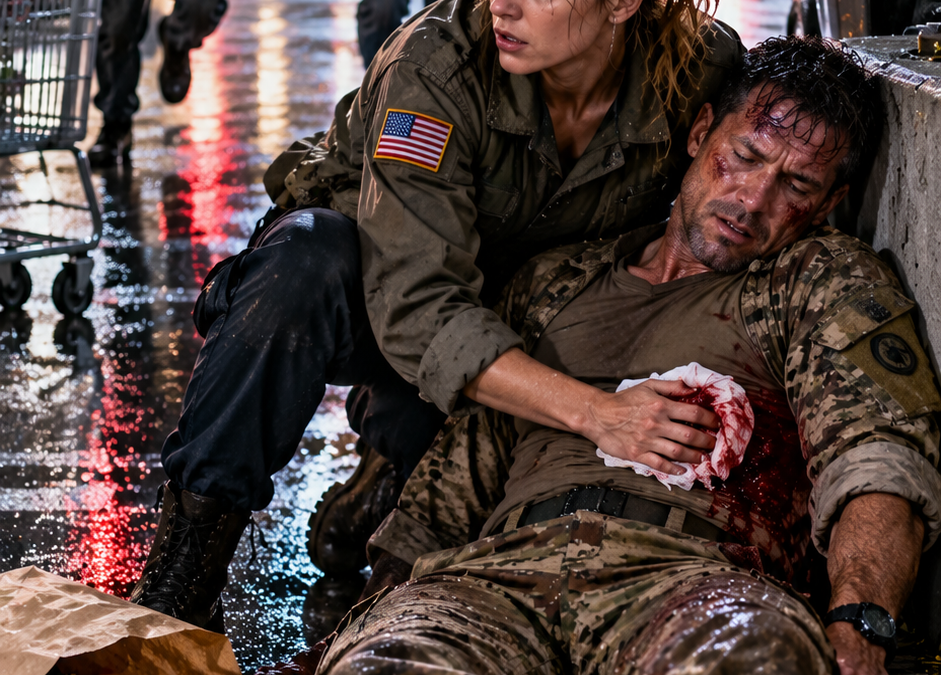
I dropped beside Cole immediately.
His eyes were closing.
“No,” I said sharply. “Stay awake.”
“Trying.”
“Try harder.”
Blood kept soaking through the gauze.
I pressed harder, and his fingers closed around my wrist.
“If I don’t make it—”
“You’re making it.”
“There’s something in my jacket.”
“We can worry about that later.”
“Now.”
The force in his voice made me obey.
I reached inside his torn jacket and pulled out a leather identification case. Rainwater ran down my sleeves as I opened it.
Then I froze.
Silver eagle.
Colonel.
COLONEL JONATHAN COLE
UNITED STATES MARINE CORPS.
I looked down at him.
“You’re a colonel?”
“Unfortunately.”
“You could have mentioned that.”
“Would it have changed anything?”
I looked toward the flashing ambulance lights turning into the parking lot.
“No.”
His mouth curved faintly.
“That’s why I didn’t.”
Paramedics reached us minutes later. I gave them everything I knew, which was not much: his name, his wound location, how long I had been applying pressure, and that two men had approached him before fleeing.
Cole remained conscious just long enough to grip my wrist once more.
“Carter.”
I looked at him.
That was the second thing I missed.
I had never told him my last name either.
“Don’t let them call it random,” he whispered.
Then his eyes closed, and the paramedics lifted him into the ambulance.
The next two hours dissolved into police statements, wet clothes, fluorescent lights, and questions I did not have enough answers to satisfy.
No, I did not know Colonel Cole.
No, I had not seen the two men before.
No, I could not say why they were following him.
Yes, one of them had told me to walk away.
Yes, Cole had seemed to recognize at least one of them.
By the time I reached home, it was close to three in the morning.
I should have slept immediately.
Instead, I sat on the edge of my bed in damp jeans and stared at my hands.
There was still blood beneath one fingernail.
I washed it three times before I stopped seeing it.
At 6:47, someone pounded on my front door.
I jolted awake.
For several seconds, I did not understand where I was. My apartment was dark except for the dull gray light pressing through the curtains. My head throbbed. My body ached in that specific way that comes after adrenaline abandons you.
The pounding came again.
I pulled on sweatpants, grabbed the first Army T-shirt I found, and moved quietly toward the door.
I looked through the peephole.
Then I stopped breathing.
Marines.
At least eight of them.
They stood in disciplined stillness on my narrow front walkway, rain darkening their uniforms, their faces unreadable. A gunnery sergeant stood closest to the door.
I opened it slowly.
“Lieutenant Emily Carter?” he asked.
“Yes.”
“We’re with Colonel Cole’s command.”
My stomach dropped so violently I almost reached for the doorframe.
“Is he alive?”
The gunnery sergeant’s expression softened.
“He made it through surgery.”
The relief hit so hard my knees weakened.
I pressed one hand against the door.
“Thank God.”
“He lost a significant amount of blood, ma’am, but the doctors are optimistic.”
Only then did I realize none of the Marines were leaving.
I looked past them.
“What are you all doing here?”
The gunnery sergeant glanced at the others before answering.
“Colonel Cole woke up forty-three minutes ago.”
I waited.
“And the first thing he asked was whether you were alive.”
I opened my mouth, but no sound came out.
Before I could recover, a black government SUV turned onto my street and stopped behind the Marines.
Every Marine straightened.
Two people stepped out.
The first was a tall officer in his late fifties, silver at his temples, his face controlled but not cold. He moved with the calm authority of someone accustomed to entering rooms where everyone else immediately fell silent.
The second was a woman in civilian clothes beneath a dark raincoat. Mid-fifties, intelligent eyes, careful expression. She carried a leather folder under one arm.
The tall officer approached first.
“Lieutenant Carter?”
“Yes, sir.”
“Major General Stephen Whitaker.”
My posture corrected itself.
“Sir.”
The woman stepped forward.
“Margaret Hale. Department of Defense.”
That did absolutely nothing to reduce my confusion.
General Whitaker seemed to notice.
“No one is here to place you under investigation, Lieutenant.”
“I’m glad you said that, sir, because this looks exactly like what I imagine the beginning of an investigation looks like.”
The gunnery sergeant’s mouth twitched.
Margaret Hale did not smile, but something softened around her eyes.
“May we come inside?” she asked.
I looked over my shoulder.
My living room contained yesterday’s boots, two unopened moving boxes I had failed to unpack after six months, a blanket twisted across the couch, and an empty coffee mug with a spoon standing upright inside it.
“Sir, with respect, my house currently looks like it lost a small war.”
General Whitaker glanced at the Marines behind him.
“They’ve seen worse.”
“That isn’t reassuring.”
This time, even Margaret Hale smiled.
I stepped aside.
Only General Whitaker, Margaret Hale, and the gunnery sergeant entered. The other Marines remained outside, less like a security detail than men who simply did not know what else to do with themselves while the colonel they served lay in a hospital bed.
I closed the door.
“Coffee?” I asked automatically.
The general looked surprised.
“I think we should be offering you coffee.”
“I have some.”
“Then yes.”
Five minutes later, I was sitting at my kitchen table with a major general, a Pentagon official, and Gunnery Sergeant Daniel Ruiz, who had apparently served under Colonel Cole for eight years.
My coffeemaker made a dying sound.
Nobody mentioned it.
General Whitaker rested his hands around the mug I gave him.
“You asked why we’re here.”
“Yes, sir.”
“Colonel Cole’s condition is stable.”
I released a breath I had not realized I was holding.
“They repaired the damage. He will require rehabilitation, but his doctors expect a full recovery.”
“Good.”
The word came out much softer than I intended.
Ruiz nodded.
“He’s stubborn.”
“I noticed.”
“He’ll probably argue with physical therapy.”
“He argued with me while actively bleeding.”
“That sounds like him.”
There was affection in Ruiz’s voice.
Not automatic loyalty.
Something deeper.
Whitaker watched the exchange before continuing.
“What happened last night is under review. The two men who approached Colonel Cole were located by local law enforcement before dawn.”
I looked up sharply.
“They caught them?”
“Yes.”
“Who were they?”
Margaret answered.
“Former civilian contractors.”
“For the military?”
“For several agencies over the years.”
I waited.
She did not elaborate.
“Why were they following him?”
“That,” Margaret said, “is part of what we are trying to establish.”
I stared at her.
“You came to my house at seven in the morning with eight Marines because you don’t know why two former contractors were following a colonel?”
“No,” Whitaker said gently. “We came because Jonathan insisted.”
The use of Cole’s first name caught my attention.
“You know him personally.”
“For twenty-three years.”
That explained something.
The general had not come only because a Marine colonel had been injured.
He had come because his friend had nearly died.
Whitaker looked down into his coffee.
“Jonathan woke after surgery briefly disoriented. The first clear question he asked was about you. Once they told him you were unharmed, he asked for his phone.”
Ruiz gave a quiet snort.
“The nurse told him no.”
“I assume that went well,” I said.
“It did not.”
“Eventually,” Whitaker continued, “someone gave in.”
“Who did he call?”
“Me.”
I frowned.
“And you came here?”
“He asked me to.”
“What exactly did he say?”
The general remained silent for several seconds.
Then he looked directly at me.
“He said, ‘Find Carter before somebody convinces her last night was an accident.’”
The kitchen suddenly felt smaller.
“What does that mean?”
“We hoped you might know.”
“I met him in a grocery store parking lot.”
Margaret leaned forward.
“Had you ever seen him before?”
“No.”
“Had you heard his name?”
“No.”
“Any family connection to the Marine Corps?”
“My father was Army. My grandfather too.”
“What about your mother’s family?”
I hesitated.
“My mother grew up in a military family, but her father died before I was born.”
“Name?”
“Thomas Bennett.”
Margaret and Whitaker exchanged a glance.
It happened quickly.
But I saw it.
“What?” I asked.
Neither answered immediately.
“What was that look?”
Margaret placed her mug down with deliberate care.
“Your maternal grandfather was Thomas James Bennett?”
“Yes.”
“Army?”
“I think so. My mother didn’t talk about him much.”
Whitaker leaned back.
“Jonathan knew him.”
I stared at him.
“That’s impossible.”
“Why?”
“My grandfather died in 1989.”
“Jonathan was a young Marine then.”
I tried to calculate the ages.
Cole looked somewhere in his early fifties.
It was possible.
Barely.
“How would a Marine know my grandfather?”
Whitaker’s expression tightened.
“That is something Jonathan should probably explain himself.”
I stood.
“No.”
All three faces turned toward me.
“No offense, sir, but you do not get to arrive at my house with a government convoy, ask questions about my dead grandfather, exchange meaningful looks, and then tell me somebody else should explain.”
Ruiz looked like he was trying very hard not to approve.
Whitaker’s expression stayed calm.
“You’re right.”
Margaret opened the leather folder she had carried inside.
“We found Colonel Cole’s personal effects at the hospital. Most were routine.”
She removed a clear evidence envelope.
Inside was the leather identification case I had pulled from Cole’s jacket.
And behind it, partly visible through the plastic, was something I had not noticed in the rain.
A photograph.
Old.
Faded.
Margaret slid it across the table.
I leaned closer.
Three men stood beside a military helicopter.
One was very young.
Even so, I recognized Jonathan Cole.
The second man was unfamiliar.
The third—
My knees nearly gave out.
I sat down hard.
My grandfather.
Thomas Bennett.
I knew him from exactly four photographs my mother kept in a box upstairs at her house in Richmond.
Same square jaw.
Same crooked smile.
Same heavy watch on his left wrist.
I touched the edge of the evidence envelope.
“That’s him.”
Whitaker nodded.
“The picture is dated 1988.”
My thoughts scattered.
“Why would Colonel Cole carry a photograph of my grandfather?”
Nobody answered.
I looked at Ruiz.
He shook his head.
“First time I’ve seen it, ma’am.”
“What happened in 1988?”
Margaret spoke carefully.
“Something several people have spent a long time trying to understand.”
Not cover up.
Not hide.
Understand.
There was a difference.
“What kind of something?”
“An operation involving American personnel and allied forces overseas. Training support. Logistics. Intelligence coordination.”
“And my grandfather?”
“Army communications.”
“Cole?”
“Junior Marine attached to the security element.”
I stared again at the photograph.
My grandfather looked happy.
Cole looked impossibly young.
They were standing shoulder to shoulder.
Not strangers.
Friends, maybe.
“What does that have to do with last night?”
Whitaker’s expression tightened slightly.
“We don’t know.”
That answer sounded honest.
Somehow that made it worse.
Ruiz’s phone buzzed.
He checked the screen, and his entire face changed.
“Colonel’s awake again.”
Whitaker stood.
“Hospital?”
“Yes, sir.”
Ruiz looked at me.
“He’s asking for Lieutenant Carter.”
Of course he was.
Twenty minutes later, I was riding in the government SUV wearing jeans, boots, and a jacket thrown over the same Army T-shirt. The Marines did not follow. Ruiz came with us.
Northern Virginia slid past the tinted windows, wet and gray beneath a low sky. Rain streaked across the glass.
I stared at my reflection.
“You all knew my name before last night?”
Margaret answered from the opposite seat.
“No.”
“But Cole knew it when he told me to leave.”
Ruiz looked over.
“What?”
“He said, ‘Emily, leave.’”
The vehicle became quiet.
Margaret leaned forward slightly.
“Did you tell him your first name?”
I replayed everything.
The rain.
The blood.
My hands pressing gauze.
I had said, “Easy. I’ve got you.”
He had called me Lieutenant.
Then later—
Emily.
“No.”
Whitaker looked through the windshield.
That was the first time I saw genuine concern on his face.
At the hospital, we were directed through a quiet corridor away from the main entrance. Cole’s room was guarded by two Marines.
Inside, he looked smaller than he had in the parking lot.
Hospital beds do that to people.
They strip away rank, authority, and the illusion that any of us are larger than our bodies.
His face was pale. An IV line ran into one arm. His injured leg was secured beneath the blanket.
But his eyes were clear.
They found me immediately.
“There she is.”
I crossed my arms.
“You knew my name.”
Whitaker closed the door behind us.
Cole sighed.
“Good morning to you too.”
“Did you know who I was before last night?”
He looked toward Whitaker.
“You showed her the picture.”
“I showed her the picture,” Whitaker said.
Cole closed his eyes.
“Steve.”
“You sent me to her house.”
“I told you to make sure she was safe.”
“You also said not to let anyone convince her it was an accident.”
Cole opened his eyes again.
Margaret stepped closer.
“Jonathan, we need clarity.”
Cole studied each of us.
Then he looked back at me.
“I knew your grandfather.”
“So I’ve been told.”
“He saved my life.”
The anger I had been holding shifted.
Not gone.
Just displaced.
“How?”
Cole looked toward the window.
“When I was twenty-one, I thought confidence was the same thing as experience. Your grandfather corrected that misconception several times.”
Despite myself, I almost smiled.
“That sounds like something my mother would say he did.”
“He was difficult.”
“She says stubborn.”
“He was that too.”
Cole’s voice softened.
“He was also one of the finest men I ever knew.”
I sat beside the bed.
“Tell me.”
For the next twenty minutes, Jonathan Cole described a man I had known only through old photographs and my mother’s carefully rationed stories.
Thomas Bennett liked terrible coffee.
He carried peppermints in every pocket.
He wrote letters to his wife almost daily.
He could repair radios everyone else had declared useless.
He hated people touching his tools.
He hummed old country songs when concentrating.
He had once spent an entire afternoon helping a homesick twenty-one-year-old Marine write a letter apologizing to his father.
“That Marine was you?” I asked.
Cole nodded.
“My father and I hadn’t spoken in nearly a year.”
“What happened?”
“He answered.”
Something about the simplicity of that sentence hurt more than I expected.
“And you kept the photograph all these years?”
“Yes.”
“Why?”
Cole’s gaze met mine.
“Because the day that photograph was taken was the last ordinary day we had.”
Silence settled.
I waited.
Cole drew a slow breath.
“There was an accident three days later.”
“What kind?”
“Vehicle rollover during a communications movement. Bad weather. Poor road.”
“My grandfather died in a training accident.”
“Yes.”
“You were there.”
“Yes.”
My mother had never said that.
Or perhaps she had never known.
Cole continued quietly.
“Thomas got two people out before the vehicle shifted. I was one of them.”
No dramatic details.
No heroic speech.
Just the plain truth.
“He saved you.”
“Yes.”
“And then he died.”
“Yes.”
For a long time, nobody spoke.
Finally, I asked, “Why did you know my name?”
Cole looked troubled.
“I’ve kept track of your family.”
My head lifted.
“What does that mean?”
“Not surveillance.”
“You might want to choose your next words very carefully.”
Ruiz coughed into his hand.
Cole gave him a look.
Then returned his attention to me.
“Every few years, I checked publicly available information. Your grandmother passed in 2007. Your mother became a school counselor. You graduated from Virginia Tech. ROTC. Commissioned Army. Logistics.”
“You knew all that?”
“Yes.”
“Why?”
His answer came without hesitation.
“Gratitude.”
I did not know what to do with that.
“You never contacted us.”
“I almost did. Many times.”
“Why didn’t you?”
“Because gratitude can become selfish if you force it onto someone who never asked for it.”
That answer surprised me.
Cole looked tired now, but he continued.
“Your grandmother wanted distance from the military after Thomas died. I respected that. I wrote her once after the funeral. She sent a kind response and asked that we let the family move forward.”
“My mother never mentioned that.”
“She may not have known.”
“And last night?”
Cole’s eyes shifted away.
“That was coincidence.”
I did not believe him.
Neither did Whitaker.
“Jonathan,” the general said quietly.
Cole looked at his old friend.
“You told me not to let anyone tell her it was an accident.”
“That wasn’t about meeting Emily.”
“What was it about?”
“The men following me.”
Margaret’s voice became sharper.
“You recognize them?”
“One.”
“Which one?”
“The shaved head. Nathan Voss.”
Ruiz’s face changed.
“You know Voss?”
“Years ago.”
Margaret removed a small notebook from her bag.
“In what capacity?”
Cole hesitated.
“He worked contract security around several archival recovery projects.”
“Archival recovery?” I asked.
Cole looked toward me.
“There are thousands of old military records that become digitized, reviewed, corrected, relocated, or declassified over time. Some are mundane. Some reveal administrative mistakes no one noticed decades ago.”
“What kind of mistakes?”
“Names. Dates. Payments. Missing reports.”
“And this connects to my grandfather?”
Cole was silent.
That silence told me more than an answer would have.
Whitaker noticed it too.
“What did you find, Jonathan?”
Cole looked at Margaret.
“Did you recover my briefcase?”
“Yes.”
“Blue folder.”
Margaret’s expression changed.
“There was no blue folder.”
Cole went still.
Ruiz glanced at the door.
“What was in it?”
Cole looked at me.
“A copy of a personnel amendment filed seven months after your grandfather died.”
My throat tightened.
“What amendment?”
“It concerned the official report of his accident.”
Margaret’s voice became controlled.
“Jonathan, why were you carrying it?”
“Because I intended to give it to someone.”
“Who?”
Cole looked directly at me.
“Emily’s mother.”
By noon, I had stopped feeling tired.
Fatigue had been replaced by a strange, suspended clarity. Everything sounded louder: shoes in hospital corridors, the rustle of paper, the hum of fluorescent lights, even my own breathing.
“My mother?” I asked.
Cole nodded.
“I was scheduled to see her tomorrow.”
“She knows you?”
“No.”
“Then how exactly were you planning to show up and explain that you’ve been carrying my grandfather’s photograph for almost forty years?”
“I had not settled on the opening sentence.”
“You’re a colonel.”
“That does not make awkward conversations easier.”
Whitaker sat near the window.
“What did the amendment say?”
Cole looked at Margaret.
“Can we discuss this with Emily present?”
“It concerns her family,” Margaret said. “I think we have to.”
Cole nodded slowly.
“The original accident report listed Thomas Bennett as killed during an authorized training movement. The amendment, filed months later, changed the purpose of the movement.”
“To what?”
“Unscheduled transport.”
I frowned.
“Why does that matter?”
“Benefits,” Margaret said. “Awards. Administrative responsibility. Sometimes legal liability.”
“But my grandmother received survivor benefits.”
“Yes,” Cole said. “Because the change was apparently never processed through the broader system.”
“So it was just paperwork?”
“That’s what I thought at first.”
“What changed your mind?”
Cole’s expression became distant.
“Your grandfather’s last letter.”
My heart seemed to miss a beat.
“What letter?”
“A copy surfaced in an archival box last month.”
“To my grandmother?”
“No.”
He paused.
“To me.”
I stared at him.
“You said you knew him for only four months.”
“Yes.”
“And he wrote you a letter?”
“Two days before the accident.”
“What did it say?”
Cole looked toward Margaret.
“The original was in the blue folder.”
“But you read it.”
“Yes.”
“Then tell me.”
He hesitated long enough for impatience to rise in me.
Then he spoke.
“Thomas wrote that he had found irregularities in equipment manifests.”
“What kind?”
“Radios and emergency communications equipment marked as transferred when they had not arrived.”
“Stolen?”
“Possibly. More likely diverted.”
“By whom?”
“He didn’t name anyone.”
“Then why write you?”
Cole’s eyes held mine.
“Because he was worried he had accused the wrong person.”
That was not the answer I expected.
“Who?”
“A young Army specialist assigned to logistics support.”
“Was the specialist involved?”
“I don’t know.”
“What does any of this have to do with two men following you thirty-eight years later?”
“Probably very little.”
I stared at him.
“That is not convincing.”
“It is the truth. Most old administrative misconduct does not produce dramatic conspiracies. People retire. People die. Organizations change. Records get lost.”
“Then why was your folder taken?”
“That,” Margaret said, “is what we are trying to determine.”
I rubbed my eyes.
“Has anyone called my mother?”
“No,” Cole said immediately.
“Why not?”
“Because I wanted you to decide how.”
That stopped me.
“You could have called her yourself.”
“Yes.”
“You could have sent people to her house the way you sent them to mine.”
“Yes.”
“But you didn’t.”
“No.”
“Why?”
Cole’s face softened.
“Because Thomas was her father, not mine.”
For the first time since opening my front door, my anger truly faded.
Not because everything made sense.
It did not.
But because I understood the boundary he was trying not to cross.
I stood.
“I’ll tell her.”
Cole nodded.
“Would you like me there?”
“I don’t know.”
“That’s fair.”
My mother lived ninety minutes away in Richmond.
I called first.
She answered on the third ring.
“Emily?”
“Hi, Mom.”
A pause.
“You sound strange.”
“I haven’t slept.”
“Well, that’s not new.”
Despite everything, I smiled.
“I need to come see you.”
“Today?”
“Yes.”
Another pause.
“Are you all right?”
“I’m fine.”
“Work?”
“No.”
“Then what?”
I looked through the glass at Cole’s room.
“Grandpa.”
Silence.
My mother did not ask which grandpa.
She knew.
“When will you be here?” she asked.
“Two hours.”
“I’ll make lunch.”
That was my mother’s response to almost everything.
Uncertainty required soup.
Bad news required sandwiches.
Celebration required something baked.
By two-thirty, I was sitting at her kitchen table while rain tapped against the windows.
My mother, Sarah Carter, had my eyes and none of my inability to hide emotion. She was sixty-one, silver beginning to show in her dark hair, wearing gardening gloves because I had interrupted her while she was repotting herbs.
She looked at the photograph I placed on the table.
For almost a minute, she did not speak.
Then she touched her father’s face with one finger.
“Where did you get this?”
“From a Marine colonel.”
Her hand stopped.
“What Marine colonel?”
“Jonathan Cole.”
The gardening gloves came off slowly.
My mother sat down.
I knew immediately.
“You know that name.”
Her eyes remained on the photograph.
“I haven’t heard it in years.”
“He knew Grandpa.”
“Yes.”
Now it was my turn to go silent.
“You knew?”
“Not exactly.”
“Mom.”
She closed her eyes.
“My mother kept letters.”
“Grandma?”
“Yes.”
“From Colonel Cole?”
“One.”
“Why didn’t you tell me?”
“Because I didn’t know you would ever need to know.”
That sounded painfully like my mother.
She stood and walked toward the hallway.
“Come upstairs.”
My grandparents’ cedar chest sat at the foot of the bed in the guest room. I had seen it a hundred times. Christmas blankets came from it. Old school papers. Photo albums. Things families keep because throwing them away feels like erasing proof that a life occurred.
My mother knelt and opened it.
Beneath quilts and folders, she removed a small tin box.
“I found this after your grandmother died.”
Inside were letters tied with faded blue ribbon.
My grandfather’s handwriting covered most of the envelopes.
My mother lifted one separately.
Different handwriting.
J. Cole.
She handed it to me.
I unfolded the page carefully.
The letter was short.
Cole expressed sorrow. Gratitude. He described my grandfather’s humor, patience, and courage without discussing details my grandmother may not have wanted.
The final paragraph caught my attention.
If there is ever anything I can do for Sarah, or for any family she may one day have, please allow me the privilege.
My throat tightened.
“He meant it,” I said.
My mother looked toward the window.
“He was twenty-one years old.”
“He still meant it.”
“Yes.”
I refolded the letter.
“What else did Grandma keep?”
My mother hesitated.
Then she removed another envelope.
Unopened.
My grandfather’s handwriting.
Jonathan Cole.
My breath caught.
“Why is it here?”
“I don’t know.”
“You never opened it?”
“It wasn’t addressed to me.”
“Grandma?”
“She kept it.”
“Why?”
“I never asked.”
I stared at the sealed envelope.
Thirty-eight years old.
A letter Thomas Bennett had apparently meant for Jonathan Cole.
A letter Jonathan had never received.
“Mom.”
“Yes?”
“Colonel Cole told me Grandpa wrote him two days before the accident.”
“He did.”
“But that letter was found in an archive.”
She looked at the envelope in my hand.
“So this is another one.”
We both stared at it.
There was a date written on the back.
The morning of the accident.
My mother whispered, “Emily…”
I turned the envelope over.
Under Cole’s name, my grandfather had written four words.
Personal. Deliver if delayed.
My mother and I looked at each other.
For the first time all day, the mystery stopped feeling like an old military problem.
It felt like family.
“Do we open it?” I asked.
My mother was quiet for a long moment.
Then she shook her head.
“No.”
“Why?”
“Because it isn’t ours.”
“It may explain everything.”
“Maybe.”
“Mom—”
She touched my hand.
“Your grandfather addressed it to Jonathan Cole. If that man is alive, then the letter belongs to him.”
After everything—the missing folder, the altered accident report, Cole carrying my grandfather’s photograph for nearly four decades—the answer might be inside.
And my mother was right.
That mattered more.
I picked up my phone.
Cole answered from his hospital bed on the second ring.
“Lieutenant.”
“You need to stop calling me that when we’re talking about my family.”
A small pause.
“Emily.”
“Better.”
“Everything all right?”
I looked at my mother.
She nodded.
“We found something.”
Cole became silent.
“A letter,” I said.
Still no response.
“From my grandfather.”
I heard his breathing change.
“When?”
“Dated the day he died.”
The silence that followed was different.
Not confusion.
Recognition.
“Jonathan?”
His voice was barely above a whisper.
“I wondered where that went.”
My fingers tightened around the phone.
“You knew it existed?”
“No.”
“But?”
He took a slow breath.
“Your grandfather told me that morning he had written down what he should have told me the night before.”
“What was that?”
“I don’t know.”
“He never told you?”
“He didn’t get the chance.”
I looked at the envelope again.
“Then I suppose we’re going to find out.”
Cole was quiet.
Then he said something I did not expect.
“Emily, before you bring that letter here, ask your mother whether she remembers the name Michael Bennett.”
I turned toward her.
My mother’s face had gone completely still.
She had heard him through the phone.
I lowered it.
“Mom?”
Her eyes filled—not with fear, but with an old, complicated sadness I had never seen before.
“Yes,” she said.
“Who is Michael Bennett?”
She looked toward the cedar chest.
Then back at me.
“My brother.”
I forgot how to breathe.
“You don’t have a brother.”
Her voice was almost inaudible.
“I did.”
The rain continued tapping against the window.
For a moment, neither of us moved.
Then my mother sat down on the edge of the bed as though her legs had failed.
“He was eight years older than me,” she said. “My big brother. I adored him.”
I looked down at the sealed envelope.
“What happened to him?”
“That depends on who you ask.”
“Mom.”
She pressed both hands together in her lap.
“When I was seventeen, Michael enlisted. My father was proud of him, but worried. Michael had always been restless. He wanted to prove himself. He wanted Dad to stop treating him like a kid.”
“What happened?”
“He was assigned overseas. Not with Dad at first, but close enough that they crossed paths. Then, after Dad died, everything changed.”
Her voice wavered.
“Changed how?”
“Michael was accused of misconduct. Equipment discrepancies. Missing communications gear. I never understood all of it. I only know men came to the house, and my mother cried for two days.”
“Was he charged?”
“No. Not formally, I don’t think. But he was separated from the Army under circumstances nobody would explain to us. He came home once.”
Her eyes moved to the window.
“I had never seen him like that. He looked hollow. He kept saying Dad knew the truth.”
My skin went cold.
“And then?”
“He left. He told me he would come back when he could prove something. He never did.”
I sat beside her.
“Is he dead?”
“I don’t know.”
“You don’t know?”
“My mother said we should stop asking. She said Michael had made his choices. But I never believed she meant it. I think she was ashamed, and afraid, and so tired of military men bringing papers to our door that she decided silence was safer.”
My mother wiped her face.
“When I married your father, I told him I had lost a brother. I never told you because I didn’t know how to explain someone who was both alive and gone.”
I looked at the envelope.
“Cole knew him.”
“Maybe.”
I lifted the phone again.
Cole was still there.
“Jonathan.”
“I heard enough,” he said quietly.
“My mother says Michael was accused after Thomas died.”
“I was afraid of that.”
“Why?”
“Because the letter found in the archive mentioned a specialist. It did not include his name, but Thomas wrote that he might have accused the wrong man.”
“My uncle.”
“Possibly.”
“Do you know where Michael is?”
“No.”
The answer came too quickly.
“Jonathan.”
He was silent.
“You told me not to let anyone call last night an accident. You knew my name. You knew my mother’s name. You knew Michael’s name. Do not start hiding things now.”
“I don’t know where Michael is,” he said. “But I know someone else was looking.”
“Who?”
“Nathan Voss.”
The room tilted slightly.
“The man who came after you.”
“Yes.”
“Why would he look for my uncle?”
“Because if Michael Bennett is alive, he may be the only living person who knows what Thomas discovered before he died.”
We brought the letter to the hospital that evening.
My mother came with me.
She wore a navy cardigan and carried the tin box from the cedar chest against her chest like it contained something fragile enough to break from memory alone.
Colonel Cole looked better than he had that morning, though not by much. His color had improved. His voice was stronger. But when he saw my mother step into the room, his expression changed completely.
For a moment, he was not a colonel.
He was twenty-one again, looking at the daughter of the man who had saved his life.
“Sarah,” he said softly.
My mother stopped.
Nobody had called her that with such familiarity and grief in years.
“You knew my father.”
“Yes.”
“You wrote to my mother.”
“I did.”
“She kept your letter.”
Cole swallowed.
“I hoped she might.”
My mother placed the tin box on the small table beside his bed.
“She kept more than that.”
I handed him the sealed envelope.
Cole stared at his name in my grandfather’s handwriting.
His hand trembled when he reached for it.
“Do you want privacy?” I asked.
“No.”
He looked at my mother.
“If you agree, I would like you both here.”
My mother nodded.
Cole opened the envelope carefully, as though rough handling might injure the man who had written it.
Inside were three pages.
The paper had yellowed.
The handwriting was firm but hurried.
Cole read the first lines silently.
Then he stopped.
His mouth tightened.
“What does it say?” I asked.
He looked at my mother.
“May I?”
She nodded.
He began reading aloud.
Jonathan,
If this reaches you late, then I failed to say plainly what I should have said last night. I was wrong about Michael.
My mother made a sound like she had been struck.
Cole stopped.
She covered her mouth.
“Keep reading,” she whispered.
Cole continued.
I believed my son had helped divert communications equipment from the transfer chain. I confronted him. I said things a father should never say unless he is certain. Michael denied it, and I did not believe him.
I have reviewed the manifests again. The signatures are not his. The dates do not match his assignment. Someone used his name to move equipment that never reached the receiving unit.
I think Captain Adrian Voss knows more than he told me.
Ruiz, Whitaker, and Margaret Hale stood very still near the wall.
Cole continued, his voice roughening.
I am going out this morning to retrieve original logs before they disappear. I have been told to leave it alone. I will not.
If anything happens to me, find Michael. Tell him his father believed him too late, but believed him.
Tell Sarah that her brother is not what people may say he is.
And Jonathan—be careful who wants a clean report.
The last line was almost illegible.
Cole read it twice before speaking.
There are people who prefer a dead man’s silence to a living man’s correction.
The room went utterly still.
My mother had tears running down her face.
Cole lowered the letter to his lap.
“I never got this.”
“I know,” she whispered.
“I would have looked for him.”
“I know.”
“I should have anyway.”
“No,” my mother said, surprising us both. “You were twenty-one. You lost a friend. You did not owe my family the rest of your life.”
Cole stared at her.
“But you tried to give it anyway,” she added.
His eyes filled.
For the first time since I had met him bleeding in the rain, Jonathan Cole looked defenseless.
Margaret stepped forward.
“We need to secure the letter.”
My mother’s expression changed.
So did mine.
Margaret raised both hands slightly.
“Not take it from you. Preserve it. Properly. Chain of custody. Copies. Analysis. If this connects to the missing blue folder, it matters.”
I looked at Cole.
“And Nathan Voss?”
Margaret’s jaw tightened.
“He is in custody. So is the second man from the parking lot.”
“Who sent them?”
“We do not yet know.”
But she was not looking away.
That meant there were theories.
The next forty-eight hours changed everything.
The missing blue folder was recovered from a storage unit rented under a false name. Investigators found it because Nathan Voss had kept the key on a ring with two others, and one of those keys led to a motel room containing receipts, burner phones, and enough bad decisions to make experienced federal agents shake their heads.
Inside the folder were copies of the personnel amendment, Thomas Bennett’s earlier letter to Cole, and a partial index of equipment transfers from 1988.
There was also a name.
Captain Adrian Voss.
Nathan Voss’s father.
The old captain had died five years earlier, which meant there would be no dramatic confrontation with the man my grandfather had suspected. No courtroom confession. No moment where my mother could ask why he had let her family break under the weight of a lie.
But the records still spoke.
They showed communications equipment rerouted through false transfer numbers. They showed Michael Bennett’s name entered into logs on days he had not been present. They showed that Thomas Bennett had requested original documentation shortly before his death.
They did not prove someone had murdered my grandfather.
That part mattered.
The accident remained an accident.
Bad road. Bad weather. Bad timing.
But the reason he was on that road had been altered after his death.
He had not been on an unauthorized errand.
He had been following evidence.
And someone had tried to make that disappear.
A week later, Margaret Hale found Michael Bennett.
He was living under his own name in Oregon.
He was sixty-nine years old.
He repaired fishing boats, lived alone, and had not spoken to my mother in thirty-six years.
When Margaret called my mother with the news, my mother did not cry at first.
She sat at the kitchen table, hands folded, staring at nothing.
Then she asked one question.
“Does he know about the letter?”
“Not yet,” Margaret said.
My mother closed her eyes.
“I want to tell him.”
Three days later, we flew west.
Cole insisted on coming.
His doctors objected.
Ruiz objected louder.
Cole went anyway, with a cane, a compression brace, and the deeply annoying confidence of a man accustomed to being obeyed.
Michael Bennett met us outside a boatyard near the Oregon coast.
He looked nothing like the uncle I might have imagined. He was lean, weathered, white-haired, and guarded in a way I recognized instantly.
Military people did not own that look.
But they understood it.
My mother stepped out of the rental car first.
Michael stared at her.
For several seconds, they simply looked at each other across thirty-six years of silence.
Then he said her name.
“Sarah.”
My mother covered her mouth.
The sound that came from her was not quite a sob.
Michael took one step toward her, then stopped, as if he had no right to come closer.
My mother closed the distance herself.
She threw her arms around him.
He broke.
Not gently.
Not gracefully.
He folded around her like something inside him had finally given way.
“I didn’t do it,” he kept saying. “Sarah, I swear I didn’t do it.”
“I know,” she cried. “Daddy knew too.”
Michael went still.
She pulled back and took the letter from her bag.
“He wrote it down.”
Michael stared at the envelope.
His hands shook so violently that Cole stepped forward and steadied it for him.
For the first time, my uncle looked at the Marine colonel standing beside us.
“You’re Cole.”
Jonathan nodded.
“You were the kid in the photograph,” Michael said.
“Yes.”
“My father liked you.”
“I loved him,” Cole said simply.
Michael looked away.
That nearly broke me.
We spent the afternoon in a small diner that smelled like coffee, salt, and frying oil. My mother sat beside the brother she thought she had lost forever. Cole sat across from him, answering questions carefully. Margaret spoke with the kind of precision government officials use when lives have already been wounded by careless language.
Michael told us what had happened after Thomas died.
He had been accused quietly, not formally. No public trial. No clear process. Just pressure, interviews, and the slow destruction of his reputation. He had been told his father suspected him. He had believed it for decades.
“My father died thinking I was a thief,” he said.
“No,” my mother said, holding his hand. “He died trying to prove you weren’t.”
Michael looked down.
“I waited for someone to come back and tell me the truth.”
Cole’s face tightened.
“I am sorry.”
Michael shook his head.
“Don’t take guilt that belongs to dead men.”
Cole did not answer.
But I saw the words land.
In the months that followed, the Department of Defense corrected the record.
Not loudly.
Not perfectly.
Government truth rarely arrives with the drama people imagine. It comes through memoranda, amended files, preserved evidence, administrative findings, and letters written in careful language.
But this time, the careful language mattered.
Thomas Bennett’s record was amended to reflect the authorized nature of his final movement and the circumstances surrounding his actions. Michael Bennett received formal correction of the records that had shadowed him for most of his adult life. My grandmother was no longer alive to see it, but my mother placed copies beside her grave and stood there silently for nearly an hour.
Colonel Jonathan Cole recovered.
Of course he argued with physical therapy.
Of course Ruiz complained about it.
And of course Cole pretended not to enjoy being fussed over by Marines who clearly loved him more than they were willing to admit.
As for me, I returned to duty with a new understanding of my own family name.
Before that night in the rain, Thomas Bennett had been a photograph, a few stories, and a source of sadness my mother kept locked away in careful silence.
Now he was real.
He carried peppermints.
He hummed country songs.
He saved a young Marine who would spend nearly forty years trying to honor him.
He made a mistake with his son and then died trying to correct it.
That part mattered most to me.
Not because it made him perfect.
Because it made him human.
One month after the records were corrected, my mother, Michael, Cole, Ruiz, Whitaker, Margaret Hale, and I gathered in a small room at a military installation in Virginia.
There was no crowd.
No cameras.
No public spectacle.
Just a table, a folded flag, several old photographs, and a corrected file.
Michael stood beside my mother, his shoulders tense.
Cole stood with his cane in one hand and my grandfather’s faded photograph in the other.
When the official letter was read aloud, my mother reached for her brother’s hand.
He held on like a drowning man.
Afterward, Cole approached me outside.
Rain was falling again, softer this time.
He looked out across the wet pavement.
“Strange,” he said.
“What is?”
“How much of a life can turn on a parking lot.”
I looked at him.
“You knew my name.”
“Yes.”
“You still owe me a better explanation for that.”
He smiled faintly.
“I saw your face.”
“That is not an explanation.”
“You look like your mother.”
“Try again.”
“And like your grandfather.”
I was quiet.
“In the rain, with blood loss and poor judgment,” he continued, “I thought I was seeing Thomas Bennett’s granddaughter standing exactly where Thomas Bennett would have stood.”
I looked away.
“I’m not him.”
“No,” Cole said. “You’re not.”
Then he added gently, “But you did what he taught people to do.”
“What?”
“You stayed.”
I thought about that night.
The blood.
The rain.
The two men crossing the parking lot.
Cole telling me to leave.
My body moving in front of his before fear had time to explain why that was dangerous.
“I didn’t know who you were,” I said.
“I know.”
“I didn’t know you knew my family.”
“I know.”
“I only knew someone was hurt.”
Cole nodded.
“That is why it mattered.”
Years later, people would ask me about the night eight Marines appeared at my door.
Some wanted the dramatic version.
The government SUV.
The colonel in the hospital bed.
The secret letter.
The hidden uncle.
The old photograph that tied a wounded Marine to a grandfather I had never met.
But that was not where the story truly began.
It began in a parking lot, with rain in my eyes and a stranger bleeding beside a curb.
It began with a choice so simple I did not recognize it as a choice until much later.
Walk away.
Or stay.
Colonel Jonathan Cole had spent nearly forty years carrying my grandfather’s memory.
My mother had spent most of her life carrying grief she did not know how to name.
My uncle had carried a false accusation until it bent the shape of his entire life.
And my grandfather had carried the truth as far as he could before the road took him.
That night, without knowing any of that, I carried pressure gauze in one hand and stood between a wounded man and the people coming after him.
I thought I was saving a stranger.
I did not know I was opening a door my family had kept locked for almost four decades.
I did not know that one wounded Marine’s phone call would bring generals, government officials, old letters, and buried names into my life before sunrise.
And I certainly did not know that the man I saved had once been saved by my grandfather.
But when I think back to that night now, I do not think first about rank, records, or secrets.
I think about what Cole said when I asked whether knowing who he was would have changed anything.
No.
It would not have.
Because some duties do not need orders.
Some truths do not stay buried forever.
And sometimes the life you protect in the rain turns out to be the one carrying the missing piece of your own family’s story.








