𝗙𝗨𝗟𝗟 𝗦𝗧𝗢𝗥𝗬 The Woman Trying to Throw My Wife Out of Our Home Had No Idea Who Was Waiting Behind the Bench
𝗙𝗨𝗟𝗟 𝗦𝗧𝗢𝗥𝗬
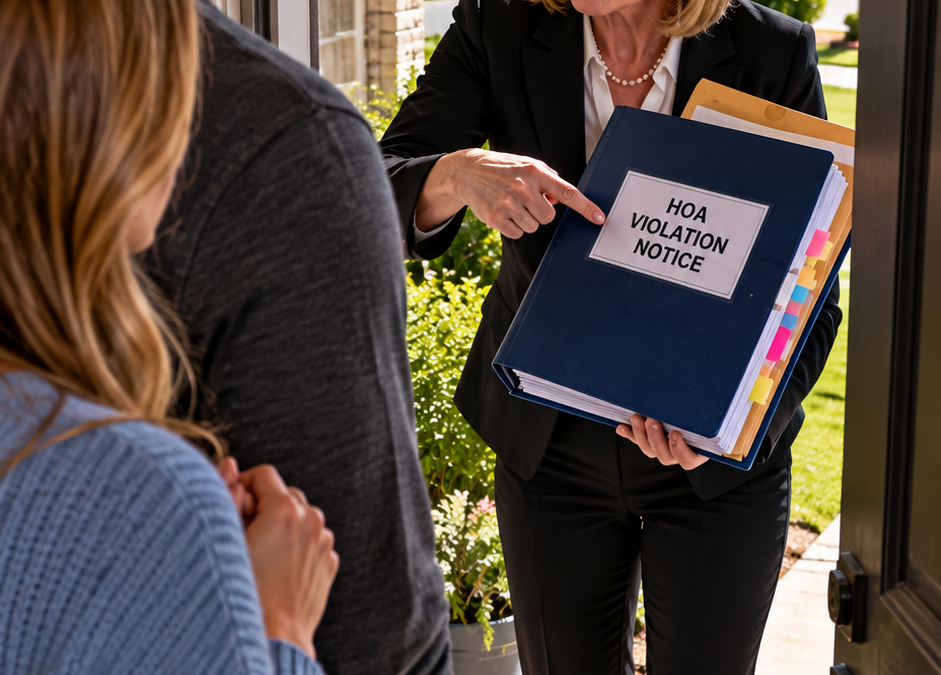
The top page bore the heading: “Briar Glen Residential Occupancy Compliance Notice.”
The second page appeared to be an excerpt from some set of restrictions. The third showed a property identification number and a short paragraph describing enforcement procedures.
At first glance, it looked official.
That was the point.
But official-looking is not the same thing as official.
I read the property number once.
Then again.
Something was wrong.
I had memorized our parcel number during closing because I am the sort of person who reads everything three times before signing it. The number on Karen’s page resembled ours, but it was not ours. Two digits in the middle were reversed, and the final suffix was different.
I looked at the association name printed at the top.
That was wrong too.
Our HOA was Briar Glen Homeowners Association, Inc.
The document said Briar Glenn Residential Community Association.
Two n’s in Glenn.
Different legal name.
Different structure.
Different document source.
I lifted my eyes to Karen.
“This is not our parcel number.”
Her expression did not move.
“It is your property.”
“No,” I said. “It’s a similar number, but it isn’t ours.”
“That is a clerical issue.”
“And the HOA name is wrong.”
Another flicker.
“Again,” she said, “clerical.”
“Two clerical issues on the first page?”
Her voice sharpened.
“You are not qualified to interpret these documents.”
I almost laughed.
Not because anything was funny.
Because the arrogance was so complete it came close to parody.
“I’m qualified to read the deed to my own house.”
Karen extended her hand.
“I’ll take those back.”
I did not give them to her immediately.
“Where did these come from?”
“The association’s file.”
“Who prepared them?”
“That is not your concern.”
“It became my concern when you came to my porch and told my wife she had to leave.”
Emily opened the door behind me.
Her voice was quiet, but steady.
“Karen, what exactly are you accusing me of?”
Karen’s attention snapped to her.
“You are residing in violation of an occupancy restriction applicable to this property.”
“What restriction?”
“You will be provided that information through counsel.”
Emily swallowed.
“My name is on the deed.”
“That may be part of the issue.”
I turned fully toward Karen.
“What is that supposed to mean?”
Karen adjusted the folder again.
“The documents speak for themselves.”
“No,” I said. “They don’t. They have the wrong parcel number and the wrong association name.”
“You can raise your objections in court.”
She said it with satisfaction.
That was when I realized this was already moving. Karen had not come to warn us because she hoped to avoid escalation. She had come to enjoy telling us escalation had begun. The folder was not preparation. It was performance.
“Are you saying you’ve already filed something?” I asked.
“Not yet,” she said. “But the board has authorized enforcement.”
“When did the board vote?”
Her face tightened.
“At the last executive session.”
“Was this on the agenda?”
“Executive matters are confidential.”
“Was notice given?”
“You are not entitled to disrupt board procedure.”
Emily’s voice trembled slightly.
“You want a court to remove me from my own home based on papers you won’t explain?”
Karen looked at her without pity.
“If you had complied with association requirements, we would not be here.”
Emily stepped back as if Karen had physically touched her.
That was enough for me.
“You need to leave,” I said.
Karen lifted her chin.
“You have been notified.”
“No. You have trespassed onto our porch to threaten my wife with a bogus document. Leave.”
For the first time, anger showed plainly on Karen’s face.
“You will regret taking this tone.”
“I regret opening the door.”
She snatched the papers from my hand.
“You’ll see it in court,” she said again.
Then she turned and walked down our steps as though she had delivered justice.
I stood on the porch until her car pulled away from the curb.
Only then did I go back inside.
Emily was standing in the entry hall, one hand pressed against the wall.
“Can they do that?” she asked.
“No.”
I answered too quickly.
She heard it.
“You don’t know that.”
“I know what our deed says.”
“That isn’t the same thing as knowing what they’re willing to do.”
I had no answer for that.
Because she was right.
A person can be wrong and still file papers. A person can be wrong and still force you into a courtroom. A person can be wrong and still frighten your family, drain your savings, and make your home feel unstable.
I stepped closer and took her hand.
“We’re going to pull every record,” I said. “We’re going to compare everything. We’re going to call the county clerk. And if Karen files anything, we will be ready.”
Emily nodded, but her eyes were wet.
“This is our house.”
“I know.”
“No,” she said, her voice cracking. “I mean, this is our house. We chose the paint. We planted the rosebushes. My grandmother’s chair is in the reading room. Your father’s tools are in the garage. We rebuilt the back steps ourselves. How can someone just walk up and say I have to leave?”
I pulled her into my arms.
“She can say anything,” I said. “That doesn’t make it true.”
But as I held her, I felt the same fear moving underneath my anger.
The house had never felt fragile before.
That evening, our dining table became a records office.
We spread out the closing folder, our deed, the title report, the recorded covenants, the HOA declaration, past dues notices, board letters, tax records, and the county parcel printout. Emily brought her laptop. I brought a yellow legal pad. We worked through everything page by page.
Our deed was clean.
Both our names were listed as owners.
The parcel number matched the county database.
The Briar Glen governing documents applied to our lot, but nothing in them resembled Karen’s claim. There were rules about rentals, short-term leasing, exterior alterations, commercial use, nuisance activity, and maximum occupancy under health and safety standards. There was nothing that allowed the HOA to remove one spouse from an owner-occupied home.
Nothing.
No special restriction.
No residency ban.
No hidden approval requirement.
No clause that turned my wife into an unauthorized occupant.
At eleven that night, Emily leaned back from the table and rubbed her forehead.
“This makes no sense.”
“It makes sense if the document isn’t from our property.”
She looked at the page where I had written the mismatched parcel number Karen showed us.
“I want to know whose property that number belongs to.”
“So do I.”
The next morning, I called the county records office.
A clerk named Denise answered after I had been transferred twice. She had the practical, patient voice of someone who spent her workdays guiding panicked people through systems that seemed simple only to the people who built them.
I gave her our parcel number first.
She confirmed it.
Briar Glen Homeowners Association, Inc.
Our names.
Our address.
Our deed recording information.
No occupancy enforcement document recorded beyond the standard declaration.
Then I gave her the number from Karen’s paper.
There was a pause.
“That is not your parcel,” Denise said.
“What is it?”
“I can’t provide confidential information beyond the public record, but I can tell you that parcel is associated with a different property.”
“Same subdivision?”
Another pause.
“No.”
“Same HOA?”
“No. The association name is different.”
I closed my eyes.
“Can you repeat that?”
“The parcel number you gave me is not your property, and the association name attached to it is not Briar Glen Homeowners Association, Inc.”
I thanked her and requested certified copies of our deed and the governing documents tied to our parcel. She explained the process, and I ordered them immediately.
When I hung up, Emily was watching me from across the kitchen.
“It’s wrong,” I said.
She let out a shaky breath.
“We knew that.”
“Now the county knows it too.”
But knowing did not stop what happened two days later.
Karen filed the papers.
A courier delivered the notice just after lunch.
The envelope was addressed to both of us, but the petition inside named Emily as the person subject to removal. The HOA, acting through Karen as president, sought enforcement of an alleged occupancy restriction and requested an order requiring Emily to vacate the property pending compliance review.
I read the words once.
Then again.
The room narrowed around me.
Emily sat down before she finished the second page.
“She actually did it,” she whispered.
I kept reading.
The filing attached the same suspicious pages Karen had brought to our porch, along with a board certification stating that the HOA had reviewed “the property record” and authorized enforcement. Karen had signed it. Her attorney had filed it. The document called Emily an unauthorized occupant three times.
Unauthorized.
In her own home.
My wife pressed her hands together so tightly her knuckles turned white.
I looked at her and felt an anger deeper than anything I had felt on the porch.
Karen had transformed a clerical mismatch, or something worse, into a legal threat against my wife’s place in our home. She had not verified the record. She had not paused when challenged. She had not cared that the parcel number was wrong. She had taken the power of a court filing and aimed it at a woman who had done nothing except live in the house she owned.
I called an attorney that afternoon.
His name was Martin Hale, and he had handled a boundary dispute for a coworker of mine years earlier. He was not theatrical. He did not promise destruction. He asked for documents, listened carefully, and used the phrase “record discrepancy” in a way that made me feel, for the first time all day, that the situation had a shape we could fight.
“Send me everything,” he said.
I did.
Within an hour, he called back.
“This is sloppy,” he said.
“That’s the legal term?”
“It’s the polite one.”
“Can they remove my wife?”
“Based on what I’m seeing? They have a serious evidentiary problem. But we need to respond properly.”
“The parcel number is wrong.”
“Yes.”
“The HOA name is wrong.”
“Yes.”
“The restriction doesn’t appear in our records.”
“Correct.”
“Then why would they file it?”
He was quiet for a moment.
“Because some people think official process will scare homeowners faster than accurate records will protect them.”
I looked toward Emily, who was sitting at the dining table with the filing in front of her like it was a medical diagnosis.
“What do we do?”
“We answer with the record,” Martin said. “No drama. No speculation. Certified deed. County parcel confirmation. Recorded HOA documents. We challenge authenticity, applicability, and chain of source. And if the court sees what I’m seeing, the HOA will have explaining to do.”
That evening, Emily called her mother.
I did not hear the whole conversation.
I heard enough.
Her mother, Judge Margaret Ellison, served on the county circuit court. She was not assigned to HOA disputes as a specialty, but in smaller county systems, civil matters passed through rotations that could place almost anything on a judge’s docket. Emily had grown up careful about never dragging her mother into legal problems. Margaret had been strict about that boundary too.
The law was the law.
Family was family.
Those lines did not cross unless disclosure required it.
Emily stood in the hallway while she spoke, one hand wrapped around her phone, her voice low and strained.
“No, Mom, I’m not asking you to do anything. I just wanted you to know because there’s a filing now.”
A pause.
“I don’t know who it’s assigned to yet.”
Another pause.
“Yes, we have an attorney.”
Then Emily closed her eyes.
“I’m scared.”
That broke something in me.
Not loudly.
Quietly.
Husbands often imagine themselves protecting their wives from dramatic things: strangers, accidents, storms, emergencies. But sometimes the thing hurting the person you love is a stack of paper on a dining table. Sometimes protection means scanning documents until midnight, learning filing deadlines, and telling her for the hundredth time that the house is still hers while secretly wishing you could make the fear leave faster.
When Emily came back into the kitchen, she looked exhausted.
“She said if it comes before her, she’ll disclose immediately.”
“Of course.”
“She sounded angry.”
“She’s your mother.”
“She’s also a judge.”
“I know.”
Emily sat across from me.
“She said those two facts cannot touch.”
I reached for her hand.
“Then they won’t.”
But fate has a cruel sense of timing.
The hearing notice came the next day.
The case had been assigned to Courtroom 3.
Judge Margaret Ellison presiding.
Emily read the notice standing beside the mailbox.
I watched her face go still.
“No,” she said softly.
I took the paper from her.
There it was.
Her mother’s name, printed in black ink beneath the hearing date.
For a moment, all the noise in my head stopped.
Then Emily started shaking her head.
“She can’t hear this.”
“She’ll recuse.”
“Karen will twist it.”
“Let her try.”
“She’ll say we arranged it.”
“We didn’t.”
“She’ll say Mom protected me.”
“Your mother hasn’t done anything.”
Emily looked at me, frightened and furious at once.
“That won’t matter to Karen.”
She was right again.
Karen did not need truth. She needed insinuation. If the judge ruled against her, she would claim bias. If the judge stepped away, she would claim we had hidden the relationship. If another judge dismissed the case, she would claim the court system had protected its own.
People like Karen do not lose arguments. They relocate blame.
Martin filed our response before the hearing.
He also filed a notice disclosing the family relationship out of caution, even though the judge herself would be required to do the same on the record. He wanted no surprises, no appearance of concealment, no opening for Karen’s attorney to pretend we had waited in ambush.
Karen’s attorney responded with a stiff paragraph stating that his client “reserved all rights” concerning judicial assignment.
That phrase made Emily sick to her stomach.
The night before the hearing, she barely slept.
I found her at two in the morning sitting on the edge of the bed, staring at the dark window.
“Em?”
She did not turn around.
“I keep seeing Karen on the porch.”
I sat up.
“She can’t just take you out of this house.”
“I know that in my head.”
“But not in your body.”
She nodded.
“I feel stupid.”
“You’re not stupid.”
“She walked up with a folder, and I let her scare me.”
“She filed papers in court. That would scare anyone.”
Emily wiped at her eyes quickly, irritated with herself for crying.
“My mother spent my whole life teaching me that courts are where facts matter. And now I’m terrified that some wrong number on some wrong paper is going to make me defend my right to sleep in my own bedroom.”
I moved beside her and put my arm around her shoulders.
“The facts still matter.”
“What if they don’t matter fast enough?”
That question stayed with me.
Facts matter, but not always quickly.
Records matter, but only after someone reads them.
Truth matters, but people can suffer while waiting for it to be recognized.
The next morning, we dressed like people going to a funeral.
Emily wore a charcoal dress and low heels. Her hair was pinned back neatly, though I saw her hands tremble twice while she fixed it. I wore a navy suit I had not worn since my cousin’s wedding. Martin met us outside the courthouse holding a slim leather case and a binder tabbed with our evidence.
The courthouse stood downtown, old stone and tall windows, the kind of building meant to make people feel the seriousness of what happened inside. I had passed it many times without thinking much about it. That morning, every step toward the entrance felt heavier.
Security checked our bags.
The hallway smelled faintly of floor polish and paper.
People moved around us carrying files, whispering into phones, waiting on benches, trying not to look scared.
Courtrooms are full of private disasters made public.
Ours was just one more.
Karen arrived ten minutes after we did.
She wore an expensive cream-colored suit, pearl earrings, and the expression of someone attending a ceremony in her own honor. Her folder was tucked under one arm. Her attorney, Daniel Ross, walked beside her, speaking softly. He looked polished and careful, but I noticed he did not look relaxed.
Karen did.
She saw us and smiled.
Not fully.
Just enough.
Emily’s hand tightened around mine.
Martin leaned toward us.
“Do not engage.”
Karen and Ross passed close enough that I could smell her perfume.
“Good morning,” Karen said.
I said nothing.
Emily looked straight ahead.
Karen’s smile widened for a second, then faded when we did not give her the reaction she wanted.
We entered Courtroom 3.
The room was quieter than I expected. Wooden benches. Counsel tables. A seal mounted behind the bench. The American flag and state flag standing motionless in their corners. The judge’s chair sat empty.
I had seen Margaret Ellison many times across holiday tables, birthday dinners, and Sunday lunches. I had watched her laugh while drying dishes, scold Emily gently for skipping breakfast, and fall asleep in an armchair with a book open on her lap. But I had never seen her courtroom from this side.
Emily sat beside me, rigid.
Martin placed our binder on the table.
Across the aisle, Karen arranged her papers neatly, lining them up as though precision on the table could fix inaccuracies inside the documents. Ross whispered something in her ear. She nodded once, confident again.
Then the bailiff stood.
“All rise.”
The side door opened.
Judge Margaret Ellison entered in a black robe.
The room rose around us.
Emily inhaled sharply.
Karen looked up.
For one bright, terrible second, she was still smiling.
Then she saw the judge’s face.
The smile vanished.
Judge Ellison’s eyes moved across the courtroom with controlled professionalism. They passed over Karen, over Ross, over Martin, and then came to rest briefly on Emily.
Only briefly.
But enough.
A mother can recognize fear in her daughter faster than any judge can read a docket.
Then her expression became unreadable.
She took her seat.
“Please be seated.”
Everyone sat.
Karen leaned toward her attorney and whispered something urgently.
I could not hear the first part.
I heard only the last two words.
“That’s her.”
Ross nodded tightly.
Karen turned her head slightly toward Emily.
Understanding moved across her face in stages.
First confusion.
Then recognition.
Then alarm.
Then anger.
It was the first time since she had stepped onto our porch that she looked genuinely uncertain.
Judge Ellison looked down at the file.
“We are here on Briar Glen Homeowners Association, Inc. versus Emily Carter and James Carter, petition for enforcement of alleged occupancy restriction.”
Her voice was calm.
No tremor.
No warmth.
No hint that the woman named in the petition had once been a child who fell asleep on her lap.
“Before any substantive matter is addressed,” she continued, “the court will place a disclosure on the record.”
Karen’s attorney was already standing.
“Your Honor—”
Judge Ellison looked at him.
“You may be heard after the court completes its disclosure.”
He sat.
The judge continued.
“The respondent Emily Carter is my daughter. Respondent James Carter is my son-in-law. I have had no communication with either party regarding the merits of this matter beyond the existence of the filing, and I have not reviewed evidence outside the court file. Given the relationship, recusal may be required. The court will allow counsel to make a record concerning assignment, recusal, and any immediate procedural matters necessary to preserve the status quo.”
Her words were precise enough to cut glass.
No one moved.
Then Ross stood again.
“Your Honor, my client has significant concerns regarding impartiality.”
“I understand,” Judge Ellison said. “Those concerns are precisely why the relationship has been disclosed.”
Ross adjusted his tie.
“We would request reassignment.”
“That request is noted.”
Martin stood.
“Your Honor, respondents agree that reassignment is appropriate given the disclosed relationship. However, we also ask the court to note that petitioner seeks immediate enforcement affecting occupancy of an owner-occupied home, and the petition appears to rely on documents that do not match the county record for the respondents’ property.”
Judge Ellison’s eyes lowered to the file.
Karen’s shoulders stiffened.
Ross said, “We object to counsel arguing the merits before reassignment.”
Martin replied, “I am not arguing the merits. I am identifying an apparent record discrepancy relevant to emergency enforcement.”
The judge looked at the petition.
Her hand turned the first page.
Then the second.
Then the attachment.
The courtroom was so quiet I could hear the faint buzz of the overhead lights.
Judge Ellison did not look at Emily.
She looked only at the document.
“Counsel for petitioner,” she said.
Ross straightened.
“Yes, Your Honor.”
“The property identification number on the attached restriction excerpt appears to differ from the parcel number listed in the petition caption and from the respondents’ address reference. Can you identify the source of this document?”
Ross glanced down at his own copy.
“Your Honor, the document was provided by the association.”
“That was not the question. What is its recorded source?”
Ross paused.
“I would need to confirm the recording information.”
Judge Ellison looked at the next page.
“The association name on this page is Briar Glenn Residential Community Association. The petitioner before the court is Briar Glen Homeowners Association, Inc. Can you explain the discrepancy?”
Karen whispered sharply to him.
Ross held up one hand toward her, barely.
“Your Honor, it may be a clerical variation.”
“May be?”
“I do not have independent confirmation at this moment.”
Judge Ellison turned to the clerk.
“Please access the county property record for the respondents’ parcel number as listed in the petition.”
The clerk began typing.
Karen’s face had gone pale under her makeup.
Ross stood very still.
Judge Ellison’s voice remained neutral.
“The court is not making findings on the merits. The court is identifying procedural concerns apparent on the face of the filing before taking action on any requested immediate relief.”
That sentence mattered.
Even I understood that.
She was building a clean record, not protecting us.
She was not saying Karen was wrong because Emily was her daughter. She was saying the paper in front of her did not match itself.
The clerk looked up.
“Your Honor, county records show the parcel at the respondents’ address under James Carter and Emily Carter. Briar Glen Homeowners Association, Inc. declaration recorded under instrument number 14-8821. I do not see the attached occupancy restriction under this parcel record.”
Ross swallowed.
Judge Ellison asked, “Does the parcel number shown on petitioner’s attachment match the respondents’ parcel?”
The clerk typed again.
“No, Your Honor.”
Karen closed her eyes briefly.
The judge said, “Enter the discrepancy into the record.”
The clerk nodded.
Martin stood.
“Your Honor, respondents have certified copies of the deed and recorded HOA declaration available.”
Ross objected immediately.
“Again, Your Honor, petitioner objects to substantive evidence being introduced before reassignment.”
Judge Ellison looked at him.
“Counsel, your client seeks relief that would affect whether a titled owner may occupy her home. The court will not issue any interim enforcement order on a filing with unresolved record discrepancies. The evidence may be marked for identification only and reviewed by the reassigned judge.”
Ross’s jaw tightened.
“Yes, Your Honor.”
Martin handed the certified copies to the clerk.
I watched Karen watch those documents cross the courtroom.
For days, she had treated paperwork like a weapon.
Now real records had entered the room.
There was a difference.
Judge Ellison turned another page in Karen’s packet.
“Counsel for petitioner, who verified the original property record before this petition was filed?”
Ross looked toward Karen.
Karen looked down.
“Your Honor,” Ross said carefully, “my understanding is that the documents were prepared by the HOA’s management company and provided to the board.”
“That does not answer who verified them against the county record.”
“I do not know at this time.”
Judge Ellison looked at Karen.
“Ms. Whitmore, you signed the board certification attached to this petition.”
Karen stood slowly.
“Yes, Your Honor.”
“Did you personally verify that the attached restriction applied to the respondents’ parcel?”
Karen’s voice had lost its polished edge.
“I relied on the management company’s file.”
“That is not what I asked.”
Karen swallowed.
“No, Your Honor. I did not personally verify it with the county.”
“Did anyone on the board verify it?”
“I believed the management company had done so.”
“Did you confirm that belief?”
“No.”
The silence that followed felt enormous.
Emily’s hand found mine under the table.
Her fingers were cold.
Judge Ellison looked back to Ross.
“Petitioner seeks significant relief. The court expects parties to verify property records before requesting enforcement affecting occupancy.”
Ross said, “Understood, Your Honor.”
Karen sat down slowly.
Her folder no longer looked powerful. It looked heavy.
Then, because Karen could not help herself, she stood again.
“Your Honor, if I may—”
Ross reached for her sleeve.
She pulled away.
“The respondents have not been transparent with the association. This entire situation exists because information was withheld from the HOA.”
Judge Ellison’s face did not change.
“What information?”
Karen hesitated.
“Their occupancy information.”
“What specific information was requested and withheld?”
Karen opened her mouth.
No words came.
Judge Ellison waited.
The courtroom waited.
Emily lifted her chin slightly.
For the first time that morning, I saw something steadier move through her.
Karen looked at her papers, then at Ross, then at the judge.
“I would need to review the file.”
Judge Ellison said, “Then the accusation will not be treated as fact.”
Karen sat down.
That was the moment her case began to collapse in public.
Not with shouting.
Not with a dramatic confession.
With a simple request for specificity.
What information?
Which record?
Who verified it?
Where was it recorded?
Karen had built her threat out of vague authority. The courtroom demanded exactness. Under exactness, her confidence began to break apart.
Judge Ellison announced a brief recess.
“During the recess,” she said, “court administration will be contacted for reassignment. No further substantive matter will be heard by this court beyond necessary transfer orders.”
The gavel came down lightly.
“All rise,” the bailiff said.
Judge Ellison left the bench.
Emily stood beside me, breathing carefully.
I wanted to put my arms around her, but Martin gently shook his head.
“Not here,” he murmured. “Stay composed.”
Across the aisle, Karen was whispering furiously to Ross. He was not whispering back with equal intensity. He looked angry now, but not at us. He looked like a lawyer who had just discovered that his client’s confidence had outrun her evidence.
The recess lasted twenty minutes.
I spent most of it staring at the wall clock.
Emily did not speak.
When the courtroom resumed, Judge Ellison returned only long enough to issue the transfer.
She disclosed again for the record. She recused herself formally. She stated that another judge would review the petition, the response, the marked documents, and the record discrepancies independently. She made clear she would take no further part in the case.
Then she left.
Just like that, Emily’s mother was gone from the matter.
No rescue.
No secret help.
No family favor.
Only disclosure, restraint, and a clean record.
Another judge took the bench later that afternoon.
Judge Paul Renshaw was older, with silver hair, rimless glasses, and the weary directness of a man who had no patience for theatrics disguised as procedure. He began by confirming that he had reviewed the transfer order, the petition, the response, and the documents marked during the earlier appearance.
He looked at Ross first.
“Counsel, does petitioner still seek immediate occupancy enforcement today?”
Ross stood.
“Your Honor, given the questions raised regarding document verification, petitioner requests a short continuance to investigate.”
Karen turned toward him sharply.
That was not what she wanted.
Judge Renshaw noticed.
“Ms. Whitmore, your counsel speaks for you in court.”
Karen faced forward again.
Martin stood.
“Your Honor, respondents oppose any continuance that leaves the petition hanging over Mrs. Carter’s occupancy rights without a finding that the HOA has produced applicable recorded authority. At minimum, we request denial of immediate relief and an order requiring petitioner to verify the property record before proceeding.”
Judge Renshaw looked down at the papers.
“The court has the certified deed?”
The clerk handed it up.
He reviewed it.
“The respondents are both titled owners.”
“Yes, Your Honor,” Martin said.
“The petition identifies Mrs. Carter as an unauthorized occupant.”
“Yes.”
“On what basis?”
Ross stood again, slower this time.
“Your Honor, the petition was filed based on documents provided to the association that appeared to indicate an occupancy restriction.”
“Appeared to whom?”
Ross paused.
“To the board and management company.”
“Was the restriction recorded against this parcel?”
“At this time, we cannot confirm that.”
Judge Renshaw looked over his glasses.
“That is a problem.”
Karen shifted in her chair.
The judge turned to the clerk.
“The county record comparison?”
The clerk summarized what had already been entered: wrong parcel number, different association name, no matching recorded restriction in the respondents’ property record.
Judge Renshaw leaned back.
“I am not removing, restricting, or clouding the occupancy rights of a titled homeowner based on an unverified document attached to the wrong parcel number.”
Emily’s grip on my hand tightened.
This time with relief.
Ross said, “Understood, Your Honor.”
Judge Renshaw continued.
“Petitioner may pursue any lawful remedy supported by verified records. But this petition, as currently presented, does not support immediate enforcement. The request for immediate relief is denied.”
Karen’s lips parted.
Judge Renshaw looked at her directly.
“Ms. Whitmore, this court expects property-related enforcement filings to be grounded in verified records. Homeowners’ associations do not get to shortcut title, deed, and recording requirements by attaching documents from uncertain sources.”
Karen’s face burned red.
“Yes, Your Honor,” she said, barely audible.
“The parties are ordered to follow proper property record process. If petitioner contends a restriction applies, petitioner must identify the recorded instrument, recording information, parcel applicability, and chain of authority. Until then, the court will not entertain any request to remove an owner from an owner-occupied home.”
The gavel came down.
The immediate threat was over.
Emily closed her eyes.
I felt her body fold slightly toward mine, not collapsing, just releasing tension she had carried for days. I put my hand over hers, and this time Martin did not stop me.
Karen remained seated across the aisle, staring at the table.
Her folder sat unopened in front of her.
For once, she seemed afraid to touch it.
Outside the courtroom, the hallway felt brighter than it had that morning.
Not because everything was finished. The judge had not declared Karen malicious. He had not punished the HOA. He had not ended every possible future dispute. But the thing that mattered most had happened.
Emily was not leaving our home.
The court had refused to let Karen convert bad paperwork into immediate power.
We walked toward the exit with Martin beside us.
“Do we need to do anything else today?” I asked.
“Not today,” he said. “We wait to see whether they try to refile with verified documents. My guess is they have a bigger problem than they understood.”
Emily said quietly, “What kind of problem?”
Martin glanced back toward the courtroom doors.
“If those documents came from the wrong property by mistake, they were careless. If they knew and filed anyway, it’s worse. Either way, they asked a court to remove you from your home without confirming the record.”
Emily nodded, but she looked exhausted rather than satisfied.
At the courthouse steps, we stopped.
Karen’s voice came from behind us.
“Emily.”
We turned.
Karen stood a few feet away, clutching the folder to her chest. Ross was not beside her. For the first time since I had known her, she looked smaller without someone or something official at her side.
Her eyes moved from Emily to me.
“I did not know Judge Ellison was your mother.”
Emily’s voice was flat.
“That was disclosed.”
“I never would have filed it that way if I had known.”
I stepped forward slightly.
“That’s what bothers you? Not the wrong parcel number? Not calling my wife unauthorized in her own house? Not filing unverified documents?”
Karen’s eyes narrowed.
“I relied on the records provided to me.”
“You ignored us when we told you they were wrong.”
“They looked official.”
“So did your threat.”
Emily’s voice cut through mine, quiet but firm.
“You came to my porch and told me I had to leave my home.”
Karen looked at her.
“I was enforcing what I believed was an HOA restriction.”
“You didn’t check.”
Karen’s jaw tightened.
“The management company prepared the file.”
“You signed it,” Emily said.
That silenced her.
A car passed on the street. Somewhere behind us, the courthouse doors opened and closed. People moved around us, carrying on with their own problems, their own filings, their own private griefs.
Karen looked away first.
“This is not over,” she said.
The words should have frightened us.
They didn’t.
Not this time.
Emily looked at her with a steadiness that had been missing for days.
“Then next time,” she said, “bring the right records.”
Karen’s mouth tightened, but she did not answer.
She turned and walked toward the parking lot.
I watched her go, feeling no triumph.
Only relief.
And something colder beneath it.
Because the damage had already been done, even if the eviction had failed. For three days, Emily had wondered whether a court might force her out of the home she owned. She had cried in the middle of the night. She had walked through our rooms touching furniture as though memorizing it. She had folded laundry with shaking hands because Karen had made ordinary domestic life feel temporary.
That kind of fear does not vanish when a judge denies a petition.
It leaves residue.
We drove home in silence.
When we pulled into the driveway, Emily did not get out immediately.
She sat in the passenger seat looking at the house.
The rosebushes she had planted along the walkway were beginning to bloom. The porch light was still on from when we left before sunrise. Through the front window, I could see the blanket she had folded across the couch the morning Karen came.
Emily stared at it all for a long time.
Then she whispered, “I was afraid to come back and find it didn’t feel like ours anymore.”
I reached for her hand.
“Does it?”
She looked at the front door.
After a moment, she nodded.
“Yes.”
We went inside.
No one stopped us.
No folder waited on the porch.
No court officer stood in the hallway.
The house smelled faintly of coffee and lemon cleaner. The ordinary mess of our lives was still there: shoes near the mat, a stack of mail on the entry table, a half-finished crossword on the arm of the couch, a plant Emily kept forgetting to water somehow still alive near the window.
She walked room to room slowly.
I followed at a distance.
In the kitchen, she stopped beside the dining table where all the records still lay in piles. The deed. The title report. The certified copies. The court papers. The wrong documents. The right ones.
She picked up our deed and ran her fingers over her name.
“I hate that I needed this to feel safe,” she said.
“I know.”
“But I’m glad we had it.”
“So am I.”
That night, we filed everything into a binder.
Not because we wanted to live defensively forever, but because the experience had taught us something ugly and useful. Ownership is not just a feeling. It is not just a key, a mortgage payment, a memory, or a life built inside walls. Ownership is also paper, record, number, legal description, signature, recording stamp. It is a story the county can verify when someone else tries to tell a false one louder.
I labeled the binder PROPERTY RECORDS.
Emily added a smaller label beneath it.
OUR HOME.
I smiled when I saw it.
“That’s better,” I said.
She leaned against me.
“It’s the part that matters.”
Over the next few weeks, the HOA became very quiet.
There were no new filings.
No revised petitions.
No corrected restriction.
No explanation of how a document from another parcel and another association had landed in Karen’s enforcement folder. The management company sent a short letter saying the matter was “under internal review.” Karen did not come back to our porch.
The board held a meeting the following month.
We attended.
Not because we wanted drama, but because we had learned what happened when people like Karen operated without witnesses.
The room was full when we arrived. Word had spread, of course. It always does. Neighbors turned to look at us with a mixture of curiosity, embarrassment, and quiet sympathy. A few looked away too quickly. Those were the ones who had probably believed Karen’s version before the court record corrected it.
Karen sat at the front table.
She looked thinner somehow, though maybe it was only the absence of that old certainty.
During open comment, Emily stood.
The room went still.
She held no folder.
No dramatic stack of papers.
Only one page.
“My name is Emily Carter,” she said. “I am a homeowner in Briar Glen. Last month, the association filed a court petition identifying me as an unauthorized occupant in my own home. The filing relied on documents that did not match our parcel number, did not match the association’s legal name, and were not verified against the county record before enforcement was pursued.”
Karen’s face froze.
Emily continued.
“I am not here to argue the case. The court record speaks for itself. I am here to ask that no homeowner in this community ever again be threatened with removal from their home based on unverified paperwork.”
No one spoke.
Emily looked toward Karen.
“Before enforcement reaches a porch, a lawyer, or a courtroom, the board should verify the record. That is not hostility toward the HOA. That is basic responsibility.”
She sat down.
For several seconds, the room remained silent.
Then an older man in the second row stood.
“I’d like that entered into the minutes,” he said.
Another resident raised her hand.
“I’d like to know how this happened.”
Then another.
“And who approved the filing?”
Then another.
“Was the board shown the actual deed?”
Karen tried to regain control of the meeting.
“We cannot discuss pending legal matters.”
A man near the back said, “Is it pending if the judge denied it?”
The room shifted.
Not into chaos.
Into accountability.
Karen had always been strongest when homeowners were isolated: one letter, one fine, one porch confrontation at a time. But in that room, people began comparing stories. A widow mentioned a violation notice sent to the wrong lot number. A young couple said they had been threatened over a fence approval already granted by the prior board. Another resident asked whether the management company’s records had ever been audited.
Karen’s authority did not collapse that night.
Real life is slower than that.
But it cracked.
And everyone heard it.
Two months later, the board voted to require record verification before any legal enforcement action involving property rights. Three months later, the management company was replaced. Karen finished her term, but she did not run again.
She never apologized.
Not to me.
Not to Emily.
Not publicly.
For a while, that bothered me more than I wanted to admit. I thought I needed to hear her say she had been wrong. I thought closure required acknowledgment from the person who caused the harm.
But some people cannot give that.
Not because they do not understand.
Because understanding would require them to see themselves clearly.
So we stopped waiting.
The house became ours again in the way homes become ours through living, not through court records.
Emily repainted the reading room a deep green that looked almost black at night. I fixed the loose board on the back steps. We planted two more rosebushes along the walkway. Her grandmother’s chair stayed by the window. My father’s tools stayed in the garage. Sunday mornings returned to coffee, laundry, sunlight across the kitchen floor, and the quiet comfort of not having to defend every ordinary thing.
Still, the binder remained on the shelf in my office.
Every so often, I would notice it and feel that old anger stir.
Then I would hear Emily laughing in another room, or see her curled in the chair with a book, or watch her step onto the porch barefoot to water the roses, and the anger would settle into something firmer.
Resolve.
That was what Karen gave us, though she never meant to.
She taught us that a home is not protected by assuming people will be reasonable. It is protected by knowing the truth well enough to stand on it when someone arrives carrying lies in a folder.
The strangest part is that my mother-in-law never had to choose between family and the law.
Karen thought the relationship would be the dramatic twist. She thought the judge’s identity was the reason her plan failed. But that was never true.
Judge Ellison did exactly what she was supposed to do.
She disclosed.
She preserved the record.
She stepped away.
Another judge looked at the same papers and saw the same problem.
Wrong parcel.
Wrong association.
No verified restriction.
No basis to remove my wife from our home.
That was the truth Karen could never talk her way around.
The law did not save us because Emily’s mother wore a robe.
The law saved us because the record was stronger than Karen’s performance.
Sometimes people imagine justice as a thunderclap. A dramatic speech. A final ruling that makes every wrongdoer lower their head in shame.
Ours was quieter.
It sounded like a clerk reading a parcel number.
It looked like a judge comparing names on a page.
It felt like my wife squeezing my hand under a courtroom table while a false story finally ran out of places to hide.
And when it was over, there was no applause.
There was only the right to go home.
So that is what we did.
We went home, unlocked our own door, stepped inside together, and stayed.








