𝗙𝗨𝗟𝗟 𝗦𝗧𝗢𝗥𝗬 The Woman at My Gate Carried Papers Like They Could Erase Twenty Years of Ownership
𝗙𝗨𝗟𝗟 𝗦𝗧𝗢𝗥𝗬
The younger contractor, Luis according to the name stitched on his shirt, looked up from a toolbox. The older one, Mike, had already lifted a cutting machine from the truck bed.
I raised my voice.
“Don’t unload anything else.”
Mike paused.
Karen turned toward him sharply. “Continue.”
I looked straight at Mike.
“If you touch that gate, you are cutting private property.”
Mike glanced between us, suddenly less sure of himself.
Karen stepped closer to me.
“Mr. Ward, the contractors have a work order.”
“From whom?”
“The HOA board.”
“The HOA board does not own this gate.”
“The HOA maintains the western approach.”
“No,” I said. “The HOA occasionally has landscapers mow the shoulder outside the subdivision entrance. That does not give them title to my land.”
Karen’s expression cooled.
“I can see this is going to be difficult.”
“It became difficult when you showed up with trucks.”
She lifted one page from the packet and tapped it with a manicured finger.
“You were notified.”
“I was not.”
“This notice was issued.”
“I didn’t receive it.”
“It was sent.”
“Where?”
She glanced at the page. “To the address on file.”
“My ranch address?”
“To the address associated with the affected entrance.”
“That is not an answer.”
Her eyes flicked back to mine.
“The board followed procedure.”
I almost laughed, but there was nothing funny about the cutting machine sitting ten feet from my gate.
“I want to see the document that says my ranch is subject to Briwood Ridge covenants.”
Karen inhaled slowly, as if speaking to a stubborn child.
“You are benefiting from the neighborhood’s maintained approach.”
“I maintain my entrance.”
“The HOA has maintained the surrounding area.”
“You mean the strip outside the fence the county occasionally grades?”
“That area is part of the community’s visual corridor.”
“That phrase doesn’t mean anything legally.”
“It means the board has jurisdiction.”
“No,” I said. “It means someone wrote an impressive sentence.”
Mike cleared his throat.
“Ma’am,” he said to Karen, “do you want us to wait?”
“No,” Karen said immediately. “Begin with the hinge side.”
I stepped between him and the gate.
“Do not start that machine.”
Mike’s face tightened. He was not looking for a fight. Most working men are not. They come with a job sheet, do what the paper says, collect a check, and go home. I did not blame him for standing there with the equipment.
But I would blame him if he used it.
Luis lowered a pry bar onto the gravel.
“Maybe we should hold up,” he said quietly.
Karen heard him.
“You were hired to remove an unauthorized structure,” she said. “The association expects the work completed today.”
I pulled out my phone.
Karen’s eyes narrowed. “Who are you calling?”
“The sheriff.”
She gave a short laugh.
“That is unnecessary.”
“Then you shouldn’t mind waiting.”
“We are not delaying scheduled work because you disagree with enforcement.”
I dialed anyway.
My hands were steady, but I could feel my heartbeat in my throat. Not because I was afraid of Karen. I had dealt with difficult people before. Ranch life teaches patience because animals do not care about your temper, weather does not care about your plans, and machinery breaks most often when you need it most.
But this was different.
A person can insult me, threaten me, or send letters.
Cutting my gate was a physical act.
Once steel is cut, no apology makes it whole again.
The dispatcher answered. I gave my name, my address, and explained that contractors were attempting to remove my ranch gate under an HOA work order even though my property was outside their boundary.
The dispatcher asked if there was an active confrontation.
I looked at Karen, who was now whispering sharply to Mike.
“Yes,” I said. “They are setting up equipment.”
“Are there weapons?”
“No.”
“Any threats?”
“Not verbal threats. But they’re preparing to cut the gate.”
She told me a deputy would be sent.
I ended the call and put the phone in my pocket.
Karen crossed her arms.
“You have escalated this unnecessarily.”
“You brought a cutting machine to my property.”
“You were given ample opportunity to comply.”
“I was given nothing.”
“That is not our problem.”
I looked at her for a long moment.
That sentence told me who I was dealing with.
Not our problem.
She could stand in front of a man’s ranch with contractors, documents, and no proof that she had any authority there, and still believe the burden belonged to me.
Behind me, Daisy whinnied again from the pasture.
The sound pulled my attention toward the barn. Horses do not like unfamiliar machines. They do not understand paperwork, HOA boards, compliance notices, or women in red blazers. They understand tone, noise, pressure, and movement.
I saw my gelding, Ranger, moving along the fence line, head high, ears forward.
The cutting machine would spook him if they started it.
I turned back.
“Karen, I am telling you clearly. Do not cut that gate.”
She lifted her chin.
“Mike, proceed.”
Mike hesitated only a second.
Then he put on his face shield.
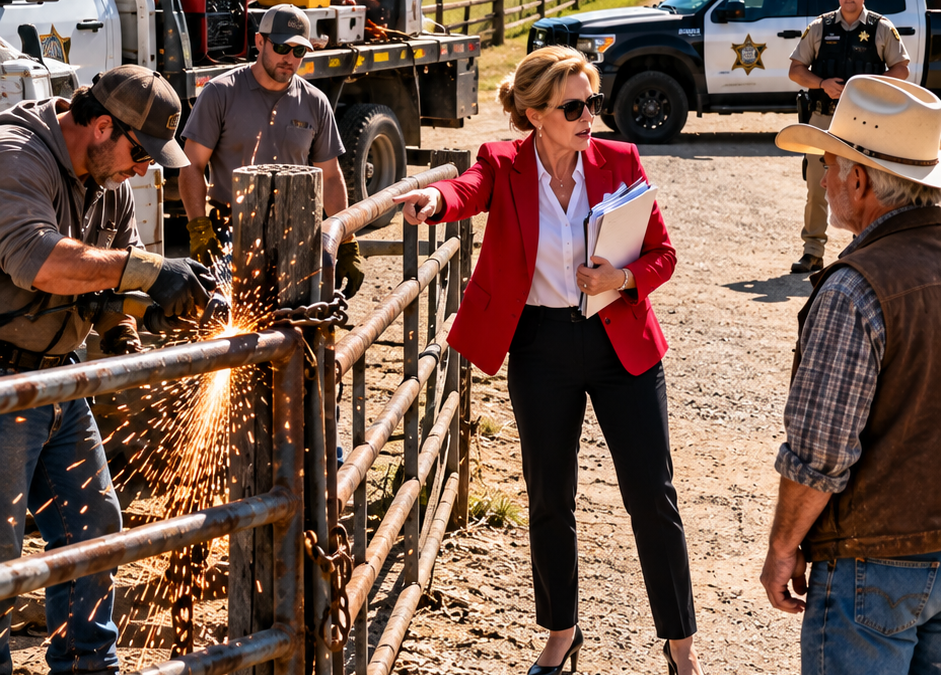
The machine screamed to life.
That sound ripped through the morning.
Daisy startled. Ranger tossed his head. The first sparks sprayed from the hinge bracket like angry orange insects.
For one second, I froze.
It was not fear that stopped me.
It was disbelief.
There are things you expect people to say and things you expect people to threaten. But when the sparks actually fly, when metal that has stood for decades begins to burn under a blade because someone who does not own it has decided she can order its destruction, a cold clarity comes over you.
I moved back, not because I accepted it, but because I was not going to put my body against a cutting wheel and give Karen a chance to make the story about my recklessness.
“Stop!” I shouted.
Mike did not stop.
Karen stood nearby, watching like a manager supervising a late shipment.
The blade bit into the old metal.
Sparks fell onto my gravel.
I heard a vehicle approaching from the county road.
At first, I thought it might be another contractor.
Then I saw the sheriff’s SUV.
It turned in fast enough to throw dust, then stopped at an angle beside the entrance. The machine cut off almost immediately. The sudden silence rang in my ears.
Sheriff Daniel Brooks stepped out.
I had known Dan Brooks for years, though not well. In a county our size, you did not have to be friends with a man to know his reputation. He had been sheriff for nearly a decade. Before that, he had worked patrol roads where cattle got loose, neighbors argued over fences, and people discovered that property lines could ruin friendships faster than politics.
He was not dramatic.
That was what I liked about him.
He walked toward us with his hat low, his face unreadable, and his thumbs resting near his belt.
His first glance went to the gate.
The hinge plate was scored now, not cut through, but damaged. Fresh metal shone bright beneath the old paint. Tiny black marks dotted the gravel where sparks had landed.
Then he looked at me.
“Jack.”
“Sheriff.”
He looked at Karen, then at Mike and Luis.
“Who ordered the gate cut?”
Karen stepped forward before anyone else could speak.
“I did, Sheriff. Karen Millner, Briwood Ridge HOA.”
Dan turned his head slowly toward her.
“You ordered contractors to cut Mr. Ward’s gate?”
“This gate is under HOA enforcement.”
“Is it?”
“Yes.”
“Based on what?”
Karen opened her folder again, relieved to be back in the world of paper.
“Based on board review and approved standards for the western entrance corridor. The structure is noncompliant and has been scheduled for removal.”
Dan took the papers she handed him.
He read them without expression.
I could feel the whole morning balancing on the next few minutes.
Karen stood confidently, almost smugly, as if a badge would automatically respect letterhead. Mike kept his face shield lifted and his eyes lowered. Luis looked like he wished he had called in sick.
Dan flipped the page.
“Do you have a court order?”
Karen blinked.
“A court order?”
“Yes.”
“This is an HOA matter.”
“Do you have a court order authorizing removal of property over the owner’s objection?”
Her mouth tightened.
“The board voted.”
“That is not what I asked.”
“The association has enforcement authority.”
“Over this parcel?”
“Yes.”
Dan looked toward me.
“Jack, do you have your survey?”
“In the house.”
“Go get it.”
Karen objected immediately.
“Sheriff, the work crew is on a schedule.”
Dan looked at her, calm as stone.
“Then they can use the time to stop working.”
Mike stepped back from the gate at once.
I went to the house.
The walk up the drive felt longer than usual. My boots sounded hard on the gravel. My horses watched me from the fence, still restless. I wanted to stop and settle them, but I knew the documents mattered more in that moment.
Inside, I went to the old file cabinet in my office.
I knew exactly where the survey was.
Second drawer. Blue folder. Recorded property documents. Closing papers. Boundary survey. Easement records. Tax maps. The kind of papers most people forget about until someone in a blazer tries to cut down their gate.
My hands touched the folder, and for a moment, I thought of the day I bought the ranch.
I was younger then, thirty-eight, with more strength than money and more stubbornness than sense. The place had needed work. Fences sagged. The barn roof leaked. The pasture had gone thin. My friends told me I was buying a problem with acreage.
Maybe I was.
But I loved it from the first day.
I loved the open ground, the quiet, the way the house sat low against the wind. I loved that the gate marked something real. Not wealth. Not status. Work. Responsibility. A line I had chosen.
I had signed those papers with shaking hands.
Not because I was scared.
Because I knew I was taking hold of the rest of my life.
Now someone was standing at the entrance with a folder from an HOA that did not exist when I bought the place, telling me that line no longer mattered.
I carried the documents back outside.
Dan was standing near the gate. Karen was talking at him, but he was not reacting. Mike and Luis had shut everything down. The cutting machine sat on the gravel like evidence.
I handed Dan the blue folder.
He opened the survey first.
The map was clear. My ranch boundary ran along the frontage road, curved around the entrance, and enclosed the gate entirely inside my parcel. The surveyor’s seal was stamped in the corner. The legal description matched my deed.
Dan studied it, then looked at the gate, then back at the map.
Karen leaned closer.
“What is that?”
“My recorded survey,” I said.
She frowned as if the existence of my documents offended her.
Dan asked, “Do you have the HOA boundary map?”
Karen opened her folder again.
“Yes.”
She pulled out a glossy neighborhood map, the kind printed for meetings and welcome packets. It showed Briwood Ridge lots, streets, common areas, walking paths, and entrance features. It also showed a shaded region labeled western approach.
She placed it beside my survey on the hood of her truck.
For a few seconds, nobody spoke.
The two maps did not match.
Not slightly.
Not in a technical way only a surveyor could see.
They were plainly different.
The HOA map treated the entrance area as if the neighborhood reached farther west than it did. My survey showed the recorded boundary stopping short of my ranch entrance.
Dan put one finger on my survey.
“This is recorded?”
“Yes,” I said. “County records. Same survey used when I bought the property. Updated copy from the boundary confirmation ten years ago.”
He turned to Karen.
“Is your map a recorded survey?”
Karen looked down at it.
“It is the association map.”
“That is not what I asked.”
“It is used for HOA planning and maintenance.”
“Is it a recorded legal survey?”
Her mouth opened, then closed.
“I would have to confirm that.”
Dan nodded once.
“Then as of now, this map does not authorize anyone to cut this gate.”
Karen’s face flushed.
“Sheriff, with respect, the HOA has maintained this entrance area for years.”
I said, “No, it hasn’t.”
She turned on me.
“Yes, it has.”
“You hired landscapers to mow near the road twice last summer because your residents complained about weeds. That is not maintenance of my entrance.”
“The visual corridor—”
“Stop calling my driveway a corridor.”
Dan raised one hand.
Both of us went quiet.
He looked at Karen.
“Maintenance, even if it happened, is not ownership.”
Karen’s eyes sharpened.
“I understand that.”
“I’m not sure you do.”
That hit her like a slap, though Dan had not raised his voice.
He continued.
“If there is a genuine property dispute, you handle it through records, attorneys, surveyors, and civil court if necessary. You do not send contractors with cutting equipment to remove a structure from land that may not belong to you.”
“The board authorized it.”
“Then the board can provide legal authority.”
Karen stiffened. “They did.”
“Where?”
She looked through her folder.
The more she searched, the quieter the ranch became.
Paper shifted. Clips snapped. Her breath grew sharper.
But no document appeared.
No easement. No deed. No court order. No recorded covenant tying my ranch to Briwood Ridge. No county permit authorizing removal.
Just letters.
Minutes.
A map.
A work order.
Dan watched her search.
Finally, he said, “Who told you the gate belonged to the HOA?”
Karen did not answer immediately.
I saw the first crack in her confidence.
It was small, but I had spent my life watching animals. I knew when posture changed. I knew when certainty became defense.
“The board reviewed the location,” she said.
“That is not an answer.”
She swallowed.
“The instruction came from the board.”
“Which board member?”
“I don’t think it’s appropriate to—”
“Karen,” I said, my voice harder than before, “someone sent two trucks to my ranch to cut my gate. Say the name.”
Her eyes flashed with anger.
But Dan was waiting too.
Finally, she said, “Martin Hale signed the enforcement approval.”
I knew the name.
Martin Hale lived in Briwood Ridge. He had moved in five years earlier and complained three times about my horses kicking up dust when the wind blew east. He had once asked whether I would consider installing “more aesthetically consistent fencing.” I had told him no.
Dan turned toward Mike.
“You have a work order?”
Mike looked uncomfortable.
“Yes, sir.”
“Let me see it.”
Karen quickly said, “That is a private contractor document.”
Dan looked at her.
“Not anymore.”
Mike walked to his truck, pulled a clipboard from the cab, and brought it over.
He handed it to the sheriff without looking at Karen.
Dan read it.
I watched his expression.
The work order was simple and damning. Remove existing iron gate at western approach. Dispose of structure. Clear entrance obstruction. Work approved by Briwood Ridge HOA representative. Signature: Martin Hale.
No county authorization.
No attached survey.
No court order.
No owner consent.
Dan handed the clipboard back to Mike.
“Did you confirm ownership before beginning?”
Mike’s face tightened with embarrassment.
“We were told the HOA owned it.”
“By whom?”
“The lady here and the work order.”
“Did Mr. Ward give permission?”
“No.”
“Did you ask him?”
Mike looked at me.
“No, sir.”
Luis shifted near the truck.
Dan turned to him. “You understand you need to stop work immediately.”
Luis nodded fast. “Yes, Sheriff.”
Mike said, “We’ll pack it up.”
Karen cut in. “Sheriff, this is a civil matter.”
Dan looked back at her.
“It became more than a civil conversation when your contractor started cutting property without clear authority after the owner objected.”
Her face went still.
I could tell she had expected the words civil matter to protect her.
People use that phrase like a shield. They say it when they want law enforcement to step aside while the damage continues. Sometimes it works. Sometimes officers shrug and leave people to fight later over what has already been broken.
But Dan Brooks had seen the sparks.
He had seen the cut.
He had seen the maps.
And he had heard enough.
“This gate stays exactly where it is,” he said.
Karen’s voice rose. “You cannot overrule the HOA board.”
“No,” he said. “But I can stop an active disturbance and prevent further damage while ownership is unresolved. And right now, the only recorded survey anyone has shown me says this gate is on Mr. Ward’s property.”
Karen looked at my survey again.
For the first time that morning, she seemed to actually see it.
Not as an inconvenience.
As a problem.
The contractors began loading their equipment back onto the truck. The metallic clank of tools sounded almost gentle compared to the scream of the cutter. Mike secured the machine in the flatbed while Luis gathered cords and gloves.
I walked to the gate.
The damaged hinge plate was warm when I put my hand near it. I did not touch the fresh cut directly. The metal smelled burned.
Above the crossbar hung the old wooden ranch sign.
WARD RANCH.
The letters were faded, carved years ago by a friend who had died before Briwood Ridge existed. I ran my hand across the wood, feeling the grooves of my own name.
There are moments when anger comes loud.
This was not one of them.
My anger came quiet.
Deep.
The kind that does not burn out quickly because it has settled somewhere permanent.
Karen stepped closer, though not as close as before.
“Mr. Ward,” she said, “this may have been a misunderstanding.”
I looked at the fresh scar on the hinge.
“No, Karen. A misunderstanding is when someone turns into the wrong driveway. This was a decision.”
“The board acted on the information available.”
“You acted without checking the county records.”
Her lips pressed together.
“I trusted the board’s documentation.”
“You trusted what you wanted to trust.”
She did not answer.
Dan closed my folder and handed it back to me.
“Jack, I’m going to give you an incident number. Take photos of the damage before you repair anything.”
“I will.”
“If this continues, contact an attorney. And if anyone returns to remove, cut, block, or alter this gate without a court order, call us immediately.”
Karen said, “Sheriff, surely that is unnecessary.”
Dan turned to her.
“What’s unnecessary is cutting a man’s gate before proving you have the right.”
She looked away.
Mike approached me slowly.
“Mr. Ward.”
I turned.
He took off his gloves and held them in one hand.
“I’m sorry. We were told it was cleared.”
I believed him.
Not completely, maybe. A contractor still has responsibility. But I believed he had not come intending to trespass. He had trusted paperwork from someone who spoke with authority.
That was how damage often happened.
Not because every person involved was evil.
Because one person lied confidently, and others decided checking was not their job.
“You should confirm next time,” I said.
Mike nodded. “I will.”
Luis looked at the gate. “We didn’t know.”
“I know.”
They finished loading the trucks.
Karen remained near the entrance, her red blazer bright and stiff, but she looked smaller now. Without the workers moving at her command, without the cutting machine screaming, without the assumption that everyone would obey the paper in her folder, she was just a woman standing on someone else’s gravel with a map that did not match the land.
Dan wrote the incident number on a card and handed it to me.
Then he looked at Karen.
“I suggest you leave.”
She gathered her papers slowly.
The glossy HOA map slipped slightly from the folder, and she shoved it back inside as if embarrassed by it.
Before she got into her truck, she looked once more at the gate.
I wondered what she saw now.
An eyesore? A mistake? A liability? Or maybe, finally, the thing it had always been.
A boundary.
She did not apologize.
I did not expect her to.
People like Karen rarely apologize at the scene of the harm. Apology requires accepting the truth while witnesses are still close enough to hear it.
She got into her truck and left behind the contractors.
Their tires rolled over the gravel, then onto the county road. Dust rose and drifted through the morning light until the ranch entrance was quiet again.
Dan stayed a few minutes longer.
“You all right?” he asked.
I looked at the hinge.
“No.”
He nodded like that was a reasonable answer.
“They got farther than they should have.”
“They shouldn’t have gotten out of the truck.”
“No,” he said. “They shouldn’t have.”
I looked toward the pasture. Daisy had settled, though Ranger still watched the road with his head high.
“She would’ve cut the whole thing down if you hadn’t come.”
Dan looked at the gate.
“I know.”
That was the part that stayed with me.
He did not soften it.
He did not tell me it probably would have been fine. He did not say the HOA meant well or that it was just a misunderstanding. He stood there beside the damaged hinge and acknowledged the truth.
Sometimes that is the first repair.
Not the final one.
But the first.
After Dan left, I took photographs.
Wide shots of the entrance. Close shots of the cut. The tire tracks. The equipment marks in the gravel. The trucks had left shallow impressions near the right post. I photographed everything with the incident card visible in several frames.
Then I opened the gate.
It groaned.
The damaged hinge held, but the movement was not smooth anymore. The blade had bitten deep enough to weaken the bracket. The gate sagged a fraction of an inch where it had always hung true.
That small change hit me harder than I expected.
I stood there with one hand on the iron and felt an ache that had nothing to do with the cost of repair.
It was the violation.
That is the word people avoid because it sounds dramatic.
But when someone comes onto your land and begins destroying something you own while telling you their paperwork matters more than your life, it feels exactly like that.
A violation.
I fed the horses late that morning.
Daisy nudged my shoulder harder than usual, annoyed by the delay. Ranger settled only after I stayed in the paddock for a while, running my hand along his neck. Animals forgive a disrupted routine faster than people do, but they remember noise.
The whole ranch felt unsettled.
So did I.
By noon, my phone had started ringing.
First it was my neighbor, Alan Briggs, who owned forty acres north of me.
“Jack, did I hear right that Briwood Ridge tried to cut your gate?”
“That’s right.”
He swore.
Then came Mary Caldwell from the feed store.
Then a man from the county road department who said, off the record, that no permit had been requested for work at my entrance.
By midafternoon, I understood that news had traveled.
Not just through the ranch community.
Through Briwood Ridge too.
That evening, I sat at my kitchen table with the survey spread out in front of me. The incident card lay beside it. The photographs were saved and backed up. My coffee had gone cold. Outside, the damaged gate stood closed against the dark.
I called an attorney the next morning.
Her name was Ellen Price, and she had handled agricultural land disputes for half the county. She listened without interrupting while I explained what had happened. Then she asked for the documents.
When she saw the survey, the HOA notice, the work order, and the photos, her voice changed.
“Jack,” she said, “this is not a close call based on what you’ve shown me.”
“That’s what I thought.”
“They may try to frame it as confusion over maintenance or boundary interpretation.”
“They already did.”
“Confusion does not authorize self-help removal of a structure on land they have not proven they control.”
“What do we do?”
“We send a preservation and cease-and-desist letter immediately. We demand they retain all records, emails, maps, board minutes, contractor communications, and approvals related to your gate. We also demand repair costs and written confirmation that they will not enter or alter your property without legal authority.”
I looked through the window toward the gate.
“And if they refuse?”
“Then we escalate.”
I liked Ellen.
She spoke plainly.
By Friday, Briwood Ridge HOA had received her letter.
By Monday, I received their response.
It was exactly what I expected.
They denied wrongdoing.
They regretted any “confusion.”
They claimed the western approach had long been “treated as part of the community’s maintained visual zone.”
They stated the contractor had been hired in “good faith.”
They offered to discuss “mutually acceptable aesthetic modifications” to my entrance.
I read the letter twice.
Then I called Ellen.
She sighed before I even finished.
“They want you to negotiate away the boundary.”
“Yes.”
“Do you want to?”
“No.”
“Good.”
Her second letter was shorter and sharper.
She attached the recorded survey, the sheriff’s incident report, photographs of the damage, the contractor work order, and the county’s confirmation that no removal permit or legal authorization had been issued. She demanded full repair by a ranch-approved welder, reimbursement of legal costs incurred so far, and written acknowledgment that Ward Ranch was outside Briwood Ridge HOA jurisdiction.
This time, the response took longer.
During those weeks, Briwood Ridge changed.
I could feel it even from outside.
Cars slowed near my gate, but not the way they used to. Before, some residents slowed to inspect, judge, or complain. Now they slowed because they were curious, maybe uneasy, maybe embarrassed.
One afternoon, a man in a Briwood Ridge polo shirt pulled up outside the gate while I was repairing a fence line.
He introduced himself as David Mercer, a homeowner.
“I just wanted to say not all of us knew about this,” he said.
“I didn’t figure you did.”
He looked at the damaged hinge.
“They told residents the gate was abandoned common infrastructure.”
I almost laughed.
“Does it look abandoned?”
“No,” he admitted.
I leaned against the fence.
“Did they mention my name?”
He looked uncomfortable. “They said the adjacent landowner had refused to cooperate.”
“That part’s true,” I said. “I refused to let them cut my gate.”
David looked down.
“There’s a board meeting Thursday. People are asking questions now.”
“Good.”
He glanced toward the ranch sign.
“My kids like seeing your horses.”
That surprised me.
He smiled faintly. “They call this the horse road.”
I looked toward the pasture where Daisy grazed with her tail flicking at flies.
“Well,” I said, “the horses prefer their gate attached.”
David gave a quiet laugh, then grew serious again.
“I’m sorry this happened.”
That apology meant more than Karen’s would have, because his cost him nothing except honesty.
The Thursday meeting must have been ugly.
I did not attend, but three people called me afterward. Their stories matched closely enough for me to trust the outline.
Residents had demanded to see the board vote authorizing the gate removal. Martin Hale tried to claim it was a routine enforcement matter. Someone asked why the HOA map did not match recorded surveys. Someone else asked how many other “visual corridor” decisions had been made without legal review.
Karen apparently said very little.
That interested me.
People like Karen often talk until silence serves them better.
The contractor, Mike, had sent his own statement to the HOA’s insurer. Ellen obtained a copy later. In it, he confirmed that he had been told by Karen and Martin Hale that the HOA controlled the entrance and that the property owner had been notified. He also confirmed that I objected before cutting began.
That mattered.
A lot.
The HOA could no longer claim they had not known I objected. They could only claim they chose not to care.
Two weeks after the attempted removal, a formal letter arrived.
This one did not mention visual corridors.
It did not mention aesthetic standards.
It did not mention community maintenance.
It stated that Briwood Ridge HOA acknowledged Ward Ranch was not subject to its covenants, conditions, restrictions, architectural standards, or enforcement authority. It further stated that the HOA did not claim ownership of my ranch gate or the land on which it stood.
They agreed to pay for repairs.
They agreed to reimburse my attorney’s initial fees.
They agreed to notify their contractors in writing that no work was authorized on my property.
There was no apology.
But there was something better.
A record.
I had the gate repaired by a local welder named Sam Ortega, who had fixed half the ranch gates in the county at one point or another. He arrived with a welding rig, inspected the hinge, and shook his head.
“Somebody actually put a cutter to this?”
“Yep.”
“Idiots.”
That was Sam’s full legal analysis.
He reinforced the hinge plate, cleaned the scarred metal, and repainted the section so well that most people would not notice the damage unless they knew where to look.
I knew.
I would always know.
When he finished, he swung the gate open and closed three times.
Smooth.
Solid.
True.
“There,” he said. “Back how it ought to be.”
I paid him, then stood at the entrance after he drove away.
The late afternoon sun laid gold across the gravel. Dust hung low over the road. The ranch sign moved slightly in the breeze.
WARD RANCH.
Still there.
I rested my hand on the top bar.
For twenty years, I had opened that gate as part of a routine. Feed the horses. Check the fence. Walk the pasture. Fix what weather, age, or animals had damaged.
After that morning, opening it felt different.
Not because I doubted it was mine.
Because I understood how quickly someone else could pretend it was not.
A few days later, I saw Karen again.
She was standing near the Briwood Ridge entrance, talking with another resident. She was not wearing the red blazer. This time, she had on a gray coat and sunglasses, though the sky was cloudy.
When she saw my truck, she stopped speaking.
I slowed at the turn because a county maintenance crew was working near the shoulder. For one brief moment, we looked at each other through my windshield.
I expected her to turn away.
She did not.
But she did not glare either.
Her face was tight, controlled, emptied of the authority she had carried that morning like a weapon. She looked less like someone sorry for what she had done and more like someone angry that consequences had found the correct address.
That was fine.
I did not need her remorse.
I needed her distance.
I drove through my gate and closed it behind me.
Months passed.
The seasons turned.
The pasture browned, then greened again. Ranger pulled a shoe in the spring mud. Daisy developed a taste for leaning over the fence to steal leaves from the low branches near the drive. The barn roof needed patching after a storm. Life returned to its usual list of problems, most of them honest.
But the ranch entrance never returned to being invisible.
Not to me.
Every morning, when I opened the iron gate, I remembered the trucks. The sparks. Karen’s folder. Mike’s face when he realized the paperwork was not enough. Sheriff Brooks standing beside the hinge, asking one simple question after another until all the false certainty drained out of the morning.
Who authorized it?
Where is the court order?
Is your map a recorded survey?
Those questions saved my gate.
Not force.
Not shouting.
Not pride.
Records. Boundaries. Patience. Witnesses.
And the refusal to let someone turn confidence into authority.
That is what I learned.
A person can stand on your gravel with letterhead in her hand and still have no right to be there. A board can vote on something it does not own. A map can be printed in color and still be wrong. A contractor can carry a work order and still be trespassing if nobody bothered to check the land beneath his boots.
And a gate can be more than steel.
It can be the line between what is yours and what someone else finds convenient to claim.
Briwood Ridge still sits beyond the trees. Its lawns are still trimmed. Its entrance stones are still washed clean after storms. Its board still meets, though I hear Martin Hale no longer sits on it, and Karen’s name disappeared from the notices people occasionally forward to me.
I do not follow their politics.
I have enough fences to maintain.
But no one from that HOA has crossed my entrance since.
No letters.
No demands.
No trucks.
Sometimes residents walk by on the county road and wave. I wave back if my hands are free. Their children still stop to look at the horses. Once, a little girl asked if the gate was old.
I told her yes.
She asked if I was going to replace it.
I looked at the black iron bars, the repaired hinge, the faded wooden sign, and the long drive leading home.
“No,” I said. “It still does its job.”
That evening, after the sun dropped behind the ridge, I walked down to close it for the night. The air smelled like hay and cooling dirt. The horses were quiet in the pasture. A truck passed on the county road, slowed for a moment, then continued on.
I pulled the gate shut.
The latch dropped into place with the same heavy sound I had heard for more than twenty years.
This time, I listened to it.
Really listened.
It was not just metal catching metal.
It was an answer.
To Karen.
To the board.
To every person who had looked at my ranch and seen only a line they thought they could move.
The gate was still standing.
The ranch was still mine.
And the boundary they tried to cut through had become the one thing no one in Briwood Ridge would ever mistake again.
𝗧𝗛𝗘 𝗘𝗡𝗗
The Woman at My Gate Carried Papers Like They Could Erase Twenty Years of Ownership
The first spark flew off my gate before anyone could show me a court order.
Two trucks blocked the entrance to my ranch, and a woman in a red blazer spoke as if the life I had built there was only a mistake on her neighborhood map.
By the time the sheriff arrived, everyone standing in that gravel driveway understood that the gate was not the only thing being tested.
My name is Jack Ward, and for more than twenty years, that gate had opened to my ranch every morning before sunrise.
It was not fancy.
It was iron, black once, though the years had worn the paint thin along the bars where my hands had pushed it open and pulled it shut. Rust showed around the hinges. Dust gathered in the corners after dry weeks. In winter, the latch stuck hard enough that I had to lean my shoulder into it. In summer, the metal got hot enough to make me use the edge of my shirt when the sun had been beating on it all afternoon.
But it was mine.
That meant something to me.
A gate is not just a gate when it marks the place where your work begins and the rest of the world ends. Every morning, I opened it before checking the horses. I listened for the soft scrape of hooves in the barn, the low blow of breath through nostrils, the creak of old leather hanging from the tack hooks. I watched the eastern light roll over the pasture and catch on the fence wire. I knew every dip in the drive, every rock near the culvert, every worn patch of ground where the horses gathered when they heard my boots on the gravel.
That ranch had never been part of Briwood Ridge.
Not when I bought it.
Not when the first houses went up beyond the tree line.
Not when the developers paved their streets, planted their ornamental shrubs, and built stone columns at the entrance to a neighborhood that had once been hayfield.
I had watched Briwood Ridge arrive slowly.
First came survey flags, then bulldozers, then the sound of nail guns and concrete trucks. Then came streetlights, mailboxes, homeowners, and finally the HOA. At first, I paid them no mind. They had their rules. I had my land. There was a fence, a recorded boundary, and no reason for either side to bother the other.
For years, that was how it stayed.
Sometimes a resident waved when I drove past with feed in the truck bed. Sometimes kids stood by the fence and watched the horses. Every now and then, someone from the neighborhood complained about flies, dust, or the smell of manure after rain. I would listen politely, then remind them that the ranch had been there before their cul-de-sac had a name.
Most understood.
A few did not.
But nobody had ever come for my gate.
Not until that morning.
I woke before five, the way I always did. The house was quiet except for the old refrigerator humming in the kitchen and the wind pressing lightly against the back windows. I made coffee, pulled on my boots, and stood at the sink while the first gray light spread over the pasture.
I remember thinking the day looked peaceful.
That is the cruel thing about trouble.
It rarely announces itself properly.
I stepped outside with my coffee in one hand and my keys in the other. The air smelled like damp grass and cold dirt. Somewhere in the barn, my mare, Daisy, gave a soft impatient whinny. She knew my routine better than most people did.
“I’m coming,” I called, even though she could not see me from the house.
I crossed the yard, climbed into my old truck, and drove the short distance down the private lane toward the front entrance.
That was when I saw them.
Two unfamiliar trucks were parked outside my gate.
One was a white contractor truck with a flatbed trailer attached. The other was a dark pickup with a magnetic sign on the door. Both were angled across the gravel entrance in a way that made it impossible for me to drive through.
Beside them stood a woman in a red blazer.
She did not belong there.
I knew that before I saw her face.
People who belong at a ranch gate stand differently. They lean on the fence. They shade their eyes. They look toward the animals or the house. They wait to be invited in.
This woman stood as if she had brought the entrance with her.
Her heels were planted on my gravel. Her folder was tucked under one arm. Her hair was pinned back so tightly it looked painful. The red blazer was bright against the muted browns and greens of the morning, a hard color in a soft place.
Two men were near the trucks unloading equipment.
One was built thick through the shoulders, wearing a gray work shirt and gloves. The other was younger, leaner, with a tape measure clipped to his belt and safety glasses pushed up on his head.
I stopped my truck about twenty feet from the gate and got out slowly.
The woman turned toward me before I said a word.
“You must be Jack Ward.”
I looked from her to the trucks, then to the tools being moved toward my gate.
“I am.”
She smiled, but it did not reach her eyes.
“My name is Karen Millner. I represent Briwood Ridge Homeowners Association.”
That told me more than she probably intended.
Represent.
Not neighbor. Not resident. Not visitor.
Represent.
“What are you doing at my gate?” I asked.
Her smile tightened. “I’m here regarding a compliance issue.”
I looked at my gate again.
It had stood in that same place for more than two decades. I had replaced the hinges twice, welded one corner after a storm-damaged branch bent it, and repainted it more times than I could count. It had never received a complaint from anyone except one teenager who thought it looked “creepy” at night.
“What compliance issue?”
Karen opened the folder and pulled out several sheets of paper clipped together.
“This entrance violates Briwood Ridge HOA standards.”
For a moment, I honestly thought I had misunderstood her.
“My ranch is not in Briwood Ridge.”
She held the papers out as if they were evidence from a courtroom.
“The board has reviewed the matter.”
I did not take the papers immediately.
Instead, I looked past her at the men moving tools from the trailer.
“What matter?”
“The gate,” she said. “Its design, placement, and condition are inconsistent with approved community standards. It creates a visual obstruction at the western approach and has been identified as noncompliant.”
I stared at her.
Behind the gate, the private drive curved toward my barn. Beyond that, the pastures opened wide under the pale morning sky. The only visual obstruction was Karen’s red blazer standing where my truck was supposed to pass.
I took the papers.
The top page carried the Briwood Ridge HOA letterhead. Under that, in bold, was a notice demanding immediate removal of the “nonconforming entrance structure located at the west access boundary.”
Immediate removal.
Not repair.
Not inspection.
Not discussion.
Removal.
I read the first paragraph once, then again, because the words were so absurd that my mind resisted taking them seriously.
“You’re claiming authority over my ranch gate,” I said.
Karen folded her hands in front of her. “The board has determined the gate falls within the HOA entrance corridor.”
“No, it doesn’t.”
“It is adjacent to Briwood Ridge.”
“Adjacent is not inside.”
Her jaw moved slightly.
“Mr. Ward, we are not here to debate definitions.”
“That’s unfortunate,” I said, “because definitions are about to matter a lot.”
The younger contractor, Luis according to the name stitched on his shirt, looked up from a toolbox. The older one, Mike, had already lifted a cutting machine from the truck bed.
I raised my voice.
“Don’t unload anything else.”
Mike paused.
Karen turned toward him sharply. “Continue.”
I looked straight at Mike.
“If you touch that gate, you are cutting private property.”
Mike glanced between us, suddenly less sure of himself.
Karen stepped closer to me.
“Mr. Ward, the contractors have a work order.”
“From whom?”
“The HOA board.”
“The HOA board does not own this gate.”
“The HOA maintains the western approach.”
“No,” I said. “The HOA occasionally has landscapers mow the shoulder outside the subdivision entrance. That does not give them title to my land.”
Karen’s expression cooled.
“I can see this is going to be difficult.”
“It became difficult when you showed up with trucks.”
She lifted one page from the packet and tapped it with a manicured finger.
“You were notified.”
“I was not.”
“This notice was issued.”
“I didn’t receive it.”
“It was sent.”
“Where?”
She glanced at the page. “To the address on file.”
“My ranch address?”
“To the address associated with the affected entrance.”
“That is not an answer.”
Her eyes flicked back to mine.
“The board followed procedure.”
I almost laughed, but there was nothing funny about the cutting machine sitting ten feet from my gate.
“I want to see the document that says my ranch is subject to Briwood Ridge covenants.”
Karen inhaled slowly, as if speaking to a stubborn child.
“You are benefiting from the neighborhood’s maintained approach.”
“I maintain my entrance.”
“The HOA has maintained the surrounding area.”
“You mean the strip outside the fence the county occasionally grades?”
“That area is part of the community’s visual corridor.”
“That phrase doesn’t mean anything legally.”
“It means the board has jurisdiction.”
“No,” I said. “It means someone wrote an impressive sentence.”
Mike cleared his throat.
“Ma’am,” he said to Karen, “do you want us to wait?”
“No,” Karen said immediately. “Begin with the hinge side.”
I stepped between him and the gate.
“Do not start that machine.”
Mike’s face tightened. He was not looking for a fight. Most working men are not. They come with a job sheet, do what the paper says, collect a check, and go home. I did not blame him for standing there with the equipment.
But I would blame him if he used it.
Luis lowered a pry bar onto the gravel.
“Maybe we should hold up,” he said quietly.
Karen heard him.
“You were hired to remove an unauthorized structure,” she said. “The association expects the work completed today.”
I pulled out my phone.
Karen’s eyes narrowed. “Who are you calling?”
“The sheriff.”
She gave a short laugh.
“That is unnecessary.”
“Then you shouldn’t mind waiting.”
“We are not delaying scheduled work because you disagree with enforcement.”
I dialed anyway.
My hands were steady, but I could feel my heartbeat in my throat. Not because I was afraid of Karen. I had dealt with difficult people before. Ranch life teaches patience because animals do not care about your temper, weather does not care about your plans, and machinery breaks most often when you need it most.
But this was different.
A person can insult me, threaten me, or send letters.
Cutting my gate was a physical act.
Once steel is cut, no apology makes it whole again.
The dispatcher answered. I gave my name, my address, and explained that contractors were attempting to remove my ranch gate under an HOA work order even though my property was outside their boundary.
The dispatcher asked if there was an active confrontation.
I looked at Karen, who was now whispering sharply to Mike.
“Yes,” I said. “They are setting up equipment.”
“Are there weapons?”
“No.”
“Any threats?”
“Not verbal threats. But they’re preparing to cut the gate.”
She told me a deputy would be sent.
I ended the call and put the phone in my pocket.
Karen crossed her arms.
“You have escalated this unnecessarily.”
“You brought a cutting machine to my property.”
“You were given ample opportunity to comply.”
“I was given nothing.”
“That is not our problem.”
I looked at her for a long moment.
That sentence told me who I was dealing with.
Not our problem.
She could stand in front of a man’s ranch with contractors, documents, and no proof that she had any authority there, and still believe the burden belonged to me.
Behind me, Daisy whinnied again from the pasture.
The sound pulled my attention toward the barn. Horses do not like unfamiliar machines. They do not understand paperwork, HOA boards, compliance notices, or women in red blazers. They understand tone, noise, pressure, and movement.
I saw my gelding, Ranger, moving along the fence line, head high, ears forward.
The cutting machine would spook him if they started it.
I turned back.
“Karen, I am telling you clearly. Do not cut that gate.”
She lifted her chin.
“Mike, proceed.”
Mike hesitated only a second.
Then he put on his face shield.
The machine screamed to life.
That sound ripped through the morning.
Daisy startled. Ranger tossed his head. The first sparks sprayed from the hinge bracket like angry orange insects.
For one second, I froze.
It was not fear that stopped me.
It was disbelief.
There are things you expect people to say and things you expect people to threaten. But when the sparks actually fly, when metal that has stood for decades begins to burn under a blade because someone who does not own it has decided she can order its destruction, a cold clarity comes over you.
I moved back, not because I accepted it, but because I was not going to put my body against a cutting wheel and give Karen a chance to make the story about my recklessness.
“Stop!” I shouted.
Mike did not stop.
Karen stood nearby, watching like a manager supervising a late shipment.
The blade bit into the old metal.
Sparks fell onto my gravel.
I heard a vehicle approaching from the county road.
At first, I thought it might be another contractor.
Then I saw the sheriff’s SUV.
It turned in fast enough to throw dust, then stopped at an angle beside the entrance. The machine cut off almost immediately. The sudden silence rang in my ears.
Sheriff Daniel Brooks stepped out.
I had known Dan Brooks for years, though not well. In a county our size, you did not have to be friends with a man to know his reputation. He had been sheriff for nearly a decade. Before that, he had worked patrol roads where cattle got loose, neighbors argued over fences, and people discovered that property lines could ruin friendships faster than politics.
He was not dramatic.
That was what I liked about him.
He walked toward us with his hat low, his face unreadable, and his thumbs resting near his belt.
His first glance went to the gate.
The hinge plate was scored now, not cut through, but damaged. Fresh metal shone bright beneath the old paint. Tiny black marks dotted the gravel where sparks had landed.
Then he looked at me.
“Jack.”
“Sheriff.”
He looked at Karen, then at Mike and Luis.
“Who ordered the gate cut?”
Karen stepped forward before anyone else could speak.
“I did, Sheriff. Karen Millner, Briwood Ridge HOA.”
Dan turned his head slowly toward her.
“You ordered contractors to cut Mr. Ward’s gate?”
“This gate is under HOA enforcement.”
“Is it?”
“Yes.”
“Based on what?”
Karen opened her folder again, relieved to be back in the world of paper.
“Based on board review and approved standards for the western entrance corridor. The structure is noncompliant and has been scheduled for removal.”
Dan took the papers she handed him.
He read them without expression.
I could feel the whole morning balancing on the next few minutes.
Karen stood confidently, almost smugly, as if a badge would automatically respect letterhead. Mike kept his face shield lifted and his eyes lowered. Luis looked like he wished he had called in sick.
Dan flipped the page.
“Do you have a court order?”
Karen blinked.
“A court order?”
“Yes.”
“This is an HOA matter.”
“Do you have a court order authorizing removal of property over the owner’s objection?”
Her mouth tightened.
“The board voted.”
“That is not what I asked.”
“The association has enforcement authority.”
“Over this parcel?”
“Yes.”
Dan looked toward me.
“Jack, do you have your survey?”
“In the house.”
“Go get it.”
Karen objected immediately.
“Sheriff, the work crew is on a schedule.”
Dan looked at her, calm as stone.
“Then they can use the time to stop working.”
Mike stepped back from the gate at once.
I went to the house.
The walk up the drive felt longer than usual. My boots sounded hard on the gravel. My horses watched me from the fence, still restless. I wanted to stop and settle them, but I knew the documents mattered more in that moment.
Inside, I went to the old file cabinet in my office.
I knew exactly where the survey was.
Second drawer. Blue folder. Recorded property documents. Closing papers. Boundary survey. Easement records. Tax maps. The kind of papers most people forget about until someone in a blazer tries to cut down their gate.
My hands touched the folder, and for a moment, I thought of the day I bought the ranch.
I was younger then, thirty-eight, with more strength than money and more stubbornness than sense. The place had needed work. Fences sagged. The barn roof leaked. The pasture had gone thin. My friends told me I was buying a problem with acreage.
Maybe I was.
But I loved it from the first day.
I loved the open ground, the quiet, the way the house sat low against the wind. I loved that the gate marked something real. Not wealth. Not status. Work. Responsibility. A line I had chosen.
I had signed those papers with shaking hands.
Not because I was scared.
Because I knew I was taking hold of the rest of my life.
Now someone was standing at the entrance with a folder from an HOA that did not exist when I bought the place, telling me that line no longer mattered.
I carried the documents back outside.
Dan was standing near the gate. Karen was talking at him, but he was not reacting. Mike and Luis had shut everything down. The cutting machine sat on the gravel like evidence.
I handed Dan the blue folder.
He opened the survey first.
The map was clear. My ranch boundary ran along the frontage road, curved around the entrance, and enclosed the gate entirely inside my parcel. The surveyor’s seal was stamped in the corner. The legal description matched my deed.
Dan studied it, then looked at the gate, then back at the map.
Karen leaned closer.
“What is that?”
“My recorded survey,” I said.
She frowned as if the existence of my documents offended her.
Dan asked, “Do you have the HOA boundary map?”
Karen opened her folder again.
“Yes.”
She pulled out a glossy neighborhood map, the kind printed for meetings and welcome packets. It showed Briwood Ridge lots, streets, common areas, walking paths, and entrance features. It also showed a shaded region labeled western approach.
She placed it beside my survey on the hood of her truck.
For a few seconds, nobody spoke.
The two maps did not match.
Not slightly.
Not in a technical way only a surveyor could see.
They were plainly different.
The HOA map treated the entrance area as if the neighborhood reached farther west than it did. My survey showed the recorded boundary stopping short of my ranch entrance.
Dan put one finger on my survey.
“This is recorded?”
“Yes,” I said. “County records. Same survey used when I bought the property. Updated copy from the boundary confirmation ten years ago.”
He turned to Karen.
“Is your map a recorded survey?”
Karen looked down at it.
“It is the association map.”
“That is not what I asked.”
“It is used for HOA planning and maintenance.”
“Is it a recorded legal survey?”
Her mouth opened, then closed.
“I would have to confirm that.”
Dan nodded once.
“Then as of now, this map does not authorize anyone to cut this gate.”
Karen’s face flushed.
“Sheriff, with respect, the HOA has maintained this entrance area for years.”
I said, “No, it hasn’t.”
She turned on me.
“Yes, it has.”
“You hired landscapers to mow near the road twice last summer because your residents complained about weeds. That is not maintenance of my entrance.”
“The visual corridor—”
“Stop calling my driveway a corridor.”
Dan raised one hand.
Both of us went quiet.
He looked at Karen.
“Maintenance, even if it happened, is not ownership.”
Karen’s eyes sharpened.
“I understand that.”
“I’m not sure you do.”
That hit her like a slap, though Dan had not raised his voice.
He continued.
“If there is a genuine property dispute, you handle it through records, attorneys, surveyors, and civil court if necessary. You do not send contractors with cutting equipment to remove a structure from land that may not belong to you.”
“The board authorized it.”
“Then the board can provide legal authority.”
Karen stiffened. “They did.”
“Where?”
She looked through her folder.
The more she searched, the quieter the ranch became.
Paper shifted. Clips snapped. Her breath grew sharper.
But no document appeared.
No easement. No deed. No court order. No recorded covenant tying my ranch to Briwood Ridge. No county permit authorizing removal.
Just letters.
Minutes.
A map.
A work order.
Dan watched her search.
Finally, he said, “Who told you the gate belonged to the HOA?”
Karen did not answer immediately.
I saw the first crack in her confidence.
It was small, but I had spent my life watching animals. I knew when posture changed. I knew when certainty became defense.
“The board reviewed the location,” she said.
“That is not an answer.”
She swallowed.
“The instruction came from the board.”
“Which board member?”
“I don’t think it’s appropriate to—”
“Karen,” I said, my voice harder than before, “someone sent two trucks to my ranch to cut my gate. Say the name.”
Her eyes flashed with anger.
But Dan was waiting too.
Finally, she said, “Martin Hale signed the enforcement approval.”
I knew the name.
Martin Hale lived in Briwood Ridge. He had moved in five years earlier and complained three times about my horses kicking up dust when the wind blew east. He had once asked whether I would consider installing “more aesthetically consistent fencing.” I had told him no.
Dan turned toward Mike.
“You have a work order?”
Mike looked uncomfortable.
“Yes, sir.”
“Let me see it.”
Karen quickly said, “That is a private contractor document.”
Dan looked at her.
“Not anymore.”
Mike walked to his truck, pulled a clipboard from the cab, and brought it over.
He handed it to the sheriff without looking at Karen.
Dan read it.
I watched his expression.
The work order was simple and damning. Remove existing iron gate at western approach. Dispose of structure. Clear entrance obstruction. Work approved by Briwood Ridge HOA representative. Signature: Martin Hale.
No county authorization.
No attached survey.
No court order.
No owner consent.
Dan handed the clipboard back to Mike.
“Did you confirm ownership before beginning?”
Mike’s face tightened with embarrassment.
“We were told the HOA owned it.”
“By whom?”
“The lady here and the work order.”
“Did Mr. Ward give permission?”
“No.”
“Did you ask him?”
Mike looked at me.
“No, sir.”
Luis shifted near the truck.
Dan turned to him. “You understand you need to stop work immediately.”
Luis nodded fast. “Yes, Sheriff.”
Mike said, “We’ll pack it up.”
Karen cut in. “Sheriff, this is a civil matter.”
Dan looked back at her.
“It became more than a civil conversation when your contractor started cutting property without clear authority after the owner objected.”
Her face went still.
I could tell she had expected the words civil matter to protect her.
People use that phrase like a shield. They say it when they want law enforcement to step aside while the damage continues. Sometimes it works. Sometimes officers shrug and leave people to fight later over what has already been broken.
But Dan Brooks had seen the sparks.
He had seen the cut.
He had seen the maps.
And he had heard enough.
“This gate stays exactly where it is,” he said.
Karen’s voice rose. “You cannot overrule the HOA board.”
“No,” he said. “But I can stop an active disturbance and prevent further damage while ownership is unresolved. And right now, the only recorded survey anyone has shown me says this gate is on Mr. Ward’s property.”
Karen looked at my survey again.
For the first time that morning, she seemed to actually see it.
Not as an inconvenience.
As a problem.
The contractors began loading their equipment back onto the truck. The metallic clank of tools sounded almost gentle compared to the scream of the cutter. Mike secured the machine in the flatbed while Luis gathered cords and gloves.
I walked to the gate.
The damaged hinge plate was warm when I put my hand near it. I did not touch the fresh cut directly. The metal smelled burned.
Above the crossbar hung the old wooden ranch sign.
WARD RANCH.
The letters were faded, carved years ago by a friend who had died before Briwood Ridge existed. I ran my hand across the wood, feeling the grooves of my own name.
There are moments when anger comes loud.
This was not one of them.
My anger came quiet.
Deep.
The kind that does not burn out quickly because it has settled somewhere permanent.
Karen stepped closer, though not as close as before.
“Mr. Ward,” she said, “this may have been a misunderstanding.”
I looked at the fresh scar on the hinge.
“No, Karen. A misunderstanding is when someone turns into the wrong driveway. This was a decision.”
“The board acted on the information available.”
“You acted without checking the county records.”
Her lips pressed together.
“I trusted the board’s documentation.”
“You trusted what you wanted to trust.”
She did not answer.
Dan closed my folder and handed it back to me.
“Jack, I’m going to give you an incident number. Take photos of the damage before you repair anything.”
“I will.”
“If this continues, contact an attorney. And if anyone returns to remove, cut, block, or alter this gate without a court order, call us immediately.”
Karen said, “Sheriff, surely that is unnecessary.”
Dan turned to her.
“What’s unnecessary is cutting a man’s gate before proving you have the right.”
She looked away.
Mike approached me slowly.
“Mr. Ward.”
I turned.
He took off his gloves and held them in one hand.
“I’m sorry. We were told it was cleared.”
I believed him.
Not completely, maybe. A contractor still has responsibility. But I believed he had not come intending to trespass. He had trusted paperwork from someone who spoke with authority.
That was how damage often happened.
Not because every person involved was evil.
Because one person lied confidently, and others decided checking was not their job.
“You should confirm next time,” I said.
Mike nodded. “I will.”
Luis looked at the gate. “We didn’t know.”
“I know.”
They finished loading the trucks.
Karen remained near the entrance, her red blazer bright and stiff, but she looked smaller now. Without the workers moving at her command, without the cutting machine screaming, without the assumption that everyone would obey the paper in her folder, she was just a woman standing on someone else’s gravel with a map that did not match the land.
Dan wrote the incident number on a card and handed it to me.
Then he looked at Karen.
“I suggest you leave.”
She gathered her papers slowly.
The glossy HOA map slipped slightly from the folder, and she shoved it back inside as if embarrassed by it.
Before she got into her truck, she looked once more at the gate.
I wondered what she saw now.
An eyesore? A mistake? A liability? Or maybe, finally, the thing it had always been.
A boundary.
She did not apologize.
I did not expect her to.
People like Karen rarely apologize at the scene of the harm. Apology requires accepting the truth while witnesses are still close enough to hear it.
She got into her truck and left behind the contractors.
Their tires rolled over the gravel, then onto the county road. Dust rose and drifted through the morning light until the ranch entrance was quiet again.
Dan stayed a few minutes longer.
“You all right?” he asked.
I looked at the hinge.
“No.”
He nodded like that was a reasonable answer.
“They got farther than they should have.”
“They shouldn’t have gotten out of the truck.”
“No,” he said. “They shouldn’t have.”
I looked toward the pasture. Daisy had settled, though Ranger still watched the road with his head high.
“She would’ve cut the whole thing down if you hadn’t come.”
Dan looked at the gate.
“I know.”
That was the part that stayed with me.
He did not soften it.
He did not tell me it probably would have been fine. He did not say the HOA meant well or that it was just a misunderstanding. He stood there beside the damaged hinge and acknowledged the truth.
Sometimes that is the first repair.
Not the final one.
But the first.
After Dan left, I took photographs.
Wide shots of the entrance. Close shots of the cut. The tire tracks. The equipment marks in the gravel. The trucks had left shallow impressions near the right post. I photographed everything with the incident card visible in several frames.
Then I opened the gate.
It groaned.
The damaged hinge held, but the movement was not smooth anymore. The blade had bitten deep enough to weaken the bracket. The gate sagged a fraction of an inch where it had always hung true.
That small change hit me harder than I expected.
I stood there with one hand on the iron and felt an ache that had nothing to do with the cost of repair.
It was the violation.
That is the word people avoid because it sounds dramatic.
But when someone comes onto your land and begins destroying something you own while telling you their paperwork matters more than your life, it feels exactly like that.
A violation.
I fed the horses late that morning.
Daisy nudged my shoulder harder than usual, annoyed by the delay. Ranger settled only after I stayed in the paddock for a while, running my hand along his neck. Animals forgive a disrupted routine faster than people do, but they remember noise.
The whole ranch felt unsettled.
So did I.
By noon, my phone had started ringing.
First it was my neighbor, Alan Briggs, who owned forty acres north of me.
“Jack, did I hear right that Briwood Ridge tried to cut your gate?”
“That’s right.”
He swore.
Then came Mary Caldwell from the feed store.
Then a man from the county road department who said, off the record, that no permit had been requested for work at my entrance.
By midafternoon, I understood that news had traveled.
Not just through the ranch community.
Through Briwood Ridge too.
That evening, I sat at my kitchen table with the survey spread out in front of me. The incident card lay beside it. The photographs were saved and backed up. My coffee had gone cold. Outside, the damaged gate stood closed against the dark.
I called an attorney the next morning.
Her name was Ellen Price, and she had handled agricultural land disputes for half the county. She listened without interrupting while I explained what had happened. Then she asked for the documents.
When she saw the survey, the HOA notice, the work order, and the photos, her voice changed.
“Jack,” she said, “this is not a close call based on what you’ve shown me.”
“That’s what I thought.”
“They may try to frame it as confusion over maintenance or boundary interpretation.”
“They already did.”
“Confusion does not authorize self-help removal of a structure on land they have not proven they control.”
“What do we do?”
“We send a preservation and cease-and-desist letter immediately. We demand they retain all records, emails, maps, board minutes, contractor communications, and approvals related to your gate. We also demand repair costs and written confirmation that they will not enter or alter your property without legal authority.”
I looked through the window toward the gate.
“And if they refuse?”
“Then we escalate.”
I liked Ellen.
She spoke plainly.
By Friday, Briwood Ridge HOA had received her letter.
By Monday, I received their response.
It was exactly what I expected.
They denied wrongdoing.
They regretted any “confusion.”
They claimed the western approach had long been “treated as part of the community’s maintained visual zone.”
They stated the contractor had been hired in “good faith.”
They offered to discuss “mutually acceptable aesthetic modifications” to my entrance.
I read the letter twice.
Then I called Ellen.
She sighed before I even finished.
“They want you to negotiate away the boundary.”
“Yes.”
“Do you want to?”
“No.”
“Good.”
Her second letter was shorter and sharper.
She attached the recorded survey, the sheriff’s incident report, photographs of the damage, the contractor work order, and the county’s confirmation that no removal permit or legal authorization had been issued. She demanded full repair by a ranch-approved welder, reimbursement of legal costs incurred so far, and written acknowledgment that Ward Ranch was outside Briwood Ridge HOA jurisdiction.
This time, the response took longer.
During those weeks, Briwood Ridge changed.
I could feel it even from outside.
Cars slowed near my gate, but not the way they used to. Before, some residents slowed to inspect, judge, or complain. Now they slowed because they were curious, maybe uneasy, maybe embarrassed.
One afternoon, a man in a Briwood Ridge polo shirt pulled up outside the gate while I was repairing a fence line.
He introduced himself as David Mercer, a homeowner.
“I just wanted to say not all of us knew about this,” he said.
“I didn’t figure you did.”
He looked at the damaged hinge.
“They told residents the gate was abandoned common infrastructure.”
I almost laughed.
“Does it look abandoned?”
“No,” he admitted.
I leaned against the fence.
“Did they mention my name?”
He looked uncomfortable. “They said the adjacent landowner had refused to cooperate.”
“That part’s true,” I said. “I refused to let them cut my gate.”
David looked down.
“There’s a board meeting Thursday. People are asking questions now.”
“Good.”
He glanced toward the ranch sign.
“My kids like seeing your horses.”
That surprised me.
He smiled faintly. “They call this the horse road.”
I looked toward the pasture where Daisy grazed with her tail flicking at flies.
“Well,” I said, “the horses prefer their gate attached.”
David gave a quiet laugh, then grew serious again.
“I’m sorry this happened.”
That apology meant more than Karen’s would have, because his cost him nothing except honesty.
The Thursday meeting must have been ugly.
I did not attend, but three people called me afterward. Their stories matched closely enough for me to trust the outline.
Residents had demanded to see the board vote authorizing the gate removal. Martin Hale tried to claim it was a routine enforcement matter. Someone asked why the HOA map did not match recorded surveys. Someone else asked how many other “visual corridor” decisions had been made without legal review.
Karen apparently said very little.
That interested me.
People like Karen often talk until silence serves them better.
The contractor, Mike, had sent his own statement to the HOA’s insurer. Ellen obtained a copy later. In it, he confirmed that he had been told by Karen and Martin Hale that the HOA controlled the entrance and that the property owner had been notified. He also confirmed that I objected before cutting began.
That mattered.
A lot.
The HOA could no longer claim they had not known I objected. They could only claim they chose not to care.
Two weeks after the attempted removal, a formal letter arrived.
This one did not mention visual corridors.
It did not mention aesthetic standards.
It did not mention community maintenance.
It stated that Briwood Ridge HOA acknowledged Ward Ranch was not subject to its covenants, conditions, restrictions, architectural standards, or enforcement authority. It further stated that the HOA did not claim ownership of my ranch gate or the land on which it stood.
They agreed to pay for repairs.
They agreed to reimburse my attorney’s initial fees.
They agreed to notify their contractors in writing that no work was authorized on my property.
There was no apology.
But there was something better.
A record.
I had the gate repaired by a local welder named Sam Ortega, who had fixed half the ranch gates in the county at one point or another. He arrived with a welding rig, inspected the hinge, and shook his head.
“Somebody actually put a cutter to this?”
“Yep.”
“Idiots.”
That was Sam’s full legal analysis.
He reinforced the hinge plate, cleaned the scarred metal, and repainted the section so well that most people would not notice the damage unless they knew where to look.
I knew.
I would always know.
When he finished, he swung the gate open and closed three times.
Smooth.
Solid.
True.
“There,” he said. “Back how it ought to be.”
I paid him, then stood at the entrance after he drove away.
The late afternoon sun laid gold across the gravel. Dust hung low over the road. The ranch sign moved slightly in the breeze.
WARD RANCH.
Still there.
I rested my hand on the top bar.
For twenty years, I had opened that gate as part of a routine. Feed the horses. Check the fence. Walk the pasture. Fix what weather, age, or animals had damaged.
After that morning, opening it felt different.
Not because I doubted it was mine.
Because I understood how quickly someone else could pretend it was not.
A few days later, I saw Karen again.
She was standing near the Briwood Ridge entrance, talking with another resident. She was not wearing the red blazer. This time, she had on a gray coat and sunglasses, though the sky was cloudy.
When she saw my truck, she stopped speaking.
I slowed at the turn because a county maintenance crew was working near the shoulder. For one brief moment, we looked at each other through my windshield.
I expected her to turn away.
She did not.
But she did not glare either.
Her face was tight, controlled, emptied of the authority she had carried that morning like a weapon. She looked less like someone sorry for what she had done and more like someone angry that consequences had found the correct address.
That was fine.
I did not need her remorse.
I needed her distance.
I drove through my gate and closed it behind me.
Months passed.
The seasons turned.
The pasture browned, then greened again. Ranger pulled a shoe in the spring mud. Daisy developed a taste for leaning over the fence to steal leaves from the low branches near the drive. The barn roof needed patching after a storm. Life returned to its usual list of problems, most of them honest.
But the ranch entrance never returned to being invisible.
Not to me.
Every morning, when I opened the iron gate, I remembered the trucks. The sparks. Karen’s folder. Mike’s face when he realized the paperwork was not enough. Sheriff Brooks standing beside the hinge, asking one simple question after another until all the false certainty drained out of the morning.
Who authorized it?
Where is the court order?
Is your map a recorded survey?
Those questions saved my gate.
Not force.
Not shouting.
Not pride.
Records. Boundaries. Patience. Witnesses.
And the refusal to let someone turn confidence into authority.
That is what I learned.
A person can stand on your gravel with letterhead in her hand and still have no right to be there. A board can vote on something it does not own. A map can be printed in color and still be wrong. A contractor can carry a work order and still be trespassing if nobody bothered to check the land beneath his boots.
And a gate can be more than steel.
It can be the line between what is yours and what someone else finds convenient to claim.
Briwood Ridge still sits beyond the trees. Its lawns are still trimmed. Its entrance stones are still washed clean after storms. Its board still meets, though I hear Martin Hale no longer sits on it, and Karen’s name disappeared from the notices people occasionally forward to me.
I do not follow their politics.
I have enough fences to maintain.
But no one from that HOA has crossed my entrance since.
No letters.
No demands.
No trucks.
Sometimes residents walk by on the county road and wave. I wave back if my hands are free. Their children still stop to look at the horses. Once, a little girl asked if the gate was old.
I told her yes.
She asked if I was going to replace it.
I looked at the black iron bars, the repaired hinge, the faded wooden sign, and the long drive leading home.
“No,” I said. “It still does its job.”
That evening, after the sun dropped behind the ridge, I walked down to close it for the night. The air smelled like hay and cooling dirt. The horses were quiet in the pasture. A truck passed on the county road, slowed for a moment, then continued on.
I pulled the gate shut.
The latch dropped into place with the same heavy sound I had heard for more than twenty years.
This time, I listened to it.
Really listened.
It was not just metal catching metal.
It was an answer.
To Karen.
To the board.
To every person who had looked at my ranch and seen only a line they thought they could move.
The gate was still standing.
The ranch was still mine.
And the boundary they tried to cut through had become the one thing no one in Briwood Ridge would ever mistake again.








