𝗣𝗔𝗥𝗧 𝟮 The White TEMP Strip Under My Badge Told Everyone Less Than They Thought
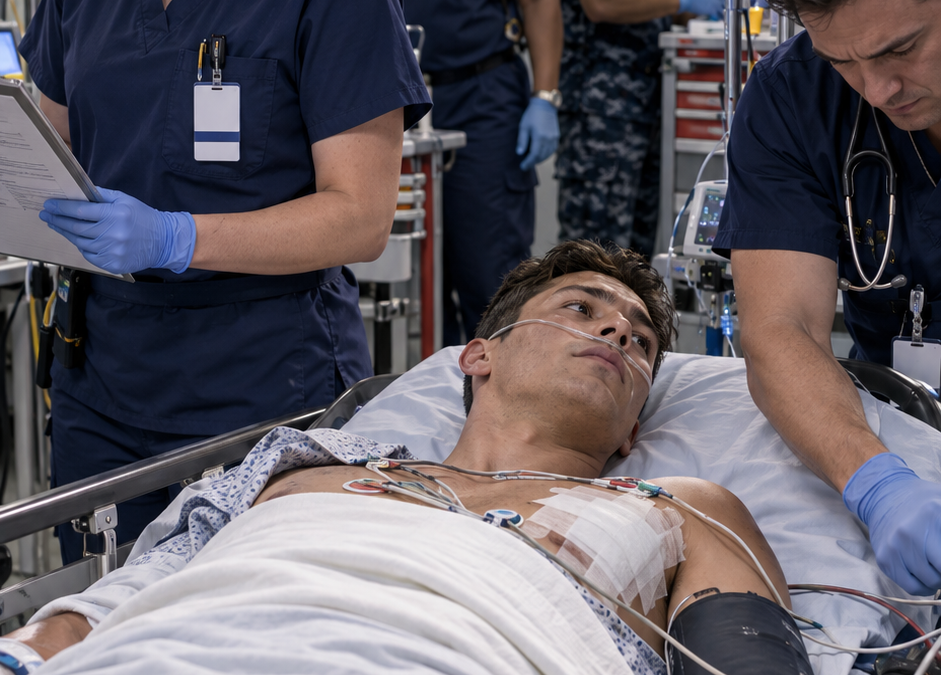
𝗣𝗔𝗥𝗧 𝟮
That landed differently.
Not enough to convince him.
Enough to make him look at Daniel again.
A voice came through the curtain.
“Dr. Cole? Trauma Two is ready.”
Ethan glanced toward it.
Then back.
“We do not have time to chase every variation in a stable patient.”
That sentence could have ended the conversation.
Maybe on my first year in nursing, it would have.
Maybe if I had been less tired of watching people describe patients as stable when what they really meant was not yet unstable enough to frighten us, I would have let it.
Instead I said, “Give me thirty seconds.”
Ethan stared.
“Thirty seconds for what?”
“To make sure stable still means stable.”
Daniel turned his head toward me.
I did not touch the tube.
Did not disconnect anything.
Did not manipulate the chamber.
I knew where my authority ended.
Being dismissed did not give me permission to cross it.
I stepped into Daniel’s line of sight.
“Daniel.”
His eyes found mine.
“Is it harder to breathe now than when I first came in?”
He hesitated.
“Maybe a little.”
Ethan turned back toward the stretcher.
“Pain worse?”
“No, sir.”
The sir came too fast.
Automatic.
Military reflex.
Shoulders still.
Expression controlled.
A young sailor trying to make discomfort sound smaller because somewhere inside him, being the easy patient still felt like part of the job.
My fingers touched the thin silver chain at my collar.
Habit.
I tucked it beneath my scrub top.
“Daniel.”
He looked at me again.
“Don’t give us the answer that gets you out of here faster.”
His eyes shifted toward Ethan.
Then back.
“Better, worse, or the same?”
He swallowed.
“Worse.”
The room changed by half a degree.
Nothing dramatic.
No alarm.
No crash.
Just a word honest enough to make the previous numbers less comfortable.
Ethan moved back to the stretcher.
Stethoscope to Daniel’s chest.
He listened once.
Shifted.
Listened again.
“Take a deeper breath.”
Daniel tried.
The breath stopped short.
“Again.”
Same.
Ethan looked at the monitor.
Still ninety-four.
“Document increased work of breathing. Hold transfer until transport gets here.”
I looked at him.
“I think he needs reassessment before transport.”
His head lifted.
“I just reassessed him.”
“You listened.”
“Yes.”
“And he told you he’s worse.”
His eyes hardened.
“Bennett.”
I stopped.
Not because I agreed.
Because I recognized the boundary.
Ethan removed one glove.
“I have another trauma waiting.”
“I know.”
“His saturation is ninety-four.”
“I know.”
“Pressure stable.”
“I know.”
“Repeat imaging is pending.”
“I know.”
“Stay with him. If anything changes, call me immediately.”
I held his gaze.
“His breathing already changed.”
“Then document it.”
He stepped toward the curtain.
“If it changes again, call.”
Then he stopped.
Turned back.
“Do not manipulate the tube or drainage system without an order.”
“I won’t.”
“Good.”
He disappeared into Trauma Two.
At the curtain he paused for half a second.
“Call if the saturation drops.”
Then he was gone.
I turned back to Daniel.
“Ninety-four,” he said.
“What?”
“The number.”
I looked at him.
“You’re watching it.”
He gave the faintest embarrassed smile.
“Hard not to.”
“Don’t.”
His next breath was shallow.
The next ended sooner.
On the third, his right shoulder lifted.
Small accessory-muscle use.
I saw the muscles above his collarbone engage.
The monitor still said ninety-four.
The patient did not.
I looked at the drainage chamber.
Almost motionless.
Daniel swallowed.
“He thinks I’m okay.”
“I care what your body thinks.”
A soft tone sounded.
Ninety-three.
Daniel’s eyes went toward the monitor.
I stepped into his line of sight.
“Don’t watch the number.”
He looked at me.
“Watch me.”
Another breath.
He tried to deepen it.
Couldn’t.
Right shoulder lifted again.
I checked his pulse.
Faster.
Chamber.
Still minimal movement.
Ninety-two.
The alarm changed pitch.
His composure cracked.
“Clare.”
I was already pressing the call control.
“Trauma Three. Get Dr. Cole back now.”
I released it.
Leaned closer.
“Stay with me, Daniel.”
His eyes widened.
Footsteps sounded somewhere beyond the curtain.
Ninety-one.
I looked at his chest.
Then the almost-silent drainage system.
Whatever was wrong had stopped giving us the luxury of disagreement.
Ethan came through the curtain fast, resident behind him.
“What changed?”
“Breathing worsened. Saturation ninety-four to ninety-one. Pulse climbing. Drainage system still not responding the way I’d expect.”
He put the stethoscope to Daniel’s chest.
“Still moving air.”
I watched Daniel breathe.
“Not the same on both sides.”
Ethan shifted the stethoscope.
This time he listened longer.
The irritation left his face.
Concentration replaced it.
Daniel tried another breath.
Stopped short.
“Portable chest X-ray,” Ethan said.
The resident reached for the phone.
I asked, “How long?”
“Radiology’s backed up.”
“How long?”
“Five minutes if we’re lucky. Ten if we’re not.”
The monitor remained at ninety-one.
I looked at Ethan.
“I don’t think we should spend ten minutes waiting for a picture before checking the system again.”
“Clare.”
The warning remained.
The certainty behind it did not.
“I’m not asking to touch the insertion site or change treatment.”
“We already checked the system.”
“Before his condition changed.”
Another nurse appeared.
“Doctor, they need you in Two.”
“One minute.”
Ethan looked from Daniel to me.
“What exactly are you asking for?”
“Thirty seconds.”
His mouth tightened.
“For?”
“External tubing. Patient to chamber. No disconnection. No manipulation. Just inspect it again.”
“You think you know what’s wrong?”
“No.”
Immediate answer.
Because pretending certainty when I did not have it would have destroyed the only useful thing I was bringing into the room.
“I know something doesn’t fit.”
Daniel took another short breath.
His collarbone muscles tightened.
I kept my eyes on Ethan.
“You told me to call when something changed.”
The alarm sounded again.
“It changed.”
He looked at ninety-one.
Then Daniel.
“Thirty seconds.”
I moved.
Not to the insertion site.
Not to the tube connection.
I followed the external line visually.
Ethan checked the tubing nearest Daniel.
“Clear here.”
I crouched beside the rail.
The line ran downward toward the collection chamber.
For a short section it disappeared beneath the edge of the blanket.
I lifted the blanket.
Nothing obvious.
Then I followed farther.
Stopped.
The angle beside the raised stretcher rail looked wrong.
Too flat.
“Hold on.”
I leaned closer.
Ethan crouched beside me.
From above, everything appeared intact.
I pressed two fingers against the mattress edge.
Moved it back slightly.
A hidden section appeared between the mattress and the inside of the rail.
Flattened.
Not completely occluded.
Compressed enough to restrict flow.
Ethan’s expression changed.
“Hold the rail.”
I gripped it.
He relieved the pressure on the tubing and checked the line.
The drainage chamber responded almost immediately.
Fluid shifted.
The system that had looked nearly dead began moving.
Daniel pulled in a deeper breath.
Ninety-two.
Then ninety-three.
I ignored the monitor.
Watched his face.
Tension around his mouth eased.
Shoulders dropped.
“Daniel?”
“Yeah.”
“Better?”
He tested another breath.
“Yeah.”
Ethan listened again.
Right.
Left.
“Better movement.”
He traced the tube once more.
Then looked at the resident.
“Document compression. Repeat imaging before transfer. He does not leave this bay until I reassess him.”
“Got it.”
No one congratulated me.
Good.
The resident looked once at the section trapped beneath the rail.
Then started documenting.
I stood.
Checked Daniel’s pulse.
Ethan stayed crouched for another second.
Then looked up.
“You saw that from across the bed?”
“No.”
“Then what did you see?”
“His breathing changed.”
I glanced at the chamber.
“That didn’t.”
A voice called from the hallway.
“Dr. Cole!”
He started toward Trauma Two.
Stopped.
His eyes moved to Daniel.
Then me.
Then the white TEMP strip under my badge.
“Bennett.”
“Yes?”
“Stay with him.”
“I will.”
One step.
Then he turned back.
“When I return, show me exactly what you saw.”
“All right.”
He disappeared.
Daniel took another deeper breath.
This time he listened to himself.
I checked his pulse.
He looked at me.
“He checked.”
“What?”
“The same thing you did.”
“No.”
Daniel frowned.
“No?”
I adjusted the blanket so the tubing remained completely visible.
“He checked the answer.”
Daniel looked toward the chamber.
“And you?”
“I noticed the question.”
Three minutes later, Ethan came back with his sleeves pushed higher and Trauma Two still visible in the tension across his face.
He went straight to Daniel.
No question for me first.
Good.
Monitor.
Chest.
Tubing.
Respiratory effort.
Daniel said, “Breathing’s a lot better.”
Ethan nodded.
“Repeat imaging before transfer.”
The resident put the order through.
Only then did Ethan look at me.
“Show me.”
I crouched.
Pointed to the section.
“The monitor wasn’t what bothered me first.”
“What was?”
“His breathing changed but the chamber didn’t.”
“You knew the tubing was compressed?”
“No.”
I stood.
“I knew the pieces stopped agreeing.”
His eyes lifted.
“And if I hadn’t returned?”
“I would have called again.”
“And after that?”
“Charge nurse. Emergency escalation if he continued deteriorating.”
“You wouldn’t have released the tubing yourself.”
“Not just because I thought I was right.”
That made him pause.
“If it became an immediate emergency and my scope allowed intervention, different situation.”
“But not yet.”
“No.”
He looked at Daniel.
Then back.
“You were willing to push me.”
“Yes.”
“But not use being right as permission to cross your role.”
“Those are different things.”
His face softened slightly.
“They are.”
Not an apology.
I didn’t need one.
Thirty seconds later, I heard him in the hallway.
Karen stood at the nurses’ station reorganizing assignments.
Ethan walked directly to her.
“Who has Bennett after Harris?”
Karen kept scrolling.
“Intake.”
“Keep her in trauma.”
Karen finally looked up.
“She’s agency.”
“I know.”
“I have permanent nurses who know this department better.”
“I know.”
“Then why?”
He glanced through the glass toward me.
“Because she recognized something didn’t fit, escalated it, and stayed inside her scope while doing it.”
I had stepped into the hall in time to hear him.
“Dr. Cole.”
He turned.
“I’m not asking to be moved.”
“I know.”
“Then why are you moving me?”
His eyes dropped briefly to the white strip beneath my badge.
“Because ten minutes ago I used that to decide how much weight to give your judgment.”
Quiet enough that only Karen and I heard.
“That was a bad shortcut.”
I watched him.
I could have taken the victory.
Stepped into the next trauma bay.
Enjoyed the sudden reversal.
Instead, I asked for something more useful.
“If I work directly with you, I need something clear.”
“What?”
“If I raise a concern, you do not have to agree with me.”
He waited.
“But you evaluate the concern before you evaluate the badge.”
Karen stopped scrolling.
Ethan looked at TEMPORARY once more.
Then nodded.
“Fair.”
“And your medical decisions stay yours.”
“They were always going to.”
“Good.”
I turned toward Karen.
“Put me wherever the department needs me.”
One corner of her mouth moved.
A small electronic tap changed the assignment board.
“Trauma Two.”
Ethan picked up the next chart.
We entered together.
Paramedics were transferring another injured sailor.
I stopped at the foot of the bed and listened to the entire handoff before moving.
Mechanism.
Vitals.
Interventions.
Response.
Medication.
Ethan noticed.
He did not tell the room I had just identified a compressed tube.
Did not introduce me as experienced.
Did not create a dramatic second chance.
He waited for the handoff to finish.
Then said, “Bennett, primary nursing assessment.”
I pulled on fresh gloves.
“Understood.”
To the resident:
“If she flags something, we stop long enough to understand why.”
No argument.
No performance.
The room simply adjusted.
That difference mattered more to me than an apology would have.
The new sailor was Petty Officer Mason.
Around thirty.
Broad shoulders.
Rain still darkening the collar of his training uniform.
“I’m Clare.”
I secured the cuff.
“I’ll handle your nursing assessment while Dr. Cole examines you.”
Mason nodded.
“Pain zero to ten?”
“Three.”
I wrote three.
Did not challenge it.
“Where?”
“Left side.”
Ethan examined beneath Mason’s ribs.
Mason barely reacted.
But his right hand tightened around the blanket.
I noticed.
“Pulse one-oh-eight.”
Skin cool.
“Pain with breathing?”
“Not really.”
Ethan’s eyes moved toward me.
This time he did not wait for an interruption.
“What are you seeing?”
That was the first real evidence that Trauma Three had changed something.
I answered plainly.
“His words say mild pain.”
I looked at Mason’s hand.
“His body doesn’t.”
Ethan followed my gaze.
Then watched Mason breathe.
“Agreed.”
He ordered imaging.
To the resident:
“Repeat vitals in five.”
No debate.
No one looked at my badge.
The room moved.
I could have protected that new credibility.
Stayed beside Mason.
Made myself indispensable.
Instead, I looked toward Rachel, a younger permanent nurse preparing supplies.
“Rachel.”
She turned.
“Take his respiratory observation.”
“You want me on the monitor?”
“On him.”
I stepped aside.
“The monitor is part of it.”
She moved closer.
“What am I looking for?”
“Change.”
“What kind?”
“Not what I would notice.”
I met her eyes.
“What changes from what you see now?”
Rachel nodded more cautiously.
Good.
She would have to observe rather than search for my answer.
I finished the rest of Mason’s assessment.
Ethan noticed the handoff.
Said nothing.
Over the next few minutes, the new trust in the room stopped belonging only to me.
Ethan asked for my observations before deciding what they meant.
I gave observations without converting them into diagnoses.
The resident repeated the vitals.
Rachel watched Mason.
Not the machine.
Then she leaned closer.
“Petty Officer, deeper breath for me.”
Mason tried.
His expression barely changed.
The breath stopped short.
Rachel looked at me.
I waited.
“Say what you saw.”
She hesitated.
Then:
“His breathing is shallower than when I started watching. He stopped the deeper breath before the monitor changed.”
Ethan was already moving toward the bed.
He reassessed.
Listened.
Looked at the newest vitals.
“Good catch.”
Rachel’s shoulders shifted almost invisibly.
Ethan advanced the imaging request.
I stayed where I was.
Rachel had seen it.
She deserved to remain attached to the observation.
Mason looked toward me.
“Am I getting worse?”
“We’re checking because something changed.”
He waited.
“That is different from deciding what the change means before we have the information.”
He nodded.
But his hand still strangled the blanket.
“I need to get back tonight.”
“To your unit?”
“They’re already short.”
“What have you told them?”
“That I’m fine.”
The answer came too fast.
Familiar.
“If you stay overnight, what happens?”
“Someone else handles my part.”
“Can they?”
His jaw tightened.
“Yeah.”
“What are you trying to protect them from?”
He looked at me.
The answer took longer.
“Having to cover for me.”
Transport arrived.
Rachel started moving with the stretcher.
I touched her elbow.
“Stay.”
She looked surprised.
“But I was watching him.”
“You were.”
“And you reported the change.”
“Yes.”
“Now transport owns the movement and you have another patient waiting.”
I nodded toward the neighboring bay.
“Don’t turn responsibility into ownership.”
She absorbed that.
Stepped back.
Ethan heard it too.
When Mason rolled away, he removed his gloves.
“You could’ve kept Rachel on the monitor and done that observation yourself.”
“Yes.”
“Faster.”
“Probably.”
“Then why didn’t you?”
I wiped the rail.
“Because if I have to stand beside everyone before they trust what they see, we haven’t improved anything.”
That left him quiet.
A monitor chimed beyond the curtain.
I reached for fresh linens.
His eyes flicked briefly toward the thin silver chain at my collar.
It had slipped free.
I tucked it inside automatically.
“You’ve worked places where people had to make decisions quickly,” he said.
“Yes.”
“Trauma?”
“Among other things.”
He waited.
I offered nothing more.
For once, he did not ask.
Mason returned from imaging quieter.
Before the stretcher brakes locked, I saw his left hand close around the blanket.
Ethan reviewed the images.
Then came to the bedside.
“Nothing needs surgery.”
Mason exhaled.
“But you’re staying overnight for observation.”
His answer came instantly.
“How soon can I return to my team?”
Ethan looked at me.
Earlier, that look had meant:
What are you seeing?
I did not answer for him.
I stepped closer.
“What does your team think is happening?”
“They know I got brought in.”
“What did you tell them?”
“That I’m fine.”
I waited.
Mason looked away.
“They’re short.”
“If you stay?”
“Someone else takes my part of the handoff.”
“Can they?”
“Yeah.”
I pulled the phone from its cradle.
Placed it within reach.
“Then decide what they need to know.”
He looked at it.
“You want me to call them?”
“I want you to decide whether they plan around the truth or around what you told them earlier.”
Ethan stayed silent.
Mason finally took the receiver.
“Give me a minute.”
I stepped outside.
Ethan followed.
Through the curtain:
“Yeah, they’re keeping me overnight.”
Pause.
“No, don’t send anybody.”
Pause.
“Have Collins take the handoff.”
Longer pause.
“Yeah.”
His voice softened.
“I know he can.”
When the call ended, we returned.
“Covered?” I asked.
Mason handed back the phone.
“Yeah.”
“Good.”
He looked toward the ceiling.
“Feels wrong.”
“What?”
“Lying here while someone else does my job.”
“Maybe it should feel wrong.”
His eyes came to mine.
“You care about the people depending on you.”
I checked his IV site.
“That part is not the problem.”
“Then what is?”
“Thinking you’re the only person allowed to carry it.”
His eyes dropped.
His fingers slowly loosened around the blanket.
Ethan watched from the counter.
“You knew he’d make the call.”
“No.”
He frowned.
“I knew it had to be his call.”
“You could’ve ordered him to contact his unit.”
“So could you.”
“But you didn’t.”
I adjusted the pressure cuff.
“Getting him to obey wasn’t the problem.”
His expression shifted.
“People tell you more when they still feel like they own part of what happens next.”
He looked at Mason.
Then me.
“Is that what you were doing with Harris?”
“With Harris I gave you information.”
I met his eyes.
“I didn’t ask to make your decision.”
He was quiet.
In the neighboring bay, Rachel was giving a report to the resident without looking toward me.
Ethan said, “I thought what made you useful was that you notice things.”
My fingers paused.
“Noticing is the easy part.”
“What is the hard part?”
“Knowing what belongs to you after you notice.”
Mason shifted on the pillow.
“For what it’s worth, Doc, she’s annoying.”
Ethan looked at him.
The faintest smile touched Mason’s face.
“But she’s right.”
I almost smiled.
“Get some rest.”
“Yes, ma’am.”
I stepped into the hallway with Ethan.
The department had quieted enough that I could hear the printer and fluorescent hum beneath the monitors.
He picked up the assignment tablet.
“Three more evaluations before morning.”
“All right.”
He started to hand it to me.
Stopped.
“I can keep asking what you see.”
I waited.
“But if I’m going to rely on your judgment, I need to understand what responsibility comes with it.”
My hand rose toward the chain at my collar.
Stopped.
The locket remained hidden.
“That depends on what you’re asking me to carry.”
He lowered the tablet.
At the beginning of the shift, I had been fighting for thirty seconds of attention.
Now I had it.
Attention creates responsibility too.
What mattered next was not whether Ethan trusted me.
It was what I did with being trusted.
“I’ll tell you what I think,” I said.
“You make the medical decisions.”
“That’s already my job.”
“Then don’t give me part of it just because you trust me now.”
He considered that.
“You tell me what you observe.”
“Yes.”
“You tell me when something concerns you.”
“Yes.”
“If you think I’m missing something, you say it.”
“Even when you’re busy.”
His mouth tightened.
“And I make the call.”
“And own it.”
He nodded.
“Your nursing decisions stay yours.”
“They always were.”
“I know.”
No defensiveness.
Just clarity.
Karen approached with two charts.
“Last two from the training group stable. One observation, one waiting repeat labs.”
Ethan took them.
“Bennett stays with me until trauma clears.”
Karen looked past him.
“Clare?”
“Until trauma clears.”
I nodded.
“Then put me wherever you need me.”
Karen moved on.
Ethan handed me a chart.
“You really don’t want special treatment.”
“I want people to listen when information matters.”
“Not the same thing.”
“No.”
We moved toward the next bay.
At the curtain, Ethan stopped.
“Something still doesn’t make sense.”
I looked back.
“You’ve worked trauma before.”
“Yes.”
“More than ordinary civilian trauma.”
I said nothing.
He chose his words more carefully than he had earlier.
“Harris. Mason. The way you recognize what people are trying not to say.”
The silver chain shifted against my collar.
I touched it but did not hide it immediately.
“Where did you learn that?”
“I treated people trained to keep functioning while something hurt.”
His eyes went toward Mason’s bay.
“People used to carrying responsibility before taking care of themselves.”
“That helped you understand him.”
“Yes.”
“And the rest?”
My hand dropped from the chain.
“The rest doesn’t belong to this shift.”
He held my gaze.
Earlier, he might have treated that answer as evidence against me.
Now he nodded.
“Understood.”
I studied him.
“If something from my history matters to a patient, I’ll tell you what you need.”
He waited.
“If it doesn’t, you don’t need my history to decide whether what I’m seeing deserves attention.”
Another nod.
“Understood.”
We entered the final bay.
No crisis.
No second test.
Just another sailor under a gray blanket.
The resident opened the chart.
Ethan took one side.
I took the other.
I reached across the raised rail for IV tubing.
The movement pulled the silver chain from beneath my scrub top.
A small locket settled against the fabric.
I felt it.
My hand started toward it.
Stopped.
Ethan had asked.
I had set a boundary.
He had respected it.
I did not need to hide the existence of the boundary in order to protect it.
So I left the locket outside my scrub top.
The pressure cuff tightened around the sailor’s arm.
“One-eighteen over seventy-four.”
Ethan reviewed the chart.
The resident entered orders.
The sailor said, “Pain’s better, sir.”
I reached across the rail.
The locket swung forward.
Its edge caught beneath a plastic clip.
The chain pulled hard against the back of my neck.
I stopped.
A tiny metallic snap cut through the monitor rhythm.
The locket struck the rail.
Opened.
One dog tag hit the tile.
Then another.
Then a third.
Thin chains spilled out behind them in a tangle of worn steel.
Ethan stopped reading.
For half a second, every calm habit I had built disappeared.
I looked down.
“I’ve got them.”
I crouched.
Ethan bent instinctively toward the nearest tag.
“Here.”
“Please.”
Quiet.
Firm.
He stopped.
I reached for the chains.
One tag lay almost beneath his shoe.
He moved his foot back.
Then lifted the metal carefully by one edge.
The stamped face was turned upward.
THOMAS J. MERCER.
Ethan’s hand stopped.
“Mercer.”
My fingers froze over the remaining chain.
His eyes lifted.
“Tom Mercer?”
I held out my hand.
“Give it to me.”
He placed the tag into my palm.
Years earlier, Ethan had treated Mercer after a stateside training injury.
I knew that only because Tom had once complained about “a surgeon named Cole who thought humor was a symptom.”
Ethan remembered Tom because people like Tom were hard to forget.
The resident glanced over.
Ethan raised one hand.
“Give us a second.”
I untangled the chains.
Different names.
Scratched edges.
Metal polished smooth in places by years of handling.
Ethan looked at them.
“Were the others patients?”
My fingers slowed.
“Men I treated.”
“SEALs?”
I looked at Mercer’s tag.
“Some of them.”
He said nothing.
I opened the locket wider.
I had altered its inside years earlier to hold the thin chains.
One at a time, I put them back.
Ethan could have asked everything.
Where had I worked?
Why did I have three dog tags?
How long had I known Mercer?
Why was I working temporary nursing shifts at Westbridge?
Why did I carry dead men’s names against my chest?
The questions were visible.
None left his mouth.
I noticed.
“They’re not credentials.”
He looked at me.
“I know.”
My hands stopped for the smallest beat.
Then I placed the last chain inside.
“I don’t carry them so people listen.”
“I know that too.”
I closed the locket.
His gaze moved briefly toward the TEMP strip.
At the beginning of the night, that one word had been enough for him to decide how much of my judgment deserved space.
Now three worn pieces of steel had shown him how little a badge could ever say.
He looked back at my face.
“Ready?”
I tucked the locket beneath my scrub top.
“Yes.”
We returned to the patient.
Ethan did not introduce me differently.
Did not tell the resident what he had seen.
Did not ask about Mercer.
“Bennett.”
“Yes?”
“Anything you’d change?”
I watched the sailor breathe.
Checked pressure.
IV.
Color.
Expression.
“Not right now.”
“He’s tolerating fluids.”
Ethan looked at the same data.
“Agreed.”
The resident asked, “Increase them anyway?”
“No.”
Ethan closed the chart.
“Stable is information too. We don’t change something simply because we can.”
I glanced at him.
He had heard my assessment.
Made his own decision.
Owned it.
Exactly what we had agreed.
The locket changed nothing about that.
We finished.
Stepped into the hallway.
Wheels moved over tile.
Printer hummed.
Burnt coffee somewhere beyond the desk.
I opened a supply cabinet.
Ethan stopped several feet away.
“Bennett.”
I looked back.
His eyes flicked once toward the locket hidden beneath my collar.
“I’m not going to ask about Mercer.”
“Okay.”
“Or the others.”
“Okay.”
He nodded.
Walked away.
That was all.
He left the boundary exactly where I had placed it.
Minutes later, Karen approached.
“Trauma’s clearing. I can leave you with Cole for the rest of shift or move you back to intake.”
Ethan was close enough to hear.
He said nothing.
Karen looked at me.
“Where do you need me?”
“Trauma another hour.”
“Then intake after.”
I nodded.
“That’s where I’ll go.”
Karen glanced toward Ethan.
Earlier, he’d asked specifically to keep me.
Now he only asked, “Do I still have Rachel?”
“Yes.”
“Then we’re covered.”
Good.
He did not turn what he learned about me into ownership either.
Rachel approached with a chart.
“Clare, can you look at something?”
I turned.
“Tell me what you saw.”
She held the chart out.
“Heart rate jumped when he sat up. Pressure stayed almost the same. I thought I should call the resident, but I wanted you to check.”
I did not take the chart.
“What did you do after the heart rate changed?”
“Repeated pulse manually.”
“And?”
“Asked about dizziness. Checked breathing and skin. Repeated pressure.”
“Result?”
“Pulse stayed elevated. Mild dizziness. Everything else stable.”
I nodded toward the phone.
“Then you know what comes next.”
She looked at it.
“Call the resident.”
“You observed the change.”
“Yes.”
“You report it.”
“What if I’m wrong?”
“About what you saw?”
She hesitated.
“About what it means.”
“Different questions.”
I stepped aside.
“Tell her what you observed. Let her decide what it means medically.”
Rachel picked up the phone.
Her voice tightened slightly near the end.
But she finished.
The resident arrived.
Asked her to repeat the sequence.
Rachel did.
I kept charting.
When they disappeared into the bay, Ethan came beside the workstation.
“You didn’t check him yourself.”
“Rachel did.”
“You weren’t worried she’d miss something?”
“If she needed another set of eyes, she could ask.”
“You trust her?”
“I gave her something to be responsible for.”
I clicked the next field.
“What she does with that comes next.”
He looked toward the bay.
Then picked up his chart.
Still no question about Mercer.
No question about the other names.
No question about where my experience came from.
Near the end of the hour, Karen called:
“Bennett, intake needs you.”
I saved.
Logged out.
Stood.
Ethan was reviewing a chart with Rachel.
He looked up.
“Bennett.”
I paused.
“Thanks.”
I waited because I wanted to know what he meant.
His gaze stayed on my face.
Not my locket.
Not the TEMP strip.
Not history.
“For tonight.”
I understood.
Not thank you for Mercer.
Not thank you for revealing some impressive past.
Thank you for the work.
“You’re welcome.”
I turned toward intake.
Rachel was already beside him with the next chart open.
I kept walking.
For the first time that night, leaving trauma did not feel like being moved away because I was temporary.
It was simply where the department needed a nurse next.
By the time I settled into intake, Westbridge had found its night rhythm again.
Phones.
Curtains.
Soft alarms.
Fluorescent light.
Bad coffee.
My temporary badge still carried the same word.
Nothing printed on it had changed.
For the next hour, nothing dramatic happened.
I took histories.
Started lines.
Finished documentation.
Helped a corpsman find a vein in a dehydrated sailor.
Replaced a blanket.
Found a phone charger for a frightened wife.
Did the small work hospitals are mostly made of.
Ethan stayed in trauma.
Rachel worked without checking with me every time something felt uncertain.
Near dawn, a young sailor in Room Six was being prepared for discharge after evaluation for dizziness.
I sat at the workstation.
Rachel reviewed instructions.
“Stand slowly. If the dizziness returns, sit down.”
“Got it.”
The sailor swung his legs over the bed.
Started standing.
Halfway upright, one hand caught the mattress.
Rachel saw it.
“Sit back down.”
“I’m okay.”
“Sit first.”
No hesitation.
No alarm.
He lowered himself.
Rachel checked his pulse.
“Still dizzy?”
“A little.”
I heard everything from the workstation.
My hands stayed on the keyboard.
Rachel repeated the pulse.
Checked pressure.
Then stepped into the hallway as Ethan passed carrying a chart.
“Dr. Cole.”
He stopped.
“What do you have?”
“Room Six was being discharged. Dizzy again on standing. Grabbed the bed for support. Pulse went up.”
“Pressure?”
She gave him the number.
He did not reach for the chart.
“What do you think?”
Rachel took half a second.
“Hold discharge and reassess before he walks out.”
Ethan nodded.
“Then hold it.”
He turned toward the room.
“Show me the trend.”
Rachel went with him.
I kept typing.
No one called my name.
No one needed to.
At 6:45, gray morning light began replacing fluorescent reflection in the eastern windows.
Karen started handoff.
I closed my final chart.
Logged out.
Removed the temporary badge from my scrub top and clipped it to my jacket pocket.
TEMPORARY.
Same photograph.
Same name.
Same cheap plastic strip Ethan had looked at hours earlier before deciding how much of me deserved his attention.
Beneath my jacket, the silver locket settled against my chest.
Closed.
Unseen.
Where I preferred it.
At the nurses’ station, Ethan reviewed the board.
I walked past.
“Clare.”
I stopped.
He had used my first name only once before that night.
When the dog tags were on the floor.
Now there was nothing dramatic in it.
“Good morning.”
I looked toward the windows.
“You finally got the time right.”
One corner of his mouth moved.
“Long night.”
“They usually are.”
He did not apologize again.
Good.
He did not mention Mercer.
Good.
He did not ask about the other names.
Better.
“See you next shift?”
I touched the temporary badge on my jacket.
“If scheduling says so.”
He nodded.
“Then I’ll see you when I see you.”
Enough.
I turned toward the exit.
Behind me, Rachel’s voice came from Room Six.
“Dr. Cole? There’s one more thing.”
I reached the automatic doors.
For one second, the beginning of the night returned.
Daniel’s monitor reading ninety-four.
His shoulder lifting.
The chamber refusing to move.
Ethan already turning toward another trauma while I asked him for thirty seconds.
Back then, being heard required me to stand still long enough that he had to stop.
Now Rachel was speaking behind me.
I did not turn around.
Ethan did.
I heard the chart in his hand lower.
“Go ahead, Rachel.”
No impatience.
No rank check.
No judgment before observation.
Only room for her to finish.
Rachel kept talking.
I stepped through the doors.
Cool morning air touched my face.
I thought that was the end of the lesson.
It wasn’t.
Two weeks later, Westbridge called the agency and requested me specifically for another trauma rotation.
I almost declined.
Not because of Ethan.
Because I had become wary of places where people learned too much about me.
The more a room knows about your past, the easier it becomes for the past to do your work for you.
I had no interest in becoming “the nurse with the SEAL dog tags.”
That would have been another badge.
Different material.
Same problem.
Karen called me personally.
“We need coverage.”
“You have coverage.”
“I need someone who knows the flow.”
“You have permanent staff.”
“Clare.”
I waited.
She continued.
“Rachel asked if you were coming.”
That mattered more.
I took the shift.
When I arrived, the TEMP strip was still beneath my badge.
No one had changed it.
Good.
Rachel saw me first.
“You came back.”
“Scheduling error.”
She smiled.
Ethan emerged from Trauma One.
Saw me.
No dramatic greeting.
“Bennett.”
“Cole.”
He pointed toward the board.
“Two.”
I looked.
“You giving orders already?”
“Patient waiting.”
“Acceptable answer.”
I went in.
That shift was quieter.
No chest-tube emergency.
No dog tags on the floor.
Nothing that would make a good story.
That was why I remember it.
A temporary nurse came into a department where the physician no longer needed proof before listening.
A young permanent nurse began trusting her own observations enough to report them clearly.
A charge nurse moved people where they were needed without interpreting trust as ownership.
Patients came in.
Patients left.
The system worked a little better than it had two weeks earlier.
That is what improvement usually looks like.
Boring.
Near midnight, Rachel brought me coffee.
“I think Ethan is scared of you.”
“He should be.”
She laughed.
Then grew serious.
“Can I ask something?”
“Depends.”
“Why temporary?”
I looked at the word beneath my badge.
“That is a much better question than where I worked before.”
She waited.
I considered not answering.
Then decided this part belonged to the present.
“I left full-time trauma years ago.”
“Because of what happened to those men?”
Her eyes flicked toward the place where the locket rested beneath my scrubs.
“No.”
Not directly.
“I was good at being the person everyone called when things went wrong.”
Rachel listened.
“For a while, I thought that meant I had to keep being that person forever.”
“What changed?”
“Too many people died.”
Her expression softened.
“I’m sorry.”
“Don’t.”
I looked at my coffee.
“Not because sympathy is wrong. Because that’s not the point.”
She waited.
“I started believing responsibility meant staying until there was nothing left of me that wasn’t useful to someone else.”
Rachel glanced toward Trauma Three.
“Mason.”
“Exactly.”
“So you left.”
“I stepped away.”
“Same thing?”
“No.”
I smiled faintly.
“Leaving sounds final.”
“Temporary doesn’t.”
That surprised me.
I looked at the badge.
Rachel smiled.
“Maybe you picked the right label.”
Perhaps I had.
Years earlier, Thomas Mercer had been one of three men whose dog tags ended up in my care.
Not because I collected them.
I hated the idea.
After Tom died, his wife asked me to carry his temporarily until she could decide what to do with the personal effects.
Then another family made a similar request.
Then another.
The temporary became permanent because grief rarely respects administrative language.
I kept them together in the locket because separate chains tangled badly.
Practical.
That was what I told myself.
The truth was less clean.
Each tag reminded me there had been a point where another person trusted me to stay calm.
Sometimes I saved them.
Sometimes I didn’t.
People often imagine experienced trauma clinicians become confident because they have seen enough good outcomes.
The opposite is closer to truth.
Experience teaches you how often you can do everything right and still lose.
That knowledge either makes you arrogant or humble.
I had spent years trying to choose humble.
Not small.
Different.
That was why Ethan dismissing me bothered me less than people assumed.
I did not need him impressed.
I needed Daniel breathing.
Once he was, the insult became manageable.
Weeks passed.
My temporary contract extended.
Then extended again.
Westbridge offered a permanent position.
I turned it down the first time.
Karen stared at me.
“Why?”
“Because I like being able to leave.”
“You planning to?”
“No.”
“Then that’s stupid.”
“Strong recruitment technique.”
She sighed.
“Think about it.”
I did.
What frightened me was not permanence itself.
It was the old pattern.
Become useful.
Become needed.
Become indispensable.
Confuse indispensable with loved.
Stay too long.
Carry too much.
Break quietly.
I knew that road.
Ethan found me in the staff room one morning staring at the offer.
“You’re leaving?”
“No.”
“Then sign it.”
“That is approximately Karen’s argument.”
“She is usually right.”
“Dangerous thing to admit.”
He sat opposite me.
“What’s the problem?”
I looked at him.
“Remember Mason?”
“Yes.”
“Thinking you’re the only person allowed to carry the work?”
He understood.
“You’re worried permanent becomes ownership.”
“Yes.”
“Of you?”
“By me.”
That made him quiet.
Then he said, “So don’t let it.”
I almost laughed.
“Brilliant.”
“I’m a doctor.”
“Surgeon.”
“Worse.”
I looked at the contract again.
He tapped the table once.
“You taught Rachel.”
“I gave her room.”
“She uses it.”
“Yes.”
“You tell me when I’m missing something.”
“Often.”
“Too often.”
“Your personal growth has stalled.”
He ignored that.
“If you stay, the goal is not that we need Clare Bennett.”
I looked at him.
“The goal is that the department gets better at noticing.”
That was the right answer.
Annoyingly.
I signed.
Three months after the night Daniel Harris’s saturation fell from ninety-four to ninety-one, the white temporary strip disappeared from beneath my badge.
I noticed immediately.
I expected satisfaction.
Instead I felt almost nothing.
The plastic had never changed my experience.
Removing it did not increase my judgment.
It only changed what people assumed before I spoke.
Rachel noticed.
“No TEMP.”
“Tragic.”
“Frame it.”
“Absolutely not.”
Ethan walked past.
“Congratulations.”
“For surviving hospital credentialing?”
“That is among medicine’s higher-risk procedures.”
I laughed.
Then went back to work.
Daniel returned for follow-up once.
Not to trauma.
He stopped by the unit because he claimed someone had told him I was working.
I suspected Karen.
He looked healthy.
Breathing normally.
He stood near the nurses’ station holding a paper coffee cup.
“Hey.”
I looked up.
“Daniel.”
He smiled.
“You remember.”
“You almost stopped breathing in my fourth shift. Memorable.”
His smile faded slightly.
“I wanted to say thanks.”
“You already did.”
“No.”
He looked toward Trauma Three.
“I don’t think I understood what happened.”
“You had compressed drainage tubing.”
“I know that part.”
He looked at me.
“I mean when I said he thinks I’m okay.”
I remembered.
“I was scared.”
“I know.”
“I thought if the doctor said stable, I should be stable.”
“That happens.”
“And you said you cared what my body thought.”
“Yes.”
He nodded.
“I’ve thought about that.”
I waited.
“Been doing physical therapy. They keep asking about pain.”
“Dangerous people.”
“I used to say three.”
“Always?”
“Everything was three.”
I laughed.
He smiled.
“I’m working on it.”
“Good.”
He raised the coffee.
“Anyway. Thanks.”
“Keep breathing.”
“That’s the plan.”
He left.
That mattered more than any apology from Ethan ever could have.
Mason sent Rachel a message six months after his visit.
Apparently he had learned to say no to one training assignment while recovering from another injury.
Rachel showed me.
“He said you ruined him.”
“Excellent.”
“He tells people the truth now.”
“Terrible career development.”
She laughed.
The dog tags stayed inside my locket.
Ethan never asked.
Years later, after we had worked enough shifts together that silence had become comfortable rather than guarded, he once handed me a chart and said:
“Mercer would have hated this patient.”
I looked at him.
“What?”
“Same sense of humor.”
That was the first time he used Tom’s name after the night the locket opened.
Not as leverage.
Not as curiosity.
Memory.
I smiled.
“He probably would.”
Then we kept working.
That was exactly right.
The biggest change in Westbridge was not that a doctor learned who a temporary nurse used to be.
It was not that I turned out to have treated SEALs.
It was not the dog tags.
It was not even Daniel’s compressed chest tube.
The real change happened in smaller moments afterward.
Rachel saying, “Something changed,” and nobody asking whether she had enough years to say it.
Residents learning to separate observation from interpretation instead of pretending they had to own both.
Ethan asking, “What doesn’t fit?” before asking who noticed.
Karen assigning temporary staff based on what they demonstrated rather than what their employment category implied.
And me learning that being heard did not require becoming indispensable again.
Years after I first walked into Westbridge with a white strip beneath my badge, I was standing beside Rachel during a difficult handoff.
She had become charge nurse by then.
A new agency nurse was on her second shift.
Young.
Quiet.
Temporary badge.
A resident dismissed one of her observations.
Nothing cruel.
Just automatic.
“She’s new.”
I heard it from three feet away.
For half a second I was back in Trauma Three.
She’s just a temp.
I looked at Rachel.
She had heard it too.
I expected her to look at me.
She didn’t.
Good.
She turned toward the agency nurse.
“What did you see?”
The nurse explained.
Rachel listened.
Then looked at the resident.
“Evaluate the concern first.”
No speech.
No lecture.
No story about me.
The resident nodded.
They checked.
The concern turned out to be nothing dangerous.
That did not make the listening unnecessary.
I stood behind them and felt something inside me settle.
Rachel did not need me there.
That was the point.
At the end of the shift, she came over.
“You heard that.”
“Yes.”
“You were very quiet.”
“You handled it.”
“I learned from someone annoying.”
“Mason said the same thing.”
She smiled.
Then looked toward my badge.
Permanent now.
No white strip.
“You ever miss temporary?”
I thought about it.
“Yes.”
“Really?”
“Sometimes.”
“Why?”
“Temporary reminded me I was allowed to leave.”
Rachel leaned against the desk.
“And permanent?”
I looked around Westbridge.
Trauma bays.
Monitors.
Young nurses.
Old surgeons.
Sailors trying to act less hurt than they were.
“Permanent taught me staying can also be a choice.”
She nodded.
That distinction took me years.
On the morning my first full decade at Westbridge ended, Ethan and I crossed paths near Trauma Three.
His hair had more gray.
Mine did too.
He was carrying two charts.
I was heading toward handoff.
He stopped.
“Bennett.”
“Cole.”
He glanced through the open curtain.
Different patient.
Same stretcher position.
Same wall.
Same rail.
“Remember Harris?”
“Of course.”
“You asked for thirty seconds.”
“You gave them reluctantly.”
“Very.”
“You were rude.”
“I was busy.”
“You were rude while busy.”
He accepted that.
Then said, “Who were you before Westbridge?”
The question surprised me.
Not because he had never wondered.
Because after ten years, he finally asked it in a way that did not sound like he needed the answer.
I thought about the dog tags.
The places.
The teams.
The long nights.
The people who died.
The people who lived.
Then I looked at Trauma Three.
“Same person.”
Ethan smiled.
“That sounds like you.”
“It should.”
He shifted the charts under his arm.
“For what it’s worth, I’m glad you stayed.”
I nodded.
“Me too.”
Then he disappeared toward surgery.
I walked into handoff.
A new patient had arrived overnight.
A junior nurse was giving report.
She hesitated midway through.
“Something about his breathing seemed off, but the numbers were fine.”
No one interrupted.
No one dismissed her.
Rachel asked:
“What changed?”
The nurse explained.
I stayed near the back.
Listened.
No one needed my history.
No one needed the locket.
No one needed Thomas Mercer’s name.
The observation belonged to the nurse standing there now.
The decision would belong to the clinician responsible now.
The patient belonged to neither of them.
He belonged to himself.
That was the lesson it had taken me years to understand.
Authority matters.
Scope matters.
Experience matters.
Protocols matter.
Hierarchy matters.
But none of them exist so people can win rooms.
They exist so the patient has the best possible chance of leaving one.
The young nurse finished her report.
The physician nodded.
“Let’s reassess before transfer.”
Simple.
No argument.
No revelation.
No one asked, “Who are you?”
I touched the locket beneath my scrub top once.
Three dog tags rested inside.
Then I lowered my hand.
The nurse had already moved to the bedside.
The physician followed.
Rachel opened the chart.
I stayed where I was.
They did not need me.
And after everything I had once believed responsibility meant, that felt less like being unnecessary than freedom.








