𝗣𝗔𝗥𝗧 𝟮 The Waitress at the Academy Gate Carried Something the SEAL Commander Thought He Would Never See Again
𝗣𝗔𝗥𝗧 𝟮
The word surprised both of us.
I looked at the clock.
7:15.
Ceremony started at 8:15.
The academy was thirty-five minutes away under perfect traffic.
I still had four tables.
“I can finish my section.”
“That helps.”
“Then I’m leaving.”
He nodded.
I worked fast.
Not careless.
Fast.
Checks delivered.
Coffee refilled.
A family needed a high chair.
A man complained his eggs were overcooked.
Someone spilled orange juice.
At 7:31, I untied my apron.
Then a busboy handed me a receipt issue from table twelve.
At 7:36, I finally reached the employee door.
I looked toward my car.
The dress was inside.
I looked at the time.
Thirty-nine minutes.
I could change in five.
Maybe four.
Then traffic would decide everything.
I stood there for half a second.
And thought of Danny.
Four years.
Early morning runs.
Late-night study sessions.
The calls where he pretended not to be exhausted.
The first time he failed an evaluation and told me he wasn’t sure he belonged.
The first time I told him Dad had failed things too.
He had laughed at me.
“No, he didn’t.”
“Yes, he did.”
“How do you know?”
“Because nobody becomes that good at anything without failing first.”
That answer satisfied him.
Mostly because it sounded like something Dad would have said.
I looked down at my waitress uniform.
Blue blouse.
White trim.
Apron.
Silver name tag.
Coffee stain near one pocket.
I had spent years caring far too much about being seen correctly.
That morning, I stopped.
I got in the car.
The dress stayed where it was.
Traffic was worse than I wanted.
I changed lanes three times.
Hit every red light.
The clock seemed to move faster whenever I looked at it.
At 8:06, I turned into the academy grounds.
Uniformed cadets directed traffic.
Families crossed the lawn.
Men wore suits.
Women wore dresses and tailored coats.
Parents held flowers.
Some carried academy programs in embossed folders.
I parked farther away than I expected.
Eight minutes.
I grabbed my invitation from the passenger seat.
Opened the door.
Then stopped.
My right hand went automatically to my apron pocket.
Metal touched my fingers.
I carried Dad’s medal almost every day.
Not the ribbon.
That had deteriorated years earlier.
Just the medal.
Small.
Heavy.
Worn at the edges.
My mother had given it to me after his funeral.
I could still remember the cemetery.
The wet grass.
Danny asleep against an aunt’s shoulder.
Mom kneeling in front of me after most people had left.
Her eyes looked empty.
She placed the medal in my palm.
“Keep this safe.”
“For what?”
“For Danny.”
“When?”
“When it’s time.”
I had been eleven.
I didn’t understand.
For years, I thought she meant I should simply give it to him when he was older.
Then seventeen came.
Eighteen.
His academy acceptance.
None of those moments felt right.
That morning did.
I closed my hand around the medal.
“Okay, Dad.”
I put it back into the pocket.
Then I started toward the entrance.
I was twenty feet from the doors when I heard a woman’s voice.
“This is a military institution.”
I would probably have kept walking if she had stopped there.
She didn’t.
“Not a diner.”
I looked toward the voice.
Three women stood near the entrance.
The woman speaking wore a cream designer coat even though the morning was already warming.
Perfect hair.
Pearl earrings.
Shoes that probably cost more than my monthly grocery bill.
She was somewhere in her fifties.
Beside her stood a man in a dark suit and another woman carrying flowers.
The speaker looked directly at me.
Then down.
Shoes.
Apron.
Name tag.
Back to my face.
“You are attending the graduation?”
I held up my invitation.
“Yes.”
She gave a smile that wasn’t a smile.
“There is a dress standard.”
“I’m aware.”
Her eyes narrowed.
“You’re aware.”
“Yes.”
“And you came like that?”
I looked at my uniform.
Then back at her.
“My shift ran late.”
“This ceremony represents years of sacrifice.”
“I know.”
“Then surely you understand why presentation matters.”
There were people close enough to hear.
That was intentional.
I knew the type.
She wasn’t trying to solve a problem.
She was establishing hierarchy in front of an audience.
I had met far worse versions of that personality in uniform.
At least there, rank was displayed honestly.
I moved toward the doors.
She stepped slightly into my path.
Not enough to touch me.
Enough to make the intention clear.
“My son is graduating today.”
“So is my brother.”
“Then I would think you’d want to honor him appropriately.”
Something inside me tightened.
I thought of the dress in my car.
For half a second, shame tried to enter.
Not because she was right.
Because humiliation works fastest when it attaches itself to something you already wish you had done differently.
I did wish I had changed.
I wanted Danny’s photographs to show me looking rested and prepared.
Not like I had just served sixty-seven breakfasts.
But wanting something different did not make me ashamed of how I had arrived.
I had worked because rent existed.
Because Danny’s graduation dinner had to be paid for.
Because one of my coworkers had not shown.
Because life does not suspend itself for ceremonies.
I met the woman’s eyes.
“Excuse me.”
Then I stepped around her.
The security officer near the entrance saw the exchange.
He also saw her speak briefly to an academy administrator.
That became my problem thirty seconds later.
“Ma’am?”
I stopped.
The officer approached politely.
Too politely.
“Yes?”
“May I see your invitation?”
I handed it over.
He checked the name.
“Olivia Lane.”
“Yes.”
“Relationship to Cadet Daniel Lane?”
“Sister.”
He gave the invitation back.
Then hesitated.
“I’ve been asked to address an issue.”
Behind him, the woman in cream stood with her arms loosely folded.
Of course.
“What issue?”
“There are standards regarding guest presentation.”
I looked at him.
He looked uncomfortable.
That helped.
At least he knew.
“My work uniform?”
“Yes, ma’am.”
“Is there a written policy prohibiting it?”
He hesitated.
“The institution asks guests to dress appropriately for the dignity of the ceremony.”
“This is clean.”
I looked down at the coffee stain.
“Mostly.”
He almost smiled.
Didn’t.
“I understand there were circumstances.”
“There were.”
He lowered his voice.
“Perhaps you could wait on the outer steps during the formal portion.”
I stared at him.
He continued because silence makes people uncomfortable.
“You would still be able to see part of the procession.”
“My brother has no one else here.”
He stopped.
“No parents.”
I pointed toward the interior.
“No grandparents. No uncles. No one.”
His expression shifted.
“I am his family section.”
“I understand.”
“No.”
I kept my voice calm.
“You understand the sentence. You don’t understand what you’re asking.”
The woman behind him moved closer.
“Officer, you’re being very patient.”
I looked at her.
The security guard looked miserable now.
I didn’t want him trapped between me and an administrator because somebody with money had complained.
I also did not intend to miss Danny’s graduation.
I reached into my apron pocket.
The medal came out with my fingers wrapped around it.
The officer saw only metal at first.
I placed it in his palm.
He looked down.
The medal had been handled so often that the highest edges were polished almost smooth.
The engraving on the back was faint.
ROBERT LANE.
A date.
A service number.
The guard turned it once.
“What is this?”
“My father’s.”
He looked up.
“Was he military?”
“Yes.”
The entrance doors opened behind me.
I heard footsteps.
The guard was still examining the medal.
The person coming through the doors stopped.
Not slowed.
Stopped.
The silence made me turn.
A senior Navy officer stood ten or twelve feet away.
Dress uniform.
Rows of ribbons.
SEAL trident.
Silver at the temples.
He was maybe in his late fifties.
He had the kind of presence that comes from decades of never entering a room accidentally.
His eyes were fixed on the medal.
Not me.
The medal.
The color had changed in his face.
For several seconds, he didn’t move.
Then he walked toward us.
The woman in cream straightened immediately.
I later learned the commander’s name was Wade Mercer.
He was presiding over the ceremony.
At that moment, all I knew was that he stared at the medal as though it had crossed thirty years to reach him.
He stopped beside the guard.
“May I?”
The guard handed it over.
Commander Mercer did not take it casually.
He lifted it in both hands.
Turned it over.
Read the engraving.
His jaw tightened.
Then he looked at me.
Not at my apron.
Not my hair.
Not the name tag.
My face.
“Whose is this?”
“My father’s.”
He looked down again.
“Robert Lane?”
“Yes.”
“What rank?”
“Chief Petty Officer.”
He closed his eyes for one second.
When they opened, the composure was back.
Mostly.
“What was his community?”
“Navy SEAL.”
The commander stared at me.
“Your name?”
“Olivia Lane.”
“How old are you?”
“Thirty.”
Something behind his eyes changed.
“And your brother?”
“Danny. Twenty-two.”
Commander Mercer looked at the medal again.
“Robert had a daughter.”
It wasn’t a question.
I felt my heartbeat change.
“You knew him?”
His eyes came back to mine.
“I served with him.”
Everything around me seemed to move farther away.
The entrance.
The security desk.
The woman in cream.
The families passing outside.
For nineteen years, people had known my father in the past tense.
Teachers.
Neighbors.
Relatives.
Veterans who attended the funeral.
But almost nobody in my adult life had ever said his name with recognition before I explained who he was.
Commander Mercer had recognized the metal before he recognized me.
That meant something.
“When?”
My voice sounded unfamiliar.
He looked at the engraving.
“Early nineties.”
I swallowed.
“His last deployment?”
The commander took a breath.
“Yes.”
I did not know what to do with my hands.
So I folded them.
Old habit.
“Were you there?”
His answer came quietly.
“Yes.”
That one word almost undid me.
I had spent nineteen years imagining Dad’s last days using fragments.
Official notification.
Funeral language.
A few vague conversations with men who said they had served with him but never enough detail to tell me anything real.
Mom had refused to discuss the mission.
Eventually, I stopped asking.
Commander Mercer held the medal as carefully as if Dad’s hand were still attached to it.
“Your father saved my life.”
I said nothing.
He continued.
“Four of us.”
My throat tightened.
“What happened?”
His eyes moved briefly toward the people standing nearby.
Then back to me.
“Not here.”
I understood immediately.
Some stories were not for entrances.
But he gave me enough.
“1993.”
I nodded.
“A night movement went wrong. We took contact where we were not supposed to take contact.”
His mouth tightened.
“Robert was the reason four men made it out.”
I stared at him.
“Was he injured?”
“Yes.”
“Then why—”
“He stayed.”
The answer was simple.
Of course it was.
Dad would have stayed.
I hated that I knew that.
Loved it too.
Commander Mercer looked at the medal.
“I thought this had been buried with him.”
“My mother kept it.”
He nodded slowly.
“Then gave it to me.”
“When?”
“At the cemetery.”
“You were eleven.”
“Yes.”
He looked at my apron pocket.
“You carry it?”
“Most days.”
“For nineteen years.”
“Yes.”
The woman in cream had gone completely silent.
The security officer looked as though he wished the floor would open.
Commander Mercer asked, “Why today?”
I looked toward the academy grounds.
“My brother graduates.”
“Robert’s son.”
“Yes.”
“Does he know you have this?”
“No.”
The commander understood before I explained.
“You’re giving it to him.”
“If it feels right.”
His expression softened.
“It will.”
For several seconds, we stood there saying nothing.
Then his eyes moved toward my uniform.
“You came from work.”
“Yes.”
“What time did you start?”
“Four.”
His eyebrows rose.
“Today?”
“Yes.”
“And you drove here directly?”
“I was supposed to change.”
“You didn’t have time.”
“No.”
The woman in cream shifted.
Commander Mercer noticed.
Then the guard said, “Sir, there was a concern regarding ceremony dress standards.”
Mercer looked at him.
“A concern.”
The guard glanced toward the woman.
I almost felt sorry for him.
Mercer followed the glance.
The woman stepped forward.
“Commander Mercer.”
He knew her.
“Mrs. Holt.”
She smiled carefully.
“I simply felt that an institution of this caliber should maintain consistent standards.”
Mercer said nothing.
That forced her to continue.
“My son and these other young men have worked four years for this morning. Families have made significant sacrifices. Surely asking guests to dress appropriately isn’t unreasonable.”
“No.”
Mercer said.
Her shoulders relaxed.
Then he added:
“What is unreasonable is confusing clothing with respect.”
Her smile disappeared.
“I wasn’t suggesting—”
“You were.”
He didn’t raise his voice.
That somehow made it sharper.
He turned toward me.
“Ms. Lane, what did you do before the diner?”
The question surprised me.
“Navy corpsman.”
“How long?”
“Five years.”
Mrs. Holt looked at me.
Really looked this time.
Mercer nodded.
“Of course.”
“What does that mean?”
I asked.
He almost smiled.
“You stand like Robert.”
That hurt.
I blinked.
The commander looked toward the guard.
“She goes inside.”
The guard stepped aside immediately.
Mercer continued.
“She goes in first.”
I shook my head.
“Commander, I don’t need—”
“This isn’t preferential treatment.”
His eyes held mine.
“You are the immediate family of a graduate.”
That was true.
Nothing more needed to be said.
Then he looked at Mrs. Holt.
“Chief Petty Officer Robert Lane gave twenty-two years to the Navy.”
Her face had changed.
“He died on active duty.”
Mercer’s voice remained even.
“His daughter served five years as a corpsman. His son graduates from this academy today.”
He looked at my waitress uniform.
“She began working at four this morning and came directly here because missing her brother’s ceremony was not an option.”
Mrs. Holt’s lips parted.
“I didn’t know.”
“No.”
Mercer said.
“You didn’t.”
The sentence stayed between them.
There was no cruelty in his voice.
No triumph.
That made it harder to escape.
Mrs. Holt looked at me.
“I apologize.”
I believed she was embarrassed.
I did not yet know whether she was sorry.
Those are different things.
But I had not come for her transformation.
“Thank you.”
I turned back to Mercer.
“My father’s medal?”
He looked almost startled.
Then glanced down as though he’d forgotten he was still holding it.
“Of course.”
He returned it with both hands.
I closed my fingers around the worn metal.
Before I put it away, Mercer said quietly:
“He never needed permission to belong in any room.”
I looked at him.
“Neither do you.”
My throat tightened.
I nodded once.
Then I put Dad back into my apron pocket and walked through the doors.
No applause.
Thank God.
I would have hated that.
The administrator who had spoken to security stood near the family seating area.
He looked at me.
Then at Commander Mercer behind me.
His face drained slightly.
“Ms. Lane.”
“Yes?”
“Your seat is front row.”
“Thank you.”
“I apologize for the confusion.”
“It wasn’t confusing.”
He flinched.
I wasn’t trying to punish him.
I was tired.
That was all.
I sat.
Front row.
Blue-and-white diner uniform.
Apron still tied.
Name tag visible.
Dad’s medal in my pocket.
Seven minutes before the ceremony.
For the first time since 3:15 that morning, nobody needed anything from me.
No customer.
No manager.
No academy official.
No younger brother asking whether he had made the right decision.
I sat still.
The parade field stretched in front of me.
Morning light reached across trimmed grass.
Chairs filled behind me.
Programs opened.
Families whispered.
Somewhere to my right, a woman was crying before anything had even started.
I understood.
At precisely 8:15, the formation entered.
My body recognized the cadence before my mind did.
Boots.
Commands.
Alignment.
Hundreds of small movements made identical through repetition.
I searched for Danny.
Found him in the second row.
Third from the left.
My chest tightened.
He looked older.
That thought seemed ridiculous.
I had seen him six weeks earlier.
But there are uniforms that reveal adulthood more brutally than time does.
His shoulders were squared.
Eyes forward.
Jaw set.
For a moment, I saw Dad.
Not literally.
Danny had Mom’s mouth.
My eyes.
His own face.
But something in the posture belonged to our father.
I put my hand over the medal in my pocket.
“You made it.”
I whispered.
I wasn’t sure which of them I meant.
Commander Mercer took the podium.
His prepared remarks began exactly as expected.
Duty.
Responsibility.
Service.
Leadership.
The dangers of confusing authority with character.
That line caught my attention.
He spoke well.
Not theatrically.
Like someone who had learned that the people worth listening to rarely needed to demand silence.
Halfway through, he stopped looking at his notes.
“There is something else I want to say this morning.”
The field changed.
You can feel when prepared remarks end.
He looked toward the graduating class.
“Most of you are wearing the finest uniforms you have ever owned.”
A few small smiles.
“Your families dressed carefully for this day. They should have.”
Then he looked toward the family section.
“But service has taught me that dignity is not always dressed the way we expect.”
My stomach tightened.
No.
Please don’t.
He continued.
“This morning, someone arrived at our gate wearing a waitress uniform.”
Every eye in my section seemed to move.
I considered sliding beneath the chair.
Obviously impossible.
“She had come directly from a shift that began at four.”
Danny’s eyes found me.
I could see the confusion from the field.
Mercer continued.
“She carried no flowers. No expensive coat. No visible symbol of rank.”
His voice slowed.
“But she carried something in her pocket that reminded me what this institution is supposed to recognize.”
My hand closed around Dad’s medal.
“A decoration belonging to a sailor I served beside more than thirty years ago.”
The field became silent.
“Chief Petty Officer Robert Lane.”
Danny moved.
Barely.
But I saw it.
His head wanted to turn toward me.
Training kept it forward.
Mercer said:
“Robert Lane was one of the finest men I ever served with. During an operation in 1993, he made a decision in darkness that brought four of us home.”
My vision blurred.
I had not cried when Mrs. Holt spoke to me.
Had not cried when security tried to keep me outside.
Had not cried when Mercer recognized Dad’s medal.
This was different.
Because Danny was hearing it.
For the first time.
“Our institutions teach us to recognize service through uniforms, insignia, medals, rank.”
Mercer paused.
“Those things matter.”
Then:
“But courage does not always arrive wearing them.”
He looked toward me.
“Sometimes it walks through the door in an apron because it finished a shift before coming to watch a younger brother graduate.”
I lowered my eyes.
Behind me, someone sniffed.
I hated all of them.
Not really.
But enough.
Mercer finished simply.
“When you leave here today, remember this: never mistake presentation for character. Never mistake quiet for weakness. And never assume you know what someone has carried merely because they did not show it to you.”
He returned to his prepared remarks.
No name.
No applause.
He gave me that mercy.
Danny stared forward.
But I knew him.
The muscle in his jaw was working.
When the graduates were finally released to meet their families, the field became chaos.
Parents crying.
Phones raised.
Flowers everywhere.
Men who had spent four years learning composure being nearly crushed by their mothers.
I stayed where I was.
Danny found me.
He walked quickly at first.
Then slowed when he got close.
His eyes dropped to my uniform.
“You came straight from work.”
“Obviously.”
“You could’ve changed.”
“I could’ve missed the ceremony.”
His face tightened.
“Liv.”
“Don’t.”
His eyes were wet.
“I didn’t know he knew Dad.”
“Neither did I.”
“He said Dad saved him.”
“Yes.”
“Four men?”
“Yes.”
“Did you know?”
“No.”
That answer hit him.
For years, Danny had assumed I possessed the complete version of Dad.
I didn’t.
I had simply carried more fragments.
“You didn’t know.”
“No.”
He looked toward Commander Mercer in the distance.
Then back at me.
“What else don’t I know?”
I smiled sadly.
“A lot.”
“About Dad?”
“About everybody.”
He looked down.
“I feel like an idiot.”
“Why?”
“All those years, I thought you knew everything.”
“I encouraged that.”
“You absolutely did.”
“Older-sister privilege.”
He laughed once.
Then stopped.
His eyes moved to my apron pocket.
“The medal.”
I reached inside.
For nineteen years, I had imagined this moment.
I thought I would know what to say.
I didn’t.
The medal rested in my palm.
Its edges were smooth from my fingers.
Danny stared at it.
“Is that his?”
“Yes.”
“You had it?”
“Mom gave it to me after the funeral.”
His eyes lifted sharply.
“You were eleven.”
“Yes.”
“And you’ve kept it all this time?”
“Yes.”
“For me?”
I looked at the medal.
“At first.”
“What does that mean?”
“Eventually it became mine too.”
That was the truth.
I had carried it through school.
Through enlistment.
Through five years in the Navy.
Through Mom’s illness.
Through every job after.
Through Danny’s first day at the academy.
Some nights it had been the only physical proof I possessed that our childhood had really happened.
Giving it away suddenly felt harder than I expected.
Danny saw that.
He closed my fingers over it.
“Keep it.”
I looked at him.
“No.”
“Liv.”
“Mom told me to keep it until it was time.”
“I don’t care.”
“I do.”
I opened my hand again.
He stared at the metal.
“I don’t want to take something you’ve carried for nineteen years.”
“You’re not taking it.”
I reached for his hand.
Opened his palm.
Placed the medal there.
“You’re continuing it.”
His face broke.
Not dramatically.
Danny had always cried quietly.
His fingers closed around the medal.
“I don’t remember him.”
“I know.”
“That always made me feel guilty.”
My heart tightened.
“Danny.”
“You had him.”
“For eleven years.”
“I had stories.”
“So?”
“It felt like I was pretending sometimes.”
I stepped closer.
“You were three.”
“I know.”
“You do not owe anyone memory.”
He looked at me.
“You carry him differently.”
“That’s all.”
His fingers tightened around the medal.
“What was he like?”
The question surprised me.
“You’ve asked before.”
“I know.”
“Then why now?”
“Because I think I heard stories before.”
He looked toward the commander.
“Today I realized he was a person.”
That was one of the saddest and most accurate things Danny had ever said.
I took a breath.
“He was annoying.”
Danny laughed through tears.
“Seriously?”
“Extremely.”
“What did he do?”
“He sang badly.”
“Like you.”
“Watch yourself.”
“He burned pancakes.”
“You burn water.”
“Not possible.”
“You found a way.”
He smiled.
I continued.
“He hated being late. Tapped the table when he was thinking. Pretended he didn’t like dogs and then fed every stray dog he saw.”
Danny listened.
“He was strict about shoes being lined up by the door. Terrible about putting his coffee cup in the sink.”
“That sounds familiar.”
“Shut up.”
He laughed again.
Then:
“Was he brave?”
I looked at the medal in his hand.
“Yes.”
“But?”
“He was afraid too.”
Danny frowned.
“How do you know?”
“Because brave people aren’t people who never get scared.”
I touched his uniform collar.
“They’re people who decide what matters more.”
His face changed.
That was the answer he needed.
Maybe it was the answer I had needed at twenty-two too.
“You’re proud of me?”
I stared at him.
“Danny.”
“I know. Stupid question.”
“It is.”
“I wanted to hear it.”
My throat tightened.
“I’m proud of you.”
He swallowed.
“More than I know how to explain.”
He looked down.
“I wouldn’t be here without you.”
“Don’t do that.”
“Why?”
“Because you earned this.”
“You paid application fees.”
“You passed the exams.”
“You worked doubles.”
“You ran the courses.”
“You sold Mom’s car so I could—”
“That car barely had an engine.”
“You left the Navy.”
I froze.
Danny had never said it like that.
“You needed me.”
“You loved the Navy.”
“So?”
“You gave it up.”
“I finished my enlistment.”
“You could’ve reenlisted.”
“Yes.”
“For me.”
“For us.”
He looked angry now.
Not at me.
At the past.
“You should’ve told me.”
“Why?”
“So I could understand what this cost you.”
I shook my head.
“You were sixteen.”
“So?”
“You didn’t need the cost.”
My voice softened.
“You needed the chance.”
He looked at me.
“That was my decision, Danny.”
“You never regretted it?”
I thought carefully.
“I missed it.”
“That isn’t what I asked.”
“No.”
I smiled.
“I didn’t regret it.”
His shoulders lowered.
Then I fixed his collar because I had been doing things like that since he was small.
“You’re crooked.”
“I’ve been standing in formation for two hours.”
“And yet you’ve somehow failed buttons.”
He smiled.
Commander Mercer approached while we were still standing there.
Danny straightened instantly.
“Sir.”
Mercer almost laughed.
“Relax, Ensign.”
Danny tried.
Failed.
Mercer looked at the medal in his hand.
“So she gave it to you.”
“Yes, sir.”
“Good.”
Danny looked at him.
“Sir, you served with my father?”
“I did.”
“Would you tell me about him?”
Mercer looked at me first.
Permission.
I appreciated that.
I nodded.
“Not all of it today.”
Mercer told Danny.
“Some stories deserve time.”
“Yes, sir.”
“But I’ll tell you one thing.”
Danny waited.
“Your father was not fearless.”
Danny glanced at me.
I smiled.
Mercer continued.
“He was simply very clear about what mattered when fear showed up.”
That was almost exactly what I had said.
Maybe Dad had taught both of us.
Mercer looked at my uniform.
Then at Danny.
“You know what your sister did?”
Danny smiled.
“She’ll say nothing.”
“Correct.”
Mercer said.
“That doesn’t make it nothing.”
I rolled my eyes.
“Commander.”
He ignored me.
“Five years as a corpsman?”
Danny looked at me.
“You never told him?”
“I told him I served.”
“As what?”
“Medical.”
Danny stared.
“You said medical.”
“That is accurate.”
“You were a corpsman?”
“Yes.”
He looked offended.
“You let me spend four years at a military academy telling people my sister ‘used to work in medical.’”
“It was entertaining.”
“Liv.”
Mercer laughed.
I had not expected that sound from him.
Danny shook his head.
“You’re impossible.”
“I raised you. You’re welcome.”
Mercer looked between us.
Then his expression changed.
Something more serious.
“Robert would have been proud.”
Danny’s face tightened.
I looked away toward the field.
Mercer added:
“Of both of you.”
That almost hurt more.
For years, I had imagined Dad’s pride as something directed toward Danny.
The academy.
The uniform.
The commission.
My role had been getting him there.
I had never seriously asked what Dad might have thought of me.
The Navy.
The corpsman years.
Leaving.
Working at a diner.
Raising Danny.
Surviving Mom.
Keeping the medal.
I looked at Mercer.
“You really think so?”
He studied me.
“Olivia, your father once crawled forty yards under fire because one of our men couldn’t move.”
I said nothing.
“He didn’t do it because somebody was watching.”
Mercer’s voice softened.
“He did it because someone needed him.”
He glanced toward Danny.
“You’ve spent nineteen years doing the same thing in different clothes.”
I looked down at my apron.
That was the first moment all morning that I felt embarrassed by it.
Not ashamed.
Overwhelmed.
Because suddenly the uniform meant something else.
It represented 4:00 a.m. shifts.
Rent.
Danny’s textbooks.
Mom’s prescriptions.
Application fees.
Gas.
Groceries.
Ordinary survival.
I had spent years believing those things were less significant because nobody handed out medals for them.
Maybe that was never true.
Mrs. Holt approached us several minutes later.
I saw her coming.
Danny didn’t know who she was.
Mercer did.
His expression became neutral.
“Ms. Lane.”
She stopped several feet away.
Without the crowd at the entrance and the confidence of being the person setting the standard, she looked smaller.
Human.
“I wanted to apologize properly.”
I waited.
“What I said was inappropriate.”
“Yes.”
She looked surprised by the direct answer.
I wasn’t going to rescue her from it.
“I made assumptions.”
“Yes.”
Her eyes dropped briefly to my apron.
“I judged you based on your clothes.”
“Yes.”
Danny looked between us.
Understanding slowly appeared on his face.
Mrs. Holt continued.
“I was wrong.”
I believed that part.
Maybe shame had become reflection.
Maybe not.
People deserve the chance to correct themselves.
They are not automatically entitled to absolution.
“Thank you.”
I said.
She hesitated.
“I hope your brother has a successful career.”
Danny answered.
“Thank you, ma’am.”
She left.
Danny turned to me immediately.
“What did she do?”
“Nothing worth ruining your graduation over.”
“Olivia.”
“Danny.”
“What did she say?”
“Later.”
Mercer looked amused.
Danny pointed at him.
“Sir, with respect, don’t encourage her.”
“I wouldn’t dream of it.”
“You absolutely are.”
I laughed.
The sound surprised me.
The whole morning had been carrying such weight that I had forgotten joy was allowed inside it.
Eventually, Mercer had to leave.
Before he did, he gave me his card.
“Call me.”
“For what?”
“Your father.”
I looked at it.
“There are things you and Daniel should know.”
Daniel.
Only people who knew Dad ever used Danny’s full name naturally.
Dad had insisted on it when he was born.
Commander Mercer looked at the medal in Danny’s palm.
“I’ve carried my part of that story a long time.”
His voice lowered.
“Maybe it’s time I stopped carrying it alone.”
I understood.
“So have we.”
He nodded.
Then left.
Danny and I remained near the field until most families had gone.
He had photographs to take.
People to introduce.
One of his classmates stared at my apron for a second.
Danny saw.
“This is my sister Olivia.”
There was something in his voice.
Pride.
Too much pride.
I gave him a warning look.
He ignored it.
“She raised me.”
“Danny.”
“And served as a Navy corpsman.”
“Danny.”
“And Commander Mercer apparently owes our father his life.”
I stepped closer.
“I can still hurt you in front of your classmates.”
He smiled.
“That sounds medically unethical.”
“I’m off duty.”
His friends laughed.
For once, I let them.
Later, we walked toward the parking lot together.
He carried his cap under one arm.
Dad’s medal stayed clenched in his other hand.
I realized he had not put it into a pocket once.
“You can put that away.”
“No.”
“You’re going to drop it.”
“I won’t.”
“That is exactly what someone says immediately before dropping something.”
He closed his fist tighter.
“I’ve got it.”
I smiled.
The words reached somewhere old.
Mom at the cemetery.
Keep this safe.
I had.
Now he had it.
Maybe that was what she meant.
Not simply that I should preserve a piece of metal.
That I should preserve the story long enough for Danny to become ready to carry it without being crushed by it.
We reached my car.
He looked through the window.
Saw the navy dress hanging behind the driver’s seat.
His face changed.
“You brought clothes.”
“Yes.”
“You really didn’t have time.”
“No.”
He stared at the dress.
Then back at the uniform I was wearing.
“You know what?”
“What?”
“I’m glad you didn’t change.”
I laughed.
“That makes one of us.”
“No.”
He shook his head.
“I mean it.”
“Why?”
He looked down at the medal.
“Because now when I remember today, I’ll remember what it actually took to get here.”
My eyes burned.
“Danny.”
“You always made everything look easy.”
“It wasn’t.”
“I know that now.”
He looked at me.
“I wish I had known earlier.”
I opened the car door.
“You weren’t supposed to.”
“Why do you keep saying that?”
“Because children shouldn’t have to understand the full price of being cared for while they’re still being cared for.”
“I wasn’t a child at twenty.”
“You were to me.”
He groaned.
“That is insulting.”
“You’ll survive.”
He put Dad’s medal carefully inside the inner pocket of his uniform.
For the first time.
Then he looked at me.
“Dinner tonight?”
“I made reservations.”
“You did?”
“Obviously.”
“With what money?”
“Don’t ask dangerous questions on graduation day.”
“Olivia.”
“Get in the car.”
He laughed.
We drove away from the academy with the dress still hanging untouched behind us.
For the next several months, Commander Mercer became part of our lives in a way I never expected.
Not constantly.
He understood boundaries too well for that.
But he called.
Sometimes Danny joined.
Sometimes it was only me.
He told us about Dad slowly.
Never classified details.
Never anything that belonged to somebody else’s story.
Just the human parts.
Dad once carried hot sauce through an entire deployment and nearly started a fight when somebody used the last bottle.
He cheated badly at cards.
He hated canned peaches.
He wrote letters home and then carried them for days before remembering to mail them.
He talked about me.
That surprised me most.
“How much?”
I asked Mercer during one call.
“Enough that I knew he had a daughter who corrected his grammar.”
I covered my face.
“I was nine.”
“He was deeply offended.”
“I was right.”
“He admitted that later.”
“And Danny?”
“He talked about the baby constantly.”
Danny, listening on speakerphone, smiled.
“He called me the baby?”
“You were three.”
“I had a name.”
“He used that too.”
We laughed.
Then Mercer told us about the night Dad died.
Not everything.
Enough.
The team had been compromised.
Two men wounded.
A route out partially cut off.
Dad had chosen to stay with one injured man while the others repositioned.
Mercer had tried to remain with him.
Dad ordered him to move.
“You listened?”
I asked.
“Eventually.”
“What did he say?”
Mercer was silent long enough that I almost withdrew the question.
Then:
“He said, ‘Your job is to get the living home.’”
My eyes closed.
That sounded exactly like him.
Danny asked:
“Was Dad scared?”
“Yes.”
Mercer’s answer came without hesitation.
“Anyone who tells you men like your father aren’t afraid is selling you something.”
Silence.
“He knew what might happen.”
Mercer continued.
“He did the job anyway.”
For years, I had imagined Dad’s final moments as something almost mythical.
A hero disappearing into a classified story.
Mercer returned him to me as a person.
Afraid.
Decisive.
Flawed.
Funny.
Alive until he wasn’t.
That helped more than mythology ever had.
A year after Danny’s graduation, I returned to the academy for another ceremony.
This time I wore the navy dress.
Not because anyone required it.
Because I had time.
Danny was there in uniform.
Commander Mercer had retired.
Mrs. Holt was nowhere in sight.
Nobody stopped me at the entrance.
Nobody cared what I carried in my pocket.
I still carried another small token of Dad.
Not the medal.
That belonged to Danny now.
A worn coin Mercer had given me after one of our conversations.
Dad had carried it during training.
Mercer had somehow ended up with it after the final deployment.
He said it belonged with the family.
I kept it beside my name tag at work.
Customers occasionally noticed.
“What’s that?”
I usually answered:
“My father’s.”
That was enough.
I stayed at Miller’s longer than people expected.
Some thought discovering Dad’s connection to Commander Mercer would make me seek some grand military return.
It didn’t.
I had already served.
I had already come home.
I did eventually begin using my corpsman experience again.
Two evenings a week, I volunteered with a veterans’ outreach clinic.
Basic medical navigation.
Appointments.
Helping families understand paperwork.
Sometimes just coffee and conversation.
I still worked breakfast shifts.
I liked them.
There was dignity in feeding people before the world had fully woken up.
That was another thing the academy morning changed in me.
I stopped ranking forms of service.
For years, I had quietly divided my life.
Important years.
Navy.
Unimportant years.
Diner.
Important sacrifice.
Dad.
Ordinary sacrifice.
Me.
That distinction did not survive graduation day.
Dad served twenty-two years and died in uniform.
I served five.
Then I spent years doing something far less visible.
Both mattered.
Danny needed a father he could be proud of.
He also needed a sister who paid the electric bill.
One did not erase the other.
Sometimes courage is dramatic enough to become a medal.
Sometimes it is getting up at 3:15 for a shift because your brother’s tuition gap has to come from somewhere.
Sometimes duty is crossing dangerous ground.
Sometimes it is refusing another enlistment because a sixteen-year-old needs someone at home.
Sometimes honoring the dead means telling their stories.
Sometimes it means packing lunches for the children they left behind.
I had spent nineteen years carrying Dad’s medal because I thought it contained his legacy.
The day I finally placed it in Danny’s hand, I understood something else.
The medal was never the whole legacy.
We were.
Danny in his new uniform.
Me in my waitress uniform.
Both of us standing on the same field because of choices made by people who loved us.
Dad.
Mom.
Me.
Eventually Danny too.
Three years after graduation, Danny came home on leave.
He walked into Miller’s at 6:20 one morning.
I was carrying two breakfast plates.
He sat at Harold’s old stool.
Harold had passed the winter before.
Some absences remain attached to furniture.
“What are you doing here?”
I asked.
“Breakfast.”
“You have a key to my apartment.”
“I wanted eggs.”
“You can cook.”
He smiled.
“You taught me.”
“Exactly.”
“Which is why I came here.”
I put coffee in front of him.
He reached into his pocket.
Dad’s medal.
Still worn.
Now carried by different hands.
“You bring that everywhere?”
“Most places.”
I smiled.
“I used to do that.”
“I know.”
He turned it over.
The engraving had faded even more.
“Commander Mercer called yesterday.”
“Oh?”
“He wants me to visit.”
“You should.”
“He said he found another photograph of Dad.”
That still had power over me.
“Really?”
“Yeah.”
Danny looked at the medal.
“You want to come?”
I thought about the schedule.
My shift.
The ordinary things.
Then I remembered the academy morning.
How close I had come to missing everything because I believed being responsible meant always saying yes to work.
I untied my apron.
My manager looked through the kitchen window.
His eyes widened.
“Where are you going?”
I smiled.
“Family thing.”
He stared.
“You’re leaving early?”
“Yes.”
“Olivia Lane voluntarily leaving before the end of a shift?”
“Don’t make this historic.”
Danny laughed.
I grabbed my coat.
As we walked toward the door, he stopped me.
“Liv.”
“What?”
“That graduation day.”
I looked at him.
“What about it?”
“I’ve thought about something you said.”
“Dangerous.”
“You said I didn’t need to know what everything cost you.”
I remembered.
“Okay.”
“I think you were wrong.”
I leaned against the counter.
“Explain.”
“I didn’t need to know when I was sixteen.”
He looked down.
“But eventually, I did.”
I waited.
“Not so I could feel guilty.”
He looked at me again.
“So I could understand you.”
That landed somewhere deep.
Children grow up.
Sometimes faster than the people who raised them realize.
“You understand me now?”
He smiled.
“No.”
“Good.”
“But more.”
“I’ll allow it.”
He opened the diner door.
Morning light came through the glass.
For a second, I saw him at three.
Then sixteen.
Then twenty-two on the parade field.
All of them existed inside the man standing there.
Maybe the same was true of me.
Eleven years old at the cemetery.
Eighteen joining the Navy.
Twenty-three coming home.
Thirty in a waitress uniform at an academy gate.
None of those women had disappeared.
They had simply carried one another forward.
I touched the pocket where Dad’s medal used to live.
Empty now.
For years, that emptiness would have frightened me.
It didn’t anymore.
The weight had moved where it belonged.
Danny held the door.
I stepped outside.
No uniform could have explained the whole of either of us.
No medal could either.
That morning at the academy, a woman looked at my apron and believed she understood what I had brought through the gate.
She saw a waitress who had failed to dress properly.
The security guard saw a dress-code problem.
Commander Mercer saw a medal.
Danny saw his sister.
Each person saw a different fragment.
None of them saw everything.
Maybe nobody ever does.
That is why judgment should come slowly.
Why dignity should never depend on clothing.
Why the quietest person in the room may be carrying the heaviest history.
And why, after all those years, the most important thing Commander Mercer gave me was not recognition.
It was not his authority at the entrance.
It was not the story of Dad’s final mission.
It was the reminder that the life I had built after the Navy did not make the life before it smaller.
I had spent years believing that Dad’s legacy was something I was protecting for Danny.
By the time Danny graduated, I understood that I had been living inside that legacy too.
Not because I wore his medal.
Not because I served.
Because when the people I loved needed something from me, I stayed.
Dad had done the same.
Different battlefield.
Different uniform.
Same answer.
And that morning, when Danny marched across the parade ground and I sat in the front row still smelling faintly of diner coffee, I finally stopped wishing I had arrived looking like someone else.
I had arrived exactly as the life we built required.
That was enough.
Have you finished reading the story and want to read it again?
The Waitress at the Academy Gate Carried Something the SEAL Commander Thought He Would Never See Again
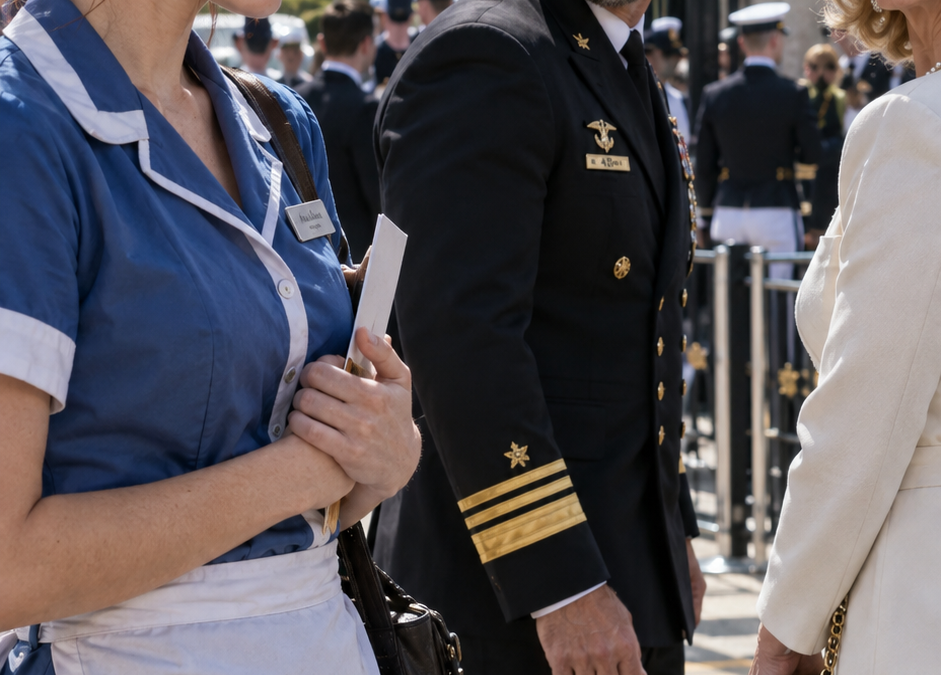
I arrived at my brother’s military graduation wearing the same waitress uniform I had put on before dawn.
A woman near the entrance looked at me once and decided I did not belong there.
Then a SEAL commander saw what I carried in my apron pocket, and the entire morning changed.
My name is Olivia Lane, and at four o’clock that morning, I was already pouring coffee.
Miller’s Diner opened before sunrise because truck drivers, hospital workers, police officers, construction crews, and insomniacs all seemed to agree that hunger did not respect normal business hours.
By 4:15, the first pot was half gone.
By 5:00, every stool at the counter had somebody in it.
By 6:00, the grill sounded like rain on sheet metal.
Eggs cracked.
Bacon snapped.
Orders slid beneath the heat lamps.
Coffee cups knocked against saucers.
I moved through all of it in the blue-and-white uniform I had worn for six years, silver name tag pinned above my left breast, apron tied around my waist, hair pulled back badly enough that strands had already escaped around my face.
I had been awake since 3:15.
I was tired.
But not because of work.
My younger brother was graduating that morning from one of the most competitive military academies in the state.
Danny had spent four years earning that moment.
In some ways, I had spent nineteen years getting him there.
I didn’t say that aloud.
I never had.
Danny was three when our father died.
I was eleven.
Our father, Chief Petty Officer Robert Lane, had spent twenty-two years in the Navy.
To Danny, he had always been a photograph.
A uniform.
A name engraved beneath glass.
A story other people told at holidays.
To me, he had been hands.
A laugh.
The smell of shaving cream.
Boots beside the front door.
A voice telling me not to quit halfway through something just because halfway was where it started hurting.
I remembered the way he would tap two fingers against the kitchen table when he was thinking.
I remembered him carrying Danny on one arm while trying to make pancakes with the other.
I remembered the last morning he left.
Danny did not.
For years, I had believed that was somehow my responsibility.
Not the death.
The remembering.
When Dad was gone, Mom did what she could.
But grief changed her.
She kept us fed.
Kept the lights on.
Went to work.
Came home.
But there was a part of her that never fully returned from the cemetery.
So I became older than eleven very quickly.
I learned how to make Danny breakfast.
How to sign school permission slips once Mom gave up arguing about whether my handwriting looked enough like hers.
How to sit through parent-teacher meetings when she was working.
How to explain to a five-year-old why every other boy at baseball practice had a father standing near the fence.
I never thought of it as sacrifice.
It was simply what the day required.
Maybe that was something I inherited from Dad.
When I turned eighteen, I joined the Navy.
People assumed I did it because of him.
They were partly right.
I wanted to understand the part of his life that had always existed behind closed doors.
But I also wanted something that belonged to me.
I became a corpsman.
Five years.
Enough time to learn how different military service looked from the inside.
Enough time to understand why Dad had sometimes stared through dinner without hearing us.
Enough time to stop asking certain questions about him because I finally understood why he would never have answered them.
I worked alongside people who could remain calm while everything around them was breaking.
I learned to do the same.
Then I came home.
Not because of a dramatic injury.
Not because I had failed.
My enlistment ended during a period when Danny needed stability more than I needed another set of orders.
Mom had become sick.
The bills had multiplied.
Danny was sixteen and pretending he didn’t need anyone.
I knew better.
So I left the Navy.
I worked wherever work existed.
Medical transport for a while.
Night shifts at a warehouse.
Then Miller’s.
People occasionally asked whether I missed medicine.
I did.
People rarely asked whether I missed the Navy.
That answer was more complicated.
I missed knowing exactly what my role was.
Civilian life contains a strange amount of ambiguity.
In the military, when someone is bleeding, you stop the bleeding.
When a team needs movement, it moves.
When an order comes, you understand where responsibility begins and ends.
Civilian life gives you bills, grief, family, unfinished plans, and asks you to determine priorities every morning without a briefing.
I never became comfortable with that.
I simply became functional.
Danny became the clearest priority I had.
He wanted the academy from the time he was fourteen.
At fifteen, he found out what the tuition cost and stopped talking about it.
I found the brochures underneath his mattress.
“You still want this?”
He shrugged.
“It’s stupid.”
“That wasn’t my question.”
“We can’t afford it.”
“That also wasn’t my question.”
He stared at me.
“Yes.”
So we figured it out.
Scholarships.
Entrance exams.
Recommendations.
Fitness standards.
Applications.
Interviews.
He worked harder than I had ever seen him work.
I worked more hours.
Mom died before his first year ended.
That nearly broke him.
I remember sitting beside him on the apartment floor while his academy acceptance packet lay open on the table.
“I’m not going.”
“Yes, you are.”
“You need me here.”
“I need you to become what you worked for.”
“You just lost Mom.”
“So did you.”
He looked at me with tears running down his face.
“We’re supposed to take care of each other.”
“We are.”
I put both hands on his shoulders.
“This is me taking care of you.”
He went.
Four years later, that morning had arrived.
Graduation.
I had a navy-blue dress hanging in my car.
Pressed.
Simple.
The kind of thing that would let me disappear into a row of appropriately dressed families.
I planned to finish at seven.
Change in the employee restroom.
Drive to the academy.
Arrive early.
That was the plan.
Then two servers called out.
At 6:20, the dining room filled.
At 6:45, the kitchen printer started producing tickets faster than the cook could pull them.
My manager appeared beside the counter.
“Olivia.”
“No.”
“I haven’t asked yet.”
“You’re going to ask me to stay.”
“Two hours.”
“No.”
He blinked.
In six years, I had almost never said no.
“I’m short.”
“My brother graduates today.”
“I know, but—”
“No.”
The word surprised both of us.
I looked at the clock.
7:15.
Ceremony started at 8:15.
The academy was thirty-five minutes away under perfect traffic.
I still had four tables.
“I can finish my section.”
“That helps.”
“Then I’m leaving.”
He nodded.
I worked fast.
Not careless.
Fast.
Checks delivered.
Coffee refilled.
A family needed a high chair.
A man complained his eggs were overcooked.
Someone spilled orange juice.
At 7:31, I untied my apron.
Then a busboy handed me a receipt issue from table twelve.
At 7:36, I finally reached the employee door.
I looked toward my car.
The dress was inside.
I looked at the time.
Thirty-nine minutes.
I could change in five.
Maybe four.
Then traffic would decide everything.
I stood there for half a second.
And thought of Danny.
Four years.
Early morning runs.
Late-night study sessions.
The calls where he pretended not to be exhausted.
The first time he failed an evaluation and told me he wasn’t sure he belonged.
The first time I told him Dad had failed things too.
He had laughed at me.
“No, he didn’t.”
“Yes, he did.”
“How do you know?”
“Because nobody becomes that good at anything without failing first.”
That answer satisfied him.
Mostly because it sounded like something Dad would have said.
I looked down at my waitress uniform.
Blue blouse.
White trim.
Apron.
Silver name tag.
Coffee stain near one pocket.
I had spent years caring far too much about being seen correctly.
That morning, I stopped.
I got in the car.
The dress stayed where it was.
Traffic was worse than I wanted.
I changed lanes three times.
Hit every red light.
The clock seemed to move faster whenever I looked at it.
At 8:06, I turned into the academy grounds.
Uniformed cadets directed traffic.
Families crossed the lawn.
Men wore suits.
Women wore dresses and tailored coats.
Parents held flowers.
Some carried academy programs in embossed folders.
I parked farther away than I expected.
Eight minutes.
I grabbed my invitation from the passenger seat.
Opened the door.
Then stopped.
My right hand went automatically to my apron pocket.
Metal touched my fingers.
I carried Dad’s medal almost every day.
Not the ribbon.
That had deteriorated years earlier.
Just the medal.
Small.
Heavy.
Worn at the edges.
My mother had given it to me after his funeral.
I could still remember the cemetery.
The wet grass.
Danny asleep against an aunt’s shoulder.
Mom kneeling in front of me after most people had left.
Her eyes looked empty.
She placed the medal in my palm.
“Keep this safe.”
“For what?”
“For Danny.”
“When?”
“When it’s time.”
I had been eleven.
I didn’t understand.
For years, I thought she meant I should simply give it to him when he was older.
Then seventeen came.
Eighteen.
His academy acceptance.
None of those moments felt right.
That morning did.
I closed my hand around the medal.
“Okay, Dad.”
I put it back into the pocket.
Then I started toward the entrance.
I was twenty feet from the doors when I heard a woman’s voice.
“This is a military institution.”
I would probably have kept walking if she had stopped there.
She didn’t.
“Not a diner.”
I looked toward the voice.
Three women stood near the entrance.
The woman speaking wore a cream designer coat even though the morning was already warming.
Perfect hair.
Pearl earrings.
Shoes that probably cost more than my monthly grocery bill.
She was somewhere in her fifties.
Beside her stood a man in a dark suit and another woman carrying flowers.
The speaker looked directly at me.
Then down.
Shoes.
Apron.
Name tag.
Back to my face.
“You are attending the graduation?”
I held up my invitation.
“Yes.”
She gave a smile that wasn’t a smile.
“There is a dress standard.”
“I’m aware.”
Her eyes narrowed.
“You’re aware.”
“Yes.”
“And you came like that?”
I looked at my uniform.
Then back at her.
“My shift ran late.”
“This ceremony represents years of sacrifice.”
“I know.”
“Then surely you understand why presentation matters.”
There were people close enough to hear.
That was intentional.
I knew the type.
She wasn’t trying to solve a problem.
She was establishing hierarchy in front of an audience.
I had met far worse versions of that personality in uniform.
At least there, rank was displayed honestly.
I moved toward the doors.
She stepped slightly into my path.
Not enough to touch me.
Enough to make the intention clear.
“My son is graduating today.”
“So is my brother.”
“Then I would think you’d want to honor him appropriately.”
Something inside me tightened.
I thought of the dress in my car.
For half a second, shame tried to enter.
Not because she was right.
Because humiliation works fastest when it attaches itself to something you already wish you had done differently.
I did wish I had changed.
I wanted Danny’s photographs to show me looking rested and prepared.
Not like I had just served sixty-seven breakfasts.
But wanting something different did not make me ashamed of how I had arrived.
I had worked because rent existed.
Because Danny’s graduation dinner had to be paid for.
Because one of my coworkers had not shown.
Because life does not suspend itself for ceremonies.
I met the woman’s eyes.
“Excuse me.”
Then I stepped around her.
The security officer near the entrance saw the exchange.
He also saw her speak briefly to an academy administrator.
That became my problem thirty seconds later.
“Ma’am?”
I stopped.
The officer approached politely.
Too politely.
“Yes?”
“May I see your invitation?”
I handed it over.
He checked the name.
“Olivia Lane.”
“Yes.”
“Relationship to Cadet Daniel Lane?”
“Sister.”
He gave the invitation back.
Then hesitated.
“I’ve been asked to address an issue.”
Behind him, the woman in cream stood with her arms loosely folded.
Of course.
“What issue?”
“There are standards regarding guest presentation.”
I looked at him.
He looked uncomfortable.
That helped.
At least he knew.
“My work uniform?”
“Yes, ma’am.”
“Is there a written policy prohibiting it?”
He hesitated.
“The institution asks guests to dress appropriately for the dignity of the ceremony.”
“This is clean.”
I looked down at the coffee stain.
“Mostly.”
He almost smiled.
Didn’t.
“I understand there were circumstances.”
“There were.”
He lowered his voice.
“Perhaps you could wait on the outer steps during the formal portion.”
I stared at him.
He continued because silence makes people uncomfortable.
“You would still be able to see part of the procession.”
“My brother has no one else here.”
He stopped.
“No parents.”
I pointed toward the interior.
“No grandparents. No uncles. No one.”
His expression shifted.
“I am his family section.”
“I understand.”
“No.”
I kept my voice calm.
“You understand the sentence. You don’t understand what you’re asking.”
The woman behind him moved closer.
“Officer, you’re being very patient.”
I looked at her.
The security guard looked miserable now.
I didn’t want him trapped between me and an administrator because somebody with money had complained.
I also did not intend to miss Danny’s graduation.
I reached into my apron pocket.
The medal came out with my fingers wrapped around it.
The officer saw only metal at first.
I placed it in his palm.
He looked down.
The medal had been handled so often that the highest edges were polished almost smooth.
The engraving on the back was faint.
ROBERT LANE.
A date.
A service number.
The guard turned it once.
“What is this?”
“My father’s.”
He looked up.
“Was he military?”
“Yes.”
The entrance doors opened behind me.
I heard footsteps.
The guard was still examining the medal.
The person coming through the doors stopped.
Not slowed.
Stopped.
The silence made me turn.
A senior Navy officer stood ten or twelve feet away.
Dress uniform.
Rows of ribbons.
SEAL trident.
Silver at the temples.
He was maybe in his late fifties.
He had the kind of presence that comes from decades of never entering a room accidentally.
His eyes were fixed on the medal.
Not me.
The medal.
The color had changed in his face.
For several seconds, he didn’t move.
Then he walked toward us.
The woman in cream straightened immediately.
I later learned the commander’s name was Wade Mercer.
He was presiding over the ceremony.
At that moment, all I knew was that he stared at the medal as though it had crossed thirty years to reach him.
He stopped beside the guard.
“May I?”
The guard handed it over.
Commander Mercer did not take it casually.
He lifted it in both hands.
Turned it over.
Read the engraving.
His jaw tightened.
Then he looked at me.
Not at my apron.
Not my hair.
Not the name tag.
My face.
“Whose is this?”
“My father’s.”
He looked down again.
“Robert Lane?”
“Yes.”
“What rank?”
“Chief Petty Officer.”
He closed his eyes for one second.
When they opened, the composure was back.
Mostly.
“What was his community?”
“Navy SEAL.”
The commander stared at me.
“Your name?”
“Olivia Lane.”
“How old are you?”
“Thirty.”
Something behind his eyes changed.
“And your brother?”
“Danny. Twenty-two.”
Commander Mercer looked at the medal again.
“Robert had a daughter.”
It wasn’t a question.
I felt my heartbeat change.
“You knew him?”
His eyes came back to mine.
“I served with him.”
Everything around me seemed to move farther away.
The entrance.
The security desk.
The woman in cream.
The families passing outside.
For nineteen years, people had known my father in the past tense.
Teachers.
Neighbors.
Relatives.
Veterans who attended the funeral.
But almost nobody in my adult life had ever said his name with recognition before I explained who he was.
Commander Mercer had recognized the metal before he recognized me.
That meant something.
“When?”
My voice sounded unfamiliar.
He looked at the engraving.
“Early nineties.”
I swallowed.
“His last deployment?”
The commander took a breath.
“Yes.”
I did not know what to do with my hands.
So I folded them.
Old habit.
“Were you there?”
His answer came quietly.
“Yes.”
That one word almost undid me.
I had spent nineteen years imagining Dad’s last days using fragments.
Official notification.
Funeral language.
A few vague conversations with men who said they had served with him but never enough detail to tell me anything real.
Mom had refused to discuss the mission.
Eventually, I stopped asking.
Commander Mercer held the medal as carefully as if Dad’s hand were still attached to it.
“Your father saved my life.”
I said nothing.
He continued.
“Four of us.”
My throat tightened.
“What happened?”
His eyes moved briefly toward the people standing nearby.
Then back to me.
“Not here.”
I understood immediately.
Some stories were not for entrances.
But he gave me enough.
“1993.”
I nodded.
“A night movement went wrong. We took contact where we were not supposed to take contact.”
His mouth tightened.
“Robert was the reason four men made it out.”
I stared at him.
“Was he injured?”
“Yes.”
“Then why—”
“He stayed.”
The answer was simple.
Of course it was.
Dad would have stayed.
I hated that I knew that.
Loved it too.
Commander Mercer looked at the medal.
“I thought this had been buried with him.”
“My mother kept it.”
He nodded slowly.
“Then gave it to me.”
“When?”
“At the cemetery.”
“You were eleven.”
“Yes.”
He looked at my apron pocket.
“You carry it?”
“Most days.”
“For nineteen years.”
“Yes.”
The woman in cream had gone completely silent.
The security officer looked as though he wished the floor would open.
Commander Mercer asked, “Why today?”
I looked toward the academy grounds.
“My brother graduates.”
“Robert’s son.”
“Yes.”
“Does he know you have this?”
“No.”
The commander understood before I explained.
“You’re giving it to him.”
“If it feels right.”
His expression softened.
“It will.”
For several seconds, we stood there saying nothing.
Then his eyes moved toward my uniform.
“You came from work.”
“Yes.”
“What time did you start?”
“Four.”
His eyebrows rose.
“Today?”
“Yes.”
“And you drove here directly?”
“I was supposed to change.”
“You didn’t have time.”
“No.”
The woman in cream shifted.
Commander Mercer noticed.
Then the guard said, “Sir, there was a concern regarding ceremony dress standards.”
Mercer looked at him.
“A concern.”
The guard glanced toward the woman.
I almost felt sorry for him.
Mercer followed the glance.
The woman stepped forward.
“Commander Mercer.”
He knew her.
“Mrs. Holt.”
She smiled carefully.
“I simply felt that an institution of this caliber should maintain consistent standards.”
Mercer said nothing.
That forced her to continue.
“My son and these other young men have worked four years for this morning. Families have made significant sacrifices. Surely asking guests to dress appropriately isn’t unreasonable.”
“No.”
Mercer said.
Her shoulders relaxed.
Then he added:
“What is unreasonable is confusing clothing with respect.”
Her smile disappeared.
“I wasn’t suggesting—”
“You were.”
He didn’t raise his voice.
That somehow made it sharper.
He turned toward me.
“Ms. Lane, what did you do before the diner?”
The question surprised me.
“Navy corpsman.”
“How long?”
“Five years.”
Mrs. Holt looked at me.
Really looked this time.
Mercer nodded.
“Of course.”
“What does that mean?”
I asked.
He almost smiled.
“You stand like Robert.”
That hurt.
I blinked.
The commander looked toward the guard.
“She goes inside.”
The guard stepped aside immediately.
Mercer continued.
“She goes in first.”
I shook my head.
“Commander, I don’t need—”
“This isn’t preferential treatment.”
His eyes held mine.
“You are the immediate family of a graduate.”
That was true.
Nothing more needed to be said.
Then he looked at Mrs. Holt.
“Chief Petty Officer Robert Lane gave twenty-two years to the Navy.”
Her face had changed.
“He died on active duty.”
Mercer’s voice remained even.
“His daughter served five years as a corpsman. His son graduates from this academy today.”
He looked at my waitress uniform.
“She began working at four this morning and came directly here because missing her brother’s ceremony was not an option.”
Mrs. Holt’s lips parted.
“I didn’t know.”
“No.”
Mercer said.
“You didn’t.”
The sentence stayed between them.
There was no cruelty in his voice.
No triumph.
That made it harder to escape.
Mrs. Holt looked at me.
“I apologize.”
I believed she was embarrassed.
I did not yet know whether she was sorry.
Those are different things.
But I had not come for her transformation.
“Thank you.”
I turned back to Mercer.
“My father’s medal?”
He looked almost startled.
Then glanced down as though he’d forgotten he was still holding it.
“Of course.”
He returned it with both hands.
I closed my fingers around the worn metal.
Before I put it away, Mercer said quietly:
“He never needed permission to belong in any room.”
I looked at him.
“Neither do you.”
My throat tightened.
I nodded once.
Then I put Dad back into my apron pocket and walked through the doors.
No applause.
Thank God.
I would have hated that.
The administrator who had spoken to security stood near the family seating area.
He looked at me.
Then at Commander Mercer behind me.
His face drained slightly.
“Ms. Lane.”
“Yes?”
“Your seat is front row.”
“Thank you.”
“I apologize for the confusion.”
“It wasn’t confusing.”
He flinched.
I wasn’t trying to punish him.
I was tired.
That was all.
I sat.
Front row.
Blue-and-white diner uniform.
Apron still tied.
Name tag visible.
Dad’s medal in my pocket.
Seven minutes before the ceremony.
For the first time since 3:15 that morning, nobody needed anything from me.
No customer.
No manager.
No academy official.
No younger brother asking whether he had made the right decision.
I sat still.
The parade field stretched in front of me.
Morning light reached across trimmed grass.
Chairs filled behind me.
Programs opened.
Families whispered.
Somewhere to my right, a woman was crying before anything had even started.
I understood.
At precisely 8:15, the formation entered.
My body recognized the cadence before my mind did.
Boots.
Commands.
Alignment.
Hundreds of small movements made identical through repetition.
I searched for Danny.
Found him in the second row.
Third from the left.
My chest tightened.
He looked older.
That thought seemed ridiculous.
I had seen him six weeks earlier.
But there are uniforms that reveal adulthood more brutally than time does.
His shoulders were squared.
Eyes forward.
Jaw set.
For a moment, I saw Dad.
Not literally.
Danny had Mom’s mouth.
My eyes.
His own face.
But something in the posture belonged to our father.
I put my hand over the medal in my pocket.
“You made it.”
I whispered.
I wasn’t sure which of them I meant.
Commander Mercer took the podium.
His prepared remarks began exactly as expected.
Duty.
Responsibility.
Service.
Leadership.
The dangers of confusing authority with character.
That line caught my attention.
He spoke well.
Not theatrically.
Like someone who had learned that the people worth listening to rarely needed to demand silence.
Halfway through, he stopped looking at his notes.
“There is something else I want to say this morning.”
The field changed.
You can feel when prepared remarks end.
He looked toward the graduating class.
“Most of you are wearing the finest uniforms you have ever owned.”
A few small smiles.
“Your families dressed carefully for this day. They should have.”
Then he looked toward the family section.
“But service has taught me that dignity is not always dressed the way we expect.”
My stomach tightened.
No.
Please don’t.
He continued.
“This morning, someone arrived at our gate wearing a waitress uniform.”
Every eye in my section seemed to move.
I considered sliding beneath the chair.
Obviously impossible.
“She had come directly from a shift that began at four.”
Danny’s eyes found me.
I could see the confusion from the field.
Mercer continued.
“She carried no flowers. No expensive coat. No visible symbol of rank.”
His voice slowed.
“But she carried something in her pocket that reminded me what this institution is supposed to recognize.”
My hand closed around Dad’s medal.
“A decoration belonging to a sailor I served beside more than thirty years ago.”
The field became silent.
“Chief Petty Officer Robert Lane.”
Danny moved.
Barely.
But I saw it.
His head wanted to turn toward me.
Training kept it forward.
Mercer said:
“Robert Lane was one of the finest men I ever served with. During an operation in 1993, he made a decision in darkness that brought four of us home.”
My vision blurred.
I had not cried when Mrs. Holt spoke to me.
Had not cried when security tried to keep me outside.
Had not cried when Mercer recognized Dad’s medal.
This was different.
Because Danny was hearing it.
For the first time.
“Our institutions teach us to recognize service through uniforms, insignia, medals, rank.”
Mercer paused.
“Those things matter.”
Then:
“But courage does not always arrive wearing them.”
He looked toward me.
“Sometimes it walks through the door in an apron because it finished a shift before coming to watch a younger brother graduate.”
I lowered my eyes.
Behind me, someone sniffed.
I hated all of them.
Not really.
But enough.
Mercer finished simply.
“When you leave here today, remember this: never mistake presentation for character. Never mistake quiet for weakness. And never assume you know what someone has carried merely because they did not show it to you.”
He returned to his prepared remarks.
No name.
No applause.
He gave me that mercy.
Danny stared forward.
But I knew him.
The muscle in his jaw was working.
When the graduates were finally released to meet their families, the field became chaos.
Parents crying.
Phones raised.
Flowers everywhere.
Men who had spent four years learning composure being nearly crushed by their mothers.
I stayed where I was.
Danny found me.
He walked quickly at first.
Then slowed when he got close.
His eyes dropped to my uniform.
“You came straight from work.”
“Obviously.”
“You could’ve changed.”
“I could’ve missed the ceremony.”
His face tightened.
“Liv.”
“Don’t.”
His eyes were wet.
“I didn’t know he knew Dad.”
“Neither did I.”
“He said Dad saved him.”
“Yes.”
“Four men?”
“Yes.”
“Did you know?”
“No.”
That answer hit him.
For years, Danny had assumed I possessed the complete version of Dad.
I didn’t.
I had simply carried more fragments.
“You didn’t know.”
“No.”
He looked toward Commander Mercer in the distance.
Then back at me.
“What else don’t I know?”
I smiled sadly.
“A lot.”
“About Dad?”
“About everybody.”
He looked down.
“I feel like an idiot.”
“Why?”
“All those years, I thought you knew everything.”
“I encouraged that.”
“You absolutely did.”
“Older-sister privilege.”
He laughed once.
Then stopped.
His eyes moved to my apron pocket.
“The medal.”
I reached inside.
For nineteen years, I had imagined this moment.
I thought I would know what to say.
I didn’t.
The medal rested in my palm.
Its edges were smooth from my fingers.
Danny stared at it.
“Is that his?”
“Yes.”
“You had it?”
“Mom gave it to me after the funeral.”
His eyes lifted sharply.
“You were eleven.”
“Yes.”
“And you’ve kept it all this time?”
“Yes.”
“For me?”
I looked at the medal.
“At first.”
“What does that mean?”
“Eventually it became mine too.”
That was the truth.
I had carried it through school.
Through enlistment.
Through five years in the Navy.
Through Mom’s illness.
Through every job after.
Through Danny’s first day at the academy.
Some nights it had been the only physical proof I possessed that our childhood had really happened.
Giving it away suddenly felt harder than I expected.
Danny saw that.
He closed my fingers over it.
“Keep it.”
I looked at him.
“No.”
“Liv.”
“Mom told me to keep it until it was time.”
“I don’t care.”
“I do.”
I opened my hand again.
He stared at the metal.
“I don’t want to take something you’ve carried for nineteen years.”
“You’re not taking it.”
I reached for his hand.
Opened his palm.
Placed the medal there.
“You’re continuing it.”
His face broke.
Not dramatically.
Danny had always cried quietly.
His fingers closed around the medal.
“I don’t remember him.”
“I know.”
“That always made me feel guilty.”
My heart tightened.
“Danny.”
“You had him.”
“For eleven years.”
“I had stories.”
“So?”
“It felt like I was pretending sometimes.”
I stepped closer.
“You were three.”
“I know.”
“You do not owe anyone memory.”
He looked at me.
“You carry him differently.”
“That’s all.”
His fingers tightened around the medal.
“What was he like?”
The question surprised me.
“You’ve asked before.”
“I know.”
“Then why now?”
“Because I think I heard stories before.”
He looked toward the commander.
“Today I realized he was a person.”
That was one of the saddest and most accurate things Danny had ever said.
I took a breath.
“He was annoying.”
Danny laughed through tears.
“Seriously?”
“Extremely.”
“What did he do?”
“He sang badly.”
“Like you.”
“Watch yourself.”
“He burned pancakes.”
“You burn water.”
“Not possible.”
“You found a way.”
He smiled.
I continued.
“He hated being late. Tapped the table when he was thinking. Pretended he didn’t like dogs and then fed every stray dog he saw.”
Danny listened.
“He was strict about shoes being lined up by the door. Terrible about putting his coffee cup in the sink.”
“That sounds familiar.”
“Shut up.”
He laughed again.
Then:
“Was he brave?”
I looked at the medal in his hand.
“Yes.”
“But?”
“He was afraid too.”
Danny frowned.
“How do you know?”
“Because brave people aren’t people who never get scared.”
I touched his uniform collar.
“They’re people who decide what matters more.”
His face changed.
That was the answer he needed.
Maybe it was the answer I had needed at twenty-two too.
“You’re proud of me?”
I stared at him.
“Danny.”
“I know. Stupid question.”
“It is.”
“I wanted to hear it.”
My throat tightened.
“I’m proud of you.”
He swallowed.
“More than I know how to explain.”
He looked down.
“I wouldn’t be here without you.”
“Don’t do that.”
“Why?”
“Because you earned this.”
“You paid application fees.”
“You passed the exams.”
“You worked doubles.”
“You ran the courses.”
“You sold Mom’s car so I could—”
“That car barely had an engine.”
“You left the Navy.”
I froze.
Danny had never said it like that.
“You needed me.”
“You loved the Navy.”
“So?”
“You gave it up.”
“I finished my enlistment.”
“You could’ve reenlisted.”
“Yes.”
“For me.”
“For us.”
He looked angry now.
Not at me.
At the past.
“You should’ve told me.”
“Why?”
“So I could understand what this cost you.”
I shook my head.
“You were sixteen.”
“So?”
“You didn’t need the cost.”
My voice softened.
“You needed the chance.”
He looked at me.
“That was my decision, Danny.”
“You never regretted it?”
I thought carefully.
“I missed it.”
“That isn’t what I asked.”
“No.”
I smiled.
“I didn’t regret it.”
His shoulders lowered.
Then I fixed his collar because I had been doing things like that since he was small.
“You’re crooked.”
“I’ve been standing in formation for two hours.”
“And yet you’ve somehow failed buttons.”
He smiled.
Commander Mercer approached while we were still standing there.
Danny straightened instantly.
“Sir.”
Mercer almost laughed.
“Relax, Ensign.”
Danny tried.
Failed.
Mercer looked at the medal in his hand.
“So she gave it to you.”
“Yes, sir.”
“Good.”
Danny looked at him.
“Sir, you served with my father?”
“I did.”
“Would you tell me about him?”
Mercer looked at me first.
Permission.
I appreciated that.
I nodded.
“Not all of it today.”
Mercer told Danny.
“Some stories deserve time.”
“Yes, sir.”
“But I’ll tell you one thing.”
Danny waited.
“Your father was not fearless.”
Danny glanced at me.
I smiled.
Mercer continued.
“He was simply very clear about what mattered when fear showed up.”
That was almost exactly what I had said.
Maybe Dad had taught both of us.
Mercer looked at my uniform.
Then at Danny.
“You know what your sister did?”
Danny smiled.
“She’ll say nothing.”
“Correct.”
Mercer said.
“That doesn’t make it nothing.”
I rolled my eyes.
“Commander.”
He ignored me.
“Five years as a corpsman?”
Danny looked at me.
“You never told him?”
“I told him I served.”
“As what?”
“Medical.”
Danny stared.
“You said medical.”
“That is accurate.”
“You were a corpsman?”
“Yes.”
He looked offended.
“You let me spend four years at a military academy telling people my sister ‘used to work in medical.’”
“It was entertaining.”
“Liv.”
Mercer laughed.
I had not expected that sound from him.
Danny shook his head.
“You’re impossible.”
“I raised you. You’re welcome.”
Mercer looked between us.
Then his expression changed.
Something more serious.
“Robert would have been proud.”
Danny’s face tightened.
I looked away toward the field.
Mercer added:
“Of both of you.”
That almost hurt more.
For years, I had imagined Dad’s pride as something directed toward Danny.
The academy.
The uniform.
The commission.
My role had been getting him there.
I had never seriously asked what Dad might have thought of me.
The Navy.
The corpsman years.
Leaving.
Working at a diner.
Raising Danny.
Surviving Mom.
Keeping the medal.
I looked at Mercer.
“You really think so?”
He studied me.
“Olivia, your father once crawled forty yards under fire because one of our men couldn’t move.”
I said nothing.
“He didn’t do it because somebody was watching.”
Mercer’s voice softened.
“He did it because someone needed him.”
He glanced toward Danny.
“You’ve spent nineteen years doing the same thing in different clothes.”
I looked down at my apron.
That was the first moment all morning that I felt embarrassed by it.
Not ashamed.
Overwhelmed.
Because suddenly the uniform meant something else.
It represented 4:00 a.m. shifts.
Rent.
Danny’s textbooks.
Mom’s prescriptions.
Application fees.
Gas.
Groceries.
Ordinary survival.
I had spent years believing those things were less significant because nobody handed out medals for them.
Maybe that was never true.
Mrs. Holt approached us several minutes later.
I saw her coming.
Danny didn’t know who she was.
Mercer did.
His expression became neutral.
“Ms. Lane.”
She stopped several feet away.
Without the crowd at the entrance and the confidence of being the person setting the standard, she looked smaller.
Human.
“I wanted to apologize properly.”
I waited.
“What I said was inappropriate.”
“Yes.”
She looked surprised by the direct answer.
I wasn’t going to rescue her from it.
“I made assumptions.”
“Yes.”
Her eyes dropped briefly to my apron.
“I judged you based on your clothes.”
“Yes.”
Danny looked between us.
Understanding slowly appeared on his face.
Mrs. Holt continued.
“I was wrong.”
I believed that part.
Maybe shame had become reflection.
Maybe not.
People deserve the chance to correct themselves.
They are not automatically entitled to absolution.
“Thank you.”
I said.
She hesitated.
“I hope your brother has a successful career.”
Danny answered.
“Thank you, ma’am.”
She left.
Danny turned to me immediately.
“What did she do?”
“Nothing worth ruining your graduation over.”
“Olivia.”
“Danny.”
“What did she say?”
“Later.”
Mercer looked amused.
Danny pointed at him.
“Sir, with respect, don’t encourage her.”
“I wouldn’t dream of it.”
“You absolutely are.”
I laughed.
The sound surprised me.
The whole morning had been carrying such weight that I had forgotten joy was allowed inside it.
Eventually, Mercer had to leave.
Before he did, he gave me his card.
“Call me.”
“For what?”
“Your father.”
I looked at it.
“There are things you and Daniel should know.”
Daniel.
Only people who knew Dad ever used Danny’s full name naturally.
Dad had insisted on it when he was born.
Commander Mercer looked at the medal in Danny’s palm.
“I’ve carried my part of that story a long time.”
His voice lowered.
“Maybe it’s time I stopped carrying it alone.”
I understood.
“So have we.”
He nodded.
Then left.
Danny and I remained near the field until most families had gone.
He had photographs to take.
People to introduce.
One of his classmates stared at my apron for a second.
Danny saw.
“This is my sister Olivia.”
There was something in his voice.
Pride.
Too much pride.
I gave him a warning look.
He ignored it.
“She raised me.”
“Danny.”
“And served as a Navy corpsman.”
“Danny.”
“And Commander Mercer apparently owes our father his life.”
I stepped closer.
“I can still hurt you in front of your classmates.”
He smiled.
“That sounds medically unethical.”
“I’m off duty.”
His friends laughed.
For once, I let them.
Later, we walked toward the parking lot together.
He carried his cap under one arm.
Dad’s medal stayed clenched in his other hand.
I realized he had not put it into a pocket once.
“You can put that away.”
“No.”
“You’re going to drop it.”
“I won’t.”
“That is exactly what someone says immediately before dropping something.”
He closed his fist tighter.
“I’ve got it.”
I smiled.
The words reached somewhere old.
Mom at the cemetery.
Keep this safe.
I had.
Now he had it.
Maybe that was what she meant.
Not simply that I should preserve a piece of metal.
That I should preserve the story long enough for Danny to become ready to carry it without being crushed by it.
We reached my car.
He looked through the window.
Saw the navy dress hanging behind the driver’s seat.
His face changed.
“You brought clothes.”
“Yes.”
“You really didn’t have time.”
“No.”
He stared at the dress.
Then back at the uniform I was wearing.
“You know what?”
“What?”
“I’m glad you didn’t change.”
I laughed.
“That makes one of us.”
“No.”
He shook his head.
“I mean it.”
“Why?”
He looked down at the medal.
“Because now when I remember today, I’ll remember what it actually took to get here.”
My eyes burned.
“Danny.”
“You always made everything look easy.”
“It wasn’t.”
“I know that now.”
He looked at me.
“I wish I had known earlier.”
I opened the car door.
“You weren’t supposed to.”
“Why do you keep saying that?”
“Because children shouldn’t have to understand the full price of being cared for while they’re still being cared for.”
“I wasn’t a child at twenty.”
“You were to me.”
He groaned.
“That is insulting.”
“You’ll survive.”
He put Dad’s medal carefully inside the inner pocket of his uniform.
For the first time.
Then he looked at me.
“Dinner tonight?”
“I made reservations.”
“You did?”
“Obviously.”
“With what money?”
“Don’t ask dangerous questions on graduation day.”
“Olivia.”
“Get in the car.”
He laughed.
We drove away from the academy with the dress still hanging untouched behind us.
For the next several months, Commander Mercer became part of our lives in a way I never expected.
Not constantly.
He understood boundaries too well for that.
But he called.
Sometimes Danny joined.
Sometimes it was only me.
He told us about Dad slowly.
Never classified details.
Never anything that belonged to somebody else’s story.
Just the human parts.
Dad once carried hot sauce through an entire deployment and nearly started a fight when somebody used the last bottle.
He cheated badly at cards.
He hated canned peaches.
He wrote letters home and then carried them for days before remembering to mail them.
He talked about me.
That surprised me most.
“How much?”
I asked Mercer during one call.
“Enough that I knew he had a daughter who corrected his grammar.”
I covered my face.
“I was nine.”
“He was deeply offended.”
“I was right.”
“He admitted that later.”
“And Danny?”
“He talked about the baby constantly.”
Danny, listening on speakerphone, smiled.
“He called me the baby?”
“You were three.”
“I had a name.”
“He used that too.”
We laughed.
Then Mercer told us about the night Dad died.
Not everything.
Enough.
The team had been compromised.
Two men wounded.
A route out partially cut off.
Dad had chosen to stay with one injured man while the others repositioned.
Mercer had tried to remain with him.
Dad ordered him to move.
“You listened?”
I asked.
“Eventually.”
“What did he say?”
Mercer was silent long enough that I almost withdrew the question.
Then:
“He said, ‘Your job is to get the living home.’”
My eyes closed.
That sounded exactly like him.
Danny asked:
“Was Dad scared?”
“Yes.”
Mercer’s answer came without hesitation.
“Anyone who tells you men like your father aren’t afraid is selling you something.”
Silence.
“He knew what might happen.”
Mercer continued.
“He did the job anyway.”
For years, I had imagined Dad’s final moments as something almost mythical.
A hero disappearing into a classified story.
Mercer returned him to me as a person.
Afraid.
Decisive.
Flawed.
Funny.
Alive until he wasn’t.
That helped more than mythology ever had.
A year after Danny’s graduation, I returned to the academy for another ceremony.
This time I wore the navy dress.
Not because anyone required it.
Because I had time.
Danny was there in uniform.
Commander Mercer had retired.
Mrs. Holt was nowhere in sight.
Nobody stopped me at the entrance.
Nobody cared what I carried in my pocket.
I still carried another small token of Dad.
Not the medal.
That belonged to Danny now.
A worn coin Mercer had given me after one of our conversations.
Dad had carried it during training.
Mercer had somehow ended up with it after the final deployment.
He said it belonged with the family.
I kept it beside my name tag at work.
Customers occasionally noticed.
“What’s that?”
I usually answered:
“My father’s.”
That was enough.
I stayed at Miller’s longer than people expected.
Some thought discovering Dad’s connection to Commander Mercer would make me seek some grand military return.
It didn’t.
I had already served.
I had already come home.
I did eventually begin using my corpsman experience again.
Two evenings a week, I volunteered with a veterans’ outreach clinic.
Basic medical navigation.
Appointments.
Helping families understand paperwork.
Sometimes just coffee and conversation.
I still worked breakfast shifts.
I liked them.
There was dignity in feeding people before the world had fully woken up.
That was another thing the academy morning changed in me.
I stopped ranking forms of service.
For years, I had quietly divided my life.
Important years.
Navy.
Unimportant years.
Diner.
Important sacrifice.
Dad.
Ordinary sacrifice.
Me.
That distinction did not survive graduation day.
Dad served twenty-two years and died in uniform.
I served five.
Then I spent years doing something far less visible.
Both mattered.
Danny needed a father he could be proud of.
He also needed a sister who paid the electric bill.
One did not erase the other.
Sometimes courage is dramatic enough to become a medal.
Sometimes it is getting up at 3:15 for a shift because your brother’s tuition gap has to come from somewhere.
Sometimes duty is crossing dangerous ground.
Sometimes it is refusing another enlistment because a sixteen-year-old needs someone at home.
Sometimes honoring the dead means telling their stories.
Sometimes it means packing lunches for the children they left behind.
I had spent nineteen years carrying Dad’s medal because I thought it contained his legacy.
The day I finally placed it in Danny’s hand, I understood something else.
The medal was never the whole legacy.
We were.
Danny in his new uniform.
Me in my waitress uniform.
Both of us standing on the same field because of choices made by people who loved us.
Dad.
Mom.
Me.
Eventually Danny too.
Three years after graduation, Danny came home on leave.
He walked into Miller’s at 6:20 one morning.
I was carrying two breakfast plates.
He sat at Harold’s old stool.
Harold had passed the winter before.
Some absences remain attached to furniture.
“What are you doing here?”
I asked.
“Breakfast.”
“You have a key to my apartment.”
“I wanted eggs.”
“You can cook.”
He smiled.
“You taught me.”
“Exactly.”
“Which is why I came here.”
I put coffee in front of him.
He reached into his pocket.
Dad’s medal.
Still worn.
Now carried by different hands.
“You bring that everywhere?”
“Most places.”
I smiled.
“I used to do that.”
“I know.”
He turned it over.
The engraving had faded even more.
“Commander Mercer called yesterday.”
“Oh?”
“He wants me to visit.”
“You should.”
“He said he found another photograph of Dad.”
That still had power over me.
“Really?”
“Yeah.”
Danny looked at the medal.
“You want to come?”
I thought about the schedule.
My shift.
The ordinary things.
Then I remembered the academy morning.
How close I had come to missing everything because I believed being responsible meant always saying yes to work.
I untied my apron.
My manager looked through the kitchen window.
His eyes widened.
“Where are you going?”
I smiled.
“Family thing.”
He stared.
“You’re leaving early?”
“Yes.”
“Olivia Lane voluntarily leaving before the end of a shift?”
“Don’t make this historic.”
Danny laughed.
I grabbed my coat.
As we walked toward the door, he stopped me.
“Liv.”
“What?”
“That graduation day.”
I looked at him.
“What about it?”
“I’ve thought about something you said.”
“Dangerous.”
“You said I didn’t need to know what everything cost you.”
I remembered.
“Okay.”
“I think you were wrong.”
I leaned against the counter.
“Explain.”
“I didn’t need to know when I was sixteen.”
He looked down.
“But eventually, I did.”
I waited.
“Not so I could feel guilty.”
He looked at me again.
“So I could understand you.”
That landed somewhere deep.
Children grow up.
Sometimes faster than the people who raised them realize.
“You understand me now?”
He smiled.
“No.”
“Good.”
“But more.”
“I’ll allow it.”
He opened the diner door.
Morning light came through the glass.
For a second, I saw him at three.
Then sixteen.
Then twenty-two on the parade field.
All of them existed inside the man standing there.
Maybe the same was true of me.
Eleven years old at the cemetery.
Eighteen joining the Navy.
Twenty-three coming home.
Thirty in a waitress uniform at an academy gate.
None of those women had disappeared.
They had simply carried one another forward.
I touched the pocket where Dad’s medal used to live.
Empty now.
For years, that emptiness would have frightened me.
It didn’t anymore.
The weight had moved where it belonged.
Danny held the door.
I stepped outside.
No uniform could have explained the whole of either of us.
No medal could either.
That morning at the academy, a woman looked at my apron and believed she understood what I had brought through the gate.
She saw a waitress who had failed to dress properly.
The security guard saw a dress-code problem.
Commander Mercer saw a medal.
Danny saw his sister.
Each person saw a different fragment.
None of them saw everything.
Maybe nobody ever does.
That is why judgment should come slowly.
Why dignity should never depend on clothing.
Why the quietest person in the room may be carrying the heaviest history.
And why, after all those years, the most important thing Commander Mercer gave me was not recognition.
It was not his authority at the entrance.
It was not the story of Dad’s final mission.
It was the reminder that the life I had built after the Navy did not make the life before it smaller.
I had spent years believing that Dad’s legacy was something I was protecting for Danny.
By the time Danny graduated, I understood that I had been living inside that legacy too.
Not because I wore his medal.
Not because I served.
Because when the people I loved needed something from me, I stayed.
Dad had done the same.
Different battlefield.
Different uniform.
Same answer.
And that morning, when Danny marched across the parade ground and I sat in the front row still smelling faintly of diner coffee, I finally stopped wishing I had arrived looking like someone else.
I had arrived exactly as the life we built required.
That was enough.








