𝗣𝗔𝗥𝗧 𝟮 The Waitress at General Harris’s Funeral Was Carrying a Secret No One at the Gate Could See
𝗣𝗔𝗥𝗧 𝟮
Then I wrote the funeral date on a piece of paper.
For the next twenty days, I alternated between planning to attend and deciding I would not.
On the night before the funeral, I still had not decided.
At 11:14, apparently, my body decided for me.
The highway was almost empty.
I drove with both hands on the wheel.
No music.
No podcasts.
Silence had become my preferred traveling companion because it never asked follow-up questions.
Around one in the morning, I stopped for gas.
A young cashier saw my uniform and asked if I was headed to work.
“Something like that.”
He did not ask more.
By three-thirty, the sky was beginning to lighten.
By four-ten, I reached Arlington.
I parked.
Turned off the engine.
And stayed in the car.
Twenty minutes.
Maybe twenty-five.
I watched people arrive.
Black cars.
Uniforms.
Dark suits.
Dress shoes polished enough to catch the early light.
I looked down at myself.
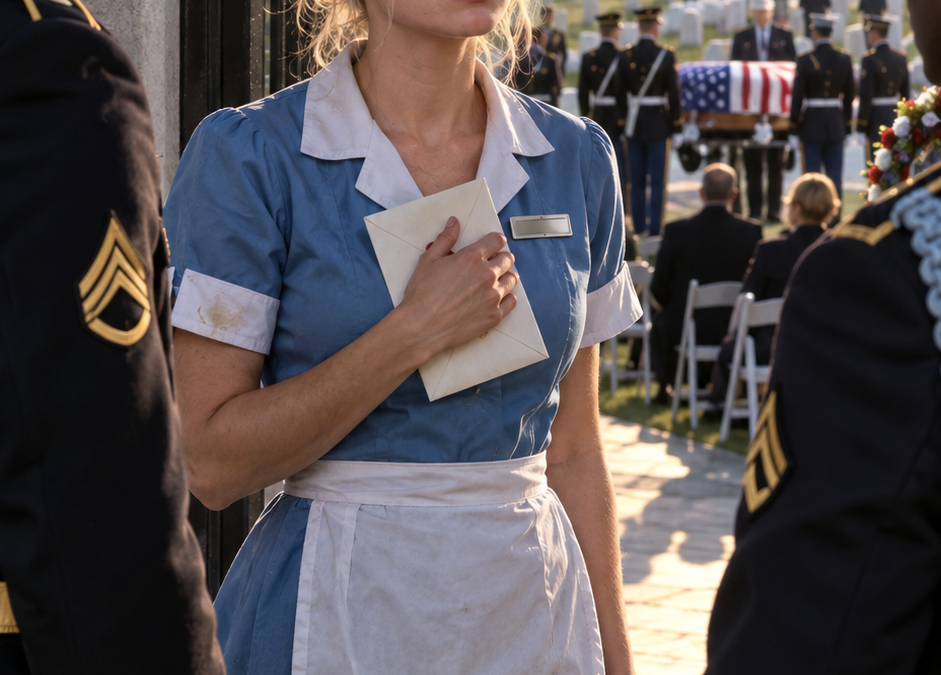
Blue-and-white waitress dress.
White apron.
Cheap black shoes designed for twelve-hour shifts.
Name tag.
OLIVIA.
I almost left.
Then I thought about Harris’s office seven years earlier.
Wait for the truth.
I had not.
Maybe showing up now was the smallest apology I could offer.
Not for leaving.
I still believed I had needed to leave.
For disappearing.
For never giving him the chance to say anything else.
I got out.
Arlington in the morning has a kind of quiet that does not exist anywhere else.
It is not empty silence.
It is accumulated silence.
Thousands of names beneath the grass.
Thousands of families who came carrying one unbearable story at a time.
The place did not erase grief.
It made room for it.
I walked toward the service.
I stayed near the back.
That had been my plan.
Invisible.
I had seven years of practice.
The casket was already in place.
Flag stretched over it.
Honor guard precise and motionless.
Rows of officers.
Marines.
Navy personnel.
Retired commanders.
Political figures.
Family.
Men and women whose uniforms carried careers across their chests.
I stood behind all of them.
Exactly where a waitress belonged.
That thought entered my mind automatically.
I hated myself for it.
I had not always thought that way.
Seven years of hiding had changed the scale I used to measure myself.
I was watching the casket when someone stepped into my peripheral vision.
Young.
Very young.
A specialist assigned to security.
He could not have been older than twenty.
“Ma’am?”
I turned.
His eyes moved over my uniform.
Not rudely.
Efficiently.
Categorizing.
“Yes?”
“This section is restricted to family and distinguished guests.”
“I know.”
He pointed toward a public viewing area farther back.
“You’ll need to move over there.”
I looked toward the casket.
“I only need a minute.”
His expression tightened.
“Ma’am, I need you to move.”
“I will.”
“When?”
“After I pay my respects.”
“That’s not how this works.”
I almost smiled.
He was trying.
Young soldier.
Formal assignment.
Probably terrified of making a mistake.
Unfortunately, he had decided I was the mistake.
“I understand.”
“Then please move now.”
I did not.
Something about the casket held me there.
Maybe stubbornness.
Maybe shame.
Maybe the fact that I had driven four hours to stand fifty yards from a dead man and apparently even that was going to require permission.
The specialist called a sergeant.
The sergeant arrived with an expression that said the situation should already have been solved.
“What’s the problem?”
“She refuses to move to the public section.”
The sergeant looked at me.
“Ma’am.”
“I heard him.”
“Then I don’t understand the issue.”
“I served under General Harris.”
His eyes flicked to the apron.
“How?”
There it was.
Not when.
Not where.
How.
How could a waitress have served under a general?
“I was military.”
“What branch?”
“Navy.”
“Do you have identification?”
“Not current.”
“Then you need to move.”
Another guard arrived.
Then a second sergeant.
The funeral had not started yet, but people were noticing.
I hated that more than anything.
I had come to stand quietly.
Instead, I was becoming an event.
“I don’t want trouble,” I said.
The first sergeant appeared a minute later.
He was older.
Late thirties, maybe early forties.
Confident.
Professional.
And immediately certain.
He examined the situation.
Then me.
His gaze stopped on the worn patch attached to my canvas bag.
A unit insignia.
Old.
Faded.
I had forgotten it was still there.
He pointed.
“That military insignia is unauthorized.”
I looked down.
“No, it isn’t.”
“Are you currently serving?”
“No.”
“Then you shouldn’t be displaying it.”
I stared at him.
“That’s not the regulation.”
His face changed.
Small.
Authority does not enjoy correction from waitresses.
“Ma’am, I’m not debating regulations with you.”
“Then don’t quote them incorrectly.”
The young specialist looked like he wanted to disappear.
The first sergeant stepped closer.
“You are in a restricted area without credentials.”
“I understand.”
“You were instructed to move.”
“Yes.”
“And you refused.”
“Yes.”
“So now you are creating a security issue.”
I almost laughed.
Seven years earlier, I had spent nine hours treating casualties inside an active combat zone.
Now I was a security issue because I wanted sixty seconds near a coffin.
Life has a strange sense of scale.
I reached into my pocket.
Pulled out a challenge coin.
It was old.
Edges worn nearly smooth.
I handed it to him.
He took it.
Turned it over.
Operation Sentinel Ridge.
Unit insignia.
A date.
On the reverse, one line:
FORTUNE FAVORS THE PREPARED HAND.
Harris had given it to twelve of us after the operation.
I was the only one who never attended the ceremony.
Mine had arrived in the mail.
The first sergeant studied it.
Nothing registered.
He handed it back.
“This doesn’t authorize your presence.”
“I didn’t say it did.”
“Then move.”
I closed my fingers around the coin.
“No.”
That was when something in the crowd shifted.
I did not know why at first.
A man in Marine dress uniform had turned toward us.
Captain.
Young.
Mid-twenties.
He had been standing near the edge of the distinguished section with a funeral program in one hand.
He looked at the guards.
Then the first sergeant.
Then me.
His program slipped from his hand.
He did not pick it up.
Instead, he started walking.
Fast.
Not running.
Military people rarely need to run to communicate urgency.
He moved directly toward us.
A staff officer tried to speak to him.
The captain gave him one look.
The officer stopped.
The first sergeant noticed the captain only when he was several feet away.
“Sir, we’re handling—”
The captain walked past him.
Not disrespectfully.
Simply as though the sentence had no relevance.
He stopped in front of me.
Three feet away.
His eyes studied my face.
Not my apron.
Not the name tag.
My face.
“Ma’am.”
“Yes?”
His voice was suddenly careful.
“Is your name Olivia Reeves?”
Everything around me seemed to narrow.
“Yes.”
The first sergeant opened his mouth.
The captain looked at him.
One glance.
The mouth closed.
The captain returned his attention to me.
“I’ve seen your photograph.”
My stomach tightened.
“Where?”
“Combat medic training program.”
I stared.
He swallowed.
“Eighteen months ago, I was assigned to help teach the Sentinel Ridge case study.”
My fingers closed harder around the coin.
He continued.
“Your after-action report is part of the curriculum.”
I could not speak.
He seemed to understand.
“Every combat medic graduating through our advanced program studies that operation.”
I looked toward the casket.
Harris.
Of course.
Even dead, somehow, he was still rearranging rooms around me.
The captain turned toward the first sergeant.
His tone changed.
Not louder.
Sharper.
“This is Olivia Reeves.”
Nobody moved.
“She served as the primary combat medic during Operation Sentinel Ridge.”
The first sergeant’s face emptied.
The captain continued.
“She maintained field triage for nine hours under sustained contact.”
He looked toward the young specialist.
“Eleven Marines survived because of the decisions she made with one field kit and limited evacuation support.”
I hated hearing it said like that.
Clean.
Heroic.
Missing everything.
The captain was not finished.
“General Harris personally recommended her for the Navy Cross.”
The specialist looked at me.
Then immediately looked away.
The first sergeant’s gaze dropped to my waitress uniform again.
This time, the apron meant something different to him.
That angered me more than his earlier judgment.
I had not changed.
The information had.
The captain looked directly at him.
“She finished a closing shift last night.”
How did he know that?
I looked down.
The apron.
Of course.
“She drove here without changing because apparently being here mattered more to her than looking like you expected.”
The first sergeant’s jaw tightened.
Then the captain said the sentence that ended the conversation.
“And you told her she didn’t belong.”
Nobody answered.
He did not humiliate them further.
I respected him for that.
There is a point at which correction becomes performance.
He stopped before it.
A brigadier general twenty feet away had turned toward us.
An aide beside him made a phone call.
Thirty seconds later, the aide approached.
He spoke quietly to the captain.
The captain listened.
Then nodded.
He turned back to me.
“Mrs. Harris would like you at the front.”
My entire body resisted.
“No.”
The captain seemed surprised.
“I mean—”
I looked at my clothes.
“I’m dressed like this.”
His eyes moved over the uniform once.
Then back to my face.
“General Harris wouldn’t care.”
“You didn’t know him seven years ago.”
“No.”
“He cared about standards.”
The smallest smile appeared.
“I just spoke with his wife.”
I waited.
“She said he wouldn’t care.”
That was harder to argue with.
I looked at the first sergeant.
His face was pale.
“I’m sorry, ma’am.”
I believed him.
The young specialist added, “Me too.”
I nodded.
“You were doing your job.”
The first sergeant started to say something.
I stopped him.
“Next time, ask one more question before deciding you know the whole answer.”
He swallowed.
“Yes, ma’am.”
Then I followed the captain.
Walking toward the front felt worse than walking into the firefight at Sentinel Ridge.
People moved aside.
Generals.
Colonels.
Decorated veterans.
People whose careers had shaped policy and units and wars.
I wanted to tell them to stop.
I wanted invisibility back.
Instead, I kept walking.
The apron moved against my knees.
My name tag caught the light.
Every step seemed to announce:
WAITRESS.
CIVILIAN.
FORMER.
BROKEN.
Then another voice inside me said something I had not heard in years.
Keep moving.
That voice had once belonged to me.
At the front stood Evelyn Harris.
General Harris’s wife.
I recognized her from photographs.
Silver hair.
Black coat.
Perfect posture.
Grief held with extraordinary discipline.
She looked at my uniform.
Then my face.
And said:
“He talked about you.”
I froze.
Her eyes filled.
“Until the end.”
My chest tightened.
“He said he never stopped looking for you.”
I stared at her.
“What?”
She reached inside her coat.
Pulled out an envelope.
My name was written across the front.
Olivia Reeves.
I knew the handwriting.
Seven years did not matter.
I had seen that hand on orders.
Evaluations.
Commendations.
Briefing notes.
A resignation request he refused to sign for forty-eight hours.
General Harris.
My fingers shook when I accepted it.
“How long?”
Mrs. Harris’s voice softened.
“Four years.”
I looked at her.
“What?”
“He wrote it four years ago.”
The envelope was soft around the edges.
Handled.
Carried.
Waited on.
I looked toward the casket.
Then back to her.
“He knew where I was?”
“No.”
“He could find anyone.”
“He tried.”
I almost laughed.
“Apparently not a waitress.”
Mrs. Harris did not smile.
“He regretted that.”
I opened the envelope.
Three pages.
Handwritten.
The first line began:
Olivia, I owe you an apology, but not the one you think.
I stopped breathing.
The captain stood several feet away.
Mrs. Harris did not rush me.
I read.
Harris wrote that six weeks after Sentinel Ridge, the final intelligence package arrived.
The timeline burned into me.
Six weeks.
I had already left.
The woman in the compound had been identified.
Not a civilian.
Not incidental.
Not collateral.
Her name was Marisol Vega.
Cartel lieutenant.
Operational coordinator.
Responsible for ordering the assassinations of nine local officials over eighteen months.
The compound had existed largely because of her network.
The weapon in her hands had been real.
The threat had been real.
My decision had been tactically and legally justified.
I read the paragraph again.
Then again.
Then a third time.
Words do not become believable just because you understand them.
Sometimes your mind has to catch up with the life your body has already lived.
Seven years.
For seven years, I had woken with a dead civilian in my head.
For seven years, I had believed my worst fear about myself had been true.
For seven years, I had built an entirely different life around punishment for something that had never happened the way I believed.
I kept reading.
Harris wrote:
The intelligence arrived after you resigned. I requested permission to contact you. Classification prevented disclosure. By the time restrictions changed, every address I had for you was dead. Every number disconnected. I asked people who knew you. You had made yourself difficult to find. I understand why.
My vision blurred.
I should have fought harder to keep you from leaving. I also know that sentence is selfish. You had the right to leave. What you did not deserve was to leave carrying a conclusion built from missing information.
I had to stop.
Mrs. Harris placed one hand lightly against my arm.
I looked at her.
“Did he blame himself?”
She took a long breath.
“Yes.”
“Why?”
“Because he ordered the mission.”
“That wasn’t—”
I stopped.
Seven years ago, I would have said it was his fault.
Now, standing over his coffin, I suddenly wanted to defend him.
Grief is inconsistent.
So is forgiveness.
Mrs. Harris said, “He told me that sending people into danger was part of command.”
Her mouth trembled.
“But what haunted him was knowing you came home carrying the wrong version of what happened.”
I looked at the letter.
“He could have stopped.”
“Looking?”
“Yes.”
“No.”
Her answer came immediately.
“He said he would find you if it took the rest of his life.”
She looked toward the flag.
A sad smile.
“It almost did.”
I kept reading.
Harris did not ask me to forgive him.
That surprised me.
He did not tell me to return to service.
He did not tell me leaving had been a mistake.
Instead, he wrote something that made the seven years inside me collapse into a single breath.
The life you built afterward is not evidence of weakness. Leaving was not cowardice. Staying would not have repaired what you believed was broken. I only wish you had been given the truth before you had to choose.
Tears filled my eyes.
I blinked them back.
The next paragraph was harder.
Eleven men lived through Sentinel Ridge because you kept making decisions after every reasonable person would have stopped functioning. You have spent years allowing one uncertain death to erase eleven certain lives. That accounting is false. You knew that once. I hope someday you know it again.
My hand covered my mouth.
I could hear gunfire.
Not in Arlington.
In memory.
Nine hours.
Tourniquets.
Needles.
Collapsed lungs.
Burns.
Blood.
One Marine squeezing my wrist.
“Don’t leave.”
“I’m here.”
Another choking.
Another praying.
One asking for his wife.
Eleven.
I had forgotten them.
Not their faces.
Their meaning.
Guilt had turned survival into background noise.
Harris remembered.
The last page ended:
If this reaches you after I am gone, then I failed at delivering it myself. I am sorry for that too. But the truth is yours whether I am present to see what you do with it or not. What happened at Sentinel Ridge does not require your forgiveness. It requires your understanding. I hope you finally give yourself the same accuracy you gave every wounded man under your care.
Signed:
William Harris
Below it:
You were never what broke that night.
I lowered the letter.
I could not feel my legs.
Seven years of emotion tried to occupy the same space.
Relief.
Anger.
Grief.
Humiliation.
Freedom.
Loss.
I wanted to laugh because the woman had not been a civilian.
I wanted to scream because nobody told me.
I wanted Harris alive so I could demand to know why it took seven years.
I wanted to thank him.
I wanted to blame him.
I wanted the past returned so I could make a different decision with information I should have had.
But time does not negotiate.
It only moves.
I folded the letter carefully.
Put it back inside the envelope.
Then slid it into my apron pocket.
The same pocket where I had carried pens, checks, tips, receipts, and straws.
Now it held seven years.
The captain stood nearby.
Waiting.
He had the good sense not to ask whether I was okay.
Eventually, I looked at him.
“You teach Sentinel Ridge?”
“Yes, ma’am.”
“Don’t call me ma’am.”
A pause.
“Yes, ma—”
He stopped himself.
I almost smiled.
“What’s your name?”
“Captain Aaron Bell.”
“USMC?”
“Yes.”
“You look twelve.”
“That has been mentioned.”
I looked back toward Harris’s casket.
Bell hesitated.
Then said, “I meant what I told them.”
“About the training program?”
“Yes.”
I looked at him.
“They use your operation as a case study.”
“My operation?”
“The one you ran medical on.”
“I didn’t run the operation.”
“You know what I mean.”
“I do.”
He continued.
“We teach the timeline.”
“Reports.”
“Reports.”
“Casualty movement.”
“Yes.”
“Decision points.”
“Yes.”
“Clinical interventions.”
“Yes.”
I nodded.
“Then you teach the clean version.”
Bell did not argue.
“Yes.”
That answer made me respect him.
He said, “The reports tell us what you did.”
His gaze held mine.
“They don’t tell us what it felt like to decide.”
I looked away.
“You don’t need that.”
“I think we do.”
“No.”
“Why?”
“Because feeling is where mistakes come from.”
Bell was quiet.
Then:
“Sometimes.”
I looked at him.
“And sometimes feeling is how people know what the cost of a decision actually is.”
He let that sit.
Then said, “I’d like you to come speak.”
I laughed.
Actually laughed.
At Harris’s funeral.
It came out tired and disbelieving.
“I have been a waitress for seven years.”
“I know.”
“I haven’t practiced combat medicine in seven years.”
“I know.”
“I don’t belong in your classroom.”
Bell looked at my apron.
Then at the guards in the distance.
Something almost amused crossed his face.
“I think we’ve established that appearances are not reliable evidence of where you belong.”
That was irritatingly good.
I looked at him.
“I hate captains.”
“So I’ve heard.”
“Who told you?”
“Your case study has quotations.”
I closed my eyes.
“Harris.”
“Probably.”
I looked at the letter in my pocket.
Then the casket.
“I don’t know.”
Bell nodded.
“That is not no.”
“It is extremely close.”
“I’ll take it.”
I reached into my apron.
Pulled out my order pad.
He looked confused.
I flipped past:
Two eggs over easy.
No onions.
Extra ranch.
Turkey club.
Then found a clean page.
I wrote my phone number.
Tore it out.
Held it toward him.
“Give me two weeks.”
Bell took it.
Folded it.
Placed it carefully in his breast pocket.
“Take three.”
The honor guard moved.
The service began.
Bell stepped away.
I stayed beside Mrs. Harris.
Nobody asked about the apron again.
Nobody asked for credentials.
Nobody looked at me as though I was lost.
That should have felt satisfying.
It did not.
Mostly, it made me sad.
I had been Olivia Reeves before Captain Bell recognized my face.
My history had not materialized because he named it.
The challenge coin had meant the same thing when the first sergeant did not understand it.
I had belonged beside Harris’s funeral before anybody discovered why.
That lesson stayed with me.
The ceremony moved with military precision.
Words.
Prayer.
Honor guard.
Rifle salute.
The sound cracked across Arlington.
My body reacted before my mind did.
Shoulders tight.
Breath gone.
Seven years later, some reflexes still lived closer to the bone than thought.
Mrs. Harris noticed.
She did not look at me.
She simply moved one hand near mine.
Not touching.
Available.
I appreciated that.
Then came the flag.
The honor guard folded it slowly.
Precise triangles.
Red disappearing.
White disappearing.
Only blue and stars remaining.
The folded flag went to Mrs. Harris.
She accepted it with both hands.
For several seconds, she held it.
Then she turned toward me.
I immediately shook my head.
“No.”
Her eyes remained steady.
“He wanted you to have it.”
“No.”
“Olivia.”
“You’re his wife.”
“And I have forty-six years.”
Her voice shook for the first time.
“Photographs. Letters. His uniforms. His books. The ridiculous fishing rods he bought and barely used.”
A small broken smile.
“He left instructions.”
My throat tightened.
“He said?”
“If you came.”
Those three words destroyed me.
If you came.
Harris had not known.
Even at the end, he left room for my choice.
Mrs. Harris extended the flag.
“He said this belonged with the person he failed to bring home.”
I stared at her.
“I came home.”
Her eyes filled.
“Not all the way.”
I could not argue.
I took the flag.
Behind me, Captain Bell came to attention.
Then saluted.
One person.
Then another.
Movement passed through the assembled officers.
Not theatrical.
Not planned.
But uniforms straightened.
Hands rose.
For a few impossible seconds, I stood at General Harris’s funeral wearing a diner uniform and holding his folded flag while decorated men and women saluted.
I wanted the earth to open.
I wanted Danny—
There was no Danny in this story.
That was another life.
Another loss.
I wanted nobody watching.
But I stayed.
Because running had already cost me seven years.
After the service, the first sergeant found me.
He approached slowly.
No entourage.
No command voice.
“Ms. Reeves.”
“Olivia.”
“Olivia.”
He glanced at the flag.
Then at me.
“I owe you an apology.”
“You already apologized.”
“Not correctly.”
I waited.
“I looked at what you were wearing and decided I knew what you were.”
My fingers tightened around the flag.
“Yes.”
“I told myself I was enforcing access.”
“You were.”
“That doesn’t excuse how I did it.”
No defense.
No explanation.
Good.
I nodded.
“Thank you.”
He hesitated.
“The patch.”
I looked at my bag.
“I was wrong about that too.”
“Yes.”
A faint, embarrassed smile.
“I checked.”
“I assumed you would.”
He nodded.
Then glanced toward the young specialist waiting farther away.
“May he come over?”
I said yes.
The kid approached.
His face was red.
“Ma’am.”
I waited.
“I’m sorry.”
“You followed procedure.”
He looked confused.
“I did?”
“Mostly.”
“That doesn’t sound reassuring.”
“It shouldn’t.”
A tiny smile appeared.
I continued.
“Procedure is useful. So is judgment.”
He nodded.
“And when somebody tells you something that doesn’t fit the picture you already made of them, pause long enough to check whether the picture is wrong.”
“Yes, ma’am.”
“You’re going to call me ma’am anyway, aren’t you?”
“Yes, ma’am.”
I almost laughed.
“Fine.”
Then I left Arlington.
The drive home took longer.
Not because of traffic.
Because I stopped twice.
The first time, I pulled into a rest area and read Harris’s letter again.
The second time, I parked beside a gas station and cried so hard I could not see.
Seven years of guilt did not disappear because of three pages.
That is not how the mind works.
Truth can arrive instantly.
Healing has to catch up.
When I finally reached my apartment, I set the folded flag on my kitchen table.
Then took the challenge coin from my pocket.
Placed it beside the letter.
For seven years, that coin had been evidence of a life I could no longer touch.
That night, it looked different.
Not like accusation.
History.
I slept for fourteen hours.
Three weeks later, Captain Bell called.
I stared at the phone until the last ring.
Did not answer.
He called again the following day.
I ignored that too.
On Friday, an envelope appeared at the diner.
Inside:
Tuesday. 0900. Classroom 4. No obligation to stay.
Below it:
You said two weeks. I gave you three.
I hated him.
I went.
Not in my diner uniform.
Not in anything military.
Dark jeans.
Gray shirt.
Boots.
My canvas bag.
Harris’s letter inside.
I drove past the base gate seven minutes before nine.
I had driven past that base at least seven times since leaving the Navy.
Never entered.
The guard checked my visitor authorization.
“Captain Bell is expecting you.”
Of course he was.
I parked.
Stayed in my car.
Only a minute.
Not twenty.
Progress can be measured in strange units.
Bell waited at the entrance.
He saw me.
Did not smile too broadly.
Smart man.
“You came.”
“Don’t make it significant.”
“Wouldn’t dream of it.”
“You already look pleased.”
“That’s my neutral face.”
“You should work on it.”
We walked inside.
Floor polish.
Institutional air-conditioning.
Coffee.
Uniform fabric.
Boots against hallway tile.
Smells can open doors memory spent years locking.
My pulse climbed.
Bell noticed.
“Want to stop?”
“No.”
“Okay.”
No encouragement.
No you can do this.
Just okay.
I liked him more for that.
We reached a classroom.
He stopped outside.
“Thirty-two students.”
“How many know I’m coming?”
“None.”
“Good.”
“They’ve all studied Sentinel Ridge.”
My hand moved instinctively toward my bag.
Harris’s letter.
Still there.
Bell opened the door.
Thirty-two heads turned.
Uniforms.
Young faces.
Some older.
All alert.
They looked at Bell.
Then me.
Civilian.
No rank.
No insignia.
No reason, visibly, to matter.
For one second I saw myself at Arlington again.
Apron.
Name tag.
People deciding.
Then I realized these students were not guards.
And I was no longer asking permission.
Bell said nothing.
He closed the door behind me.
I walked to the front.
Placed my bag on the table.
Removed my old field manual.
Seven years old.
Soft pages.
Bent corners.
Blood stains on one edge I had never been able to fully remove.
I set it down.
The room watched.
“My name is Olivia Reeves.”
A few expressions changed.
Recognition.
Good.
“Seven years ago, I had the job title you’re training for.”
More recognition.
“Most of you know Operation Sentinel Ridge.”
Every hand stayed down.
Nobody needed to answer.
“You’ve read the report.”
Nods.
“You know the timeline.”
More nods.
“You know casualty numbers.”
Nods.
“You know what procedures were performed, when evacuation became available, where the triage points moved, and what the final outcomes were.”
I paused.
“What you don’t know is what the report leaves out.”
The room became still.
“So that’s what I’m here to teach.”
For three hours, I talked.
I did not begin with the famous parts.
I began with thirst.
How dry your mouth becomes when your body has been running on adrenaline for hours.
How gloves change when blood dries inside them.
How difficult it becomes to perform simple arithmetic after sustained contact.
How people forget to eat.
Forget to urinate.
Forget the last time they changed dressings.
How training scenarios usually end before exhaustion becomes the dominant variable.
Real operations do not.
I taught the first casualty.
Then the second.
The point when evacuation failed.
The moment we realized the field kit had to last longer than the mission plan assumed.
I explained why I moved the triage point.
The report said:
Medic relocated treatment position at 0347 due to tactical degradation.
That sentence sounded intelligent.
Reality was:
A wall was coming apart.
Rounds were penetrating one side.
I smelled fuel.
A Marine looked at me and said, “Doc, this place is bad.”
And I answered, “Yeah.”
Then we dragged wounded people thirty yards through darkness.
Reports are clean because hindsight has time.
Decisions are dirty because reality does not.
I explained the eleven Marines.
Not as numbers.
As people.
One would not stop apologizing because he thought he had gotten his team hurt.
One kept asking me whether his face was damaged.
It was.
I lied to him once.
The only lie I admitted using under treatment.
“You still look terrible.”
He laughed.
That helped his breathing.
One prayed in Spanish.
One called me by his sister’s name for two hours.
One was convinced he had lost his wedding ring.
It was still on his finger.
The students listened.
Nobody checked a clock.
Then I reached the woman.
Marisol Vega.
My mouth went dry.
I had not planned to discuss her.
But a report cannot teach from the inside if you hide the part that changed the person making decisions.
So I told them.
Weapon.
Movement.
Threat assessment.
Engagement.
Then uncertainty.
Then seven years.
I did not dramatize it.
I did not need to.
At the end of the third hour, a woman in the second row raised her hand.
Young.
Maybe twenty-three.
Focused eyes.
Her notebook had barely stopped moving all morning.
“Yes?”
“Ma’am.”
I almost corrected her.
Didn’t.
“The report lists seventeen confirmed engagements.”
“Yes.”
“And one potential non-combatant casualty.”
The room changed.
A few students looked down.
They knew.
I nodded.
“That’s what the report said at the time.”
She swallowed.
“How did you carry that?”
That question mattered more than anything else asked that morning.
I opened my bag.
Took out Harris’s letter.
Held it in one hand.
“For seven years, badly.”
The honesty surprised them.
Good.
I continued.
“I carried incomplete information as if it were complete.”
I looked around.
“You are going to make decisions without everything you want.”
Nobody moved.
“That is not a failure of preparation.”
I held up the letter.
“That is the job.”
I set it down.
“The standard is not perfect information.”
I looked at the young woman.
“The standard is using the best information available, applying your training, checking your judgment, and acting when action is required.”
“What if the outcome is wrong?”
“Then you examine it.”
“What if it was your fault?”
“Then you own it.”
“And if it wasn’t?”
That one hurt.
I looked at Harris’s handwriting.
“Then you have to learn not to punish yourself because guilt feels more honorable than uncertainty.”
No pens moved.
Good.
I continued.
“I spent seven years believing suffering was evidence that I cared.”
My voice tightened.
“It wasn’t.”
I looked at the room.
“It was suffering.”
A few people shifted.
“The woman I engaged was not a civilian. I learned that three weeks ago.”
Thirty-two faces looked at me.
“The intelligence confirming it arrived six weeks after the mission.”
The student whispered, “You didn’t know?”
“No.”
“For seven years?”
“No.”
Her face fell.
I understood what she was feeling.
Outrage on my behalf.
It was comforting.
And useless.
“Do not build your resilience around the fantasy that someday you will have every answer.”
I stepped away from the table.
“You won’t.”
I pointed toward their field manuals.
“Those are necessary.”
Then toward my head.
“This is necessary.”
Then my chest.
“And whether you like it or not, this comes with you too.”
Silence.
“You cannot remove the human being from combat medicine and still have a combat medic.”
That became the center of what I taught.
Not Sentinel Ridge.
Not heroics.
Human beings.
I returned the next Tuesday.
Then the next.
Bell never made a big deal of it.
He put me on the schedule.
I pretended not to notice.
Six weeks became three months.
Three months became six.
I kept working Friday and Saturday nights at the diner.
Bell asked once why.
We were standing beside a vending machine after class.
“You know you don’t need both jobs.”
“I know.”
“Then why are you still waiting tables?”
I thought about that.
“Because coffee is coffee.”
He frowned.
I continued.
“If someone orders eggs, I bring eggs.”
“Yes.”
“If somebody spills a drink, I wipe it up.”
“Very tactical.”
“Mock me and I quit.”
He raised both hands.
I smiled.
“The diner has honest consequences.”
Bell’s expression softened.
“I like that.”
“No one dies because I forgot ranch dressing.”
“Usually.”
“Captain.”
“Sorry.”
I took my coffee.
“I need something ordinary.”
He nodded.
That was the end of the question.
I taught Tuesdays.
Waitressed weekends.
For the first time in years, neither life felt like disguise.
I did not have to stop being a waitress to become useful again.
I did not have to become the old Olivia either.
There was room between.
Mrs. Harris wrote once.
Just a card.
William would have been unbearable about this.
I laughed when I read it.
Then cried.
I framed neither the letter nor the flag.
The flag eventually went into a case in the classroom.
Not because Harris belonged there.
Because the lesson did.
Students asked about it.
I told them:
“That is what remains after command ends.”
Some understood immediately.
Others needed time.
On the final Tuesday of my sixth month, I arrived to find the classroom empty.
No students.
No chairs in their normal arrangement.
Just Bell.
Standing at the front.
Holding a black box.
I stopped in the doorway.
“No.”
He looked innocent.
“You don’t know what it is.”
“I know boxes.”
“That’s an impressive tactical skill.”
“I’m leaving.”
“Olivia.”
I stayed.
He opened it.
Inside was a challenge coin.
New brass.
Sharp edges.
Same unit insignia as the old Sentinel Ridge coin.
My throat tightened.
I picked it up.
Turned it over.
The inscription read:
COMBAT MEDIC INSTRUCTOR
Below it:
BECAUSE YOU CAME BACK.
I stared at those words.
Then at Bell.
“Who approved this?”
“People.”
“That is not an answer.”
“Correct.”
“Was this your idea?”
“Partly.”
“I hate it.”
“I expected that.”
I closed the box.
Then opened it again.
Bell watched.
“Bad design?”
“No.”
“Spelling?”
“No.”
“What?”
I ran my thumb along the new edge.
“My old one is worn smooth.”
“I’ve seen it.”
“This isn’t.”
“It will be.”
I looked up.
That sentence reached farther than he probably intended.
Or maybe exactly as far.
I put the coin into my jacket pocket.
Not my apron pocket.
Not a uniform pocket.
Mine.
Bell nodded toward the empty chairs.
“Next class starts Tuesday.”
“Same time?”
“0900.”
I pretended to think.
“Fine.”
His mouth almost smiled.
“Good.”
I picked up my bag.
Walked toward the door.
Then stopped.
The folded flag sat in its case on the shelf.
Students had seen it for six months.
Most eventually learned whose it was.
Nobody touched it.
Nobody needed the whole story.
I looked at Harris’s flag.
Then at the classroom.
For seven years, I believed recovery meant removing the weight.
Forgetting.
Moving on.
Becoming someone untouched.
I had failed at that completely.
Now I understood why.
That was never the job.
The job was learning where the weight belonged.
Some of it belonged with Harris.
Some with Sentinel Ridge.
Some with me.
And some could be placed in this room where it might help the next medic stay standing through their own impossible decision.
I left the base.
Drove to the diner.
The morning shift had already started.
I changed in the restroom.
Gray shirt off.
Blue-and-white uniform on.
Apron tied.
Name tag pinned.
Olivia.
Same as before.
Different as anything could be.
I walked behind the counter.
Marty, one of our regulars, looked up from stool three.
“Morning.”
“Morning.”
“You look tired.”
“Thank you.”
“You know what I mean.”
“I do.”
He lifted his coffee cup.
“How are you?”
For seven years, I had answered that question with one word because it ended conversations.
Fine.
At first, it had been a lie.
Then habit.
Then armor.
That morning, I poured his coffee.
Looked toward the early sunlight coming through the diner windows.
Thought about Harris.
The letter.
The flag.
The classroom.
The young medic who asked how a person carries the impossible.
I set the pot down.
“Fine.”
Marty nodded.
And for the first time in years, I realized I meant it.
Not healed.
Not finished.
Not returned to who I had been.
Fine.
A word small enough to hold reality instead of pretending reality had disappeared.
I reached into my jacket hanging beneath the counter.
Touched the new challenge coin once.
Sharp edges.
Those would wear down eventually.
Everything does.
That no longer frightened me.
Some things are not diminished by being carried.
They become yours.
General Harris had spent the last years of his life trying to give me a truth I had refused to wait for.
He never got to see me read it.
Never got to hear what I would have said.
I still do not know exactly what I would have said.
Maybe:
I hated you.
Maybe:
Thank you.
Probably both.
The dead do not give us perfect endings.
They leave unfinished sentences.
Letters.
Flags.
Orders we finally understand years too late.
What mattered was that I had stopped treating unfinished as the same thing as broken.
I was still a waitress.
I was also a former combat medic.
An instructor.
A woman who made a decision in the dark with incomplete information.
A woman who carried the wrong story for seven years.
A woman who finally learned the truth.
None of those identities erased the others.
And whenever I walked into the classroom on Tuesday mornings, thirty-two future medics did not see the woman the guards had seen at Arlington.
They did not see the hero Captain Bell had described either.
I made sure of that.
Because both pictures were incomplete.
Instead, I stood at the front and told them:
“Today we’re going to talk about what happens when the report ends.”
Then I taught them everything the report could not.
Everything Harris had wanted me to understand.
Everything seven years had cost me to learn.
And every Tuesday, before I began, I looked once at the folded flag on the shelf.
Not as a monument to the man who ordered the mission that broke me.
That version of the story was too simple.
I looked at it as a reminder of the man who spent the rest of his life trying to make sure I learned that I had never been broken at all.
I had only been carrying the wrong truth.
Once I understood that, I finally knew where to put it down.
Have you finished reading the story and want to read it again?
The Waitress at General Harris’s Funeral Was Carrying a Secret No One at the Gate Could See
They saw my apron before they saw my face.
None of them knew why I had driven four hours through the night to stand beside General Harris’s grave.
And none of them knew what his final letter was about to give back to me after seven years.
My name is Olivia Reeves.
At 11:14 the night before General Harris was buried, I pulled out of the diner parking lot wearing the same blue-and-white uniform I had worn for the previous eight hours.
My apron was still tied around my waist.
My silver name tag was still pinned above my heart.
There was coffee on one cuff, a faint grease stain near the hem, and a crumpled order ticket in my pocket from table nine.
I had told myself all week that I would go home first.
Shower.
Change.
Find the black dress hanging in the back of my closet.
Become, for one morning, someone who looked like she belonged at the funeral of a decorated general.
But when my shift ended, I stood beneath the buzzing parking-lot light with my keys in my hand and understood something I had been refusing to admit.
If I went home, I would not leave again.
I would sit at my kitchen table.
I would make coffee.
Then I would convince myself I was too tired to drive.
I would tell myself Harris would not care whether I attended.
Then I would remind myself that seven years had passed.
That I had already disappeared.
That dead men did not need witnesses.
By dawn, I would have built a wall out of reasonable excuses high enough to hide behind for the rest of my life.
So I did not go home.
I got into my car.
Put Arlington into the navigation system.
And drove.
Four hours through darkness.
Four hours with General William Harris sitting in the passenger seat of my memory.
There are some people you cannot categorize after they are gone.
Harris was one of them.
I had hated him.
I had admired him.
I had trusted him with my life.
I had blamed him for ruining it.
Every one of those things was true.
Seven years earlier, he had ordered me onto Operation Sentinel Ridge.
That mission became the last operation of my military career.
Not officially.
My resignation came afterward.
The paperwork took time.
But the woman who walked into Sentinel Ridge did not come out.
At least that was what I had believed for seven years.
I had served as a combat medic.
Not in the abstract way civilians sometimes imagined the title.
I was not standing safely behind the fight waiting for wounded men to arrive.
I went where they went.
I carried what I could carry.
I learned to work with light from red lenses, hands slippery inside gloves, radios screaming in one ear and injured men screaming in the other.
I learned how blood smells when it is hot.
I learned how frighteningly calm a person can become when they realize their life depends on your hands.
And I learned that training prepares you for procedure.
It does not prepare you for memory.
Sentinel Ridge lasted nine hours.
Nine hours that became three hundred pages of reports, classified annexes, medical summaries, citations, briefings, diagrams, and lessons for people who had never been there.
For me, it became one face.
One woman.
One trigger pull.
One uncertainty I could never close.
I had entered the compound believing she was an armed threat.
Everything available to us said she was.
Her position.
Her movement.
The weapon.
The intelligence.
The chaos of the moment.
I fired.
She died.
Then someone said she might have been a civilian.
Not confirmed.
Might.
One word.
That was enough.
You can survive gunfire and still be destroyed by a word.
For weeks afterward, I waited for the intelligence report.
Nothing.
Then another deployment cycle began.
Questions went into classified channels and did not come back.
Harris told me the investigation was ongoing.
I heard that as avoidance.
He told me I had acted within the information available.
I heard that as command language for live with it.
He recommended me for the Navy Cross for what I did during the rest of the operation.
I refused to think about the medal.
Eleven Marines survived that night.
People called what I had done extraordinary.
I remembered only the woman.
That was how guilt works.
It takes a landscape and narrows it until one grave fills the horizon.
Six weeks after Sentinel Ridge, I submitted my resignation.
Harris called me into his office.
He looked older than he had before the mission.
I remember that.
Everything else about him was controlled.
Pressed uniform.
Straight posture.
That particular command stillness that made even silence feel intentional.
“You don’t have to leave,” he said.
“Yes, sir.”
“That was not a question.”
“I know.”
“You acted correctly.”
“You don’t know that.”
His jaw tightened.
“We don’t have final intelligence.”
“Exactly.”
“Olivia.”
I hated when he used my first name.
Officers used rank when they wanted obedience.
Names when they wanted access.
“I killed somebody I may not have had to kill.”
“You engaged an armed individual inside a hostile compound during an active firefight.”
“She may have been a civilian.”
“She may not have been.”
I stared at him.
“That sentence is supposed to help?”
“No.”
For the first time, his voice softened.
“It is supposed to be accurate.”
I looked away.
He stood.
“Do not make a permanent decision because you are waiting on information.”
“I already made it.”
“Then wait.”
“For what?”
“The truth.”
I remember laughing.
Not because anything was funny.
Because sometimes exhaustion comes out sounding like contempt.
“You think intelligence is going to give me my sleep back?”
“No.”
“Then what exactly am I waiting for?”
His answer stayed with me for years.
“So you know what belongs to you and what doesn’t.”
At the time, I thought it was cowardly.
A general trying to make responsibility philosophical because reality was inconvenient.
I left anyway.
By the time the investigation finished, I was gone.
I did not know that then.
I did not know anything beyond the fact that I could no longer stand inside a military building without seeing the woman’s face.
I changed states.
Changed numbers.
Stopped opening messages from people I had served with.
Stopped attending reunions.
Stopped reading military news.
Mostly.
That last one never fully stuck.
Even after I became a waitress, a military affairs newsletter still arrived in my email every month.
I told myself I kept it because unsubscribing required finding the link.
The truth was more pathetic.
Deleting it felt like locking one final door.
Three weeks before the funeral, General Harris’s name appeared in the obituary section.
Retired General William Harris.
Decorated combat commander.
Husband.
Father.
Mentor.
A list of commands.
A list of honors.
Nothing about Sentinel Ridge.
Nothing about me.
Of course not.
I read the notice six times.
Then I wrote the funeral date on a piece of paper.
For the next twenty days, I alternated between planning to attend and deciding I would not.
On the night before the funeral, I still had not decided.
At 11:14, apparently, my body decided for me.
The highway was almost empty.
I drove with both hands on the wheel.
No music.
No podcasts.
Silence had become my preferred traveling companion because it never asked follow-up questions.
Around one in the morning, I stopped for gas.
A young cashier saw my uniform and asked if I was headed to work.
“Something like that.”
He did not ask more.
By three-thirty, the sky was beginning to lighten.
By four-ten, I reached Arlington.
I parked.
Turned off the engine.
And stayed in the car.
Twenty minutes.
Maybe twenty-five.
I watched people arrive.
Black cars.
Uniforms.
Dark suits.
Dress shoes polished enough to catch the early light.
I looked down at myself.
Blue-and-white waitress dress.
White apron.
Cheap black shoes designed for twelve-hour shifts.
Name tag.
OLIVIA.
I almost left.
Then I thought about Harris’s office seven years earlier.
Wait for the truth.
I had not.
Maybe showing up now was the smallest apology I could offer.
Not for leaving.
I still believed I had needed to leave.
For disappearing.
For never giving him the chance to say anything else.
I got out.
Arlington in the morning has a kind of quiet that does not exist anywhere else.
It is not empty silence.
It is accumulated silence.
Thousands of names beneath the grass.
Thousands of families who came carrying one unbearable story at a time.
The place did not erase grief.
It made room for it.
I walked toward the service.
I stayed near the back.
That had been my plan.
Invisible.
I had seven years of practice.
The casket was already in place.
Flag stretched over it.
Honor guard precise and motionless.
Rows of officers.
Marines.
Navy personnel.
Retired commanders.
Political figures.
Family.
Men and women whose uniforms carried careers across their chests.
I stood behind all of them.
Exactly where a waitress belonged.
That thought entered my mind automatically.
I hated myself for it.
I had not always thought that way.
Seven years of hiding had changed the scale I used to measure myself.
I was watching the casket when someone stepped into my peripheral vision.
Young.
Very young.
A specialist assigned to security.
He could not have been older than twenty.
“Ma’am?”
I turned.
His eyes moved over my uniform.
Not rudely.
Efficiently.
Categorizing.
“Yes?”
“This section is restricted to family and distinguished guests.”
“I know.”
He pointed toward a public viewing area farther back.
“You’ll need to move over there.”
I looked toward the casket.
“I only need a minute.”
His expression tightened.
“Ma’am, I need you to move.”
“I will.”
“When?”
“After I pay my respects.”
“That’s not how this works.”
I almost smiled.
He was trying.
Young soldier.
Formal assignment.
Probably terrified of making a mistake.
Unfortunately, he had decided I was the mistake.
“I understand.”
“Then please move now.”
I did not.
Something about the casket held me there.
Maybe stubbornness.
Maybe shame.
Maybe the fact that I had driven four hours to stand fifty yards from a dead man and apparently even that was going to require permission.
The specialist called a sergeant.
The sergeant arrived with an expression that said the situation should already have been solved.
“What’s the problem?”
“She refuses to move to the public section.”
The sergeant looked at me.
“Ma’am.”
“I heard him.”
“Then I don’t understand the issue.”
“I served under General Harris.”
His eyes flicked to the apron.
“How?”
There it was.
Not when.
Not where.
How.
How could a waitress have served under a general?
“I was military.”
“What branch?”
“Navy.”
“Do you have identification?”
“Not current.”
“Then you need to move.”
Another guard arrived.
Then a second sergeant.
The funeral had not started yet, but people were noticing.
I hated that more than anything.
I had come to stand quietly.
Instead, I was becoming an event.
“I don’t want trouble,” I said.
The first sergeant appeared a minute later.
He was older.
Late thirties, maybe early forties.
Confident.
Professional.
And immediately certain.
He examined the situation.
Then me.
His gaze stopped on the worn patch attached to my canvas bag.
A unit insignia.
Old.
Faded.
I had forgotten it was still there.
He pointed.
“That military insignia is unauthorized.”
I looked down.
“No, it isn’t.”
“Are you currently serving?”
“No.”
“Then you shouldn’t be displaying it.”
I stared at him.
“That’s not the regulation.”
His face changed.
Small.
Authority does not enjoy correction from waitresses.
“Ma’am, I’m not debating regulations with you.”
“Then don’t quote them incorrectly.”
The young specialist looked like he wanted to disappear.
The first sergeant stepped closer.
“You are in a restricted area without credentials.”
“I understand.”
“You were instructed to move.”
“Yes.”
“And you refused.”
“Yes.”
“So now you are creating a security issue.”
I almost laughed.
Seven years earlier, I had spent nine hours treating casualties inside an active combat zone.
Now I was a security issue because I wanted sixty seconds near a coffin.
Life has a strange sense of scale.
I reached into my pocket.
Pulled out a challenge coin.
It was old.
Edges worn nearly smooth.
I handed it to him.
He took it.
Turned it over.
Operation Sentinel Ridge.
Unit insignia.
A date.
On the reverse, one line:
FORTUNE FAVORS THE PREPARED HAND.
Harris had given it to twelve of us after the operation.
I was the only one who never attended the ceremony.
Mine had arrived in the mail.
The first sergeant studied it.
Nothing registered.
He handed it back.
“This doesn’t authorize your presence.”
“I didn’t say it did.”
“Then move.”
I closed my fingers around the coin.
“No.”
That was when something in the crowd shifted.
I did not know why at first.
A man in Marine dress uniform had turned toward us.
Captain.
Young.
Mid-twenties.
He had been standing near the edge of the distinguished section with a funeral program in one hand.
He looked at the guards.
Then the first sergeant.
Then me.
His program slipped from his hand.
He did not pick it up.
Instead, he started walking.
Fast.
Not running.
Military people rarely need to run to communicate urgency.
He moved directly toward us.
A staff officer tried to speak to him.
The captain gave him one look.
The officer stopped.
The first sergeant noticed the captain only when he was several feet away.
“Sir, we’re handling—”
The captain walked past him.
Not disrespectfully.
Simply as though the sentence had no relevance.
He stopped in front of me.
Three feet away.
His eyes studied my face.
Not my apron.
Not the name tag.
My face.
“Ma’am.”
“Yes?”
His voice was suddenly careful.
“Is your name Olivia Reeves?”
Everything around me seemed to narrow.
“Yes.”
The first sergeant opened his mouth.
The captain looked at him.
One glance.
The mouth closed.
The captain returned his attention to me.
“I’ve seen your photograph.”
My stomach tightened.
“Where?”
“Combat medic training program.”
I stared.
He swallowed.
“Eighteen months ago, I was assigned to help teach the Sentinel Ridge case study.”
My fingers closed harder around the coin.
He continued.
“Your after-action report is part of the curriculum.”
I could not speak.
He seemed to understand.
“Every combat medic graduating through our advanced program studies that operation.”
I looked toward the casket.
Harris.
Of course.
Even dead, somehow, he was still rearranging rooms around me.
The captain turned toward the first sergeant.
His tone changed.
Not louder.
Sharper.
“This is Olivia Reeves.”
Nobody moved.
“She served as the primary combat medic during Operation Sentinel Ridge.”
The first sergeant’s face emptied.
The captain continued.
“She maintained field triage for nine hours under sustained contact.”
He looked toward the young specialist.
“Eleven Marines survived because of the decisions she made with one field kit and limited evacuation support.”
I hated hearing it said like that.
Clean.
Heroic.
Missing everything.
The captain was not finished.
“General Harris personally recommended her for the Navy Cross.”
The specialist looked at me.
Then immediately looked away.
The first sergeant’s gaze dropped to my waitress uniform again.
This time, the apron meant something different to him.
That angered me more than his earlier judgment.
I had not changed.
The information had.
The captain looked directly at him.
“She finished a closing shift last night.”
How did he know that?
I looked down.
The apron.
Of course.
“She drove here without changing because apparently being here mattered more to her than looking like you expected.”
The first sergeant’s jaw tightened.
Then the captain said the sentence that ended the conversation.
“And you told her she didn’t belong.”
Nobody answered.
He did not humiliate them further.
I respected him for that.
There is a point at which correction becomes performance.
He stopped before it.
A brigadier general twenty feet away had turned toward us.
An aide beside him made a phone call.
Thirty seconds later, the aide approached.
He spoke quietly to the captain.
The captain listened.
Then nodded.
He turned back to me.
“Mrs. Harris would like you at the front.”
My entire body resisted.
“No.”
The captain seemed surprised.
“I mean—”
I looked at my clothes.
“I’m dressed like this.”
His eyes moved over the uniform once.
Then back to my face.
“General Harris wouldn’t care.”
“You didn’t know him seven years ago.”
“No.”
“He cared about standards.”
The smallest smile appeared.
“I just spoke with his wife.”
I waited.
“She said he wouldn’t care.”
That was harder to argue with.
I looked at the first sergeant.
His face was pale.
“I’m sorry, ma’am.”
I believed him.
The young specialist added, “Me too.”
I nodded.
“You were doing your job.”
The first sergeant started to say something.
I stopped him.
“Next time, ask one more question before deciding you know the whole answer.”
He swallowed.
“Yes, ma’am.”
Then I followed the captain.
Walking toward the front felt worse than walking into the firefight at Sentinel Ridge.
People moved aside.
Generals.
Colonels.
Decorated veterans.
People whose careers had shaped policy and units and wars.
I wanted to tell them to stop.
I wanted invisibility back.
Instead, I kept walking.
The apron moved against my knees.
My name tag caught the light.
Every step seemed to announce:
WAITRESS.
CIVILIAN.
FORMER.
BROKEN.
Then another voice inside me said something I had not heard in years.
Keep moving.
That voice had once belonged to me.
At the front stood Evelyn Harris.
General Harris’s wife.
I recognized her from photographs.
Silver hair.
Black coat.
Perfect posture.
Grief held with extraordinary discipline.
She looked at my uniform.
Then my face.
And said:
“He talked about you.”
I froze.
Her eyes filled.
“Until the end.”
My chest tightened.
“He said he never stopped looking for you.”
I stared at her.
“What?”
She reached inside her coat.
Pulled out an envelope.
My name was written across the front.
Olivia Reeves.
I knew the handwriting.
Seven years did not matter.
I had seen that hand on orders.
Evaluations.
Commendations.
Briefing notes.
A resignation request he refused to sign for forty-eight hours.
General Harris.
My fingers shook when I accepted it.
“How long?”
Mrs. Harris’s voice softened.
“Four years.”
I looked at her.
“What?”
“He wrote it four years ago.”
The envelope was soft around the edges.
Handled.
Carried.
Waited on.
I looked toward the casket.
Then back to her.
“He knew where I was?”
“No.”
“He could find anyone.”
“He tried.”
I almost laughed.
“Apparently not a waitress.”
Mrs. Harris did not smile.
“He regretted that.”
I opened the envelope.
Three pages.
Handwritten.
The first line began:
Olivia, I owe you an apology, but not the one you think.
I stopped breathing.
The captain stood several feet away.
Mrs. Harris did not rush me.
I read.
Harris wrote that six weeks after Sentinel Ridge, the final intelligence package arrived.
The timeline burned into me.
Six weeks.
I had already left.
The woman in the compound had been identified.
Not a civilian.
Not incidental.
Not collateral.
Her name was Marisol Vega.
Cartel lieutenant.
Operational coordinator.
Responsible for ordering the assassinations of nine local officials over eighteen months.
The compound had existed largely because of her network.
The weapon in her hands had been real.
The threat had been real.
My decision had been tactically and legally justified.
I read the paragraph again.
Then again.
Then a third time.
Words do not become believable just because you understand them.
Sometimes your mind has to catch up with the life your body has already lived.
Seven years.
For seven years, I had woken with a dead civilian in my head.
For seven years, I had believed my worst fear about myself had been true.
For seven years, I had built an entirely different life around punishment for something that had never happened the way I believed.
I kept reading.
Harris wrote:
The intelligence arrived after you resigned. I requested permission to contact you. Classification prevented disclosure. By the time restrictions changed, every address I had for you was dead. Every number disconnected. I asked people who knew you. You had made yourself difficult to find. I understand why.
My vision blurred.
I should have fought harder to keep you from leaving. I also know that sentence is selfish. You had the right to leave. What you did not deserve was to leave carrying a conclusion built from missing information.
I had to stop.
Mrs. Harris placed one hand lightly against my arm.
I looked at her.
“Did he blame himself?”
She took a long breath.
“Yes.”
“Why?”
“Because he ordered the mission.”
“That wasn’t—”
I stopped.
Seven years ago, I would have said it was his fault.
Now, standing over his coffin, I suddenly wanted to defend him.
Grief is inconsistent.
So is forgiveness.
Mrs. Harris said, “He told me that sending people into danger was part of command.”
Her mouth trembled.
“But what haunted him was knowing you came home carrying the wrong version of what happened.”
I looked at the letter.
“He could have stopped.”
“Looking?”
“Yes.”
“No.”
Her answer came immediately.
“He said he would find you if it took the rest of his life.”
She looked toward the flag.
A sad smile.
“It almost did.”
I kept reading.
Harris did not ask me to forgive him.
That surprised me.
He did not tell me to return to service.
He did not tell me leaving had been a mistake.
Instead, he wrote something that made the seven years inside me collapse into a single breath.
The life you built afterward is not evidence of weakness. Leaving was not cowardice. Staying would not have repaired what you believed was broken. I only wish you had been given the truth before you had to choose.
Tears filled my eyes.
I blinked them back.
The next paragraph was harder.
Eleven men lived through Sentinel Ridge because you kept making decisions after every reasonable person would have stopped functioning. You have spent years allowing one uncertain death to erase eleven certain lives. That accounting is false. You knew that once. I hope someday you know it again.
My hand covered my mouth.
I could hear gunfire.
Not in Arlington.
In memory.
Nine hours.
Tourniquets.
Needles.
Collapsed lungs.
Burns.
Blood.
One Marine squeezing my wrist.
“Don’t leave.”
“I’m here.”
Another choking.
Another praying.
One asking for his wife.
Eleven.
I had forgotten them.
Not their faces.
Their meaning.
Guilt had turned survival into background noise.
Harris remembered.
The last page ended:
If this reaches you after I am gone, then I failed at delivering it myself. I am sorry for that too. But the truth is yours whether I am present to see what you do with it or not. What happened at Sentinel Ridge does not require your forgiveness. It requires your understanding. I hope you finally give yourself the same accuracy you gave every wounded man under your care.
Signed:
William Harris
Below it:
You were never what broke that night.
I lowered the letter.
I could not feel my legs.
Seven years of emotion tried to occupy the same space.
Relief.
Anger.
Grief.
Humiliation.
Freedom.
Loss.
I wanted to laugh because the woman had not been a civilian.
I wanted to scream because nobody told me.
I wanted Harris alive so I could demand to know why it took seven years.
I wanted to thank him.
I wanted to blame him.
I wanted the past returned so I could make a different decision with information I should have had.
But time does not negotiate.
It only moves.
I folded the letter carefully.
Put it back inside the envelope.
Then slid it into my apron pocket.
The same pocket where I had carried pens, checks, tips, receipts, and straws.
Now it held seven years.
The captain stood nearby.
Waiting.
He had the good sense not to ask whether I was okay.
Eventually, I looked at him.
“You teach Sentinel Ridge?”
“Yes, ma’am.”
“Don’t call me ma’am.”
A pause.
“Yes, ma—”
He stopped himself.
I almost smiled.
“What’s your name?”
“Captain Aaron Bell.”
“USMC?”
“Yes.”
“You look twelve.”
“That has been mentioned.”
I looked back toward Harris’s casket.
Bell hesitated.
Then said, “I meant what I told them.”
“About the training program?”
“Yes.”
I looked at him.
“They use your operation as a case study.”
“My operation?”
“The one you ran medical on.”
“I didn’t run the operation.”
“You know what I mean.”
“I do.”
He continued.
“We teach the timeline.”
“Reports.”
“Reports.”
“Casualty movement.”
“Yes.”
“Decision points.”
“Yes.”
“Clinical interventions.”
“Yes.”
I nodded.
“Then you teach the clean version.”
Bell did not argue.
“Yes.”
That answer made me respect him.
He said, “The reports tell us what you did.”
His gaze held mine.
“They don’t tell us what it felt like to decide.”
I looked away.
“You don’t need that.”
“I think we do.”
“No.”
“Why?”
“Because feeling is where mistakes come from.”
Bell was quiet.
Then:
“Sometimes.”
I looked at him.
“And sometimes feeling is how people know what the cost of a decision actually is.”
He let that sit.
Then said, “I’d like you to come speak.”
I laughed.
Actually laughed.
At Harris’s funeral.
It came out tired and disbelieving.
“I have been a waitress for seven years.”
“I know.”
“I haven’t practiced combat medicine in seven years.”
“I know.”
“I don’t belong in your classroom.”
Bell looked at my apron.
Then at the guards in the distance.
Something almost amused crossed his face.
“I think we’ve established that appearances are not reliable evidence of where you belong.”
That was irritatingly good.
I looked at him.
“I hate captains.”
“So I’ve heard.”
“Who told you?”
“Your case study has quotations.”
I closed my eyes.
“Harris.”
“Probably.”
I looked at the letter in my pocket.
Then the casket.
“I don’t know.”
Bell nodded.
“That is not no.”
“It is extremely close.”
“I’ll take it.”
I reached into my apron.
Pulled out my order pad.
He looked confused.
I flipped past:
Two eggs over easy.
No onions.
Extra ranch.
Turkey club.
Then found a clean page.
I wrote my phone number.
Tore it out.
Held it toward him.
“Give me two weeks.”
Bell took it.
Folded it.
Placed it carefully in his breast pocket.
“Take three.”
The honor guard moved.
The service began.
Bell stepped away.
I stayed beside Mrs. Harris.
Nobody asked about the apron again.
Nobody asked for credentials.
Nobody looked at me as though I was lost.
That should have felt satisfying.
It did not.
Mostly, it made me sad.
I had been Olivia Reeves before Captain Bell recognized my face.
My history had not materialized because he named it.
The challenge coin had meant the same thing when the first sergeant did not understand it.
I had belonged beside Harris’s funeral before anybody discovered why.
That lesson stayed with me.
The ceremony moved with military precision.
Words.
Prayer.
Honor guard.
Rifle salute.
The sound cracked across Arlington.
My body reacted before my mind did.
Shoulders tight.
Breath gone.
Seven years later, some reflexes still lived closer to the bone than thought.
Mrs. Harris noticed.
She did not look at me.
She simply moved one hand near mine.
Not touching.
Available.
I appreciated that.
Then came the flag.
The honor guard folded it slowly.
Precise triangles.
Red disappearing.
White disappearing.
Only blue and stars remaining.
The folded flag went to Mrs. Harris.
She accepted it with both hands.
For several seconds, she held it.
Then she turned toward me.
I immediately shook my head.
“No.”
Her eyes remained steady.
“He wanted you to have it.”
“No.”
“Olivia.”
“You’re his wife.”
“And I have forty-six years.”
Her voice shook for the first time.
“Photographs. Letters. His uniforms. His books. The ridiculous fishing rods he bought and barely used.”
A small broken smile.
“He left instructions.”
My throat tightened.
“He said?”
“If you came.”
Those three words destroyed me.
If you came.
Harris had not known.
Even at the end, he left room for my choice.
Mrs. Harris extended the flag.
“He said this belonged with the person he failed to bring home.”
I stared at her.
“I came home.”
Her eyes filled.
“Not all the way.”
I could not argue.
I took the flag.
Behind me, Captain Bell came to attention.
Then saluted.
One person.
Then another.
Movement passed through the assembled officers.
Not theatrical.
Not planned.
But uniforms straightened.
Hands rose.
For a few impossible seconds, I stood at General Harris’s funeral wearing a diner uniform and holding his folded flag while decorated men and women saluted.
I wanted the earth to open.
I wanted Danny—
There was no Danny in this story.
That was another life.
Another loss.
I wanted nobody watching.
But I stayed.
Because running had already cost me seven years.
After the service, the first sergeant found me.
He approached slowly.
No entourage.
No command voice.
“Ms. Reeves.”
“Olivia.”
“Olivia.”
He glanced at the flag.
Then at me.
“I owe you an apology.”
“You already apologized.”
“Not correctly.”
I waited.
“I looked at what you were wearing and decided I knew what you were.”
My fingers tightened around the flag.
“Yes.”
“I told myself I was enforcing access.”
“You were.”
“That doesn’t excuse how I did it.”
No defense.
No explanation.
Good.
I nodded.
“Thank you.”
He hesitated.
“The patch.”
I looked at my bag.
“I was wrong about that too.”
“Yes.”
A faint, embarrassed smile.
“I checked.”
“I assumed you would.”
He nodded.
Then glanced toward the young specialist waiting farther away.
“May he come over?”
I said yes.
The kid approached.
His face was red.
“Ma’am.”
I waited.
“I’m sorry.”
“You followed procedure.”
He looked confused.
“I did?”
“Mostly.”
“That doesn’t sound reassuring.”
“It shouldn’t.”
A tiny smile appeared.
I continued.
“Procedure is useful. So is judgment.”
He nodded.
“And when somebody tells you something that doesn’t fit the picture you already made of them, pause long enough to check whether the picture is wrong.”
“Yes, ma’am.”
“You’re going to call me ma’am anyway, aren’t you?”
“Yes, ma’am.”
I almost laughed.
“Fine.”
Then I left Arlington.
The drive home took longer.
Not because of traffic.
Because I stopped twice.
The first time, I pulled into a rest area and read Harris’s letter again.
The second time, I parked beside a gas station and cried so hard I could not see.
Seven years of guilt did not disappear because of three pages.
That is not how the mind works.
Truth can arrive instantly.
Healing has to catch up.
When I finally reached my apartment, I set the folded flag on my kitchen table.
Then took the challenge coin from my pocket.
Placed it beside the letter.
For seven years, that coin had been evidence of a life I could no longer touch.
That night, it looked different.
Not like accusation.
History.
I slept for fourteen hours.
Three weeks later, Captain Bell called.
I stared at the phone until the last ring.
Did not answer.
He called again the following day.
I ignored that too.
On Friday, an envelope appeared at the diner.
Inside:
Tuesday. 0900. Classroom 4. No obligation to stay.
Below it:
You said two weeks. I gave you three.
I hated him.
I went.
Not in my diner uniform.
Not in anything military.
Dark jeans.
Gray shirt.
Boots.
My canvas bag.
Harris’s letter inside.
I drove past the base gate seven minutes before nine.
I had driven past that base at least seven times since leaving the Navy.
Never entered.
The guard checked my visitor authorization.
“Captain Bell is expecting you.”
Of course he was.
I parked.
Stayed in my car.
Only a minute.
Not twenty.
Progress can be measured in strange units.
Bell waited at the entrance.
He saw me.
Did not smile too broadly.
Smart man.
“You came.”
“Don’t make it significant.”
“Wouldn’t dream of it.”
“You already look pleased.”
“That’s my neutral face.”
“You should work on it.”
We walked inside.
Floor polish.
Institutional air-conditioning.
Coffee.
Uniform fabric.
Boots against hallway tile.
Smells can open doors memory spent years locking.
My pulse climbed.
Bell noticed.
“Want to stop?”
“No.”
“Okay.”
No encouragement.
No you can do this.
Just okay.
I liked him more for that.
We reached a classroom.
He stopped outside.
“Thirty-two students.”
“How many know I’m coming?”
“None.”
“Good.”
“They’ve all studied Sentinel Ridge.”
My hand moved instinctively toward my bag.
Harris’s letter.
Still there.
Bell opened the door.
Thirty-two heads turned.
Uniforms.
Young faces.
Some older.
All alert.
They looked at Bell.
Then me.
Civilian.
No rank.
No insignia.
No reason, visibly, to matter.
For one second I saw myself at Arlington again.
Apron.
Name tag.
People deciding.
Then I realized these students were not guards.
And I was no longer asking permission.
Bell said nothing.
He closed the door behind me.
I walked to the front.
Placed my bag on the table.
Removed my old field manual.
Seven years old.
Soft pages.
Bent corners.
Blood stains on one edge I had never been able to fully remove.
I set it down.
The room watched.
“My name is Olivia Reeves.”
A few expressions changed.
Recognition.
Good.
“Seven years ago, I had the job title you’re training for.”
More recognition.
“Most of you know Operation Sentinel Ridge.”
Every hand stayed down.
Nobody needed to answer.
“You’ve read the report.”
Nods.
“You know the timeline.”
More nods.
“You know casualty numbers.”
Nods.
“You know what procedures were performed, when evacuation became available, where the triage points moved, and what the final outcomes were.”
I paused.
“What you don’t know is what the report leaves out.”
The room became still.
“So that’s what I’m here to teach.”
For three hours, I talked.
I did not begin with the famous parts.
I began with thirst.
How dry your mouth becomes when your body has been running on adrenaline for hours.
How gloves change when blood dries inside them.
How difficult it becomes to perform simple arithmetic after sustained contact.
How people forget to eat.
Forget to urinate.
Forget the last time they changed dressings.
How training scenarios usually end before exhaustion becomes the dominant variable.
Real operations do not.
I taught the first casualty.
Then the second.
The point when evacuation failed.
The moment we realized the field kit had to last longer than the mission plan assumed.
I explained why I moved the triage point.
The report said:
Medic relocated treatment position at 0347 due to tactical degradation.
That sentence sounded intelligent.
Reality was:
A wall was coming apart.
Rounds were penetrating one side.
I smelled fuel.
A Marine looked at me and said, “Doc, this place is bad.”
And I answered, “Yeah.”
Then we dragged wounded people thirty yards through darkness.
Reports are clean because hindsight has time.
Decisions are dirty because reality does not.
I explained the eleven Marines.
Not as numbers.
As people.
One would not stop apologizing because he thought he had gotten his team hurt.
One kept asking me whether his face was damaged.
It was.
I lied to him once.
The only lie I admitted using under treatment.
“You still look terrible.”
He laughed.
That helped his breathing.
One prayed in Spanish.
One called me by his sister’s name for two hours.
One was convinced he had lost his wedding ring.
It was still on his finger.
The students listened.
Nobody checked a clock.
Then I reached the woman.
Marisol Vega.
My mouth went dry.
I had not planned to discuss her.
But a report cannot teach from the inside if you hide the part that changed the person making decisions.
So I told them.
Weapon.
Movement.
Threat assessment.
Engagement.
Then uncertainty.
Then seven years.
I did not dramatize it.
I did not need to.
At the end of the third hour, a woman in the second row raised her hand.
Young.
Maybe twenty-three.
Focused eyes.
Her notebook had barely stopped moving all morning.
“Yes?”
“Ma’am.”
I almost corrected her.
Didn’t.
“The report lists seventeen confirmed engagements.”
“Yes.”
“And one potential non-combatant casualty.”
The room changed.
A few students looked down.
They knew.
I nodded.
“That’s what the report said at the time.”
She swallowed.
“How did you carry that?”
That question mattered more than anything else asked that morning.
I opened my bag.
Took out Harris’s letter.
Held it in one hand.
“For seven years, badly.”
The honesty surprised them.
Good.
I continued.
“I carried incomplete information as if it were complete.”
I looked around.
“You are going to make decisions without everything you want.”
Nobody moved.
“That is not a failure of preparation.”
I held up the letter.
“That is the job.”
I set it down.
“The standard is not perfect information.”
I looked at the young woman.
“The standard is using the best information available, applying your training, checking your judgment, and acting when action is required.”
“What if the outcome is wrong?”
“Then you examine it.”
“What if it was your fault?”
“Then you own it.”
“And if it wasn’t?”
That one hurt.
I looked at Harris’s handwriting.
“Then you have to learn not to punish yourself because guilt feels more honorable than uncertainty.”
No pens moved.
Good.
I continued.
“I spent seven years believing suffering was evidence that I cared.”
My voice tightened.
“It wasn’t.”
I looked at the room.
“It was suffering.”
A few people shifted.
“The woman I engaged was not a civilian. I learned that three weeks ago.”
Thirty-two faces looked at me.
“The intelligence confirming it arrived six weeks after the mission.”
The student whispered, “You didn’t know?”
“No.”
“For seven years?”
“No.”
Her face fell.
I understood what she was feeling.
Outrage on my behalf.
It was comforting.
And useless.
“Do not build your resilience around the fantasy that someday you will have every answer.”
I stepped away from the table.
“You won’t.”
I pointed toward their field manuals.
“Those are necessary.”
Then toward my head.
“This is necessary.”
Then my chest.
“And whether you like it or not, this comes with you too.”
Silence.
“You cannot remove the human being from combat medicine and still have a combat medic.”
That became the center of what I taught.
Not Sentinel Ridge.
Not heroics.
Human beings.
I returned the next Tuesday.
Then the next.
Bell never made a big deal of it.
He put me on the schedule.
I pretended not to notice.
Six weeks became three months.
Three months became six.
I kept working Friday and Saturday nights at the diner.
Bell asked once why.
We were standing beside a vending machine after class.
“You know you don’t need both jobs.”
“I know.”
“Then why are you still waiting tables?”
I thought about that.
“Because coffee is coffee.”
He frowned.
I continued.
“If someone orders eggs, I bring eggs.”
“Yes.”
“If somebody spills a drink, I wipe it up.”
“Very tactical.”
“Mock me and I quit.”
He raised both hands.
I smiled.
“The diner has honest consequences.”
Bell’s expression softened.
“I like that.”
“No one dies because I forgot ranch dressing.”
“Usually.”
“Captain.”
“Sorry.”
I took my coffee.
“I need something ordinary.”
He nodded.
That was the end of the question.
I taught Tuesdays.
Waitressed weekends.
For the first time in years, neither life felt like disguise.
I did not have to stop being a waitress to become useful again.
I did not have to become the old Olivia either.
There was room between.
Mrs. Harris wrote once.
Just a card.
William would have been unbearable about this.
I laughed when I read it.
Then cried.
I framed neither the letter nor the flag.
The flag eventually went into a case in the classroom.
Not because Harris belonged there.
Because the lesson did.
Students asked about it.
I told them:
“That is what remains after command ends.”
Some understood immediately.
Others needed time.
On the final Tuesday of my sixth month, I arrived to find the classroom empty.
No students.
No chairs in their normal arrangement.
Just Bell.
Standing at the front.
Holding a black box.
I stopped in the doorway.
“No.”
He looked innocent.
“You don’t know what it is.”
“I know boxes.”
“That’s an impressive tactical skill.”
“I’m leaving.”
“Olivia.”
I stayed.
He opened it.
Inside was a challenge coin.
New brass.
Sharp edges.
Same unit insignia as the old Sentinel Ridge coin.
My throat tightened.
I picked it up.
Turned it over.
The inscription read:
COMBAT MEDIC INSTRUCTOR
Below it:
BECAUSE YOU CAME BACK.
I stared at those words.
Then at Bell.
“Who approved this?”
“People.”
“That is not an answer.”
“Correct.”
“Was this your idea?”
“Partly.”
“I hate it.”
“I expected that.”
I closed the box.
Then opened it again.
Bell watched.
“Bad design?”
“No.”
“Spelling?”
“No.”
“What?”
I ran my thumb along the new edge.
“My old one is worn smooth.”
“I’ve seen it.”
“This isn’t.”
“It will be.”
I looked up.
That sentence reached farther than he probably intended.
Or maybe exactly as far.
I put the coin into my jacket pocket.
Not my apron pocket.
Not a uniform pocket.
Mine.
Bell nodded toward the empty chairs.
“Next class starts Tuesday.”
“Same time?”
“0900.”
I pretended to think.
“Fine.”
His mouth almost smiled.
“Good.”
I picked up my bag.
Walked toward the door.
Then stopped.
The folded flag sat in its case on the shelf.
Students had seen it for six months.
Most eventually learned whose it was.
Nobody touched it.
Nobody needed the whole story.
I looked at Harris’s flag.
Then at the classroom.
For seven years, I believed recovery meant removing the weight.
Forgetting.
Moving on.
Becoming someone untouched.
I had failed at that completely.
Now I understood why.
That was never the job.
The job was learning where the weight belonged.
Some of it belonged with Harris.
Some with Sentinel Ridge.
Some with me.
And some could be placed in this room where it might help the next medic stay standing through their own impossible decision.
I left the base.
Drove to the diner.
The morning shift had already started.
I changed in the restroom.
Gray shirt off.
Blue-and-white uniform on.
Apron tied.
Name tag pinned.
Olivia.
Same as before.
Different as anything could be.
I walked behind the counter.
Marty, one of our regulars, looked up from stool three.
“Morning.”
“Morning.”
“You look tired.”
“Thank you.”
“You know what I mean.”
“I do.”
He lifted his coffee cup.
“How are you?”
For seven years, I had answered that question with one word because it ended conversations.
Fine.
At first, it had been a lie.
Then habit.
Then armor.
That morning, I poured his coffee.
Looked toward the early sunlight coming through the diner windows.
Thought about Harris.
The letter.
The flag.
The classroom.
The young medic who asked how a person carries the impossible.
I set the pot down.
“Fine.”
Marty nodded.
And for the first time in years, I realized I meant it.
Not healed.
Not finished.
Not returned to who I had been.
Fine.
A word small enough to hold reality instead of pretending reality had disappeared.
I reached into my jacket hanging beneath the counter.
Touched the new challenge coin once.
Sharp edges.
Those would wear down eventually.
Everything does.
That no longer frightened me.
Some things are not diminished by being carried.
They become yours.
General Harris had spent the last years of his life trying to give me a truth I had refused to wait for.
He never got to see me read it.
Never got to hear what I would have said.
I still do not know exactly what I would have said.
Maybe:
I hated you.
Maybe:
Thank you.
Probably both.
The dead do not give us perfect endings.
They leave unfinished sentences.
Letters.
Flags.
Orders we finally understand years too late.
What mattered was that I had stopped treating unfinished as the same thing as broken.
I was still a waitress.
I was also a former combat medic.
An instructor.
A woman who made a decision in the dark with incomplete information.
A woman who carried the wrong story for seven years.
A woman who finally learned the truth.
None of those identities erased the others.
And whenever I walked into the classroom on Tuesday mornings, thirty-two future medics did not see the woman the guards had seen at Arlington.
They did not see the hero Captain Bell had described either.
I made sure of that.
Because both pictures were incomplete.
Instead, I stood at the front and told them:
“Today we’re going to talk about what happens when the report ends.”
Then I taught them everything the report could not.
Everything Harris had wanted me to understand.
Everything seven years had cost me to learn.
And every Tuesday, before I began, I looked once at the folded flag on the shelf.
Not as a monument to the man who ordered the mission that broke me.
That version of the story was too simple.
I looked at it as a reminder of the man who spent the rest of his life trying to make sure I learned that I had never been broken at all.
I had only been carrying the wrong truth.
Once I understood that, I finally knew where to put it down.








