𝗙𝗨𝗟𝗟 𝗦𝗧𝗢𝗥𝗬 The Voicemail a SEAL Commander Brought Into My Diner Carried a Name I Had Spent Six Years Hiding
𝗣𝗔𝗥𝗧 𝟮
Something shifted in his face.
Not suspicion exactly.
Recognition of a boundary he had crossed without understanding it existed.
I straightened again.
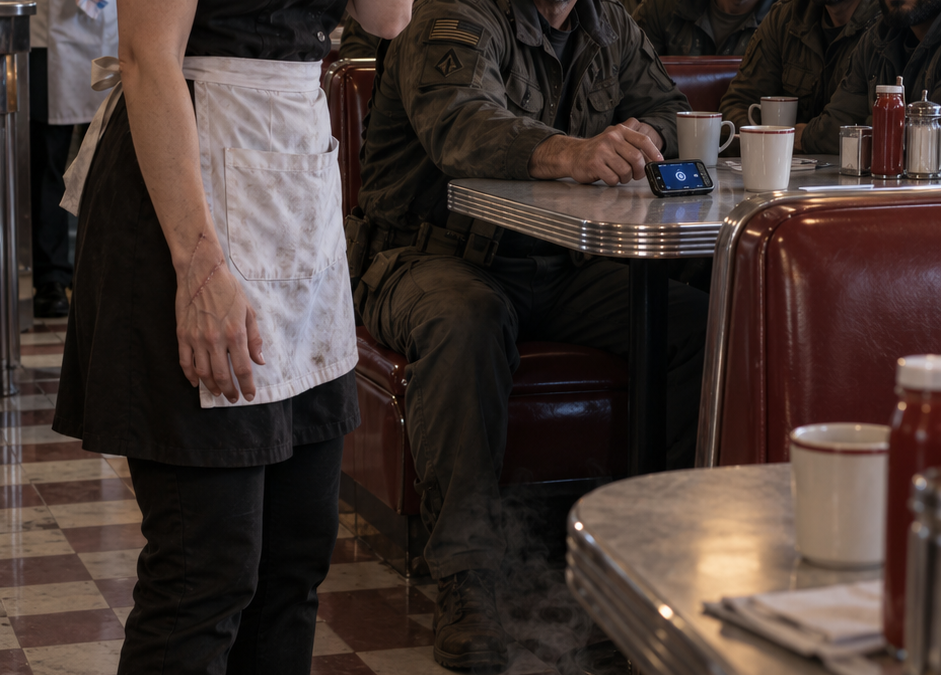
My left hand had disappeared into my apron pocket.
It always did when I was frightened.
Three fingers no longer opened completely.
The joints had been damaged years earlier, and when I got tired or cold, they curled inward as if remembering the shape they had been forced into.
Most customers never noticed.
Ryan had noticed the first week he met me.
He just never asked.
That was one of the reasons I loved him.
Torres was still standing.
Kessler sat back down slowly.
“How did you know Mercer?”
I looked toward the phone again.
Mercer.
To them, Ryan Mercer.
Petty Officer Ryan Mercer.
Brother.
Operator.
Teammate.
To me, he had been the man who put too much black pepper in soup and insisted the smoke alarm was oversensitive.
“He was my fiancé.”
The diner became so quiet that I heard the refrigerator compressor behind the counter shut off.
Torres’s hand dropped.
Harris stared at me.
Another man whispered something I couldn’t hear.
Kessler did not react at all for several seconds.
Then he asked, very carefully, “You were engaged to Ryan?”
“Yes.”
“How long?”
“Five weeks.”
“Before the deployment?”
“Yes.”
Torres finally sat.
I could see him trying to rearrange six years of memories in his head.
There was suddenly a room in Ryan’s life that none of them had known existed.
I understood why it hurt.
That did not make it easier for me to stand there while they discovered I existed.
Kessler gestured toward the empty chair at the end of the booth.
“You should sit.”
“I’d rather stand.”
His eyes dropped toward my hands.
He noticed the way my left one remained hidden.
He didn’t comment.
“When did you meet him?”
“Stateside training rotation.”
“What medical unit?”
I gave him the designation.
Harris frowned.
“You were Navy?”
“I was a hospital corpsman.”
Torres looked at me again.
Not waitress.
Not anymore.
At least not only that.
I could almost see the assumptions leaving his face one at a time.
I told them about the first time Ryan came into the medical office.
He was supposed to be waiting for an exam.
Instead, he found a loose hinge on one of our supply cabinets and repaired it with a multitool he wasn’t supposed to have inside the clinic.
He complained about the coffee.
Two days later, the coffee was better.
Nobody admitted buying it.
Ryan acted offended when I accused him.
“What kind of man do you think I am?” he’d asked.
“The kind currently drinking the expensive coffee you claim you didn’t buy.”
“Coincidence.”
He smiled.
I remembered that smile with painful precision.
Harris lowered his eyes.
“He fixed stuff when he was nervous.”
“I know.”
Torres looked up.
“You know?”
“He peeled labels off bottles during serious conversations. He slept with one foot outside the blanket. He hated canned peaches. The scar under his chin came from falling off a bike when he was nine.”
Three of the men looked at one another.
Ryan had apparently told them a different story about the scar.
I almost smiled.
“He said it happened during combatives training.”
“It didn’t.”
Despite everything, Harris laughed.
A small, broken sound.
“That lying son of a bitch.”
My chest tightened.
For six years, I had remembered Ryan alone.
Suddenly other people were remembering him with me.
The feeling was almost unbearable.
Kessler leaned forward.
“Why didn’t he tell us?”
“He planned to.”
I looked down at my hand.
“He wanted to tell you after he came home.”
That had been important to Ryan.
He didn’t want the news traveling through text messages or somebody else’s version of events.
He wanted to walk into a room with me beside him.
He wanted to see their faces.
He had spent an entire evening guessing their reactions.
Harris would say congratulations first.
Torres would demand free alcohol.
Kessler would pretend not to care, then interrogate me like a security clearance.
Ryan had laughed when he said it.
“He wanted to do it himself,” I told them. “We had a courthouse appointment three weeks after he was supposed to return.”
Kessler looked down at the table.
There was a framed photograph beside the old phone.
Ryan smiling into sunlight.
I had served that table for two years.
The first year, I saw that photograph from halfway across the diner and nearly dropped an entire tray.
I told myself I was mistaken.
That grief had trained my mind to put Ryan’s face onto strangers.
Then I got closer.
It was him.
There was no mistake.
I finished the shift in a fog.
The next year they came back.
Same date.
Same booth.
Same photograph.
I knew then who they were.
Still, I said nothing.
Kessler seemed to understand before I admitted it.
“You recognized the picture.”
I nodded.
Torres stared.
“You knew?”
“Yes.”
“For two years?”
“Yes.”
“Why?”
That word came out harder.
Why?
As if grief always obeyed logic.
I looked at him.
“I attended his memorial.”
The anger vanished from his face.
“What?”
“I sat in the back.”
Nobody spoke.
“I wore a gray coat.”
Torres went completely still.
“One of the buttons was missing.”
His mouth opened slightly.
I remembered him.
He had sat three rows ahead of me with both hands over his face.
Kessler had carried the folded flag to Ryan’s mother.
I remembered watching her receive it.
I remembered thinking that grief had a hierarchy.
A mother.
A sister.
Brothers in uniform.
Official family.
Official teammates.
And me.
The woman with a courthouse appointment and a ring nobody knew existed.
I had been wearing that ring beneath my glove.
“I saw all of you,” I said. “His mother had lost her son. His sister had lost her brother. You had lost someone who trusted you with his life. I didn’t know where I belonged in that room.”
“You belonged with us,” Harris said.
He meant it.
That was what made it hurt.
“I know that now.”
My voice cracked.
“I didn’t know it then.”
I took a breath.
“Nobody had my name. Ryan hadn’t updated his paperwork. There was no spouse notification. No family contact. Nothing that said I was supposed to be there.”
Torres looked down.
“The ring?”
“I had one.”
“Had?”
“I still have it.”
I touched my apron unconsciously.
“It stays in a box beside my bed.”
Nobody asked why I stopped wearing it.
The answer was obvious.
A ring can become unbearable when it represents a future that stopped existing.
I continued before I lost the nerve.
“I thought if I went to his family afterward and said, ‘He was going to marry me,’ it would sound like I was asking for part of him.”
“No,” Torres said.
“But that’s how it felt.”
He rubbed both hands over his face.
“I thought I was protecting everyone.”
“From what?”
“From one more loss.”
The words surprised even me.
I had never said them aloud.
I looked at Ryan’s picture.
“I already had my grief. I didn’t think you needed mine too.”
Torres’s shoulders dropped.
For the first time that night, he looked ashamed.
Kessler did not tell me I had been wrong.
He didn’t tell me I had been right.
He simply asked, “What promise?”
My eyes moved toward the envelope beside the phone.
It was old.
Yellow at the edges.
My stomach tightened.
On Ryan’s last evening home, rain had tapped against the kitchen window while a pot of soup cooled between us.
He had put a sealed envelope into his travel bag.
“What is that?” I’d asked.
“Evidence.”
“Of what?”
“That I am capable of emotional communication.”
“I’ve seen no proof.”
He laughed.
Then he became serious.
“I wrote some things down.”
“What things?”
“Things I’m apparently terrible at saying.”
I told him to bring it home himself.
He promised I would get it either way.
I hated the sentence.
I told him not to talk like that.
He kissed my forehead.
Then, like people do when they are afraid and pretending not to be, we changed the subject.
“I thought the letter was gone,” I whispered.
Kessler touched the envelope.
“Ryan’s sister found this two weeks ago.”
My throat closed.
“Where?”
“Among their mother’s things. The phone was wrapped with it.”
He turned the envelope toward me.
Across the front, in handwriting I could have recognized underwater, were two words.
For her.
Not my name.
Just those words.
For her.
I didn’t reach for it.
Six years.
For six years, I had believed Ryan’s promise had died with him.
Now it was sitting beside a sugar dispenser at Bell’s Diner.
Kessler seemed to realize I couldn’t touch it yet.
He left the envelope on the table.
Then his attention moved toward my left hand.
I had pulled it out of my apron without noticing.
My fingers were wrapped around the counter.
The pale crescent scar above my thumb caught the fluorescent light.
Kessler stopped breathing.
At first, I thought he was staring because of Ryan.
Because I had told him the ring had been designed for that hand.
Then he pushed his chair backward.
The legs scraped against the floor.
“No.”
I looked at him.
His face had gone pale.
“What?”
Kessler stood.
“I know that hand.”
The sentence hit me strangely.
My pulse changed.
He came around the booth.
Not close enough to touch me.
Just close enough to look.
“Did you have that scar before the nerve damage?”
“Yes.”
“How long?”
“Second deployment.”
He stared at the crescent above my thumb.
There was fear in his face now.
Not fear of me.
Fear of remembering.
“Nearly seven years ago,” he said, “were you attached to an extraction team operating north of Daruun Province?”
The diner disappeared.
Not literally.
But suddenly I smelled dust instead of coffee.
Blood instead of bacon grease.
Cold stone.
Hot metal.
A helicopter somewhere beyond a ridge.
My left hand twitched.
Kessler touched his right shoulder.
“Rocky terrain,” he continued. “Night extraction. One operator trapped below a ledge.”
I couldn’t answer.
I was back there.
A body beneath me.
Blood running too fast.
A shoulder wound too high for an ordinary tourniquet.
Gunfire snapping over rock.
Somebody screaming for us to move.
I looked at Kessler’s shoulder.
He saw the answer in my face.
“Were you the medic?”
My voice came out almost inaudible.
“Your upper arm was torn near the shoulder.”
Kessler closed his eyes.
I kept speaking because once the memory opened, it would not close.
“The bleeding was too high. I packed the wound and held pressure. I kept checking the pulse at your wrist because I thought we might save you and still lose the arm.”
Kessler’s breathing changed.
Harris set his glass down.
Nobody else moved.
I stared at Kessler.
“You woke up once.”
His eyes opened.
“You tried to push me away.”
He whispered, “What did I say?”
I remembered.
I had remembered for years.
“You said, ‘Don’t let them take my good arm.'”
Kessler’s face broke.
I finished the memory.
“I told you, ‘Then stop trying to bleed out of it.'”
He turned away.
One hand covered his mouth.
Torres looked between us.
“Kessler?”
Kessler laughed once.
Except there was no humor in it.
“I remember that.”
He looked back at me.
“I’ve remembered that sentence for seven years.”
My skin went cold.
I had never known his name.
He had never known mine.
That night, his face had been covered in blood, dirt and helmet shadow.
Mine had been behind eye protection and dust.
What he remembered was my hand.
What I remembered was a shoulder wound and a man apologizing because he thought he was too heavy while three people dragged him uphill.
Halfway toward extraction, a piece of metal ripped through my glove.
It cut across the back of my hand.
Nerves.
Tendons.
Enough damage that my fingers stopped cooperating almost immediately.
I wrapped the hand against my chest and kept moving.
At the helicopter, they loaded Kessler onto one aircraft.
I was sent to another because my hand would not stop bleeding.
Our transfer records were damaged during the evacuation.
His casualty documentation listed me only as part of a temporary medical element.
By the time he woke in a hospital, I was recovering from surgery elsewhere.
“You saved him?” Torres asked.
I looked at him.
“I treated him.”
“Kessler would have died.”
I didn’t answer.
There was a difference between knowing your job mattered and wanting to be called a hero for doing it.
I had never liked that word.
Kessler stepped toward me.
For a terrible second, I thought he might hug me.
I couldn’t have handled that.
Instead, he stopped.
“You kept me alive.”
“I did my job.”
“You kept working after your hand was hit.”
“So would anyone there.”
“No.”
His voice hardened.
“Do not do that.”
I blinked.
“Do what?”
“Disappear from your own story.”
The words landed harder than they should have.
I looked away.
He knew.
Maybe because he had spent seven years looking for an unknown medic.
Maybe because he had spent six years grieving Ryan.
Maybe because survivors develop an instinct for recognizing the particular ways other survivors hide.
“I tried to find you,” he said.
“I didn’t know.”
“Every inquiry came back incomplete.”
“I didn’t know your name either.”
He looked at my hand again.
“All I remembered clearly was that scar.”
I almost laughed.
“You remembered the scar?”
“And your voice.”
Something inside me shifted.
For years, I believed that night had belonged only to my injury.
The loss of movement.
The surgeries.
The career changes.
The nightmares.
I had never considered that somewhere else, another person had been carrying a memory of me.
Torres sat slowly.
“So Ryan was engaged to the medic who saved Kessler.”
Harris stared at the table.
“Mercer would have been unbearable if he knew.”
For the first time, I smiled.
“He would have told that story forever.”
“He would’ve added things.”
“Absolutely.”
“Probably claimed you carried Kessler one-handed.”
“I did not.”
Kessler looked offended.
“I was very light.”
I laughed.
Actually laughed.
The sound startled me.
It was the first laugh I had ever shared with Ryan’s team.
And somehow that made what came next harder.
Kessler lifted the envelope.
“This belongs to you.”
This time I took it.
My left hand couldn’t manage the flap.
Torres started to reach toward me.
Then he stopped.
I saw the hesitation.
Help or pity.
He didn’t know which it would feel like.
I appreciated that he let me choose.
I picked up a butter knife with my right hand and carefully broke the old seal.
There were several pages inside.
Not one letter.
Several.
The first was dated the night before Ryan left.
Other pages had dates from the deployment.
The envelope had been opened and resealed.
Ryan had kept adding to it.
I sat down.
For the first time, nobody questioned whether I belonged at that table.
I unfolded the first page.
Ryan’s handwriting leaned slightly to the right.
Olivia,
If you’re reading this because I chickened out and handed it to you instead of saying any of it properly, pretend I sound confident.
I laughed through my nose.
That was exactly Ryan.
The next paragraph mentioned my soup.
Then our courthouse date.
He had written it inside his helmet so he couldn’t forget.
I pressed my lips together.
The words began to blur.
He wrote that loving me had changed the way he imagined the future.
Before me, the future had been an abstraction.
A place on a calendar.
After me, it had rooms.
A kitchen.
A ridiculous yellow kettle I refused to throw away.
Shoes by a door.
Someone waiting.
He wrote that he could never promise to come back from every deployment.
He respected me too much to make a promise no person could guarantee.
But he could promise something else.
If something happened, I would never have to wonder whether I had been loved.
That was the promise.
Not survival.
Certainty.
I covered my mouth.
For six years, I had wondered whether the private life we built together had mattered as much to him as it had to me.
I knew he loved me.
Of course I knew.
But grief is cruel.
After enough years, it puts questions into places where certainty once lived.
Ryan had known that.
The voicemail was not asking Kessler to tell me he had survived.
It was asking him to make sure I knew Ryan had kept his promise.
I continued reading.
There were jokes.
Complaints about mattresses.
A paragraph accusing Kessler of pretending gas-station food qualified as dinner.
Kessler objected.
“That part is classified.”
Harris told him to shut up.
Another page described Torres singing badly.
Torres groaned.
“I do not sing.”
“You did according to Ryan.”
“That man was unreliable.”
I laughed again.
Then I reached the final sheet.
The handwriting was hurried.
Different.
Written the morning of Ryan’s last mission.
I slowed down.
He mentioned a disagreement about the approach route.
Dry wash versus northern rise.
He wrote that recent weather had weakened the walls of the wash.
He thought anyone watching the team would know they had used it before.
He had argued for higher ground.
Kessler finally trusted me, he wrote. If I’m wrong, I’ll buy dinner for a month. If I’m right, nobody will ever know how close we came.
I stopped.
The air around the table changed.
Kessler leaned forward.
“What?”
I looked at him.
“I don’t know what this means.”
“Read it again.”
I did.
Three men went pale.
Harris looked at Torres.
Torres looked toward the third man sitting beside him.
Kessler stood.
“The dry wash collapsed.”
I waited.
“Minutes before we would have entered.”
Nobody spoke.
I looked at Ryan’s handwriting.
“What are you saying?”
Kessler pointed toward the page.
“Ryan challenged the route.”
“Yes.”
“He was the one who pushed the northern approach?”
“That’s what he wrote.”
Kessler sat back down.
His face changed in a way I had never seen before.
He looked sick.
“I approved the change.”
“So?”
“So the report listed it as a command adjustment.”
I understood slowly.
“It didn’t say Ryan recommended it.”
“No.”
Harris rubbed his forehead.
“Three of us were supposed to move through that wash.”
Torres whispered, “Me. Harris. Coleman.”
Kessler looked at me.
“Ryan may have saved all three.”
The words hurt in a completely new place.
Ryan had died believing no one would ever know how close they came.
He had been right.
For six years, no one had.
Kessler asked if he could see the page.
I handed it over.
He read the passage twice.
Then the final paragraph.
His voice broke slightly.
Ryan had written about me.
About the ridge.
He didn’t know Kessler was the man I had treated.
Ryan only knew the story as I had told it to him.
A stranger.
An extraction.
A damaged hand.
A person who lived.
You once carried a stranger off a ridge with one working hand, Ryan had written. You are allowed to leave the war. Just don’t leave yourself there with it.
Kessler stopped reading.
The room went quiet.
I stared at the page.
That sentence felt less like something written by a dead man and more like an instruction I had spent six years refusing to follow.
I had left the Navy.
I had moved inland.
I had become Liv.
But some part of Olivia Carter had remained in every room I was trying to escape.
Kessler folded the page carefully along the old crease.
“There may be records.”
I looked up.
“What?”
“Archived planning traffic. Route sheets. Messages.”
Torres leaned forward.
“You think there’s proof?”
“I think there may be.”
“What happens if there is?”
Kessler looked at Ryan’s photograph.
“Then the record gets corrected.”
He didn’t promise.
That mattered to me.
He didn’t tell us he would fix everything.
He said he would look.
After six years of impossible promises, I trusted that kind.
Three weeks later, he called me at Bell’s.
I was wiping down the counter.
“Olivia.”
I knew immediately.
“You found something.”
A pause.
“Yes.”
An old message thread.
Ryan had written that the dry wash showed fresh collapse marks and recommended the northern rise.
Underneath was Kessler’s reply.
Approved. Update all teams.
There was also a route sheet.
Ryan’s hand-drawn change.
Time-stamped eleven minutes before the final briefing.
The letter had not proven the official record wrong.
It had simply told them where to search.
That distinction mattered.
Kessler submitted a supplemental statement.
Harris did the same.
So did Torres and Coleman.
Nobody accused anyone of stealing Ryan’s credit.
Kessler refused to let the correction become revenge.
The original report had been written after casualties, damaged communications and a mission that ended with Ryan dead.
The truth was simpler.
Ryan’s recommendation had disappeared inside the language of command.
Months later, one sentence was added to the account.
Petty Officer Ryan Mercer identified the hazard, recommended the northern approach, and prevented three members of the element from entering the collapse zone.
Ryan’s sister called me when she received the corrected copy.
She tried to read the sentence.
She stopped halfway through his name.
Then she started again.
“I want to say it right,” she told me.
So she read every word.
When she finished, neither of us spoke for a while.
Then she said something I had feared for years.
“I wish I’d known about you.”
I closed my eyes.
“I’m sorry.”
“No.”
Her voice shook.
“Don’t apologize.”
“I should’ve come to you.”
“Maybe.”
The honesty hurt.
Then she continued.
“But Ryan should have told us too. And he was planning to. Life just didn’t give him the chance.”
I cried after we hung up.
Not because she had forgiven me.
Because there had never been anything to forgive as neatly as I wanted.
Grief had made all of us imperfect.
A few weeks later, Torres came into Bell’s alone.
He sat at the counter.
I poured coffee.
He didn’t touch it.
For almost a minute, he turned the cup between his hands.
Then he said, “I owe you an apology.”
I waited.
“When Ryan’s voice said your name, I got angry.”
“I noticed.”
A weak smile.
“I thought you were taking something.”
“From you?”
“From all of us.”
He looked embarrassed.
“If he had this entire life with you that we didn’t know about, I thought maybe we didn’t know him.”
I understood.
More than he expected.
“And?”
“And I was wrong.”
He stared into the coffee.
“Knowing he loved you doesn’t mean he loved us less.”
“No.”
“I should’ve asked what you lost before questioning why you were there.”
My throat tightened.
I didn’t tell him his reaction hadn’t hurt.
It had.
Forgiveness didn’t require rewriting the injury.
“I accept your apology.”
He nodded.
Then I went into the back room and brought out one page from Ryan’s letter.
The paragraph about Torres singing.
He read it.
His mouth twisted.
“That bastard.”
Then he laughed.
Then he cried.
I stood behind the counter and let him do both.
Kessler’s next search was about me.
I didn’t ask him to do it.
He found surviving transfer logs from the ridge.
Statements from two medics.
A blond corpsman had arrived with a hand wound after delivering an operator alive.
There was enough information to request a correction to my own service record.
But this time, Kessler couldn’t do it without me.
He brought the forms to Bell’s.
He placed them beside my coffee.
“I can testify,” he said.
I stared at the envelope.
“I didn’t ask for this.”
“No.”
“Then why?”
“Because your name is still missing.”
I looked at him.
He touched his shoulder.
“My record says an unidentified provider from a cross-attached medical element treated me.”
“That’s technically true.”
“No.”
His eyes held mine.
“It’s incomplete.”
I pushed the envelope away.
He did not push it back.
“I can testify,” he repeated. “I cannot choose this for you.”
Then he left.
The envelope stayed beneath the counter for twelve days.
On the thirteenth morning, I signed.
Not because I wanted a medal.
Not because I wanted anyone calling me heroic.
I signed because I finally understood what Kessler meant.
The unknown medic deserved a name.
So did the woman I used to be.
The review took months.
Medical notes.
Flight times.
Transfer records.
Kessler’s testimony.
Eventually, the corrected entry was approved.
Hospital Corpsman First Class Olivia Carter had controlled Commander David Kessler’s hemorrhage, maintained care during extraction and continued treatment after sustaining injury to her own hand.
Kessler brought me a copy after closing.
No ceremony.
No reporters.
No uniforms.
Just the two of us in an empty diner.
He read the entry once.
Then he folded the page.
For several seconds, he said nothing.
When he finally spoke, his voice was quiet.
“Thank you for keeping me alive.”
I looked at the stiffness that still limited his right shoulder.
Seven years earlier, I had believed that saving him meant getting him onto a helicopter with a pulse.
I understood something different now.
Saving a life isn’t a finished act.
The person still has to live it.
“Thank you for doing something with the life.”
Kessler smiled.
“I’ve tried.”
“So have I.”
That was the closest either of us came to admitting how difficult surviving could be.
The corrected record led to an invitation from a medical training center.
They wanted me to speak during a casualty extraction class.
One afternoon.
Continuing care while injured.
Broken handoffs.
Field documentation failures.
My first instinct was no.
Absolutely not.
I had spent years trying to become invisible.
Standing in front of young medics explaining the worst night of my career felt like reopening a door I had finally closed.
Then I reread Ryan’s letter.
You are allowed to leave the war. Just don’t leave yourself there with it.
I accepted.
I wore civilian clothes.
I kept my left hand visible.
The students noticed.
Of course they did.
I told them what happened without making the story beautiful.
There was blood.
Confusion.
Fear.
Pain.
Mistakes.
Good decisions made by exhausted people.
Incomplete paperwork.
A patient who lived.
A medic who got hurt.
I told them courage did not make pain disappear.
It simply prevented pain from making the next decision for you.
Afterward, one student remained behind.
She looked at my hand.
“Did you ever wish you hadn’t gone down the ridge?”
I thought carefully.
“No.”
“Even with your hand?”
I flexed the fingers as far as they would go.
“No.”
“Why?”
“Because he lived.”
Months later, the training center advertised a civilian simulation instructor position.
Part time.
I applied.
Kessler wrote a recommendation.
He couldn’t hire me.
That mattered.
I interviewed like everyone else.
During the simulation, I identified three problems before the panel finished giving instructions.
One evaluator finally laughed.
“Can we at least finish the scenario?”
“You can,” I said. “Your patient might not.”
I got the job.
I didn’t quit Bell’s.
Not immediately.
For a while, I worked mornings at the diner and taught two afternoons a week.
I liked the balance.
At Bell’s, I was still Liv.
The woman who knew who wanted extra butter.
At the training center, I was Olivia Carter.
Former corpsman.
Instructor.
The medic whose imperfect hand sometimes taught more effectively than perfect ones.
The engagement ring remained in its wooden box.
But the box stopped feeling like a grave.
Ryan’s sister mailed me childhood photographs.
Ryan at seven with missing front teeth.
Ryan at twelve wearing a baseball glove too large for him.
Ryan at seventeen pretending not to smile beside his first car.
Torres started calling on Sundays.
That had been Ryan’s day to call home.
Sometimes we talked about Ryan.
Sometimes we didn’t.
Harris visited the diner whenever he passed through town.
Kessler kept his monthly medical appointments.
Little by little, I stopped carrying separate versions of the man I had loved.
There had been my Ryan.
The man in my kitchen.
The man who proposed beside cooling soup.
Then there had been their Ryan.
The operator.
The teammate.
The brother.
Then the official Ryan.
A name inside reports.
For years, those versions had felt like different people.
They weren’t.
He had simply been large enough to belong to all of us.
One year after the voicemail played, the six men came back to Bell’s.
Same date.
Same booth.
Same photograph.
But that year, when the bell above the diner door rang, I was not carrying a coffee pot.
I had finished early.
I changed out of my uniform and put on a simple blue dress.
For several minutes, I stood in the back room staring at myself in the mirror.
My left hand hung beside me.
Visible.
I almost put it in my pocket.
Then I stopped.
When I walked into the dining room, Kessler saw me first.
He stood.
Torres turned.
Harris smiled.
Nobody looked surprised.
Kessler pulled out a chair.
A seventh chair.
Ryan’s photograph sat in the middle of the table.
Beside it lay the old phone.
And his letter.
I sat down.
Harris began telling a story about the cabinet hinge Ryan repaired the first time we met.
He got half of it wrong.
“That’s not what happened.”
He looked offended.
“I heard it from Mercer.”
“You heard the version he told you.”
“Which is therefore the correct version.”
“He claimed the cabinet door fell off.”
“It did.”
“It was loose.”
“According to you.”
“According to the person standing there.”
Torres pointed at Ryan’s photograph.
“I vote Mercer.”
“Of course you do.”
Kessler laughed.
And just like that, the evening became something I had thought impossible.
Not a memorial.
Not exactly.
A dinner.
With Ryan.
Without Ryan.
Stories passed around the table.
Some I knew.
Most I didn’t.
I learned he once fell asleep sitting upright in a vehicle and denied it even though someone had photographed him.
They learned Ryan had tried to cook lasagna for me and forgotten to remove a sheet of wax paper between the noodles.
I learned he kept an emergency candy bar hidden in his gear.
They learned he had danced with me barefoot in my kitchen because the radio played a song from high school.
Every story filled a gap.
No story replaced another.
Near the end of the evening, Kessler lifted his glass.
Nobody stood.
Nobody needed to.
He looked at Ryan’s photograph.
“To the man who changed a route.”
Torres lifted his glass.
Harris followed.
“To the man who kept a promise,” Kessler continued.
My throat tightened.
Then his eyes moved toward me.
“And to the people who finally stopped letting silence tell the story.”
I lifted my glass.
With my left hand.
The fingers didn’t open all the way.
They never would.
The pale crescent above my thumb was still there.
So was the stiffness.
So was the memory of the ridge.
So was the kitchen where Ryan proposed.
So was the streetlight beneath which I watched him leave.
Healing had not erased any of those things.
It had simply stopped them from owning the entire landscape.
I looked at the six men around me.
For years, I believed grief was something people carried alone because no one else could possibly understand the exact shape of what they had lost.
I had been partly right.
No one else had lost Ryan the way I had.
But I had been wrong about what that meant.
Love was not territory.
Memory was not a limited resource.
Making room for someone else’s grief did not shrink your own.
Ryan had belonged to his mother.
His sister.
His teammates.
To me.
And none of us had possessed the whole of him.
That was why finding one another had not taken pieces away.
It had returned them.
I looked at his photograph.
The same smile that once hurt too much to see now made me smile back.
Six years earlier, I had believed Ryan’s final promise died somewhere far from home.
But promises, I learned, do not always arrive when we expect them to.
Sometimes they travel inside an old phone.
Sometimes they wait in a sealed envelope.
Sometimes they survive in damaged records, unfinished stories, scars, and memories carried by strangers who do not yet know they are connected.
Ryan had promised I would never have to wonder whether I had been loved.
He kept that promise.
Kessler had spent seven years wondering who kept him alive on a dark ridge.
He finally got his answer.
Three men had lived without knowing whose stubborn warning moved them out of a collapsing ravine.
Ryan finally received his name beside that decision.
And I had spent years believing the safest thing I could do was disappear.
I was wrong about that.
The safest life is not always the fullest one.
Sometimes hiding prevents pain.
Sometimes it prevents healing too.
When dinner ended, Torres gathered the glasses.
Harris complained that he was doing it wrong.
Kessler slipped the old phone carefully into its case.
I picked up Ryan’s photograph.
For years, I had kept photographs of him hidden inside a drawer.
This time, I held one openly.
Before we left, I placed it back at the center of the booth.
Not because Ryan belonged there.
Because we did.
Seven chairs.
Six living men.
One woman who had finally stopped hiding her hand.
And one empty place that no longer felt empty.
I understood then that some debts are never meant to be repaid.
You cannot repay the person who saves your life.
You cannot repay the person who loved you and died.
You cannot balance grief like numbers on opposite sides of a ledger.
All you can do is carry the truth carefully.
Say the missing name.
Correct the unfinished record.
Make room at the table.
And when someone you loved leaves behind a promise, you keep living long enough to discover what it was really asking of you.
I walked out of Bell’s beside Ryan’s brothers beneath a cold, clear sky.
For once, my left hand stayed outside my pocket.
And for the first time in six years, I did not feel as though I was walking away from Ryan.
I felt as though I was finally carrying him forward.
Have you finished reading the story and want to read it again?
The Voicemail a SEAL Commander Brought Into My Diner Carried a Name I Had Spent Six Years Hiding
Every year, six men came to my diner to mourn the same dead brother.
On the third year, their commander set an old phone on the table and pressed play.
Then the man I had buried six years earlier said my full name.
PART2
The coffee pot slipped out of my hand before I realized I had stopped holding it.
Glass exploded across the tile.
Hot coffee spread beneath my shoes in a dark, steaming pool, and for a second, the entire diner seemed to hold its breath.
I could still hear Ryan’s voice.
Not in my memory.
Not in the place inside me where I had kept him preserved for six years.
His actual voice.
Warm.
Tired.
Amused.
Alive.
“Dave,” he had said from that old phone, “if something happens, find Olivia Carter. Tell her I kept my promise. She’ll understand.”
Then silence.
Commander David Kessler stopped the recording.
Six men in the back booth stared at me.
I stared at the phone.
The cook pushed through the swinging kitchen door carrying a dish towel.
“What the hell was—”
He stopped.
Nobody looked at him.
Nobody looked at the shattered glass.
Every eye in that diner was on me.
Kessler’s gaze moved slowly from my face to the silver name badge pinned above my apron.
LIV.
Three letters.
For two years, that had been enough.
I worked mornings at Bell’s Diner.
I poured coffee.
I remembered who wanted rye instead of wheat and who could not have salt because of his heart medication. I knew which truckers needed their checks dropped early and which elderly customers ordered pie at ten in the morning because they really came in because they were lonely.
Everybody called me Liv.
Nobody asked much more after the first few months.
I had learned how to answer personal questions with a smile that felt friendly without actually opening a door.
Where are you from?
All over.
You married?
No.
Family nearby?
Not anymore.
What happened to your hand?
Old injury.
Most people understood when a subject was closed.
And if they didn’t, I became very busy with someone else’s coffee.
But now David Kessler was looking at me as though those three letters had become a lie.
“What is your full name?” he asked.
My mouth went dry.
I had imagined this moment before.
Not exactly like this.
Never with Ryan’s voice still hanging in the air.
But during the first year Kessler and the others came to Bell’s, I had imagined walking to their booth and telling them.
During the second year, I had imagined it again.
Each time, I had decided silence was kinder.
Maybe I had been wrong.
Maybe silence was simply easier.
“Olivia,” I said.
Nobody moved.
I forced myself to finish.
“Olivia Carter.”
Luis Torres stood so fast his knee hit the underside of the table.
Coffee jumped inside six cups.
“What?”
He looked younger than the others, even though grief had already carved permanent lines beside his mouth.
I knew his name because I had heard Ryan talk about him.
Torres sings when he’s nervous.
Torres steals everybody’s socks.
Torres once spent forty minutes arguing with a vending machine and lost.
Ryan had told me dozens of stories about the men in that booth.
They had never heard one about me.
Torres pointed toward the old phone.
“Ryan never said anything about you.”
I looked at him.
“He wasn’t ashamed of me.”
His expression changed.
“I didn’t say he was.”
“You were about to.”
Kessler lifted a hand.
“Torres.”
But the damage had already been done.
Not because Torres meant to be cruel.
Because grief makes people territorial.
I knew that better than anyone.
I looked down at the broken coffee pot.
“Nobody move. There’s glass everywhere.”
Even then, even with my heart pounding hard enough to make the room tilt, I saw the sharp edge near Harris’s boot.
I crouched.
Kessler stood immediately.
“Leave it.”
“I’m working.”
“Liv—”
“Olivia.”
He stopped.
I swallowed.
“My name is Olivia.”
Something shifted in his face.
Not suspicion exactly.
Recognition of a boundary he had crossed without understanding it existed.
I straightened again.
My left hand had disappeared into my apron pocket.
It always did when I was frightened.
Three fingers no longer opened completely.
The joints had been damaged years earlier, and when I got tired or cold, they curled inward as if remembering the shape they had been forced into.
Most customers never noticed.
Ryan had noticed the first week he met me.
He just never asked.
That was one of the reasons I loved him.
Torres was still standing.
Kessler sat back down slowly.
“How did you know Mercer?”
I looked toward the phone again.
Mercer.
To them, Ryan Mercer.
Petty Officer Ryan Mercer.
Brother.
Operator.
Teammate.
To me, he had been the man who put too much black pepper in soup and insisted the smoke alarm was oversensitive.
“He was my fiancé.”
The diner became so quiet that I heard the refrigerator compressor behind the counter shut off.
Torres’s hand dropped.
Harris stared at me.
Another man whispered something I couldn’t hear.
Kessler did not react at all for several seconds.
Then he asked, very carefully, “You were engaged to Ryan?”
“Yes.”
“How long?”
“Five weeks.”
“Before the deployment?”
“Yes.”
Torres finally sat.
I could see him trying to rearrange six years of memories in his head.
There was suddenly a room in Ryan’s life that none of them had known existed.
I understood why it hurt.
That did not make it easier for me to stand there while they discovered I existed.
Kessler gestured toward the empty chair at the end of the booth.
“You should sit.”
“I’d rather stand.”
His eyes dropped toward my hands.
He noticed the way my left one remained hidden.
He didn’t comment.
“When did you meet him?”
“Stateside training rotation.”
“What medical unit?”
I gave him the designation.
Harris frowned.
“You were Navy?”
“I was a hospital corpsman.”
Torres looked at me again.
Not waitress.
Not anymore.
At least not only that.
I could almost see the assumptions leaving his face one at a time.
I told them about the first time Ryan came into the medical office.
He was supposed to be waiting for an exam.
Instead, he found a loose hinge on one of our supply cabinets and repaired it with a multitool he wasn’t supposed to have inside the clinic.
He complained about the coffee.
Two days later, the coffee was better.
Nobody admitted buying it.
Ryan acted offended when I accused him.
“What kind of man do you think I am?” he’d asked.
“The kind currently drinking the expensive coffee you claim you didn’t buy.”
“Coincidence.”
He smiled.
I remembered that smile with painful precision.
Harris lowered his eyes.
“He fixed stuff when he was nervous.”
“I know.”
Torres looked up.
“You know?”
“He peeled labels off bottles during serious conversations. He slept with one foot outside the blanket. He hated canned peaches. The scar under his chin came from falling off a bike when he was nine.”
Three of the men looked at one another.
Ryan had apparently told them a different story about the scar.
I almost smiled.
“He said it happened during combatives training.”
“It didn’t.”
Despite everything, Harris laughed.
A small, broken sound.
“That lying son of a bitch.”
My chest tightened.
For six years, I had remembered Ryan alone.
Suddenly other people were remembering him with me.
The feeling was almost unbearable.
Kessler leaned forward.
“Why didn’t he tell us?”
“He planned to.”
I looked down at my hand.
“He wanted to tell you after he came home.”
That had been important to Ryan.
He didn’t want the news traveling through text messages or somebody else’s version of events.
He wanted to walk into a room with me beside him.
He wanted to see their faces.
He had spent an entire evening guessing their reactions.
Harris would say congratulations first.
Torres would demand free alcohol.
Kessler would pretend not to care, then interrogate me like a security clearance.
Ryan had laughed when he said it.
“He wanted to do it himself,” I told them. “We had a courthouse appointment three weeks after he was supposed to return.”
Kessler looked down at the table.
There was a framed photograph beside the old phone.
Ryan smiling into sunlight.
I had served that table for two years.
The first year, I saw that photograph from halfway across the diner and nearly dropped an entire tray.
I told myself I was mistaken.
That grief had trained my mind to put Ryan’s face onto strangers.
Then I got closer.
It was him.
There was no mistake.
I finished the shift in a fog.
The next year they came back.
Same date.
Same booth.
Same photograph.
I knew then who they were.
Still, I said nothing.
Kessler seemed to understand before I admitted it.
“You recognized the picture.”
I nodded.
Torres stared.
“You knew?”
“Yes.”
“For two years?”
“Yes.”
“Why?”
That word came out harder.
Why?
As if grief always obeyed logic.
I looked at him.
“I attended his memorial.”
The anger vanished from his face.
“What?”
“I sat in the back.”
Nobody spoke.
“I wore a gray coat.”
Torres went completely still.
“One of the buttons was missing.”
His mouth opened slightly.
I remembered him.
He had sat three rows ahead of me with both hands over his face.
Kessler had carried the folded flag to Ryan’s mother.
I remembered watching her receive it.
I remembered thinking that grief had a hierarchy.
A mother.
A sister.
Brothers in uniform.
Official family.
Official teammates.
And me.
The woman with a courthouse appointment and a ring nobody knew existed.
I had been wearing that ring beneath my glove.
“I saw all of you,” I said. “His mother had lost her son. His sister had lost her brother. You had lost someone who trusted you with his life. I didn’t know where I belonged in that room.”
“You belonged with us,” Harris said.
He meant it.
That was what made it hurt.
“I know that now.”
My voice cracked.
“I didn’t know it then.”
I took a breath.
“Nobody had my name. Ryan hadn’t updated his paperwork. There was no spouse notification. No family contact. Nothing that said I was supposed to be there.”
Torres looked down.
“The ring?”
“I had one.”
“Had?”
“I still have it.”
I touched my apron unconsciously.
“It stays in a box beside my bed.”
Nobody asked why I stopped wearing it.
The answer was obvious.
A ring can become unbearable when it represents a future that stopped existing.
I continued before I lost the nerve.
“I thought if I went to his family afterward and said, ‘He was going to marry me,’ it would sound like I was asking for part of him.”
“No,” Torres said.
“But that’s how it felt.”
He rubbed both hands over his face.
“I thought I was protecting everyone.”
“From what?”
“From one more loss.”
The words surprised even me.
I had never said them aloud.
I looked at Ryan’s picture.
“I already had my grief. I didn’t think you needed mine too.”
Torres’s shoulders dropped.
For the first time that night, he looked ashamed.
Kessler did not tell me I had been wrong.
He didn’t tell me I had been right.
He simply asked, “What promise?”
My eyes moved toward the envelope beside the phone.
It was old.
Yellow at the edges.
My stomach tightened.
On Ryan’s last evening home, rain had tapped against the kitchen window while a pot of soup cooled between us.
He had put a sealed envelope into his travel bag.
“What is that?” I’d asked.
“Evidence.”
“Of what?”
“That I am capable of emotional communication.”
“I’ve seen no proof.”
He laughed.
Then he became serious.
“I wrote some things down.”
“What things?”
“Things I’m apparently terrible at saying.”
I told him to bring it home himself.
He promised I would get it either way.
I hated the sentence.
I told him not to talk like that.
He kissed my forehead.
Then, like people do when they are afraid and pretending not to be, we changed the subject.
“I thought the letter was gone,” I whispered.
Kessler touched the envelope.
“Ryan’s sister found this two weeks ago.”
My throat closed.
“Where?”
“Among their mother’s things. The phone was wrapped with it.”
He turned the envelope toward me.
Across the front, in handwriting I could have recognized underwater, were two words.
For her.
Not my name.
Just those words.
For her.
I didn’t reach for it.
Six years.
For six years, I had believed Ryan’s promise had died with him.
Now it was sitting beside a sugar dispenser at Bell’s Diner.
Kessler seemed to realize I couldn’t touch it yet.
He left the envelope on the table.
Then his attention moved toward my left hand.
I had pulled it out of my apron without noticing.
My fingers were wrapped around the counter.
The pale crescent scar above my thumb caught the fluorescent light.
Kessler stopped breathing.
At first, I thought he was staring because of Ryan.
Because I had told him the ring had been designed for that hand.
Then he pushed his chair backward.
The legs scraped against the floor.
“No.”
I looked at him.
His face had gone pale.
“What?”
Kessler stood.
“I know that hand.”
The sentence hit me strangely.
My pulse changed.
He came around the booth.
Not close enough to touch me.
Just close enough to look.
“Did you have that scar before the nerve damage?”
“Yes.”
“How long?”
“Second deployment.”
He stared at the crescent above my thumb.
There was fear in his face now.
Not fear of me.
Fear of remembering.
“Nearly seven years ago,” he said, “were you attached to an extraction team operating north of Daruun Province?”
The diner disappeared.
Not literally.
But suddenly I smelled dust instead of coffee.
Blood instead of bacon grease.
Cold stone.
Hot metal.
A helicopter somewhere beyond a ridge.
My left hand twitched.
Kessler touched his right shoulder.
“Rocky terrain,” he continued. “Night extraction. One operator trapped below a ledge.”
I couldn’t answer.
I was back there.
A body beneath me.
Blood running too fast.
A shoulder wound too high for an ordinary tourniquet.
Gunfire snapping over rock.
Somebody screaming for us to move.
I looked at Kessler’s shoulder.
He saw the answer in my face.
“Were you the medic?”
My voice came out almost inaudible.
“Your upper arm was torn near the shoulder.”
Kessler closed his eyes.
I kept speaking because once the memory opened, it would not close.
“The bleeding was too high. I packed the wound and held pressure. I kept checking the pulse at your wrist because I thought we might save you and still lose the arm.”
Kessler’s breathing changed.
Harris set his glass down.
Nobody else moved.
I stared at Kessler.
“You woke up once.”
His eyes opened.
“You tried to push me away.”
He whispered, “What did I say?”
I remembered.
I had remembered for years.
“You said, ‘Don’t let them take my good arm.'”
Kessler’s face broke.
I finished the memory.
“I told you, ‘Then stop trying to bleed out of it.'”
He turned away.
One hand covered his mouth.
Torres looked between us.
“Kessler?”
Kessler laughed once.
Except there was no humor in it.
“I remember that.”
He looked back at me.
“I’ve remembered that sentence for seven years.”
My skin went cold.
I had never known his name.
He had never known mine.
That night, his face had been covered in blood, dirt and helmet shadow.
Mine had been behind eye protection and dust.
What he remembered was my hand.
What I remembered was a shoulder wound and a man apologizing because he thought he was too heavy while three people dragged him uphill.
Halfway toward extraction, a piece of metal ripped through my glove.
It cut across the back of my hand.
Nerves.
Tendons.
Enough damage that my fingers stopped cooperating almost immediately.
I wrapped the hand against my chest and kept moving.
At the helicopter, they loaded Kessler onto one aircraft.
I was sent to another because my hand would not stop bleeding.
Our transfer records were damaged during the evacuation.
His casualty documentation listed me only as part of a temporary medical element.
By the time he woke in a hospital, I was recovering from surgery elsewhere.
“You saved him?” Torres asked.
I looked at him.
“I treated him.”
“Kessler would have died.”
I didn’t answer.
There was a difference between knowing your job mattered and wanting to be called a hero for doing it.
I had never liked that word.
Kessler stepped toward me.
For a terrible second, I thought he might hug me.
I couldn’t have handled that.
Instead, he stopped.
“You kept me alive.”
“I did my job.”
“You kept working after your hand was hit.”
“So would anyone there.”
“No.”
His voice hardened.
“Do not do that.”
I blinked.
“Do what?”
“Disappear from your own story.”
The words landed harder than they should have.
I looked away.
He knew.
Maybe because he had spent seven years looking for an unknown medic.
Maybe because he had spent six years grieving Ryan.
Maybe because survivors develop an instinct for recognizing the particular ways other survivors hide.
“I tried to find you,” he said.
“I didn’t know.”
“Every inquiry came back incomplete.”
“I didn’t know your name either.”
He looked at my hand again.
“All I remembered clearly was that scar.”
I almost laughed.
“You remembered the scar?”
“And your voice.”
Something inside me shifted.
For years, I believed that night had belonged only to my injury.
The loss of movement.
The surgeries.
The career changes.
The nightmares.
I had never considered that somewhere else, another person had been carrying a memory of me.
Torres sat slowly.
“So Ryan was engaged to the medic who saved Kessler.”
Harris stared at the table.
“Mercer would have been unbearable if he knew.”
For the first time, I smiled.
“He would have told that story forever.”
“He would’ve added things.”
“Absolutely.”
“Probably claimed you carried Kessler one-handed.”
“I did not.”
Kessler looked offended.
“I was very light.”
I laughed.
Actually laughed.
The sound startled me.
It was the first laugh I had ever shared with Ryan’s team.
And somehow that made what came next harder.
Kessler lifted the envelope.
“This belongs to you.”
This time I took it.
My left hand couldn’t manage the flap.
Torres started to reach toward me.
Then he stopped.
I saw the hesitation.
Help or pity.
He didn’t know which it would feel like.
I appreciated that he let me choose.
I picked up a butter knife with my right hand and carefully broke the old seal.
There were several pages inside.
Not one letter.
Several.
The first was dated the night before Ryan left.
Other pages had dates from the deployment.
The envelope had been opened and resealed.
Ryan had kept adding to it.
I sat down.
For the first time, nobody questioned whether I belonged at that table.
I unfolded the first page.
Ryan’s handwriting leaned slightly to the right.
Olivia,
If you’re reading this because I chickened out and handed it to you instead of saying any of it properly, pretend I sound confident.
I laughed through my nose.
That was exactly Ryan.
The next paragraph mentioned my soup.
Then our courthouse date.
He had written it inside his helmet so he couldn’t forget.
I pressed my lips together.
The words began to blur.
He wrote that loving me had changed the way he imagined the future.
Before me, the future had been an abstraction.
A place on a calendar.
After me, it had rooms.
A kitchen.
A ridiculous yellow kettle I refused to throw away.
Shoes by a door.
Someone waiting.
He wrote that he could never promise to come back from every deployment.
He respected me too much to make a promise no person could guarantee.
But he could promise something else.
If something happened, I would never have to wonder whether I had been loved.
That was the promise.
Not survival.
Certainty.
I covered my mouth.
For six years, I had wondered whether the private life we built together had mattered as much to him as it had to me.
I knew he loved me.
Of course I knew.
But grief is cruel.
After enough years, it puts questions into places where certainty once lived.
Ryan had known that.
The voicemail was not asking Kessler to tell me he had survived.
It was asking him to make sure I knew Ryan had kept his promise.
I continued reading.
There were jokes.
Complaints about mattresses.
A paragraph accusing Kessler of pretending gas-station food qualified as dinner.
Kessler objected.
“That part is classified.”
Harris told him to shut up.
Another page described Torres singing badly.
Torres groaned.
“I do not sing.”
“You did according to Ryan.”
“That man was unreliable.”
I laughed again.
Then I reached the final sheet.
The handwriting was hurried.
Different.
Written the morning of Ryan’s last mission.
I slowed down.
He mentioned a disagreement about the approach route.
Dry wash versus northern rise.
He wrote that recent weather had weakened the walls of the wash.
He thought anyone watching the team would know they had used it before.
He had argued for higher ground.
Kessler finally trusted me, he wrote. If I’m wrong, I’ll buy dinner for a month. If I’m right, nobody will ever know how close we came.
I stopped.
The air around the table changed.
Kessler leaned forward.
“What?”
I looked at him.
“I don’t know what this means.”
“Read it again.”
I did.
Three men went pale.
Harris looked at Torres.
Torres looked toward the third man sitting beside him.
Kessler stood.
“The dry wash collapsed.”
I waited.
“Minutes before we would have entered.”
Nobody spoke.
I looked at Ryan’s handwriting.
“What are you saying?”
Kessler pointed toward the page.
“Ryan challenged the route.”
“Yes.”
“He was the one who pushed the northern approach?”
“That’s what he wrote.”
Kessler sat back down.
His face changed in a way I had never seen before.
He looked sick.
“I approved the change.”
“So?”
“So the report listed it as a command adjustment.”
I understood slowly.
“It didn’t say Ryan recommended it.”
“No.”
Harris rubbed his forehead.
“Three of us were supposed to move through that wash.”
Torres whispered, “Me. Harris. Coleman.”
Kessler looked at me.
“Ryan may have saved all three.”
The words hurt in a completely new place.
Ryan had died believing no one would ever know how close they came.
He had been right.
For six years, no one had.
Kessler asked if he could see the page.
I handed it over.
He read the passage twice.
Then the final paragraph.
His voice broke slightly.
Ryan had written about me.
About the ridge.
He didn’t know Kessler was the man I had treated.
Ryan only knew the story as I had told it to him.
A stranger.
An extraction.
A damaged hand.
A person who lived.
You once carried a stranger off a ridge with one working hand, Ryan had written. You are allowed to leave the war. Just don’t leave yourself there with it.
Kessler stopped reading.
The room went quiet.
I stared at the page.
That sentence felt less like something written by a dead man and more like an instruction I had spent six years refusing to follow.
I had left the Navy.
I had moved inland.
I had become Liv.
But some part of Olivia Carter had remained in every room I was trying to escape.
Kessler folded the page carefully along the old crease.
“There may be records.”
I looked up.
“What?”
“Archived planning traffic. Route sheets. Messages.”
Torres leaned forward.
“You think there’s proof?”
“I think there may be.”
“What happens if there is?”
Kessler looked at Ryan’s photograph.
“Then the record gets corrected.”
He didn’t promise.
That mattered to me.
He didn’t tell us he would fix everything.
He said he would look.
After six years of impossible promises, I trusted that kind.
Three weeks later, he called me at Bell’s.
I was wiping down the counter.
“Olivia.”
I knew immediately.
“You found something.”
A pause.
“Yes.”
An old message thread.
Ryan had written that the dry wash showed fresh collapse marks and recommended the northern rise.
Underneath was Kessler’s reply.
Approved. Update all teams.
There was also a route sheet.
Ryan’s hand-drawn change.
Time-stamped eleven minutes before the final briefing.
The letter had not proven the official record wrong.
It had simply told them where to search.
That distinction mattered.
Kessler submitted a supplemental statement.
Harris did the same.
So did Torres and Coleman.
Nobody accused anyone of stealing Ryan’s credit.
Kessler refused to let the correction become revenge.
The original report had been written after casualties, damaged communications and a mission that ended with Ryan dead.
The truth was simpler.
Ryan’s recommendation had disappeared inside the language of command.
Months later, one sentence was added to the account.
Petty Officer Ryan Mercer identified the hazard, recommended the northern approach, and prevented three members of the element from entering the collapse zone.
Ryan’s sister called me when she received the corrected copy.
She tried to read the sentence.
She stopped halfway through his name.
Then she started again.
“I want to say it right,” she told me.
So she read every word.
When she finished, neither of us spoke for a while.
Then she said something I had feared for years.
“I wish I’d known about you.”
I closed my eyes.
“I’m sorry.”
“No.”
Her voice shook.
“Don’t apologize.”
“I should’ve come to you.”
“Maybe.”
The honesty hurt.
Then she continued.
“But Ryan should have told us too. And he was planning to. Life just didn’t give him the chance.”
I cried after we hung up.
Not because she had forgiven me.
Because there had never been anything to forgive as neatly as I wanted.
Grief had made all of us imperfect.
A few weeks later, Torres came into Bell’s alone.
He sat at the counter.
I poured coffee.
He didn’t touch it.
For almost a minute, he turned the cup between his hands.
Then he said, “I owe you an apology.”
I waited.
“When Ryan’s voice said your name, I got angry.”
“I noticed.”
A weak smile.
“I thought you were taking something.”
“From you?”
“From all of us.”
He looked embarrassed.
“If he had this entire life with you that we didn’t know about, I thought maybe we didn’t know him.”
I understood.
More than he expected.
“And?”
“And I was wrong.”
He stared into the coffee.
“Knowing he loved you doesn’t mean he loved us less.”
“No.”
“I should’ve asked what you lost before questioning why you were there.”
My throat tightened.
I didn’t tell him his reaction hadn’t hurt.
It had.
Forgiveness didn’t require rewriting the injury.
“I accept your apology.”
He nodded.
Then I went into the back room and brought out one page from Ryan’s letter.
The paragraph about Torres singing.
He read it.
His mouth twisted.
“That bastard.”
Then he laughed.
Then he cried.
I stood behind the counter and let him do both.
Kessler’s next search was about me.
I didn’t ask him to do it.
He found surviving transfer logs from the ridge.
Statements from two medics.
A blond corpsman had arrived with a hand wound after delivering an operator alive.
There was enough information to request a correction to my own service record.
But this time, Kessler couldn’t do it without me.
He brought the forms to Bell’s.
He placed them beside my coffee.
“I can testify,” he said.
I stared at the envelope.
“I didn’t ask for this.”
“No.”
“Then why?”
“Because your name is still missing.”
I looked at him.
He touched his shoulder.
“My record says an unidentified provider from a cross-attached medical element treated me.”
“That’s technically true.”
“No.”
His eyes held mine.
“It’s incomplete.”
I pushed the envelope away.
He did not push it back.
“I can testify,” he repeated. “I cannot choose this for you.”
Then he left.
The envelope stayed beneath the counter for twelve days.
On the thirteenth morning, I signed.
Not because I wanted a medal.
Not because I wanted anyone calling me heroic.
I signed because I finally understood what Kessler meant.
The unknown medic deserved a name.
So did the woman I used to be.
The review took months.
Medical notes.
Flight times.
Transfer records.
Kessler’s testimony.
Eventually, the corrected entry was approved.
Hospital Corpsman First Class Olivia Carter had controlled Commander David Kessler’s hemorrhage, maintained care during extraction and continued treatment after sustaining injury to her own hand.
Kessler brought me a copy after closing.
No ceremony.
No reporters.
No uniforms.
Just the two of us in an empty diner.
He read the entry once.
Then he folded the page.
For several seconds, he said nothing.
When he finally spoke, his voice was quiet.
“Thank you for keeping me alive.”
I looked at the stiffness that still limited his right shoulder.
Seven years earlier, I had believed that saving him meant getting him onto a helicopter with a pulse.
I understood something different now.
Saving a life isn’t a finished act.
The person still has to live it.
“Thank you for doing something with the life.”
Kessler smiled.
“I’ve tried.”
“So have I.”
That was the closest either of us came to admitting how difficult surviving could be.
The corrected record led to an invitation from a medical training center.
They wanted me to speak during a casualty extraction class.
One afternoon.
Continuing care while injured.
Broken handoffs.
Field documentation failures.
My first instinct was no.
Absolutely not.
I had spent years trying to become invisible.
Standing in front of young medics explaining the worst night of my career felt like reopening a door I had finally closed.
Then I reread Ryan’s letter.
You are allowed to leave the war. Just don’t leave yourself there with it.
I accepted.
I wore civilian clothes.
I kept my left hand visible.
The students noticed.
Of course they did.
I told them what happened without making the story beautiful.
There was blood.
Confusion.
Fear.
Pain.
Mistakes.
Good decisions made by exhausted people.
Incomplete paperwork.
A patient who lived.
A medic who got hurt.
I told them courage did not make pain disappear.
It simply prevented pain from making the next decision for you.
Afterward, one student remained behind.
She looked at my hand.
“Did you ever wish you hadn’t gone down the ridge?”
I thought carefully.
“No.”
“Even with your hand?”
I flexed the fingers as far as they would go.
“No.”
“Why?”
“Because he lived.”
Months later, the training center advertised a civilian simulation instructor position.
Part time.
I applied.
Kessler wrote a recommendation.
He couldn’t hire me.
That mattered.
I interviewed like everyone else.
During the simulation, I identified three problems before the panel finished giving instructions.
One evaluator finally laughed.
“Can we at least finish the scenario?”
“You can,” I said. “Your patient might not.”
I got the job.
I didn’t quit Bell’s.
Not immediately.
For a while, I worked mornings at the diner and taught two afternoons a week.
I liked the balance.
At Bell’s, I was still Liv.
The woman who knew who wanted extra butter.
At the training center, I was Olivia Carter.
Former corpsman.
Instructor.
The medic whose imperfect hand sometimes taught more effectively than perfect ones.
The engagement ring remained in its wooden box.
But the box stopped feeling like a grave.
Ryan’s sister mailed me childhood photographs.
Ryan at seven with missing front teeth.
Ryan at twelve wearing a baseball glove too large for him.
Ryan at seventeen pretending not to smile beside his first car.
Torres started calling on Sundays.
That had been Ryan’s day to call home.
Sometimes we talked about Ryan.
Sometimes we didn’t.
Harris visited the diner whenever he passed through town.
Kessler kept his monthly medical appointments.
Little by little, I stopped carrying separate versions of the man I had loved.
There had been my Ryan.
The man in my kitchen.
The man who proposed beside cooling soup.
Then there had been their Ryan.
The operator.
The teammate.
The brother.
Then the official Ryan.
A name inside reports.
For years, those versions had felt like different people.
They weren’t.
He had simply been large enough to belong to all of us.
One year after the voicemail played, the six men came back to Bell’s.
Same date.
Same booth.
Same photograph.
But that year, when the bell above the diner door rang, I was not carrying a coffee pot.
I had finished early.
I changed out of my uniform and put on a simple blue dress.
For several minutes, I stood in the back room staring at myself in the mirror.
My left hand hung beside me.
Visible.
I almost put it in my pocket.
Then I stopped.
When I walked into the dining room, Kessler saw me first.
He stood.
Torres turned.
Harris smiled.
Nobody looked surprised.
Kessler pulled out a chair.
A seventh chair.
Ryan’s photograph sat in the middle of the table.
Beside it lay the old phone.
And his letter.
I sat down.
Harris began telling a story about the cabinet hinge Ryan repaired the first time we met.
He got half of it wrong.
“That’s not what happened.”
He looked offended.
“I heard it from Mercer.”
“You heard the version he told you.”
“Which is therefore the correct version.”
“He claimed the cabinet door fell off.”
“It did.”
“It was loose.”
“According to you.”
“According to the person standing there.”
Torres pointed at Ryan’s photograph.
“I vote Mercer.”
“Of course you do.”
Kessler laughed.
And just like that, the evening became something I had thought impossible.
Not a memorial.
Not exactly.
A dinner.
With Ryan.
Without Ryan.
Stories passed around the table.
Some I knew.
Most I didn’t.
I learned he once fell asleep sitting upright in a vehicle and denied it even though someone had photographed him.
They learned Ryan had tried to cook lasagna for me and forgotten to remove a sheet of wax paper between the noodles.
I learned he kept an emergency candy bar hidden in his gear.
They learned he had danced with me barefoot in my kitchen because the radio played a song from high school.
Every story filled a gap.
No story replaced another.
Near the end of the evening, Kessler lifted his glass.
Nobody stood.
Nobody needed to.
He looked at Ryan’s photograph.
“To the man who changed a route.”
Torres lifted his glass.
Harris followed.
“To the man who kept a promise,” Kessler continued.
My throat tightened.
Then his eyes moved toward me.
“And to the people who finally stopped letting silence tell the story.”
I lifted my glass.
With my left hand.
The fingers didn’t open all the way.
They never would.
The pale crescent above my thumb was still there.
So was the stiffness.
So was the memory of the ridge.
So was the kitchen where Ryan proposed.
So was the streetlight beneath which I watched him leave.
Healing had not erased any of those things.
It had simply stopped them from owning the entire landscape.
I looked at the six men around me.
For years, I believed grief was something people carried alone because no one else could possibly understand the exact shape of what they had lost.
I had been partly right.
No one else had lost Ryan the way I had.
But I had been wrong about what that meant.
Love was not territory.
Memory was not a limited resource.
Making room for someone else’s grief did not shrink your own.
Ryan had belonged to his mother.
His sister.
His teammates.
To me.
And none of us had possessed the whole of him.
That was why finding one another had not taken pieces away.
It had returned them.
I looked at his photograph.
The same smile that once hurt too much to see now made me smile back.
Six years earlier, I had believed Ryan’s final promise died somewhere far from home.
But promises, I learned, do not always arrive when we expect them to.
Sometimes they travel inside an old phone.
Sometimes they wait in a sealed envelope.
Sometimes they survive in damaged records, unfinished stories, scars, and memories carried by strangers who do not yet know they are connected.
Ryan had promised I would never have to wonder whether I had been loved.
He kept that promise.
Kessler had spent seven years wondering who kept him alive on a dark ridge.
He finally got his answer.
Three men had lived without knowing whose stubborn warning moved them out of a collapsing ravine.
Ryan finally received his name beside that decision.
And I had spent years believing the safest thing I could do was disappear.
I was wrong about that.
The safest life is not always the fullest one.
Sometimes hiding prevents pain.
Sometimes it prevents healing too.
When dinner ended, Torres gathered the glasses.
Harris complained that he was doing it wrong.
Kessler slipped the old phone carefully into its case.
I picked up Ryan’s photograph.
For years, I had kept photographs of him hidden inside a drawer.
This time, I held one openly.
Before we left, I placed it back at the center of the booth.
Not because Ryan belonged there.
Because we did.
Seven chairs.
Six living men.
One woman who had finally stopped hiding her hand.
And one empty place that no longer felt empty.
I understood then that some debts are never meant to be repaid.
You cannot repay the person who saves your life.
You cannot repay the person who loved you and died.
You cannot balance grief like numbers on opposite sides of a ledger.
All you can do is carry the truth carefully.
Say the missing name.
Correct the unfinished record.
Make room at the table.
And when someone you loved leaves behind a promise, you keep living long enough to discover what it was really asking of you.
I walked out of Bell’s beside Ryan’s brothers beneath a cold, clear sky.
For once, my left hand stayed outside my pocket.
And for the first time in six years, I did not feel as though I was walking away from Ryan.
I felt as though I was finally carrying him forward.








