𝗙𝗨𝗟𝗟 𝗦𝗧𝗢𝗥𝗬 The Voice From the Cockpit Called Back the Woman I Had Buried
𝗣𝗔𝗥𝗧 𝟮
I looked around.
At sleeping children now waking to frightened parents. At husbands gripping wives’ hands. At strangers who had stepped onto this aircraft believing someone else would get them safely across the ocean.
Then an old promise rose inside me.
Never again.
After what happened to Daniel Ruiz, I swore I would never again put myself in a position where one decision from me could send someone toward death.
But another sentence rose louder.
A pilot doesn’t leave people behind.
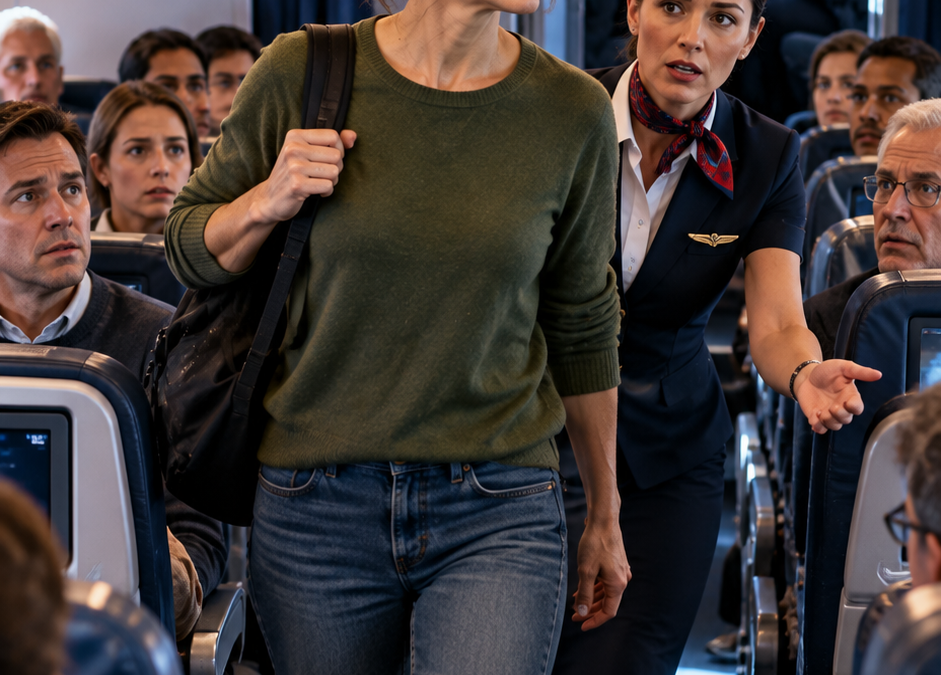
“I’m a pilot,” I said.
The flight attendant blinked.
“I’m sorry?”
I unfastened my seat belt.
“Former U.S. Air Force fighter pilot. F-16s.”
The man in 8B removed one side of his headphones and stared.
“You?”
I nodded once.
The flight attendant’s expression shifted from disbelief to relief so quickly it almost hurt to watch.
“Please come with me. Right now.”
I stood.
The click of my seat belt sounded absurdly loud.
As I followed her toward the cockpit, I felt the woman I had spent seven years burying begin to wake up inside me.
My breathing slowed.
My senses sharpened.
The aircraft’s vibration moved through my feet and up my spine. I felt the slight pressure changes, the subtle corrections, the weight of the machine cutting through night. Training I thought I had abandoned came rushing back with terrifying ease.
Then I saw the crew near the forward galley.
Their faces weren’t just tense.
They were terrified.
That told me this was not simply an equipment failure.
Something else was wrong.
Something they did not understand.
Something that had made a captain desperate enough to ask a cabin full of passengers for a fighter pilot.
A flight attendant keyed the cockpit door.
I stopped outside it.
One of the crew members looked at me as if he already knew exactly who I was.
My blood went cold.
Then the cockpit door began to open.
Only halfway at first.
A man in a white pilot’s shirt stood on the other side, one hand braced against the frame. He was younger than the captain I had heard over the speakers, maybe thirty-five, with dark hair touched by premature gray near his temples.
His face was pale from concentration.
But that was not what stopped me.
It was the way he looked at me.
Not like a stranger.
Not like a passenger who happened to have the qualifications they needed.
He looked at me the way people look when a name from an old story suddenly becomes flesh and blood.
“Commander Quinn,” he said quietly.
For a moment, the aircraft noise seemed to fade.
Nobody had called me that in seven years.
My hand tightened around the edge of the doorway.
“How do you know my name?”
His expression changed.
Something complicated moved behind his eyes.
Recognition.
Regret.
Maybe even relief.
But there was no time to explain.
“Please,” he said. “We need you inside.”
The flight attendant beside me touched my elbow gently.
I stepped through the door.
The cockpit was darker than I expected. Only the instrument panels cast their blue-white glow across the pilots’ faces. The captain, a broad-shouldered man in his late fifties, sat in the left seat with both hands resting lightly on the controls.
Nothing about his posture suggested panic.
Everything about the room suggested trouble.
Several displays carried amber caution messages. One of the main navigation screens had been dimmed. A line of text flashed across the central panel before disappearing beneath another warning.
I had spent years trying to forget the language of cockpits.
My mind translated it anyway.
Autopilot unavailable.
Flight-control disagreement.
Inertial reference mismatch.
The aircraft itself was flying normally for the moment. I could feel that through my feet and through the subtle pressure changes in my inner ear.
But the computers were arguing about where the airplane was.
That was more dangerous than an engine failure people could see or smell.
A machine that knew it was injured could often be managed.
A machine receiving conflicting information could make very reasonable decisions based on very wrong assumptions.
The captain glanced toward me.
“Rachel Quinn?”
“Yes.”
“Captain Samuel Cole.”
He nodded toward the younger pilot.
“First Officer Mateo Ruiz.”
My stomach tightened.
Ruiz.
I looked at the first officer again.
Now I saw it.
The shape of the brow.
The line of the jaw.
The slight downward turn at the corners of his mouth when he concentrated.
Daniel.
Seven years disappeared.
For one terrible second, I was back in a briefing room in Nevada, standing in front of a map while Lieutenant Daniel Ruiz laughed about losing a bet and owing the entire flight a round of terrible vending-machine coffee.
Then another memory threatened to follow.
I shut the door on it.
Not now.
Captain Cole pointed to the jumpseat behind them.
“Sit. Strap in.”
I did.
“What happened?”
“About fourteen minutes ago, we got disagreement between two inertial reference sources,” he said. “Then intermittent air-data inconsistencies. Autopilot disconnected twice. We’ve isolated one source, but the remaining systems still aren’t agreeing consistently.”
“What’s dispatch saying?”
“They’re working with maintenance control.”
Mateo handed me a headset.
Captain Cole continued.
“We’re not asking you to fly the airplane.”
“Good.”
One corner of his mouth almost moved.
“Thought you might say that.”
“What exactly are you asking?”
He looked at me directly.
“To help us decide which instruments we can trust.”
The sentence went straight through me.
My fingers froze around the headset.
Mateo noticed.
Of course he noticed.
His brother had died because of almost exactly that question.
Which instrument do you trust when the cockpit starts disagreeing with itself?
Captain Cole went on, unaware of the full meaning.
“Ruiz remembered your name from the manifest.”
I looked at Mateo.
“You checked the passenger manifest?”
He hesitated.
“I recognized your name at boarding.”
“Why?”
Captain Cole looked between us.
“You two know each other?”
“No,” Mateo said.
Then he looked at me.
“But my brother did.”
Silence filled the small cockpit.
He did not need to say Daniel’s name.
I heard it anyway.
Captain Cole gave us exactly two seconds.
Then he returned to the emergency.
“Whatever history is here, we deal with it later. Right now, I have two hundred eighty-six passengers and twelve crew members whose best interests require three calm adults in this cockpit.”
It was the kind of sentence I once would have said myself.
I leaned forward.
“Show me the sequence.”
Mateo pulled up the caution log.
Times.
Warnings.
Resets.
Sensor disagreement.
A navigation drift corrected by GPS.
Then a second drift.
The crew had followed procedure exactly.
They had not rushed.
They had not guessed.
That helped.
“What was the weather when it started?”
“Cloud tops below us,” Mateo said. “No significant turbulence. Some electrical activity about forty miles north, but nothing near our track.”
“Any lightning indication?”
“No.”
“Static?”
“Minor.”
I scanned the readings.
Three independent ways of estimating the aircraft’s attitude were displayed in slightly different forms.
Two agreed.
One occasionally wandered.
Then returned.
Then wandered again.
I felt something cold move through me.
Not because I knew this aircraft.
I did not.
I had never flown an airliner of this type.
But patterns did not care what uniform you wore.
Machines developed habits.
Failures had personalities.
Some died loudly.
Some lied.
“What’s the time drift between reference two and the standby system?” I asked.
Mateo checked.
“Less than a second.”
“Reference one?”
He frowned.
“Variable.”
“How variable?”
“Point eight. Then one point two. Back to point six.”
Captain Cole turned slightly.
“You think the problem is timing?”
“I think you may not have three systems disagreeing about position,” I said. “You may have one system disagreeing about when the position was measured.”
Mateo stared at the values.
Something changed in his face.
He knew.
Not the solution.
The memory.
Daniel’s accident had involved the same distinction.
For years, the official report described it as conflicting attitude information. During the investigation, I had argued that something stranger had happened.
The instruments had not simply disagreed.
One had been late.
Only fractions of a second.
At fighter speeds, fractions mattered.
Captain Cole contacted maintenance control again. The conversation became technical. I listened while a specialist in London joined the channel, followed by another voice from the aircraft manufacturer.
Nobody liked my theory immediately.
That was comforting.
Good professionals are suspicious of convenient answers.
We compared values. Checked independent sources. Ran through alternate navigation references. Mateo and I called numbers while Captain Cole maintained the aircraft manually.
Minute by minute, the picture sharpened.
One inertial reference unit was not failing completely.
It was lagging intermittently.
That lag created contradictory information elsewhere.
The crew isolated it.
Warnings disappeared one by one.
Not all of them.
But enough.
The cockpit became quieter.
Captain Cole let out a breath through his nose.
“That’s better.”
Mateo leaned back slightly. For the first time since I entered, I noticed how exhausted he looked.
“Maintenance agrees with the isolation,” he said.
Captain Cole nodded.
“Then we divert.”
“Shannon?” Mateo asked.
“Shannon.”
He contacted oceanic control.
My hands suddenly began to shake.
Only slightly.
Enough that I placed them under my thighs.
The immediate problem was contained.
That was when memory came back for its payment.
Daniel’s voice.
A training room.
A flight plan.
My own command over the radio.
Trust your standby.
Daniel answering.
Copy, Lead.
Then silence.
I stared at the dark windshield. Somewhere beneath us was the Atlantic Ocean. Above us were stars we could not see.
Captain Cole finished speaking with air traffic control and looked back.
“We’ll be on the ground in a little over two hours.”
I nodded.
“Do you still need me?”
“Yes.”
The answer came from Mateo.
Captain Cole glanced at him, then at me.
“For operational reasons,” he added dryly.
Mateo almost smiled.
Almost.
I remained in the jumpseat.
For the next twenty minutes, we monitored. The aircraft behaved. Once we were satisfied the remaining systems were stable, Captain Cole gave the cabin an update.
His voice was different now.
Still serious.
But the hidden edge was gone.
“Ladies and gentlemen, thank you for your patience. We have identified the source of an instrumentation problem. The aircraft is stable and operating normally under alternate systems. As a precaution, we will be diverting to Shannon, Ireland, where maintenance personnel will inspect the aircraft.”
He paused.
“There is no need for alarm. Our cabin crew will prepare you for the diversion, and we appreciate your cooperation.”
I closed my eyes.
No applause.
No dramatic announcement.
No declaration that somebody had saved the airplane.
Good.
I did not want one.
When the radio traffic quieted again, Captain Cole turned toward Mateo.
“Now.”
Mateo understood.
He removed his headset.
Captain Cole looked at me.
“You asked why he knew your name.”
“Yes.”
“I think you deserve the answer.”
Mateo stared down at his hands.
“My brother was Daniel Ruiz.”
“I know.”
“You commanded his flight.”
“Yes.”
“He talked about you constantly.”
The words hurt in a way accusations would not have.
I looked away.
“He admired you,” Mateo said.
“Mateo.”
“No. I need to say this.”
Captain Cole remained silent.
Mateo turned in his seat.
“When I was twenty-one, my brother came home for Christmas and spent half the week explaining why Commander Rachel Quinn was the toughest person he had ever met.”
Despite myself, I remembered Daniel walking into briefing three minutes late carrying four coffees and claiming punctuality was a philosophical concept.
“He exaggerated,” I said.
“He usually did.”
A faint smile crossed Mateo’s face.
It vanished quickly.
“After the accident, nobody in my family knew what happened. Not really. We got the official explanation. System confusion. Spatial disorientation. Loss of control.”
“That’s what the board concluded.”
“I know.”
I looked at him.
Something in his tone made my heartbeat change.
“What are you saying?”
Mateo glanced toward Captain Cole.
The captain said quietly, “Tell her.”
Mateo reached into the flight bag beside his seat.
He did not take anything out yet.
“I became a pilot because of Daniel.”
I stared at him.
“My mother hated the idea,” he continued. “My father didn’t speak to me for three days after I told him I’d been accepted into flight school.”
“That sounds like Daniel’s description of him.”
Mateo smiled again.
“You remember?”
“I remember more than I want to.”
“That may be the problem.”
I stiffened.
Mateo immediately shook his head.
“I didn’t mean that the way it sounded.”
“How did you mean it?”
“You remember the accident. Maybe you stopped remembering my brother.”
The sentence found a place I had protected for years.
I saw Daniel laughing after landing.
Daniel arguing that pineapple absolutely belonged on pizza.
Daniel calling his mother every Sunday night.
Daniel showing me a photograph of his niece and pretending not to be proud while being obviously proud.
I had turned him into the worst day of both our lives.
Maybe because the alternative hurt more.
“I’m sorry,” Mateo said.
“Don’t be.”
Captain Cole checked the instruments.
The aircraft remained stable.
Mateo finally opened his flight bag. From inside, he removed a brown document envelope.
My name was written across it.
RACHEL QUINN.
The handwriting was not Daniel’s.
It was older.
Shaky.
“Where did you get that?” I asked.
“My father.”
I looked at him.
“He died eighteen months ago.”
“I’m sorry.”
“Thank you.”
Mateo rested the envelope on his knee.
“When we cleared out his house, I found a box of Daniel’s military papers. Most were ordinary things. Training certificates. Letters. Photographs.”
He paused.
“And copies of documents from the accident investigation.”
My mouth went dry.
“Your family shouldn’t have had investigative documents.”
“We didn’t. Not officially.”
“Then where did they come from?”
“That took me almost a year to figure out.”
Captain Cole turned his head slightly, listening.
Mateo continued.
“A maintenance officer contacted my father after Daniel died. He never gave him the full report. He said he wasn’t permitted to.”
“Who?”
“Chief Master Sergeant Harold Bennett.”
The name struck somewhere deep.
I knew him.
Everyone did.
Bennett had spent thirty years keeping aircraft flying. He was the kind of mechanic pilots trusted because he cared less about rank than whether you had listened when he told you not to touch something.
“He retired after the investigation,” I said.
“Yes.”
“Where is he now?”
“Arizona.”
I almost laughed.
That was where old Air Force people seemed to go when they had finished arguing with the rest of the world.
“What did Bennett give your father?”
“Enough to make him question the final report.”
I looked at the envelope.
Seven years ago, I had asked questions until people stopped answering.
I requested additional telemetry.
Denied.
Engineering data.
Unavailable.
A deeper examination of the inertial unit.
Completed under separate technical review.
I had assumed that meant there had been nothing important to find.
Or perhaps I had wanted to assume it.
Because if something was wrong with the machine, then I had spent years punishing myself for something I had not fully understood.
And if nothing was wrong with it, at least blame had a home.
Me.
Blame was terrible.
Uncertainty was worse.
“What’s in the envelope?”
Mateo did not answer immediately.
Instead, he asked, “What do you remember about Daniel’s last transmission?”
I stared at him.
Every syllable had lived inside me for seven years.
“He reported disagreement between primary attitude and standby reference.”
“And what did you tell him?”
“To trust standby and reduce maneuvering.”
“Then?”
“He acknowledged.”
“Then?”
I stopped.
The cockpit suddenly felt too small.
“Then his aircraft began a shallow right bank.”
Mateo waited.
“I corrected him.”
“What did you say?”
“Daniel, check right wing.”
“And?”
“He said he was level.”
Mateo’s eyes held mine.
“But he wasn’t.”
“No.”
“What did the official report say?”
“That he became spatially disoriented and trusted the failed instrument.”
Mateo slowly shook his head.
“No.”
I felt a strange heaviness in my chest.
“Mateo.”
“My brother followed your instruction.”
The words were quiet.
There was no music behind them.
No drama.
Just the steady hum of an aircraft crossing the night.
I almost wanted him not to continue.
“He trusted the standby,” Mateo said. “That was the problem.”
I stared at him.
“That makes no sense.”
“It didn’t to me either.”
He opened the envelope.
Inside were copies of engineering pages, handwritten notes, and what looked like a maintenance test report.
Mateo pulled out one sheet.
“Bennett believed the standby system was receiving delayed reference data through an interface unit that should have been independent.”
“No.”
“That was your argument during the inquiry.”
“No. I argued there was a timing problem. They told me the systems were independent.”
“They were supposed to be.”
I reached for the paper.
My hand stopped halfway.
“Were they?”
Mateo shook his head.
“Not completely.”
For several seconds, I did not move.
Captain Cole broke the silence.
“Rachel.”
I looked at him.
“Breathe.”
I had not realized I was holding my breath.
I took air slowly.
Then another.
The page in Mateo’s hand carried maintenance language, test values, engineering references. I knew enough to understand the implication.
Not enough to prove it.
“This is preliminary,” I said.
“Yes.”
“It isn’t a final determination.”
“No.”
“This could have been corrected later.”
“Yes.”
He was not trying to convince me.
That made it harder to dismiss him.
“Why didn’t Bennett come to me?”
“He tried.”
I looked up sharply.
“What?”
“He wrote twice.”
“I never received anything.”
“I know.”
“How could you know?”
“Because I asked him.”
“You spoke to Bennett?”
“Three months ago.”
The aircraft shifted gently in a current of air.
Nobody reacted.
My world had moved far more than the airplane.
“What did he say?”
“That after the investigation closed, he wrote to you through your base address. Both letters came back.”
I remembered leaving.
I had resigned my commission sooner than most people expected.
Changed apartments.
Changed phone numbers.
Changed almost everything.
I called it simplifying.
Maybe I had been disappearing.
“Then why are you carrying this?”
Mateo looked embarrassed.
“Because I was supposed to give it to you.”
“When?”
“In Madrid.”
I blinked.
“You knew I was going to Madrid?”
“I knew three weeks ago.”
“How?”
Now Captain Cole looked interested too.
Mateo rubbed his forehead.
“This is going to sound much stranger than it actually is.”
“Try me.”
“My mother knows your mother.”
Of all the explanations I had imagined, that was not one of them.
“What?”
“They met through a veterans’ family support organization about two years after Daniel died.”
I nearly laughed from disbelief.
“My mother never told me.”
“Mine didn’t tell me either. Apparently they agreed we had both spent enough time living inside something neither of us knew how to discuss.”
That sounded exactly like my mother.
Kind.
Protective.
Infuriating.
Mateo continued.
“My mother knew I was flying this route. Your mother knew you were traveling to Madrid.”
A strange suspicion formed.
“Why am I going to Madrid, Mateo?”
He hesitated.
“To attend your sister’s wedding.”
My heart sank.
He knew.
“Your mother mentioned it to mine,” Mateo said. “Mine told me you’d be on the flight.”
“So you were waiting for me.”
“Yes.”
The words from outside the cockpit returned.
Someone aboard this plane had been waiting for me.
But not for the reason I feared.
Mateo looked down.
“I was going to introduce myself after we landed.”
“Why didn’t you before takeoff?”
“Because I didn’t know what I wanted from you.”
The answer was painfully honest.
“I thought I wanted to give you the documents. Then I wondered if handing someone seven years of unanswered questions in an airport arrivals hall was a terrible idea.”
“It is.”
“I know that now.”
Captain Cole said, “For what it’s worth, I would have voted against the arrivals-hall strategy.”
Mateo gave him a tired look.
“Thank you, Captain.”
“Any time.”
Despite everything, a brief laugh escaped me.
It surprised all three of us.
Then I covered my mouth.
The laugh became something dangerously close to tears.
I looked at the instruments instead.
Green.
Stable.
Predictable.
I wanted the machine because the machine was easier than the past.
Captain Cole seemed to understand.
“We still have plenty of work before Shannon,” he said. “Nothing in that envelope has to be solved tonight.”
I nodded.
Mateo put the documents away.
But one question would not wait.
“Mateo.”
“Yes?”
“Did you blame me?”
His face went still.
For years, I had imagined Daniel’s family. His parents receiving uniformed officers at their door. His brother reading the report. My name becoming a word nobody wanted spoken.
Mateo looked toward the windshield.
“When I was twenty-one?”
“Yes.”
“Yes.”
I appreciated the answer more than I would have appreciated kindness.
“I blamed you,” he said. “Then I blamed the Air Force. Then the airplane. Then Daniel for becoming a pilot. Then myself because I was the one who encouraged him to apply.”
He looked at me again.
“Grief is not very disciplined.”
“No,” I whispered.
“No, it isn’t.”
“When did you stop?”
“Blaming you?”
“Yes.”
“I don’t know that there was one day,” he said. “I think it happened slowly. I became a pilot. I started understanding what cockpit decisions actually look like. How little time people sometimes have. How easy everything seems when you already know the outcome.”
I swallowed.
“And then I read your testimony.”
My eyes snapped toward him.
“You read that?”
“Every page I could get.”
“Why?”
“Because I wanted to know what you had done wrong.”
There was no cruelty in his voice.
Only the memory of a younger man desperate for somewhere to put his pain.
“And?”
Mateo took a long breath.
“You spent one hundred eighty-six pages trying to prove my brother had done nothing wrong.”
I looked down.
“You defended him when he couldn’t defend himself.”
“He was my pilot.”
“He was also my brother.”
“I know.”
“No,” Mateo said gently. “I don’t think you did.”
That caught me.
He continued before I could respond.
“I think you believed being his commander meant you were responsible for everything that happened to him.”
“That was the job.”
“No. Being responsible for someone is not the same thing as controlling everything that can happen to them.”
I stared at him.
Seven years of therapy had never found that exact sentence.
Maybe because I had not been ready to hear it from anyone else.
Maybe because it needed to come from Daniel’s brother.
The cabin interphone sounded. A flight attendant reported that passengers were calm and prepared for diversion.
Captain Cole thanked her.
Then he asked me something unexpected.
“Do you have family waiting in Madrid?”
“My sister.”
“Anyone else?”
“My daughter is back in New York with my mother.”
“How old?”
“Eleven.”
Mateo smiled.
“My niece is twelve.”
“Daniel’s?”
He nodded.
I had seen her photograph when she was a toddler. A little girl in red rain boots standing in a kitchen.
“She barely remembers him,” Mateo said. “But she knows stories.”
“That may be better than memories sometimes.”
“Maybe.”
I thought of my daughter, Sophie.
She knew I had served in the Air Force.
She knew I had flown airplanes.
She did not know much more.
Whenever school assignments asked about parents’ careers, she wrote that I worked in insurance analytics.
Which was true.
Safe.
Boring.
Ordinary.
Exactly what I had wanted.
A few months earlier, she had found an old photograph in my mother’s house. Me in a flight suit, hair pulled back, helmet tucked under one arm, twenty-nine years old and absolutely convinced I knew who I was.
Sophie had stared at it for a long time.
“You look happy,” she said.
I changed the subject.
The airplane flew on.
The sky outside gradually softened from black to dark blue.
Dawn was approaching Europe.
Captain Cole eventually asked me to help monitor the standby references during descent.
Nothing dramatic happened.
That was the miracle.
The systems remained steady. Air traffic control cleared us lower. Clouds appeared below, soft and gray in the first morning light.
When we broke through them, Ireland spread beneath us.
Green fields.
Narrow roads.
Small clusters of houses.
Ordinary life.
I had never seen anything so beautiful.
“Runway in sight,” Mateo said.
Captain Cole nodded.
“My aircraft.”
“Your aircraft.”
I sat back.
This landing belonged to them.
As it should.
The wheels touched the runway with a firm, clean thump.
Reverse thrust rose.
The aircraft slowed.
No cheers came from the cockpit. Professional pilots rarely celebrated the way movies imagined.
Captain Cole simply guided the airplane off the runway.
Only then did he exhale.
“Welcome to Shannon.”
Mateo looked back at me.
“You okay?”
I considered the question.
“No.”
He nodded.
“Me neither.”
It was strangely comforting.
When the aircraft stopped at a remote stand, maintenance vehicles approached.
Passengers began clapping in the cabin.
Muted at first.
Then louder.
I closed my eyes.
Captain Cole turned.
“They’re not clapping for you.”
“Good.”
“They’re clapping because they’re relieved.”
“Even better.”
He stood and offered me his hand.
“Rachel, what you did tonight mattered.”
I almost rejected the sentence automatically.
Then I remembered Mateo’s words.
Being responsible was not the same as controlling everything.
Maybe accepting gratitude was not the same as claiming glory.
“Thank you,” I said.
Captain Cole nodded.
No argument.
No speech.
Just acceptance.
Mateo lifted the brown envelope.
“I meant what I said. You don’t have to read this today.”
I looked at it.
For years, I told myself I wanted answers.
Standing there, I realized I had actually wanted certainty.
Answers and certainty were not the same.
Answers might complicate things.
They might change the story.
They might require forgiveness.
Worst of all, they might require me to forgive myself.
“Give it to me,” I said.
Mateo handed over the envelope.
It was lighter than I expected.
Seven years should have weighed more.
I tucked it beneath my arm.
Then the cockpit door opened.
Morning light from the cabin spilled in.
Passengers were gathering bags and checking phones. People were already turning an extraordinary night into messages for people they loved.
I stepped into the aisle.
The man who had sat beside me in 8B was waiting near our row.
His eyes widened.
“You really were a fighter pilot.”
“Once.”
He looked toward the cockpit.
“Did you save us?”
“No.”
The answer came easily.
“The pilots flew the airplane. I helped them solve a problem.”
He considered that.
Then smiled.
“Sounds like saving to me.”
I shook my head.
“Sounds like teamwork.”
He accepted that too.
My phone connected to the airport network.
Messages flooded the screen.
My sister.
My mother.
The airline.
And seventeen messages from Sophie.
Most were ordinary because she had not yet heard anything about the diversion.
A photograph of the cereal she made for breakfast.
A complaint about Grandma refusing to let her wear mismatched shoes to school.
A picture of our cat sitting inside my suitcase at home.
Then one final message.
Mom, did you land yet?
I stared at it.
My throat tightened.
I typed:
Not in Madrid. We stopped in Ireland for a little while. Everything is okay. I love you.
Three dots appeared almost immediately.
YOU’RE IN IRELAND???
Then:
CAN YOU BRING ME CHOCOLATE?
I laughed.
Really laughed this time.
Mateo heard me.
“Everything okay?”
“My daughter has priorities.”
“Good.”
We walked toward the terminal with the passengers.
At the glass doors, Mateo stopped.
“Rachel.”
I turned.
“There’s one more thing in the envelope.”
I looked down at it.
“What?”
“Something Bennett found among Daniel’s personal effects.”
My fingers tightened around the paper.
“A letter?”
Mateo shook his head.
“A recording.”
I stared at him.
“He made it the night before the flight.”
My heart began beating harder.
“For who?”
Mateo’s expression softened.
“That’s what none of us could figure out.”
He paused.
“Until Bennett listened to the end.”
The terminal doors opened behind him. Travelers moved around us, searching for coffee, calling families, making new plans.
I could barely hear them.
Mateo looked at the envelope in my hands.
“The recording was for you.”
For a moment, I felt the old urge to hand the envelope back.
To say no.
To keep the past where it belonged.
But the past had never stayed where I put it. It had followed me into grocery stores and school pickup lines. It had sat beside me at Sophie’s piano recital. It had stared back from photographs I could not throw away. It had crossed the Atlantic in a cockpit with Daniel’s brother and waited for me behind a door I had not wanted to open.
I looked at Mateo.
“Have you heard it?”
“Only the beginning,” he said. “Bennett copied it for the investigation file, but my father had the original storage card. Mateo Ruiz was apparently not the only person in my family who kept things he didn’t know what to do with.”
“Did Daniel know?”
“That he was recording for you?”
“No.” I swallowed. “That something was wrong.”
Mateo’s eyes lowered.
“I think he suspected something. But I don’t know how much.”
Captain Cole approached behind us, carrying his flight bag.
“They’re asking us to stay available for statements,” he said. “Passengers will be rebooked. It will be a few hours.”
A few hours.
Time.
The one thing emergencies never give you, suddenly arriving in excess when you least want it.
I nodded.
The airline placed us in a small conference room off the terminal, away from passengers and reporters who had not yet learned enough to form questions. A woman from operations brought coffee, bottled water, fruit, and apologetic muffins wrapped in plastic.
Captain Cole went to speak with maintenance personnel.
Mateo stayed.
Neither of us touched the food.
The envelope lay on the table between us.
I took out the engineering pages first.
That was safer.
Paper I could understand.
Numbers I could question.
Maintenance language I could distance myself from.
I read Bennett’s notes slowly.
A timing anomaly in the standby data interface.
Intermittent lag under specific maneuvering loads.
A test bench discrepancy that appeared twice, then vanished under repeat conditions.
A caution written in Bennett’s blunt handwriting:
Do not dismiss as pilot interpretation. Recreate under load.
My chest tightened.
I turned the page.
There were copies of emails. Redacted names. A memo referencing an internal technical review completed after Daniel’s accident. Another note: not included in command summary.
That line made me stop.
Not included.
How much of my life had been built around those words?
Not included.
Not available.
Not relevant.
Not enough to change the finding.
Mateo watched me carefully.
“You don’t have to read it all right now.”
“Yes,” I said. “I do.”
Because if I stopped, fear would tell me to close the envelope forever.
I kept reading.
The documents did not say what some wounded part of me wanted them to say. They did not declare me innocent in bold letters. They did not erase my command from the chain of events. They did not make Daniel alive.
But they complicated everything.
They showed that I had asked the right question.
That Bennett had asked it too.
That the system Daniel trusted may not have been independent in the way the board assumed.
That the official story had been too simple because simple stories are easier to file.
I reached the small plastic sleeve near the back of the envelope.
Inside was a storage card.
Mateo looked away.
“You can listen alone.”
“No.”
He looked back.
“You’re sure?”
“No,” I said. “But stay.”
I did not know why I wanted him there.
Maybe because the recording belonged to both of us.
Maybe because Daniel had been my pilot and his brother.
Maybe because grief held alone becomes a room with no windows.
Mateo pulled out a small adapter from his bag and connected it to his tablet. He handed me headphones.
I stared at them.
Then shook my head.
“No. Out loud.”
His eyes softened.
“All right.”
He pressed play.
For three seconds, there was only static.
Then Daniel Ruiz laughed.
The sound went through me so violently that I grabbed the edge of the table.
Not because it was dramatic.
Because it was ordinary.
Warm.
Careless.
Alive.
“All right,” Daniel’s voice said. “This is either a very professional preflight note or evidence that I should not be allowed to drink coffee after 2100.”
Mateo closed his eyes.
I covered my mouth.
Daniel continued.
“Commander Quinn, if you’re hearing this, Bennett finally bullied someone into listening, which means I was right to buy that terrifying man a muffin this morning.”
A chair scraped in the recording.
“Okay. Serious. I’m making this because something in the standby behavior during last week’s sim run still bothers me. I know we reviewed it. I know engineering says it’s noise. I know I am not supposed to become emotionally attached to weird data. You have said that sentence to me twice.”
Despite the pain, a laugh escaped me.
I had said that.
Exactly that.
Daniel’s voice softened.
“But here’s the part I don’t want to say in briefing because I don’t want anyone thinking I’m doubting the aircraft or doubting myself. When reference data lags, even a little, I get this nasty feeling that the jet is telling the truth late. And a late truth is still a lie when you’re moving fast.”
I stopped breathing.
Mateo looked at me.
Daniel continued.
“If this turns out to be nothing, please mock me privately and not in front of Henderson because he still thinks I don’t understand basic systems architecture, and I need my dignity.”
A pause.
Then his tone changed.
“And if it turns out to be something, I need you to know this. I trust you. If anything ever goes sideways, I trust your call. Not because you’re magic. Not because commanders always know. Because you listen to the machine until it tells you what kind of trouble it’s in.”
The room blurred.
Daniel’s voice became quieter.
“You once told us responsibility is not about being certain. It’s about staying useful after certainty disappears. I wrote that down. Don’t tell anyone.”
Mateo pressed both hands against his face.
I could not move.
The recording crackled.
“If tomorrow gets ugly, and I know it probably won’t, but if it does, don’t let them turn me into a cautionary tale about pilot ego. I am not planning to be an idiot. Put that on my tombstone if necessary.”
He laughed once.
Then there was silence long enough that I thought the recording had ended.
But Daniel came back softer.
“And don’t turn yourself into a tombstone either, Commander. You have this habit of carrying everybody like we’re all your personal rucksack. It’s annoying. Also noble. Mostly annoying.”
A tear slipped down my face.
“If I mess up, tell them I messed up. If the jet lies to me, tell them that too. But don’t make my death more useful by blaming yourself for it. That would be extremely on brand for you, and I formally object in advance.”
Another pause.
Then:
“Okay. This has become morbid. I’m going to sleep. Bennett says he’ll look again at the data in the morning. I told him if he finds anything, he has to buy me coffee. So really, I’m doing this for financial reasons.”
A final rustle.
“Good night, Commander. See you in briefing.”
The recording ended.
Nobody spoke.
The room hummed faintly with airport ventilation. Somewhere outside the door, someone rolled a cart down the hallway. Life continued with its indifferent noises.
I stared at the tablet.
For seven years, the last Daniel I carried was the voice on the radio.
Copy, Lead.
Then silence.
Now there was another Daniel.
Tired.
Funny.
Thoughtful.
Worried.
Alive on the edge of disaster without knowing how close he stood.
I bent forward and covered my face.
The sound that came out of me did not feel like crying at first. It felt like something tearing loose.
Mateo moved to stand.
I reached out blindly and caught his sleeve.
“Stay.”
He sat back down.
I cried for Daniel.
For the young pilot who trusted me.
For the brother Mateo lost.
For the commander I had buried alive because I did not know how to survive being unable to save him.
For Sophie, who had inherited a mother afraid of her own history.
For seven years of living as if ordinary could be built from avoidance.
When I finally looked up, Mateo’s face was wet too.
“I’m sorry,” I whispered.
He shook his head.
“No.”
“I gave the instruction.”
“He trusted the standby because the system was supposed to be trustworthy.”
“I was his commander.”
“And he was a pilot,” Mateo said, his voice breaking. “He made decisions too. He trained. He understood risk. He loved flying. You didn’t put that in him.”
The words did not heal me.
Not immediately.
But they entered.
That mattered.
Captain Cole returned a few minutes later and stopped just inside the door. He looked from Mateo to me to the tablet.
“You listened.”
I nodded.
He did not ask what Daniel had said.
Instead, he set a folder on the table.
“Maintenance pulled preliminary fault data from our aircraft.”
I wiped my face.
“And?”
His expression was grim.
“Intermittent timing lag in one inertial reference unit. Consistent with your call.”
Mateo and I looked at each other.
“Not the same system,” Captain Cole said. “Not the same aircraft type. Not the same accident. But the same kind of thinking.”
I looked down at Bennett’s notes.
Patterns did not care what uniform you wore.
Captain Cole sat across from me.
“They’re going to ask for formal statements. You can decline to speculate beyond what you observed.”
“I know.”
“But I’ll say this as plainly as I can.” He folded his hands. “Tonight, you saw a pattern our crew might not have identified in time. Not because we were incompetent. Because you carried a scar that made you recognize the shape of the wound.”
I closed my eyes.
I hated that sentence.
I needed it.
The airline rebooked passengers through Shannon. Some continued to Madrid later that day. Others went through London or Dublin. The wedding I was supposed to attend in Madrid became another logistical mess in a family already skilled at making ordinary events emotionally complicated.
My sister called me crying before noon.
“Rachel, are you safe?”
“Yes.”
“Mom said the plane diverted.”
“It did.”
“Were you scared?”
I looked at Mateo across the room.
“Yes.”
My sister went quiet.
I had not answered a family question that honestly in years.
“Are you still coming?” she asked.
“I think so.”
“You think?”
“There’s something I need to do first.”
She hesitated.
Then said, “Okay.”
Not What could possibly be more important than my wedding?
Not You always do this.
Just okay.
Maybe my family had been waiting for me to stop pretending too.
Sophie called next.
Video call.
Her face filled the screen, all dark curls and suspicious eyes.
“Grandma said your plane had a problem.”
“Grandma talks too much.”
“Mom.”
“Yes,” I said. “There was a problem.”
“Were you scared?”
There it was again.
A child asking for truth.
Not all of it.
Enough.
“Yes.”
Her mouth tightened.
“But you’re okay?”
“I’m okay.”
“Did you help?”
I looked away for one second.
Then back.
“Yes. A little.”
Sophie’s eyes widened.
“Like Air Force help?”
My throat tightened.
“Like Air Force help.”
She was silent.
Then she said, “So you were still a pilot.”
I almost corrected her.
I almost said no, not anymore, not really, that was a long time ago.
Instead, I remembered Daniel’s recording.
Don’t turn yourself into a tombstone either, Commander.
“I guess part of me was,” I said.
Sophie smiled slowly.
“Can we talk about that when you come home?”
Fear rose.
Then settled.
“Yes,” I said. “We can.”
By late afternoon, I stood with Mateo near a terminal window overlooking the aircraft that had brought us safely to Shannon. Maintenance crews moved around it in reflective vests. Passengers had gone. Captain Cole was still speaking with investigators.
The brown envelope sat in my bag.
It no longer felt light.
But it no longer felt unbearable either.
Mateo looked at the aircraft.
“I keep thinking Daniel would have loved this.”
“Emergency diversion?”
“No. Being proven right by accident during someone else’s flight.”
I laughed.
“He would have been insufferable.”
“Completely.”
For a while, we stood in silence.
Then I said, “I want to speak to Bennett.”
Mateo nodded.
“I’ll give you his number.”
“And I want the rest of the technical review reopened.”
“That may not be simple.”
“No.”
“Are you ready for that?”
I watched the maintenance crew open a panel beneath the fuselage.
“No.”
Mateo smiled faintly.
“You answer that way a lot.”
“I’m trying something new.”
“Honesty?”
“Apparently.”
He looked down.
“My mother would like to meet you someday.”
I swallowed.
“I don’t know if I can face her.”
“She doesn’t want to blame you.”
“She might when she sees me.”
“She has had seven years to blame you. I don’t think she needs the visual aid.”
That almost made me laugh again.
“She sounds like Daniel.”
“She is the original source.”
I nodded slowly.
“Then yes. Someday.”
A boarding announcement sounded for a flight to Madrid.
Mine.
Mateo heard it too.
“You should go.”
I looked at him.
“Are you continuing?”
“Not today. Crew duty limits. Captain Cole says I’m officially grounded until I sleep and stop looking haunted.”
“He seems wise.”
“Annoyingly.”
I extended my hand.
Mateo looked at it.
Then he hugged me.
For one second, I went rigid.
Then I hugged him back.
Not because everything was forgiven.
Not because grief had become simple.
Because two people who had carried different pieces of the same loss had finally stopped carrying them alone.
“Thank you,” he said.
“For what?”
“For coming forward.”
I closed my eyes.
“I almost didn’t.”
“I know.”
When he stepped back, I said, “Tell your mother Daniel was still joking the night before.”
Mateo’s face changed.
“I will.”
“And tell her…” I stopped.
There was no sentence large enough.
“Tell her I remember him.”
Mateo nodded.
“She’ll want to hear that.”
The flight from Shannon to Madrid was short compared with the crossing from New York, but I felt every minute. I sat by the window again. This time, I did not close my book to avoid people.
I did not open it at all.
When we landed in Madrid, my sister was waiting near arrivals in a white sundress with mascara under her eyes and wedding-week exhaustion all over her face.
The moment she saw me, she ran.
My sister, who normally believed public emotion should be scheduled and properly lit, threw her arms around me in the middle of the airport and held on.
“You terrified Mom,” she whispered.
“I know.”
“You terrified me.”
“I know.”
She pulled back and studied my face.
“What happened?”
For years, I would have said, Nothing. Technical problem. Long story. I’m fine.
Instead, I said, “Something I should have faced a long time ago.”
Her expression softened.
“Before or after my wedding?”
I glanced at the brown envelope in my bag.
“After.”
She nodded.
“Good. Because I still need someone to stop Aunt Linda from giving a toast.”
That was how life worked.
One hour, you were listening to the voice of a dead pilot.
The next, you were preventing a drunk relative from turning a wedding reception into a hostage situation.
I changed in a hotel bathroom and arrived at the ceremony with ten minutes to spare. My sister cried when she saw me seated in the second row. My mother cried harder. I saw it from across the aisle and knew immediately that Mateo’s mother had already called her.
After the vows, after the photographs, after my sister walked into the reception glowing with the impossible relief of a bride whose day had not collapsed, my mother found me outside near the courtyard fountain.
She did not begin with small talk.
Mothers rarely do when they have spent years loving around a locked door.
“Mateo’s mother called,” she said.
“I assumed.”
“She told me he gave you the envelope.”
“Yes.”
“And?”
I looked at the Spanish evening sky, soft purple over the hotel garden.
“And I listened to Daniel’s recording.”
My mother covered her mouth.
“Oh, Rachel.”
I turned toward her.
“You knew they were looking for me.”
She did not deny it.
“I knew there were things unfinished.”
“You could have told me.”
“I tried once.”
“When?”
“Five years ago. You told me if I mentioned the accident again, you would leave Thanksgiving.”
I remembered.
Shame moved through me.
“I’m sorry.”
“I know.”
“I made it hard to love me.”
Her eyes filled.
“No. You made it hard to reach you. That is not the same thing.”
The sentence struck deep.
I looked away.
“My plane had a problem tonight.”
“I know.”
“I helped.”
“I know.”
“And I was scared.”
My mother’s face crumpled.
Not because I had been scared.
Because I had finally admitted it.
She reached for my hand.
“I was scared too.”
I let her hold it.
For once, I did not pull away first.
Three days later, back in New York, I sat on Sophie’s bedroom floor while she sorted the Irish chocolate I had bought during the layover.
“You got the good kind,” she said approvingly.
“I had expert airport guidance.”
She studied me carefully.
Children know when adults are circling something.
“So,” she said. “Air Force help?”
I smiled despite myself.
“So.”
I told her some of it.
Not the worst parts.
Not the full accident report.
Not the sound of Daniel’s last transmission.
But enough.
I told her I used to fly fighters. I told her I commanded pilots. I told her one of them died in an accident, and I blamed myself for a long time. I told her I stopped flying because I was afraid of being responsible for losing someone again.
Sophie listened with the intense seriousness of an eleven-year-old who has just discovered her mother had existed before motherhood.
“Was the pilot your friend?” she asked.
“Yes.”
“What was his name?”
“Daniel.”
She nodded.
“Do you still miss him?”
“Yes.”
“Even though it was seven years ago?”
“Especially because it was seven years ago.”
She thought about that.
Then she handed me a chocolate bar.
“For sadness.”
I accepted it with appropriate solemnity.
“Thank you.”
“Are you going to fly planes again?”
I almost said no.
Then I thought about the Atlantic.
About Captain Cole’s steady hands.
About Mateo saying his brother followed my instruction.
About Daniel’s voice objecting in advance to my lifelong punishment.
“I don’t know,” I said.
Sophie nodded.
“That’s better than when adults say no too fast.”
“You’re very wise.”
“I know.”
Two months later, I called Harold Bennett in Arizona.
He answered on the fourth ring with a suspicious, gravelly, “Who is this?”
“Rachel Quinn.”
The line went silent.
Then he said, “Took you long enough.”
I laughed before I cried.
Bennett did not apologize at first. That was not his way. He cursed the mail system, the investigation board, two engineers by name, and himself most of all.
Then, finally, his voice grew quiet.
“I tried, Commander.”
“I know.”
“Not hard enough.”
“Maybe.”
“I should have found you.”
“I made myself hard to find.”
“That doesn’t absolve me.”
“No,” I said. “It doesn’t.”
He exhaled.
“You still sound like a commander.”
For once, the word did not feel like a wound.
“Maybe I’m learning how to be one without wearing the uniform.”
The reopened review took nearly a year.
It did not produce the clean miracle people imagine in stories.
Official institutions rarely confess in beautiful language.
But the amended finding acknowledged previously unavailable technical data, including evidence that delayed standby-reference inputs may have contributed to the conditions Daniel encountered. It stated that the original report had overemphasized pilot disorientation and insufficiently considered a system-timing anomaly.
Those words were cold.
Bureaucratic.
Late.
But they mattered.
Daniel’s family received the amended finding.
So did I.
The Air Force did not give me back seven years.
It did not give Daniel back his life.
It did not erase the fact that I gave an instruction based on the instruments we believed were trustworthy.
But it removed the lie that Daniel had simply failed.
It removed part of the lie I had told myself too.
At the small memorial gathering Mateo’s family held after the amended finding, his mother hugged me for a long time.
“You remembered him,” she whispered.
“Yes.”
“Not just the accident?”
I closed my eyes.
“No. Not just the accident.”
Mateo stood beside his niece, Daniel’s daughter, now twelve years old and wearing red shoes that made my chest ache.
She looked at me shyly.
“Uncle Mateo says my dad was funny.”
“He was.”
“Was he brave?”
I crouched slightly so we were eye level.
“Yes. But not only brave.”
She tilted her head.
“What else?”
I smiled through the ache.
“He was curious. Stubborn. Very bad at being on time. He believed terrible pizza choices were a constitutional right. He loved his family loudly. And he listened when the airplane was trying to tell him something.”
She considered that.
Then nodded as if adding it to an archive.
I thought Emily, my librarian sister-in-law in another life, would approve.
Months after that, Captain Cole sent me a message.
Short. Practical.
We’re hosting a CRM and abnormal-systems seminar. You should speak.
I stared at the invitation for three days.
Then Sophie found it open on my laptop.
“You should go,” she said.
“You don’t know what it is.”
“It says seminar.”
“That doesn’t mean I should go.”
“Mom.”
She had learned my tone and weaponized it.
“What?”
“You said being scared doesn’t mean no.”
I regretted raising a child who listened.
But I went.
I stood in front of a room full of pilots and talked about uncertainty. Not heroism. Not instinct. Not glory. I talked about instrument disagreement, cognitive lock-in, crew communication, and the danger of reducing accidents to simple stories because simple stories make survivors easier to manage.
At the end, someone asked whether I considered myself a pilot again.
I looked at Mateo in the back of the room.
At Captain Cole near the aisle.
At my mother sitting beside Sophie, who was pretending not to be proud and failing completely.
“I don’t know if that word ever really leaves you,” I said. “But I know this. I spent seven years believing responsibility meant carrying the dead alone. I was wrong. Responsibility also means telling the truth while people are still alive to hear it.”
The room was silent.
Not uncomfortable.
Listening.
That night, Sophie and I walked home from the train station under a cold New York sky.
She slipped her hand into mine.
“Were you happy today?” she asked.
I thought about the photograph she had once found. Me at twenty-nine, helmet under my arm, certain I knew who I was.
Then I thought about myself in seat 8A, trying to disappear.
Then the cockpit door opening.
Mateo saying Commander Quinn.
Daniel’s voice returning from a recording I never knew existed.
And my daughter beside me now, holding my hand without fear of the parts of me I had tried to hide.
“Yes,” I said.
Sophie smiled.
“You looked happy.”
This time, I did not change the subject.
“I was.”
For years, I believed I had left the cockpit because I wanted peace.
But peace built from avoidance is only silence wearing a softer name.
On that overnight flight to Madrid, when the captain asked for a fighter pilot and the entire cabin froze, I thought the past had come to punish me.
It had not.
It had come to return what grief had taken.
Not command.
Not certainty.
Not the illusion that I could save everyone if I only made the right call.
It returned my name.
Rachel Quinn.
Commander.
Mother.
Pilot.
Woman who was scared and stood up anyway.
And when my daughter later asked me why I did it, why I left my seat and walked toward the cockpit instead of staying safely anonymous in 8A, I told her the only answer that had ever been true.
Because a pilot doesn’t leave people behind.
Not passengers.
Not the dead.
Not the people who loved them.
And not herself.








