𝗙𝗨𝗟𝗟 𝗦𝗧𝗢𝗥𝗬 The Uniform He Called a Costume Carried a Secret My Father Took to His Grave
𝗙𝗨𝗟𝗟 𝗦𝗧𝗢𝗥𝗬
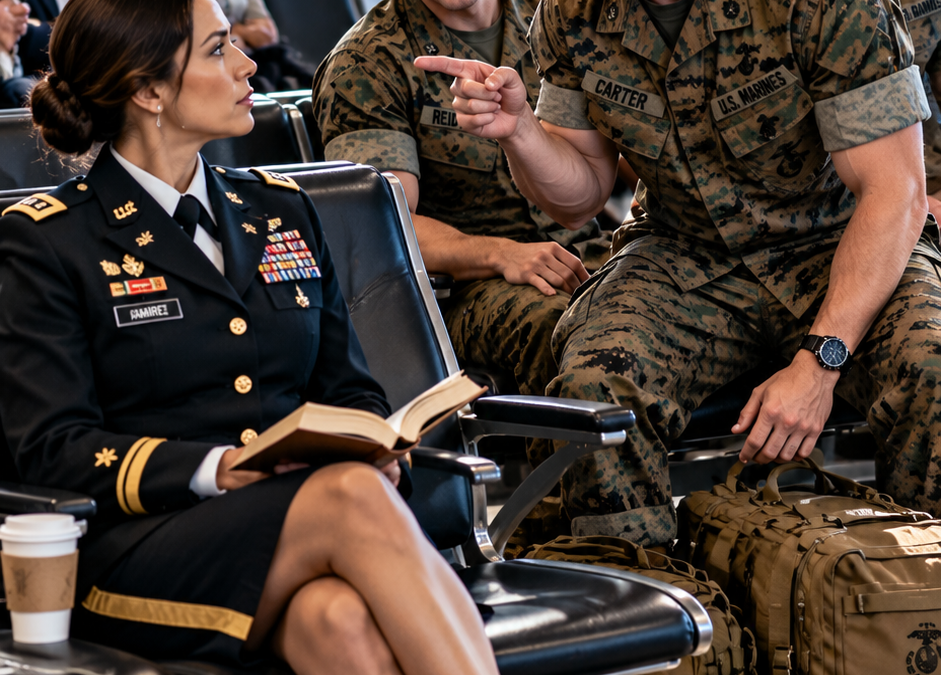
That recognition changed the atmosphere more effectively than any speech could have.
Carter stared at me.
Not at my ribbons now.
Not at the oak leaves.
At me.
As though the woman who had been sitting six feet away from him for ten minutes had suddenly become someone else.
Whitaker noticed.
“Sit down, Colonel.”
I did.
Then, after a moment, he nodded toward Carter’s empty chair.
“You too, Lance Corporal.”
Carter sat slowly.
Mason Reid had gone completely silent.
Vega seemed to be studying an advertisement across the terminal with extraordinary concentration.
General Whitaker did not raise his voice.
That made everyone nearby listen harder.
“I was standing in that line for coffee,” he said, “long enough to hear most of this conversation.”
Carter swallowed.
“Yes, sir.”
“Actually, it wasn’t much of a conversation, was it?”
“No, sir.”
Whitaker looked at me.
“Did Lieutenant Colonel Ramirez say anything to you before you approached her?”
“No, sir.”
“Did she represent herself as something she wasn’t?”
“No, sir.”
“Did she ask you to inspect her uniform?”
A few people nearby shifted in their seats.
Carter looked down.
“No, sir.”
Whitaker nodded.
Then he said something I did not expect.
“Colonel, do you need me here?”
Carter looked up.
So did Mason.
Whitaker had deliberately handed the situation back to me.
I appreciated that more than he probably knew.
“No, General.”
“Very well.”
He picked up his bag.
But before walking away, he looked at Carter.
“I suggest you listen carefully to whatever Lieutenant Colonel Ramirez decides to say. Not because she outranks you. Because you appear to have reached adulthood with a dangerous habit of deciding who people are before asking.”
Then he walked toward the far end of the gate.
No spectacle.
No shouted threats.
No demand for names and commanding officers.
He simply left Carter sitting there with the thing he had spent ten minutes avoiding.
Responsibility.
For several seconds, nobody spoke.
I could feel dozens of people trying not to stare.
Carter rubbed his palms against his trousers.
“I…”
He stopped.
Mason finally looked at him.
“Just say it.”
Carter’s jaw tightened.
For an instant, I thought pride might win.
Then something in his expression gave way.
“I’m sorry, ma’am.”
I watched him.
“Which part?”
He blinked.
“The comment.”
“There were several.”
His face reddened.
“All of it.”
I closed my book.
The anger I had expected to feel wasn’t there.
What I felt instead was exhaustion.
Not because of Carter alone.
Because his sentence had touched something I had been trying not to think about since leaving Washington that morning.
Real officers don’t look like you.
Years earlier, a different person had said something almost identical.
Not cruelly.
That had made it harder.
My own father had said it at our kitchen table when I was nineteen.
“You sure the Army is going to know what to do with somebody like you?”
He had been smiling when he said it.
Half joke.
Half warning.
Entirely convinced he was protecting me.
Rafael Ramirez worked thirty-two years repairing municipal buses in Albuquerque. He believed in steady jobs, quiet neighborhoods, paid mortgages, and never volunteering for any institution that might decide it owned your future.
When I announced that I had accepted an Army ROTC scholarship, he went silent for almost a full minute.
Then he said, “Officers are senators’ sons and generals’ daughters.”
“I’ve met three cadets,” I told him.
“That proves my point.”
“I’m going.”
“I know.”
That was the argument.
Not dramatic.
No doors slammed.
No one stopped speaking.
My family did not fight loudly.
We perfected something subtler.
We loved one another while carefully avoiding the subjects most likely to expose how little we understood one another.
And now, twenty-four years later, I was flying to Albuquerque because of a letter connected to my father that I still had not fully explained to anyone.
Not even my younger sister, Sofia.
Especially not Sofia.
Carter cleared his throat.
“I really am sorry.”
I returned to Gate C27.
To the cold coffee beside my boot.
To the Marine sitting in front of me, suddenly less interested in an audience.
“What made you think it was fake?” I asked.
He hesitated.
“I don’t know.”
“That’s not true.”
Mason glanced between us.
Carter looked at the floor.
Finally, he said, “I guess you didn’t look like what I expected.”
There it was again.
Expectation.
One of the quietest ways human beings get things wrong.
“What did you expect?”
He looked uncomfortable.
I did not rescue him.
“Someone… older, I guess.”
“You called me a fake officer because I look young?”
He immediately realized how ridiculous that sounded.
“No, ma’am.”
“Then what?”
His eyes moved briefly to my face and away.
He had probably meant more than age.
Maybe gender.
Maybe ethnicity.
Maybe a collection of assumptions he had never bothered to put into words because no one had ever forced him to examine them.
“I don’t know how to explain it.”
“That,” I said, “might be worth thinking about.”
He nodded.
I picked up my coffee.
Cold.
I took a sip anyway.
Mason leaned forward.
“Ma’am?”
“Yes?”
“I’m sorry too.”
Carter glanced at him.
Mason continued.
“I didn’t say anything to you, but I laughed.”
“I noticed.”
He winced.
“I should’ve stopped it.”
“You could have.”
“Yes, ma’am.”
The third Marine finally joined the conversation.
“Same.”
His name was Luis Vega.
He had laughed once, quietly, mostly because the other two had.
That seemed important to him now.
Maybe because small choices often look different when someone makes you name them.
I nodded toward their seats.
“You three traveling together?”
“Back to Pendleton,” Mason said. “Training assignment.”
Carter rubbed the back of his neck.
“We had leave.”
“Good leave?”
Vega smiled faintly.
“My sister got married.”
“That sounds like good leave.”
“It was.”
Something in that simple exchange released the pressure around us.
The terminal slowly returned to itself.
The mother adjusted the blanket over one child.
The businessman resumed typing.
The elderly couple went back to their paperback.
Life moved on.
That was usually how correction happened in the real world.
Not with music swelling in the background.
Not with an audience cheering.
A person was wrong.
Someone said so.
Then everyone still had a plane to catch.
Carter sat there for another minute.
“Ma’am?”
“Yes?”
“You don’t have to answer, but… General Whitaker said he knew why you were traveling.”
“He did.”
“And you’re supposed to be in uniform?”
“I am.”
He nodded.
“I’m sorry I called it a costume.”
This apology sounded different.
Less rehearsed.
“Accepted.”
His shoulders lowered slightly.
He stood.
Mason and Vega followed him back across the aisle.
I opened my book again.
I read the same paragraph six times.
Then General Whitaker sat beside me.
“I was wondering how long you were going to make him work for that apology.”
I turned.
“You were listening?”
“I’m a general. Listening from a distance is half the profession.”
I smiled despite myself.
He placed a fresh coffee on the empty seat between us.
“Peace offering.”
“You didn’t insult me.”
“No. But you drank that terrible airport coffee cold, and I couldn’t allow it.”
I accepted the cup.
“Thank you.”
For several minutes, we sat without speaking.
Whitaker and I knew each other professionally, though not well. He had been deputy commanding general during one of my assignments in Europe. Later, our paths crossed at the Pentagon. He had a reputation for remembering names, which meant either an extraordinary memory or an extraordinary staff.
I suspected both.
“You haven’t told your sister yet,” he said.
I turned toward him.
“How do you know that?”
“Because when I mentioned Albuquerque in Washington, you looked like someone carrying a secret heavier than her luggage.”
“That isn’t an answer.”
He took a drink.
“No.”
I waited.
He finally sighed.
“Your father asked me not to contact your family until the records review was complete.”
The coffee cup paused halfway to my mouth.
“My father asked you?”
“Yes.”
“When?”
“Four years ago.”
I stared at him.
My father had died three years ago.
Quietly, at seventy-one, after a brief illness he minimized until there was no point pretending it was nothing.
I had been stationed in Germany when he became ill.
I made it home.
Barely.
My final conversation with him had been about whether the air-conditioning in my hotel worked properly and whether Sofia was remembering to eat.
We talked around everything that mattered.
As usual.
“You knew my father?”
Whitaker looked toward the windows.
Rain streaked the glass.
“Not the way you mean.”
I lowered my voice.
“General, I was told this trip concerned an archival recognition ceremony. My orders say I’m attending as an official Army representative.”
“You are.”
“And?”
“That’s true.”
“That sounded very carefully phrased.”
“It was.”
I set down my coffee.
“What aren’t you telling me?”
Whitaker studied me for several seconds.
“There are things in that file you deserve to read before I explain them.”
“What file?”
“The one waiting in Albuquerque.”
My patience began thinning.
“You knew my father had contacted the Army?”
“Yes.”
“Why?”
“He was trying to correct something.”
“What?”
“I promised him you would see it in his own words.”
I laughed once, without humor.
“General, my father is dead.”
“I know.”
“So forgive me if promises about keeping his secrets no longer impress me.”
Whitaker’s face softened.
“It wasn’t about keeping something from you forever, Elena.”
He almost never used my first name.
That worried me more than anything else.
“It was about letting him decide how to tell you.”
“He didn’t.”
“No.”
“Then he made his decision.”
Whitaker nodded.
“Maybe.”
I stared at him.
He glanced across the aisle.
Carter was no longer joking. He sat hunched over his phone while Mason spoke quietly beside him.
Whitaker followed my gaze.
“People put off difficult conversations because they imagine there will be a better time.”
“My father was talented at that.”
“So are most families.”
I picked up the fresh coffee.
It had already cooled slightly.
“What does Carter have to do with any of this?”
“Nothing.”
“You said you knew why I was traveling.”
“I do.”
“And you happened to be at the same gate?”
“That part really was coincidence.”
“You’re not on my flight.”
“No.”
“Where are you going?”
“Denver.”
“Then why were you in our gate?”
“Coffee.”
I looked at the cup.
“That might be the least convincing part of the story.”
He laughed.
“Fair.”
The departure board changed.
Our flight was delayed another forty minutes.
A collective groan moved through the gate.
Whitaker stood.
Before leaving, he placed one hand on the back of the chair.
“You’ll understand more tonight.”
“Will I like what I understand?”
“No idea.”
“That’s encouraging.”
“Elena.”
I looked up.
“Your father was proud of you.”
Something tightened in my chest.
“You met him twice.”
“Three times.”
I went completely still.
Whitaker seemed to realize he had said more than intended.
“Three?”
He nodded.
“The file.”
Then he walked away.
This time, I did not try to stop him.
For almost ten minutes, I sat looking at the rain.
My father had met General Whitaker three times.
My father, who once told me he could not understand why anyone would want to spend a career surrounded by generals.
My father, who attended my commissioning but skipped my promotion to lieutenant colonel because he claimed flying upset his stomach.
My father, who rarely asked about my work beyond whether I was eating properly and sleeping enough.
Apparently that same man had met privately with a major general.
Three times.
And had never told me.
My phone vibrated.
SOFIA.
I answered.
“You boarding yet?”
“Delayed.”
“Of course.”
In the background, I heard dishes clattering.
“You’re cooking,” I said.
“I’m attempting to cook.”
“That sounds more accurate.”
“You still won’t tell me why you’re coming in uniform?”
I looked down at the gold oak leaves on my shoulders.
“Official event.”
“For Dad?”
There was no accusation in her voice.
Only curiosity.
I hesitated too long.
“Elena.”
“I don’t know.”
“You flew across the country for an event you don’t understand?”
“I understand the official part.”
“That is the most Army answer you have ever given me.”
Despite everything, I smiled.
“What are you making?”
“Enchiladas.”
“Dad’s recipe?”
“Supposedly.”
“Which means you’ve replaced half the ingredients.”
“I improved them.”
“He would haunt you.”
“Then maybe he can explain why he put cumin in everything.”
I closed my eyes.
For a moment, I could see our father in the kitchen, refusing to measure anything, humming old boleros while Sofia complained about onions.
Memory was unfair that way.
It rarely arrived in the moments you prepared for.
It ambushed you in airport gates over cumin.
“Sofia.”
She heard something in my voice.
“What?”
“There may be more to tomorrow than I thought.”
A pause.
“What kind of more?”
“I don’t know yet.”
“That doesn’t sound good.”
“It might not be bad.”
“Those are different statements.”
She had always been better than I was at hearing what people avoided saying.
“I’ll explain when I get there.”
“Elena.”
“I promise.”
Another pause.
“All right.”
It was not agreement.
It was trust extended conditionally.
After we hung up, I noticed Carter standing several feet away.
Not close enough to intrude.
Close enough to be noticed.
“Ma’am?”
I put away my phone.
“Yes?”
He held out something.
My book.
I had not realized it had fallen beside my chair.
“You dropped this.”
“Thank you.”
He handed it over.
Then remained there.
“Something else?”
He nodded.
“My grandfather was Army.”
I waited.
“He retired as a first sergeant.”
“All right.”
“I think that’s part of why I…”
He stopped.
“Why you decided you could identify fake officers?”
He gave an embarrassed half smile.
“Sort of.”
He looked across the gate.
“He has strong opinions.”
“Most first sergeants do.”
That earned a small laugh.
“He talks about the Army like it stopped being the Army the day he retired.”
“I’ve met that type.”
“He says standards used to mean something.”
“They still do.”
Carter looked surprised.
“You agree with him?”
“Standards matter. Deciding that everyone different from what you remember must be wrong is not a standard.”
He absorbed that.
“My dad and him barely speak.”
“That sounds complicated.”
“It is.”
He nodded toward my ribbons.
“My grandfather used to quiz me on stuff like that.”
“Apparently he needs to update the quiz.”
A genuine laugh escaped him.
Mason called from across the aisle.
“Carter, quit bothering the colonel.”
“I’m not bothering her.”
“You have a history.”
Carter looked back at me.
“Do I?”
“Improving.”
He returned to his friends.
Twenty minutes later, our flight began boarding.
The gate agent called military members in uniform first.
I stood.
Carter, Mason, and Vega remained seated.
Technically, they could have boarded too.
Carter caught my eye.
Then he gestured toward the line.
“After you, ma’am.”
Not because I outranked him.
I could tell the difference now.
Because he had learned something.
Maybe a small thing.
Small things were how people usually changed.
On the plane, I had an aisle seat near the front. Carter and his friends were much farther back.
By the time we landed in Albuquerque, evening had painted the Sandia Mountains purple beyond the airport windows.
Sofia waited outside baggage claim.
She was four years younger than me and had inherited every piece of our mother that I had not: soft brown curls, expressive hands, and the ability to turn any greeting into an inspection.
She hugged me.
Then immediately stepped back.
“You look tired.”
“Good to see you too.”
“You’re thinner.”
“I’m not.”
“You are.”
“You say that every time.”
“One year I’ll be right.”
Her gaze settled on my uniform.
The teasing disappeared.
“You really came dressed like this.”
“Orders.”
“You’ve said that.”
A black government sedan waited at the curb.
Sofia noticed it.
Then looked at me.
“That yours?”
“For tonight.”
“What exactly is happening?”
“I’m trying to figure that out.”
The driver took us to a small hotel near Old Town. Sofia had expected me to stay at her house, but my schedule required an early official pickup.
She complained about that for the first ten minutes.
Then she stopped because she noticed I was not arguing.
In my room, I removed my jacket and draped it carefully over the chair.
Sofia sat on the edge of the bed.
“Elena.”
“Yes?”
“What are you not telling me?”
I opened my suitcase.
“General Whitaker knew Dad.”
She frowned.
“Who?”
“The general from my old command.”
“I remember the name.”
“He met Dad three times.”
Sofia stared.
“No.”
“Yes.”
“When?”
“I don’t know.”
“Where?”
“I don’t know.”
“Why?”
“I don’t know.”
Her expression hardened.
“You’ve known this how long?”
“Since this afternoon.”
“And you didn’t call?”
“I was on a plane.”
“You had four hours in an airport.”
“I didn’t know what to say.”
“You could have started with, ‘Apparently Dad had secret meetings with a general.’”
“I knew you’d react like this.”
“Like what?”
“Like there must be some conspiracy.”
“I don’t think there’s a conspiracy. I think our father had a meeting with someone important three times and neither of us knew.”
“That is exactly what I said.”
“No, Elena. You said it like a briefing.”
Her voice softened.
“You always do that.”
I closed my suitcase.
“Do what?”
“Turn things into facts when they scare you.”
The words landed more gently than an accusation and therefore reached deeper.
“I’m not scared.”
Sofia gave me a look our mother had perfected.
“Fine. Concerned.”
“I’m cautious.”
“Professional?”
“Maybe.”
“You’re his daughter first.”
I looked away.
That was the argument between us that had never completely ended.
When Dad got sick, Sofia was here.
I was not.
I called.
I arranged appointments.
I contacted doctors.
I paid for things Dad insisted he could pay for himself.
Sofia was the one making soup.
Driving him to the pharmacy.
Sitting through long evenings while he watched baseball games with the volume too high.
When I finally arrived from Germany, I stepped into a life the two of them had been managing without me.
Nobody blamed me.
Which somehow made the guilt more durable.
“I know,” I said.
Sofia’s face softened.
“I’m not trying to start something.”
“I know.”
“What happens tomorrow?”
“An Army heritage center at nine. Small ceremony at eleven.”
“For what?”
I opened the desk drawer.
Inside was a packet someone from the local command had delivered before my arrival.
It had not been there when we entered.
My name was printed across the front.
LIEUTENANT COLONEL ELENA M. RAMIREZ.
OFFICIAL REVIEW MATERIALS.
I stared at it.
Sofia came beside me.
“You haven’t opened that?”
“No.”
“Are you allowed to?”
“It has my name on it.”
“Then that’s encouraging.”
I broke the seal.
Inside were copies of archived documents.
Personnel records.
Correspondence.
A photograph.
I picked up the photograph first.
Three men stood outside a military building.
One was General Whitaker, younger by perhaps fifteen years.
One I did not recognize.
The third was my father.
Rafael Ramirez.
He wore his usual plaid shirt, hands in his pockets, expression uncomfortable, as if he deeply disliked being photographed and had agreed only because walking away would have been ruder.
On the back, someone had written a date.
May 14, 2011.
I had been a major then.
Stationed at Fort Hood.
Sofia took the photograph.
“He never told me.”
“Me either.”
Underneath the photograph was a letter.
Typed.
Signed by my father.
I read the first line.
Then stopped.
Sofia looked at me.
“What?”
I handed it to her.
She read aloud.
“To Major General Samuel Whitaker. Sir, I am writing because I have allowed my daughter Elena to believe something about our family for most of her life that is not completely true.”
Sofia stopped.
Neither of us moved.
Outside, traffic moved through Old Town.
Someone laughed in the hallway.
An elevator bell sounded.
Ordinary noises.
Inside the room, everything had changed.
I took the letter from her.
The next paragraph was shorter.
“I told Elena that no one in our family had ever served because I believed that keeping the past buried would protect both of my daughters from questions I did not know how to answer.”
Sofia sat down.
“What past?”
I kept reading.
My father explained that his own father, our grandfather Mateo Ramirez, had served in the United States Army.
Not briefly.
Not anonymously.
For twelve years.
That alone was enough to shock us.
We had grown up believing Mateo worked his entire adult life in construction. Dad kept exactly two photographs of him in the house, both taken long after any possible military service.
But the letter continued.
Mateo left the Army in 1969 under circumstances my father had never fully understood. There had been an administrative investigation, a missing recommendation, a disputed performance report.
No crime.
No court-martial.
Nothing dramatic enough to become family legend.
Just a career quietly ended after a senior officer accused him of falsifying supply records.
Mateo denied it.
The Army upheld the finding.
He left.
And never spoke about his service again.
My father was fourteen.
For decades, that was the story.
Until 2008.
A retired warrant officer contacted him. The man had found copies of warehouse logs while sorting the personal papers of his deceased brother.
The logs suggested Mateo had been telling the truth.
The discrepancy had resulted from an accounting change that several soldiers had warned about.
Mateo had apparently been blamed for an error created above him.
Sofia whispered, “Oh my God.”
I continued reading.
Dad spent three years requesting records.
Most were incomplete.
Some were lost.
Others contradicted one another.
Eventually, his inquiry reached an Army historical review panel.
That was how he met Whitaker.
The second page contained a sentence that made my hands tremble.
“I do not want Elena told until the Army knows whether there is actually anything to correct. She has built her life believing she was the first Ramirez to wear the uniform. I let her believe that. I will not burden her with an old grievance unless there is truth behind it.”
Sofia covered her mouth.
I read the sentence again.
The first Ramirez.
For twenty-four years, I had believed that.
At commissioning, my father pinned my bars on crooked.
I had laughed.
He fixed them with shaking hands.
“You’re the first,” he whispered.
I remembered it exactly.
I had thought he meant first officer.
Apparently, he had meant something else.
Or maybe he had been lying to himself as much as he was lying to me.
At the bottom of the packet was a memorandum dated six weeks earlier.
Army Board for Correction of Military Records.
After review of newly discovered archival evidence, the board had amended portions of Mateo Ramirez’s personnel record.
The disputed report had been removed.
His honorable service had been formally reaffirmed.
There would be no dramatic award.
No rewriting of history.
No declaration that everyone involved had been malicious.
Just an official correction stating that the evidence used against him had been unreliable.
A sentence.
A piece of paper.
Fifty-seven years late.
The ceremony tomorrow was not for me.
It was for Mateo Ramirez.
My grandfather.
Sofia had tears in her eyes, but she was smiling too.
“Dad did this.”
I nodded.
“He spent years on it.”
“And never told us.”
“No.”
“Why didn’t he tell us before he died?”
I looked at the packet.
There was one final envelope.
Unlike the others, this one was not a photocopy.
It was old.
Cream-colored.
My name was written on the front in my father’s handwriting.
ELENA.
Below it, in smaller letters:
When they finally know the truth.
My fingers rested on the edge.
Sofia leaned closer.
“You’re going to open it, right?”
I wanted to.
More than anything.
But suddenly I understood what Whitaker meant.
My father had found a way to decide how to tell me.
Even after running out of time.
I turned the envelope over.
The seal was intact.
“I think,” I said quietly, “this is what tomorrow is really about.”
Sofia watched me.
Then she asked the question I had somehow avoided asking myself.
“If Grandpa Mateo’s record is what Dad spent years trying to fix…”
She looked at the sealed envelope.
“…why is the letter addressed only to you?”
I had no answer.
And for the first time since Gate C27, the uniform hanging over the chair seemed to mean something entirely different.
I did not sleep much.
Sofia stayed in my room longer than either of us expected. At first we sat on opposite sides of the bed with the packet spread between us like evidence in a case neither of us had known we were part of. Then she ordered food because she said emotional devastation required tacos.
Dad would have agreed.
We ate at the small hotel table under yellow light while reading our grandfather’s old records.
Mateo Ramirez had enlisted at nineteen. He had served in Korea near the end of one conflict and in Germany during a tense stretch of the Cold War. He had been commended twice for logistics accuracy, once for organizing emergency distribution after a supply depot fire, and once for refusing to sign off on missing equipment until discrepancies were resolved.
That last commendation hurt.
He had been punished later for the same integrity that once made him valuable.
Sofia wiped salsa from her thumb and stared at one of the photocopies.
“Dad knew all of this?”
“Some of it.”
“He carried this for years.”
“Yes.”
“And still told us Grandpa just worked construction.”
“Yes.”
She looked at me.
“Are you angry?”
I folded one of the pages carefully.
“I don’t know yet.”
“That is also a very Army answer.”
“No,” I said. “That one is honest.”
She softened.
“Fair.”
I picked up the sealed envelope again.
My name looked strange in Dad’s handwriting. He had written grocery lists, birthday cards, oil-change reminders, and recipes with the same slanted letters. Seeing that familiar script on an envelope tied to military records made the whole room feel unsteady.
Sofia watched me.
“You don’t have to wait until tomorrow.”
“I know.”
“You’re waiting anyway.”
“Yes.”
“Because of Dad?”
“Because of me.”
She did not push after that.
At nine the next morning, a government sedan took us to the Army heritage center on the edge of the city. The building was low and dignified, sand-colored against the morning light, with flags moving in the dry wind.
I wore my service uniform.
This time, the weight of it felt different.
For years, I had worn rank as responsibility. I understood what the oak leaves meant in formations, briefings, ceremonies, investigations, counseling sessions, casualty notifications, late-night phone calls, and the thousand small choices that never made it into official records.
But that morning, the uniform felt older than me.
It felt like something my grandfather had carried without being allowed to keep.
Sofia walked beside me in a dark blue dress, her curls pinned back badly because she had refused my help and then blamed humidity that did not exist.
“You’re staring,” she said.
“You missed a pin.”
“I’m grieving family history. My hair is doing its best.”
Before I could answer, General Whitaker stepped through the entrance.
This time he wore his uniform.
The sight silenced whatever joke I might have made.
He walked toward us with two officers behind him and stopped in front of Sofia first.
“Ms. Ramirez.”
She shook his hand.
“You knew our dad.”
“I did.”
“Apparently better than we knew.”
Whitaker accepted that without flinching.
“Apparently.”
That earned him a point with Sofia.
Then he turned to me.
“Colonel.”
“General.”
His gaze flicked briefly to the sealed envelope in my hand.
“You waited.”
“Yes.”
“Good.”
“I’m not sure I agree.”
“You don’t have to yet.”
He led us into a small conference room before the ceremony. On the table sat a framed certificate, several archival folders, and a black-and-white photograph I had never seen.
Mateo Ramirez in uniform.
Young.
Serious.
Standing beside a truck with one hand resting on the hood.
I moved closer.
My grandfather had died when I was six. My memories of him were mostly sensory: tobacco on his jacket, rough hands, peppermint candies, the low rasp of his voice when he told Sofia and me not to run in the house while absolutely not stopping us.
I had never seen him like this.
Straight-backed.
Uniform pressed.
Eyes direct.
For the first time, I could see my father in him.
Then myself.
Sofia came beside me.
“He looks like Dad when he was annoyed.”
“He looks like Dad all the time, then.”
She smiled through tears.
Whitaker stood quietly behind us.
After a minute, I asked, “Why did my father come to you?”
“Because he was stubborn.”
“That is not a formal answer.”
“It is the most accurate one.”
Sofia made a small approving sound.
Whitaker continued.
“He began with records requests. Those moved slowly. Then he began writing members of Congress. Someone forwarded one of his letters to an office that forwarded it to another office, and eventually it reached the historical review panel. I was not responsible for the case at first, but I was asked to review whether the corrected record should include ceremonial acknowledgment.”
“Why?” I asked.
“Because your father asked for none.”
That surprised me.
“What do you mean?”
“He did not request compensation. He did not request a public apology. He requested only that the disputed finding be removed if the evidence supported it, and that your grandfather’s honorable service be plainly recorded.”
Sofia looked down.
“That sounds like Dad.”
“Yes,” Whitaker said. “It did.”
I looked at the framed certificate.
“Then why the ceremony?”
Whitaker was quiet for a moment.
“Because at our third meeting, your father told me something.”
My throat tightened.
“What?”
“He said, ‘My daughter wore your uniform better than any man in our family was allowed to. If the Army ever admits what happened to my father, Elena should stand where he could not.’”
The room blurred.
Sofia reached for my hand.
I let her take it.
Whitaker’s voice softened.
“He did not ask for the ceremony for himself. He asked because he believed your grandfather would have wanted someone in the family to stand there unashamed.”
I looked at the sealed envelope.
Now I knew why it was addressed only to me.
Not because Sofia mattered less.
Because the uniform had become the bridge between my grandfather’s silence and my father’s regret.
My hands trembled as I opened the envelope.
Inside were three pages written in my father’s handwriting.
I recognized the first words immediately because they sounded exactly like him.
Mija,
If you are reading this, it means I ran out of time to say something hard and found the most inconvenient way possible to say it anyway.
I laughed once.
Then covered my mouth.
Sofia leaned against my shoulder to read with me.
The letter continued.
I told you that you were the first Ramirez to wear the uniform. That was not true. I told myself it was almost true because you were the first officer, the first one whose service the family could speak about proudly, the first one whose picture I could put on the wall without remembering my father coming home silent.
That was cowardice dressed up as technical accuracy.
I am sorry.
I had to stop there.
For most of my life, my father apologized through actions. Fixed cars. Sent money. Bought groceries. Showed up early at airports. Repaired broken locks. Drove across town because Sofia’s sink made a sound he did not trust.
Seeing I am sorry in his handwriting hurt more than hearing it ever could have.
I kept reading.
When you told me you were joining the Army, I was proud before I was afraid. I need you to know that. Proud first.
I said officers were senators’ sons and generals’ daughters because that is what I believed when I was fourteen and watched what happened to my father. I thought men like us could serve, but we could not belong. I thought the Army would take your strength and call it attitude, take your questions and call them trouble, take your excellence and make you prove it twice.
I did not know how to say I was afraid they would hurt you in a language that did not sound like doubt.
So I doubted you.
I am sorry for that too.
My breath caught.
Sofia wiped her face.
Whitaker had turned toward the window, giving us whatever privacy a government conference room could offer.
The second page was harder.
Your grandfather was not an easy man. Do not turn him into a saint because the record was wrong. He could be stubborn, proud, sharp-tongued, and terrible at forgiveness. If he were here, he would probably pretend none of this mattered and then keep the corrected record in a drawer where everyone could accidentally see it.
But he did not falsify those records.
I knew it when I was a boy.
I stopped knowing it as an adult because doubt is easier than grief.
When the warrant officer contacted me with the old logs, I felt ashamed that a stranger had defended my father’s name more faithfully than I had. That shame became the beginning of this file.
I did not tell you because I did not want to hand you an old wound without knowing whether there was medicine in it.
Maybe that was another mistake.
I made many.
You know that.
Sofia whispered, “He really did.”
A laugh broke through my tears.
“He did.”
The final page was shorter.
Elena, I watched you become what I had been taught people like us were not allowed to be.
I did not always understand your life. I did not understand why you wanted it. I did not know what to ask when you came home tired in ways sleep did not fix. So I asked if you were eating. I asked if your hotel had air-conditioning. I asked about anything except the things that might have helped me know you better.
That is my regret.
Not that you joined.
Never that.
My regret is that I let my fear sound like disappointment.
You were not the first Ramirez to serve.
But you were the first Ramirez who made me believe service could belong to us again.
If they have finally corrected your grandfather’s record, stand straight for him.
If I am gone by then, stand straight for me too.
And then go home and tell Sofia everything, because she will be furious if you don’t.
I love you both.
Dad.
For a moment, nobody spoke.
Then Sofia made a sound halfway between a sob and a laugh.
“He knew me.”
I folded the letter carefully.
“Yes,” I said. “He did.”
Whitaker turned back.
“He asked that you read it before the ceremony if the correction was approved.”
“Why didn’t you send it sooner?”
“Because the correction was not approved until six weeks ago.”
“And then?”
“I requested you as the Army representative.”
I looked at him.
“You could have told me before I flew here.”
“Yes.”
“Why didn’t you?”
“Because I made a judgment call.”
I almost smiled despite everything.
“That sounds dangerous.”
“It often is.”
His expression grew serious.
“I believed your father’s words should reach you before mine did.”
I looked down at the letter.
For once, I could not argue.
The ceremony was small.
No television cameras.
No large crowd.
No band.
Just a room with flags, a few officers, two archivists, three local veterans, Sofia, General Whitaker, and me.
A framed photograph of Mateo Ramirez stood beside the corrected record.
Whitaker spoke first.
He did not overstate.
He did not turn my grandfather into a hero from a recruitment poster. He described the facts: service dates, assignments, the disputed report, the newly discovered records, the board’s review, and the official correction affirming that the evidence used against Staff Sergeant Mateo Ramirez had been unreliable.
Then he paused.
“Corrections cannot return lost years,” he said. “They cannot undo silence inside families. They cannot restore every opportunity a flawed record may have taken. But a correction can still matter. It tells the living that truth is not made irrelevant by delay.”
He turned toward me.
“Lieutenant Colonel Ramirez is here today as an official representative of the United States Army and as Staff Sergeant Ramirez’s granddaughter.”
The room seemed to grow very still.
I stepped forward.
My mouth was dry.
My father’s letter rested inside my jacket, close to my heart.
I accepted the framed record with both hands.
For a second, I saw my grandfather’s photograph over the edge of it.
Then my father’s hands fixing my commissioning bars.
Then Carter at Gate C27, saying real officers don’t look like you.
Then my father at nineteen in my memory, saying officers were senators’ sons and generals’ daughters because he had inherited a wound he did not know how to name.
I turned to face the room.
I had not planned to speak.
Then I did.
“My father told me I was the first Ramirez to wear the uniform,” I said. “Today, I learned he was wrong.”
Sofia’s eyes filled.
“My grandfather wore it before me. He wore it honorably. He also carried the pain of leaving it under a shadow he did not deserve.”
I looked at the corrected record.
“This paper does not give him back what he lost. It does not give my father back the years he spent trying to understand a silence that began before he was old enough to challenge it.”
My voice trembled once.
I let it.
“But it gives us the truth. And sometimes the truth arrives late, not because it is small, but because people who loved us did not know how to carry it sooner.”
Whitaker watched me from the front row.
I continued.
“My father used to think the Army would not know what to do with somebody like me. I spent years believing that was doubt. Today, I understand it was fear. Fear shaped by what happened to his father. Fear that the uniform might ask more of me than it would ever give back.”
I took a breath.
“He was not completely wrong to be afraid. Institutions are made of people, and people fail. Records fail. Leaders fail. Families fail to say what should have been said.”
I lifted the framed correction slightly.
“But people can also correct. Search. Witness. Tell the truth. Even late. Even imperfectly.”
I looked at my grandfather’s photograph.
“Staff Sergeant Mateo Ramirez was not erased. Not completely. My father made sure of that. And today, I stand here wearing the same country’s uniform, not as the first Ramirez, but as proof that silence did not get the last word.”
Sofia covered her mouth.
I finished softly.
“On behalf of my family, thank you.”
No applause at first.
Then Sofia stood.
Of course she did.
Then everyone else did too.
It was not loud.
It was not dramatic.
It was better than that.
It was respectful.
After the ceremony, an elderly man approached us with a cane and a folder tucked beneath one arm. The archivist introduced him as Mr. Frank Delgado, nephew of the retired warrant officer who had first contacted my father.
He shook my hand carefully.
“My uncle said your grandfather was the most stubborn supply sergeant he ever met.”
Sofia laughed through tears.
“That sounds genetic.”
Mr. Delgado smiled.
“He also said if Mateo Ramirez told you a number was wrong, you could either check it then or apologize later.”
I looked at the corrected record.
“Someone chose later.”
“Yes,” he said. “But your father chose not to let later become never.”
That sentence stayed with me.
By late afternoon, Sofia and I drove to the cemetery.
No driver.
No government sedan.
Just her old SUV with the cracked dashboard and a bag of takeout enchiladas on the floor because she said Dad should be included in dinner somehow.
The cemetery sat west of the city, open to the wide New Mexico sky. The Sandia Mountains glowed pink in the distance. Wind moved softly through desert grass.
My father’s grave was simple.
Rafael Mateo Ramirez.
Beloved father.
Beloved brother.
Steady hands. Stubborn heart.
Sofia had chosen the last line.
I had objected.
Then admitted it was perfect.
I stood in my uniform holding the corrected record.
For the first time all day, I felt foolish.
Not because of the ceremony.
Because graves do not answer.
They do not explain.
They do not apologize.
They leave you to do both sides of the conversation.
Sofia knelt first and brushed dust from the marker.
“Hi, Dad.”
My throat closed.
She looked back at me.
“Your turn.”
I stepped closer.
For a while, I said nothing.
Then I took the letter from inside my jacket.
“I read it,” I said.
The wind moved over the paper.
“You were right. Sofia was furious.”
She laughed softly beside me.
I swallowed.
“I wish you had told me when you were alive.”
That sentence had been waiting all day.
Maybe longer.
“I wish I had asked better questions. I wish you had trusted us with more. I wish our family didn’t treat silence like a form of protection.”
Sofia stared at the mountains.
I kept going.
“But I know why you were afraid now. I don’t forgive all of it yet. Maybe that takes time. But I understand more than I did yesterday.”
I set a copy of Mateo’s corrected record against the grave marker.
“You fixed it.”
My voice broke.
“You fixed what you could.”
Sofia reached for my hand.
I let her take it.
Then she placed the takeout bag beside the grave.
I stared.
“What are you doing?”
“Leaving enchiladas.”
“You cannot leave enchiladas in a cemetery.”
“Why not?”
“Animals.”
“Dad would want coyotes fed.”
“That is not military honors.”
“It is family honors.”
I looked at her.
Then started laughing.
The kind of laugh that comes too close to crying and chooses laughter at the last second.
Sofia laughed too.
For a moment, I could feel him there.
Not as a ghost.
Not as a voice.
As the shape of everything he had left behind.
The fear.
The love.
The unfinished apology.
The stubborn repair.
That night, back at the hotel, I saw an email waiting in my official inbox.
Subject: Gate C27.
For one brief, absurd moment, I thought Carter had somehow filed a complaint.
Instead, it was from General Whitaker.
Attached was a note forwarded through proper channels from a Marine staff sergeant at Camp Pendleton.
Lance Corporal Evan Carter had reported his own conduct to his chain of command after landing.
The note was brief.
He disrespected a superior officer in public, admitted bias in his assumptions, and requested corrective mentorship.
I read that line twice.
Corrective mentorship.
Sofia leaned over my shoulder.
“Is that good?”
“It’s better than pretending nothing happened.”
“Will he get in trouble?”
“Probably.”
“Good.”
“Sofia.”
“What? Growth can have consequences.”
I could not argue with that.
The next morning, before flying back to Washington, I stopped at a shipping office and mailed copies of the corrected record and my father’s letter to myself, to Sofia, and to the small family archive that until yesterday had consisted mostly of recipes, photographs, and birth certificates.
At the airport, I wore civilian clothes.
Jeans.
Blouse.
Light jacket.
The uniform hung inside my garment bag.
For the first time in years, I was careful not because the Army required it, but because the fabric felt connected to something older than my own service.
At security, an elderly woman noticed the garment bag and asked if I was traveling for a wedding.
I looked at the bag.
Then smiled.
“No,” I said. “A family matter.”
“That sounds important.”
“It was.”
I found a seat near the window and watched planes move across the tarmac.
My phone buzzed.
A message from Sofia.
Dad’s enchiladas survived the night. No coyotes. Disappointing.
A second message followed.
I’m making a frame for Grandpa Mateo’s photo. Also, you’re coming back next month so we can go through Dad’s boxes. No Army answers.
I typed back:
Understood.
Then I paused and added:
Daughter answers.
She responded almost immediately.
Better.
I put the phone down and looked out at the runway.
For years, I had thought being the first Ramirez in uniform meant standing alone at the beginning of a story.
Now I knew I had been standing in the middle of one.
My grandfather’s silence.
My father’s fear.
My sister’s patience.
My own service.
Even a young Marine at Gate C27, wrong and arrogant and still capable of learning, belonged somewhere in the lesson.
Real officers don’t look like you.
Carter’s words had been meant to diminish me.
Instead, they had followed me home to a truth my father spent years trying to recover.
Real officers looked like senators’ sons.
Generals’ daughters.
Bus mechanics’ daughters.
Granddaughters of supply sergeants whose records were corrected fifty-seven years too late.
Women reading cold coffee apologies at airport gates.
People who stood straighter after learning the past was heavier than they thought.
The boarding announcement called my flight.
I rose, lifted the garment bag carefully, and joined the line.
This time, no one questioned the uniform inside it.
But if they had, I knew what I would say.
It belonged to me.
And, in a way I had only just begun to understand, it had belonged to us long before I ever put it on.








