𝗙𝗨𝗟𝗟 𝗦𝗧𝗢𝗥𝗬 The Two Trucks Blocking My Driveway Were Only the Beginning of What the HOA Had to Explain
𝗙𝗨𝗟𝗟 𝗦𝗧𝗢𝗥𝗬
The patrol officer nearest my window looked away.
That told me he already knew this was wrong.
“What compliance matter?”
Linda opened her clipboard.
“There are outstanding concerns involving vehicle storage, roadway use, and failure to acknowledge prior violation notices.”
I almost laughed.
“Vehicle storage? I keep my truck in my garage.”
“You have repeatedly parked a commercial-looking vehicle in a visible driveway.”
“I parked in my driveway while unloading tools.”
“Several residents complained.”
“Several residents can look somewhere else.”
Her smile thinned.
“This kind of response is why the board has had to take additional measures.”
I turned off my engine.
Not because I was done moving.
Because I did not trust myself to keep my foot still.
“What additional measures?”
She lifted her chin.
“The HOA has temporarily restricted your vehicle access until you sign acknowledgment of the violation notice and agree to comply with community roadway standards.”
For a moment, all I could hear was my pulse.
“You are saying I cannot leave or enter my driveway unless I sign your notice.”
“That is not how I would phrase it.”
“How would you phrase it?”
“We are encouraging cooperation.”
I looked at the two trucks blocking my driveway.
“This is what you call encouragement?”
Linda’s smile returned, smaller this time.
“If you cooperate, this can be resolved quickly.”
I looked at the patrol officer in the driver’s seat of the front truck.
“Move your vehicle.”
He shifted but did not start the engine.
“Sir, I’ve been instructed to remain in position.”
“By whom?”
He glanced at Linda.
She answered for him.
“By the association.”
“The association doesn’t get to trap my vehicle.”
“No one is trapping you.”
I opened my door and stepped out.
The evening air felt cooler than it had through the windshield. A few sprinklers clicked somewhere down the block. A dog barked from behind a fence. Everything looked normal except the two trucks blocking my driveway and the woman pretending that normal rules had stopped applying.
I pointed toward the patrol vehicles.
“If I tried to drive out of my garage right now, could I leave?”
Linda said nothing.
“If I pulled into my driveway right now, could I park at my house?”
Still nothing.
“That means I’m blocked.”
“This is a temporary access restriction.”
“That is a fancy phrase for something you have no authority to do.”
Her eyes hardened.
“Mr. Carter, you live within Oak Hollow Estates. You are subject to community regulations.”
“I am subject to recorded covenants and lawful rules. I am not subject to being physically boxed in by private patrol trucks because you want a signature.”
She held up the clipboard.
“You have ignored repeated notices.”
“I disputed them.”
“You failed to resolve them.”
“I refused to admit to a violation that doesn’t exist.”
“The board disagrees.”
“The board can send letters. It cannot blockade my driveway.”
The first patrol officer finally spoke.
“Sir, we’re just following instructions.”
I turned to him.
“What’s your name?”
He hesitated.
“Mark.”
“Mark, are you a police officer?”
“No, sir.”
“Are you a sworn peace officer?”
“No.”
“Do you have a court order?”
He looked at Linda.
She answered sharply.
“That is not relevant.”
“It is extremely relevant.”
Linda stepped closer.
“Mr. Carter, I strongly suggest you lower your tone.”
“My tone is the calmest thing happening here.”
Her face flushed.
I could feel the situation tightening. Linda was used to people backing down when she introduced enough official-sounding language. The patrol officers were used to residents complaining but complying. I could already see the story they would tell later if I lost my temper.
Resident became aggressive.
Resident refused compliance.
Resident created safety concern.
I had seen enough HOA letters to know how carefully they polished their version of events after the fact.
So I did the one thing that changed everything.
I pulled out my phone and started recording.
I filmed both trucks first.
The front truck, angled across my driveway.
The second truck, parked behind it.
The license plates.
The HOA seals.
The amber lights.
Then I turned the camera toward Linda.
“For documentation,” I said clearly, “it is 6:14 p.m. Two Oak Hollow HOA patrol trucks are blocking my private driveway. HOA president Linda Reynolds is present. I have asked them to move. They have refused.”
Linda’s expression changed immediately.
Not fear exactly.
Discomfort.
People who rely on vague authority hate clear records.
“Put the phone away,” she said.
“No.”
“You do not have my permission to record.”
“We’re standing outside on my property line while you block access to my home. I’m documenting it.”
“This is an HOA enforcement action.”
“Then you should be proud to have it documented.”
The patrol officer named Mark lowered his eyes.
The second patrol officer, younger and broader, stood near the rear truck with his arms crossed. He had said nothing so far, but his posture suggested he thought intimidation counted as training.
Linda looked at him.
“Stay where you are.”
He nodded.
I kept recording.
“Linda, what rule gives the HOA authority to physically block a resident’s driveway?”
She lifted the clipboard.
“The board has authority to enforce violations and maintain community standards.”
“Read the specific rule that allows a blockade.”
“This is not a debate.”
“It is when you’re blocking my home.”
“You were notified.”
“Not of this.”
“We attempted less direct methods.”
“That doesn’t answer the question.”
Her voice sharpened.
“You need to sign the acknowledgment.”
“What does it say?”
She pulled out a paper and held it toward me.
I did not take it.
“Read it.”
“You can read it yourself.”
“I’m recording. Read the part you want me to sign.”
Her jaw tightened.
“It acknowledges that your vehicle use and driveway activity have violated community standards and that you agree to comply with board directives regarding access and parking going forward.”
“Access?”
“Yes.”
“You want me to sign a document saying the HOA can direct my access to my own driveway.”
“That is not what it says.”
“That is exactly what you just said.”
“It says you agree to comply with community standards.”
“While your trucks block my driveway.”
“Temporarily.”
I turned the camera back to the trucks.
“For the record, they have not identified a rule, court order, or recorded property right allowing them to block the driveway.”
Linda’s voice dropped.
“You are making this harder than it needs to be.”
“No. I am making it visible.”
That sentence landed.
Behind her, a curtain moved in the house across the street. Someone was watching.
Good.
I did not call Sarah immediately.
That surprises people when I tell the story. They assume my first instinct was to summon my wife because she worked in law enforcement. It was not. I knew better than to turn my marriage into a weapon in a neighborhood dispute. Sarah had spent her entire career earning respect the hard way. I was not going to drag her into a confrontation just to scare an HOA president.
But I did send her the video.
No message. No demand. Just the footage.
A minute later, my phone buzzed.
Sarah: Stay calm. I’m coming home.
Those five words steadied me more than I wanted to admit.
Linda kept talking.
She explained that the HOA had received complaints. She explained that the board had reviewed my conduct. She explained that patrol officers had been authorized to ensure compliance. She used the word authorized over and over, but never once identified who had the power to authorize what they were doing.
I kept asking the same question.
“Where is the rule?”
She kept refusing to answer it.
Mark, the patrol officer, looked more uncomfortable by the minute.
Finally, I turned toward him again.
“Mark, who told you to park there?”
He glanced at Linda.
She said, “Do not answer that.”
I raised my eyebrows.
“That’s interesting.”
“This is not an interrogation,” Linda said.
“No. It’s a very simple question.”
The younger patrol officer stepped forward.
“Sir, you need to stop escalating.”
I turned the camera toward him.
“What is your name?”
He said nothing.
“You’re standing in front of my driveway and telling me I’m escalating because I’m asking who ordered it?”
“You’re being confrontational.”
“I’m being blocked.”
Linda snapped, “Enough.”
The word echoed down the street.
Another curtain moved. A garage door opened two houses away. A man stepped out holding a trash bag he clearly no longer cared about. Across the street, a woman walked to the edge of her porch with her phone in her hand.
Linda noticed.
That made her angrier.
“This matter does not concern the neighbors,” she said loudly.
The man with the trash bag said, “It concerns us if the HOA is blocking driveways now.”
Linda turned toward him.
“Please return to your home.”
He laughed once.
“No.”
That was the first crack in her control.
Then Sarah’s car turned onto the street.
She did not come fast. That was Sarah’s way. She never arrived like a storm unless the situation demanded it. Her sedan rolled down the block, parked along the curb behind my truck, and shut off. She stepped out in dark slacks and a plain blue blouse, carrying no badge in her hand, no visible weapon, no uniform.
But everyone recognized her.
That was not because Sarah advertised her job. She did not. It was because Oak Hollow was full of people who paid attention to status, and my wife’s career had become impossible for the HOA to ignore once she began attending town safety meetings.
Linda recognized her immediately.
So did both patrol officers.
The street changed.
I felt it before anyone spoke.
Linda lowered her clipboard.
Mark straightened away from the truck.
The younger patrol officer uncrossed his arms.
Sarah walked toward us with the same calm expression I had seen her use in rooms full of angry people who had suddenly realized anger would not help them.
She stopped beside me.
“You okay?” she asked.
“I’m fine.”
She looked at the trucks.
“How long?”
“About twenty minutes before I sent the video. Longer now.”
She nodded once.
Then she turned to Linda.
“Ms. Reynolds.”
Linda’s voice lost some of its sharpness.
“Sarah. This is an HOA compliance matter.”
Sarah looked at the patrol trucks again.
“No. This is a vehicle blockade.”
Linda stiffened.
“That is an inflammatory term.”
“It is a descriptive one.”
The neighbor with the trash bag made a sound that might have been a laugh.
Sarah ignored him.
She stepped toward Mark.
“Who authorized you to block this driveway?”
Mark swallowed.
“Ma’am, we were instructed by HOA leadership to hold position until Mr. Carter resolved the notice.”
“Who specifically instructed you?”
He looked at Linda.
Sarah did not.
“Who specifically instructed you?”
Mark’s shoulders dropped slightly.
“Ms. Reynolds.”
Linda cut in.
“As HOA president, I have enforcement authority.”
Sarah turned to her.
“What legal authority allows you to detain a resident’s vehicle or physically restrict access to private driveway property?”
Linda lifted her folder.
“We have governing documents.”
“Show me the recorded authority.”
“The HOA has maintenance rights over community roadways.”
“I didn’t ask about maintenance. I asked what allows you to block a private driveway.”
Linda opened the folder quickly.
Her hands were not steady now.
She produced a stack of documents: bylaws, enforcement policies, roadway maintenance provisions, parking rules, community standards, and a violation notice with my name on it.
Sarah took them.
Then she did something that made Linda more nervous than shouting ever could have.
She read.
Page by page.
Without speaking.
The street grew quiet around her.
I kept recording.
Linda tried twice to interrupt.
Sarah lifted one finger each time without looking up.
That was enough.
Finally, Sarah looked at the patrol trucks, then at the documents, then at Linda.
“These papers allow the HOA to issue notices, fines, and internal enforcement actions according to the procedures listed here.”
Linda nodded quickly.
“Yes.”
“They also reference maintenance responsibilities for portions of the private community road.”
“Yes.”
Sarah held up the packet.
“I do not see authority to block an owner’s private driveway, prevent vehicle movement, or hold access hostage until a resident signs an acknowledgment.”
Linda’s face hardened.
“That is your interpretation.”
“It is my reading.”
“There are additional provisions.”
“Show them.”
Linda opened her mouth.
No document followed.
I walked to my truck, opened the glove compartment, and pulled out my deed and property survey. I had started keeping copies there months earlier after one too many HOA letters claimed things about my property that were not true.
I handed them to Sarah.
She gave me a look that said she was both impressed and unsurprised.
“This is our deed,” I said. “Driveway is part of the lot. The HOA has maintenance language related to the shared road edge, but no ownership interest in the driveway.”
Sarah looked at the survey, then at the driveway entrance.
She handed the deed to Mark.
“Do you understand the difference between maintaining a road and blocking access to private property?”
Mark looked like he wished the ground would open.
“Yes, ma’am.”
“Then why is your truck still there?”
That was the sentence that moved him.
Not my anger.
Not Linda’s clipboard.
Not the neighbors.
That simple question from someone who understood exactly what authority was, and what it was not.
Mark looked at Linda.
“We may need clarification before continuing.”
Linda turned on him.
“You were instructed to remain.”
“With respect,” he said, voice quieter now, “I’m not comfortable blocking the driveway without clearer authority.”
The younger patrol officer looked at him, then away.
Linda’s face flushed.
“This is insubordination.”
“No,” Sarah said. “It is caution.”
Linda turned toward her.
“You are interfering in an HOA matter.”
Sarah’s expression did not change.
“I am standing at my home, where two private patrol vehicles are blocking my husband’s access.”
“You are using your position to intimidate HOA personnel.”
“I have not identified myself by title, displayed a badge, issued an order, or threatened enforcement. I asked what authority supports the blockade. That question still has not been answered.”
Linda’s lips pressed together.
For the first time, she looked less like the president of anything and more like a person who had pushed a bad idea too far in front of the wrong audience.
But she was not finished.
She pulled the violation acknowledgment from her clipboard and held it toward me.
“Sign the notice, and we will end this.”
I looked at the paper.
“No.”
Her eyes widened slightly.
“Excuse me?”
“I said no.”
“This refusal will be reported to the board.”
“Report it.”
“You are making a serious mistake.”
“The mistake was believing you could trap me into signing something by blocking my driveway.”
She shook the paper.
“This notice documents your failure to comply.”
“It claims authority you don’t have. I’m not signing it.”
Linda looked at Sarah.
“Tell him to sign it.”
That was the wrong sentence.
The entire street seemed to lean toward us.
Sarah’s voice became very quiet.
“Ms. Reynolds, do not ask me to pressure my husband into signing a document while private patrol trucks are blocking his driveway.”
Linda realized what she had said a second too late.
“I only meant—”
“I know what you meant.”
The neighbor across the street lifted his phone higher.
Another neighbor stepped out from behind a hedge.
Then another.
Within minutes, the confrontation was no longer hidden between me, Linda, and two patrol officers. It was spread across the street in full view of the community Linda claimed to represent.
People were recording now.
Not one person.
Several.
A woman named Marcy from three houses down called out, “Linda, why are patrol trucks blocking their driveway?”
Linda turned.
“This is a compliance matter.”
Marcy said, “That doesn’t answer the question.”
A man from the corner house added, “Are you going to block everyone who disputes a fine?”
Linda’s posture stiffened.
“No one is blocking anyone.”
A few people actually laughed at that because the trucks were still physically blocking the driveway while she said it.
Sarah stepped away from the group and made a phone call.
She spoke quietly, too quietly for most people to hear. I caught only pieces.
“Private HOA patrol vehicles.”
“Blocking residential driveway.”
“No court order shown.”
“Requesting official review.”
“Documenting names and vehicle plates.”
Linda watched her with growing unease.
“Who is she calling?” she asked me.
I looked at her.
“Someone who writes things down.”
That was all I said.
Sarah returned a minute later.
“I have requested that this be reviewed formally,” she said. “No one is being threatened. No one is being arrested. But this needs to be documented through proper channels.”
Linda swallowed.
“What proper channels?”
Sarah looked at the trucks.
“The ones that exist when private actors physically restrict access and then cannot identify legal authority for doing so.”
Mark walked to his truck.
Linda snapped, “Do not move that vehicle.”
He stopped with his hand on the door.
Sarah did not speak.
I did not speak.
The neighbors did not speak.
Mark looked from Linda to Sarah, then to me, then at the driveway he was blocking.
“I’m moving it,” he said.
Linda’s mouth opened.
Nothing came out.
Mark started the engine.
The truck rolled forward and away from my driveway.
The sound of its tires over the pavement felt larger than it should have.
Then the younger patrol officer moved too.
He did not wait for Linda’s permission.
Within thirty seconds, my driveway was clear.
After nearly an hour of being blocked from my own home, the entrance stood open again.
Just open pavement.
Just the path to my garage.
Just something that should never have been taken.
I stepped into the driveway and stood there for a moment, letting myself feel the anger only after the immediate danger had passed.
Linda gathered her papers.
“This is not over,” she said.
Sarah answered before I could.
“No. It is not.”
Linda looked at her.
Sarah’s voice stayed calm.
“There will be questions about who authorized this, how patrol staff were trained, whether this has happened to other residents, and what policies allowed anyone to believe this was acceptable.”
“You do not oversee the HOA.”
“No,” Sarah said. “But the HOA does not operate outside the law.”
Linda’s face tightened.
Then she got into her SUV and left.
The patrol trucks followed.
The neighbors remained.
For a few seconds, nobody knew what to say. People are comfortable watching conflict from behind curtains. They are less comfortable standing in the open afterward, holding phones full of evidence.
Marcy finally walked over.
“Are you both okay?”
Sarah nodded.
“Yes.”
I said, “I’m angry.”
“That seems fair.”
The man from the corner house said, “Did they really block you over a vehicle notice?”
“Yes.”
He shook his head.
“They sent me a violation last month for parking my work van in my driveway.”
Another neighbor said, “They threatened to tow my daughter’s car during spring break.”
A third said, “Patrol followed my son home because he came through the gate after midnight.”
The street began talking.
That was the thing Linda had not counted on.
She thought she was dealing with one resident.
But once people saw the trucks move because the authority was questioned, their own stories came out. It turned out I was not the only one who had been pressured. I was simply the one whose driveway they blocked in public long enough for everyone to notice.
Sarah listened carefully.
She did not turn the moment into a speech. She did not promise action she could not take. She only said, “Document everything. Keep notices. Save dates. If someone blocks access or threatens enforcement beyond HOA rules, write down exactly what happened.”
That was Sarah.
No drama.
No grandstanding.
Just procedure.
When we finally went inside, the house felt strangely unfamiliar. Maybe because I had spent an hour looking at it from the street while someone else decided whether I could reach it.
I set my keys on the counter harder than necessary.
Sarah closed the door behind us.
Then she looked at me.
Only then did her face change.
The controlled calm fell away, and I saw the anger she had been holding back.
“They blocked your driveway.”
“I know.”
“They used private patrol trucks to block your driveway.”
“I know.”
“And tried to make you sign something while they were doing it.”
“I know.”
She pressed her hands against the edge of the kitchen counter and took one slow breath.
I had seen Sarah angry before. Her anger was not loud. It was focused, cold, and precise.
“That was coercive,” she said.
“That was Linda.”
“No. Don’t reduce it to personality. That was a system problem. Patrol officers followed an instruction they should have questioned. The HOA president believed she could physically restrict access over a paperwork dispute. The documents don’t support it. That means either they were badly trained, or they were trained exactly the wrong way.”
I sat down.
“What happens now?”
“Now we make sure it is documented.”
“It already is.”
“Good. Then we preserve it.”
That night, we saved the video in three places.
Sarah wrote a timeline while the details were fresh. I added every sentence I remembered. We took photos of the driveway, the tire positions, the road, the HOA patrol truck markings, and the notice Linda had tried to force me to sign.
The next morning, my attorney received everything.
So did the town office responsible for private security registration and community patrol complaints.
So did the HOA board.
Not just Linda.
The full board.
The subject line was simple: Formal Notice Regarding Unauthorized Driveway Blockade.
My attorney’s letter was sharper than anything I could have written.
It stated that the HOA had no authority to detain vehicles, block private driveway access, or condition removal of a blockade on signing an acknowledgment of disputed violations. It demanded preservation of all communications, patrol instructions, radio logs, training materials, enforcement policies, and board approvals related to the incident.
It also requested confirmation that no further physical access restrictions would occur.
Linda did not respond personally.
Her attorney did.
The response used careful language.
The HOA denied wrongdoing. The patrol presence had been intended as a “temporary compliance measure.” The association disputed my characterization of the incident as a blockade. The board would review internal procedures. The HOA reserved all rights.
Sarah read it and said, “They’re scared.”
I looked at the letter.
“This sounds like the opposite of scared.”
“That’s because you’re reading the words. I’m reading what they avoided.”
She was right.
They did not say they had authority to block my driveway.
They did not identify the rule.
They did not defend the demand for my signature.
They did not promise to do it again.
Within two weeks, the HOA suspended patrol enforcement actions pending review.
Officially, the board called it an “operational assessment.”
Unofficially, the patrol trucks stopped creeping through the neighborhood like they were hunting for violations. People noticed immediately.
The whole neighborhood changed when the trucks disappeared.
Kids rode bikes without slowing every time a white pickup turned a corner. A retired couple put lawn chairs slightly beyond the approved patio line and left them there all weekend. A contractor parked at a resident’s house without someone photographing the work van. It was not chaos. It was just normal life returning in small, almost embarrassing ways.
At the next HOA meeting, the room was packed.
I went with Sarah, but she sat beside me as a resident’s wife, not as anything else.
Linda sat at the front table with the other board members, her face composed, her folder thick, her expression prepared. But the energy in the room was different. People were not there to complain about shrub heights. They were there because they had seen how far enforcement could go when nobody questioned it.
The first resident to speak was Marcy.
She described seeing the patrol trucks block my driveway. She asked whether the board had approved that action.
Linda said, “We cannot discuss individual enforcement matters in detail.”
A man in the back called out, “You blocked a driveway in the middle of the street. It stopped being private.”
The room murmured.
Another resident asked who trained patrol officers to restrict access.
A third asked whether patrol staff had authority to detain residents.
A fourth asked whether the HOA had legal counsel review the policy before it was used.
Linda answered in generalities.
The board treasurer looked increasingly uncomfortable.
One board member finally said, “We are reviewing the matter.”
The room did not accept that as enough.
By the end of the meeting, the board voted to commission an outside review of the patrol program, enforcement procedures, and access-related policies.
Linda opposed the motion at first.
Then she realized the votes were not there.
The review passed.
That should have been the end of it for us.
In a practical sense, maybe it was.
The trucks no longer blocked my driveway. The violation notice disappeared into legal correspondence. The HOA stopped sending aggressive letters and started sending carefully edited ones that sounded like three attorneys had strangled every sentence before mailing it.
But for Sarah, the incident had a longer shadow.
Not because she took it personally, although she did.
Because she saw what could happen when private enforcement blurred itself into public authority.
“People need to know the difference,” she told me one evening. “A rule is not a law. A patrol officer is not a police officer. A notice is not a court order. And a clipboard is not authority.”
That became a phrase in our house.
A clipboard is not authority.
Months passed.
Life settled back into its ordinary shape.
Then the town police chief announced his retirement.
I remember the evening Sarah told me she had been asked to apply. We were in the kitchen, and I was slicing tomatoes for dinner. She leaned against the counter, arms folded, trying to sound casual and failing.
“They approached me today,” she said.
“For what?”
“The chief position.”
I stopped cutting.
“Our town police chief?”
“No, the chief of tomato slicing. Yes, our town police chief.”
I looked at her.
“You’re going to apply.”
“I haven’t decided.”
“You already decided.”
She looked away, which meant I was right.
Sarah did not chase titles. That was one reason she deserved them. She cared about systems, training, accountability, and whether people understood the power they held. She did not want authority because it made her bigger. She wanted authority because mishandled authority made everyone smaller.
The selection process took months.
Interviews. Public meetings. Background review. Council sessions. Community input. It was not easy, and Sarah did not assume she would get it. But when the town council announced her appointment, I felt something I still struggle to describe.
Pride, yes.
But also relief.
Not because my wife would now have power over people who had wronged us.
That was not Sarah.
I felt relief because someone who understood restraint would be responsible for people who carried real authority.
The day she was sworn in, Linda Reynolds sat three rows back.
I noticed her immediately.
She wore a gray suit and an expression that revealed nothing.
When Sarah raised her right hand and took the oath, I watched Linda’s face.
For once, she did not look like she owned the room.
She looked like someone calculating how the room had changed.
A month later, the HOA requested a meeting with the new police chief.
Officially, it was about “coordination between community patrol operations and municipal law enforcement.”
Sarah showed me the request at dinner.
I read the subject line and laughed.
“That didn’t take long.”
“They have a right to request a meeting,” she said.
“You’re going to take it?”
“Yes.”
“Do you want me there?”
“No.”
I nodded.
She looked at me across the table.
“This cannot be personal.”
“I know.”
“I mean it.”
“So do I.”
Her expression softened slightly.
“I am not going to punish Linda.”
“I don’t want you to.”
“I am going to ask the questions that should have been asked long before your driveway was blocked.”
“That I do want.”
The meeting happened in the town administrative building.
I was not in the room, but Sarah told me enough afterward, and the written policy memo later confirmed the important pieces.
Linda arrived with two board members, the HOA attorney, the patrol supervisor, and three binders.
Of course she brought binders.
Sarah sat across from them in uniform, not because she needed the symbolism, but because the meeting was official. Beside her sat the town attorney and a captain responsible for community liaison programs.
Linda began with a prepared statement about safety, partnership, and the HOA’s desire to maintain order inside Oak Hollow Estates.
Sarah let her finish.
Then she asked, “Who authorized the use of patrol vehicles to block a resident’s driveway on August 14?”
Linda reportedly paused.
The HOA attorney said the incident was disputed.
Sarah said, “I did not ask whether you dispute characterization. I asked who authorized the action.”
The attorney said the HOA preferred to discuss future procedures.
Sarah said future procedures required understanding past failures.
Then she asked the next question.
“What training were HOA patrol personnel given regarding the limits of their authority?”
The patrol supervisor said staff were trained to observe, report, and assist with HOA compliance.
Sarah asked, “Were they trained that they cannot detain residents, block vehicles, restrict driveway access, or imply police authority?”
The room went quiet.
She asked whether patrol vehicles had written operating policies.
She asked whether officers were instructed not to use vehicle positioning as coercion.
She asked whether any resident complaints had previously involved patrol intimidation.
She asked whether patrol uniforms, vehicle markings, and amber lights could create confusion about public law enforcement authority.
She asked whether the HOA understood that criminal trespass, traffic control, detention, and access restriction were not enforcement tools available to private HOA patrol staff without lawful authority.
No shouting.
No threats.
No dramatic arrest.
Just questions.
One after another.
The kind that do not need volume because the answer either exists or it does not.
By the end of that meeting, the HOA agreed to several changes.
The patrol program would be reviewed.
Vehicle blockades were expressly prohibited.
Patrol staff could not restrict driveway access, block vehicles, or use their trucks to compel compliance with HOA notices.
Any alleged parking or vehicle violation had to proceed through written HOA procedures, not physical interference.
Patrol vehicles had to be marked more clearly as private HOA patrol, not law enforcement.
Staff would receive updated training on the limits of their role.
Police would not act as HOA enforcement agents in civil rule disputes unless there was an actual law enforcement issue.
When Sarah told me, I sat quietly for a while.
Then I said, “So they finally learned the difference.”
She took off her reading glasses and looked at me.
“No. They were formally told the difference. Learning it is their choice.”
That was fair.
Linda remained HOA president for several more months, but her influence changed.
People challenged her more openly. Board members asked for legal review before approving enforcement actions. Residents requested written authority when patrol staff made demands. The phrase “show me the rule” started appearing in meetings so often that Linda visibly braced herself whenever someone said it.
The patrol trucks still drove through the neighborhood eventually.
But slower now.
Quieter.
No angled parking across driveways.
No amber lights flashing over trash can violations.
No private officer leaning on someone’s truck as if he had the weight of the government behind him.
Our driveway stayed clear.
That sounds like a small thing unless you have ever had someone take it from you.
Every time I pulled into my garage after that, I felt the memory of those trucks. The blocked entrance. Linda’s smile. Mark’s uncomfortable silence. Sarah’s calm voice asking the one question that broke the whole performance open.
What legal authority allows this?
That question became larger than our driveway.
It became the line between rules and power.
Between community standards and coercion.
Between an HOA managing shared property and an HOA forgetting that residents were not subjects.
One Saturday morning, I saw Mark at a hardware store across town.
He was out of uniform, wearing jeans and a faded baseball cap, holding a box of deck screws. For a second, we both pretended not to recognize each other. Then he walked over.
“Mr. Carter,” he said.
“Mark.”
He looked uncomfortable, but he did not walk away.
“I wanted to say something.”
I waited.
“That day at your driveway. I should have moved sooner.”
I studied him.
“Yes.”
He nodded, accepting it.
“I was told it was approved. I figured the board knew what they were doing.”
“That’s how people end up doing things they shouldn’t.”
“I know that now.”
There was no easy answer to that.
So I asked, “You still working patrol?”
“No. I quit after the review.”
That surprised me.
He shifted the box in his hands.
“They wanted us to act official, but not take responsibility when things got official. I didn’t like where that was going.”
For the first time, I felt something close to sympathy.
“You were smart to leave.”
He nodded.
“Your wife was fair, by the way.”
I looked at him.
“She usually is.”
“She could have made us look worse.”
“She didn’t need to.”
He almost smiled.
“No. I guess not.”
We parted without shaking hands, but not with hostility either.
That mattered to me more than I expected.
Because the point had never been to destroy everyone involved. Mark had made a bad choice under bad instructions. Linda had created the situation, pushed it, defended it, and tried to use pressure where authority was missing. Those were not the same.
A system that cannot tell the difference between mistake and abuse will eventually protect the wrong people.
Sarah understood that.
That was one reason she was good at her job.
A year after the driveway incident, Oak Hollow held its annual meeting in the clubhouse.
I went mostly because Sarah could not. She had a town budget hearing that same night. I sat in the back with a cup of bad coffee and watched residents debate landscaping contracts, reserve funds, pool repairs, and mailbox replacements.
Near the end, a board member presented the updated enforcement policy.
It was dry.
Boring.
Almost painfully procedural.
Notices had to cite exact rule sections. Residents had defined response periods. Disputed violations could not trigger physical access restrictions. Private patrol staff were limited to observation, reporting, and safety assistance. Any law enforcement request had to involve a suspected legal violation, not mere HOA disagreement. Board members were prohibited from directing patrol vehicles to block driveways, roads, or resident vehicles except in genuine emergencies involving immediate safety risk.
I sat there listening.
No one said my name.
No one mentioned my driveway.
No one needed to.
The policy existed because of that evening.
When the board asked for comments, Mrs. Kline from two streets over raised her hand and said, “It’s sad we needed this written down, but I’m glad it is.”
Half the room murmured agreement.
Linda was no longer president by then.
She sat near the front, still on the board but not leading it. Her face remained carefully blank throughout the discussion. When the policy passed, she voted yes.
That surprised me.
Maybe she had changed.
Maybe she had counted the votes.
Maybe both.
After the meeting, I walked home instead of driving.
The night was cool. Porch lights glowed. Sprinklers ticked softly against lawns. Somewhere, a basketball bounced in a driveway. I passed the place where the patrol trucks had blocked me and stopped for a moment.
There was nothing there now.
No trucks.
No clipboard.
No confrontation.
Just pavement leading home.
The absence felt like victory.
Not the kind people cheer for.
The better kind.
The kind where life returns to normal because the line has been redrawn where it always should have been.
When I reached the house, Sarah was already home, sitting at the kitchen table with a folder open in front of her.
“How was the meeting?” she asked.
“Boring.”
She smiled.
“Good.”
“They passed the policy.”
“Good.”
“Linda voted yes.”
Sarah looked up.
“That is interesting.”
“I thought so.”
I poured water and sat across from her.
“For what it’s worth,” I said, “your question became policy.”
“What question?”
“What legal authority allows this?”
She leaned back.
“It should have been asked before the trucks ever moved.”
“I know.”
“But I’m glad it’s written now.”
“So am I.”
She returned to her folder, and I sat there watching her work for a moment.
That was the part Linda never understood.
Sarah’s position did not give her power over the HOA.
It gave her responsibility to the town.
There is a difference between using authority and honoring it. Linda saw authority as something to press down on people until they complied. Sarah saw authority as something that had to be limited, explained, documented, and used only where it belonged.
That was why the HOA lost control of that driveway.
Not because my wife scared them.
Because the facts did.
Because the documents did.
Because a private association cannot invent power by parking two trucks across someone’s home and calling it compliance.
I still live in Oak Hollow.
The mailboxes still match.
The lawns are still too perfect.
The HOA still sends notices, and some of them are still ridiculous enough to make me stare at the ceiling before answering. But the tone has changed. Residents ask for citations. Board members hesitate before making threats. The patrol trucks keep moving.
Most evenings now, I pull into my driveway without thinking about it.
That is how access should feel.
Unremarkable.
Ordinary.
Free of someone else’s permission.
But sometimes, especially when the sun hits the pavement the way it did that evening, I remember Linda standing there with her clipboard, telling me I was not leaving. I remember the patrol trucks angled like a trap. I remember my own anger burning hot enough that I had to make myself speak slowly. I remember sending Sarah the video and seeing her car turn onto the street minutes later.
Most of all, I remember the moment the first patrol truck moved.
That quiet surrender of machinery.
That rolling admission that authority had limits.
That open strip of driveway appearing again between my truck and my home.
People think the most powerful moment in a confrontation is when someone wins.
They are wrong.
The most powerful moment is when everyone sees the truth clearly enough that the lie can no longer stand in the way.
Linda Reynolds thought her title gave her control over my driveway.
The patrol officers thought instructions were the same as lawful authority.
The HOA board thought enforcement could stretch as far as residents allowed it to stretch.
But the deed said otherwise.
The law said otherwise.
The neighbors, once they saw the trucks with their own eyes, said otherwise too.
And after that evening, Oak Hollow learned a lesson that should never have required a blockade.
A clipboard can carry rules.
A truck can block pavement.
A title can make people hesitate.
But none of those things owns the road home.
𝗧𝗛𝗘 𝗘𝗡𝗗
The Two Trucks Blocking My Driveway Were Only the Beginning of What the HOA Had to Explain
I knew something was wrong before I reached my driveway.
The trucks were positioned too perfectly to be an accident, angled across the entrance like someone had practiced how to trap me.
Then I saw Linda Reynolds standing beside them with a clipboard in her hand, smiling like my own property had just become hers to control.
I had been looking forward to one simple thing that evening: getting home.
It had been one of those days that drained the patience out of a man one small inconvenience at a time. The kind of day where every phone call ran long, every errand took longer than it should have, and every person I dealt with seemed determined to make their problem my responsibility. By the time I turned into Oak Hollow Estates, the sun had already started dropping behind the roofs, turning the neighborhood windows orange and making every trimmed lawn look calmer than the people who lived behind it.
Oak Hollow was designed to look peaceful.
That was the trick.
Wide streets curved past expensive homes with stone veneers, matching mailboxes, and ornamental trees planted exactly far enough apart to look natural without actually being natural. The entrance had a carved sign surrounded by seasonal flowers. The sidewalks were always clean. The drainage ponds had fountains. Even the streetlights looked like they had been approved by a committee that believed beauty could be regulated into existence.
And maybe it could, at least from a distance.
But behind the clean landscaping and quiet cul-de-sacs, the HOA had become something else entirely.
It started small, the way these things always do. A warning about trash cans left out too late. A letter about the height of someone’s shrubs. A fine because a porch light was the wrong color temperature. Then came the patrol trucks.
The HOA called them “community safety vehicles.”
Most of us called them patrol trucks because that was what they were trying to be.
They were white pickups with magnetic HOA seals on the doors, amber lights mounted on top, and men in black polo shirts who drove slowly through the neighborhood as if they were protecting a federal facility instead of monitoring lawn clippings. They had no police authority. Everyone knew that. At least, we thought everyone knew that.
But the HOA board liked the appearance of authority almost as much as the real thing.
And nobody liked it more than Linda Reynolds.
Linda had been HOA president for three years by then, and she wore that title like a badge pinned directly to her personality. She was not the loudest person in every meeting, but she did not have to be. She spoke with the calm, sharpened confidence of someone who had learned that a quiet threat often worked better than a shouted one.
She had a way of making ordinary words sound official.
Compliance.
Enforcement.
Review.
Temporary restriction.
Resident accountability.
The problem was that people started believing those words meant more than they did. A lot of neighbors paid fines they did not owe because fighting seemed exhausting. A lot of residents corrected imaginary violations because they did not want letters in their mailbox. A lot of good people let themselves be managed by a folder and a tone of voice.
I had tried to stay out of it.
My wife, Sarah, always told me that was wishful thinking.
“You bought a house inside an HOA,” she said once while reading one of their notices over coffee. “Staying out of it is like standing in a swimming pool and deciding you don’t want to get wet.”
Sarah was usually right.
She had a gift for seeing the structure beneath a problem. Maybe it came from her work. She had spent years in law enforcement, first as an officer, then in supervisory roles, and eventually in administrative command. She was not theatrical about it. She did not bring her job home in dramatic stories or speak like every dinner conversation was a briefing. But she had a calmness under pressure that made other people either settle down or reveal themselves.
That evening, she was still across town finishing work.
I was alone when I turned onto our street.
At first, I thought there had been an emergency.
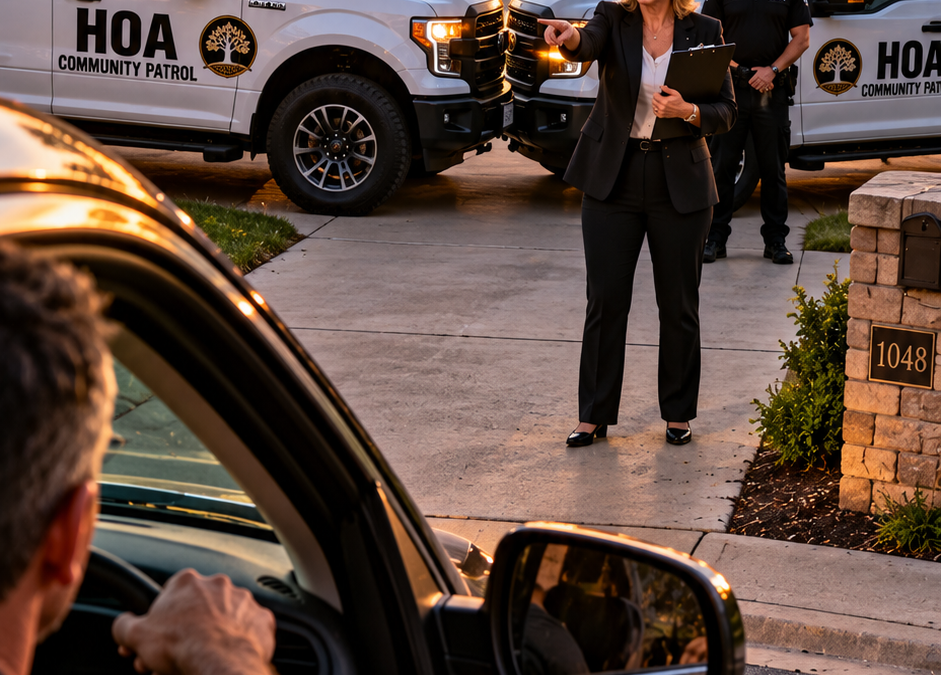
Two HOA patrol trucks sat near my driveway. One was pulled nose-first across the entrance, blocking the lower half of the drive. The second was angled behind it, cutting off the remaining space. Together, they formed a crude barricade between my truck and my own garage.
For one second, my brain tried to make excuses.
Maybe there was road work.
Maybe a tree limb had fallen.
Maybe someone was hurt.
Then I saw Linda.
She stood beside the front patrol truck, clipboard tucked against her chest, sunglasses pushed up on her hair even though the sun was nearly gone. Two HOA patrol officers stood nearby, one leaning against a truck door, the other facing my driveway like he was guarding a border checkpoint.
I slowed my truck and stopped in the street.
My house sat twenty yards beyond them. The porch light was on. The garage door was closed. My driveway, the one I had paid for, maintained, shoveled, sealed, and used every day, was blocked by people who had no business standing there.
I rolled down my window.
“Linda,” I said. “Why are your trucks blocking my driveway?”
She stepped toward me with that practiced smile.
“Good evening, Mr. Carter.”
Her voice was too pleasant.
That was never a good sign.
“Move the trucks.”
“I’m afraid we can’t do that just yet.”
I stared at her.
“You’re blocking access to my home.”
“Temporarily,” she said. “Until we resolve a compliance matter.”
The patrol officer nearest my window looked away.
That told me he already knew this was wrong.
“What compliance matter?”
Linda opened her clipboard.
“There are outstanding concerns involving vehicle storage, roadway use, and failure to acknowledge prior violation notices.”
I almost laughed.
“Vehicle storage? I keep my truck in my garage.”
“You have repeatedly parked a commercial-looking vehicle in a visible driveway.”
“I parked in my driveway while unloading tools.”
“Several residents complained.”
“Several residents can look somewhere else.”
Her smile thinned.
“This kind of response is why the board has had to take additional measures.”
I turned off my engine.
Not because I was done moving.
Because I did not trust myself to keep my foot still.
“What additional measures?”
She lifted her chin.
“The HOA has temporarily restricted your vehicle access until you sign acknowledgment of the violation notice and agree to comply with community roadway standards.”
For a moment, all I could hear was my pulse.
“You are saying I cannot leave or enter my driveway unless I sign your notice.”
“That is not how I would phrase it.”
“How would you phrase it?”
“We are encouraging cooperation.”
I looked at the two trucks blocking my driveway.
“This is what you call encouragement?”
Linda’s smile returned, smaller this time.
“If you cooperate, this can be resolved quickly.”
I looked at the patrol officer in the driver’s seat of the front truck.
“Move your vehicle.”
He shifted but did not start the engine.
“Sir, I’ve been instructed to remain in position.”
“By whom?”
He glanced at Linda.
She answered for him.
“By the association.”
“The association doesn’t get to trap my vehicle.”
“No one is trapping you.”
I opened my door and stepped out.
The evening air felt cooler than it had through the windshield. A few sprinklers clicked somewhere down the block. A dog barked from behind a fence. Everything looked normal except the two trucks blocking my driveway and the woman pretending that normal rules had stopped applying.
I pointed toward the patrol vehicles.
“If I tried to drive out of my garage right now, could I leave?”
Linda said nothing.
“If I pulled into my driveway right now, could I park at my house?”
Still nothing.
“That means I’m blocked.”
“This is a temporary access restriction.”
“That is a fancy phrase for something you have no authority to do.”
Her eyes hardened.
“Mr. Carter, you live within Oak Hollow Estates. You are subject to community regulations.”
“I am subject to recorded covenants and lawful rules. I am not subject to being physically boxed in by private patrol trucks because you want a signature.”
She held up the clipboard.
“You have ignored repeated notices.”
“I disputed them.”
“You failed to resolve them.”
“I refused to admit to a violation that doesn’t exist.”
“The board disagrees.”
“The board can send letters. It cannot blockade my driveway.”
The first patrol officer finally spoke.
“Sir, we’re just following instructions.”
I turned to him.
“What’s your name?”
He hesitated.
“Mark.”
“Mark, are you a police officer?”
“No, sir.”
“Are you a sworn peace officer?”
“No.”
“Do you have a court order?”
He looked at Linda.
She answered sharply.
“That is not relevant.”
“It is extremely relevant.”
Linda stepped closer.
“Mr. Carter, I strongly suggest you lower your tone.”
“My tone is the calmest thing happening here.”
Her face flushed.
I could feel the situation tightening. Linda was used to people backing down when she introduced enough official-sounding language. The patrol officers were used to residents complaining but complying. I could already see the story they would tell later if I lost my temper.
Resident became aggressive.
Resident refused compliance.
Resident created safety concern.
I had seen enough HOA letters to know how carefully they polished their version of events after the fact.
So I did the one thing that changed everything.
I pulled out my phone and started recording.
I filmed both trucks first.
The front truck, angled across my driveway.
The second truck, parked behind it.
The license plates.
The HOA seals.
The amber lights.
Then I turned the camera toward Linda.
“For documentation,” I said clearly, “it is 6:14 p.m. Two Oak Hollow HOA patrol trucks are blocking my private driveway. HOA president Linda Reynolds is present. I have asked them to move. They have refused.”
Linda’s expression changed immediately.
Not fear exactly.
Discomfort.
People who rely on vague authority hate clear records.
“Put the phone away,” she said.
“No.”
“You do not have my permission to record.”
“We’re standing outside on my property line while you block access to my home. I’m documenting it.”
“This is an HOA enforcement action.”
“Then you should be proud to have it documented.”
The patrol officer named Mark lowered his eyes.
The second patrol officer, younger and broader, stood near the rear truck with his arms crossed. He had said nothing so far, but his posture suggested he thought intimidation counted as training.
Linda looked at him.
“Stay where you are.”
He nodded.
I kept recording.
“Linda, what rule gives the HOA authority to physically block a resident’s driveway?”
She lifted the clipboard.
“The board has authority to enforce violations and maintain community standards.”
“Read the specific rule that allows a blockade.”
“This is not a debate.”
“It is when you’re blocking my home.”
“You were notified.”
“Not of this.”
“We attempted less direct methods.”
“That doesn’t answer the question.”
Her voice sharpened.
“You need to sign the acknowledgment.”
“What does it say?”
She pulled out a paper and held it toward me.
I did not take it.
“Read it.”
“You can read it yourself.”
“I’m recording. Read the part you want me to sign.”
Her jaw tightened.
“It acknowledges that your vehicle use and driveway activity have violated community standards and that you agree to comply with board directives regarding access and parking going forward.”
“Access?”
“Yes.”
“You want me to sign a document saying the HOA can direct my access to my own driveway.”
“That is not what it says.”
“That is exactly what you just said.”
“It says you agree to comply with community standards.”
“While your trucks block my driveway.”
“Temporarily.”
I turned the camera back to the trucks.
“For the record, they have not identified a rule, court order, or recorded property right allowing them to block the driveway.”
Linda’s voice dropped.
“You are making this harder than it needs to be.”
“No. I am making it visible.”
That sentence landed.
Behind her, a curtain moved in the house across the street. Someone was watching.
Good.
I did not call Sarah immediately.
That surprises people when I tell the story. They assume my first instinct was to summon my wife because she worked in law enforcement. It was not. I knew better than to turn my marriage into a weapon in a neighborhood dispute. Sarah had spent her entire career earning respect the hard way. I was not going to drag her into a confrontation just to scare an HOA president.
But I did send her the video.
No message. No demand. Just the footage.
A minute later, my phone buzzed.
Sarah: Stay calm. I’m coming home.
Those five words steadied me more than I wanted to admit.
Linda kept talking.
She explained that the HOA had received complaints. She explained that the board had reviewed my conduct. She explained that patrol officers had been authorized to ensure compliance. She used the word authorized over and over, but never once identified who had the power to authorize what they were doing.
I kept asking the same question.
“Where is the rule?”
She kept refusing to answer it.
Mark, the patrol officer, looked more uncomfortable by the minute.
Finally, I turned toward him again.
“Mark, who told you to park there?”
He glanced at Linda.
She said, “Do not answer that.”
I raised my eyebrows.
“That’s interesting.”
“This is not an interrogation,” Linda said.
“No. It’s a very simple question.”
The younger patrol officer stepped forward.
“Sir, you need to stop escalating.”
I turned the camera toward him.
“What is your name?”
He said nothing.
“You’re standing in front of my driveway and telling me I’m escalating because I’m asking who ordered it?”
“You’re being confrontational.”
“I’m being blocked.”
Linda snapped, “Enough.”
The word echoed down the street.
Another curtain moved. A garage door opened two houses away. A man stepped out holding a trash bag he clearly no longer cared about. Across the street, a woman walked to the edge of her porch with her phone in her hand.
Linda noticed.
That made her angrier.
“This matter does not concern the neighbors,” she said loudly.
The man with the trash bag said, “It concerns us if the HOA is blocking driveways now.”
Linda turned toward him.
“Please return to your home.”
He laughed once.
“No.”
That was the first crack in her control.
Then Sarah’s car turned onto the street.
She did not come fast. That was Sarah’s way. She never arrived like a storm unless the situation demanded it. Her sedan rolled down the block, parked along the curb behind my truck, and shut off. She stepped out in dark slacks and a plain blue blouse, carrying no badge in her hand, no visible weapon, no uniform.
But everyone recognized her.
That was not because Sarah advertised her job. She did not. It was because Oak Hollow was full of people who paid attention to status, and my wife’s career had become impossible for the HOA to ignore once she began attending town safety meetings.
Linda recognized her immediately.
So did both patrol officers.
The street changed.
I felt it before anyone spoke.
Linda lowered her clipboard.
Mark straightened away from the truck.
The younger patrol officer uncrossed his arms.
Sarah walked toward us with the same calm expression I had seen her use in rooms full of angry people who had suddenly realized anger would not help them.
She stopped beside me.
“You okay?” she asked.
“I’m fine.”
She looked at the trucks.
“How long?”
“About twenty minutes before I sent the video. Longer now.”
She nodded once.
Then she turned to Linda.
“Ms. Reynolds.”
Linda’s voice lost some of its sharpness.
“Sarah. This is an HOA compliance matter.”
Sarah looked at the patrol trucks again.
“No. This is a vehicle blockade.”
Linda stiffened.
“That is an inflammatory term.”
“It is a descriptive one.”
The neighbor with the trash bag made a sound that might have been a laugh.
Sarah ignored him.
She stepped toward Mark.
“Who authorized you to block this driveway?”
Mark swallowed.
“Ma’am, we were instructed by HOA leadership to hold position until Mr. Carter resolved the notice.”
“Who specifically instructed you?”
He looked at Linda.
Sarah did not.
“Who specifically instructed you?”
Mark’s shoulders dropped slightly.
“Ms. Reynolds.”
Linda cut in.
“As HOA president, I have enforcement authority.”
Sarah turned to her.
“What legal authority allows you to detain a resident’s vehicle or physically restrict access to private driveway property?”
Linda lifted her folder.
“We have governing documents.”
“Show me the recorded authority.”
“The HOA has maintenance rights over community roadways.”
“I didn’t ask about maintenance. I asked what allows you to block a private driveway.”
Linda opened the folder quickly.
Her hands were not steady now.
She produced a stack of documents: bylaws, enforcement policies, roadway maintenance provisions, parking rules, community standards, and a violation notice with my name on it.
Sarah took them.
Then she did something that made Linda more nervous than shouting ever could have.
She read.
Page by page.
Without speaking.
The street grew quiet around her.
I kept recording.
Linda tried twice to interrupt.
Sarah lifted one finger each time without looking up.
That was enough.
Finally, Sarah looked at the patrol trucks, then at the documents, then at Linda.
“These papers allow the HOA to issue notices, fines, and internal enforcement actions according to the procedures listed here.”
Linda nodded quickly.
“Yes.”
“They also reference maintenance responsibilities for portions of the private community road.”
“Yes.”
Sarah held up the packet.
“I do not see authority to block an owner’s private driveway, prevent vehicle movement, or hold access hostage until a resident signs an acknowledgment.”
Linda’s face hardened.
“That is your interpretation.”
“It is my reading.”
“There are additional provisions.”
“Show them.”
Linda opened her mouth.
No document followed.
I walked to my truck, opened the glove compartment, and pulled out my deed and property survey. I had started keeping copies there months earlier after one too many HOA letters claimed things about my property that were not true.
I handed them to Sarah.
She gave me a look that said she was both impressed and unsurprised.
“This is our deed,” I said. “Driveway is part of the lot. The HOA has maintenance language related to the shared road edge, but no ownership interest in the driveway.”
Sarah looked at the survey, then at the driveway entrance.
She handed the deed to Mark.
“Do you understand the difference between maintaining a road and blocking access to private property?”
Mark looked like he wished the ground would open.
“Yes, ma’am.”
“Then why is your truck still there?”
That was the sentence that moved him.
Not my anger.
Not Linda’s clipboard.
Not the neighbors.
That simple question from someone who understood exactly what authority was, and what it was not.
Mark looked at Linda.
“We may need clarification before continuing.”
Linda turned on him.
“You were instructed to remain.”
“With respect,” he said, voice quieter now, “I’m not comfortable blocking the driveway without clearer authority.”
The younger patrol officer looked at him, then away.
Linda’s face flushed.
“This is insubordination.”
“No,” Sarah said. “It is caution.”
Linda turned toward her.
“You are interfering in an HOA matter.”
Sarah’s expression did not change.
“I am standing at my home, where two private patrol vehicles are blocking my husband’s access.”
“You are using your position to intimidate HOA personnel.”
“I have not identified myself by title, displayed a badge, issued an order, or threatened enforcement. I asked what authority supports the blockade. That question still has not been answered.”
Linda’s lips pressed together.
For the first time, she looked less like the president of anything and more like a person who had pushed a bad idea too far in front of the wrong audience.
But she was not finished.
She pulled the violation acknowledgment from her clipboard and held it toward me.
“Sign the notice, and we will end this.”
I looked at the paper.
“No.”
Her eyes widened slightly.
“Excuse me?”
“I said no.”
“This refusal will be reported to the board.”
“Report it.”
“You are making a serious mistake.”
“The mistake was believing you could trap me into signing something by blocking my driveway.”
She shook the paper.
“This notice documents your failure to comply.”
“It claims authority you don’t have. I’m not signing it.”
Linda looked at Sarah.
“Tell him to sign it.”
That was the wrong sentence.
The entire street seemed to lean toward us.
Sarah’s voice became very quiet.
“Ms. Reynolds, do not ask me to pressure my husband into signing a document while private patrol trucks are blocking his driveway.”
Linda realized what she had said a second too late.
“I only meant—”
“I know what you meant.”
The neighbor across the street lifted his phone higher.
Another neighbor stepped out from behind a hedge.
Then another.
Within minutes, the confrontation was no longer hidden between me, Linda, and two patrol officers. It was spread across the street in full view of the community Linda claimed to represent.
People were recording now.
Not one person.
Several.
A woman named Marcy from three houses down called out, “Linda, why are patrol trucks blocking their driveway?”
Linda turned.
“This is a compliance matter.”
Marcy said, “That doesn’t answer the question.”
A man from the corner house added, “Are you going to block everyone who disputes a fine?”
Linda’s posture stiffened.
“No one is blocking anyone.”
A few people actually laughed at that because the trucks were still physically blocking the driveway while she said it.
Sarah stepped away from the group and made a phone call.
She spoke quietly, too quietly for most people to hear. I caught only pieces.
“Private HOA patrol vehicles.”
“Blocking residential driveway.”
“No court order shown.”
“Requesting official review.”
“Documenting names and vehicle plates.”
Linda watched her with growing unease.
“Who is she calling?” she asked me.
I looked at her.
“Someone who writes things down.”
That was all I said.
Sarah returned a minute later.
“I have requested that this be reviewed formally,” she said. “No one is being threatened. No one is being arrested. But this needs to be documented through proper channels.”
Linda swallowed.
“What proper channels?”
Sarah looked at the trucks.
“The ones that exist when private actors physically restrict access and then cannot identify legal authority for doing so.”
Mark walked to his truck.
Linda snapped, “Do not move that vehicle.”
He stopped with his hand on the door.
Sarah did not speak.
I did not speak.
The neighbors did not speak.
Mark looked from Linda to Sarah, then to me, then at the driveway he was blocking.
“I’m moving it,” he said.
Linda’s mouth opened.
Nothing came out.
Mark started the engine.
The truck rolled forward and away from my driveway.
The sound of its tires over the pavement felt larger than it should have.
Then the younger patrol officer moved too.
He did not wait for Linda’s permission.
Within thirty seconds, my driveway was clear.
After nearly an hour of being blocked from my own home, the entrance stood open again.
Just open pavement.
Just the path to my garage.
Just something that should never have been taken.
I stepped into the driveway and stood there for a moment, letting myself feel the anger only after the immediate danger had passed.
Linda gathered her papers.
“This is not over,” she said.
Sarah answered before I could.
“No. It is not.”
Linda looked at her.
Sarah’s voice stayed calm.
“There will be questions about who authorized this, how patrol staff were trained, whether this has happened to other residents, and what policies allowed anyone to believe this was acceptable.”
“You do not oversee the HOA.”
“No,” Sarah said. “But the HOA does not operate outside the law.”
Linda’s face tightened.
Then she got into her SUV and left.
The patrol trucks followed.
The neighbors remained.
For a few seconds, nobody knew what to say. People are comfortable watching conflict from behind curtains. They are less comfortable standing in the open afterward, holding phones full of evidence.
Marcy finally walked over.
“Are you both okay?”
Sarah nodded.
“Yes.”
I said, “I’m angry.”
“That seems fair.”
The man from the corner house said, “Did they really block you over a vehicle notice?”
“Yes.”
He shook his head.
“They sent me a violation last month for parking my work van in my driveway.”
Another neighbor said, “They threatened to tow my daughter’s car during spring break.”
A third said, “Patrol followed my son home because he came through the gate after midnight.”
The street began talking.
That was the thing Linda had not counted on.
She thought she was dealing with one resident.
But once people saw the trucks move because the authority was questioned, their own stories came out. It turned out I was not the only one who had been pressured. I was simply the one whose driveway they blocked in public long enough for everyone to notice.
Sarah listened carefully.
She did not turn the moment into a speech. She did not promise action she could not take. She only said, “Document everything. Keep notices. Save dates. If someone blocks access or threatens enforcement beyond HOA rules, write down exactly what happened.”
That was Sarah.
No drama.
No grandstanding.
Just procedure.
When we finally went inside, the house felt strangely unfamiliar. Maybe because I had spent an hour looking at it from the street while someone else decided whether I could reach it.
I set my keys on the counter harder than necessary.
Sarah closed the door behind us.
Then she looked at me.
Only then did her face change.
The controlled calm fell away, and I saw the anger she had been holding back.
“They blocked your driveway.”
“I know.”
“They used private patrol trucks to block your driveway.”
“I know.”
“And tried to make you sign something while they were doing it.”
“I know.”
She pressed her hands against the edge of the kitchen counter and took one slow breath.
I had seen Sarah angry before. Her anger was not loud. It was focused, cold, and precise.
“That was coercive,” she said.
“That was Linda.”
“No. Don’t reduce it to personality. That was a system problem. Patrol officers followed an instruction they should have questioned. The HOA president believed she could physically restrict access over a paperwork dispute. The documents don’t support it. That means either they were badly trained, or they were trained exactly the wrong way.”
I sat down.
“What happens now?”
“Now we make sure it is documented.”
“It already is.”
“Good. Then we preserve it.”
That night, we saved the video in three places.
Sarah wrote a timeline while the details were fresh. I added every sentence I remembered. We took photos of the driveway, the tire positions, the road, the HOA patrol truck markings, and the notice Linda had tried to force me to sign.
The next morning, my attorney received everything.
So did the town office responsible for private security registration and community patrol complaints.
So did the HOA board.
Not just Linda.
The full board.
The subject line was simple: Formal Notice Regarding Unauthorized Driveway Blockade.
My attorney’s letter was sharper than anything I could have written.
It stated that the HOA had no authority to detain vehicles, block private driveway access, or condition removal of a blockade on signing an acknowledgment of disputed violations. It demanded preservation of all communications, patrol instructions, radio logs, training materials, enforcement policies, and board approvals related to the incident.
It also requested confirmation that no further physical access restrictions would occur.
Linda did not respond personally.
Her attorney did.
The response used careful language.
The HOA denied wrongdoing. The patrol presence had been intended as a “temporary compliance measure.” The association disputed my characterization of the incident as a blockade. The board would review internal procedures. The HOA reserved all rights.
Sarah read it and said, “They’re scared.”
I looked at the letter.
“This sounds like the opposite of scared.”
“That’s because you’re reading the words. I’m reading what they avoided.”
She was right.
They did not say they had authority to block my driveway.
They did not identify the rule.
They did not defend the demand for my signature.
They did not promise to do it again.
Within two weeks, the HOA suspended patrol enforcement actions pending review.
Officially, the board called it an “operational assessment.”
Unofficially, the patrol trucks stopped creeping through the neighborhood like they were hunting for violations. People noticed immediately.
The whole neighborhood changed when the trucks disappeared.
Kids rode bikes without slowing every time a white pickup turned a corner. A retired couple put lawn chairs slightly beyond the approved patio line and left them there all weekend. A contractor parked at a resident’s house without someone photographing the work van. It was not chaos. It was just normal life returning in small, almost embarrassing ways.
At the next HOA meeting, the room was packed.
I went with Sarah, but she sat beside me as a resident’s wife, not as anything else.
Linda sat at the front table with the other board members, her face composed, her folder thick, her expression prepared. But the energy in the room was different. People were not there to complain about shrub heights. They were there because they had seen how far enforcement could go when nobody questioned it.
The first resident to speak was Marcy.
She described seeing the patrol trucks block my driveway. She asked whether the board had approved that action.
Linda said, “We cannot discuss individual enforcement matters in detail.”
A man in the back called out, “You blocked a driveway in the middle of the street. It stopped being private.”
The room murmured.
Another resident asked who trained patrol officers to restrict access.
A third asked whether patrol staff had authority to detain residents.
A fourth asked whether the HOA had legal counsel review the policy before it was used.
Linda answered in generalities.
The board treasurer looked increasingly uncomfortable.
One board member finally said, “We are reviewing the matter.”
The room did not accept that as enough.
By the end of the meeting, the board voted to commission an outside review of the patrol program, enforcement procedures, and access-related policies.
Linda opposed the motion at first.
Then she realized the votes were not there.
The review passed.
That should have been the end of it for us.
In a practical sense, maybe it was.
The trucks no longer blocked my driveway. The violation notice disappeared into legal correspondence. The HOA stopped sending aggressive letters and started sending carefully edited ones that sounded like three attorneys had strangled every sentence before mailing it.
But for Sarah, the incident had a longer shadow.
Not because she took it personally, although she did.
Because she saw what could happen when private enforcement blurred itself into public authority.
“People need to know the difference,” she told me one evening. “A rule is not a law. A patrol officer is not a police officer. A notice is not a court order. And a clipboard is not authority.”
That became a phrase in our house.
A clipboard is not authority.
Months passed.
Life settled back into its ordinary shape.
Then the town police chief announced his retirement.
I remember the evening Sarah told me she had been asked to apply. We were in the kitchen, and I was slicing tomatoes for dinner. She leaned against the counter, arms folded, trying to sound casual and failing.
“They approached me today,” she said.
“For what?”
“The chief position.”
I stopped cutting.
“Our town police chief?”
“No, the chief of tomato slicing. Yes, our town police chief.”
I looked at her.
“You’re going to apply.”
“I haven’t decided.”
“You already decided.”
She looked away, which meant I was right.
Sarah did not chase titles. That was one reason she deserved them. She cared about systems, training, accountability, and whether people understood the power they held. She did not want authority because it made her bigger. She wanted authority because mishandled authority made everyone smaller.
The selection process took months.
Interviews. Public meetings. Background review. Council sessions. Community input. It was not easy, and Sarah did not assume she would get it. But when the town council announced her appointment, I felt something I still struggle to describe.
Pride, yes.
But also relief.
Not because my wife would now have power over people who had wronged us.
That was not Sarah.
I felt relief because someone who understood restraint would be responsible for people who carried real authority.
The day she was sworn in, Linda Reynolds sat three rows back.
I noticed her immediately.
She wore a gray suit and an expression that revealed nothing.
When Sarah raised her right hand and took the oath, I watched Linda’s face.
For once, she did not look like she owned the room.
She looked like someone calculating how the room had changed.
A month later, the HOA requested a meeting with the new police chief.
Officially, it was about “coordination between community patrol operations and municipal law enforcement.”
Sarah showed me the request at dinner.
I read the subject line and laughed.
“That didn’t take long.”
“They have a right to request a meeting,” she said.
“You’re going to take it?”
“Yes.”
“Do you want me there?”
“No.”
I nodded.
She looked at me across the table.
“This cannot be personal.”
“I know.”
“I mean it.”
“So do I.”
Her expression softened slightly.
“I am not going to punish Linda.”
“I don’t want you to.”
“I am going to ask the questions that should have been asked long before your driveway was blocked.”
“That I do want.”
The meeting happened in the town administrative building.
I was not in the room, but Sarah told me enough afterward, and the written policy memo later confirmed the important pieces.
Linda arrived with two board members, the HOA attorney, the patrol supervisor, and three binders.
Of course she brought binders.
Sarah sat across from them in uniform, not because she needed the symbolism, but because the meeting was official. Beside her sat the town attorney and a captain responsible for community liaison programs.
Linda began with a prepared statement about safety, partnership, and the HOA’s desire to maintain order inside Oak Hollow Estates.
Sarah let her finish.
Then she asked, “Who authorized the use of patrol vehicles to block a resident’s driveway on August 14?”
Linda reportedly paused.
The HOA attorney said the incident was disputed.
Sarah said, “I did not ask whether you dispute characterization. I asked who authorized the action.”
The attorney said the HOA preferred to discuss future procedures.
Sarah said future procedures required understanding past failures.
Then she asked the next question.
“What training were HOA patrol personnel given regarding the limits of their authority?”
The patrol supervisor said staff were trained to observe, report, and assist with HOA compliance.
Sarah asked, “Were they trained that they cannot detain residents, block vehicles, restrict driveway access, or imply police authority?”
The room went quiet.
She asked whether patrol vehicles had written operating policies.
She asked whether officers were instructed not to use vehicle positioning as coercion.
She asked whether any resident complaints had previously involved patrol intimidation.
She asked whether patrol uniforms, vehicle markings, and amber lights could create confusion about public law enforcement authority.
She asked whether the HOA understood that criminal trespass, traffic control, detention, and access restriction were not enforcement tools available to private HOA patrol staff without lawful authority.
No shouting.
No threats.
No dramatic arrest.
Just questions.
One after another.
The kind that do not need volume because the answer either exists or it does not.
By the end of that meeting, the HOA agreed to several changes.
The patrol program would be reviewed.
Vehicle blockades were expressly prohibited.
Patrol staff could not restrict driveway access, block vehicles, or use their trucks to compel compliance with HOA notices.
Any alleged parking or vehicle violation had to proceed through written HOA procedures, not physical interference.
Patrol vehicles had to be marked more clearly as private HOA patrol, not law enforcement.
Staff would receive updated training on the limits of their role.
Police would not act as HOA enforcement agents in civil rule disputes unless there was an actual law enforcement issue.
When Sarah told me, I sat quietly for a while.
Then I said, “So they finally learned the difference.”
She took off her reading glasses and looked at me.
“No. They were formally told the difference. Learning it is their choice.”
That was fair.
Linda remained HOA president for several more months, but her influence changed.
People challenged her more openly. Board members asked for legal review before approving enforcement actions. Residents requested written authority when patrol staff made demands. The phrase “show me the rule” started appearing in meetings so often that Linda visibly braced herself whenever someone said it.
The patrol trucks still drove through the neighborhood eventually.
But slower now.
Quieter.
No angled parking across driveways.
No amber lights flashing over trash can violations.
No private officer leaning on someone’s truck as if he had the weight of the government behind him.
Our driveway stayed clear.
That sounds like a small thing unless you have ever had someone take it from you.
Every time I pulled into my garage after that, I felt the memory of those trucks. The blocked entrance. Linda’s smile. Mark’s uncomfortable silence. Sarah’s calm voice asking the one question that broke the whole performance open.
What legal authority allows this?
That question became larger than our driveway.
It became the line between rules and power.
Between community standards and coercion.
Between an HOA managing shared property and an HOA forgetting that residents were not subjects.
One Saturday morning, I saw Mark at a hardware store across town.
He was out of uniform, wearing jeans and a faded baseball cap, holding a box of deck screws. For a second, we both pretended not to recognize each other. Then he walked over.
“Mr. Carter,” he said.
“Mark.”
He looked uncomfortable, but he did not walk away.
“I wanted to say something.”
I waited.
“That day at your driveway. I should have moved sooner.”
I studied him.
“Yes.”
He nodded, accepting it.
“I was told it was approved. I figured the board knew what they were doing.”
“That’s how people end up doing things they shouldn’t.”
“I know that now.”
There was no easy answer to that.
So I asked, “You still working patrol?”
“No. I quit after the review.”
That surprised me.
He shifted the box in his hands.
“They wanted us to act official, but not take responsibility when things got official. I didn’t like where that was going.”
For the first time, I felt something close to sympathy.
“You were smart to leave.”
He nodded.
“Your wife was fair, by the way.”
I looked at him.
“She usually is.”
“She could have made us look worse.”
“She didn’t need to.”
He almost smiled.
“No. I guess not.”
We parted without shaking hands, but not with hostility either.
That mattered to me more than I expected.
Because the point had never been to destroy everyone involved. Mark had made a bad choice under bad instructions. Linda had created the situation, pushed it, defended it, and tried to use pressure where authority was missing. Those were not the same.
A system that cannot tell the difference between mistake and abuse will eventually protect the wrong people.
Sarah understood that.
That was one reason she was good at her job.
A year after the driveway incident, Oak Hollow held its annual meeting in the clubhouse.
I went mostly because Sarah could not. She had a town budget hearing that same night. I sat in the back with a cup of bad coffee and watched residents debate landscaping contracts, reserve funds, pool repairs, and mailbox replacements.
Near the end, a board member presented the updated enforcement policy.
It was dry.
Boring.
Almost painfully procedural.
Notices had to cite exact rule sections. Residents had defined response periods. Disputed violations could not trigger physical access restrictions. Private patrol staff were limited to observation, reporting, and safety assistance. Any law enforcement request had to involve a suspected legal violation, not mere HOA disagreement. Board members were prohibited from directing patrol vehicles to block driveways, roads, or resident vehicles except in genuine emergencies involving immediate safety risk.
I sat there listening.
No one said my name.
No one mentioned my driveway.
No one needed to.
The policy existed because of that evening.
When the board asked for comments, Mrs. Kline from two streets over raised her hand and said, “It’s sad we needed this written down, but I’m glad it is.”
Half the room murmured agreement.
Linda was no longer president by then.
She sat near the front, still on the board but not leading it. Her face remained carefully blank throughout the discussion. When the policy passed, she voted yes.
That surprised me.
Maybe she had changed.
Maybe she had counted the votes.
Maybe both.
After the meeting, I walked home instead of driving.
The night was cool. Porch lights glowed. Sprinklers ticked softly against lawns. Somewhere, a basketball bounced in a driveway. I passed the place where the patrol trucks had blocked me and stopped for a moment.
There was nothing there now.
No trucks.
No clipboard.
No confrontation.
Just pavement leading home.
The absence felt like victory.
Not the kind people cheer for.
The better kind.
The kind where life returns to normal because the line has been redrawn where it always should have been.
When I reached the house, Sarah was already home, sitting at the kitchen table with a folder open in front of her.
“How was the meeting?” she asked.
“Boring.”
She smiled.
“Good.”
“They passed the policy.”
“Good.”
“Linda voted yes.”
Sarah looked up.
“That is interesting.”
“I thought so.”
I poured water and sat across from her.
“For what it’s worth,” I said, “your question became policy.”
“What question?”
“What legal authority allows this?”
She leaned back.
“It should have been asked before the trucks ever moved.”
“I know.”
“But I’m glad it’s written now.”
“So am I.”
She returned to her folder, and I sat there watching her work for a moment.
That was the part Linda never understood.
Sarah’s position did not give her power over the HOA.
It gave her responsibility to the town.
There is a difference between using authority and honoring it. Linda saw authority as something to press down on people until they complied. Sarah saw authority as something that had to be limited, explained, documented, and used only where it belonged.
That was why the HOA lost control of that driveway.
Not because my wife scared them.
Because the facts did.
Because the documents did.
Because a private association cannot invent power by parking two trucks across someone’s home and calling it compliance.
I still live in Oak Hollow.
The mailboxes still match.
The lawns are still too perfect.
The HOA still sends notices, and some of them are still ridiculous enough to make me stare at the ceiling before answering. But the tone has changed. Residents ask for citations. Board members hesitate before making threats. The patrol trucks keep moving.
Most evenings now, I pull into my driveway without thinking about it.
That is how access should feel.
Unremarkable.
Ordinary.
Free of someone else’s permission.
But sometimes, especially when the sun hits the pavement the way it did that evening, I remember Linda standing there with her clipboard, telling me I was not leaving. I remember the patrol trucks angled like a trap. I remember my own anger burning hot enough that I had to make myself speak slowly. I remember sending Sarah the video and seeing her car turn onto the street minutes later.
Most of all, I remember the moment the first patrol truck moved.
That quiet surrender of machinery.
That rolling admission that authority had limits.
That open strip of driveway appearing again between my truck and my home.
People think the most powerful moment in a confrontation is when someone wins.
They are wrong.
The most powerful moment is when everyone sees the truth clearly enough that the lie can no longer stand in the way.
Linda Reynolds thought her title gave her control over my driveway.
The patrol officers thought instructions were the same as lawful authority.
The HOA board thought enforcement could stretch as far as residents allowed it to stretch.
But the deed said otherwise.
The law said otherwise.
The neighbors, once they saw the trucks with their own eyes, said otherwise too.
And after that evening, Oak Hollow learned a lesson that should never have required a blockade.
A clipboard can carry rules.
A truck can block pavement.
A title can make people hesitate.
But none of those things owns the road home.








