The Twenty-Year Lease on My Hill Carried a Signature That Looked Almost Like Mine
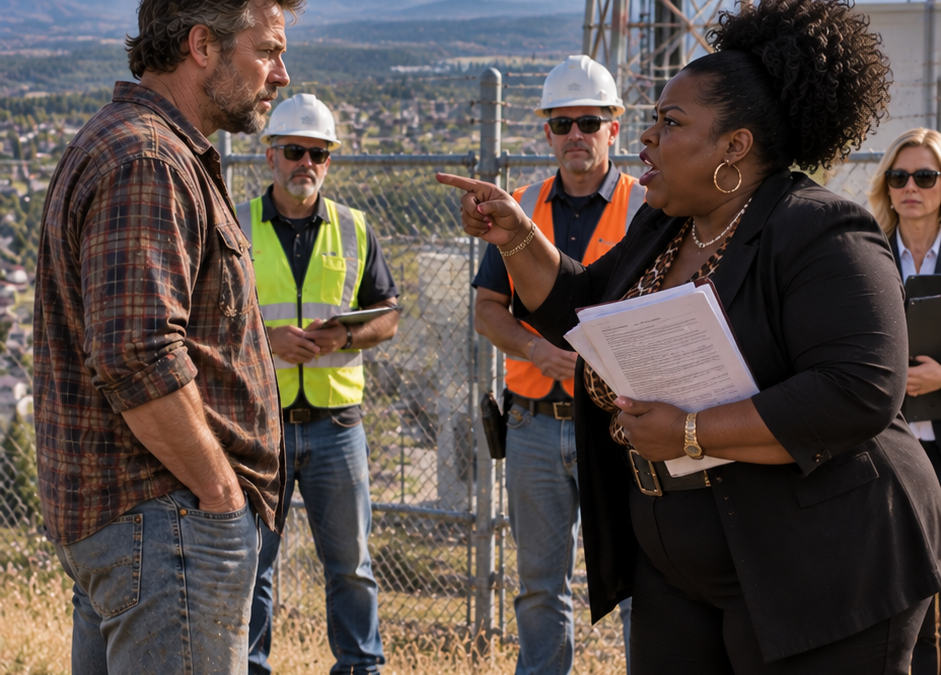
The Twenty-Year Lease on My Hill Carried a Signature That Looked Almost Like Mine
I had been gone three days when I came home and found a 180-foot communications tower standing on the hill behind my house.
At the bottom of it was a posted notice describing a twenty-year land lease, and when I called the company to tell them somebody had made a mistake, they read me the name of the property owner who had supposedly approved everything.
It was mine.
My name is Calvin Reic.
I was forty-eight years old when somebody decided that owning eleven acres did not necessarily mean I got to decide what happened on them.
I had owned that land for eleven years.
The deed had never carried another name.
Not a spouse.
Not a business partner.
Not an association.
Just mine.
I bought it the year my mother died.
She had spent thirty-one years working in the laundry department of a hospital, which meant she came home smelling faintly of bleach and steam no matter how cold the weather was outside.
She never made much money.
But she saved.
Slowly.
Quietly.
The way people who have never expected a windfall learn to save.
When she died, she left me enough that, together with what I already had, I could buy a piece of ground I had been watching for years.
Eleven acres of rolling grass and oak on the eastern edge of Cedar Crest Estates.
The subdivision was already there when I bought the place.
Two hundred six houses.
Curving streets.
Stone entrance markers.
A clubhouse.
A pool.
A water tower visible from almost anywhere in the valley.
My land was not part of Cedar Crest.
That mattered to me.
It touched the subdivision.
It looked down over it.
But the recorded boundary stopped at my fence.
The highest point of my property was a broad rise marked on an old survey as the East Knoll.
Nobody called it that.
Within a year of me buying the land, people around town had started calling it Reic Hill.
I never asked them to.
Names just stick.
From the top, I could see the county road curving south, the water tower in town, the little strip of businesses near the highway, and the roofs of Cedar Crest laid out below me so evenly they looked like tiles.
I knew every part of that hill.
The place where the ground stayed soft three days after rain.
The shallow wash that filled during thunderstorms.
The oak with the scar down one side from a lightning strike before I owned the property.
The section of fence where deer crossed at dusk.
I had walked it in snow deep enough to spill over my boots and in August heat that made the grass smell dry and sweet.
That is why my brain refused to understand what I was seeing when I drove home that Thursday evening.
Steel.
Gray steel.
Rising above the ridge.
At first I thought some piece of machinery was parked on the other side.
Then the road curved.
The whole structure came into view.
A lattice tower.
Tall enough that I had to bend my neck back to find the top.
Red obstruction lights were already blinking against the evening sky.
My hands went cold on the steering wheel.
I did not stop at the house.
My mailbox was packed with three days of flyers.
My porch light was off.
My overnight bag was still in the truck.
None of that mattered.
I drove past the house and took the dirt track leading toward the hill.
Except it was not my dirt track anymore.
Somebody had widened it by almost eight feet.
Hawthorn had been cut along the western edge.
Fresh crushed stone covered the tire path.
The rock snapped under my tires like broken glass.
Four fence posts had been pulled.
The wire between them had been rolled neatly and leaned against a tree.
That almost bothered me more than if they had thrown it on the ground.
There was something insulting about the care.
As though a person could trespass politely.
Halfway up the hill stood a new electrical cabinet on a concrete pad.
The concrete still had that pale color fresh slabs carry before weather gets into them.
I remember staring at it and thinking:
Concrete takes time to cure.
Whoever had done this had not arrived that morning.
People had been working on my land for days.
They knew I was not home.
At the top, three men were working.
One stood in a bucket lift.
Two were feeding cable off a reel.
A generator ran beside a trailer.
Another pickup sat with its tailgate down and paper coffee cups lined up along it.
I parked.
Got out.
Walked toward the nearest worker.
He was a heavyset man in a reflective vest.
He looked at me with the mild patience of someone assuming I was about to ask where the delivery entrance was.
“Who authorized this?”
He pointed toward a sign near the access road.
“If you’ve got a complaint about noise, there’s a contact number posted down there.”
“I don’t have a noise complaint.”
He waited.
“Who authorized work on this parcel?”
“We have full site access.”
“From who?”
“The landowner.”
I looked behind him at the tower.
“Who is the landowner?”
He hesitated.
“I don’t have the paperwork.”
“Then get whoever does.”
He reached for his radio.
“Gavin, can you come up to the pad?”
The project manager arrived a few minutes later.
Gavin Shaw.
Maybe forty.
Clean work pants.
Company jacket.
Tablet already in his hand.
He introduced himself as project manager for Northline Wireless Infrastructure.
He was polite.
Professional.
At that point, he still believed he was dealing with a neighbor who had misunderstood where a property line ran.
“What’s your name, sir?”
“Calvin Reic.”
Something changed in his face.
Small.
But there.
He looked at the tablet.
Then at me.
“Calvin Reic?”
“Yes.”
He began scrolling.
Owner consent.
Site access authorization.
Survey.
Lease.
His movements slowed.
“Can I see that?”
He turned the screen.
The documents were all there.
My address.
Correct.
My parcel number.
Correct to the final digit.
Surveyed tower footprint.
Access route.
Utility easement.
Twenty-year lease.
Two renewal options.
And at the bottom of the consent page:
Calvin Reic.
Signed.
I stared at the signature.
It was close.
That was what made it worse.
A looping capital C.
Compressed letters through the middle.
Hard downward stroke near the end.
Whoever had written it had seen my signature before.
Maybe on a public document.
Maybe on something the association already had.
If you showed it to somebody who saw my signature twice a year, they might believe it.
But I had signed my own name tens of thousands of times.
I knew the small things.
The habits.
My second downstroke crossed lower than the copy.
A movement I had picked up from my mother.
The signature on Gavin’s screen looked like mine in the same way a stranger wearing my coat might look like me from across a parking lot.
Close enough until you got near.
I felt something inside me become very still.
“Where did you get this?”
Gavin looked through the file.
“The project coordination came through Cedar Crest Estates.”
“The HOA?”
“That’s common in community projects.”
“My land is not part of Cedar Crest.”
He looked up.
Then back down.
I could see him beginning to understand this was no longer the conversation he had expected.
He opened the transmittal record.
“Documents were sent by…”
He paused.
“Brin Holloway. President, Cedar Crest Estates Homeowners Association.”
The name did not surprise me.
That was the worst part.
Six months earlier, Brin Holloway had stood on my front porch and asked for exactly what was now standing on my hill.
She was fifty-four.
Precise.
Never looked rumpled.
She used your first name every few sentences in a way meant to sound personal but always felt slightly rehearsed.
“Calvin, I really think this benefits everyone.”
“Calvin, we all have to think beyond our individual parcels.”
“Calvin, surely we can find something reasonable.”
She came carrying brochures.
Maps.
Coverage studies.
A folder.
A pen.
The map already had my hill circled in red before she asked whether I was interested.
Cedar Crest residents had complained for years about dropped calls.
Northline had conducted a coverage study.
My ridge was the best location within about four miles.
Brin explained all of it as though she was briefing me on a project already approved.
When she finished, she placed the lease proposal on my porch table.
Then laid the pen across it.
I never picked up the pen.
“No.”
Her smile stayed for a second.
Then faded.
“Maybe you should take some time.”
“I don’t need time.”
“Calvin, it’s substantial compensation.”
“That isn’t the issue.”
“What is?”
I pointed toward the track running behind my house.
“The only access to the ridge passes within sixty feet of my back door.”
“We can manage traffic.”
“Twenty years?”
“Maintenance would be occasional.”
“Generators?”
“Only as needed.”
“Fuel delivery?”
“As necessary.”
“Emergency repairs at two in the morning?”
She folded her hands.
“That would be uncommon.”
“But allowed.”
She did not answer.
I continued.
“A tower means permanent access rights. Utility trenches. Service vehicles. Contractors. Equipment changes. Legal rights that stay with the land after I’m gone.”
She sighed.
“You would still own the property.”
“That isn’t the same thing as controlling it.”
The eleven acres were quiet.
That was why I bought them.
My mother’s money had bought me space.
Not a financial instrument.
Not a telecommunications partnership.
Space.
I told Brin I would consider something smaller.
A short-term arrangement.
Strict hours.
Defined access.
No blanket expansion rights.
No twenty-year commitment.
She had no interest.
Her tone changed almost immediately.
The neighborly part disappeared.
“You’re turning an empty piece of ground into a problem for an entire community.”
“It’s still my ground.”
“Property lines are not the only thing that matters when people live beside one another.”
“They’re the only thing written on my deed.”
She gathered the papers.
Picked up her pen.
At the bottom of my porch steps, she turned.
“There are things bigger than one person’s ownership.”
At the time, I thought she was being rude.
Standing beneath the tower six months later, I heard the sentence differently.
It sounded like notice.
I went home that evening with the tower lights blinking red through the kitchen window.
The generator on my property hummed while I called Brin.
She answered on the second ring.
“Calvin.”
Not surprised.
Not confused.
Just my name.
“There is a communications tower on my hill.”
“I’m aware.”
That response told me more than any explanation could have.
“I never gave permission.”
“The project moved forward.”
“I never signed a lease.”
“The community is already experiencing better coverage.”
“Brin.”
I kept my voice level.
“I did not sign anything.”
“You agreed to participate.”
“No.”
A pause.
“Maybe I ought to check my memory.”
That sentence ended the possibility that I was dealing with a clerical mistake.
A person who thinks a real mistake occurred asks what document you are looking at.
A person who knows exactly what happened tells you your memory is the problem.
I said good night.
Hung up.
Then sat at the kitchen table listening to somebody else’s generator run on land my mother’s hands had helped pay for.
The next morning, I emailed Gavin Shaw.
I asked for the entire file.
Not just the lease.
Every attachment.
Every transmittal record.
Every authorization.
Every revision.
Every email that could legally be released to me.
To Gavin’s credit, he sent everything in less than four hours.
I drove into town and printed it all at an office supply store.
Then sat in my truck in the parking lot reading page by page.
The consent form was only the beginning.
There was a ground-access agreement.
Twenty years of continuous vehicular access for Northline, its contractors, agents, successors, and assigns.
There was an equipment provision allowing future additions within the leased footprint without needing new owner consent.
Antennas.
Radios.
Cabinets.
Cables.
Whatever technology required over the term.
There was a buried utility easement crossing diagonally through two acres I used regularly.
There was an indemnity clause stating that I supposedly agreed to hold Northline harmless for certain damage associated with site use.
Every page treated me as though I had voluntarily surrendered control.
Then I reached the payment schedule.
Annual rent to me.
Modest.
Nothing remarkable.
But below that was another payment.
CEDAR CREST ESTATES HOMEOWNERS ASSOCIATION — SITE COORDINATION FEE: $18,000.
Then quarterly administrative payments for the life of the lease.
The HOA was described as the coordinating entity authorized by the landowner.
Me.
I sat there with the page in my hands.
Somebody had not merely forged my name to get a tower built.
They had inserted themselves between me and my land.
Then arranged to be paid for representing me without permission.
That afternoon, I drove to the Cedar Crest association office.
It was a converted two-bedroom unit near the clubhouse.
Laminated sign.
Reception counter.
Bowl of mints.
Brin saw me through the glass.
She waved me into a conference room herself.
She sat at the head of a table built for nine people.
I sat opposite her.
She offered water.
I placed the Northline file between us.
She looked at it.
No surprise.
No apology.
No performance of confusion.
That almost helped.
It told me not to waste time.
“You’re not losing anything,” she said.
I stared at her.
“The hill is still yours.”
“There is a 180-foot tower on it.”
“In five years you won’t notice it.”
“There is a twenty-year lease with my signature.”
“You are being compensated.”
“I never agreed to compensation.”
“The arrangement benefits everybody.”
I opened the payment schedule.
“Eighteen thousand dollars.”
Her eyes moved to the page.
“Administrative coordination.”
“What administration?”
“There were significant project costs.”
“Paid by Northline.”
“Not all costs are construction costs.”
“Did you sign my name?”
Her expression hardened.
“That is not what happened.”
“Then explain what happened.”
She shifted slightly in her chair.
“The project was properly coordinated.”
“If everything was proper, why is my name on those pages instead of yours?”
That stopped her.
Four seconds.
Maybe less.
Long enough for me to watch her choose.
She was not going to confess.
She was also not going to give me a clean lie I could quote.
Instead she leaned forward.
“Calvin, I don’t think you understand what you’re turning this into.”
I stood.
That was enough.
There was nothing useful left inside that room.
I drove home with two thoughts holding me steady.
First, I did not need to win an argument with Brin.
Second, everything she had done existed on paper.
Paper has advantages.
It does not become embarrassed.
It does not improvise.
It does not remember differently when the room fills with people.
Miles Keaton worked above a shoe repair shop two towns over.
He was fifty-two and had spent twenty-six years doing land, title, and easement work.
He read Northline’s file without speaking.
Occasionally, he went backward.
Compared pages.
Made small pencil marks.
When he finished, he removed his glasses.
“Have you signed anything involving Cedar Crest in the last year?”
“No.”
“Anything.”
“No.”
“Petition?”
“No.”
“Meeting attendance?”
“No.”
“Delivery receipt?”
“No.”
“Card?”
“No.”
He nodded.
“That makes this simpler.”
“Good.”
“And more serious.”
Not as good.
Over the next week, we reconstructed the official record.
My deed was clear.
The parcel was legally independent.
Cedar Crest had never annexed it.
No covenant declaration covered it.
The eastern boundary extended sixty-two feet beyond the top of the ridge.
No telecommunications easement.
No communications lease.
No prior site rights.
Nothing.
Then Miles found the public filing.
Northline had recorded a memorandum of lease.
Standard practice.
Short form.
It did not contain every business term, but it told anyone searching title that a long-term lease burdened my parcel.
That changed everything.
A steel tower could be dismantled.
A fraudulent recorded encumbrance followed land.
Sell the property?
It appeared.
Refinance?
It appeared.
Use the property as collateral?
It appeared.
Die and leave it to someone?
It appeared.
The problem was no longer only trespass.
My title had been clouded.
Miles moved quickly.
Formal notice of title dispute.
Demand to Northline to stop expansion, trenching, and additional installation.
Preservation letter to Cedar Crest.
Emails.
Drafts.
Minutes.
Budget files.
Text messages.
Project correspondence.
Everything was to be preserved.
Then Miles gave me instructions I hated and followed exactly.
“Do not touch the tower.”
“I wasn’t planning to.”
“Do not block the road.”
I said nothing.
“Calvin.”
“I heard you.”
“No chains across the access.”
“Fine.”
“No parking your truck in front of theirs.”
“Fine.”
“No arguing with technicians.”
“I know.”
“The fastest way to damage your position is to give them a story about you instead of the paperwork.”
That sentence stayed with me.
I am a Black man living alone on eleven acres beside a subdivision of two hundred six households.
I had thought about that kind of story long before Brin Holloway.
A confrontation at my gate.
An angry landowner.
A worker calling the sheriff.
A photograph without context.
It would take very little for the forged documents to become background while my reaction became the headline.
So I did nothing dramatic.
Every morning, Northline vehicles drove across my ground.
I drank coffee and watched.
Then I bought two game cameras.
Mounted them on my property facing the access route.
Every vehicle.
Every plate.
Every date.
Every time.
Documentation.
Not confrontation.
Miles requested eighteen months of Cedar Crest meeting minutes.
That was where the first crack opened.
Early spring.
Coverage initiative.
One line:
MR. REIC DECLINED PARTICIPATION.
Plain.
Official.
The association’s own record.
Six weeks later:
LANDOWNER AUTHORIZATION OBTAINED.
Nothing between those dates.
No call from me.
No visit.
No email.
No meeting.
No letter.
No negotiation.
Two sentences.
Six weeks apart.
In the empty space between them, somebody had created consent.
Then Brin went public.
She got ahead of the dispute before most residents understood what had happened.
Coffee morning.
Membership email.
Casual conversations.
Her version was simple.
I had originally supported the tower.
I had agreed in principle.
After construction finished and I discovered the HOA was receiving a coordination fee, I became angry and demanded more money.
She never called me greedy.
She did not need to.
She built the outline.
People colored it in themselves.
A man I had jump-started in January stopped making eye contact at the hardware store.
A woman who used to walk her grandchildren near my fence began taking another route.
Someone left a note in my mailbox.
CEDAR CREST WAS FINE BEFORE YOU DECIDED TO MAKE TROUBLE.
That hurt more than I expected.
Not because I needed those people to like me.
Because there is something exhausting about watching strangers accept a version of your life created by someone who never had permission to speak for you.
I did not answer publicly.
Not once.
Miles collected Brin’s statements instead.
A letter to Northline claiming I was attempting to renegotiate after completion.
An email to the board summarizing the same claim.
A membership notice defending the coordination payment.
Every time she explained herself, she created another document.
Miles once looked at the growing binder and said:
“A person who lies in writing is doing half my job.”
Then Owen Sutter called.
Association treasurer.
Sixty.
Retired sales manager.
Four years on the board.
He did not want to meet at the clubhouse.
Did not want to meet at the association office.
We met after dark in the parking lot of a diner off the highway.
He got into my truck carrying a manila envelope.
He sat without speaking for almost thirty seconds.
Then handed it to me.
I want to be fair about Owen.
I do not think he suddenly became brave.
I think he became frightened.
Sometimes fear arrives late enough to look like courage.
Inside was a working draft of Cedar Crest’s budget.
File metadata.
Creation date.
Modification date.
Capital projects.
Revenue.
I scanned the lines.
Then stopped.
SITE COORDINATION INCOME.
First-year amount.
Recurring quarterly income projected forward across five years.
That money had already been spent on paper.
Clubhouse renovation.
Pavilion roof.
Pool-deck resurfacing.
Tennis-court work.
Brin had promised residents all of it without increasing assessments.
The projected tower income made the numbers work.
I looked at the file date.
Then at Owen.
“When was this entered?”
He stared through the windshield.
“Owen.”
“Before.”
“Before what?”
“Before Brin went to see you.”
“How long?”
“About eleven weeks.”
I sat completely still.
Eleven weeks before anyone asked me to lease my hill, Cedar Crest had already approved a budget counting the money.
They had promised projects.
Shown numbers.
Built expectations.
My consent was already assumed.
That changed the entire story.
Until then, I had thought Brin received my refusal and took a reckless shortcut afterward.
The budget said something else.
My answer had never mattered.
The money had already been allocated.
By the time Brin placed a pen on my porch table, my signature was not something the plan depended on obtaining.
It was something the plan depended on producing.
Soon after, the association attorney contacted Miles with a proposal.
Brin’s tone had changed.
No more claims about my memory.
No more insistence that everything was already proper.
Now it was called an administrative correction.
If I signed a new set of lease documents properly and in person, ratifying the arrangement retroactively, Cedar Crest would pay me $7,500.
There would also be a personal letter of appreciation from the board.
Miles read the offer twice.
Then set it down.
“She wants you to clean it.”
“Clean what?”
“The chain.”
He tapped the letter.
“If you sign now, everybody gets to call the earlier paperwork defective administration instead of what it looks like.”
“In other words, put my real signature over the fake one.”
“Yes.”
I rejected it.
That night, another memory surfaced.
After I refused Brin on my porch, she had emailed me.
I remembered being irritated.
I remembered not answering.
I searched old messages.
Month by month.
Finally found it.
Thursday.
9:40 p.m.
Three paragraphs about community benefit.
Coverage.
Shared responsibility.
Then the final sentence:
IF YOU WILL NOT COOPERATE, THE BOARD WILL HAVE TO FIND ANOTHER PATH FORWARD FOR THE PROJECT.
I sat up so fast I knocked over my coffee.
On its own, the sentence proved very little.
People say things.
Boards pursue alternatives.
But placed next to everything else—
Minutes recording my refusal.
Budget dated before the request.
Authorization appearing without further contact.
Signature I did not write.
Documents coming from Brin’s account—
that sentence became something else.
Miles told me not to forward the email.
Not to print it myself.
He had a specialist preserve the original with full header information and metadata.
Another page for the binder.
Meanwhile, Gavin Shaw at Northline had begun pulling his own project file apart.
I did not know until later.
He told me the first thing that bothered him was embarrassingly simple.
In eleven years of tower projects, he had never completed a site without personally speaking to the property owner at least once.
Walkthrough.
Closing.
Verification call.
Something.
He had never spoken to me.
During development, he had asked.
He was told I preferred to work through the association.
The file looked complete.
The association was reputable.
Tuesday was busy.
He accepted it.
Now he checked.
Every executed document had arrived from one email address.
Brin Holloway.
Consent.
Access agreement.
Site plan corrections.
Lease package.
No email from me.
No call log.
No direct identity verification.
No notarization.
No witness signature.
No walkthrough sheet carrying my name.
No photograph.
Nothing.
Northline had an internal identity-verification checklist.
Marked complete.
Gavin asked the coordinator how.
She said she relied on Cedar Crest’s representation that the association was authorized to speak for the landowner.
Then Gavin checked payments.
Northline had already paid Cedar Crest the $18,000 coordination fee.
Two quarterly payments followed.
Nearly $28,000 total.
He later told me there was a moment when the whole file changed category in his head.
It stopped being a difficult landowner dispute.
Northline had built a 180-foot structure on land with no verified legal permission.
They had recorded a lease memorandum against an innocent owner’s title.
They had paid tens of thousands of dollars to an entity with no authority to receive it.
And Gavin’s name appeared in the approval chain.
Brin lost Northline as an ally that afternoon.
Cedar Crest called an emergency general meeting.
Second Tuesday of the month.
Clubhouse.
Membership invited.
Attorneys present.
Northline representation attending.
It was supposed to be the night the matter was put under control.
A reasonable president.
An unreasonable adjacent landowner.
An unfortunate paperwork disagreement.
Miles asked me that morning how much I planned to say.
“Almost nothing.”
He smiled.
First time I had seen him do it.
“Perfect.”
Brin arrived prepared.
Slides.
Timeline.
Notes.
She spoke for eleven minutes.
And she was good.
I can say that without liking her.
Coverage problems.
Resident complaints.
Technical study.
Community initiative.
Preliminary conversations with the landowner.
She said I had indicated support.
She used the phrase “tacit agreement” twice.
Then she explained that the association acted in good faith believing authorization was complete.
Finally, she said that after the tower became operational and I realized the site’s commercial value, I demanded different financial terms.
Somebody in the third row nodded.
Then Miles stood.
No projector.
No speech.
Just a binder.
He asked permission to place five documents on the table.
First.
Cedar Crest minutes.
MR. REIC DECLINED PARTICIPATION.
Date.
Second.
Brin’s email nineteen days later.
THE BOARD WILL HAVE TO FIND ANOTHER PATH FORWARD.
Third.
Owner consent form.
My supposed signature.
Dated twenty-two days after the email.
Fourth.
Northline transmittal records.
Every approval document originated from Brin Holloway’s account.
No communication received from Calvin Reic.
Fifth.
Budget workbook.
Creation date eleven weeks before Brin ever asked me to lease the hill.
Projected tower revenue already funding promised association projects.
Miles stopped.
The room did not explode.
It became quiet.
The kind of quiet produced when one hundred people are solving the same arithmetic problem.
Brin stood.
She said Cedar Crest’s administrative procedures had sometimes been informal.
She said documentation practices were imperfect.
Any irregularity was procedural.
She said procedural three times in about ninety seconds.
Then Gavin Shaw stood near the back.
Plain gray jacket.
No slides.
No lawyer beside him.
He looked directly at Brin.
“Who sent Northline Mr. Reic’s signature?”
Brin started explaining the coordination process.
Gavin interrupted after maybe fifteen words.
Same tone.
“Who sent us Mr. Reic’s signature?”
She looked at the board.
“The documentation was assembled by the association office.”
“Who specifically transmitted the executed consent?”
“I would need to review the records.”
“The records are here.”
His voice never changed.
“Every attachment came from your account.”
Silence.
Three seconds.
Four.
Five.
People started moving in their chairs.
Then Owen Sutter stood.
His voice shook.
“In four years as treasurer, I have never witnessed Mr. Reic sign anything.”
Brin looked at him.
Owen continued.
“The board never met with him after the initial request.”
His hands trembled.
“No signed document ever came from Mr. Reic to the board that I saw.”
He swallowed.
“We were told authorization had been obtained by the president.”
He sat down.
That was when the room turned.
Not because I said anything.
I still had not spoken.
Four business days later, Northline suspended its agreement with Cedar Crest.
The company’s legal department sent a letter.
Northline no longer recognized the HOA as an authorized representative of the landowner.
All association payments stopped.
Northline would seek recovery of the amounts already paid, together with costs arising from the misrepresentation of land-use authority.
The future revenue stream disappeared instantly.
In its place:
Nearly $28,000 repayment demand.
Legal exposure.
No tower income.
Capital projects with no funding.
Brin called me one final time that Sunday.
Her voice was different.
Not defeated exactly.
Careful.
She hoped we could still reach a mutually beneficial solution.
We all had an interest in resolving the issue sensibly.
She had always respected me personally.
I let her finish.
Then said:
“You had a chance to ask me for a solution before you put my name on a contract.”
“Calvin—”
“You chose not to.”
I hung up.
Then sat on the porch in the sun.
What I did next surprised people.
I did not shut the tower down.
I could have demanded immediate cessation.
Instead, I gave Northline a temporary access license.
Ninety days.
Revocable.
Defined hours.
Defined vehicles.
No expansion.
No new hardware.
Fixed fee.
Miles drafted it that afternoon.
Northline signed immediately.
Why?
Because the tower was now live infrastructure.
There was fuel in a generator.
One hundred eighty feet of steel required maintenance.
And some of Cedar Crest’s improved emergency-call coverage was already passing through the site.
Two hundred six households lived below me.
Children.
Older people.
People who might need an ambulance at three in the morning.
None of them had signed my name.
I was not going to punish them to improve my negotiating position.
Once residents saw the complete record, the rest moved quickly.
About thirty owners demanded full production of project documents.
Cedar Crest’s attorney, now protecting the association rather than Brin, released them.
Residents learned that the clubhouse renovation they had been promised depended on revenue from land the association did not own.
They learned Brin had been told no.
They learned the board had been told yes.
They learned Northline wanted its money back.
They learned legal bills were growing while the funding source for their capital plan had disappeared.
Their anger finally moved away from me.
Owen resigned as treasurer.
He turned over every email, draft, workbook, and file in his possession.
I never learned what private advice he received.
I did not ask.
Brin Holloway was removed as president pending the association’s internal review and the civil disputes.
There was no dramatic arrest.
No police convoy.
No handcuffs in the clubhouse.
No detective arriving at dawn.
Real disputes involving land, contracts, and associations rarely end that way.
What ended Brin’s authority was paperwork.
Minutes.
Email.
Budget files.
Payment records.
Transmittal logs.
A signature.
Every document she had believed gave her control eventually became part of the record that took it away.
The most important outcome to me came later.
Northline agreed to file a release of the disputed memorandum of lease.
That mattered more than the tower.
Steel can leave.
Title problems can outlive you.
Once the fraudulent lease was removed from the public record, Northline gave me two choices.
Both in writing.
No pressure.
No answer required immediately.
Option one:
Negotiate a completely new lease directly with Northline.
My duration.
My access restrictions.
My compensation.
No HOA anywhere in the agreement.
Option two:
Full decommissioning.
Remove the tower.
Remove equipment.
Remove concrete.
Restore the hill and access road at company expense.
I read the letter twice.
Then left it on my kitchen table for eleven days.
For the first time since I had come home and seen steel where sky used to be, the decision was mine.
I considered the money.
I would be lying if I said I did not.
A properly negotiated tower lease can pay well.
The structure already existed.
Coverage was useful.
Northline was willing to accept strict access terms.
There were practical reasons to say yes.
But every time I considered a twenty-year agreement, I remembered my mother’s hands.
Bleach cracked into her skin.
Thirty-one years in hospital laundry.
Coming home tired.
Saving anyway.
The quiet on that hill was not financially efficient.
That had never been the point.
There is a difference between choosing to lease land and accepting a lease because someone already built the structure and made resistance inconvenient.
I chose removal.
Northline had another potential site about three and a half miles west.
Commercially zoned.
Nearly as strong in the original coverage model.
They moved operations there over seven months.
During that transition, my temporary access license kept the existing tower operating.
When the replacement site was ready, the crew came back.
Tower removal took two days.
Section by section.
Steel lowered.
Equipment removed.
Generator gone.
Concrete broken and hauled out.
Crushed stone dug back up.
Road narrowed.
Ground regraded.
Seeded.
Fence restored.
Northline did it carefully.
Their lawyer was watching.
So was mine.
Cedar Crest returned the coordination money and settled the related cost claim.
The clubhouse renovation was canceled.
Pool deck postponed.
Tennis court canceled.
The association rebuilt its budget.
Legal costs required an assessment increase of a little under forty dollars per quarter.
Forty dollars.
Not enough to ruin anyone.
Enough that every quarterly statement reminded two hundred six households why the increase existed.
I later heard Brin sold her house.
Moved about ninety miles away.
I never spoke to her again.
I never wanted to.
The following spring, I walked up the hill.
The road was dirt again.
Narrow.
Hawthorn growing back along the edge.
The tower base was gone.
Fresh grass grew where the concrete had been.
A slightly brighter green than everything around it.
Like a scar that had not yet learned to match the skin.
The fence was whole.
No generator.
No service trucks.
No warning signs.
No red light blinking through my kitchen window.
From the top, I could see the water tower.
The county road.
Cedar Crest.
And between me and the horizon, nothing but ordinary air.
I stood there longer than I expected.
Thinking about how strange ownership is.
A deed is paper.
A boundary is lines on paper.
A signature is ink.
Yet those things decide whether the eleven acres your mother helped you buy are actually yours to control.
That same week, Miles mailed me the last document.
County recorder stamp.
Official release.
The disputed memorandum of lease had been removed from my chain of title.
I took it to the kitchen table.
Then opened the drawer where I had kept the original Northline paperwork.
I placed the two documents side by side.
One contained a signature pretending to be mine.
That piece of paper had been used to remove a decision from my hands.
The other carried no dramatic language.
Just a county stamp confirming that the false encumbrance was gone.
That piece of paper gave the decision back.
Brin once told me there were things bigger than one person’s ownership.
For months, I thought about how much I disagreed with her.
Standing on Reic Hill after the tower came down, I finally realized she had been partly right.
Some things are bigger than ownership.
Consent is one of them.
So is truth.
And so is the damage done when somebody with enough authority convinces herself that another person’s no is merely an obstacle waiting for better paperwork.
The grass eventually blended in.
The hawthorn grew back.
The tire marks disappeared.
From my kitchen window at night, the ridge became dark again.
No red light.
No generator.
No tower.
Just the hill my mother’s work helped me buy.
And a deed with one name on it.
Mine.
Have you finished reading the story and want to read it again?
The Twenty-Year Lease on My Hill Carried a Signature That Looked Almost Like Mine
I had been gone three days when I came home and found a 180-foot communications tower standing on the hill behind my house.
At the bottom of it was a posted notice describing a twenty-year land lease, and when I called the company to tell them somebody had made a mistake, they read me the name of the property owner who had supposedly approved everything.
It was mine.
My name is Calvin Reic.
I was forty-eight years old when somebody decided that owning eleven acres did not necessarily mean I got to decide what happened on them.
I had owned that land for eleven years.
The deed had never carried another name.
Not a spouse.
Not a business partner.
Not an association.
Just mine.
I bought it the year my mother died.
She had spent thirty-one years working in the laundry department of a hospital, which meant she came home smelling faintly of bleach and steam no matter how cold the weather was outside.
She never made much money.
But she saved.
Slowly.
Quietly.
The way people who have never expected a windfall learn to save.
When she died, she left me enough that, together with what I already had, I could buy a piece of ground I had been watching for years.
Eleven acres of rolling grass and oak on the eastern edge of Cedar Crest Estates.
The subdivision was already there when I bought the place.
Two hundred six houses.
Curving streets.
Stone entrance markers.
A clubhouse.
A pool.
A water tower visible from almost anywhere in the valley.
My land was not part of Cedar Crest.
That mattered to me.
It touched the subdivision.
It looked down over it.
But the recorded boundary stopped at my fence.
The highest point of my property was a broad rise marked on an old survey as the East Knoll.
Nobody called it that.
Within a year of me buying the land, people around town had started calling it Reic Hill.
I never asked them to.
Names just stick.
From the top, I could see the county road curving south, the water tower in town, the little strip of businesses near the highway, and the roofs of Cedar Crest laid out below me so evenly they looked like tiles.
I knew every part of that hill.
The place where the ground stayed soft three days after rain.
The shallow wash that filled during thunderstorms.
The oak with the scar down one side from a lightning strike before I owned the property.
The section of fence where deer crossed at dusk.
I had walked it in snow deep enough to spill over my boots and in August heat that made the grass smell dry and sweet.
That is why my brain refused to understand what I was seeing when I drove home that Thursday evening.
Steel.
Gray steel.
Rising above the ridge.
At first I thought some piece of machinery was parked on the other side.
Then the road curved.
The whole structure came into view.
A lattice tower.
Tall enough that I had to bend my neck back to find the top.
Red obstruction lights were already blinking against the evening sky.
My hands went cold on the steering wheel.
I did not stop at the house.
My mailbox was packed with three days of flyers.
My porch light was off.
My overnight bag was still in the truck.
None of that mattered.
I drove past the house and took the dirt track leading toward the hill.
Except it was not my dirt track anymore.
Somebody had widened it by almost eight feet.
Hawthorn had been cut along the western edge.
Fresh crushed stone covered the tire path.
The rock snapped under my tires like broken glass.
Four fence posts had been pulled.
The wire between them had been rolled neatly and leaned against a tree.
That almost bothered me more than if they had thrown it on the ground.
There was something insulting about the care.
As though a person could trespass politely.
Halfway up the hill stood a new electrical cabinet on a concrete pad.
The concrete still had that pale color fresh slabs carry before weather gets into them.
I remember staring at it and thinking:
Concrete takes time to cure.
Whoever had done this had not arrived that morning.
People had been working on my land for days.
They knew I was not home.
At the top, three men were working.
One stood in a bucket lift.
Two were feeding cable off a reel.
A generator ran beside a trailer.
Another pickup sat with its tailgate down and paper coffee cups lined up along it.
I parked.
Got out.
Walked toward the nearest worker.
He was a heavyset man in a reflective vest.
He looked at me with the mild patience of someone assuming I was about to ask where the delivery entrance was.
“Who authorized this?”
He pointed toward a sign near the access road.
“If you’ve got a complaint about noise, there’s a contact number posted down there.”
“I don’t have a noise complaint.”
He waited.
“Who authorized work on this parcel?”
“We have full site access.”
“From who?”
“The landowner.”
I looked behind him at the tower.
“Who is the landowner?”
He hesitated.
“I don’t have the paperwork.”
“Then get whoever does.”
He reached for his radio.
“Gavin, can you come up to the pad?”
The project manager arrived a few minutes later.
Gavin Shaw.
Maybe forty.
Clean work pants.
Company jacket.
Tablet already in his hand.
He introduced himself as project manager for Northline Wireless Infrastructure.
He was polite.
Professional.
At that point, he still believed he was dealing with a neighbor who had misunderstood where a property line ran.
“What’s your name, sir?”
“Calvin Reic.”
Something changed in his face.
Small.
But there.
He looked at the tablet.
Then at me.
“Calvin Reic?”
“Yes.”
He began scrolling.
Owner consent.
Site access authorization.
Survey.
Lease.
His movements slowed.
“Can I see that?”
He turned the screen.
The documents were all there.
My address.
Correct.
My parcel number.
Correct to the final digit.
Surveyed tower footprint.
Access route.
Utility easement.
Twenty-year lease.
Two renewal options.
And at the bottom of the consent page:
Calvin Reic.
Signed.
I stared at the signature.
It was close.
That was what made it worse.
A looping capital C.
Compressed letters through the middle.
Hard downward stroke near the end.
Whoever had written it had seen my signature before.
Maybe on a public document.
Maybe on something the association already had.
If you showed it to somebody who saw my signature twice a year, they might believe it.
But I had signed my own name tens of thousands of times.
I knew the small things.
The habits.
My second downstroke crossed lower than the copy.
A movement I had picked up from my mother.
The signature on Gavin’s screen looked like mine in the same way a stranger wearing my coat might look like me from across a parking lot.
Close enough until you got near.
I felt something inside me become very still.
“Where did you get this?”
Gavin looked through the file.
“The project coordination came through Cedar Crest Estates.”
“The HOA?”
“That’s common in community projects.”
“My land is not part of Cedar Crest.”
He looked up.
Then back down.
I could see him beginning to understand this was no longer the conversation he had expected.
He opened the transmittal record.
“Documents were sent by…”
He paused.
“Brin Holloway. President, Cedar Crest Estates Homeowners Association.”
The name did not surprise me.
That was the worst part.
Six months earlier, Brin Holloway had stood on my front porch and asked for exactly what was now standing on my hill.
She was fifty-four.
Precise.
Never looked rumpled.
She used your first name every few sentences in a way meant to sound personal but always felt slightly rehearsed.
“Calvin, I really think this benefits everyone.”
“Calvin, we all have to think beyond our individual parcels.”
“Calvin, surely we can find something reasonable.”
She came carrying brochures.
Maps.
Coverage studies.
A folder.
A pen.
The map already had my hill circled in red before she asked whether I was interested.
Cedar Crest residents had complained for years about dropped calls.
Northline had conducted a coverage study.
My ridge was the best location within about four miles.
Brin explained all of it as though she was briefing me on a project already approved.
When she finished, she placed the lease proposal on my porch table.
Then laid the pen across it.
I never picked up the pen.
“No.”
Her smile stayed for a second.
Then faded.
“Maybe you should take some time.”
“I don’t need time.”
“Calvin, it’s substantial compensation.”
“That isn’t the issue.”
“What is?”
I pointed toward the track running behind my house.
“The only access to the ridge passes within sixty feet of my back door.”
“We can manage traffic.”
“Twenty years?”
“Maintenance would be occasional.”
“Generators?”
“Only as needed.”
“Fuel delivery?”
“As necessary.”
“Emergency repairs at two in the morning?”
She folded her hands.
“That would be uncommon.”
“But allowed.”
She did not answer.
I continued.
“A tower means permanent access rights. Utility trenches. Service vehicles. Contractors. Equipment changes. Legal rights that stay with the land after I’m gone.”
She sighed.
“You would still own the property.”
“That isn’t the same thing as controlling it.”
The eleven acres were quiet.
That was why I bought them.
My mother’s money had bought me space.
Not a financial instrument.
Not a telecommunications partnership.
Space.
I told Brin I would consider something smaller.
A short-term arrangement.
Strict hours.
Defined access.
No blanket expansion rights.
No twenty-year commitment.
She had no interest.
Her tone changed almost immediately.
The neighborly part disappeared.
“You’re turning an empty piece of ground into a problem for an entire community.”
“It’s still my ground.”
“Property lines are not the only thing that matters when people live beside one another.”
“They’re the only thing written on my deed.”
She gathered the papers.
Picked up her pen.
At the bottom of my porch steps, she turned.
“There are things bigger than one person’s ownership.”
At the time, I thought she was being rude.
Standing beneath the tower six months later, I heard the sentence differently.
It sounded like notice.
I went home that evening with the tower lights blinking red through the kitchen window.
The generator on my property hummed while I called Brin.
She answered on the second ring.
“Calvin.”
Not surprised.
Not confused.
Just my name.
“There is a communications tower on my hill.”
“I’m aware.”
That response told me more than any explanation could have.
“I never gave permission.”
“The project moved forward.”
“I never signed a lease.”
“The community is already experiencing better coverage.”
“Brin.”
I kept my voice level.
“I did not sign anything.”
“You agreed to participate.”
“No.”
A pause.
“Maybe I ought to check my memory.”
That sentence ended the possibility that I was dealing with a clerical mistake.
A person who thinks a real mistake occurred asks what document you are looking at.
A person who knows exactly what happened tells you your memory is the problem.
I said good night.
Hung up.
Then sat at the kitchen table listening to somebody else’s generator run on land my mother’s hands had helped pay for.
The next morning, I emailed Gavin Shaw.
I asked for the entire file.
Not just the lease.
Every attachment.
Every transmittal record.
Every authorization.
Every revision.
Every email that could legally be released to me.
To Gavin’s credit, he sent everything in less than four hours.
I drove into town and printed it all at an office supply store.
Then sat in my truck in the parking lot reading page by page.
The consent form was only the beginning.
There was a ground-access agreement.
Twenty years of continuous vehicular access for Northline, its contractors, agents, successors, and assigns.
There was an equipment provision allowing future additions within the leased footprint without needing new owner consent.
Antennas.
Radios.
Cabinets.
Cables.
Whatever technology required over the term.
There was a buried utility easement crossing diagonally through two acres I used regularly.
There was an indemnity clause stating that I supposedly agreed to hold Northline harmless for certain damage associated with site use.
Every page treated me as though I had voluntarily surrendered control.
Then I reached the payment schedule.
Annual rent to me.
Modest.
Nothing remarkable.
But below that was another payment.
CEDAR CREST ESTATES HOMEOWNERS ASSOCIATION — SITE COORDINATION FEE: $18,000.
Then quarterly administrative payments for the life of the lease.
The HOA was described as the coordinating entity authorized by the landowner.
Me.
I sat there with the page in my hands.
Somebody had not merely forged my name to get a tower built.
They had inserted themselves between me and my land.
Then arranged to be paid for representing me without permission.
That afternoon, I drove to the Cedar Crest association office.
It was a converted two-bedroom unit near the clubhouse.
Laminated sign.
Reception counter.
Bowl of mints.
Brin saw me through the glass.
She waved me into a conference room herself.
She sat at the head of a table built for nine people.
I sat opposite her.
She offered water.
I placed the Northline file between us.
She looked at it.
No surprise.
No apology.
No performance of confusion.
That almost helped.
It told me not to waste time.
“You’re not losing anything,” she said.
I stared at her.
“The hill is still yours.”
“There is a 180-foot tower on it.”
“In five years you won’t notice it.”
“There is a twenty-year lease with my signature.”
“You are being compensated.”
“I never agreed to compensation.”
“The arrangement benefits everybody.”
I opened the payment schedule.
“Eighteen thousand dollars.”
Her eyes moved to the page.
“Administrative coordination.”
“What administration?”
“There were significant project costs.”
“Paid by Northline.”
“Not all costs are construction costs.”
“Did you sign my name?”
Her expression hardened.
“That is not what happened.”
“Then explain what happened.”
She shifted slightly in her chair.
“The project was properly coordinated.”
“If everything was proper, why is my name on those pages instead of yours?”
That stopped her.
Four seconds.
Maybe less.
Long enough for me to watch her choose.
She was not going to confess.
She was also not going to give me a clean lie I could quote.
Instead she leaned forward.
“Calvin, I don’t think you understand what you’re turning this into.”
I stood.
That was enough.
There was nothing useful left inside that room.
I drove home with two thoughts holding me steady.
First, I did not need to win an argument with Brin.
Second, everything she had done existed on paper.
Paper has advantages.
It does not become embarrassed.
It does not improvise.
It does not remember differently when the room fills with people.
Miles Keaton worked above a shoe repair shop two towns over.
He was fifty-two and had spent twenty-six years doing land, title, and easement work.
He read Northline’s file without speaking.
Occasionally, he went backward.
Compared pages.
Made small pencil marks.
When he finished, he removed his glasses.
“Have you signed anything involving Cedar Crest in the last year?”
“No.”
“Anything.”
“No.”
“Petition?”
“No.”
“Meeting attendance?”
“No.”
“Delivery receipt?”
“No.”
“Card?”
“No.”
He nodded.
“That makes this simpler.”
“Good.”
“And more serious.”
Not as good.
Over the next week, we reconstructed the official record.
My deed was clear.
The parcel was legally independent.
Cedar Crest had never annexed it.
No covenant declaration covered it.
The eastern boundary extended sixty-two feet beyond the top of the ridge.
No telecommunications easement.
No communications lease.
No prior site rights.
Nothing.
Then Miles found the public filing.
Northline had recorded a memorandum of lease.
Standard practice.
Short form.
It did not contain every business term, but it told anyone searching title that a long-term lease burdened my parcel.
That changed everything.
A steel tower could be dismantled.
A fraudulent recorded encumbrance followed land.
Sell the property?
It appeared.
Refinance?
It appeared.
Use the property as collateral?
It appeared.
Die and leave it to someone?
It appeared.
The problem was no longer only trespass.
My title had been clouded.
Miles moved quickly.
Formal notice of title dispute.
Demand to Northline to stop expansion, trenching, and additional installation.
Preservation letter to Cedar Crest.
Emails.
Drafts.
Minutes.
Budget files.
Text messages.
Project correspondence.
Everything was to be preserved.
Then Miles gave me instructions I hated and followed exactly.
“Do not touch the tower.”
“I wasn’t planning to.”
“Do not block the road.”
I said nothing.
“Calvin.”
“I heard you.”
“No chains across the access.”
“Fine.”
“No parking your truck in front of theirs.”
“Fine.”
“No arguing with technicians.”
“I know.”
“The fastest way to damage your position is to give them a story about you instead of the paperwork.”
That sentence stayed with me.
I am a Black man living alone on eleven acres beside a subdivision of two hundred six households.
I had thought about that kind of story long before Brin Holloway.
A confrontation at my gate.
An angry landowner.
A worker calling the sheriff.
A photograph without context.
It would take very little for the forged documents to become background while my reaction became the headline.
So I did nothing dramatic.
Every morning, Northline vehicles drove across my ground.
I drank coffee and watched.
Then I bought two game cameras.
Mounted them on my property facing the access route.
Every vehicle.
Every plate.
Every date.
Every time.
Documentation.
Not confrontation.
Miles requested eighteen months of Cedar Crest meeting minutes.
That was where the first crack opened.
Early spring.
Coverage initiative.
One line:
MR. REIC DECLINED PARTICIPATION.
Plain.
Official.
The association’s own record.
Six weeks later:
LANDOWNER AUTHORIZATION OBTAINED.
Nothing between those dates.
No call from me.
No visit.
No email.
No meeting.
No letter.
No negotiation.
Two sentences.
Six weeks apart.
In the empty space between them, somebody had created consent.
Then Brin went public.
She got ahead of the dispute before most residents understood what had happened.
Coffee morning.
Membership email.
Casual conversations.
Her version was simple.
I had originally supported the tower.
I had agreed in principle.
After construction finished and I discovered the HOA was receiving a coordination fee, I became angry and demanded more money.
She never called me greedy.
She did not need to.
She built the outline.
People colored it in themselves.
A man I had jump-started in January stopped making eye contact at the hardware store.
A woman who used to walk her grandchildren near my fence began taking another route.
Someone left a note in my mailbox.
CEDAR CREST WAS FINE BEFORE YOU DECIDED TO MAKE TROUBLE.
That hurt more than I expected.
Not because I needed those people to like me.
Because there is something exhausting about watching strangers accept a version of your life created by someone who never had permission to speak for you.
I did not answer publicly.
Not once.
Miles collected Brin’s statements instead.
A letter to Northline claiming I was attempting to renegotiate after completion.
An email to the board summarizing the same claim.
A membership notice defending the coordination payment.
Every time she explained herself, she created another document.
Miles once looked at the growing binder and said:
“A person who lies in writing is doing half my job.”
Then Owen Sutter called.
Association treasurer.
Sixty.
Retired sales manager.
Four years on the board.
He did not want to meet at the clubhouse.
Did not want to meet at the association office.
We met after dark in the parking lot of a diner off the highway.
He got into my truck carrying a manila envelope.
He sat without speaking for almost thirty seconds.
Then handed it to me.
I want to be fair about Owen.
I do not think he suddenly became brave.
I think he became frightened.
Sometimes fear arrives late enough to look like courage.
Inside was a working draft of Cedar Crest’s budget.
File metadata.
Creation date.
Modification date.
Capital projects.
Revenue.
I scanned the lines.
Then stopped.
SITE COORDINATION INCOME.
First-year amount.
Recurring quarterly income projected forward across five years.
That money had already been spent on paper.
Clubhouse renovation.
Pavilion roof.
Pool-deck resurfacing.
Tennis-court work.
Brin had promised residents all of it without increasing assessments.
The projected tower income made the numbers work.
I looked at the file date.
Then at Owen.
“When was this entered?”
He stared through the windshield.
“Owen.”
“Before.”
“Before what?”
“Before Brin went to see you.”
“How long?”
“About eleven weeks.”
I sat completely still.
Eleven weeks before anyone asked me to lease my hill, Cedar Crest had already approved a budget counting the money.
They had promised projects.
Shown numbers.
Built expectations.
My consent was already assumed.
That changed the entire story.
Until then, I had thought Brin received my refusal and took a reckless shortcut afterward.
The budget said something else.
My answer had never mattered.
The money had already been allocated.
By the time Brin placed a pen on my porch table, my signature was not something the plan depended on obtaining.
It was something the plan depended on producing.
Soon after, the association attorney contacted Miles with a proposal.
Brin’s tone had changed.
No more claims about my memory.
No more insistence that everything was already proper.
Now it was called an administrative correction.
If I signed a new set of lease documents properly and in person, ratifying the arrangement retroactively, Cedar Crest would pay me $7,500.
There would also be a personal letter of appreciation from the board.
Miles read the offer twice.
Then set it down.
“She wants you to clean it.”
“Clean what?”
“The chain.”
He tapped the letter.
“If you sign now, everybody gets to call the earlier paperwork defective administration instead of what it looks like.”
“In other words, put my real signature over the fake one.”
“Yes.”
I rejected it.
That night, another memory surfaced.
After I refused Brin on my porch, she had emailed me.
I remembered being irritated.
I remembered not answering.
I searched old messages.
Month by month.
Finally found it.
Thursday.
9:40 p.m.
Three paragraphs about community benefit.
Coverage.
Shared responsibility.
Then the final sentence:
IF YOU WILL NOT COOPERATE, THE BOARD WILL HAVE TO FIND ANOTHER PATH FORWARD FOR THE PROJECT.
I sat up so fast I knocked over my coffee.
On its own, the sentence proved very little.
People say things.
Boards pursue alternatives.
But placed next to everything else—
Minutes recording my refusal.
Budget dated before the request.
Authorization appearing without further contact.
Signature I did not write.
Documents coming from Brin’s account—
that sentence became something else.
Miles told me not to forward the email.
Not to print it myself.
He had a specialist preserve the original with full header information and metadata.
Another page for the binder.
Meanwhile, Gavin Shaw at Northline had begun pulling his own project file apart.
I did not know until later.
He told me the first thing that bothered him was embarrassingly simple.
In eleven years of tower projects, he had never completed a site without personally speaking to the property owner at least once.
Walkthrough.
Closing.
Verification call.
Something.
He had never spoken to me.
During development, he had asked.
He was told I preferred to work through the association.
The file looked complete.
The association was reputable.
Tuesday was busy.
He accepted it.
Now he checked.
Every executed document had arrived from one email address.
Brin Holloway.
Consent.
Access agreement.
Site plan corrections.
Lease package.
No email from me.
No call log.
No direct identity verification.
No notarization.
No witness signature.
No walkthrough sheet carrying my name.
No photograph.
Nothing.
Northline had an internal identity-verification checklist.
Marked complete.
Gavin asked the coordinator how.
She said she relied on Cedar Crest’s representation that the association was authorized to speak for the landowner.
Then Gavin checked payments.
Northline had already paid Cedar Crest the $18,000 coordination fee.
Two quarterly payments followed.
Nearly $28,000 total.
He later told me there was a moment when the whole file changed category in his head.
It stopped being a difficult landowner dispute.
Northline had built a 180-foot structure on land with no verified legal permission.
They had recorded a lease memorandum against an innocent owner’s title.
They had paid tens of thousands of dollars to an entity with no authority to receive it.
And Gavin’s name appeared in the approval chain.
Brin lost Northline as an ally that afternoon.
Cedar Crest called an emergency general meeting.
Second Tuesday of the month.
Clubhouse.
Membership invited.
Attorneys present.
Northline representation attending.
It was supposed to be the night the matter was put under control.
A reasonable president.
An unreasonable adjacent landowner.
An unfortunate paperwork disagreement.
Miles asked me that morning how much I planned to say.
“Almost nothing.”
He smiled.
First time I had seen him do it.
“Perfect.”
Brin arrived prepared.
Slides.
Timeline.
Notes.
She spoke for eleven minutes.
And she was good.
I can say that without liking her.
Coverage problems.
Resident complaints.
Technical study.
Community initiative.
Preliminary conversations with the landowner.
She said I had indicated support.
She used the phrase “tacit agreement” twice.
Then she explained that the association acted in good faith believing authorization was complete.
Finally, she said that after the tower became operational and I realized the site’s commercial value, I demanded different financial terms.
Somebody in the third row nodded.
Then Miles stood.
No projector.
No speech.
Just a binder.
He asked permission to place five documents on the table.
First.
Cedar Crest minutes.
MR. REIC DECLINED PARTICIPATION.
Date.
Second.
Brin’s email nineteen days later.
THE BOARD WILL HAVE TO FIND ANOTHER PATH FORWARD.
Third.
Owner consent form.
My supposed signature.
Dated twenty-two days after the email.
Fourth.
Northline transmittal records.
Every approval document originated from Brin Holloway’s account.
No communication received from Calvin Reic.
Fifth.
Budget workbook.
Creation date eleven weeks before Brin ever asked me to lease the hill.
Projected tower revenue already funding promised association projects.
Miles stopped.
The room did not explode.
It became quiet.
The kind of quiet produced when one hundred people are solving the same arithmetic problem.
Brin stood.
She said Cedar Crest’s administrative procedures had sometimes been informal.
She said documentation practices were imperfect.
Any irregularity was procedural.
She said procedural three times in about ninety seconds.
Then Gavin Shaw stood near the back.
Plain gray jacket.
No slides.
No lawyer beside him.
He looked directly at Brin.
“Who sent Northline Mr. Reic’s signature?”
Brin started explaining the coordination process.
Gavin interrupted after maybe fifteen words.
Same tone.
“Who sent us Mr. Reic’s signature?”
She looked at the board.
“The documentation was assembled by the association office.”
“Who specifically transmitted the executed consent?”
“I would need to review the records.”
“The records are here.”
His voice never changed.
“Every attachment came from your account.”
Silence.
Three seconds.
Four.
Five.
People started moving in their chairs.
Then Owen Sutter stood.
His voice shook.
“In four years as treasurer, I have never witnessed Mr. Reic sign anything.”
Brin looked at him.
Owen continued.
“The board never met with him after the initial request.”
His hands trembled.
“No signed document ever came from Mr. Reic to the board that I saw.”
He swallowed.
“We were told authorization had been obtained by the president.”
He sat down.
That was when the room turned.
Not because I said anything.
I still had not spoken.
Four business days later, Northline suspended its agreement with Cedar Crest.
The company’s legal department sent a letter.
Northline no longer recognized the HOA as an authorized representative of the landowner.
All association payments stopped.
Northline would seek recovery of the amounts already paid, together with costs arising from the misrepresentation of land-use authority.
The future revenue stream disappeared instantly.
In its place:
Nearly $28,000 repayment demand.
Legal exposure.
No tower income.
Capital projects with no funding.
Brin called me one final time that Sunday.
Her voice was different.
Not defeated exactly.
Careful.
She hoped we could still reach a mutually beneficial solution.
We all had an interest in resolving the issue sensibly.
She had always respected me personally.
I let her finish.
Then said:
“You had a chance to ask me for a solution before you put my name on a contract.”
“Calvin—”
“You chose not to.”
I hung up.
Then sat on the porch in the sun.
What I did next surprised people.
I did not shut the tower down.
I could have demanded immediate cessation.
Instead, I gave Northline a temporary access license.
Ninety days.
Revocable.
Defined hours.
Defined vehicles.
No expansion.
No new hardware.
Fixed fee.
Miles drafted it that afternoon.
Northline signed immediately.
Why?
Because the tower was now live infrastructure.
There was fuel in a generator.
One hundred eighty feet of steel required maintenance.
And some of Cedar Crest’s improved emergency-call coverage was already passing through the site.
Two hundred six households lived below me.
Children.
Older people.
People who might need an ambulance at three in the morning.
None of them had signed my name.
I was not going to punish them to improve my negotiating position.
Once residents saw the complete record, the rest moved quickly.
About thirty owners demanded full production of project documents.
Cedar Crest’s attorney, now protecting the association rather than Brin, released them.
Residents learned that the clubhouse renovation they had been promised depended on revenue from land the association did not own.
They learned Brin had been told no.
They learned the board had been told yes.
They learned Northline wanted its money back.
They learned legal bills were growing while the funding source for their capital plan had disappeared.
Their anger finally moved away from me.
Owen resigned as treasurer.
He turned over every email, draft, workbook, and file in his possession.
I never learned what private advice he received.
I did not ask.
Brin Holloway was removed as president pending the association’s internal review and the civil disputes.
There was no dramatic arrest.
No police convoy.
No handcuffs in the clubhouse.
No detective arriving at dawn.
Real disputes involving land, contracts, and associations rarely end that way.
What ended Brin’s authority was paperwork.
Minutes.
Email.
Budget files.
Payment records.
Transmittal logs.
A signature.
Every document she had believed gave her control eventually became part of the record that took it away.
The most important outcome to me came later.
Northline agreed to file a release of the disputed memorandum of lease.
That mattered more than the tower.
Steel can leave.
Title problems can outlive you.
Once the fraudulent lease was removed from the public record, Northline gave me two choices.
Both in writing.
No pressure.
No answer required immediately.
Option one:
Negotiate a completely new lease directly with Northline.
My duration.
My access restrictions.
My compensation.
No HOA anywhere in the agreement.
Option two:
Full decommissioning.
Remove the tower.
Remove equipment.
Remove concrete.
Restore the hill and access road at company expense.
I read the letter twice.
Then left it on my kitchen table for eleven days.
For the first time since I had come home and seen steel where sky used to be, the decision was mine.
I considered the money.
I would be lying if I said I did not.
A properly negotiated tower lease can pay well.
The structure already existed.
Coverage was useful.
Northline was willing to accept strict access terms.
There were practical reasons to say yes.
But every time I considered a twenty-year agreement, I remembered my mother’s hands.
Bleach cracked into her skin.
Thirty-one years in hospital laundry.
Coming home tired.
Saving anyway.
The quiet on that hill was not financially efficient.
That had never been the point.
There is a difference between choosing to lease land and accepting a lease because someone already built the structure and made resistance inconvenient.
I chose removal.
Northline had another potential site about three and a half miles west.
Commercially zoned.
Nearly as strong in the original coverage model.
They moved operations there over seven months.
During that transition, my temporary access license kept the existing tower operating.
When the replacement site was ready, the crew came back.
Tower removal took two days.
Section by section.
Steel lowered.
Equipment removed.
Generator gone.
Concrete broken and hauled out.
Crushed stone dug back up.
Road narrowed.
Ground regraded.
Seeded.
Fence restored.
Northline did it carefully.
Their lawyer was watching.
So was mine.
Cedar Crest returned the coordination money and settled the related cost claim.
The clubhouse renovation was canceled.
Pool deck postponed.
Tennis court canceled.
The association rebuilt its budget.
Legal costs required an assessment increase of a little under forty dollars per quarter.
Forty dollars.
Not enough to ruin anyone.
Enough that every quarterly statement reminded two hundred six households why the increase existed.
I later heard Brin sold her house.
Moved about ninety miles away.
I never spoke to her again.
I never wanted to.
The following spring, I walked up the hill.
The road was dirt again.
Narrow.
Hawthorn growing back along the edge.
The tower base was gone.
Fresh grass grew where the concrete had been.
A slightly brighter green than everything around it.
Like a scar that had not yet learned to match the skin.
The fence was whole.
No generator.
No service trucks.
No warning signs.
No red light blinking through my kitchen window.
From the top, I could see the water tower.
The county road.
Cedar Crest.
And between me and the horizon, nothing but ordinary air.
I stood there longer than I expected.
Thinking about how strange ownership is.
A deed is paper.
A boundary is lines on paper.
A signature is ink.
Yet those things decide whether the eleven acres your mother helped you buy are actually yours to control.
That same week, Miles mailed me the last document.
County recorder stamp.
Official release.
The disputed memorandum of lease had been removed from my chain of title.
I took it to the kitchen table.
Then opened the drawer where I had kept the original Northline paperwork.
I placed the two documents side by side.
One contained a signature pretending to be mine.
That piece of paper had been used to remove a decision from my hands.
The other carried no dramatic language.
Just a county stamp confirming that the false encumbrance was gone.
That piece of paper gave the decision back.
Brin once told me there were things bigger than one person’s ownership.
For months, I thought about how much I disagreed with her.
Standing on Reic Hill after the tower came down, I finally realized she had been partly right.
Some things are bigger than ownership.
Consent is one of them.
So is truth.
And so is the damage done when somebody with enough authority convinces herself that another person’s no is merely an obstacle waiting for better paperwork.
The grass eventually blended in.
The hawthorn grew back.
The tire marks disappeared.
From my kitchen window at night, the ridge became dark again.
No red light.
No generator.
No tower.
Just the hill my mother’s work helped me buy.
And a deed with one name on it.
Mine.








