𝗙𝗨𝗟𝗟 𝗦𝗧𝗢𝗥𝗬 The Truth My Teacher Mocked Walked Through the Auditorium Doors
𝗙𝗨𝗟𝗟 𝗦𝗧𝗢𝗥𝗬 Her expression didn’t change, but I saw the moment she understood.
“Who did you choose?”
“You.”
She leaned back in her chair.
I expected her to smile.
Instead, she studied me.
“Why?”
That annoyed me.
“Because you’re my mom.”
“That explains the relationship, not the choice.”
I shifted the box in my hands.
“You served more than twenty years. You’re a colonel. You did important things.”
“Important things can still make a boring presentation.”
“Mom.”
“What do you actually want to say?”
I looked down at the box.
“I don’t know. Just that you’re brave, I guess.”
She was quiet long enough that I looked up.
“Lucas,” she said, “bravery is not a costume you put on someone after the fact.”
I groaned.
“I have a five-minute presentation, not a philosophy exam.”
“That was a very reasonable sentence.”
“It was a very Mom sentence.”
She almost smiled.
Then her face grew serious again.
“You can talk about me if you want. But not because of rank. Not because of medals. Not because it makes you feel bigger to stand near something people admire.”
“I’m not doing that.”
“I know you’re not trying to. But trying is not the only way people make mistakes.”
I set the box on the floor.
“So what am I supposed to bring?”
She thought about it, then opened a drawer in her desk.
Inside were photographs, most of them loose.
She selected one and held it out.
It showed her standing on a dusty military base in combat uniform, surrounded by soldiers. There was nothing dramatic in the picture. No helicopter. No explosion. No flag waving behind her.
Just Mom, younger than she was now, standing straight with the same calm expression she wore while reading grocery labels.
“Can I use this?”
“Yes.”
“Is this classified?”
“If it were classified, I would not be handing it to a teenager for a school project.”
“Good point.”
She tapped the edge of the photo before I took it.
“One rule.”
“I know.”
“Say it anyway.”
I sighed.
“Never use your career to make myself look important.”
“And?”
I frowned.
“There’s an and?”
“There is always an and.”
I thought for a second.
“Tell the truth?”
“Yes.”
“That seems obvious.”
“Obvious things fail most often because people stop checking them.”
I took the photograph.
“Do you ever get tired of turning everything into a lesson?”
“Yes.”
“Really?”
“No.”
The next morning, I put the photograph in a folder and took it to school.
I wasn’t nervous at first.
That seems strange now.
I should have been.
But I had spent my whole life around my mother’s quiet competence, so the truth about her felt normal to me. It never occurred to me that normal in our kitchen might sound impossible in a classroom full of people who only knew me as the quiet kid who did his homework and never caused trouble.
Mr. Davies began presentations after attendance.
He was the kind of teacher who liked the sound of his own explanations. Not a bad teacher, exactly. He knew history and could make old events feel connected to real people. But he also had a way of smiling when a student said something he thought was wrong.
Not a kind smile.
A smile that made the class wait for him to correct you.
Three students presented before me.
Then he looked at his list.
“Lucas Jensen.”
I stood, holding my folder so tightly the edges bent.
A few kids turned in their seats.
I walked to the front of the room.
My mouth was dry, but I told myself it was just a school presentation.
Nothing dangerous.
No reason to panic.
I held up the photograph.
“My hero is my mom,” I said. “Her name is Sarah Jensen. She’s a colonel in the United States Army, and she commanded a Special Forces unit.”
Mr. Davies stared at me.
The room went still for maybe half a second.
Then he smiled.
I knew immediately that something had gone wrong.
“Your mother commanded Special Forces?”
“Yes, sir.”
He leaned back against his desk and crossed his arms.
“Lucas, stop lying.”
The classroom exploded.
It didn’t happen gradually.
It was instant.
Laughter slammed into me from every direction.
Someone behind me said, “No way.”
Another kid whispered loudly, “His mom’s probably in accounting.”
A few people laughed harder at that.
My face burned so badly it felt like a fever.
I looked down at the photograph in my hand.
My mother stared back at me from another country, another year, surrounded by soldiers who knew exactly who she was.
But none of that mattered in that classroom.
Because all I had was one photograph.
No medals.
No documents.
No official biography.
No newspaper article with a headline proving that Colonel Sarah Jensen was real.
I could have said more.
I could have shouted that Admiral Frank Galloway knew my mother personally. I could have said she had served in Afghanistan and Iraq. I could have repeated pieces of conversations I’d overheard through walls when officers visited our house and forgot I was old enough to understand tone even when I didn’t understand details.
But then I remembered Mom standing in the kitchen years earlier after I came home upset because another kid had told me she couldn’t be “that important” if nobody had heard of her.
“When people refuse to believe your words,” she had told me, “don’t waste your dignity begging them.”
Then she had added something I never forgot.
“Let the truth arrive on its own.”
So I folded the edges of my paper.
I picked up my folder.
And I walked back to my desk.
Mr. Davies said, “We’ll come back to this when you’re ready to present something appropriate.”
That made people laugh again.
I sat down.
My hands were shaking under the desk.
I pressed them against my knees until they stopped.
For the rest of the morning, I heard whispers.
Liar.
Fake.
Attention seeker.
One person asked whether my mother also secretly commanded NASA.
Another asked if my dad was Batman.
I said nothing.
That was the hardest part.
Not the laughing.
Not even Mr. Davies’s face when he said the word lying.
The hardest part was silence.
Silence feels noble when adults recommend it.
It feels like swallowing glass when you are fifteen and everyone thinks they have permission to laugh at you.
At lunch, I sat outside near the gym instead of in the cafeteria.
I almost called Mom.
My phone was in my hand.
I stared at her contact photo.
It was a picture I had taken without permission while she was asleep on the couch with a book facedown on her chest. She hated that picture. I refused to delete it because she looked peaceful in it, and Mom rarely looked peaceful when she was awake.
My thumb hovered over the call button.
Then I put the phone away.
She was supposed to be out of state for meetings.
Even if I called, what would I say?
Mom, my teacher doesn’t believe you exist the way you exist.
Mom, everyone laughed.
Mom, I followed your rule and it felt terrible.
So I went to afternoon classes with a headache and a knot in my stomach.
By the time Heroes’ Week assembly began, I wanted the day to be over so badly I could barely sit still.
The whole school packed into the auditorium after seventh period.
Parents, veterans, local officials, and invited guests filled the front rows. Teachers lined the aisles. Students whispered, shoved backpacks under seats, and acted like the assembly was mainly an interruption between school and freedom.
Onstage sat Admiral Frank Galloway.
Mr. Davies had talked about him all week like royalty was visiting.
He told us Admiral Galloway had served in major commands, advised important people, and represented the kind of distinguished service Heroes’ Week was meant to honor.
I knew the name.
I had heard Mom mention Frank Galloway before, but only in the same casual tone she used for people she had known too long to be impressed by.
When the assembly began, the principal gave a welcome speech.
A choir sang the national anthem.
A local firefighter spoke about community service.
Then Admiral Galloway walked to the podium with a folder in his hand.
He began reading the names of students selected to share portions of their Heroes’ Week presentations.
I wasn’t listening closely.
I was staring at the stage floor, trying not to replay the classroom laughter in my head.
Then the admiral stopped.
The pause was small at first.
Then it grew.
I looked up.
His eyes were fixed on one line in the program.
“Lucas Jensen,” he said softly.
Something changed in his face.
He looked toward the side entrance of the auditorium.
I didn’t understand why.
Neither did Mr. Davies, who stood near the stage holding a folder.
But the auditorium began to quiet.
Not because anyone had asked us to.
Because the doors at the back opened.
Hundreds of heads turned.
I stayed facing forward at first.
Then someone beside me whispered, “Oh my God.”
I turned.
My mother stood in the doorway.
Not in jeans.
Not in the old Army sweatshirt she wore around the house.
She wore her full dress uniform.
Silver eagles rested on her shoulders.
Rows of decorations covered her chest.
Two senior Army officers stood behind her.
She did not look embarrassed.
She did not look dramatic.
She looked exactly like herself.
Steady.
Calm.
As if she had already decided where she was going and saw no reason to make a performance out of getting there.
The auditorium went completely silent.
I heard a chair scrape onstage.
Admiral Galloway had stood.
He stepped away from the podium, staring down the aisle at my mother.
Then he smiled.
“Colonel Jensen.”
That was when I heard Mr. Davies stop breathing.
My mother’s eyes found mine.
I expected anger.
Not at me.
At the room.
At the teacher.
At what had happened.
But she didn’t know what had happened.
I understood that the moment I saw her face.
She had not come to rescue me.
Her schedule had changed. She had arrived because she could, not because someone had warned her.
For some reason, that mattered.
It meant the truth had arrived on its own.
And I had no idea what to do with it.
Admiral Galloway came down from the stage as she reached the front row.
He extended his hand.
“Sarah.”
“Frank.”
That surprised me almost as much as everything else.
They spoke like people who had known each other for years.
The admiral glanced at the officers accompanying her, then turned toward the audience.
“For those who haven’t had the privilege,” he said, “Colonel Sarah Jensen has spent more than two decades serving the United States Army in positions requiring an unusual degree of judgment, discipline, and leadership.”
The auditorium remained silent.
My mother’s expression barely changed.
The admiral continued.
“She has worked with Special Operations personnel in several assignments and commanded a unit whose work, by its nature, received very little public attention.”
He paused.
“That is probably more than she would have preferred I say.”
A few people laughed softly.
Mom gave him a look.
He smiled.
“Yes,” he said. “Definitely more.”
The tension loosened.
Not much.
Enough.
I looked toward Mr. Davies.
He stood near the side of the stage with a folder in his hands.
His face had gone pale.
But what I saw on it wasn’t exactly fear.
It was worse.
Recognition.
He knew.
Not who my mother was.
Who he had been that morning.
The admiral returned to the podium.
“Colonel Jensen wasn’t originally scheduled to attend today,” he said. “She was expected to be out of state. Her schedule changed, and she arrived only a short time ago.”
My mother turned her head slightly toward me.
I understood immediately.
She still didn’t know.
The admiral looked down at his program.
“Lucas Jensen.”
My stomach dropped.
I slowly stood.
“Would you join us?”
There are walks that feel longer than they are.
The distance from my chair to the stage was maybe twenty yards.
It felt like two miles.
I climbed the steps and stood beside the podium.
Mom watched me.
Not smiling.
Not stern.
Just watching.
The admiral held up the Heroes’ Week program.
“Lucas chose his mother as his hero,” he said. “I believe he had planned to say a few words about her earlier today.”
I could feel everyone looking at me.
My classmates.
Mr. Davies.
Parents.
Teachers.
People I didn’t know.
For a second, I wanted revenge.
I wanted to turn toward my class and say, See?
I wanted to point at Mr. Davies and ask him whether I still sounded like a liar.
I wanted everyone who had laughed at me to feel as small as I had felt standing in that classroom.
Then I looked at Mom.
She gave the smallest nod.
It didn’t mean Say something impressive.
It didn’t mean Defend yourself.
It meant You’re okay.
So I stepped toward the microphone.
“My mom told me not to use her job to make myself important.”
A ripple moved through the audience.
I swallowed.
“She says what she does belongs to the people she does it with. Not to me.”
Mom’s eyes softened.
“I brought a picture today because I thought Heroes’ Week was supposed to be about someone we admire. I didn’t bring anything else because she doesn’t keep that stuff around our house.”
I glanced toward my class.
“I guess that made my story sound unbelievable.”
Nobody laughed.
I could have stopped there.
Part of me still wanted to say, I told you.
Instead, I remembered her words.
Let the truth arrive on its own.
So I said, “But I don’t think the reason she’s my hero is because she’s a colonel.”
That surprised even me.
I looked at Mom again.
“She’s my hero because when my science fair volcano exploded in our kitchen, she helped me clean it up before asking how I managed to use three times the baking soda.”
Some laughter broke through the room.
Mom finally smiled.
“She taught me how to change a tire. She calls every time she says she will, even if it’s really late. She leaves notes in my lunch when she knows I have a test. And when she doesn’t know something, she says she doesn’t know.”
I paused.
“That’s actually pretty rare for adults.”
This time the laughter was louder.
Even the admiral laughed.
Mom raised one eyebrow at me.
I knew I would hear about that later.
Then I stepped away from the microphone.
The applause started somewhere in the back.
It spread gradually until the auditorium filled with it.
I didn’t know what to do.
So I stood there until Mom reached out and squeezed my shoulder.
“Good job,” she whispered.
Two words.
They mattered more than the applause.
The rest of the assembly continued.
A nurse spoke about disaster relief.
A firefighter talked about community service.
A retired teacher described working with refugee families.
There were veterans from different generations and parents whose heroism had nothing to do with uniforms.
By the time the program ended, I had begun to understand something I had missed before.
Heroes’ Week had been designed to be quiet.
Ordinary, almost.
It was supposed to make students notice the people around them.
Somewhere along the way, my class had turned it into a competition.
Who had the most impressive story.
Whose relative had the biggest title.
Who could make everyone else say wow.
Maybe that was part of what had gone wrong.
When the auditorium lights came up, people began gathering coats and programs.
I stayed near Mom.
I wasn’t sure what happened next.
Mr. Davies solved that problem.
He approached us slowly.
“Colonel Jensen.”
Mom turned toward him.
“Mr. Davies.”
His eyebrows lifted slightly.
“You know who I am?”
“Lucas has mentioned you.”
That sentence could have meant anything.
Mr. Davies seemed to realize it.
“I see.”
Mom waited.
He looked at me.
“Lucas, I owe you an apology.”
The auditorium noise continued around us.
Parents talking.
Chairs folding.
Someone testing a microphone.
No spotlight.
No dramatic silence.
Just three people standing beside a stage.
“I should not have accused you of lying,” he said. “Especially in front of the class.”
I watched him carefully.
His face was red, but his voice was steady.
“I made an assumption,” he continued. “And I let the class react before I gave you a fair chance to explain. That was wrong.”
I had imagined this moment about a hundred times since lunch.
In most versions, I said something brilliant.
Something that made him feel exactly the way I had felt.
Now that it was happening, none of those lines seemed useful.
So I said, “Okay.”
Mr. Davies nodded.
Then he took a breath.
“I understand if that isn’t enough.”
Mom spoke for the first time.
“An apology doesn’t erase a mistake.”
Mr. Davies lowered his eyes.
“No.”
“But it tells us what someone intends to do after making one.”
He looked at her.
She wasn’t rescuing him either.
“That part matters,” she said.
Mr. Davies nodded again.
“It does.”
Mom turned to me.
“Lucas?”
I knew what she was asking.
Not whether I forgave him.
Whether I wanted to say anything else.
I looked at my teacher.
“Why didn’t you believe me?”
He could have given me an easy answer.
The photograph looked ordinary.
The claim sounded unusual.
Kids sometimes exaggerated.
All of those things were probably true.
Instead, he looked toward the emptying rows.
“Because I thought I knew what someone like your mother would look like.”
Mom’s expression changed.
Only slightly.
Mr. Davies continued.
“And I thought I knew what a family connected to someone with that kind of career would act like.”
“What do you mean?” I asked.
He hesitated.
“Louder, I suppose.”
Mom almost smiled.
“Some are.”
He nodded.
“I expected stories. Photographs. Recognition. Something. When you didn’t have those things, I decided the missing evidence meant the story was false.”
I thought about that.
“That doesn’t make much sense.”
“No,” he said quietly. “It doesn’t.”
Mom rested a hand on my shoulder.
“We need to go.”
Mr. Davies stepped aside.
“Of course.”
Then he added, “Lucas, tomorrow, I’d like to apologize to the class too. Not make you stand up or anything. Just correct what happened.”
I looked at Mom.
She didn’t answer for me.
“Okay,” I said.
We walked toward the side exit.
Before we reached it, Admiral Galloway called after us.
“Sarah.”
Mom stopped.
He came over holding a paper cup of coffee.
“You’re escaping.”
“I’m attempting to.”
“You always were difficult to keep at ceremonies.”
“So were you.”
He looked at me.
“Lucas, your mother once disappeared from her own promotion reception.”
I stared at her.
“You did?”
“The reception was running long,” she said.
“She went to get tacos,” Admiral Galloway added.
“There were excellent tacos two blocks away.”
“Forty people were waiting to congratulate you.”
“They found me eventually.”
I laughed.
It was the first moment all day that felt normal.
The admiral’s expression grew warmer.
“You did well up there, Lucas.”
“Thank you, sir.”
He looked at Mom.
“You told him the rule?”
“I told him several rules.”
“The one about borrowed importance?”
“Yes.”
The phrase stayed with me.
Borrowed importance.
Mom noticed my face.
“Later,” she said.
We left through the side entrance.
Outside, the afternoon had turned cold.
Mom’s car was parked behind the auditorium.
The two officers who had arrived with her were already walking toward another vehicle. She returned their salutes, spoke with them briefly, and opened the trunk.
Inside was a garment bag.
She removed a pair of ordinary shoes.
“You keep shoes in your trunk?” I asked.
“I keep many things in my trunk.”
“That sounds suspicious.”
“It should.”
I leaned against the car.
“What are you changing for?”
“Dinner.”
“Where?”
“Home.”
I stared at her dress uniform.
“You came all the way to school dressed like that, and now we’re eating at home?”
“Yes.”
“That is extremely you.”
She looked at me.
“I choose to interpret that as a compliment.”
The drive home was quieter than I expected.
For the first ten minutes, neither of us mentioned what had happened.
Mom had changed into a dark sweater and slacks in the staff restroom before leaving school. Her uniform lay carefully inside the garment bag in the back seat.
At a stoplight, she glanced toward me.
“Do you want to talk about this now or after food?”
“Food.”
“Good choice.”
We stopped at a small grocery store.
Mom bought chicken, rice, green onions, mushrooms, and the ice cream she claimed was for both of us even though she always ate most of it.
At home, I chopped vegetables while she cooked.
The ordinary sounds helped.
Knife against cutting board.
Water running.
Oil sizzling.
The refrigerator humming.
For most of my life, this was how important conversations started.
Never with Sit down, we need to talk.
Usually with dinner.
Mom slid mushrooms into the pan.
“Tell me what happened before the assembly.”
So I did.
Every part.
The photograph.
Mr. Davies’s reaction.
The laughter.
The whispers.
I even told her what the kid behind me had said about accounting.
Mom stirred the vegetables.
“There is nothing wrong with accounting.”
“I know.”
“You sounded offended.”
“I wasn’t offended by accounting.”
“You were offended on behalf of the truth.”
“Yes.”
“Different problem.”
I rolled my eyes.
She glanced over.
“That is hereditary, by the way.”
“What is?”
“The eye roll.”
“From you?”
“Your father.”
The kitchen became quiet.
Not painfully.
Just different.
Dad had died when I was seven.
A heart condition no one had known enough about until knowing came too late.
He existed in our house through photographs and stories and habits.
Mom still bought the coffee he liked even though she didn’t drink it.
Sometimes I thought grief was less like a storm and more like furniture.
Eventually, you stopped walking into it in the dark.
But it never left the room.
“Dad would’ve gone crazy today,” I said.
Mom smiled.
“He would have driven directly to your school.”
“Really?”
“Yes.”
“And yelled at Mr. Davies?”
“No.”
She turned off the stove.
“He would have brought a binder.”
I laughed so hard I nearly dropped the spoon.
Dad loved binders.
Receipts.
Certificates.
Instruction manuals.
He once kept a twelve-page file documenting a problem with our washing machine.
“He would have brought every document we own,” Mom continued, “and probably color-coded it.”
“That would have been amazing.”
“It would have been unbearable.”
We carried dinner to the table.
After a few minutes, I asked the question I had been holding since the auditorium.
“Why didn’t you ever tell me more?”
Mom put down her fork.
“About my work?”
“About any of it.”
“I told you what I could.”
“You told me you were in the Army.”
“I am in the Army.”
“You know what I mean.”
She leaned back.
I expected the usual answer.
Some things are classified.
Some stories aren’t mine to tell.
Instead, she said, “Because I wanted you to know me before you knew my résumé.”
I waited.
“When you were little,” she continued, “you thought everyone’s mother traveled for work. You thought all parents kept boots by the garage door and packed bags quickly.”
“I remember.”
“As you got older, you started noticing other people reacting to what I did.”
She looked toward the kitchen.
“I didn’t want their reaction to become your measurement of me.”
“What does that mean?”
“It means titles can become shortcuts.”
She tapped the table lightly.
“If someone hears colonel, they may decide I’m impressive before they know whether I’m kind. If someone hears Special Operations, they may invent a hundred things about me that aren’t true. If they hear medals, they may assume every difficult choice I made was correct.”
I had never heard her speak this way before.
“I wanted you to decide who I was from living with me.”
I looked down at my plate.
“So the rule about not using your career…”
“Was partly about protecting you.”
“From what?”
“Borrowed importance.”
There was that phrase again.
Mom folded her hands.
“You will spend your whole life meeting people connected to something admired. Money. Fame. Authority. Achievement. A respected family name. Sometimes they confuse proximity with accomplishment.”
I nodded slowly.
“If I walked into school saying, ‘My mom is Colonel Jensen,’ every time somebody challenged me, eventually I might start thinking your rank made me right.”
“Yes.”
“And it doesn’t.”
“No.”
I thought about Mr. Davies.
“But it did make me right today.”
Mom smiled.
“The facts made you right.”
“Fine.”
She reached for her water.
“And that is another hereditary trait.”
“What?”
“Arguing exact definitions.”
“Dad?”
“Definitely your father.”
After dinner, Mom disappeared into her study.
I did homework at the kitchen table.
Around nine, she came back carrying the small cardboard box from the top shelf of her closet.
She placed it in front of me.
“You want evidence?”
My eyes widened.
“Are those your medals?”
“Some.”
I sat straighter.
She lifted the lid.
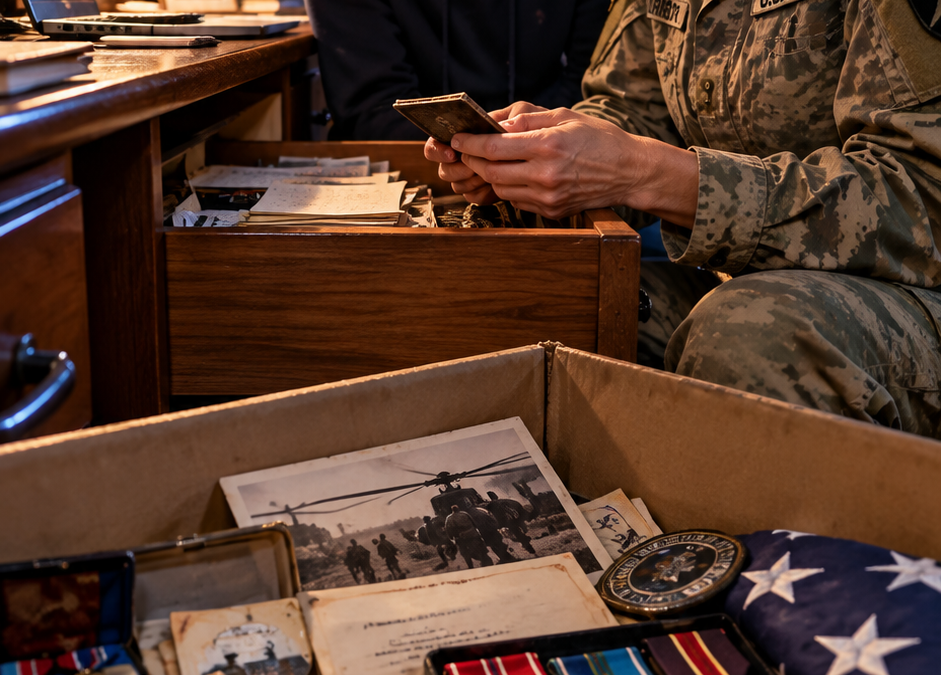
Inside were ribbon bars, certificates, photographs, coins, patches, folded letters, and several small boxes.
Nothing was arranged beautifully.
There was no display case.
Some papers had coffee stains.
One photograph had a bent corner.
“This looks like a junk drawer,” I said.
“It is organized.”
“How?”
“I know where everything is.”
“That is not organization.”
She ignored me.
I lifted a photograph.
Mom was younger in it.
Much younger.
Her hair was pulled tightly back. She stood beside a group of soldiers outside a building.
There were six people in the picture.
One of them was Admiral Galloway.
He had darker hair then.
“Was he your boss?”
“Sometimes.”
“Were you his boss?”
“Never officially.”
I pointed at another person.
A broad-shouldered man with a serious expression.
“Who’s that?”
Mom looked at the photograph.
“Major Daniel Mercer.”
“Friend?”
A small pause.
“Yes.”
I looked at her.
Something in her voice had changed.
“Where is he now?”
“I’m not sure.”
That surprised me.
Mom remembered everyone.
Teachers.
Neighbors.
A cashier at a grocery store we hadn’t visited in years.
“You lost touch?”
“Yes.”
I put the photograph down.
Underneath it was an envelope.
Across the front, written in black ink, were three words.
FOR SARAH JENSEN.
The envelope had been opened.
I glanced at Mom.
“Can I?”
She considered it.
Then shook her head.
“That one isn’t mine to share.”
I immediately put it back.
She noticed.
“Thank you.”
We went through the box for nearly an hour.
Mom explained ribbons without making them sound dramatic.
This one was for service.
This one was for a deployment.
This one involved a team award.
Whenever I asked what she had done to earn something specific, she usually answered with some version of, “A lot of people did their jobs well.”
Eventually, I picked up a newspaper clipping.
The headline had been cut away.
Only a photograph remained.
Mom stood beside several officers at a ceremony.
Next to her was Major Mercer.
Under the photo, a caption read:
Lt. Col. Sarah Jensen accepts command during Thursday’s ceremony. Retired Major Daniel Mercer attended as a guest.
I read it twice.
“Retired?”
“Yes.”
“You said you didn’t know where he is now.”
“I don’t.”
“But he came to your command ceremony.”
“That was twelve years ago.”
I looked at the envelope again.
Mom closed the box.
“That is enough history for tonight.”
There was gentleness in her voice.
And a boundary.
I knew better than to push.
The next morning at school, I expected everything to feel different.
It did.
But not in the way I had imagined.
People looked at me more.
That part was uncomfortable.
A few students stopped me in the hall.
“Dude, your mom is actually a colonel?”
“Yes.”
“Does she know, like, secret stuff?”
“Probably.”
“What kind?”
“If I knew, it wouldn’t be secret.”
That answer traveled fast.
By second period, three people had repeated it back to me like I was some kind of comedian.
Then came history.
Mr. Davies stood at the front of the classroom before the bell rang.
When everyone settled, he placed his hands on the desk.
“Before we begin, I need to correct something from yesterday.”
The room went quiet.
He looked at me only once.
“Lucas told this class the truth about his mother’s service. I publicly accused him of lying without evidence. That was unfair and inappropriate.”
Someone shifted in a chair.
Mr. Davies continued.
“More importantly, the fact that his mother’s identity was later confirmed does not make my accusation wrong only because Lucas turned out to be telling the truth.”
That caught my attention.
“If a student says something unusual, I can ask reasonable questions. I can request sources for an academic claim. I can encourage evidence. But I should not turn uncertainty into humiliation.”
His voice remained calm.
“I apologize to Lucas, and I apologize to all of you for setting the wrong example.”
Then he opened the textbook.
“Now, page 214.”
That was it.
No dramatic speech.
No forced applause.
No one made me stand.
I appreciated that more than I expected.
After class, Mr. Davies stopped me.
“There’s something else.”
I waited.
“Would your mother be willing to speak to the class?”
I almost laughed.
“I seriously doubt it.”
He nodded.
“That’s fair.”
“About the military?”
“Not exactly.”
He hesitated.
“About leadership. And privacy.”
That surprised me.
“I can ask.”
“Only if you want to.”
That afternoon, I asked Mom.
Her answer came immediately.
“No.”
“Called it.”
She looked up from her laptop.
“Was there a wager?”
“No.”
“Good.”
Then she returned to work.
Ten minutes later, she said, “What exactly did he ask?”
I told her.
Mom closed the laptop.
“Leadership and privacy?”
“Yes.”
“Interesting.”
“That means yes?”
“It means interesting.”
For Mom, that was practically a maybe.
Three days later, she agreed.
But she added conditions.
No uniform.
No discussion of specific operations.
No medals.
No introduction longer than two sentences.
Mr. Davies agreed to all of it.
Mom came the following Tuesday wearing dark pants, a blue blouse, and the same old watch she had owned for as long as I could remember.
Half the class looked disappointed.
They had expected the woman from the auditorium.
Instead, they got my mother.
Which, I slowly realized, was the entire point.
Mr. Davies introduced her simply.
“This is Colonel Sarah Jensen, Lucas’s mother. She has served in the United States Army for more than twenty years.”
Mom stood beside the whiteboard.
“Good morning.”
A student near the window raised his hand immediately.
“Have you ever jumped out of an airplane?”
Mr. Davies closed his eyes.
Mom said, “Yes.”
The entire class leaned forward.
“Was it awesome?”
“No.”
Everyone laughed.
Another student asked, “Were you scared?”
“Yes.”
That answer surprised them more.
A girl named Mia raised her hand.
“Then why did you do it?”
“Because being afraid and being unable to act are different things.”
Mia wrote that down.
Mom noticed.
“You don’t need to write that down.”
“I like it.”
Mom looked mildly alarmed at the possibility of being quotable.
The questions gradually became more thoughtful.
How do you make decisions when people disagree?
How do you know who to trust?
What happens when you make a mistake?
Mom answered carefully.
“Trust is usually built in boring moments,” she said. “People imagine trust comes from extraordinary acts. Mostly it comes from doing ordinary things consistently.”
I thought about her phone calls.
Her lunch notes.
Her promises.
“Leadership,” she continued, “is also less exciting than people think. A great deal of it involves listening to someone tell you something you hoped was not true.”
Mr. Davies looked at her.
That sentence landed somewhere between them.
Then Mia asked, “What’s the hardest part?”
Mom was quiet for a moment.
“Knowing when to speak,” she said, “and when silence is serving something important.”
I watched her face.
For the first time, I thought about the envelope.
FOR SARAH JENSEN.
The one she wouldn’t let me read.
After school, Mr. Davies thanked her.
Mom shook his hand.
As we walked toward the parking lot, I said, “That went better than you expected.”
“It did.”
“You liked them.”
“They asked good questions.”
“You liked Mr. Davies.”
Mom gave me a look.
“I did not say that.”
“You didn’t have to.”
She unlocked the car.
Before I got in, someone called her name.
“Sarah Jensen?”
Mom froze.
It was subtle.
So subtle nobody else would have noticed.
But I did.
A man stood near the visitor parking spaces.
He was probably in his late fifties, gray at the temples, wearing a brown jacket and holding a folded piece of paper in one hand.
I recognized him before Mom said a word.
The photograph.
Major Daniel Mercer.
Older now.
But unmistakable.
Mom slowly closed the car door.
“Daniel.”
He gave a small, uncertain smile.
“It’s been a long time.”
“Twelve years.”
“Thirteen.”
Mom’s eyes narrowed slightly.
He looked at me.
“You must be Lucas.”
I moved closer to Mom.
Not because I was afraid.
Because something about the moment felt private even though I was standing inside it.
“Yes, sir.”
Mercer nodded.
“I knew your father.”
I looked at Mom.
She didn’t seem surprised.
That made me more curious.
“How?”
Mercer glanced at her.
“That is a longer story.”
Mom’s voice became very quiet.
“Why are you here, Daniel?”
He held out the folded paper.
“I saw the notice about Heroes’ Week. Frank’s name was in the article.”
“And?”
“And yours.”
Mom did not take the paper.
Mercer lowered his hand.
“I’ve been trying to decide whether to contact you for a long time.”
“You had my number.”
“I know.”
“Then deciding seems to have taken considerable effort.”
He accepted that without defending himself.
“Yes.”
I had never seen Mom speak to anyone quite like that.
Not angry.
Not warm.
Careful.
“What do you want?” she asked.
Mercer looked toward me again.
“I found something while clearing my brother’s house.”
Mom’s expression changed.
“Thomas died?”
“Last winter.”
“I’m sorry.”
“Thank you.”
Mercer looked at the paper in his hand.
“He kept things. Records. Letters. Photographs. More than I realized.”
Mom finally took the folded page.
She opened it.
I could not see what was written there.
But I saw her face.
Not shock.
Recognition.
A tired kind of recognition.
“What is it?” I asked.
Mom folded the page again.
“Something from a long time ago.”
Mercer looked at her.
“There’s more.”
“How much more?”
“A box.”
Mom went completely still.
I remembered the cardboard box in our house.
Her medals.
The photographs.
The envelope.
“What kind of box?” I asked.
Neither adult answered immediately.
Then Mercer said, “Letters. Mostly.”
“Whose letters?”
He looked directly at me.
“Your father’s.”
The parking lot seemed to become very quiet.
I stared at Mom.
“You knew about them?”
She slowly shook her head.
“No.”
Mercer took a breath.
“David wrote to my brother for years.”
My father.
Writing letters to a man I had never heard of.
Mom looked down at the folded page.
“When?”
“During your deployments,” Mercer said.
Something moved through her expression.
Not fear.
Not anger.
A question.
A question she had apparently been carrying for thirteen years without knowing it existed.
I looked between them.
“What did Dad write?”
Mercer answered softly.
“I don’t know everything.”
Then he looked at Mom.
“But I think some of those letters were meant to reach Sarah eventually.”
Mom unfolded the paper one more time.
This time, her hand trembled just enough for me to notice.
At the bottom of the page was my father’s handwriting.
I recognized it from birthday cards kept in my desk.
Beneath several lines I couldn’t read from where I stood were four words written clearly enough for me to see.
When Lucas is older.
I forgot how to breathe.
Mom refolded the paper carefully.
“Where is the box?”
“In my car.”
“Bring it.”
Mercer glanced toward the school building.
“Here?”
“Not here.”
She looked at me.
“Home.”
The drive back to our house felt nothing like the drive after the assembly.
That day, silence had been full of things we both understood.
This silence was different.
It was full of a dead man’s handwriting.
Daniel Mercer followed us in his own car.
When we pulled into the driveway, Mom stayed behind the wheel for a moment after turning off the engine.
“Lucas,” she said.
“Yes?”
“I don’t know what is in that box.”
“I know.”
“If any of it becomes too much, we stop.”
I nodded.
She looked at me.
“I mean that.”
“I know.”
“And whatever your father wrote, he wrote it as a man in a moment. Not as a perfect answer from beyond the grave.”
That sounded like something she had said to herself before saying it to me.
“Mom?”
“Yes?”
“Are you scared?”
She looked toward Daniel’s car.
“Yes.”
That answer made me feel better.
Not because I wanted her scared.
Because she didn’t pretend not to be.
Daniel carried the box inside.
It was plain brown cardboard, sealed with old packing tape and labeled in black marker.
DAVID JENSEN / CORRESPONDENCE / HOLD.
The word hold made my stomach tighten.
Mom invited Daniel to sit at the kitchen table.
She made coffee automatically, even though her hands were not as steady as usual.
Daniel noticed but said nothing.
When the mugs were on the table, Mom cut the tape with a small knife from the drawer.
Inside were envelopes.
Dozens of them.
Some addressed to Thomas Mercer.
Some addressed to Mom.
Some addressed to me.
Several were labeled by date.
One bundle was tied with string.
A note sat on top.
Daniel picked it up.
“My brother wrote this.”
Mom nodded once.
He read aloud.
“Sarah, if this box reaches you, I failed to deliver it properly while I was alive. That is my burden, not yours. David trusted me with these letters because he said there were things a spouse learns during deployments that the serving parent may never know unless someone keeps a record. I told myself I would find the right time. Like most people who wait for the right time, I waited too long.”
Daniel stopped.
His throat moved.
He placed the note on the table.
“My brother ran a private support group for military families,” he said. “Not official. Not therapy. Just spouses and parents who needed somewhere to send thoughts they couldn’t say on the phone. David started writing to him during your second long deployment after Lucas was born.”
Mom sat very still.
“I didn’t know.”
“I don’t think David wanted you to. Not then.”
“Why?”
Daniel looked at the box.
“Because he didn’t want his fear to become another thing you had to carry.”
Mom looked away.
I reached for the envelope on top of the stack.
It had my name on it.
Lucas, age fifteen or older.
My voice caught.
“He wrote this for me?”
Mom looked at Daniel.
He nodded.
“He wrote several for you.”
I stared at the envelope.
“Can I open it?”
Mom’s eyes were wet, but her voice was steady.
“Yes.”
I opened it carefully.
Dad’s handwriting filled three pages.
For a moment, the letters blurred.
Then I began to read.
Lucas,
If you are reading this, either your mother decided you were old enough, or Thomas finally remembered where he put the box. Knowing Thomas, both are possible.
You are asleep upstairs right now. You are four years old. You refused peas at dinner with the moral conviction of a Supreme Court justice. Your mother called from somewhere I am not allowed to know, and when she asked what you learned today, you told her ducks are “suspicious chickens.”
She laughed so hard the connection cut out.
That was the best sound I heard all week.
I stopped.
Mom covered her mouth with one hand.
I kept reading.
Your mother worries that being gone will make you think she chose the Army over you. I need you to understand something when you are old enough to read this without turning it into a wound.
Your mother has never left you lightly.
Every time she packs a bag, part of her stays in the doorway.
Every time she calls, she is doing more than checking a box.
Every time she says she will come home, she is making the strongest promise she is allowed to make in a world that does not always respect promises.
I wiped my eyes with my sleeve.
Dad continued.
I am writing these letters because memory is unreliable when grief or anger gets involved. Someday you may be angry at her. You may think she missed something because she did not care enough to be present. When that day comes, I want you to know I was here. I saw the truth.
She cared.
She cared so much it sometimes made her silent.
I looked at Mom.
She was crying now.
Not loudly.
Mom never cried loudly.
But tears moved down her face as if something frozen had finally started melting.
I continued.
There is another thing.
Do not use your mother’s rank as a borrowed spine.
If you want to stand tall, grow your own bones.
Be proud of her, yes. Admire her, yes. But do not confuse her courage with yours. She has earned her life. You must earn yours.
And if someone laughs when you tell the truth, let the truth keep walking. It has better endurance than lies.
I stopped reading.
The room was silent.
Mom closed her eyes.
“That sounds like him,” she whispered.
I looked down at the last paragraph.
One more thing, kiddo.
Your mother is not a hero because she wears a uniform.
She is a hero if she comes home tired and still listens.
She is a hero if she admits mistakes.
She is a hero if she teaches you to be kind without teaching you to be weak.
And if I am not there to say this when you need it, hear me now:
You do not have to become impressive to be worthy of love.
You were loved before you did anything worth applauding.
Dad
I folded the letter against my chest.
For a long time, nobody spoke.
Then Mom reached for another envelope.
This one was addressed to her.
Sarah, when Lucas is older.
She looked at me.
“May I?”
I nodded.
She opened it.
Her eyes moved across the page slowly.
Whatever she read hit her differently than my letter had.
Her shoulders tightened.
Then softened.
Finally, she read part of it aloud.
Sarah,
If you are reading this, then our son is old enough to understand that adults can love each other deeply and still fail to tell each other everything.
I did not tell you about the fear properly.
I made jokes. I color-coded binders. I organized emergency contacts and pretended organization was the same thing as control.
But I was afraid every time you left.
I was also proud.
Those two truths lived in the same room.
I never wanted the first one to diminish the second.
Mom pressed her fingers to her mouth.
She kept reading silently.
Daniel stared into his coffee.
I could tell he was giving her privacy even though he sat three feet away.
When Mom finished, she folded the letter carefully and held it against her chest.
“He thought I didn’t know,” she said.
“Know what?” I asked.
“That he was afraid.”
“Did you?”
She smiled sadly.
“Yes.”
“Why didn’t you tell him?”
“Because I thought pretending to believe him helped.”
Daniel looked at her.
“Maybe it did.”
Mom shook her head.
“Maybe. Maybe not.”
The box changed our house.
Not all at once.
Not dramatically.
But slowly.
For the next few weeks, Mom and I read one letter every night after dinner.
Some made us laugh.
Dad had written entire paragraphs about my hatred of peas, my obsession with dinosaurs, and the time I tried to mail a peanut butter sandwich to Mom because I thought soldiers overseas might be hungry.
Some letters hurt.
He wrote about nights when I cried for Mom and he sat outside my bedroom door because I didn’t want to be comforted but also didn’t want to be alone.
He wrote about missing her voice.
He wrote about how proud he was of her and how angry he sometimes felt that pride did not make loneliness easier.
But the letters never made her into a statue.
They made her human.
They made Dad human, too.
That was harder than I expected.
When someone dies when you’re seven, they stay partly frozen in your mind. Dad had been funny, organized, gentle, and gone.
The letters gave him back motion.
He became a man who got tired.
A man who worried.
A man who sometimes didn’t know the right answer.
A man who loved us enough to leave a record, not because he expected to die, but because he understood that life had a way of losing important things if no one wrote them down.
At school, things changed too.
Mr. Davies kept his promise.
He never treated me like a class lesson again, but he did change Heroes’ Week.
The next year, he added a rule: no rankings, no applause comparisons, no “most impressive” stories.
“Heroism,” he told the class, “is not a contest of résumés.”
I pretended not to notice him glance at me when he said it.
Some kids still asked dumb questions about Mom.
Did she know how to kill someone with a pencil?
Had she met the president?
Was our house full of weapons?
I answered most of them with, “She makes really good rice.”
That confused people enough to make them stop.
One Friday afternoon, Mr. Davies asked if I would stay after class.
I did.
He handed me a folder.
Inside was my original Heroes’ Week paper.
The one with bent edges from the day he called me a liar.
“I found this in my desk,” he said. “I should have returned it sooner.”
I took it.
“Thanks.”
He looked uncomfortable.
Then he said, “I’ve thought a lot about what your mother said. About listening to something you hope isn’t true.”
I waited.
“I think teachers like to imagine we’re fair because we care about being fair. But caring isn’t the same as doing it.”
That sounded like something Mom would say.
“I’m trying to do better,” he added.
I looked at him.
This time, I didn’t just say okay.
“I can tell.”
His face changed.
Maybe relief.
Maybe gratitude.
Maybe both.
On the anniversary of Dad’s death, Mom and I drove to the cemetery with flowers and one letter from the box.
It was the one where Dad had written about the science fair volcano.
Apparently, I had inherited my measuring skills from neither parent.
Mom stood beside the grave in a dark coat, her hands in her pockets.
For once, she didn’t look like Colonel Jensen.
She didn’t look like the woman who had made an auditorium go silent.
She looked like my mother.
And like someone’s wife.
“I wish you had told me about the letters,” she said to the headstone.
Wind moved through the trees.
“I also understand why you didn’t.”
She looked at me.
“Both can be true.”
I nodded.
I had learned that from her.
And from Dad.
And maybe even from Mr. Davies.
People could be wrong without being monsters.
Brave without being simple.
Quiet without being weak.
Important without making sure everyone knew it.
A month later, Heroes’ Week returned.
This time, Mr. Davies didn’t ask us to present an object first.
He asked us to answer one question.
What does your hero do when nobody is applauding?
I knew my answer immediately.
I brought Dad’s letter.
Not the whole box.
Not Mom’s medals.
Not her photograph from the dusty base.
One letter.
When I stood at the front of the classroom, nobody laughed.
I unfolded the page and looked at the first line.
Then I looked at my classmates.
“My hero is still my mom,” I said. “But I understand why better now.”
Mr. Davies stood quietly at the back of the room.
I continued.
“She served in places I may never fully understand. But the reason I admire her is not because of what people saw in the auditorium last year. It’s because of what my dad saw when nobody else was watching.”
I read only a few lines.
The part about her calling when she promised.
The part about caring so much it sometimes made her silent.
The part about not using someone else’s rank as a borrowed spine.
When I finished, the room was quiet.
Not awkward quiet.
Not shocked quiet.
The kind of quiet that means people are actually thinking.
I folded the letter.
“My dad wrote that when I was four,” I said. “I didn’t read it until this year. I used to think proof meant making everyone admit you were right. Now I think proof can be something else. Sometimes proof is what remains true even when nobody believes it yet.”
I returned to my seat.
No one clapped.
Mr. Davies had asked the class not to after any presentation.
For once, I was glad.
I didn’t need applause.
After school, Mom waited in the parking lot.
She was leaning against the car wearing sunglasses and the old Army sweatshirt.
“How did it go?” she asked.
“Good.”
“Did you read the letter?”
“Part of it.”
She nodded.
“Was that hard?”
“Yes.”
“Worth it?”
“Yes.”
She unlocked the car.
Before I got in, I stopped.
“Mom?”
“Yes?”
“I think I get the rule now.”
“Which rule?”
“The one about borrowed importance.”
She looked at me over the roof of the car.
“Tell me.”
“It means I can be proud of you without pretending your life proves something about mine.”
Her face softened.
“And?”
I smiled.
“There’s always an and.”
“There is.”
“It means if I want people to know who I am, I have to show them myself.”
Mom opened the driver’s door.
“That’s a good start.”
On the way home, we stopped for tacos.
Apparently, disappearing from ceremonies for tacos was a family tradition now.
That night, Mom moved her cardboard box.
For years, it had lived on the highest shelf of her closet, hidden behind winter blankets and old garment bags.
Now she placed it on the lower shelf in the hallway cabinet.
Not displayed.
Not hidden.
Just reachable.
Dad’s letters went beside it in a new binder.
Color-coded.
He would have approved.
Sometimes I still think about that morning in Mr. Davies’s classroom.
I remember the laughter.
The heat in my face.
The photograph trembling in my hand.
I remember wanting to break Mom’s rule so badly that silence felt impossible.
But I also remember the auditorium doors opening.
My mother walking in.
The truth arriving without hurry.
And I remember something my father wrote before I was old enough to understand it.
Let the truth keep walking.
It has better endurance than lies.
He was right.
The truth did not need me to shout.
It did not need medals, applause, or revenge.
It just needed time.
And when it finally reached the room, everyone heard it.








