𝗙𝗨𝗟𝗟 𝗦𝗧𝗢𝗥𝗬 The Trucks Crossing My Gate Were Carrying the Secret the HOA Thought I Would Never Notice
𝗙𝗨𝗟𝗟 𝗦𝗧𝗢𝗥𝗬
It was not that anymore.
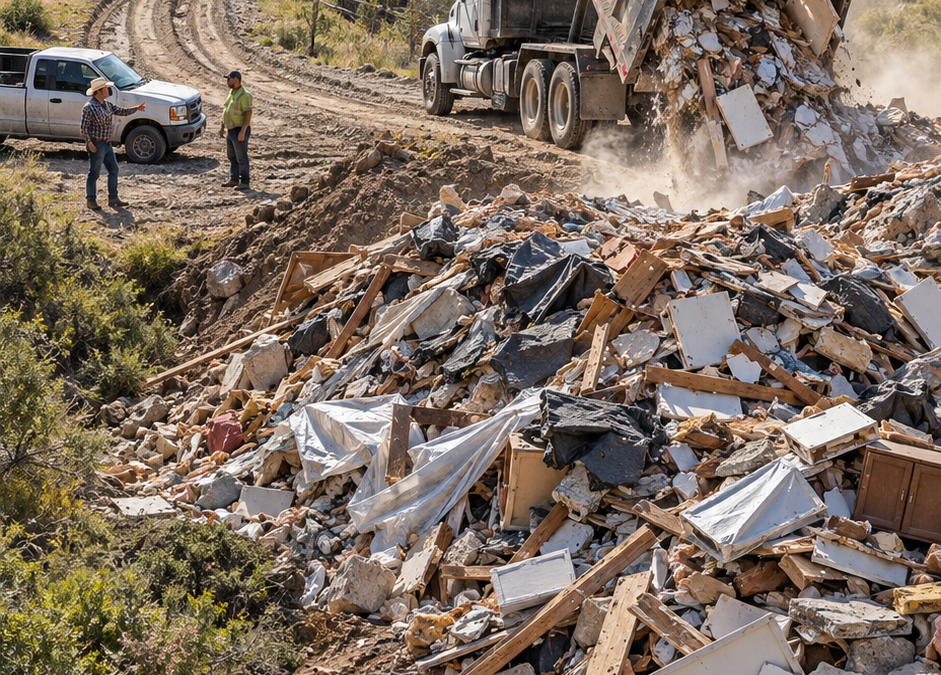
The clearing had become a dump.
Not a small illegal pile someone could claim was accidental. Not a few discarded boards, a broken appliance, or a load of brush. A massive waste pile spread across the back acreage, wider than a barn, taller than a truck in some places, layered with construction debris, broken drywall, roofing material, splintered lumber, cracked tile, insulation, torn plastic sheeting, old cabinets, concrete chunks, bent metal, packaging, dirt, and things I could not identify from a distance.
The smell hit next.
Wet wood.
Dust.
Rotting material.
Old paint.
Stale construction waste heated by the sun.
The dump truck backed toward the edge of the pile. Its warning beeper echoed across my land. The driver jumped out, walked around once, and released the tailgate. Debris slid out in a grinding avalanche.
I got out of my truck slowly.
The driver saw me and lifted one hand in a casual greeting, as if I were another worker on-site.
That made me angrier than if he had run.
He believed he had every right to be there.
“Who authorized this?” I shouted.
He looked confused.
“What?”
I walked closer, boots crunching over broken scraps.
“Who authorized you to dump here?”
He took off his sunglasses.
“I’m just making the drop.”
“On whose property?”
He pointed vaguely toward the pile.
“This is the Brookhaven disposal area.”
“No,” I said. “This is my land.”
His expression shifted.
Not guilty.
Annoyed.
“Look, man, I just go where they send me.”
“Who is they?”
He shrugged.
“Dispatch. HOA management. Depends on the job.”
“HOA management?”
“Yeah. Brookhaven Ridge.”
I stared at the pile again.
For the first time, I noticed the pattern.
This was not random trash. It was renovation debris. Bathroom tear-outs. Kitchen cabinets. Flooring. Roof shingles. Fence panels. Landscaping waste. Broken pavers. Signs of years of home improvement projects from a neighborhood that had apparently decided disposal was easier when done on someone else’s property.
I took out my phone and began recording.
The driver frowned.
“Hey, don’t put me on video.”
“You’re dumping on my land.”
“I didn’t know that.”
“You know now.”
He wiped one hand over his mouth.
“I need to call my supervisor.”
“Good.”
While he did, I walked around the truck and recorded the company name, license plate, load condition, time, date, and location. Then I photographed the gate, the tire tracks, the dump pile, and the road leading in. I did not touch anything. I did not block the truck. I did not shout again.
That was difficult.
But some instinct told me this was bigger than one driver.
The supervisor told him to leave. I heard only the driver’s side of the call, but it was enough.
“Yeah, he says it’s his land.”
Pause.
“No, he’s recording.”
Pause.
“I already dumped.”
Pause.
“Okay.”
He got back into the truck and looked down at me through the open window.
“They said someone will contact you.”
“Who?”
“Management.”
Then he drove out, leaving the fresh load steaming with dust behind him.
No one contacted me that day.
So I went back.
That afternoon, I walked the entire dump area.
The deeper I looked, the worse it got.
Some piles were old, half-covered by weeds and settled dirt. Others were recent, still sharp-edged and bright with fresh material. Tire tracks showed repeated entry from the north gate. There were multiple dumping lanes, as if drivers had been instructed where to place new loads as the old piles spread. Someone had pushed debris with equipment at least once, flattening part of the mass to make room for more.
Six years.
I did not know that number yet, but the land already looked like time had been involved.
I found old shingles with manufacturer dates. Delivery tags from renovation materials. Scraps of paperwork trapped under boards. A broken cabinet door with a Brookhaven Ridge address still written in marker on the back. Plastic wrapping from contractor supplies. A cracked sign from what looked like a neighborhood pool remodel.
Then I found the first work order.
It was damp, sun-faded, and half-buried under a sheet of broken siding. I almost missed it. The top corner showed a logo I knew immediately.
Brookhaven Ridge HOA.
Below that, in printed text, was a disposal instruction.
Deliver construction debris to north service disposal area.
No parcel number.
No permission note.
No owner name.
Just an instruction, as if my land had been turned into a line item.
I stood there holding that dirty piece of paper while the wind moved dust across the pile.
That was the moment the shape of the thing became clear.
This was not one dishonest contractor taking a shortcut.
This was an operation.
Someone had identified my back acreage as convenient. Someone had directed trucks through my gate. Someone had let them come for years. Someone had benefited from avoiding proper disposal fees, proper hauling sites, proper permits, proper cleanup, and proper permission.
And everyone involved had counted on one assumption.
I would never notice.
I folded the work order carefully, put it in a plastic sleeve from my truck, and drove straight to the Brookhaven Ridge HOA office.
Linda Carver was president of the HOA then.
Linda was one of those people who could smile without softening at all. She had perfect hair, expensive glasses, and a voice that sounded polite only if you ignored the words. I had dealt with her twice before, once over drainage and once over a complaint about my equipment barn. Both times, she had treated my refusal to cooperate as a personal flaw.
She was in the HOA office when I arrived, standing beside the receptionist with a tablet in her hand.
She saw me and said, “Mr. Carter. Do you have an appointment?”
“No.”
“Then this may not be a good time.”
“You have been dumping construction waste on my ranch.”
Her face changed.
Only slightly.
But it changed.
The receptionist looked up.
Linda recovered quickly.
“I’m sorry?”
I placed the work order on the counter between us.
“This came from the dump pile on my property.”
She glanced at it but did not pick it up.
“That area has been used for disposal for years.”
“Yes,” I said. “That is the problem.”
“It is my understanding the HOA has permission to use that area.”
“From whom?”
She lifted her chin.
“That predates my term.”
“That isn’t an answer.”
“Everyone knows we use that area.”
I stared at her.
“Everyone except the owner.”
Her smile tightened.
“Mr. Carter, if there has been a misunderstanding regarding boundaries, we can review it.”
“There is no misunderstanding. The dump is inside my parcel.”
“We’ll need to confirm that.”
“I already saw the trucks crossing my gate.”
“The north service area has historically been treated as shared.”
“By people who didn’t own it.”
She finally picked up the work order.
“This appears to be a contractor document.”
“With the HOA logo on it.”
“It may have been prepared by management staff.”
“Under HOA authority.”
She placed the paper back down.
“I think you may be overreacting.”
That sentence settled something in me.
I had entered the office angry. I left it focused.
“Show me the agreement,” I said.
“What agreement?”
“The lease, easement, license, written authorization, disposal agreement, anything giving Brookhaven Ridge the right to dump waste on my land.”
Linda’s expression hardened.
“We will have to look through historical files.”
“Do that.”
“These things take time.”
“You have until Friday.”
Her eyebrows rose.
“Excuse me?”
“By Friday, send me whatever document you believe authorizes this. Until then, no more dumping.”
“You do not have authority to shut down HOA operations.”
“On my land, I do.”
She leaned closer.
“Be careful, Mr. Carter. Accusing an entire neighborhood of wrongdoing is a serious matter.”
“So is using private property as a dump for six years.”
She looked at the receptionist, then back at me.
“You don’t know it has been six years.”
“Not yet,” I said. “But I’m going to.”
I left before she could answer.
From the HOA office, I drove straight to the county records office.
There are moments in a dispute when emotion is useless until the record speaks. This was one of them. I needed maps, deeds, recorded easements, historical plats, access records, and anything else that would prove exactly where my land ended and theirs began.
The clerk pulled the parcel map first.
There it was.
Crystal clear.
My ranch parcel extended north and west beyond the old service gate and included the entire dumping area. Brookhaven Ridge’s recorded boundary stopped hundreds of feet away from the pile. There was no common area there. No HOA tract. No recorded disposal site. No utility easement broad enough to explain the dumping. No license agreement. No transfer. No recorded right of use.
The clerk traced the line with a pen.
“This area here belongs to your parcel.”
“And Brookhaven?”
“Ends here.”
“Any recorded easement across this portion?”
She searched.
“No recorded HOA easement that I can see.”
“Any disposal agreement?”
She looked up at me.
“Those are usually private contracts, if they exist. But nothing recorded here.”
I ordered certified copies of everything.
The deed.
The parcel map.
The subdivision plat.
The easement index.
The records showing nothing gave Brookhaven Ridge what Linda claimed everyone knew.
That weekend, I did not sleep much.
I organized everything.
I made folders by category: photographs, truck logs, license plates, contractor names, debris images, satellite images, property records, county maps, work orders, communications, and witness notes. I searched old aerial imagery online and found what made my stomach sink.
The dump had grown gradually.
One year, there was only a small disturbed patch.
The next, a larger gray area.
Then a widening scar.
Then visible piles.
Then access tracks.
Then a site that looked intentional.
Six years.
The satellite images showed it clearly.
Six years of debris spreading across my land while I was building a company, paying taxes, assuming the back gate was quiet, and trusting that people did not turn another man’s property into a landfill just because it was convenient.
I printed every image.
I labeled dates.
I matched those dates with neighborhood renovation announcements from Brookhaven newsletters. Pool renovation. Clubhouse update. Street sign replacement. Roof repairs after hail season. Fence upgrades. Home remodel campaigns. Contractor cleanout days. The more I matched, the clearer it became.
This had not been occasional.
It had been convenient infrastructure.
My land had become part of their budget without my consent.
On Monday morning, I sent the HOA a formal notice.
It was not emotional.
That was important.
I did not call Linda corrupt. I did not threaten to ruin the board. I did not exaggerate. I kept it simple.
Brookhaven Ridge HOA and its contractors were using my private property for unauthorized dumping. No lease, easement, license, or written permission existed. The HOA must immediately cease all dumping, preserve all records, identify all contractors involved, and remove all waste placed on my property. I gave them a clear deadline to respond with their cleanup plan.
The final sentence was the only one that mattered.
Clean up what you put here.
Linda did not take it seriously.
I learned that from a board member later.
She told the board I was “attempting to extort the neighborhood over a historical service area.” She said I was using a technical boundary issue to seek money. She said the HOA had relied on the area for years and could not allow one adjacent owner to disrupt essential operations.
The board voted to continue using the site while “legal review” was pending.
That vote would cost them more than any of them understood.
Because the trucks kept coming.
Even after my written notice.
Even after I had recorded the gate.
Even after Linda knew I was objecting.
Every few days, another truck entered through the north service gate. I documented every one. Date. Time. Company. Plate number. Driver description. Load type. Photographs before and after dumping. When possible, I captured work orders. Some drivers refused to speak. Some said they had been told the HOA owned the site. Some said they had dumped there for years. One said, “Lady at the HOA office said this is where all renovation debris goes.”
I asked for her name.
He said, “Linda.”
That night, I hired a licensed surveyor.
His name was Gerald Fitch, and he had been surveying land in our county for thirty-five years. He was not impressed by HOA maps, developer drawings, or people who said everyone knows. He wanted legal descriptions, monuments, bearings, distances, and recorded documents.
He walked the property with two assistants over two days.
Linda sent an email demanding that I stop “creating confusion among vendors.”
I forwarded it to my attorney without answering.
Gerald finished the survey on a Friday afternoon.
He met me at the north gate with the field map rolled under his arm.
“You were right,” he said.
“How far inside?”
He pointed toward the dump.
“The nearest edge of the debris field is well within your parcel. The main pile is hundreds of feet inside your boundary.”
“Not close.”
“Not close.”
“No overlap with HOA property?”
“No.”
“Any recorded access corridor?”
“Not for dumping. Not for disposal. Not for construction debris. Nothing I saw supports what they’re doing.”
He handed me the preliminary survey.
Looking at it made my anger strangely quiet.
There is a difference between knowing you are right and seeing it drawn by a professional whose job is to remove guesswork. The dump was not straddling a line. It was not in a gray area. It was not a historical shared zone.
It was on my land.
Plainly.
Deeply.
Indisputably.
A week later, the county inspected the site.
By then, I had contacted the environmental compliance office, the code enforcement office, and the county attorney’s civil division. I did not know which office would take the lead, so I gave them all the same evidence. Photographs. Work orders. Survey. Parcel maps. Logs. Truck records. Satellite images.
Two county inspectors arrived with clipboards, cameras, and expressions that grew darker the longer they walked the pile.
They found construction debris mixed with materials that should not have been casually dumped on open ranch land. Painted wood. Roofing debris. Insulation. Possible treated lumber. Broken tile. Concrete. Plastic. Metal. Old containers. Mixed renovation waste layered with dirt and brush.
One inspector crouched near a partially buried section of debris and shook his head.
“How long did you say this has been happening?”
“Satellite images show growth over six years.”
He looked across the pile.
“That tracks.”
The other inspector asked, “Who directed the dumping?”
“Brookhaven Ridge HOA, based on the documents I have.”
“Do you have those with you?”
I handed him copies.
He saw the HOA logo.
His expression changed.
“They’re going to have a problem.”
They did.
Until that moment, Linda had treated this as a property dispute. She thought it was about a boundary argument, a stubborn ranch owner, maybe a negotiation over use. But once the county documented the site, the issue became much larger.
Unauthorized use of private property was one problem.
Years of accumulated construction debris were another.
Cleanup would not mean sending a guy with a pickup and a shovel. It would require assessment, sorting, hauling, disposal at proper facilities, possible soil testing, erosion control, and documentation. The longer the county looked, the more expensive the future became.
That was when Linda changed her story.
Suddenly, the contractors were responsible.
She claimed the HOA had never authorized illegal dumping. She said independent vendors may have misunderstood disposal instructions. She suggested that old contractors had used the area without board knowledge. She told residents the HOA was investigating “unauthorized vendor practices.”
Unfortunately for Linda, paperwork has a way of surviving arrogance.
My attorney, Martin Hale, reviewed every document I collected.
He was quiet while he read.
That usually meant something bad for the other side.
He spread the work orders across his conference table. Several bore the HOA logo. Others listed Brookhaven Ridge account numbers. Some included disposal line items charged to the HOA. A few emails from contractors referenced “north service disposal area per HOA instruction.” One invoice included a note: “Debris delivery approved by management.”
Martin tapped the invoice.
“This is important.”
“Why?”
“Because they are going to claim rogue contractors. But this shows the contractors were billing the HOA under its account for disposal activity connected to that area.”
“So the HOA knew?”
“It will be difficult for them to credibly claim complete ignorance.”
He read another page.
“And here. Disposal instructions came from management.”
“Linda said it was historical.”
“Historical does not mean lawful.”
He leaned back.
“The core claims are straightforward. Unauthorized use of private property. Trespass. Damage. Unjust benefit. Cost of remediation. Possibly statutory claims depending on what the environmental review finds. And if they continued after notice, that strengthens your position.”
“They did continue.”
“I know. You documented it.”
He looked almost pleased when he said that.
Not because the situation was good, but because evidence matters.
Then came the cleanup estimate.
I expected it to be bad.
It was worse.
The first remediation contractor walked the site for nearly two hours before giving me even a verbal range. He talked about volume, access, debris classification, equipment needs, trucking, landfill fees, possible hazardous components, soil sampling, and restoration. The second contractor’s estimate was no better. The third was more detailed and even higher.
Six years of dumping had created a fortune in liability.
The HOA had saved money for years by using my land.
Now the cost of doing things properly had come due all at once.
We filed a property use and damages claim.
That was when Brookhaven Ridge finally understood I was not bluffing.
Their attorneys requested every document connected to the dumping operation. I think they expected scattered photographs, maybe a few angry emails, perhaps one or two truck plates. Instead, Martin sent organized evidence so complete that their own legal team began asking the HOA uncomfortable questions.
The discovery process did what sunlight does.
It exposed the rot.
The records showed the dumping had not been accidental.
Years earlier, during a wave of neighborhood renovations, an HOA manager had emailed the board about disposal costs. The proper hauling facility was expensive. Contractors complained about distance. Someone suggested using the “unused north acreage beyond the service gate.” Another person asked whether the HOA owned it. The response was not proof. It was assumption.
“Area has always been treated as service overflow.”
That phrase appeared more than once.
Service overflow.
Another clean name for someone else’s land.
In one email, a board member asked whether permission was needed from the ranch owner.
The reply chilled me.
“Owner is rarely present. No issue expected.”
No issue expected.
Not permission granted.
Not agreement signed.
Not easement recorded.
Just a calculation that I would not notice.
When Linda became HOA president, the operation continued. She had inherited the practice, yes, but she also approved budgets, management contracts, vendor instructions, and disposal invoices that referenced the north service area. Her signature appeared on more than one maintenance authorization tied to debris removal from Brookhaven projects.
She had not started the fire.
But she kept adding fuel to it.
Then came the strangest turn.
My company was featured in Forbes.
It had nothing to do with the ranch.
The article was about our national expansion, a major acquisition, and infrastructure investments in several states. There was a photograph of me standing in one of our new facilities, wearing a dark suit I hated but had been told looked “executive.” The article described the growth of Carter Industrial Systems and estimated the value of recent deals.
I did not think much about it beyond the business impact.
Linda did.
At the next settlement conference, something in the room had changed.
Before that article, Linda had treated me like an inconvenience. A rural property owner making noise. A man with enough money to hire a lawyer, perhaps, but not enough to scare a board used to bullying homeowners with procedural delay.
After the article, she understood I had resources.
That should not have mattered.
The deed should have mattered.
The survey should have mattered.
The county records should have mattered.
But people like Linda often respect money before they respect rights.
One of the board members, Leonard Voss, recognized me immediately from the article. I saw him whisper to the HOA attorney before the meeting began. The attorney looked at me, then down at his notes, then back at Linda.
Linda leaned over.
I heard only part of it.
“That’s the same Michael Carter?”
Leonard nodded.
“Yes.”
She stared at me then.
Not with respect.
With recalculation.
The man she had dismissed as an inconvenience owned the property beneath their entire dumping operation, and he was not isolated, broke, confused, or bluffing.
But the article did not win the case.
The records did.
The hearing happened months later.
By then, the evidence had been reviewed so many times that I could have recited the sequence in my sleep. Still, walking into court carried its own weight. The HOA had used my land for six years, but that day was the first time all the excuses had to stand in front of a judge.
Linda wore a navy suit and sat at the HOA table with two attorneys. She looked composed, but not confident. There is a difference. Confidence looks outward. Composure holds itself together from the inside.
I sat beside Martin with our binders arranged in front of us.
The judge was named Elaine Porter.
She was direct, patient, and visibly uninterested in dramatic language. That made me trust her almost immediately.
Martin began with the deed.
Then the survey.
Then the county parcel map.
Then the subdivision plat showing Brookhaven Ridge’s boundary.
Then the certified record search showing no easement, lease, license, or recorded right for the HOA to use my property as a disposal site.
After that came the photographs.
The judge studied them carefully.
The dump in early years.
The dump expanding.
Truck entries.
Work orders.
Fresh loads after notice.
The county inspection report.
The cleanup estimates.
Then came the HOA records.
Emails.
Invoices.
Management instructions.
Board notes.
The north service disposal area.
Service overflow.
Owner rarely present.
No issue expected.
That last phrase changed the air in the courtroom.
Judge Porter looked up.
“Who wrote this email?”
The HOA attorney stood.
“Your Honor, that appears to be from a prior management employee.”
“Was it in the HOA’s records?”
“Yes.”
“Was any permission obtained from Mr. Carter or his predecessors?”
The attorney hesitated.
“We have not located a written agreement.”
“That was not my question.”
“No, Your Honor. We have not found evidence of permission.”
The judge looked at Linda.
“Was there a lease?”
Linda’s attorney answered for her.
“No lease has been produced.”
“Easement?”
“No recorded easement.”
“License agreement?”
“No written license agreement.”
“Payment to the property owner?”
“No.”
The judge made notes.
Linda’s side argued historical use.
They argued contractor misunderstanding.
They argued that previous boards had established the practice before Linda’s term. They argued that the site had been used openly. They argued that my delay in objecting complicated the question of damages. They argued that not every piece of debris could be tied to the HOA.
Martin answered all of it with the record.
Open use was not permission.
Historical trespass was still trespass.
Contractor action under HOA instruction did not absolve the HOA.
Delay caused by concealment or lack of notice did not create ownership.
And the HOA’s own documents tied its projects, vendors, invoices, and management instructions to the dumping area.
When Linda finally testified, she tried to sound reasonable.
She said she inherited the practice.
She said she believed the area was part of an old service arrangement.
She said contractors had handled operational details.
She said the HOA never intended to harm my property.
Martin stood for cross-examination with one document in his hand.
“Ms. Carver, when Mr. Carter notified the HOA in writing to stop dumping, did trucks continue entering the site?”
“I would have to review dates.”
Martin handed her the log.
“Please review the highlighted entries.”
She looked down.
“Yes, it appears some trucks entered after the notice.”
“Some?”
She said nothing.
“Were those trucks connected to HOA projects?”
“Some may have been.”
“Did the board vote to continue using the dumping area while legal review was pending?”
Linda’s attorney objected.
The judge allowed the question.
Linda swallowed.
“Yes.”
“Did the board possess a lease from Mr. Carter at that time?”
“No.”
“An easement?”
“No.”
“A written license?”
“No.”
“Any written permission from Mr. Carter?”
“No.”
Martin let the silence sit.
Then he showed her the email.
Owner is rarely present. No issue expected.
“Did you ever see this email before litigation?”
Linda looked at it.
“I don’t recall.”
“Was it maintained in HOA records?”
“Yes.”
“Does it say permission was granted?”
“No.”
“Does it say the owner agreed?”
“No.”
“Does it say no issue was expected because the owner was rarely present?”
Her voice was lower now.
“Yes.”
That was the moment the case fully turned.
Not because one email alone proved everything, but because it revealed the mindset behind the operation. They had not relied on a right. They had relied on my absence.
Judge Porter issued her decision after reviewing the full record.
She found there was no valid lease, easement, or written authorization allowing Brookhaven Ridge to use my property as a dumping area. She found the dump was located inside my parcel. She found the HOA benefited from the use of the land without paying for it. She found the HOA continued activity after receiving notice. She ordered the HOA to take responsibility for cleanup and remediation consistent with county requirements, and she awarded damages tied to unauthorized use, restoration, and related costs.
Linda stared straight ahead while the judge read the ruling.
I did not look at her for long.
I looked at the deed in front of me.
That was what had carried the day.
Not Forbes.
Not my company.
Not the fact that Linda finally realized I had the resources to fight.
The deed.
The survey.
The photographs.
The invoices.
The emails.
The records.
Those quiet things did what anger alone never could.
They held the truth in place long enough for authority to recognize it.
The cleanup took months.
Watching it happen was both satisfying and painful.
Truck after truck came through the same gate, but this time they were not bringing debris in. They were hauling it out. Crews sorted materials. Hazardous or questionable items were separated. Loads were weighed. Disposal receipts were logged. Soil was tested. Damaged areas were scraped, restored, and stabilized. The county monitored progress. My attorney monitored compliance. I monitored everything.
Some mornings, I stood near the ridge with coffee in my hand and watched excavators bite into the pile.
Layer by layer, six years of arrogance came apart.
Broken drywall.
Rotted wood.
Shingles.
Tile.
Plastic.
Concrete.
Metal.
The physical mess had always been ugly, but once I understood the decisions behind it, the dump looked different. It was not just trash. It was a record of every time someone chose convenience over permission. Every time a board avoided a disposal fee. Every time a contractor followed instructions without asking who owned the ground. Every time Linda signed something she had not verified. Every time the HOA assumed my absence was consent.
That was the hardest thing to forgive.
Not the debris itself.
The assumption.
When the final truck left, the land looked raw.
Clean, but raw.
The pile was gone. The ground beneath it was scarred, compacted, and pale where sunlight had not touched it properly in years. The restoration crew spread soil, corrected drainage, seeded the area, and installed erosion controls. It would take time for the land to feel like itself again.
But it was breathing.
For the first time in years, that back acreage was not carrying someone else’s waste.
I had the boundary permanently marked after that.
Gerald Fitch returned with his crew and set visible markers along the north side. We installed new fencing and a locked gate with a steel sign that read:
PRIVATE PROPERTY — NO ACCESS WITHOUT WRITTEN PERMISSION.
Not decorative.
Not polite.
Not vague.
Linda resigned before the cleanup was finished.
Her letter said she was stepping down to allow the community to heal. It mentioned stress, misinformation, and the difficulty of volunteer leadership. It did not mention my land. It did not mention the emails. It did not mention the six years of dumping. It did not mention the board vote to continue after notice.
People like Linda rarely confess when language can soften the exit.
I heard later that the HOA had to adjust budgets, pursue claims against former vendors and management companies, and answer angry residents who wanted to know how board oversight had failed so badly. Some homeowners were furious about the financial consequences. Others were embarrassed. A few tried to suggest I should have handled it privately for the sake of the community.
I had one answer for that.
The community should not have used my land as a landfill.
Months after the restoration, I walked the cleared area alone.
The season had changed by then. Rain had come twice. New green growth was beginning to show in uneven patches. The soil still bore marks from heavy equipment, but the worst of the scar had softened. Birds moved through the fence line again. The wind no longer carried the stale smell of debris.
I stopped where the largest pile had once stood.
For six years, trucks had crossed that ground as if it belonged to people who had never paid for it, never cared for it, never even asked my name before turning it into a dumping area.
I thought about my grandfather.
He had believed land remembered.
Standing there, I believed it too.
Land remembers weight. It remembers neglect. It remembers tires, leaks, broken glass, careless hands, and silence. But it also remembers repair. It remembers fence posts reset, soil turned, seed spread, water moving correctly again. It remembers when the people responsible finally leave it alone.
I knelt and picked up one small piece of plastic the cleanup crew had missed.
A white shard
𝗧𝗛𝗘 𝗘𝗡𝗗
The Trucks Crossing My Gate Were Carrying the Secret the HOA Thought I Would Never Notice
For years, I thought the trucks were passing through for some temporary construction job I had not bothered to question.
Then I followed one of them past the gate and saw what six years of silence had done to my land.
By the time I found the HOA logo on a work order, I understood this was not a mistake; it was a system built on the belief that I would never look closely enough.
My name is Michael Carter, and the land had been mine long before the first dump truck ever rolled across it.
It was not a small piece of ground tucked behind a backyard fence. It was ranch land, broad and uneven, with old oaks along the western edge, a dry creek bed that carried water only after heavy rain, and a long service road that cut through the back acreage toward a gate most people never noticed from the county road. My grandfather used to say land like that taught a person patience. It did not change quickly, and it did not forgive carelessness quickly either.
For most of my adult life, I was too busy to live on it full-time.
That was the truth I had to admit later.
I owned the ranch. I paid the taxes. I maintained the main house, the front pastures, the barn, the wells, the fencing along the public side, and the access road near the residence. But the back portion of the property sat far enough from my house that I did not walk it every week. Sometimes not even every month. It was rougher ground, covered with cedar brush, scrub grass, and pockets of old fill from projects done decades before. There was a service gate on the north side that had been used years earlier by utility crews and a previous tenant who stored equipment there for a while.
After the tenant left, I kept the gate chained, but I did not obsess over it.
That was my first mistake.
The neighborhood behind my western fence, Brookhaven Ridge, had grown slowly over the years. At first, it had been a small development with a dozen homes. Then another phase was added. Then a clubhouse. Then a pool. Then walking paths and decorative streetlights and stone entry signs big enough to announce importance to anyone driving past. By the time the HOA became involved in everything, Brookhaven Ridge had more rules than some small towns.
I had never joined it.
My ranch sat outside the subdivision. My deed said so. The county map said so. The fence line said so. I had no membership obligations, no HOA dues, no architectural committee, and no interest in their meetings.
Still, the neighborhood always seemed to find ways to lean against my boundary.
First it was drainage. Their stormwater basin overflowed after heavy rains, and suddenly people wanted to talk about “shared watershed responsibility.” Then it was landscaping. They did not like the view of my equipment barn from a walking trail they had built too close to the property line. Then it was security. They wanted cameras pointed toward my fence because teenagers had supposedly been cutting through my land.
Each time, I told them the same thing.
Keep your business on your side of the line.
For years, that was enough.
Then the trucks started.
At first, I hardly noticed them.
I would hear an engine in the distance while working near the barn, look up, and see dust rising somewhere beyond the back tree line. Sometimes, when I drove the county road, I saw dump trucks turning near the old service entrance. They were not coming through my main driveway. They were not crossing the front pasture. They were using the north gate, the one I rarely checked.
The first few times, I assumed there was temporary work happening somewhere beyond my property.
That part of the area had always been confusing. Utility corridors, old access trails, construction routes, back service lanes from Brookhaven Ridge, and undeveloped parcels all ran close together. A person could see a truck disappear down one gravel path and reasonably assume it was headed somewhere else.
I had a national business to run then.
That is not an excuse. It is just the truth.
My company was expanding into new markets. I spent more time in airports than I did at my own kitchen table. Investors wanted calls. Clients wanted meetings. Regional managers wanted decisions. I was building something that required every waking hour and several hours that should have belonged to sleep.
So when I saw a truck two or three times a month, I filed it away as background noise.
Construction happens.
Neighborhoods renovate.
Contractors come and go.
That was what I told myself.
Then one morning, everything changed.
I was on the ranch earlier than usual because a storm had knocked down a section of fence near the east pasture. I had driven out before sunrise, fixed what I could, and was heading back toward the house when I heard the low grinding sound of a heavy truck shifting gears near the north side.
It was close.
Too close.
I stopped my truck beside a stand of mesquite and listened.
The engine came through the brush, slow and heavy. Then I saw the top of a dump truck moving along the old service road inside my property, not beyond it. The driver passed through the north gate as if he had done it a hundred times before. The gate was not chained. It stood open.
I sat there with both hands on the steering wheel, watching dust follow the truck across my land.
For a second, my mind refused to accept what my eyes were seeing.
Then anger moved through me so sharply I could feel it in my jaw.
I turned my truck around and followed.
The service road bent around a low ridge, crossed a dry wash, and continued toward a back clearing I had not inspected in months. I remembered it as an uneven open area with poor soil, old scrub, and a few piles of broken limestone from a project my father abandoned years earlier.
It was not that anymore.
The clearing had become a dump.
Not a small illegal pile someone could claim was accidental. Not a few discarded boards, a broken appliance, or a load of brush. A massive waste pile spread across the back acreage, wider than a barn, taller than a truck in some places, layered with construction debris, broken drywall, roofing material, splintered lumber, cracked tile, insulation, torn plastic sheeting, old cabinets, concrete chunks, bent metal, packaging, dirt, and things I could not identify from a distance.
The smell hit next.
Wet wood.
Dust.
Rotting material.
Old paint.
Stale construction waste heated by the sun.
The dump truck backed toward the edge of the pile. Its warning beeper echoed across my land. The driver jumped out, walked around once, and released the tailgate. Debris slid out in a grinding avalanche.
I got out of my truck slowly.
The driver saw me and lifted one hand in a casual greeting, as if I were another worker on-site.
That made me angrier than if he had run.
He believed he had every right to be there.
“Who authorized this?” I shouted.
He looked confused.
“What?”
I walked closer, boots crunching over broken scraps.
“Who authorized you to dump here?”
He took off his sunglasses.
“I’m just making the drop.”
“On whose property?”
He pointed vaguely toward the pile.
“This is the Brookhaven disposal area.”
“No,” I said. “This is my land.”
His expression shifted.
Not guilty.
Annoyed.
“Look, man, I just go where they send me.”
“Who is they?”
He shrugged.
“Dispatch. HOA management. Depends on the job.”
“HOA management?”
“Yeah. Brookhaven Ridge.”
I stared at the pile again.
For the first time, I noticed the pattern.
This was not random trash. It was renovation debris. Bathroom tear-outs. Kitchen cabinets. Flooring. Roof shingles. Fence panels. Landscaping waste. Broken pavers. Signs of years of home improvement projects from a neighborhood that had apparently decided disposal was easier when done on someone else’s property.
I took out my phone and began recording.
The driver frowned.
“Hey, don’t put me on video.”
“You’re dumping on my land.”
“I didn’t know that.”
“You know now.”
He wiped one hand over his mouth.
“I need to call my supervisor.”
“Good.”
While he did, I walked around the truck and recorded the company name, license plate, load condition, time, date, and location. Then I photographed the gate, the tire tracks, the dump pile, and the road leading in. I did not touch anything. I did not block the truck. I did not shout again.
That was difficult.
But some instinct told me this was bigger than one driver.
The supervisor told him to leave. I heard only the driver’s side of the call, but it was enough.
“Yeah, he says it’s his land.”
Pause.
“No, he’s recording.”
Pause.
“I already dumped.”
Pause.
“Okay.”
He got back into the truck and looked down at me through the open window.
“They said someone will contact you.”
“Who?”
“Management.”
Then he drove out, leaving the fresh load steaming with dust behind him.
No one contacted me that day.
So I went back.
That afternoon, I walked the entire dump area.
The deeper I looked, the worse it got.
Some piles were old, half-covered by weeds and settled dirt. Others were recent, still sharp-edged and bright with fresh material. Tire tracks showed repeated entry from the north gate. There were multiple dumping lanes, as if drivers had been instructed where to place new loads as the old piles spread. Someone had pushed debris with equipment at least once, flattening part of the mass to make room for more.
Six years.
I did not know that number yet, but the land already looked like time had been involved.
I found old shingles with manufacturer dates. Delivery tags from renovation materials. Scraps of paperwork trapped under boards. A broken cabinet door with a Brookhaven Ridge address still written in marker on the back. Plastic wrapping from contractor supplies. A cracked sign from what looked like a neighborhood pool remodel.
Then I found the first work order.
It was damp, sun-faded, and half-buried under a sheet of broken siding. I almost missed it. The top corner showed a logo I knew immediately.
Brookhaven Ridge HOA.
Below that, in printed text, was a disposal instruction.
Deliver construction debris to north service disposal area.
No parcel number.
No permission note.
No owner name.
Just an instruction, as if my land had been turned into a line item.
I stood there holding that dirty piece of paper while the wind moved dust across the pile.
That was the moment the shape of the thing became clear.
This was not one dishonest contractor taking a shortcut.
This was an operation.
Someone had identified my back acreage as convenient. Someone had directed trucks through my gate. Someone had let them come for years. Someone had benefited from avoiding proper disposal fees, proper hauling sites, proper permits, proper cleanup, and proper permission.
And everyone involved had counted on one assumption.
I would never notice.
I folded the work order carefully, put it in a plastic sleeve from my truck, and drove straight to the Brookhaven Ridge HOA office.
Linda Carver was president of the HOA then.
Linda was one of those people who could smile without softening at all. She had perfect hair, expensive glasses, and a voice that sounded polite only if you ignored the words. I had dealt with her twice before, once over drainage and once over a complaint about my equipment barn. Both times, she had treated my refusal to cooperate as a personal flaw.
She was in the HOA office when I arrived, standing beside the receptionist with a tablet in her hand.
She saw me and said, “Mr. Carter. Do you have an appointment?”
“No.”
“Then this may not be a good time.”
“You have been dumping construction waste on my ranch.”
Her face changed.
Only slightly.
But it changed.
The receptionist looked up.
Linda recovered quickly.
“I’m sorry?”
I placed the work order on the counter between us.
“This came from the dump pile on my property.”
She glanced at it but did not pick it up.
“That area has been used for disposal for years.”
“Yes,” I said. “That is the problem.”
“It is my understanding the HOA has permission to use that area.”
“From whom?”
She lifted her chin.
“That predates my term.”
“That isn’t an answer.”
“Everyone knows we use that area.”
I stared at her.
“Everyone except the owner.”
Her smile tightened.
“Mr. Carter, if there has been a misunderstanding regarding boundaries, we can review it.”
“There is no misunderstanding. The dump is inside my parcel.”
“We’ll need to confirm that.”
“I already saw the trucks crossing my gate.”
“The north service area has historically been treated as shared.”
“By people who didn’t own it.”
She finally picked up the work order.
“This appears to be a contractor document.”
“With the HOA logo on it.”
“It may have been prepared by management staff.”
“Under HOA authority.”
She placed the paper back down.
“I think you may be overreacting.”
That sentence settled something in me.
I had entered the office angry. I left it focused.
“Show me the agreement,” I said.
“What agreement?”
“The lease, easement, license, written authorization, disposal agreement, anything giving Brookhaven Ridge the right to dump waste on my land.”
Linda’s expression hardened.
“We will have to look through historical files.”
“Do that.”
“These things take time.”
“You have until Friday.”
Her eyebrows rose.
“Excuse me?”
“By Friday, send me whatever document you believe authorizes this. Until then, no more dumping.”
“You do not have authority to shut down HOA operations.”
“On my land, I do.”
She leaned closer.
“Be careful, Mr. Carter. Accusing an entire neighborhood of wrongdoing is a serious matter.”
“So is using private property as a dump for six years.”
She looked at the receptionist, then back at me.
“You don’t know it has been six years.”
“Not yet,” I said. “But I’m going to.”
I left before she could answer.
From the HOA office, I drove straight to the county records office.
There are moments in a dispute when emotion is useless until the record speaks. This was one of them. I needed maps, deeds, recorded easements, historical plats, access records, and anything else that would prove exactly where my land ended and theirs began.
The clerk pulled the parcel map first.
There it was.
Crystal clear.
My ranch parcel extended north and west beyond the old service gate and included the entire dumping area. Brookhaven Ridge’s recorded boundary stopped hundreds of feet away from the pile. There was no common area there. No HOA tract. No recorded disposal site. No utility easement broad enough to explain the dumping. No license agreement. No transfer. No recorded right of use.
The clerk traced the line with a pen.
“This area here belongs to your parcel.”
“And Brookhaven?”
“Ends here.”
“Any recorded easement across this portion?”
She searched.
“No recorded HOA easement that I can see.”
“Any disposal agreement?”
She looked up at me.
“Those are usually private contracts, if they exist. But nothing recorded here.”
I ordered certified copies of everything.
The deed.
The parcel map.
The subdivision plat.
The easement index.
The records showing nothing gave Brookhaven Ridge what Linda claimed everyone knew.
That weekend, I did not sleep much.
I organized everything.
I made folders by category: photographs, truck logs, license plates, contractor names, debris images, satellite images, property records, county maps, work orders, communications, and witness notes. I searched old aerial imagery online and found what made my stomach sink.
The dump had grown gradually.
One year, there was only a small disturbed patch.
The next, a larger gray area.
Then a widening scar.
Then visible piles.
Then access tracks.
Then a site that looked intentional.
Six years.
The satellite images showed it clearly.
Six years of debris spreading across my land while I was building a company, paying taxes, assuming the back gate was quiet, and trusting that people did not turn another man’s property into a landfill just because it was convenient.
I printed every image.
I labeled dates.
I matched those dates with neighborhood renovation announcements from Brookhaven newsletters. Pool renovation. Clubhouse update. Street sign replacement. Roof repairs after hail season. Fence upgrades. Home remodel campaigns. Contractor cleanout days. The more I matched, the clearer it became.
This had not been occasional.
It had been convenient infrastructure.
My land had become part of their budget without my consent.
On Monday morning, I sent the HOA a formal notice.
It was not emotional.
That was important.
I did not call Linda corrupt. I did not threaten to ruin the board. I did not exaggerate. I kept it simple.
Brookhaven Ridge HOA and its contractors were using my private property for unauthorized dumping. No lease, easement, license, or written permission existed. The HOA must immediately cease all dumping, preserve all records, identify all contractors involved, and remove all waste placed on my property. I gave them a clear deadline to respond with their cleanup plan.
The final sentence was the only one that mattered.
Clean up what you put here.
Linda did not take it seriously.
I learned that from a board member later.
She told the board I was “attempting to extort the neighborhood over a historical service area.” She said I was using a technical boundary issue to seek money. She said the HOA had relied on the area for years and could not allow one adjacent owner to disrupt essential operations.
The board voted to continue using the site while “legal review” was pending.
That vote would cost them more than any of them understood.
Because the trucks kept coming.
Even after my written notice.
Even after I had recorded the gate.
Even after Linda knew I was objecting.
Every few days, another truck entered through the north service gate. I documented every one. Date. Time. Company. Plate number. Driver description. Load type. Photographs before and after dumping. When possible, I captured work orders. Some drivers refused to speak. Some said they had been told the HOA owned the site. Some said they had dumped there for years. One said, “Lady at the HOA office said this is where all renovation debris goes.”
I asked for her name.
He said, “Linda.”
That night, I hired a licensed surveyor.
His name was Gerald Fitch, and he had been surveying land in our county for thirty-five years. He was not impressed by HOA maps, developer drawings, or people who said everyone knows. He wanted legal descriptions, monuments, bearings, distances, and recorded documents.
He walked the property with two assistants over two days.
Linda sent an email demanding that I stop “creating confusion among vendors.”
I forwarded it to my attorney without answering.
Gerald finished the survey on a Friday afternoon.
He met me at the north gate with the field map rolled under his arm.
“You were right,” he said.
“How far inside?”
He pointed toward the dump.
“The nearest edge of the debris field is well within your parcel. The main pile is hundreds of feet inside your boundary.”
“Not close.”
“Not close.”
“No overlap with HOA property?”
“No.”
“Any recorded access corridor?”
“Not for dumping. Not for disposal. Not for construction debris. Nothing I saw supports what they’re doing.”
He handed me the preliminary survey.
Looking at it made my anger strangely quiet.
There is a difference between knowing you are right and seeing it drawn by a professional whose job is to remove guesswork. The dump was not straddling a line. It was not in a gray area. It was not a historical shared zone.
It was on my land.
Plainly.
Deeply.
Indisputably.
A week later, the county inspected the site.
By then, I had contacted the environmental compliance office, the code enforcement office, and the county attorney’s civil division. I did not know which office would take the lead, so I gave them all the same evidence. Photographs. Work orders. Survey. Parcel maps. Logs. Truck records. Satellite images.
Two county inspectors arrived with clipboards, cameras, and expressions that grew darker the longer they walked the pile.
They found construction debris mixed with materials that should not have been casually dumped on open ranch land. Painted wood. Roofing debris. Insulation. Possible treated lumber. Broken tile. Concrete. Plastic. Metal. Old containers. Mixed renovation waste layered with dirt and brush.
One inspector crouched near a partially buried section of debris and shook his head.
“How long did you say this has been happening?”
“Satellite images show growth over six years.”
He looked across the pile.
“That tracks.”
The other inspector asked, “Who directed the dumping?”
“Brookhaven Ridge HOA, based on the documents I have.”
“Do you have those with you?”
I handed him copies.
He saw the HOA logo.
His expression changed.
“They’re going to have a problem.”
They did.
Until that moment, Linda had treated this as a property dispute. She thought it was about a boundary argument, a stubborn ranch owner, maybe a negotiation over use. But once the county documented the site, the issue became much larger.
Unauthorized use of private property was one problem.
Years of accumulated construction debris were another.
Cleanup would not mean sending a guy with a pickup and a shovel. It would require assessment, sorting, hauling, disposal at proper facilities, possible soil testing, erosion control, and documentation. The longer the county looked, the more expensive the future became.
That was when Linda changed her story.
Suddenly, the contractors were responsible.
She claimed the HOA had never authorized illegal dumping. She said independent vendors may have misunderstood disposal instructions. She suggested that old contractors had used the area without board knowledge. She told residents the HOA was investigating “unauthorized vendor practices.”
Unfortunately for Linda, paperwork has a way of surviving arrogance.
My attorney, Martin Hale, reviewed every document I collected.
He was quiet while he read.
That usually meant something bad for the other side.
He spread the work orders across his conference table. Several bore the HOA logo. Others listed Brookhaven Ridge account numbers. Some included disposal line items charged to the HOA. A few emails from contractors referenced “north service disposal area per HOA instruction.” One invoice included a note: “Debris delivery approved by management.”
Martin tapped the invoice.
“This is important.”
“Why?”
“Because they are going to claim rogue contractors. But this shows the contractors were billing the HOA under its account for disposal activity connected to that area.”
“So the HOA knew?”
“It will be difficult for them to credibly claim complete ignorance.”
He read another page.
“And here. Disposal instructions came from management.”
“Linda said it was historical.”
“Historical does not mean lawful.”
He leaned back.
“The core claims are straightforward. Unauthorized use of private property. Trespass. Damage. Unjust benefit. Cost of remediation. Possibly statutory claims depending on what the environmental review finds. And if they continued after notice, that strengthens your position.”
“They did continue.”
“I know. You documented it.”
He looked almost pleased when he said that.
Not because the situation was good, but because evidence matters.
Then came the cleanup estimate.
I expected it to be bad.
It was worse.
The first remediation contractor walked the site for nearly two hours before giving me even a verbal range. He talked about volume, access, debris classification, equipment needs, trucking, landfill fees, possible hazardous components, soil sampling, and restoration. The second contractor’s estimate was no better. The third was more detailed and even higher.
Six years of dumping had created a fortune in liability.
The HOA had saved money for years by using my land.
Now the cost of doing things properly had come due all at once.
We filed a property use and damages claim.
That was when Brookhaven Ridge finally understood I was not bluffing.
Their attorneys requested every document connected to the dumping operation. I think they expected scattered photographs, maybe a few angry emails, perhaps one or two truck plates. Instead, Martin sent organized evidence so complete that their own legal team began asking the HOA uncomfortable questions.
The discovery process did what sunlight does.
It exposed the rot.
The records showed the dumping had not been accidental.
Years earlier, during a wave of neighborhood renovations, an HOA manager had emailed the board about disposal costs. The proper hauling facility was expensive. Contractors complained about distance. Someone suggested using the “unused north acreage beyond the service gate.” Another person asked whether the HOA owned it. The response was not proof. It was assumption.
“Area has always been treated as service overflow.”
That phrase appeared more than once.
Service overflow.
Another clean name for someone else’s land.
In one email, a board member asked whether permission was needed from the ranch owner.
The reply chilled me.
“Owner is rarely present. No issue expected.”
No issue expected.
Not permission granted.
Not agreement signed.
Not easement recorded.
Just a calculation that I would not notice.
When Linda became HOA president, the operation continued. She had inherited the practice, yes, but she also approved budgets, management contracts, vendor instructions, and disposal invoices that referenced the north service area. Her signature appeared on more than one maintenance authorization tied to debris removal from Brookhaven projects.
She had not started the fire.
But she kept adding fuel to it.
Then came the strangest turn.
My company was featured in Forbes.
It had nothing to do with the ranch.
The article was about our national expansion, a major acquisition, and infrastructure investments in several states. There was a photograph of me standing in one of our new facilities, wearing a dark suit I hated but had been told looked “executive.” The article described the growth of Carter Industrial Systems and estimated the value of recent deals.
I did not think much about it beyond the business impact.
Linda did.
At the next settlement conference, something in the room had changed.
Before that article, Linda had treated me like an inconvenience. A rural property owner making noise. A man with enough money to hire a lawyer, perhaps, but not enough to scare a board used to bullying homeowners with procedural delay.
After the article, she understood I had resources.
That should not have mattered.
The deed should have mattered.
The survey should have mattered.
The county records should have mattered.
But people like Linda often respect money before they respect rights.
One of the board members, Leonard Voss, recognized me immediately from the article. I saw him whisper to the HOA attorney before the meeting began. The attorney looked at me, then down at his notes, then back at Linda.
Linda leaned over.
I heard only part of it.
“That’s the same Michael Carter?”
Leonard nodded.
“Yes.”
She stared at me then.
Not with respect.
With recalculation.
The man she had dismissed as an inconvenience owned the property beneath their entire dumping operation, and he was not isolated, broke, confused, or bluffing.
But the article did not win the case.
The records did.
The hearing happened months later.
By then, the evidence had been reviewed so many times that I could have recited the sequence in my sleep. Still, walking into court carried its own weight. The HOA had used my land for six years, but that day was the first time all the excuses had to stand in front of a judge.
Linda wore a navy suit and sat at the HOA table with two attorneys. She looked composed, but not confident. There is a difference. Confidence looks outward. Composure holds itself together from the inside.
I sat beside Martin with our binders arranged in front of us.
The judge was named Elaine Porter.
She was direct, patient, and visibly uninterested in dramatic language. That made me trust her almost immediately.
Martin began with the deed.
Then the survey.
Then the county parcel map.
Then the subdivision plat showing Brookhaven Ridge’s boundary.
Then the certified record search showing no easement, lease, license, or recorded right for the HOA to use my property as a disposal site.
After that came the photographs.
The judge studied them carefully.
The dump in early years.
The dump expanding.
Truck entries.
Work orders.
Fresh loads after notice.
The county inspection report.
The cleanup estimates.
Then came the HOA records.
Emails.
Invoices.
Management instructions.
Board notes.
The north service disposal area.
Service overflow.
Owner rarely present.
No issue expected.
That last phrase changed the air in the courtroom.
Judge Porter looked up.
“Who wrote this email?”
The HOA attorney stood.
“Your Honor, that appears to be from a prior management employee.”
“Was it in the HOA’s records?”
“Yes.”
“Was any permission obtained from Mr. Carter or his predecessors?”
The attorney hesitated.
“We have not located a written agreement.”
“That was not my question.”
“No, Your Honor. We have not found evidence of permission.”
The judge looked at Linda.
“Was there a lease?”
Linda’s attorney answered for her.
“No lease has been produced.”
“Easement?”
“No recorded easement.”
“License agreement?”
“No written license agreement.”
“Payment to the property owner?”
“No.”
The judge made notes.
Linda’s side argued historical use.
They argued contractor misunderstanding.
They argued that previous boards had established the practice before Linda’s term. They argued that the site had been used openly. They argued that my delay in objecting complicated the question of damages. They argued that not every piece of debris could be tied to the HOA.
Martin answered all of it with the record.
Open use was not permission.
Historical trespass was still trespass.
Contractor action under HOA instruction did not absolve the HOA.
Delay caused by concealment or lack of notice did not create ownership.
And the HOA’s own documents tied its projects, vendors, invoices, and management instructions to the dumping area.
When Linda finally testified, she tried to sound reasonable.
She said she inherited the practice.
She said she believed the area was part of an old service arrangement.
She said contractors had handled operational details.
She said the HOA never intended to harm my property.
Martin stood for cross-examination with one document in his hand.
“Ms. Carver, when Mr. Carter notified the HOA in writing to stop dumping, did trucks continue entering the site?”
“I would have to review dates.”
Martin handed her the log.
“Please review the highlighted entries.”
She looked down.
“Yes, it appears some trucks entered after the notice.”
“Some?”
She said nothing.
“Were those trucks connected to HOA projects?”
“Some may have been.”
“Did the board vote to continue using the dumping area while legal review was pending?”
Linda’s attorney objected.
The judge allowed the question.
Linda swallowed.
“Yes.”
“Did the board possess a lease from Mr. Carter at that time?”
“No.”
“An easement?”
“No.”
“A written license?”
“No.”
“Any written permission from Mr. Carter?”
“No.”
Martin let the silence sit.
Then he showed her the email.
Owner is rarely present. No issue expected.
“Did you ever see this email before litigation?”
Linda looked at it.
“I don’t recall.”
“Was it maintained in HOA records?”
“Yes.”
“Does it say permission was granted?”
“No.”
“Does it say the owner agreed?”
“No.”
“Does it say no issue was expected because the owner was rarely present?”
Her voice was lower now.
“Yes.”
That was the moment the case fully turned.
Not because one email alone proved everything, but because it revealed the mindset behind the operation. They had not relied on a right. They had relied on my absence.
Judge Porter issued her decision after reviewing the full record.
She found there was no valid lease, easement, or written authorization allowing Brookhaven Ridge to use my property as a dumping area. She found the dump was located inside my parcel. She found the HOA benefited from the use of the land without paying for it. She found the HOA continued activity after receiving notice. She ordered the HOA to take responsibility for cleanup and remediation consistent with county requirements, and she awarded damages tied to unauthorized use, restoration, and related costs.
Linda stared straight ahead while the judge read the ruling.
I did not look at her for long.
I looked at the deed in front of me.
That was what had carried the day.
Not Forbes.
Not my company.
Not the fact that Linda finally realized I had the resources to fight.
The deed.
The survey.
The photographs.
The invoices.
The emails.
The records.
Those quiet things did what anger alone never could.
They held the truth in place long enough for authority to recognize it.
The cleanup took months.
Watching it happen was both satisfying and painful.
Truck after truck came through the same gate, but this time they were not bringing debris in. They were hauling it out. Crews sorted materials. Hazardous or questionable items were separated. Loads were weighed. Disposal receipts were logged. Soil was tested. Damaged areas were scraped, restored, and stabilized. The county monitored progress. My attorney monitored compliance. I monitored everything.
Some mornings, I stood near the ridge with coffee in my hand and watched excavators bite into the pile.
Layer by layer, six years of arrogance came apart.
Broken drywall.
Rotted wood.
Shingles.
Tile.
Plastic.
Concrete.
Metal.
The physical mess had always been ugly, but once I understood the decisions behind it, the dump looked different. It was not just trash. It was a record of every time someone chose convenience over permission. Every time a board avoided a disposal fee. Every time a contractor followed instructions without asking who owned the ground. Every time Linda signed something she had not verified. Every time the HOA assumed my absence was consent.
That was the hardest thing to forgive.
Not the debris itself.
The assumption.
When the final truck left, the land looked raw.
Clean, but raw.
The pile was gone. The ground beneath it was scarred, compacted, and pale where sunlight had not touched it properly in years. The restoration crew spread soil, corrected drainage, seeded the area, and installed erosion controls. It would take time for the land to feel like itself again.
But it was breathing.
For the first time in years, that back acreage was not carrying someone else’s waste.
I had the boundary permanently marked after that.
Gerald Fitch returned with his crew and set visible markers along the north side. We installed new fencing and a locked gate with a steel sign that read:
PRIVATE PROPERTY — NO ACCESS WITHOUT WRITTEN PERMISSION.
Not decorative.
Not polite.
Not vague.
Linda resigned before the cleanup was finished.
Her letter said she was stepping down to allow the community to heal. It mentioned stress, misinformation, and the difficulty of volunteer leadership. It did not mention my land. It did not mention the emails. It did not mention the six years of dumping. It did not mention the board vote to continue after notice.
People like Linda rarely confess when language can soften the exit.
I heard later that the HOA had to adjust budgets, pursue claims against former vendors and management companies, and answer angry residents who wanted to know how board oversight had failed so badly. Some homeowners were furious about the financial consequences. Others were embarrassed. A few tried to suggest I should have handled it privately for the sake of the community.
I had one answer for that.
The community should not have used my land as a landfill.
Months after the restoration, I walked the cleared area alone.
The season had changed by then. Rain had come twice. New green growth was beginning to show in uneven patches. The soil still bore marks from heavy equipment, but the worst of the scar had softened. Birds moved through the fence line again. The wind no longer carried the stale smell of debris.
I stopped where the largest pile had once stood.
For six years, trucks had crossed that ground as if it belonged to people who had never paid for it, never cared for it, never even asked my name before turning it into a dumping area.
I thought about my grandfather.
He had believed land remembered.
Standing there, I believed it too.
Land remembers weight. It remembers neglect. It remembers tires, leaks, broken glass, careless hands, and silence. But it also remembers repair. It remembers fence posts reset, soil turned, seed spread, water moving correctly again. It remembers when the people responsible finally leave it alone.
I knelt and picked up one small piece of plastic the cleanup crew had missed.
A white shard








