The Trauma Bay Had One Impossible Glucose Reading and a K9 Who Wouldn’t Stop Watching the Boy
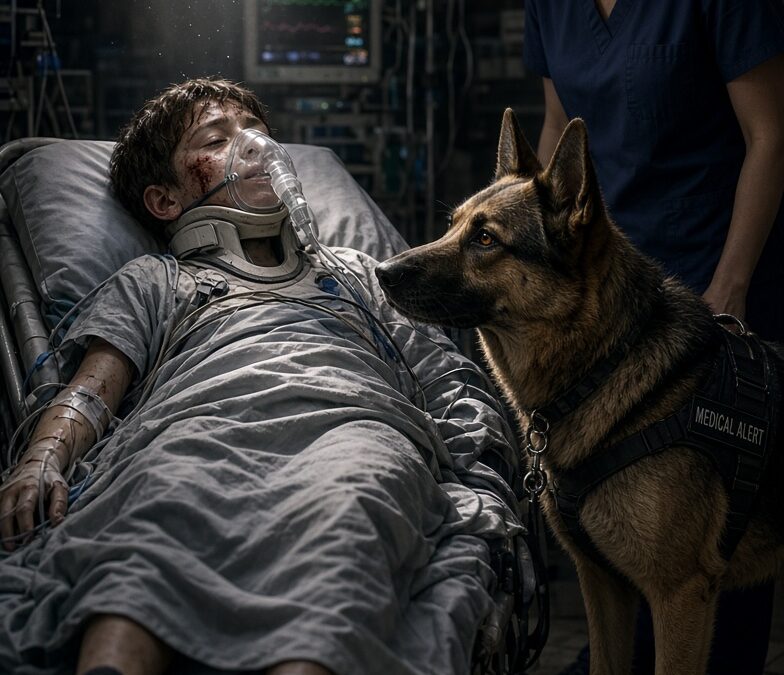
𝗣𝗔𝗥𝗧 𝟮
I pointed.
“Don’t remove him yet.”
Ethan followed my eyes.
Then glanced toward Owen’s lab results.
“Glucose is two forty-eight.”
I had already seen it.
High.
Not low.
Ranger placed his paw again.
I said, “His behavior doesn’t match the number.”
“Or he watched his kid get pulled out of a wreck.”
That was reasonable.
A trained dog could still become frightened.
A diabetic alert dog was still a dog.
Trauma did not stop being trauma because an animal had specialized training.
Ethan turned toward the transport technician.
“Unlock the bed.”
The brake released with a metallic snap.
Ranger pulled forward again.
Owen’s fingers twitched toward him.
I moved alongside the stretcher and checked the IV tubing before transport.
One saline line.
One medication line.
And a second clear bag hanging partly behind the pump.
I traced its tubing downward.
The label rotated.
D10W.
Dextrose ten percent in water.
The line joined the same IV access beneath Owen’s blanket.
Something tightened in my chest.
“Who drew the first labs?”
A resident was gathering tubing.
“I did.”
“From where?”
“The IV.”
Ethan was already at the foot of the bed.
“Mercer, walk and talk.”
I followed.
“Which IV?”
The resident pointed.
“That one.”
My eyes went to the D10 bag.
“What was running when you drew it?”
He looked down.
“Whatever EMS had connected.”
The radio from radiology cracked.
“Trauma 2, scanner ready. We need you now.”
Ethan grabbed the rail.
“We’re coming.”
The monitor alarm sharpened.
Owen’s pressure dipped again.
Ethan leaned over him.
“Owen. Open your eyes.”
Nothing.
“Owen.”
His eyelids moved weakly.
Ethan looked toward the elevator.
“If he crashes again like that, the boy may not survive it.”
The transport tech began pushing.
I took two steps.
Then the dextrose label turned fully toward me.
D10W.
My eyes went to the glucose result on the monitor.
Then to the IV port.
Then back to the number.
Behind us, Ranger planted his paw.
I put my hand on the bed rail.
“Stop.”
Ethan turned.
“Five seconds.”
“We do not have five seconds to chase the dog.”
“This isn’t about the dog anymore.”
I pointed at the IV.
“The glucose sample came from a line receiving dextrose.”
The resident froze.
Ethan looked at the tubing.
Then at the result.
The elevator doors opened at the end of the hall.
“Are you telling me the lab is wrong?”
“No.”
I shook my head.
“I’m telling you we haven’t earned the right to trust it.”
That changed his face.
Not much.
Enough.
“What do you want?”
I grabbed the glucometer mounted on the transport cart.
“One clean drop of blood.”
The elevator waited.
The transport tech held the door.
Ethan looked from me to Owen.
“If this delays CT—”
“I own the delay.”
His eyes held mine.
Maybe one second.
Maybe less.
Then he nodded.
“Do it while they switch him to transport monitoring.”
I was already pulling on fresh gloves.
I took Owen’s left hand.
Ranger remained several feet away with security.
No barking.
No struggle.
Only watching.
I cleaned a fingertip.
Lancet.
Blood.
Strip.
Five seconds.
The elevator doors began closing.
The tech caught them with his shoulder.
The glucometer beeped.
I stared at the number.
Ethan saw my face.
“Repeat.”
New lancet.
Different finger.
Fresh strip.
Owen barely reacted.
The countdown seemed impossibly slow.
Then:
Ethan looked at the original result.
“That’s not noise.”
“No.”
“But two bedside readings still don’t prove which number is wrong.”
“Agreed.”
I reached for a peripheral draw kit.
“So we get one sample that never touched that line.”
He looked at the elevator.
“While we move.”
“While we move.”
The resident took Owen’s opposite arm.
Fresh venipuncture.
Clean sample.
Labeled at bedside.
Ethan handed him the tube.
“Straight to lab. Call me with the result.”
“I’ll miss CT.”
“You’re not needed in CT.”
The resident ran.
The stretcher entered the elevator.
I stepped beside Owen.
Ethan stood at the foot.
The doors closed.
Ranger remained outside.
For the first time since the trauma started, I felt how hard my heart was beating.
Ethan pressed the radiology floor.
“We still image.”
“Absolutely.”
He looked at me.
“A glucose in the fifties doesn’t explain unequal pupils after a rollover.”
“I know.”
“You just stopped transport and now you’re agreeing with me.”
“I wasn’t trying to stop CT.”
I checked Owen’s oxygen tubing.
“I was trying to stop one contaminated number from closing another possibility.”
Owen’s hand moved faintly.
Ethan leaned close.
“Owen. Open your eyes.”
His eyelids fluttered.
Then closed again.
Ethan checked his pupils.
“If the clean lab confirms low glucose, what changes?”
“Not the trauma workup.”
I looked at Owen.
“It means we have two problems until one of them proves otherwise.”
Ethan nodded once.
“And the dog?”
I looked at the closed elevator doors.
“He made me question the number.”
“And now?”
“Now the evidence has to stand without him.”
That answer mattered.
I saw it in Ethan’s expression.
“Good.”
The elevator opened.
We rolled toward CT.
Before I followed through the doors, Ethan stopped me.
“Mercer.”
I turned.
“If the peripheral sample comes back low, I want the EMS glucose history, what they gave him, and when that insulin pump came off.”
“I’ll reconstruct it.”
“Facts first.”
“You’ll get a timeline.”
Inside CT, radiology took over positioning.
I stepped out with the paramedic’s run sheet.
The scanner hummed behind the closed doors.
I opened a blank flow sheet.
“When you reached Owen, was he talking?”
The paramedic nodded.
“Yeah. Confused, but talking.”
“Pump still attached?”
“Yes.”
“First glucose?”
He scrolled through his tablet.
“Meter errored during extrication.”
“Then he got worse.”
“Less responsive.”
“When did you start dextrose?”
“Twenty twenty.”
I wrote the time.
“Why?”
“Type 1 diabetic, altered mental status, no reliable glucose. Medical control approved.”
Reasonable.
Not proof of what Owen’s sugar had been.
Just a decision under uncertainty.
“And the pump?”
“Still on.”
“When did it come off?”
He thought.
“Maybe five minutes after we started the dextrose.”
My pen stopped.
“Why?”
“Pump housing was cracked.”
“Was the screen working?”
“Partly.”
“Alarm?”
He hesitated.
“There was beeping during extrication.”
“From the pump?”
“I can’t swear it was.”
I wrote:
Possible alarm. Source unknown.
No theory.
No conclusion.
Just fact.
At the far end of the corridor, security appeared with Ranger.
The dog stopped when he saw Owen’s empty transport bed outside CT.
His body stiffened.
I noticed.
Then looked back at the flow sheet.
That was important too.
Once a clue becomes emotionally satisfying, you start seeing it everywhere.
I was not going to turn every movement Ranger made into evidence.
My phone rang.
The resident.
“Clean serum glucose is forty-nine.”
I looked at the bedside readings.
Now 49.
“Peripheral draw?”
“Yes.”
“Site documented?”
“Yes.”
“Good.”
I ended the call.
The paramedic stared.
“So the two forty-eight was wrong.”
“Contaminated is more likely.”
I did not cross it out.
The original result remained on my timeline.
Mistakes disappear too easily when people erase them.
I wanted the sequence visible.
I said, “But fixing that result doesn’t explain why he’s still dropping.”
The CT doors opened.
Ethan stepped out pulling off gloves.
“Prelim scan shows swelling. No large bleed that explains this degree of decline. Radiology is still reviewing.”
I handed him the glucose result.
“Clean peripheral serum forty-nine.”
He read it.
“So the first value is out as a reliable glucose.”
“Yes.”
“EMS?”
I turned the timeline toward him.
“Owen was conscious but confused when they reached him. No reliable field glucose. Dextrose started at twenty twenty. Damaged insulin pump remained attached for about five minutes afterward.”
His eyes stopped at the underlined line.
“Could the pump have kept delivering?”
I could have said yes.
It would have made the story simpler.
It would also have been more than I knew.
“It could have.”
I met his eyes.
“I don’t know that it did.”
“Alarm?”
“Possible. Source unclear.”
He looked at the paramedic.
“Where’s the pump?”
“In our equipment bag downstairs.”
“Get it.”
Then back to me.
“I’ll stay on the neurologic workup.”
He pointed toward the timeline.
“You own the glucose history and whatever we can verify from the device.”
“Information. Not insulin decisions.”
“Correct.”
Someone called him back into CT.
He turned.
Then stopped.
“Mercer.”
“Yes?”
“If you find something that changes the question, don’t wait for me to ask.”
“I won’t.”
That was the first moment the relationship between us changed.
Not because he suddenly trusted me completely.
He shouldn’t have.
Because he trusted me not to claim more than I knew.
That is rarer.
The insulin pump returned in a clear property bag.
Cracked screen.
Road dust.
Scuffed housing.
The paramedic placed it on a counter.
“Want me to see if history still opens?”
His thumb moved toward the controls.
“Don’t touch it yet.”
He stopped.
I turned the bag under the light.
Part of the display still glowed.
Ethan came out again.
“Radiology agrees. Swelling, but no major bleed.”
He looked at the pump.
“What do you have?”
“Clean glucose forty-nine. Pump stayed on for about five minutes after dextrose started. Device damaged during crash. Possible alarm.”
“Can you tell whether it delivered insulin?”
“Not from that screen.”
“Can you pull history?”
“Someone familiar with the device can.”
I slid the bag to the center of the counter.
“I can preserve the information. I’m not going to interpret a damaged insulin pump outside my role.”
He looked at me.
An hour earlier, I had stopped a trauma bed because of a lab contamination concern.
Success can be dangerous.
The moment people think you were right once, they start letting you reach farther than you should.
I did not want that.
“I’ll own what I can verify,” I said. “I’m not owning an insulin decision.”
Ethan nodded.
“Fair.”
He pointed at the paramedic.
“Get pharmacy or endocrine.”
Security approached.
Ranger beside him.
“Found this in his harness.”
He handed me a laminated card.
Owen Parker.
Type 1 diabetes.
Emergency contacts.
Then two trained responses.
LOW GLUCOSE: PAW INDICATION AFTER SCENT CHECK.
HIGH GLUCOSE: NOSE TARGET RESPONSE.
I read it twice.
Through the glass, Owen was being moved from the scanner back onto his stretcher.
Ranger saw him.
His body changed.
Weight forward.
Eyes locked.
One paw lifted.
Ethan noticed.
“That’s the low response.”
“Part of it.”
“Can we use him?”
I looked at Ranger instead of answering.
The paw came down.
Reset.
Then lifted again.
No one had cued him.
The security officer asked, “Should I bring him closer?”
“No.”
My answer came immediately.
Ethan frowned.
“Why?”
“Because he’s giving us something on his own.”
“Isn’t that useful?”
“It could be.”
“Then why not test it?”
“Because I don’t want to contaminate the next clue too.”
His eyes narrowed.
I pointed toward the pump.
“We already have one piece of evidence we can’t interpret cleanly.”
The phone rang.
Pharmacy.
We put the call on speaker.
With the pharmacist guiding us, the paramedic accessed limited pump history without changing settings.
Most entries were readable.
One recent delivery entry near the crash was not.
The crack cut directly across the amount.
“Can that be recovered?”
I asked.
“Not reliably from this screen.”
“Paired device?”
“If the phone or controller synced properly, maybe.”
The paramedic checked the property list.
“No phone.”
I wrote one line:
Final insulin delivery amount unknown.
Then stopped.
That was enough.
Mysteries tempt people.
You want to solve every missing piece because incompleteness feels like failure.
But medicine is full of incomplete information.
The job is knowing which uncertainty matters and which uncertainty you can safely carry forward.
Another nurse approached with a glucometer.
“Fresh finger stick. Fifty-one.”
Ethan looked at the number.
Then the pump.
“So he’s still low.”
“Yes.”
“And the pump gives us no clean answer.”
“Correct.”
His eyes moved to Ranger.
The dog was still watching Owen.
Paw.
Hold.
Reset.
“You still don’t want to use him?”
“Not yet.”
“Even though he may be telling us something useful?”
“Especially then.”
Ethan studied me.
I knew how strange that sounded.
I stepped away from the dog.
“Keep Ranger close,” I told security. “Loose leash. No commands.”
Ethan turned.
“You heard her.”
The officer relaxed his grip.
Ranger remained where he was.
I returned the alert card to Owen’s chart.
The damaged pump had offered a possibility we could not prove.
Ranger was offering information of a different kind.
My job was not to make the dog useful.
My job was to keep us from turning him into whatever answer we wanted.
Owen’s bed came through the CT doors.
Ranger held position.
No bark.
No whining.
One paw resting against the tile.
The security officer looked at me.
“Still no command?”
“Still no command.”
As Owen passed, Ranger lowered his paw.
Followed two steps.
Stopped.
Raised it again.
Ethan watched.
“That matches the card.”
“The low pattern, yes.”
“But not a formal check.”
“Not yet.”
The stretcher stopped near the elevators.
A nurse adjusted Owen’s oxygen mask.
Ethan looked at the latest glucose.
“Could Ranger tell us if he’s dropping?”
“Not as a number.”
I picked up the laminated card.
“He can give us a trained response. That’s all.”
“Then why not use it now?”
I looked at him.
“Because now you’re ready to believe him.”
That stopped him.
“And that’s dangerous?”
“It can be.”
I handed him the card.
“Dismiss a trained signal because it comes from a dog, you can miss useful information.”
Then I pointed at the glucometer.
“Trust it because you want certainty, and you can make a different mistake.”
Ethan studied me.
“You’ve worked with trained dogs before.”
I looked at Ranger.
Before nursing, I had spent years around military medical teams and working-dog units.
I did not tell him the whole story.
Not because it was secret.
Because it did not matter yet.
“I’ve worked around them.”
“As a handler?”
“No.”
“What did they teach you?”
I watched Ranger reset beside security.
“That the dog can change the question.”
I looked back at Ethan.
“He never owns the answer.”
Ethan handed me the card.
“So what question makes him useful here?”
I looked at Owen.
“We already know Owen is low. Asking Ranger to prove that tells us nothing.”
“Then what are we waiting for?”
“A mismatch.”
“Between?”
“The number we have and what Owen does next.”
I checked the clock.
“If Owen stays stable, we continue the plan and recheck on schedule.”
“And if he worsens before that?”
“Ranger’s trained response could give you another reason to verify earlier.”
“And if he alerts?”
“Fresh glucose.”
“Treat the dog’s alert?”
“No.”
I shook my head.
“We treat the measurement.”
“If he doesn’t alert?”
“One command means one command.”
I looked directly at him.
“We do not repeat it until he tells us what we wanted to hear.”
Ethan nodded.
“That was going to be my next question.”
“Good.”
He turned to the bedside nurse.
“Continue current plan. Glucose on schedule unless clinical condition changes.”
Ranger raised his paw again.
The security officer automatically shortened the leash.
“Keep it loose,” I said.
He relaxed.
“Sorry.”
“You’re fine. Just don’t interpret for him.”
Ethan watched that.
Then looked at me.
“When the time comes, you control the conditions of the cue.”
“And you decide what the result means medically.”
“Yes.”
That was the boundary.
Clear.
Owen stirred beneath the oxygen mask.
Ethan stepped closer.
“Owen.”
The boy’s eyelids opened slowly.
For several seconds, he seemed unable to find the voice.
Then his gaze landed on Ethan.
“Tell me your name.”
A pause.
“Owen.”
Soft.
Correct.
“Good.”
Ethan checked his pupils.
Owen’s eyes closed again.
No sudden collapse.
Heart rate elevated but steady.
Pressure still concerning but not dramatically worse.
The next glucose check was more than ten minutes away.
We waited.
That sounds passive.
It was not.
Waiting in trauma is active.
Watching breathing.
Watching pupils.
Watching the monitor.
Watching the child rather than the monitor.
At nine minutes, Ethan called again.
“Owen. Open your eyes.”
The boy obeyed.
Slowly.
Too slowly.
His eyes opened halfway.
Focused past Ethan.
Then finally found him.
“Squeeze my hand.”
Owen’s fingers closed weakly.
Released.
Then his eyes drifted shut.
Ethan checked his pupils again.
No major new difference.
Blood pressure unchanged.
Heart rate stable.
Nothing dramatic.
That was what made it difficult.
A child can deteriorate quietly.
I checked the clock.
Eleven minutes remained until the planned glucose interval.
Last clean reading:
Head injury could make him slower.
Exhaustion could.
Hypoglycemia could.
Ethan called again.
“Owen.”
Delayed response.
He looked at me.
“There’s the mismatch.”
I nodded.
Ranger stood ten feet away.
Completely still now.
I placed the alert card beside a fresh glucometer.
Did not touch the dog.
“Do you want to check glucose early?”
Ethan looked at the clock.
Then Owen.
“I want to know if we have enough reason to break the interval.”
That was different from refusing the test.
He was forcing us to use the rule we had defined before pressure arrived.
I picked up Ranger’s card.
“Then we use him once.”
“One cue.”
“One.”
“No repetition.”
“No.”
“If he gives the low alert, I decide whether that justifies an immediate clean glucose.”
“Yes.”
“And if he doesn’t?”
“We don’t keep asking until he tells us what we want.”
“Agreed.”
I turned to security.
“Bring him to the doorway. Loose leash. Don’t point. Don’t talk to him.”
The officer moved.
Ranger entered the bay.
Nails clicking softly against the floor.
I raised one hand.
He stopped several feet from the bed.
Before doing anything else, I checked the environment.
No open food near Owen.
No glucose gel.
No contaminated gauze.
Dextrose tubing secured to the opposite side.
Clear path.
Rolling stand moved.
No one close enough to unconsciously cue the dog.
“Nobody touches him once he starts.”
Ethan motioned to the resident.
“Fresh meter. Fresh strip.”
The supplies went beside the bed.
I looked at Ethan.
“If Ranger alerts, the dog gives you a reason to measure.”
“The blood gives me the fact.”
“Yes.”
“And I own what we do with it.”
“Yes.”
That mattered more than any dog.
Owen’s eyelids fluttered.
Ethan leaned over him.
“Owen.”
Slow response.
“Stay with me.”
The boy tried.
His gaze held only a couple seconds.
Then slipped away.
Ethan looked at the clock.
Then the meter.
Then Ranger.
“If he gives the trained low alert, I’m ordering the early check.”
I nodded.
Decision made.
Before the dog moved.
That mattered too.
Now Ranger was not being asked to diagnose Owen.
He was being asked one controlled question.
And Ethan had already decided what his answer would trigger.
I crouched beside Ranger.
Did not touch the harness.
The security officer let the leash hang in a shallow curve.
The room became quiet enough for me to hear Ranger breathing.
His ears turned toward me.
I waited.
Ethan gave one nod.
I looked at Ranger.
“Check.”
Once.
The dog moved immediately.
He crossed to Owen’s bed.
Stopped beside the rail.
Lifted his muzzle toward Owen’s face.
No one spoke.
Ranger drew two short breaths near Owen’s mouth.
Shifted closer to his shoulder.
Then returned to the same position.
His right paw rose.
Pressed against the lower edge of the mattress.
Held.
I did not reach for the glucometer.
I looked at Ethan.
The decision belonged to him now.
He glanced at the alert card.
Then Ranger’s sustained paw.
“Immediate glucose. Fresh site.”
I was already moving.
Clean Owen’s left hand.
Unused finger.
Lancet.
Blood.
Strip.
Eleven minutes disappeared from the schedule.
The meter counted down.
Beep.
Ethan stepped closer.
“Repeat.”
New strip.
New finger.
Fresh sample.
Ranger remained beside the bed.
Paw against the mattress.
The second meter counted down.
Ethan stopped looking at the dog.
That was exactly what I wanted.
“Confirmed severe hypoglycemia.”
His voice sharpened.
“Dextrose now, per protocol.”
The resident moved.
Medication entered through the verified line.
I stepped back.
My part had ended.
Ranger justified checking early.
Blood confirmed the problem.
Ethan made the medical decision.
That separation mattered.
I watched Owen instead of Ranger.
His heart rate remained elevated.
A few seconds.
Then began easing.
Ethan leaned over him.
“Owen. Open your eyes.”
Nothing.
“Owen.”
His brow tightened.
Fingers curled against the sheet.
Then his eyelids opened slightly.
“That’s it.”
Ethan stayed close.
“Look at me.”
Owen’s gaze wandered.
Then found him.
Ranger lowered his paw.
Sat beside the bed without being told.
I checked the clock.
“Recheck on protocol timing from treatment.”
“Yes.”
Ethan turned to the resident.
“Document thirty-one and thirty-two as clean bedside readings.”
The resident typed.
“Document the K9 response separately as the reason for checking ahead of schedule.”
“Got it.”
“And note clearly: treatment was based on verified glucose, not the alert.”
I looked at Ethan.
He had kept the line.
No reminder from me.
The security officer shortened the leash.
“Should I take Ranger out?”
Ethan looked at the space around the bed.
Then moved a stool out of the dog’s way himself.
“No.”
The officer paused.
“Leave him as long as he stays controlled and doesn’t interfere with care.”
The leash relaxed.
A few minutes earlier, Ethan had needed a defined reason to interrupt the glucose schedule.
Now the process had worked.
He still preserved the boundary.
That told me more about him than whether he admitted I had been right.
Owen opened his eyes again.
His gaze moved past Ethan.
Toward the side of the bed.
His lips shifted under the mask.
I leaned closer.
“Ranger.”
The dog’s ears lifted.
Owen’s hand moved weakly.
Ethan stepped back from the rail.
Gave him space.
Ranger rested his chin beside the boy’s hand.
For several seconds, nobody said anything.
Then I prepared the next glucose strip.
Ethan glanced at the IV.
“Peripheral samples from here forward.”
The resident nodded.
“No blood draws through active dextrose.”
He entered the instruction into the chart.
The contaminated 248 was no longer just an error someone remembered.
It had changed the process.
That mattered.
The next glucose came due.
Fresh finger stick.
Ethan did not celebrate.
He leaned close to Owen.
“Tell me your last name.”
“Parker.”
“Where are you?”
Owen blinked at the ceiling.
“Hospital.”
“Good.”
His hand found Ranger’s harness.
This time no one asked the dog to confirm the number.
He had already done what he could do.
The resident lifted the damaged insulin pump from the counter.
“Do we still need this bedside?”
Ethan looked at me.
“Anything left here?”
“No.”
I shook my head.
“Endocrine can finish device history. We have a clean glucose trend.”
“Send it.”
The pump left.
No one tried to force a final answer from the broken screen just because we had once thought we needed one.
That was another lesson from the night.
Sometimes information stops mattering before uncertainty disappears.
The receiving pediatric intensive care nurse arrived with transfer paperwork.
She stopped when she saw Ranger.
“I’ll have security take the dog downstairs before transport.”
“Check PICU policy first,” Ethan said.
She paused.
He handed her the service card.
“Documented diabetic alert service dog.”
The nurse read it.
“If he can remain without interfering with care, don’t separate them just for convenience.”
I said nothing.
She made the call.
Returned.
“He can go.”
She looked at the tubing.
Then Ranger.
“We’ll keep him on Owen’s left side away from the lines.”
“Good,” Ethan said.
The transport bed was repositioned around the dog.
Not the dog around the convenience of the room.
Owen’s eyes opened as the rail came up.
“Ranger?”
“He’s coming with you,” the PICU nurse said.
Owen watched until Ranger stepped alongside the bed.
Then relaxed against the pillow.
I noticed that Ethan noticed.
Neither of us commented.
The resident approached.
“How do you want the K9 alert charted?”
Ethan answered before looking at me.
“Record the trained response and time separately.”
He pointed toward the glucose record.
“The measurement is the medical confirmation.”
I glanced at him.
No reminder needed.
That felt important.
Ethan handed me the receiving paperwork.
“You take glucose handoff.”
“Clean trend, contamination issue, reason for early check.”
“Yes.”
“I’ve got it.”
“I’ll take neuro.”
No argument.
No uncertainty about who owned what.
The elevator arrived.
I walked beside Owen’s right rail.
Ranger moved on the left with security.
At the elevator, the receiving nurse stopped to separate the leash from the IV tubing before moving forward.
Owen reached one hand through the rail.
Found the edge of Ranger’s harness.
Held it.
I watched his fingers settle there.
The crisis had required me to notice what everyone else had missed.
What came after required something quieter.
The right people taking the right responsibilities.
No one needing me to defend the dog anymore.
By the time we finished the PICU handoff, Owen was awake enough to complain about the blood pressure cuff.
“Too tight.”
The receiving nurse checked the fit.
“I know. One more reading, then I’ll give that arm a break.”
He accepted that.
Turned his head toward Ranger.
The dog lay beside the bed.
Harness on the floor.
Close enough for Owen to reach him.
I stood at the workstation.
“First hospital glucose of two forty-eight was drawn from an IV line receiving D10.”
The PICU nurse followed the timeline.
“Everything after is marked by collection site?”
“Yes.”
“Thirty-one and thirty-two?”
“Clean bedside capillary checks.”
“Early check triggered by Ranger?”
“Yes.”
I pointed at the note.
“His trained response justified checking early. The glucose determined treatment.”
She nodded.
“Understood.”
She scheduled the next clean check without asking me to repeat the distinction.
Ethan arrived with the neurologic handoff.
“You finished?”
“Almost.”
He waited.
Did not interrupt.
I completed the nursing report.
Handed the final sheet to the PICU nurse.
“Pump follow-up is endocrine. Glucose trend is here. Service animal documentation scanned.”
“I’ve got it.”
I released the paper.
“Then that’s everything I own.”
Ethan stepped forward only after I moved away.
He gave the receiving physician the CT findings.
Swelling.
No large bleed.
Ongoing neuro checks.
When they reached glucose orders, Ethan said one thing.
“Clean peripheral samples. Don’t draw through an active dextrose line.”
The PICU nurse had already placed the reminder beside the collection schedule.
No discussion needed.
Owen shifted.
“Nurse Hannah.”
I walked back.
“Yeah?”
He looked at Ranger.
“Is he in trouble?”
“For what?”
“Coming in here.”
I looked at the Shepherd stretched comfortably beside the bed.
“No. He’s not in trouble.”
Owen rubbed one finger against the harness.
“He hates hospitals.”
I looked at Ranger.
“He’s doing a pretty convincing impression.”
Owen smiled.
Tiny.
Tired.
But real.
I straightened the pulse-ox cable around his hand.
The PICU nurse checked the clock.
Opened a clean testing kit.
Placed it beside the glucometer.
I saw it.
Said nothing.
I did not need to.
Ethan picked up the empty transport folder.
“Ready?”
Before I could answer, another nurse entered with a supply cart.
She saw Ranger.
“Does the dog need to go outside during rounds?”
I turned.
The PICU nurse answered first.
“No. He stays with Owen unless a procedure requires the space. Service documentation is in the chart.”
“Okay.”
The nurse moved the cart to the opposite side of the bed.
Ranger never lifted his head.
At the beginning of the night, I had asked for five seconds just to keep someone from taking him away.
Now a nurse who had never met me adjusted her own position around him without argument.
That was when I knew the change had become larger than my opinion.
Ethan held the door.
I looked back at Owen.
His eyes were closed.
Breathing more even.
One hand rested loosely against Ranger’s harness.
Ranger’s head lay between his front paws.
Beside them sat a fresh lancet and unopened test strip.
I reached up.
Switched off the extra exam light.
The hard white glare disappeared.
“Let him sleep.”
The PICU nurse kept working.
“We’ve got him.”
I believed her.
So I walked out.
Ethan followed.
The door closed quietly behind us.
For several steps, neither of us spoke.
Then Ethan said, “You knew that dog’s behavior before tonight.”
I looked at him.
“A little.”
“That wasn’t a little.”
I kept walking.
He matched my pace.
“Military?”
I stopped.
He had guessed more than I wanted to discuss.
Before civilian nursing school, I had worked with military medical teams where working dogs were part of the environment often enough that I learned what disciplined dog behavior looked like and what it did not.
Not as a K9 handler.
Not as some hidden expert.
Just enough to respect the distinction between trained behavior and human interpretation.
“Yes.”
Ethan waited.
I did not add more.
He accepted it.
Then he asked, “Why didn’t you say that in the trauma bay?”
“Would it have changed the glucose?”
“No.”
“Would it have changed the contaminated draw?”
“No.”
“Then it wasn’t the most important fact in the room.”
He gave me a long look.
“You always answer questions like that?”
“Only when tired.”
“You’re going to be difficult.”
“I’ve been told.”
We reached the nurses’ station.
The resident who had drawn the original labs was waiting.
He looked miserable.
“Hannah.”
I stopped.
“I should’ve noticed the dextrose line.”
I could have made him feel worse.
For ten minutes earlier, part of me had wanted to.
A contaminated sample in a deteriorating child could have been catastrophic.
Then I remembered being new.
Remembered what happens when shame teaches people to hide mistakes instead of examine them.
I said, “Yes.”
His face tightened.
“Yes?”
“You should have.”
He looked down.
“So should the rest of us.”
He looked up again.
“The line was there.”
I continued.
“The important part is that the process changes.”
He nodded.
“I put the note in.”
“Good.”
“And the lab collection protocol?”
“Ethan added the peripheral reminder.”
“Good.”
He waited.
I said, “Don’t make this the story about the mistake you made.”
“What should it be?”
“The mistake you won’t repeat.”
His shoulders lowered.
“Okay.”
Ethan heard that.
He did not comment.
Later that night, when the department finally quieted, I sat in the staff room with a cup of coffee I had forgotten to drink.
My hands were shaking.
That surprised me.
During the crisis, they had been steady.
Afterward, the body collects what you postpone.
I replayed the moment at the elevator.
D10 line.
Ranger’s paw.
Five seconds.
I imagined the version where I said nothing.
Owen goes to CT.
The contaminated high glucose remains accepted.
No one treats low glucose because everyone believes the number already answered that question.
How long until somebody checks again?
Would he have worsened in the scanner?
Would the next deterioration have been blamed entirely on his head injury?
Would he have survived?
I stopped myself.
That kind of thinking is seductive after a near miss.
It turns uncertainty into imaginary certainty.
I did not know what would have happened.
I only knew what did.
We checked.
We found it.
We treated it.
That had to be enough.
Ethan entered the staff room.
I expected him to ask for a chart.
Instead, he sat across from me.
“Owen’s at ninety-six.”
I exhaled.
“Neuro?”
“Improving.”
“Good.”
“Radiology final read still shows edema, no major bleed. They’re monitoring.”
“Good.”
He looked at my untouched coffee.
“You going to drink that?”
“No.”
“Then why are you holding it?”
I looked down.
“I don’t know.”
He nodded as if that made sense.
After a moment, he said, “You were lucky.”
There it was.
I looked up.
“With the dog?”
“With all of it.”
I considered being defensive.
Then chose not to.
“Yes.”
He seemed surprised.
“The IV label could’ve been facing the other way,” I said.
“The resident could’ve drawn from another site.”
“Ranger could’ve been wrong.”
“Yes.”
“The low sugar could’ve been real and unrelated to his decline.”
“Yes.”
“You could’ve delayed CT for nothing.”
“Yes.”
He leaned back.
“And you’d still do it again?”
I thought about that.
“I’d ask for the clean sample again.”
“Why?”
“Because the number and the collection site were incompatible enough to justify verification.”
“And Ranger?”
I paused.
“I’d keep him long enough to understand the signal.”
“That sounds less certain.”
“It is.”
He nodded slowly.
“Good.”
I almost laughed.
“You like uncertainty a lot for a trauma doctor.”
“I like people who know when they’re uncertain.”
He stood.
“Get some sleep when you can.”
“Is that an order?”
“No.”
He walked toward the door.
“Those apparently have mixed results with you.”
I did laugh then.
The next afternoon, I returned for shift expecting Owen to be asleep.
Instead, he was sitting slightly elevated in bed, looking furious about a bowl of gelatin.
Ranger lay beside him.
Owen saw me.
“You.”
“Me.”
He pointed at the gelatin.
“This is not food.”
“I’m not responsible.”
“You’re a nurse.”
“That does not make me responsible for gelatin.”
He looked toward Ranger.
“Do something.”
The dog stayed still.
“See?” I said. “He respects hospital policy.”
Owen rolled his eyes.
His mother sat on the other side of the bed.
I had not met her during the trauma.
She stood when I entered.
“You’re Hannah.”
The tone told me she already knew too much.
I immediately felt uncomfortable.
“I was one of the nurses downstairs.”
“One of the nurses.”
She looked toward Ranger.
Then back at me.
“My son told me the dog saved him.”
I glanced at Owen.
“He told me you saved him too.”
I pulled a chair closer.
“Then both of them are exaggerating.”
Owen frowned.
“Ranger doesn’t exaggerate.”
His mother almost smiled.
I said, “Ranger gave us a reason to look again.”
“And you?”
“I noticed the first glucose sample wasn’t clean enough to trust.”
She stared at me.
“That sounds like saving him.”
“No.”
I shook my head.
“It sounds like doing my job at the right moment.”
She looked disappointed by the answer.
Maybe she wanted a hero.
Families often do after terror.
A hero makes catastrophe feel organized.
But Owen had not survived because one person was heroic.
EMS recognized deterioration.
Ethan insisted on CT.
The resident obtained a clean peripheral sample after the concern was raised.
Lab confirmed the glucose.
Ranger signaled.
I controlled the cue.
Ethan decided when to verify.
The resident repeated the measurement.
Medication was given.
PICU took over.
A chain.
Break one link and maybe the outcome changes.
I told her that.
She listened.
Then she said, “Still. Thank you for not letting them take Ranger.”
I looked down at the dog.
“That part I’ll accept.”
Owen’s mother sat again.
“He started alerting when Owen was seven.”
“How long have they been together?”
“Three years.”
Ranger lifted his head at his name.
She smiled.
“Owen used to hate the dog.”
“I did not.”
“You called him a furry narc.”
Owen looked offended.
“He told you every time I ate something.”
“He was doing his job.”
“He was snitching.”
I laughed.
His mother’s face softened.
Then she told me what Ranger’s alerts had meant at home.
A paw for low glucose.
A nose target for high.
Repeated training.
Scent samples.
Reward structure.
Years of reinforcement.
“He woke us twice at night before the continuous monitor alarmed.”
She stroked Ranger’s neck.
“But I never imagined…”
Her voice broke.
I waited.
“That night they called me and said there had been a crash.”
She looked toward Owen.
“I didn’t know whether he was alive.”
I understood then why Ranger mattered beyond the alert.
He was something familiar inside disaster.
A piece of home dragged into trauma under flashing lights.
Taking him away might have made logistical sense.
Keeping him, once safe, mattered differently.
Owen asked, “Were they really going to take him?”
“Yes.”
His face tightened.
“Why?”
“Because trauma rooms need space.”
“And dogs are not usually part of the team.”
“Ranger is.”
I looked at him.
“Now they know.”
That satisfied him.
Mostly.
A week later, Owen left the hospital.
Not completely recovered.
But awake.
Stable.
Still under follow-up for concussion and post-traumatic symptoms.
His glucose management had been revised with endocrinology.
The damaged pump was replaced.
The manufacturer eventually recovered enough data from the paired system to suggest a delivery event around the crash, but no one ever treated that reconstruction as more certain than it was.
That pleased me.
Not because ambiguity is comforting.
Because honesty is.
We never got one perfect explanation for every fluctuation.
Trauma rarely gives you that.
What we knew was enough.
The first hospital glucose was contaminated.
Owen had true hypoglycemia.
It contributed to his decline.
Ranger repeatedly demonstrated his trained low-glucose alert behavior.
A controlled cue prompted an earlier repeat measurement when Owen’s responsiveness changed.
That measurement found severe hypoglycemia.
Treatment followed the measurement.
Not the dog.
That distinction became part of Ethan’s teaching.
I discovered that by accident.
Two months later, I walked past the resident conference room.
His voice carried through the open door.
“Clinical tools do not have to be laboratory instruments to be useful.”
I stopped.
Inside, Ethan stood in front of a group of residents.
A slide showed no names.
No photograph.
Just a timeline.
He continued.
“A caregiver observation can be useful.”
“A parent can be useful.”
“A service animal can be useful.”
“A nurse saying, ‘This number may not be clean,’ can be useful.”
He changed slides.
“But usefulness is not confirmation.”
I leaned against the hallway wall.
“A clue changes the next question.”
Another slide.
“A clean measurement answers it.”
I almost smiled.
He had stolen my line.
Then he said something I had never said.
“The danger is not only ignoring unconventional information.”
He looked around the room.
“The opposite danger is romanticizing it.”
That caught my attention.
“If a dog alerts, verify.”
“If a parent says something is different, investigate.”
“If a nurse notices a pattern, reproduce it when safe.”
“But do not turn the person who was right once into an oracle.”
Exactly.
I kept walking before he noticed me.
Later that night he found me charting.
“You were listening.”
“No.”
“You were standing directly outside the door.”
“I was passing through slowly.”
“That’s called listening.”
“You stole my sentence.”
“Which one?”
“The dog changes the question. He doesn’t own the answer.”
He smiled.
“It’s good.”
“That doesn’t make theft legal.”
“I attributed it.”
“To who?”
He looked at the chart.
“An experienced trauma nurse.”
“I had been here three weeks.”
“Details.”
That became the shape of our working relationship.
Respect without worship.
Challenge without performance.
He questioned me.
I questioned him.
Sometimes he was right.
Sometimes I was.
Most nights the patient mattered more than either.
A year after Owen, a new nurse stopped me near the medication room.
“Can I ask something stupid?”
“Probably.”
She looked startled.
I smiled.
“I’m kidding. Ask.”
“Room eight’s monitor is normal, but his mom keeps saying he looks wrong.”
“What does wrong mean?”
“I don’t know.”
“Then that’s the next question.”
She started toward the room.
Then stopped.
“You think it could be something serious?”
“I think you don’t know what she means yet.”
That was the lesson Owen left me.
Not trust the dog.
Not distrust the lab.
Not challenge doctors.
Not follow intuition.
Those are slogans.
Slogans are dangerous in medicine.
The lesson was narrower.
Cleaner.
Know what kind of information you have.
Know what kind you do not.
Do not let one trusted number close a question the patient is still answering differently.
Do not let an unusual clue become proof simply because it feels meaningful.
And when something does not fit, earn the next step.
That was all I had done at the elevator.
I had not diagnosed Owen.
I had looked at D10 entering an IV and glucose 248 drawn from the same line.
I asked for one clean drop.
Everything followed from that.
Ranger mattered because he got my attention before I saw the tubing.
The contaminated sample mattered because it turned suspicion into a reproducible concern.
The peripheral values mattered because they were cleaner evidence.
The damaged pump mattered because it created a possible mechanism without proving one.
The controlled alert mattered because it changed timing.
The glucose of thirty-one mattered because that was the fact Ethan could treat.
A chain.
No miracle.
No magic dog.
No genius rookie nurse.
Just enough people refusing to let uncertainty become laziness.
I saw Owen and Ranger again almost eighteen months later.
They came through the emergency department for a completely unrelated reason.
A cut on Owen’s forearm from a broken fence.
Minor.
Embarrassing.
His mother looked exhausted more than frightened.
I happened to be crossing the waiting area when I heard:
“Nurse Hannah.”
I turned.
Owen had grown.
That offended me somehow.
Children you meet in trauma should not be allowed to become taller without permission.
He grinned.
Ranger’s muzzle had a little more gray.
I walked over.
“What happened?”
Owen held up his arm.
“Fence.”
His mother said, “Bad judgment.”
“I was climbing.”
“Bad judgment,” she repeated.
I looked at Ranger.
“You didn’t warn him?”
Owen said, “He’s diabetic alert, not stupid-decision alert.”
“Missed market opportunity.”
Ranger pressed against my leg.
I scratched behind his ears.
Owen watched.
“You remember him.”
“Hard to forget.”
“He remembers you.”
“How do you know?”
“Because he doesn’t like most hospital people.”
“That is a broad category.”
“He likes you.”
I looked at the dog.
“Excellent taste.”
His mother laughed.
Then Owen grew serious.
“Mom told me what actually happened that night.”
I glanced at her.
She nodded.
He said, “About my sugar.”
“Yeah.”
“And the blood test.”
“Yeah.”
“And Ranger.”
“Yes.”
He looked down at the Shepherd.
“Everyone says he saved me.”
I waited.
“Did he?”
That was not a question I could answer carelessly.
I sat beside him.
“Ranger did something important.”
“What?”
“He made me ask whether we were missing something.”
“That’s it?”
“That’s a lot.”
“But you checked.”
“Yes.”
“And Dr. Cole treated me.”
“Yes.”
“And the lab—”
“Confirmed your sugar.”
“So who saved me?”
I smiled.
“That’s the wrong question.”
He frowned.
“Why?”
“Because you’re trying to turn a team into one person.”
I pointed toward Ranger.
“He did his part.”
Then his arm.
“EMS did theirs.”
“The doctors did theirs.”
“The nurses did theirs.”
“You did yours too.”
“My job.”
“That still counts.”
I looked at him.
Fair.
“Yes.”
“It counts.”
He seemed satisfied.
Then he asked, “Would I have died?”
There are questions children ask that adults often answer too quickly because the real answer scares us.
I did not know.
So I said that.
“I don’t know.”
His expression changed.
“But Dr. Cole said—”
“You were very sick.”
I held his eyes.
“Could it have become dangerous if nobody found the low sugar? Absolutely.”
“Would you have died?”
“I can’t tell you something I don’t know.”
He considered that.
Then nodded.
“That’s what Mom said you’d say.”
His mother smiled.
“Apparently you have a reputation.”
That made me laugh.
Before they left, Owen hugged me.
Ranger leaned into my hip.
His mother thanked me again.
This time I did not argue.
I had learned that refusing gratitude can sometimes become another way of controlling the story.
So I accepted my part.
Only my part.
“Thank you,” I said.
Owen pulled back.
Then pointed at Ranger.
“You should thank him.”
I crouched beside the dog.
“I have.”
Ranger looked at me.
No paw.
No alert.
Just calm eyes.
“Good,” Owen said.
They left together.
Boy and dog.
No trauma lights.
No stretcher.
No oxygen mask.
Just a kid complaining because his mother would not let him climb another fence.
I watched until the doors closed.
Then my pager sounded.
Another patient.
Another room.
Another set of numbers waiting to be interpreted by people who would never have all the information they wanted.
That is medicine.
People sometimes imagine good clinicians as people who always know what is wrong.
I no longer believe that.
The best people I have worked with know something harder.
They know how to remain useful while they do not know.
Ethan did not know whether Owen’s declining consciousness came from his head injury, his glucose, or both.
I did not know whether the insulin pump had delivered after the crash.
The paramedic did not know whether the beeping came from the pump.
We did not know whether Ranger’s repeated behavior outside the trauma room was a trained alert, anxiety, or both.
So we separated the questions.
Head injury?
Image it.
Glucose?
Measure it cleanly.
Pump delivery?
Preserve and review the device.
Dog alert?
Control the conditions and verify with blood.
Each uncertainty got the tool it deserved.
That is what saved us from making the opposite mistake.
If we had treated Ranger as infallible, we could have missed Owen’s neurologic injury.
If we had treated the lab as infallible, we could have missed the hypoglycemia.
If we had treated the damaged pump as proof, we could have invented a mechanism that was not actually established.
If we had ignored the dog because he was “only a dog,” we might have asked the right question later than we did.
Truth was not sitting in one place.
It was distributed.
A dog.
An IV line.
A lab value.
A child’s behavior.
A paramedic’s timeline.
A broken pump.
A nurse’s doubt.
A physician willing to reconsider without abandoning the trauma workup.
None was enough alone.
Together, they were.
Years later, I still think about the moment the first meter showed 54.
Not because that was the most dramatic moment.
Because it was the moment the room changed.
Before that number, I was a rookie nurse asking a trauma attending to spend five seconds on something that did not fit.
After it, I had evidence.
But the thing I am proudest of happened later.
Not the contaminated sample.
Not the dog alert.
Not even the early thirty-one.
It was the moment Ethan asked if the damaged pump could have delivered insulin and I said:
It could have. I don’t know that it did.
That sentence sounds unimpressive.
It may be the most important kind of sentence in medicine.
I do not know.
Not ignorance.
Boundary.
We had enough information to act.
We did not have enough to pretend certainty.
Ranger had already taught the same lesson without words.
He did not need us to believe everything he did.
He needed us to understand what he had been trained to tell us.
Then do our own job.
That was why, when I remember Owen’s trauma room now, I do not remember Ranger as the dog who diagnosed him.
I remember a German Shepherd standing under fluorescent lights while adults argued with numbers.
He planted one paw.
Waited.
Reset.
And kept doing the only thing he knew how to do until someone asked the right question.
After that, the rest belonged to us.








