𝗙𝗨𝗟𝗟 𝗦𝗧𝗢𝗥𝗬 The Tiny Puppy in the Muddy Puddle Was Barely Breathing, and I Couldn’t Bear to Look Away
𝗣𝗔𝗥𝗧 𝟮
I thought about how many frightened or injured animals existed in places people passed every day.
A roadside ditch.
An abandoned lot.
A corner behind a market.
A drainage channel beneath a busy street.
Sometimes suffering doesn’t announce itself.
Sometimes it lies quietly in the mud, barely breathing, while the world continues around it.
I looked toward the treatment room.
I could see part of the examination table through the doorway.
A staff member was carefully attending to the puppy while the veterinarian continued working.
I hoped he could feel the warmth around him.
I hoped he understood, in whatever limited way an exhausted animal could, that the cold puddle was behind him.
I wanted him to know that nobody was expecting him to stand up and find his own food that night.
I wanted him to know he no longer had to endure everything alone.
But hope was all I had at that moment.
His body still had to find the strength to recover.
After a while, the veterinarian came to speak with me.
She had the measured expression of someone who understood that false reassurance could be crueler than uncertainty.
“We’ve started his treatment,” she said. “He’s very weak, and the infection is a serious concern. We need to monitor him closely.”
“Is he responding?”
“He’s receiving the care he needs. It’s still too early to know how quickly he’ll respond.”
I nodded, although I wasn’t sure I had absorbed everything she said.
“Can I see him?”
“Of course. Just keep the visit quiet. He needs to conserve his energy.”
I followed her into the treatment area.
He was resting somewhere warm and clean, no longer surrounded by the muddy water that had soaked his fur.
The staff had begun addressing his dehydration and infection.
His little body looked even smaller now that the dirty jacket was gone.
I approached slowly.
“Hey, buddy.”
One of his ears moved.
It was so slight that I wondered whether I’d imagined it.
I leaned closer.
“It’s me. The guy who picked you up.”
He didn’t open his eyes.
I rested my fingertips lightly against his shoulder.
“You made it to the clinic. That’s one thing we don’t have to worry about anymore.”
His breathing remained quiet.
I watched the gentle movement of his chest.
Then I looked at the veterinarian.
“Does he have a name?”
“Not that we know of.”
I thought about it for a moment.
I had no information about his life before the puddle.
I didn’t know whether he’d ever slept inside a house, eaten from a proper bowl, or experienced the simple comfort of someone calling him by name.
But I knew the odds he’d been facing when I found him.
And I knew how desperately I wanted those odds to change.
“Lucky,” I said.
The veterinarian glanced toward me.
“You’re naming him Lucky?”
I looked at the little dog.
“He’s going to need all the luck he can get.”
She smiled.
“Then Lucky it is.”
I gently stroked the side of his face.
“Did you hear that, little guy? You’ve got a name now.”
His eyelids moved.
I couldn’t tell whether it was a response to my voice or simply another involuntary movement.
I decided I didn’t need to know.
He was alive.
For that moment, it was enough.
The first night was the longest.
I returned home only after the veterinary staff assured me that Lucky would remain under continuous supervision and that they would contact me if there was a significant change.
I should have been exhausted.
Instead, I spent most of the evening wandering from one room to another, unable to settle.
I washed my hands.
Then I washed them again.
I put the muddy jacket into the laundry and stared at the empty space where I’d dropped it.
The house seemed strangely quiet.
I kept remembering how Lucky’s body had felt against my chest.
The frailty of his ribs.
The coldness of his soaked fur.
The terrible ease with which I’d lifted him from the puddle.
I had held plenty of puppies before.
They usually felt warm and solid, full of movement and curiosity.
Lucky had felt as though the smallest mistake could break him.
I made myself something to eat but couldn’t finish it.
Every time I looked at the food, I thought about his empty stomach.
The veterinarian had explained that nutrition would be important to his recovery but that feeding a critically ill, severely weakened animal required care.
I understood why they couldn’t simply place an enormous bowl in front of him and expect him to regain everything he’d lost.
Still, I wished I could send him every meal I’d ever taken for granted.
I checked my phone repeatedly.
No missed calls.
No messages.
I told myself that silence probably meant the staff were continuing the treatment plan.
Then I immediately wondered whether silence meant something else.
I finally called the clinic.
A staff member answered.
“How’s Lucky?” I asked before she could finish greeting me.
“He’s resting. We’re monitoring him closely.”
“Has he gotten worse?”
“There’s no new emergency to report. He’s still critical, and we’re continuing his care.”
I thanked her.
Then I sat on the edge of my bed, holding the phone.
I wanted more certainty than anyone could responsibly give me.
I wanted someone to say he would wake up tomorrow, eat breakfast, and begin getting stronger.
But recovery doesn’t follow our need for reassurance.
It happens inside a body that has to survive one hour before reaching the next.
So I waited.
Sometime during the night, I fell asleep with my phone beside my pillow.
When I woke the following morning, my first thought was Lucky.
I called the clinic before making coffee.
“Good morning. I’m calling about the puppy I brought in yesterday.”
“Lucky?”
Hearing someone else use his name made my throat tighten unexpectedly.
“Yes. Lucky.”
“He’s still with us. We’re continuing treatment, and the veterinarian will update you when she’s available.”
Still with us.
Those three words carried more weight than they should have.
I stood by the kitchen window for several minutes afterward, watching the morning sunlight move across the floor.
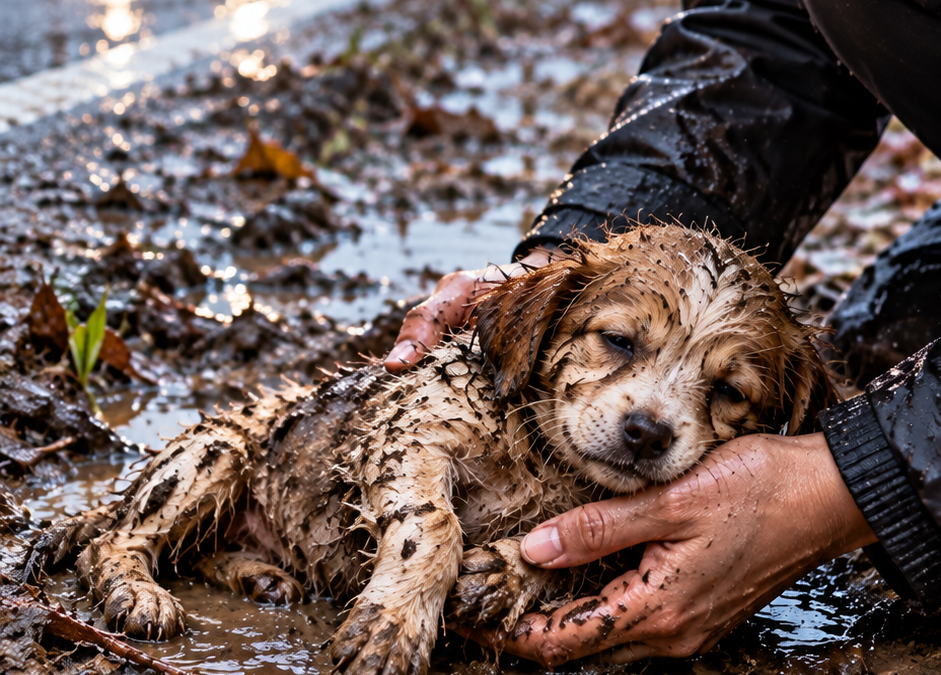
The previous day, he’d been lying in dirty water beside a road.
Now he had a name, a warm place to rest, and people watching over him.
I wanted to believe the hardest part was behind us.
I would soon discover how much patience his recovery required.
When I returned to the clinic, Lucky was still profoundly weak.
His condition hadn’t transformed overnight.
The treatment had begun, but his body was exhausted by dehydration, infection, and malnutrition.
He couldn’t simply shake off everything he’d endured and behave like a healthy puppy because someone had finally decided to care for him.
He needed time.
The veterinarian showed me where he was resting.
He opened his eyes briefly when I approached.
I froze.
“Hey, little guy.”
His gaze moved toward me.
It wasn’t the bright, inquisitive expression I hoped to see one day.
He looked tired.
Almost too tired to care who was standing beside him.
But his eyes were open.
I crouched.
“That’s right. You remember me?”
He blinked.
I smiled despite myself.
“Good. Because I’m going to be around for a while.”
I sat beside him for several minutes, speaking softly while the staff continued his care.
I told him ordinary things.
That the weather was better than it had been the previous day.
That his name suited him.
That he had managed to frighten a grown man more thoroughly than anything else I’d encountered in years.
Mostly, I told him he was doing well.
I didn’t know whether any of my words mattered medically.
But I knew gentle voices mattered to frightened animals.
And I wanted Lucky’s new experiences with people to be associated with warmth rather than danger.
The veterinarian joined me after completing another assessment.
“He’s still very fragile,” she said. “We’ll need to see how well he tolerates nutrition as he stabilizes.”
“Can he eat yet?”
“We’re taking that carefully. Even small amounts may be difficult for him right now.”
I looked at him.
The thought that he could be hungry and still too weak to eat comfortably was almost unbearable.
“Does he seem to be in pain?”
“We’re managing his condition and monitoring his comfort. Our priority is getting him stable enough to recover.”
I nodded.
There were moments when I wanted to ask a hundred questions and moments when I was afraid to ask even one.
What I really wanted to know was whether he would survive.
But the veterinarian had already explained the uncertainty.
So I sat beside him instead.
I watched his breathing.
I listened to the quiet activity of the clinic.
And I waited for the tiny changes that would tell us his body hadn’t given up.
The first few days became a strange combination of anxiety and routine.
I called every morning.
Whenever I could, I visited.
The staff continued administering fluids and medication, keeping Lucky warm, and carefully monitoring his condition.
Sometimes he seemed slightly more alert.
Other times, he slept through almost my entire visit.
His weakness made even ordinary movements look exhausting.
Lifting his head required effort.
Changing position seemed to consume what little strength he possessed.
Eating was still a challenge.
I learned to celebrate things I would never have noticed in a healthy dog.
The first time he raised his head without immediately lowering it.
The first time he looked toward a familiar voice.
The first time he seemed interested in the small amount of food being offered.
None of those moments would have impressed someone passing through the clinic.
To me, they were enormous.
One afternoon, I arrived just as a staff member was preparing a carefully measured portion of food.
“He’s been showing a little more interest,” she told me.
I tried not to become too excited.
“Really?”
She smiled.
“Watch.”
She brought the food closer.
Lucky sniffed it.
For a moment, nothing happened.
Then he extended his tongue and took a tiny amount.
I stared.
He paused.
Then he tried again.
I felt my eyes begin to sting.
“That’s it, buddy.”
The staff member glanced toward me.
“He’s taking it slowly, but this is encouraging.”
I nodded.
I didn’t trust myself to speak.
Watching an animal eat should have been the most ordinary thing in the world.
Yet I was standing in a veterinary clinic feeling as though I’d just witnessed an impossible achievement.
Lucky accepted another small portion.
Then he lowered his head, tired from the effort.
I wanted him to keep eating.
I wanted him to consume enough food to replace every missed meal, every cold night, and every day he’d spent searching for something to sustain him.
But the staff knew better.
His recovery had to proceed carefully.
I leaned toward him.
“You did good.”
He closed his eyes.
I gently rested my hand beside him.
For the first time since finding him, I could imagine a day when he might actually enjoy eating rather than struggle to manage it.
That evening, I bought a small dog bowl.
I didn’t need one yet.
Lucky was still receiving intensive care at the clinic, and there was no certainty about when he would be ready to leave.
But I saw the bowl while passing through a store and couldn’t bring myself to walk away.
It was simple and blue, with a rubber ring around the bottom to keep it from sliding.
I picked it up and turned it over in my hands.
I imagined Lucky standing in front of it, healthy enough to eat an ordinary meal.
Then I imagined him walking away when he’d finished, perhaps looking back to see whether someone had left a little more.
The thought made me smile.
I bought the bowl.
When I arrived home, I placed it on the kitchen counter.
It became a quiet reminder that I was still hoping for a future beyond the clinic.
But I didn’t allow myself to assume that future had been secured.
Lucky still had a serious infection.
He was still recovering from severe dehydration.
And his body needed time to regain strength after prolonged malnutrition.
The fact that he’d eaten a little didn’t mean every danger had disappeared.
I reminded myself of that whenever I began imagining too much.
Still, I left the bowl where I could see it.
Over the following days, Lucky continued making gradual progress.
His appetite slowly improved.
He began accepting the carefully planned meals offered by the veterinary staff.
His body responded to the consistent care.
He wasn’t suddenly energetic.
He didn’t leap from his bedding or start chasing toys.
But the changes were noticeable.
His breathing seemed less strained.
His eyes remained open for longer periods.
He began following people’s movements around the treatment area.
When I approached, he sometimes lifted his head before I spoke.
And one morning, I noticed something that nearly made me laugh.
His nose was moving.
He was sniffing the air.
I crouched beside him.
“What are you smelling?”
He looked at me.
I extended my hand.
He leaned forward just enough to sniff my fingers.
It was a tiny gesture.
But for the first time, Lucky seemed curious about something beyond his immediate discomfort.
I moved my hand away and brought it back.
He sniffed again.
“Well, look at you.”
One of the veterinary technicians smiled from across the room.
“He’s starting to show us his personality.”
I looked at Lucky.
He seemed unimpressed by our enthusiasm.
Then he closed his eyes and went back to resting.
I laughed.
“All right. I guess that was enough excitement for one morning.”
The more time I spent with him, the more I began to understand how complicated his recovery really was.
Physical illness wasn’t the only problem we had to address.
He had also experienced circumstances that left him vulnerable, exhausted, and uncertain.
We didn’t know what he’d endured before being found.
There was no reliable history to explain whether he’d once lived with a family, how long he’d been alone, or whether he had ever received proper veterinary care.
That uncertainty made me reluctant to invent explanations for his behavior.
If he withdrew from a hand reaching toward him, I couldn’t automatically assume someone had hurt him.
If he appeared frightened by an unfamiliar sound, I couldn’t know whether it reminded him of something that happened before the rescue.
All I could do was pay attention to what he needed now.
He needed predictable care.
He needed to learn that approaching people could bring food, comfort, and affection.
And he needed the freedom to develop that trust at his own pace.
Fortunately, Lucky seemed willing to give people a chance.
Even during the earliest days, when he had been too weak to resist examination, there had been moments when he relaxed beneath a gentle touch.
As his strength returned, that gentle disposition became increasingly apparent.
He didn’t suddenly become fearless.
But he began responding to familiar voices.
He watched the staff with growing interest.
And when someone sat quietly beside him, he sometimes shifted closer instead of withdrawing.
One afternoon, I was sitting near his bedding when he stretched his neck toward my hand.
I stopped moving.
His nose touched my fingers.
Then he rested his chin against my palm.
I looked at him.
“Hey.”
He didn’t move.
For several seconds, I simply held my hand beneath his head.
His eyes slowly closed.
I couldn’t remember the last time such a small gesture had affected me so deeply.
Here was a puppy who had been alone in filthy water, too weak to stand when I’d found him.
Now he was choosing to rest his head in a person’s hand.
I wondered whether he had ever known that kind of comfort before.
I hoped he had.
But if he hadn’t, I wanted it to become ordinary for him.
I wanted gentle hands to stop being something remarkable.
I wanted him to expect kindness without having to earn it.
I stayed with him until he fell asleep.
As the first week passed, the veterinary staff began sounding cautiously more optimistic.
Lucky was responding to treatment.
His appetite was improving.
His body was beginning to regain some of the strength he’d lost.
But the veterinarian remained clear about the need for continued monitoring.
I appreciated that.
I had become attached to him almost immediately, and attachment has a way of turning every hopeful sign into a promise.
The medical team wouldn’t allow me to confuse the two.
“He’s making progress,” the veterinarian explained during one of my visits. “But he still needs treatment and time to recover.”
I nodded.
“What should I be looking for?”
“Steady improvement. Better appetite, more strength, increased alertness. We want his condition to keep moving in the right direction.”
I glanced toward Lucky.
He was lying comfortably, watching a staff member cross the room.
“He’s definitely more interested in what’s happening.”
“That’s encouraging.”
“Yesterday, he spent five minutes investigating my shoelace.”
She laughed.
“That sounds like a puppy.”
The words caught me unexpectedly.
A puppy.
Not a critical patient.
Not a severely dehydrated stray.
Not an abandoned animal fighting for survival.
Just a puppy.
I looked at him again.
He was resting with his front paws stretched out, his eyes following every movement around him.
For a brief moment, I could imagine him as an ordinary young dog whose greatest problem was deciding whether to chew a shoelace or take another nap.
That image carried me through the next stage of his recovery.
His progress became more visible during the second week.
He was still thin, but his body no longer looked quite so depleted.
His coat, once soaked and matted, began looking softer and healthier with proper care.
His eyes grew brighter.
And his curiosity, which had first appeared in brief, uncertain moments, became a regular part of his behavior.
He wanted to know who was entering the room.
He wanted to investigate unfamiliar smells.
He seemed increasingly interested in whatever the veterinary staff were doing, especially when food was involved.
I began recognizing the different expressions on his face.
There was the sleepy look he gave me when I arrived during one of his naps.
The alert expression that appeared when he heard a bowl being prepared.
And the particular enthusiasm he reserved for people who approached him with familiar, gentle voices.
His tail began participating in those greetings.
At first, the movement was barely noticeable.
One day, I leaned over his bedding and said his name.
“Lucky.”
His eyes opened.
Then the very end of his tail shifted.
I waited.
“Lucky?”
It moved again.
I stared at him.
“Was that for me?”
The technician standing nearby laughed.
“I think he’s happy to see you.”
I grinned.
The next time I said his name, his tail moved more noticeably.
I had to look away for a moment.
It seemed ridiculous that a small tail wag could make a grown man feel so emotional.
But I remembered the dog I’d lifted from the puddle.
His body had been limp.
His breathing had frightened me.
He hadn’t even possessed the strength to raise his head.
And now he was greeting someone.
It was the first time I genuinely believed I might one day see him running.
That afternoon, Lucky tried to stand.
He had been repositioning himself on his bedding when he placed his front paws more firmly beneath his chest.
Then he pushed upward.
His hindquarters shifted.
For a moment, he seemed determined to lift his entire body.
I leaned forward.
“Easy, buddy.”
He managed only a limited movement before settling back down.
I looked toward the technician.
“Did you see that?”
She nodded.
“He’s getting stronger.”
Lucky appeared entirely unconcerned by our excitement.
He lowered his head and started investigating a fold in his blanket.
I smiled.
“All right. We’ll save the celebration for later.”
But I carried that moment home with me.
I could still see the effort in his small body.
He hadn’t been able to stand when I found him.
Now he was trying.
I remembered how frightened I’d been while driving him to the clinic.
I remembered the veterinarian telling me his condition was critical.
And I began to understand that recovery was built from dozens of moments like this.
A little more food.
A longer period of alertness.
A tail wag.
An attempt to stand.
None of them would have saved him alone.
Together, they were beginning to change his life.
As Lucky improved, I found myself visiting the clinic for reasons that had less to do with checking his medical condition and more to do with simply seeing him.
Of course, I still asked how he was doing.
I listened carefully to every update.
I wanted to know whether he was eating, whether his treatment was progressing, and whether the staff had noticed any new concerns.
But once those questions were answered, I often remained beside him.
Sometimes we didn’t do anything particularly interesting.
I sat in a chair while he slept.
I talked to him about the weather.
I watched him investigate the bedding or attempt to reach a nearby toy.
He began recognizing my presence before I reached him.
At least, that was how it seemed.
When I approached, his head came up.
His tail started moving.
And if I didn’t greet him quickly enough, he sometimes shifted impatiently, as though I had failed to understand the purpose of my visit.
“All right, all right. I’m coming.”
I crouched beside him.
He pushed his nose into my palm.
“There you are.”
I couldn’t tell whether he remembered the day I’d rescued him.
I doubted he understood that I was the person who’d carried him from the roadside to the clinic.
But he knew me now.
And that was enough.
The veterinary staff had also grown attached to him.
I saw it in the way they greeted him.
In the affectionate names they used.
In the smiles that appeared whenever he demonstrated another little improvement.
He had entered the clinic as a critically ill puppy whose future was uncertain.
Now he was becoming the kind of patient people looked forward to seeing.
His gentle nature made it easy.
Even when he was tired, he seemed to appreciate quiet affection.
As he recovered, he became more comfortable around the people caring for him.
He wasn’t demanding.
He didn’t need elaborate entertainment.
Sometimes he seemed perfectly content to lie beside someone and receive an occasional scratch behind the ears.
Other times, his growing energy made him restless.
He wanted to explore.
He wanted to investigate the boundaries of his little world.
And he was beginning to discover that his body could do things it hadn’t been capable of doing when I found him.
One afternoon, he surprised us all by standing more confidently.
I had just arrived when the technician called me over.
“You’re going to want to see this.”
Lucky was resting on his bedding.
She encouraged him gently.
“Come on, sweetheart.”
He raised his head.
Then he positioned his paws beneath himself.
I watched as he pushed upward.
His legs trembled slightly.
For a second, I thought he would settle back down.
Instead, he remained upright.
I covered my mouth.
“Look at you.”
Lucky looked toward me.
His tail moved.
I laughed.
“You’re standing!”
The technician smiled.
“He’s been getting stronger.”
Lucky took a small, uncertain step.
Then another.
His movements weren’t graceful.
He still needed time to rebuild his strength.
But the puppy who had once been unable to support his own weight was beginning to move independently again.
I crouched a short distance away.
“Come here, buddy.”
He looked at me.
Then he started toward my voice.
It was a short journey.
Only a few careful steps.
But when he reached me, I felt as though he’d crossed the greatest distance imaginable.
I offered my hand.
He sniffed it, then leaned forward for affection.
“That’s my boy.”
I kept my voice quiet because I didn’t want to overwhelm him.
But inside, I was celebrating more than I knew how to express.
For the first time, I could look at Lucky and see his future without immediately imagining everything that might go wrong.
He still needed care.
His recovery wasn’t finished.
But he was beginning to behave like the healthy puppy he’d always deserved the chance to become.
By the third week, Lucky’s transformation was unmistakable.
The severely undernourished dog I’d found in dirty water had gained weight.
His once-dull eyes were bright and curious.
His coat looked healthier.
His strength had returned enough for him to walk confidently.
And his tail seemed determined to make up for every day it had remained motionless.
I remember the first time I saw him cross the recovery area with real enthusiasm.
He noticed me standing near the doorway.
His ears lifted.
Then he hurried toward me.
Not with the uncertain steps of a critically ill animal.
With the eager movement of a puppy who recognized someone he liked.
I crouched just before he reached me.
He pressed against my hands.
His tail wagged so enthusiastically that his entire body seemed involved.
I laughed.
“Where did all this energy come from?”
He sniffed my sleeves, investigated my shoes, and then turned toward a nearby toy as if he had suddenly remembered that he had other important responsibilities.
The technician standing beside me shook her head.
“Three weeks ago, he couldn’t even stand.”
I watched him investigate the toy.
“I know.”
I knew better than anyone how extraordinary that change was.
I could still remember every detail of the roadside puddle.
The mud.
The coldness of his soaked fur.
The frightening stillness of his body.
The moment I’d wondered whether he would survive long enough to reach the clinic.
Now he was walking with confidence, wagging his tail, and discovering the simple pleasures of being young.
I looked toward the veterinarian.
“Is he going to be okay?”
She smiled.
“He’s made remarkable progress. We’ll make sure his recovery and follow-up care are properly managed, but he’s doing very well.”
I let out a breath I felt I’d been holding for three weeks.
Lucky had survived the most dangerous part of his ordeal.
He was no longer simply hanging on.
He was beginning to enjoy being alive.
With his health improving, another important question entered our conversations.
What would happen when Lucky was ready to leave the clinic?
It was a question I’d been avoiding.
Part of me wanted to keep him close forever.
I’d been the one who found him.
I’d driven him to the veterinary clinic, frightened that every second might be his last.
I’d visited through the uncertain early days and watched him take his first confident steps.
I’d become attached to him in a way I hadn’t expected.
But I also understood that rescue wasn’t supposed to end with an animal remaining indefinitely in a treatment facility.
Lucky deserved a permanent home.
He needed people who could provide consistent care, a safe environment, proper nutrition, and the companionship he seemed to enjoy so much.
He needed a family who would love him for the rest of his life.
The veterinary staff began considering his next chapter as his recovery progressed.
I tried to focus on what would be best for him rather than on how much I would miss him.
That wasn’t always easy.
I had grown accustomed to seeing his face.
Sometimes I caught myself imagining how it would feel to walk into the clinic and discover that his space was empty.
Not because something terrible had happened.
Because something wonderful had happened.
Because he had finally found a home.
I knew that was what I wanted for him.
I just hadn’t anticipated how difficult it would be to let him go.
One afternoon, I sat beside him while he rested after playing.
He had discovered that a soft toy could be carried around and dropped at people’s feet, apparently in the expectation that someone would return it.
I picked it up.
“You’re going to make somebody very happy.”
He looked at the toy.
I placed it beside him.
He immediately picked it up again.
I smiled.
“Whoever adopts you is going to have their hands full.”
His tail moved.
Then he settled down with the toy resting between his paws.
I stroked the top of his head.
I wondered about the family he would eventually meet.
Would they have a comfortable place for him to sleep?
Would they laugh when he carried toys from one room to another?
Would they remember to be patient if he seemed frightened by an unfamiliar experience?
Would they understand that his recovery was about more than gaining weight and learning to walk?
I wanted him to feel safe.
Not occasionally.
Not only when someone happened to have time for him.
Every day.
I wanted his future to be so ordinary and full of affection that the roadside puddle would become nothing more than the place where our lives had briefly crossed.
The family arrived sooner than I expected.
I was at the clinic when I learned that people interested in adopting Lucky were coming to meet him.
For a moment, I felt an uncomfortable mixture of excitement and sadness.
I had spent weeks hoping someone would give him a permanent home.
Now that the opportunity had arrived, I realized how attached I’d become.
The staff explained that the family wanted to meet him and learn more about his recovery.
I agreed to be there.
I wanted to see the people who might become the most important part of his life.
When they entered the clinic, Lucky was resting comfortably.
He lifted his head as unfamiliar voices approached.
I watched carefully.
I didn’t want him overwhelmed.
But he seemed curious.
One of the family members crouched a short distance away.
“Hello, Lucky.”
His ears moved.
The person extended a hand and waited.
Lucky sniffed the air.
Then he approached.
I felt my chest tighten.
He moved with the confidence that had seemed impossible when I first found him.
The family greeted him gently.
They didn’t rush him or insist on picking him up immediately.
They allowed him to investigate their hands, their shoes, and the unfamiliar smells they’d brought into the room.
Lucky seemed delighted.
His tail began wagging.
Soon he was moving between them, accepting affection as though he’d been waiting all his life for this particular introduction.
I stood back and watched.
There was something almost unbearable about seeing him so comfortable with people he’d only just met.
Not because I wanted him to be frightened of strangers.
Quite the opposite.
I wanted him to trust people.
I wanted the world to become something he could explore with curiosity instead of fear.
But watching that happen made me realize how completely his life had changed.
The little dog who had once been too weak to lift his head was now choosing which stranger should pet him next.
One family member looked toward me.
“Is he always this sweet?”
I laughed.
“He’s been gentle from the beginning. He’s just finally strong enough to show everyone how much personality he has.”
Another person stroked his ears.
“He’s wonderful.”
Lucky leaned into the touch.
I smiled.
“He seems to agree.”
The conversation gradually turned toward his medical history.
The veterinary staff explained his condition when he’d arrived, the treatment he’d received, and the progress he’d made during his recovery.
They discussed the care he would need moving forward.
The family listened attentively.
They asked questions.
They wanted to understand how to keep him healthy and comfortable.
I watched their expressions as they learned about his first days.
The dehydration.
The infection.
The severe weakness that had made standing impossible.
The uncertainty about whether his body would respond to treatment.
One of them looked down at Lucky.
“You went through all of that?”
He was busy investigating a shoelace.
The contrast almost made me cry.
There we were, discussing how close he’d come to losing his life, while he remained completely absorbed in the fascinating possibility that a shoelace might become a toy.
The family laughed.
And suddenly, the room felt lighter.
Lucky didn’t know he was being considered for adoption.
He didn’t understand that the people around him were deciding where he might spend the rest of his life.
He was simply enjoying the attention.
But I could see the connection forming.
It was there in the way the family watched him.
In the gentle voices they used.
In the questions they asked about his care.
And in the way one person continued stroking his back long after the initial excitement of meeting him had passed.
There was no dramatic announcement.
Nobody stood up and declared that destiny had brought them together.
The decision seemed to develop naturally from the simple fact that Lucky was comfortable with them and they clearly wanted him in their lives.
Eventually, one of them looked toward the veterinary staff.
“We’d love to give him a home.”
I glanced down at Lucky.
He was resting contentedly beside them.
I felt an unexpected pressure behind my eyes.
The family continued discussing the adoption arrangements and the responsibilities involved in caring for him.
I listened, trying to remain composed.
For three weeks, I’d been hoping he’d survive.
Now people were talking about where he would sleep, what he’d eat, and how to help him settle into their household.
They were discussing a future.
A real future.
One that extended far beyond the next medical assessment or the next cautiously encouraging update.
Lucky had people who wanted him.
And soon, he would have a home.
The day he left the clinic was more emotional than I expected.
The staff had grown attached to him.
I could see it in the way they gathered to say goodbye, offering gentle affection and smiling at his excitement.
Lucky moved between familiar faces, his tail wagging as though he had no idea the occasion was significant.
Maybe that was for the best.
He didn’t need to understand what it meant to leave a place that had once been essential to his survival.
He only needed to know that the people taking him away would continue caring for him.
I crouched beside him.
“Hey, buddy.”
He turned toward me immediately.
His tail began moving.
I stroked his head.
“Remember me?”
He pressed his nose into my hand.
I smiled, although my throat had suddenly become tight.
“Of course you do.”
I had imagined this moment several times.
I thought I might give him a long farewell, telling him how proud I was of everything he’d overcome.
Instead, I found myself remembering the day I’d lifted him from the puddle.
How little he weighed.
How cold his fur had been.
How desperately I’d wanted to feel his chest moving against my hand.
Now he was standing in front of me, warm and healthy, leaning against my knee because he wanted another scratch behind the ears.
The difference overwhelmed me.
“You gave us quite a scare,” I whispered.
He looked up at me.
I laughed softly.
“You have no idea.”
One of his new family members approached.
“We’ll take good care of him.”
I looked at them.
For a moment, I couldn’t speak.
Then I nodded.
“I believe you will.”
I gave Lucky one last gentle stroke.
“Go on, sweetheart. Your family’s waiting.”
He looked toward them.
Then back at me.
I don’t know whether he sensed anything unusual about the moment.
He certainly didn’t appear sad.
When his new family called his name, he moved toward them with the same enthusiasm he’d begun showing everyone he trusted.
I watched them leave together.
Lucky walked confidently.
His tail was raised.
He looked around with the bright curiosity of a healthy young dog.
I stood in the clinic doorway until they were out of sight.
Then I went back inside and sat down.
The treatment space that had belonged to him was empty.
For a moment, I felt the absence more strongly than I’d expected.
I had visited him so often that the clinic had become part of my daily routine.
I knew where he liked to rest.
I knew how he responded when someone called his name.
I knew the little expression that appeared whenever he suspected food was nearby.
And now all those familiar moments were going somewhere else.
I reminded myself that this was the outcome we’d wanted.
An empty recovery space could be a beautiful thing when it meant the patient had gone home.
Still, I missed him.
I missed him before the day was over.
When I returned to my house that evening, the blue dog bowl was still sitting on the kitchen counter.
I picked it up.
I had bought it during the uncertain first week, when I wasn’t sure Lucky would survive.
At the time, I’d imagined him eating from it someday.
Now he was settling into a home of his own, where he would have everything he needed.
I turned the bowl over in my hands.
Then I smiled.
He wouldn’t need the bowl I’d bought.
His new family would have one waiting for him.
And that was exactly how it should be.
As Lucky settled into his new home, I continued receiving updates about his progress.
The first time I saw photographs of him with his family, I stared at them for far longer than necessary.
He looked comfortable.
Not merely alive.
Not simply recovering.
Comfortable.
He had soft places to sleep, regular meals, and people who clearly enjoyed his company.
His expression was bright.
His coat looked healthy.
And his tail seemed to be in almost constant motion whenever someone paid attention to him.
I studied the photographs carefully, searching for the dog I remembered from the roadside.
There were traces of him, of course.
The same face.
The same eyes.
The same small body I’d carried in my jacket.
But everything else had changed.
He was no longer lying motionless in filthy water.
He wasn’t struggling to eat.
He wasn’t spending his days under close medical supervision while everyone waited to see whether the infection would improve.
He was living.
He was playing.
He was discovering what it meant to belong somewhere.
One update described how much he enjoyed affection.
Another showed him resting comfortably.
I smiled when I learned that his gentle personality had continued blossoming in his new surroundings.
That was the part of his recovery I’d never wanted anyone to overlook.
Saving his life had been essential.
Restoring his health had required enormous effort.
But the opportunity to experience companionship, security, and ordinary happiness was what made the entire journey feel complete.
Lucky wasn’t simply a medical success.
He was a young dog who had been given the chance to become himself.
I thought about the veterinarian who’d first examined him.
The technician who’d celebrated his first small attempts to eat.
The staff members who’d kept him warm and watched over him when he was too weak to do anything for himself.
Everyone had played a part in bringing him to this moment.
But now his family would take over.
They would be the people who greeted him in the morning.
They would notice when he wanted attention.
They would provide his meals, arrange his veterinary care, and make room for him in the ordinary routines of their lives.
That was the kind of care he deserved.
Not a single dramatic rescue followed by uncertainty.
A dependable life.
The kind most loved pets are fortunate enough to take for granted.
Sometimes I still think about the morning I found him.
Usually, the memory arrives unexpectedly.
I might be driving past a wet roadside after heavy rain.
Or I might see a small dog sleeping comfortably against its owner’s legs.
Something ordinary will remind me of that filthy puddle and the almost invisible movement that made me stop.
I remember kneeling in the mud, trying to determine whether the tiny animal in front of me was still alive.
I remember the way his head rested against my wrist.
I remember being frightened that I might accidentally hurt him simply by lifting him.
Most of all, I remember the drive to the clinic.
The way I kept glancing toward him.
The way I talked because I couldn’t bear the silence.
The way I begged him to keep breathing for just a little longer.
At the time, I didn’t know whether any of it would matter.
There are things compassion can do immediately.
It can remove an animal from danger.
It can provide warmth.
It can bring a critically ill puppy to people with the knowledge and equipment needed to treat him.
But compassion alone cannot guarantee survival.
Lucky’s body still had to respond to treatment.
The veterinary staff had to manage his dehydration and infection, support his nutrition, and monitor every stage of his recovery.
And once he was healthy enough, someone had to offer him a permanent home.
His second chance depended on all those things coming together.
I had been fortunate enough to take the first step.
But it took an entire group of people to give him the life he deserved.
I think about that whenever someone calls him lucky.
He was fortunate that someone noticed him.
He was fortunate to reach a clinic in time to receive treatment.
He was fortunate that his body responded and that a family eventually welcomed him into their home.
But I sometimes wonder whether the name tells only half the story.
He was also determined.
Even when his body was frighteningly weak, he kept breathing.
When eating was difficult, he gradually began accepting food.
When standing was beyond his strength, he rested until he could try again.
And when he finally became healthy enough to walk, his curiosity returned as though the world still had an endless supply of wonderful things waiting to be discovered.
I never want to romanticize what he endured.
There was nothing beautiful about finding an undernourished puppy lying helplessly in filthy water.
His suffering wasn’t necessary to prove that he was special.
He deserved food, shelter, veterinary care, and affection long before I found him.
But the resilience he showed during his recovery made a lasting impression on everyone who cared for him.
He had been given so little.
And once he had the chance, he embraced everything that came afterward.
The photographs from his new home eventually replaced the image of the roadside in my mind.
I could picture him resting in a comfortable bed.
I could imagine him waiting for meals and looking up eagerly whenever a familiar person entered the room.
I knew he had begun enjoying the ordinary pleasures of a cherished family pet.
Those details might sound insignificant compared with the drama of his rescue.
To me, they were the most important part of the story.
A dog shouldn’t have to fight for survival to experience a soft bed.
He shouldn’t have to endure hunger before someone decides he deserves a regular meal.
He shouldn’t have to become critically ill before receiving gentle affection.
Lucky had already lived through more hardship than any puppy should experience.
His new life didn’t need to be extraordinary.
It only needed to be safe.
And in his permanent home, surrounded by people who loved him, he finally had that.
The last time I looked at an update from his family, I found myself smiling before I’d even finished reading it.
There he was.
Healthy.
Comfortable.
Loved.
The little dog who had once been too weak to lift his head now had people who knew his habits, recognized his moods, and made space for him in their daily lives.
I thought about the morning I’d stood beside the road with muddy water soaking through my shoes.
At the time, I’d wanted only one thing.
For him to survive long enough to reach the veterinarian.
I hadn’t dared imagine everything that would follow.
The small improvements.
The first tail wag.
The first confident steps.
The family who would kneel beside him and decide they wanted him to stay forever.
All of it had begun with a tiny movement in a dirty puddle.
I set my phone down and sat quietly for a moment.
I realized that what moved me most wasn’t how dramatically Lucky’s appearance had changed.
It was the fact that he would no longer have to wonder where he belonged.
Someone would be waiting for him every evening.
Someone would notice if he wasn’t feeling well.
Someone would make sure his bowl was full and his bed was warm.
Someone would call his name simply because they were happy to see him.
I thought of the puppy I’d carried in my jacket and how frightened I’d been that he might stop breathing before we reached the clinic.
Then I thought of the healthy young dog sleeping peacefully in his new home.
For the first time, the memory of that roadside didn’t hurt quite as much.
Lucky had made it.
And I knew that somewhere, surrounded by the family who had chosen him, he was no longer fighting to survive.
He was simply home.








