𝗙𝗨𝗟𝗟 𝗦𝗧𝗢𝗥𝗬 The Ticket Girl at Station Seventeen Carried an Old Rifle, a Missing Nameplate, and a Secret the Colorado Open Had Buried for Twenty Years
𝗣𝗔𝗥𝗧 𝟮
Ben released the rifle.
“No.”
“You barely inspected it.”
He looked at Victoria.
“I know what I’m looking at.”
His tone ended the conversation.
He passed the rifle.
After walking three stations away, he looked back.
I saw him do it.
Victoria did too.
“You know him?”
“No.”
“He knows that rifle.”
“He recognized the design.”
“You should withdraw before you damage it.”
I placed my employee tag beside the ammunition box.
“I didn’t bring it here to protect it.”
“What did you bring it for?”
I looked at the target field.
“To use it.”
The final horn sounded.
Range officers raised flags.
Spectators moved behind the safety line.
Thirty-two competitors.
Five qualifying stages.
Eight would advance.
The first stage used steel plates at six hundred yards.
Three hits required.
Five rounds permitted.
I placed three cartridges beside the rifle.
Victoria saw them.
“You only brought three?”
“For this stage.”
“You get five.”
“I read the rules.”
“You’ll need all five.”
“I hope not.”
Wind moved across the valley.
Not strongly yet.
Tall grass leaned east.
Dust drifted low over the gravel.
A yellow ribbon tied near the fencing twisted twice, settled, then lifted again.
My father’s voice lived in my head.
Never ask where the wind is.
Ask where the wind has been.
The green light appeared.
Thirty-one shooters seemed to fire at once.
The roof magnified every report.
Steel rang downrange.
Monitors flashed.
Victoria fired almost immediately.
Hit.
The crowd behind station eighteen applauded.
Second shot.
Hit.
Third.
Slightly left, but good.
Eleven seconds.
She lifted her head and smiled toward a camera.
Then looked at me.
I was still standing.
Twenty seconds had passed.
“Clock’s running,” she said.
I watched a ribbon rotate.
Dust crossed the firing line.
A gust passed.
“Scared to pull it?”
People laughed.
I sat.
The worn stock came into my shoulder.
The cheek weld felt so familiar that the noise around me vanished.
I closed my eyes for one breath.
My father used to stand behind me when I was a child.
He never touched the rifle while I aimed.
Never corrected me mid-shot.
Never moved the barrel.
If I missed, he waited.
Then he asked one question.
“What did you see?”
Not “Why did you miss?”
What did you see?
I opened my eyes.
The world narrowed.
Target.
Wind.
Breath.
Pressure.
The first shot broke.
The old rifle recoiled into my shoulder.
A moment later, steel answered.
The monitor flashed.
Perfect center.
The laughter disappeared.
I worked the bolt.
The casing rolled across the bench.
Victoria stared at the monitor.
“Lucky.”
I chambered the second round.
Fired.
Steel.
Another center hit.
Nobody laughed.
The third cartridge slid into the chamber.
I breathed out.
Pressed.
Ring.
Three rounds.
Three hits.
A tight group.
I opened the bolt and stood.
The scorekeeper walked to the monitor.
He checked it twice.
Then looked at the target feed.
“No scoring error.”
Victoria removed one side of her hearing protection.
“She’s shooting an antique with factory ammunition.”
The scorekeeper shrugged.
“The target doesn’t care.”
A few spectators laughed.
At Victoria.
Her face tightened.
I collected my brass.
I always collected brass.
My father had trained that habit into me long before I understood reloading.
Victoria watched.
“You caught favorable wind.”
“We had the same wind.”
“I shot first.”
“That was your decision.”
My score ranked above hers.
That should have felt satisfying.
Instead, it scared me.
Because suddenly this thing I had imagined privately for years had become real.
I had not come to prove Victoria wrong.
I had come to find out whether my father had been right.
About me.
About everything he had taught me.
The second stage stretched to eight hundred yards.
Five shots permitted.
Best four counted.
By then, the wind had strengthened.
Victoria’s assistant used a tablet, weather meter, and ballistic program.
He whispered into her ear.
I drank from my dented water bottle.
Someone in the bleachers shouted, “Nice shooting, ticket girl!”
This time the nickname sounded different.
I looked up.
A woman waved.
I nodded.
Victoria turned toward the crowd.
“One decent group doesn’t make a champion.”
“No one said it did,” I replied.
“You’re enjoying this.”
“I’m preparing.”
“For what?”
“The next stage.”
She stepped closer.
“You think staying calm makes you intimidating?”
“No.”
“Then why aren’t you nervous?”
I surprised her.
“I am.”
She paused.
I screwed the cap back onto my bottle.
“I just don’t give nerves control.”
Her assistant looked down.
Victoria did not answer.
The stage began.
Shots started slower this time.
The wind shoved rounds away from center.
Victoria followed her assistant’s calls.
First hit right.
Second better.
Third near center.
Fourth missed the scoring ring.
A murmur moved through her supporters.
She fired quickly again.
Low.
Still a respectable score.
Not what she wanted.
She looked at me.
I still had not fired.
“You can’t wait forever.”
I watched the sponsor banners.
They were pulling east.
Then one twisted.
Another snapped west.
Several experienced shooters raised their heads.
There.
The valley was changing.
I dropped behind the rifle.
First shot.
Center.
Second.
Within an inch.
Victoria’s assistant whispered, “She corrected before the shift registered.”
Victoria snapped, “Watch my station.”
He obeyed.
I waited.
The wind dipped.
Two more rounds.
Both inside.
Four hits.
I left the fifth cartridge untouched.
Again, my score remained above Victoria’s.
People clapped.
Not everyone.
Enough.
Victoria stood.
“She’s getting wind calls.”
Ben turned toward her.
“From whom?”
“I don’t know.”
“You made the accusation.”
“She has no instruments.”
“People read wind before lithium batteries.”
“Not like that.”
Ben looked at me.
“Are you receiving any outside assistance?”
“No.”
“Communication device?”
“No.”
He inspected my collar and hearing protection.
Checked the bench.
Then Victoria demanded the rifle be inspected again.
I stepped back.
“Go ahead.”
Ben lifted it.
Removed the bolt.
Inspected the chamber.
Checked the fixed-power scope.
No electronics.
No hidden equipment.
He returned it.
“Legal.”
Victoria folded her arms.
“That belongs in a museum.”
I looked at her.
“Then losing to it should concern you.”
The reaction came instantly.
Laughter.
Applause.
I regretted saying it almost immediately.
Not because it was untrue.
Because my father disliked people who mistook applause for proof.
Victoria stared at me.
“You haven’t won anything.”
“I know.”
“You won’t survive the moving stage.”
“We’ll see.”
“You people always say that.”
I stopped.
“What people?”
Her eyes moved to the employee tag.
“Amateurs who mistake luck for talent.”
I clipped the tag back onto my shirt.
“I earned this job.”
“That might be the only thing you earn today.”
I turned away.
The third stage was a moving steel plate at seven hundred yards.
Four passes.
Two hits required.
Victoria specialized in moving targets.
I knew because I had watched her compete the previous two summers.
She was good.
Extremely good.
People forget that cruel people can still be talented.
She tracked smoothly.
Hit the front edge.
Then closer to center.
Missed the third.
Hit again on the fourth.
Strong score.
She turned toward me.
“Try not to shoot the motor.”
I loaded one cartridge.
The scorekeeper noticed.
“You have four passes.”
“I know.”
Victoria laughed.
“She forgot ammunition.”
The first pass began.
I stayed standing.
The plate crossed.
Disappeared.
Whispers.
Second pass.
Still nothing.
Victoria shouted, “It moves, genius!”
I watched the grass.
Third pass.
The conditions aligned.
I shouldered the rifle.
Tracked ahead.
Pressed.
The plate snapped.
Dead center.
The monitor displayed the highest possible score.
For two seconds, nobody reacted.
Then the bleachers erupted.
I opened the action.
Removed the rifle from my shoulder.
One shot.
I had needed one.
The teenage boy who laughed at me earlier was now yelling louder than anybody.
Victoria stared at the board.
“That’s impossible.”
The scorekeeper did not even look at her.
“Confirmed.”
“She guessed the lead.”
“That’s generally how moving targets work.”
Victoria turned on him.
Her assistant intervened.
“Save your focus.”
“You’re supposed to help me.”
“I am.”
“Then explain her.”
He looked at me.
“I can’t.”
Ben came over.
“Why skip the first two passes?”
“Wind.”
“And the fourth?”
“I didn’t need it.”
His eyes returned to the missing nameplate.
“How long have you been shooting that rifle?”
“Years.”
“Where?”
“Family land west of Pueblo.”
“Your father’s?”
“Yes.”
“Your father removed the plate?”
“Yes.”
“Why?”
That question hurt more than it should have.
Because I had asked my father the same thing.
He always gave me some version of the same answer.
Names make people look backward.
So I repeated what he told me.
“He wanted me looking at the target.”
Ben went still.
Behind him, Victoria filed a formal protest.
First coaching.
Then ammunition.
Then employee status.
Then my age.
I was twenty-two.
Every protest failed.
Ben produced the paperwork.
Victoria finally said, “Employees shouldn’t be allowed into sponsor events.”
Ben replied, “The rules do not prohibit it.”
“My sponsors help pay for this range.”
“They did not purchase the rulebook.”
Her face changed.
“If this turns into a spectacle, sponsors will complain.”
Ben looked toward the spectators.
“It became a spectacle when you blocked her entrance.”
Victoria looked around.
The cameras.
Phones.
People who had watched everything.
Suddenly she smiled.
“I was joking.”
I felt something cold settle inside me.
“You hit my shoulder.”
“I barely touched you.”
“You touched my rifle case.”
“It survived.”
“That wasn’t your decision.”
Victoria looked directly at me.
“You want an apology?”
“I want you to stop pretending cruelty becomes harmless when people notice.”
Silence.
Ben looked at me.
So did several reporters.
Victoria’s eyes flicked toward her sponsors.
“I’m sorry you misunderstood.”
“That isn’t an apology.”
“You’re not getting another one.”
I nodded.
“Then save your energy.”
“For what?”
“The semifinal.”
The qualifying board updated.
My name appeared at the top.
First.
Victoria was fourth.
Eight of us advanced.
For the first time all day, people called my name as I walked.
Some wanted photographs.
Others offered congratulations.
I thanked them and kept moving.
Attention frightened me more than mockery.
Mockery was simple.
You knew where it came from.
Applause could make you forget what you came to do.
During the break, I sat under the shade structure cleaning dust from the bolt.
The teenage boy approached.
His father stood behind him.
“Miss Hayes?”
I looked up.
He held out a cold water bottle.
“I’m sorry I laughed.”
I accepted it.
“What changed your mind?”
His face reddened.
“You hit everything.”
“That shouldn’t decide whether you respect somebody.”
His eyes dropped.
“No, ma’am.”
His father said quietly, “We both owe you an apology.”
I nodded.
“Make the next person’s day easier.”
He put his phone away.
“That seems fair.”
They left.
Victoria had watched.
“You enjoy making everyone guilty?”
“I’m cleaning my rifle.”
“You’re performing humility.”
I continued working.
She crouched near the bench.
“You think this makes us equals?”
“We’re in the same competition.”
“That does not make us equal.”
“What would?”
“Years of training.”
I pushed the bolt back into place.
“Then your advantage should be obvious.”
Her left hand trembled.
Very slightly.
She curled it into a fist when she saw me notice.
“You’re going to break,” she said.
“Maybe.”
“You admit it?”
“Everyone can break.”
“I don’t.”
I looked at her hand.
“You missed because the wind changed.”
“Everybody misses.”
“Then we agree.”
She walked away.
The semifinal target sat at one thousand yards.
Six rounds allowed.
Consecutive misses could eliminate us.
The first shooter missed twice.
Out.
The second survived.
Another had a malfunction.
Officials cleared his weapon.
Victoria shot fifth.
Two beautiful center hits.
Then one drifting left.
Fourth inside.
Fifth miss.
The pressure changed her breathing.
Her assistant whispered.
Final shot.
Hit.
She survived.
I shot last.
Four cartridges.
Ben saw them.
“You’re allowed six.”
“Four should be enough.”
Victoria heard.
“Arrogance looks strange on you.”
I ignored her.
The wind moved southwest near us.
Farther downrange, brush leaned differently.
Two currents.
I adjusted the scope.
Three clicks.
First shot.
Hit.
Second.
Slightly high.
Third.
Inner ring.
Then the wind strengthened.
I waited.
The clock fell.
Victoria watched the monitor.
“She waited too long.”
Ben said nothing.
The wind collapsed.
Fence ribbons went almost still.
For perhaps two seconds, the valley gave me a lane.
I fired.
Steel.
Four confirmed hits.
Advanced.
No extra ammunition.
Only three shooters remained.
Daniel Ross.
Victoria Blake.
Me.
The final involved three distances.
Eight hundred.
One thousand.
Then beyond twelve hundred yards.
Reporters swarmed Ben during the reset.
“Who is she?”
“Has she competed under another name?”
“What rifle is that?”
Ben answered only what he could verify.
Then one reporter asked, “Do you recognize the rifle?”
Ben looked toward me.
“I recognize the work.”
He walked away.
I sat near a storage building with the rifle across my knees.
My thumb rubbed the pale rectangle where the silver plate used to be.
For the first time that day, I felt truly afraid.
Not of the final.
Of Ben.
Of the way he looked at the rifle.
Of the questions my father had refused to answer.
My father, Thomas Hayes, had died three years earlier when a truck crossed the centerline outside Pueblo.
There was no goodbye.
No final conversation.
No last lesson.
Just a sheriff at my door and a workshop that still smelled like gun oil and cedar.
After the funeral, I found a box behind one of his workbenches.
Competition medals.
Newspaper clippings.
Photographs.
Most had been damaged deliberately.
Names scratched.
Plates removed.
Pictures cut.
I asked my mother.
She only said, “Your father had another life before you were born.”
He had taught me to shoot.
He had never told me he once competed seriously.
Whenever I asked why he stopped, he said, “Some targets cost too much.”
I thought he meant money.
Maybe he never did.
Ben approached.
“Can I sit?”
“It’s county property.”
He sat.
For a while, neither of us spoke.
Then he looked at the missing plate.
“I saw that rifle twenty years ago.”
I stopped rubbing the wood.
“You’re mistaken.”
“The crack along the stock was repaired with a brass pin underneath the grip.”
My throat tightened.
“Many rifles are repaired.”
“I installed that pin.”
I looked at him.
For the first time in three summers, Ben Carter did not look like the match director.
He looked like a man who had been waiting years for something he never expected to see.
“What was your father’s name?”
I almost refused.
Then I said it.
“Thomas Hayes.”
Ben lowered his head.
“He taught you.”
“Yes.”
His voice changed.
“We competed together.”
“My father never had a partner.”
“He did.”
“Then why did I never hear your name?”
Ben looked toward the range.
“Because he erased that part of his life.”
“Why?”
“We ended badly.”
“How badly?”
The announcement system interrupted us.
Ten minutes to final equipment inspection.
I stood.
“I have to go.”
“I owe you an explanation.”
“I didn’t ask for one.”
“No.”
He looked at the rifle.
“But you deserve one.”
I walked back toward the line.
My thoughts had become louder than the crowd.
Victoria noticed immediately.
“Finally nervous?”
“I was nervous earlier.”
“You look different.”
“Worry about yourself.”
She leaned closer.
“Ben knows you.”
“He knew my father.”
Suspicion appeared instantly.
“So this was arranged.”
“No.”
“He recognized the rifle before qualifying.”
“So?”
“He controls the match.”
“The scoring is electronic.”
“Officials can manipulate electronics.”
I stared at her.
“You accused me of cheating before I fired a single shot.”
“And now I know why.”
“No.”
“You know nothing.”
She studied my face.
Then something in her expression changed.
“You really didn’t know.”
“Not until five minutes ago.”
For once, Victoria had no insult ready.
Finally she said, “I still intend to beat you.”
“That’s why we’re here.”
Daniel Ross shot first at eight hundred.
Hit.
Victoria hit.
I waited through a small gust and fired once.
Center.
At one thousand, Daniel missed, then hit.
Victoria caught the edge with her first.
I hit center.
Then the twelve-hundred-yard target appeared.
Small.
Bright.
Heat shimmer rolled above the ground.
Wind contradicted itself across the valley.
Near us, east.
Midrange, west.
Beyond the target, a thin streamer pulled north.
Three different stories.
One bullet.
Daniel fired.
Miss right.
Adjusted.
Miss high.
Final round.
Outer edge.
The crowd applauded.
Victoria settled behind her rifle.
Her assistant read data.
First shot.
Miss left.
Her jaw tightened.
Correction.
Second shot.
Ring.
She had the lead.
One round remained unused.
Then I lay down behind my father’s rifle.
The world felt very quiet.
Three cartridges waited beside me.
Victoria stood behind the line.
“Scared to pull it?”
The same words from the first stage.
Nobody laughed now.
I watched the grass.
Twenty seconds.
Ben stared at the monitor.
Fifteen.
The crowd became restless.
Ten.
Victoria smiled.
“She’s not going to shoot.”
Five.
A banner snapped hard.
The near wind changed.
For an instant, the middle brush stopped fighting it.
I raised my head slightly.
Breathed out.
My father’s voice came back.
Wind doesn’t lie.
People do.
I settled.
Pressed.
The rifle cracked.
The bullet disappeared into distance.
There was no immediate reaction.
Just silence traveling after it.
Then—
Ring.
A clean metallic note crossed the valley.
The scoreboard changed.
My hit appeared inside the center circle.
Then the ranking.
LILY HAYES — FIRST.
VICTORIA BLAKE — SECOND.
DANIEL ROSS — THIRD.
I stared at the screen.
The crowd rose.
Sound crashed over the range.
People shouted my name.
The teenage boy threw both arms into the air.
Daniel removed his cap and grinned at me.
Victoria did not move.
I remained behind the rifle.
Opened the bolt.
Smoke drifted from the chamber.
My hand started trembling.
Not because I had won.
Because suddenly I wanted my father so badly that breathing became difficult.
He should have been behind the fence.
He should have been pretending not to smile.
He should have said something irritating like, “You rushed the trigger.”
I closed my eyes.
The applause became distant.
I was nine again.
Dust on my shoes.
My father behind me.
The rifle too heavy.
“Dad, what if I miss?”
“You will.”
“That’s not helpful.”
“It’s honest.”
“What do I do when I miss?”
“Look again.”
At the time, I hated that answer.
Now I understood it.
I opened my eyes.
Ben was standing near station seventeen.
He looked shaken.
“Who taught you that wind hold?”
“My father.”
The nearest microphones caught it.
Ben removed his cap.
I stood.
“Thomas Hayes taught me everything.”
The name moved through the older crowd.
Not loudly.
Like recognition traveling person to person.
A gray-haired man near the railing whispered something.
Daniel turned.
Victoria looked at her assistant.
“Who was Thomas Hayes?”
The assistant stared at my rifle.
“A championship marksman.”
“He’s not in the records.”
“He asked to be removed.”
Ben stepped toward the microphone.
“Thomas Hayes was more than—”
I cut him off.
“This is my story to tell.”
Ben stopped.
Then nodded.
“You’re right.”
I looked at the crowd.
“My father taught me privately.”
My voice sounded steadier than I felt.
“He never used his name to get me into this match.”
I looked toward Victoria.
“He never contacted officials.”
She said nothing.
“He never bought me expensive equipment.”
My hand rested against the worn stock.
“He taught me using the rifle people laughed at this morning.”
I looked at the wind ribbons.
“He taught me to watch before acting.”
Then at the crowd.
“He taught me that noise often hides fear.”
Victoria lowered her eyes.
“And he taught me that people deserve respect before they prove what they can do.”
The range went quiet.
I did not say it to humiliate Victoria.
That mattered to me.
I knew what public humiliation looked like.
I had experienced it hours earlier.
I wanted no part in becoming what hurt me.
Ben stepped closer.
“There’s something else.”
I looked at him.
“You promised an explanation.”
“I owe one publicly.”
“You owe one honestly.”
He nodded.
Twenty years earlier, Ben Carter and Thomas Hayes had shot together.
Not occasionally.
As partners.
They became one of the strongest long-range teams in Colorado.
My father had used the same rifle I was holding.
The missing silver plate carried his name.
They traveled.
Won.
Lost.
Learned.
Then came a national championship and a sponsorship offer.
The sponsor wanted Ben and my father together.
The money was more than either had ever seen from shooting.
But there was a condition.
They had to use sponsor equipment.
My father refused.
The old rifle had belonged to his father before him.
He would not replace it for a contract.
That should have ended the discussion.
Instead, Ben signed preliminary documents without telling him.
Worse, the contract gave the sponsor rights to use Thomas Hayes’s name.
My father found out afterward.
They fought.
Publicly.
Sponsors began describing my father as unstable.
Difficult.
Unprofessional.
Ben stayed silent.
Because if he defended his partner, he feared losing the deal.
My father walked away.
Completely.
“He didn’t lose his career,” Ben said.
His voice shook.
“I helped take it from him.”
I stared at him.
The crowd disappeared.
“You had twenty years to say that.”
“Yes.”
“Why didn’t you?”
“Cowardice.”
No excuse.
No complicated speech.
Just the word.
“I built this championship afterward,” he continued. “I told myself the past was over.”
He looked at me.
“Then you came here.”
“You knew who I was?”
“Not when I hired you.”
“When?”
“Later.”
“How much later?”
“Your first summer.”
My anger sharpened.
“You watched me sell tickets for three years.”
“Yes.”
“You watched me stand outside this range.”
“Yes.”
“And you said nothing.”
“I was ashamed.”
“That protected you.”
His face tightened.
“Yes.”
“Not me.”
“No.”
I stepped closer.
“Did you approve my registration?”
“No.”
“Did you change my scores?”
“No.”
“Did anyone help me today?”
“No.”
“Say it so everyone hears you.”
Ben turned toward the cameras.
“Lily Hayes registered through the public process.”
He swallowed.
“She paid the full fee.”
“No special entry.”
“No score adjustments.”
“No assistance.”
“She won every stage under the same rules as every other competitor.”
The official scorekeeper raised his tablet.
“I confirm that.”
Daniel smiled.
“So do I.”
All eyes shifted toward Victoria.
She had demanded those answers.
Now she had them.
She removed her shooting glasses.
“I was wrong about the cheating.”
I waited.
“And the badge.”
She swallowed.
“And the rifle.”
Nobody rescued her from the silence.
She stepped toward me.
“I shouldn’t have blocked you.”
No answer.
“I shouldn’t have touched you.”
Her eyes flicked toward the cameras.
Then back to mine.
“I treated your job like it made you less important.”
Her voice shook.
“That was cruel.”
I could have made her suffer.
Part of me wanted to.
The part that remembered people laughing at the gate.
The case striking wood.
Her finger tapping my father’s rifle.
But my father had also taught me that the cleanest shot was not always the most important one.
“I’m sorry, Lily.”
This time she did not say if.
No misunderstanding.
No excuse.
I nodded.
“I accept that you said it.”
Her face tightened.
I did not say I forgave her.
An apology does not purchase immediate forgiveness.
But she had finally told the truth.
That counted for something.
The awards ceremony began.
Daniel received third.
Warm applause.
Victoria took second.
She did not wave.
Then Ben stood behind the microphone.
“The Colorado Open champion is Lily Hayes.”
The cheering came again.
I walked toward the platform carrying my father’s rifle.
I still wore my ticket-booth tag.
People had asked whether I wanted to take it off before the ceremony.
I said no.
At nine that morning, it had been evidence against me.
Now everyone wanted photographs of it.
That seemed worth remembering.
Ben lifted the championship cup.
Before handing it over, he stopped.
“One more matter.”
My stomach tightened.
He placed a document beside the trophy.
“This event cannot repair what happened to Thomas Hayes.”
He looked at me.
“And restoring a record cannot erase twenty years.”
“What is that?”
“A request to restore his verified competitive history.”
I stared at the document.
“It includes a full statement about why he withdrew.”
“Whose statement?”
“Mine.”
“You prepared this today?”
“No.”
“How long have you had it?”
“Three years.”
The answer hurt.
“Since he died.”
“Yes.”
“Why didn’t you send it?”
His eyes lowered.
“I kept waiting until I was brave enough.”
“And today made you brave?”
“No.”
He looked at me.
“You did.”
The crowd seemed to soften around us.
I did not.
Not yet.
“My father removed his name because you made it painful.”
“Yes.”
“You don’t get to put it back simply because guilt became inconvenient.”
“I know.”
I lifted the document.
“I will read it privately.”
“That’s fair.”
“I may refuse.”
“That is your right.”
“If I approve anything, nothing gets rewritten.”
“Nothing will.”
“The record says what you did.”
“Yes.”
“And what he did.”
“Yes.”
I folded it.
Placed it inside my rifle case.
Then I accepted the trophy.
It was heavier than I expected.
Cold metal.
Polished enough to reflect my face.
Behind me, my name covered the scoreboard.
I raised the cup only slightly.
That was enough.
Afterward, reporters crowded around me.
I answered three questions.
Who taught me?
My father.
Had I competed before?
No.
Was I going professional?
I didn’t know.
Then I left.
I went back to the ticket booth.
The place looked exactly as it had that morning.
Paper wristbands.
Program stacks.
Cash drawer.
Card reader.
Dust in the corners.
The championship trophy looked ridiculous beside the register.
I liked that.
The teenage boy came to the window.
His father stood behind him.
“You’re working tomorrow?”
“Yes.”
“But you won.”
“Winning doesn’t fill the schedule.”
He thought about that.
“Can I buy tomorrow’s pass?”
“If we still have them.”
He slid money through the opening.
I printed two tickets.
“Thank you.”
“You’re welcome.”
His father pointed to the trophy.
“You should probably move that somewhere safer.”
“For now, it’s fine.”
They left.
Victoria arrived a few minutes later.
She had removed her sponsor jacket.
Without it, she looked younger.
More tired.
She stopped outside the booth.
“I don’t expect another conversation.”
“Then why are you here?”
“To ask you something.”
I looked up.
“Was your father proud of this place?”
“No.”
The answer surprised her.
“Then why compete?”
I looked past her toward the firing line.
“Because I was tired of watching from outside.”
Victoria looked toward the entrance.
“I helped keep you outside this morning.”
“Yes.”
“I know an apology doesn’t fix that.”
“No.”
She placed something on the counter.
My competitor badge.
The clip had broken earlier.
Now it had a new one.
“I found it near seventeen.”
I picked it up.
“Thank you.”
She turned away.
“Victoria.”
She stopped.
I held the badge.
“Next time, look at the person before the label.”
Her face changed.
Not defensively.
Quietly.
“I will.”
She walked away.
Ben came near sunset.
No director jacket.
No microphone.
He stood outside the booth.
“I know what you want,” I said.
“You don’t.”
“You want my answer about the document.”
“No.”
He placed an envelope on the counter.
“I came to give you something.”
Inside was a tarnished silver plate.
THOMAS HAYES.
My lungs stopped working for a second.
I touched the letters.
“Where did you get this?”
“Your father mailed it to me after he quit.”
“Why?”
“There was a note.”
Ben handed me folded paper.
I knew my father’s handwriting before I opened it.
Four lines.
That was all.
He told Ben to keep the plate.
He wrote that anger might keep him away forever.
Maybe forgiveness would do what anger could not.
Then the final sentence.
If I ever teach someone else, tell them I was better before bitterness.
I read it again.
My vision blurred.
Ben stayed outside the window.
“He never told me.”
“I never gave him a reason to.”
“You could have called.”
“I should have.”
“He could have too.”
Ben nodded.
“Yes.”
That truth hurt differently.
For years I had preserved my father in memory as if death made him flawless.
It did not.
Thomas Hayes could be stubborn.
Proud.
Terrible at apologizing.
He kept anger longer than he should have.
Ben had failed him.
My father had also chosen silence afterward.
Two men waited for each other to cross a distance neither would cross.
Then time ended the argument for them.
“My father saved every article about this championship,” I said.
Ben’s head lifted.
“What?”
“They’re in his workshop.”
His eyes filled.
“He kept watching?”
“Yes.”
Ben looked away.
I put the plate beside my competitor badge.
“I may restore his records.”
He nodded.
“With the full explanation.”
“Yes.”
“I won’t do it for you.”
“I know.”
“I’ll do it because silence already took enough.”
He closed his eyes briefly.
“Thank you.”
“Don’t thank me yet.”
He opened them.
“One condition.”
“Anything.”
“Summer employees compete free next year if they meet the safety rules.”
He blinked.
“All of them?”
“All of them.”
“Sponsors may object.”
“Then choose better sponsors.”
A small smile appeared.
“Agreed.”
“Ticket staff get proper breaks.”
“Agreed.”
“And nobody uses staff entrances or job titles to decide who is allowed to compete.”
“That should never have happened.”
“No.”
“I’ll change the policy.”
“Change the culture.”
Ben absorbed that.
“I’ll try.”
I extended my hand.
He shook it.
That handshake was not forgiveness.
It was not absolution.
It was simply proof that two people could begin somewhere without pretending the past had disappeared.
After Ben left, I locked the cash drawer.
The range was nearly empty.
Wind moved through the grass without anybody studying it now.
Targets caught the last sunlight.
I reopened my rifle case.
The pale rectangle on the stock waited.
I placed my father’s silver plate over it.
The screw holes aligned perfectly.
A screwdriver sat less than six feet away in the maintenance drawer.
I could have restored his name in thirty seconds.
I didn’t.
My father had removed that plate in pain.
I would not replace it in emotion.
Beside me stood the championship trophy.
Beside that was my employee badge.
One represented what everybody respected now.
The other represented what they had dismissed that morning.
I picked up the badge.
Clipped it back onto my shirt.
Then I closed the rifle case with the silver plate safely inside.
Outside, the teenage boy waited near the parking lot.
His father was already beside their truck.
“Miss Hayes?”
I stopped.
He held out a paper target.
“Can you sign this?”
“Why?”
“Because you won.”
I looked at the blank corner.
Then handed it back.
“Come early tomorrow.”
His face fell.
“Why?”
“I’ll teach you how to read wind.”
His eyes widened.
“Really?”
“If your father says yes.”
From the truck, his father raised one hand.
“He says yes.”
The boy grinned.
I walked toward my old pickup.
The trophy went onto the passenger floor.
The rifle case beside it.
Before closing the door, I took the silver plate out one more time.
THOMAS HAYES.
For years I had thought my father removed his name because he lost.
Now I understood.
He had walked away because winning demanded something he could not give.
That did not make every choice he made afterward right.
It did not erase his bitterness.
Or Ben’s cowardice.
Or twenty wasted years.
But the lessons my father gave me had survived both men’s failures.
Patience before recoil.
Observation before action.
Respect before proof.
Across the lot, temporary workers emptied trash bins and folded barricades.
One of the young women from the ticket staff noticed the trophy through my open truck door.
She threw both arms into the air.
I laughed.
Really laughed.
Maybe for the first time all day.
Then I started the engine.
It coughed twice before settling.
As I drove toward the entrance, Victoria stood beside a sponsor vehicle.
She saw me.
For a second, neither of us moved.
Then she stepped away from the gate.
Completely.
Nothing blocked the road.
I drove through.
The mountains rose ahead of me beneath the late Colorado sun.
On the passenger floor, the championship trophy rattled against my father’s scarred rifle case.
It was not a dignified sound.
It was not cinematic.
It was simply real.
I rested one hand on the steering wheel.
With the other, I touched the employee badge clipped near my heart.
That morning, hundreds of people had seen it and decided they already understood me.
By evening, those same people wanted photographs beside it.
I knew better than to confuse that reversal with justice.
Winning did not make me more worthy of respect than I had been at sunrise.
Hitting twelve hundred yards did not make Victoria’s cruelty wrong.
It had already been wrong.
The trophy did not make the teenage boy’s apology necessary.
Respect should never require proof.
And my father did not become important because people remembered his records.
He had mattered when nobody said his name.
That might have been the most valuable thing I carried away from the Colorado Open.
Not first place.
Not applause.
Not even the truth about Thomas Hayes.
The truth was simpler.
A label can tell you where somebody works.
A ranking can tell you how somebody performed.
A sponsor logo can tell you who paid for the jacket.
A trophy can tell you who won one competition on one particular day.
None of those things tell you what a person is worth.
My father had tried to teach me that without ever saying it directly.
Ben had learned it too late.
Victoria learned it publicly.
I had spent years learning it quietly from behind a ticket window.
The highway opened ahead of me.
Sunlight turned the mountains gold.
I thought about my father sitting beside me when I first learned to drive, gripping the passenger door every time I changed lanes.
I thought about his hands repairing the split in the rifle stock.
About the little brass pin Ben said he had installed decades earlier.
About two young men who once believed friendship would last forever.
About how pride broke them.
About how silence preserved the break.
The silver nameplate rested inside the case.
I still did not know whether I would put it back.
Maybe tomorrow.
Maybe next month.
Maybe never.
For the first time, I understood that the choice belonged to me.
Not Ben.
Not the championship.
Not the spectators.
Not the sponsors.
Not even my father anymore.
Me.
I drove faster as the road left the range behind.
The trophy rattled again.
The old rifle remained quiet beside it.
And somewhere beneath the noise, I could almost hear my father asking the same question he had asked after every missed shot when I was a child.
What did you see?
This time I finally had an answer.
I had seen what happened when people judged a uniform before a person.
I had seen arrogance collapse when reality refused to obey it.
I had seen guilt confess.
I had seen an apology that could not repair the past but could stop making it worse.
I had seen a man I loved become more human after death instead of less.
And I had seen myself step onto a firing line I had watched from outside for three summers and discover that I had never needed anyone’s permission to belong there.
The mountains darkened in front of me.
I kept driving.
My father’s name came home with me.
But this time, it did not feel like something I had to carry.
It felt like something I was finally free to choose.
Have you finished reading the story and want to read it again?
The Ticket Girl at Station Seventeen Carried an Old Rifle, a Missing Nameplate, and a Secret the Colorado Open Had Buried for Twenty Years
They knew me as the girl behind the ticket window.
They knew my rifle as a joke before they ever heard it fire.
What none of them knew was why my father had scraped his own name off its stock.
“Go sell tickets, kid.”
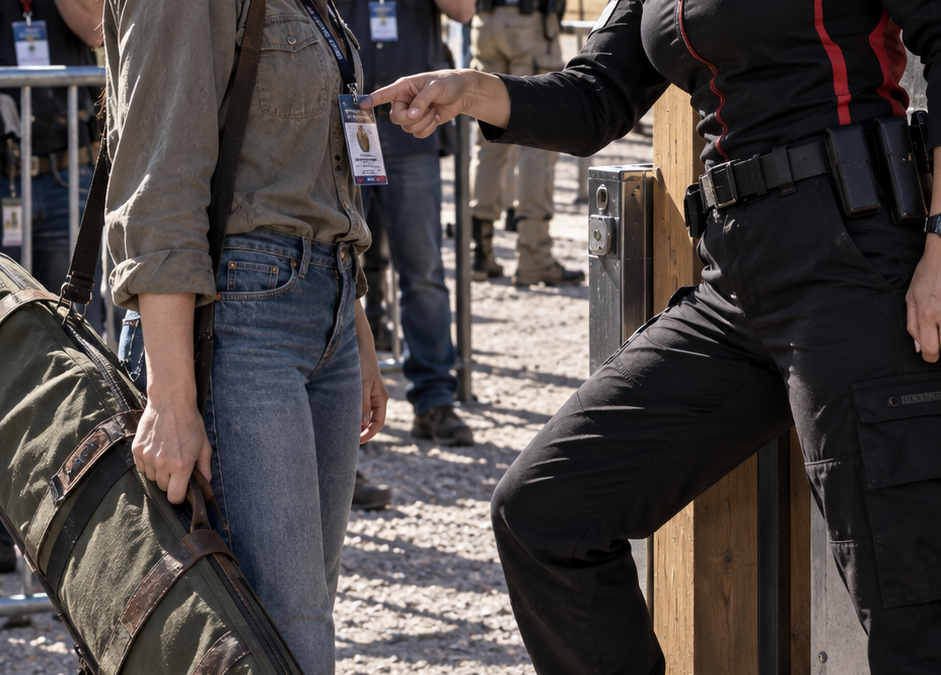
Victoria Blake planted one polished boot across the entrance to the firing line and looked at me as though I had wandered into the wrong building.
Hundreds of people were already moving toward the qualifying stations behind her. Sponsor banners snapped in the Colorado wind. Gravel crunched beneath shooting boots. The registration horn had just sounded, warning us that the first stage would begin in minutes.
I stopped with my rifle case hanging from my right hand.
“Move.”
Victoria’s eyes traveled down my faded jeans, my worn work shirt, and finally to the paper employee tag clipped beside my competitor badge.
LILY HAYES.
TICKET SERVICES.
Her mouth curved.
“Workers use the service entrance.”
I held up the plastic badge hanging from my lanyard.
“This entrance is for competitors.”
Victoria pinched the badge between two fingers without asking and tilted it toward herself.
Her nails were painted a shade of red that matched one of the sponsor logos on her custom shooting jacket.
“That looks fake.”
“It scanned ten minutes ago.”
“Then someone made a mistake.”
She flicked the badge back against my chest.
People noticed.
Of course they noticed.
Nothing attracts a crowd faster than somebody being publicly reminded of where everyone thinks she belongs.
A man near the railing lifted his phone.
Then another.
One of the event camera operators rotated his shoulder rig toward us.
I looked beyond Victoria at the range clock.
Four minutes.
Officials were checking chambers.
Shooters were opening ammunition cases.
“Move,” I said again.
Victoria folded her arms.
“I’m protecting the competition.”
“From what?”
“Embarrassment.”
A few shooters laughed.
I recognized some of them.
For three summers I had sold them programs, wristbands, cold drinks, and replacement passes when they lost the first ones.
Some had said hello to me.
None had ever asked whether I shot.
Victoria leaned toward me.
“You sell tickets beside the parking lot.”
“I also registered.”
“This is the Colorado Open.”
“I know where I work.”
“You clearly don’t know where you belong.”
My grip tightened around the canvas rifle case.
It was older than I was.
Dark green once, though years of dust and sun had turned it gray in places. My father had repaired one corner with heavy thread. The original zipper had broken when I was fourteen, so he replaced the pull with a short leather cord.
Victoria looked down at it.
“What’s in there?”
“A rifle.”
“I thought maybe a broom.”
That got a louder laugh.
I stared at her.
Not because I could not think of an answer.
Because my father had spent years teaching me that silence often made cruel people reveal more of themselves than confrontation ever could.
He used to say, “Noise hides nerves.”
At nine years old, I thought he meant gunfire.
By twenty-two, I knew he meant people.
Victoria mistook my silence for weakness.
She widened her stance.
“Say please.”
I glanced at the clock again.
Three minutes.
“Please stop wasting everyone’s time.”
Her smile vanished.
“That attitude might work inside your booth.”
“It’s going to work here.”
Something changed in the people watching us.
The laughter softened.
Victoria heard it too.
As she finally stepped aside, she drove her shoulder deliberately into mine.
Hard enough to knock me toward the wooden railing.
My rifle case struck the post with a deep metallic knock from inside.
My stomach dropped.
For one second, everything around me disappeared.
I steadied the case with both hands.
Victoria waited for me to explode.
I didn’t.
That seemed to bother her more.
“You should make sure that antique survived,” she said.
I walked past her.
“Enjoy your public humiliation.”
I heard the words behind me.
I also heard someone laugh.
I kept walking.
Station seventeen.
That was mine.
Victoria occupied station eighteen.
When the qualifying board lit up, our names appeared beside each other.
VICTORIA BLAKE.
National ranking.
Photograph.
Sponsors.
Competitive résumé.
LILY HAYES.
Nothing.
Victoria pointed at the screen.
“They forgot your biography.”
“I didn’t submit one.”
“Nothing worth submitting?”
I set the rifle case on the bench.
My hands were steady.
That mattered.
My heartbeat was not.
I had imagined this morning for three years.
Not the insults.
Not Victoria.
The firing line itself.
For three summers I had stood behind fences selling other people admission to this place.
I arrived before sunrise.
I swept the booth.
Counted ticket rolls.
Checked wristbands.
Refilled maps.
Pointed families toward the bleachers.
During lunch breaks, I would walk to the far fence with a sandwich and watch.
I watched the flags.
The grass.
The dust.
The shooters.
Mostly the shooters.
Some studied electronics.
Some trusted spotters.
Some fired fast.
Some waited.
When the day ended, I collected discarded target sheets before cleanup crews threw them away.
At home, on our land west of Pueblo, I recreated what I could.
My father had built steel plates from scrap.
Nothing was measured electronically.
Distance came from range markers he had set years earlier.
Wind came from grass.
Dust.
Heat.
The movement of cottonwood leaves.
I opened the case.
The old bolt-action rifle lay inside.
Conversation near station seventeen faded.
The stock was scratched.
The bluing along the barrel had worn pale.
Two old cracks in the wood had been repaired.
A small rectangular patch showed where a silver identification plate had once been mounted.
Victoria’s assistant placed her rifle on the neighboring bench.
Carbon fiber.
High-end optic.
Custom barrel.
It was probably worth more than everything I had earned during the previous three summers combined.
Victoria looked at mine.
Then tapped one fingernail against the wooden stock.
“Does that relic even fire?”
I pulled the rifle away from her.
“You’ll hear it.”
She laughed toward the bleachers.
A teenage boy copied her.
His father started recording.
I removed the bolt.
Checked the chamber.
Inspected the locking surfaces.
Ran my eyes over the barrel and scope.
My hands moved automatically.
I had done the same sequence thousands of times.
Victoria noticed.
“You practiced that inspection somewhere?”
“At home.”
“Soda cans?”
“Sometimes.”
The second preparation horn sounded.
Match Director Ben Carter began moving down the line.
Ben was in his late fifties, broad through the shoulders, gray-haired, and permanently sunburned around the neck. He walked with a slight limp that became more obvious when he hurried.
I had worked around him for three summers.
We had exchanged perhaps twenty sentences.
Mostly things like, “We need more wristbands,” or, “Move the cash box before the storm comes.”
He reached station seventeen.
Then stopped.
His eyes landed on my rifle.
Something happened to his face.
Very small.
But real.
He touched the pale rectangle where the nameplate had once been.
“Where did you get this?”
“My family.”
His thumb moved over the old wood.
“What happened to the plate?”
“My father took it off.”
“Who was your father?”
Before I could answer, Victoria leaned across the divider.
“Is there a problem with her equipment?”
Ben released the rifle.
“No.”
“You barely inspected it.”
He looked at Victoria.
“I know what I’m looking at.”
His tone ended the conversation.
He passed the rifle.
After walking three stations away, he looked back.
I saw him do it.
Victoria did too.
“You know him?”
“No.”
“He knows that rifle.”
“He recognized the design.”
“You should withdraw before you damage it.”
I placed my employee tag beside the ammunition box.
“I didn’t bring it here to protect it.”
“What did you bring it for?”
I looked at the target field.
“To use it.”
The final horn sounded.
Range officers raised flags.
Spectators moved behind the safety line.
Thirty-two competitors.
Five qualifying stages.
Eight would advance.
The first stage used steel plates at six hundred yards.
Three hits required.
Five rounds permitted.
I placed three cartridges beside the rifle.
Victoria saw them.
“You only brought three?”
“For this stage.”
“You get five.”
“I read the rules.”
“You’ll need all five.”
“I hope not.”
Wind moved across the valley.
Not strongly yet.
Tall grass leaned east.
Dust drifted low over the gravel.
A yellow ribbon tied near the fencing twisted twice, settled, then lifted again.
My father’s voice lived in my head.
Never ask where the wind is.
Ask where the wind has been.
The green light appeared.
Thirty-one shooters seemed to fire at once.
The roof magnified every report.
Steel rang downrange.
Monitors flashed.
Victoria fired almost immediately.
Hit.
The crowd behind station eighteen applauded.
Second shot.
Hit.
Third.
Slightly left, but good.
Eleven seconds.
She lifted her head and smiled toward a camera.
Then looked at me.
I was still standing.
Twenty seconds had passed.
“Clock’s running,” she said.
I watched a ribbon rotate.
Dust crossed the firing line.
A gust passed.
“Scared to pull it?”
People laughed.
I sat.
The worn stock came into my shoulder.
The cheek weld felt so familiar that the noise around me vanished.
I closed my eyes for one breath.
My father used to stand behind me when I was a child.
He never touched the rifle while I aimed.
Never corrected me mid-shot.
Never moved the barrel.
If I missed, he waited.
Then he asked one question.
“What did you see?”
Not “Why did you miss?”
What did you see?
I opened my eyes.
The world narrowed.
Target.
Wind.
Breath.
Pressure.
The first shot broke.
The old rifle recoiled into my shoulder.
A moment later, steel answered.
The monitor flashed.
Perfect center.
The laughter disappeared.
I worked the bolt.
The casing rolled across the bench.
Victoria stared at the monitor.
“Lucky.”
I chambered the second round.
Fired.
Steel.
Another center hit.
Nobody laughed.
The third cartridge slid into the chamber.
I breathed out.
Pressed.
Ring.
Three rounds.
Three hits.
A tight group.
I opened the bolt and stood.
The scorekeeper walked to the monitor.
He checked it twice.
Then looked at the target feed.
“No scoring error.”
Victoria removed one side of her hearing protection.
“She’s shooting an antique with factory ammunition.”
The scorekeeper shrugged.
“The target doesn’t care.”
A few spectators laughed.
At Victoria.
Her face tightened.
I collected my brass.
I always collected brass.
My father had trained that habit into me long before I understood reloading.
Victoria watched.
“You caught favorable wind.”
“We had the same wind.”
“I shot first.”
“That was your decision.”
My score ranked above hers.
That should have felt satisfying.
Instead, it scared me.
Because suddenly this thing I had imagined privately for years had become real.
I had not come to prove Victoria wrong.
I had come to find out whether my father had been right.
About me.
About everything he had taught me.
The second stage stretched to eight hundred yards.
Five shots permitted.
Best four counted.
By then, the wind had strengthened.
Victoria’s assistant used a tablet, weather meter, and ballistic program.
He whispered into her ear.
I drank from my dented water bottle.
Someone in the bleachers shouted, “Nice shooting, ticket girl!”
This time the nickname sounded different.
I looked up.
A woman waved.
I nodded.
Victoria turned toward the crowd.
“One decent group doesn’t make a champion.”
“No one said it did,” I replied.
“You’re enjoying this.”
“I’m preparing.”
“For what?”
“The next stage.”
She stepped closer.
“You think staying calm makes you intimidating?”
“No.”
“Then why aren’t you nervous?”
I surprised her.
“I am.”
She paused.
I screwed the cap back onto my bottle.
“I just don’t give nerves control.”
Her assistant looked down.
Victoria did not answer.
The stage began.
Shots started slower this time.
The wind shoved rounds away from center.
Victoria followed her assistant’s calls.
First hit right.
Second better.
Third near center.
Fourth missed the scoring ring.
A murmur moved through her supporters.
She fired quickly again.
Low.
Still a respectable score.
Not what she wanted.
She looked at me.
I still had not fired.
“You can’t wait forever.”
I watched the sponsor banners.
They were pulling east.
Then one twisted.
Another snapped west.
Several experienced shooters raised their heads.
There.
The valley was changing.
I dropped behind the rifle.
First shot.
Center.
Second.
Within an inch.
Victoria’s assistant whispered, “She corrected before the shift registered.”
Victoria snapped, “Watch my station.”
He obeyed.
I waited.
The wind dipped.
Two more rounds.
Both inside.
Four hits.
I left the fifth cartridge untouched.
Again, my score remained above Victoria’s.
People clapped.
Not everyone.
Enough.
Victoria stood.
“She’s getting wind calls.”
Ben turned toward her.
“From whom?”
“I don’t know.”
“You made the accusation.”
“She has no instruments.”
“People read wind before lithium batteries.”
“Not like that.”
Ben looked at me.
“Are you receiving any outside assistance?”
“No.”
“Communication device?”
“No.”
He inspected my collar and hearing protection.
Checked the bench.
Then Victoria demanded the rifle be inspected again.
I stepped back.
“Go ahead.”
Ben lifted it.
Removed the bolt.
Inspected the chamber.
Checked the fixed-power scope.
No electronics.
No hidden equipment.
He returned it.
“Legal.”
Victoria folded her arms.
“That belongs in a museum.”
I looked at her.
“Then losing to it should concern you.”
The reaction came instantly.
Laughter.
Applause.
I regretted saying it almost immediately.
Not because it was untrue.
Because my father disliked people who mistook applause for proof.
Victoria stared at me.
“You haven’t won anything.”
“I know.”
“You won’t survive the moving stage.”
“We’ll see.”
“You people always say that.”
I stopped.
“What people?”
Her eyes moved to the employee tag.
“Amateurs who mistake luck for talent.”
I clipped the tag back onto my shirt.
“I earned this job.”
“That might be the only thing you earn today.”
I turned away.
The third stage was a moving steel plate at seven hundred yards.
Four passes.
Two hits required.
Victoria specialized in moving targets.
I knew because I had watched her compete the previous two summers.
She was good.
Extremely good.
People forget that cruel people can still be talented.
She tracked smoothly.
Hit the front edge.
Then closer to center.
Missed the third.
Hit again on the fourth.
Strong score.
She turned toward me.
“Try not to shoot the motor.”
I loaded one cartridge.
The scorekeeper noticed.
“You have four passes.”
“I know.”
Victoria laughed.
“She forgot ammunition.”
The first pass began.
I stayed standing.
The plate crossed.
Disappeared.
Whispers.
Second pass.
Still nothing.
Victoria shouted, “It moves, genius!”
I watched the grass.
Third pass.
The conditions aligned.
I shouldered the rifle.
Tracked ahead.
Pressed.
The plate snapped.
Dead center.
The monitor displayed the highest possible score.
For two seconds, nobody reacted.
Then the bleachers erupted.
I opened the action.
Removed the rifle from my shoulder.
One shot.
I had needed one.
The teenage boy who laughed at me earlier was now yelling louder than anybody.
Victoria stared at the board.
“That’s impossible.”
The scorekeeper did not even look at her.
“Confirmed.”
“She guessed the lead.”
“That’s generally how moving targets work.”
Victoria turned on him.
Her assistant intervened.
“Save your focus.”
“You’re supposed to help me.”
“I am.”
“Then explain her.”
He looked at me.
“I can’t.”
Ben came over.
“Why skip the first two passes?”
“Wind.”
“And the fourth?”
“I didn’t need it.”
His eyes returned to the missing nameplate.
“How long have you been shooting that rifle?”
“Years.”
“Where?”
“Family land west of Pueblo.”
“Your father’s?”
“Yes.”
“Your father removed the plate?”
“Yes.”
“Why?”
That question hurt more than it should have.
Because I had asked my father the same thing.
He always gave me some version of the same answer.
Names make people look backward.
So I repeated what he told me.
“He wanted me looking at the target.”
Ben went still.
Behind him, Victoria filed a formal protest.
First coaching.
Then ammunition.
Then employee status.
Then my age.
I was twenty-two.
Every protest failed.
Ben produced the paperwork.
Victoria finally said, “Employees shouldn’t be allowed into sponsor events.”
Ben replied, “The rules do not prohibit it.”
“My sponsors help pay for this range.”
“They did not purchase the rulebook.”
Her face changed.
“If this turns into a spectacle, sponsors will complain.”
Ben looked toward the spectators.
“It became a spectacle when you blocked her entrance.”
Victoria looked around.
The cameras.
Phones.
People who had watched everything.
Suddenly she smiled.
“I was joking.”
I felt something cold settle inside me.
“You hit my shoulder.”
“I barely touched you.”
“You touched my rifle case.”
“It survived.”
“That wasn’t your decision.”
Victoria looked directly at me.
“You want an apology?”
“I want you to stop pretending cruelty becomes harmless when people notice.”
Silence.
Ben looked at me.
So did several reporters.
Victoria’s eyes flicked toward her sponsors.
“I’m sorry you misunderstood.”
“That isn’t an apology.”
“You’re not getting another one.”
I nodded.
“Then save your energy.”
“For what?”
“The semifinal.”
The qualifying board updated.
My name appeared at the top.
First.
Victoria was fourth.
Eight of us advanced.
For the first time all day, people called my name as I walked.
Some wanted photographs.
Others offered congratulations.
I thanked them and kept moving.
Attention frightened me more than mockery.
Mockery was simple.
You knew where it came from.
Applause could make you forget what you came to do.
During the break, I sat under the shade structure cleaning dust from the bolt.
The teenage boy approached.
His father stood behind him.
“Miss Hayes?”
I looked up.
He held out a cold water bottle.
“I’m sorry I laughed.”
I accepted it.
“What changed your mind?”
His face reddened.
“You hit everything.”
“That shouldn’t decide whether you respect somebody.”
His eyes dropped.
“No, ma’am.”
His father said quietly, “We both owe you an apology.”
I nodded.
“Make the next person’s day easier.”
He put his phone away.
“That seems fair.”
They left.
Victoria had watched.
“You enjoy making everyone guilty?”
“I’m cleaning my rifle.”
“You’re performing humility.”
I continued working.
She crouched near the bench.
“You think this makes us equals?”
“We’re in the same competition.”
“That does not make us equal.”
“What would?”
“Years of training.”
I pushed the bolt back into place.
“Then your advantage should be obvious.”
Her left hand trembled.
Very slightly.
She curled it into a fist when she saw me notice.
“You’re going to break,” she said.
“Maybe.”
“You admit it?”
“Everyone can break.”
“I don’t.”
I looked at her hand.
“You missed because the wind changed.”
“Everybody misses.”
“Then we agree.”
She walked away.
The semifinal target sat at one thousand yards.
Six rounds allowed.
Consecutive misses could eliminate us.
The first shooter missed twice.
Out.
The second survived.
Another had a malfunction.
Officials cleared his weapon.
Victoria shot fifth.
Two beautiful center hits.
Then one drifting left.
Fourth inside.
Fifth miss.
The pressure changed her breathing.
Her assistant whispered.
Final shot.
Hit.
She survived.
I shot last.
Four cartridges.
Ben saw them.
“You’re allowed six.”
“Four should be enough.”
Victoria heard.
“Arrogance looks strange on you.”
I ignored her.
The wind moved southwest near us.
Farther downrange, brush leaned differently.
Two currents.
I adjusted the scope.
Three clicks.
First shot.
Hit.
Second.
Slightly high.
Third.
Inner ring.
Then the wind strengthened.
I waited.
The clock fell.
Victoria watched the monitor.
“She waited too long.”
Ben said nothing.
The wind collapsed.
Fence ribbons went almost still.
For perhaps two seconds, the valley gave me a lane.
I fired.
Steel.
Four confirmed hits.
Advanced.
No extra ammunition.
Only three shooters remained.
Daniel Ross.
Victoria Blake.
Me.
The final involved three distances.
Eight hundred.
One thousand.
Then beyond twelve hundred yards.
Reporters swarmed Ben during the reset.
“Who is she?”
“Has she competed under another name?”
“What rifle is that?”
Ben answered only what he could verify.
Then one reporter asked, “Do you recognize the rifle?”
Ben looked toward me.
“I recognize the work.”
He walked away.
I sat near a storage building with the rifle across my knees.
My thumb rubbed the pale rectangle where the silver plate used to be.
For the first time that day, I felt truly afraid.
Not of the final.
Of Ben.
Of the way he looked at the rifle.
Of the questions my father had refused to answer.
My father, Thomas Hayes, had died three years earlier when a truck crossed the centerline outside Pueblo.
There was no goodbye.
No final conversation.
No last lesson.
Just a sheriff at my door and a workshop that still smelled like gun oil and cedar.
After the funeral, I found a box behind one of his workbenches.
Competition medals.
Newspaper clippings.
Photographs.
Most had been damaged deliberately.
Names scratched.
Plates removed.
Pictures cut.
I asked my mother.
She only said, “Your father had another life before you were born.”
He had taught me to shoot.
He had never told me he once competed seriously.
Whenever I asked why he stopped, he said, “Some targets cost too much.”
I thought he meant money.
Maybe he never did.
Ben approached.
“Can I sit?”
“It’s county property.”
He sat.
For a while, neither of us spoke.
Then he looked at the missing plate.
“I saw that rifle twenty years ago.”
I stopped rubbing the wood.
“You’re mistaken.”
“The crack along the stock was repaired with a brass pin underneath the grip.”
My throat tightened.
“Many rifles are repaired.”
“I installed that pin.”
I looked at him.
For the first time in three summers, Ben Carter did not look like the match director.
He looked like a man who had been waiting years for something he never expected to see.
“What was your father’s name?”
I almost refused.
Then I said it.
“Thomas Hayes.”
Ben lowered his head.
“He taught you.”
“Yes.”
His voice changed.
“We competed together.”
“My father never had a partner.”
“He did.”
“Then why did I never hear your name?”
Ben looked toward the range.
“Because he erased that part of his life.”
“Why?”
“We ended badly.”
“How badly?”
The announcement system interrupted us.
Ten minutes to final equipment inspection.
I stood.
“I have to go.”
“I owe you an explanation.”
“I didn’t ask for one.”
“No.”
He looked at the rifle.
“But you deserve one.”
I walked back toward the line.
My thoughts had become louder than the crowd.
Victoria noticed immediately.
“Finally nervous?”
“I was nervous earlier.”
“You look different.”
“Worry about yourself.”
She leaned closer.
“Ben knows you.”
“He knew my father.”
Suspicion appeared instantly.
“So this was arranged.”
“No.”
“He recognized the rifle before qualifying.”
“So?”
“He controls the match.”
“The scoring is electronic.”
“Officials can manipulate electronics.”
I stared at her.
“You accused me of cheating before I fired a single shot.”
“And now I know why.”
“No.”
“You know nothing.”
She studied my face.
Then something in her expression changed.
“You really didn’t know.”
“Not until five minutes ago.”
For once, Victoria had no insult ready.
Finally she said, “I still intend to beat you.”
“That’s why we’re here.”
Daniel Ross shot first at eight hundred.
Hit.
Victoria hit.
I waited through a small gust and fired once.
Center.
At one thousand, Daniel missed, then hit.
Victoria caught the edge with her first.
I hit center.
Then the twelve-hundred-yard target appeared.
Small.
Bright.
Heat shimmer rolled above the ground.
Wind contradicted itself across the valley.
Near us, east.
Midrange, west.
Beyond the target, a thin streamer pulled north.
Three different stories.
One bullet.
Daniel fired.
Miss right.
Adjusted.
Miss high.
Final round.
Outer edge.
The crowd applauded.
Victoria settled behind her rifle.
Her assistant read data.
First shot.
Miss left.
Her jaw tightened.
Correction.
Second shot.
Ring.
She had the lead.
One round remained unused.
Then I lay down behind my father’s rifle.
The world felt very quiet.
Three cartridges waited beside me.
Victoria stood behind the line.
“Scared to pull it?”
The same words from the first stage.
Nobody laughed now.
I watched the grass.
Twenty seconds.
Ben stared at the monitor.
Fifteen.
The crowd became restless.
Ten.
Victoria smiled.
“She’s not going to shoot.”
Five.
A banner snapped hard.
The near wind changed.
For an instant, the middle brush stopped fighting it.
I raised my head slightly.
Breathed out.
My father’s voice came back.
Wind doesn’t lie.
People do.
I settled.
Pressed.
The rifle cracked.
The bullet disappeared into distance.
There was no immediate reaction.
Just silence traveling after it.
Then—
Ring.
A clean metallic note crossed the valley.
The scoreboard changed.
My hit appeared inside the center circle.
Then the ranking.
LILY HAYES — FIRST.
VICTORIA BLAKE — SECOND.
DANIEL ROSS — THIRD.
I stared at the screen.
The crowd rose.
Sound crashed over the range.
People shouted my name.
The teenage boy threw both arms into the air.
Daniel removed his cap and grinned at me.
Victoria did not move.
I remained behind the rifle.
Opened the bolt.
Smoke drifted from the chamber.
My hand started trembling.
Not because I had won.
Because suddenly I wanted my father so badly that breathing became difficult.
He should have been behind the fence.
He should have been pretending not to smile.
He should have said something irritating like, “You rushed the trigger.”
I closed my eyes.
The applause became distant.
I was nine again.
Dust on my shoes.
My father behind me.
The rifle too heavy.
“Dad, what if I miss?”
“You will.”
“That’s not helpful.”
“It’s honest.”
“What do I do when I miss?”
“Look again.”
At the time, I hated that answer.
Now I understood it.
I opened my eyes.
Ben was standing near station seventeen.
He looked shaken.
“Who taught you that wind hold?”
“My father.”
The nearest microphones caught it.
Ben removed his cap.
I stood.
“Thomas Hayes taught me everything.”
The name moved through the older crowd.
Not loudly.
Like recognition traveling person to person.
A gray-haired man near the railing whispered something.
Daniel turned.
Victoria looked at her assistant.
“Who was Thomas Hayes?”
The assistant stared at my rifle.
“A championship marksman.”
“He’s not in the records.”
“He asked to be removed.”
Ben stepped toward the microphone.
“Thomas Hayes was more than—”
I cut him off.
“This is my story to tell.”
Ben stopped.
Then nodded.
“You’re right.”
I looked at the crowd.
“My father taught me privately.”
My voice sounded steadier than I felt.
“He never used his name to get me into this match.”
I looked toward Victoria.
“He never contacted officials.”
She said nothing.
“He never bought me expensive equipment.”
My hand rested against the worn stock.
“He taught me using the rifle people laughed at this morning.”
I looked at the wind ribbons.
“He taught me to watch before acting.”
Then at the crowd.
“He taught me that noise often hides fear.”
Victoria lowered her eyes.
“And he taught me that people deserve respect before they prove what they can do.”
The range went quiet.
I did not say it to humiliate Victoria.
That mattered to me.
I knew what public humiliation looked like.
I had experienced it hours earlier.
I wanted no part in becoming what hurt me.
Ben stepped closer.
“There’s something else.”
I looked at him.
“You promised an explanation.”
“I owe one publicly.”
“You owe one honestly.”
He nodded.
Twenty years earlier, Ben Carter and Thomas Hayes had shot together.
Not occasionally.
As partners.
They became one of the strongest long-range teams in Colorado.
My father had used the same rifle I was holding.
The missing silver plate carried his name.
They traveled.
Won.
Lost.
Learned.
Then came a national championship and a sponsorship offer.
The sponsor wanted Ben and my father together.
The money was more than either had ever seen from shooting.
But there was a condition.
They had to use sponsor equipment.
My father refused.
The old rifle had belonged to his father before him.
He would not replace it for a contract.
That should have ended the discussion.
Instead, Ben signed preliminary documents without telling him.
Worse, the contract gave the sponsor rights to use Thomas Hayes’s name.
My father found out afterward.
They fought.
Publicly.
Sponsors began describing my father as unstable.
Difficult.
Unprofessional.
Ben stayed silent.
Because if he defended his partner, he feared losing the deal.
My father walked away.
Completely.
“He didn’t lose his career,” Ben said.
His voice shook.
“I helped take it from him.”
I stared at him.
The crowd disappeared.
“You had twenty years to say that.”
“Yes.”
“Why didn’t you?”
“Cowardice.”
No excuse.
No complicated speech.
Just the word.
“I built this championship afterward,” he continued. “I told myself the past was over.”
He looked at me.
“Then you came here.”
“You knew who I was?”
“Not when I hired you.”
“When?”
“Later.”
“How much later?”
“Your first summer.”
My anger sharpened.
“You watched me sell tickets for three years.”
“Yes.”
“You watched me stand outside this range.”
“Yes.”
“And you said nothing.”
“I was ashamed.”
“That protected you.”
His face tightened.
“Yes.”
“Not me.”
“No.”
I stepped closer.
“Did you approve my registration?”
“No.”
“Did you change my scores?”
“No.”
“Did anyone help me today?”
“No.”
“Say it so everyone hears you.”
Ben turned toward the cameras.
“Lily Hayes registered through the public process.”
He swallowed.
“She paid the full fee.”
“No special entry.”
“No score adjustments.”
“No assistance.”
“She won every stage under the same rules as every other competitor.”
The official scorekeeper raised his tablet.
“I confirm that.”
Daniel smiled.
“So do I.”
All eyes shifted toward Victoria.
She had demanded those answers.
Now she had them.
She removed her shooting glasses.
“I was wrong about the cheating.”
I waited.
“And the badge.”
She swallowed.
“And the rifle.”
Nobody rescued her from the silence.
She stepped toward me.
“I shouldn’t have blocked you.”
No answer.
“I shouldn’t have touched you.”
Her eyes flicked toward the cameras.
Then back to mine.
“I treated your job like it made you less important.”
Her voice shook.
“That was cruel.”
I could have made her suffer.
Part of me wanted to.
The part that remembered people laughing at the gate.
The case striking wood.
Her finger tapping my father’s rifle.
But my father had also taught me that the cleanest shot was not always the most important one.
“I’m sorry, Lily.”
This time she did not say if.
No misunderstanding.
No excuse.
I nodded.
“I accept that you said it.”
Her face tightened.
I did not say I forgave her.
An apology does not purchase immediate forgiveness.
But she had finally told the truth.
That counted for something.
The awards ceremony began.
Daniel received third.
Warm applause.
Victoria took second.
She did not wave.
Then Ben stood behind the microphone.
“The Colorado Open champion is Lily Hayes.”
The cheering came again.
I walked toward the platform carrying my father’s rifle.
I still wore my ticket-booth tag.
People had asked whether I wanted to take it off before the ceremony.
I said no.
At nine that morning, it had been evidence against me.
Now everyone wanted photographs of it.
That seemed worth remembering.
Ben lifted the championship cup.
Before handing it over, he stopped.
“One more matter.”
My stomach tightened.
He placed a document beside the trophy.
“This event cannot repair what happened to Thomas Hayes.”
He looked at me.
“And restoring a record cannot erase twenty years.”
“What is that?”
“A request to restore his verified competitive history.”
I stared at the document.
“It includes a full statement about why he withdrew.”
“Whose statement?”
“Mine.”
“You prepared this today?”
“No.”
“How long have you had it?”
“Three years.”
The answer hurt.
“Since he died.”
“Yes.”
“Why didn’t you send it?”
His eyes lowered.
“I kept waiting until I was brave enough.”
“And today made you brave?”
“No.”
He looked at me.
“You did.”
The crowd seemed to soften around us.
I did not.
Not yet.
“My father removed his name because you made it painful.”
“Yes.”
“You don’t get to put it back simply because guilt became inconvenient.”
“I know.”
I lifted the document.
“I will read it privately.”
“That’s fair.”
“I may refuse.”
“That is your right.”
“If I approve anything, nothing gets rewritten.”
“Nothing will.”
“The record says what you did.”
“Yes.”
“And what he did.”
“Yes.”
I folded it.
Placed it inside my rifle case.
Then I accepted the trophy.
It was heavier than I expected.
Cold metal.
Polished enough to reflect my face.
Behind me, my name covered the scoreboard.
I raised the cup only slightly.
That was enough.
Afterward, reporters crowded around me.
I answered three questions.
Who taught me?
My father.
Had I competed before?
No.
Was I going professional?
I didn’t know.
Then I left.
I went back to the ticket booth.
The place looked exactly as it had that morning.
Paper wristbands.
Program stacks.
Cash drawer.
Card reader.
Dust in the corners.
The championship trophy looked ridiculous beside the register.
I liked that.
The teenage boy came to the window.
His father stood behind him.
“You’re working tomorrow?”
“Yes.”
“But you won.”
“Winning doesn’t fill the schedule.”
He thought about that.
“Can I buy tomorrow’s pass?”
“If we still have them.”
He slid money through the opening.
I printed two tickets.
“Thank you.”
“You’re welcome.”
His father pointed to the trophy.
“You should probably move that somewhere safer.”
“For now, it’s fine.”
They left.
Victoria arrived a few minutes later.
She had removed her sponsor jacket.
Without it, she looked younger.
More tired.
She stopped outside the booth.
“I don’t expect another conversation.”
“Then why are you here?”
“To ask you something.”
I looked up.
“Was your father proud of this place?”
“No.”
The answer surprised her.
“Then why compete?”
I looked past her toward the firing line.
“Because I was tired of watching from outside.”
Victoria looked toward the entrance.
“I helped keep you outside this morning.”
“Yes.”
“I know an apology doesn’t fix that.”
“No.”
She placed something on the counter.
My competitor badge.
The clip had broken earlier.
Now it had a new one.
“I found it near seventeen.”
I picked it up.
“Thank you.”
She turned away.
“Victoria.”
She stopped.
I held the badge.
“Next time, look at the person before the label.”
Her face changed.
Not defensively.
Quietly.
“I will.”
She walked away.
Ben came near sunset.
No director jacket.
No microphone.
He stood outside the booth.
“I know what you want,” I said.
“You don’t.”
“You want my answer about the document.”
“No.”
He placed an envelope on the counter.
“I came to give you something.”
Inside was a tarnished silver plate.
THOMAS HAYES.
My lungs stopped working for a second.
I touched the letters.
“Where did you get this?”
“Your father mailed it to me after he quit.”
“Why?”
“There was a note.”
Ben handed me folded paper.
I knew my father’s handwriting before I opened it.
Four lines.
That was all.
He told Ben to keep the plate.
He wrote that anger might keep him away forever.
Maybe forgiveness would do what anger could not.
Then the final sentence.
If I ever teach someone else, tell them I was better before bitterness.
I read it again.
My vision blurred.
Ben stayed outside the window.
“He never told me.”
“I never gave him a reason to.”
“You could have called.”
“I should have.”
“He could have too.”
Ben nodded.
“Yes.”
That truth hurt differently.
For years I had preserved my father in memory as if death made him flawless.
It did not.
Thomas Hayes could be stubborn.
Proud.
Terrible at apologizing.
He kept anger longer than he should have.
Ben had failed him.
My father had also chosen silence afterward.
Two men waited for each other to cross a distance neither would cross.
Then time ended the argument for them.
“My father saved every article about this championship,” I said.
Ben’s head lifted.
“What?”
“They’re in his workshop.”
His eyes filled.
“He kept watching?”
“Yes.”
Ben looked away.
I put the plate beside my competitor badge.
“I may restore his records.”
He nodded.
“With the full explanation.”
“Yes.”
“I won’t do it for you.”
“I know.”
“I’ll do it because silence already took enough.”
He closed his eyes briefly.
“Thank you.”
“Don’t thank me yet.”
He opened them.
“One condition.”
“Anything.”
“Summer employees compete free next year if they meet the safety rules.”
He blinked.
“All of them?”
“All of them.”
“Sponsors may object.”
“Then choose better sponsors.”
A small smile appeared.
“Agreed.”
“Ticket staff get proper breaks.”
“Agreed.”
“And nobody uses staff entrances or job titles to decide who is allowed to compete.”
“That should never have happened.”
“No.”
“I’ll change the policy.”
“Change the culture.”
Ben absorbed that.
“I’ll try.”
I extended my hand.
He shook it.
That handshake was not forgiveness.
It was not absolution.
It was simply proof that two people could begin somewhere without pretending the past had disappeared.
After Ben left, I locked the cash drawer.
The range was nearly empty.
Wind moved through the grass without anybody studying it now.
Targets caught the last sunlight.
I reopened my rifle case.
The pale rectangle on the stock waited.
I placed my father’s silver plate over it.
The screw holes aligned perfectly.
A screwdriver sat less than six feet away in the maintenance drawer.
I could have restored his name in thirty seconds.
I didn’t.
My father had removed that plate in pain.
I would not replace it in emotion.
Beside me stood the championship trophy.
Beside that was my employee badge.
One represented what everybody respected now.
The other represented what they had dismissed that morning.
I picked up the badge.
Clipped it back onto my shirt.
Then I closed the rifle case with the silver plate safely inside.
Outside, the teenage boy waited near the parking lot.
His father was already beside their truck.
“Miss Hayes?”
I stopped.
He held out a paper target.
“Can you sign this?”
“Why?”
“Because you won.”
I looked at the blank corner.
Then handed it back.
“Come early tomorrow.”
His face fell.
“Why?”
“I’ll teach you how to read wind.”
His eyes widened.
“Really?”
“If your father says yes.”
From the truck, his father raised one hand.
“He says yes.”
The boy grinned.
I walked toward my old pickup.
The trophy went onto the passenger floor.
The rifle case beside it.
Before closing the door, I took the silver plate out one more time.
THOMAS HAYES.
For years I had thought my father removed his name because he lost.
Now I understood.
He had walked away because winning demanded something he could not give.
That did not make every choice he made afterward right.
It did not erase his bitterness.
Or Ben’s cowardice.
Or twenty wasted years.
But the lessons my father gave me had survived both men’s failures.
Patience before recoil.
Observation before action.
Respect before proof.
Across the lot, temporary workers emptied trash bins and folded barricades.
One of the young women from the ticket staff noticed the trophy through my open truck door.
She threw both arms into the air.
I laughed.
Really laughed.
Maybe for the first time all day.
Then I started the engine.
It coughed twice before settling.
As I drove toward the entrance, Victoria stood beside a sponsor vehicle.
She saw me.
For a second, neither of us moved.
Then she stepped away from the gate.
Completely.
Nothing blocked the road.
I drove through.
The mountains rose ahead of me beneath the late Colorado sun.
On the passenger floor, the championship trophy rattled against my father’s scarred rifle case.
It was not a dignified sound.
It was not cinematic.
It was simply real.
I rested one hand on the steering wheel.
With the other, I touched the employee badge clipped near my heart.
That morning, hundreds of people had seen it and decided they already understood me.
By evening, those same people wanted photographs beside it.
I knew better than to confuse that reversal with justice.
Winning did not make me more worthy of respect than I had been at sunrise.
Hitting twelve hundred yards did not make Victoria’s cruelty wrong.
It had already been wrong.
The trophy did not make the teenage boy’s apology necessary.
Respect should never require proof.
And my father did not become important because people remembered his records.
He had mattered when nobody said his name.
That might have been the most valuable thing I carried away from the Colorado Open.
Not first place.
Not applause.
Not even the truth about Thomas Hayes.
The truth was simpler.
A label can tell you where somebody works.
A ranking can tell you how somebody performed.
A sponsor logo can tell you who paid for the jacket.
A trophy can tell you who won one competition on one particular day.
None of those things tell you what a person is worth.
My father had tried to teach me that without ever saying it directly.
Ben had learned it too late.
Victoria learned it publicly.
I had spent years learning it quietly from behind a ticket window.
The highway opened ahead of me.
Sunlight turned the mountains gold.
I thought about my father sitting beside me when I first learned to drive, gripping the passenger door every time I changed lanes.
I thought about his hands repairing the split in the rifle stock.
About the little brass pin Ben said he had installed decades earlier.
About two young men who once believed friendship would last forever.
About how pride broke them.
About how silence preserved the break.
The silver nameplate rested inside the case.
I still did not know whether I would put it back.
Maybe tomorrow.
Maybe next month.
Maybe never.
For the first time, I understood that the choice belonged to me.
Not Ben.
Not the championship.
Not the spectators.
Not the sponsors.
Not even my father anymore.
Me.
I drove faster as the road left the range behind.
The trophy rattled again.
The old rifle remained quiet beside it.
And somewhere beneath the noise, I could almost hear my father asking the same question he had asked after every missed shot when I was a child.
What did you see?
This time I finally had an answer.
I had seen what happened when people judged a uniform before a person.
I had seen arrogance collapse when reality refused to obey it.
I had seen guilt confess.
I had seen an apology that could not repair the past but could stop making it worse.
I had seen a man I loved become more human after death instead of less.
And I had seen myself step onto a firing line I had watched from outside for three summers and discover that I had never needed anyone’s permission to belong there.
The mountains darkened in front of me.
I kept driving.
My father’s name came home with me.
But this time, it did not feel like something I had to carry.
It felt like something I was finally free to choose.








