The Three Officers at Pump Two Had No Idea What My Silence Meant
𝗙𝗨𝗟𝗟 𝗦𝗧𝗢𝗥𝗬
He left a cup of coffee on my desk and wisely decided not to continue the conversation.
My work also taught me to take precautions.
For several years, I had worn a small silver pendant containing an emergency transmitter. The device could send my location directly to a designated FBI response team and update that position every thirty seconds.
It had an integrated recording function and a tiny indicator light that flashed red when activated.
I wore it on a thin chain beneath my clothes.
It looked like an ordinary piece of jewelry.
Nicole once accused me of being paranoid because I refused to take it off, even when we went on vacation.
“I investigate people who know how to make evidence disappear,” I told her. “I’m comfortable being paranoid.”
She laughed.
Three months before that Saturday at the gas station, our laughter became considerably harder to find.
Mama was diagnosed with stage-two breast cancer.
She had spent thirty-one years taking care of people at Grady Memorial Hospital.
Now she was returning to the same building for chemotherapy, sitting in treatment rooms where some of the nurses had once been her students.
She hated being a patient.
She hated being fussed over.
Most of all, she hated that Nicole and I suddenly spoke to her as though she might break.
“Stop using that voice,” she told us during our first visit.
“What voice?” Nicole asked.
“The one people use when they think somebody’s already halfway dead.”
We laughed because she wanted us to.
But I saw how hard she gripped the armrest when she stood up.
I noticed the unopened food on her tray.
And when she finally agreed to let us help her home, I watched Nicole turn away so Mama wouldn’t see her crying.
Chemotherapy changed the sound of our mother’s voice.
She still gave orders over the telephone, complained about hospital food, and demanded updates on everyone in the family.
But she paused more frequently between sentences.
Sometimes she forgot what she’d been talking about.
Sometimes we heard her breathing on the other end of the line and silently waited for her to find the strength to continue.
The possibility of losing her became a constant presence in my life.
It followed me into interrogation rooms.
It sat beside me during late-night paperwork.
It woke me at three in the morning with the image of an empty chair at our next Thanksgiving dinner.
That Thursday, Nicole called me.
“I’m driving down Saturday. You coming?”
“Of course.”
“Pick you up at eight?”
“Bring breakfast.”
“You bring fruit. Mama specifically said no flowers.”
“Why?”
“She says hospital flowers look like funeral flowers.”
I smiled.
“That sounds like her.”
“Audrey?”
Something in Nicole’s voice made me sit up.
“What?”
“She sounded really tired today.”
I stared at the files scattered across my desk.
“I know.”
There was a long silence.
Then Nicole said, “We should leave early.”
“Eight o’clock. I’ll be ready.”
She arrived Saturday morning in her silver Lexus RX.
I was waiting outside with an overnight bag, wearing jeans, sneakers, and a fitted black T-shirt.
Nicole had chosen a red summer dress and sandals, along with oversized sunglasses she claimed made her look mysterious.
“You look like you’re about to interrogate somebody,” she told me.
“You look like you’re about to spend forty dollars on a glass of lemonade.”
She lowered her sunglasses.
“Some of us have standards.”
We were arguing about the playlist before she pulled away from the curb.
Nicole wanted a podcast.
I wanted music.
The podcast turned out to be three hours of a man discussing mushrooms in a voice so quiet that I threatened to jump out of the moving car.
She turned up the volume.
I rolled down the window.
Hot Georgia air rushed inside, carrying the smell of freshly cut grass and sunbaked pavement.
For a little while, we were simply sisters again.
Not an FBI agent and a federal judge.
Not two frightened daughters counting the days between chemotherapy appointments.
Just Audrey and Nicole, arguing about music and remembering old friends as the miles disappeared behind us.
We took I-75 south toward Atlanta.
After nearly two hours on the road, traffic and a construction detour brought us through a small town called Greyfield.
It had one traffic light, a diner with faded blue awnings, and a gas station that appeared to have survived several decades without meaningful renovation.
Nicole glanced at the dashboard.
“We need gas.”
“Can’t it wait?”
“Unless you want to push this thing the rest of the way.”
She turned into Greyfield Gas and Go.
It was just before noon.
The sun was almost directly overhead, and heat rose from the cracked pavement in waves.
A faded red sign hung above the convenience store.
A pickup truck was parked near the building, and an elderly man stood inside scratching a lottery ticket.
Nicole stopped at pump two.
I got out and stretched my legs.
“How does anybody live in this heat?”
Nicole slipped her credit card into the pump.
“People live everywhere, Audrey.”
“Not voluntarily.”
She laughed.
I headed inside for water and fruit.
The door chime made a miserable metallic squawk when I entered.
The elderly man looked up from his lottery ticket, inspected me from head to toe, and returned to his scratching.
The cashier watched me walk toward the refrigerated section.
I selected two bottles of water and a bag of grapes.
The strawberries looked bruised.
When I reached the counter, the woman scanned my purchases without greeting me.
I paid, thanked her, and walked back outside.
Nicole was talking to Mama on the phone.
“Yes, we’re close. About forty minutes. No, I didn’t bring flowers. I brought fruit.”
She paused.
“Audrey bought grapes.”
I could hear our mother through the speaker.
“Tell her I wanted strawberries.”
“The strawberries looked terrible,” I called.
Nicole tilted the phone toward me.
Mama’s voice came through thin but unmistakably irritated.
“You’re cheap, Audrey Shaw.”
“I love you, too.”
“Drive carefully, both of you.”
“We will, Mama.”
Nicole hung up.
The pump clicked off.
She replaced the nozzle and reached for her purse.
Then I noticed the cruiser across the road.
It was parked beneath a large oak tree, partially hidden by shadow.
Three officers were sitting inside.
All three appeared to be watching us.
I had seen their cruiser when we first pulled into the station, but now the driver had leaned forward, his attention fixed on Nicole.
Something about the way they were watching made the back of my neck tighten.
Nicole noticed my expression.
“What?”
“The cruiser across the road.”
She glanced over.
“What about it?”
“They’ve been watching us.”
“Audrey, we’re getting gas.”
“I know.”
“Please don’t start investigating somebody on our way to see Mama.”
I took a sip of water.
“I’m not investigating anybody.”
She raised an eyebrow.
“Your hand is on your necklace.”
I looked down.
Without realizing it, I had touched the pendant beneath my shirt.
“Occupational habit.”
Nicole opened the driver’s door.
“Well, leave your occupational habits at home next time.”
I reached for the passenger door.
That’s when the cruiser pulled away from the curb.
It crossed the two-lane road slowly, without lights or sirens.
Then it turned into the gas station and stopped directly behind our Lexus.
Blocking the only clear path out.
Three doors opened.
Three officers stepped onto the pavement.
The oldest was a broad-shouldered man with closely cropped gray hair and the heavy, practiced walk of someone accustomed to everyone moving out of his way.
His nameplate read Thornton.
The two younger officers followed him.
Lawson and Greer.
Thornton stopped near the front of our car and slapped the hood twice.
“Both of you. Out of the vehicle.”
Nicole looked at me.
I gave her a small nod.
She stepped out slowly, leaving the driver’s door open.
I remained beside the passenger side with my hands visible.
“Is there a problem, Officer?” Nicole asked.
“Sergeant,” Thornton corrected.
Then he looked at the Lexus.
“Registration and license.”
Nicole reached into her purse and handed him both documents.
He studied the registration.
Then he looked at her.
“This your car?”
“Yes, sir.”
“Paid for it yourself?”
“Yes.”
He glanced at Lawson.
“You believe that?”
Lawson grinned.
“Not without checking.”
Nicole’s expression changed.
I knew that look.
It was the same expression she’d worn on the school bus eighteen years earlier, when she was trying to understand why somebody had singled us out.
Thornton held the registration toward the sunlight.
“Something doesn’t look right.”
“It’s the original registration,” Nicole said.
“Did I ask?”
She fell silent.
He moved closer.
“Listen, sweetheart. When I tell you something looks wrong, it means something looks wrong. You understand?”
Nicole’s jaw tightened.
“Yes, sir.”
“Good girl.”
The words landed like a slap.
I placed my water bottle on the roof of the Lexus.
“Sergeant, you’ve seen the registration. Is there something specific you’re concerned about?”
He turned toward me.
For the first time, he seemed to examine my face carefully.
“You got identification?”
“Yes.”
“Then let me see it.”
I retrieved my driver’s license and handed it over.
He looked at the name.
“Audrey Shaw.”
Then at Nicole.
“Nicole Shaw.”
He moved his gaze between us.
“Twins?”
“Yes.”
A smile appeared beneath his sunglasses.
“Well, isn’t that something.”
He tapped my license against his palm.
“Two Black girls driving a car like this through my town.”
I kept my expression neutral.
“What exactly are you suggesting?”
“I’m suggesting I don’t see this very often.”
He glanced at Lawson again.
“Usually means somebody got themselves a car they couldn’t afford.”
Nicole inhaled sharply.
“Sergeant, we haven’t done anything wrong.”
Thornton dropped both driver’s licenses.
Mine slid beneath the Lexus.
Nicole’s landed in a shallow puddle of oil near the front tire.
The registration followed.
For a moment, neither of us moved.
Thornton pointed at the ground.
“Pick them up.”
Nicole stared at him.
“Excuse me?”
“You heard me.”
“There’s no reason to—”
“Get your identification off my pavement.”
I felt something cold settle in my stomach.
There was no legitimate purpose to what he was doing.
He wanted Nicole on her knees.
He wanted us to understand that he could humiliate us and that we were expected to cooperate.
I had interviewed enough officers to recognize the behavior.
But knowing what it was didn’t make watching it any easier.
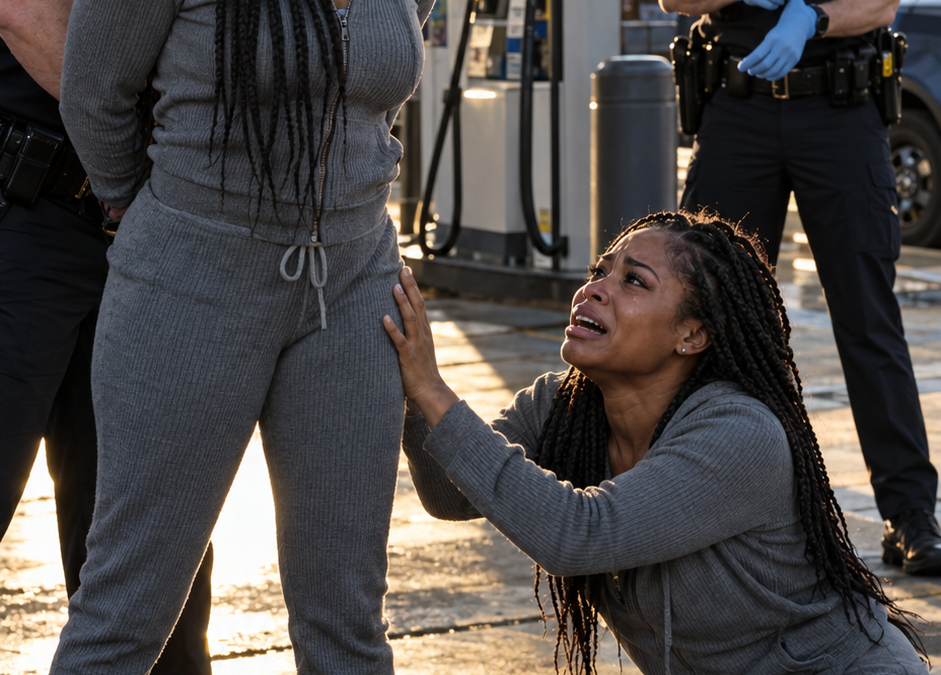
Nicole slowly knelt beside the Lexus.
Her red dress brushed the oily concrete.
She reached beneath the car for her license.
Thornton watched her with obvious satisfaction.
Lawson laughed.
“That’s more like it.”
My hands curled into fists.
I forced myself to relax them.
I thought of Mama.
I thought of the hospital room waiting for us.
I thought of every training exercise that began with an instructor reminding us that surviving an encounter was more important than winning an argument.
Nicole retrieved her identification.
Oil stained her fingers.
She stood, her face burning with embarrassment.
Thornton bent slightly toward her.
“Let me explain something. I run this town. I run this road. When I see something suspicious, I investigate it.”
Nicole swallowed.
“We understand.”
“You sure?”
“Yes.”
He looked at me.
“And you?”
I met his eyes.
“No problem, Sergeant.”
Something about my tone seemed to annoy him.
He turned away, walked several steps toward the cruiser, and then stopped.
“Lawson, run those plates.”
Lawson reached for his radio.
Nicole looked at me.
Her eyes were beginning to shine.
I gave her the smallest shake of my head.
Don’t argue.
Not yet.
Lawson read the license plate number into the radio.
Dispatch responded.
The registration was valid.
The vehicle had no theft report.
There were no outstanding warrants associated with Nicole.
Everything was clean.
Thornton lit a cigarette.
He stood beside the cruiser, smoking while we waited in the sun.
Three minutes passed.
Then five.
Sweat slid down my spine.
Nicole shifted from one foot to the other, but she didn’t complain.
When Lawson finally confirmed that nothing was wrong with the vehicle, Thornton barely reacted.
“Clean?”
“Yes, Sarge.”
He exhaled smoke.
“Interesting.”
He looked from Nicole to me.
“Maybe the car isn’t stolen. Doesn’t mean they aren’t hiding something else.”
I felt my heartbeat change.
“Sergeant, are we free to leave?”
He smiled.
“No.”
“Are we under arrest?”
“Not yet.”
“What is the basis for detaining us?”
His smile disappeared.
“Lawson. Greer. Put them on the hood.”
Lawson reached me first.
His hand closed around my arm.
I didn’t resist.
“Officer, I’m not posing a threat.”
“Shut up.”
He twisted my arm behind my back and drove me forward.
My water bottle fell and rolled beneath the cruiser.
Then my cheek struck the hood.
The heat was shocking.
It felt like pressing my face against the side of a pan that had been sitting on a stove.
I instinctively tried to turn away.
Lawson pressed harder.
“Don’t move.”
Beside me, Nicole cried out.
Greer had slammed her against the same hood.
Her forehead hit the metal.
“Please! What are you doing?”
“Hold still!”
I turned my head just enough to see her.
She was bent awkwardly over the hood, her red dress pulled tight across her back.
Greer had both her wrists behind her.
“Nicole, don’t fight him.”
“I’m not fighting!”
“Then stop moving,” Greer snapped.
The handcuffs closed around my wrists.
Too tightly.
I felt the metal dig into the bones immediately.
Nicole gasped when Greer cuffed her.
“What are we being charged with?”
Thornton laughed.
“Who said anything about charges?”
“You cannot detain us without a lawful basis.”
He approached her slowly.
“Listen to you.”
Nicole lifted her head.
“This is an unlawful detention. We’ve cooperated with every request.”
Thornton placed one hand on the back of her neck.
My entire body went rigid.
He leaned close to her ear.
“Say one more word.”
She went silent.
I watched his hand remain on her neck.
One second.
Two.
Three.
Then he released her.
“Much better.”
He stepped back and looked at us.
I had spent eight years teaching victims that being frightened didn’t make them weak.
Now I understood how useless those words could feel when your own face was pressed against hot metal and someone you loved was crying beside you.
My necklace was trapped beneath my shirt.
I had pressed the emergency button when Thornton threw our identification onto the ground.
By my estimate, nine minutes had passed.
My location had already been transmitted to the FBI response center in Atlanta.
The recording function was active.
The red indicator light was flashing beneath the black fabric of my shirt.
I had no way of knowing exactly how quickly a response team would reach us.
All I could do was keep Nicole alive and prevent the situation from escalating.
Lawson opened the Lexus.
He began pulling things from the glove compartment and center console.
Nicole’s sunglasses.
A phone charger.
Tissues.
Her hospital parking pass.
He dropped each item onto the pavement.
“Anything?” Thornton called.
“Nothing yet.”
“Check the trunk.”
I heard the trunk release.
A moment later, Lawson lifted our overnight bags.
He opened one and rummaged through it.
Then he found the fruit and the lavender envelope Nicole had placed beside it.
Our mother’s get-well card.
He removed the card.
Opened it.
And began reading aloud.
“Dear Mama, we’re coming home.”
His voice had taken on an exaggerated sweetness.
“Stay strong. Love, your girls.”
He held the card up.
“Aw, Sarge. They’re going to see their mommy.”
Greer laughed.
Thornton shook his head.
I felt Nicole begin to tremble beside me.
“That’s for our mother,” she whispered.
Lawson looked at her.
“Then I guess your mommy’s going to be disappointed.”
Something inside me changed.
I had tolerated the insults.
I had remained still when he handcuffed me.
I had done everything my training told me to do.
But hearing him mock a letter my sister had written to our mother before another chemotherapy treatment filled me with an anger so immediate that I couldn’t breathe.
Nicole’s voice broke.
“Audrey.”
I turned toward her as much as Lawson’s grip allowed.
“I’m here.”
“I can’t do this.”
“Yes, you can.”
“Why are they doing this?”
I didn’t have an answer that would help her.
So I repeated the sentence we’d heard all our lives.
“Remember what Mama told us?”
Nicole squeezed her eyes shut.
“Be twice as good.”
“That’s right.”
She began breathing more slowly.
Thornton approached the hood.
“Car’s clean.”
Neither of us spoke.
He looked at Lawson.
“Maybe they’re hiding something on themselves.”
I felt Lawson’s grip shift.
Then I heard the sharp snap of a latex glove.
“Let’s find out,” Thornton said.
Lawson began searching me.
At first, he moved his hands over my shoulders and down my sides.
I knew what a legitimate pat-down involved.
I knew what officers were permitted to do when they had an articulable safety concern.
There was no reason for this search.
There was even less reason for him to move the way he was moving.
His hands lingered where they shouldn’t have.
I stared at a scratch in the cruiser’s paint.
It was shaped like a crescent moon.
I focused on that scratch as if memorizing every tiny ridge might somehow separate my mind from what was happening to my body.
“Don’t touch me like that,” I said.
Lawson leaned closer.
“Just doing my job.”
Thornton watched from the shade.
“Take your time.”
Lawson stepped back.
“She’s clean.”
Thornton flicked cigarette ash onto the pavement.
“Check again.”
My stomach tightened.
“There’s no justification for another search.”
Lawson placed his hands on me again.
This time, he lifted the edge of my shirt.
His fingers touched my bare skin.
I jerked involuntarily.
“Stop.”
He pressed me harder against the hood.
“Stay still.”
Beside me, Nicole raised her voice.
“Get your hands off my sister!”
Thornton looked at her.
“Or what?”
“You’re going to regret this.”
He smiled.
“Greer. Her turn.”
I watched Greer approach Nicole.
She tried to straighten up.
He forced her back down.
“Please,” she said. “I’m not resisting.”
He grabbed one shoulder of her red dress and pulled the strap aside.
Nicole cried out.
“Don’t!”
He clamped a hand against the back of her neck.
I could see her eyes.
They were wide with terror.
She stopped speaking.
Not because she had agreed to anything.
Because she was frightened enough that her body seemed to have forgotten how.
I had witnessed that reaction in countless interviews.
Victims often described freezing during an assault and later blamed themselves for not fighting.
I had explained to them that freezing was an involuntary survival response.
Now I was watching it happen to the person who had shared a bedroom with me for eighteen years.
I had never felt so helpless.
Greer continued his invasive search.
Nicole pressed her forehead into the hood.
Tears rolled down her face.
Thornton lit another cigarette.
“What’s the matter, sweetheart? You were doing all that talking a minute ago.”
I pulled against Lawson’s grip.
“Leave her alone!”
He twisted my arm.
Pain shot through my shoulder.
“Quiet!”
Then I heard a camera shutter.
Lawson had taken out his phone.
He was photographing Nicole.
He tilted the screen toward Thornton.
Thornton laughed.
Greer reached for his own phone.
“Get a better angle,” Lawson said.
Another shutter clicked.
I watched Nicole’s expression collapse.
There are forms of humiliation that leave no visible wound.
They make a person feel as though her own body no longer belongs to her.
They replace ordinary memories with moments she cannot bear to revisit.
I saw that happening to my sister in real time.
And for the first time since Thornton had approached us, I nearly lost control.
I wanted to break free.
I wanted to put all three men on the ground.
I wanted to do something that would erase the look in Nicole’s eyes.
But my wrists were cuffed.
My shoulder was injured.
And any sudden movement could turn an already dangerous situation into something neither of us would survive.
So I concentrated on breathing.
On the pendant pressing into my chest.
On the emergency signal that had been transmitting for fourteen minutes.
Then I made a decision.
“Sergeant Thornton.”
My voice was quiet.
But something in it made him turn.
“What?”
“You need to stop this immediately.”
He stared at me.
“Excuse me?”
“Take your officers away from my sister. Now.”
He gave an incredulous laugh.
“Or what?”
I lifted my head as far as Lawson’s grip allowed.
“Because the necklace beneath my shirt contains an FBI emergency transmitter. I activated it when you threw our identification on the ground.”
Thornton’s smile began to disappear.
“My location has been transmitted to FBI dispatch every thirty seconds for approximately fourteen minutes. The incident is also being recorded.”
For the first time that morning, the parking lot became completely silent.
Lawson loosened his grip.
Greer’s hands stopped moving.
Thornton stared at my necklace.
“You’re lying.”
“My name is Special Agent Audrey Shaw. I work in the FBI’s civil rights and public corruption investigations. My credentials are in the wallet you threw beneath my sister’s vehicle.”
He glanced toward the Lexus.
I continued.
“I have investigated officers for eight years, Sergeant. And you have just given me fourteen minutes of evidence.”
He took a step backward.
“You think you’re funny?”
“No.”
I met his eyes.
“I think you should instruct your officers to stop touching us.”
Nicole slowly raised her head.
Her mascara had run.
Her red dress was torn at one shoulder.
A dark mark was spreading across her forehead.
When she spoke, her voice sounded different from anything I’d ever heard.
There was no pleading left in it.
“My sister isn’t the only federal official you’ve detained.”
Thornton looked at her.
She swallowed.
“I’m Nicole Shaw. I’m a federal judge on the Eleventh Circuit Court of Appeals.”
Nobody moved.
Nicole straightened as much as her position allowed.
“You had our identification. You had confirmation that this vehicle wasn’t stolen. And you continued to detain us, threaten us, and subject us to invasive searches.”
Lawson looked at Thornton.
“Sarge?”
Thornton ignored him.
Nicole’s voice grew steadier.
“Every one of those actions is going to be examined by federal investigators. Not because of our titles, but because you had no right to do this to anyone.”
Thornton’s cigarette burned between his fingers.
He stared at us as though our faces had suddenly changed.
Perhaps they had.
Perhaps he was finally seeing the two women who had been standing in front of him all along.
Then we heard tires.
Two black Chevrolet Suburbans turned into the gas station.
They moved quickly across the lot and stopped in a V formation, blocking Thornton’s cruiser.
Four federal agents stepped out.
The lead agent was a tall woman with her hair pulled back tightly.
I recognized her immediately.
Special Agent Rebecca Hayes.
She came directly toward me.
“Audrey?”
“Rebecca.”
Her eyes moved over my face, my wrists, and Lawson’s hand on my shoulder.
“Get away from her.”
Lawson released me.
Hayes unlocked my handcuffs.
When the metal fell away, pain surged through both wrists.
She looked at the red marks.
“Are you injured?”
“My shoulder. My face. Nicole needs help.”
Hayes turned toward my sister.
Another agent removed Nicole’s handcuffs.
The moment she was free, her knees buckled.
I caught her before she fell.
She wrapped both arms around me.
And then she began to cry.
Not quietly.
Not the controlled tears she’d shed during our mother’s chemotherapy appointments.
She cried with the desperate, frightened sobs of someone whose body had finally realized she was no longer in immediate danger.
I held her against my chest.
“I’m here.”
She was shaking so badly that I could barely keep my balance.
“I thought they were going to—”
“I know.”
“I couldn’t make them stop.”
“I know, baby.”
That word came out without thinking.
Mama had called us that when we were little.
I hadn’t used it with Nicole in years.
But as I held my sister in that parking lot, I could see the fourteen-year-old girl sitting beside me on the school bus, watching a stranger read her diary.
I wished I could go back and protect her from both afternoons.
Hayes approached Thornton.
“Sergeant Wade Thornton?”
He stood motionless beside his cruiser.
“Yes.”
“Keep your hands away from your weapon.”
His hand had moved toward his holster.
He slowly lifted it.
Hayes continued.
“Your department has been notified. Federal investigators are taking control of this scene. You and your officers will be detained while we secure evidence and determine the appropriate charges.”
Thornton opened his mouth.
“I didn’t know who they were.”
Hayes looked at him.
For a moment, her professional expression hardened.
“And you think that changes what you did?”
He had no answer.
Lawson started talking.
“Sarge gave the orders. I was just following instructions.”
Greer shook his head.
“I didn’t know either.”
I looked at all three men.
A few minutes earlier, they had been laughing while my sister begged them to stop.
Now they were frightened.
Now they wanted explanations.
Now they wanted somebody to understand that the situation had gotten out of control.
I wondered whether they had ever extended that same consideration to anyone they’d detained.
Hayes directed them to surrender their weapons.
Thornton unclipped his badge.
For twenty-two years, that piece of metal had announced his authority.
He held it for several seconds before lowering it to the pavement.
Lawson and Greer followed.
Then the handcuffs came out.
I heard the first metallic click as Hayes secured Thornton’s wrists.
Nicole flinched beside me.
I tightened my arms around her.
“It’s over.”
But even as I said the words, I knew they weren’t entirely true.
The immediate danger was over.
What had happened to us was only beginning to reveal itself.
An ambulance arrived.
Paramedics examined our burns, bruises, and injured wrists.
Nicole needed treatment for her forehead and shoulder.
I had abrasions on my cheek and a sprained shoulder from Lawson twisting my arm.
Medical personnel documented everything.
So did the investigators.
They photographed the Lexus, the contents scattered across the pavement, Nicole’s torn dress, and the bruises already forming on our arms.
They recovered our identification from the ground.
They secured the officers’ phones.
They collected the recording from my pendant and the footage from the Lexus dashcam.
The gas station’s exterior security camera had also captured much of the encounter.
By the time we left Greyfield, the parking lot had become a federal crime scene.
I wanted to feel victorious.
Instead, I felt exhausted.
Nicole sat beside me in the back of an FBI vehicle, wrapped in a blanket, staring at her hands.
She hadn’t spoken for nearly twenty minutes.
When she finally did, her question nearly broke me.
“Do you think Mama heard about it?”
I took her hand.
“Not yet.”
“She’s expecting us.”
“I’ll call her.”
Nicole shook her head.
“Don’t tell her everything.”
I looked at the bruise on her forehead.
“Nicole—”
“Please. Not until we get there.”
I knew what she meant.
Our mother was undergoing chemotherapy.
She was already frightened, exhausted, and in pain.
The last thing Nicole wanted was for her to hear that both her daughters had been assaulted on the way to visit her.
We reached the hospital that afternoon.
Mama took one look at us and knew something was wrong.
She was sitting upright in bed, wearing a pale blue sweater over her hospital gown.
Her hair had thinned so much that she had started wearing a scarf.
But her eyes were still sharp.
“What happened?”
Nicole tried to smile.
“We had a little trouble on the road.”
Mama looked at the dressing on her forehead.
Then at my wrists.
Her expression changed.
“Tell me.”
I sat beside her bed.
For the first time in years, I couldn’t find the right words.
“We were stopped by the police.”
She closed her eyes.
When she opened them again, they were wet.
“Did they hurt you?”
Neither of us answered quickly enough.
Mama reached for Nicole.
My sister sank into the chair beside her.
And there, in the same hospital where our mother had spent thirty-one years comforting frightened strangers, we finally told her what had happened.
She listened without interrupting.
Only once did she make a sound.
It was when Nicole described the officers opening her get-well card.
Mama pressed her hand against her mouth.
“Oh, my babies.”
I had survived the encounter without crying.
I had remained composed while investigators interviewed me.
But hearing those three words from my mother undid everything.
I lowered my head into her lap.
She placed one hand on my hair and the other on Nicole’s shoulder.
For a while, none of us spoke.
The television was playing quietly in the corner.
Somewhere in the hallway, a nurse laughed.
A monitor beeped.
Life inside the hospital continued exactly as it always had.
And I realized how easily the world could keep moving while somebody else’s world fell apart.
The recording became public the following evening.
Our legal team and federal investigators had warned us that images from the incident might circulate.
I believed I was prepared.
I wasn’t.
By Monday morning, clips were everywhere.
The footage showed Thornton ordering Nicole onto her knees.
It showed Lawson forcing me against the hood.
It showed Greer restraining my sister.
And it showed Lawson opening the lavender envelope and reading our mother’s letter aloud while the other officers laughed.
That seven-second clip became the image people associated most strongly with our case.
Dear Mama, we’re coming home.
Stay strong.
Love, your girls.
Four ordinary words at the end of a letter.
Words Nicole had written because she was afraid our mother might not survive another round of treatment.
Words the officers had treated as entertainment.
The complete incident recording ran fourteen minutes and twenty-two seconds.
Within days, it had been viewed millions of times.
Our names appeared in national headlines.
Reporters gathered outside our homes.
Nicole received messages from attorneys she’d worked with years earlier.
My FBI colleagues called, offering help, support, and, in some cases, apologies for not having realized how frightened I had been.
But the messages that affected me most came from strangers.
A woman in Mississippi wrote that she’d been subjected to an invasive search during a traffic stop and hadn’t told anyone because she believed nobody would take her seriously.
A young man in Alabama described spending six hours in a holding cell after being mistaken for somebody else.
A mother from South Carolina sent a photograph of her seventeen-year-old son and explained that she made him rehearse what to say if an officer approached him.
I read those messages late at night.
Sometimes I couldn’t finish them.
Because I knew that if I hadn’t been carrying an emergency transmitter, our own story might have ended as another complaint nobody wanted to investigate.
The FBI opened a broader investigation into the Greyfield Police Department.
At first, the department insisted the gas station incident involved only three officers.
Chief Harold Dunn appeared before reporters and read a prepared statement condemning their conduct.
He called it an isolated incident.
I was watching the press conference from my living room.
Nicole sat beside me, her injured shoulder supported by a pillow.
When Dunn used the word isolated, she reached for the remote and turned off the television.
“Fourteen,” she said.
I looked at her.
“What?”
“Fourteen complaints against Thornton. Rebecca told us investigators found fourteen.”
I already knew.
I’d read the preliminary report that morning.
But hearing Nicole say the number aloud gave it a different weight.
Fourteen people had tried to tell somebody.
Fourteen times, the department had found a way to look away.
The records revealed a disturbing history.
Thornton had been accused of racial profiling, unlawful detention, excessive force, and repeated verbal abuse.
One complaint had been filed by a twenty-two-year-old Black college student in 2019.
Thornton had stopped her for a broken taillight.
According to her statement, he made her stand beside the road for forty-five minutes while he searched her vehicle and made inappropriate comments about her body.
She had reported him.
The supervisor reviewing her complaint was Thornton’s brother-in-law.
The complaint was marked unfounded.
Another involved a Black father who claimed Thornton had threatened him in front of his children.
Another concerned an illegal vehicle search.
The details varied.
The internal response did not.
Complaints were filed.
Supervisors reviewed them.
Investigations were closed.
Nothing changed.
Lawson had three prior excessive-force complaints.
One involved a sixteen-year-old boy whose arm was broken during a traffic stop.
The police report stated that the boy had resisted.
Recovered video showed him standing with his hands raised.
Greer had been sued by a woman who accused him of conducting an unlawful body search.
The lawsuit had been settled.
The terms were confidential, and his personnel record contained no meaningful disciplinary action.
I had spent years investigating institutional misconduct.
I had seen this pattern before.
But reading those records while my sister sat beside me with bruises on her arms made every page feel unbearable.
I kept thinking about the fourteen people who had complained about Thornton.
What if the department had taken the first one seriously?
What if the second complaint had triggered an independent investigation?
What if the third had resulted in suspension?
How many people might have been spared?
The department had not simply failed to stop misconduct.
Its leadership had repeatedly chosen not to examine evidence that might have exposed it.
The records eventually reached the press.
The Atlanta Journal-Constitution published a detailed investigation into Greyfield’s handling of misconduct complaints.
Chief Dunn’s explanation of an isolated incident became impossible to sustain.
He resigned that Friday.
By Saturday morning, hundreds of people had gathered outside Greyfield Town Hall.
Some carried photographs of people who had filed complaints against the department.
Others held signs demanding an independent review.
One woman had brought her teenage daughter.
I later watched an interview in which the mother explained why she had come.
“I want my daughter to understand that people don’t have to stay quiet just because somebody powerful tells them to.”
The words reminded me of Mama sitting on the edge of our bed after the school bus incident.
What are you going to do about it?
The town council convened an emergency meeting.
After reviewing the investigative findings and hearing hours of public testimony, council members voted seven to one to dissolve the Greyfield Police Department and transfer local law-enforcement responsibilities to the county sheriff’s office.
All nineteen members of the department were separated from their positions as part of the restructuring.
The federal investigation continued.
The officers’ criminal cases moved forward.
And Greyfield, a town most people had never heard of, became a place where residents were finally asking questions that should have been asked years earlier.
But none of those developments made Nicole’s nightmares stop.
She returned to work after her physical injuries had improved.
She told me she was ready.
Then, one morning, she called from her car outside the courthouse.
I could hear traffic in the background.
“Audrey?”
“What’s wrong?”
She didn’t answer immediately.
“I can’t get out.”
I sat upright.
“Where are you?”
“In the parking garage.”
“Are you hurt?”
“No.”
Her breathing quickened.
“There’s a police officer near the entrance. He’s just standing there. I know he’s not doing anything wrong, but I can’t—”
Her voice broke.
“I can’t make myself open the door.”
I stayed on the phone until she could breathe normally.
Then I drove to the courthouse.
When I arrived, she was sitting behind the steering wheel, staring straight ahead.
I opened the passenger door and sat beside her.
She looked ashamed.
“I’ve been a federal judge for years. I’ve sentenced people. I’ve handled threats. And now I can’t walk past somebody wearing a uniform.”
I reached for her hand.
“You don’t have to prove anything to me.”
She started crying.
“I thought I was stronger than this.”
I remembered the gas station.
The way Greer had held her down.
The camera shutter.
The expression on her face.
“You were strong enough to survive it,” I said. “You don’t have to pretend it didn’t hurt.”
She leaned against my shoulder.
We stayed in the car until she was ready to walk inside.
I accompanied her to the entrance.
Then I watched my sister straighten her jacket, lift her chin, and disappear through the courthouse doors.
She looked every inch the federal judge she had spent her life becoming.
But now I understood something I hadn’t before.
Courage wasn’t the absence of fear.
Sometimes it was walking through a doorway while every part of your body begged you to turn around.
The federal grand jury convened the following month.
Thornton, Lawson, and Greer faced charges arising from their violations of our civil rights.
Investigators also pursued allegations related to excessive force, sexual misconduct, unlawful detention, and efforts to conceal evidence.
Lawson had attempted to delete the photograph he’d taken of Nicole.
Federal forensic specialists recovered it.
They recovered Greer’s photographs, too.
The images became some of the most disturbing evidence presented at trial.
Not because they showed anything the other recordings hadn’t captured.
But because they revealed how the officers had regarded us.
They had photographed our humiliation.
They had laughed.
They had wanted to preserve what they were doing.
When the trial began, I expected my professional experience to help me.
I was accustomed to courtrooms.
I understood cross-examination, evidentiary objections, and the careful language prosecutors use when they don’t want a witness to appear coached.
But sitting in the gallery while attorneys discussed the worst minutes of my life was entirely different from reviewing someone else’s case.
I hated hearing my own voice in the recordings.
I hated watching Lawson twist my arm.
Most of all, I hated seeing Nicole’s face when Greer pulled her dress from her shoulder.
There were moments when I wanted to leave.
There were moments when I wanted to stand up and scream.
Instead, I sat quietly and listened.
The defense argued that the officers had been performing a legitimate investigation.
Thornton’s attorney characterized his language as inappropriate but insufficient to establish criminal intent.
He described the initial stop as a routine inquiry.
Then the prosecution played the complete video.
The jury watched without speaking.
They saw the clean registration.
They heard dispatch confirm that the Lexus wasn’t stolen.
They watched Thornton order us onto the hood despite having no evidence that we had committed a crime.
They heard Nicole repeatedly ask what we were being charged with.
They watched the searches.
Then they heard the camera shutters and the laughter.
The defense attorney lowered his eyes as the video continued.
Later, when Nicole was called to testify, I sat behind the prosecution team.
She wore a black suit and a white blouse.
There was no judicial robe.
No elevated bench.
No authority attached to her position in that room beyond the credibility of her testimony.
She was there as a witness.
As a woman who had been assaulted.
The prosecutor asked her to describe what happened after the officers searched our car.
Nicole folded her hands.
She explained how Thornton had ordered us onto the hood.
She described the heat.
The handcuffs.
The threats.
When she reached the part where Greer began searching her, she paused.
The prosecutor waited.
Nicole took a sip of water.
“He pulled my dress aside.”
Her voice trembled.
“I told him to stop.”
The prosecutor spoke gently.
“What happened next?”
“He put his hand on the back of my neck.”
She looked down.
“I stopped talking.”
“Why?”
For several seconds, she couldn’t answer.
Then she looked toward the jury.
“Because I was terrified.”
The courtroom became very quiet.
“I kept thinking that if I made him angrier, he might hurt my sister. And if I stayed quiet, maybe he’d finish and let us go.”
She wiped her cheek.
The prosecutor gave her a moment.
Then she asked, “Judge Shaw, what were you thinking when you realized the officers were taking photographs?”
Nicole’s eyes found mine.
“I was thinking about every woman who has ever been treated that way and didn’t have somebody coming to help her.”
She drew a breath.
“And I was thinking that if my sister hadn’t been wearing that necklace, I don’t know how we would have gotten out of there.”
I couldn’t hold her gaze.
I looked down at my hands.
The red marks from the handcuffs had faded weeks earlier.
But for a moment, I could feel them again.
The trial lasted nine days.
During closing arguments, the prosecutor displayed the photographs recovered from the officers’ phones.
One showed Lawson smiling.
Another showed Greer holding up his camera.
In the background, Nicole was still restrained against the cruiser.
The prosecutor turned toward the jury.
“These images weren’t taken by concerned witnesses. They weren’t created by journalists documenting an incident. The defendants took them themselves.”
She paused.
“They treated the suffering they caused as something worth keeping.”
The defense objected to the prosecution’s interpretation.
The judge instructed the jury to evaluate the evidence under the applicable law.
But the images remained.
No argument could change who had taken them.
The verdict came on a Thursday afternoon.
I remember the courtroom clock.
I remember the sound of people standing as the jury entered.
I remember Nicole reaching for my hand before the first verdict was read.
Guilty.
Thornton stared straight ahead.
Guilty.
Lawson lowered his head.
Guilty.
Greer began crying.
The jury convicted all three officers on the counts submitted against them.
At sentencing, Thornton received eight years in federal prison.
Lawson received three years.
Greer received four.
The judge also imposed the applicable terms of supervised release and other conditions.
I listened to each sentence without moving.
For eight years, I had helped build cases against corrupt officers.
I knew the significance of a federal conviction.
I understood what prison would mean for men who had spent their careers believing they were untouchable.
But I didn’t experience the triumph I had imagined.
I felt the familiar ache of remembering a Saturday morning when my sister had been frightened and I couldn’t protect her.
Outside the courthouse, reporters were waiting.
Microphones appeared in front of us.
People shouted questions about the verdict, the sentences, and whether we believed justice had been served.
I stopped briefly.
“Fourteen people complained about Sergeant Thornton before we encountered him,” I said.
The reporters fell quiet.
“Fourteen people asked somebody to listen.”
I looked toward the courthouse.
“It shouldn’t have taken another victim for those complaints to matter.”
Then I took Nicole’s hand and walked away.
Mama watched the verdict from home.
By then, she had finished another round of chemotherapy and was recovering well enough to spend more time outside the hospital.
When we arrived that evening, she was waiting on the porch.
She stood before we reached the steps.
I hurried toward her.
“Mama, sit down. You’re supposed to be resting.”
She ignored me.
She wrapped her arms around both of us.
I felt how much weight she’d lost.
Her shoulders seemed smaller beneath my hands.
But when she spoke, her voice was the same firm voice that had carried us through childhood.
“I’m proud of you.”
Nicole started crying.
Mama kissed her forehead.
“Both of you.”
We stayed on that porch until the sun disappeared.
Nobody talked about the officers.
Nobody mentioned prison.
For a few hours, we were simply a family grateful to be together.
The months that followed changed my understanding of the work I had devoted my life to.
I’d always believed that a successful investigation ended when the evidence was presented and the responsible people were convicted.
But the gas station case forced me to confront something I had known professionally and avoided personally.
A conviction couldn’t undo the damage.
It couldn’t give Nicole back the sense of safety she’d lost.
It couldn’t erase the memory of Thornton making her kneel in the oil.
And it couldn’t protect the people whose complaints were still sitting in filing cabinets across the country.
Six months after the incident, I was invited to speak at FBI headquarters in Washington.
Nearly two hundred agents attended.
I had prepared notes.
I didn’t use them.
When I stepped behind the podium, I thought about my sister sitting in her car outside the courthouse, unable to open the door.
Then I thought about the women who had written to us.
“I’ve spent eight years investigating police misconduct,” I began. “I thought I understood what our victims experienced.”
I looked across the room.
“Then I became one.”
Nobody moved.
“My sister and I survived our encounter because help arrived. I had an emergency transmitter. I knew the procedures. My sister understood the law.”
I paused.
“Most people don’t have those advantages.”
I spoke about Thornton’s fourteen previous complaints.
About the supervisors who had dismissed them.
About the other victims who had tried to report misconduct and been ignored.
“I don’t want our case remembered simply because an FBI agent and a federal judge were mistreated,” I said. “I want people to understand that the same conduct would have been wrong if we’d been two unemployed women, two college students, or two teenagers on their way home from school.”
As I stepped away from the podium, I finally understood what Mama had been trying to teach us.
Being twice as good had never meant we deserved twice as much protection.
It meant the world might demand more from us before offering the protection we should have had all along.
Nicole returned to her judicial work with a different perspective.
She was careful not to let her personal experience replace the law or the evidence in cases before her.
But she became more attentive to the practical consequences of institutional failures.
In one civil rights opinion, she wrote a passage that people began sharing widely:
“The absence of accountability is not the absence of harm. When a system buries fourteen complaints, it does not erase fourteen victims. It creates the conditions for a fifteenth.”
She showed me the draft before the opinion was published.
I read those sentences three times.
Then I looked at her.
“Fourteen?”
She nodded.
“I want them counted.”
Together, we established the Shaw Justice Initiative.
Our goal was to help people document misconduct, obtain legal assistance, and understand their rights before an encounter became a tragedy.
We organized programs to distribute affordable recording equipment to communities that lacked reliable access to it.
We created a legal assistance hotline for victims of police misconduct.
We worked with attorneys and law-enforcement trainers on educational programs centered on accountability, lawful searches, and the responsibility that accompanies police authority.
Within the first year, the initiative helped distribute approximately four thousand cameras and supported sixty-two legal cases.
Our training partners conducted programs in nine states.
The work was exhausting.
Some days, it felt as though every case we helped resolve was replaced by three more.
But every time I began wondering whether we were making a difference, I remembered the complaint files from Greyfield.
Fourteen chances.
Fourteen opportunities to prevent what happened to us.
I refused to believe those opportunities had been meaningless.
Later, I was invited to testify before a Senate subcommittee examining police accountability.
I brought a copy of Thornton’s personnel record.
Fourteen complaints.
I placed the file on the table in front of me.
Then I held it up.
“Every page in this file represents somebody who went to the trouble of reporting what happened to them.”
I looked toward the committee members.
“Some were frightened. Some had injuries. Some had families who were terrified that filing a complaint would lead to retaliation.”
I lowered the file.
“They came forward anyway.”
I explained how internal reviews had repeatedly dismissed the complaints and how those decisions allowed the misconduct to continue.
“I don’t want the law to depend on whether the person being harmed happens to have an impressive job title,” I said. “I want existing protections to mean something before another person becomes a victim.”
The hearing lasted three hours.
Months later, lawmakers introduced a proposal that became known as the Greyfield Act.
It sought to require independent civilian oversight for police departments receiving federal funding.
The bill passed the House and remained under consideration in the Senate.
I understood that legislation moved slowly.
I also understood that changing the language of a law was easier than changing the culture of an institution.
But the hearings had brought people into the conversation whose experiences might otherwise never have been heard.
That mattered to me.
It mattered to Nicole, too.
One afternoon, she called me from her office.
“Audrey, I got a letter.”
“From who?”
“A woman in Alabama.”
She sounded emotional.
The woman had filed a misconduct complaint against her local sheriff’s department several years earlier.
Her complaint had been dismissed.
When she read Nicole’s opinion discussing the fourteen ignored complaints in Greyfield, she sat at her kitchen table and cried.
Nicole read part of the letter aloud.
“I wasn’t crying because I was sad. I was crying because somebody finally counted me.”
My throat tightened.
Nicole fell silent.
Then she said, “I think I’m going to keep this in my desk.”
“Where you’ll see it?”
“Every day.”
For the first time since the gas station, I heard something in her voice that sounded like peace.
Not complete peace.
Not the impossible kind that erases every painful memory.
But the kind that comes from knowing the worst thing somebody did to you does not have to become the only thing your life is about.
Mama completed chemotherapy in October.
The day she received her encouraging scan results, I was sitting in my office reviewing a case file.
My phone rang.
I answered without checking the screen.
“Shaw.”
“Is that how you greet your mother?”
I nearly dropped the phone.
“Mama? What happened?”
“Apparently, I’m going to be around long enough to annoy you for a while.”
I stood.
“What did the doctor say?”
“The scans look good.”
I put one hand over my mouth.
She continued talking, explaining that she would need follow-up appointments and ongoing monitoring.
But I barely heard the details.
I was crying too hard.
When I finally managed to speak, all I could say was, “Thank God.”
Mama laughed softly.
“And don’t think this means you’re getting out of Thanksgiving dinner.”
“I wouldn’t dream of it.”
“Bring strawberries this time.”
I laughed through my tears.
“Yes, ma’am.”
That November, Nicole and I drove to our mother’s house in south Atlanta.
We took the interstate.
Neither of us suggested the old road through Greyfield.
Nicole was driving again.
She still became tense when a police cruiser appeared behind us.
Sometimes I saw her fingers tighten on the steering wheel.
Sometimes she asked me to check whether a patrol car was following us.
I never laughed at her.
I simply looked, answered, and stayed beside her.
Healing was happening slowly.
Some mornings were better than others.
But she was driving.
She was working.
And she was beginning to laugh again.
When we reached Mama’s house, the front door was open.
Music drifted out toward the porch.
The smell of roasted turkey and sweet potatoes filled the air.
Mama was standing in the kitchen wearing an apron she’d owned since we were children.
Her hair was beginning to grow back.
She looked tired.
She looked beautiful.
She looked alive.
Nicole rushed toward her.
I followed.
Mama pretended to complain that we were crushing her.
But she held us tightly.
Thanksgiving dinner was chaotic.
Nicole had overcooked the green beans.
I had forgotten the cranberry sauce.
Mama insisted that nobody knew how to make cornbread properly anymore.
We laughed until our stomachs hurt.
After dinner, the three of us carried our drinks onto the porch.
The evening air was cool.
A few leaves had gathered along the steps.
Mama settled into her old wooden chair while Nicole and I sat on either side of her.
For a while, we listened to the neighborhood sounds.
A dog barking.
Children playing down the street.
Someone starting a car.
The familiar sounds of a world that had nearly taken more from us than we knew how to bear.
Mama reached into a bowl of fruit.
She picked up a grape.
Tasted it.
Made a face.
“These are terrible.”
Nicole burst out laughing.
“Mama!”
“I told you to buy strawberries.”
I shook my head.
“Six months later, and you’re still talking about those grapes?”
“Some disappointments stay with you.”
Nicole laughed so hard she nearly spilled her drink.
Watching her, I felt a warmth spread through my chest that I hadn’t experienced in months.
The sound was familiar.
It was the same laugh I’d heard in our bedroom above the laundromat.
The same laugh she’d made when Mama caught us sneaking cookies.
The same laugh I’d been afraid I might never hear again after that Saturday at the gas station.
I reached beneath my sweater and touched the silver pendant.
Mama noticed.
“You still wearing that thing?”
“Every day.”
She nodded slowly.
Then she looked at both of us.
“I’ve been thinking about something.”
Nicole leaned back.
“That usually means we’re about to get another lecture.”
Mama ignored her.
“When you girls were little, I kept telling you that you had to be twice as good.”
I smiled.
“We remember.”
“I thought if I raised you to be smart enough and strong enough, maybe I could protect you from the things I couldn’t control.”
Her voice softened.
“But when I watched that recording, I realized there was nothing I could have taught you that would have made those men treat you right.”
Nicole reached for her hand.
“Mama—”
“No, let me finish.”
She looked at us with tears in her eyes.
“What happened wasn’t because you weren’t careful enough. And it wasn’t because you needed to be stronger. Those men made their choices.”
I felt my throat tighten.
For so many months, I had replayed that morning in my mind.
What if I’d told Thornton I was an FBI agent immediately?
What if I’d activated the transmitter sooner?
What if I’d refused to get out of the car?
What if I’d done something, anything, before they hurt Nicole?
I had gone through every possible variation.
And in every one, I had found a new way to blame myself.
Mama squeezed my hand.
“You hear me, Audrey?”
I nodded.
“Yes, ma’am.”
She looked at Nicole.
“And you?”
Nicole wiped her cheek.
“Yes, Mama.”
Our mother leaned back in her chair.
“Good. Because I didn’t raise you girls to spend the rest of your lives carrying somebody else’s shame.”
We sat together as the sky darkened.
Eventually, Nicole rested her head on Mama’s shoulder.
I stretched my legs across the porch steps.
For the first time in months, I wasn’t thinking about courtrooms, recordings, criminal charges, or the terrible weight of fourteen unanswered complaints.
I was thinking about how grateful I was that my mother was still sitting between us.
A little later, I touched my necklace again.
“Mama?”
“Hmm?”
“Next time you want us to visit, we’re taking the highway. No back roads. No little towns. And absolutely no gas stations.”
Nicole laughed.
Mama looked at me for a long moment.
Then she shook her head.
“Baby, you’re going to take whatever road you want.”
I looked at her.
She smiled.
“You’ve earned every mile of it.”
I didn’t answer immediately.
I watched Nicole slip her arm around our mother’s shoulders.
I watched the porch light illuminate the steps where we’d played as children.
And I remembered two fourteen-year-old girls sitting on a school bus, holding hands after strangers had made them feel powerless.
For years, I’d believed our lives had been defined by what those officers had done.
Now I knew better.
Those men had influenced the direction we took.
They had given us reasons to fight.
But they had never owned our futures.
Neither did Thornton, Lawson, or Greer.
They could take our dignity for a moment.
They could frighten us, hurt us, and leave us with memories we would have to work through for years.
But they could not decide what those memories would eventually mean.
Nicole was still my sister.
Mama was still our mother.
And I was still the little girl who had memorized two badge numbers because she believed somebody, somewhere, ought to remember what happened.
Only now, I understood that remembering was just the beginning.
As we sat together on that porch, Mama reached for another grape, inspected it suspiciously, and put it back in the bowl.
Nicole and I started laughing.
And for the first time since that terrible afternoon at pump two, I laughed without feeling the need to look over my shoulder.








