𝗙𝗨𝗟𝗟 𝗦𝗧𝗢𝗥𝗬 The Three-Legged Puppy Was Still Moving When I Saw What Was Waiting Above Him
𝗙𝗨𝗟𝗟 𝗦𝗧𝗢𝗥𝗬
She glanced toward the missing leg.
“We’ll also need to evaluate the old injury and make sure there are no complications.”
I stroked the puppy’s head.
“You’re not going back there,” I whispered.
It was the first promise I made to him.
And it was the only promise I knew I could keep.
The next several hours passed in a blur of medical assessments, careful monitoring, and conversations about treatment.
His bloodwork raised concerns about anemia and systemic illness.
Additional testing revealed Ehrlichia, a tick-borne infection capable of causing serious complications, particularly in an animal whose body is already severely weakened.
I remember standing beside the veterinarian while she explained the results.
“He’s fighting several problems at once.”
“The infection, the starvation, and his mouth?”
“Yes. And we still need to address the wounds and his overall weakness.”
I looked through the examination room window.
The puppy was resting beneath a clean blanket.
“Can he recover?”
The veterinarian didn’t offer the easy reassurance I desperately wanted.
“He has a chance. But we’re going to have to take this carefully.”
I appreciated her honesty.
In rescue work, hope matters.
But hope isn’t a treatment plan.
This puppy needed medical attention, nutrition, constant monitoring, and time.
Most of all, he needed his already exhausted body to cooperate.
That night, our team discussed what to call him.
Until then, we had referred to him as the puppy from the playground.
It felt wrong to keep describing him by the place where we’d nearly lost him.
He deserved something that belonged entirely to him.
We chose Vicente.
A name we associated with victory.
I liked it immediately.
Not because I believed he had already defeated everything threatening him.
He hadn’t.
The hardest part of his journey was still ahead.
But he had survived long enough for us to find him.
And after watching him struggle across that playground on three trembling legs, I couldn’t imagine giving him a name that suggested anything less than courage.
“Hello, Vicente,” I whispered when I returned to his room.
He opened one eye.
I smiled.
“That’s your name now.”
He rested his head against the blanket.
I pulled a chair beside him and sat down.
For the first time that day, I allowed myself to feel how frightened I really was.
I kept thinking about the missing leg.
A severe injury like that doesn’t simply disappear from an animal’s life.
Even when a wound heals, losing a limb changes everything about how a dog moves, balances, rests, and learns to trust his body.
Some dogs adapt remarkably well to three legs.
But Vicente wasn’t a healthy dog adjusting to an amputation under veterinary supervision.
He was a starving puppy whose body had endured an unknown period of pain, infection, and neglect.
He had no muscle reserves.
He had wounds.
He was battling illness.
And the papillomas inside his mouth threatened to make nutrition, the one thing he desperately needed, extraordinarily difficult.
I wondered how many people had walked past him before somebody finally called for help.
I wondered whether he’d once belonged to someone.
Had there been a time when he slept in a warm room, played with another puppy, or waited beside a door for someone to come home?
Or had his entire short life been a struggle to survive?
I didn’t know.
And I had to accept that I might never know.
What mattered was what happened next.
The following morning, Vicente was still alive.
I entered the clinic earlier than necessary because I hadn’t slept much.
One of the technicians was checking his condition.
“How was he overnight?”
“Quiet. Very weak, but he’s still with us.”
I approached his bed.
“Morning, little winner.”
His eyes moved toward me.
I gently placed my fingers near his muzzle.
He sniffed them.
Then he rested his chin against my hand.
That tiny gesture nearly undid me.
I had spent the night imagining every terrible outcome.
He greeted me by doing something ordinary.
He wanted to be close to another living creature.
I sat beside him while the veterinary team continued his treatment.
His nutrition had to be introduced carefully.
When an animal has been severely malnourished, suddenly providing too much food can trigger dangerous metabolic changes. A starving body cannot always handle the rapid shift back toward normal feeding.
So Vicente’s meals were controlled.
They were small.
They were carefully scheduled.
And every successful feeding felt like a victory.
At first, he showed interest in food but struggled with the growths inside his mouth.
Watching him try to eat was heartbreaking.
His nose would move toward the food, and for a moment, his eyes would brighten.
Then he would hesitate.
Sometimes he tried again.
Other times, the discomfort seemed to overwhelm his hunger.
I remember sitting beside him during one feeding and realizing that I’d begun unconsciously holding my breath whenever he attempted to swallow.
“Come on, sweetheart,” I whispered. “Just a little.”
He managed a small amount.
I wanted to celebrate.
Instead, I looked at the technician.
“Is that enough?”
“It’s a start.”
A start.
I learned to appreciate those two words.
For Vicente, recovery wasn’t going to arrive in one dramatic moment.
It would be measured in tiny improvements that might have seemed insignificant to anyone who hadn’t seen him lying in that playground.
A little food.
A steadier breath.
A few minutes with his eyes open.
One more night survived.
His treatment for Ehrlichia began under veterinary supervision, and the team monitored his blood health and overall response.
His wounds were cleaned and treated.
His hydration and nutritional needs required constant attention.
And through all of it, he remained heartbreakingly gentle.
He was frightened by some forms of handling.
There were moments when his body trembled as someone approached, especially when an examination involved an area that had already caused him pain.
But he gradually began to recognize the people caring for him.
He learned our voices.
He noticed familiar footsteps.
And whenever I sat beside him, he would sometimes move his head until his muzzle touched my hand.
One afternoon, I was cleaning up after a feeding when I noticed him watching me.
“What is it?”
His tail moved.
Barely.
Just enough for me to see.
I stopped what I was doing.
“Did you just wag your tail?”
It moved again.
I laughed.
Then, to my considerable embarrassment, I started crying.
There are things that sound ridiculous until you’ve experienced them.
Crying because a puppy wags his tail is one of them.
But I had first seen that same tail lying almost motionless in the dirt.
I had watched his exhausted body tremble whenever a vulture moved closer.
And now, in a clean room with fresh bedding and people who cared whether he lived, he was beginning to respond to the world around him.
It was the smallest sign of happiness.
To me, it felt enormous.
Over the following days, Vicente developed an attachment to the familiar hands that fed and comforted him.
He still frightened easily.
Sometimes he froze when someone reached toward him too quickly. Sometimes he became distressed during treatment, and there were moments when he seemed unwilling to move at all.
We couldn’t know exactly which experiences had shaped his behavior.
His physical condition alone was enough to explain much of his exhaustion and distress.
But whatever he had endured, he needed patience.
We learned to announce ourselves before touching him.
We gave him time to recognize our voices.
We supported his body carefully whenever he had to be moved.
And we stopped expecting him to behave like a healthy puppy simply because he had survived another day.
One evening, I sat beside him after the clinic had grown quieter.
Most of the day’s activity had ended.
The lights were dimmer, and the sounds of barking from other rooms had settled into occasional murmurs.
Vicente lay on his blanket, looking at me.
“You’re doing better,” I told him.
He blinked slowly.
“I know it doesn’t feel like it yet.”
I touched the top of his head.
“One day, you’re going to be able to walk around without somebody carrying you everywhere.”
He watched my hand.
“And when that happens, I’m going to let you explore everything you want.”
He gave a little sigh.
I smiled.
“Within reason.”
I didn’t know then how much he would eventually enjoy proving that there was nothing reasonable about the way he wanted to move.
For the time being, however, standing was still an enormous challenge.
We carried him almost everywhere.
His muscles were too weak to support prolonged activity, and the missing hind leg made balance particularly difficult.
When the veterinary team began helping him practice supported movement, every attempt required careful attention.
He would lift his head, shift his front paws, and try to bring his body upright.
Sometimes he succeeded for a moment.
Then his remaining hind leg would tremble, and he would need help again.
We never forced him beyond what his condition allowed.
He had already spent too long fighting without anyone protecting him.
Now he needed an opportunity to heal without being asked to endure unnecessary pain.
But there was one problem that continued to grow despite everything else we were doing.
The papillomas.
As the weeks passed, the growths in Vicente’s mouth remained a serious obstacle.
They made eating difficult and uncomfortable, and their continued presence threatened to interfere with his nutritional recovery.
The veterinary team tried medication.
We hoped the treatment would reduce the growths enough for him to begin eating more comfortably.
For a while, I watched every feeding with the expectation that something would improve.
Perhaps today he’d manage a little more.
Perhaps tomorrow he’d approach his food without hesitation.
Perhaps the next examination would reveal that the growths had finally begun to shrink.
Instead, the papillomas continued to cause problems.
One morning, I arrived to find Vicente resting beside an unfinished feeding.
He lifted his head when he heard my voice.
“Hey, sweetheart.”
His tail moved.
I looked at the food.
“Not feeling hungry?”
The technician shook her head.
“He wants it. His mouth is making things difficult.”
I crouched beside him.
His eyes followed me as I lowered myself onto the floor.
The unfairness of his situation suddenly overwhelmed me.
He had already survived the loss of a leg.
He had somehow endured severe starvation.
He had escaped the vultures.
He was fighting a serious infection.
And now, even with food readily available, his own body was making it difficult for him to eat.
I thought about the months or weeks he might have spent searching for scraps while these growths interfered with every attempt to feed himself.
I wanted to reach backward through time and change everything that had happened to him.
Instead, I sat beside him and waited while the veterinarian reviewed the next treatment options.
Ultimately, the team recommended laser surgery to remove the problematic growths.
It was an important decision.
Vicente was stronger than he’d been when we first brought him in, but he was still recovering from profound malnutrition and infection.
Any procedure required careful planning and assessment.
I remember standing in the consultation room while the veterinarian explained what she hoped to accomplish.
“If we can remove these growths successfully, he should have a much better opportunity to eat normally.”
I looked toward Vicente’s room.
“And if we don’t?”
“We’ll have to keep managing the feeding difficulties. But they’re becoming a significant obstacle to his recovery.”
I nodded.
“Then we give him the opportunity.”
The night before his procedure, I stayed with him longer than usual.
He was resting comfortably when I arrived.
His eyes brightened slightly as I approached.
“Hey, little winner.”
He raised his head.
I sat beside his bed.
“Tomorrow’s going to be an important day.”
His tail moved against the blanket.
I wondered whether he’d ever known what it felt like to eat without pain.
Most dogs approach a meal with the uncomplicated enthusiasm of creatures who expect something wonderful to happen.
Some bark.
Some jump.
Some perform elaborate little dances around their bowls.
Vicente had never shown us anything like that.
For him, eating had become another difficult task.
I wanted him to experience the ordinary pleasure of finishing a meal and looking around for more.
I wanted him to discover what it felt like to be full.
And I wanted him to stop associating every attempt to eat with discomfort.
The next morning, the veterinary team prepared him for surgery.
I watched as he was carried away.
Then I sat in the waiting area with the same restless anxiety I’d experienced on the day we rescued him.
I knew the team was capable.
I knew the procedure had been planned carefully.
But knowing those things didn’t make waiting any easier.
I thought about the first time I’d lifted him.
I thought about the vultures.
And I thought about the enormous amount of trust he had placed in people he had every reason to fear.
When the veterinarian finally emerged, I stood before she had finished opening the door.
“How is he?”
“The procedure went well.”
For a moment, I couldn’t speak.
“We were able to remove the growths.”
I released a breath I hadn’t realized I’d been holding.
“Can I see him?”
“Once he’s ready.”
I nodded.
“Thank you.”
It seemed inadequate.
But I couldn’t think of anything else to say.
When Vicente was awake and recovering, I approached him quietly.
His body was still tired from the procedure.
He looked at me with the same cloudy, searching eyes I’d first seen in the playground.
“Hey, buddy.”
His tail moved.
I smiled.
“You did it.”
Of course, he hadn’t finished recovering.
He still needed close observation, medical care, and time for his mouth to heal.
But we had removed one of the greatest obstacles between him and a normal meal.
And that changed everything.
As his recovery continued, Vicente began eating more comfortably.
The improvement wasn’t instantaneous.
We still had to respect his nutritional needs, monitor his condition, and follow the veterinary team’s instructions.
But gradually, the painful hesitation that had accompanied so many meals began to disappear.
He showed more interest in food.
He managed larger portions as his feeding plan advanced.
And eventually, the feeding tube that had helped support him during his most difficult period was no longer necessary.
I remember the first time I watched him eat without that terrible struggle.
He approached his food carefully.
For a moment, he seemed uncertain.
Then he began eating.
I sat beside him, hardly daring to move.
He continued.
And continued.
When he finally lifted his head, I found myself laughing.
“Look at you.”
He licked his mouth.
“Was that good?”
His tail began moving.
I glanced toward the technician.
“He’s actually enjoying it.”
She smiled.
“He’s getting there.”
I lowered myself onto the floor.
Vicente came toward me on three unsteady legs, his tail wagging with an enthusiasm that his body still struggled to accommodate.
He rested his head against my knee.
I rubbed behind his ears.
“You’re getting there,” I whispered.
For the first time since his rescue, I allowed myself to imagine him as something other than a critically ill puppy.
I imagined him playing.
Running.
Sleeping in the sunlight.
Waiting impatiently for breakfast.
Living without the constant medical emergencies that had defined his first weeks with us.
I had imagined those things before, of course.
But now they felt possible.
His weight began increasing.
His body slowly regained muscle.
His eyes became brighter, and his interest in his surroundings grew.
The puppy who once seemed exhausted by the effort of lifting his head started paying attention whenever somebody entered his room.
He recognized familiar voices immediately.
He became increasingly interested in what the other animals were doing.
And he developed a particular habit that made us laugh.
Whenever a caregiver stopped petting him before he was ready, he would lean forward, trying to bring his head back beneath the departing hand.
“Excuse me,” I told him one afternoon. “I thought we were finished.”
He pushed his muzzle against my palm.
“Oh, we’re not finished?”
His tail moved.
I continued scratching behind his ears.
He settled down with a satisfied expression.
I remembered the puppy who had been too frightened and weak to react when I first reached toward him.
Now he was demanding affection.
I couldn’t have been happier.
But recovery still required patience.
Even as his health improved, Vicente had to learn how to move confidently with three legs.
A healthy dog missing a hind limb can often adapt remarkably well, but balance depends on strength, coordination, and the ability to compensate for the missing support.
Vicente had almost none of those advantages when we found him.
His starvation had deprived him of muscle.
His illness had exhausted him.
And whatever had caused the loss of his leg had left him struggling long before we arrived.
He needed time to rebuild his body.
At first, we supported him during short periods of movement.
He practiced standing.
Then taking a few careful steps.
Then turning around without losing his balance.
Some days he seemed eager to move.
Other days he tired quickly and needed to rest.
We followed his medical team’s guidance and celebrated improvements without rushing him.
I learned to recognize the particular determination that appeared in his expression whenever he noticed something interesting across the room.
His ears would lift.
His eyes would focus.
And he would shift his weight forward as if calculating how to reach it.
One afternoon, I placed a small toy a short distance from him.
He studied it.
“Want that?”
His tail moved.
“Go ahead.”
He took a tentative step.
Then another.
His front paws moved carefully, and his remaining hind leg pushed him forward with visible effort.
Halfway to the toy, he stopped.
For a moment, I thought he was going to lie down.
Instead, he adjusted his balance and continued.
When he reached the toy, he lowered his head and touched it with his nose.
I applauded.
He looked up, startled.
Then his tail began wagging.
“That’s right,” I told him. “You got it.”
He picked up the toy.
And for one glorious moment, Vicente looked like an ordinary puppy who had accomplished something very important.
He had.
From that day forward, his personality became increasingly difficult to contain.
He was curious.
He was affectionate.
And he was far more interested in exploring than in obeying our cautious expectations.
I would arrive at the clinic intending to spend a quiet few minutes beside him, only to discover that he had decided something across the room required immediate investigation.
He would hop forward, pause to regain his balance, and continue.
Whenever someone called his name, his whole body seemed to participate in the response.
His tail wagged.
His ears lifted.
His paws moved.
And sometimes he became so excited that he had to stop and reorganize his legs before continuing.
He made us laugh in ways that seemed impossible during those first terrible days.
I remember watching him cross the clinic one morning and thinking about the animals we’d failed to save.
Rescue work leaves you with more memories than you can comfortably carry.
Some animals arrive too late.
Some have injuries that cannot be repaired.
Some survive the initial emergency only to develop complications that no amount of dedication can overcome.
You learn to accept that loving an animal and saving it are not always the same thing.
But Vicente was giving us something we’d desperately needed.
He was showing us what could happen when an animal received help before the last of his strength disappeared.
That didn’t erase the suffering he’d endured.
Nothing could.
But his suffering no longer had to determine every remaining day of his life.
As the weeks passed, his recovery continued.
His medical treatment addressed the serious problems identified when he first arrived.
His nutritional condition improved.
He became more comfortable with being handled.
And he gradually regained enough strength to move around without needing someone to carry him everywhere.
The transformation wasn’t dramatic in the way people sometimes imagine.
There wasn’t one morning when he woke up completely healthy.
Instead, there were dozens of ordinary moments that slowly added up to an extraordinary change.
The first time he finished a meal comfortably.
The first time he stood without immediate assistance.
The first time he moved across the clinic with his tail wagging.
The first time he sought out a toy instead of simply resting.
The first time he fell asleep without looking exhausted by the effort of staying alive.
I treasured every one of those moments.
And still, there were days when looking at him brought me back to that playground.
Sometimes I would be helping him settle onto his blanket when my hand brushed against the place where his hind leg was missing.
I would remember the crude appearance of the old injury.
I would remember the wounds along his sides.
And I would wonder what kind of circumstances had allowed such a small animal to suffer for so long.
We never discovered where he had come from.
We couldn’t reconstruct his early life from the injuries on his body.
The cause of his missing leg remained uncertain.
And there was no way to know how long he’d struggled before someone finally noticed him.
Eventually, I stopped trying to invent answers.
Not because those questions didn’t matter.
But because Vicente was becoming much more than the terrible circumstances in which we’d found him.
He was developing preferences.
He liked familiar people.
He enjoyed affection.
He had become increasingly enthusiastic about food now that eating no longer caused the same discomfort.
And he was beginning to discover the simple pleasure of playing without having to worry about surviving the next hour.
One sunny afternoon, I carried him outside for some supervised time in the yard.
The grass was warm.
The air was gentle.
And for the first time in what felt like forever, there was nothing urgent about the moment.
No emergency calls.
No blood tests.
No frightened conversations about whether he would survive another night.
Just a little dog, a patch of sunlight, and the ordinary sounds of the world around us.
I placed him carefully on the grass.
He stood still for a moment.
Then he lowered his nose.
I watched him investigate the unfamiliar scents.
“Well?”
He took a few steps.
“Do you like it?”
His tail began wagging.
He moved toward a sunny patch near the edge of the yard, stopped, and looked back at me.
I sat down on the grass.
“Go ahead, buddy.”
He continued.
Then something seemed to happen inside him.
His movements became quicker.
His remaining hind leg pushed harder.
He hopped forward with a sudden burst of energy that made me laugh.
“Hey! Easy!”
He paused.
Looked at me.
And started moving again.
There he was.
The puppy who had once dragged himself through dirt while vultures watched from a few feet away.
The puppy who’d been too weak to lift his head.
The puppy who’d struggled to eat and had required weeks of intensive medical care.
Now he wanted to explore an entire yard.
And he seemed deeply offended by the possibility that anyone might slow him down.
“All right,” I laughed. “I get it. You’re fast.”
He came hopping back toward me.
I opened my arms.
He pressed himself against my chest.
For a moment, I buried my face against his fur.
I’d imagined holding him like that when we first arrived at the playground.
But back then, I’d been afraid to hug him too tightly.
His body had been so fragile that even ordinary affection seemed capable of causing discomfort.
Now he was leaning into me with the enthusiastic confidence of a dog who expected to be loved.
I held him carefully.
And I cried.
I didn’t try to stop myself.
I simply sat in the grass with Vicente resting against me while the afternoon sunlight warmed his back.
There was no audience.
No dramatic music.
Nobody announcing that we’d achieved a miracle.
There was only a little dog who had survived something terrible and a person who was overwhelmingly grateful to be holding him.
By the fourth month after his rescue, Vicente had changed so much that it was difficult to reconcile the playful dog in front of us with the skeletal puppy we’d carried into the clinic.
His weight had increased.
His confidence had grown.
He ate without the same fear and discomfort that had once made every meal a struggle.
The growths that had interfered with eating were no longer controlling his life.
And his three-legged gait had become an unmistakable part of his personality.
He didn’t move like other dogs.
He didn’t need to.
He hopped.
He bounded.
And when he was especially excited, he moved so quickly that I sometimes found myself instinctively reaching forward, convinced he was about to lose his balance.
He rarely seemed concerned.
The support he’d once needed for his front leg was no longer necessary.
He could move around the yard, investigate toys, and enjoy the attention of the volunteers who had spent so many anxious days helping him recover.
One afternoon, I watched him discover a toy that another volunteer had placed on the grass.
He approached it cautiously.
Sniffed it.
Then picked it up and began hopping away.
“Vicente!”
He stopped.
I held out my hand.
“Are you bringing that back?”
He looked at me.
His tail moved.
Then he turned and continued in the opposite direction.
The volunteer standing beside me burst out laughing.
“He’s definitely feeling better.”
I shook my head.
“He has absolutely no respect for authority.”
Vicente dropped the toy, bounced around it, and picked it up again.
I watched him move across the yard.
And suddenly I remembered the sound that had led us to him.
That faint cry beneath the afternoon heat.
I remembered how desperate it had sounded.
How I’d followed it past the empty playground equipment.
How frightened I’d been when I saw the vultures.
And how little hope I’d dared to express when I first lifted him.
Now he was running away with a toy because he’d decided it belonged to him.
It was the most wonderful act of disobedience I’d ever witnessed.
There are things about Vicente’s recovery that I will probably never completely understand.
I don’t know what made him continue crawling when his body was so close to exhaustion.
I don’t know whether he’d been trying to escape the vultures or simply searching for somewhere safer to rest.
I don’t know how many painful meals he’d attempted before someone finally treated the growths in his mouth.
And I don’t know how he’d survived so long with the combined effects of starvation, infection, and the loss of his leg.
What I do know is that he kept moving long enough for help to reach him.
But I don’t want to romanticize what happened to him.
His suffering wasn’t necessary to prove that he was strong.
He shouldn’t have had to earn kindness by surviving extraordinary pain.
He was a puppy.
He deserved food, shelter, medical care, and someone who would notice when he was frightened.
He deserved the opportunity to grow up without learning how to endure starvation.
And he deserved to play in the sunshine without having to fight off exhaustion merely to stand.
Sometimes people describe rescued animals as fighters because their stories inspire us.
Vicente certainly fought to survive.
But the thing that moved me most wasn’t his ability to endure suffering.
It was how readily he embraced happiness once suffering stopped controlling his life.
He didn’t spend his days looking backward.
He wasn’t interested in the terrible place where we’d found him.
He wanted breakfast.
He wanted toys.
He wanted somebody to scratch behind his ears.
And when the sun came out, he wanted to find the warmest patch of ground in the yard and make himself comfortable.
As his recovery progressed, we began thinking more seriously about his future.
He needed a permanent home with people prepared to understand his physical needs, continue any necessary veterinary care, and love him without treating his missing leg as something that made him less deserving.
We didn’t know exactly who those people would be.
But for the first time, imagining his future felt joyful instead of frightening.
I pictured a soft bed.
A food bowl that was never empty for long.
Toys scattered across a living room.
And someone laughing when Vicente hopped toward the door with the unmistakable determination of a dog who had somewhere important to go.
I pictured him growing older in a place where his most difficult decisions involved choosing between a sunny spot on the floor and a comfortable place beside someone he loved.
That was the life I wanted for him.
Not because he had survived something terrible.
But because every dog deserved the opportunity to feel safe.
One afternoon, near the end of his fourth month with us, I arrived to find Vicente resting in the sunshine.
His eyes were half closed.
His body looked fuller, healthier, and stronger than it had during those first desperate weeks.
A toy lay beside his front paws.
I sat down next to him.
“Remember me?”
He lifted his head.
His tail began wagging.
“Of course you do.”
He pushed himself upright and came toward me.
I scratched beneath his chin.
“You know, the first time I saw you, I wasn’t sure we’d get you out of there alive.”
He leaned into my hand.
“And now look at you.”
He turned toward the yard, apparently deciding he’d spent enough time listening to me.
I laughed.
“All right. Go play.”
He hopped away.
I watched him cross the grass, his three legs working together with a confidence that would once have seemed impossible.
There were no vultures overhead.
No painful attempt to crawl toward safety.
No desperate little cry that might go unanswered.
There was only Vicente, moving through the sunshine with a toy waiting somewhere ahead of him.
I thought about the name we’d given him.
The winner.
For a long time, I’d associated that name with the fact that he’d survived.
But watching him now, I understood it differently.
His victory wasn’t simply that he had escaped death.
It was that he had finally been given the opportunity to live.
He reached his toy, picked it up, and looked back at me.
His tail wagged.
Then he bounded across the yard.
And for the first time since the day I found him, I watched him run without feeling afraid.
Vicente was safe.
He was loved.
And the frightened little puppy we’d carried away from that deserted playground was finally enjoying the childhood he’d nearly lost.
𝗧𝗛𝗘 𝗘𝗡𝗗
The Three-Legged Puppy Was Still Moving When I Saw What Was Waiting Above Him
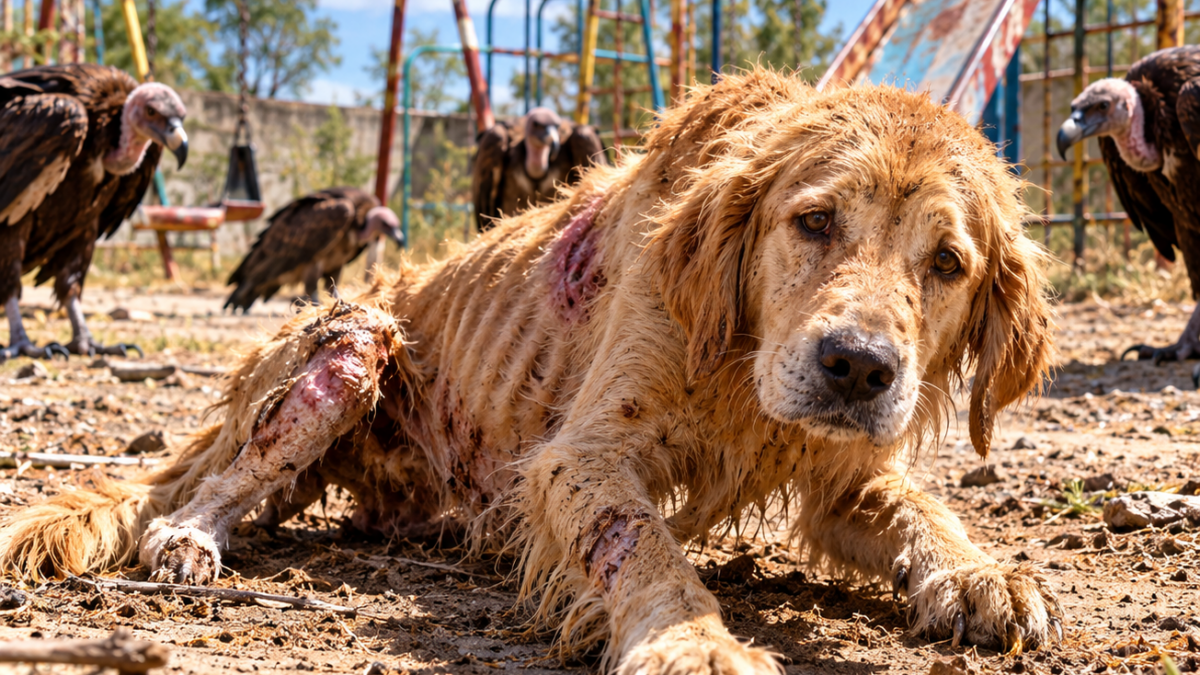
The vultures were already gathering when I heard a puppy crying in the abandoned playground.
He had only three legs, his bones were visible beneath his skin, and every attempt to escape brought the enormous birds a little closer.
When I finally reached him, I discovered that getting him away from those vultures might be the easiest part of saving his life.
My name isn’t important to what happened that afternoon. What matters is that I was part of the rescue team at Promise of Love Animal Welfare Organization, and I had spent enough time helping abandoned animals to believe I was prepared for almost anything.
I had seen dogs tied to fences and forgotten, puppies left beside highways, and animals so frightened of human hands that they preferred to endure pain rather than allow someone to touch them. I had held dying dogs while veterinarians worked desperately to save them, and I had celebrated small victories that most people would never understand.
I thought those experiences had taught me how to protect my heart.
Then I met Vicente.
There are certain images that never really leave you. They settle somewhere deep inside your memory and return unexpectedly, sometimes years later, when you hear a particular sound or walk through a familiar place.
For me, one of those images is a small, skeletal puppy dragging himself through the dirt beneath a merciless afternoon sun while vultures waited for him to stop moving.
I still remember the silence of that playground.
There should have been children running between the swings, parents calling from benches, and the cheerful noise of ordinary life. Instead, the equipment stood deserted beneath the heat, and the only movement came from the dark shapes gathering near the ground.
We had received a report about an injured puppy in desperate condition.
The information was limited. We knew he was severely weakened and that large birds were gathering around him. We didn’t know how long he’d been there, whether he could still walk, or whether we would reach him in time.
When our vehicle approached the playground, I looked through the windshield and saw several vultures moving slowly across the dirt.
My stomach tightened.
“Stop here,” I told my teammate.
We hadn’t completely stopped before I opened the door.
The heat struck me immediately.
Then I heard him.
It was a thin, broken whimper, so faint that I initially couldn’t tell where it was coming from. I followed the sound past an empty swing set and a patch of dry grass.
And there he was.
He was smaller than I’d expected.
His body seemed to consist of little more than skin stretched over bones. His ribs were sharply outlined beneath his patchy fur, and his spine protruded so prominently that I could distinguish individual vertebrae from several feet away.
One of his hind legs was missing.
The remaining three trembled whenever he tried to lift himself.
He had wounds along his sides, and his face was so exhausted that I could barely reconcile what I was seeing with the lively, curious expression a puppy his age should have had.
A vulture stood several feet away.
Another watched from beyond the playground equipment.
I raised my arms and moved forward, frightening the nearest birds away from him.
The puppy flinched.
“Hey, sweetheart,” I whispered. “It’s okay. I’m not going to hurt you.”
His head lifted a fraction.
Then it dropped again.
I knelt in the dirt.
Up close, his condition was even worse.
His remaining legs were painfully thin, and his skin appeared fragile beneath the areas where his fur had fallen out. His eyes were cloudy and tired. Every breath seemed to demand strength he no longer possessed.
I looked at the place where his hind leg should have been.
The injury had the appearance of an old, crudely severed limb.
There was no way to determine exactly what had happened by looking at him. He might have been caught in something sharp, suffered an accident, or endured an injury that had never received medical treatment.
What I knew was that he had somehow survived the loss of a leg without the protection and care any animal should have received.
And now he was starving.
My teammate approached carefully.
“Is he alive?”
“Yes.”
“Can he stand?”
I watched the puppy try to push himself forward.
His front paws scraped weakly against the ground. His remaining hind leg trembled, and his entire body tilted before he collapsed again.
“Not really.”
My teammate looked toward the birds.
“We need to get him out of here.”
“I know.”
I reached toward the puppy, stopping before my fingers touched him.
I had learned not to mistake helplessness for an invitation to move too quickly. Even a severely weakened dog can become frightened and defensive when a stranger approaches, especially if touching him causes pain.
But this puppy didn’t bare his teeth.
He didn’t growl.
He simply looked at my hand.
Then he made another tiny sound.
I moved closer and gently touched the side of his head.
His skin was hot beneath the sunlight.
“It’s all right,” I whispered. “I’ve got you.”
His eyes closed for a moment.
I will never know whether he understood anything about what was happening. Perhaps he was simply too exhausted to react. Perhaps the warmth of another living creature was enough to make him feel a little less alone.
But when I carefully slid my hand beneath his chest, he stopped trying to crawl away.
I supported his body while my teammate prepared a blanket.
He weighed almost nothing.
That was the first thing I noticed when I lifted him.
A puppy should have a reassuring weight, even when he’s small. There should be muscle beneath his skin, some resistance when he moves, and enough energy for him to protest when somebody picks him up unexpectedly.
Holding him felt like lifting a collection of fragile bones.
His head rested against my arm.
I was afraid to adjust my grip.
“I’ve got you,” I repeated, although my voice sounded less certain than it had a moment earlier.
We carried him toward the rescue vehicle.
Behind us, the vultures remained near the playground.
I looked back once.
The place where he had been lying was an ordinary patch of dirt. There was nothing remarkable about it, nothing that would tell a passerby how close a living creature had come to dying there.
I turned away and climbed into the vehicle.
The puppy lay wrapped in a blanket across my lap.
“We’re going straight to the clinic,” my teammate said.
“Call ahead. Tell them he’s severely malnourished, missing a hind leg, and has multiple wounds.”
I looked down at him.
“Tell them he’s extremely weak.”
The puppy opened his eyes when the engine started.
I placed a hand beside his head to keep him steady as we pulled away.
For the first few minutes, he barely moved.
Then he tried to lift his muzzle toward my fingers.
“Are you hungry, little guy?”
He made a weak sound.
I felt something tighten in my throat.
Of course he was hungry.
He looked as though he’d been hungry for longer than his small body could reasonably endure.
But I also knew that feeding a severely starved animal carelessly could be dangerous. His body needed medical assessment, controlled nutrition, and treatment for whatever underlying illnesses had contributed to his condition.
I couldn’t simply place a large bowl of food in front of him and hope everything would be fine.
That realization made the drive feel unbearably long.
Every bump in the road caused me to tighten my hold on the blanket. Whenever he stopped moving, I watched his chest until I saw another breath.
I had transported many injured animals before.
I’d learned how to remain calm in those moments because panic never helped the animal lying in front of me.
But this puppy frightened me.
Not because he was aggressive or difficult.
Because I couldn’t understand how he was still alive.
When we reached the clinic, the veterinary team was waiting.
I carried him through the entrance, and a technician immediately guided us toward an examination room.
“What happened?” the veterinarian asked.
“We found him at an abandoned playground. Vultures were gathering around him.”
The veterinarian looked at his missing leg.
“Do we know how long he’s been like this?”
“No.”
“Any history at all?”
“Nothing.”
I placed him gently on the examination table.
The bright overhead lights revealed details that had been difficult to see outside.
There were wounds along his sides, areas of damaged skin, and patches of missing fur. His muscles were severely wasted, and his remaining legs looked almost too thin to support him.
The veterinarian examined his mouth.
Then she paused.
“Look at this.”
I leaned forward.
Inside his mouth were numerous growths.
They covered areas that should have allowed him to eat and chew without difficulty.
“What are they?”
“They appear to be papillomas.”
I looked at the puppy.
“Would they make eating painful?”
“They certainly can, especially when there are this many.”
That answer explained something I hadn’t understood.
For a starving animal, food is survival.
But this puppy had growths in his mouth that could interfere with the very act of eating.
Even if he had managed to find food, chewing and swallowing might have been difficult.
I imagined him searching for scraps while his body grew weaker, then struggling to eat whatever he found.
The thought made me feel physically ill.
The veterinary team continued its examination.
They checked his hydration, temperature, heart rate, wounds, and overall condition. Blood samples were collected to investigate anemia, infection, and other complications.
One of the technicians gently cleaned his face.
He didn’t resist.
That worried me almost as much as his injuries.
A puppy should be curious.
He should investigate unfamiliar smells, turn toward voices, and react when someone touches him.
This little dog barely had the energy to keep his eyes open.
The veterinarian looked at me.
“He’s in very serious condition.”
I nodded.
“I know.”
“We need to stabilize him carefully. His body has been under enormous stress.”
“Do whatever he needs.”
She glanced toward the missing leg.
“We’ll also need to evaluate the old injury and make sure there are no complications.”
I stroked the puppy’s head.
“You’re not going back there,” I whispered.
It was the first promise I made to him.
And it was the only promise I knew I could keep.
The next several hours passed in a blur of medical assessments, careful monitoring, and conversations about treatment.
His bloodwork raised concerns about anemia and systemic illness.
Additional testing revealed Ehrlichia, a tick-borne infection capable of causing serious complications, particularly in an animal whose body is already severely weakened.
I remember standing beside the veterinarian while she explained the results.
“He’s fighting several problems at once.”
“The infection, the starvation, and his mouth?”
“Yes. And we still need to address the wounds and his overall weakness.”
I looked through the examination room window.
The puppy was resting beneath a clean blanket.
“Can he recover?”
The veterinarian didn’t offer the easy reassurance I desperately wanted.
“He has a chance. But we’re going to have to take this carefully.”
I appreciated her honesty.
In rescue work, hope matters.
But hope isn’t a treatment plan.
This puppy needed medical attention, nutrition, constant monitoring, and time.
Most of all, he needed his already exhausted body to cooperate.
That night, our team discussed what to call him.
Until then, we had referred to him as the puppy from the playground.
It felt wrong to keep describing him by the place where we’d nearly lost him.
He deserved something that belonged entirely to him.
We chose Vicente.
A name we associated with victory.
I liked it immediately.
Not because I believed he had already defeated everything threatening him.
He hadn’t.
The hardest part of his journey was still ahead.
But he had survived long enough for us to find him.
And after watching him struggle across that playground on three trembling legs, I couldn’t imagine giving him a name that suggested anything less than courage.
“Hello, Vicente,” I whispered when I returned to his room.
He opened one eye.
I smiled.
“That’s your name now.”
He rested his head against the blanket.
I pulled a chair beside him and sat down.
For the first time that day, I allowed myself to feel how frightened I really was.
I kept thinking about the missing leg.
A severe injury like that doesn’t simply disappear from an animal’s life.
Even when a wound heals, losing a limb changes everything about how a dog moves, balances, rests, and learns to trust his body.
Some dogs adapt remarkably well to three legs.
But Vicente wasn’t a healthy dog adjusting to an amputation under veterinary supervision.
He was a starving puppy whose body had endured an unknown period of pain, infection, and neglect.
He had no muscle reserves.
He had wounds.
He was battling illness.
And the papillomas inside his mouth threatened to make nutrition, the one thing he desperately needed, extraordinarily difficult.
I wondered how many people had walked past him before somebody finally called for help.
I wondered whether he’d once belonged to someone.
Had there been a time when he slept in a warm room, played with another puppy, or waited beside a door for someone to come home?
Or had his entire short life been a struggle to survive?
I didn’t know.
And I had to accept that I might never know.
What mattered was what happened next.
The following morning, Vicente was still alive.
I entered the clinic earlier than necessary because I hadn’t slept much.
One of the technicians was checking his condition.
“How was he overnight?”
“Quiet. Very weak, but he’s still with us.”
I approached his bed.
“Morning, little winner.”
His eyes moved toward me.
I gently placed my fingers near his muzzle.
He sniffed them.
Then he rested his chin against my hand.
That tiny gesture nearly undid me.
I had spent the night imagining every terrible outcome.
He greeted me by doing something ordinary.
He wanted to be close to another living creature.
I sat beside him while the veterinary team continued his treatment.
His nutrition had to be introduced carefully.
When an animal has been severely malnourished, suddenly providing too much food can trigger dangerous metabolic changes. A starving body cannot always handle the rapid shift back toward normal feeding.
So Vicente’s meals were controlled.
They were small.
They were carefully scheduled.
And every successful feeding felt like a victory.
At first, he showed interest in food but struggled with the growths inside his mouth.
Watching him try to eat was heartbreaking.
His nose would move toward the food, and for a moment, his eyes would brighten.
Then he would hesitate.
Sometimes he tried again.
Other times, the discomfort seemed to overwhelm his hunger.
I remember sitting beside him during one feeding and realizing that I’d begun unconsciously holding my breath whenever he attempted to swallow.
“Come on, sweetheart,” I whispered. “Just a little.”
He managed a small amount.
I wanted to celebrate.
Instead, I looked at the technician.
“Is that enough?”
“It’s a start.”
A start.
I learned to appreciate those two words.
For Vicente, recovery wasn’t going to arrive in one dramatic moment.
It would be measured in tiny improvements that might have seemed insignificant to anyone who hadn’t seen him lying in that playground.
A little food.
A steadier breath.
A few minutes with his eyes open.
One more night survived.
His treatment for Ehrlichia began under veterinary supervision, and the team monitored his blood health and overall response.
His wounds were cleaned and treated.
His hydration and nutritional needs required constant attention.
And through all of it, he remained heartbreakingly gentle.
He was frightened by some forms of handling.
There were moments when his body trembled as someone approached, especially when an examination involved an area that had already caused him pain.
But he gradually began to recognize the people caring for him.
He learned our voices.
He noticed familiar footsteps.
And whenever I sat beside him, he would sometimes move his head until his muzzle touched my hand.
One afternoon, I was cleaning up after a feeding when I noticed him watching me.
“What is it?”
His tail moved.
Barely.
Just enough for me to see.
I stopped what I was doing.
“Did you just wag your tail?”
It moved again.
I laughed.
Then, to my considerable embarrassment, I started crying.
There are things that sound ridiculous until you’ve experienced them.
Crying because a puppy wags his tail is one of them.
But I had first seen that same tail lying almost motionless in the dirt.
I had watched his exhausted body tremble whenever a vulture moved closer.
And now, in a clean room with fresh bedding and people who cared whether he lived, he was beginning to respond to the world around him.
It was the smallest sign of happiness.
To me, it felt enormous.
Over the following days, Vicente developed an attachment to the familiar hands that fed and comforted him.
He still frightened easily.
Sometimes he froze when someone reached toward him too quickly. Sometimes he became distressed during treatment, and there were moments when he seemed unwilling to move at all.
We couldn’t know exactly which experiences had shaped his behavior.
His physical condition alone was enough to explain much of his exhaustion and distress.
But whatever he had endured, he needed patience.
We learned to announce ourselves before touching him.
We gave him time to recognize our voices.
We supported his body carefully whenever he had to be moved.
And we stopped expecting him to behave like a healthy puppy simply because he had survived another day.
One evening, I sat beside him after the clinic had grown quieter.
Most of the day’s activity had ended.
The lights were dimmer, and the sounds of barking from other rooms had settled into occasional murmurs.
Vicente lay on his blanket, looking at me.
“You’re doing better,” I told him.
He blinked slowly.
“I know it doesn’t feel like it yet.”
I touched the top of his head.
“One day, you’re going to be able to walk around without somebody carrying you everywhere.”
He watched my hand.
“And when that happens, I’m going to let you explore everything you want.”
He gave a little sigh.
I smiled.
“Within reason.”
I didn’t know then how much he would eventually enjoy proving that there was nothing reasonable about the way he wanted to move.
For the time being, however, standing was still an enormous challenge.
We carried him almost everywhere.
His muscles were too weak to support prolonged activity, and the missing hind leg made balance particularly difficult.
When the veterinary team began helping him practice supported movement, every attempt required careful attention.
He would lift his head, shift his front paws, and try to bring his body upright.
Sometimes he succeeded for a moment.
Then his remaining hind leg would tremble, and he would need help again.
We never forced him beyond what his condition allowed.
He had already spent too long fighting without anyone protecting him.
Now he needed an opportunity to heal without being asked to endure unnecessary pain.
But there was one problem that continued to grow despite everything else we were doing.
The papillomas.
As the weeks passed, the growths in Vicente’s mouth remained a serious obstacle.
They made eating difficult and uncomfortable, and their continued presence threatened to interfere with his nutritional recovery.
The veterinary team tried medication.
We hoped the treatment would reduce the growths enough for him to begin eating more comfortably.
For a while, I watched every feeding with the expectation that something would improve.
Perhaps today he’d manage a little more.
Perhaps tomorrow he’d approach his food without hesitation.
Perhaps the next examination would reveal that the growths had finally begun to shrink.
Instead, the papillomas continued to cause problems.
One morning, I arrived to find Vicente resting beside an unfinished feeding.
He lifted his head when he heard my voice.
“Hey, sweetheart.”
His tail moved.
I looked at the food.
“Not feeling hungry?”
The technician shook her head.
“He wants it. His mouth is making things difficult.”
I crouched beside him.
His eyes followed me as I lowered myself onto the floor.
The unfairness of his situation suddenly overwhelmed me.
He had already survived the loss of a leg.
He had somehow endured severe starvation.
He had escaped the vultures.
He was fighting a serious infection.
And now, even with food readily available, his own body was making it difficult for him to eat.
I thought about the months or weeks he might have spent searching for scraps while these growths interfered with every attempt to feed himself.
I wanted to reach backward through time and change everything that had happened to him.
Instead, I sat beside him and waited while the veterinarian reviewed the next treatment options.
Ultimately, the team recommended laser surgery to remove the problematic growths.
It was an important decision.
Vicente was stronger than he’d been when we first brought him in, but he was still recovering from profound malnutrition and infection.
Any procedure required careful planning and assessment.
I remember standing in the consultation room while the veterinarian explained what she hoped to accomplish.
“If we can remove these growths successfully, he should have a much better opportunity to eat normally.”
I looked toward Vicente’s room.
“And if we don’t?”
“We’ll have to keep managing the feeding difficulties. But they’re becoming a significant obstacle to his recovery.”
I nodded.
“Then we give him the opportunity.”
The night before his procedure, I stayed with him longer than usual.
He was resting comfortably when I arrived.
His eyes brightened slightly as I approached.
“Hey, little winner.”
He raised his head.
I sat beside his bed.
“Tomorrow’s going to be an important day.”
His tail moved against the blanket.
I wondered whether he’d ever known what it felt like to eat without pain.
Most dogs approach a meal with the uncomplicated enthusiasm of creatures who expect something wonderful to happen.
Some bark.
Some jump.
Some perform elaborate little dances around their bowls.
Vicente had never shown us anything like that.
For him, eating had become another difficult task.
I wanted him to experience the ordinary pleasure of finishing a meal and looking around for more.
I wanted him to discover what it felt like to be full.
And I wanted him to stop associating every attempt to eat with discomfort.
The next morning, the veterinary team prepared him for surgery.
I watched as he was carried away.
Then I sat in the waiting area with the same restless anxiety I’d experienced on the day we rescued him.
I knew the team was capable.
I knew the procedure had been planned carefully.
But knowing those things didn’t make waiting any easier.
I thought about the first time I’d lifted him.
I thought about the vultures.
And I thought about the enormous amount of trust he had placed in people he had every reason to fear.
When the veterinarian finally emerged, I stood before she had finished opening the door.
“How is he?”
“The procedure went well.”
For a moment, I couldn’t speak.
“We were able to remove the growths.”
I released a breath I hadn’t realized I’d been holding.
“Can I see him?”
“Once he’s ready.”
I nodded.
“Thank you.”
It seemed inadequate.
But I couldn’t think of anything else to say.
When Vicente was awake and recovering, I approached him quietly.
His body was still tired from the procedure.
He looked at me with the same cloudy, searching eyes I’d first seen in the playground.
“Hey, buddy.”
His tail moved.
I smiled.
“You did it.”
Of course, he hadn’t finished recovering.
He still needed close observation, medical care, and time for his mouth to heal.
But we had removed one of the greatest obstacles between him and a normal meal.
And that changed everything.
As his recovery continued, Vicente began eating more comfortably.
The improvement wasn’t instantaneous.
We still had to respect his nutritional needs, monitor his condition, and follow the veterinary team’s instructions.
But gradually, the painful hesitation that had accompanied so many meals began to disappear.
He showed more interest in food.
He managed larger portions as his feeding plan advanced.
And eventually, the feeding tube that had helped support him during his most difficult period was no longer necessary.
I remember the first time I watched him eat without that terrible struggle.
He approached his food carefully.
For a moment, he seemed uncertain.
Then he began eating.
I sat beside him, hardly daring to move.
He continued.
And continued.
When he finally lifted his head, I found myself laughing.
“Look at you.”
He licked his mouth.
“Was that good?”
His tail began moving.
I glanced toward the technician.
“He’s actually enjoying it.”
She smiled.
“He’s getting there.”
I lowered myself onto the floor.
Vicente came toward me on three unsteady legs, his tail wagging with an enthusiasm that his body still struggled to accommodate.
He rested his head against my knee.
I rubbed behind his ears.
“You’re getting there,” I whispered.
For the first time since his rescue, I allowed myself to imagine him as something other than a critically ill puppy.
I imagined him playing.
Running.
Sleeping in the sunlight.
Waiting impatiently for breakfast.
Living without the constant medical emergencies that had defined his first weeks with us.
I had imagined those things before, of course.
But now they felt possible.
His weight began increasing.
His body slowly regained muscle.
His eyes became brighter, and his interest in his surroundings grew.
The puppy who once seemed exhausted by the effort of lifting his head started paying attention whenever somebody entered his room.
He recognized familiar voices immediately.
He became increasingly interested in what the other animals were doing.
And he developed a particular habit that made us laugh.
Whenever a caregiver stopped petting him before he was ready, he would lean forward, trying to bring his head back beneath the departing hand.
“Excuse me,” I told him one afternoon. “I thought we were finished.”
He pushed his muzzle against my palm.
“Oh, we’re not finished?”
His tail moved.
I continued scratching behind his ears.
He settled down with a satisfied expression.
I remembered the puppy who had been too frightened and weak to react when I first reached toward him.
Now he was demanding affection.
I couldn’t have been happier.
But recovery still required patience.
Even as his health improved, Vicente had to learn how to move confidently with three legs.
A healthy dog missing a hind limb can often adapt remarkably well, but balance depends on strength, coordination, and the ability to compensate for the missing support.
Vicente had almost none of those advantages when we found him.
His starvation had deprived him of muscle.
His illness had exhausted him.
And whatever had caused the loss of his leg had left him struggling long before we arrived.
He needed time to rebuild his body.
At first, we supported him during short periods of movement.
He practiced standing.
Then taking a few careful steps.
Then turning around without losing his balance.
Some days he seemed eager to move.
Other days he tired quickly and needed to rest.
We followed his medical team’s guidance and celebrated improvements without rushing him.
I learned to recognize the particular determination that appeared in his expression whenever he noticed something interesting across the room.
His ears would lift.
His eyes would focus.
And he would shift his weight forward as if calculating how to reach it.
One afternoon, I placed a small toy a short distance from him.
He studied it.
“Want that?”
His tail moved.
“Go ahead.”
He took a tentative step.
Then another.
His front paws moved carefully, and his remaining hind leg pushed him forward with visible effort.
Halfway to the toy, he stopped.
For a moment, I thought he was going to lie down.
Instead, he adjusted his balance and continued.
When he reached the toy, he lowered his head and touched it with his nose.
I applauded.
He looked up, startled.
Then his tail began wagging.
“That’s right,” I told him. “You got it.”
He picked up the toy.
And for one glorious moment, Vicente looked like an ordinary puppy who had accomplished something very important.
He had.
From that day forward, his personality became increasingly difficult to contain.
He was curious.
He was affectionate.
And he was far more interested in exploring than in obeying our cautious expectations.
I would arrive at the clinic intending to spend a quiet few minutes beside him, only to discover that he had decided something across the room required immediate investigation.
He would hop forward, pause to regain his balance, and continue.
Whenever someone called his name, his whole body seemed to participate in the response.
His tail wagged.
His ears lifted.
His paws moved.
And sometimes he became so excited that he had to stop and reorganize his legs before continuing.
He made us laugh in ways that seemed impossible during those first terrible days.
I remember watching him cross the clinic one morning and thinking about the animals we’d failed to save.
Rescue work leaves you with more memories than you can comfortably carry.
Some animals arrive too late.
Some have injuries that cannot be repaired.
Some survive the initial emergency only to develop complications that no amount of dedication can overcome.
You learn to accept that loving an animal and saving it are not always the same thing.
But Vicente was giving us something we’d desperately needed.
He was showing us what could happen when an animal received help before the last of his strength disappeared.
That didn’t erase the suffering he’d endured.
Nothing could.
But his suffering no longer had to determine every remaining day of his life.
As the weeks passed, his recovery continued.
His medical treatment addressed the serious problems identified when he first arrived.
His nutritional condition improved.
He became more comfortable with being handled.
And he gradually regained enough strength to move around without needing someone to carry him everywhere.
The transformation wasn’t dramatic in the way people sometimes imagine.
There wasn’t one morning when he woke up completely healthy.
Instead, there were dozens of ordinary moments that slowly added up to an extraordinary change.
The first time he finished a meal comfortably.
The first time he stood without immediate assistance.
The first time he moved across the clinic with his tail wagging.
The first time he sought out a toy instead of simply resting.
The first time he fell asleep without looking exhausted by the effort of staying alive.
I treasured every one of those moments.
And still, there were days when looking at him brought me back to that playground.
Sometimes I would be helping him settle onto his blanket when my hand brushed against the place where his hind leg was missing.
I would remember the crude appearance of the old injury.
I would remember the wounds along his sides.
And I would wonder what kind of circumstances had allowed such a small animal to suffer for so long.
We never discovered where he had come from.
We couldn’t reconstruct his early life from the injuries on his body.
The cause of his missing leg remained uncertain.
And there was no way to know how long he’d struggled before someone finally noticed him.
Eventually, I stopped trying to invent answers.
Not because those questions didn’t matter.
But because Vicente was becoming much more than the terrible circumstances in which we’d found him.
He was developing preferences.
He liked familiar people.
He enjoyed affection.
He had become increasingly enthusiastic about food now that eating no longer caused the same discomfort.
And he was beginning to discover the simple pleasure of playing without having to worry about surviving the next hour.
One sunny afternoon, I carried him outside for some supervised time in the yard.
The grass was warm.
The air was gentle.
And for the first time in what felt like forever, there was nothing urgent about the moment.
No emergency calls.
No blood tests.
No frightened conversations about whether he would survive another night.
Just a little dog, a patch of sunlight, and the ordinary sounds of the world around us.
I placed him carefully on the grass.
He stood still for a moment.
Then he lowered his nose.
I watched him investigate the unfamiliar scents.
“Well?”
He took a few steps.
“Do you like it?”
His tail began wagging.
He moved toward a sunny patch near the edge of the yard, stopped, and looked back at me.
I sat down on the grass.
“Go ahead, buddy.”
He continued.
Then something seemed to happen inside him.
His movements became quicker.
His remaining hind leg pushed harder.
He hopped forward with a sudden burst of energy that made me laugh.
“Hey! Easy!”
He paused.
Looked at me.
And started moving again.
There he was.
The puppy who had once dragged himself through dirt while vultures watched from a few feet away.
The puppy who’d been too weak to lift his head.
The puppy who’d struggled to eat and had required weeks of intensive medical care.
Now he wanted to explore an entire yard.
And he seemed deeply offended by the possibility that anyone might slow him down.
“All right,” I laughed. “I get it. You’re fast.”
He came hopping back toward me.
I opened my arms.
He pressed himself against my chest.
For a moment, I buried my face against his fur.
I’d imagined holding him like that when we first arrived at the playground.
But back then, I’d been afraid to hug him too tightly.
His body had been so fragile that even ordinary affection seemed capable of causing discomfort.
Now he was leaning into me with the enthusiastic confidence of a dog who expected to be loved.
I held him carefully.
And I cried.
I didn’t try to stop myself.
I simply sat in the grass with Vicente resting against me while the afternoon sunlight warmed his back.
There was no audience.
No dramatic music.
Nobody announcing that we’d achieved a miracle.
There was only a little dog who had survived something terrible and a person who was overwhelmingly grateful to be holding him.
By the fourth month after his rescue, Vicente had changed so much that it was difficult to reconcile the playful dog in front of us with the skeletal puppy we’d carried into the clinic.
His weight had increased.
His confidence had grown.
He ate without the same fear and discomfort that had once made every meal a struggle.
The growths that had interfered with eating were no longer controlling his life.
And his three-legged gait had become an unmistakable part of his personality.
He didn’t move like other dogs.
He didn’t need to.
He hopped.
He bounded.
And when he was especially excited, he moved so quickly that I sometimes found myself instinctively reaching forward, convinced he was about to lose his balance.
He rarely seemed concerned.
The support he’d once needed for his front leg was no longer necessary.
He could move around the yard, investigate toys, and enjoy the attention of the volunteers who had spent so many anxious days helping him recover.
One afternoon, I watched him discover a toy that another volunteer had placed on the grass.
He approached it cautiously.
Sniffed it.
Then picked it up and began hopping away.
“Vicente!”
He stopped.
I held out my hand.
“Are you bringing that back?”
He looked at me.
His tail moved.
Then he turned and continued in the opposite direction.
The volunteer standing beside me burst out laughing.
“He’s definitely feeling better.”
I shook my head.
“He has absolutely no respect for authority.”
Vicente dropped the toy, bounced around it, and picked it up again.
I watched him move across the yard.
And suddenly I remembered the sound that had led us to him.
That faint cry beneath the afternoon heat.
I remembered how desperate it had sounded.
How I’d followed it past the empty playground equipment.
How frightened I’d been when I saw the vultures.
And how little hope I’d dared to express when I first lifted him.
Now he was running away with a toy because he’d decided it belonged to him.
It was the most wonderful act of disobedience I’d ever witnessed.
There are things about Vicente’s recovery that I will probably never completely understand.
I don’t know what made him continue crawling when his body was so close to exhaustion.
I don’t know whether he’d been trying to escape the vultures or simply searching for somewhere safer to rest.
I don’t know how many painful meals he’d attempted before someone finally treated the growths in his mouth.
And I don’t know how he’d survived so long with the combined effects of starvation, infection, and the loss of his leg.
What I do know is that he kept moving long enough for help to reach him.
But I don’t want to romanticize what happened to him.
His suffering wasn’t necessary to prove that he was strong.
He shouldn’t have had to earn kindness by surviving extraordinary pain.
He was a puppy.
He deserved food, shelter, medical care, and someone who would notice when he was frightened.
He deserved the opportunity to grow up without learning how to endure starvation.
And he deserved to play in the sunshine without having to fight off exhaustion merely to stand.
Sometimes people describe rescued animals as fighters because their stories inspire us.
Vicente certainly fought to survive.
But the thing that moved me most wasn’t his ability to endure suffering.
It was how readily he embraced happiness once suffering stopped controlling his life.
He didn’t spend his days looking backward.
He wasn’t interested in the terrible place where we’d found him.
He wanted breakfast.
He wanted toys.
He wanted somebody to scratch behind his ears.
And when the sun came out, he wanted to find the warmest patch of ground in the yard and make himself comfortable.
As his recovery progressed, we began thinking more seriously about his future.
He needed a permanent home with people prepared to understand his physical needs, continue any necessary veterinary care, and love him without treating his missing leg as something that made him less deserving.
We didn’t know exactly who those people would be.
But for the first time, imagining his future felt joyful instead of frightening.
I pictured a soft bed.
A food bowl that was never empty for long.
Toys scattered across a living room.
And someone laughing when Vicente hopped toward the door with the unmistakable determination of a dog who had somewhere important to go.
I pictured him growing older in a place where his most difficult decisions involved choosing between a sunny spot on the floor and a comfortable place beside someone he loved.
That was the life I wanted for him.
Not because he had survived something terrible.
But because every dog deserved the opportunity to feel safe.
One afternoon, near the end of his fourth month with us, I arrived to find Vicente resting in the sunshine.
His eyes were half closed.
His body looked fuller, healthier, and stronger than it had during those first desperate weeks.
A toy lay beside his front paws.
I sat down next to him.
“Remember me?”
He lifted his head.
His tail began wagging.
“Of course you do.”
He pushed himself upright and came toward me.
I scratched beneath his chin.
“You know, the first time I saw you, I wasn’t sure we’d get you out of there alive.”
He leaned into my hand.
“And now look at you.”
He turned toward the yard, apparently deciding he’d spent enough time listening to me.
I laughed.
“All right. Go play.”
He hopped away.
I watched him cross the grass, his three legs working together with a confidence that would once have seemed impossible.
There were no vultures overhead.
No painful attempt to crawl toward safety.
No desperate little cry that might go unanswered.
There was only Vicente, moving through the sunshine with a toy waiting somewhere ahead of him.
I thought about the name we’d given him.
The winner.
For a long time, I’d associated that name with the fact that he’d survived.
But watching him now, I understood it differently.
His victory wasn’t simply that he had escaped death.
It was that he had finally been given the opportunity to live.
He reached his toy, picked it up, and looked back at me.
His tail wagged.
Then he bounded across the yard.
And for the first time since the day I found him, I watched him run without feeling afraid.
Vicente was safe.
He was loved.
And the frightened little puppy we’d carried away from that deserted playground was finally enjoying the childhood he’d nearly lost.








