𝗙𝗨𝗟𝗟 𝗦𝗧𝗢𝗥𝗬 The Symbol on My Back Made the Whole Yard Forget How to Laugh
𝗣𝗔𝗥𝗧 𝟮
I walked past him.
By evening, I finished the exercise with time to spare.
Nobody congratulated me.
That was fine.
I had not come to be liked.
At least, that was what I told myself.
The truth was more complicated.
I had come to disappear into effort. I wanted fatigue to sand down everything sharp inside me. I wanted aching muscles, simple orders, bad coffee, and mornings that began before memory had time to wake.
Most of all, I wanted to be measured by what I could do, not by what my last name could buy.
For two days, they measured me wrong.
Then came the hand-to-hand combat drill.
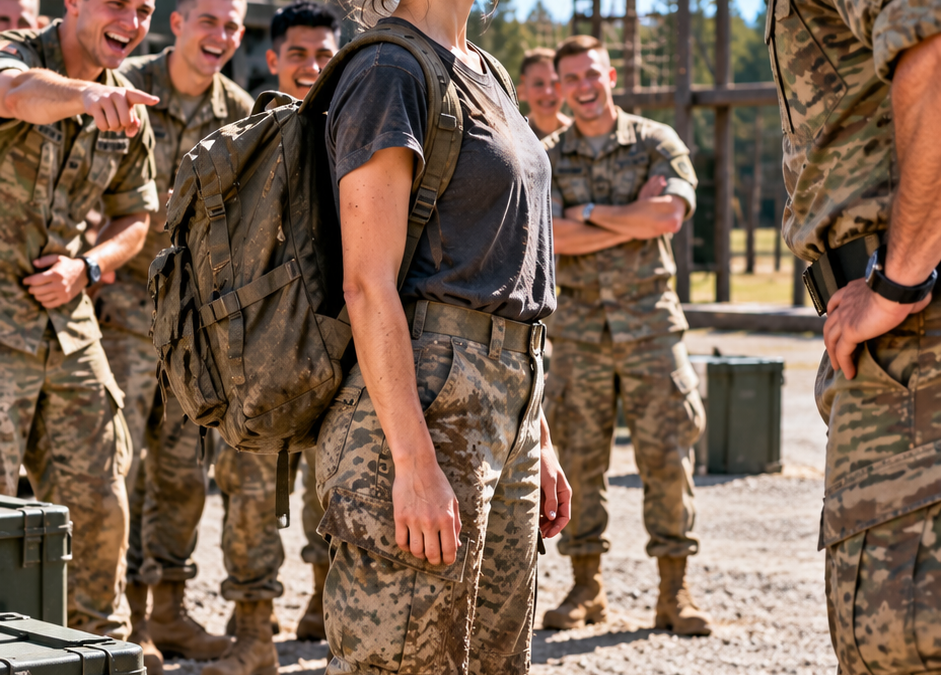
The yard smelled of heat, rubber mats, and trampled grass. Harrow divided us into rotating pairs while Colonel Raymond Cole watched from the sideline.
I noticed him immediately.
Everyone did.
Colonel Cole was in his late fifties, maybe early sixties, with close-cropped gray hair, a weathered face, and a stillness that made rank look unnecessary. He did not need to raise his voice. He did not need to posture. Men like Harrow watched him without wanting to seem like they were watching.
I knew Cole’s name.
I had known it since I was seventeen.
I had seen him once across a cemetery, standing near the back under a black umbrella while rain slid down the brim of his dress cap.
Another time, I saw him in an old photograph tucked inside my father’s desk.
That was all.
He had never come to dinner.
Never sent birthday cards.
Never appeared in the polished family stories my mother allowed at fundraising events.
But his name had lived in the quiet places around my father.
Raymond Cole.
Ghost Viper.
The drill began.
I moved through the first two rotations without drawing attention. A block, a pivot, a controlled takedown that looked less impressive than it felt. The goal was not to humiliate anyone. It was to survive the scenario and learn from the mistake.
My third opponent did not share that view.
His name was Marcus, though most recruits called him Mack. Big arms, short temper, and the kind of smile that appeared only when someone smaller stood in front of him.
He circled me, hands up.
“Girls like you are only good at hiding,” he said.
“Then find me.”
His grin twitched.
He lunged.
I stepped aside.
He stumbled.
A few recruits laughed.
That was the moment pride entered the drill and made him stupid.
He came harder the second time, grabbing for my shoulder. I ducked, turned, and used his momentum to put him on one knee.
Not enough to injure him.
Enough to embarrass him.
His face darkened.
Harrow barked, “Reset!”
I stepped back.
Mack did not.
He moved behind me too quickly, outside the rhythm of the drill, grabbed my collar from the back, and yanked hard.
Fabric ripped.
Cold air hit my skin.
The back of my faded T-shirt tore from collar to mid-spine.
I heard Tara gasp.
Someone muttered, “Whoa.”
Mack laughed once.
Then stopped.
The entire training yard went silent.
Not quieter.
Silent.
The kind of silence that carries weight.
I felt the air against my upper back and knew what they could see.
A small black tattoo between my shoulder blades.
A viper curved around a narrow compass rose.
No words.
No official designation.
Nothing that would mean anything to most people.
But it meant something to Colonel Raymond Cole.
Behind me, someone sucked in a breath.
I turned.
Cole was staring directly at my back.
His face had changed.
Recognition came first.
Then disbelief.
But beneath both was something more complicated.
Regret.
Slowly, he stepped forward.
Every recruit watched him.
Captain Harrow frowned.
“Sir?”
Cole did not look at him.
His eyes remained on the tattoo.
Then, with a precision that made the yard feel even stiller, Colonel Raymond Cole snapped to attention.
And saluted me.
For one terrible second, I wanted to disappear.
Not because I was ashamed of the tattoo.
Because I understood what would happen next.
People who had spent the day laughing at my boots would now turn me into a mystery. People who had mocked my backpack would invent stories to explain why a veteran colonel had saluted a cadet he had never met.
I did not want awe from people who had not offered decency.
I returned the salute because training demanded it, though technically, I had no idea what he was saluting.
Cole slowly lowered his hand.
Captain Harrow stepped forward.
“Sir?”
Cole still did not look at him.
“End the drill.”
Harrow hesitated.
“The rotation has another twenty minutes.”
“I said end it.”
“Yes, sir.”
The command moved across the yard.
Training stopped.
Nobody spoke.
Derek stared at me as if I had become a different person in the span of ten seconds. Tara had gone pale. Kyle held the edge of a mat he had been resetting, his hands motionless. Lance stood near the back of the formation, no smirk left on his face.
He was the first one brave enough to break the silence.
“What is Ghost Viper?”
Cole turned toward him.
“That is not a question you need answered.”
His voice was not angry.
That somehow made it more effective.
He looked at Harrow.
“Captain, get Cadet Mitchell a replacement shirt.”
Then his eyes returned to me.
“My office. Twenty minutes.”
I nodded.
“Yes, sir.”
The recruits moved away slowly.
Not one of them laughed.
That should have felt satisfying.
It did not.
I had spent years learning there was a strange emptiness in proving people wrong when I had never wanted their attention in the first place.
I walked toward the barracks.
Behind me, someone whispered, “She didn’t even tell us.”
Another voice answered, “Why would she?”
I kept walking.
Inside the changing room, I stood for a moment with my palms against a metal locker.
The tattoo between my shoulder blades felt hot, though I knew that was only my imagination.
A viper.
A compass.
A promise I had accepted before I fully understood what promises could cost.
My father took me to get it after my twenty-first birthday.
I still remembered the smell of antiseptic, ink, and old leather in the tattoo shop. He had been unusually quiet that day. Thomas Mitchell was not often quiet. He was charming, restless, impossible to ignore, the kind of man who could turn a delayed flight into a three-act comedy and a tense board meeting into a room full of people wondering how they had agreed with him before he finished speaking.
When I asked him what the symbol meant, he said, “Courage.”
I asked why there was no name.
He said, “The things that matter most don’t need branding.”
That was very rich coming from a Mitchell.
I teased him about it.
He laughed.
Then he became serious.
“It means you are part of something older than yourself, Liv. Not because of blood. Because of choice.”
I did not understand then.
Not really.
I pulled on the replacement training shirt Harrow sent. It fit badly, too large in the shoulders.
Of all the things that had happened that day, somehow that felt normal.
When I stepped outside, Derek was waiting beside the doorway.
He did not block my path.
He actually moved aside.
“Mitchell.”
I stopped.
He looked embarrassed.
That was new.
“I didn’t know.”
“No.”
His eyes dropped to the ground.
“That stuff at lunch…”
I waited.
He rubbed the back of his neck.
“I was being stupid.”
“You were.”
He looked up, surprised.
Maybe he had expected me to make it easier for him.
I was not interested in punishing him.
I also was not interested in pretending it had not happened.
“I’m sorry,” he said.
I studied him for a second.
“Then don’t do it to the next person.”
He nodded.
“That’s fair.”
I walked away.
Colonel Cole’s office was in an older brick building overlooking a stand of longleaf pines. The hallway smelled like floor polish and coffee. His door was open when I arrived.
He stood by the window, hands clasped behind his back.
“Close it, please.”
I did.
For several seconds, neither of us spoke.
Then Cole turned around.
“You look like your mother.”
I had not expected that.
My chest tightened.
“People usually say my father.”
“People who knew your father say that.”
He walked back to his desk.
“People who knew Eleanor say otherwise.”
I stared at him.
“My mother never mentioned you.”
“I’m not surprised.”
There was no bitterness in his voice.
Only acceptance.
He opened a drawer and took out an old photograph.
He placed it on the desk between us.
Five people stood in front of a transport aircraft. The photograph had faded at the corners. My father was easy to recognize.
Thomas Mitchell.
Thirty years younger.
Lean.
Smiling.
His arm rested across the shoulders of a man I recognized as Colonel Cole.
Beside them stood two women and another soldier.
One of the women was my mother.
I stared.
I had never seen her dressed that way.
Not in a uniform exactly.
A field jacket.
Cargo pants.
Hair tied back.
No pearl earrings. No tailored dress. No polished foundation smile.
But there was no mistaking her.
“What is this?”
Cole sat down.
“You should probably sit too.”
I remained standing.
He nodded as if he had expected that.
“Ghost Viper was never an official unit designation.”
“I know.”
“Do you?”
His gaze sharpened.
“You know what your father told you. That may not be the same thing.”
I said nothing.
Cole folded his hands.
“Your father worked in intelligence support for joint recovery operations. Your mother was a civilian linguist and logistics analyst. Most of what they did was dull. Reports. Movement schedules. Local coordination. Transportation. Communication.”
“That is not how Dad described it.”
“Your father liked a good story.”
Despite myself, I smiled.
He had.
Cole continued.
“Ghost Viper began as a nickname. Five people who kept being assigned to the same difficult recovery missions. Eventually, it became shorthand among a handful of us.”
I looked at the photograph again.
“And the tattoo?”
“That came later.”
His expression softened.
“After Elias Ward died.”
The name meant nothing to me.
Cole noticed.
“Your father never told you about Elias?”
“No.”
Cole leaned back.
“That explains more than I expected.”
He opened a file.
Not classified.
Not secret.
Just old.
Inside were copies of letters, photographs, and newspaper clippings.
“Elias was the fifth member of that group,” he said. “Good man. Careful. Patient. The kind of person who could sit in a room for six hours listening to people argue and then say one sentence that solved the problem.”
“What happened?”
“He got sick.”
I blinked.
“That’s all?”
“That is life more often than people expect.”
Cole gave me a tired smile.
“Not every loss comes with gunfire.”
The simplicity of it caught me off guard.
Elias Ward had died from aggressive cancer less than a year after leaving government service. The remaining four had gotten the same small tattoo at a reunion.
A compass for finding your way home.
A viper because Elias had joked that the group was patient until it needed to move.
My father had brought me to the tattoo artist after my twenty-first birthday. He told me it represented courage. He told me it meant I was part of something older than myself.
He never told me my mother had worn the same symbol.
“Why did you salute me?” I asked.
I had meant to say Colonel Cole.
Instead, I said you.
He heard the difference.
“Because I made a mistake.”
I frowned.
“When I saw the insignia, I thought for a moment that your father was standing there.”
“That does not explain a salute.”
“No,” he said. “It does not.”
The room went quiet.
Then he said, “I owed him one.”
That answer carried more weight than I expected.
“For what?”
Cole exhaled slowly.
“That is a conversation I should have had with your family years ago.”
I sat down.
He looked almost relieved.
“Your father saved my career.”
“From what?”
“From myself.”
Cole turned the photograph around and tapped the younger version of himself.
“I made an operational recommendation based on incomplete information. Nothing illegal. Nothing dramatic. Just wrong. Your father challenged it.”
“That sounds like him.”
“He challenged it loudly.”
“That definitely sounds like him.”
Cole smiled.
Then the smile faded.
“I was senior to him. I could have forced the issue. He could have embarrassed me later. Instead, he pulled me aside and showed me what I had missed. He gave me a chance to correct it before anyone was put in a difficult position.”
I looked at the photograph.
“He never mentioned that.”
“Your father rarely mentioned the things that made him look good.”
I almost laughed.
“That does not sound like him.”
Cole laughed once.
“Fair point. He mentioned plenty of those. Just not the important ones.”
For the first time that day, I felt something loosen inside me.
Then Cole said, “Why are you here, Olivia?”
I knew he did not mean his office.
“You have my application.”
“I read it.”
“Then you know.”
“I know what you wrote.”
His expression became more serious.
“I also know Thomas Mitchell’s daughter did not need to enlist in any program to prove she could survive without family money.”
My jaw tightened.
“This is not about money.”
“Good.”
He leaned forward.
“Then what is it about?”
I looked toward the window.
Outside, recruits crossed the courtyard in pairs. Normal movement. Normal afternoon. The kind of ordinary sight I had wanted.
“My father died thinking I was angry with him.”
Cole went still.
I had not said those words aloud to anyone outside my family.
Not even my brother.
Especially not my brother.
I folded my hands in my lap.
“Three days before he went into the hospital, we argued.”
Cole did not interrupt.
“He wanted me to join the family foundation.”
The Mitchell Foundation managed scholarships, medical grants, veterans’ housing programs, and enough money to make every family dinner feel like a board meeting.
“I told him I wanted a life that was mine.”
“That seems reasonable.”
“He thought I was rejecting him.”
“Were you?”
“No.”
My answer came too quickly.
I tried again.
“I was rejecting what everyone had decided I should become.”
Cole nodded.
“My brother Andrew had already taken over the business side. My mother wanted me with the foundation. Dad kept saying I had a responsibility.”
“Did you?”
“Yes.”
That was the part I had taken years to understand.
“I just didn’t think responsibility meant surrender.”
Cole watched me carefully.
“What happened after the argument?”
“He called me the next morning.”
I swallowed.
“I didn’t answer.”
The shame attached to that memory had worn smooth over the years, but it had never disappeared.
“He left a voicemail. He said we would talk when I was ready.”
My eyes dropped.
“There wasn’t time.”
My father suffered a cardiac event two days later. He remained conscious for only a short period in the hospital. By the time I arrived, there had been no conversation left to have.
Cole’s voice softened.
“Olivia, your father knew you loved him.”
“You cannot know that.”
“Yes,” he said. “I can.”
He reached for the file and removed an envelope.
My name was written across the front.
Not typed.
Written.
I recognized the handwriting immediately.
OLIVIA.
My heartbeat changed.
“Where did you get that?”
“Your mother gave it to me.”
I did not touch it.
“When?”
“Six years ago.”
The answer hit harder than I expected.
Six years.
My father had been dead for six years.
“My mother gave you a letter for me?”
“She asked me to keep it until you came looking for the reason behind Ghost Viper.”
I stared at him.
“That makes no sense.”
“I said the same thing.”
“And?”
“She said you were too much like Thomas. If she handed it to you, you would read it as an instruction. If you found it yourself, you might read it as a choice.”
I stood so quickly the chair scraped backward.
“My mother had no right.”
Cole said nothing.
“She knew what I thought.”
“Yes.”
“She knew I believed he died angry with me.”
“I believe she thought she was protecting you.”
“From what?”
Cole’s silence answered before he did.
“From the expectations attached to his last wishes.”
I laughed once, without humor.
“Of course.”
I picked up the envelope.
The paper trembled slightly in my fingers.
I hated that Cole could see it.
“Did you read it?”
“No.”
“Does my brother know?”
“I don’t believe so.”
“Why now?”
“Because you came here wearing the symbol,” he said. “And because for six years, you have apparently been walking toward the answer without knowing where it was.”
I turned the envelope over.
It was still sealed.
I could have opened it there.
I did not.
Some things deserved privacy.
I slipped it into my pocket.
Cole watched me.
“Does Captain Harrow know anything?”
“No.”
“The recruits?”
“No.”
“Good.”
Cole raised an eyebrow.
“You do not want special treatment.”
“I want the opposite.”
“That may be impossible now.”
“Then make it possible.”
There was enough of my father in that answer that Cole smiled.
“I will speak to Harrow. The story will be that I recognized a memorial insignia connected to your family.”
“That is true.”
“Yes.”
He stood.
“Olivia.”
I stopped at the door.
“Your father would have been proud you came here.”
I turned.
“You do not know why I came.”
“No,” Cole said. “But I knew Thomas. He would have been proud that you chose something difficult without needing anyone to see you do it.”
I walked out before I could answer.
The training yard had changed.
Not physically.
Emotionally.
People who had barely noticed me that morning now noticed every step I took.
Tara approached first.
She carried my torn shirt, folded neatly.
“I thought you might want this.”
“Thanks.”
She held it out.
“I owe you an apology.”
I accepted the shirt.
“Yes.”
Her eyebrows lifted.
Apparently Derek had expected forgiveness to be easier too.
“I was awful,” she said.
“You were trying to impress people.”
She looked surprised.
“How did you know?”
“Because people who are actually confident usually don’t need an audience.”
Tara winced.
“Okay. I deserved that.”
“I wasn’t trying to hurt you.”
“I know.”
That seemed to bother her more.
She looked toward the barracks.
“My older sister was supposed to come here.”
I waited.
“She got into the program. Then she changed her mind.”
“Why?”
“Our dad.”
Tara pressed her lips together.
“He’s intense. Everything is achievement. Everything is comparison. She decided she wanted to study architecture instead.”
“And he did not like that.”
“No.”
Tara looked down at her boots.
“So I came.”
The admission was quiet.
“Because you wanted to?”
“I thought I did.”
That was the first honest thing she had said to me.
“You can still decide.”
She looked at me.
“Is that what you’re doing?”
I thought about the letter in my pocket.
“I’m trying.”
That night, I did not open it.
I placed the envelope inside my locker.
Then I lay awake listening to the building settle.
At 11:42 p.m., my phone buzzed.
One message.
MOM.
I stared at the screen.
You met Raymond.
Not a question.
I sat up.
How did you know?
Her reply came almost immediately.
He called me.
Of course he did.
I typed three different answers and deleted all of them.
Finally, I wrote:
Why didn’t you give me Dad’s letter?
The dots appeared.
Disappeared.
Appeared again.
Then:
Because I made a choice I’m no longer sure was mine to make.
That answer hurt more than an excuse would have.
I called her.
She answered on the first ring.
“Liv.”
“Six years.”
“I know.”
“You knew what I believed.”
“Yes.”
“Then explain it.”
My mother was silent.
When she finally spoke, her voice sounded smaller than I remembered.
“Your father wrote three letters. One for Andrew. One for me. One for you.”
“What did Andrew’s say?”
“I don’t know. That was his.”
“And yours?”
Another silence.
“He asked me not to let grief decide your future.”
I closed my eyes.
“That does not explain hiding mine.”
“No.”
For the first time in my life, Eleanor Mitchell sounded uncertain.
Not polished.
Not composed.
Just human.
“I was angry with your father,” she said.
That surprised me.
“Why?”
“Because he was dying and still planning things.”
Her breath trembled.
“He was worried about everyone else. Andrew. The foundation. You. Me. And I wanted him to stop being responsible for five minutes and admit he was afraid.”
I had never heard my mother speak about those days.
We had treated my father’s death like an event to survive efficiently.
Funeral.
Lawyers.
Statements.
Family.
Foundation.
Then silence.
“What did he want from me?” I asked.
“I didn’t know.”
“You could have read it.”
“I almost did.”
Her voice cracked slightly.
“I held it up to the light like a ridiculous teenager. Then I realized that if I opened it, I would spend the rest of my life wondering whether I had changed whatever he wanted to tell you.”
“Why give it to Cole?”
“Because Raymond understood that part of your father’s life.”
I looked at the dark locker across the room.
“And the condition?”
“You had the tattoo by then.”
“Yes.”
“I thought if you ever started asking questions about it, it would mean you were ready to separate your father the man from your father the symbol.”
I almost argued.
Then stopped.
There was truth in it.
After his death, I had done exactly what I accused my family of doing.
I had turned Thomas Mitchell into an idea.
A final argument.
A missed phone call.
A photograph.
A regret.
“Mom.”
“Yes?”
“Were you Ghost Viper?”
She laughed softly.
“Oh, Thomas would love that question.”
“So?”
“It was a ridiculous nickname.”
“Cole showed me the photograph.”
Silence.
“You never told me.”
“There were many things we didn’t tell you.”
“Why?”
“Because parents make the mistake of thinking their children know them.”
Her answer stayed with me.
Before we ended the call, she said, “Read the letter when you’re ready, Liv.”
This time, I did not correct her.
The next morning, Captain Harrow treated me exactly as he had before.
That was the first favor he ever did for me.
“Mitchell!”
“Yes, sir.”
“Your pace yesterday was acceptable.”
“Thank you, sir.”
“That was not a compliment.”
“Understood.”
Derek covered a smile.
Harrow pointed at him.
“Something funny?”
“No, sir.”
“Excellent. Then you can both carry the navigation equipment.”
We spent the morning running field exercises.
Something unexpected happened.
People stopped performing around me.
Derek quit making jokes every thirty seconds.
Kyle asked whether I wanted the north or south section of the route instead of grabbing the map.
Tara admitted she was terrible at estimating distance.
Lance remained distant.
That did not bother me.
Apologies were choices.
So was silence.
At lunch, I sat alone again.
This time, not for long.
Tara placed her tray across from me.
“Is this seat taken?”
“No.”
Derek appeared.
“Can I sit here, or is there an application process?”
Tara rolled her eyes.
I pointed at the chair.
“Sit down.”
Kyle joined us a minute later.
Nobody mentioned Ghost Viper.
I appreciated that more than they knew.
Halfway through lunch, Lance passed the table.
Derek called out, “You joining?”
Lance shook his head.
He walked away.
I watched him.
Tara noticed.
“He thinks you’re going to get us all in trouble.”
“Why?”
“Because of yesterday.”
“I did not report anyone.”
“He doesn’t know that.”
I returned to my food.
“He could ask.”
That afternoon, Lance did.
We were cleaning equipment after a field exercise when he approached.
“Mitchell.”
I kept wiping mud from a compass case.
“What?”
“Did you tell Cole about us?”
“No.”
“Harrow?”
“No.”
He seemed confused.
“Why not?”
I looked at him.
“Because you acting like an idiot for one day does not need to define your entire life.”
His face reddened.
“I wasn’t—”
“Yes, you were.”
He looked away.
Then he nodded once.
“Fair.”
I went back to the equipment.
After a moment, he said, “My dad was here.”
“At Fort Bragg?”
“Years ago.”
I waited.
“He’s always talking about standards. Toughness. Not making excuses.”
Lance ran a thumb along the edge of a storage crate.
“I guess I thought if I was harder than everybody else, people would know I belonged.”
I had heard versions of that sentence my entire life.
Different homes.
Different families.
Same fear.
“Did it work?”
He laughed quietly.
“No.”
“Then try something else.”
He nodded.
Before leaving, he said, “For what it’s worth, I’m sorry.”
“Okay.”
He looked back.
“That’s it?”
“That’s it.”
“You’re not going to tell me you forgive me?”
“I don’t know you well enough to make forgiveness dramatic.”
He laughed.
“Mitchell, you are really strange.”
“So I’ve heard.”
Over the next week, something shifted among us.
Not friendship exactly.
Trust came slower than that.
But the edges softened.
Derek turned out to be good with mechanics and terrible with directions.
Tara had an almost photographic memory once she stopped panicking about being wrong.
Kyle could estimate distance better than anyone in our group.
Lance was the strongest runner, but he started circling back when someone fell behind instead of using it as an opportunity to show off.
And me?
I began to understand that keeping quiet was not always strength.
Sometimes silence protected dignity.
Sometimes it protected fear.
One evening, I found Tara sitting outside the barracks with her phone in her hands.
“You okay?”
She nodded too quickly.
“My sister got engaged.”
“That sounds good.”
“It is.”
She smiled.
Then her eyes filled.
“She asked me to be in the wedding.”
I sat beside her.
“When is it?”
“Six weeks.”
“You think training won’t allow it?”
“No.”
She stared at the screen.
“I’m afraid to tell my dad I want to go.”
I understood more than I wanted to.
“What do you want?”
“To be there.”
“Then start with that.”
“What if he says I’m not committed?”
“You’re twenty-three.”
She gave me a sideways look.
“You make that sound very old.”
“It is old enough to stop making every decision as if your father gets a vote.”
She laughed.
“Did you figure that out before or after joining military training to deal with your father issues?”
I stared at her.
She covered her mouth.
“Oh, wow. Sorry.”
Then I laughed.
Really laughed.
The first time since arriving.
“Probably after.”
That night, I opened my locker.
The letter was exactly where I had left it.
I took it outside.
There was a bench near the edge of the compound beneath an old oak tree. The evening was warm. Cicadas buzzed in the distance.
I sat beneath the weak yellow light and broke the seal.
Inside was a single sheet of paper.
My father’s handwriting covered both sides.
Liv,
If you are reading this, then either your mother ignored my instructions or followed them too carefully. Both are entirely possible.
I laughed through the first unexpected tears.
That was him.
Even on paper.
I kept reading.
I know you think our last argument was about duty. It wasn’t.
It was about fear.
Mine.
I have spent years telling you to be brave while quietly arranging the world so I wouldn’t have to worry about you.
That is not the same thing.
I stopped.
Read the sentence again.
Then continued.
You said you wanted a life that was yours.
I should have told you that I understood.
Instead, I heard rejection where you were asking for trust.
That was my mistake.
Not yours.
The words blurred.
I wiped my eyes with the back of my hand.
There was more.
I do want something from you.
Not the foundation.
Not the company.
Not the Mitchell name.
I want you to find your mother’s blue box.
She will know which one.
Inside is something that belongs to you, although none of us understood that when it was first given to us.
Do not let Andrew sell it.
That line made me sit straighter.
Sell what?
I read on.
And please tell your brother that being responsible does not require him to become boring. He has been flirting with that possibility for years.
I laughed again.
The final paragraph was shorter.
You were never a disappointment to me, Olivia.
Not once.
You were angry.
So was I.
People who love each other are allowed to leave a conversation unfinished without leaving the love unfinished too.
Go build something that belongs to you.
If you come back to us, come because you choose us.
Dad
I sat under the tree until the paper stopped shaking.
For six years, I had imagined a conversation that never happened.
I had written both sides.
His disappointment.
My defense.
His anger.
My regret.
And all that time, his actual words had been waiting in an envelope.
I called my brother.
Andrew answered sleepily.
“Liv?”
“Are you boring?”
A pause.
“What?”
“Dad said you were in danger of becoming boring.”
Another pause.
Then I heard him laugh.
Not the polite laugh he used at dinners.
The old one.
The one from when we were teenagers.
“You opened the letter.”
“Yes.”
His voice changed.
“You okay?”
“No.”
“Good no or bad no?”
“I don’t know yet.”
“That sounds inconvenient.”
I smiled.
“Andrew.”
“Yeah?”
“What is Mom’s blue box?”
Silence.
Long enough that I sat up straighter.
“Andrew?”
“I have not heard that phrase in years.”
“What is it?”
“I don’t know exactly.”
“You’re lying.”
“I’m not.”
His voice had become careful.
“Mom keeps an old blue document case in the library safe.”
“At the house?”
“Yes.”
“Dad said there is something inside that belongs to me.”
Andrew did not answer.
“He also said not to let you sell it.”
“That sounds unfairly specific.”
“What were you trying to sell?”
“Nothing.”
“Andrew.”
He sighed.
“The foundation has been reviewing old property holdings.”
“And?”
“There is one parcel we have never used.”
I waited.
“It is in North Carolina.”
A strange feeling moved through me.
“Where?”
“Outside Fayetteville.”
I looked across the dark grounds of Fort Bragg.
“How far outside?”
“Liv…”
“How far?”
“Maybe forty minutes.”
My pulse quickened.
“What property?”
“I don’t know. Twelve acres. Old farmhouse. Some woods.”
“Who bought it?”
“That’s the strange part.”
Andrew paused.
“Dad didn’t.”
“Mom?”
“No.”
I heard papers moving on his end.
“I looked at the deed when the review started.”
“And?”
“The property was transferred to the Mitchell Foundation twenty-four years ago.”
“By whom?”
Andrew was quiet.
Then he said a name I had heard for the first time only the day before.
“Elias Ward.”
I stood beneath the oak tree with my father’s letter in one hand and my phone in the other.
The sounds of the base seemed suddenly distant.
“Why would Elias Ward give our family twelve acres?”
“I don’t know.”
“Does Mom?”
“She told me not to touch it.”
“Why?”
“She said it wasn’t ours to sell.”
I looked down at Dad’s letter.
Inside is something that belongs to you, although none of us understood that when it was first given to us.
“Andrew.”
“Yeah?”
“Don’t sell anything.”
“I wasn’t going to.”
“Good.”
“Liv?”
“What?”
There was hesitation in his voice.
“When you come home, you should look at the blue box yourself.”
“Why?”
“Because there is one more thing.”
My fingers tightened around the phone.
“What?”
“I saw the outside of it once when Mom opened the safe.”
He hesitated.
“Your name is written on the lid.”
I did not sleep much that night.
The next morning, Colonel Cole found me outside the training hall.
“You read it.”
I looked at him.
“How do you know?”
“You have Thomas’s expression when he discovered a problem he intended to make everybody else help solve.”
Despite everything, I smiled.
“Did you know about Elias’s property?”
The humor left his face.
“What property?”
That answered my question.
“A farmhouse outside Fayetteville.”
Cole stared at me.
“Elias had a farmhouse outside Fayetteville?”
“You didn’t know?”
“No.”
For the first time since I had met him, Colonel Raymond Cole looked genuinely unsettled.
Not frightened.
Not shocked.
Simply confronted with a piece of his own past that did not fit.
“When did he buy it?” he asked.
“I don’t know.”
“Who owns it now?”
“The Mitchell Foundation.”
Cole’s eyes narrowed.
“Why?”
“I was hoping you could tell me.”
He shook his head.
“I can’t.”
Then he looked toward the tree line.
“But I may know someone who can.”
“Who?”
Cole turned back to me.
“The fifth person in that photograph was not Elias.”
I frowned.
“You said—”
“I said Elias was the fifth member of the group.”
He chose his next words carefully.
“But the photograph showed six people.”
My mind returned to the faded image.
My father.
My mother.
Cole.
Elias.
Another soldier.
And a woman standing slightly apart near the aircraft stairs.
I had barely noticed her.
“Who was she?”
Cole’s expression became distant.
“Her name was Miriam Ward.”
“Elias’s wife?”
“His younger sister.”
“Is she alive?”
Cole nodded.
“As far as I know.”
“Where?”
He looked toward the road beyond the base.
“About thirty miles from that farmhouse.”
The question was no longer what my father had left for me.
It was why an almost forgotten member of Ghost Viper had quietly transferred a piece of land to my family twenty-four years earlier, and why my mother had kept my name locked beside its deed ever since.
Three days later, I was granted weekend leave.
Captain Harrow gave it to me without asking too many questions.
That was the second favor he ever did for me.
Cole drove.
He claimed it was because I did not know the area.
I suspected it was because he did not trust himself to stay away from the answer.
We left just after sunrise. The road out of Fort Bragg unwound through pine woods, gas stations, old churches, and houses set back from the road with porches wide enough for long silences. The farther we drove, the quieter Cole became.
“You are nervous,” I said.
“I am not nervous.”
“You have checked the rearview mirror nine times in ten minutes.”
“That is defensive driving.”
“That is avoidance with mirrors.”
His mouth twitched.
“You really are Thomas’s daughter.”
People kept saying that.
For years, the comparison had felt like an accusation.
That morning, it felt more like inheritance.
Miriam Ward lived in a white house with green shutters and a garden that looked too well-tended to belong to someone unprepared for visitors. She was in her seventies, tall, brown-skinned, and elegant in a way that had nothing to do with money. Her gray hair was braided over one shoulder. When she opened the door and saw Cole, one hand went to her chest.
“Raymond.”
“Miriam.”
They did not hug.
They did not need to.
Some history enters the room before bodies move.
Then her eyes shifted to me.
For a moment, she looked at my face as if measuring old grief against new bone.
“You’re Thomas’s girl.”
“Yes, ma’am.”
Her gaze moved over me.
“You have Eleanor’s eyes.”
That made two people.
She stepped back.
“Come in.”
Her house smelled like lemon oil, books, and something sweet baking. On the living room wall hung photographs of people I did not know, children at different ages, soldiers in different decades, Elias Ward smiling beside a younger Miriam in front of a farmhouse I recognized from Andrew’s description before I had ever seen it in person.
Miriam noticed me looking.
“That is the place you came about.”
I turned to her.
“You know why we’re here?”
“I have been waiting twenty-four years for someone to ask the right question.”
Cole lowered himself into an armchair as if his knees had suddenly remembered his age.
Miriam brought tea.
I did not want tea.
I drank it anyway.
She sat across from me.
“Elias bought that farmhouse after his diagnosis,” she said. “Not before.”
I glanced at Cole.
He looked stunned.
“You never told us,” he said.
“No,” Miriam replied. “He asked me not to.”
“Why?”
“Because all of you were very good at turning grief into missions.”
That landed hard enough to silence him.
Miriam looked at me.
“My brother knew he was dying. He accepted it sooner than the rest of us. But he worried about what would happen to the group after he was gone. Especially Thomas.”
“My father?”
“He loved loudly,” she said. “But he grieved privately. Dangerous combination.”
That was so accurate it hurt.
“The farmhouse was meant to be a place for the families,” Miriam continued. “Not an estate. Not a memorial with marble plaques. A place where people could come when they needed to remember they were human. Elias believed service took too much from families that never received uniforms or medals.”
“And he gave it to the Mitchell Foundation?”
“Eventually. But first, he left it to the group.”
Cole sat forward.
“No one told me that.”
“No,” Miriam said. “Because after Elias died, everything fractured.”
Her eyes softened with old pain.
“Your father left for another posting. Eleanor became pregnant with Andrew. Thomas threw himself into work. The fifth member of Ghost Viper, David Mercer, disappeared into private contracting. Everyone promised to stay close. Then everyone became busy surviving.”
Cole looked away.
I had never seen him ashamed before.
“My brother’s will placed the property into a trust,” Miriam said. “The trust named the remaining members of Ghost Viper as stewards. After several years, when no one used it and taxes became inconvenient, Thomas arranged for it to move under the Mitchell Foundation so it would not be lost.”
“That sounds like Dad,” I said.
“Yes,” Miriam said. “Practical. Generous. Controlling.”
I almost smiled.
“Why was my name on the blue box?”
Miriam looked toward the photograph.
“Because of something Elias wrote before he died.”
She stood and returned with a small folder.
Inside was a copy of a letter written in careful handwriting.
Miriam handed it to me.
The first line read:
For the child who asks the question no one else wants answered.
I looked up.
Miriam nodded.
“Elias did not know you. You were not born yet. But he knew people like Thomas and Eleanor would raise children surrounded by duty. He wanted the property eventually to belong to the one who chose service freely, not the one who inherited obligation.”
I read the line again.
For the child who asks the question no one else wants answered.
My throat tightened.
“Why me?”
“Because you asked.”
“But Andrew—”
“Andrew inherited plenty,” Miriam said gently. “That does not mean he received what he needed. But this was never about money or acreage.”
“Then what is it about?”
She leaned back.
“A refuge.”
Cole closed his eyes.
Miriam continued.
“Elias wanted the farmhouse used for veterans, families, trainees, widows, children who grew up with absences they could not explain. He wanted it to be quiet. Useful. Human. Thomas promised to protect it until someone in the next generation understood.”
I thought of my father’s letter.
Inside is something that belongs to you, although none of us understood that when it was first given to us.
“He wanted me to do something with it,” I said.
“No,” Miriam said.
The word stopped me.
“He wanted you to choose whether to do something with it.”
The difference was small.
It changed everything.
I spent the next hour listening.
About Elias Ward.
About Ghost Viper.
About my mother before pearls and foundation boards.
About my father before wealth turned every decision into a public statement.
About a group of young people who had tried to do good work in complicated places and came home carrying memories they did not know where to put.
Before we left, Miriam took my hand.
“Your father was proud of you,” she said.
I looked down.
“You all keep saying that.”
“Because it is true.”
I swallowed.
“He never said it enough.”
“No,” she agreed. “Thomas often trusted people to know what he should have said aloud.”
That sentence felt like a key turning in an old lock.
On Monday morning, I returned to training.
The yard looked the same.
The mud was still mud.
Harrow was still Harrow.
Derek still talked too much.
Tara still worried she was failing even when she was not.
Lance still ran like he had something chasing him.
But I was different.
Not because I had answers.
Because I finally understood that answers were not orders.
That week’s final exercise was a team endurance course through wooded terrain, timed by group completion, not individual performance. It required navigation, load carry, obstacle clearance, casualty drag, and a final climb under fatigue.
Harrow explained the rules.
“If one person fails, your team fails. If you abandon someone, your time does not matter.”
He looked across the formation.
“Strength without discipline is noise. Discipline without humility is brittle. Today we find out who is just loud.”
His eyes passed over Lance.
Then me.
I almost smiled.
Our team was Derek, Tara, Kyle, Lance, me, and two quieter recruits named Evans and Malik.
We started strong.
Too strong.
Lance set an aggressive pace out of habit, and Derek tried to match him out of pride. Tara kept checking the map every thirty seconds. Kyle corrected her twice, then stopped correcting when she snapped at him. Evans twisted an ankle on the second incline but insisted he was fine.
He was not.
By the fourth mile, the team began to crack.
Derek cursed at the stretcher rig.
Tara misread a terrain feature and turned us toward a ravine.
Lance accused Kyle of wasting time.
Kyle threw the compass at his chest.
“Then you read it.”
Lance caught it.
Nobody moved.
I looked at all of them and felt a strange calm.
A week earlier, they had surrounded me in the woods and laughed.
Now they looked exactly like what they were.
Young.
Tired.
Afraid to be the weak link.
I picked up the map.
“Enough.”
Lance glared at me.
“We’re losing time.”
“We are losing the team.”
That shut him up.
I pointed to the ridgeline.
“We are here. The checkpoint is not north. It is northeast, below the second rise. Tara was right about the slope but wrong about the stream. Kyle, confirm.”
Kyle moved beside me.
His breathing was hard, but his eyes cleared when he looked at the map.
“She’s right.”
“Derek, fix the stretcher straps. Malik, take Evans’s pack. Lance, stop setting a pace only you can survive. Tara, you’re on distance count. Call it every hundred meters.”
Tara blinked.
“You trust me with that?”
“You have the best recall here when you stop apologizing for thinking.”
Her face changed.
“Okay.”
Lance looked as if he wanted to argue.
Then he looked at Evans, pale and sweating.
He handed off his own extra gear.
“Fine. We move together.”
That was the first moment I believed he meant it.
We finished with mud on our faces, bruises on our shins, and Evans half-carried between Lance and Malik for the final stretch.
We were not first.
We were not last.
But we finished as a team.
When we crossed the line, Harrow looked at us for a long moment.
Then he said, “Acceptable.”
Derek dropped to the ground.
“I am beginning to understand that word means love.”
Harrow pointed at him.
“Mitchell, make him stop talking.”
“I’ve been trying, sir.”
Even Harrow almost smiled.
That evening, I called my mother.
“I met Miriam Ward.”
Silence.
Then Eleanor Mitchell exhaled.
“I wondered when you would.”
“You should have told me.”
“Yes.”
No defense.
That mattered.
“I want to see the blue box.”
“I know.”
“And the property.”
“Yes.”
“I don’t know what I am going to do with it.”
“You don’t have to know yet.”
That surprised me.
The mother I grew up with always knew the next step before the current one ended.
“I thought you’d have a plan,” I said.
“I had too many plans,” she replied. “That was the problem.”
A week later, Andrew drove down with my mother.
He arrived in a vehicle much too clean for the gravel lot, wearing a linen shirt and the expression of a man trying not to look uncomfortable on a military installation. Tara saw him first.
“Please tell me that is not your brother.”
“That is my brother.”
“He looks like he owns weather.”
“He might, through a holding company.”
Derek walked by and muttered, “Suddenly the pickup feels like a lie.”
“It was never a lie,” I said. “It was a boundary.”
He considered that.
“Rich people are exhausting.”
“You have no idea.”
Andrew hugged me harder than usual.
Mom waited.
I looked at her.
She looked at me.
Then, for once, neither of us performed composure.
I hugged her.
She held on like someone who had been waiting six years to be allowed.
The blue box was in Andrew’s trunk.
Old.
Scuffed.
My name written on the lid in my father’s handwriting.
Inside were the deed documents, Elias’s letter, photographs, maps, a small brass compass, and a legal transfer prepared by my father but never filed.
The transfer did not give me money.
It did not give me control of the Mitchell Foundation.
It gave me stewardship of the Ward House property, with one condition written in my father’s precise legal notes:
The property must remain dedicated to service, recovery, training, or refuge, as chosen by Olivia Mitchell without coercion from family, foundation, or board.
I read that sentence three times.
Without coercion.
My father had known us too well.
Andrew stood beside me.
“I didn’t know,” he said.
“I believe you.”
“I was reviewing it because the foundation has assets we don’t use.”
“I know.”
“I wouldn’t have sold it if I’d known.”
I looked at him.
“You might have.”
He flinched.
Then nodded.
“I might have.”
That honesty felt better than reassurance.
“What will you do?” Mom asked.
I looked across the training yard, where recruits moved under a hot afternoon sun, carrying more than gear and trying not to show it.
“I don’t know yet.”
For the first time, no one corrected me.
Months passed.
I finished the program.
Not at the top.
Close enough.
More important, I finished without hiding behind either version of myself. Not the poor-looking girl with muddy boots. Not the wealthy Mitchell daughter people wanted to resent or impress.
Just Olivia.
On the final day, Captain Harrow shook my hand.
“Mitchell.”
“Sir.”
“You were less annoying than expected.”
“Thank you, sir.”
“That was almost a compliment.”
“I’ll treasure it.”
He gave me the smallest smile.
Colonel Cole stood near the edge of the yard.
When the ceremony ended, he approached.
“No salute this time?” I asked.
His eyes warmed.
“Not unless you tear another shirt.”
“I’ll try to avoid that.”
He handed me a small envelope.
“What is this?”
“Miriam found another photograph.”
Inside was a picture of the farmhouse. My father stood on the porch beside my mother, Cole, Elias, Miriam, and two others I had not yet learned enough about. They were younger, laughing, caught in the unguarded middle of a life they did not know would become history.
On the back, someone had written:
For whoever needs to find their way back.
I looked up.
Cole said, “Elias loved dramatic sentences.”
“So did my father.”
“Yes,” he said. “But your mother had the best ones.”
That made me smile.
A year later, Ward House opened quietly.
No gala.
No ribbon cutting with politicians.
No donor wall with the Mitchell name carved larger than everyone else’s.
Just twelve acres outside Fayetteville, an old farmhouse restored but not polished beyond recognition, a barn converted into meeting space, cabins placed along the tree line, and a small trail marked by compass signs.
It became a place for veterans transitioning out of service, for families between deployments, for trainees who needed mentorship, for people carrying burdens too complicated for slogans.
Derek came to help repair the barn roof.
Tara designed the scheduling system and brought her sister, the architect, to redesign the kitchen.
Kyle mapped the trails.
Lance led morning runs and learned to stay with the slowest person.
Andrew handled the legal structure.
Mom built the endowment but refused to put her name on it.
Miriam planted rosemary beside the porch because Elias had loved the smell.
Cole visited every Thursday and pretended it was not because he liked the terrible coffee we served.
One evening, I stood on the porch watching the sun sink behind the pines.
The same brass compass from the blue box rested in my palm.
My mother came outside and stood beside me.
“You built something good,” she said.
“We built it.”
She shook her head.
“No. We helped. You chose it.”
That distinction mattered.
Below the porch, a teenage boy whose father had recently returned from deployment chased a soccer ball across the grass. Near the barn, two veterans sat in folding chairs, not speaking, but not alone. Tara laughed at something Derek said. Lance jogged beside an older man on the trail, matching his pace.
For a long time, I had thought my life had split into two parts.
The world I inherited.
The world I chose.
But standing there, I understood that inheritance and choice were not enemies. Inheritance was simply what arrived in your hands. Choice was what you did with the weight.
The recruits had laughed when I entered the training yard in muddy boots.
They had seen poverty where I had chosen simplicity.
They had seen weakness where I had chosen silence.
They had seen a girl who did not belong.
Maybe they were right in one way.
I had not belonged to their assumptions.
I had not belonged to my family’s expectations either.
I belonged to the life I was building.
Behind me, inside Ward House, my father’s letter rested in a frame in my office, folded open to the line I needed most:
Go build something that belongs to you.
I had.
Not alone.
Not perfectly.
But truthfully.
And for the first time since the last unanswered phone call, I no longer imagined my father dying angry with me.
I imagined him standing somewhere beyond the porch light, watching the house fill with people who needed a way back to themselves.
I imagined him laughing at the bad coffee.
I imagined him telling me the trails needed better markers.
I imagined myself rolling my eyes and listening anyway.
Then I looked toward the tree line, where the last light caught the small compass carved into the trail post.
A compass for finding your way home.
A viper because patience does not mean surrender.
And beneath my shirt, between my shoulder blades, the old symbol no longer felt like a secret.
It felt like a promise finally kept.








