𝗙𝗨𝗟𝗟 𝗦𝗧𝗢𝗥𝗬 The Summer Victoria Built a Water Park Around a Well She Never Owned
𝗙𝗨𝗟𝗟 𝗦𝗧𝗢𝗥𝗬
Luis gave me a sideways look.
“People do a lot of stupid things when water comes out of the ground for free.”
I wish he had been wrong.
Within weeks, Silver Ridge opened its water park.
They did it loudly.
Banners went up at the entrance. The HOA newsletter called it “the crown jewel of the community’s summer lifestyle.” Families lined up on opening day with towels, sunscreen, coolers, and children bouncing with excitement. Music played from speakers hidden among fake rocks. Water shot from fountains. Slides thundered all day. The splash pad sprayed upward in glittering arcs under the sun.
Every drop of it was coming from my well.
I knew before I proved it because the ranch told me.
Pressure dropped first.
The southern irrigation zone began sputtering. A sprinkler line that had always covered the lower hay patch started losing reach by midafternoon. The livestock tank near the east pen filled slower than usual. The pump cycled too often, working harder than it should have in heat that already punished machinery. By the third day of the water park’s operation, one of my fields showed dry edges it should not have had.
That was when Victoria arrived.
She drove through my front gate without calling, parked near the barn, and stepped out holding a binder against her chest. Her sunglasses were large and dark. Her white blouse looked crisp despite the heat. Behind her, the distant roar of water slides drifted across the property like an insult.
“Thomas,” she said, walking toward me. “We need to discuss the water issue.”
I looked at her for a moment before answering.
“My water issue?”
“The community is experiencing irregular flow at the new aquatic facility.”
“Aquatic facility,” I repeated.
“Yes. The board has received complaints that water pressure is fluctuating.”
“That sounds like your problem.”
Her smile became tighter.
“It is a shared infrastructure matter.”
“No,” I said. “It is not.”
She opened the binder. “Silver Ridge has made a substantial investment in this amenity. Residents were promised full summer access.”
“Why are your promises my responsibility?”
That took some of the polish off her face.
“Because the water system serving the area has historically supported community-adjacent use.”
I almost laughed.
There it was: the phrase people used when they wanted something without paying for it.
Community-adjacent.
“Victoria,” I said, “that well belongs to my ranch.”
“The HOA has regulations concerning shared utility access.”
“You can regulate your neighborhood. You cannot regulate my well.”
She removed several printed pages from the binder and held them toward me. “The board has reviewed this.”
I did not take them.
“Does any page in that binder contain a deed transferring my well to your HOA?”
Her lips pressed together.
“Does it contain a signed water agreement with me?”
No answer.
“Does it contain a recorded easement granting Silver Ridge the right to connect to my irrigation infrastructure?”
She lifted her chin. “The matter is more complicated than that.”
“No,” I said. “It is exactly that simple.”
Her voice cooled. “The community needs that water immediately.”
“My cattle need it too. So do my fields.”
“The water park is already open.”
“You should have secured water before opening it.”
She looked toward the south pasture, then back at me.
“You do not want to be responsible for disappointing hundreds of families.”
I stepped closer.
“Victoria, I did not build a water park around someone else’s well.”
For the first time, her expression cracked.
Only slightly.
But enough.
She closed the binder.
“The board will hear about this.”
“Good. Tell them to bring the water rights documents.”
She left angry, which told me she did not have them.
That evening, I did what my father would have done.
I pulled out the records.
The well file was stored in a metal cabinet in the office behind my kitchen. It was thick, old, and organized in the practical way my father had organized everything: drilling records in one folder, county filings in another, maintenance invoices by year, maps in a wide envelope, pump replacement receipts clipped together, inspection sheets labeled in his blocky handwriting.
The original well installation record sat near the front.
My grandfather’s name was on the first permit.
My father’s notes were on later upgrades.
The county map placed the well inside our ranch boundary, well away from Silver Ridge property. The irrigation diagram showed the main line running toward my south field, with branch lines feeding livestock areas and landscaping. There was no transfer. No agreement. No HOA authorization. No shared use provision. No easement that could even be twisted into what Victoria was claiming.
Nothing.
I spread the documents across the desk and felt my anger change shape.
Before that night, I had been furious.
After that night, I became focused.
Anger can make you loud. Records make you dangerous.
I called my attorney, Elaine Porter, first thing the next morning. Elaine had represented ranchers, growers, and landowners long enough to know that water disputes could get ugly faster than fence disputes.
When I told her the HOA had connected a water park to my irrigation infrastructure, she was silent for several seconds.
Then she said, “Say that again slowly.”
I did.
“They built pools and slides?”
“Yes.”
“Connected to your well?”
“Yes.”
“Without a written agreement?”
“Yes.”
“Do they have any plausible claim to the water rights?”
“Not from anything I can find.”
“Send me every document.”
“I already scanned them.”
“Good. Also photograph the well, the valve, the line route if visible, pressure records if you have them, and any evidence showing reduced ranch flow after the water park opened.”
“I can do that.”
“Do not damage their equipment,” she said.
“I won’t.”
“Do not confront residents.”
“I won’t.”
“Do not let Victoria turn this into you being hostile to children at a pool.”
“She already tried.”
“Of course she did.”
I looked through the window toward the fields.
“What can I do right now?”
“Secure your system,” Elaine said. “If the valve controls unauthorized flow from your private infrastructure, and if shutting it does not endanger anyone, you may stop unauthorized use. Document before and after. I’ll prepare notice.”
I walked outside after the call and stood beside the main irrigation valve.
It was not dramatic to look at. Just a metal control point near the service housing, the kind of thing most people would pass without understanding. But I understood exactly what it did.
One turn would stop water from flowing toward the unauthorized connection.
One turn would tell the truth faster than any meeting.
Still, I waited.
I photographed everything first.
The valve position.
The well housing.
The pressure gauge.
The line markers.
The dry edge of the hay field.
The livestock tank filling too slowly.
Then I stood there in the heat, hand on the valve wheel, and listened.
From beyond the property line came the roar of Silver Ridge’s new attraction. Children shouting. Water rushing. Fountains spraying. Pumps pushing my ranch water through their bright plastic paradise.
My father’s voice came back to me then, as clear as if he were standing beside me.
Water is work, son. Anyone who treats it like decoration has never had to depend on it.
I turned the valve.
At first, nothing seemed to happen.
Then the pressure gauge shifted.
The line vibration changed.
The sound moving through the pipe faded.
Across the property line, the water park continued for perhaps two minutes on what remained in the system. Then one feature sputtered. The tall fountain near the center lost height, dropped to a weak spray, and stopped. The dumping bucket filled halfway and hung uselessly. The slides kept running briefly, then thinned to uneven streams. One by one, the fountains went silent.
The roar disappeared.
That silence was extraordinary.
Not peaceful exactly.
Loaded.
Like a room after someone finally says the thing everyone has been avoiding.
By midafternoon, Silver Ridge was in chaos.
I could hear voices across the fence. Workers ran between pump housings. Residents gathered around the closed slides. Children complained. Someone blew a whistle repeatedly. A maintenance cart rushed down the path near the aquatic center.
Victoria arrived at my ranch less than thirty minutes later.
She did not smile this time.
She stormed through the gate in a cloud of dust, parked crookedly near the well road, and marched toward me with two board members behind her. One of them was Mark Ellison, the HOA treasurer, a man I had met only once but remembered because he seemed more cautious than the others.
Victoria pointed toward the south pasture.
“Open that valve.”
“No.”
“You have shut down HOA property.”
“I shut down my private water system.”
“You are interfering with a community amenity.”
“You connected that amenity to my well without permission.”
“We have hundreds of residents on site.”
“You should send them home.”
Her eyes flashed. “Do you understand the liability you’re creating?”
“I understand the liability you created when you tied a water park to a private irrigation well.”
Mark stepped forward, palms raised slightly.
“Thomas, maybe we should all slow down.”
“I slowed down long enough to read the documents. You should try it.”
Victoria’s jaw tightened.
“The HOA regulations give us authority over shared systems.”
“Show me where my well became shared.”
She opened her binder again and pulled out pages, her movements sharp now.
“Here. Utility access standards. Community maintenance provisions. Amenity infrastructure procedures.”
I took the papers this time.
Not because I needed them.
Because I wanted Mark to watch.
I flipped through page after page. Architectural standards. Pool rules. Guest wristbands. Equipment-room access. Maintenance budgeting. Water conservation recommendations for HOA-owned landscaping. Nothing about my well. Nothing about my ranch. Nothing about water rights.
I handed the papers back.
“These are rules for property you own.”
Victoria’s voice rose. “This is not just about ownership.”
“It is entirely about ownership.”
“The residents were promised unlimited summer access.”
“By you.”
“The board approved operational expenses.”
“Without securing water.”
She looked at Mark.
He did not defend her.
That mattered.
Victoria turned back to me. “If you do not reopen the valve, the HOA will fine you for interference.”
I stared at her.
“You have no authority to fine me.”
“We will pursue damages.”
“Good. Put everything in writing.”
“You are being unreasonable.”
“No. I am being robbed politely, and I am done pretending otherwise.”
For a second, no one spoke.
The air was hot and still. A fly moved around the brim of Mark’s hat. Somewhere behind us, a cow bawled near the lower pen. Across the property line, the water park sat silent, its slides dry under the sun.
Victoria lowered her voice.
“Thomas, this can still be resolved without embarrassment.”
“That ended when your residents started sliding through my water.”
Her face reddened.
“I will involve the county.”
“Please do.”
She seemed surprised by that.
I was not.
By then, Elaine had already contacted the county water office and requested an inspection. If Victoria wanted officials, she was about to get them.
The next morning, a county water inspector arrived at my ranch.
His name was Daniel Reeves, and he came in a white county truck with a hard case of instruments, a clipboard, and the calm expression of someone who had already read enough to know this would not be a routine visit. He introduced himself at my front gate, then asked to see the well records before inspecting the physical system.
Victoria arrived ten minutes later with Mark, another board member, and the HOA’s maintenance supervisor.
She started speaking before Daniel had even closed his truck door.
“Inspector Reeves, thank you for coming. The HOA has been dealing with a disruption caused by Mr. Calder shutting off water to a community facility.”
Daniel looked at her, then at me.
“I’ll inspect the system and review the records.”
Victoria seemed annoyed that he had not accepted her framing.
“The water park was approved through proper HOA procedure,” she said.
Daniel made a note. “HOA approval is not the same as water authorization.”
Her mouth closed.
I liked him immediately.
We began at the well.
I showed him the service housing, the pump configuration, the main valve, the pressure readings, and the documents establishing installation and ownership. He reviewed the county map carefully, then compared it with the physical location. He asked several precise questions about line routing, maintenance, and recent pressure changes.
Then we followed the irrigation line south.
The unauthorized connection was impossible to miss once we reached the trench area.
Even covered, the ground told the story. Fresh fill. New fittings. A branch connection tied into the ranch line and routed toward Silver Ridge’s aquatic facility. Daniel photographed it, marked the location, checked the alignment, and compared it with the documents.
Victoria grew quieter with every step.
That was new.
She usually filled space with language. Community need. Shared use. Operational expectations. Board approval. This time, she watched Daniel work and said almost nothing.
Mark asked the question she would not.
“Inspector, is that connection on Mr. Calder’s system?”
Daniel looked up from the exposed section.
“Yes.”
Mark swallowed. “And the HOA water park is drawing from it?”
“Based on what I’m seeing, yes.”
Victoria cut in. “There may have been an understanding with prior ownership.”
“My family never sold this ranch,” I said. “There was no prior owner for you to misunderstand.”
Daniel looked at her. “Do you have a written water agreement?”
“We are reviewing archived records.”
“That is not a yes.”
She flushed.
He continued. “Do you have a recorded easement granting access to this well or line?”
“The board believed—”
“That is also not a yes.”
Mark closed his eyes briefly.
Daniel stood, dusted off his hands, and faced the group.
“The well is located on Mr. Calder’s property according to the county records provided and the site location. The irrigation system appears to be part of his ranch infrastructure. The branch connection to the HOA facility does not appear to have documented authorization based on what has been presented today.”
The words were clinical.
They still hit like thunder.
Victoria’s posture stiffened. “The community depends on that water.”
Daniel’s expression did not change.
“Then the community needed to secure lawful access before depending on it.”
Several residents had gathered along the Silver Ridge side by then. Word traveled fast when a water park died in July. They stood beyond the fence, watching the inspection with towels over shoulders and confusion turning slowly into anger.
One man called out, “Is he saying our water came from the ranch?”
No one from the HOA answered.
Daniel did.
“The facility appears to have been connected to private irrigation infrastructure.”
A woman shouted, “Did we pay for that?”
Mark looked physically pained.
Victoria turned toward the residents. “This is a complex matter.”
“No,” someone said. “It sounds like you used his well.”
Another resident asked, “Did the HOA have permission or not?”
Victoria opened her mouth.
Mark finally spoke.
“No,” he said.
The single word seemed to surprise even him.
Victoria turned sharply. “Mark.”
He looked at her, then at the residents, then at the dry slides rising uselessly behind them.
“No,” he repeated, stronger this time. “Not based on what we have. We do not have a signed water agreement. We do not have a recorded transfer. We do not have an easement. The board made a serious mistake.”
The anger that had been directed toward me shifted so quickly I could almost feel it move through the air.
Residents began talking at once.
“We paid assessments for this.”
“You opened it without water rights?”
“What happens to our fees?”
“Who approved the construction?”
“Did anyone check?”
Victoria tried to regain control.
“Everyone needs to remain calm.”
That only made things worse.
A father standing near the fence pointed toward the slides. “My kids have been out here all week, and you didn’t even know where the water came from?”
Victoria said, “We relied on contractor guidance.”
The maintenance supervisor looked startled. “We connected where the plans indicated.”
Mark turned toward him. “Who provided the plans?”
No answer came fast enough.
Daniel stepped back, letting the HOA collapse under its own silence.
I stood beside the well line and felt something I did not expect.
Not triumph.
Relief, maybe.
But heavier.
For weeks, I had felt like I was arguing against a fantasy. Victoria had spoken as if the water park’s existence proved its right to exist. Residents had assumed water flowing through slides meant someone had properly secured it. Contractors had followed plans. The board had approved budgets. Everyone had moved forward because forward motion feels like legitimacy when nobody stops to read the underlying documents.
Now the documents had caught up.
Elaine arrived shortly before noon.
She spoke with Daniel, reviewed his preliminary findings, and then addressed the HOA attorney by phone. Her tone remained calm, but I knew her well enough by then to hear the steel beneath it.
“My client will not supply free irrigation water to an unauthorized HOA attraction,” she said. “Any further access must be negotiated lawfully, permitted properly, and compensated appropriately, if he chooses to consider it at all. Otherwise, the association needs to disconnect from his system and develop its own supply.”
Victoria stood several yards away, arms folded, staring at the ground.
For the first time since I had known her, she looked less like someone controlling a situation and more like someone trapped inside the consequences of her own confidence.
The county issued a written notice after the inspection.
The HOA could not continue drawing from my private well without authorization. The connection had to be addressed. The water park would remain non-operational until Silver Ridge either negotiated a lawful water agreement with me or developed an independent approved water supply.
Residents were furious.
Not at me anymore.
At the board.
At Victoria.
At the contractors.
At whoever had failed to ask the one question that should have been answered before a single slide was installed.
Where is the water coming from?
Over the next few weeks, Silver Ridge became a neighborhood at war with itself.
I heard enough through neighboring landowners to understand the general shape of it. Emergency meetings. Demands for financial disclosure. Arguments over contractor contracts. Questions about whether the board had misrepresented the water source. Parents angry that summer access had been advertised before infrastructure was secured. Retirees angry that assessments had increased for a facility now sitting dry behind locked gates.
Victoria stopped coming to my ranch.
Her attorney wrote instead.
The first letter tried to frame the matter as an “unfortunate infrastructure misunderstanding.” Elaine answered with a timeline, property records, county findings, photographs, and a reminder that the HOA had received notice before demanding continued flow.
The second letter suggested a temporary seasonal water-sharing agreement.
I refused.
Not because I wanted children disappointed or residents angry. I refused because the HOA had not come to me before building. They had connected first, opened first, collected praise first, and only treated my rights as relevant after I turned the valve.
That was not negotiation.
That was attempted pressure.
Mark came alone one evening near the end of July.
He parked by the front gate, called from his truck, and asked if I would speak with him. I almost said no, but something in his voice sounded different from the others.
I met him near the barn.
He looked tired.
Not politically tired. Genuinely tired.
“I wanted to apologize,” he said.
I waited.
He removed his cap and looked down at it. “I should have asked harder questions.”
“Yes, you should have.”
He nodded. “The board was told the water source was handled.”
“By Victoria?”
He hesitated.
“That’s an answer,” I said.
He sighed. “She said there were legacy infrastructure rights tied to the development.”
“Did anyone ask to see them?”
“Not until it was too late.”
“It wasn’t too late when I objected.”
“I know.”
The honesty took some of the anger out of me, though not enough to absolve him.
Mark looked toward the south pasture.
“I don’t expect you to help us.”
“Good.”
“But the residents need to understand what happened. I plan to recommend a full audit.”
“That sounds wise.”
“And Victoria may step down.”
“That sounds late.”
He gave a short, humorless laugh.
“You’re not wrong.”
For a moment, neither of us spoke.
Then he said, “Can I ask you something?”
“You can ask.”
“If we had come to you first, before construction, would you have considered a water agreement?”
I thought about that.
It would have depended on volume, compensation, conservation limits, liability, drought protections, infrastructure safeguards, legal permits, and whether the water draw threatened the ranch. I would not have agreed to unlimited summer access. I would not have risked livestock or fields for fountains. But I might have discussed limited use if it had been approached honestly.
“Maybe,” I said.
He looked pained.
“One meeting,” I continued. “One honest question before construction. That’s what your board skipped.”
Mark nodded.
“I know.”
He left without asking me to reopen the valve.
That mattered.
By August, Silver Ridge had disconnected from my system under county supervision. The unauthorized branch was capped and removed where it tied into my irrigation line. Daniel Reeves returned to inspect the correction, and I watched while the connection that should never have existed was physically undone.
When the work was complete, I reopened my irrigation system fully.
Water moved back through the ranch the way it was supposed to.
The south field recovered first. Then the east livestock tank returned to normal fill times. The pump stopped cycling so aggressively. Pressure stabilized. The old system settled into its familiar rhythm, serving the land it had been built to serve.
I stood beside the trough one evening and watched cattle drink under a sky streaked orange and purple by the setting sun.
It was such a simple sight.
Water flowing where it belonged.
Animals drinking.
Field lines hissing softly in the distance.
No fountains. No slides. No artificial waterfalls pouring all day for people who had never asked where the supply came from.
Just ranch water doing ranch work.
Silver Ridge eventually chose to develop a separate water source. It cost them far more than they had expected, partly because doing things properly often does. Permits took time. Engineers had to redesign systems. The water park remained closed for the rest of that summer.
Residents were not happy.
I could understand that.
But their disappointment did not make my well theirs.
Victoria resigned in September.
The official notice said she was leaving to “pursue other commitments.” Nobody believed that. Not after the county inspection. Not after the emergency meetings. Not after Mark’s audit revealed that the board had approved the water park without a completed water rights agreement in place.
The phrase people used around town was simple.
“They built it on borrowed water.”
That was too generous.
Borrowing requires permission.
They had built it on stolen assumptions.
I never received an apology from Victoria. I did not expect one. People like her do not apologize for overreach. They mourn the moment overreach becomes visible.
But I did receive a formal letter from the HOA’s attorney confirming that Silver Ridge Commons claimed no ownership interest in my well, no access right to my irrigation system, no easement over my water lines, and no authority to draw from my ranch infrastructure without a written agreement.
I put that letter in the water file.
Then I made three copies.
One for Elaine.
One for the ranch office.
One for the fireproof cabinet where my father’s records still sat, waiting for the next person who thought confidence could replace proof.
The water park reopened the following year, I heard.
By then it had its own approved supply, its own metering, and strict operating limits during dry periods. I never went to see it. I had no interest in watching water shoot through fiberglass tubes behind a subdivision fence.
But sometimes, when the wind came from the east, I could hear it faintly.
Children laughing.
Pumps running.
Water falling.
It did not bother me the way it had before.
Because it was not my water anymore.
That was all I had ever wanted.
One morning the next spring, I walked the ranch early before the heat came up. The fields were green from a week of good rain, and the cattle stood near the trough with steam rising faintly from their backs in the cool air. I stopped by the well house and rested one hand on the metal casing.
It was not sentimental-looking.
No one would photograph it for a brochure.
No child would beg to visit it on a summer afternoon.
But that well had kept my family’s land alive for decades. It had outlasted drought years, pump failures, storms, bad markets, and now an HOA water park built by people who had mistaken access for entitlement.
I thought again about my father.
He had taught me to read land by its needs. He had taught me that water was not decoration. It was not an amenity. It was not something a board could vote into existence after approving a budget.
It was a responsibility.
And responsibility belonged to the person who protected it, paid for it, documented it, and understood what would happen if it failed.
Victoria had promised residents unlimited summer fun.
I had promised my father I would keep the ranch running.
Only one of those promises was tied to a legal right.
That was the lesson Silver Ridge learned the expensive way.
An HOA can print regulations thick enough to fill a binder. It can hold meetings, approve projects, collect assessments, and promise residents a perfect summer behind locked gates and bright signs.
But it cannot write rules over someone else’s deed.
It cannot turn private infrastructure into community property by connecting a pipe in the dirt.
And it cannot build an entire water park around a well it does not own, then act surprised when the owner turns the valve.
By the end of that summer, the ranch was quiet again.
The fields were watered.
The livestock tanks were full.
The pump ran smoothly.
And the well, finally free from the burden of Victoria’s promises, went back to doing the only job it had ever been built to do.
Keeping my land alive.
𝗧𝗛𝗘 𝗘𝗡𝗗
The Summer Victoria Built a Water Park Around a Well She Never Owned
The first time I saw water shooting from the HOA’s new slides, I felt my stomach tighten before I understood why. Something about the sound was wrong, too familiar, too close to home. By the time Victoria appeared at my gate demanding that I keep the water flowing, I knew the HOA had built its summer dream on top of my family’s property.
My name is Thomas Calder, and my ranch had survived on that irrigation well long before anyone thought to build a subdivision beside it.
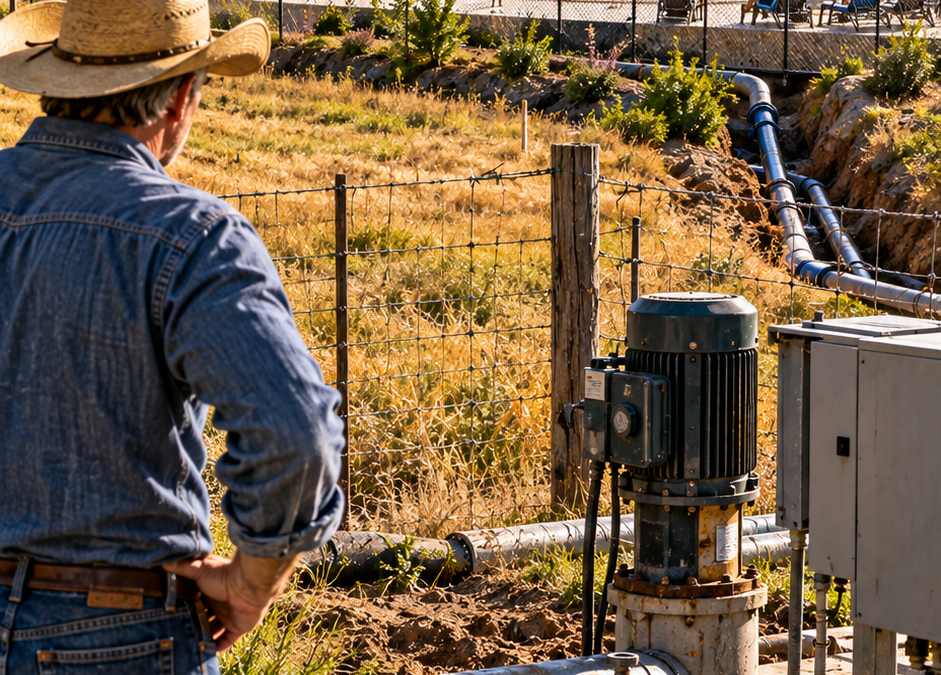
The well sat near the south pasture, just beyond a line of mesquite and old pipe fencing my father had installed when I was still too small to carry a post-hole digger without dragging it behind me. It was not impressive to look at. There was no stone housing, no decorative cover, no sign announcing its importance. Just a locked service box, a pump system, a gravel access pad, and a network of buried lines that ran beneath the ranch like veins.
But that well was the difference between living land and dead land.
It watered my fields when summer heat turned the soil hard. It supplied the livestock tanks during dry weeks when the creek fell low. It kept the windbreak alive along the western edge and fed the old irrigation lines my father had patched, replaced, and cursed over for half his life. Every season depended on it. Every acre I worked had, at one time or another, been kept alive by that water.
My father used to say a rancher does not truly own land until he understands where the water comes from.
I understood.
I knew the main valve by touch. I knew the sound the pump made when it was running smoothly and the sharper hum it gave off when pressure was wrong. I knew which fields needed less, which troughs filled fastest, and which sprinkler heads always clogged after a hard wind. I knew the records too: drilling documents, county filings, maintenance logs, inspection sheets, repair invoices, pump replacement receipts, and the original water system map showing the well inside my ranch boundary.
The homeowners association next door knew none of that.
They saw open land and assumed unused land.
They saw a working ranch and treated it like a backdrop for their neighborhood.
Then they saw my well and apparently decided it was theirs to use.
The HOA was called Silver Ridge Commons, though there was nothing common about the houses once the final phase went up. The smallest one had a three-car garage and a stone entryway. The community had decorative streetlights, artificial ponds, walking paths, a clubhouse, tennis courts, and a board that seemed to believe every nearby feature existed to increase their property values.
I was not part of Silver Ridge.
My ranch predated it by decades.
My family’s land had been here before their entrance monument, before their landscaping standards, before their monthly newsletters, and before their president, Victoria Langford, decided the world became more orderly when she controlled it.
Victoria was not loud in the usual sense. She did not shout first. She smiled first. That was worse. Her smile always came with the quiet certainty of someone who believed politeness and authority were the same thing. She wore expensive linen in summer, tailored coats in winter, and an expression that suggested every disagreement with her was only a delay before compliance.
We had crossed paths before.
She had complained about dust from my cattle road.
She had questioned whether my fence line was “aesthetically compatible” with their community entrance.
She had once sent a letter suggesting that my hay field created “visual inconsistency” when viewed from the upstairs balconies of Silver Ridge homes.
I sent back a two-sentence response.
My hay field was not subject to HOA review.
My fence line was not an architectural feature.
After that, she stopped sending letters for a while.
I should have known silence did not mean surrender.
The trouble began one summer morning when I saw heavy equipment moving across the neighboring property.
At first, I thought Silver Ridge was building another set of amenities. That was always their answer to dissatisfaction: build more, pave more, light more, decorate more. I saw loaders, trenching equipment, pallets of pipe, stacks of fiberglass panels, concrete trucks, and workers in hard hats moving across the far side of the property near the low stretch bordering my south pasture.
For three days, I watched from a distance.
Then the framing went up.
Slides.
Not little ones for children at a neighborhood pool. Big, curling water slides in bright colors, rising above the fence line like something from a resort. A wide splash pad took shape beside them. Then came fountains, overhead dumping buckets, a shallow play pool, cabanas, decorative rock features, and a building that looked like a miniature clubhouse.
Silver Ridge was building a water park.
I remember standing near the pasture gate, one boot on the bottom rail, staring across at it with a kind of tired disbelief.
A water park.
In a neighborhood that already complained every time my cows made noise before sunrise.
I might have laughed if the project had stayed on their side and used their own resources. People can waste their own money however they like. But about two weeks into construction, I noticed something that tightened every nerve in my body.
A trench line was running the wrong direction.
I had seen enough water and irrigation work to recognize the path of new infrastructure. The pipe trench did not lead toward a new well house. It did not angle toward municipal water service. It ran low along the ground, crossed near the shared drainage corridor, and disappeared toward the area where my old irrigation line approached the south field.
I told myself not to jump to conclusions.
Then I saw the connection work.
Two contractors were digging near a section I knew should not have interested them at all. It was close to my buried line, too close to be coincidence. I walked down the fence line with binoculars and watched one worker lower himself into the trench while another handed down fittings.
My mouth went dry.
They had not drilled their own well.
They had not asked for a water agreement.
They were connecting their water park to my irrigation system.
I called my ranch hand, Luis, over from the equipment shed.
“Tell me I’m not seeing what I think I’m seeing,” I said, handing him the binoculars.
Luis adjusted them and stared.
He was quiet for a long time.
Then he lowered them.
“Boss,” he said, “that trench is headed straight for your supply line.”
“My supply line.”
“Looks like it.”
“They wouldn’t be that stupid.”
Luis gave me a sideways look.
“People do a lot of stupid things when water comes out of the ground for free.”
I wish he had been wrong.
Within weeks, Silver Ridge opened its water park.
They did it loudly.
Banners went up at the entrance. The HOA newsletter called it “the crown jewel of the community’s summer lifestyle.” Families lined up on opening day with towels, sunscreen, coolers, and children bouncing with excitement. Music played from speakers hidden among fake rocks. Water shot from fountains. Slides thundered all day. The splash pad sprayed upward in glittering arcs under the sun.
Every drop of it was coming from my well.
I knew before I proved it because the ranch told me.
Pressure dropped first.
The southern irrigation zone began sputtering. A sprinkler line that had always covered the lower hay patch started losing reach by midafternoon. The livestock tank near the east pen filled slower than usual. The pump cycled too often, working harder than it should have in heat that already punished machinery. By the third day of the water park’s operation, one of my fields showed dry edges it should not have had.
That was when Victoria arrived.
She drove through my front gate without calling, parked near the barn, and stepped out holding a binder against her chest. Her sunglasses were large and dark. Her white blouse looked crisp despite the heat. Behind her, the distant roar of water slides drifted across the property like an insult.
“Thomas,” she said, walking toward me. “We need to discuss the water issue.”
I looked at her for a moment before answering.
“My water issue?”
“The community is experiencing irregular flow at the new aquatic facility.”
“Aquatic facility,” I repeated.
“Yes. The board has received complaints that water pressure is fluctuating.”
“That sounds like your problem.”
Her smile became tighter.
“It is a shared infrastructure matter.”
“No,” I said. “It is not.”
She opened the binder. “Silver Ridge has made a substantial investment in this amenity. Residents were promised full summer access.”
“Why are your promises my responsibility?”
That took some of the polish off her face.
“Because the water system serving the area has historically supported community-adjacent use.”
I almost laughed.
There it was: the phrase people used when they wanted something without paying for it.
Community-adjacent.
“Victoria,” I said, “that well belongs to my ranch.”
“The HOA has regulations concerning shared utility access.”
“You can regulate your neighborhood. You cannot regulate my well.”
She removed several printed pages from the binder and held them toward me. “The board has reviewed this.”
I did not take them.
“Does any page in that binder contain a deed transferring my well to your HOA?”
Her lips pressed together.
“Does it contain a signed water agreement with me?”
No answer.
“Does it contain a recorded easement granting Silver Ridge the right to connect to my irrigation infrastructure?”
She lifted her chin. “The matter is more complicated than that.”
“No,” I said. “It is exactly that simple.”
Her voice cooled. “The community needs that water immediately.”
“My cattle need it too. So do my fields.”
“The water park is already open.”
“You should have secured water before opening it.”
She looked toward the south pasture, then back at me.
“You do not want to be responsible for disappointing hundreds of families.”
I stepped closer.
“Victoria, I did not build a water park around someone else’s well.”
For the first time, her expression cracked.
Only slightly.
But enough.
She closed the binder.
“The board will hear about this.”
“Good. Tell them to bring the water rights documents.”
She left angry, which told me she did not have them.
That evening, I did what my father would have done.
I pulled out the records.
The well file was stored in a metal cabinet in the office behind my kitchen. It was thick, old, and organized in the practical way my father had organized everything: drilling records in one folder, county filings in another, maintenance invoices by year, maps in a wide envelope, pump replacement receipts clipped together, inspection sheets labeled in his blocky handwriting.
The original well installation record sat near the front.
My grandfather’s name was on the first permit.
My father’s notes were on later upgrades.
The county map placed the well inside our ranch boundary, well away from Silver Ridge property. The irrigation diagram showed the main line running toward my south field, with branch lines feeding livestock areas and landscaping. There was no transfer. No agreement. No HOA authorization. No shared use provision. No easement that could even be twisted into what Victoria was claiming.
Nothing.
I spread the documents across the desk and felt my anger change shape.
Before that night, I had been furious.
After that night, I became focused.
Anger can make you loud. Records make you dangerous.
I called my attorney, Elaine Porter, first thing the next morning. Elaine had represented ranchers, growers, and landowners long enough to know that water disputes could get ugly faster than fence disputes.
When I told her the HOA had connected a water park to my irrigation infrastructure, she was silent for several seconds.
Then she said, “Say that again slowly.”
I did.
“They built pools and slides?”
“Yes.”
“Connected to your well?”
“Yes.”
“Without a written agreement?”
“Yes.”
“Do they have any plausible claim to the water rights?”
“Not from anything I can find.”
“Send me every document.”
“I already scanned them.”
“Good. Also photograph the well, the valve, the line route if visible, pressure records if you have them, and any evidence showing reduced ranch flow after the water park opened.”
“I can do that.”
“Do not damage their equipment,” she said.
“I won’t.”
“Do not confront residents.”
“I won’t.”
“Do not let Victoria turn this into you being hostile to children at a pool.”
“She already tried.”
“Of course she did.”
I looked through the window toward the fields.
“What can I do right now?”
“Secure your system,” Elaine said. “If the valve controls unauthorized flow from your private infrastructure, and if shutting it does not endanger anyone, you may stop unauthorized use. Document before and after. I’ll prepare notice.”
I walked outside after the call and stood beside the main irrigation valve.
It was not dramatic to look at. Just a metal control point near the service housing, the kind of thing most people would pass without understanding. But I understood exactly what it did.
One turn would stop water from flowing toward the unauthorized connection.
One turn would tell the truth faster than any meeting.
Still, I waited.
I photographed everything first.
The valve position.
The well housing.
The pressure gauge.
The line markers.
The dry edge of the hay field.
The livestock tank filling too slowly.
Then I stood there in the heat, hand on the valve wheel, and listened.
From beyond the property line came the roar of Silver Ridge’s new attraction. Children shouting. Water rushing. Fountains spraying. Pumps pushing my ranch water through their bright plastic paradise.
My father’s voice came back to me then, as clear as if he were standing beside me.
Water is work, son. Anyone who treats it like decoration has never had to depend on it.
I turned the valve.
At first, nothing seemed to happen.
Then the pressure gauge shifted.
The line vibration changed.
The sound moving through the pipe faded.
Across the property line, the water park continued for perhaps two minutes on what remained in the system. Then one feature sputtered. The tall fountain near the center lost height, dropped to a weak spray, and stopped. The dumping bucket filled halfway and hung uselessly. The slides kept running briefly, then thinned to uneven streams. One by one, the fountains went silent.
The roar disappeared.
That silence was extraordinary.
Not peaceful exactly.
Loaded.
Like a room after someone finally says the thing everyone has been avoiding.
By midafternoon, Silver Ridge was in chaos.
I could hear voices across the fence. Workers ran between pump housings. Residents gathered around the closed slides. Children complained. Someone blew a whistle repeatedly. A maintenance cart rushed down the path near the aquatic center.
Victoria arrived at my ranch less than thirty minutes later.
She did not smile this time.
She stormed through the gate in a cloud of dust, parked crookedly near the well road, and marched toward me with two board members behind her. One of them was Mark Ellison, the HOA treasurer, a man I had met only once but remembered because he seemed more cautious than the others.
Victoria pointed toward the south pasture.
“Open that valve.”
“No.”
“You have shut down HOA property.”
“I shut down my private water system.”
“You are interfering with a community amenity.”
“You connected that amenity to my well without permission.”
“We have hundreds of residents on site.”
“You should send them home.”
Her eyes flashed. “Do you understand the liability you’re creating?”
“I understand the liability you created when you tied a water park to a private irrigation well.”
Mark stepped forward, palms raised slightly.
“Thomas, maybe we should all slow down.”
“I slowed down long enough to read the documents. You should try it.”
Victoria’s jaw tightened.
“The HOA regulations give us authority over shared systems.”
“Show me where my well became shared.”
She opened her binder again and pulled out pages, her movements sharp now.
“Here. Utility access standards. Community maintenance provisions. Amenity infrastructure procedures.”
I took the papers this time.
Not because I needed them.
Because I wanted Mark to watch.
I flipped through page after page. Architectural standards. Pool rules. Guest wristbands. Equipment-room access. Maintenance budgeting. Water conservation recommendations for HOA-owned landscaping. Nothing about my well. Nothing about my ranch. Nothing about water rights.
I handed the papers back.
“These are rules for property you own.”
Victoria’s voice rose. “This is not just about ownership.”
“It is entirely about ownership.”
“The residents were promised unlimited summer access.”
“By you.”
“The board approved operational expenses.”
“Without securing water.”
She looked at Mark.
He did not defend her.
That mattered.
Victoria turned back to me. “If you do not reopen the valve, the HOA will fine you for interference.”
I stared at her.
“You have no authority to fine me.”
“We will pursue damages.”
“Good. Put everything in writing.”
“You are being unreasonable.”
“No. I am being robbed politely, and I am done pretending otherwise.”
For a second, no one spoke.
The air was hot and still. A fly moved around the brim of Mark’s hat. Somewhere behind us, a cow bawled near the lower pen. Across the property line, the water park sat silent, its slides dry under the sun.
Victoria lowered her voice.
“Thomas, this can still be resolved without embarrassment.”
“That ended when your residents started sliding through my water.”
Her face reddened.
“I will involve the county.”
“Please do.”
She seemed surprised by that.
I was not.
By then, Elaine had already contacted the county water office and requested an inspection. If Victoria wanted officials, she was about to get them.
The next morning, a county water inspector arrived at my ranch.
His name was Daniel Reeves, and he came in a white county truck with a hard case of instruments, a clipboard, and the calm expression of someone who had already read enough to know this would not be a routine visit. He introduced himself at my front gate, then asked to see the well records before inspecting the physical system.
Victoria arrived ten minutes later with Mark, another board member, and the HOA’s maintenance supervisor.
She started speaking before Daniel had even closed his truck door.
“Inspector Reeves, thank you for coming. The HOA has been dealing with a disruption caused by Mr. Calder shutting off water to a community facility.”
Daniel looked at her, then at me.
“I’ll inspect the system and review the records.”
Victoria seemed annoyed that he had not accepted her framing.
“The water park was approved through proper HOA procedure,” she said.
Daniel made a note. “HOA approval is not the same as water authorization.”
Her mouth closed.
I liked him immediately.
We began at the well.
I showed him the service housing, the pump configuration, the main valve, the pressure readings, and the documents establishing installation and ownership. He reviewed the county map carefully, then compared it with the physical location. He asked several precise questions about line routing, maintenance, and recent pressure changes.
Then we followed the irrigation line south.
The unauthorized connection was impossible to miss once we reached the trench area.
Even covered, the ground told the story. Fresh fill. New fittings. A branch connection tied into the ranch line and routed toward Silver Ridge’s aquatic facility. Daniel photographed it, marked the location, checked the alignment, and compared it with the documents.
Victoria grew quieter with every step.
That was new.
She usually filled space with language. Community need. Shared use. Operational expectations. Board approval. This time, she watched Daniel work and said almost nothing.
Mark asked the question she would not.
“Inspector, is that connection on Mr. Calder’s system?”
Daniel looked up from the exposed section.
“Yes.”
Mark swallowed. “And the HOA water park is drawing from it?”
“Based on what I’m seeing, yes.”
Victoria cut in. “There may have been an understanding with prior ownership.”
“My family never sold this ranch,” I said. “There was no prior owner for you to misunderstand.”
Daniel looked at her. “Do you have a written water agreement?”
“We are reviewing archived records.”
“That is not a yes.”
She flushed.
He continued. “Do you have a recorded easement granting access to this well or line?”
“The board believed—”
“That is also not a yes.”
Mark closed his eyes briefly.
Daniel stood, dusted off his hands, and faced the group.
“The well is located on Mr. Calder’s property according to the county records provided and the site location. The irrigation system appears to be part of his ranch infrastructure. The branch connection to the HOA facility does not appear to have documented authorization based on what has been presented today.”
The words were clinical.
They still hit like thunder.
Victoria’s posture stiffened. “The community depends on that water.”
Daniel’s expression did not change.
“Then the community needed to secure lawful access before depending on it.”
Several residents had gathered along the Silver Ridge side by then. Word traveled fast when a water park died in July. They stood beyond the fence, watching the inspection with towels over shoulders and confusion turning slowly into anger.
One man called out, “Is he saying our water came from the ranch?”
No one from the HOA answered.
Daniel did.
“The facility appears to have been connected to private irrigation infrastructure.”
A woman shouted, “Did we pay for that?”
Mark looked physically pained.
Victoria turned toward the residents. “This is a complex matter.”
“No,” someone said. “It sounds like you used his well.”
Another resident asked, “Did the HOA have permission or not?”
Victoria opened her mouth.
Mark finally spoke.
“No,” he said.
The single word seemed to surprise even him.
Victoria turned sharply. “Mark.”
He looked at her, then at the residents, then at the dry slides rising uselessly behind them.
“No,” he repeated, stronger this time. “Not based on what we have. We do not have a signed water agreement. We do not have a recorded transfer. We do not have an easement. The board made a serious mistake.”
The anger that had been directed toward me shifted so quickly I could almost feel it move through the air.
Residents began talking at once.
“We paid assessments for this.”
“You opened it without water rights?”
“What happens to our fees?”
“Who approved the construction?”
“Did anyone check?”
Victoria tried to regain control.
“Everyone needs to remain calm.”
That only made things worse.
A father standing near the fence pointed toward the slides. “My kids have been out here all week, and you didn’t even know where the water came from?”
Victoria said, “We relied on contractor guidance.”
The maintenance supervisor looked startled. “We connected where the plans indicated.”
Mark turned toward him. “Who provided the plans?”
No answer came fast enough.
Daniel stepped back, letting the HOA collapse under its own silence.
I stood beside the well line and felt something I did not expect.
Not triumph.
Relief, maybe.
But heavier.
For weeks, I had felt like I was arguing against a fantasy. Victoria had spoken as if the water park’s existence proved its right to exist. Residents had assumed water flowing through slides meant someone had properly secured it. Contractors had followed plans. The board had approved budgets. Everyone had moved forward because forward motion feels like legitimacy when nobody stops to read the underlying documents.
Now the documents had caught up.
Elaine arrived shortly before noon.
She spoke with Daniel, reviewed his preliminary findings, and then addressed the HOA attorney by phone. Her tone remained calm, but I knew her well enough by then to hear the steel beneath it.
“My client will not supply free irrigation water to an unauthorized HOA attraction,” she said. “Any further access must be negotiated lawfully, permitted properly, and compensated appropriately, if he chooses to consider it at all. Otherwise, the association needs to disconnect from his system and develop its own supply.”
Victoria stood several yards away, arms folded, staring at the ground.
For the first time since I had known her, she looked less like someone controlling a situation and more like someone trapped inside the consequences of her own confidence.
The county issued a written notice after the inspection.
The HOA could not continue drawing from my private well without authorization. The connection had to be addressed. The water park would remain non-operational until Silver Ridge either negotiated a lawful water agreement with me or developed an independent approved water supply.
Residents were furious.
Not at me anymore.
At the board.
At Victoria.
At the contractors.
At whoever had failed to ask the one question that should have been answered before a single slide was installed.
Where is the water coming from?
Over the next few weeks, Silver Ridge became a neighborhood at war with itself.
I heard enough through neighboring landowners to understand the general shape of it. Emergency meetings. Demands for financial disclosure. Arguments over contractor contracts. Questions about whether the board had misrepresented the water source. Parents angry that summer access had been advertised before infrastructure was secured. Retirees angry that assessments had increased for a facility now sitting dry behind locked gates.
Victoria stopped coming to my ranch.
Her attorney wrote instead.
The first letter tried to frame the matter as an “unfortunate infrastructure misunderstanding.” Elaine answered with a timeline, property records, county findings, photographs, and a reminder that the HOA had received notice before demanding continued flow.
The second letter suggested a temporary seasonal water-sharing agreement.
I refused.
Not because I wanted children disappointed or residents angry. I refused because the HOA had not come to me before building. They had connected first, opened first, collected praise first, and only treated my rights as relevant after I turned the valve.
That was not negotiation.
That was attempted pressure.
Mark came alone one evening near the end of July.
He parked by the front gate, called from his truck, and asked if I would speak with him. I almost said no, but something in his voice sounded different from the others.
I met him near the barn.
He looked tired.
Not politically tired. Genuinely tired.
“I wanted to apologize,” he said.
I waited.
He removed his cap and looked down at it. “I should have asked harder questions.”
“Yes, you should have.”
He nodded. “The board was told the water source was handled.”
“By Victoria?”
He hesitated.
“That’s an answer,” I said.
He sighed. “She said there were legacy infrastructure rights tied to the development.”
“Did anyone ask to see them?”
“Not until it was too late.”
“It wasn’t too late when I objected.”
“I know.”
The honesty took some of the anger out of me, though not enough to absolve him.
Mark looked toward the south pasture.
“I don’t expect you to help us.”
“Good.”
“But the residents need to understand what happened. I plan to recommend a full audit.”
“That sounds wise.”
“And Victoria may step down.”
“That sounds late.”
He gave a short, humorless laugh.
“You’re not wrong.”
For a moment, neither of us spoke.
Then he said, “Can I ask you something?”
“You can ask.”
“If we had come to you first, before construction, would you have considered a water agreement?”
I thought about that.
It would have depended on volume, compensation, conservation limits, liability, drought protections, infrastructure safeguards, legal permits, and whether the water draw threatened the ranch. I would not have agreed to unlimited summer access. I would not have risked livestock or fields for fountains. But I might have discussed limited use if it had been approached honestly.
“Maybe,” I said.
He looked pained.
“One meeting,” I continued. “One honest question before construction. That’s what your board skipped.”
Mark nodded.
“I know.”
He left without asking me to reopen the valve.
That mattered.
By August, Silver Ridge had disconnected from my system under county supervision. The unauthorized branch was capped and removed where it tied into my irrigation line. Daniel Reeves returned to inspect the correction, and I watched while the connection that should never have existed was physically undone.
When the work was complete, I reopened my irrigation system fully.
Water moved back through the ranch the way it was supposed to.
The south field recovered first. Then the east livestock tank returned to normal fill times. The pump stopped cycling so aggressively. Pressure stabilized. The old system settled into its familiar rhythm, serving the land it had been built to serve.
I stood beside the trough one evening and watched cattle drink under a sky streaked orange and purple by the setting sun.
It was such a simple sight.
Water flowing where it belonged.
Animals drinking.
Field lines hissing softly in the distance.
No fountains. No slides. No artificial waterfalls pouring all day for people who had never asked where the supply came from.
Just ranch water doing ranch work.
Silver Ridge eventually chose to develop a separate water source. It cost them far more than they had expected, partly because doing things properly often does. Permits took time. Engineers had to redesign systems. The water park remained closed for the rest of that summer.
Residents were not happy.
I could understand that.
But their disappointment did not make my well theirs.
Victoria resigned in September.
The official notice said she was leaving to “pursue other commitments.” Nobody believed that. Not after the county inspection. Not after the emergency meetings. Not after Mark’s audit revealed that the board had approved the water park without a completed water rights agreement in place.
The phrase people used around town was simple.
“They built it on borrowed water.”
That was too generous.
Borrowing requires permission.
They had built it on stolen assumptions.
I never received an apology from Victoria. I did not expect one. People like her do not apologize for overreach. They mourn the moment overreach becomes visible.
But I did receive a formal letter from the HOA’s attorney confirming that Silver Ridge Commons claimed no ownership interest in my well, no access right to my irrigation system, no easement over my water lines, and no authority to draw from my ranch infrastructure without a written agreement.
I put that letter in the water file.
Then I made three copies.
One for Elaine.
One for the ranch office.
One for the fireproof cabinet where my father’s records still sat, waiting for the next person who thought confidence could replace proof.
The water park reopened the following year, I heard.
By then it had its own approved supply, its own metering, and strict operating limits during dry periods. I never went to see it. I had no interest in watching water shoot through fiberglass tubes behind a subdivision fence.
But sometimes, when the wind came from the east, I could hear it faintly.
Children laughing.
Pumps running.
Water falling.
It did not bother me the way it had before.
Because it was not my water anymore.
That was all I had ever wanted.
One morning the next spring, I walked the ranch early before the heat came up. The fields were green from a week of good rain, and the cattle stood near the trough with steam rising faintly from their backs in the cool air. I stopped by the well house and rested one hand on the metal casing.
It was not sentimental-looking.
No one would photograph it for a brochure.
No child would beg to visit it on a summer afternoon.
But that well had kept my family’s land alive for decades. It had outlasted drought years, pump failures, storms, bad markets, and now an HOA water park built by people who had mistaken access for entitlement.
I thought again about my father.
He had taught me to read land by its needs. He had taught me that water was not decoration. It was not an amenity. It was not something a board could vote into existence after approving a budget.
It was a responsibility.
And responsibility belonged to the person who protected it, paid for it, documented it, and understood what would happen if it failed.
Victoria had promised residents unlimited summer fun.
I had promised my father I would keep the ranch running.
Only one of those promises was tied to a legal right.
That was the lesson Silver Ridge learned the expensive way.
An HOA can print regulations thick enough to fill a binder. It can hold meetings, approve projects, collect assessments, and promise residents a perfect summer behind locked gates and bright signs.
But it cannot write rules over someone else’s deed.
It cannot turn private infrastructure into community property by connecting a pipe in the dirt.
And it cannot build an entire water park around a well it does not own, then act surprised when the owner turns the valve.
By the end of that summer, the ranch was quiet again.
The fields were watered.
The livestock tanks were full.
The pump ran smoothly.
And the well, finally free from the burden of Victoria’s promises, went back to doing the only job it had ever been built to do.
Keeping my land alive.








