The sound of my face hitting metal silenced an entire mess hall.
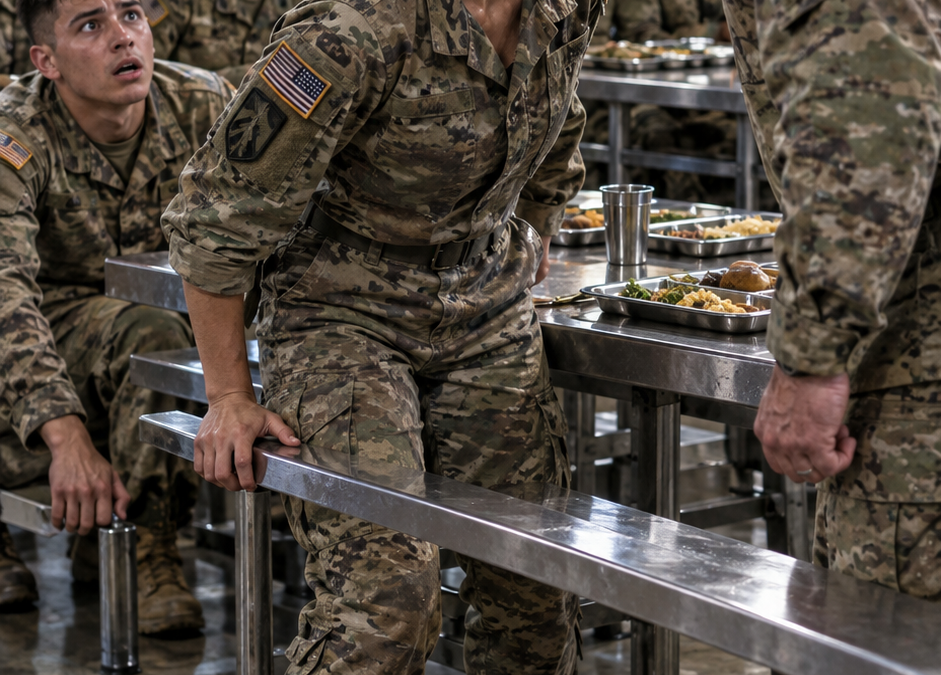
𝗙𝗨𝗟𝗟 𝗦𝗧𝗢𝗥𝗬
The room became so quiet that I could hear ventilation fans above us.
Sterling slowly turned his full attention toward me.
“What did you say?”
“I said there’s no need to escalate, Major.”
I kept my voice level.
No sarcasm.
No hostility.
That made it worse.
Men like Sterling often understand anger.
Anger acknowledges their power.
Calm does not.
He leaned closer.
I smelled tobacco and coffee.
“Who are you?”
“A soldier telling you what happened.”
“That wasn’t the question.”
“It was the relevant answer.”
His nostrils flared.
Behind him, Miller whispered, “Please.”
I could not tell whether he was asking Sterling to stop or asking me not to make things worse.
Sterling looked down at my collar.
No insignia.
Then my chest.
No name tape.
His eyes returned to mine.
His expression changed.
Relief.
He believed he had understood me.
Nobody.
That was the category he had placed me in.
“Do you have any idea who you are speaking to?”
“Yes, sir.”
“And yet you’re standing there.”
“Yes.”
“You think you get to interfere with discipline?”
“I think discipline should serve a purpose.”
His face turned dark red.
“Get out of my way.”
“No.”
That single word did it.
Sterling lunged.
One hand struck the back of my head.
Before I could brace fully, his weight drove me downward.
My face hit the aluminum tray.
Hard.
The edge caught my forehead.
The sound cracked through the room.
Mashed potatoes, gravy, and pieces of Salisbury steak scattered across the table and floor.
For half a second, I saw white.
Then pain.
Sharp across my forehead.
Dull through my jaw.
I tasted blood.
Sterling’s hand stayed on the back of my neck.
“GET OUT!”
His voice boomed above me.
“You do not speak to me. You do not question me. You do not even look at me unless I tell you to.”
I heard someone gasp behind the serving counter.
Sterling pressed harder.
“You’re nothing. Do you understand?”
The aluminum tray felt cold beneath my cheek.
Gravy ran toward my collar.
“You are dirt under my boots.”
Nobody moved.
That was the most important thing happening in the room.
Not the assault.
The silence.
Nearly one hundred soldiers.
Several NCOs.
Civilian workers.
Everyone watching.
Nobody intervening.
My anger was not directed at them.
Fear changes people.
Sterling had spent years teaching this base that witnesses paid almost as much as victims.
He released me.
“You think you can come into my mess hall and play hero?”
I remained bent over the table for another second.
Not because I could not stand.
Because I needed to control what I did when I did.
Sterling stepped backward.
“I’ll break you until you spend the rest of your career cleaning toilets.”
I pushed myself upright.
Slowly.
The room blurred once and sharpened again.
Mashed potato clung to one cheek.
Gravy ran from my chin.
Blood from a cut near my hairline mixed with it.
Miller was crying.
Not loudly.
His face was turned down and tears dropped onto his hands.
He thought this had happened because of him.
That hurt more than my forehead.
Sterling adjusted his collar.
Victory restored his posture.
“Now get out.”
I reached toward the napkin dispenser.
Pulled out one napkin.
Wiped my eyes.
Then my mouth.
Then I looked at him.
Something shifted in his face.
Confusion first.
He had expected tears.
Or pleading.
Or rage.
He got none of them.
Then came unease.
Because I smiled.
Not broadly.
Just enough.
I had not planned to.
The smile appeared because suddenly I knew the investigation was over.
Not legally.
Not procedurally.
But evidentiary ambiguity was gone.
Sterling had just assaulted an undercover federal inspector in a room full of witnesses because she asked him not to terrorize a teenager.
No interpretation could rescue that.
No cleaned-up command-climate survey could bury it.
He had finally shown me exactly who he was.
“Are you deaf?” he barked.
His voice had lost something.
“I told you to get out.”
I reached into my left breast pocket.
My fingers touched cold metal.
For three months, I had carried it every day without wearing it.
I took it out.
A silver eagle.
Colonel.
I held it in my palm beneath the fluorescent lights.
Sterling stared.
For several seconds, he did not understand.
Then his eyes narrowed.
He looked from the insignia to my face.
Back to the insignia.
His ego rejected the answer before his mind could consider it.
“Stolen valor.”
The words came almost as a whisper.
Then louder.
“Stolen valor.”
He stepped toward me.
Relief hardened into rage.
“You thought you could buy a piece of metal from some surplus store and threaten me?”
I wiped more blood from my forehead.
“My name is Colonel Elena Vance.”
His mouth twisted.
“Bullshit.”
“Department of Defense, Office of Inspector General.”
The room changed.
Even people who knew little about Pentagon bureaucracy understood those words.
Sterling did not.
Or rather, he understood them well enough to become more dangerous.
“You sick little fraud.”
I slipped the eagle back into my pocket.
“Major, I recommend you stop talking.”
“I’m going to see you imprisoned.”
“That would be interesting.”
“I will personally watch them drag you into Leavenworth.”
“If that helps you remain calm.”
His eyes widened.
Men like Sterling can tolerate insults better than condescension.
He turned.
“Hayes!”
Sergeant Hayes looked up.
“Sir.”
“Call the MPs.”
Hayes did not move immediately.
“Tell them we have a civilian impersonating a commissioned officer.”
Sterling pointed at me.
“And tell them she assaulted the base command staff.”
A murmur moved through the room.
I stared at him.
“Assaulted you?”
He ignored me.
“Make the call!”
“Major,” I said, “you should consider very carefully what happens next.”
He spun back.
“You don’t advise me.”
“I’m giving you a final opportunity to step away from this.”
“You’re threatening me?”
“No.”
I looked at Miller.
Then Sterling.
“I’m documenting your choices.”
His fist tightened.
Miller made a small sound.
“Please don’t hit her again.”
Sterling turned toward him.
Everything about Miller collapsed.
“What did you say, Private?”
“I…”
Sterling walked over.
“Look at me.”
Miller looked up.
Tears had left streaks down his cheeks.
“Did this woman assault me?”
Miller’s mouth opened.
His eyes found mine.
I did not nod.
Did not signal.
Did not ask him to be brave.
A frightened nineteen-year-old should not have been required to save a colonel.
“I…”
Sterling leaned closer.
“Did you see her assault me?”
Miller broke.
“I didn’t see anything, sir.”
Sterling smiled.
Not at Miller.
At me.
Then he looked around the room.
“Anyone else?”
Nobody answered.
“Did anyone see anything other than this deranged woman attacking a superior officer?”
Forks remained on plates.
Eyes remained lowered.
The silence became almost physical.
Sterling turned back.
“There. You see?”
I understood then why every previous investigation had failed.
He did not merely punish dissent.
He engineered complicity.
Every silent witness became invested in keeping the truth buried.
Every person who looked away once became easier to silence the second time.
“You’re nothing,” he said.
“Less than nothing.”
He pointed toward Hayes.
“Call the MPs.”
Hayes lifted his radio slowly.
I looked at him.
“Sergeant Hayes.”
His eyes met mine.
“Article 92 does not require a soldier to obey an unlawful order.”
Sterling stepped between us.
“Do not speak to my men.”
I continued anyway.
“If you contact military police, tell them Colonel Elena Vance from the Pentagon Inspector General requires immediate escort to the Provost Marshal.”
Sterling laughed.
A short, harsh sound.
“Still doing it.”
Hayes swallowed.
Then something unexpected happened.
“Sir,” he said.
Sterling turned.
“The MPs are already coming.”
“What?”
“Someone activated the silent panic alarm.”
Every head turned toward the serving counter.
Brenda.
Civilian cook.
Probably in her late fifties.
I had seen her every day for weeks.
She remembered which soldiers wanted extra gravy.
Which ones were losing weight.
Which ones had birthdays.
She was standing beside the hidden alarm button, hands trembling against her apron.
Sterling stared at her.
She stared back.
“You,” he said.
Brenda’s chin rose.
“You put your hands on her.”
“You’re fired.”
Her face went pale.
“You hear me? Get your things. You’re finished on this base.”
The mess hall doors slammed open.
“Military Police! Stand down!”
Two MP corporals entered.
Hands near their sidearms.
Eyes moving rapidly across the room.
They saw the spilled food.
Miller crying.
My bleeding forehead.
Then Sterling.
Sterling immediately took control.
“This woman is impersonating a commissioned officer and assaulted me.”
One MP reached toward his handcuffs.
“I want her detained immediately.”
I held up my left hand.
“Corporal, I am Colonel Elena Vance, Department of Defense Office of Inspector General. My identification is in my right breast pocket.”
The MP stopped.
Sterling shouted over me.
“Fake credentials. Fake rank.”
He walked toward them.
“Cuff her.”
The two young MPs looked at each other.
I could see the calculation.
A major they knew.
A battered stranger making an unbelievable claim.
One decision could end their careers either way.
“Corporal,” I said, “you may retrieve my identification yourself.”
Sterling stepped closer.
“Are you refusing a direct order?”
The lead MP stiffened.
Sterling had found the pressure point.
Rank.
Habit.
Fear.
The corporal looked at my bruised face.
Then at Sterling.
“Ma’am.”
He removed his cuffs.
“I need you to turn around.”
Miller covered his face.
Hayes closed his eyes.
Sterling smiled.
There it was.
The system functioning exactly as he had designed it.
I turned.
Put my hands behind my back.
The cuffs clicked shut.
Too tight.
I said nothing.
Sterling leaned close.
“Make them tighter.”
The MP ignored that.
Barely.
I looked over my shoulder.
“Do not search me here.”
The corporal hesitated.
“I am requesting immediate transport to the Provost Marshal’s office.”
Sterling laughed.
“You’re not requesting anything.”
I looked at him.
“Major Sterling, you have now ordered the unlawful detention of a federal inspector after physically assaulting her in front of witnesses.”
His smile remained.
“You’re insane.”
“Possibly.”
I looked toward Hayes.
“But keep Private Miller safe.”
Hayes finally met my eyes.
“For the next hour, nobody leaves him alone.”
Sterling laughed louder.
“You aren’t coming back.”
I smiled.
“That’s where we disagree.”
The MPs led me down the aisle.
Nobody looked at me.
Except Brenda.
She did.
I nodded once.
Thank you.
Outside, sunlight struck my face hard enough to make me squint.
My forehead throbbed.
The MPs put me in the back of their cruiser.
The door slammed.
Through the wire partition, I could see Sterling still standing inside the mess hall.
He believed he had won.
That was why I could not stop smiling.
The cruiser smelled like disinfectant and stale upholstery.
Neither MP spoke.
The driver’s name was Corporal Miller.
No relation to Leo.
His partner was Santino.
Every bump in the road pulled the cuffs against my wrists.
I rested my head carefully against the window.
“You both understand this is a mistake.”
Corporal Miller stared forward.
“The Major gave an order.”
“An unlawful one.”
No answer.
“You saw my insignia.”
Santino glanced at me through the mirror.
Fear had entered his face.
I continued.
“You saw my injury.”
Miller’s hands tightened on the wheel.
“We’re taking you to the Provost Marshal. They can sort it out.”
“That is the first correct thing anyone has said in five minutes.”
Santino looked back again.
“What if you’re really OIG?”
Miller snapped, “Don’t engage.”
I smiled.
“That’s a good question, Corporal.”
Nobody spoke again.
The Provost Marshal’s office was a square concrete building built with the aesthetic warmth of a bunker.
Inside, a desk sergeant looked up.
He was older.
Experienced enough that disbelief did not come as quickly.
“What have you got?”
“Assault on a superior officer,” Miller said.
“Impersonating a colonel.”
The desk sergeant looked at my face.
Then my cuffs.
“Who ordered detention?”
“Major Sterling.”
Something subtle changed.
“Credentials checked?”
Miller hesitated.
“Major said they were fake.”
“That wasn’t my question.”
Silence.
The sergeant looked at me.
“My name is Colonel Elena Vance.”
Miller exhaled impatiently.
“She keeps saying that.”
I continued.
“Department of Defense Office of Inspector General.”
The sergeant’s eyes sharpened.
“My credentials are in my right breast pocket. You may retrieve them.”
He looked at Miller.
“You didn’t?”
“The Major ordered us not to.”
The sergeant stared at him.
Then me.
Then my bleeding forehead.
“Take the cuffs off.”
Miller blinked.
“Sergeant?”
“Now.”
“But Major Sterling—”
“I don’t care what Sterling said. Remove them.”
Keys came out.
Miller struggled with the lock.
The cuffs opened.
I brought my hands forward.
Red marks circled both wrists.
I did not rub them.
I reached into my pocket.
Pulled out a black credential wallet.
Opened it.
Department of Defense seal.
Photograph.
Colonel Elena Vance.
Office of Inspector General.
Special investigative authority.
The desk sergeant went gray.
He snapped to attention.
“Ma’am.”
Miller stopped breathing.
Santino looked as if somebody had removed all the bones from his body.
“Colonel, I…”
I raised one hand.
“Stop.”
The sergeant stopped.
“I’m not interested in panic.”
I looked at the MPs.
“I’m interested in choices.”
Neither spoke.
“You had information in conflict.”
I pointed toward my face.
“You saw evidence of injury.”
Then toward the credentials.
“I offered identification.”
“You refused to verify it because someone with more visible rank told you not to.”
Santino’s eyes filled.
“Ma’am…”
“You will both provide statements.”
“Yes, ma’am.”
“You will not coordinate them.”
“Yes, ma’am.”
“And neither of you will contact Sterling.”
Their faces changed.
They finally understood.
This was no longer discipline.
It was evidence preservation.
I turned to the desk sergeant.
“I need your secure line.”
“Yes, ma’am.”
“And lock the front entrance.”
He moved immediately.
I washed some dried gravy from my hands while encryption connected.
Then I lifted the receiver.
“This is Vance.”
A familiar voice answered.
“Status?”
“Operation Clean Sweep is active.”
Silence sharpened on the other end.
“Reason?”
“I have direct evidence of command abuse. Major Thomas Sterling physically assaulted me and ordered my unlawful detention.”
“Your condition?”
“Conscious. Probable concussion. Minor laceration.”
“Witnesses?”
“Approximately one hundred potential. Several priority.”
“Understood.”
“I need the preauthorized JAG package executed.”
“Sterling only?”
I looked at the wall.
Three months of investigation.
Missing soldiers.
Money.
Records that did not align.
“No.”
My voice became quieter.
“Execute the secondary warrant protocol too.”
A pause.
“Thorne?”
“We don’t know yet.”
“We have enough for the storage sites.”
“Then move.”
“ETA approximately ten minutes.”
“Bring medical personnel.”
“For you?”
“For Private Leo Miller first.”
I thought of him crying beneath Sterling’s shadow.
“He’s been under extreme duress.”
“Understood.”
“And I want the arrest package brought to the mess hall.”
“Copy.”
I hung up.
The room was silent.
The desk sergeant stared at me.
“Ma’am… how long have you been on this base?”
“Three months.”
His eyes widened.
That was enough.
I looked at the two MPs.
“You’re driving me back.”
Miller swallowed.
“Yes, ma’am.”
“No sirens.”
“Yes, ma’am.”
“Drive normally.”
He nodded.
As we crossed the base again, nobody spoke.
The world outside looked exactly the same.
Barracks.
Training fields.
Rows of parked vehicles.
Soldiers moving through routines.
That was the strange thing about institutions with serious rot inside them.
From fifty yards away, they often looked perfectly healthy.
As we approached the mess hall, Sterling’s voice carried through an open window.
“I want these floors spotless!”
I looked toward the building.
He was still there.
Of course he was.
Some men cannot simply abuse authority.
They need to remain nearby and watch people live under the consequence.
We stopped.
I stepped out.
The two MPs followed several paces behind me.
I pushed open the mess hall doors.
Sterling turned.
“I thought I told you—”
He stopped.
No cuffs.
No hands controlling my arms.
Two MPs following me rather than escorting me.
His face emptied.
“What is this?”
I walked to the exact place where he had hit me.
He looked at the MPs.
“Why isn’t she in a cell?”
Neither answered.
I pulled out my phone.
Sterling backed away half a step.
“I told you I had a call to finish.”
“You can’t—”
“Your orders are over, Thomas.”
That was the first time I used his first name.
He heard the difference.
I dialed.
The secure office answered.
“This is Colonel Elena Vance. Confirming target Major Thomas Sterling for immediate relief of command pending federal investigation.”
Sterling shook his head.
“You’re lying.”
The windows began to vibrate.
Rotor noise.
Heavy.
Close.
A Black Hawk descended toward the parade area outside.
Soldiers near the windows looked up.
Sterling did too.
Color drained from his face.
“This is a setup.”
“No.”
I stepped closer.
“This is what happens when someone finally documents the room after you think you own it.”
The helicopter touched down.
Within moments, federal investigative personnel and military legal officers entered.
Sterling stepped back.
“You can’t do this.”
The lead agent approached.
“Major Thomas Sterling?”
Sterling looked toward me.
“You’re making a mistake.”
The agent produced paperwork.
“You are hereby relieved of duties pending investigation into allegations including assault, obstruction, witness intimidation, financial misconduct, and abuse of authority.”
Sterling’s knees seemed to weaken.
The agent reached for his arm.
That was when Sterling laughed.
It was not the laugh from earlier.
This one sounded frightened.
“You think this is me?”
I watched him.
“What?”
His eyes moved past me toward the administrative corridor behind the kitchen.
“You actually think I’m the one running this place?”
The room became very still.
My stomach tightened.
Sterling smiled weakly.
“You have no idea what you walked into.”
Footsteps sounded from the hallway.
Slow.
Unhurried.
A man stepped out.
Brigadier General Silas Thorne.
Base Commander.
The man whose schedule showed him attending a conference in Washington.
The man whose official correspondence repeatedly expressed concern about “isolated allegations of overzealous junior leadership.”
The man whose signature appeared on every missing-soldier determination.
He wore his uniform perfectly.
Silver hair immaculate.
Expression composed.
He stopped near the entrance to the administrative wing.
“Colonel Vance.”
Not surprise.
Recognition.
That mattered.
I faced him.
“General Thorne.”
“I must congratulate the Inspector General’s office.”
His voice was smooth.
“Very theatrical.”
Sterling looked toward him desperately.
“Sir, thank God.”
Thorne barely glanced at him.
“Stand up, Thomas.”
Sterling scrambled upright.
“You look pathetic.”
Sterling’s face changed.
For the first time, I saw what their relationship really was.
Sterling had terrorized the base.
Thorne terrorized Sterling.
I looked at the general.
“You’re back from Washington early.”
Thorne smiled faintly.
“Plans change.”
“Or perhaps you never left.”
The smile disappeared.
Investigators spread through the room.
The lead agent hesitated.
Their warrant authorized Sterling.
The general standing before them created a different problem.
Thorne noticed.
Of course he did.
Powerful men survive by recognizing hesitation faster than anyone else.
“You have caused quite a disturbance, Colonel.”
He glanced at my forehead.
“Based on what? Harsh words?”
“Assault.”
“This is the Army.”
“Assault remains assault in uniform.”
“Training can be uncomfortable.”
“So can federal prison.”
Sterling looked between us.
Thorne’s eyes cooled.
“You arrived expecting to find a tyrant.”
“No.”
I shook my head.
“I arrived because money was disappearing.”
A flicker.
Tiny.
But there.
“And because three soldiers reported concerns shortly before being classified AWOL.”
Thorne’s expression returned to neutral.
“Deserters.”
“Their families disagree.”
“Families often do.”
“And because payroll records show compulsory transfers into private accounts controlled through shell organizations linked to contractors serving this base.”
Sterling looked at Thorne.
Interesting.
He had not known all of that.
Thorne stepped closer.
“You are exceeding your mandate.”
“My mandate expanded this morning.”
He smiled.
“Because Thomas pushed your face into lunch?”
“No.”
I looked at Sterling.
“He simply confirmed the culture.”
Then back to Thorne.
“The rest was already moving.”
That was the moment Thorne’s confidence changed.
Not disappeared.
Changed.
He realized Sterling had not brought the investigation.
The investigation had brought me.
“You’re bluffing.”
I took out my phone.
Opened a secure tracking screen.
Several team markers moved north of the base.
One was already stationary near old ammunition-storage bunkers.
“Secondary search teams executed warrants eleven minutes ago.”
For the first time, Sterling looked truly frightened.
Thorne’s eyes narrowed.
“What warrant?”
“One concerning the old bunker sector.”
Nobody breathed.
I continued.
“Specifically areas associated with the three soldiers you classified AWOL.”
Thorne said nothing.
“Investigators identified disturbed ground during preliminary surveillance.”
Sterling turned toward him.
“Sir?”
Thorne ignored him.
My phone vibrated.
One message.
CONFIRMED HUMAN REMAINS. THREE LOCATIONS.
I stared at the screen.
I had expected financial records.
Weapons.
Maybe hidden property.
Not this.
For one second, the room tilted.
Three families had spent months believing their children had deserted.
Some had been angry.
Some ashamed.
One mother had told us she simply wanted to know whether her son was warm somewhere.
He had been three miles away.
In the ground.
I looked up.
“Three sets of remains.”
Sterling went white.
Thorne remained still.
But the statesman was gone from his face.
Something harder stood in his place.
“You should be very careful, Colonel.”
“No.”
I put the phone away.
“You should.”
He stepped toward me.
The agents shifted.
“This base manages programs far beyond your clearance.”
“That sentence is being recorded.”
“You think I’m threatening you?”
“I think you’re used to people needing permission to hear the truth.”
His jaw tightened.
“There are logistics arrangements here tied to national-security programs.”
“Then legitimate ones will survive review.”
“You have no idea what you’re touching.”
“That’s what documents are for.”
His eyes moved to the soldiers along the walls.
“You see what she is doing?”
Nobody responded.
“Destroying your command.”
Still nothing.
“Turning soldiers against officers.”
Silence.
Then he saw Hayes.
“Sergeant Hayes.”
Hayes stiffened.
“Sir.”
“Arrest Colonel Vance.”
Nobody moved.
Thorne’s voice hardened.
“That is a direct order.”
Hayes looked at me.
Then Sterling.
Then Private Miller, who was still sitting near the wall.
I watched Hayes fight with himself.
Career.
Pension.
Family.
Every reason sensible people remain quiet.
Thorne raised his voice.
“Sergeant!”
Hayes walked toward Miller.
He put one hand on the young soldier’s shoulder.
Helped him stand.
Then he looked at Thorne.
“With all due respect, sir…”
He took one breath.
“Go to hell.”
A sound moved through the mess hall.
Not quite a gasp.
Something larger.
Sterling reacted first.
His hand moved toward his holstered sidearm.
The tactical team was faster.
“DON’T!”
Weapons came up.
Sterling froze.
Several laser points settled across his chest.
His hand trembled inches from the grip.
“Hands away!”
Slowly, he lifted them.
Then sank to his knees.
The man who had spent years making nineteen-year-olds tremble was now crying.
Not quietly.
Thorne looked at him with disgust.
The lead investigator approached the general.
“Sir, do not move.”
Thorne laughed once.
“You’re detaining a brigadier general based on the word of an undercover colonel with a head injury?”
“Based on evidence obtained under federal warrants.”
That answer did not come from me.
It came from a JAG colonel entering behind the team.
He carried a sealed folder.
“Brigadier General Silas Thorne, additional authority was approved five minutes ago.”
Thorne’s face finally changed.
“You don’t have jurisdiction.”
“We do now.”
The folder opened.
The general listened while authorities relating to obstruction, suspected financial crimes, conspiracy, and the newly discovered remains were explained.
He did not resist when cuffs were placed on him.
That surprised me.
Men like Thorne often understand systems well enough to know when public resistance creates worse evidence.
As agents led him toward the doors, he stopped beside me.
“This goes higher than me.”
“Then the elevator works both ways.”
His eyes hardened.
“People will come for you.”
I met his stare.
“I work for Inspector General.”
I wiped blood from my brow.
“People coming for me is basically the job description.”
He was taken outside.
Sterling followed.
The doors closed.
And for the first time since I had arrived at Camp Vora three months earlier, the mess hall breathed.
Not metaphorically.
I heard it.
A room full of people exhaling at once.
The lead investigator handed me a clean cloth.
“You look terrible.”
“I’ve looked worse.”
“Concussion evaluation.”
“In a minute.”
“Colonel.”
“That was an order?”
“No.”
“Then in a minute.”
I walked toward Leo Miller.
He stood beside Hayes.
His eyes remained red.
His hands still shook.
When I approached, he tried to come to attention.
“Don’t.”
He stopped.
“Private, look at me.”
He did.
“This was not your fault.”
His mouth trembled.
“If I hadn’t dropped the canteen—”
“No.”
I shook my head.
“He made his choices long before today.”
“But you got hurt because I—”
“I stepped between you because I chose to.”
He looked down.
“I lied.”
The words barely came out.
“What?”
“When he asked what I saw.”
“I know.”
Tears returned.
“I’m sorry.”
I looked at him for several seconds.
“You were terrified.”
“That’s not an excuse.”
“No.”
He looked surprised.
I continued.
“But courage is not something you either have or don’t have.”
Hayes watched me.
“It is something you practice after fear shows you where you’re weak.”
Miller wiped his face.
“Am I in trouble?”
“For being frightened?”
“No.”
“For lying?”
“That depends what you do next.”
He straightened slightly.
“What should I do?”
“When investigators interview you, tell the truth.”
“All of it?”
“Especially the parts you’re ashamed of.”
He nodded.
I reached into my pocket.
The silver eagle was still there.
For a moment, I considered pinning it back onto my collar.
Instead, I placed it in Miller’s palm.
His eyes widened.
“Ma’am…”
“Hold it.”
“Why?”
“Because I want you to remember something.”
He looked down at the eagle.
“Rank can make people obey you.”
I closed his fingers over it.
“It cannot make you decent.”
He looked at me.
“And if anyone ever teaches you differently, remember today.”
Hayes cleared his throat.
“Colonel, respectfully, giving away government insignia is going to complicate your property inventory.”
I looked at him.
“You had twenty minutes to grow a conscience and that’s your first concern?”
A few soldiers nearby laughed nervously.
Hayes smiled.
The tension cracked.
Just enough.
“I deserve that.”
“Yes.”
His expression became serious.
“I’m sorry.”
“For what?”
“For looking down.”
I studied him.
“That one will take longer.”
“I know.”
“You knew exactly what Sterling was doing.”
“Yes.”
“And you stayed quiet.”
“Yes.”
No excuses.
That mattered.
“I was afraid.”
“I know.”
“My pension. My family.”
“I know.”
His eyes filled with shame.
“I hate that I thought of those things while he was hurting you.”
“You should.”
He looked surprised.
I continued.
“And then you should decide what to do with that shame.”
Hayes nodded.
“There’s going to be a lot of rebuilding here.”
“Yes.”
“I want to help.”
“Then start by making sure nobody who testifies gets punished for telling the truth.”
“I will.”
“And Brenda?”
He looked toward the kitchen.
Brenda was sitting on a stool with her apron in her lap.
“She keeps her job.”
“Good.”
Hayes hesitated.
“Colonel?”
“Yes?”
“Was that really your plan? Let Sterling assault you?”
“No.”
I touched the swelling on my forehead.
“This part was extremely unscheduled.”
He almost smiled.
“What was the plan?”
“Observe.”
“Then?”
“Document.”
“Then?”
“Leave quietly.”
He looked toward the doors through which Sterling and Thorne had disappeared.
“That went well.”
“I have had smoother inspections.”
Medical personnel arrived.
I finally allowed myself to sit.
A medic examined my pupils.
Then my forehead.
Then informed me with visible caution that I needed imaging.
“I know.”
“You might have a concussion.”
“I probably do.”
“You should not be making major decisions.”
“That advice is approximately two arrests late.”
He did not laugh.
Medics have little patience for officers who joke about brain injuries.
Across the room, Leo sat with an investigator.
He spoke slowly at first.
Then more steadily.
I watched Hayes stand outside the interview area, not interfering.
Brenda gave a statement too.
Then one soldier stood.
Then another.
By evening, forty-three people had requested to speak to investigators.
Once fear cracked, truth moved quickly.
Sterling had understood that.
That was why he had worked so hard to keep the first person silent.
By midnight, the allegations were larger than anything our office had originally received.
Forced payments.
Retaliatory duty assignments.
Falsified counseling statements.
Threats against families.
Medical neglect.
Manipulated evaluations.
Sterling had built a system of everyday terror.
Thorne had used that system to protect something more profitable.
Contract money.
Supply diversions.
Ghost purchases.
Off-book storage.
And now three bodies.
The investigation lasted months.
The base did not transform overnight.
Institutions never do.
Sterling was removed from command and eventually faced charges relating to assault, obstruction, witness intimidation, financial misconduct, and conspiracy.
His courtroom swagger did not survive discovery.
Recordings existed.
Financial transfers existed.
Witnesses who had once looked at their plates began speaking.
Brigadier General Thorne’s case grew much darker.
Forensic examination identified the remains as the three soldiers previously labeled AWOL.
The full circumstances of their deaths required a separate criminal investigation, and much of the eventual record remained sealed.
But their families learned one thing quickly.
Their children had not deserted.
I attended the return of the first soldier’s remains.
I stood near the back.
No uniform.
No visible rank.
His mother recognized me anyway.
She walked directly toward me.
“You’re Colonel Vance?”
“Yes, ma’am.”
She held my hands.
“My son told me he was going to do the right thing.”
I swallowed.
“He did.”
“They said he ran away.”
“I know.”
“I believed them for a while.”
Her voice broke.
“That’s what hurts.”
There was nothing useful to say.
So I did not say something useless.
I simply held her hands while she cried.
Camp Vora received a new command team.
Sergeant Hayes stayed.
Not because I promoted him.
I did not have that authority over his career.
He stayed because the incoming commander asked for experienced NCOs willing to rebuild trust.
Hayes volunteered.
His first action was not dramatic.
He placed a locked reporting box outside the mess hall.
Then he made sure complaints were collected by someone outside the local chain of command.
Brenda kept her job.
The first morning she saw me again, she handed me a tray.
No gravy.
I stared at it.
“Is that deliberate?”
“Doctor’s orders.”
“My doctor did not say anything about gravy.”
“Mine did.”
“You have a doctor controlling my lunch?”
“I do now.”
I smiled.
“How is Miller?”
She nodded toward the far side of the room.
Leo was sitting with three other young soldiers.
He looked healthier.
Still thin.
Still quiet.
But when a tray crashed near the kitchen, his shoulders jumped only once.
Then settled.
He saw me and stood.
This time I let him.
He walked over.
“Colonel.”
“Private.”
He reached into his pocket.
My silver eagle.
“I think this belongs to you.”
I looked at it.
“You kept it.”
“Yes, ma’am.”
“Did it work?”
He smiled slightly.
“I don’t know.”
“What did you learn?”
He thought.
“That I kept waiting for somebody stronger to say something.”
I nodded.
“And?”
“Sometimes everybody is waiting.”
“That happens.”
“So somebody has to be first.”
“Yes.”
He held the eagle toward me.
I took it.
“Thank you.”
He hesitated.
“My mom’s doing better.”
“I’m glad.”
“The medical-debt assistance office helped us.”
I had not arranged that.
Someone else had noticed.
That pleased me more.
“Good.”
Miller looked at the insignia in my hand.
“Are you going to put it back on?”
I considered the question.
Then pinned the eagle to my collar.
Only one.
No full uniform.
No ceremony.
Just enough.
Miller smiled.
“Looks strange.”
“What does?”
“Seeing you with rank.”
“Why?”
He shrugged.
“You were scarier without it.”
I laughed.
Sergeant Hayes heard and walked over.
“He’s right.”
“I’m surrounded by insubordination.”
Hayes looked at Miller.
“Private, remember this moment when your evaluation comes due.”
Miller’s smile vanished.
Hayes laughed.
It was the first time I had seen Miller realize an NCO’s threat could be a joke.
That small moment told me more about Camp Vora’s recovery than any formal briefing.
Months later, the new commander asked me to speak to the base.
I refused twice.
Then accepted on one condition.
No dramatic introduction.
No list of awards.
No retelling of the mess hall assault.
Just my name.
Colonel Elena Vance.
I stood in front of hundreds of soldiers inside the same building where Sterling had smashed my face into a lunch tray.
The aluminum tables were unchanged.
Same fluorescent lights.
Same floors.
Different atmosphere.
Private Miller sat near the front.
Brenda stood behind the serving counter.
Hayes leaned against the side wall.
I looked around.
“You have probably heard people say that rank comes with authority.”
The room remained quiet.
“That is true.”
I touched the eagle on my collar.
“But authority is the easiest part of leadership.”
A few heads lifted.
“A piece of metal can make someone stand when you enter a room.”
I paused.
“It cannot make them trust you.”
Nobody moved.
“It can make someone say yes, sir.”
I looked toward Miller.
“It cannot tell you whether they are telling you the truth.”
Then toward Hayes.
“And it cannot tell you what they say after you leave.”
I walked slowly across the front of the room.
“The most dangerous leaders are not always the loudest.”
I thought of Thorne.
“Some smile.”
I thought of Sterling.
“Some scream.”
I looked at the soldiers.
“But both survive for the same reason.”
Silence.
“People around them become convinced that speaking is more dangerous than staying quiet.”
No one looked away.
“I watched that happen here.”
The room tightened.
“I watched good people lower their eyes because fear had taught them to.”
Hayes accepted the sentence without flinching.
“I watched a nineteen-year-old soldier believe that dropping a canteen justified being treated as worthless.”
Miller looked down.
“Then I watched that same soldier tell the truth after being frightened into silence.”
He raised his eyes.
“That matters.”
I let the words settle.
“Courage is not never being afraid.”
I had learned that decades earlier.
I was still learning it.
“Courage is deciding what deserves to control you after fear arrives.”
I looked toward Brenda.
“One civilian employee pressed a panic button.”
She smiled faintly.
“One sergeant eventually refused an unlawful order.”
Hayes folded his arms.
“One private gave an honest statement even after failing the first time.”
Miller sat straighter.
“And dozens of others followed.”
I touched the healed ridge near my forehead.
“People have asked me why I was smiling after Major Sterling hit me.”
That finally drew a few nervous glances.
“They assumed I knew I had more rank.”
I shook my head.
“That wasn’t it.”
The room remained completely still.
“I smiled because in that moment, the truth stopped being a rumor.”
I looked around the mess hall.
“It had witnesses.”
No one spoke.
“And eventually, witnesses have to decide what kind of people they want to be.”
I took the eagle from my collar.
Held it in my hand.
The same insignia Sterling had called fake.
The same one Miller had carried for months.
“This weighs almost nothing.”
I looked at it.
“Yet people have destroyed themselves trying to obtain what it represents.”
I closed my fingers around it.
“Promotion.”
“Power.”
“Access.”
“Control.”
Then I opened my hand again.
“But if this is the only reason people behave decently around you, you are not a leader.”
I pinned it back onto my collar.
“You are simply someone they are afraid to offend.”
After the talk, soldiers began leaving.
No applause.
I had asked them not to.
I did not want performance.
Miller remained near the door.
Hayes joined me.
“You went long.”
“I was concise.”
“You spoke for thirty-two minutes.”
“Extremely concise.”
He smiled.
Then his expression turned thoughtful.
“You know what still bothers me?”
“Only one thing?”
“That day.”
I waited.
“I keep wondering what would have happened if Brenda hadn’t pushed that button.”
I looked toward the serving counter.
Brenda was cleaning the coffee station.
“The MPs would have arrived eventually.”
“That’s not what I mean.”
I knew.
“What if nobody had spoken?”
I considered the question.
Then looked toward the open doors.
Sunlight crossed the floor.
“I would still have completed the investigation.”
“You know what I mean, Elena.”
“Yes.”
I turned toward him.
“And that is why we changed the system.”
He nodded.
Because heroes are unreliable infrastructure.
One person should never have to be brave enough to save everyone else.
A nineteen-year-old should not need to risk his career to report abuse.
A cook should not need to gamble her livelihood to stop an assault.
A sergeant should not have to choose between retirement and conscience because every safer channel has been corrupted.
Good organizations do not depend on extraordinary courage for ordinary accountability.
That was the real lesson of Camp Vora.
Not that I had been secretly powerful.
Not that Sterling had hit the wrong woman.
He had hit exactly the kind of person he believed he could hit.
Rankless.
Unknown.
Isolated.
He had treated me the way he treated people when he believed consequences could not reach him.
The silver eagle merely allowed the rest of the institution to see how wrong that assumption was.
Years later, I still have the scar.
Small.
Barely visible above my eyebrow.
Sometimes people ask about it.
Usually I tell them I met a metal lunch tray at high speed.
That answer is technically true.
Private Leo Miller eventually became Sergeant Miller.
The first time I saw his new stripes, he looked embarrassed by how proud he was.
His mother survived her medical crisis.
Brenda retired with a ceremony she insisted was unnecessary and secretly loved.
Hayes reached his pension.
Then, against everyone’s advice, took a civilian job helping soldiers navigate Inspector General complaints.
When I asked why he would voluntarily choose more paperwork after retirement, he blamed me.
Sterling never returned to command.
Thorne never returned to Camp Vora.
The investigations surrounding the three dead soldiers changed far more than one base, though much of that story will never belong in public records.
As for me, I eventually stopped doing undercover work.
Not because of Sterling.
Not because of the concussion.
Because there comes a point in a career when you realize your experience is more useful teaching people how to recognize corruption before someone has to bleed for proof.
But I kept that faded uniform.
The one with no name tape.
No rank.
A stain near the collar never completely came out.
Sometimes I look at it beside my dress uniform.
One covered in ribbons, badges, and insignia.
The other almost blank.
I know which one taught me more.
Because on the day Major Thomas Sterling looked at me and saw nobody, he gave me the clearest lesson of my career.
Power does not reveal character when people know you have it.
Character is revealed by what they do when they believe you don’t.
And that was why I smiled with blood running down my face and gravy dripping from my collar.
I already knew my rank.
I was waiting to see his.
Have you finished reading the story and want to read it again?
The sound of my face hitting metal silenced an entire mess hall.
Major Thomas Sterling expected me to stay down because everyone else at Camp Vora had learned to.
What he didn’t understand was that I had spent three months waiting for someone like him to make exactly that mistake.
My name is Elena Vance.
That afternoon, however, almost nobody inside the Camp Vora mess hall knew it.
To the hundred or so soldiers packed around the long metal tables, I was simply another newly transferred holdover waiting for assignment processing.
My fatigues were slightly faded.
My boots were ordinary.
There was no name tape on my chest and no rank on my collar.
That had been deliberate.
For three months, the Department of Defense Office of Inspector General had been receiving fragments from Camp Vora.
Not formal complaints.
Those had a habit of disappearing.
Fragments.
A mother calling because her son had sent home almost his entire paycheck and refused to explain why.
A junior soldier emailing from a public library two towns away because he believed base computers were monitored.
A civilian employee describing young troops being publicly humiliated until they broke down.
Then there were darker allegations.
Money collected from soldiers under threats disguised as “unit obligations.”
Punishments that existed nowhere in regulations.
Medical complaints ignored.
Whistleblowers suddenly receiving catastrophic evaluations.
Three soldiers ultimately classified as absent without leave after privately telling relatives they intended to report something serious.
Nobody could prove the stories were connected.
Nobody at Camp Vora wanted to testify.
The command climate surveys were remarkably clean.
Too clean.
Every inspection arrived after days of preparation.
Every official visit produced the same polished barracks, smiling officers, and carefully selected soldiers assuring everyone that morale had never been better.
So the Inspector General stopped announcing visits.
I removed the silver eagles from my collar.
A transfer record was created for someone forgettable enough to disappear inside administrative processing.
Then I walked into Camp Vora as if I belonged at the bottom of its hierarchy.
I had expected shouting.
Aggressive corrective training.
Officers who confused humiliation with discipline.
I had not expected a major to assault me in front of nearly a hundred witnesses before I finished lunch.
It began with a canteen.
Private Leo Miller was nineteen.
Thin.
Pale.
Too young-looking for the uniform he wore.
He sat four places down from me, eating quickly and quietly, shoulders slightly hunched as though he had learned that occupying less physical space made him safer.
I had been watching him for several days.
Miller sent most of his pay home to his mother, who was struggling with medical bills.
He skipped buying food off base.
He rarely went anywhere on weekends.
He apologized even when nothing was his fault.
Those details alone did not make him unusual.
What made him interesting to me was how his entire body changed whenever Major Sterling entered a room.
That afternoon, Miller reached for his canteen.
His fingers slipped.
The metal bottle struck the floor.
CLANG.
It was loud.
That was all.
Sterling turned from across the room.
His face changed immediately.
Major Thomas Sterling was forty-five, broad through the shoulders, thick through the neck, and permanently dissatisfied with the world around him.
I had met men like him throughout my career.
Some were merely strict.
Some were insecure.
Some were poor leaders who believed volume could substitute for competence.
Sterling was something worse.
He enjoyed fear.
You could see it in the fraction of a second he waited after entering a room, watching people straighten.
You could hear it in the way he lowered his voice rather than raised it when he wanted someone truly frightened.
He knew who had financial problems.
Who had disciplinary records.
Who wanted promotion.
Whose spouse was pregnant.
Whose father was sick.
Information was leverage to him.
The canteen rolled beneath the table.
Miller bent to retrieve it.
Sterling was already walking toward him.
“What was that?”
Miller froze.
“Sir?”
“You heard me.”
“My canteen, sir.”
“Did I ask what object fell?”
“No, sir.”
“Then answer the question I asked.”
Miller’s fingers began trembling.
“I’m sorry, sir.”
Sterling stopped directly in front of him.
I watched every soldier at the nearest tables become intensely interested in lunch.
Nobody looked at Sterling.
That told me the scene was familiar.
Sterling leaned toward Miller.
“You’re sorry?”
“Yes, sir.”
“Sorry for what?”
Miller opened his mouth.
Nothing came out.
Sterling’s face reddened.
“For disrupting my mess hall?”
“Yes, sir.”
“For demonstrating once again that you are incapable of controlling even the simplest piece of equipment?”
Miller swallowed.
“Yes, sir.”
“For proving that every dollar the United States government spends training you is wasted?”
Miller’s eyes glistened.
There it was.
The real purpose.
Not correction.
Destruction.
Sterling had turned one dropped canteen into a public trial of a nineteen-year-old’s worth as a human being.
I gave him several seconds.
I wanted to see whether anyone else would intervene.
Sergeant Hayes sat two tables away.
Ten years of service.
Excellent evaluations.
A wife.
Two children.
Nineteen months from reaching an important retirement milestone.
His jaw tightened.
He looked toward Sterling.
Then down.
A few other NCOs did the same.
Miller closed his eyes.
He knew what came next.
I stood.
My chair scraped against the floor.
Sterling stopped talking.
So did everyone else.
I walked between him and Miller.
Not aggressively.
I simply occupied the space.
“He dropped a canteen, sir.”
Sterling stared at me.
“It was an accident. There’s no need to escalate.”
The room became so quiet that I could hear ventilation fans above us.
Sterling slowly turned his full attention toward me.
“What did you say?”
“I said there’s no need to escalate, Major.”
I kept my voice level.
No sarcasm.
No hostility.
That made it worse.
Men like Sterling often understand anger.
Anger acknowledges their power.
Calm does not.
He leaned closer.
I smelled tobacco and coffee.
“Who are you?”
“A soldier telling you what happened.”
“That wasn’t the question.”
“It was the relevant answer.”
His nostrils flared.
Behind him, Miller whispered, “Please.”
I could not tell whether he was asking Sterling to stop or asking me not to make things worse.
Sterling looked down at my collar.
No insignia.
Then my chest.
No name tape.
His eyes returned to mine.
His expression changed.
Relief.
He believed he had understood me.
Nobody.
That was the category he had placed me in.
“Do you have any idea who you are speaking to?”
“Yes, sir.”
“And yet you’re standing there.”
“Yes.”
“You think you get to interfere with discipline?”
“I think discipline should serve a purpose.”
His face turned dark red.
“Get out of my way.”
“No.”
That single word did it.
Sterling lunged.
One hand struck the back of my head.
Before I could brace fully, his weight drove me downward.
My face hit the aluminum tray.
Hard.
The edge caught my forehead.
The sound cracked through the room.
Mashed potatoes, gravy, and pieces of Salisbury steak scattered across the table and floor.
For half a second, I saw white.
Then pain.
Sharp across my forehead.
Dull through my jaw.
I tasted blood.
Sterling’s hand stayed on the back of my neck.
“GET OUT!”
His voice boomed above me.
“You do not speak to me. You do not question me. You do not even look at me unless I tell you to.”
I heard someone gasp behind the serving counter.
Sterling pressed harder.
“You’re nothing. Do you understand?”
The aluminum tray felt cold beneath my cheek.
Gravy ran toward my collar.
“You are dirt under my boots.”
Nobody moved.
That was the most important thing happening in the room.
Not the assault.
The silence.
Nearly one hundred soldiers.
Several NCOs.
Civilian workers.
Everyone watching.
Nobody intervening.
My anger was not directed at them.
Fear changes people.
Sterling had spent years teaching this base that witnesses paid almost as much as victims.
He released me.
“You think you can come into my mess hall and play hero?”
I remained bent over the table for another second.
Not because I could not stand.
Because I needed to control what I did when I did.
Sterling stepped backward.
“I’ll break you until you spend the rest of your career cleaning toilets.”
I pushed myself upright.
Slowly.
The room blurred once and sharpened again.
Mashed potato clung to one cheek.
Gravy ran from my chin.
Blood from a cut near my hairline mixed with it.
Miller was crying.
Not loudly.
His face was turned down and tears dropped onto his hands.
He thought this had happened because of him.
That hurt more than my forehead.
Sterling adjusted his collar.
Victory restored his posture.
“Now get out.”
I reached toward the napkin dispenser.
Pulled out one napkin.
Wiped my eyes.
Then my mouth.
Then I looked at him.
Something shifted in his face.
Confusion first.
He had expected tears.
Or pleading.
Or rage.
He got none of them.
Then came unease.
Because I smiled.
Not broadly.
Just enough.
I had not planned to.
The smile appeared because suddenly I knew the investigation was over.
Not legally.
Not procedurally.
But evidentiary ambiguity was gone.
Sterling had just assaulted an undercover federal inspector in a room full of witnesses because she asked him not to terrorize a teenager.
No interpretation could rescue that.
No cleaned-up command-climate survey could bury it.
He had finally shown me exactly who he was.
“Are you deaf?” he barked.
His voice had lost something.
“I told you to get out.”
I reached into my left breast pocket.
My fingers touched cold metal.
For three months, I had carried it every day without wearing it.
I took it out.
A silver eagle.
Colonel.
I held it in my palm beneath the fluorescent lights.
Sterling stared.
For several seconds, he did not understand.
Then his eyes narrowed.
He looked from the insignia to my face.
Back to the insignia.
His ego rejected the answer before his mind could consider it.
“Stolen valor.”
The words came almost as a whisper.
Then louder.
“Stolen valor.”
He stepped toward me.
Relief hardened into rage.
“You thought you could buy a piece of metal from some surplus store and threaten me?”
I wiped more blood from my forehead.
“My name is Colonel Elena Vance.”
His mouth twisted.
“Bullshit.”
“Department of Defense, Office of Inspector General.”
The room changed.
Even people who knew little about Pentagon bureaucracy understood those words.
Sterling did not.
Or rather, he understood them well enough to become more dangerous.
“You sick little fraud.”
I slipped the eagle back into my pocket.
“Major, I recommend you stop talking.”
“I’m going to see you imprisoned.”
“That would be interesting.”
“I will personally watch them drag you into Leavenworth.”
“If that helps you remain calm.”
His eyes widened.
Men like Sterling can tolerate insults better than condescension.
He turned.
“Hayes!”
Sergeant Hayes looked up.
“Sir.”
“Call the MPs.”
Hayes did not move immediately.
“Tell them we have a civilian impersonating a commissioned officer.”
Sterling pointed at me.
“And tell them she assaulted the base command staff.”
A murmur moved through the room.
I stared at him.
“Assaulted you?”
He ignored me.
“Make the call!”
“Major,” I said, “you should consider very carefully what happens next.”
He spun back.
“You don’t advise me.”
“I’m giving you a final opportunity to step away from this.”
“You’re threatening me?”
“No.”
I looked at Miller.
Then Sterling.
“I’m documenting your choices.”
His fist tightened.
Miller made a small sound.
“Please don’t hit her again.”
Sterling turned toward him.
Everything about Miller collapsed.
“What did you say, Private?”
“I…”
Sterling walked over.
“Look at me.”
Miller looked up.
Tears had left streaks down his cheeks.
“Did this woman assault me?”
Miller’s mouth opened.
His eyes found mine.
I did not nod.
Did not signal.
Did not ask him to be brave.
A frightened nineteen-year-old should not have been required to save a colonel.
“I…”
Sterling leaned closer.
“Did you see her assault me?”
Miller broke.
“I didn’t see anything, sir.”
Sterling smiled.
Not at Miller.
At me.
Then he looked around the room.
“Anyone else?”
Nobody answered.
“Did anyone see anything other than this deranged woman attacking a superior officer?”
Forks remained on plates.
Eyes remained lowered.
The silence became almost physical.
Sterling turned back.
“There. You see?”
I understood then why every previous investigation had failed.
He did not merely punish dissent.
He engineered complicity.
Every silent witness became invested in keeping the truth buried.
Every person who looked away once became easier to silence the second time.
“You’re nothing,” he said.
“Less than nothing.”
He pointed toward Hayes.
“Call the MPs.”
Hayes lifted his radio slowly.
I looked at him.
“Sergeant Hayes.”
His eyes met mine.
“Article 92 does not require a soldier to obey an unlawful order.”
Sterling stepped between us.
“Do not speak to my men.”
I continued anyway.
“If you contact military police, tell them Colonel Elena Vance from the Pentagon Inspector General requires immediate escort to the Provost Marshal.”
Sterling laughed.
A short, harsh sound.
“Still doing it.”
Hayes swallowed.
Then something unexpected happened.
“Sir,” he said.
Sterling turned.
“The MPs are already coming.”
“What?”
“Someone activated the silent panic alarm.”
Every head turned toward the serving counter.
Brenda.
Civilian cook.
Probably in her late fifties.
I had seen her every day for weeks.
She remembered which soldiers wanted extra gravy.
Which ones were losing weight.
Which ones had birthdays.
She was standing beside the hidden alarm button, hands trembling against her apron.
Sterling stared at her.
She stared back.
“You,” he said.
Brenda’s chin rose.
“You put your hands on her.”
“You’re fired.”
Her face went pale.
“You hear me? Get your things. You’re finished on this base.”
The mess hall doors slammed open.
“Military Police! Stand down!”
Two MP corporals entered.
Hands near their sidearms.
Eyes moving rapidly across the room.
They saw the spilled food.
Miller crying.
My bleeding forehead.
Then Sterling.
Sterling immediately took control.
“This woman is impersonating a commissioned officer and assaulted me.”
One MP reached toward his handcuffs.
“I want her detained immediately.”
I held up my left hand.
“Corporal, I am Colonel Elena Vance, Department of Defense Office of Inspector General. My identification is in my right breast pocket.”
The MP stopped.
Sterling shouted over me.
“Fake credentials. Fake rank.”
He walked toward them.
“Cuff her.”
The two young MPs looked at each other.
I could see the calculation.
A major they knew.
A battered stranger making an unbelievable claim.
One decision could end their careers either way.
“Corporal,” I said, “you may retrieve my identification yourself.”
Sterling stepped closer.
“Are you refusing a direct order?”
The lead MP stiffened.
Sterling had found the pressure point.
Rank.
Habit.
Fear.
The corporal looked at my bruised face.
Then at Sterling.
“Ma’am.”
He removed his cuffs.
“I need you to turn around.”
Miller covered his face.
Hayes closed his eyes.
Sterling smiled.
There it was.
The system functioning exactly as he had designed it.
I turned.
Put my hands behind my back.
The cuffs clicked shut.
Too tight.
I said nothing.
Sterling leaned close.
“Make them tighter.”
The MP ignored that.
Barely.
I looked over my shoulder.
“Do not search me here.”
The corporal hesitated.
“I am requesting immediate transport to the Provost Marshal’s office.”
Sterling laughed.
“You’re not requesting anything.”
I looked at him.
“Major Sterling, you have now ordered the unlawful detention of a federal inspector after physically assaulting her in front of witnesses.”
His smile remained.
“You’re insane.”
“Possibly.”
I looked toward Hayes.
“But keep Private Miller safe.”
Hayes finally met my eyes.
“For the next hour, nobody leaves him alone.”
Sterling laughed louder.
“You aren’t coming back.”
I smiled.
“That’s where we disagree.”
The MPs led me down the aisle.
Nobody looked at me.
Except Brenda.
She did.
I nodded once.
Thank you.
Outside, sunlight struck my face hard enough to make me squint.
My forehead throbbed.
The MPs put me in the back of their cruiser.
The door slammed.
Through the wire partition, I could see Sterling still standing inside the mess hall.
He believed he had won.
That was why I could not stop smiling.
The cruiser smelled like disinfectant and stale upholstery.
Neither MP spoke.
The driver’s name was Corporal Miller.
No relation to Leo.
His partner was Santino.
Every bump in the road pulled the cuffs against my wrists.
I rested my head carefully against the window.
“You both understand this is a mistake.”
Corporal Miller stared forward.
“The Major gave an order.”
“An unlawful one.”
No answer.
“You saw my insignia.”
Santino glanced at me through the mirror.
Fear had entered his face.
I continued.
“You saw my injury.”
Miller’s hands tightened on the wheel.
“We’re taking you to the Provost Marshal. They can sort it out.”
“That is the first correct thing anyone has said in five minutes.”
Santino looked back again.
“What if you’re really OIG?”
Miller snapped, “Don’t engage.”
I smiled.
“That’s a good question, Corporal.”
Nobody spoke again.
The Provost Marshal’s office was a square concrete building built with the aesthetic warmth of a bunker.
Inside, a desk sergeant looked up.
He was older.
Experienced enough that disbelief did not come as quickly.
“What have you got?”
“Assault on a superior officer,” Miller said.
“Impersonating a colonel.”
The desk sergeant looked at my face.
Then my cuffs.
“Who ordered detention?”
“Major Sterling.”
Something subtle changed.
“Credentials checked?”
Miller hesitated.
“Major said they were fake.”
“That wasn’t my question.”
Silence.
The sergeant looked at me.
“My name is Colonel Elena Vance.”
Miller exhaled impatiently.
“She keeps saying that.”
I continued.
“Department of Defense Office of Inspector General.”
The sergeant’s eyes sharpened.
“My credentials are in my right breast pocket. You may retrieve them.”
He looked at Miller.
“You didn’t?”
“The Major ordered us not to.”
The sergeant stared at him.
Then me.
Then my bleeding forehead.
“Take the cuffs off.”
Miller blinked.
“Sergeant?”
“Now.”
“But Major Sterling—”
“I don’t care what Sterling said. Remove them.”
Keys came out.
Miller struggled with the lock.
The cuffs opened.
I brought my hands forward.
Red marks circled both wrists.
I did not rub them.
I reached into my pocket.
Pulled out a black credential wallet.
Opened it.
Department of Defense seal.
Photograph.
Colonel Elena Vance.
Office of Inspector General.
Special investigative authority.
The desk sergeant went gray.
He snapped to attention.
“Ma’am.”
Miller stopped breathing.
Santino looked as if somebody had removed all the bones from his body.
“Colonel, I…”
I raised one hand.
“Stop.”
The sergeant stopped.
“I’m not interested in panic.”
I looked at the MPs.
“I’m interested in choices.”
Neither spoke.
“You had information in conflict.”
I pointed toward my face.
“You saw evidence of injury.”
Then toward the credentials.
“I offered identification.”
“You refused to verify it because someone with more visible rank told you not to.”
Santino’s eyes filled.
“Ma’am…”
“You will both provide statements.”
“Yes, ma’am.”
“You will not coordinate them.”
“Yes, ma’am.”
“And neither of you will contact Sterling.”
Their faces changed.
They finally understood.
This was no longer discipline.
It was evidence preservation.
I turned to the desk sergeant.
“I need your secure line.”
“Yes, ma’am.”
“And lock the front entrance.”
He moved immediately.
I washed some dried gravy from my hands while encryption connected.
Then I lifted the receiver.
“This is Vance.”
A familiar voice answered.
“Status?”
“Operation Clean Sweep is active.”
Silence sharpened on the other end.
“Reason?”
“I have direct evidence of command abuse. Major Thomas Sterling physically assaulted me and ordered my unlawful detention.”
“Your condition?”
“Conscious. Probable concussion. Minor laceration.”
“Witnesses?”
“Approximately one hundred potential. Several priority.”
“Understood.”
“I need the preauthorized JAG package executed.”
“Sterling only?”
I looked at the wall.
Three months of investigation.
Missing soldiers.
Money.
Records that did not align.
“No.”
My voice became quieter.
“Execute the secondary warrant protocol too.”
A pause.
“Thorne?”
“We don’t know yet.”
“We have enough for the storage sites.”
“Then move.”
“ETA approximately ten minutes.”
“Bring medical personnel.”
“For you?”
“For Private Leo Miller first.”
I thought of him crying beneath Sterling’s shadow.
“He’s been under extreme duress.”
“Understood.”
“And I want the arrest package brought to the mess hall.”
“Copy.”
I hung up.
The room was silent.
The desk sergeant stared at me.
“Ma’am… how long have you been on this base?”
“Three months.”
His eyes widened.
That was enough.
I looked at the two MPs.
“You’re driving me back.”
Miller swallowed.
“Yes, ma’am.”
“No sirens.”
“Yes, ma’am.”
“Drive normally.”
He nodded.
As we crossed the base again, nobody spoke.
The world outside looked exactly the same.
Barracks.
Training fields.
Rows of parked vehicles.
Soldiers moving through routines.
That was the strange thing about institutions with serious rot inside them.
From fifty yards away, they often looked perfectly healthy.
As we approached the mess hall, Sterling’s voice carried through an open window.
“I want these floors spotless!”
I looked toward the building.
He was still there.
Of course he was.
Some men cannot simply abuse authority.
They need to remain nearby and watch people live under the consequence.
We stopped.
I stepped out.
The two MPs followed several paces behind me.
I pushed open the mess hall doors.
Sterling turned.
“I thought I told you—”
He stopped.
No cuffs.
No hands controlling my arms.
Two MPs following me rather than escorting me.
His face emptied.
“What is this?”
I walked to the exact place where he had hit me.
He looked at the MPs.
“Why isn’t she in a cell?”
Neither answered.
I pulled out my phone.
Sterling backed away half a step.
“I told you I had a call to finish.”
“You can’t—”
“Your orders are over, Thomas.”
That was the first time I used his first name.
He heard the difference.
I dialed.
The secure office answered.
“This is Colonel Elena Vance. Confirming target Major Thomas Sterling for immediate relief of command pending federal investigation.”
Sterling shook his head.
“You’re lying.”
The windows began to vibrate.
Rotor noise.
Heavy.
Close.
A Black Hawk descended toward the parade area outside.
Soldiers near the windows looked up.
Sterling did too.
Color drained from his face.
“This is a setup.”
“No.”
I stepped closer.
“This is what happens when someone finally documents the room after you think you own it.”
The helicopter touched down.
Within moments, federal investigative personnel and military legal officers entered.
Sterling stepped back.
“You can’t do this.”
The lead agent approached.
“Major Thomas Sterling?”
Sterling looked toward me.
“You’re making a mistake.”
The agent produced paperwork.
“You are hereby relieved of duties pending investigation into allegations including assault, obstruction, witness intimidation, financial misconduct, and abuse of authority.”
Sterling’s knees seemed to weaken.
The agent reached for his arm.
That was when Sterling laughed.
It was not the laugh from earlier.
This one sounded frightened.
“You think this is me?”
I watched him.
“What?”
His eyes moved past me toward the administrative corridor behind the kitchen.
“You actually think I’m the one running this place?”
The room became very still.
My stomach tightened.
Sterling smiled weakly.
“You have no idea what you walked into.”
Footsteps sounded from the hallway.
Slow.
Unhurried.
A man stepped out.
Brigadier General Silas Thorne.
Base Commander.
The man whose schedule showed him attending a conference in Washington.
The man whose official correspondence repeatedly expressed concern about “isolated allegations of overzealous junior leadership.”
The man whose signature appeared on every missing-soldier determination.
He wore his uniform perfectly.
Silver hair immaculate.
Expression composed.
He stopped near the entrance to the administrative wing.
“Colonel Vance.”
Not surprise.
Recognition.
That mattered.
I faced him.
“General Thorne.”
“I must congratulate the Inspector General’s office.”
His voice was smooth.
“Very theatrical.”
Sterling looked toward him desperately.
“Sir, thank God.”
Thorne barely glanced at him.
“Stand up, Thomas.”
Sterling scrambled upright.
“You look pathetic.”
Sterling’s face changed.
For the first time, I saw what their relationship really was.
Sterling had terrorized the base.
Thorne terrorized Sterling.
I looked at the general.
“You’re back from Washington early.”
Thorne smiled faintly.
“Plans change.”
“Or perhaps you never left.”
The smile disappeared.
Investigators spread through the room.
The lead agent hesitated.
Their warrant authorized Sterling.
The general standing before them created a different problem.
Thorne noticed.
Of course he did.
Powerful men survive by recognizing hesitation faster than anyone else.
“You have caused quite a disturbance, Colonel.”
He glanced at my forehead.
“Based on what? Harsh words?”
“Assault.”
“This is the Army.”
“Assault remains assault in uniform.”
“Training can be uncomfortable.”
“So can federal prison.”
Sterling looked between us.
Thorne’s eyes cooled.
“You arrived expecting to find a tyrant.”
“No.”
I shook my head.
“I arrived because money was disappearing.”
A flicker.
Tiny.
But there.
“And because three soldiers reported concerns shortly before being classified AWOL.”
Thorne’s expression returned to neutral.
“Deserters.”
“Their families disagree.”
“Families often do.”
“And because payroll records show compulsory transfers into private accounts controlled through shell organizations linked to contractors serving this base.”
Sterling looked at Thorne.
Interesting.
He had not known all of that.
Thorne stepped closer.
“You are exceeding your mandate.”
“My mandate expanded this morning.”
He smiled.
“Because Thomas pushed your face into lunch?”
“No.”
I looked at Sterling.
“He simply confirmed the culture.”
Then back to Thorne.
“The rest was already moving.”
That was the moment Thorne’s confidence changed.
Not disappeared.
Changed.
He realized Sterling had not brought the investigation.
The investigation had brought me.
“You’re bluffing.”
I took out my phone.
Opened a secure tracking screen.
Several team markers moved north of the base.
One was already stationary near old ammunition-storage bunkers.
“Secondary search teams executed warrants eleven minutes ago.”
For the first time, Sterling looked truly frightened.
Thorne’s eyes narrowed.
“What warrant?”
“One concerning the old bunker sector.”
Nobody breathed.
I continued.
“Specifically areas associated with the three soldiers you classified AWOL.”
Thorne said nothing.
“Investigators identified disturbed ground during preliminary surveillance.”
Sterling turned toward him.
“Sir?”
Thorne ignored him.
My phone vibrated.
One message.
CONFIRMED HUMAN REMAINS. THREE LOCATIONS.
I stared at the screen.
I had expected financial records.
Weapons.
Maybe hidden property.
Not this.
For one second, the room tilted.
Three families had spent months believing their children had deserted.
Some had been angry.
Some ashamed.
One mother had told us she simply wanted to know whether her son was warm somewhere.
He had been three miles away.
In the ground.
I looked up.
“Three sets of remains.”
Sterling went white.
Thorne remained still.
But the statesman was gone from his face.
Something harder stood in his place.
“You should be very careful, Colonel.”
“No.”
I put the phone away.
“You should.”
He stepped toward me.
The agents shifted.
“This base manages programs far beyond your clearance.”
“That sentence is being recorded.”
“You think I’m threatening you?”
“I think you’re used to people needing permission to hear the truth.”
His jaw tightened.
“There are logistics arrangements here tied to national-security programs.”
“Then legitimate ones will survive review.”
“You have no idea what you’re touching.”
“That’s what documents are for.”
His eyes moved to the soldiers along the walls.
“You see what she is doing?”
Nobody responded.
“Destroying your command.”
Still nothing.
“Turning soldiers against officers.”
Silence.
Then he saw Hayes.
“Sergeant Hayes.”
Hayes stiffened.
“Sir.”
“Arrest Colonel Vance.”
Nobody moved.
Thorne’s voice hardened.
“That is a direct order.”
Hayes looked at me.
Then Sterling.
Then Private Miller, who was still sitting near the wall.
I watched Hayes fight with himself.
Career.
Pension.
Family.
Every reason sensible people remain quiet.
Thorne raised his voice.
“Sergeant!”
Hayes walked toward Miller.
He put one hand on the young soldier’s shoulder.
Helped him stand.
Then he looked at Thorne.
“With all due respect, sir…”
He took one breath.
“Go to hell.”
A sound moved through the mess hall.
Not quite a gasp.
Something larger.
Sterling reacted first.
His hand moved toward his holstered sidearm.
The tactical team was faster.
“DON’T!”
Weapons came up.
Sterling froze.
Several laser points settled across his chest.
His hand trembled inches from the grip.
“Hands away!”
Slowly, he lifted them.
Then sank to his knees.
The man who had spent years making nineteen-year-olds tremble was now crying.
Not quietly.
Thorne looked at him with disgust.
The lead investigator approached the general.
“Sir, do not move.”
Thorne laughed once.
“You’re detaining a brigadier general based on the word of an undercover colonel with a head injury?”
“Based on evidence obtained under federal warrants.”
That answer did not come from me.
It came from a JAG colonel entering behind the team.
He carried a sealed folder.
“Brigadier General Silas Thorne, additional authority was approved five minutes ago.”
Thorne’s face finally changed.
“You don’t have jurisdiction.”
“We do now.”
The folder opened.
The general listened while authorities relating to obstruction, suspected financial crimes, conspiracy, and the newly discovered remains were explained.
He did not resist when cuffs were placed on him.
That surprised me.
Men like Thorne often understand systems well enough to know when public resistance creates worse evidence.
As agents led him toward the doors, he stopped beside me.
“This goes higher than me.”
“Then the elevator works both ways.”
His eyes hardened.
“People will come for you.”
I met his stare.
“I work for Inspector General.”
I wiped blood from my brow.
“People coming for me is basically the job description.”
He was taken outside.
Sterling followed.
The doors closed.
And for the first time since I had arrived at Camp Vora three months earlier, the mess hall breathed.
Not metaphorically.
I heard it.
A room full of people exhaling at once.
The lead investigator handed me a clean cloth.
“You look terrible.”
“I’ve looked worse.”
“Concussion evaluation.”
“In a minute.”
“Colonel.”
“That was an order?”
“No.”
“Then in a minute.”
I walked toward Leo Miller.
He stood beside Hayes.
His eyes remained red.
His hands still shook.
When I approached, he tried to come to attention.
“Don’t.”
He stopped.
“Private, look at me.”
He did.
“This was not your fault.”
His mouth trembled.
“If I hadn’t dropped the canteen—”
“No.”
I shook my head.
“He made his choices long before today.”
“But you got hurt because I—”
“I stepped between you because I chose to.”
He looked down.
“I lied.”
The words barely came out.
“What?”
“When he asked what I saw.”
“I know.”
Tears returned.
“I’m sorry.”
I looked at him for several seconds.
“You were terrified.”
“That’s not an excuse.”
“No.”
He looked surprised.
I continued.
“But courage is not something you either have or don’t have.”
Hayes watched me.
“It is something you practice after fear shows you where you’re weak.”
Miller wiped his face.
“Am I in trouble?”
“For being frightened?”
“No.”
“For lying?”
“That depends what you do next.”
He straightened slightly.
“What should I do?”
“When investigators interview you, tell the truth.”
“All of it?”
“Especially the parts you’re ashamed of.”
He nodded.
I reached into my pocket.
The silver eagle was still there.
For a moment, I considered pinning it back onto my collar.
Instead, I placed it in Miller’s palm.
His eyes widened.
“Ma’am…”
“Hold it.”
“Why?”
“Because I want you to remember something.”
He looked down at the eagle.
“Rank can make people obey you.”
I closed his fingers over it.
“It cannot make you decent.”
He looked at me.
“And if anyone ever teaches you differently, remember today.”
Hayes cleared his throat.
“Colonel, respectfully, giving away government insignia is going to complicate your property inventory.”
I looked at him.
“You had twenty minutes to grow a conscience and that’s your first concern?”
A few soldiers nearby laughed nervously.
Hayes smiled.
The tension cracked.
Just enough.
“I deserve that.”
“Yes.”
His expression became serious.
“I’m sorry.”
“For what?”
“For looking down.”
I studied him.
“That one will take longer.”
“I know.”
“You knew exactly what Sterling was doing.”
“Yes.”
“And you stayed quiet.”
“Yes.”
No excuses.
That mattered.
“I was afraid.”
“I know.”
“My pension. My family.”
“I know.”
His eyes filled with shame.
“I hate that I thought of those things while he was hurting you.”
“You should.”
He looked surprised.
I continued.
“And then you should decide what to do with that shame.”
Hayes nodded.
“There’s going to be a lot of rebuilding here.”
“Yes.”
“I want to help.”
“Then start by making sure nobody who testifies gets punished for telling the truth.”
“I will.”
“And Brenda?”
He looked toward the kitchen.
Brenda was sitting on a stool with her apron in her lap.
“She keeps her job.”
“Good.”
Hayes hesitated.
“Colonel?”
“Yes?”
“Was that really your plan? Let Sterling assault you?”
“No.”
I touched the swelling on my forehead.
“This part was extremely unscheduled.”
He almost smiled.
“What was the plan?”
“Observe.”
“Then?”
“Document.”
“Then?”
“Leave quietly.”
He looked toward the doors through which Sterling and Thorne had disappeared.
“That went well.”
“I have had smoother inspections.”
Medical personnel arrived.
I finally allowed myself to sit.
A medic examined my pupils.
Then my forehead.
Then informed me with visible caution that I needed imaging.
“I know.”
“You might have a concussion.”
“I probably do.”
“You should not be making major decisions.”
“That advice is approximately two arrests late.”
He did not laugh.
Medics have little patience for officers who joke about brain injuries.
Across the room, Leo sat with an investigator.
He spoke slowly at first.
Then more steadily.
I watched Hayes stand outside the interview area, not interfering.
Brenda gave a statement too.
Then one soldier stood.
Then another.
By evening, forty-three people had requested to speak to investigators.
Once fear cracked, truth moved quickly.
Sterling had understood that.
That was why he had worked so hard to keep the first person silent.
By midnight, the allegations were larger than anything our office had originally received.
Forced payments.
Retaliatory duty assignments.
Falsified counseling statements.
Threats against families.
Medical neglect.
Manipulated evaluations.
Sterling had built a system of everyday terror.
Thorne had used that system to protect something more profitable.
Contract money.
Supply diversions.
Ghost purchases.
Off-book storage.
And now three bodies.
The investigation lasted months.
The base did not transform overnight.
Institutions never do.
Sterling was removed from command and eventually faced charges relating to assault, obstruction, witness intimidation, financial misconduct, and conspiracy.
His courtroom swagger did not survive discovery.
Recordings existed.
Financial transfers existed.
Witnesses who had once looked at their plates began speaking.
Brigadier General Thorne’s case grew much darker.
Forensic examination identified the remains as the three soldiers previously labeled AWOL.
The full circumstances of their deaths required a separate criminal investigation, and much of the eventual record remained sealed.
But their families learned one thing quickly.
Their children had not deserted.
I attended the return of the first soldier’s remains.
I stood near the back.
No uniform.
No visible rank.
His mother recognized me anyway.
She walked directly toward me.
“You’re Colonel Vance?”
“Yes, ma’am.”
She held my hands.
“My son told me he was going to do the right thing.”
I swallowed.
“He did.”
“They said he ran away.”
“I know.”
“I believed them for a while.”
Her voice broke.
“That’s what hurts.”
There was nothing useful to say.
So I did not say something useless.
I simply held her hands while she cried.
Camp Vora received a new command team.
Sergeant Hayes stayed.
Not because I promoted him.
I did not have that authority over his career.
He stayed because the incoming commander asked for experienced NCOs willing to rebuild trust.
Hayes volunteered.
His first action was not dramatic.
He placed a locked reporting box outside the mess hall.
Then he made sure complaints were collected by someone outside the local chain of command.
Brenda kept her job.
The first morning she saw me again, she handed me a tray.
No gravy.
I stared at it.
“Is that deliberate?”
“Doctor’s orders.”
“My doctor did not say anything about gravy.”
“Mine did.”
“You have a doctor controlling my lunch?”
“I do now.”
I smiled.
“How is Miller?”
She nodded toward the far side of the room.
Leo was sitting with three other young soldiers.
He looked healthier.
Still thin.
Still quiet.
But when a tray crashed near the kitchen, his shoulders jumped only once.
Then settled.
He saw me and stood.
This time I let him.
He walked over.
“Colonel.”
“Private.”
He reached into his pocket.
My silver eagle.
“I think this belongs to you.”
I looked at it.
“You kept it.”
“Yes, ma’am.”
“Did it work?”
He smiled slightly.
“I don’t know.”
“What did you learn?”
He thought.
“That I kept waiting for somebody stronger to say something.”
I nodded.
“And?”
“Sometimes everybody is waiting.”
“That happens.”
“So somebody has to be first.”
“Yes.”
He held the eagle toward me.
I took it.
“Thank you.”
He hesitated.
“My mom’s doing better.”
“I’m glad.”
“The medical-debt assistance office helped us.”
I had not arranged that.
Someone else had noticed.
That pleased me more.
“Good.”
Miller looked at the insignia in my hand.
“Are you going to put it back on?”
I considered the question.
Then pinned the eagle to my collar.
Only one.
No full uniform.
No ceremony.
Just enough.
Miller smiled.
“Looks strange.”
“What does?”
“Seeing you with rank.”
“Why?”
He shrugged.
“You were scarier without it.”
I laughed.
Sergeant Hayes heard and walked over.
“He’s right.”
“I’m surrounded by insubordination.”
Hayes looked at Miller.
“Private, remember this moment when your evaluation comes due.”
Miller’s smile vanished.
Hayes laughed.
It was the first time I had seen Miller realize an NCO’s threat could be a joke.
That small moment told me more about Camp Vora’s recovery than any formal briefing.
Months later, the new commander asked me to speak to the base.
I refused twice.
Then accepted on one condition.
No dramatic introduction.
No list of awards.
No retelling of the mess hall assault.
Just my name.
Colonel Elena Vance.
I stood in front of hundreds of soldiers inside the same building where Sterling had smashed my face into a lunch tray.
The aluminum tables were unchanged.
Same fluorescent lights.
Same floors.
Different atmosphere.
Private Miller sat near the front.
Brenda stood behind the serving counter.
Hayes leaned against the side wall.
I looked around.
“You have probably heard people say that rank comes with authority.”
The room remained quiet.
“That is true.”
I touched the eagle on my collar.
“But authority is the easiest part of leadership.”
A few heads lifted.
“A piece of metal can make someone stand when you enter a room.”
I paused.
“It cannot make them trust you.”
Nobody moved.
“It can make someone say yes, sir.”
I looked toward Miller.
“It cannot tell you whether they are telling you the truth.”
Then toward Hayes.
“And it cannot tell you what they say after you leave.”
I walked slowly across the front of the room.
“The most dangerous leaders are not always the loudest.”
I thought of Thorne.
“Some smile.”
I thought of Sterling.
“Some scream.”
I looked at the soldiers.
“But both survive for the same reason.”
Silence.
“People around them become convinced that speaking is more dangerous than staying quiet.”
No one looked away.
“I watched that happen here.”
The room tightened.
“I watched good people lower their eyes because fear had taught them to.”
Hayes accepted the sentence without flinching.
“I watched a nineteen-year-old soldier believe that dropping a canteen justified being treated as worthless.”
Miller looked down.
“Then I watched that same soldier tell the truth after being frightened into silence.”
He raised his eyes.
“That matters.”
I let the words settle.
“Courage is not never being afraid.”
I had learned that decades earlier.
I was still learning it.
“Courage is deciding what deserves to control you after fear arrives.”
I looked toward Brenda.
“One civilian employee pressed a panic button.”
She smiled faintly.
“One sergeant eventually refused an unlawful order.”
Hayes folded his arms.
“One private gave an honest statement even after failing the first time.”
Miller sat straighter.
“And dozens of others followed.”
I touched the healed ridge near my forehead.
“People have asked me why I was smiling after Major Sterling hit me.”
That finally drew a few nervous glances.
“They assumed I knew I had more rank.”
I shook my head.
“That wasn’t it.”
The room remained completely still.
“I smiled because in that moment, the truth stopped being a rumor.”
I looked around the mess hall.
“It had witnesses.”
No one spoke.
“And eventually, witnesses have to decide what kind of people they want to be.”
I took the eagle from my collar.
Held it in my hand.
The same insignia Sterling had called fake.
The same one Miller had carried for months.
“This weighs almost nothing.”
I looked at it.
“Yet people have destroyed themselves trying to obtain what it represents.”
I closed my fingers around it.
“Promotion.”
“Power.”
“Access.”
“Control.”
Then I opened my hand again.
“But if this is the only reason people behave decently around you, you are not a leader.”
I pinned it back onto my collar.
“You are simply someone they are afraid to offend.”
After the talk, soldiers began leaving.
No applause.
I had asked them not to.
I did not want performance.
Miller remained near the door.
Hayes joined me.
“You went long.”
“I was concise.”
“You spoke for thirty-two minutes.”
“Extremely concise.”
He smiled.
Then his expression turned thoughtful.
“You know what still bothers me?”
“Only one thing?”
“That day.”
I waited.
“I keep wondering what would have happened if Brenda hadn’t pushed that button.”
I looked toward the serving counter.
Brenda was cleaning the coffee station.
“The MPs would have arrived eventually.”
“That’s not what I mean.”
I knew.
“What if nobody had spoken?”
I considered the question.
Then looked toward the open doors.
Sunlight crossed the floor.
“I would still have completed the investigation.”
“You know what I mean, Elena.”
“Yes.”
I turned toward him.
“And that is why we changed the system.”
He nodded.
Because heroes are unreliable infrastructure.
One person should never have to be brave enough to save everyone else.
A nineteen-year-old should not need to risk his career to report abuse.
A cook should not need to gamble her livelihood to stop an assault.
A sergeant should not have to choose between retirement and conscience because every safer channel has been corrupted.
Good organizations do not depend on extraordinary courage for ordinary accountability.
That was the real lesson of Camp Vora.
Not that I had been secretly powerful.
Not that Sterling had hit the wrong woman.
He had hit exactly the kind of person he believed he could hit.
Rankless.
Unknown.
Isolated.
He had treated me the way he treated people when he believed consequences could not reach him.
The silver eagle merely allowed the rest of the institution to see how wrong that assumption was.
Years later, I still have the scar.
Small.
Barely visible above my eyebrow.
Sometimes people ask about it.
Usually I tell them I met a metal lunch tray at high speed.
That answer is technically true.
Private Leo Miller eventually became Sergeant Miller.
The first time I saw his new stripes, he looked embarrassed by how proud he was.
His mother survived her medical crisis.
Brenda retired with a ceremony she insisted was unnecessary and secretly loved.
Hayes reached his pension.
Then, against everyone’s advice, took a civilian job helping soldiers navigate Inspector General complaints.
When I asked why he would voluntarily choose more paperwork after retirement, he blamed me.
Sterling never returned to command.
Thorne never returned to Camp Vora.
The investigations surrounding the three dead soldiers changed far more than one base, though much of that story will never belong in public records.
As for me, I eventually stopped doing undercover work.
Not because of Sterling.
Not because of the concussion.
Because there comes a point in a career when you realize your experience is more useful teaching people how to recognize corruption before someone has to bleed for proof.
But I kept that faded uniform.
The one with no name tape.
No rank.
A stain near the collar never completely came out.
Sometimes I look at it beside my dress uniform.
One covered in ribbons, badges, and insignia.
The other almost blank.
I know which one taught me more.
Because on the day Major Thomas Sterling looked at me and saw nobody, he gave me the clearest lesson of my career.
Power does not reveal character when people know you have it.
Character is revealed by what they do when they believe you don’t.
And that was why I smiled with blood running down my face and gravy dripping from my collar.
I already knew my rank.
I was waiting to see his.








